

IEC 60068-2-87:2024
(Main)Environmental testing – Part 2-87: Tests – UV-C exposure of materials and components to simulate ultraviolet germicidal Irradiation or other applications
General Information
- Abstract
IEC 60068-2-87:2024 describes exposures of materials and components to UV-C radiation during ultraviolet germicidal irradiation (UVGI) treatments or other processes that require UV‑C exposure and test procedures to simulate those environments. Severities representing various frequencies and intensities of UV-C exposures are described. Test conditions are described and limited to devices that utilize low pressure mercury lamps which emit most of their radiation at a single spectral line at 254 nm.
- Status
- Published
- Publication Date
- 14-Oct-2024
- Technical Committee
- TC 104 - Environmental conditions, classification and methods of test
- Drafting Committee
- PT 60068-2-87 - TC 104/PT 60068-2-87
- Current Stage
- PPUB - Publication issued
- Start Date
- 15-Oct-2024
- Completion Date
- 08-Nov-2024
Buy Documents
IEC 60068-2-87:2024 - Environmental testing – Part 2-87: Tests – UV-C exposure of materials and components to simulate ultraviolet germicidal Irradiation or other applications Released:10/15/2024
Overview
IEC 60068-2-87:2024 is an international standard developed by the International Electrotechnical Commission (IEC) for environmental testing. This document focuses on test methods for exposing materials and components to UV-C radiation in order to simulate the effects of ultraviolet germicidal irradiation (UVGI) and other applications that involve UV-C light exposure. The standard provides detailed procedures for simulating environments where UV-C exposure is prevalent, primarily using low pressure mercury lamps that emit radiation at a spectral line of 254 nm. The aim is to standardize the assessment of material durability and performance when subject to UV-C exposure, which is vital for ensuring reliability in a variety of applications such as medical devices, textiles, polymers, and electrical components.
Key Topics
- UV-C Exposure Simulation: Defines test procedures and conditions to replicate real-world UV-C exposure, focusing on germicidal environments using low pressure mercury lamps.
- Test Severities: Outlines exposure levels, frequencies, and intensities to represent different use cases, from infrequent personal care applications to continuous sterilization in medical settings.
- Test Chamber Requirements: Specifies construction and safety guidelines for test chambers, ensuring operators are protected from harmful UV-C radiation during tests.
- Measurement and Calibration: Emphasizes accurate monitoring and control of irradiance, highlighting common sources of measurement error, such as spectral mismatch and cosine response deviation.
- Evaluation Criteria: Lists the mechanical, physical, and visual properties to assess pre- and post-exposure, including color change, gloss, contact angle, light transmittance, and impact strength.
Applications
IEC 60068-2-87:2024 provides practical value across industries that rely on UV-C technologies:
- Medical Devices: Evaluates the impact of repeated UVGI disinfection on plastics, coatings, and components in healthcare environments.
- Personal Protective Equipment (PPE): Verifies material integrity in items repeatedly exposed to UV-C during sterilization processes.
- Building and Facility Surfaces: Assesses durability of paints, plastics, and finishes in spaces where UVGI is used for air and surface disinfection, especially in response to heightened hygiene requirements post-pandemic.
- Electrical and Electronic Components: Ensures safety and performance of internal parts of UVGI devices, including insulation materials frequently exposed to high UV-C doses.
- Textiles: Tests fabrics intended for environments with routine UVGI exposure, helping maintain quality and compliance with durability standards.
Related Standards
This standard references and aligns with several international documents to ensure comprehensive and harmonized testing:
- IEC 60335-1: Safety requirements for household and similar electrical appliances.
- IEC 62471: Photobiological safety of lamps and lamp systems.
- ISO 4892-1 and ISO 4892-3: Exposure methods for plastics under laboratory light sources, including notes on test chamber compatibility.
- ISO 9370: Guidance on instrumental determination of radiant exposure in weathering tests.
- ASTM G130: Calibration for ultraviolet radiometers.
- ASTM G224: Practices for operating UVC lamp apparatus for material exposure.
- CIE 220: Calibration methods for UV radiometers.
- ISO Test Methods: Related to the physical and optical assessment of plastics, paints, and textiles post-exposure, such as ISO 178 (flexural properties), ISO 2813 (gloss), ISO 11664-4 (colorimetry), and ISO 13468 (transmittance).
Conclusion
IEC 60068-2-87:2024 is essential for manufacturers, laboratories, and quality assurance professionals seeking standardized, reliable methods for evaluating the UV-C resistance of materials and products. By ensuring robust performance under UVGI, it supports safety, compliance, and longevity in critical applications ranging from healthcare to electronics and building maintenance. Adhering to this standard helps organizations safeguard material integrity, reduce failures, and support innovation in environments where UV-C exposure is common.
Buy Documents
IEC 60068-2-87:2024 - Environmental testing – Part 2-87: Tests – UV-C exposure of materials and components to simulate ultraviolet germicidal Irradiation or other applications Released:10/15/2024
Get Certified
Connect with accredited certification bodies for this standard

IMP NDT d.o.o.
Non-destructive testing services. Radiography, ultrasonic, magnetic particle, penetrant, visual inspection.
Inštitut za kovinske materiale in tehnologije
Institute of Metals and Technology. Materials testing, metallurgical analysis, NDT.
Q Techna d.o.o.
NDT and quality assurance specialist. 30+ years experience. NDT personnel certification per ISO 9712, nuclear and thermal power plant inspections, QA/
Sponsored listings
Frequently Asked Questions
IEC 60068-2-87:2024 is a standard published by the International Electrotechnical Commission (IEC). Its full title is "Environmental testing – Part 2-87: Tests – UV-C exposure of materials and components to simulate ultraviolet germicidal Irradiation or other applications". This standard covers: IEC 60068-2-87:2024 describes exposures of materials and components to UV-C radiation during ultraviolet germicidal irradiation (UVGI) treatments or other processes that require UV‑C exposure and test procedures to simulate those environments. Severities representing various frequencies and intensities of UV-C exposures are described. Test conditions are described and limited to devices that utilize low pressure mercury lamps which emit most of their radiation at a single spectral line at 254 nm.
IEC 60068-2-87:2024 describes exposures of materials and components to UV-C radiation during ultraviolet germicidal irradiation (UVGI) treatments or other processes that require UV‑C exposure and test procedures to simulate those environments. Severities representing various frequencies and intensities of UV-C exposures are described. Test conditions are described and limited to devices that utilize low pressure mercury lamps which emit most of their radiation at a single spectral line at 254 nm.
IEC 60068-2-87:2024 is classified under the following ICS (International Classification for Standards) categories: 19.040 - Environmental testing. The ICS classification helps identify the subject area and facilitates finding related standards.
IEC 60068-2-87:2024 is available in PDF format for immediate download after purchase. The document can be added to your cart and obtained through the secure checkout process. Digital delivery ensures instant access to the complete standard document.
Standards Content (Sample)
IEC 60068-2-87 ®
Edition 1.0 2024-10
INTERNATIONAL
STANDARD
NORME
INTERNATIONALE
Environmental testing –
Part 2-87: Tests – UV-C exposure of materials and components to simulate
ultraviolet germicidal Irradiation or other applications
Essais d'environnement –
Partie 2-87: Essais – Exposition des matériaux et composants aux UV-C pour
simuler l'irradiation germicide aux ultraviolets ou d'autres applications
All rights reserved. Unless otherwise specified, no part of this publication may be reproduced or utilized in any form
or by any means, electronic or mechanical, including photocopying and microfilm, without permission in writing from
either IEC or IEC's member National Committee in the country of the requester. If you have any questions about IEC
copyright or have an enquiry about obtaining additional rights to this publication, please contact the address below or
your local IEC member National Committee for further information.
Droits de reproduction réservés. Sauf indication contraire, aucune partie de cette publication ne peut être reproduite ni
utilisée sous quelque forme que ce soit et par aucun procédé, électronique ou mécanique, y compris la photocopie et
les microfilms, sans l'accord écrit de l'IEC ou du Comité national de l'IEC du pays du demandeur. Si vous avez des
questions sur le copyright de l'IEC ou si vous désirez obtenir des droits supplémentaires sur cette publication, utilisez
les coordonnées ci-après ou contactez le Comité national de l'IEC de votre pays de résidence.
IEC Secretariat Tel.: +41 22 919 02 11
3, rue de Varembé info@iec.ch
CH-1211 Geneva 20 www.iec.ch
Switzerland
About the IEC
The International Electrotechnical Commission (IEC) is the leading global organization that prepares and publishes
International Standards for all electrical, electronic and related technologies.
About IEC publications
The technical content of IEC publications is kept under constant review by the IEC. Please make sure that you have the
latest edition, a corrigendum or an amendment might have been published.
IEC publications search - webstore.iec.ch/advsearchform IEC Products & Services Portal - products.iec.ch
The advanced search enables to find IEC publications by a Discover our powerful search engine and read freely all the
variety of criteria (reference number, text, technical publications previews, graphical symbols and the glossary.
committee, …). It also gives information on projects, replaced With a subscription you will always have access to up to date
and withdrawn publications. content tailored to your needs.
IEC Just Published - webstore.iec.ch/justpublished
Electropedia - www.electropedia.org
Stay up to date on all new IEC publications. Just Published
The world's leading online dictionary on electrotechnology,
details all new publications released. Available online and once
containing more than 22 500 terminological entries in English
a month by email.
and French, with equivalent terms in 25 additional languages.
Also known as the International Electrotechnical Vocabulary
IEC Customer Service Centre - webstore.iec.ch/csc
(IEV) online.
If you wish to give us your feedback on this publication or need
further assistance, please contact the Customer Service
Centre: sales@iec.ch.
A propos de l'IEC
La Commission Electrotechnique Internationale (IEC) est la première organisation mondiale qui élabore et publie des
Normes internationales pour tout ce qui a trait à l'électricité, à l'électronique et aux technologies apparentées.
A propos des publications IEC
Le contenu technique des publications IEC est constamment revu. Veuillez vous assurer que vous possédez l’édition la
plus récente, un corrigendum ou amendement peut avoir été publié.
Recherche de publications IEC - IEC Products & Services Portal - products.iec.ch
webstore.iec.ch/advsearchform Découvrez notre puissant moteur de recherche et consultez
La recherche avancée permet de trouver des publications IEC gratuitement tous les aperçus des publications, symboles
en utilisant différents critères (numéro de référence, texte, graphiques et le glossaire. Avec un abonnement, vous aurez
comité d’études, …). Elle donne aussi des informations sur les toujours accès à un contenu à jour adapté à vos besoins.
projets et les publications remplacées ou retirées.
Electropedia - www.electropedia.org
IEC Just Published - webstore.iec.ch/justpublished
Le premier dictionnaire d'électrotechnologie en ligne au monde,
Restez informé sur les nouvelles publications IEC. Just
avec plus de 22 500 articles terminologiques en anglais et en
Published détaille les nouvelles publications parues.
français, ainsi que les termes équivalents dans 25 langues
Disponible en ligne et une fois par mois par email.
additionnelles. Egalement appelé Vocabulaire
Electrotechnique International (IEV) en ligne.
Service Clients - webstore.iec.ch/csc
Si vous désirez nous donner des commentaires sur cette
publication ou si vous avez des questions contactez-nous:
sales@iec.ch.
IEC 60068-2-87 ®
Edition 1.0 2024-10
INTERNATIONAL
STANDARD
NORME
INTERNATIONALE
Environmental testing –
Part 2-87: Tests – UV-C exposure of materials and components to simulate
ultraviolet germicidal Irradiation or other applications
Essais d'environnement –
Partie 2-87: Essais – Exposition des matériaux et composants aux UV-C pour
simuler l'irradiation germicide aux ultraviolets ou d'autres applications
INTERNATIONAL
ELECTROTECHNICAL
COMMISSION
COMMISSION
ELECTROTECHNIQUE
INTERNATIONALE
ICS 19.040 ISBN 978-2-8322-9871-8
– 2 – IEC 60068-2-87:2024 © IEC 2024
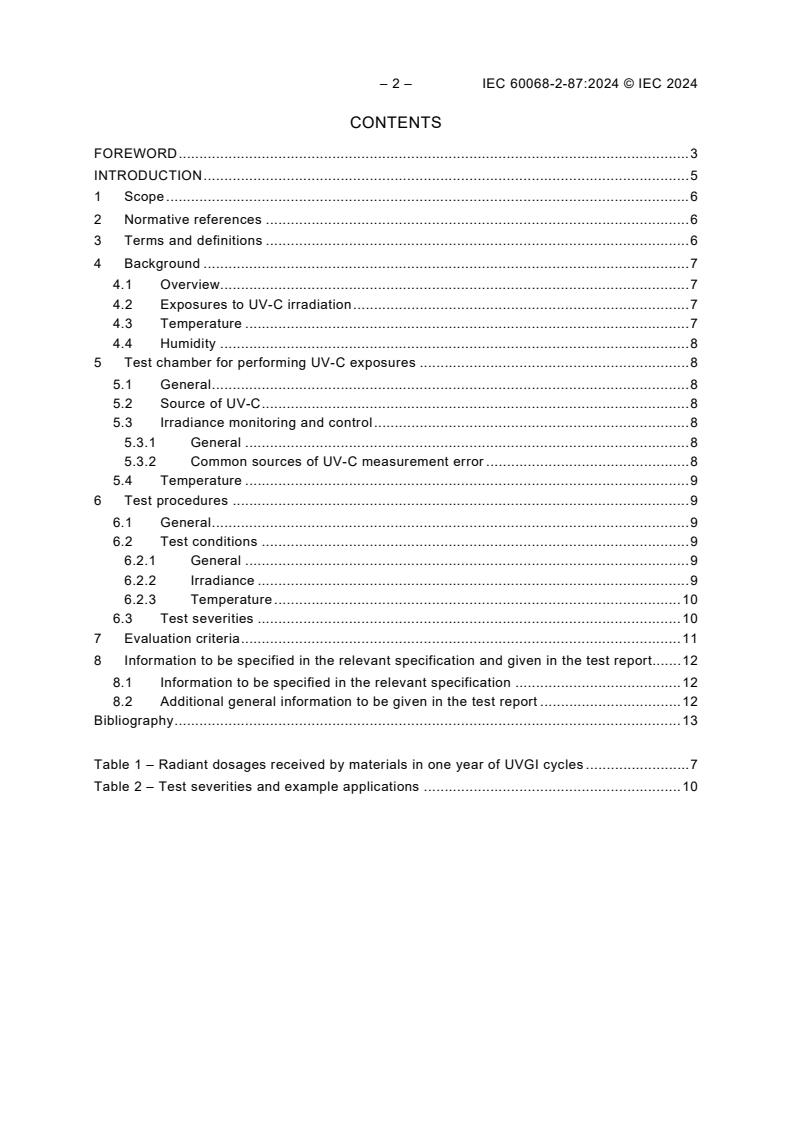
CONTENTS
FOREWORD . 3
INTRODUCTION . 5
1 Scope . 6
2 Normative references . 6
3 Terms and definitions . 6
4 Background . 7
4.1 Overview. 7
4.2 Exposures to UV-C irradiation . 7
4.3 Temperature . 7
4.4 Humidity . 8
5 Test chamber for performing UV-C exposures . 8
5.1 General . 8
5.2 Source of UV-C . 8
5.3 Irradiance monitoring and control . 8
5.3.1 General . 8
5.3.2 Common sources of UV-C measurement error . 8
5.4 Temperature . 9
6 Test procedures . 9
6.1 General . 9
6.2 Test conditions . 9
6.2.1 General . 9
6.2.2 Irradiance . 9
6.2.3 Temperature . 10
6.3 Test severities . 10
7 Evaluation criteria . 11
8 Information to be specified in the relevant specification and given in the test report. 12
8.1 Information to be specified in the relevant specification . 12
8.2 Additional general information to be given in the test report . 12
Bibliography . 13
Table 1 – Radiant dosages received by materials in one year of UVGI cycles . 7
Table 2 – Test severities and example applications . 10
INTERNATIONAL ELECTROTECHNICAL COMMISSION
____________
ENVIRONMENTAL TESTING –
Part 2-87: Tests – UV-C exposure of materials and components to
simulate ultraviolet germicidal irradiation or other applications
FOREWORD
1) The International Electrotechnical Commission (IEC) is a worldwide organization for standardization comprising
all national electrotechnical committees (IEC National Committees). The object of IEC is to promote international
co-operation on all questions concerning standardization in the electrical and electronic fields. To this end and
in addition to other activities, IEC publishes International Standards, Technical Specifications, Technical Reports,
Publicly Available Specifications (PAS) and Guides (hereafter referred to as "IEC Publication(s)"). Their
preparation is entrusted to technical committees; any IEC National Committee interested in the subject dealt with
may participate in this preparatory work. International, governmental and non-governmental organizations liaising
with the IEC also participate in this preparation. IEC collaborates closely with the International Organization for
Standardization (ISO) in accordance with conditions determined by agreement between the two organizations.
2) The formal decisions or agreements of IEC on technical matters express, as nearly as possible, an international
consensus of opinion on the relevant subjects since each technical committee has representation from all
interested IEC National Committees.
3) IEC Publications have the form of recommendations for international use and are accepted by IEC National
Committees in that sense. While all reasonable efforts are made to ensure that the technical content of IEC
Publications is accurate, IEC cannot be held responsible for the way in which they are used or for any
misinterpretation by any end user.
4) In order to promote international uniformity, IEC National Committees undertake to apply IEC Publications
transparently to the maximum extent possible in their national and regional publications. Any divergence between
any IEC Publication and the corresponding national or regional publication shall be clearly indicated in the latter.
5) IEC itself does not provide any attestation of conformity. Independent certification bodies provide conformity
assessment services and, in some areas, access to IEC marks of conformity. IEC is not responsible for any
services carried out by independent certification bodies.
6) All users should ensure that they have the latest edition of this publication.
7) No liability shall attach to IEC or its directors, employees, servants or agents including individual experts and
members of its technical committees and IEC National Committees for any personal injury, property damage or
other damage of any nature whatsoever, whether direct or indirect, or for costs (including legal fees) and
expenses arising out of the publication, use of, or reliance upon, this IEC Publication or any other IEC
Publications.
8) Attention is drawn to the Normative references cited in this publication. Use of the referenced publications is
indispensable for the correct application of this publication.
9) IEC draws attention to the possibility that the implementation of this document may involve the use of (a)
patent(s). IEC takes no position concerning the evidence, validity or applicability of any claimed patent rights in
respect thereof. As of the date of publication of this document, IEC had not received notice of (a) patent(s), which
may be required to implement this document. However, implementers are cautioned that this may not represent
the latest information, which may be obtained from the patent database available at https://patents.iec.ch. IEC
shall not be held responsible for identifying any or all such patent rights.
IEC 60068-2-87 has been prepared by IEC technical committee 104: Environmental conditions,
classification and methods of test. It is an International Standard.
The text of this International Standard is based on the following documents:
Draft Report on voting
104/1067/FDIS 104/1073/RVD
Full information on the voting for its approval can be found in the report on voting indicated in
the above table.
The language used for the development of this International Standard is English.
– 4 – IEC 60068-2-87:2024 © IEC 2024
This document was drafted in accordance with ISO/IEC Directives, Part 2, and developed in
accordance with ISO/IEC Directives, Part 1 and ISO/IEC Directives, IEC Supplement, available
at www.iec.ch/members_experts/refdocs. The main document types developed by IEC are
described in greater detail at www.iec.ch/publications.
A list of all parts in the IEC 60068 series, published under the general title Environmental
testing, can be found on the IEC website.
The committee has decided that the contents of this document will remain unchanged until the
stability date indicated on the IEC website under webstore.iec.ch in the data related to the
specific document. At this date, the document will be
• reconfirmed,
• withdrawn, or
• revised.
INTRODUCTION
UV-C radiation (with wavelength ranging from 100 nm to 280 nm) emitted by the sun is known
to destroy DNA and RNA in living cells, but it is filtered entirely by the atmosphere, so that none
reaches Earth's surface. Because of its effects on cells, artificial light sources that emit UV-C
radiation are used to kill or deactivate pathogens in air, water, and on material surfaces, a
process known as ultra-violet germicidal irradiation (UVGI). Although UVGI systems for
disinfection of water have been in use for decades, the technology's use on surfaces and in air
has become common more recently and has accelerated in response to the COVID-19
pandemic.
UV-C radiation is potentially harmful to polymers, textiles, and other materials. Consequently,
UVGI treatments can degrade material properties, especially when frequently performed.
The test procedure set out in this document is intended as a standardized method of evaluating
the effects of UVGI on either samples of material or components, subsystems or complete
systems of electrical equipment.
The severities are listed in order from lowest to highest expected UV-C radiation dose. A low
severity environment represents materials exposed to UVGI treatments infrequently. Higher
severity environments represent materials with more frequent exposures, including materials
used within a UVGI system's components.
The majority of UVGI systems in use rely on low pressure mercury lamps, which emit most of
their output at a single wavelength of 254 nm. This type of lamp is available in several power
levels and in many physical configurations, but the spectral output is the same regardless of
these factors. Other light sources are used in some UVGI systems, including excimer lamps
with output at 222 nm and LEDs with output at 265 nm.
This document will be limited to applications using low pressure mercury lamps because the
technology is very well known and commercial testing equipment using it is available.
– 6 – IEC 60068-2-87:2024 © IEC 2024
ENVIRONMENTAL TESTING –
Part 2-87: Tests – UV-C exposure of materials and components to
simulate ultraviolet germicidal irradiation or other applications
1 Scope
This part of IEC 60068 describes exposures of materials and components to UV-C radiation
during ultraviolet germicidal irradiation (UVGI) treatments or other processes that require UV-C
exposure and test procedures to simulate those environments. Severities representing various
frequencies and intensities of UV-C exposures are described. Test conditions are described
and limited to devices that utilize low pressure mercury lamps which emit most of their radiation
at a single spectral line at 254 nm.
NOTE A more precise characterization of the wavelength of the spectral line is 253,7 nm. The ability for a laboratory
to determine the wavelength to this resolution is rare. Therefore, this spectral line is often quantified to the resolution
of 1 nm.
2 Normative references
The following documents are referred to in the text in such a way that some or all of their content
constitutes requirements of this document. For dated references, only the edition cited applies.
For undated references, the latest edition of the referenced document (including any
amendments) applies.
ISO 4892-1, Plastics – Methods of exposure to laboratory light sources – Part 1: General
guidance
ISO 9370:2017, Plastics – Instrumental determination of radiant exposure in weathering tests
– General guidance and basic test method
ASTM G130, Standard Test Method for Calibration of Narrow and Broad-Band Ultraviolet
Radiometers Using a Spectroradiometer
3 Terms and definitions
For the purposes of this document, the following terms and definitions apply.
ISO and IEC maintain terminology databases for use in standardization at the following
addresses:
• IEC Electropedia: available at https://www.electropedia.org/
• ISO Online browsing platform: available at https://www.iso.org/obp
3.1
low pressure mercury lamp
discharge lamp of the mercury vapour type, with or without a coating of phosphors, in which
during operation, the partial pressure of the vapour does not exceed 100 Pa
Note 1 to entry: For the purposes of this document, low pressure mercury lamps do not contain any phosphors.
3.2
UV-C
ultraviolet C
electromagnetic radiation in the wavelength range of 100 nm to 280 nm, which is completely
filtered by the atmosphere before reaching Earth's surface
4 Background
4.1 Overview
Ultraviolet C radiation is effective in deactivating, or killing, pathogens in air and water or on
surfaces. Germicidal effectiveness curves are published which show peak effectiveness at
265 nm. Low pressure mercury lamps, without a coating of phosphors, emit most of their
irradiance at a single wavelength of 254 nm. The proximity of this spectral line to the peak of
the germicidal effectiveness curve has resulted in wide deployment of this lamp type in
commercial ultraviolet germicidal irradiance (UVGI) systems. During UVGI exposures,
irradiance in the UV-C region can degrade non-metallic materials including paints, plastics, and
textiles.
4.2 Exposures to UV-C irradiation
Literature describes UV-C dose levels required to deactivate specific pathogens. In addition,
different levels of disinfection are defined for various applications, with the highest levels called
sterilization. Defining the service environment of materials exposed to repeated UVGI
exposures requires knowledge of the target disinfection level, UV-C dose required to deactivate
the target pathogen(s) and expected frequency of UVGI exposures. In addition, in some
situations, UV-C exposures are continuous or nearly so, which results in significantly higher
UV-C dose levels. Table 1 represents four UV-C radiant dose levels for different UVGI
requirements and the total annual dose level experienced by a material or component for
weekly, daily, or eight UVGI cycles per day. In addition, a fixed dose is included as specified
by IEC 60335-1:2020, Annex T.
Table 1 – Radiant dosages received by materials in one year of UVGI cycles
Frequency of UV-C exposures
and resulting annual radiant
Target UV-C dose
Application
doses (J/cm )
(per UVGI cycle)
Weekly Daily 8 × per day
20 mJ/cm Materials exposed to UVGI in non-medical settings 1,0 7,3 58,4
80 mJ/cm Materials exposed to UVGI in medical settings 4,2 29,2 234
Materials exposed to whole room UVGI systems, average 13 91 730
250 mJ/cm
Disinfection of medical devices and personal protective
1 J/cm equipment (PPE) by UVGI; materials exposed to whole 52 365 2 920
room UVGI, typical maximum
Safety of electrical insulation in UVC devices or Dose fixed
3,6 kJ/cm
frequently exposed to UVC, IEC 60335-1:2020, Annex T 3 600
4.3 Temperature
UVGI exposures occur mostly in indoor environments where the temperature is controlled. In
other instances, exposures can occur outdoors or inside of vehicles where temperatures can
be elevated. Specimen tests should consider the service environment where UV-C exposures
occur.
– 8 – IEC 60068-2-87:2024 © IEC 2024
4.4 Humidity
Relative humidity is not typically factored into UVGI exposures. Theoretically, very high relative
humidity can attenuate the amount of UV-C radiation reaching a surface, due to the absorption
of photons by water vapour. For specimen testing, humidity should not be added by the test
chamber.
5 Test chamber for performing UV-C exposures
5.1 General
Test chambers shall be constructed of materials capable of withstanding the exposure
conditions. Chambers that conform to ISO 4892-3 requirements are suitable, provided they are
equipped with the proper lamp as described in 5.2. Moisture functions described in ISO 4892-3
are not necessary to perform tests described in this document. Other chamber designs are
possible provided they meet the specific requirements.
For safety reasons, the chamber shall be designed so that operators are shielded from UV-C
irradiance during testing and maintenance.
NOTE Some commercially available test apparatus designed for ISO 4892-3 have been adapted to perform UV-C
exposures of materials.
WARNING UV-C irradiance causes inflammation of the eyes and sunburn of skin. See CIE Technical Report 187
for information on health and safety concerns related to exposure to UV-C lamps.
5.2 Source of UV-C
The light source shall be one or more low pressure mercury lamps without a phosphor coating,
designed so that ozone is not produced. Approximately 90 % of the irradiance of this lamp type
is concentrated in a single spectral line at 254 nm.
NOTE Ozone is produced when UV-C wavelengths dissociate oxygen molecules, some of which recombine into
ozone. Longer wavelength UV-C (250 nm to 280 nm) essentially reverses this process. Low pressure mercury lamps
can produce, in addition to the 254 nm spectral line, a spectral line in the UV-C band at 185 nm, which produces
ozone molecules faster than they are consumed by the 254 nm line. However, the 185 nm line is blocked by certain
glass types so that there is no net ozone produced by the lamp.
5.3 Irradiance monitoring and control
5.3.1 General
Irradiance at wavelength 254 nm shall be measured and should preferably be controlled during
the exposure. At a minimum, irradiance shall be measured and adjusted before the exposure,
after approximately half of the intended exposure duration, and at the conclusion of the
exposure, or as described in the relevant specification. Continuous irradiance control as
described in ISO 4892-1 and ISO 4892-3 is preferred.
5.3.2 Common sources of UV-C measurement error
5.3.2.1 General
Two common sources of UV irradiance measurement error are spectral mismatch between the
light source used during calibration and that being measured, and deviation from true cosine
response.
NOTE In a study of commercially available UV-C radiometers conducted by the National Institute of Standards and
Technology (NIST), several devices demonstrated significantly lower readings than the reference measurements.
One device measured approximately one-third of the actual value. The report concludes that poor cosine response
was the primary reason for the errors. However, spectral mismatch between the detector sensitivity and calibration
source versus the measured source has been shown to be a common problem.
5.3.2.2 Spectral mismatch errors
Spectral mismatch issues are discussed in CIE 220 and ASTM G130. UV-C radiometers used
to measure irradiance shall be calibrated to measure the 254 nm spectral line emitted by low
pressure mercury lamps in accordance with ASTM G130 or an equivalent procedure.
5.3.2.3 Deviation from true cosine response
Errors caused by deviation from true cosine responses can be very significant when the
distance between the specimen plane and lamp is smaller than the length of the light source.
Irradiance sensors shall comply with the requirements for cosine response in ISO 9370:2017,
Table 2.
NOTE In the case of many chambers designed for ISO 4892-3, the distance between the specimen plane and lamps
is typically less than 10 % of the lamp length.
5.4 Temperature
Temperature shall be measured and controlled in accordance with ISO 4892-1 by a black panel
thermometer. Alternative means of temperature control, such as an insulated black panel or
black standard thermometer may be used when specified by the relevant specification.
NOTE Black panel thermometers as described in ISO 4892-1 are not insulated, while black standard thermometers
are. Black standard thermometers have a very specific construction and are not typically used in chambers designed
for ISO 4892-3 tests. By adding insulation to a black panel thermometer, the resulting measurement is very similar
to a black standard thermometer, however.
6 Test procedures
6.1 General
Specimens are exposed to a UV-C radiant dose equal to that expected during the service life
of a component or material, or a significant portion of the service life. After exposure, and, when
specified, at intermediate intervals during the test, specimens are evaluated to determine their
change in relevant properties (Clause 7).
6.2 Test conditions
6.2.1 General
Table 2 describes test conditions representing a range of exposure severities. Each test
duration represents the nominal UV-C dose during one year of service life, with a minimum total
dose.
The maximum allowable operational fluctuations, which are defined as the positive and negative
deviations from the setting of the sensor at the operational control set point during equilibrium
.
conditions, shall be for black panel temperature ±2 °C and irradiance ±0,1 mW/cm
6.2.2 Irradiance
6.2.2.1 General
Irradiance levels in Table 2 are intended to provide a balance between achieving realistic
simulation of operating conditions and minimizing test durations for the most demanding
applications. Any deviations from the specified conditions shall be indicated in the test report.
– 10 – IEC 60068-2-87:2024 © IEC 2024
6.2.2.2 Testing at higher irradiance levels to shorten the test period
Reciprocity law shall not be assumed when performing tests to this document. Testing at higher
irradiance levels to achieve the required dose in less time may be conducted if the material
being tested has shown that it performs very similarly at both irradiance levels through a
reciprocity study.
NOTE Reciprocity law, also known as the Bunsen-Roscoe law, states that a given radiant dose can be delivered at
different rates and achieve the same level of material degradation. However, this law generally holds only over a
limited range of exposure durations and can break down due to several reasons.
See IEC 60050-845:2020, 845-26-081.
6.2.2.3 Testing at lower irradiance levels for a longer duration
Testing at lower irradiance levels for a longer time period to achieve the required dose is
acceptable.
NOTE The risk of a breakdown in reciprocity law is acceptable in the case of testing at a lower irradiance level than
listed in Table 2 because such a breakdown is most likely to result in more material degradation than from the shorter
exposure at higher irradiance.
6.2.2.4 Cycling with periods of darkness
Use of cycles which alternate periods of darkness may be used, as long as the time of darkness
is added to the total duration.
NOTE Alternating periods of darkness can produce a different result than continuous exposure. Some materials
can experience a relaxation effect when no longer exposed to irradiance.
6.2.3 Temperature
Except as noted, two temperature settings are given for each severity in Table 2: 35 °C and
60 °C. Testing at 35 °C is preferred due to conditions during most UVGI cycles, unless the
service environment is known to experience elevated temperatures.
6.3 Test severities
Table 2 lists test severities and example applications. It is possible that test severity numbering
will not completely align with results when tests are performed at different temperatures.
NOTE For some temperature sensitive materials, it is possible that the hotter test in a test severity designated with
"a" will produce more degradation than a higher numbered severity without the "a" designation, which runs at a lower
temperature.
Table 2 – Test severities and example applications
Test Irradiance at Black panel Test Resulting Example applications
severity 254 nm temperature duration UV-C dose
2 2
°C h
mW/(cm nm) J/cm
1 35 Annual exposure by hand-held device
in non-medical personal care setting,
1,0 16 57,6
where multiple UVGI cycles are
1a 60
performed per day
2 35 Annual exposure to UVGI in a medical
1,0 72 259 setting where multiple UVGI cycles
2a 60
are performed per day
3 35 Devices exposed to whole room UVGI
1,0 144 518 systems at least daily, average
3a 60
irradiance
4 35
Medical devices disinfected by UVGI
3,0 100 1 080
at least daily
4a 60
5 3,0 35 200 2 160
Test Irradiance at Black panel Test Resulting Example applications
severity 254 nm temperature duration UV-C dose
2 2
°C h
mW/(cm nm) J/cm
Durable items exposed to whole room
5a 60 UVGI systems at least daily for
multiple years
Safety of electrical insulation exposed
6 1,0 63 1 000 3 600
to UVC, IEC 60335-1:2020, Annex T
7 35 Durable items exposed to whole room
6,0 240 5 184 UVGI cycles for multiple years, typical
7a 60
maximum irradiance
8 35
Materials used within a UVGI device
6,0 1 000 21 600
or other extreme applications
8a 60
NOTE Severities 1, 2, and 3 test conditions correspond to Cycle 5 of ASTM G224. Severity 6 conditions
correspond to Cycle 4 of ASTM G224. Severity 7 and 8 correspond to Cycle 1 of ASTM G224.
7 Evaluation criteria
The relevant specification shall set out the required evaluation and inspection procedure to be
utilized, including initial, intermediate, and post-exposure evaluations. Some common
properties for evaluation include colour change, gloss change, contact angle, light
transmittance, and physical changes such as impact or flexural strength.
Standard methods for post-exposure evaluation of plastics (ISO technical committee 61) or
coatings (ISO technical committee 35) or both are listed below. See the bibliography for
complete document titles.
• ISO 178 (flexural properties);
• ISO 179-1 and ISO 179-2 (impact);
• ISO 2813 (gloss – instrumental);
• ISO 3668 (colour – visual);
• ISO 4628-4 (cracking);
• ISO 4628-5 (flaking);
• ISO 4628-6 (chalking – tape);
• ISO 4628-7 (chalking – velvet);
• ISO 11664-4 (colour – instrumental);
• ISO 13468-1 and ISO 13468-2 (transmittance of transparent materials);
• ISO 14782 (haze);
• ISO 26723 (transmittance and reflectance).
For textiles, suitable methods can be found in ISO 105-A02 (colour – grey scale), ISO 105-A05
(colour – instrumental), and other standards published by ISO technical committee 38.
– 12 – IEC 60068-2-87:2024 © IEC 2024
8 Information to be specified in the relevant specification and given in the test
report
8.1 Information to be specified in the relevant specification
The relevant specification shall contain the following details, if applicable:
a) test method or severity number, if applicable;
b) required values (temperature, irradiance, etc.);
c) test duration;
d) failure criteria.
8.2 Additional general information to be given in the test report
When this test is included in the relevant specification, the following details shall be given in
the test report, if applicable:
a) test standard (IEC 60068-2-87);
b) test laboratory (name and address and details of accreditation, if any);
c) test dates (dates when test was started and completed);
d) customer (name and address);
e) test specimen(s) description;
f) test apparatus (manufacturer, model number, unique identifier, etc);
g) calibration data (instrument type and model, last and next due date);
h) summary of test;
i) initial, intermediate, and final measurements.
Bibliography
IEC 60050-845:2020, International Electrotechnical Vocabulary (IEV) – Part 845: Lighting,
available at https://www.electropedia.org/
IEC 60335-1:2020, Household and similar electrical appliances – Safety – Part 1: General
requirements
IEC 62471, Photobiological safety of lamps and lamp systems
ISO 105-A02, Textiles – Tests for colour fastness – Part A02: Grey scale for assessing change
in colour
ISO 105-A05, Textiles – Tests for colour fastness – Part A05: Instrumental assessment of
change in colour for determination of grey scale rating
ISO 4892-3, Plastics – Methods of exposure to laboratory light sources – Part 3: Fluorescent
UV lamps
ISO 178, Plastics – Determination of flexural properties
ISO 179-1, Plastics – Determination of Charpy impact properties – Part 1: Non-instrumented
impact test
ISO 179-2, Plastics – Determination of Charpy impact properties – Part 2: Instrumented impact
test
ISO 2813, Paints and varnishes – Determination of gloss value at 20 degrees, 60 degrees and
85 degrees
ISO 3668, Paints and varnishes – Visual comparison of colour of paints
ISO 4628-4, Paints and varnishes – Evaluation of degradation of coatings – Designation of
quantity and size of defects, and of intensity of uniform changes in appearance – Part 4:
Assessment of degree of cracking
ISO 4628-5, Paints and varnishes – Evaluation of quantity and size of defects, and of intensity
of uniform changes in appearance – Part 5: Assessment of degree of flaking
ISO 4628-6, Paints and varnishes – Evaluation of quantity and size of defects, and of intensity
of uniform changes in appearance – Part 6: Assessment of degree of chalking by tape method
ISO 4628-7, Paints and varnishes – Evaluation of degradation of coatings – Designation of
quantity and size of defects, and of intensity of uniform changes in appearance – Part 7:
Assessment of degree of chalking by velvet method
ISO 4892-3, Plastics – Methods of exposure to laboratory light sources – Part 3: Fluorescent
UV lamps
ISO 11664-4, Colorimetry – Part 4: CIE 1976 L*a*b* Colour space
ISO 13468-1, Plastics – Determination of the total luminous transmittance of transparent
materials – Part 1: Single-beam instrument
ISO 13468-2, Plastics – Determination of the total luminous transmittance of transparent
materials – Part 2: Double-beam instrument
– 14 – IEC 60068-2-87:2024 © IEC 2024
ISO 14782, Plastics – Determination of haze for transparent materials
ISO 26723, Plastics – Determination of total luminous transmittance and reflectance
ASTM G224, Standard Practice for Operating UVC Lamp Apparatus for Exposure of Materials
BIFMA HCF 8.1:2019, Health Care Furniture Design Guidelines for Cleanability. Business +
Institutional Furniture Manufacturers Association. (2019). Grand Rapids, MI, USA
CIE Technical Report 187:2010, UV-C Photocarcinogenesis Risks from Germicidal Lamps
CIE 220, Characterization and calibration methods of UV radiometers
KOWALSKI, W. Ultraviolet Germicidal Irradiation Handbook. Springer Berlin, Heidelberg. 2009
LINDBLAD, M., TANO, E., LINDAHL, C., & HUSS, F. Ultraviolet-C decontamination of a hospital
room: Amount of UV light needed. Burns.2020;46, 842-849
MILLER, C. Cameron. UVC Measurement Methods & UVC Documentary Standard
Development, NIST, Sensor Science Division [viewed 2024-01-08]. Available at
https://www.energy.gov/sites/default/files/2022-02/ssl-rd22_miller_guv.pdf
MILLS, D., HARNISH, D. A., LAWRENCE, C., SANDOVAL-POWERS, M., & HEIMBUCH, B. K.
Ultraviolet germicidal irradiation of influenza-contaminated N95. American Journal of Infection
Control. 2018, 46(7), e49-e55
___________
– 16 – IEC 60068-2-87:2024 © IEC 2024
SOMMAIRE
AVANT-PROPOS . 17
INTRODUCTION . 19
1 Domaine d'application . 20
2 Références normatives . 20
3 Termes et définitions . 20
4 Contexte . 21
4.1 Vue d'ensemble . 21
4.2 Expositions aux rayonnements UV-C . 21
4.3 Température . 22
4.4 Humidité . 22
5 Chambre d'essai pour la réalisation des expositions aux UV-C . 22
5.1 Généralités . 22
5.2 Source d'UV-C . 23
5.3 Surveillance et contrôle de l'éclairement énergétique . 23
5.3.1 Généralités . 23
5.3.2 Sources courantes d'erreur de mesure des UV-C. 23
5.4 Température . 24
6 Procédures d'essai . 24
6.1 Généralités . 24
6.2 Conditions d'essai . 24
6.2.1 Généralités . 24
6.2.2 Éclairement énergétique . 24
6.2.3 Température . 25
6.3 Sévérités d'essai . 25
7 Critères d'évaluation . 26
8 Renseignements à spécifier dans la spécification pertinente et à fournir dans le
rapport d'essai . 27
8.1 Renseignements à spécifier dans la spécification pertinente . 27
8.2 Renseignements généraux supplémentaires à fournir dans le rapport d'essai . 27
Bibliographie . 28
Tableau 1 – Doses de rayonnement reçues par les matériaux sur une année de cycles
UVGI . 22
Tableau 2 – Sévérités d'essai et exemples d'applications . 25
COMMISSION ÉLECTROTECHNIQUE INTERNATIONALE
____________
ESSAIS D'ENVIRONNEMENT –
Partie 2-87: Essais – Exposition des matériaux et composants
aux UV-C pour simuler l'irradiation germicide aux ultraviolets
ou d'autres applications
AVANT-PROPOS
1) La Commission Électrotechnique Internationale (IEC) est une organisation mondiale de normalisation composée
de l'ensemble des comités électrotechniques nationaux (Comités nationaux de l'IEC). L'IEC a pour objet de
favoriser la coopération internationale pour toutes les questions de normalisation dans les domaines de
l'électricité et de l'électronique. À cet effet, l'IEC – entre autres activités – publie des Normes internationales,
des Spécifications techniques, des Rapports techniques, des Spécifications accessibles au public (PAS) et des
Guides (ci-après dénommés "Publication(s) de l'IEC"). Leur élaboration est confiée à des comités d'études, aux
travaux desquels tout Comité national intéressé par le sujet traité peut participer. Les organisations
internationales, gouvernementales et non gouvernementales, en liaison avec l'IEC, participent également aux
travaux. L'IEC collabore étroitement avec l'Organisation Internationale de Normalisation (ISO), selon des
conditions fixées par accord entre les deux organisations.
2) Les décisions ou accords officiels de l'IEC concernant les questions techniques représentent, dans la mesure du
possible, un accord international sur les sujets étudiés, étant donné que les Comités nationaux de l'IEC intéressés
sont représentés dans chaque comité d'études.
3) Les Publications de l'IEC se présentent sous la forme de recommandations inte
...