


IEC 62402:2007
(Main)Obsolescence management - Application guide
Obsolescence management - Application guide
This International Standard gives guidance for establishing a framework for obsolescence management and for planning a cost-effective obsolescence management process that is applicable through all phases of the product life cycle.
Gestion de l'obsolescence - Guide d'application
La présente Norme internationale donne des indications pour établir un cadre pour la gestion de l'obsolescence et pour planifier un processus de gestion de l'obsolescence efficace applicable à toutes les phases du cycle de vie du produit.
General Information
- Status
- Published
- Publication Date
- 13-Jun-2007
- Technical Committee
- TC 56 - Dependability
- Current Stage
- DELPUB - Deleted Publication
- Start Date
- 29-May-2019
- Completion Date
- 30-Dec-2016
Relations
- Effective Date
- 05-Sep-2023
Overview
IEC 62402:2007 - Obsolescence Management: Application Guide, published by the International Electrotechnical Commission (IEC), provides comprehensive guidance for organizations on establishing effective obsolescence management frameworks. This standard is applicable to all product types-capital equipment, infrastructure, consumer durables, consumables, and software-across all stages of the product life cycle. By integrating obsolescence management into design, development, production, and support, organizations can reduce disruptions, minimize costs, and enhance product dependability and availability.
Obsolescence affects products when they no longer meet users’ needs or are no longer available from their original manufacturers, often introducing challenges in supply continuity and performance. With the rapid advancement of technology and shortening component life cycles, a proactive, systematic approach to obsolescence management is critical for reducing negative business impact.
Key Topics
Obsolescence Management Framework:
- Guidance on establishing and maintaining a cost-effective obsolescence management process.
- Integration with dependability and risk management practices.
- Responsibilities and roles for management and technical staff in obsolescence planning and mitigation.
Process and Planning:
- Principles for lifecycle-based planning, addressing obsolescence at design, development, operation, and disposal stages.
- Development of an obsolescence management plan, including proactive and reactive strategies.
- Communication pathways with customers, suppliers, and stakeholders.
Strategies and Options:
- Techniques for identifying, monitoring, and treating potential obsolescence risks.
- Exploring approaches for both hardware and software, such as lifetime buys, design considerations, and planned upgrades.
- Selective use of “reactive” and “proactive” methods, depending on business needs and product criticality.
Resource Allocation and Documentation:
- Ensuring adequate human, financial, and informational resources for successful execution.
- Documentation of policies, processes, and communication protocols for consistent implementation.
- Regular management reviews to assess strategy effectiveness.
Applications
IEC 62402:2007 is valuable for a broad range of industries, including aerospace, defense, manufacturing, critical infrastructure, and IT systems-any organization facing risks associated with unavailable or obsolete components, materials, or software.
Typical applications include:
Product Design and Development
- Integrating obsolescence management into the design phase to forecast and mitigate future risks.
- Selecting materials and components with known long-term support and availability.
Lifecycle Support and Maintenance
- Supporting legacy products with planned replacements or upgrades.
- Managing commercial-off-the-shelf (COTS) integration and the associated lifecycle challenges.
Supply Chain Management
- Coordinating with original component manufacturers (OCM), original equipment manufacturers (OEM), and suppliers to receive timely product change notifications and obsolescence alerts.
- Managing contracts and regulatory obligations affected by obsolescence/deliveries.
Software Management
- Addressing unique challenges of software obsolescence, especially for products with long service lives or regulatory requirements.
- Implementing proactive upgrade paths and support plans.
Related Standards
Obsolescence management is interconnected with several international standards that provide additional guidance and requirements:
- IEC 60050-191: International Electrotechnical Vocabulary – Dependability and quality of service
- IEC 60300-1 & IEC 60300-2: Dependability management systems and guidelines
- IEC 62198: Project risk management – Application guidelines
- IEC/TS 62239: Electronic components management plan for avionics
- IEC 62258: Semiconductor die products
- IEC 62309: Dependability of products containing reused parts
Adopting IEC 62402:2007 alongside these related standards ensures a holistic, resilient approach to obsolescence and dependability management, aligning with best practices and international expectations.
Keywords: IEC 62402:2007, obsolescence management, lifecycle management, proactive strategies, product support, dependability, risk management, supply chain, electronic components, COTS, product availability, component obsolescence, management plan.
Frequently Asked Questions
IEC 62402:2007 is a standard published by the International Electrotechnical Commission (IEC). Its full title is "Obsolescence management - Application guide". This standard covers: This International Standard gives guidance for establishing a framework for obsolescence management and for planning a cost-effective obsolescence management process that is applicable through all phases of the product life cycle.
This International Standard gives guidance for establishing a framework for obsolescence management and for planning a cost-effective obsolescence management process that is applicable through all phases of the product life cycle.
IEC 62402:2007 is classified under the following ICS (International Classification for Standards) categories: 21.020 - Characteristics and design of machines, apparatus, equipment. The ICS classification helps identify the subject area and facilitates finding related standards.
IEC 62402:2007 has the following relationships with other standards: It is inter standard links to IEC 62402:2019. Understanding these relationships helps ensure you are using the most current and applicable version of the standard.
IEC 62402:2007 is available in PDF format for immediate download after purchase. The document can be added to your cart and obtained through the secure checkout process. Digital delivery ensures instant access to the complete standard document.
Standards Content (Sample)
INTERNATIONAL IEC
STANDARD
CEI
NORME
First edition
INTERNATIONALE
Première édition
2007-06
Obsolescence management –
Application guide
Gestion de l’obsolescence –
Guide d’application
Reference number
Numéro de référence
IEC/CEI 62402:2007
All rights reserved. Unless otherwise specified, no part of this publication may be reproduced or utilized in any form
or by any means, electronic or mechanical, including photocopying and microfilm, without permission in writing from
either IEC or IEC's member National Committee in the country of the requester.
If you have any questions about IEC copyright or have an enquiry about obtaining additional rights to this publication,
please contact the address below or your local IEC member National Committee for further information.
Droits de reproduction réservés. Sauf indication contraire, aucune partie de cette publication ne peut être reproduite
ni utilisée sous quelque forme que ce soit et par aucun procédé, électronique ou mécanique, y compris la photocopie
et les microfilms, sans l'accord écrit de la CEI ou du Comité national de la CEI du pays du demandeur.
Si vous avez des questions sur le copyright de la CEI ou si vous désirez obtenir des droits supplémentaires sur cette
publication, utilisez les coordonnées ci-après ou contactez le Comité national de la CEI de votre pays de résidence.
IEC Central Office
3, rue de Varembé
CH-1211 Geneva 20
Switzerland
Email: inmail@iec.ch
Web: www.iec.ch
About the IEC
The International Electrotechnical Commission (IEC) is the leading global organization that prepares and publishes
International Standards for all electrical, electronic and related technologies.
About IEC publications
The technical content of IEC publications is kept under constant review by the IEC. Please make sure that you have the
latest edition, a corrigenda or an amendment might have been published.
ƒ Catalogue of IEC publications: www.iec.ch/searchpub
The IEC on-line Catalogue enables you to search by a variety of criteria (reference number, text, technical committee,…).
It also gives information on projects, withdrawn and replaced publications.
ƒ IEC Just Published: www.iec.ch/online_news/justpub
Stay up to date on all new IEC publications. Just Published details twice a month all new publications released. Available
on-line and also by email.
ƒ Customer Service Centre: www.iec.ch/webstore/custserv
If you wish to give us your feedback on this publication or need further assistance, please visit the Customer Service
Centre FAQ or contact us:
Email: csc@iec.ch
Tel.: +41 22 919 02 11
Fax: +41 22 919 03 00
A propos de la CEI
La Commission Electrotechnique Internationale (CEI) est la première organisation mondiale qui élabore et publie des
normes internationales pour tout ce qui a trait à l'électricité, à l'électronique et aux technologies apparentées.
A propos des publications CEI
Le contenu technique des publications de la CEI est constamment revu. Veuillez vous assurer que vous possédez
l’édition la plus récente, un corrigendum ou amendement peut avoir été publié.
ƒ Catalogue des publications de la CEI: www.iec.ch/searchpub/cur_fut-f.htm
Le Catalogue en-ligne de la CEI vous permet d’effectuer des recherches en utilisant différents critères (numéro de
référence, texte, comité d’études,…). Il donne aussi des informations sur les projets et les publications retirées ou
remplacées.
ƒ Just Published CEI: www.iec.ch/online_news/justpub
Restez informé sur les nouvelles publications de la CEI. Just Published détaille deux fois par mois les nouvelles
publications parues. Disponible en-ligne et aussi par email.
ƒ Service Clients: www.iec.ch/webstore/custserv/custserv_entry-f.htm
Si vous désirez nous donner des commentaires sur cette publication ou si vous avez des questions, visitez le FAQ du
Service clients ou contactez-nous:
Email: csc@iec.ch
Tél.: +41 22 919 02 11
Fax: +41 22 919 03 00
INTERNATIONAL IEC
STANDARD
CEI
NORME
First edition
INTERNATIONALE
Première édition
2007-06
Obsolescence management –
Application guide
Gestion de l’obsolescence –
Guide d’application
PRICE CODE
W
CODE PRIX
Commission Electrotechnique Internationale
International Electrotechnical Commission
МеждународнаяЭлектротехническаяКомиссия
For price, see current catalogue
Pour prix, voir catalogue en vigueur
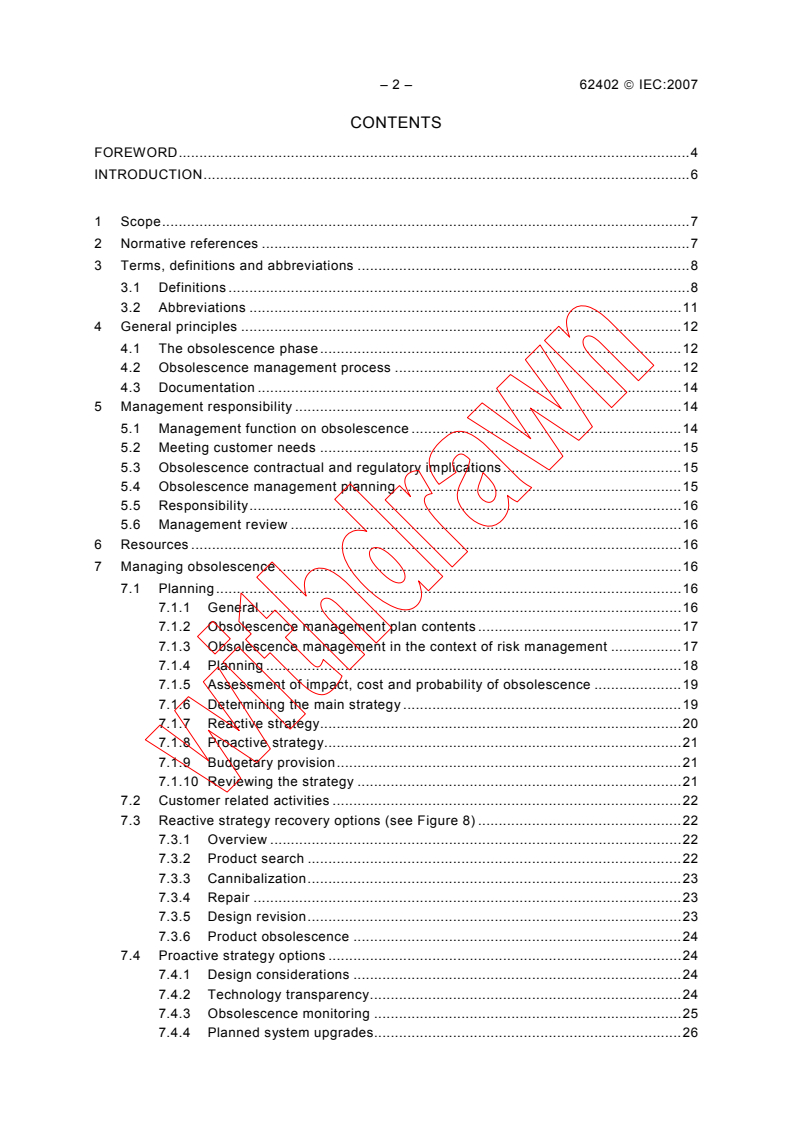
– 2 – 62402 © IEC:2007
CONTENTS
FOREWORD.4
INTRODUCTION.6
1 Scope.7
2 Normative references .7
3 Terms, definitions and abbreviations .8
3.1 Definitions .8
3.2 Abbreviations .11
4 General principles .12
4.1 The obsolescence phase.12
4.2 Obsolescence management process .12
4.3 Documentation .14
5 Management responsibility .14
5.1 Management function on obsolescence .14
5.2 Meeting customer needs .15
5.3 Obsolescence contractual and regulatory implications.15
5.4 Obsolescence management planning .15
5.5 Responsibility.16
5.6 Management review .16
6 Resources .16
7 Managing obsolescence .16
7.1 Planning.16
7.1.1 General .16
7.1.2 Obsolescence management plan contents .17
7.1.3 Obsolescence management in the context of risk management .17
7.1.4 Planning .18
7.1.5 Assessment of impact, cost and probability of obsolescence .19
7.1.6 Determining the main strategy .19
7.1.7 Reactive strategy.20
7.1.8 Proactive strategy.21
7.1.9 Budgetary provision.21
7.1.10 Reviewing the strategy .21
7.2 Customer related activities .22
7.3 Reactive strategy recovery options (see Figure 8) .22
7.3.1 Overview .22
7.3.2 Product search .22
7.3.3 Cannibalization.23
7.3.4 Repair .23
7.3.5 Design revision.23
7.3.6 Product obsolescence .24
7.4 Proactive strategy options .24
7.4.1 Design considerations .24
7.4.2 Technology transparency.24
7.4.3 Obsolescence monitoring .25
7.4.4 Planned system upgrades.26
62402 © IEC:2007 – 3 –
7.4.5 Lifetime buy.26
7.4.6 Additional factors affecting the choice of obsolescence management
programme options.27
7.4.7 Skills training.27
7.5 Supply chain management .27
8 Measurement, analysis and improvement .27
9 Software obsolescence issues and strategies.28
9.1 Additional planning aspects for software.28
9.1.1 Software and hardware similarities and differences .28
9.1.2 Causes of software obsolescence.29
9.1.3 Determining the main strategy to combat software obsolescence .30
9.1.4 Reactive strategy – Do nothing until the need arises .31
9.1.5 Proactive strategy.31
9.2 Relationship between the customer and the supplier .32
9.3 Reactive strategy recovery options (see Figure 10) .32
9.3.1 Overview .32
9.3.2 Software search .32
9.3.3 Revision .32
9.3.4 Software obsolescence.33
9.4 Proactive strategy as applied to software separable from hardware (see
Figure 11) .33
9.4.1 Overview .33
9.4.2 Design considerations .33
9.4.3 Technology transparency/open systems .33
9.4.4 Contract support.34
9.4.5 Planned upgrades .34
9.4.6 Additional factors affecting choice of obsolescence management
programme options.34
Annex A (informative) Check list .36
Annex B (informative) Monitoring products.37
Bibliography.39
Figure 1 – Availability phases .12
Figure 2 – Process steps for managing obsolescence.13
Figure 3 – Obsolescence management versus product life cycle.13
Figure 4 – Relationship between OCM, OEM and the customer .14
Figure 5 – Process steps in project risk management versus obsolescence
management.18
Figure 6 – Reactive versus proactive strategy.20
Figure 7 – Proactive strategy .21
Figure 8 – Overview of reactive strategy recovery options .22
Figure 9 – Reactive versus proactive strategy in relation to software obsolescence .31
Figure 10 – Overview of recovery options .32
Figure 11 – Proactive options overview (software) .33
Figure B.1 – Simplified outline of monitoring of active electronic parts with suggested
solutions (see 7.4.3) .38
– 4 – 62402 © IEC:2007
INTERNATIONAL ELECTROTECHNICAL COMMISSION
____________
OBSOLESCENCE MANAGEMENT –
APPLICATION GUIDE
FOREWORD
1) The International Electrotechnical Commission (IEC) is a worldwide organization for standardization comprising
all national electrotechnical committees (IEC National Committees). The object of IEC is to promote
international co-operation on all questions concerning standardization in the electrical and electronic fields. To
this end and in addition to other activities, IEC publishes International Standards, Technical Specifications,
Technical Reports, Publicly Available Specifications (PAS) and Guides (hereafter referred to as “IEC
Publication(s)”). Their preparation is entrusted to technical committees; any IEC National Committee interested
in the subject dealt with may participate in this preparatory work. International, governmental and non-
governmental organizations liaising with the IEC also participate in this preparation. IEC collaborates closely
with the International Organization for Standardization (ISO) in accordance with conditions determined by
agreement between the two organizations.
2) The formal decisions or agreements of IEC on technical matters express, as nearly as possible, an international
consensus of opinion on the relevant subjects since each technical committee has representation from all
interested IEC National Committees.
3) IEC Publications have the form of recommendations for international use and are accepted by IEC National
Committees in that sense. While all reasonable efforts are made to ensure that the technical content of IEC
Publications is accurate, IEC cannot be held responsible for the way in which they are used or for any
misinterpretation by any end user.
4) In order to promote international uniformity, IEC National Committees undertake to apply IEC Publications
transparently to the maximum extent possible in their national and regional publications. Any divergence
between any IEC Publication and the corresponding national or regional publication shall be clearly indicated in
the latter.
5) IEC provides no marking procedure to indicate its approval and cannot be rendered responsible for any
equipment declared to be in conformity with an IEC Publication.
6) All users should ensure that they have the latest edition of this publication.
7) No liability shall attach to IEC or its directors, employees, servants or agents including individual experts and
members of its technical committees and IEC National Committees for any personal injury, property damage or
other damage of any nature whatsoever, whether direct or indirect, or for costs (including legal fees) and
expenses arising out of the publication, use of, or reliance upon, this IEC Publication or any other IEC
Publications.
8) Attention is drawn to the Normative references cited in this publication. Use of the referenced publications is
indispensable for the correct application of this publication.
9) Attention is drawn to the possibility that some of the elements of this IEC Publication may be the subject of
patent rights. IEC shall not be held responsible for identifying any or all such patent rights.
International Standard IEC 62402 has been prepared by IEC technical committee 56:
Dependability.
The text of this standard is based on the following documents:
FDIS Report on voting
56/1189/FDIS 56/1205/RVD
Full information on the voting for the approval of this standard can be found in the report on
voting indicated in the above table.
This publication has been drafted in accordance with the ISO/IEC Directives, Part 2.
62402 © IEC:2007 – 5 –
The committee has decided that the contents of this publication will remain unchanged until
the maintenance result date indicated on the IEC web site under "http://webstore.iec.ch" in
the data related to the specific publication. At this date, the publication will be
• reconfirmed;
• withdrawn;
• replaced by a revised edition, or
• amended.
– 6 – 62402 © IEC:2007
INTRODUCTION
Obsolescence affects all products and it impacts upon all stages of their life. The term
product includes
• capital equipment;
• infrastructure;
• consumer durables;
• consumables;
• software products.
Obsolescence is inevitable and it cannot be avoided, but forethought and careful planning can
minimize its impact and its potential high costs. The objective of obsolescence management
is to ensure that obsolescence is managed as an integral part of design, development,
production and in-service support in order to minimize cost and detrimental impact throughout
the product life cycle.
Obsolescence presents itself in two ways:
• the item is no longer suitable for current demands, or
• the item is no longer available from the original manufacturer, e.g. due to economic
constraints.
From the user's point of view, obsolescence then manifests itself as difficulty in obtaining
supplies. If the end-user is the general public, it will be in the interest of the supplier to protect
his brand image by having a defined obsolescence policy.
Commercial-off-the-shelf (COTS) products and custom designed items, e.g. new design tools
and new production processes, tend to have a much shorter life in terms of availability and
supportability than in the past. With the increased use of commercial items in complex
products expecting to have a long life cycle, it has become essential to include obsolescence
management within programme plans from the earliest stages. Furthermore environmental
considerations have the potential to affect the use of some materials during the life of the
product and should be considered from the outset.
Obsolescence management is essential to achieve optimum cost-effectiveness throughout the
life cycle of a product. The purpose of this standard is to provide guidance on planning a cost
effective obsolescence management process that takes into account essential factors to
ensure product life cycle costs are considered and applied. Obsolescence management
should also include the maintenance of the relevant knowledge and skill base sets.
Clause 4 provides overview of the process and its relation to others.
Clauses 5, 6 and 8 give guidance on management responsibility, resources, measurement
and improvement with regard to obsolescence management.
Clause 7 gives guidance on planning, strategies and options described for hardware
(including integral software).
Clause 9 gives guidance on planning, strategies and options for software that is separable
from its hardware.
62402 © IEC:2007 – 7 –
OBSOLESCENCE MANAGEMENT –
APPLICATION GUIDE
1 Scope
This International Standard gives guidance for establishing a framework for obsolescence
management and for planning a cost-effective obsolescence management process that is
applicable through all phases of the product life cycle, the term ‘product’ includes:
• capital equipment;
• infrastructure;
• consumer durables;
• consumables;
• software products.
Obsolescence management covers the following areas:
a) design of new products;
b) new technology insertion into existing products;
c) support and maintenance of legacy products.
2 Normative references
The following referenced documents are indispensable for the application of this document.
For dated references, only the edition cited applies. For undated references, the latest edition
of the referenced document (including any amendments) applies.
IEC 60050-191, International Electrotechnical Vocabulary (IEV) – Part 191: Dependability and
quality of service
IEC 60300-1, Dependability management – Part 1: Dependability management systems
IEC 60300-2:2004, Dependability management – Part 2: Guidelines for dependability
management
IEC 62198, Project risk management – Application guidelines
IEC/TS 62239, Process management for avionics – Preparation of an electronic components
management plan
IEC 62258 (all parts), Semiconductor die products
IEC 62309, Dependability of products containing reused parts – Requirements for functionality
and tests
– 8 – 62402 © IEC:2007
3 Terms, definitions and abbreviations
For the purposes of this document, the terms and definitions given in IEC 60050-191 and the
following apply.
3.1 Definitions
3.1.1
bench marking
testing and comparing similar products or processes
3.1.2
bridge buy
lifetime buy for a given period, e.g. during replacement product development
3.1.3
cannibalization
re-use of components and assemblies taken from products within the inventory to support
other products
3.1.4
commercial-off-the-shelf
COTS
conforming to the manufacturer’s data sheet and available to any purchaser
NOTE A single user is not able to influence the specification.
3.1.5
end of life
EOL
discontinuance of production by the original manufacturer
NOTE EOL should not be confused with ‘time to wear out’ or ‘end of use’.
3.1.6
hardware
physical components of a system including its associated data and documentation
3.1.7
infrastructure
facilities, plant and people who design, manufacture, operate and support the product
3.1.8
integrated logistic support
ILS
management method by which all the logistic support services required by a customer can be
brought together in a structured way and in harmony with a product
[IEC 60300-3-12:2001, Subclause 3.2]
62402 © IEC:2007 – 9 –
3.1.9
intellectual property rights
IPR
patents, designs (whether registered or not), registered trade marks, and copyright
NOTE These are rights defined and regulated by international agreement. Confidential technical information
(usually in reports, drawings, specifications or data), and general “know-how” comprise other rights under
international law. Although to an extent intangible, they constitute a form of property, possess value and can be
bought, sold or licensed.
3.1.10
legacy product
product whose development is complete
3.1.11
legacy system
system whose development is complete
3.1.12
lifetime buy
LTB
purchase of a supply of components sufficient to support the product throughout its life cycle
or until the next planned technology change
3.1.13
materiel
systems, products, stores, supplies, spares and related documentation, manuals, computer
software and firmware
3.1.14
original component manufacturer
OCM
manufacturer of an item, material or component that is intended for embodiment into an
assembly or a product by an original equipment manufacturer (OEM)
3.1.15
original equipment manufacturer
OEM
manufacturer of an assembly or a product
NOTE 1 OEM is a common term used to identify a position in the supply chain.
NOTE 2 The assembly or product might be regarded as a component by a customer.
3.1.16
obsolescence
3.1.16.1 transition from availability from the original manufacturer to unavailability
3.1.16.2 permanent transition from operability to non-functionality due to external
reasons
3.1.17
obsolescence management
co-ordinated activities to direct and control an organization with regard to obsolescence
3.1.18
obsolescence management plan
description of the strategies for the identification and mitigation of the effects of obsolescence
through all stages of the life of a product
– 10 – 62402 © IEC:2007
3.1.19
obsolescent
subject to an announced future end of
• service provision;
• support of software;
• production by the OCM;
• processed material supply
3.1.20
obsolete
no longer available
NOTE This might be because of the lack of availability of
• service provision;
• support of software;
• production by the OCM and there is no replacement available;
• processed material supply.
3.1.21
proactive strategy
development and implementation of an obsolescence management plan in advance
3.1.22
product
result of a process
NOTE There are four generic product categories, as follows:
• service (e.g. transport, after sales support);
• software (e.g. computer program, dictionary);
• hardware (e.g. mechanical component, electrical component or assembly);
• process material (e.g. lubricant).
[ISO 9000:2005, definition 3.4.2 modified]
3.1.23
product change note/notice/notification
PCN
notice from a supplier announcing a change of process, an error on a data-sheet or the
obsolescence of a component
3.1.24
product discontinuance notice
PDN
notice of discontinuance of production by the original manufacturer
NOTE It is also often referred to as an EOL notice.
3.1.25
project manager
individual or body with authority and responsibility for managing a project to achieve specific
objectives
62402 © IEC:2007 – 11 –
3.1.26
reactive strategy
reaction to problems of obsolescence as and when they occur
3.1.27
software
programs, procedures, rules, data and documentation associated with programmable aspects
of systems hardware and infrastructure
3.1.28
support
total resources required to operate and maintain systems or products throughout their
operating phase, including all aspects of software, hardware and complete design knowledge
3.1.29
technology insertion
updates or upgrades to legacy products (utilizing developing technologies)
NOTE 1 Update: new version, same features.
NOTE 2 Upgrade: new version, additional features.
3.1.30
life cycle costs
LCC
cumulative cost of a product over its life cycle
[IEC 60300-3-3:2005, Subclause 3.3]
3.2 Abbreviations
COTS commercial-off-the-shelf
EOL end of life
ILS integrated logistics support
IPR intellectual property rights
LCC life cycle costs
LTB life time buy
OCM original component manufacturer
OEM original equipment manufacturer
PCN product change note/notice/notification
PDN product discontinuance notice
– 12 – 62402 © IEC:2007
4 General principles
4.1 The obsolescence phase
Production
Obsolescent
volume
Qualification Obsolete
Production
Samples
Time
Availability phase Obsolescence phase
Figure 1 – Availability phases
As a general principle, the obsolescence phase of a product begins immediately after the
information about discontinuance is issued and the product is considered as obsolescent, as
shown in Figure 1. The information at the obsolescent phase change is often in the form of a
product discontinuance notice (PDN), end-of-life (EOL) notification or lifetime buy (LTB)
notification. A product change notice (PCN) may also cause a product to enter the
obsolescence phase for certain manufacturers (OCM or OEM). For a software product, the
obsolescence phase commences once the original software manufacturer indicates that the
software is no longer supported.
A product may be considered obsolete once it is no longer available from the original
manufacturer, even thought some product is still in the supply chain.
4.2 Obsolescence management process
Dependability management encompasses obsolescence management, which is the process of
assuring that the product is manufacturable and supportable for the intended life, see
Figure 2. The process consists of planned and co-ordinated activities for providing availability
of a product during its intended life, by the economic and practicable provision of replacement
components and support activities. Figure 3 shows the relationship between obsolescence
management and product life cycle.
62402 © IEC:2007 – 13 –
Obsolescence management
Plan for Design for Check for Act as
obsolescence obsolescence obsolescence planned
Develop Implement pro- Check for Consult the plan
obsolescence active measures obsolescence to and apply an
management as early as ensure early appropriate
plan in the possible, reaction reactive option
framework of preferably in the to handle
product life design phase occurred
cycle obsolescence
management
Figure 2 – Process steps for managing obsolescence
Information about future obsolescence of parts
or equipment from OCM/OEM
Product life cycle phases
Concept and Design and Operation and
Installation Disposal
Manufacturing
definition development maintenance
Plan for Design for Check for Act as
and
obsolescence obsolescence obsolescence planned
Obsolescence management process
Figure 3 – Obsolescence management versus product life cycle
Obsolescence management can be viewed from two organizations within the supply chain, the
user and the supplier. All members of the supply chain are responsible to their customers or
users in assisting them in pro-actively managing obsolescence issues. Figure 4 shows the
typical relationship between these organizations.
– 14 – 62402 © IEC:2007
Start of selling Decision to make obsolescent Lifetime buy option
OCM Item, material or
Product life cycle of supplied material or item
component
obsolete
Information to OEM, e.g. PDN
Obsolescence
Obsolescence management
solution
implemented
OEM of
the product,
Act to handle obsolescence
system or
program
Extended
Product life cycle (system or program) product
life
Customer information
Customer Product life cycle of customers equipment
NOTE For clarity, only the case of obsolescence information originating with the OCM is shown. To obtain mutual
benefit, obsolescence originating with the OEM should lead to communication with the OCM.
Figure 4 – Relationship between OCM, OEM and the customer
4.3 Documentation
The documentation for obsolescence management should include but not be limited to
a) a general statement of obsolescence policy and objectives;
b) documented procedures, describing the obsolescence management process, related
activities and responsibilities;
c) documents needed by the organization to ensure the effective planning, operation and
control of obsolescence management, e.g. an obsolescence management plan.
Also see IEC/TS 62239 for component records.
5 Management responsibility
5.1 Management function on obsolescence
The management function on dependability should be identified with specific roles and
objectives in relation to quality and other technical disciplines as needed by the organization
or project. This should include its function in regard to obsolescence.
62402 © IEC:2007 – 15 –
Top management should
– establish an obsolescence management policy that is consistent with the overall business
strategy;
– establish obsolescence management in the framework of dependability management
system, see IEC 60300-1;
– provide adequate resources to support obsolescence management activities consistent
with the organization’s business. This may include the use of external component
monitoring services.
5.2 Meeting customer needs
The needs and expectations of customers regarding obsolescence should be translated into
objectives for formulating a specific obsolescence management plan.
As a minimum, early information about obsolescence issues should be provided. This can
range from information on the organization’s internet ‘home page’, to directly addressed
information to the customer.
Where applicable, early customer involvement in obsolescence management planning can be
essential to ensure achieving the best solution for the customer.
Meeting customer needs and expectations also demands proper deployment of resources and
assignment of dedicated technical responsibilities.
NOTE The customer referred to above can be an OEM or the OEM customer.
5.3 Obsolescence contractual and regulatory implications
Some obsolescence-related activities may be determined by contractual, regulatory and
statutory requirements. Personnel assigned to obsolescence tasks should be aware of such
situations and act accordingly. Typical contractual, regulatory and statutory issues involving
obsolescence are long-term delivery obligations and those given in IEC 60300-2 Subclause
5.3 and IEC/TS 62239 for electronic component management plans.
5.4 Obsolescence management planning
In the framework of the dependability management planning, an obsolescence management
plan should be used to ensure adequate selection and timely implementation of relevant
obsolescence activities.
The objective of the obsolescence management plan should be to describe strategies for
identification and mitigation of the effects of obsolescence through all stages of the product
life cycle. The plan can be part of another plan or a separate document.
The objectives include but are not limited to
i) achieving the optimum compromise between life cycle costs for the system, product
performance and product availability, maintainability and safety;
ii) including all materiel regardless of whether it has been developed specifically for a
customer.
The plan should consider the following:
a) all in-house processes, skills and infrastructure necessary for production and support of
the product and their maintenance;
– 16 – 62402 © IEC:2007
b) compatibility with the customer’s current support arrangements;
c) identifying the items that present the greatest risk from obsolescence;
d) provision of clear basis upon which obsolescence management objectives can be
negotiated with OEM and partners in collaborative projects;
e) robustness within an environment of change;
f) consideration of the need for component, material or product re-qualification following
item substitution (also see Subclause 7.3.5a) “Equivalent” or 7.3.5b) “Alternative”);
g) the processes for communication between the organization, customers and the suppliers;
h) maintenance of the plan.
5.5 Responsibility
A representative should be appointed and given authority by top management to manage,
monitor, evaluate and coordinate the obsolescence issues. This appointment is to promote
effective and efficient operation and improvement of obsolescence management. The
obsolescence management representative should report to top management and may
communicate with customers and OCMs on matters pertaining to obsolescence.
5.6 Management review
Top management should review obsolescence management performance on a regular basis
to determine the continuing suitability of the chosen strategy and policy.
Top management should also review obsolescence issues on a regular basis to determine the
continuing suitability of obsolescence management activities.
6 Resources
The organization should provide adequate resources to sustain effective obsolescence
management to meet business objectives.
These include human resources, such as personnel for obsolescence planning and
monitoring, financial resources, e.g. for covering activities to prevent or compensate for
obsolescence issues, as well as information resources, e.g. on time information about
obsolete material or components.
7 Managing obsolescence
7.1 Planning
7.1.1 General
An increased incidence of obsolescence is likely to be a significant factor in cost,
supportability, manufacturability and product life cycle. It is essential therefore that the
organization involves the customers and suppliers in pro-actively managing obsolescence
from the outset.
Obsolescence management planning can be performed either for the whole organization, thus
covering all items that might become obsolete or on a project level where each project
resolves its obsolescence independently.
62402 © IEC:2007 – 17 –
If the planning is focused on a specific project, the project manager should produce an outline
obsolescence management plan at the earliest stages of a project. However, everyone
involved in the project should recognize that the finally agreed strategy will be influenced by
proposals offered by contractors during the bidding phase. A costed obsolescence
management plan for a specified project life should be a feature of an invitation to tender. The
plan should be subject to planned review and maintenance.
7.1.2 Obsolescence management plan contents
The obsolescence management plan should initially record the choice of strategy. The level of
detail in the plan should increase as the product proceeds through its life cycle. Subsidiary
documentation should contain a full record of the factors in the analysis and trade-off
arguments. Details of plans, decisions and analyses should be recorded for later reference.
As well as the record of decisions, the obsolescence management plan should also identify
the following aspects:
a) the scope (the items covered);
b) objectives of the obsolescence activities;
c) the obsolescence management roles and responsibilities of the customer and OCM;
d) the current authority responsible for review and maintenance of the plan and the
milestones for future transfer of ownership of the plan if applicable;
e) the interval between reviews (can be combined with other reviews);
f) for each item under consideration a checklist is given in Annex A.
Guidance on strategies and options described for hardware (including integral software) can
be found later on in this clause.
Guidance on strategies and options described for software that is separable from its hardware
can be found in Clause 9.
7.1.3 Obsolescence management in the context of risk management
Obsolescence issues should be considered as early as possible in the life cycle to reduce the
risks.
In the course of the planning activities, the steps of risk management as outlined in
IEC 62198 are as shown in Figure 5.
– 18 – 62402 © IEC:2007
The risk management process
Establishing Risk identification Risk assessment Risk treatment Risk review and
the context monitoring
For obsolescence management this means in particular:
Define general Determine Assess impact, Derive strategy Review and
plan aspects products and cost and monitor situation,
Reactive or
customers probability
pro-active
For each item: affected, of obsolescence Act accordingly
Define part, contractual and a
Prevention
material, regulatory
Budget
component data boundaries
b
recovery
a
General prevention measures are: avoidance (of obsolescence), probability reduction, consequence
limitation, risk sharing (e.g. by means of contractual arrangements). In particular for obsolescence technology
transparency, obsolescence monitoring, planned system upgrades, lifetime buy can be considered.
b
Recovery measures can be component search, cannibalization, design revision.
NOTE For plan contents, see 7.1.2, for planning, see 7.1.4.
Figure 5 – Process steps in project risk management versus obsolescence management
The risks associated with obsolescence should be reviewed when changes occur such as
obsolete components being replaced.
7.1.4 Planning
Only limited information can be available in the early stages of a project, so the plan should
be progressively developed and reviewed as the project matures; the plan should take into
account the technology, complexity, cost and operational considerations of the product. The
plan should be used throughout the life of the product to define obsolescence management
activities and responsibilities.
The plan should record the chosen options (see 7.1.6) for the project, with reasons for the
choice. It may be appropriate to apply different management options to different components
of the same project and the choices should be regularly reviewed to ensure that they are still
appropriate.
The plan should be based on the best understanding of the project and its implementation at
the time. If it is clear that early reconsideration is appropriate, this fact should be recorded
with a recommendation of the longest time that should be allowed to elapse before review.
The plan should never appear to be absolute or beyond question unless the product itself is
approaching the end of its life. The essential factor in choosing between options is optimum
value for money over the life of the project taking account of cash flow constraints.
Regardless of the option chosen, the associated costs should be included in the cost of
ownership and recorded in the life-cycle management plan.
62402 © IEC:2007 – 19 –
The main steps in constructing the plan are as follows:
a) define general plan aspects;
b) for every item identified:
1) define general aspects of the item;
2) define products, customers and obligations;
3) assess impact, cost and probability of obsolescence – what is the risk associated
with reactive strategy (see 7.1.7 for hardware and 9.1.4 for software);
4) derive main strategy; if a proactive strategy is chosen then
• define preventive measures;
• assess impact, cost and probability of obsolescence – what is
...
Questions, Comments and Discussion
Ask us and Technical Secretary will try to provide an answer. You can facilitate discussion about the standard in here.
Loading comments...