

IEC 61199:1999
(Main)Single-capped fluorescent lamps - Safety specifications
General Information
- Abstract
Specifies the safety requirements for single-capped fluorescent lamps for general lighting purposes of all groups having 2G7, 2GX7, GR8, G10q, GR10q, GX10q, GY10q, 2G11, G23, GX23, G24, GX32 and 2G13 caps. Also specifies the method a manufacturer should use to show compliance with the requirements of this standard.
- Status
- Published
- Publication Date
- 19-Oct-1999
- Technical Committee
- SC 34A - Electric light sources
- Drafting Committee
- WG 6 - TC 34/SC 34A/WG 6
- Current Stage
- DELPUB - Deleted Publication
- Start Date
- 11-Jul-2011
- Completion Date
- 28-Aug-2026
Overview
IEC 61199:1999 – Single-capped Fluorescent Lamps – Safety Specifications is an international standard developed by the International Electrotechnical Commission (IEC). This standard outlines essential safety requirements for single-capped fluorescent lamps used for general lighting purposes, specifically those with a range of caps including 2G7, 2GX7, GR8, G10q, GR10q, GX10q, GY10q, 2G11, G23, GX23, G24, GX24, GX32, and 2G13. IEC 61199 details not only the technical and construction requirements to ensure user and environmental safety but also the methods by which manufacturers can demonstrate compliance, supporting both product certification and quality control within production and batch assessment processes.
Key Topics
- Scope and Applicability: Specifies safety requirements for a wide range of single-capped fluorescent lamps for general lighting.
- Marking and Identification: Ensures traceability through durable and legible marking of origin and nominal wattage on each lamp.
- Mechanical and Electrical Safety: Covers the construction and assembly of lamp caps, insulation resistance, electrical strength, and prevention of accidental live parts.
- Thermal and Fire Resistance: Establishes requirements and tests for resistance to heat and fire for materials used in lamp caps.
- Assessment and Compliance: Defines systematic procedures for production assessment, including whole production and batch sampling, as well as procedures manufacturers need to follow for certification.
- Caps and Non-interchangeability: Specifies dimensional standards and keying features for lamp caps to guarantee electrical compatibility and safety, helping to prevent product misuse.
- Normative References: Leverages additional IEC standards for lamp caps, holders, performance, sampling plans, degrees of protection, luminaires, and fire hazard testing.
Applications
IEC 61199:1999 is essential for:
- Lamp Manufacturers: To design and produce safe single-capped fluorescent lamps that conform to international requirements, thereby facilitating market access and certification.
- Testing Laboratories: To accurately assess lamp designs against established mechanical, electrical, and thermal safety criteria, ensuring compliance before lamps reach end users.
- Certification Bodies: To verify that lamps and their manufacturers follow consistent safety practices, using standard methods of whole production or batch assessment.
- Lighting Equipment Designers: To ensure that luminaires and ballasts are compatible with standardized lamps, supporting safe installation and reliable operation in residential, commercial, and industrial settings.
- Regulatory Agencies and Inspectors: To reference clear safety benchmarks when evaluating lighting products in the market.
Related Standards
IEC 61199:1999 references several key international standards relevant to lamp safety and performance, including:
- IEC 60061 series: Covers lamp caps, holders, and gauges for safety and interchangeability.
- IEC 60901: Specifies performance requirements for single-capped fluorescent lamps.
- IEC 60529: Details the degrees of protection provided by enclosures (IP code).
- IEC 60598-1: Provides general requirements and tests for luminaires.
- IEC 60410: Outlines sampling plans and procedures for inspection by attributes.
- IEC 60695-2-1/0: Focuses on fire hazard testing and glow-wire test methods.
By following IEC 61199:1999, stakeholders in the lighting industry ensure that single-capped fluorescent lamps meet international safety standards, reducing risk and supporting global trade. This standard is fundamental for compliance, certification, and safety-focused design within the lighting sector.
Relations
- Revises
IEC 61199:1993/AMD1:1997 - Amendment 1 - Single-capped fluorescent lamps - Safety specifications - Effective Date
- 05-Sep-2023
- Effective Date
- 05-Sep-2023
- Revises
IEC 61199:1993/AMD2:1998 - Amendment 2 - Single-capped fluorescent lamps - Safety specifications - Effective Date
- 05-Sep-2023
- Effective Date
- 05-Sep-2023
Get Certified
Connect with accredited certification bodies for this standard

IMQ S.p.A. (Certification)
Italian electrical product certification.

SLG Prüf- und Zertifizierungs GmbH
German testing and certification body.

UL Solutions
Global safety science company with testing, inspection and certification.
Sponsored listings
Frequently Asked Questions
IEC 61199:1999 is a standard published by the International Electrotechnical Commission (IEC). Its full title is "Single-capped fluorescent lamps - Safety specifications". This standard covers: Specifies the safety requirements for single-capped fluorescent lamps for general lighting purposes of all groups having 2G7, 2GX7, GR8, G10q, GR10q, GX10q, GY10q, 2G11, G23, GX23, G24, GX32 and 2G13 caps. Also specifies the method a manufacturer should use to show compliance with the requirements of this standard.
Specifies the safety requirements for single-capped fluorescent lamps for general lighting purposes of all groups having 2G7, 2GX7, GR8, G10q, GR10q, GX10q, GY10q, 2G11, G23, GX23, G24, GX32 and 2G13 caps. Also specifies the method a manufacturer should use to show compliance with the requirements of this standard.
IEC 61199:1999 is classified under the following ICS (International Classification for Standards) categories: 29.140.30 - Fluorescent lamps. Discharge lamps. The ICS classification helps identify the subject area and facilitates finding related standards.
IEC 61199:1999 has the following relationships with other standards: It is inter standard links to IEC 61199:1993/AMD1:1997, IEC 61199:2011, IEC 61199:1993/AMD2:1998, IEC 61199:1993. Understanding these relationships helps ensure you are using the most current and applicable version of the standard.
IEC 61199:1999 is available in PDF format for immediate download after purchase. The document can be added to your cart and obtained through the secure checkout process. Digital delivery ensures instant access to the complete standard document.
Standards Content (Sample)
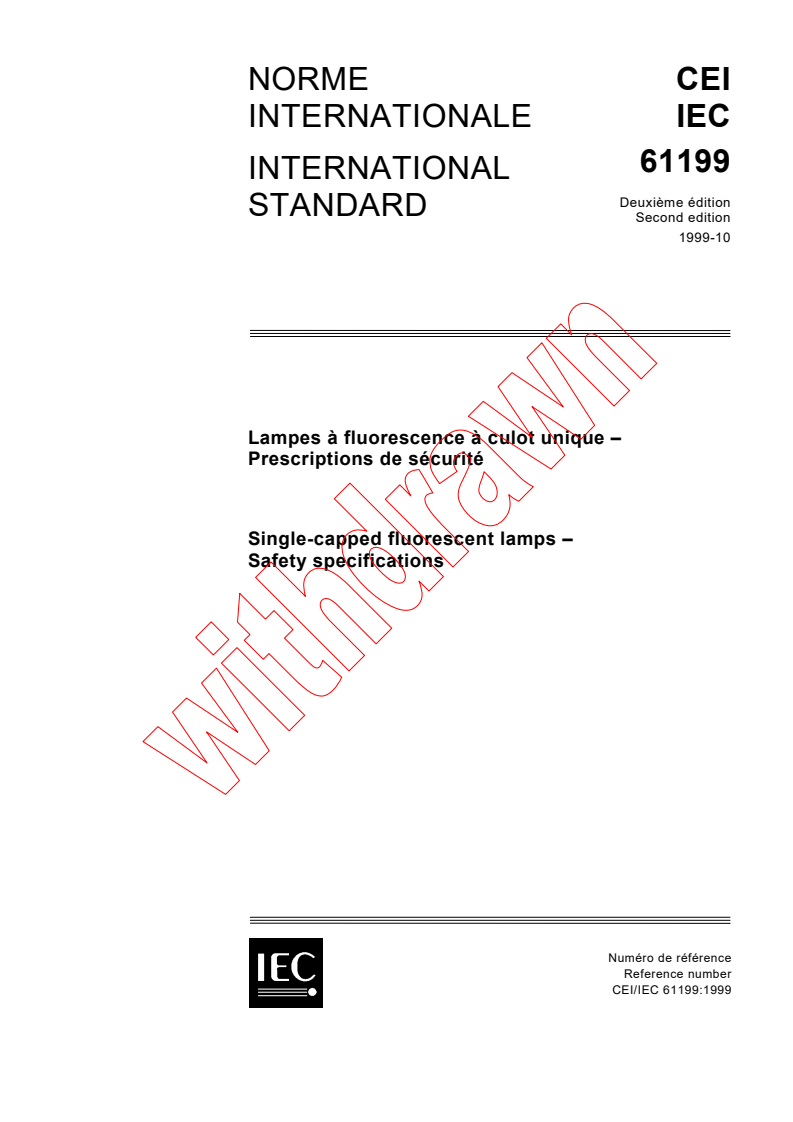
NORME CEI
INTERNATIONALE IEC
INTERNATIONAL
Deuxième édition
STANDARD
Second edition
1999-10
Lampes à fluorescence à culot unique –
Prescriptions de sécurité
Single-capped fluorescent lamps –
Safety specifications
Numéro de référence
Reference number
CEI/IEC 61199:1999
Numéros des publications Numbering
Depuis le 1er janvier 1997, les publications de la CEI As from 1 January 1997 all IEC publications are
sont numérotées à partir de 60000. issued with a designation in the 60000 series.
Publications consolidées Consolidated publications
Les versions consolidées de certaines publications de Consolidated versions of some IEC publications
la CEI incorporant les amendements sont disponibles. including amendments are available. For example,
Par exemple, les numéros d’édition 1.0, 1.1 et 1.2 edition numbers 1.0, 1.1 and 1.2 refer, respectively, to
indiquent respectivement la publication de base, la the base publication, the base publication incor-
publication de base incorporant l’amendement 1, et la porating amendment 1 and the base publication
publication de base incorporant les amendements 1 incorporating amendments 1 and 2.
et 2.
Validité de la présente publication Validity of this publication
Le contenu technique des publications de la CEI est The technical content of IEC publications is kept
constamment revu par la CEI afin qu'il reflète l'état under constant review by the IEC, thus ensuring that
actuel de la technique. the content reflects current technology.
Des renseignements relatifs à la date de reconfir- Information relating to the date of the reconfirmation
mation de la publication sont disponibles dans le of the publication is available in the IEC catalogue.
Catalogue de la CEI.
Les renseignements relatifs à des questions à l’étude et Information on the subjects under consideration and
des travaux en cours entrepris par le comité technique work in progress undertaken by the technical
qui a établi cette publication, ainsi que la liste des committee which has prepared this publication, as well
publications établies, se trouvent dans les documents ci- as the list of publications issued, is to be found at the
dessous: following IEC sources:
• «Site web» de la CEI* • IEC web site*
• Catalogue des publications de la CEI • Catalogue of IEC publications
Publié annuellement et mis à jour Published yearly with regular updates
régulièrement (On-line catalogue)*
(Catalogue en ligne)*
• IEC Bulletin
• Bulletin de la CEI Available both at the IEC web site* and
Disponible à la fois au «site web» de la CEI* as a printed periodical
et comme périodique imprimé
Terminologie, symboles graphiques
Terminology, graphical and letter
et littéraux
symbols
En ce qui concerne la terminologie générale, le lecteur
For general terminology, readers are referred to
se reportera à la CEI 60050: Vocabulaire Electro-
IEC 60050: International Electrotechnical Vocabulary
technique International (VEI).
(IEV).
Pour les symboles graphiques, les symboles littéraux
For graphical symbols, and letter symbols and signs
et les signes d'usage général approuvés par la CEI, le
approved by the IEC for general use, readers are
lecteur consultera la CEI 60027: Symboles littéraux à
referred to publications IEC 60027: Letter symbols to
utiliser en électrotechnique, la CEI 60417: Symboles
be used in electrical technology, IEC 60417: Graphical
graphiques utilisables sur le matériel. Index, relevé et
symbols for use on equipment. Index, survey and
compilation des feuilles individuelles, et la CEI 60617:
compilation of the single sheets and IEC 60617:
Symboles graphiques pour schémas.
Graphical symbols for diagrams.
* Voir adresse «site web» sur la page de titre.
* See web site address on title page.
NORME CEI
INTERNATIONALE IEC
INTERNATIONAL
Deuxième édition
STANDARD
Second edition
1999-10
Lampes à fluorescence à culot unique –
Prescriptions de sécurité
Single-capped fluorescent lamps –
Safety specifications
IEC 1999 Droits de reproduction réservés Copyright - all rights reserved
Aucune partie de cette publication ne peut être reproduite ni No part of this publication may be reproduced or utilized in
utilisée sous quelque forme que ce soit et par aucun procédé, any form or by any means, electronic or mechanical,
électronique ou mécanique, y compris la photo-copie et les including photocopying and microfilm, without permission in
microfilms, sans l'accord écrit de l'éditeur. writing from the publisher.
International Electrotechnical Commission 3, rue de Varembé Geneva, Switzerland
Telefax: +41 22 919 0300 e-mail: inmail@iec.ch IEC web site http://www.iec.ch
CODE PRIX
Commission Electrotechnique Internationale
U
PRICE CODE
International Electrotechnical Commission
Pour prix, voir catalogue en vigueur
For price, see current catalogue
– 2 – 61199 © CEI:1999
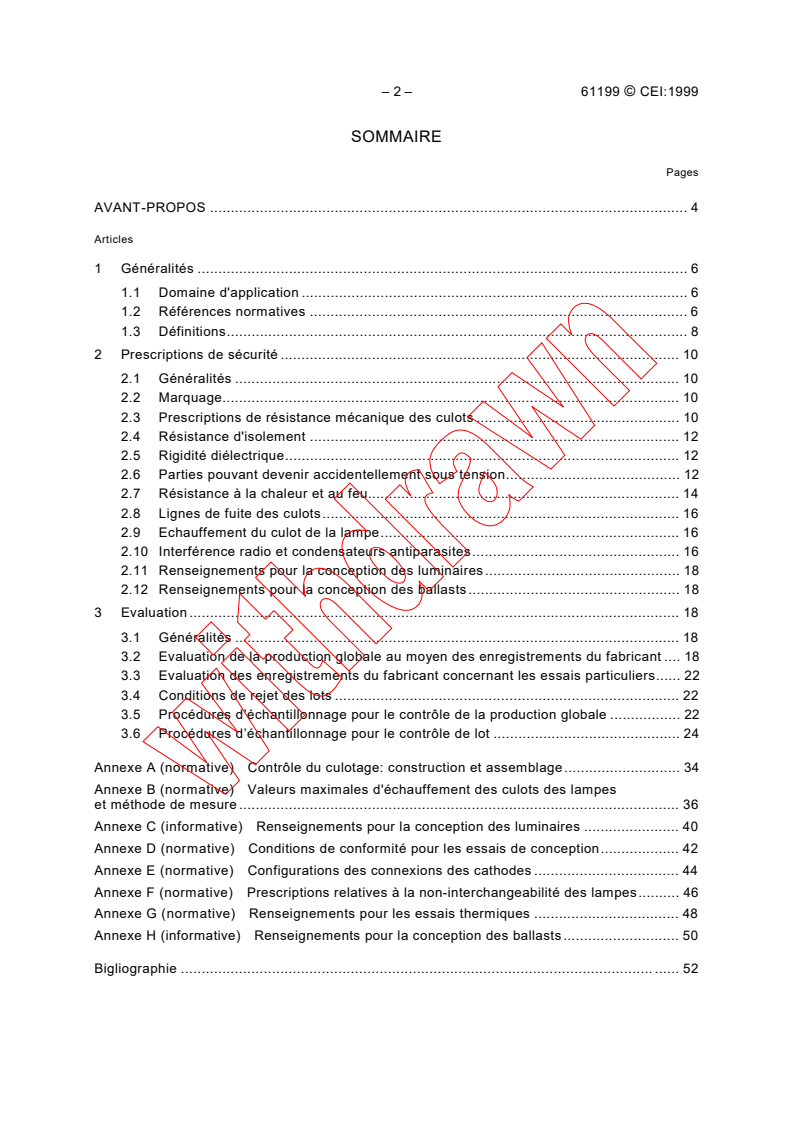
SOMMAIRE
Pages
AVANT-PROPOS . 4
Articles
1 Généralités . 6
1.1 Domaine d'application . 6
1.2 Références normatives . 6
1.3 Définitions. 8
2 Prescriptions de sécurité . 10
2.1 Généralités . 10
2.2 Marquage. 10
2.3 Prescriptions de résistance mécanique des culots . 10
2.4 Résistance d'isolement . 12
2.5 Rigidité diélectrique. 12
2.6 Parties pouvant devenir accidentellement sous tension. 12
2.7 Résistance à la chaleur et au feu. 14
2.8 Lignes de fuite des culots. 16
2.9 Echauffement du culot de la lampe. 16
2.10 Interférence radio et condensateurs antiparasites. 16
2.11 Renseignements pour la conception des luminaires. 18
2.12 Renseignements pour la conception des ballasts. 18
3 Evaluation . 18
3.1 Généralités . 18
3.2 Evaluation de la production globale au moyen des enregistrements du fabricant . 18
3.3 Evaluation des enregistrements du fabricant concernant les essais particuliers. 22
3.4 Conditions de rejet des lots . 22
3.5 Procédures d’échantillonnage pour le contrôle de la production globale . 22
3.6 Procédures d’échantillonnage pour le contrôle de lot . 24
Annexe A (normative) Contrôle du culotage: construction et assemblage. 34
Annexe B (normative) Valeurs maximales d'échauffement des culots des lampes
et méthode de mesure. 36
Annexe C (informative) Renseignements pour la conception des luminaires . 40
Annexe D (normative) Conditions de conformité pour les essais de conception. 42
Annexe E (normative) Configurations des connexions des cathodes . 44
Annexe F (normative) Prescriptions relatives à la non-interchangeabilité des lampes. 46
Annexe G (normative) Renseignements pour les essais thermiques . 48
Annexe H (informative) Renseignements pour la conception des ballasts. 50
Bigliographie . . 52
61199 © IEC:1999 – 3 –
CONTENTS
Page
FOREWORD . 5
Clause
1 General. 7
1.1 Scope . 7
1.2 Normative references. 7
1.3 Definitions. 9
2 Safety requirements . 11
2.1 General. 11
2.2 Marking. 11
2.3 Mechanical requirements for caps . 11
2.4 Insulation resistance . 13
2.5 Electric strength . 13
2.6 Parts which can become accidentally live . 13
2.7 Resistance to heat and fire. 15
2.8 Creepage distance for caps. 17
2.9 Lamp cap temperature rise. 17
2.10 Radio interference suppression capacitors . 17
2.11 Information for luminaire design . 19
2.12 Information for ballast design . 19
3 Assessment . 19
3.1 General. 19
3.2 Whole production assessment by means of the manufacturer’s records . 19
3.3 Assessment of the manufacturer’s records of particular tests. 23
3.4 Rejection conditions of batches . 23
3.5 Sampling procedures for whole production testing . 23
3.6 Sampling procedures for batch testing. 25
Annex A (normative) Tests for assessing caps for construction and assembly. 35
Annex B (normative) Maximum lamp cap temperature rise values and method
of measurement . 37
Annex C (informative) Information for luminaire design. 41
Annex D (normative) Conditions of compliance for design tests . 43
Annex E (normative) Cathode connection configurations . 45
Annex F (normative) Lamp non-interchangeability requirements. 47
Annex G (normative) Information for thermal tests . 49
Annex H (informative) Information for ballast design . 51
Bibliography . 53
– 4 – 61199 © CEI:1999
COMMISSION ÉLECTROTECHNIQUE INTERNATIONALE
____________
LAMPES À FLUORESCENCE À CULOT UNIQUE –
PRESCRIPTIONS DE SÉCURITÉ
AVANT-PROPOS
1) La CEI (Commission Électrotechnique Internationale) est une organisation mondiale de normalisation composée
de l'ensemble des comités électrotechniques nationaux (Comités nationaux de la CEI). La CEI a pour objet de
favoriser la coopération internationale pour toutes les questions de normalisation dans les domaines de
l'électricité et de l'électronique. A cet effet, la CEI, entre autres activités, publie des Normes internationales.
Leur élaboration est confiée à des comités d'études, aux travaux desquels tout Comité national intéressé par le
sujet traité peut participer. Les organisations internationales, gouvernementales et non gouvernementales, en
liaison avec la CEI, participent également aux travaux. La CEI collabore étroitement avec l'Organisation
Internationale de Normalisation (ISO), selon des conditions fixées par accord entre les deux organisations.
2) Les décisions ou accords officiels de la CEI concernant les questions techniques représentent, dans la mesure
du possible, un accord international sur les sujets étudiés, étant donné que les Comités nationaux intéressés
sont représentés dans chaque comité d’études.
3) Les documents produits se présentent sous la forme de recommandations internationales. Ils sont publiés comme
normes, spécifications techniques, rapports techniques ou guides et agréés comme tels par les Comités nationaux.
4) Dans le but d'encourager l'unification internationale, les Comités nationaux de la CEI s'engagent à appliquer de
façon transparente, dans toute la mesure possible, les Normes internationales de la CEI dans leurs normes
nationales et régionales. Toute divergence entre la norme de la CEI et la norme nationale ou régionale
correspondante doit être indiquée en termes clairs dans cette dernière.
5) La CEI n’a fixé aucune procédure concernant le marquage comme indication d’approbation et sa responsabilité
n’est pas engagée quand un matériel est déclaré conforme à l’une de ses normes.
6) L’attention est attirée sur le fait que certains des éléments de la présente Norme internationale peuvent faire
l’objet de droits de propriété intellectuelle ou de droits analogues. La CEI ne saurait être tenue pour
responsable de ne pas avoir identifié de tels droits de propriété et de ne pas avoir signalé leur existence.
La Norme internationale CEI 61199 a été établie par le sous-comité 34A: Lampes, du comité
d’études 34 de la CEI: Lampes et équipements associés.
Cette deuxième édition annule et remplace la première édition parue en 1993, l'amendement 1
(1997), l'amendement 2 (1998) ainsi que l'édition 1.2 consolidée (1998). Cette deuxième
édition constitue une révision technique.
Le texte de cette norme est issu des documents suivants:
FDIS Rapport de vote
34A/883/FDIS 34A/897/RVD
Le rapport de vote indiqué dans le tableau ci-dessus donne toute information sur le vote ayant
abouti à l'approbation de cette norme.
Cette publication a été rédigée selon les Directives ISO/CEI, Partie 3.
Les annexes A, B, D, E, F et G font partie intégrante de cette norme.
Les annexes C et H sont données uniquement à titre d’information.
Le comité a décidé que cette publication reste valable jusqu’en 2003-09.
A cette date, selon décision préalable du comité, la publication sera
• reconduite;
• supprimée;
• remplacée par une édition révisée, ou
• amendée.
61199 © IEC:1999 – 5 –
INTERNATIONAL ELECTROTECHNICAL COMMISSION
____________
SINGLE-CAPPED FLUORESCENT LAMPS –
SAFETY SPECIFICATIONS
FOREWORD
1) The IEC (International Electrotechnical Commission) is a worldwide organization for standardization comprising
all national electrotechnical committees (IEC National Committees). The object of the IEC is to promote
international co-operation on all questions concerning standardization in the electrical and electronic fields. To
this end and in addition to other activities, the IEC publishes International Standards. Their preparation is
entrusted to technical committees; any IEC National Committee interested in the subject dealt with may
participate in this preparatory work. International, governmental and non-governmental organizations liaising
with the IEC also participate in this preparation. The IEC collaborates closely with the International Organization for
Standardization (ISO) in accordance with conditions determined by agreement between the two organizations.
2) The formal decisions or agreements of the IEC on technical matters express, as nearly as possible, an
international consensus of opinion on the relevant subjects since each technical committee has representation
from all interested National Committees.
3) The documents produced have the form of recommendations for international use and are published in the form
of standards, technical specifications, technical reports or guides and they are accepted by the National
Committees in that sense.
4) In order to promote international unification, IEC National Committees undertake to apply IEC International
Standards transparently to the maximum extent possible in their national and regional standards. Any
divergence between the IEC Standard and the corresponding national or regional standard shall be clearly
indicated in the latter.
5) The IEC provides no marking procedure to indicate its approval and cannot be rendered responsible for any
equipment declared to be in conformity with one of its standards.
6) Attention is drawn to the possibility that some of the elements of this International Standard may be the subject
of patent rights. The IEC shall not be held responsible for identifying any or all such patent rights.
International Standard IEC 61199 has been prepared by subcommittee 34A: Lamps, of IEC
technical committee 34: Lamps and related equipment.
This second edition cancels and replaces the first edition published in 1993, amendment 1
(1997), amendment 2 (1998) as well as consolidated edition 1.2 (1998). This second edition
constitutes a technical revision.
The text of this standard is based on the following documents:
FDIS Report on voting
34A/883/FDIS 34A/897/RVD
Full information on the voting for the approval of this standard can be found in the report on
voting indicated in the above table.
This publication has been drafted in accordance with the ISO/IEC Directives, Part 3.
Annexes A, B, D, E, F and G form an integral part of this standard.
Annexes C and H are for information only.
The committee has decided that this publication remains valid until 2003-09
At this date, in accordance with the committee’s decision, the publication will be
• reconfirmed;
• withdrawn;
• replaced by a revised edition, or
• amended.
– 6 – 61199 © CEI:1999
LAMPES À FLUORESCENCE À CULOT UNIQUE –
PRESCRIPTIONS DE SÉCURITÉ
1 Généralités
1.1 Domaine d'application
La présente Norme internationale spécifie les prescriptions de sécurité pour les lampes à
fluorescence à culot unique, destinées à l’éclairage général, de tous les groupes à culots 2G7,
2GX7, GR8, 2G10, G10q, GR10q, GX10q, GY10q, 2G11, G23, GX23, G24, GX24 et GX32.
Elle spécifie aussi la méthode que le fabricant utilisera pour démontrer la conformité de ses
produits aux prescriptions de la présente norme, méthode basée sur l'évaluation de la qualité
de la production globale, associée aux résultats d'essais enregistrés sur les produits finis.
Cette méthode peut aussi être appliquée à des fins de certification. Des précisions sont
également données, dans la présente norme, sur la procédure de contrôle par lots qui peut
être utilisée pour l'appréciation limitée de la qualité des lots.
NOTE – La conformité à la présente norme ne concerne que les critères de sécurité; la performance des lampes à
fluorescence à culot unique pour éclairage général n'est pas prise en compte pour tout ce qui concerne le flux
lumineux, la couleur et les caractéristiques d'amorçage et de fonctionnement. Pour toutes ces données, le lecteur
est renvoyé à la CEI 60901.
1.2 Références normatives
Les documents normatifs suivants contiennent des dispositions qui, par suite de la référence
qui y est faite, constituent des dispositions valables pour la présente Norme internationale.
Pour les références datées, les amendements ultérieurs ou les révisions de ces publications
ne s’appliquent pas. Toutefois, les parties prenantes aux accords fondés sur la présente
Norme internationale sont invitées à rechercher la possibilité d'appliquer les éditions les plus
récentes des documents normatifs indiqués ci-après. Pour les références non datées, la
dernière édition du document normatif en référence s’applique. Les membres de la CEI et de
l'ISO possèdent le registre des Normes internationales en vigueur.
CEI 60061-1, Culots de lampes et douilles ainsi que calibres pour le contrôle de l'inter-
changeabilité et de la sécurité – Première partie: Culots de lampes
CEI 60061-2, Culots de lampes et douilles ainsi que calibres pour le contrôle de l'inter-
changeabilité et de la sécurité – Deuxième partie: Douilles
CEI 60061-3, Culots de lampes et douilles ainsi que calibres pour le contrôle de l'inter-
changeabilité et de la sécurité – Troisième partie: Calibres
CEI 60410, Plans et règles d'échantillonnage pour les contrôles par attributs
CEI 60529:1989, Degrés de protection procurés par les enveloppes (Code IP)
CEI 60598-1, Luminaires – Partie 1: Prescriptions générales et essais
CEI 60695-2-1/0, Essais relatifs aux risques du feu – Partie 2: Méthodes d'essai – Section 1/
feuille 0: Méthodes d'essai au fil incandescent – Généralités
CEI 60901, Lampes à fluorescence à culot unique – Prescriptions de performances
61199 © IEC:1999 – 7 –
SINGLE-CAPPED FLUORESCENT LAMPS –
SAFETY SPECIFICATIONS
1 General
1.1 Scope
This International Standard specifies the safety requirements for single-capped fluorescent
lamps for general lighting purposes of all groups having 2G7, 2GX7, GR8, 2G10, G10q,
GR10q, GX10q, GY10q, 2G11, G23, GX23, G24, GX24 and GX32 caps.
It also specifies the method a manufacturer should use to show compliance with the
requirements of this standard on the basis of whole production appraisal in association with his
test records on finished products. This method can also be applied for certification purposes.
Details of a batch test procedure which can be used to make limited assessment of batches
are also given in this standard.
NOTE – Compliance with this standard concerns only safety criteria and does not take into account the
performance of single-capped fluorescent lamps for general lighting purposes with respect to luminous flux, colour,
starting and operational characteristics. For this information, readers are referred to IEC 60901.
1.2 Normative references
The following normative documents contain provisions which, through reference in this text,
constitute provisions of this International Standard. For dated references, subsequent
amendments to, or revisions of, any of these publications do not apply. However, parties to
agreements based on this International Standard are encouraged to investigate the possibility
of applying the most recent editions of the normative documents indicated below. For undated
references, the latest edition of the normative document referred to applies. Members of IEC
and ISO maintain registers of currently valid International Standards.
IEC 60061-1 Lamp caps and holders together with gauges for the control of inter-
changeability and safety – Part 1: Lamp caps
IEC 60061-2, Lamp caps and holders together with gauges for the control of inter-
changeability and safety – Part 2: Lampholders
IEC 60061-3, Lamp caps and holders together with gauges for the control of inter-
changeability and safety – Part 3: Gauges
IEC 60410, Sampling plans and procedures for inspection by attributes
IEC 60529:1989, Degrees of protection provided by enclosures (IP Code)
IEC 60598-1, Luminaires – Part 1: General requirements and tests
IEC 60695-2-1/0, Fire hazard testing – Part 2: Test methods – Section 1/sheet 0: Glow-wire
test methods – General
IEC 60901, Single-capped fluorescent lamps – Performance specifications
– 8 – 61199 © CEI:1999
1.3 Définitions
Pour les besoins de la présente Norme internationale, les définitions suivantes s'appliquent.
1.3.1
lampe à fluorescence à culot unique
lampe à décharge dans la vapeur de mercure à basse pression, équipée d'un seul culot, et
dans laquelle la plus grande partie de la lumière est émise par une couche de substances
fluorescentes excitées par le rayonnement ultra-violet de la décharge
1.3.2
groupe
lampes ayant les mêmes caractéristiques électriques et de cathodes, les mêmes cotes
géométriques et la même méthode d'amorçage
1.3.3
type
lampes du même groupe ayant les mêmes caractéristiques de flux lumineux et de couleur
apparente
1.3.4
famille
groupes de lampes qui se distinguent par des traits communs touchant aux matériaux utilisés,
aux composants, au diamètre du tube et/ou à la méthode de fabrication
1.3.5
puissance nominale
puissance utilisée pour désigner la lampe
1.3.6
essai de conception
essai effectué sur un échantillon dans le but de vérifier la conformité de la conception d'une
famille, d'un groupe ou d'un certain nombre de groupes aux prescriptions de l'article
correspondant
1.3.7
essai périodique
essai ou série d'essais exécutés à intervalles afin de vérifier que le produit ne dévie pas, à
certains égards, du modèle correspondant à la conception
1.3.8
essai courant
essai répété à intervalles courts en vue de réunir les données destinées à l'évaluation
1.3.9
lot
toutes les lampes d'une famille, ou d'un groupe, identifiées comme telles et présentées en
même temps pour subir ensemble le contrôle de la conformité
1.3.10
production globale
ensemble de tous les types de lampes produits au cours d'une période de douze mois dans le
cadre de la présente norme et entrant dans une liste dressée par le fabricant en vue d'être
incluse dans le certificat de conformité
61199 © IEC:1999 – 9 –
1.3 Definitions
For the purposes of this International Standard, the following definitions apply.
1.3.1
single-capped fluorescent lamp
low-pressure mercury discharge lamp having a single cap in which most of the light from the
lamp is emitted by a layer of fluorescent material excited by the ultraviolet radiation from
the discharge
1.3.2
group
lamps having the same electrical and cathode characteristics, the same physical dimensions
and the same starting method
1.3.3
type
lamps of the same group having the same photometric and colour characteristics
1.3.4
family
lamp groups which are distinguished by common features of materials, components, tube
diameter and/or method of processing
1.3.5
nominal wattage
wattage used to designate the lamp
1.3.6
design test
test made on a sample for the purpose of checking compliance of the design of a family, group
or a number of groups with the requirements of the relevant clause
1.3.7
periodic test
test, or series of tests, repeated at intervals in order to check that a product does not deviate in
certain respects from the given design
1.3.8
running test
test repeated at frequent intervals to provide data for assessment
1.3.9
batch
all lamps of one family and/or group and identified as such and put forward at one time for test
or checking compliance
1.3.10
whole production
production during a period of twelve months of all types of lamps within the scope of this
standard and nominated in a list of the manufacturer for inclusion in the certificate
– 10 – 61199 © CEI:1999
2 Prescriptions de sécurité
2.1 Généralités
Les lampes doivent être conçues et construites de telle sorte qu'elles ne présentent en
utilisation normale aucun danger pour l'usager ou l'environnement.
D'une manière générale, la conformité est vérifiée en exécutant tous les contrôles spécifiés.
2.2 Marquage
2.2.1 Les renseignements suivants doivent être marqués sur les lampes de manière durable
et lisible:
a) marque d'origine (elle peut prendre la forme d'une marque commerciale, du nom du
fabricant ou de celui du vendeur responsable);
b) puissance nominale (marquée «W» ou «watts») ou toute autre indication identifiant la
lampe.
2.2.2 La conformité est vérifiée comme suit:
a) présence et lisibilité de la marque par inspection visuelle;
b) durabilité du marquage en appliquant l'essai suivant à des lampes neuves.
La zone du marquage des lampes doit être frottée à la main au moyen d'un chiffon doux imbibé
d'eau pendant une période de 15 s.
Après l'exécution de cet essai, le marquage doit être encore lisible.
2.3 Prescriptions de résistance mécanique des culots
2.3.1 Construction et assemblage
Les culots doivent être construits et assemblés au(x) tube(s) de manière que l'ensemble
demeure intact et que ses différentes parties demeurent assemblées pendant et après le
fonctionnement des lampes.
La conformité est vérifiée au moyen des essais donnés à l'annexe A.
A la fin des essais, les culots ne doivent montrer aucun dommage susceptible de compro-
mettre la sécurité.
2.3.2 Prescriptions dimensionnelles pour les culots
Les lampes doivent être équipées de culots normalisés conformes aux prescriptions
2.3.2.1
de la CEI 60061-1.
2.3.2.2 La conformité est vérifiée en utilisant les calibres indiqués au tableau 1.
61199 © IEC:1999 – 11 –
2 Safety requirements
2.1 General
Lamps shall be so designed and constructed that in normal use they present no danger to the
user or the surroundings.
In general, compliance is checked by carrying out all the tests specified.
2.2 Marking
2.2.1 The following information shall be legibly and durably marked on the lamps:
a) mark of origin (this may take the form of a trade mark, the manufacturer's name or the
name of the responsible vendor);
b) the nominal wattage (marked "W" or "watts") or any other indication which identifies
the lamp.
2.2.2 Compliance is checked by the following:
a) presence and legibility of the marking by visual inspection;
b) durability of marking by applying the following test on unused lamps.
The area of the marking on the lamp shall be rubbed by hand with a smooth cloth damped with
water for a period of 15 s.
After this test, the marking shall still be legible.
2.3 Mechanical requirements for caps
2.3.1 Construction and assembly
Caps shall be so constructed and assembled to the tube(s) that the whole assembly remains
intact and attached during and after operation.
Compliance is checked by carrying out the tests given in annex A.
At the end of the tests, the caps shall show no damage that impairs safety.
2.3.2 Dimensional requirements for caps
2.3.2.1 Lamps shall use standardized caps in accordance with the dimensional requirements
of IEC 60061-1.
2.3.2.2 Compliance is checked by using the gauges shown in table 1.
– 12 – 61199 © CEI:1999
2.3.3 Connexions des broches et configuration des détrompeurs
2.3.3.1 Connexions des broches
Les liaisons des cathodes de la lampe aux culots à quatre broches doivent être conformes aux
prescriptions correspondantes de l'annexe E.
La conformité est vérifiée au moyen d'essais de continuité électrique entre les broches
correspondantes et/ou de l'inspection visuelle.
2.3.3.2 Configuration des détrompeurs
Les types de culots comportant des détrompeurs, dont la fonction est d'assurer la non-
interchangeabilité des types de lampes similaires, doivent être conformes à la version
culot/détrompeur donnée dans la feuille de caractéristiques de la lampe correspondante de la
CEI 60901. L'annexe F fournit les directives indiquant quelle combinaison culot/détrompeur doit
être utilisée lors de la conception de lampes destinées à fonctionner avec un ballast donné.
La conformité est vérifiée au moyen d'un système de mesure convenable et/ou de l'inspection visuelle.
2.4 Résistance d'isolement
2.4.1 La résistance d'isolement entre les parties métalliques du culot, s'il y en a, et toutes les
broches connectées ensemble ne doit pas être inférieure à 2 MΩ.
2.4.2 La conformité est vérifiée par des mesures et au moyen d'un équipement d'essai
convenable utilisant une tension continue de 500 V.
Dans le cas de culots réalisés entièrement en matériau isolant, l'essai est appliqué entre les
broches connectées ensemble d'une part, et une feuille métallique enveloppant les surfaces
qui sont accessibles lorsque le culot est inséré dans une douille ayant les dimensions
minimales de bague isolante données dans la CEI 60061-2, d'autre part.
2.5 Rigidité diélectrique
2.5.1 L'isolement entre les parties qui font l'objet de 2.4 doit résister à la tension d'essai
de 2.5.2. Aucun contournement ou claquage ne doit se produire durant l'essai.
2.5.2 La conformité est vérifiée avec une tension alternative de 1 500 V de forme réellement
sinusoïdale, de fréquence 50 Hz ou 60 Hz et appliquée pendant 1 min. La tension initialement
appliquée ne doit pas dépasser la moitié de la valeur prescrite; elle doit ensuite être
augmentée rapidement jusqu'à la valeur prescrite.
Les décharges en régime de lueur, sans chute de tension, sont négligées.
2.6 Parties pouvant devenir accidentellement sous tension
2.6.1 Les parties métalliques, s'il y en a, destinées à être isolées des parties sous tension ne
doivent pas être ni devenir sous tension.
2.6.2 Exception faite des broches du culot, aucune partie sous tension ne doit faire saillie
d'aucune partie du culot.
61199 © IEC:1999 – 13 –
2.3.3 Pin connections and keying configurations
2.3.3.1 Pin connections
The connection of lamp cathodes to the pins of caps having four pins shall conform to the
requirements shown in annex E for the relevant cap.
Compliance is checked by electrical continuity tests between relevant pins and/or by visual
inspection.
2.3.3.2 Key configuration
For those cap types incorporating keys which ensure non-interchangeability with similar lamp
types, the caps shall conform to the cap/key version given in the relevant lamp data sheet
of IEC 60901. Annex F gives guidance to which cap/key shall be used when designing lamps to
operate on a certain ballast.
Compliance is checked by a suitable measuring system and/or visual inspection.
2.4 Insulation resistance
2.4.1 The insulation resistance between the metal parts, if any, of the cap and all pins
connected together shall not be less than 2 MΩ.
2.4.2 Compliance is checked by measurement with suitable test equipment using a d.c.
voltage of 500 V.
In the case of caps made entirely from insulating material, the test is made between all pins
connected together and metal foil wrapped over those surfaces that are accessible when
the cap has been connected to a lampholder with minimum shrouding dimensions, as given
in IEC 60061-2.
2.5 Electric strength
2.5.1 The insulation between the same parts as those referred to in 2.4 shall withstand the
test voltage of 2.5.2. No flash-over or breakdown shall occur during the test.
2.5.2 Compliance is checked with a 1 500 V a.c. voltage of substantially sine-wave form, with
a frequency of 50 Hz or 60 Hz and applied for 1 min. Initially, not more than half the prescribed
voltage shall be applied; it shall then be raised rapidly to the full value.
Glow discharges without a drop in voltage are neglected.
2.6 Parts which can become accidentally live
2.6.1 Metal parts, if any, intended to be insulated from live parts shall not be or become live.
2.6.2 With the exception of cap pins, no live part shall project from any part of the cap.
– 14 – 61199 © CEI:1999
2.6.3 La conformité est vérifiée au moyen d’un système de mesure approprié qui peut inclure,
si cela convient, un contrôle visuel. En outre, des contrôles réguliers journaliers des
équipements ou une vérification de l’efficacité du contrôle doivent être effectués. Voir 3.5.4.
2.7 Résistance à la chaleur et au feu
2.7.1 Le matériau isolant des culots doit être suffisamment résistant à la chaleur.
2.7.2 La conformité est vérifiée au moyen des essais suivants.
2.7.2.1 Les échantillons sont testés pendant une période de 168 h dans une étuve réglée aux
températures indiquées à l'annexe G.
A la fin de l'essai, les échantillons ne doivent avoir subi aucun changement mettant en cause la
fonction de sécurité qu'ils doivent assurer, surtout en ce qui concerne les points suivants:
– réduction de la protection contre les chocs électriques selon les exigences de 2.4 et 2.5;
– jeu dans les broches des culots, fêlures, gonflement et rétrécissement, à constater par
inspection visuelle.
A la fin de l'essai, les dimensions doivent être conformes aux prescriptions de 2.3.2.
2.7.2.2 Les échantillons sont soumis à l'essai à la bille au moyen de l'appareil représenté à la
figure G.1.
La surface soumise à l'essai est placée en position horizontale. Une bille d'acier d'un diamètre
de 5 mm est pressée contre la surface à tester avec une force de 20 N. Si la surface soumise
à l'essai plie, elle doit être supportée à l'endroit où la bille exerce la pression.
L'essai doit être exécuté à l'intérieur d'une étuve, à une température de 125 °C ± 5 °C.
Après 1 h, la bille doit être retirée et le diamètre de l'empreinte mesuré. Ce diamètre ne doit
pas excéder 2 mm.
L'essai ne doit pas être exécuté sur les parties en céramique.
2.7.3 Le matériau isolant des culots doit résister à une chaleur anormale et au feu.
2.7.4 La conformité est vérifiée au moyen de l'essai suivant.
Les parties sont soumises à un essai au fil de nickel-chrome incandescent, chauffé à 650 °C.
L'appareil d'essai doit être celui décrit dans la CEI 60695-2-1/0.
L'échantillon à tester est monté verticalement sur le chariot et pressé contre l'extrémité du fil
incandescent avec une force de 1 N, de préférence à 15 mm ou plus du bord supérieur de
l'échantillon. La pénétration du fil incandescent dans l'échantillon est limitée mécaniquement
à 7 mm. Le contact entre l'échantillon et l'extrémité du fil incandescent est interrompu après 30 s.
Toute flamme ou incandescence de l'échantillon doit s'éteindre dans les 30 s qui suivent le
retrait du fil incandescent, et les gouttes de matière fondue ou enflammée ne doivent pas
communiquer le feu à un ensemble de cinq couches de papier de soie dépliées
horizontalement à 200 mm ± 5 mm sous l'échantillon.
61199 © IEC:1999 – 15 –
2.6.3 Compliance is checked by a suitable measuring system which may include visual
inspection where appropriate. In addition, there shall be regular daily checks of the equipment
or a verification of the effectiveness of the inspection. See 3.5.4.
2.7 Resistance to heat and fire
2.7.1 Insulating material of caps shall be sufficiently resistant to heat.
2.7.2 Compliance is checked by the following tests.
2.7.2.1 Samples are tested for a period of 168 h in a heating cabinet at a temperature as
given in annex G.
At the end of the test, the samples shall not have undergone any change impairing their future
safety, especially in the following respects:
– reduction in the protection against electric shock as required in 2.4 and 2.5;
– loosening of cap pins, cracks, swelling and shrinking as determined by visual inspection.
At the end of the test, the dimensions shall comply with the requirements of 2.3.2.
2.7.2.2 Samples are subjected to a ball-pressure test by means of the apparatus shown in
figure G.1.
The surface of the part under test is placed in the horizontal position and a steel ball of 5 mm
diameter is pressed against this surface by a force of 20 N. If the surface under test bends, the
part where the ball presses shall be supported.
The test shall be made in a heating cabinet at a temperature of 125 °C ± 5 °C.
After 1 h the ball shall be removed and the diameter of the impression measured. This
diameter shall not exceed 2 mm.
The test shall not be made on parts of ceramic material.
2.7.3 Insulating material of caps shall be resistant to abnormal heat and to fire.
2.7.4 Compliance is checked by the following test.
Parts are subjected to a test using a nickel-chromium glow-wire heated to 650 °C. The test
apparatus shall be that described in IEC 60695-2-1/0.
The sample to be tested is mounted vertically on the carriage and pressed against the glow-
wire tip with a force of 1 N, preferably 15 mm or more from the upper edge of the sample. The
penetration of the glow-wire into the sample is mechanically limited to 7 mm. After 30 s the
sample is withdrawn from contact with the glow-wire tip.
Any flame or glowing of the sample shall extinguish within 30 s of withdrawing the glow-wire
and any burning or molten drops shall not ignite a piece of tissue paper consisting of five
layers, spread out horizontally 200 mm ± 5 mm below the sample.
– 16 – 61199 © CEI:1999
La température du fil incandescent et le courant de chauffage doivent demeurer constants
pendant la minute qui précède le début de l'essai. On doit prendre soin à ce que la chaleur
radiée n'influence pas le comportement de l'échantillon pendant cette période. La température
de l'extrémité du fil incandescent est mesurée au moyen d'un couple thermoélectrique à fil fin
gainé, construit et étalonné comme indiqué dans la CEI 60695-2-1/0.
NOTE – Il convient de prendre des précautions pour préserver la santé du personnel chargé de l'essai contre les
risques
– d'explosion ou de feu;
– d'inhalation de fumée et/ou de produits toxiques;
– d'action des résidus toxiques.
2.8 Lignes de fuite des culots
2.8.1 La longueur minimale des lignes de fuite entre les broches et les parties métalliques du
culot, s'il y en a, doit être conforme aux prescriptions de la CEI 60061-1. Les numéros des
feuilles de norme des culots correspondants sont donnés au tableau 1.
2.8.2 La conformité est vérifiée par mesure, dans la position la plus défavorable.
2.9 Echauffement du culot de la lampe
2.9.1 Pour les lampes à dispositif d’amorçage interne et pour les lampes destinées à
fonctionner à l’aide d’un starter externe, l’échauffement du culot au-dessus de la température
ambiante ne doit pas dépasser la valeur correspondante donnée au tableau B.2.
2.9.2 La procédure d'essai est spécifiée à l'annexe B. Les conditions de conformité sont
données en D.4.
2.9.3 Lorsqu'il peut être démontré qu'à un groupe de lampes correspond l'échauffement de
culot le plus élevé pour une famille donnée de lampes, les essais nécessaires à la vérification
de la conformité de toutes les lampes culottées de manière identique ne sont à effectuer que
sur ce seul groupe.
2.10 Interférence radio et condensateurs antiparasites
Les lampes contenant des dispositifs d'amorçage et/ou des condensateurs antiparasites
destinés à supprimer les interférences radio doivent avoir des condensateurs conformes aux
prescriptions suivantes.
2.10.1 Résistance à l'humidité
Le condensateur doit être résistant à l'humidité. La conformité est vérifiée au moyen de l'essai
suivant.
Avant l'exécution du traitement d'humidité, les condensateurs doivent être maintenus pendant
+4
au moins 4 h à une température ambiante ne différant pas de plus de °C de la température
qui règne dans l'enceinte de l'essai d'humidité.
Immédiatement après le traitement d'humidité ambiante de 48 h dan
...