

IEC 62554:2011
(Main)Sample preparation for measurement of mercury level in fluorescent lamps
General Information
- Abstract
IEC 62554:2011 specifies sample preparation methods for determining mercury levels in new tubular fluorescent lamps (including single capped, double capped, self-ballasted and CCFL for backlighting) containing 0,1 mg mercury or more. The intended resolution of the methods described in this standard is of the order of 5 %. Mercury level measurement of spent lamps is excluded, as during lamp operation, mercury gradually diffuses into the glass wall and reacts with the glass materials. The test method of this standard does not recover mercury that is diffused into or reacted with or otherwise incorporated irreversibly with the glass wall of discharge tubes. This standard does not contain information on measurement. Measurement is specified in IEC 62321.
- Status
- Published
- Publication Date
- 10-Feb-2025
- Technical Committee
- SC 34A - Electric light sources
- Drafting Committee
- WG 6 - TC 34/SC 34A/WG 6
- Current Stage
- PPUB - Publication issued
- Start Date
- 19-Aug-2011
- Completion Date
- 15-Sep-2011
Buy Documents
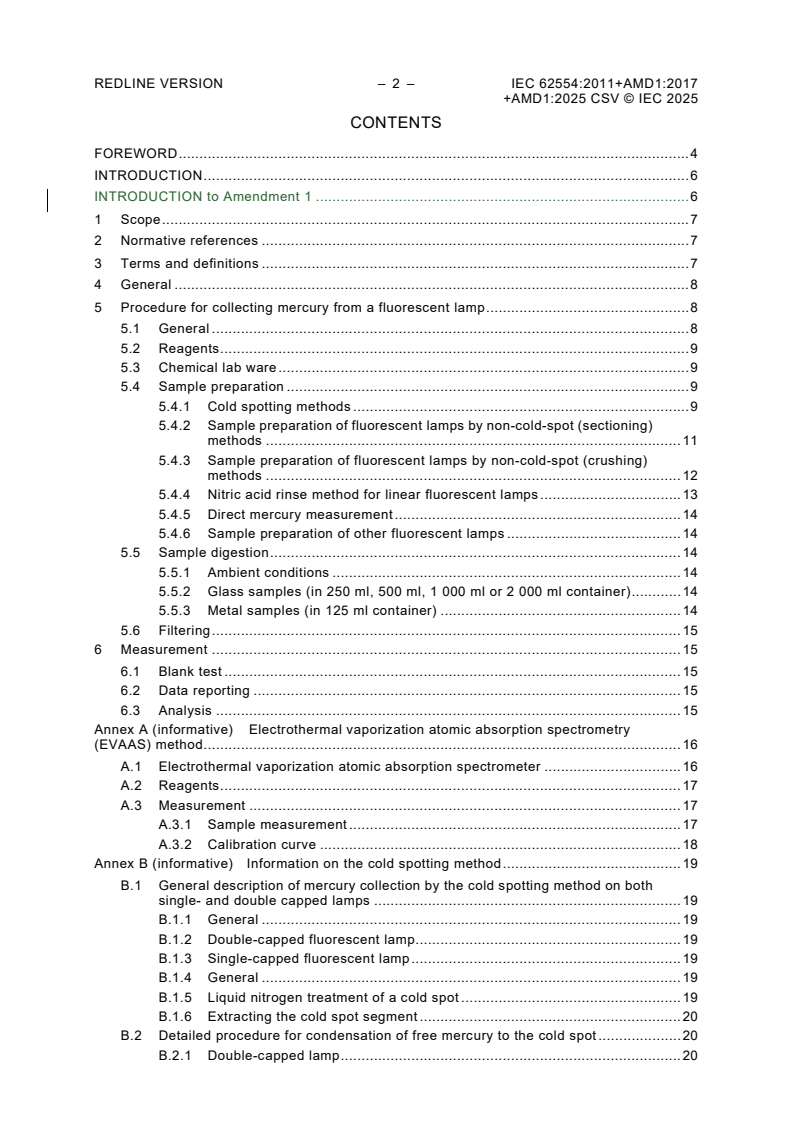
IEC 62554:2011+AMD1:2017+AMD2:2025 CSV - Sample preparation for measurement of mercury level in fluorescent lamps and low-pressure mercury UV radiation sources Released:2/11/2025
IEC 62554:2011 - Sample preparation for measurement of mercury level in fluorescent lamps Released:8/19/2011

IEC 62554:2011+AMD1:2017 CSV - Sample preparation for measurement of mercury level in fluorescent lamps Released:10/18/2017
Overview
IEC 62554:2011 provides standardized procedures for the sample preparation of new fluorescent lamps and low-pressure mercury UV radiation sources for the purpose of measuring mercury content. This International Standard, developed by the International Electrotechnical Commission (IEC), is crucial for laboratories, manufacturers, and regulators who need consistent and reliable methods for preparing lamp samples to determine mercury levels. The standard covers a range of fluorescent lamp types, including single capped, double capped, self-ballasted, and cold cathode fluorescent lamps (CCFL) for backlighting. Notably, this document addresses only new lamps and does not cover mercury measurements in spent lamps, as ongoing lamp operation leads to mercury incorporation into the glass, rendering recovery by these methods incomplete.
Key Topics
- Scope and Applicability
- Applies to new tubular fluorescent lamps and low-pressure mercury UV sources with at least 0.1 mg mercury.
- Excludes spent lamps and mercury diffused or reacted with discharge tube glass.
- Sample Preparation Techniques
- Cold Spotting Methods: Condenses free mercury for efficient collection prior to sample digestion.
- Non-Cold-Spot Methods: Includes sectioning and crushing of the lamp for sample preparation.
- Nitric Acid Rinse: Detailed procedure for linear lamps to dissolve surface mercury for analysis.
- Direct Measurement Preparation: Special approaches for small-diameter lamps (EEFL, CCFL).
- Reagents and Labware
- Specifies grade requirements for water and chemicals (e.g., potassium permanganate, nitric acid).
- Details the use of mercury non-absorbing labware and correct sample containers.
- Safety and Best Practices
- Emphasizes laboratory safety, environmental protection, and regulatory compliance.
- Stresses use of proper protective equipment and waste management protocols.
Applications
The procedures in IEC 62554:2011 ensure accurate sample preparation for mercury level measurement in new fluorescent lamps. Application sectors include:
- Quality Control and Compliance: Lamp manufacturers and importers rely on these methods to demonstrate compliance with environmental regulations, such as RoHS, which limit mercury content.
- Testing Laboratories: Accredited labs use this standard for consistent sample preparation before performing mercury analysis to ensure reliable, reproducible results.
- Regulatory Authorities: Environmental agencies reference IEC 62554:2011 in auditing, enforcement, and certification programs for lighting products.
- Research and Product Development: R&D teams leverage these methods to validate alternative lamp designs or changes in manufacturing processes that impact mercury dosing.
By standardizing sample preparation, this IEC standard facilitates data comparability across different organizations and national markets and supports global trade in lighting products.
Related Standards
For a comprehensive assessment and regulatory compliance, IEC 62554:2011 should be used alongside:
- IEC 62321: Specifies methods for measuring mercury content (and other restricted substances) in electrotechnical products.
- ISO/IEC 17025: Outlines general requirements for the competence of testing and calibration laboratories.
- ISO 3696: Defines water specifications for analytical laboratory use.
- IEC 62321-4: Details mercury determination methods for metals, polymers, and electronic components.
Integrating IEC 62554:2011 with these related standards ensures robust procedures for sample preparation and subsequent measurement, enabling accurate determination of mercury content and aiding conformance to international safety and environmental guidelines.
Relations
- Effective Date
- 05-Sep-2023
- Effective Date
- 05-Sep-2023
Buy Documents
IEC 62554:2011+AMD1:2017+AMD2:2025 CSV - Sample preparation for measurement of mercury level in fluorescent lamps and low-pressure mercury UV radiation sources Released:2/11/2025
IEC 62554:2011 - Sample preparation for measurement of mercury level in fluorescent lamps Released:8/19/2011
IEC 62554:2011+AMD1:2017 CSV - Sample preparation for measurement of mercury level in fluorescent lamps Released:10/18/2017
Get Certified
Connect with accredited certification bodies for this standard

IMQ S.p.A. (Certification)
Italian electrical product certification.

SLG Prüf- und Zertifizierungs GmbH
German testing and certification body.

UL Solutions
Global safety science company with testing, inspection and certification.
Sponsored listings
Frequently Asked Questions
IEC 62554:2011 is a standard published by the International Electrotechnical Commission (IEC). Its full title is "Sample preparation for measurement of mercury level in fluorescent lamps". This standard covers: IEC 62554:2011 specifies sample preparation methods for determining mercury levels in new tubular fluorescent lamps (including single capped, double capped, self-ballasted and CCFL for backlighting) containing 0,1 mg mercury or more. The intended resolution of the methods described in this standard is of the order of 5 %. Mercury level measurement of spent lamps is excluded, as during lamp operation, mercury gradually diffuses into the glass wall and reacts with the glass materials. The test method of this standard does not recover mercury that is diffused into or reacted with or otherwise incorporated irreversibly with the glass wall of discharge tubes. This standard does not contain information on measurement. Measurement is specified in IEC 62321.
IEC 62554:2011 specifies sample preparation methods for determining mercury levels in new tubular fluorescent lamps (including single capped, double capped, self-ballasted and CCFL for backlighting) containing 0,1 mg mercury or more. The intended resolution of the methods described in this standard is of the order of 5 %. Mercury level measurement of spent lamps is excluded, as during lamp operation, mercury gradually diffuses into the glass wall and reacts with the glass materials. The test method of this standard does not recover mercury that is diffused into or reacted with or otherwise incorporated irreversibly with the glass wall of discharge tubes. This standard does not contain information on measurement. Measurement is specified in IEC 62321.
IEC 62554:2011 is classified under the following ICS (International Classification for Standards) categories: 29.140.30 - Fluorescent lamps. Discharge lamps. The ICS classification helps identify the subject area and facilitates finding related standards.
IEC 62554:2011 has the following relationships with other standards: It is inter standard links to IEC 62554:2011/AMD2:2025, IEC 62554:2011/AMD1:2017. Understanding these relationships helps ensure you are using the most current and applicable version of the standard.
IEC 62554:2011 is available in PDF format for immediate download after purchase. The document can be added to your cart and obtained through the secure checkout process. Digital delivery ensures instant access to the complete standard document.
Standards Content (Sample)
IEC 62554 ®
Edition 1.2 2025-02
CONSOLIDATED VERSION
INTERNATIONAL
STANDARD
Sample preparation for measurement of mercury level in fluorescent lamps and
low-pressure mercury UV radiation sources
All rights reserved. Unless otherwise specified, no part of this publication may be reproduced or utilized in any form
or by any means, electronic or mechanical, including photocopying and microfilm, without permission in writing from
either IEC or IEC's member National Committee in the country of the requester. If you have any questions about IEC
copyright or have an enquiry about obtaining additional rights to this publication, please contact the address below or
your local IEC member National Committee for further information.
IEC Secretariat Tel.: +41 22 919 02 11
3, rue de Varembé info@iec.ch
CH-1211 Geneva 20 www.iec.ch
Switzerland
About the IEC
The International Electrotechnical Commission (IEC) is the leading global organization that prepares and publishes
International Standards for all electrical, electronic and related technologies.
About IEC publications
The technical content of IEC publications is kept under constant review by the IEC. Please make sure that you have the
latest edition, a corrigendum or an amendment might have been published.
IEC publications search - webstore.iec.ch/advsearchform IEC Products & Services Portal - products.iec.ch
The advanced search enables to find IEC publications by a Discover our powerful search engine and read freely all the
variety of criteria (reference number, text, technical publications previews, graphical symbols and the glossary.
committee, …). It also gives information on projects, replaced With a subscription you will always have access to up to date
and withdrawn publications. content tailored to your needs.
IEC Just Published - webstore.iec.ch/justpublished
Electropedia - www.electropedia.org
Stay up to date on all new IEC publications. Just Published
The world's leading online dictionary on electrotechnology,
details all new publications released. Available online and once
containing more than 22 500 terminological entries in English
a month by email.
and French, with equivalent terms in 25 additional languages.
Also known as the International Electrotechnical Vocabulary
IEC Customer Service Centre - webstore.iec.ch/csc
(IEV) online.
If you wish to give us your feedback on this publication or need
further assistance, please contact the Customer Service
Centre: sales@iec.ch.
IEC 62554 ®
Edition 1.2 2025-02
CONSOLIDATED VERSION
INTERNATIONAL
STANDARD
Sample preparation for measurement of mercury level in fluorescent lamps and
low-pressure mercury UV radiation sources
INTERNATIONAL
ELECTROTECHNICAL
COMMISSION
ICS 29.140.30 ISBN 978-2-8327-0224-6
REDLINE VERSION – 2 – IEC 62554:2011+AMD1:2017
+AMD1:2025 CSV © IEC 2025
CONTENTS
FOREWORD . 4
INTRODUCTION . 6
INTRODUCTION to Amendment 1 . 6
1 Scope . 7
2 Normative references . 7
3 Terms and definitions . 7
4 General . 8
5 Procedure for collecting mercury from a fluorescent lamp . 8
5.1 General . 8
5.2 Reagents . 9
5.3 Chemical lab ware . 9
5.4 Sample preparation . 9
5.4.1 Cold spotting methods . 9
5.4.2 Sample preparation of fluorescent lamps by non-cold-spot (sectioning)
methods . 11
5.4.3 Sample preparation of fluorescent lamps by non-cold-spot (crushing)
methods . 12
5.4.4 Nitric acid rinse method for linear fluorescent lamps . 13
5.4.5 Direct mercury measurement . 14
5.4.6 Sample preparation of other fluorescent lamps . 14
5.5 Sample digestion . 14
5.5.1 Ambient conditions . 14
5.5.2 Glass samples (in 250 ml, 500 ml, 1 000 ml or 2 000 ml container) . 14
5.5.3 Metal samples (in 125 ml container) . 14
5.6 Filtering . 15
6 Measurement . 15
6.1 Blank test . 15
6.2 Data reporting . 15
6.3 Analysis . 15
Annex A (informative) Electrothermal vaporization atomic absorption spectrometry
(EVAAS) method . 16
A.1 Electrothermal vaporization atomic absorption spectrometer . 16
A.2 Reagents . 17
A.3 Measurement . 17
A.3.1 Sample measurement . 17
A.3.2 Calibration curve . 18
Annex B (informative) Information on the cold spotting method . 19
B.1 General description of mercury collection by the cold spotting method on both
single- and double capped lamps . 19
B.1.1 General . 19
B.1.2 Double-capped fluorescent lamp. 19
B.1.3 Single-capped fluorescent lamp . 19
B.1.4 General . 19
B.1.5 Liquid nitrogen treatment of a cold spot . 19
B.1.6 Extracting the cold spot segment . 20
B.2 Detailed procedure for condensation of free mercury to the cold spot . 20
B.2.1 Double-capped lamp . 20
+AMD1:2025 CSV © IEC 2025
B.2.2 Single-capped lamp . 21
Bibliography . 22
Figure A.1 – Configuration of the electrothermal vaporization atomic absorption
spectrometry testing apparatus . 16
Figure A.2 – An example of the electrothermal vaporization atomic absorption
spectrometer test apparatus layout . 17
Figure B.1 – Example of glass cell arrangement . 20
Figure B.2 – Example of cooling device arrangement . 21
REDLINE VERSION – 4 – IEC 62554:2011+AMD1:2017
+AMD1:2025 CSV © IEC 2025
INTERNATIONAL ELECTROTECHNICAL COMMISSION
____________
SAMPLE PREPARATION FOR MEASUREMENT
OF MERCURY LEVEL IN FLUORESCENT LAMPS AND LOW-PRESSURE
MERCURY UV RADIATION SOURCES
FOREWORD
1) The International Electrotechnical Commission (IEC) is a worldwide organization for standardization comprising
all national electrotechnical committees (IEC National Committees). The object of IEC is to promote international
co-operation on all questions concerning standardization in the electrical and electronic fields. To this end and in
addition to other activities, IEC publishes International Standards, Technical Specifications, Technical Reports,
Publicly Available Specifications (PAS) and Guides (hereafter referred to as "IEC Publication(s)"). Their
preparation is entrusted to technical committees; any IEC National Committee interested in the subject dealt with
may participate in this preparatory work. International, governmental and non-governmental organizations liaising
with the IEC also participate in this preparation. IEC collaborates closely with the International Organization for
Standardization (ISO) in accordance with conditions determined by agreement between the two organizations.
2) The formal decisions or agreements of IEC on technical matters express, as nearly as possible, an international
consensus of opinion on the relevant subjects since each technical committee has representation from all
interested IEC National Committees.
3) IEC Publications have the form of recommendations for international use and are accepted by IEC National
Committees in that sense. While all reasonable efforts are made to ensure that the technical content of IEC
Publications is accurate, IEC cannot be held responsible for the way in which they are used or for any
misinterpretation by any end user.
4) In order to promote international uniformity, IEC National Committees undertake to apply IEC Publications
transparently to the maximum extent possible in their national and regional publications. Any divergence between
any IEC Publication and the corresponding national or regional publication shall be clearly indicated in the latter.
5) IEC itself does not provide any attestation of conformity. Independent certification bodies provide conformity
assessment services and, in some areas, access to IEC marks of conformity. IEC is not responsible for any
services carried out by independent certification bodies.
6) All users should ensure that they have the latest edition of this publication.
7) No liability shall attach to IEC or its directors, employees, servants or agents including individual experts and
members of its technical committees and IEC National Committees for any personal injury, property damage or
other damage of any nature whatsoever, whether direct or indirect, or for costs (including legal fees) and expenses
arising out of the publication, use of, or reliance upon, this IEC Publication or any other IEC Publications.
8) Attention is drawn to the Normative references cited in this publication. Use of the referenced publications is
indispensable for the correct application of this publication.
9) IEC draws attention to the possibility that the implementation of this document may involve the use of (a) patent(s).
IEC takes no position concerning the evidence, validity or applicability of any claimed patent rights in respect
thereof. As of the date of publication of this document, IEC had received notice of (a) patent(s), which may be
required to implement this document. However, implementers are cautioned that this may not represent the latest
information, which may be obtained from the patent database available at https://patents.iec.ch. IEC shall not be
held responsible for identifying any or all such patent rights.
This consolidated version of the official IEC Standard and its amendment has been
prepared for user convenience.
IEC 62554 edition 1.2 contains the first edition (2011-08) [documents 34A/1484/FDIS and
34A/1502/RVD], its amendment 1 (2017-10) [documents 34A/1997/CDV and 34A/2028/RVC]
and its amendment 2 (2025-02) [documents 34A/2398/CDV and 34A/2427/RVC].
In this Redline version, a vertical line in the margin shows where the technical content is
modified by amendments 1 and 2. Additions are in green text, deletions are in
strikethrough red text. A separate Final version with all changes accepted is available in
this publication.
+AMD1:2025 CSV © IEC 2025
International Standard IEC 62554 has been prepared by subcommittee 34A: Lamps, of IEC
technical committee 34: Lamps and related equipment.
This publication has been drafted in accordance with the ISO/IEC Directives, Part 2.
The committee has decided that the contents of this document and its amendments will remain
unchanged until the stability date indicated on the IEC website under webstore.iec.ch in the
data related to the specific document. At this date, the document will be
• reconfirmed,
• withdrawn, or
• revised.
REDLINE VERSION – 6 – IEC 62554:2011+AMD1:2017
+AMD1:2025 CSV © IEC 2025
INTRODUCTION
The International Electrotechnical Commission (IEC) draws attention to the fact that it is claimed
that compliance with this document may involve the use of a patent concerning Cold spotting
given in 5.4.1.
IEC takes no position concerning the evidence, validity and scope of this patent right.
The holder of this patent right has assured the IEC that he/she is willing to negotiate licences
free of charge with applicants throughout the world. In this respect, the statement of the holder
of this patent right is registered with IEC. Information may be obtained from:
General Electric Company
Appliance Park AP35-1002, Louisville, KY, 40225-0001, US
Attention is drawn to the possibility that some of the elements of this document may be the
subject of patent rights other than those identified above. IEC shall not be held responsible for
identifying any or all such patent rights.
ISO (www.iso.org/patents) and IEC (http://patents.iec.ch) maintain on-line data bases of patents
relevant to their standards. Users are encouraged to consult the data bases for the most up to
date information concerning patents.
According to IEC SMB 136/7 decision, the technical committee decided to remove designation of
a reference method.
INTRODUCTION to Amendment 1
IEC 62554 specifies the method of sample preparation for the measurement of mercury level in
fluorescent lamps. It refers to IEC 62321:2008 for the technique for determining the amount of
mercury.
In the meantime it has been found that for fluorescent lamps, some of the techniques specified
in IEC 62321 can lead to inaccurate and misleading results and in addition this standard has
been split into several parts.
In bilateral discussions between members of subcommittee 34A and technical committee 111, it
was agreed to update the relevant part of IEC 62321 and the reference made to it in IEC 62554.
Amendment 1 to IEC 62321-4 has now been published (IEC 62321-4:2013/AMD1:2017).
+AMD1:2025 CSV © IEC 2025
SAMPLE PREPARATION FOR MEASUREMENT
OF MERCURY LEVEL IN FLUORESCENT LAMPS AND LOW-PRESSURE
MERCURY UV RADIATION SOURCES
1 Scope
This International Standard specifies sample preparation methods for determining mercury
levels in new tubular fluorescent lamps (including single capped, double capped, self-ballasted
and cold cathode fluorescent lamp (CCFL) for backlighting) and new low-pressure mercury UV
radiation sources, containing 0,1 mg mercury or more. The intended resolution of the methods
described in this standard document is of the order of 5 %.
Mercury level measurement of spent lamps is excluded, as during lamp operation, mercury
gradually diffuses into the glass wall and reacts with the glass materials. The test method of this
standard does not recover mercury that is diffused into or reacted with or otherwise incorporated
irreversibly with the glass wall of discharge tubes.
This standard does not contain information on measurement. Measurement is specified in
IEC 62321.
2 Normative references
The following referenced documents are indispensable for the application of this document. For
dated references, only the edition cited applies. For undated references, the latest edition of the
referenced document (including any amendments) applies.
ISO/IEC 17025:2005, General requirements for the competence of testing and calibration
laboratories
IEC 62321:2008, Electrotechnical products – Determination of levels of six regulated
substances (lead, mercury, cadmium, hexavalent chromium, polybrominated biphenyls,
polybrominated diphenyl ethers)
IEC 62321-4:2013, Determination of certain substances in electrotechnical products – Part 4:
Mercury in polymers, metals and electronics by CV-AAS, CV-AFS, ICP-OES and ICP-MS
IEC 62321-4:2013/AMD1:2017
ISO 3696:1987, Water for analytical laboratory use – Specification and test methods
3 Terms and definitions
For the purposes of the present document, the following terms and definitions apply.
3.1
new lamp
a lamp that has not been energized since manufacture
3.2
cold cathode fluorescent lamp (CCFL) for backlighting
small diameter fluorescent lamp having cold cathode in the lamp, in which most of light is
emitted by the excitation of phosphors coated in discharge tube and used as backlight in LCD
REDLINE VERSION – 8 – IEC 62554:2011+AMD1:2017
+AMD1:2025 CSV © IEC 2025
3.3
external electrode fluorescent lamp (EEFL) for backlighting
small diameter fluorescent lamp having cold cathode attached outside the lamp, in which most of
light is emitted by the excitation of phosphors coated in discharge tube and used as backlighting
in LCD
EEFL is a subtype in CCFL lamp group.
4 General
Mercury in fluorescent lamps exists in the following states:
a) vapour in a lamp;
b) liquid metal;
c) compound;
d) alloy.
There is a wide variety of mercury dosing solutions including appearance and placement of
mercury dispensing devices and also composition and structure of those devices. Although
some of the lamps are dosed with amalgam or solid mercury alloy, there are also many
fluorescent lamps dosed with liquid mercury.
Amalgam dosed lamps often have device(s) that act as an auxiliary amalgam. Form and location
of these devices vary widely as well.
The introduction of a cold spot (see Annex B) minimizes the loss of mercury in the vapour state
when the discharge tube is opened. With the lamp operating, the cold spot will condense all the
mercury in the discharge, allowing superior control for mercury recovery.
The procedure in Clause 5 below includes a method to collect liquid mercury, mercury
compounds and alloys and amalgams.
The total amount of mercury is determined by measuring the amount of liquid mercury, mercury
compounds and alloys and amalgam.
The amount of mercury is calculated from the measured mercury concentration, the volume of
the filtered solution and the dilution factor.
Where "fluorescent lamp(s)" and "lamp(s)" are mentioned in Clause 5 and in Annex B of this
document, also "low-pressure mercury UV radiation source(s)" shall be read.
5 Procedure for collecting mercury from a fluorescent lamp
5.1 General
For test arrangement and ambient conditions, relevant parts of ISO/IEC 17025:2005 shall be
followed.
WARNING – Persons using this International Standard should be familiar with normal laboratory
practice. This standard does not purport to address all of the safety problems, if any, associated
with its use. It is the responsibility of the user to establish appropriate safety and health
practices, to avoid pollution of the environment and to ensure compliance with any national
regulatory conditions.
+AMD1:2025 CSV © IEC 2025
5.2 Reagents
The following reagents shall be used:
– water: Grade 1, as specified in ISO 3696;
–9
– the mass fraction of mercury in the following reagents shall be below 1 × 10 ;
– potassium permanganate 5 % aqueous solution (m/v);
– nitric acid, concentrated 65 %;
– hydrochloric acid, concentrated 37 %;
– hydrofluoric acid, concentrated 40 %.
5.3 Chemical lab ware
Chemical lab ware shall be verified to be mercury non-absorbing.
Chemical lab ware shall be as follows:
– disposable vacuum filter pack with medium retention filter;
– disposable wide mouth screw-capped plastic bottles: 125 ml, 250 ml, 500 ml, 1 000 ml,
2 000 ml;
– disposable wide mouth sturdy plastic bag nominal 500 ml, 1 000 ml;
– beaker 50 ml, 100 ml, 125 ml, 250 ml, 500 ml;
– volumetric flasks: 50 ml, 100 ml, 250 ml, 500 ml;
– micropipettes;
– dispensers;
– bench coat: sheet of plastic lined laboratory bench paper.
NOTE The plastic bag may be clear polyethylene or similar chemical and acid resistant material nominally 0,01 mm
or thicker. The 1 000 ml bag would be approximately 200 mm × 300 mm. Sometimes known as a “blender or stomacher
bag” they are available from biological laboratory suppliers. Bag size may be adjusted to suit availability and lamp size
being tested.
5.4 Sample preparation
Sample preparation process shall be a continuous operation without excessive hold time.
5.4.1 Cold spotting methods
5.4.1.1 General
Cold spotting is a method for condensing free mercury in a localized position (see Annex B).
The mercury localization occurs while the low-pressure discharge lamp is “ON” under normal
operating conditions while a small area (the cold spot) of the discharge tube is maintained at a
low temperature. During the cold spotting process, no heavy end blackening should be
observed.
When the free mercury is fully condensed, the total light output of the lamp will drop significantly
and the discharge colour will typically turn pink change throughout the lamp. The process of free
mercury localization (cold -spotting) is then completed.
NOTE Mercury collection with cold spot below 0 °C and operating with the normal control gear of the lamp may take
several days.
REDLINE VERSION – 10 – IEC 62554:2011+AMD1:2017
+AMD1:2025 CSV © IEC 2025
5.4.1.2 Sample preparation of self-ballasted and single capped compact fluorescent
multi limbed lamps with cold-spotting
Discharge tube cutting operations shall be carried out above the wide mouth screw capped
plastic bottle to minimize the risk of material loss.
Sample containers shall be as follows.
– Use 250 ml wide mouth screw-capped plastic bottle for cold spot section as first container.
– Use 125 ml wide mouth screw-capped plastic bottle for end portions of discharge tube as
second container.
– Use 500 ml or 1 000 ml wide mouth screw-capped plastic bottle for glass parts of discharge
tube, depending on which one fits better to the discharge tube dimensions under test as third
container.
The sample preparation shall be executed according to the process steps listed below.
a) Separate discharge tube from its outer bulb, if any.
b) Clean the discharge tube with chemical wipe.
c) Mark discharge tube in a non-destructive manner for first sectioning. Mark 3 cm on both
sides of the cold spot.
d) Collect the free mercury with cold spotting – see 5.4.1.1 – until mercury starvation is verified.
e) Remove lamp from cooler. Keep lamp in same position as it was during cold spotting until
sectioning.
f) Place the lamp on cutting table covered by bench coat – with the plastic side up, toward the
lamp.
g) Score and break the discharge tube at the first mark allowing the arc tube to fill with air
slowly so that no fluorescent powder coating of the tube is blown off.
h) Break the lamp fully at the first mark. Score and break the lamp at the other mark around the
cold spot. Place cold spot section (6 cm) immediately into the first container. Close the
container. Shake first container allowing the discharge tube section to crush. Keep the first
container in crushed ice until digestion. Allow 5 min for the floating dust to settle before
continuing. Proceed to 5.5.2 sample digestion with the first container immediately.
i) Next, separate discharge tube from plastic surrounds and associated electronics, if any. Cut
associated lead wires as close to the glass seal as possible. Only the discharge tube will be
used for mercury level measurement.
j) Score and break all tip offs and check for metal parts. Crush tip offs with pliers into the
second container.
k) Score both of the lead wire containing ends of the discharge tube approximately 7 mm from
the end of the tube. Pre-score discharge tube for sectioning, step n) below. Use the minimum
possible number of sections allowing the parts to fit into the third container.
l) Cut lead wire containing ends of the discharge tube at the score using hot rod or hot wire.
m) Check end portions for any hollow glass objects and crush them gently with pliers into the
second container. Carefully avoid touching the content of hollow glass objects with the pliers.
Place the removed end portions – inclusive of metal parts in them – of the discharge tube
into the second container and close the container.
n) Section the discharge tube using hot rod or wire at scores marked in step k) above.
o) Place discharge tube section(s) into the third container.
p) Check bench coat for material chips. Any material on bench coat shall be placed into the
third container. Then, close the third container.
q) Shake the third container allowing the discharge tube sections(s) to crush. Allow 5 min for
the floating dust to settle before continuing.
Samples are ready for digestion. Proceed to 5.5 sample digestion immediately.
+AMD1:2025 CSV © IEC 2025
5.4.1.3 Sample preparation of linear fluorescent lamps with cold spotting
Sample containers shall be as follows.
– Use 250 ml or 500 ml wide mouth screw-capped plastic bottle for cold spot section as first
container.
– Use 125 ml wide mouth screw-capped plastic bottle for end portions of discharge tube as
second container.
– Use 250 ml, 500 ml , 1 000 ml or 2 000 ml wide mouth screw-capped plastic bottle for glass
parts of discharge tube, depending on which one fits better to the discharge tube dimensions
under test as third container.
The sample preparation shall be executed according to the process steps listed below.
a) Separate discharge tube from its fragment retention cover, if any.
b) Mark discharge tube in a non-destructive manner for first sectioning. Mark 12 cm from the
labelled end for the initial cut; mark 6 cm on both sides of the cold spot.
c) Collect the free mercury with cold spotting – see 5.4.1.1 – until mercury starvation is verified.
d) Remove lamp from cooler. Keep lamp horizontal until sectioning.
e) Place the lamp on cutting table covered by bench coat – with the plastic side up, toward the
lamp.
f) Score and break the discharge tube at the first mark allowing the arc tube to fill with air
slowly so that no fluorescent powder coating of the tube is blown off.
g) Score and break the lamp at the remaining two marks. Place cold spot section (12 cm)
immediately into the first container. Close the first container. Shake the first container
Keep the first container in crushed ice until
allowing the discharge tube section to crush.
digestion. Allow 5 min for the floating dust to settle before continuing. Proceed to the 5.5.2
sample digestion immediately.
h) Next, separate discharge tube from its plastic and metallic surrounds. Cut associated lead
wires as close to the glass seal as possible. Only the discharge tube will be used for mercury
level measurement.
i) Score both of the lead wire containing ends of the discharge tube approximately 7 mm from
the end of the tube. Pre-score discharge tube for sectioning. Use the minimum possible
number of sections allowing the parts to fit into the third container.
j) Section the ends of the discharge tube using hot rod or wire at scores marked. Score and
break tip offs and check for metal parts. Crush tip offs with pliers into the second container.
Check end portions for any hollow glass objects and crush them gently with pliers into the
second container. Carefully avoid touching the content of hollow glass objects with the pliers.
Place the end portions – inclusive of metal parts in them – of the discharge tube into the
second container and close the second container.
k) Section the remaining discharge tube using hot rod or wire at scores marked in step i).
l) Place discharge tube sections into the third container.
m) Check bench coat for material chips. Any material on bench coat shall be placed into the
third container. Then close the third container.
n) Shake the third container allowing the discharge tube to crush. Allow 5 min for the floating
dust to settle before opening.
Samples are ready for digestion. Proceed to 5.5 sample digestion immediately.
5.4.2 Sample preparation of fluorescent lamps by non-cold-spot (sectioning) methods
Sample containers shall be as follows.
– Use 500 ml or 1 000 ml wide mouth screw-capped plastic bottle for glass parts of discharge
tube, depending on which one fits better to the discharge tube dimensions under test as first
container.
REDLINE VERSION – 12 – IEC 62554:2011+AMD1:2017
+AMD1:2025 CSV © IEC 2025
– Use 125 ml wide mouth screw-capped plastic bottle for end portions of discharge tube as
second container.
The sample preparation shall be executed according to the process steps listed below.
a) Separate discharge tube from its outer bulb, if any.
b) Separate discharge tube from its plastic and metallic surrounds. Cut associated lead wires
as close to the glass seal as possible. Only the discharge tube will be used for mercury level
measurement.
c) Clean the discharge tube with chemical wipe.
d) Place the lamp on cutting table covered by bench coat – with the plastic side up, toward the
lamp.
e) Score both of the lead wire containing ends of the discharge tube approximately 7 mm from
the end of the tube. Pre-score discharge tube for sectioning. Use the minimum possible
number of sections allowing the parts to fit into the first container.
f) Select a tip off that does not contain metal part. Score and break it allowing the discharge
tube to fill with air slowly that no fluorescent powder coating of the tube is blown off. Break tip
off with pliers into the second container.
g) Score and break all tip offs and check for metal parts. Break tip-offs with pliers into the
second container.
h) Cut lead wire containing ends of the discharge tube at the score using hot rod or hot wire.
i) Check end portions for any hollow glass objects and crush them gently with pliers into the
second container. Carefully avoid touching the content of hollow glass objects with the pliers.
Place the removed end portions – inclusive of metal parts in them – of the discharge tube
into the second container.
j) Section the discharge tube using hot rod or wire at scores marked in step e).
k) Place discharge tube sections into the first container.
l) Check bench coat for material chips. Any material on bench coat shall be placed into the first
container. Then close the first container.
m) Shake the first container allowing the discharge tube to crush. Allow 5 min for the floating
dust to settle before continuing.
Samples are ready for digestion. Proceed to 5.5 sample digestion immediately.
5.4.3 Sample preparation of fluorescent lamps by non-cold-spot (crushing) methods
The sample preparation shall be executed according to the following procedure.
a) Separate discharge tube from any plastic surrounds or metallic ends. Cut lead wires as close
to the glass seal as possible. Only the discharge tube will be used for mercury measurement.
b) Clean the discharge tube with a chemical wipe to remove any dust particles.
c) Using pliers, break the tip off at one end of the fluorescent lamp, allowing the discharge tube
to fill with air. Place broken tip into plastic bag.
d) Squirt a small amount (approximately 3 ml) of deionised water into the fluorescent lamp to
wet the phosphor powder inside the lamp. This will prevent the loss of any mercury contained
in the dry phosphor coating when the bulb is broken into pieces.
e) If the fluorescent lamp is of a small compact type (single capped fluorescent multi limbed),
place the whole lamp into a wide mouthed thick plastic bag. Fold over the open end to create
a temporary seal and using a mallet carefully break the lamp into small pieces hitting the
outside of the bag.
f) If the fluorescent lamp is of a linear type, place the first portion in to a wide mouth thick
plastic bag. Carefully using a mallet break the lamp hitting the outside of the bag while
feeding the non-broken end into the bag until all the linear lamp is in the bag. Fold over the
open end to create a temporary seal and using a mallet carefully break the lamp into small
pieces hitting the outside of the bag.
+AMD1:2025 CSV © IEC 2025
g) Empty the contents of the plastic bag into a suitable sized first container of 5.4.2.
h) Rinse the contents of the plastic bag using a small amount of deionised water. This can be
achieved by cutting the sealed end of the plastic bag off and rinsing the inside straight into
the container with the broken lamp.
Samples are ready for digestion. Proceed to sample digestion immediately according to 5.5.2. If
any metals remain after digestion according to 5.5.2 these are to be dissolved using step 5.5.3.
5.4.4 Nitric acid rinse method for linear fluorescent lamps
Sample containers shall be as follows.
– Use 50 ml or 100 ml plastic sample beaker for end portions of discharge tube as first
container.
– Use 250 ml plastic sample beaker as second container.
The sample preparation shall be executed according to the process steps listed below.
a) Separate discharge tube from its fragment retention cover, if any.
b) Separate discharge tube from its plastic and metallic surrounds (including end caps). Cut
associated lead wires as close to the glass seal as possible. Only the discharge tube will be
used for mercury level measurement.
c) Carefully break the tip-off, crush and collect it into the first container. Inject a volume of
concentrated nitric acid 1/30th of the lamps interior volume using a pipette or an injection
syringe having no attached needle. Alternatively use the following method for the injection of
nitric acid. Place a plastic tubing over the tip-off. Place the other end of the tubing into a
vessel containing the appropriate volume of nitric acid. Carefully break the tip-off inside the
tubing with a pair of needle nose pliers. The less than atmosphere pressure inside the lamp
will draw the acid into the lamp.
NOTE 1 An appropriate example of plastic tubing is a 30 cm piece of Tygon or PVC tubing with 4,8 mm inner and
7,9 mm outer diameter.
d) Holding the lamp in a near horizontal orientation, rotate the lamp such that the acid contacts
all interior surfaces. Place the lamp in a vertical orientation for 15 min. Repeat this procedure
a minimum of three times.
e) Remove the open tip-off end of the lamp (approximately 2 cm) using a diamond pen or hot
wire and place the 2 cm section including the coil mount into the first container. Decant the
concentrated nitric acid from the lamp into the second container.
f) Wash the interior of the lamp with water and decant into the second container. Wash the
interior of the lamp a minimum of five times.
g) Remove the other end of the lamp (approximately 2 cm) using a diamond pen or hot wire.
Crush tip off with pliers into the first container and place the 2 cm section including the coil
mount also into the first container. Add an appropriate volume of concentrated nitric acid
and allow to stand for at least 15 min.
h) Decant the concentrated nitric acid from the first container into the second container and
wash the first container a minimum of three times with water and decant into the second
container.
i) Transfer all glass components from the first container to the second container, leaving the
metallic components.
NOTE 2 It is important that the majority of glass is removed from the first container as this may influence the results
of the metal digestion using HF (see 5.5.3).
j) Process the first container in accordance with 5.5.3 digestion of metal samples.
k) Process the second container in accordance with 5.5.2 b) digestion of glass samples.
5.4.5 Direct mercury measurement
This method is applicable for small diameter fluorescent lamps (e.g. EEFL, CCFL).
REDLINE VERSION – 14 – IEC 62554:2011+AMD1:2017
+AMD1:2025 CSV © IEC 2025
The sample preparation shall be executed according to the process steps listed below.
a) Cut associated lead wires as close to the glass seal as possible. Remove the external
electrodes of EEFL. Only the discharge tube will be used for mercury level measurement
(see Note 1).
b) Clean the discharge tube with a chemical wipe.
c) Make scratches and section discharge tube near the both ends. Then section discharge tube
remainder into 100 mm segments. Place discharge tube segments on a quartz boat (see
Note 2).
Sample is ready for analysis with electrothermal vaporization atomic absorption spectrometry.
NOTE 1 Any solder adhered to the lead may cause contamination in the measurement section because it has a low
boiling point and contains paste. Completely remove any oil from the surface as it may cause contamination in the
measurement section.
NOTE 2 Carefully break the sample just above the boat, so that the mercury does not scatter.
5.4.6 Sample preparation of other fluorescent lamps
For any other differently shaped fluorescent lamps follow 5.4.1.2 if lamp is self-ballasted or
5.4.1.3 if not self-ballasted.
5.5 Sample digestion
5.5.1 Ambient conditions
The sample digestion shall be executed at room temperature.
5.5.2 Glass samples (in 250 ml, 500 ml, 1 000 ml or 2 000 ml container)
Samples prepared according to Subclause 5.4.1.2 h), 5.4.1.2 q) , 5.4.1.3 g), 5.4.1.3 n), 5.4.2. k),
5.4.3 h) and 5.4.4 k).
The following recipe applies to samples in 250 ml container. For samples in 500 ml, 1 000 ml or
2 000 ml container, use appropriate multiple (2x, 4x, 8x) amount of each listed ingredient. Make
sure that acid mixture covers crushed material.
The sample digestion shall be executed according to the process steps listed below.
a) Add 25 ml concentrated nitric acid. Add 10 ml water and swirl to mix.
b) Add 0,25 ml of 5 % potassium permanganate and allow to stand for 16 h (overnight) in a
well-ventilated fume cupboard.
NOTE To accelerate reactions, heating solution up to 80 degree centigrade on a hot plate is also allowed.
If any metal remains after digestion these are to be dissolved using step 5.5.3.
5.5.3 Metal samples (in 125 ml container)
Samples prepared according to Subclause 5.4.1.2 m), 5.4.1.3 j), 5.4.2.i) and 5.4.4.j).
The sample digestion shall be executed according to the process steps listed below.
a) Add 3 ml concentrated hydrochloric acid and 1 ml concentrated nitric acid.
b) If dissolution is incomplete except tungsten coils, add 2 ml HF.
When all metals (not necessarily glass materials) are dissolved, add 20 ml nitric acid. Add
10 ml water and swirl to mix.
c) Add 0,25 ml of 5 % potassium permanganate and let stand for 16 h (overnight) in a
well-ventilated fume cupboard.
+AMD1:2025 CSV © IEC 2025
NOTE To accelerate reactions, heating solution up to 80 degree centigrade on a hot plate is also allowed.
5.6 Filtering
Filter all digested samples through a medium retention filter into the same 250 ml (500 ml,
1 000 ml or 2 000 ml) volumetric filter flask and dilute with deionised water to the mark on the
flask. The filter packs are never reused.
6 Measurement
6.1 Blank test
Before sample is treated, a blank test should be performed in order to confirm that the blank
value has no influence on the sample measurement value.
6.2 Data reporting
Measurements should be repeated three times on each of the extracted solutions. The reported
values should be the average and 95 % confidence interval of the average.
Amount of mercury measured in accordance with this standard should be expressed with 2
significant digits.
6.3 Analysis
The analytical test procedure shall comply with the requirements of Clause 7 of IEC 62321-4.
NOTE For measurements of mercury in fluorescent lamps IEC 62321-4:2013/AMD1:2017 gives a warning about
matrix effects in 5.1, and a recommendation of "CV-AAS" as the preferred analytical method in 8.1.
For 5.4.5 sample preparation method, the electrothermal vaporization atomic absorption
spectrometry method is applicable (see Annex A).
REDLINE VERSION – 16 – IEC 62554:2011+AMD1:2017
+AMD1:2025 CSV © IEC 2025
Annex A
(informative)
Electrothermal vaporization atomic absorption spectrometry
(EVAAS) method
A.1 Electrothermal vaporization atomic absorption spectrometer
The mercury vapour generator vaporizes mercury from the sample by heating broken pieces of
a lamp. This mercury vapour is then introduced into the atomic absorption spectrometer to
measure the total mercury quantity. The atomic absorption spectrometer should be stable and
linear across the measuring range. The controller monitors the ultraviolet absorbance of
mercury introduced into the spectrometer, and controls the temperature of the generator so
that the absorbance does not exceed the linear range of the spectrometer. The integrator sums
the ultraviolet absorbance signal during the entire heating period. Figure A.1 shows a block
diagram of the EVAAS test. Figure A.2 illustrates an example of an EVAAS test apparatus
layout.
Controller
Atomic absorption
UV source
and
spectrometer
integrator
Mercury vapour
generator
IEC 1848/11
Figure A.1 – Configuration of the electrothermal vaporization
atomic absorption spectrometry testing apparatus
------------------
...
IEC 62554 ®
Edition 1.0 2011-08
INTERNATIONAL
STANDARD
NORME
INTERNATIONALE
colour
inside
Sample preparation for measurement of mercury level in fluorescent lamps
Préparation des échantillons en vue de la mesure du niveau de mercure dans
les lampes fluorescentes
All rights reserved. Unless otherwise specified, no part of this publication may be reproduced or utilized in any form or by
any means, electronic or mechanical, including photocopying and microfilm, without permission in writing from either IEC or
IEC's member National Committee in the country of the requester.
If you have any questions about IEC copyright or have an enquiry about obtaining additional rights to this publication,
please contact the address below or your local IEC member National Committee for further information.
Droits de reproduction réservés. Sauf indication contraire, aucune partie de cette publication ne peut être reproduite
ni utilisée sous quelque forme que ce soit et par aucun procédé, électronique ou mécanique, y compris la photocopie
et les microfilms, sans l'accord écrit de la CEI ou du Comité national de la CEI du pays du demandeur.
Si vous avez des questions sur le copyright de la CEI ou si vous désirez obtenir des droits supplémentaires sur cette
publication, utilisez les coordonnées ci-après ou contactez le Comité national de la CEI de votre pays de résidence.
IEC Central Office
3, rue de Varembé
CH-1211 Geneva 20
Switzerland
Email: inmail@iec.ch
Web: www.iec.ch
About the IEC
The International Electrotechnical Commission (IEC) is the leading global organization that prepares and publishes
International Standards for all electrical, electronic and related technologies.
About IEC publications
The technical content of IEC publications is kept under constant review by the IEC. Please make sure that you have the
latest edition, a corrigenda or an amendment might have been published.
Catalogue of IEC publications: www.iec.ch/searchpub
The IEC on-line Catalogue enables you to search by a variety of criteria (reference number, text, technical committee,…).
It also gives information on projects, withdrawn and replaced publications.
IEC Just Published: www.iec.ch/online_news/justpub
Stay up to date on all new IEC publications. Just Published details twice a month all new publications released. Available
on-line and also by email.
Electropedia: www.electropedia.org
The world's leading online dictionary of electronic and electrical terms containing more than 20 000 terms and definitions
in English and French, with equivalent terms in additional languages. Also known as the International Electrotechnical
Vocabulary online.
Customer Service Centre: www.iec.ch/webstore/custserv
If you wish to give us your feedback on this publication or need further assistance, please visit the Customer Service
Centre FAQ or contact us:
Email: csc@iec.ch
Tel.: +41 22 919 02 11
Fax: +41 22 919 03 00
A propos de la CEI
La Commission Electrotechnique Internationale (CEI) est la première organisation mondiale qui élabore et publie des
normes internationales pour tout ce qui a trait à l'électricité, à l'électronique et aux technologies apparentées.
A propos des publications CEI
Le contenu technique des publications de la CEI est constamment revu. Veuillez vous assurer que vous possédez
l’édition la plus récente, un corrigendum ou amendement peut avoir été publié.
Catalogue des publications de la CEI: www.iec.ch/searchpub/cur_fut-f.htm
Le Catalogue en-ligne de la CEI vous permet d’effectuer des recherches en utilisant différents critères (numéro de référence,
texte, comité d’études,…). Il donne aussi des informations sur les projets et les publications retirées ou remplacées.
Just Published CEI: www.iec.ch/online_news/justpub
Restez informé sur les nouvelles publications de la CEI. Just Published détaille deux fois par mois les nouvelles
publications parues. Disponible en-ligne et aussi par email.
Electropedia: www.electropedia.org
Le premier dictionnaire en ligne au monde de termes électroniques et électriques. Il contient plus de 20 000 termes et
définitions en anglais et en français, ainsi que les termes équivalents dans les langues additionnelles. Egalement appelé
Vocabulaire Electrotechnique International en ligne.
Service Clients: www.iec.ch/webstore/custserv/custserv_entry-f.htm
Si vous désirez nous donner des commentaires sur cette publication ou si vous avez des questions, visitez le FAQ du
Service clients ou contactez-nous:
Email: csc@iec.ch
Tél.: +41 22 919 02 11
Fax: +41 22 919 03 00
IEC 62554 ®
Edition 1.0 2011-08
INTERNATIONAL
STANDARD
NORME
INTERNATIONALE
colour
inside
Sample preparation for measurement of mercury level in fluorescent lamps
Préparation des échantillons en vue de la mesure du niveau de mercure dans
les lampes fluorescentes
INTERNATIONAL
ELECTROTECHNICAL
COMMISSION
COMMISSION
ELECTROTECHNIQUE
PRICE CODE
INTERNATIONALE
CODE PRIX S
ICS 29.140.30 ISBN 978-2-88912-632-3
– 2 – 62554 © IEC:2011
CONTENTS
FOREWORD . 3
INTRODUCTION . 5
1 Scope . 6
2 Normative references . 6
3 Terms and definitions . 6
4 General . 7
5 Procedure for collecting mercury from a fluorescent lamp . 7
5.1 General . 7
5.2 Reagents . 7
5.3 Chemical lab ware . 8
5.4 Sample preparation . 8
5.4.1 Cold spotting methods . 8
5.4.2 Sample preparation of fluorescent lamps by non-cold-spot (sectioning)
methods . 10
5.4.3 Sample preparation of fluorescent lamps by non-cold-spot (crushing)
methods . 11
5.4.4 Nitric acid rinse method for linear fluorescent lamps . 12
5.4.5 Direct mercury measurement . 12
5.4.6 Sample preparation of other fluorescent lamps . 13
5.5 Sample digestion . 13
5.5.1 Ambient conditions . 13
5.5.2 Glass samples (in 250 ml, 500 ml, 1 000 ml or 2 000 ml container) . 13
5.5.3 Metal samples (in 125 ml container) . 13
5.6 Filtering . 14
6 Measurement . 14
6.1 Blank test . 14
6.2 Data reporting . 14
6.3 Analysis . 14
Annex A (informative) Electrothermal vaporization atomic absorption spectrometry
(EVAAS) method . 15
Annex B (informative) Information on the cold spotting method . 18
Figure A.1 – Configuration of the electrothermal vaporization atomic absorption
spectrometry testing apparatus . 15
Figure A.2 – An example of the electrothermal vaporization atomic absorption
spectrometer test apparatus layout . 16
Figure B.1 – Example of glass cell arrangement . 19
Figure B.2 – Example of cooling device arrangement . 20
62554 © IEC:2011 – 3 –
INTERNATIONAL ELECTROTECHNICAL COMMISSION
____________
SAMPLE PREPARATION FOR MEASUREMENT
OF MERCURY LEVEL IN FLUORESCENT LAMPS
FOREWORD
1) The International Electrotechnical Commission (IEC) is a worldwide organization for standardization comprising
all national electrotechnical committees (IEC National Committees). The object of IEC is to promote international
co-operation on all questions concerning standardization in the electrical and electronic fields. To this end and in
addition to other activities, IEC publishes International Standards, Technical Specifications, Technical Reports,
Publicly Available Specifications (PAS) and Guides (hereafter referred to as “IEC Publication(s)”). Their
preparation is entrusted to technical committees; any IEC National Committee interested in the subject dealt with
may participate in this preparatory work. International, governmental and non-governmental organizations liaising
with the IEC also participate in this preparation. IEC collaborates closely with the International Organization for
Standardization (ISO) in accordance with conditions determined by agreement between the two organizations.
2) The formal decisions or agreements of IEC on technical matters express, as nearly as possible, an international
consensus of opinion on the relevant subjects since each technical committee has representation from all
interested IEC National Committees.
3) IEC Publications have the form of recommendations for international use and are accepted by IEC National
Committees in that sense. While all reasonable efforts are made to ensure that the technical content of IEC
Publications is accurate, IEC cannot be held responsible for the way in which they are used or for any
misinterpretation by any end user.
4) In order to promote international uniformity, IEC National Committees undertake to apply IEC Publications
transparently to the maximum extent possible in their national and regional publications. Any divergence between
any IEC Publication and the corresponding national or regional publication shall be clearly indicated in the latter.
5) IEC itself does not provide any attestation of conformity. Independent certification bodies provide conformity
assessment services and, in some areas, access to IEC marks of conformity. IEC is not responsible for any
services carried out by independent certification bodies.
6) All users should ensure that they have the latest edition of this publication.
7) No liability shall attach to IEC or its directors, employees, servants or agents including individual experts and
members of its technical committees and IEC National Committees for any personal injury, property damage or
other damage of any nature whatsoever, whether direct or indirect, or for costs (including legal fees) and expenses
arising out of the publication, use of, or reliance upon, this IEC Publication or any other IEC Publications.
8) Attention is drawn to the Normative references cited in this publication. Use of the referenced publications is
indispensable for the correct application of this publication.
9) Attention is drawn to the possibility that some of the elements of this IEC Publication may be the subject of patent
rights. IEC shall not be held responsible for identifying any or all such patent rights.
International Standard IEC 62554 has been prepared by subcommittee 34A: Lamps, of IEC
technical committee 34: Lamps and related equipment.
The text of this standard is based on the following documents:
FDIS Report on voting
34A/1484/FDIS 34A/1502/RVD
Full information on the voting for the approval of this standard can be found in the report on
voting indicated in the above table.
This publication has been drafted in accordance with the ISO/IEC Directives, Part 2.
– 4 – 62554 © IEC:2011
The committee has decided that the contents of this publication will remain unchanged until the
stability date indicated on the IEC web site under "http://webstore.iec.ch" in the data related to
the specific publication. At this date, the publication will be
• reconfirmed,
• withdrawn,
• replaced by a revised edition, or
• amended.
IMPORTANT – The 'colour inside' logo on the cover page of this publication indicates
that it contains colours which are considered to be useful for the correct understanding
of its contents. Users should therefore print this document using a colour printer.
62554 © IEC:2011 – 5 –
INTRODUCTION
The International Electrotechnical Commission (IEC) draws attention to the fact that it is claimed
that compliance with this document may involve the use of a patent concerning Cold spotting
given in 5.4.1.
IEC takes no position concerning the evidence, validity and scope of this patent right.
The holder of this patent right has assured the IEC that he/she is willing to negotiate licences
free of charge with applicants throughout the world. In this respect, the statement of the holder
of this patent right is registered with IEC. Information may be obtained from:
General Electric Company
Appliance Park AP35-1002, Louisville, KY, 40225-0001, US
Attention is drawn to the possibility that some of the elements of this document may be the
subject of patent rights other than those identified above. IEC shall not be held responsible for
identifying any or all such patent rights.
ISO (www.iso.org/patents) and IEC (http://patents.iec.ch) maintain on-line data bases of patents
relevant to their standards. Users are encouraged to consult the data bases for the most up to
date information concerning patents.
According to IEC SMB 136/7 decision, the technical committee decided to remove designation of
a reference method.
– 6 – 62554 © IEC:2011
SAMPLE PREPARATION FOR MEASUREMENT
OF MERCURY LEVEL IN FLUORESCENT LAMPS
1 Scope
This International Standard specifies sample preparation methods for determining mercury
levels in new tubular fluorescent lamps (including single capped, double capped, self-ballasted
and CCFL for backlighting) containing 0,1 mg mercury or more. The intended resolution of the
methods described in this standard is of the order of 5 %.
Mercury level measurement of spent lamps is excluded, as during lamp operation, mercury
gradually diffuses into the glass wall and reacts with the glass materials. The test method of this
standard does not recover mercury that is diffused into or reacted with or otherwise incorporated
irreversibly with the glass wall of discharge tubes.
This standard does not contain information on measurement. Measurement is specified in
IEC 62321.
2 Normative references
The following referenced documents are indispensable for the application of this document. For
dated references, only the edition cited applies. For undated references, the latest edition of the
referenced document (including any amendments) applies.
ISO/IEC 17025:2005, General requirements for the competence of testing and calibration
laboratories
IEC 62321:2008, Electrotechnical products – Determination of levels of six regulated
substances (lead, mercury, cadmium, hexavalent chromium, polybrominated biphenyls,
polybrominated diphenyl ethers)
ISO 3696:1987, Water for analytical laboratory use – Specification and test methods
3 Terms and definitions
For the purposes of the present document, the following terms and definitions apply.
3.1
new lamp
a lamp that has not been energized since manufacture
3.2
cold cathode fluorescent lamp (CCFL) for backlighting
small diameter fluorescent lamp having cold cathode in the lamp, in which most of light is
emitted by the excitation of phosphors coated in discharge tube and used as backlight in LCD
3.3
external electrode fluorescent lamp (EEFL) for backlighting
small diameter fluorescent lamp having cold cathode attached outside the lamp, in which most of
light is emitted by the excitation of phosphors coated in discharge tube and used as backlighting
in LCD
EEFL is a subtype in CCFL lamp group.
62554 © IEC:2011 – 7 –
4 General
Mercury in fluorescent lamps exists in the following states:
a) vapour in a lamp;
b) liquid metal;
c) compound;
d) alloy.
There is a wide variety of mercury dosing solutions including appearance and placement of
mercury dispensing devices and also composition and structure of those devices. Although
some of the lamps are dosed with amalgam or solid mercury alloy, there are also many
fluorescent lamps dosed with liquid mercury.
Amalgam dosed lamps often have device(s) that act as an auxiliary amalgam. Form and location
of these devices vary widely as well.
The introduction of a cold spot (see Annex B) minimizes the loss of mercury in the vapour state
when the discharge tube is opened. With the lamp operating, the cold spot will condense all the
mercury in the discharge, allowing superior control for mercury recovery.
The procedure in Clause 5 below includes a method to collect liquid mercury, mercury
compounds and alloys and amalgams.
The total amount of mercury is determined by measuring the amount of liquid mercury, mercury
compounds and alloys and amalgam.
The amount of mercury is calculated from the measured mercury concentration, the volume of
the filtered solution and the dilution factor.
5 Procedure for collecting mercury from a fluorescent lamp
5.1 General
For test arrangement and ambient conditions, relevant parts of ISO/IEC 17025:2005 shall be
followed.
WARNING – Persons using this International Standard should be familiar with normal laboratory
practice. This standard does not purport to address all of the safety problems, if any, associated
with its use. It is the responsibility of the user to establish appropriate safety and health
practices, to avoid pollution of the environment and to ensure compliance with any national
regulatory conditions.
5.2 Reagents
The following reagents shall be used:
– water: Grade 1, as specified in ISO 3696;
–9
– the mass fraction of mercury in the following reagents shall be below 1 × 10 ;
– potassium permanganate 5 % aqueous solution (m/v);
– nitric acid, concentrated 65 %;
– hydrochloric acid, concentrated 37 %;
– hydrofluoric acid, concentrated 40 %.
– 8 – 62554 © IEC:2011
5.3 Chemical lab ware
Chemical lab ware shall be verified to be mercury non-absorbing.
Chemical lab ware shall be as follows:
– disposable vacuum filter pack with medium retention filter;
– disposable wide mouth screw-capped plastic bottles: 125 ml, 250 ml, 500 ml, 1 000 ml,
2 000 ml;
– disposable wide mouth sturdy plastic bag nominal 500 ml, 1 000 ml;
– beaker 50 ml, 100 ml, 125 ml, 250 ml, 500 ml;
– volumetric flasks: 50 ml, 100 ml, 250 ml, 500 ml;
– micropipettes;
– dispensers;
– bench coat: sheet of plastic lined laboratory bench paper.
NOTE The plastic bag may be clear polyethylene or similar chemical and acid resistant material nominally 0,01 mm
or thicker. The 1 000 ml bag would be approximately 200 mm × 300 mm. Sometimes known as a “blender or stomacher
bag” they are available from biological laboratory suppliers. Bag size may be adjusted to suit availability and lamp size
being tested.
5.4 Sample preparation
Sample preparation process shall be a continuous operation without excessive hold time.
5.4.1 Cold spotting methods
5.4.1.1 General
Cold spotting is a method for condensing free mercury in a localized position (see Annex B).
The mercury localization occurs while the low-pressure discharge lamp is “ON” under normal
operating conditions while a small area (the cold spot) of the discharge tube is maintained at a
low temperature. During the cold spotting process, no heavy end blackening should be
observed.
When the free mercury is fully condensed, the light output of the lamp will drop significantly and
the discharge colour will typically turn pink. The process of free mercury localization
(cold-spotting) is then completed.
NOTE Mercury collection with cold spot below 0 °C and operating with the normal control gear of the lamp may take
several days.
5.4.1.2 Sample preparation of self-ballasted and single capped compact fluorescent
multi limbed lamps with cold-spotting
Discharge tube cutting operations shall be carried out above the wide mouth screw capped
plastic bottle to minimize the risk of material loss.
Sample containers shall be as follows.
– Use 250 ml wide mouth screw-capped plastic bottle for cold spot section as first container.
– Use 125 ml wide mouth screw-capped plastic bottle for end portions of discharge tube as
second container.
– Use 500 ml or 1 000 ml wide mouth screw-capped plastic bottle for glass parts of discharge
tube, depending on which one fits better to the discharge tube dimensions under test as third
container.
62554 © IEC:2011 – 9 –
The sample preparation shall be executed according to the process steps listed below.
a) Separate discharge tube from its outer bulb, if any.
b) Clean the discharge tube with chemical wipe.
c) Mark discharge tube in a non-destructive manner for first sectioning. Mark 3 cm on both
sides of the cold spot.
d) Collect the free mercury with cold spotting – see 5.4.1.1 – until mercury starvation is verified.
e) Remove lamp from cooler. Keep lamp in same position as it was during cold spotting until
sectioning.
f) Place the lamp on cutting table covered by bench coat – with the plastic side up, toward the
lamp.
g) Score and break the discharge tube at the first mark allowing the arc tube to fill with air
slowly so that no fluorescent powder coating of the tube is blown off.
h) Break the lamp fully at the first mark. Score and break the lamp at the other mark around the
cold spot. Place cold spot section (6 cm) immediately into the first container. Close the
container. Shake first container allowing the discharge tube section to crush. Keep the first
container in crushed ice until digestion. Allow 5 min for the floating dust to settle before
continuing. Proceed to 5.5.2 sample digestion with the first container immediately.
i) Next, separate discharge tube from plastic surrounds and associated electronics, if any. Cut
associated lead wires as close to the glass seal as possible. Only the discharge tube will be
used for mercury level measurement.
j) Score and break all tip offs and check for metal parts. Crush tip offs with pliers into the
second container.
k) Score both of the lead wire containing ends of the discharge tube approximately 7 mm from
the end of the tube. Pre-score discharge tube for sectioning, step n) below. Use the minimum
possible number of sections allowing the parts to fit into the third container.
l) Cut lead wire containing ends of the discharge tube at the score using hot rod or hot wire.
m) Check end portions for any hollow glass objects and crush them gently with pliers into the
second container. Carefully avoid touching the content of hollow glass objects with the pliers.
Place the removed end portions – inclusive of metal parts in them – of the discharge tube
into the second container and close the container.
n) Section the discharge tube using hot rod or wire at scores marked in step k) above.
o) Place discharge tube section(s) into the third container.
p) Check bench coat for material chips. Any material on bench coat shall be placed into the
third container. Then, close the third container.
q) Shake the third container allowing the discharge tube sections(s) to crush. Allow 5 min for
the floating dust to settle before continuing.
Samples are ready for digestion. Proceed to 5.5 sample digestion immediately.
5.4.1.3 Sample preparation of linear fluorescent lamps with cold spotting
Sample containers shall be as follows.
– Use 250 ml or 500 ml wide mouth screw-capped plastic bottle for cold spot section as first
container.
– Use 125 ml wide mouth screw-capped plastic bottle for end portions of discharge tube as
second container.
– Use 250 ml, 500 ml , 1 000 ml or 2 000 ml wide mouth screw-capped plastic bottle for glass
parts of discharge tube, depending on which one fits better to the discharge tube dimensions
under test as third container.
– 10 – 62554 © IEC:2011
The sample preparation shall be executed according to the process steps listed below.
a) Separate discharge tube from its fragment retention cover, if any.
b) Mark discharge tube in a non-destructive manner for first sectioning. Mark 12 cm from the
labelled end for the initial cut; mark 6 cm on both sides of the cold spot.
c) Collect the free mercury with cold spotting – see 5.4.1.1 – until mercury starvation is verified.
d) Remove lamp from cooler. Keep lamp horizontal until sectioning.
e) Place the lamp on cutting table covered by bench coat – with the plastic side up, toward the
lamp.
f) Score and break the discharge tube at the first mark allowing the arc tube to fill with air
slowly so that no fluorescent powder coating of the tube is blown off.
g) Score and break the lamp at the remaining two marks. Place cold spot section (12 cm)
immediately into the first container. Close the first container. Shake the first container
allowing the discharge tube section to crush. Keep the first container in crushed ice until
digestion. Allow 5 min for the floating dust to settle before continuing. Proceed to the 5.5.2
sample digestion immediately.
h) Next, separate discharge tube from its plastic and metallic surrounds. Cut associated lead
wires as close to the glass seal as possible. Only the discharge tube will be used for mercury
level measurement.
i) Score both of the lead wire containing ends of the discharge tube approximately 7 mm from
the end of the tube. Pre-score discharge tube for sectioning. Use the minimum possible
number of sections allowing the parts to fit into the third container.
j) Section the ends of the discharge tube using hot rod or wire at scores marked. Score and
break tip offs and check for metal parts. Crush tip offs with pliers into the second container.
Check end portions for any hollow glass objects and crush them gently with pliers into the
second container. Carefully avoid touching the content of hollow glass objects with the pliers.
Place the end portions – inclusive of metal parts in them – of the discharge tube into the
second container and close the second container.
k) Section the remaining discharge tube using hot rod or wire at scores marked in step i).
l) Place discharge tube sections into the third container.
m) Check bench coat for material chips. Any material on bench coat shall be placed into the
third container. Then close the third container.
n) Shake the third container allowing the discharge tube to crush. Allow 5 min for the floating
dust to settle before opening.
Samples are ready for digestion. Proceed to 5.5 sample digestion immediately.
5.4.2 Sample preparation of fluorescent lamps by non-cold-spot (sectioning) methods
Sample containers shall be as follows.
– Use 500 ml or 1 000 ml wide mouth screw-capped plastic bottle for glass parts of discharge
tube, depending on which one fits better to the discharge tube dimensions under test as first
container.
– Use 125 ml wide mouth screw-capped plastic bottle for end portions of discharge tube as
second container.
The sample preparation shall be executed according to the process steps listed below.
a) Separate discharge tube from its outer bulb, if any.
b) Separate discharge tube from its plastic and metallic surrounds. Cut associated lead wires
as close to the glass seal as possible. Only the discharge tube will be used for mercury level
measurement.
c) Clean the discharge tube with chemical wipe.
62554 © IEC:2011 – 11 –
d) Place the lamp on cutting table covered by bench coat – with the plastic side up, toward the
lamp.
e) Score both of the lead wire containing ends of the discharge tube approximately 7 mm from
the end of the tube. Pre-score discharge tube for sectioning. Use the minimum possible
number of sections allowing the parts to fit into the first container.
f) Select a tip off that does not contain metal part. Score and break it allowing the discharge
tube to fill with air slowly that no fluorescent powder coating of the tube is blown off. Break tip
off with pliers into the second container.
g) Score and break all tip offs and check for metal parts. Break tip-offs with pliers into the
second container.
h) Cut lead wire containing ends of the discharge tube at the score using hot rod or hot wire.
i) Check end portions for any hollow glass objects and crush them gently with pliers into the
second container. Carefully avoid touching the content of hollow glass objects with the pliers.
Place the removed end portions – inclusive of metal parts in them – of the discharge tube
into the second container.
j) Section the discharge tube using hot rod or wire at scores marked in step e).
k) Place discharge tube sections into the first container.
l) Check bench coat for material chips. Any material on bench coat shall be placed into the first
container. Then close the first container.
m) Shake the first container allowing the discharge tube to crush. Allow 5 min for the floating
dust to settle before continuing.
Samples are ready for digestion. Proceed to 5.5 sample digestion immediately.
5.4.3 Sample preparation of fluorescent lamps by non-cold-spot (crushing) methods
The sample preparation shall be executed according to the following procedure.
a) Separate discharge tube from any plastic surrounds or metallic ends. Cut lead wires as close
to the glass seal as possible. Only the discharge tube will be used for mercury measurement.
b) Clean the discharge tube with a chemical wipe to remove any dust particles.
c) Using pliers, break the tip off at one end of the fluorescent lamp, allowing the discharge tube
to fill with air. Place broken tip into plastic bag.
d) Squirt a small amount (approximately 3 ml) of deionised water into the fluorescent lamp to
wet the phosphor powder inside the lamp. This will prevent the loss of any mercury contained
in the dry phosphor coating when the bulb is broken into pieces.
e) If the fluorescent lamp is of a small compact type (single capped fluorescent multi limbed),
place the whole lamp into a wide mouthed thick plastic bag. Fold over the open end to create
a temporary seal and using a mallet carefully break the lamp into small pieces hitting the
outside of the bag.
f) If the fluorescent lamp is of a linear type, place the first portion in to a wide mouth thick
plastic bag. Carefully using a mallet break the lamp hitting the outside of the bag while
feeding the non-broken end into the bag until all the linear lamp is in the bag. Fold over the
open end to create a temporary seal and using a mallet carefully break the lamp into small
pieces hitting the outside of the bag.
g) Empty the contents of the plastic bag into a suitable sized first container of 5.4.2.
h) Rinse the contents of the plastic bag using a small amount of deionised water. This can be
achieved by cutting the sealed end of the plastic bag off and rinsing the inside straight into
the container with the broken lamp.
Samples are ready for digestion. Proceed to sample digestion immediately according to 5.5.2. If
any metals remain after digestion according to 5.5.2 these are to be dissolved using step 5.5.3.
– 12 – 62554 © IEC:2011
5.4.4 Nitric acid rinse method for linear fluorescent lamps
Sample containers shall be as follows.
– Use 50 ml or 100 ml plastic sample beaker for end portions of discharge tube as first
container.
– Use 250 ml plastic sample beaker as second container.
The sample preparation shall be executed according to the process steps listed below.
a) Separate discharge tube from its fragment retention cover, if any.
b) Separate discharge tube from its plastic and metallic surrounds (including end caps). Cut
associated lead wires as close to the glass seal as possible. Only the discharge tube will be
used for mercury level measurement.
c) Carefully break the tip-off, crush and collect it into the first container. Inject a volume of
concentrated nitric acid 1/30th of the lamps interior volume using a pipette or an injection
syringe having no attached needle. Alternatively use the following method for the injection of
nitric acid. Place a plastic tubing over the tip-off. Place the other end of the tubing into a
vessel containing the appropriate volume of nitric acid. Carefully break the tip-off inside the
tubing with a pair of needle nose pliers. The less than atmosphere pressure inside the lamp
will draw the acid into the lamp.
NOTE 1 An appropriate example of plastic tubing is a 30 cm piece of Tygon or PVC tubing with 4,8 mm inner and
7,9 mm outer diameter.
d) Holding the lamp in a near horizontal orientation, rotate the lamp such that the acid contacts
all interior surfaces. Place the lamp in a vertical orientation for 15 min. Repeat this procedure
a minimum of three times.
e) Remove the open tip-off end of the lamp (approximately 2 cm) using a diamond pen or hot
wire and place the 2 cm section including the coil mount into the first container. Decant the
concentrated nitric acid from the lamp into the second container.
f) Wash the interior of the lamp with water and decant into the second container. Wash the
interior of the lamp a minimum of five times.
g) Remove the other end of the lamp (approximately 2 cm) using a diamond pen or hot wire.
Crush tip off with pliers into the first container and place the 2 cm section including the coil
mount also into the first container. Add an appropriate volume of concentrated nitric acid
and allow to stand for at least 15 min.
h) Decant the concentrated nitric acid from the first container into the second container and
wash the first container a minimum of three times with water and decant into the second
container.
i) Transfer all glass components from the first container to the second container, leaving the
metallic components.
NOTE 2 It is important that the majority of glass is removed from the first container as this may influence the results
of the metal digestion using HF (see 5.5.3).
j) Process the first container in accordance with 5.5.3 digestion of metal samples.
k) Process the second container in accordance with 5.5.2 b) digestion of glass samples.
5.4.5 Direct mercury measurement
This method is applicable for small diameter fluorescent lamps (e.g. EEFL, CCFL).
The sample preparation shall be executed according to the process steps listed below.
a) Cut associated lead wires as close to the glass seal as possible. Remove the external
electrodes of EEFL. Only the discharge tube will be used for mercury level measurement
(see Note 1).
b) Clean the discharge tube with a chemical wipe.
62554 © IEC:2011 – 13 –
c) Make scratches and section discharge tube near the both ends. Then section discharge tube
remainder into 100 mm segments. Place discharge tube segments on a quartz boat (see
Note 2).
Sample is ready for analysis with electrothermal vaporization atomic absorption spectrometry.
NOTE 1 Any solder adhered to the lead may cause contamination in the measurement section because it has a low
boiling point and contains paste. Completely remove any oil from the surface as it may cause contamination in the
measurement section.
NOTE 2 Carefully break the sample just above the boat, so that the mercury does not scatter.
5.4.6 Sample preparation of other fluorescent lamps
For any other differently shaped fluorescent lamps follow 5.4.1.2 if lamp is self-ballasted or
5.4.1.3 if not self-ballasted.
5.5 Sample digestion
5.5.1 Ambient conditions
The sample digestion shall be executed at room temperature.
5.5.2 Glass samples (in 250 ml, 500 ml, 1 000 ml or 2 000 ml container)
Samples prepared according to Subclause 5.4.1.2 h), 5.4.1.2 q) , 5.4.1.3 g), 5.4.1.3 n), 5.4.2. k),
5.4.3 h) and 5.4.4 k).
The following recipe applies to samples in 250 ml container. For samples in 500 ml, 1 000 ml or
2 000 ml container, use appropriate multiple (2x, 4x, 8x) amount of each listed ingredient. Make
sure that acid mixture covers crushed material.
The sample digestion shall be executed according to the process steps listed below.
a) Add 25 ml concentrated nitric acid. Add 10 ml water and swirl to mix.
b) Add 0,25 ml of 5 % potassium permanganate and allow to stand for 16 h (overnight) in a
well-ventilated fume cupboard.
NOTE To accelerate reactions, heating solution up to 80 degree centigrade on a hot plate is also allowed.
If any metal remains after digestion these are to be dissolved using step 5.5.3.
5.5.3 Metal samples (in 125 ml container)
Samples prepared according to Subclause 5.4.1.2 m), 5.4.1.3 j), 5.4.2.i) and 5.4.4.j).
The sample digestion shall be executed according to the process steps listed below.
a) Add 3 ml concentrated hydrochloric acid and 1 ml concentrated nitric acid.
b) If dissolution is incomplete except tungsten coils, add 2 ml HF.
When all metals (not necessarily glass materials) are dissolved, add 20 ml nitric acid. Add
10 ml water and swirl to mix.
c) Add 0,25 ml of 5 % potassium permanganate and let stand for 16 h (overnight) in a
well-ventilated fume cupboard.
NOTE To accelerate reactions, heating solution up to 80 degree centigrade on a hot plate is also allowed.
– 14 – 62554 © IEC:2011
5.6 Filtering
Filter all digested samples through a medium retention filter into the same 250 ml (500 ml,
1 000 ml or 2 000 ml) volumetric filter flask and dilute with deionised water to the mark on the
flask. The filter packs are never reused.
6 Measurement
6.1 Blank test
Before sample is treated, a blank test should be performed in order to confirm that the blank
value has no influence on the sample measurement value.
6.2 Data reporting
Measurements should be repeated three times on each of the extracted solutions. The reported
values should be the average and 95 % confidence interval of the average.
Amount of mercury measured in accordance with this standard should be expressed with 2
significant digits.
6.3 Analysis
The analytical test procedure shall comply with the requirements of Clause 7 of IEC 62321.
For 5.4.5 sample preparation method, the electrothermal vaporization atomic absorption
spectrometry method is applicable (see Annex A).
62554 © IEC:2011 – 15 –
Annex A
(informative)
Electrothermal vaporization atomic absorption spectrometry
(EVAAS) method
A.1 Electrothermal vaporization atomic absorption spectrometer
The mercury vapour generator vaporizes mercury from the sample by heating broken pieces of
a lamp. This mercury vapour is then introduced into the atomic absorption spectrometer to
measure the total mercury quantity. The atomic absorption spectrometer should be stable and
linear across the measuring range. The controller monitors the ultraviolet absorbance of
mercury introduced into the spectrometer, and controls the temperature of the generator so
that the absorbance does not exceed the linear range of the spectrometer. The integrator sums
the ultraviolet absorbance signal during the entire heating period. Figure A.1 shows a block
diagram of the EVAAS test. Figure A.2 illustrates an example of an EVAAS test apparatus
layout.
Controller
Atomic absorption
UV source
and
spectrometer
integrator
Mercury vapour
generator
IEC 1848/11
Figure A.1 – Configuration of the electrothermal vaporization
atomic absorption spectrometry testing apparatus
– 16 – 62554 © IEC:2011
J
D C
B
I
A
A
G
F E
H
IEC 1849/11
Key
A Mercury removing device F Mercury lamp
B Air pump G Atomic absorption detector
C Quartz heating tube H Integrator
D Quartz boat I Power unit with controller
E Quartz absorption cell J Heater
Figure A.2 – An example of the electrothermal vaporization atomic absorption
spectrometer test apparatus layout
A.2 Reagents
The following reagents shall be used.
a) Water: Ion-exchange water or distilled water should be used throughout this procedure.
b) Mercury acetate standard solutions: Mercury acetate of more than 99 % purity is dissolved
in water to make standard solutions.
The mercury acetate standard solution should be a certified reference material or should be
traceable to it.
c) Granular or powdered activated alumina having particle size range from 40 μm to 2 000 μm
should be used.
A.3 Measurement
A.3.1 Sample measurement
Insert the boat into (see 5.4.5) the quartz heating tube of the electrothermal vaporization
atomic absorption spectrometer, and start the generator (heater), controller and integrator to
initiate measurement. Integration of the ultraviolet absorbance signal from the atomic
absorption spectrometer should begin as soon as heating starts. Control the heater while
monitoring the concentration of mercury being generated (see Note in A.3.2). Keep the
temperature at 240 °C or higher, and continue heating and integrating until no more mercury is
generated.
62554 © IEC:2011 – 17 –
A.3.2 Calibration curve
The calibration curve of the apparatus should be linear over the measuring range from 0,01 mg
to 20 mg. Use a mercury acetate standard solution to make calibration curves. Place a layer of
activated alumina on the boat and drop the appropriate quantity of standard solution onto the
activated alumina with a micropipette. Start measuring as soon as the boat is inserted into the
quartz heating tube in the electrothermal vaporization atomic absorption spectrometer, and
keep the temperature at least 360 °C. Make a calibration curve from the relation between the
amounts of mercury vaporized from the standard solution and the measured integration of the
ultra violet absorbance signal. The amount of mercury in the lamp sample is estimated from the
calibration curve.
NOTE Occasionally, samples may suddenly generate an amount of mercury that exceeds the concentration
measurement range of the atomic absorption spectrometer. If this does occur, the measurement results may be
biased toward underestimation of the total mercury quantity.
...
IEC 62554 ®
Edition 1.1 2017-10
CONSOLIDATED VERSION
INTERNATIONAL
STANDARD
NORME
INTERNATIONALE
colour
inside
Sample preparation for measurement of mercury level in fluorescent lamps
Préparation des échantillons en vue de la mesure du niveau de mercure dans
les lampes fluorescentes
All rights reserved. Unless otherwise specified, no part of this publication may be reproduced or utilized in any form
or by any means, electronic or mechanical, including photocopying and microfilm, without permission in writing from
either IEC or IEC's member National Committee in the country of the requester. If you have any questions about IEC
copyright or have an enquiry about obtaining additional rights to this publication, please contact the address below or
your local IEC member National Committee for further information.
Droits de reproduction réservés. Sauf indication contraire, aucune partie de cette publication ne peut être reproduite
ni utilisée sous quelque forme que ce soit et par aucun procédé, électronique ou mécanique, y compris la photocopie
et les microfilms, sans l'accord écrit de l'IEC ou du Comité national de l'IEC du pays du demandeur. Si vous avez des
questions sur le copyright de l'IEC ou si vous désirez obtenir des droits supplémentaires sur cette publication, utilisez
les coordonnées ci-après ou contactez le Comité national de l'IEC de votre pays de résidence.
IEC Central Office Tel.: +41 22 919 02 11
3, rue de Varembé Fax: +41 22 919 03 00
CH-1211 Geneva 20 info@iec.ch
Switzerland www.iec.ch
About the IEC
The International Electrotechnical Commission (IEC) is the leading global organization that prepares and publishes
International Standards for all electrical, electronic and related technologies.
About IEC publications
The technical content of IEC publications is kept under constant review by the IEC. Please make sure that you have the
latest edition, a corrigenda or an amendment might have been published.
IEC Catalogue - webstore.iec.ch/catalogue Electropedia - www.electropedia.org
The stand-alone application for consulting the entire The world's leading online dictionary of electronic and
bibliographical information on IEC International Standards, electrical terms containing 20 000 terms and definitions in
Technical Specifications, Technical Reports and other English and French, with equivalent terms in 16 additional
documents. Available for PC, Mac OS, Android Tablets and languages. Also known as the International Electrotechnical
iPad. Vocabulary (IEV) online.
IEC publications search - www.iec.ch/searchpub IEC Glossary - std.iec.ch/glossary
The advanced search enables to find IEC publications by a 65 000 electrotechnical terminology entries in English and
variety of criteria (reference number, text, technical French extracted from the Terms and Definitions clause of
committee,…). It also gives information on projects, replaced IEC publications issued since 2002. Some entries have been
and withdrawn publications. collected from earlier publications of IEC TC 37, 77, 86 and
CISPR.
IEC Just Published - webstore.iec.ch/justpublished
Stay up to date on all new IEC publications. Just Published IEC Customer Service Centre - webstore.iec.ch/csc
details all new publications released. Available online and If you wish to give us your feedback on this publication or
also once a month by email. need further assistance, please contact the Customer Service
Centre: csc@iec.ch.
A propos de l'IEC
La Commission Electrotechnique Internationale (IEC) est la première organisation mondiale qui élabore et publie des
Normes internationales pour tout ce qui a trait à l'électricité, à l'électronique et aux technologies apparentées.
A propos des publications IEC
Le contenu technique des publications IEC est constamment revu. Veuillez vous assurer que vous possédez l’édition la
plus récente, un corrigendum ou amendement peut avoir été publié.
Catalogue IEC - webstore.iec.ch/catalogue Electropedia - www.electropedia.org
Application autonome pour consulter tous les renseignements
Le premier dictionnaire en ligne de termes électroniques et
bibliographiques sur les Normes internationales,
électriques. Il contient 20 000 termes et définitions en anglais
Spécifications techniques, Rapports techniques et autres
et en français, ainsi que les termes équivalents dans 16
documents de l'IEC. Disponible pour PC, Mac OS, tablettes
langues additionnelles. Egalement appelé Vocabulaire
Android et iPad.
Electrotechnique International (IEV) en ligne.
Recherche de publications IEC - www.iec.ch/searchpub
Glossaire IEC - std.iec.ch/glossary
La recherche avancée permet de trouver des publications IEC
65 000 entrées terminologiques électrotechniques, en anglais
en utilisant différents critères (numéro de référence, texte,
et en français, extraites des articles Termes et Définitions des
comité d’études,…). Elle donne aussi des informations sur les
publications IEC parues depuis 2002. Plus certaines entrées
projets et les publications remplacées ou retirées.
antérieures extraites des publications des CE 37, 77, 86 et
CISPR de l'IEC.
IEC Just Published - webstore.iec.ch/justpublished
Restez informé sur les nouvelles publications IEC. Just Service Clients - webstore.iec.ch/csc
Published détaille les nouvelles publications parues. Si vous désirez nous donner des commentaires sur cette
Disponible en ligne et aussi une fois par mois par email. publication ou si vous avez des questions contactez-nous:
csc@iec.ch.
IEC 62554 ®
Edition 1.1 2017-10
CONSOLIDATED VERSION
INTERNATIONAL
STANDARD
NORME
INTERNATIONALE
colour
inside
Sample preparation for measurement of mercury level in fluorescent lamps
Préparation des échantillons en vue de la mesure du niveau de mercure dans
les lampes fluorescentes
INTERNATIONAL
ELECTROTECHNICAL
COMMISSION
COMMISSION
ELECTROTECHNIQUE
INTERNATIONALE
ICS 29.140.30 ISBN 978-2-8322-4982-6
IEC 62554 ®
Edition 1.1 2017-10
CONSOLIDATED VERSION
REDLINE VERSION
VERSION REDLINE
colour
inside
Sample preparation for measurement of mercury level in fluorescent lamps
Préparation des échantillons en vue de la mesure du niveau de mercure dans
les lampes fluorescentes
– 2 – IEC 62554:2011+AMD1:2017 CSV
© IEC 2017
CONTENTS
FOREWORD . 3
INTRODUCTION . 5
INTRODUCTION to Amendment 1 . 5
1 Scope . 6
2 Normative references . 6
3 Terms and definitions . 6
4 General . 7
5 Procedure for collecting mercury from a fluorescent lamp . 7
5.1 General . 7
5.2 Reagents . 7
5.3 Chemical lab ware . 8
5.4 Sample preparation . 8
5.4.1 Cold spotting methods . 8
5.4.2 Sample preparation of fluorescent lamps by non-cold-spot (sectioning)
methods . 10
5.4.3 Sample preparation of fluorescent lamps by non-cold-spot (crushing)
methods . 11
5.4.4 Nitric acid rinse method for linear fluorescent lamps . 12
5.4.5 Direct mercury measurement . 12
5.4.6 Sample preparation of other fluorescent lamps . 13
5.5 Sample digestion . 13
5.5.1 Ambient conditions . 13
5.5.2 Glass samples (in 250 ml, 500 ml, 1 000 ml or 2 000 ml container) . 13
5.5.3 Metal samples (in 125 ml container) . 13
5.6 Filtering . 14
6 Measurement . 14
6.1 Blank test . 14
6.2 Data reporting . 14
6.3 Analysis . 14
Annex A (informative) Electrothermal vaporization atomic absorption spectrometry
(EVAAS) method . 15
Annex B (informative) Information on the cold spotting method . 18
Bibliography . 21
Figure A.1 – Configuration of the electrothermal vaporization atomic absorption
spectrometry testing apparatus . 15
Figure A.2 – An example of the electrothermal vaporization atomic absorption
spectrometer test apparatus layout . 16
Figure B.1 – Example of glass cell arrangement . 19
Figure B.2 – Example of cooling device arrangement . 20
© IEC 2017
INTERNATIONAL ELECTROTECHNICAL COMMISSION
____________
SAMPLE PREPARATION FOR MEASUREMENT
OF MERCURY LEVEL IN FLUORESCENT LAMPS
FOREWORD
1) The International Electrotechnical Commission (IEC) is a worldwide organization for standardization comprising
all national electrotechnical committees (IEC National Committees). The object of IEC is to promote international
co-operation on all questions concerning standardization in the electrical and electronic fields. To this end and in
addition to other activities, IEC publishes International Standards, Technical Specifications, Technical Reports,
Publicly Available Specifications (PAS) and Guides (hereafter referred to as “IEC Publication(s)”). Their
preparation is entrusted to technical committees; any IEC National Committee interested in the subject dealt with
may participate in this preparatory work. International, governmental and non-governmental organizations liaising
with the IEC also participate in this preparation. IEC collaborates closely with the International Organization for
Standardization (ISO) in accordance with conditions determined by agreement between the two organizations.
2) The formal decisions or agreements of IEC on technical matters express, as nearly as possible, an international
consensus of opinion on the relevant subjects since each technical committee has representation from all
interested IEC National Committees.
3) IEC Publications have the form of recommendations for international use and are accepted by IEC National
Committees in that sense. While all reasonable efforts are made to ensure that the technical content of IEC
Publications is accurate, IEC cannot be held responsible for the way in which they are used or for any
misinterpretation by any end user.
4) In order to promote international uniformity, IEC National Committees undertake to apply IEC Publications
transparently to the maximum extent possible in their national and regional publications. Any divergence between
any IEC Publication and the corresponding national or regional publication shall be clearly indicated in the latter.
5) IEC itself does not provide any attestation of conformity. Independent certification bodies provide conformity
assessment services and, in some areas, access to IEC marks of conformity. IEC is not responsible for any
services carried out by independent certification bodies.
6) All users should ensure that they have the latest edition of this publication.
7) No liability shall attach to IEC or its directors, employees, servants or agents including individual experts and
members of its technical committees and IEC National Committees for any personal injury, property damage or
other damage of any nature whatsoever, whether direct or indirect, or for costs (including legal fees) and expenses
arising out of the publication, use of, or reliance upon, this IEC Publication or any other IEC Publications.
8) Attention is drawn to the Normative references cited in this publication. Use of the referenced publications is
indispensable for the correct application of this publication.
9) Attention is drawn to the possibility that some of the elements of this IEC Publication may be the subject of patent
rights. IEC shall not be held responsible for identifying any or all such patent rights.
This consolidated version of the official IEC Standard and its amendment has been prepared
for user convenience.
IEC 62554 edition 1.1 contains the first edition (2011-08) [documents 34A/1484/FDIS and
34A/1502/RVD] and its amendment 1 (2017-10) [documents 34A/1997/CDV and 34A/2028/RVC].
In this Redline version, a vertical line in the margin shows where the technical content is
modified by amendment 1. Additions are in green text, deletions are in strikethrough red text. A
separate Final version with all changes accepted is available in this publication.
– 4 – IEC 62554:2011+AMD1:2017 CSV
© IEC 2017
International Standard IEC 62554 has been prepared by subcommittee 34A: Lamps, of IEC
technical committee 34: Lamps and related equipment.
This publication has been drafted in accordance with the ISO/IEC Directives, Part 2.
The committee has decided that the contents of the base publication and its amendment will
remain unchanged until the stability date indicated on the IEC web site under
"http://webstore.iec.ch" in the data related to the specific publication. At this date, the
publication will be
• reconfirmed,
• withdrawn,
• replaced by a revised edition, or
• amended.
IMPORTANT – The 'colour inside' logo on the cover page of this publication indicates
that it contains colours which are considered to be useful for the correct understanding
of its contents. Users should therefore print this document using a colour printer.
© IEC 2017
INTRODUCTION
The International Electrotechnical Commission (IEC) draws attention to the fact that it is claimed
that compliance with this document may involve the use of a patent concerning Cold spotting
given in 5.4.1.
IEC takes no position concerning the evidence, validity and scope of this patent right.
The holder of this patent right has assured the IEC that he/she is willing to negotiate licences
free of charge with applicants throughout the world. In this respect, the statement of the holder
of this patent right is registered with IEC. Information may be obtained from:
General Electric Company
Appliance Park AP35-1002, Louisville, KY, 40225-0001, US
Attention is drawn to the possibility that some of the elements of this document may be the
subject of patent rights other than those identified above. IEC shall not be held responsible for
identifying any or all such patent rights.
ISO (www.iso.org/patents) and IEC (http://patents.iec.ch) maintain on-line data bases of patents
relevant to their standards. Users are encouraged to consult the data bases for the most up to
date information concerning patents.
According to IEC SMB 136/7 decision, the technical committee decided to remove designation of
a reference method.
INTRODUCTION to Amendment 1
IEC 62554 specifies the method of sample preparation for the measurement of mercury level in
fluorescent lamps. It refers to IEC 62321:2008 for the technique for determining the amount of
mercury.
In the meantime it has been found that for fluorescent lamps, some of the techniques specified
in IEC 62321 can lead to inaccurate and misleading results and in addition this standard has
been split into several parts.
In bilateral discussions between members of subcommittee 34A and technical committee 111, it
was agreed to update the relevant part of IEC 62321 and the reference made to it in IEC 62554.
Amendment 1 to IEC 62321-4 has now been published (IEC 62321-4:2013/AMD1:2017).
– 6 – IEC 62554:2011+AMD1:2017 CSV
© IEC 2017
SAMPLE PREPARATION FOR MEASUREMENT
OF MERCURY LEVEL IN FLUORESCENT LAMPS
1 Scope
This International Standard specifies sample preparation methods for determining mercury
levels in new tubular fluorescent lamps (including single capped, double capped, self-ballasted
and CCFL for backlighting) containing 0,1 mg mercury or more. The intended resolution of the
methods described in this standard is of the order of 5 %.
Mercury level measurement of spent lamps is excluded, as during lamp operation, mercury
gradually diffuses into the glass wall and reacts with the glass materials. The test method of this
standard does not recover mercury that is diffused into or reacted with or otherwise incorporated
irreversibly with the glass wall of discharge tubes.
This standard does not contain information on measurement. Measurement is specified in
IEC 62321.
2 Normative references
The following referenced documents are indispensable for the application of this document. For
dated references, only the edition cited applies. For undated references, the latest edition of the
referenced document (including any amendments) applies.
ISO/IEC 17025:2005, General requirements for the competence of testing and calibration
laboratories
IEC 62321:2008, Electrotechnical products – Determination of levels of six regulated
substances (lead, mercury, cadmium, hexavalent chromium, polybrominated biphenyls,
polybrominated diphenyl ethers)
IEC 62321-4:2013, Determination of certain substances in electrotechnical products – Part 4:
Mercury in polymers, metals and electronics by CV-AAS, CV-AFS, ICP-OES and ICP-MS
IEC 62321-4:2013/AMD1:2017
ISO 3696:1987, Water for analytical laboratory use – Specification and test methods
3 Terms and definitions
For the purposes of the present document, the following terms and definitions apply.
3.1
new lamp
a lamp that has not been energized since manufacture
3.2
cold cathode fluorescent lamp (CCFL) for backlighting
small diameter fluorescent lamp having cold cathode in the lamp, in which most of light is
emitted by the excitation of phosphors coated in discharge tube and used as backlight in LCD
© IEC 2017
3.3
external electrode fluorescent lamp (EEFL) for backlighting
small diameter fluorescent lamp having cold cathode attached outside the lamp, in which most of
light is emitted by the excitation of phosphors coated in discharge tube and used as backlighting
in LCD
EEFL is a subtype in CCFL lamp group.
4 General
Mercury in fluorescent lamps exists in the following states:
a) vapour in a lamp;
b) liquid metal;
c) compound;
d) alloy.
There is a wide variety of mercury dosing solutions including appearance and placement of
mercury dispensing devices and also composition and structure of those devices. Although
some of the lamps are dosed with amalgam or solid mercury alloy, there are also many
fluorescent lamps dosed with liquid mercury.
Amalgam dosed lamps often have device(s) that act as an auxiliary amalgam. Form and location
of these devices vary widely as well.
The introduction of a cold spot (see Annex B) minimizes the loss of mercury in the vapour state
when the discharge tube is opened. With the lamp operating, the cold spot will condense all the
mercury in the discharge, allowing superior control for mercury recovery.
The procedure in Clause 5 below includes a method to collect liquid mercury, mercury
compounds and alloys and amalgams.
The total amount of mercury is determined by measuring the amount of liquid mercury, mercury
compounds and alloys and amalgam.
The amount of mercury is calculated from the measured mercury concentration, the volume of
the filtered solution and the dilution factor.
5 Procedure for collecting mercury from a fluorescent lamp
5.1 General
For test arrangement and ambient conditions, relevant parts of ISO/IEC 17025:2005 shall be
followed.
WARNING – Persons using this International Standard should be familiar with normal laboratory
practice. This standard does not purport to address all of the safety problems, if any, associated
with its use. It is the responsibility of the user to establish appropriate safety and health
practices, to avoid pollution of the environment and to ensure compliance with any national
regulatory conditions.
5.2 Reagents
The following reagents shall be used:
– water: Grade 1, as specified in ISO 3696;
– 8 – IEC 62554:2011+AMD1:2017 CSV
© IEC 2017
–9
– the mass fraction of mercury in the following reagents shall be below 1 × 10 ;
– potassium permanganate 5 % aqueous solution (m/v);
– nitric acid, concentrated 65 %;
– hydrochloric acid, concentrated 37 %;
– hydrofluoric acid, concentrated 40 %.
5.3 Chemical lab ware
Chemical lab ware shall be verified to be mercury non-absorbing.
Chemical lab ware shall be as follows:
– disposable vacuum filter pack with medium retention filter;
– disposable wide mouth screw-capped plastic bottles: 125 ml, 250 ml, 500 ml, 1 000 ml,
2 000 ml;
– disposable wide mouth sturdy plastic bag nominal 500 ml, 1 000 ml;
– beaker 50 ml, 100 ml, 125 ml, 250 ml, 500 ml;
– volumetric flasks: 50 ml, 100 ml, 250 ml, 500 ml;
– micropipettes;
– dispensers;
– bench coat: sheet of plastic lined laboratory bench paper.
NOTE The plastic bag may be clear polyethylene or similar chemical and acid resistant material nominally 0,01 mm
or thicker. The 1 000 ml bag would be approximately 200 mm × 300 mm. Sometimes known as a “blender or stomacher
bag” they are available from biological laboratory suppliers. Bag size may be adjusted to suit availability and lamp size
being tested.
5.4 Sample preparation
Sample preparation process shall be a continuous operation without excessive hold time.
5.4.1 Cold spotting methods
5.4.1.1 General
Cold spotting is a method for condensing free mercury in a localized position (see Annex B).
The mercury localization occurs while the low-pressure discharge lamp is “ON” under normal
operating conditions while a small area (the cold spot) of the discharge tube is maintained at a
low temperature. During the cold spotting process, no heavy end blackening should be
observed.
When the free mercury is fully condensed, the light output of the lamp will drop significantly and
the discharge colour will typically turn pink. The process of free mercury localization
(cold-spotting) is then completed.
NOTE Mercury collection with cold spot below 0 °C and operating with the normal control gear of the lamp may take
several days.
5.4.1.2 Sample preparation of self-ballasted and single capped compact fluorescent
multi limbed lamps with cold-spotting
Discharge tube cutting operations shall be carried out above the wide mouth screw capped
plastic bottle to minimize the risk of material loss.
Sample containers shall be as follows.
– Use 250 ml wide mouth screw-capped plastic bottle for cold spot section as first container.
© IEC 2017
– Use 125 ml wide mouth screw-capped plastic bottle for end portions of discharge tube as
second container.
– Use 500 ml or 1 000 ml wide mouth screw-capped plastic bottle for glass parts of discharge
tube, depending on which one fits better to the discharge tube dimensions under test as third
container.
The sample preparation shall be executed according to the process steps listed below.
a) Separate discharge tube from its outer bulb, if any.
b) Clean the discharge tube with chemical wipe.
c) Mark discharge tube in a non-destructive manner for first sectioning. Mark 3 cm on both
sides of the cold spot.
d) Collect the free mercury with cold spotting – see 5.4.1.1 – until mercury starvation is verified.
e) Remove lamp from cooler. Keep lamp in same position as it was during cold spotting until
sectioning.
f) Place the lamp on cutting table covered by bench coat – with the plastic side up, toward the
lamp.
g) Score and break the discharge tube at the first mark allowing the arc tube to fill with air
slowly so that no fluorescent powder coating of the tube is blown off.
h) Break the lamp fully at the first mark. Score and break the lamp at the other mark around the
cold spot. Place cold spot section (6 cm) immediately into the first container. Close the
container. Shake first container allowing the discharge tube section to crush. Keep the first
container in crushed ice until digestion. Allow 5 min for the floating dust to settle before
continuing. Proceed to 5.5.2 sample digestion with the first container immediately.
i) Next, separate discharge tube from plastic surrounds and associated electronics, if any. Cut
associated lead wires as close to the glass seal as possible. Only the discharge tube will be
used for mercury level measurement.
j) Score and break all tip offs and check for metal parts. Crush tip offs with pliers into the
second container.
k) Score both of the lead wire containing ends of the discharge tube approximately 7 mm from
the end of the tube. Pre-score discharge tube for sectioning, step n) below. Use the minimum
possible number of sections allowing the parts to fit into the third container.
l) Cut lead wire containing ends of the discharge tube at the score using hot rod or hot wire.
m) Check end portions for any hollow glass objects and crush them gently with pliers into the
second container. Carefully avoid touching the content of hollow glass objects with the pliers.
Place the removed end portions – inclusive of metal parts in them – of the discharge tube
into the second container and close the container.
n) Section the discharge tube using hot rod or wire at scores marked in step k) above.
o) Place discharge tube section(s) into the third container.
p) Check bench coat for material chips. Any material on bench coat shall be placed into the
third container. Then, close the third container.
q) Shake the third container allowing the discharge tube sections(s) to crush. Allow 5 min for
the floating dust to settle before continuing.
Samples are ready for digestion. Proceed to 5.5 sample digestion immediately.
5.4.1.3 Sample preparation of linear fluorescent lamps with cold spotting
Sample containers shall be as follows.
– Use 250 ml or 500 ml wide mouth screw-capped plastic bottle for cold spot section as first
container.
– Use 125 ml wide mouth screw-capped plastic bottle for end portions of discharge tube as
second container.
– 10 – IEC 62554:2011+AMD1:2017 CSV
© IEC 2017
– Use 250 ml, 500 ml , 1 000 ml or 2 000 ml wide mouth screw-capped plastic bottle for glass
parts of discharge tube, depending on which one fits better to the discharge tube dimensions
under test as third container.
The sample preparation shall be executed according to the process steps listed below.
a) Separate discharge tube from its fragment retention cover, if any.
b) Mark discharge tube in a non-destructive manner for first sectioning. Mark 12 cm from the
labelled end for the initial cut; mark 6 cm on both sides of the cold spot.
c) Collect the free mercury with cold spotting – see 5.4.1.1 – until mercury starvation is verified.
d) Remove lamp from cooler. Keep lamp horizontal until sectioning.
e) Place the lamp on cutting table covered by bench coat – with the plastic side up, toward the
lamp.
f) Score and break the discharge tube at the first mark allowing the arc tube to fill with air
slowly so that no fluorescent powder coating of the tube is blown off.
g) Score and break the lamp at the remaining two marks. Place cold spot section (12 cm)
immediately into the first container. Close the first container. Shake the first container
allowing the discharge tube section to crush. Keep the first container in crushed ice until
digestion. Allow 5 min for the floating dust to settle before continuing. Proceed to the 5.5.2
sample digestion immediately.
h) Next, separate discharge tube from its plastic and metallic surrounds. Cut associated lead
wires as close to the glass seal as possible. Only the discharge tube will be used for mercury
level measurement.
i) Score both of the lead wire containing ends of the discharge tube approximately 7 mm from
the end of the tube. Pre-score discharge tube for sectioning. Use the minimum possible
number of sections allowing the parts to fit into the third container.
j) Section the ends of the discharge tube using hot rod or wire at scores marked. Score and
break tip offs and check for metal parts. Crush tip offs with pliers into the second container.
Check end portions for any hollow glass objects and crush them gently with pliers into the
second container. Carefully avoid touching the content of hollow glass objects with the pliers.
Place the end portions – inclusive of metal parts in them – of the discharge tube into the
second container and close the second container.
k) Section the remaining discharge tube using hot rod or wire at scores marked in step i).
l) Place discharge tube sections into the third container.
m) Check bench coat for material chips. Any material on bench coat shall be placed into the
third container. Then close the third container.
n) Shake the third container allowing the discharge tube to crush. Allow 5 min for the floating
dust to settle before opening.
Samples are ready for digestion. Proceed to 5.5 sample digestion immediately.
5.4.2 Sample preparation of fluorescent lamps by non-cold-spot (sectioning) methods
Sample containers shall be as follows.
– Use 500 ml or 1 000 ml wide mouth screw-capped plastic bottle for glass parts of discharge
tube, depending on which one fits better to the discharge tube dimensions under test as first
container.
– Use 125 ml wide mouth screw-capped plastic bottle for end portions of discharge tube as
second container.
The sample preparation shall be executed according to the process steps listed below.
a) Separate discharge tube from its outer bulb, if any.
© IEC 2017
b) Separate discharge tube from its plastic and metallic surrounds. Cut associated lead wires
as close to the glass seal as possible. Only the discharge tube will be used for mercury level
measurement.
c) Clean the discharge tube with chemical wipe.
d) Place the lamp on cutting table covered by bench coat – with the plastic side up, toward the
lamp.
e) Score both of the lead wire containing ends of the discharge tube approximately 7 mm from
the end of the tube. Pre-score discharge tube for sectioning. Use the minimum possible
number of sections allowing the parts to fit into the first container.
f) Select a tip off that does not contain metal part. Score and break it allowing the discharge
tube to fill with air slowly that no fluorescent powder coating of the tube is blown off. Break tip
off with pliers into the second container.
g) Score and break all tip offs and check for metal parts. Break tip-offs with pliers into the
second container.
h) Cut lead wire containing ends of the discharge tube at the score using hot rod or hot wire.
i) Check end portions for any hollow glass objects and crush them gently with pliers into the
second container. Carefully avoid touching the content of hollow glass objects with the pliers.
Place the removed end portions – inclusive of metal parts in them – of the discharge tube
into the second container.
j) Section the discharge tube using hot rod or wire at scores marked in step e).
k) Place discharge tube sections into the first container.
l) Check bench coat for material chips. Any material on bench coat shall be placed into the first
container. Then close the first container.
m) Shake the first container allowing the discharge tube to crush. Allow 5 min for the floating
dust to settle before continuing.
Samples are ready for digestion. Proceed to 5.5 sample digestion immediately.
5.4.3 Sample preparation of fluorescent lamps by non-cold-spot (crushing) methods
The sample preparation shall be executed according to the following procedure.
a) Separate discharge tube from any plastic surrounds or metallic ends. Cut lead wires as close
to the glass seal as possible. Only the discharge tube will be used for mercury measurement.
b) Clean the discharge tube with a chemical wipe to remove any dust particles.
c) Using pliers, break the tip off at one end of the fluorescent lamp, allowing the discharge tube
to fill with air. Place broken tip into plastic bag.
d) Squirt a small amount (approximately 3 ml) of deionised water into the fluorescent lamp to
wet the phosphor powder inside the lamp. This will prevent the loss of any mercury contained
in the dry phosphor coating when the bulb is broken into pieces.
e) If the fluorescent lamp is of a small compact type (single capped fluorescent multi limbed),
place the whole lamp into a wide mouthed thick plastic bag. Fold over the open end to create
a temporary seal and using a mallet carefully break the lamp into small pieces hitting the
outside of the bag.
f) If the fluorescent lamp is of a linear type, place the first portion in to a wide mouth thick
plastic bag. Carefully using a mallet break the lamp hitting the outside of the bag while
feeding the non-broken end into the bag until all the linear lamp is in the bag. Fold over the
open end to create a temporary seal and using a mallet carefully break the lamp into small
pieces hitting the outside of the bag.
g) Empty the contents of the plastic bag into a suitable sized first container of 5.4.2.
h) Rinse the contents of the plastic bag using a small amount of deionised water. This can be
achieved by cutting the sealed end of the plastic bag off and rinsing the inside straight into
the container with the broken lamp.
– 12 – IEC 62554:2011+AMD1:2017 CSV
© IEC 2017
Samples are ready for digestion. Proceed to sample digestion immediately according to 5.5.2. If
any metals remain after digestion according to 5.5.2 these are to be dissolved using step 5.5.3.
5.4.4 Nitric acid rinse method for linear fluorescent lamps
Sample containers shall be as follows.
– Use 50 ml or 100 ml plastic sample beaker for end portions of discharge tube as first
container.
– Use 250 ml plastic sample beaker as second container.
The sample preparation shall be executed according to the process steps listed below.
a) Separate discharge tube from its fragment retention cover, if any.
b) Separate discharge tube from its plastic and metallic surrounds (including end caps). Cut
associated lead wires as close to the glass seal as possible. Only the discharge tube will be
used for mercury level measurement.
c) Carefully break the tip-off, crush and collect it into the first container. Inject a volume of
concentrated nitric acid 1/30th of the lamps interior volume using a pipette or an injection
syringe having no attached needle. Alternatively use the following method for the injection of
nitric acid. Place a plastic tubing over the tip-off. Place the other end of the tubing into a
vessel containing the appropriate volume of nitric acid. Carefully break the tip-off inside the
tubing with a pair of needle nose pliers. The less than atmosphere pressure inside the lamp
will draw the acid into the lamp.
NOTE 1 An appropriate example of plastic tubing is a 30 cm piece of Tygon or PVC tubing with 4,8 mm inner and
7,9 mm outer diameter.
d) Holding the lamp in a near horizontal orientation, rotate the lamp such that the acid contacts
all interior surfaces. Place the lamp in a vertical orientation for 15 min. Repeat this procedure
a minimum of three times.
e) Remove the open tip-off end of the lamp (approximately 2 cm) using a diamond pen or hot
wire and place the 2 cm section including the coil mount into the first container. Decant the
concentrated nitric acid from the lamp into the second container.
f) Wash the interior of the lamp with water and decant into the second container. Wash the
interior of the lamp a minimum of five times.
g) Remove the other end of the lamp (approximately 2 cm) using a diamond pen or hot wire.
Crush tip off with pliers into the first container and place the 2 cm section including the coil
mount also into the first container. Add an appropriate volume of concentrated nitric acid
and allow to stand for at least 15 min.
h) Decant the concentrated nitric acid from the first container into the second container and
wash the first container a minimum of three times with water and decant into the second
container.
i) Transfer all glass components from the first container to the second container, leaving the
metallic components.
NOTE 2 It is important that the majority of glass is removed from the first container as this may influence the results
of the metal digestion using HF (see 5.5.3).
j) Process the first container in accordance with 5.5.3 digestion of metal samples.
k) Process the second container in accordance with 5.5.2 b) digestion of glass samples.
5.4.5 Direct mercury measurement
This method is applicable for small diameter fluorescent lamps (e.g. EEFL, CCFL).
The sample preparation shall be executed according to the process steps listed below.
© IEC 2017
a) Cut associated lead wires as close to the glass seal as possible. Remove the external
electrodes of EEFL. Only the discharge tube will be used for mercury level measurement
(see Note 1).
b) Clean the discharge tube with a chemical wipe.
c) Make scratches and section discharge tube near the both ends. Then section discharge tube
remainder into 100 mm segments. Place discharge tube segments on a quartz boat (see
Note 2).
Sample is ready for analysis with electrothermal vaporization atomic absorption spectrometry.
NOTE 1 Any solder adhered to the lead may cause contamination in the measurement section because it has a low
boiling point and contains paste. Completely remove any oil from the surface as it may cause contamination in the
measurement section.
NOTE 2 Carefully break the sample just above the boat, so that the mercury does not scatter.
5.4.6 Sample preparation of other fluorescent lamps
For any other differently shaped fluorescent lamps follow 5.4.1.2 if lamp is self-ballasted or
5.4.1.3 if not self-ballasted.
5.5 Sample digestion
5.5.1 Ambient conditions
The sample digestion shall be executed at room temperature.
5.5.2 Glass samples (in 250 ml, 500 ml, 1 000 ml or 2 000 ml container)
Samples prepared according to Subclause 5.4.1.2 h), 5.4.1.2 q) , 5.4.1.3 g), 5.4.1.3 n), 5.4.2. k),
5.4.3 h) and 5.4.4 k).
The following recipe applies to samples in 250 ml container. For samples in 500 ml, 1 000 ml or
2 000 ml container, use appropriate multiple (2x, 4x, 8x) amount of each listed ingredient. Make
sure that acid mixture covers crushed material.
The sample digestion shall be executed according to the process steps listed below.
a) Add 25 ml concentrated nitric acid. Add 10 ml water and swirl to mix.
b) Add 0,25 ml of 5 % potassium permanganate and allow to stand for 16 h (overnight) in a
well-ventilated fume cupboard.
NOTE To accelerate reactions, heating solution up to 80 degree centigrade on a hot plate is also allowed.
If any metal remains after digestion these are to be dissolved using step 5.5.3.
5.5.3 Metal samples (in 125 ml container)
Samples prepared according to Subclause 5.4.1.2 m), 5.4.1.3 j), 5.4.2.i) and 5.4.4.j).
The sample digestion shall be executed according to the process steps listed below.
a) Add 3 ml concentrated hydrochloric acid and 1 ml concentrated nitric acid.
b) If dissolution is incomplete except tungsten coils, add 2 ml HF.
When all metals (not necessarily glass materials) are dissolved, add 20 ml nitric acid. Add
10 ml water and swirl to mix.
c) Add 0,25 ml of 5 % potassium permanganate and let stand for 16 h (overnight) in a
well-ventilated fume cupboard.
NOTE To accelerate reactions, heating solution up to 80 degree centigrade on a hot plate is also allowed.
– 14 – IEC 62554:2011+AMD1:2017 CSV
© IEC 2017
5.6 Filtering
Filter all digested samples through a medium retention filter into the same 250 ml (500 ml,
1 000 ml or 2 000 ml) volumetric filter flask and dilute with deionised water to the mark on the
flask. The filter packs are never reused.
6 Measurement
6.1 Blank test
Before sample is treated, a blank test should be performed in order to confirm that the blank
value has no influence on the sample measurement value.
6.2 Data reporting
Measurements should be repeated three times on each of the extracted solutions. The reported
values should be the average and 95 % confidence interval of the average.
Amount of mercury measured in accordance with this standard should be expressed with 2
significant digits.
6.3 Analysis
The analytical test procedure shall comply with the requirements of Clause 7 of IEC 62321-4.
NOTE For measurements of mercury in fluorescent lamps IEC 62321-4:2013/AMD1:2017 gives a warning about
matrix effects in 5.1, and a recommendation of "CV-AAS" as the preferred analytical method in 8.1.
For 5.4.5 sample preparation method, the electrothermal vaporization atomic absorption
spectrometry method is applicable (see Annex A).
© IEC 2017
Annex A
(informative)
Electrothermal vaporization atomic absorption spectrometry
(EVAAS) method
A.1 Electrothermal vaporization atomic absorption spectrometer
The
...