

IEC 60969:2016
(Main)Self-ballasted compact fluorescent lamps for general lighting services - Performance requirements
General Information
- Abstract
IEC 60969:2016 specifies performance requirements together with test methods and conditions required to show compliance of self-ballasted compact fluorescent lamps intended for general lighting services. This second edition cancels and replaces the first edition published in 1988, Amendment 1:1991 and Amendment 2:2000. This edition constitutes a technical revision. This edition includes the following significant technical changes with respect to the previous edition:
a) title change;
b) scope is now limited to compact fluorescent lamps, but expanded to cover all lamps of voltages greater than 50 V and all power ratings;
c) introduction of requirements for lamp equivalency claims, switching withstand, starting time;
d) low temperature, run up time, treatment of claims for different operating conditions;
e) enhanced assessment and compliance criteria especially for lifetime;
f) introduction in-rush test conditions and displacement factor.
The contents of the corrigendum of January 2017 have been included in this copy.
- Status
- Published
- Publication Date
- 12-Oct-2016
- Technical Committee
- SC 34A - Electric light sources
- Drafting Committee
- WG 6 - TC 34/SC 34A/WG 6
- Current Stage
- PPUB - Publication issued
- Start Date
- 13-Oct-2016
- Completion Date
- 31-Oct-2016
Buy Documents
IEC 60969:2016 RLV - Self-ballasted compact fluorescent lamps for general lighting services - Performance requirements Released:10/13/2016
IEC 60969:2016 - Self-ballasted compact fluorescent lamps for general lighting services - Performance requirements Released:10/13/2016
Overview
IEC 60969:2016 specifies performance requirements and test methods for self‑ballasted compact fluorescent lamps (CFLs) intended for general lighting services. This second edition (2016, with corrigendum Jan 2017) replaces earlier editions and narrows the scope to compact fluorescent lamps while expanding coverage to all lamps with voltages greater than 50 V and all power ratings. The revision adds modern requirements for lamp equivalency claims, starting and run‑up behaviour, low‑temperature starting, switching withstand, in‑rush current, displacement factor, and enhanced lifetime/lumen‑maintenance compliance criteria.
Key Topics
- Scope & definitions: Applies to self‑ballasted compact fluorescent lamps for general lighting (voltages >50 V, all power ratings).
- Performance requirements: Photometric and electrical characteristics required for compliance (luminous flux, efficacy, colour).
- Starting & run‑up: Tests and limits for starting time and run‑up behaviour under specified conditions.
- Low‑temperature starting: Procedures to verify lamp operation in cold conditions.
- Lumen maintenance & life: Ageing tests, sample sizes and criteria for lumen maintenance and rated life.
- Switching withstand: Tests to assess lamp robustness under repeated switching cycles.
- In‑rush current & dimmer compatibility: In‑rush test conditions, requirements for compatibility with switches and dimmers.
- Displacement factor & harmonics: Measurement of displacement factor and assessment of harmonic current effects.
- Marking & equivalency claims: Requirements for labeling rated values and rules governing claims of equivalence to incandescent lamps.
- Normative annexes: Detailed test setups and measurement methods (photometric, electrical, life tests, and more).
Applications
IEC 60969:2016 is used to ensure CFLs meet reliable, repeatable performance and safety expectations in general lighting:
- Manufacturers: Design, validate, and document product performance and labeling; justify equivalency claims.
- Test laboratories: Implement standard test methods and measurement procedures for certification.
- Certification bodies & regulators: Assess compliance for market access, energy programs and safety approvals.
- Specifiers & procurement: Compare products based on verified luminous flux, life, and starting behaviour.
- Lighting designers: Understand lamp performance under cold environments or switching scenarios.
Who should use this standard
Product designers, quality engineers, compliance managers, independent test labs, certification agencies, procurement teams, and regulators involved with compact fluorescent lamp performance and safety.
Related standards
Refer to other IEC lamp and lighting standards and national regulations for complementary requirements (electrical safety, EMC, energy labeling and environmental rules). Keywords: IEC 60969, compact fluorescent lamps, self‑ballast CFL, lamp performance, lumen maintenance, starting time, inrush current, switching withstand.
Relations
- Effective Date
- 05-Sep-2023
- Revises
IEC 60969:1988 - Self-ballasted lamps for general lighting services - Performance requirements - Effective Date
- 05-Sep-2023
- Effective Date
- 05-Sep-2023
Buy Documents
IEC 60969:2016 RLV - Self-ballasted compact fluorescent lamps for general lighting services - Performance requirements Released:10/13/2016
IEC 60969:2016 - Self-ballasted compact fluorescent lamps for general lighting services - Performance requirements Released:10/13/2016
Get Certified
Connect with accredited certification bodies for this standard

IMQ S.p.A. (Certification)
Italian electrical product certification.

SLG Prüf- und Zertifizierungs GmbH
German testing and certification body.

UL Solutions
Global safety science company with testing, inspection and certification.
Sponsored listings
Frequently Asked Questions
IEC 60969:2016 is a standard published by the International Electrotechnical Commission (IEC). Its full title is "Self-ballasted compact fluorescent lamps for general lighting services - Performance requirements". This standard covers: IEC 60969:2016 specifies performance requirements together with test methods and conditions required to show compliance of self-ballasted compact fluorescent lamps intended for general lighting services. This second edition cancels and replaces the first edition published in 1988, Amendment 1:1991 and Amendment 2:2000. This edition constitutes a technical revision. This edition includes the following significant technical changes with respect to the previous edition: a) title change; b) scope is now limited to compact fluorescent lamps, but expanded to cover all lamps of voltages greater than 50 V and all power ratings; c) introduction of requirements for lamp equivalency claims, switching withstand, starting time; d) low temperature, run up time, treatment of claims for different operating conditions; e) enhanced assessment and compliance criteria especially for lifetime; f) introduction in-rush test conditions and displacement factor. The contents of the corrigendum of January 2017 have been included in this copy.
IEC 60969:2016 specifies performance requirements together with test methods and conditions required to show compliance of self-ballasted compact fluorescent lamps intended for general lighting services. This second edition cancels and replaces the first edition published in 1988, Amendment 1:1991 and Amendment 2:2000. This edition constitutes a technical revision. This edition includes the following significant technical changes with respect to the previous edition: a) title change; b) scope is now limited to compact fluorescent lamps, but expanded to cover all lamps of voltages greater than 50 V and all power ratings; c) introduction of requirements for lamp equivalency claims, switching withstand, starting time; d) low temperature, run up time, treatment of claims for different operating conditions; e) enhanced assessment and compliance criteria especially for lifetime; f) introduction in-rush test conditions and displacement factor. The contents of the corrigendum of January 2017 have been included in this copy.
IEC 60969:2016 is classified under the following ICS (International Classification for Standards) categories: 29.140.30 - Fluorescent lamps. Discharge lamps. The ICS classification helps identify the subject area and facilitates finding related standards.
IEC 60969:2016 has the following relationships with other standards: It is inter standard links to IEC 60969:2016/COR1:2017, IEC 60969:1988, IEC 60969:1988/AMD2:2000. Understanding these relationships helps ensure you are using the most current and applicable version of the standard.
IEC 60969:2016 is available in PDF format for immediate download after purchase. The document can be added to your cart and obtained through the secure checkout process. Digital delivery ensures instant access to the complete standard document.
Standards Content (Sample)
IEC 60969 ®
Edition 2.0 2016-10
REDLINE VERSION
INTERNATIONAL
STANDARD
colour
inside
Self-ballasted compact fluorescent lamps for general lighting services –
Performance requirements
All rights reserved. Unless otherwise specified, no part of this publication may be reproduced or utilized in any form
or by any means, electronic or mechanical, including photocopying and microfilm, without permission in writing from
either IEC or IEC's member National Committee in the country of the requester. If you have any questions about IEC
copyright or have an enquiry about obtaining additional rights to this publication, please contact the address below or
your local IEC member National Committee for further information.
IEC Central Office Tel.: +41 22 919 02 11
3, rue de Varembé Fax: +41 22 919 03 00
CH-1211 Geneva 20 info@iec.ch
Switzerland www.iec.ch
About the IEC
The International Electrotechnical Commission (IEC) is the leading global organization that prepares and publishes
International Standards for all electrical, electronic and related technologies.
About IEC publications
The technical content of IEC publications is kept under constant review by the IEC. Please make sure that you have the
latest edition, a corrigenda or an amendment might have been published.
IEC Catalogue - webstore.iec.ch/catalogue Electropedia - www.electropedia.org
The stand-alone application for consulting the entire The world's leading online dictionary of electronic and
bibliographical information on IEC International Standards, electrical terms containing 20 000 terms and definitions in
Technical Specifications, Technical Reports and other English and French, with equivalent terms in 15 additional
documents. Available for PC, Mac OS, Android Tablets and languages. Also known as the International Electrotechnical
iPad. Vocabulary (IEV) online.
IEC publications search - www.iec.ch/searchpub IEC Glossary - std.iec.ch/glossary
The advanced search enables to find IEC publications by a 65 000 electrotechnical terminology entries in English and
variety of criteria (reference number, text, technical French extracted from the Terms and Definitions clause of
committee,…). It also gives information on projects, replaced IEC publications issued since 2002. Some entries have been
and withdrawn publications. collected from earlier publications of IEC TC 37, 77, 86 and
CISPR.
IEC Just Published - webstore.iec.ch/justpublished
Stay up to date on all new IEC publications. Just Published IEC Customer Service Centre - webstore.iec.ch/csc
details all new publications released. Available online and If you wish to give us your feedback on this publication or
also once a month by email. need further assistance, please contact the Customer Service
Centre: csc@iec.ch.
IEC 60969 ®
Edition 2.0 2016-10
REDLINE VERSION
INTERNATIONAL
STANDARD
colour
inside
Self-ballasted compact fluorescent lamps for general lighting services –
Performance requirements
INTERNATIONAL
ELECTROTECHNICAL
COMMISSION
ICS 29.140.30 ISBN 978-2-8322-3702-1
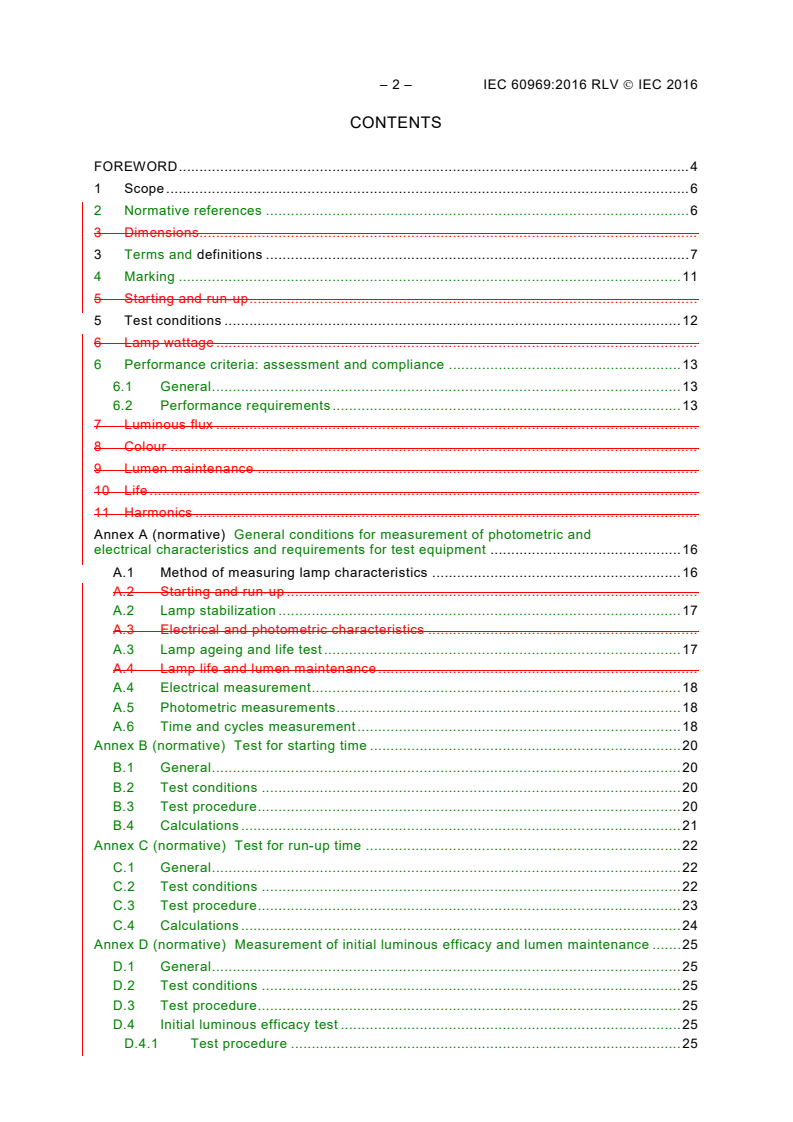
– 2 – IEC 60969:2016 RLV IEC 2016
CONTENTS
FOREWORD . 4
1 Scope . 6
2 Normative references . 6
3 Dimensions.
3 Terms and definitions . 7
4 Marking . 11
5 Starting and run-up .
5 Test conditions . 12
6 Lamp wattage .
6 Performance criteria: assessment and compliance . 13
6.1 General . 13
6.2 Performance requirements . 13
7 Luminous flux .
8 Colour .
9 Lumen maintenance .
10 Life .
11 Harmonics .
Annex A (normative) General conditions for measurement of photometric and
electrical characteristics and requirements for test equipment . 16
A.1 Method of measuring lamp characteristics . 16
A.2 Starting and run-up .
A.2 Lamp stabilization . 17
A.3 Electrical and photometric characteristics .
A.3 Lamp ageing and life test . 17
A.4 Lamp life and lumen maintenance .
A.4 Electrical measurement . 18
A.5 Photometric measurements . 18
A.6 Time and cycles measurement . 18
Annex B (normative) Test for starting time . 20
B.1 General . 20
B.2 Test conditions . 20
B.3 Test procedure . 20
B.4 Calculations . 21
Annex C (normative) Test for run-up time . 22
C.1 General . 22
C.2 Test conditions . 22
C.3 Test procedure . 23
C.4 Calculations . 24
Annex D (normative) Measurement of initial luminous efficacy and lumen maintenance . 25
D.1 General . 25
D.2 Test conditions . 25
D.3 Test procedure . 25
D.4 Initial luminous efficacy test . 25
D.4.1 Test procedure . 25
D.4.2 Calculations . 26
D.5 Lumen maintenance test . 26
Annex E (normative) Test for low temperature and low supply voltage starting. 27
E.1 General . 27
E.2 Test conditions . 27
E.3 Test procedure . 27
Annex F Annex F (normative) Test for switching withstand. 28
Annex G (normative) Test for lamp life . 29
Annex H (normative) Tests for compatibility with dimmers and switches. 30
H.1 Inrush current . 30
H.2 Specific requirements for dimmable lamps . 31
Annex I (normative) Measurement of displacement factor . 32
I.1 General . 32
I.2 Phase-angle definition . 32
I.3 Measurements requirements . 33
I.3.1 Measurement circuit and supply source . 33
I.3.2 Requirements for measurement equipment . 33
I.3.3 Test conditions . 33
Annex J (informative) Explanation of displacement and distortion factors . 34
J.1 General . 34
J.2 Recommended values for displacement factor . 34
Bibliography . 35
Figure B.1 – Typical setup for starting time test . 21
Figure C.1 – Typical setup for run-up time test . 23
Figure D.1 – Measurement of luminous flux . 25
Figure H.1 – Typical inrush current profile. 30
Figure H.2 – Current spikes before I are ignored . 31
peak
Figure H.3 – Waveform generator circuit for inrush current . 31
Figure I.1 – Definition of the first harmonic current phase-angle (φ ) (I leads U ),
1 1 mains
φ > 0) . 32
Figure I.2 – Definition of the first harmonic current phase-angle (φ ) (I lags U ),
1 1 mains
φ < 0) . 33
Table 1 – Locations where marking of rated values is required . 11
Table 2 – Equivalency with non-directional incandescent lamps . 12
Table 3 – Sample sizes, compliance criteria and test conditions . 13
Table A.1 – Conditioning, off time and stabilization time . 17
Table H.1 – Inrush current limitations and test conditions . 30
Table J.1 – Recommended values for displacement factor . 34
– 4 – IEC 60969:2016 RLV IEC 2016
INTERNATIONAL ELECTROTECHNICAL COMMISSION
____________
SELF-BALLASTED COMPACT FLUORESCENT
LAMPS FOR GENERAL LIGHTING SERVICES –
PERFORMANCE REQUIREMENTS
FOREWORD
1) The International Electrotechnical Commission (IEC) is a worldwide organization for standardization comprising
all national electrotechnical committees (IEC National Committees). The object of IEC is to promote
international co-operation on all questions concerning standardization in the electrical and electronic fields. To
this end and in addition to other activities, IEC publishes International Standards, Technical Specifications,
Technical Reports, Publicly Available Specifications (PAS) and Guides (hereafter referred to as “IEC
Publication(s)”). Their preparation is entrusted to technical committees; any IEC National Committee interested
in the subject dealt with may participate in this preparatory work. International, governmental and non-
governmental organizations liaising with the IEC also participate in this preparation. IEC collaborates closely
with the International Organization for Standardization (ISO) in accordance with conditions determined by
agreement between the two organizations.
2) The formal decisions or agreements of IEC on technical matters express, as nearly as possible, an international
consensus of opinion on the relevant subjects since each technical committee has representation from all
interested IEC National Committees.
3) IEC Publications have the form of recommendations for international use and are accepted by IEC National
Committees in that sense. While all reasonable efforts are made to ensure that the technical content of IEC
Publications is accurate, IEC cannot be held responsible for the way in which they are used or for any
misinterpretation by any end user.
4) In order to promote international uniformity, IEC National Committees undertake to apply IEC Publications
transparently to the maximum extent possible in their national and regional publications. Any divergence
between any IEC Publication and the corresponding national or regional publication shall be clearly indicated in
the latter.
5) IEC itself does not provide any attestation of conformity. Independent certification bodies provide conformity
assessment services and, in some areas, access to IEC marks of conformity. IEC is not responsible for any
services carried out by independent certification bodies.
6) All users should ensure that they have the latest edition of this publication.
7) No liability shall attach to IEC or its directors, employees, servants or agents including individual experts and
members of its technical committees and IEC National Committees for any personal injury, property damage or
other damage of any nature whatsoever, whether direct or indirect, or for costs (including legal fees) and
expenses arising out of the publication, use of, or reliance upon, this IEC Publication or any other IEC
Publications.
8) Attention is drawn to the Normative references cited in this publication. Use of the referenced publications is
indispensable for the correct application of this publication.
9) Attention is drawn to the possibility that some of the elements of this IEC Publication may be the subject of
patent rights. IEC shall not be held responsible for identifying any or all such patent rights.
This redline version of the official IEC Standard allows the user to identify the changes
made to the previous edition. A vertical bar appears in the margin wherever a change
has been made. Additions are in green text, deletions are in strikethrough red text.
International Standard IEC 60969 has been prepared by subcommittee 34A: Lamps, of IEC
technical committee 34: Lamp and related equipment.
This second edition cancels and replaces the first edition published in 1988,
Amendment 1:1991 and Amendment 2:2000. This edition constitutes a technical revision.
This edition includes the following significant technical changes with respect to the previous
edition:
a) title change;
b) scope is now limited to compact fluorescent lamps, but expanded to cover all lamps of
voltages greater than 50 V and all power ratings;
c) introduction of requirements for lamp equivalency claims, switching withstand, starting
time, low temperature, run up time, treatment of claims for different operating conditions;
d) enhanced assessment and compliance criteria especially for lifetime;
e) introduction in-rush test conditions and displacement factor.
The text of this standard is based on the following documents:
FDIS Report on voting
34A/1923/FDIS 34A/1945/RVD
Full information on the voting for the approval of this standard can be found in the report on
voting indicated in the above table.
This publication has been drafted in accordance with the ISO/IEC Directives, Part 2.
The committee has decided that the contents of this publication will remain unchanged until
the stability date indicated on the IEC web site under "http://webstore.iec.ch" in the data
related to the specific publication. At this date, the publication will be
• reconfirmed,
• withdrawn,
• replaced by a revised edition, or
• amended.
The contents of the corrigendum of January 2017 have been included in this copy.
IMPORTANT – The 'colour inside' logo on the cover page of this publication indicates
that it contains colours which are considered to be useful for the correct
understanding of its contents. Users should therefore print this document using a
colour printer.
– 6 – IEC 60969:2016 RLV IEC 2016
SELF-BALLASTED COMPACT FLUORESCENT
LAMPS FOR GENERAL LIGHTING SERVICES –
PERFORMANCE REQUIREMENTS
1 Scope
This document specifies performance requirements together with test methods and conditions
required to show compliance of tubular self-ballasted compact fluorescent and other gas-
discharge lamps with integrated means for controlling starting and stable operation (self-
ballasted lamps) intended for domestic and similar general lighting purposes services having.
– a rated wattage up to 60 W;
– a rated voltage of 100 V to 250 V;
– Edison screw or bayonet caps.
This document applies to self-ballasted compact fluorescent lamps of voltages > 50 V and all
power ratings with lamp caps complying with IEC 60061-1.
NOTE Some features of this document could be applicable to self-ballasted compact fluorescent lamps of
voltages ≤ 50 V and to other types of self-ballasted gas discharge lamps.
The requirements of this document relate only to type testing.
Recommendations for whole product testing or batch testing are under consideration.
The performance requirements specified in this document are additional to the safety
requirements specified in IEC 60968.
It can be expected that self-ballasted compact fluorescent lamps, which comply with this
document, will start and operate satisfactorily at normal conditions (voltages between 92 %
and 106 % of rated supply voltage, ambient air temperature of between -10 °C and 40 °C and
in a luminaire complying with IEC 60598-1).
2 Normative references
The following documents are referred to in the text in such a way that some or all of their
content constitutes requirements of this document. For dated references, only the edition
cited applies. For undated references, the latest edition of the referenced document (including
any amendments) applies.
IEC 60630, Maximum lamp outlines for incandescent lamps
IEC 60968, Self-ballasted fluorescent lamps for general lighting services – Safety
requirements
IEC 61000-3-2:2014, Electromagnetic compatibility (EMC) – Part 3-2: Limits – Limits for
harmonic current emissions (equipment input current <= 16 A per phase)
IEC 61000-4-7, Electromagnetic compatibility (EMC) – Part 4-7: Testing and measurement
techniques – General guide on harmonics and interharmonics measurements and
instrumentation, for power supply systems and equipment connected thereto
IEC TR 61341, Method of measurement of centre beam intensity and beam angle(s) of
reflector lamps
CIE 015-2004, Colorimetry
CIE 13.3, Method of Measuring and Specifying Colour Rendering Properties of Light Source
3 Dimensions
The lamp dimensions shall comply with the requirements as indicated by the manufacturer or
responsible vendor.
3 Terms and definitions
For the purposes of this document the following terms and definitions apply.
ISO and IEC maintain terminological databases for use in standardization at the following
addresses:
• IEC Electropedia: available at http://www.electropedia.org/
• ISO Online browsing platform: available at http://www.iso.org/obp
3.1
self-ballasted lamp
integrated lamp
a tubular fluorescent or other discharge lamp unit that incorporates, permanently enclosed, all
elements that are necessary for starting and for stable operation, and which does not include
any replaceable or interchangeable parts.
unit which cannot be dismantled without being permanently damaged, provided with a lamp
cap and incorporating a light source and any additional elements necessary for starting and
stable operation of the light source
Note 1 to entry: A self-ballasted lamp is referred to as a lamp in this document.
[SOURCE: IEC 60968:2015, 3.1, modified – The admitted term and note have been added]
3.2
new lamp
lamp which has not been energized since manufacture
2.3
rated voltage
the voltage or voltage range marked on the lamp
3.3
rated value
quantity value, assigned by the supplier, for a lamp characteristic under specified operating
conditions
EXAMPLE Rated luminous flux.
3.4
test voltage
input voltage at which tests are carried out
[SOURCE: IEC 62612:2013, 3.2, modified – The word "input" has been added.]
– 8 – IEC 60969:2016 RLV IEC 2016
2.5
rated wattage
the wattage marked on the lamp
3.5
initial values
photometric and electrical characteristics measured at the end of the 100 h ageing period
2.6
rated frequency
the frequency marked on the lamp or declared as such by the manufacturer or responsible
vendor
3.6
lamp failure
moment at which the lamp fails to light up, fails to remain alight or delivers low light output (in
case of doubt, low light output refers to less than approximately 50 % of rated light output)
2.7
rated luminous flux
the flux marked on the lamp or declared as such by the manufacturer or responsible vendor
3.7
lamp life
number of operating hours to lamp failure
3.8
median of lamp life
number of operating hours elapsed at which point 50 % of a representative group of lamps
have failed, when operated under specified test conditions
3.9
starting time
time required for a lamp to develop an electrically stable arc discharge, the time being
measured from the moment the lamp circuit is energized
2.10
life (of an individual lamp)
the length of time during which a complete lamp operates to burn-out or to any other criterion
of life performance laid down in this standard
3.10
run-up time
the time needed, after the supply voltage is switched on, for the lamp to reach 80 % of its final
luminous flux
time required for a lamp to reach a specified percentage of its (stable) luminous flux, the time
being measured from the moment the lamp circuit is energized
2.11
average life (life to 50 % failures)
the length of time during which 50 % of the lamps reach the end of their individual lives
3.11
displacement factor
cosine of the phase-angle between the fundamental harmonic current and the mains voltage
Note 1 to entry: Displacement factor is explained in Annex J.
2.12
rated average life (rated life to 50 % failures)
the life declared by the manufacturer or responsible vendor as being the expected time at
which 50 % of any large number of lamps reach the end of their individual lives
3.12
distortion factor
factor indicating the level of harmonic current distortion
Note 1 to entry: Distortion factor is explained in Annex J.
2.13
colour
the colour characteristics of a lamp are defined by the colour appearance and the colour
rendition
a) The actual colour of the lamp is called colour appearance and is defined in terms of the
spectral tristimulus values (colour co-ordinates) according to the recommendations of
the CIE.
b) The spectral characteristics of the light emitted by the lamp have an effect on the
appearance of the objects it illuminates; this effect is called colour rendition.
2.14
rated colour
the colour appearance as declared by the manufacturer or responsible vendor, or the colour
corresponding to the colour designation marked on the lamp
3.13
power factor
under periodic conditions, ratio of the absolute value of the active power to the apparent
power
Note 1 to entry: Alternatively, the power factor is the product of the displacement and distortion factor.
3.14
lumen maintenance
luminous flux at a given time in the life of a lamp, divided by the initial value of the luminous
flux of the lamp
Note 1 to entry: Lumen maintenance is expressed as a percentage of the initial luminous flux.
3.15
lamp type
lamps that, independent of the type of cap or base, are identical in photometric and electrical
rating, have identical rated values in relation to the relevant compliance test
3.16
lamp stabilization time
the burning time of the lamp required to obtain stable operating electrical and photometric
characteristics
time required for a lamp to reach stable conditions for measurement
3.17
type test
test or series of tests made on a type test sample, for the purpose of checking compliance of
the design of a given product with the requirements of the relevant standard
[SOURCE: IEC 60598-1:2014, 1.2.44]
– 10 – IEC 60969:2016 RLV IEC 2016
3.18
type test sample
sample consisting of one or more similar units submitted by the manufacturer or responsible
vendor for the purpose of a type test
[SOURCE: IEC 60598-1:2014, 1.2.45]
3.19
luminous efficacy
quotient of the lamp luminous flux by the lamp power consumption
3.20
beam angle
angle between two imaginary lines in a plane through the optical beam axis, such that these
lines pass through the centre of the front face of the lamp and through points at which the
luminous intensity is 50 % of the centre beam intensity
[SOURCE: IEC TR 61341:2010, 2.4]
3.21
ageing
preconditioning of lamps by operating them at controlled conditions for a specified period
3.22
supplier
manufacturer, responsible vendor or importer
3.23
dimmable lamp
lamp that is capable of producing varying levels of light when paired with a control or dimmer
3.24
inrush current
transient current associated with energizing a lamp
3.25
chromaticity coordinates
ratio of each of a set of three tristimulus values to their sum
[SOURCE: IEC 60050-845:1987, 845-03-33, modified – The notes have been deleted]
3.26
correlated colour temperature
CCT
temperature of the Planckian radiator whose perceived colour most closely resembles that of
a given stimulus at the same brightness and under specified viewing conditions
Note 1 to entry: The correlated colour temperature is expressed in K.
Note 2 to entry: This note applies to the French language only.
[SOURCE: IEC 60050-845:1987, 845-03-50, modified – The abbreviated term has been added
and the notes have been replaced]
3.27
colour rendering index
CRI
measure of the degree to which the psychophysical colour of an object illuminated by the test
illuminant conforms to that of the same object illuminated by the reference illuminant, suitable
allowance having been made for the state of chromatic adaptation
Note 1 to entry: This note applies to the French language only.
[SOURCE: IEC 60050-845:1987, 845-02-61]
3.28
colour code
3-digit code expressing the rated colour rendering index and the rated correlated colour
temperature as described in IEC TR 62732
Note 1 to entry: The light colour designation is detailed in IEC TR 62732.
4 Marking
For this performance standard the following data shall be provided (in addition to the
mandatory data required by IEC 60968) by the supplier and located as specified in Table 1.
The rated values refer to performance claims under the general conditions for measurement
as specified in Clause A.1.
Table 1 – Locations where marking of rated values is required
Product
Product
Parameter (rated) Product datasheets
packaging
or leaflets
a) Initial luminous flux of the lamp (lm)
- x x
(luminous flux for reflector lamps is under consideration)
b) Beam angle (degrees) and centre beam intensity (cd) measured
- x x
in accordance with IEC TR 61341 for reflector lamps
c) Initial luminous efficacy (lm/W) - - x
d) Correlated colour temperature (K)
x x x
For the product a colour code is permissible.
e) Colour rendering index
- x x
For the packaging a colour code is permissible.
f) Chromaticity coordinates - - x
g) Median lamp life (h) - x x
h) Lumen maintenance (%)
- - x
Including operating hours at which lumen maintenance value(s) are
claimed
i) Switching withstand (no. of cycles) - - x
j) Special operating requirements
- x x
e.g. dimming, orientation (base up/down), restricted operating
temperature range
k) Starting time (s) - - x
l) Low temperature starting time (s)
- - x
(and temperature if different from -10 °C)
m) Run-up time (s) - x x
n) Displacement factor - - x
o) Dimensions (mm) - - x
– 12 – IEC 60969:2016 RLV IEC 2016
Product
Product
Parameter (rated) Product datasheets
packaging
or leaflets
p) Performance claims for different conditions - - x
q) Location of additional information
- x -
(how to find product datasheets or leaflets)
(x = required, – = not required but optional)
NOTE In Japan, the power factor is used instead of displacement factor and the requirement on colour
classification and indication is specified in JIS Z9112.
If equivalence with an incandescent lamp is claimed, the claimed equivalent incandescent
lamp power (rounded to 1 W) for lamps with CCT values less than 4 500 K shall be that
corresponding in Table 2 below unless superseded by regional requirements. The
intermediate values of both the luminous flux and the claimed incandescent lamp power
(rounded to 1 W) shall be calculated by linear interpolation between two adjacent values.
Table 2 – Equivalency with non-directional incandescent lamps
(for 220-240 V regions) (for 110-120 V regions)
Claimed equivalent incandescent
lamp power
Minimum rated Minimum rated
luminous flux luminous flux
W
lm lm
15 125
25 229 250
40 432 450
60 741 800
75 970 1 100
100 1 398 1 600
150 2 253 2 550
200 3 172
5 Starting and run-up
The starting and run-up time shall comply with the values as indicated by the manufacturer or
responsible vendor.
5 Test conditions
Test Conditions for testing electrical and photometric characteristics, lumen maintenance and
life are given in annex A.
For lamps with special features for example dimming and daylight sensing, the supplier shall
provide advice on how to disable these features in order to test the lamp.
Where applicable, sample sizes and compliance conditions for various requirements are given
in Table 3.
Where a supplier claims suitability for operation at different conditions (for instance, at higher
voltage, temperature or humidity) then:
a) lamps shall be tested under claimed different conditions; and
b) lamps shall start and operate satisfactorily under claimed different conditions; and
c) lamps shall meet the performance claims under the claimed different conditions, which
may differ from the general conditions for measurement specified in Clause A.1.
6 Lamp wattage
The power dissipated by the lamp shall not differ from the rated wattage by more than 15%.
6 Performance criteria: assessment and compliance
6.1 General
A lamp, on which compliance with this document is claimed, shall comply with the
requirements of IEC 60968.
A lamp shall be designed so that its performance is reliable in normal and accepted use. In
general this can be achieved by satisfying the requirements of 6.2.
The requirements and information given apply to 95 % of production.
NOTE It can be expected that the type test samples submitted by the supplier for type test to the requirements
and tolerances of this document will, in principle, consist of units having characteristics typical of the
manufacturer’s production and being as close to the production centre point values as reasonably possible.
It can be expected with the tolerances given in this document that products manufactured in accordance with the
type test sample will comply with this document for the majority of production. Due to the production spread
however, it is inevitable that there will sometimes be products outside the specified tolerances. For guidance on
sampling plans and procedures for inspection by attributes, refer to ISO 2859 and for inspection by variables refer
to ISO 3951.
6.2 Performance requirements
Lamps shall be assessed against all the parameters listed in Table 3. Minimum sample sizes
for each test are specified in column C, compliance conditions for all parameters and test
conditions are listed in column D and column E.
Table 3 – Sample sizes, compliance criteria and test conditions
A B C D E
Parameter for Minimum type Test condition for
Row Compliance
test test sample size compliance
Mean measured value shall not exceed
108 % of rated value, and all samples
1 Initial power 10 Annex A
shall measure below 115 % of rated
value.
All samples shall measure equal to or
greater than the rated displacement
Annex I
Displacement
factor value minus 0,05.
2 10
a
factor
NOTE In Japan, the power factor
instead of displacement factor is used.
Distortion factor All samples shall be within limits for
3 10 IEC 61000-3-2
a
(harmonics) harmonics according to IEC 61000-3-2.
Mean measured value shall be greater
Initial luminous than or equal to 90 % of rated value,
4 10 Annex D
flux and all samples shall measure greater
than or equal to 85 % of rated value.
Beam angle Measured beam angle shall be within
5 1 IEC TR 61341
(reflector lamps)
±25 % of rated value.
Centre beam Mean measured centre beam intensity
6 intensity (reflector 1 shall be equal to or greater than 75 % of IEC TR 61341
lamps) the rated value.
– 14 – IEC 60969:2016 RLV IEC 2016
A B C D E
Parameter for Minimum type Test condition for
Row Compliance
test test sample size compliance
Chromaticity coordinates of at least
90 % of the samples shall measure less
Chromaticity
7 10 than or equal to 5 SDCM (standard CIE 015
b
coordinates
deviation of colour matching) from the
rated value.
All samples shall measure equal to or
Colour rendering
8 10 greater than the rated CRI value minus CIE 13.3
index (CRI)
3.
Mean measured value shall be less than
or equal to 1,5 s, and all samples shall
start within 2,0 s.
9 Starting time 6 Annex B
Mean measured value shall be ≤110% of
rated value.
Low temperature All lamps shall start within the time if
10 and low supply 6 specified by the supplier or within 10 s Annex E
voltage starting maximum.
The mean measured time, to reach 60%
of initial luminous flux, shall be less
than or equal to 110 % of the rated time.
11 Run-up time 6 Annex C
All samples shall reach 60% of initial
luminous flux within 150 % of the rated
time.
Mean measured value(s) shall be equal
to or greater than 90 % of the rated
Lumen
value(s).
12 10 Annex D
maintenance
All samples shall measure equal or
greater than 85 % of the rated value(s).
After the operating hours specified by
Premature lamp
the supplier have elapsed, the
13 failure rate (if 10 Annex G
proportion of lamp failures shall be less
claimed)
than or equal to the rated value.
Assess lifetime based on either of the
following tests (Based on Weibull shape
c
factor 3 ):
Test 10 samples to 100 % of rated life
Annex G
14 Lifetime 10 or 20 Pass if less than or equal to 6 failures
Fail if equal or greater than 7 failures.
Test 20 samples to 90 % of rated life
Pass if less than or equal to 10 failures
Fail if equal or greater than 11 failures.
Assess switching withstand based on
the following test (Based on Weibull
c
shape factor 3 ):
Switching
15 10 Annex F
Test 10 samples to the rated number of
withstand
switching cycles
Pass if less than or equal to 6 failures
Fail if equal or greater than 7 failures.
All samples shall comply with rated
minimum and maximum specifications.
Mean measured dimension shall be
d
Physical
within 90 % and 110 % of rated value.
16 Dimensions 6
measurements
If dimensional equivalence with
incandescent lamps is claimed then
lamps shall comply with IEC 60630.
Inrush current shall not exceed given
17 Inrush current 1 Annex H
limits.
In accordance
Claims for performance at different
Performance In accordance with
with the relevant
conditions (voltages or temperatures
18 under different the relevant type
type test in this
outside of normal conditions, including
conditions test in this table
table
high humidity) shall be tested under
A B C D E
Parameter for Minimum type Test condition for
Row Compliance
test test sample size compliance
those conditions using the relevant
annexes to this document (altering test
conditions to suit different conditions).
Under these conditions:
a) lamps shall start and operate
satisfactorily, and
b) lamps shall meet all performance
claims, which may differ from the
performance claims under the
general conditions for measurement
specified in Clause A.1.
NOTE There are local and regional regulations for many of these and other parameters.
a
The relationship between power factor, displacement and distortion factors are explained in Annex J.
b
Preferred rated chromaticity coordinates are the standardised chromaticity coordinates for 2 700 K, 3 000 K,
3 500 K, 4 000 K, 5 000 K and 6 500 K as defined in IEC 60081, Annex D.
c
Statistical tools, such as Weibull analysis and parametric fits may be used to estimate median lamp life of
the sample.
d
Supplier should advise sizes to allow assessment, and these should be clear if maximum or rated
dimensions.
7 Luminous flux
The initial luminous flux measured after the ageing time shall be not less than 90 % of the
rated luminous flux.
An increase is under consideration.
8 Colour
The colour co-ordinates of a lamp shall be within the tolerance area on the chromaticity chart
as declared by the manufacturer or responsible vendor, but shall in any case be within
5 SDCM from the target values.
For further information see annex D of IEC 60081.
9 Lumen maintenance
After 2 000 h of operation, including the ageing period, the lumen maintenance shall be not
less than the value declared by the manufacturer or responsible vendor.
10 Life
The life to 50 % failures (average life) measured on "n" lamps shall be not less that the rated
life to 50 % failures.
("n" is declared by the manufacturer or responsible vendor, but shall be a minimum of
20 lamps.)
11 Harmonics
Under consideration.
– 16 – IEC 60969:2016 RLV IEC 2016
Annex A
(normative)
General conditions for measurement of photometric and electrical
characteristics and requirements for test equipment
A.1 Method of measuring lamp characteristics
Sample sizes and compliance conditions are given in Table 3.
The visual appearance of all samples shall be checked before testing, and if required all
samples shall be cleaned before photometric testing.
Unless specified elsewhere all tests shall:
a) be made in a draught-free atmosphere at an ambient temperature of (25 ± 1) °C and a
relative humidity of 65 % maximum. If lamp operation under different conditions is claimed
by the supplier, operation at this atmosphere shall also be tested. Air movement shall be
in accordance with CIE 121. For lamp ageing, the lamp life test and the switch withstand
test, the ambient temperature of the room shall be in the range of 15 °C to 40 °C, and
some draught is allowed but vibration and shock should be minimized.
b) be carried out at rated voltage and frequency if a single value is declared. If the rated
voltage is a range, the lamp shall be aged and tested at the mean voltage of that range.
For dual-voltage lamps, for example those intended for operation at 110 V to 130 V and
220 V to 240 V, ageing and testing shall be conducted at the mean voltage of each voltage
range.
c) have a test voltage tolerance during ageing and luminous flux maintenance testing within
2 %. During lamp stabilization the voltage shall be within ±0,5 %. At the moment of
measurement the tolerance shall be within ±0,2 % for voltage and ±0,2 % for frequency.
For life testing the tolerance is 2%. The total harmonic content of the supply voltage shall
not exceed 3 % . The harmonic content is defined as the R.M.S. summation of the
individual harmonic components using the fundamental as 100 %. IEC 61000-3-2, Annex
A, provides guidance on the supply voltage source.
d) be conducted with lamps operated in free air in a vertical base-up position for all tests
including life lumen maintenance tests. If a supplier has declared the lamp is suitable for
use in a specific orientation only, then the lamp shall be mounted in the declared
orientation during all tests.
Electrical and photometric instruments used shall be selected having a guaranteed accuracy
commensurate with the requirements of the test.
A.2 Starting and run-up
The starting and run-up tests shall be made before ageing except in the case of lamps
declared by the manufacturer to be VPC (Vapour Pressure Control) types, where the following
procedure shall be carried out.
VPC lamps are aged for a period of at least 100 h of normal operation and then switched off
for at least 24 h before the run-up test is performed. The starting test for VPC lamps shall
...
IEC 60969 ®
Edition 2.0 2016-10
INTERNATIONAL
STANDARD
NORME
INTERNATIONALE
colour
inside
Self-ballasted compact fluorescent lamps for general lighting services –
Performance requirements
Lampes à fluorescence compactes à ballast intégré pour l'éclairage général –
Exigences de performances
All rights reserved. Unless otherwise specified, no part of this publication may be reproduced or utilized in any form
or by any means, electronic or mechanical, including photocopying and microfilm, without permission in writing from
either IEC or IEC's member National Committee in the country of the requester. If you have any questions about IEC
copyright or have an enquiry about obtaining additional rights to this publication, please contact the address below or
your local IEC member National Committee for further information.
Droits de reproduction réservés. Sauf indication contraire, aucune partie de cette publication ne peut être reproduite
ni utilisée sous quelque forme que ce soit et par aucun procédé, électronique ou mécanique, y compris la photocopie
et les microfilms, sans l'accord écrit de l'IEC ou du Comité national de l'IEC du pays du demandeur. Si vous avez des
questions sur le copyright de l'IEC ou si vous désirez obtenir des droits supplémentaires sur cette publication, utilisez
les coordonnées ci-après ou contactez le Comité national de l'IEC de votre pays de résidence.
IEC Central Office Tel.: +41 22 919 02 11
3, rue de Varembé Fax: +41 22 919 03 00
CH-1211 Geneva 20 info@iec.ch
Switzerland www.iec.ch
About the IEC
The International Electrotechnical Commission (IEC) is the leading global organization that prepares and publishes
International Standards for all electrical, electronic and related technologies.
About IEC publications
The technical content of IEC publications is kept under constant review by the IEC. Please make sure that you have the
latest edition, a corrigenda or an amendment might have been published.
IEC Catalogue - webstore.iec.ch/catalogue Electropedia - www.electropedia.org
The stand-alone application for consulting the entire The world's leading online dictionary of electronic and
bibliographical information on IEC International Standards, electrical terms containing 20 000 terms and definitions in
Technical Specifications, Technical Reports and other English and French, with equivalent terms in 15 additional
documents. Available for PC, Mac OS, Android Tablets and languages. Also known as the International Electrotechnical
iPad. Vocabulary (IEV) online.
IEC publications search - www.iec.ch/searchpub IEC Glossary - std.iec.ch/glossary
The advanced search enables to find IEC publications by a 65 000 electrotechnical terminology entries in English and
variety of criteria (reference number, text, technical French extracted from the Terms and Definitions clause of
committee,…). It also gives information on projects, replaced IEC publications issued since 2002. Some entries have been
and withdrawn publications. collected from earlier publications of IEC TC 37, 77, 86 and
CISPR.
IEC Just Published - webstore.iec.ch/justpublished
Stay up to date on all new IEC publications. Just Published IEC Customer Service Centre - webstore.iec.ch/csc
details all new publications released. Available online and If you wish to give us your feedback on this publication or
also once a month by email. need further assistance, please contact the Customer Service
Centre: csc@iec.ch.
A propos de l'IEC
La Commission Electrotechnique Internationale (IEC) est la première organisation mondiale qui élabore et publie des
Normes internationales pour tout ce qui a trait à l'électricité, à l'électronique et aux technologies apparentées.
A propos des publications IEC
Le contenu technique des publications IEC est constamment revu. Veuillez vous assurer que vous possédez l’édition la
plus récente, un corrigendum ou amendement peut avoir été publié.
Catalogue IEC - webstore.iec.ch/catalogue Electropedia - www.electropedia.org
Application autonome pour consulter tous les renseignements
Le premier dictionnaire en ligne de termes électroniques et
bibliographiques sur les Normes internationales,
électriques. Il contient 20 000 termes et définitions en anglais
Spécifications techniques, Rapports techniques et autres
et en français, ainsi que les termes équivalents dans 15
documents de l'IEC. Disponible pour PC, Mac OS, tablettes
langues additionnelles. Egalement appelé Vocabulaire
Android et iPad.
Electrotechnique International (IEV) en ligne.
Recherche de publications IEC - www.iec.ch/searchpub
Glossaire IEC - std.iec.ch/glossary
65 000 entrées terminologiques électrotechniques, en anglais
La recherche avancée permet de trouver des publications IEC
en utilisant différents critères (numéro de référence, texte, et en français, extraites des articles Termes et Définitions des
comité d’études,…). Elle donne aussi des informations sur les publications IEC parues depuis 2002. Plus certaines entrées
projets et les publications remplacées ou retirées. antérieures extraites des publications des CE 37, 77, 86 et
CISPR de l'IEC.
IEC Just Published - webstore.iec.ch/justpublished
Service Clients - webstore.iec.ch/csc
Restez informé sur les nouvelles publications IEC. Just
Published détaille les nouvelles publications parues. Si vous désirez nous donner des commentaires sur cette
Disponible en ligne et aussi une fois par mois par email. publication ou si vous avez des questions contactez-nous:
csc@iec.ch.
IEC 60969 ®
Edition 2.0 2016-10
INTERNATIONAL
STANDARD
NORME
INTERNATIONALE
colour
inside
Self-ballasted compact fluorescent lamps for general lighting services –
Performance requirements
Lampes à fluorescence compactes à ballast intégré pour l'éclairage général –
Exigences de performances
INTERNATIONAL
ELECTROTECHNICAL
COMMISSION
COMMISSION
ELECTROTECHNIQUE
INTERNATIONALE
ICS 29.140.30 ISBN 978-2-8322-3661-1
– 2 – IEC 60969:2016 IEC 2016
CONTENTS
FOREWORD . 4
1 Scope . 6
2 Normative references . 6
3 Terms and definitions . 7
4 Marking . 10
5 Test conditions . 11
6 Performance criteria: assessment and compliance . 11
6.1 General . 11
6.2 Performance requirements . 12
Annex A (normative) General conditions for measurement of photometric and
electrical characteristics and requirements for test equipment . 14
A.1 Method of measuring lamp characteristics . 14
A.2 Lamp stabilization . 14
A.3 Lamp ageing and life test . 15
A.4 Electrical measurement . 15
A.5 Photometric measurements . 15
A.6 Time and cycles measurement . 15
Annex B (normative) Test for starting time . 16
B.1 General . 16
B.2 Test conditions . 16
B.3 Test procedure . 16
B.4 Calculations . 17
Annex C (normative) Test for run-up time . 18
C.1 General . 18
C.2 Test conditions . 18
C.3 Test procedure . 19
C.4 Calculations . 20
Annex D (normative) Measurement of initial luminous efficacy and lumen maintenance . 21
D.1 General . 21
D.2 Test conditions . 21
D.3 Test procedure . 21
D.4 Initial luminous efficacy test . 21
D.4.1 Test procedure . 21
D.4.2 Calculations . 22
D.5 Lumen maintenance test . 22
Annex E (normative) Test for low temperature and low supply voltage starting. 23
E.1 General . 23
E.2 Test conditions . 23
E.3 Test procedure . 23
Annex F (normative) Test for switching withstand . 24
Annex G (normative) Test for lamp life . 25
Annex H (normative) Tests for compatibility with dimmers and switches. 26
H.1 Inrush current . 26
H.2 Specific requirements for dimmable lamps . 27
Annex I (normative) Measurement of displacement factor . 28
I.1 General . 28
I.2 Phase-angle definition . 28
I.3 Measurements requirements . 29
I.3.1 Measurement circuit and supply source . 29
I.3.2 Requirements for measurement equipment . 29
I.3.3 Test conditions . 29
Annex J (informative) Explanation of displacement and distortion factors . 30
J.1 General . 30
J.2 Recommended values for displacement factor . 30
Bibliography . 31
Figure B.1 – Typical setup for starting time test . 17
Figure C.1 – Typical setup for run-up time test . 19
Figure D.1 – Measurement of luminous flux . 21
Figure H.1 – Typical inrush current profile. 26
Figure H.2 – Current spikes before I are ignored . 27
peak
Figure H.3 – Waveform generator circuit for inrush current . 27
Figure I.1 – Definition of the first harmonic current phase-angle (φ ) (I leads U ),
1 1 mains
φ > 0) . 28
Figure I.2 – Definition of the first harmonic current phase-angle (φ ) (I lags U ),
1 1 mains
φ < 0) . 29
Table 1 – Locations where marking of rated values is required . 10
Table 2 – Equivalency with non-directional incandescent lamps . 11
Table 3 – Sample sizes, compliance criteria and test conditions . 12
Table A.1 – Conditioning, off time and stabilization time . 15
Table H.1 – Inrush current limitations and test conditions . 26
Table J.1 – Recommended values for displacement factor . 30
– 4 – IEC 60969:2016 IEC 2016
INTERNATIONAL ELECTROTECHNICAL COMMISSION
____________
SELF-BALLASTED COMPACT FLUORESCENT
LAMPS FOR GENERAL LIGHTING SERVICES –
PERFORMANCE REQUIREMENTS
FOREWORD
1) The International Electrotechnical Commission (IEC) is a worldwide organization for standardization comprising
all national electrotechnical committees (IEC National Committees). The object of IEC is to promote
international co-operation on all questions concerning standardization in the electrical and electronic fields. To
this end and in addition to other activities, IEC publishes International Standards, Technical Specifications,
Technical Reports, Publicly Available Specifications (PAS) and Guides (hereafter referred to as “IEC
Publication(s)”). Their preparation is entrusted to technical committees; any IEC National Committee interested
in the subject dealt with may participate in this preparatory work. International, governmental and non-
governmental organizations liaising with the IEC also participate in this preparation. IEC collaborates closely
with the International Organization for Standardization (ISO) in accordance with conditions determined by
agreement between the two organizations.
2) The formal decisions or agreements of IEC on technical matters express, as nearly as possible, an international
consensus of opinion on the relevant subjects since each technical committee has representation from all
interested IEC National Committees.
3) IEC Publications have the form of recommendations for international use and are accepted by IEC National
Committees in that sense. While all reasonable efforts are made to ensure that the technical content of IEC
Publications is accurate, IEC cannot be held responsible for the way in which they are used or for any
misinterpretation by any end user.
4) In order to promote international uniformity, IEC National Committees undertake to apply IEC Publications
transparently to the maximum extent possible in their national and regional publications. Any divergence
between any IEC Publication and the corresponding national or regional publication shall be clearly indicated in
the latter.
5) IEC itself does not provide any attestation of conformity. Independent certification bodies provide conformity
assessment services and, in some areas, access to IEC marks of conformity. IEC is not responsible for any
services carried out by independent certification bodies.
6) All users should ensure that they have the latest edition of this publication.
7) No liability shall attach to IEC or its directors, employees, servants or agents including individual experts and
members of its technical committees and IEC National Committees for any personal injury, property damage or
other damage of any nature whatsoever, whether direct or indirect, or for costs (including legal fees) and
expenses arising out of the publication, use of, or reliance upon, this IEC Publication or any other IEC
Publications.
8) Attention is drawn to the Normative references cited in this publication. Use of the referenced publications is
indispensable for the correct application of this publication.
9) Attention is drawn to the possibility that some of the elements of this IEC Publication may be the subject of
patent rights. IEC shall not be held responsible for identifying any or all such patent rights.
International Standard IEC 60969 has been prepared by subcommittee 34A: Lamps, of IEC
technical committee 34: Lamp and related equipment.
This second edition cancels and replaces the first edition published in 1988,
Amendment 1:1991 and Amendment 2:2000. This edition constitutes a technical revision.
This edition includes the following significant technical changes with respect to the previous
edition:
a) title change;
b) scope is now limited to compact fluorescent lamps, but expanded to cover all lamps of
voltages greater than 50 V and all power ratings;
c) introduction of requirements for lamp equivalency claims, switching withstand, starting
time, low temperature, run up time, treatment of claims for different operating conditions;
d) enhanced assessment and compliance criteria especially for lifetime;
e) introduction in-rush test conditions and displacement factor.
The text of this standard is based on the following documents:
FDIS Report on voting
34A/1923/FDIS 34A/1945/RVD
Full information on the voting for the approval of this standard can be found in the report on
voting indicated in the above table.
This publication has been drafted in accordance with the ISO/IEC Directives, Part 2.
The committee has decided that the contents of this publication will remain unchanged until
the stability date indicated on the IEC web site under "http://webstore.iec.ch" in the data
related to the specific publication. At this date, the publication will be
• reconfirmed,
• withdrawn,
• replaced by a revised edition, or
• amended.
The contents of the corrigendum of January 2017 have been included in this copy.
IMPORTANT – The 'colour inside' logo on the cover page of this publication indicates
that it contains colours which are considered to be useful for the correct
understanding of its contents. Users should therefore print this document using a
colour printer.
– 6 – IEC 60969:2016 IEC 2016
SELF-BALLASTED COMPACT FLUORESCENT
LAMPS FOR GENERAL LIGHTING SERVICES –
PERFORMANCE REQUIREMENTS
1 Scope
This document specifies performance requirements together with test methods and conditions
required to show compliance of self-ballasted compact fluorescent lamps intended for general
lighting services.
This document applies to self-ballasted compact fluorescent lamps of voltages > 50 V and all
power ratings with lamp caps complying with IEC 60061-1.
NOTE Some features of this document could be applicable to self-ballasted compact fluorescent lamps of
voltages ≤ 50 V and to other types of self-ballasted gas discharge lamps.
The requirements of this document relate only to type testing.
The performance requirements specified in this document are additional to the safety
requirements specified in IEC 60968.
It can be expected that self-ballasted compact fluorescent lamps, which comply with this
document, will start and operate satisfactorily at normal conditions (voltages between 92 %
and 106 % of rated supply voltage, ambient air temperature of between -10 °C and 40 °C and
in a luminaire complying with IEC 60598-1).
2 Normative references
The following documents are referred to in the text in such a way that some or all of their
content constitutes requirements of this document. For dated references, only the edition
cited applies. For undated references, the latest edition of the referenced document (including
any amendments) applies.
IEC 60630, Maximum lamp outlines for incandescent lamps
IEC 60968, Self-ballasted fluorescent lamps for general lighting services – Safety
requirements
IEC 61000-3-2:2014, Electromagnetic compatibility (EMC) – Part 3-2: Limits – Limits for
harmonic current emissions (equipment input current <= 16 A per phase)
IEC 61000-4-7, Electromagnetic compatibility (EMC) – Part 4-7: Testing and measurement
techniques – General guide on harmonics and interharmonics measurements and
instrumentation, for power supply systems and equipment connected thereto
IEC TR 61341, Method of measurement of centre beam intensity and beam angle(s) of
reflector lamps
CIE 015-2004, Colorimetry
CIE 13.3, Method of Measuring and Specifying Colour Rendering Properties of Light Source
3 Terms and definitions
For the purposes of this document the following terms and definitions apply.
ISO and IEC maintain terminological databases for use in standardization at the following
addresses:
• IEC Electropedia: available at http://www.electropedia.org/
• ISO Online browsing platform: available at http://www.iso.org/obp
3.1
self-ballasted lamp
integrated lamp
unit which cannot be dismantled without being permanently damaged, provided with a lamp
cap and incorporating a light source and any additional elements necessary for starting and
stable operation of the light source
Note 1 to entry: A self-ballasted lamp is referred to as a lamp in this document.
[SOURCE: IEC 60968:2015, 3.1, modified – The admitted term and note have been added]
3.2
new lamp
lamp which has not been energized since manufacture
3.3
rated value
quantity value, assigned by the supplier, for a lamp characteristic under specified operating
conditions
EXAMPLE Rated luminous flux.
3.4
test voltage
input voltage at which tests are carried out
[SOURCE: IEC 62612:2013, 3.2, modified – The word "input" has been added.]
3.5
initial value
photometric and electrical characteristic measured at the end of a 100 h ageing period
3.6
lamp failure
moment at which the lamp fails to light up, fails to remain alight or delivers low light output (in
case of doubt, low light output refers to less than approximately 50 % of rated light output)
3.7
lamp life
number of operating hours to lamp failure
3.8
median of lamp life
number of operating hours elapsed at which point 50 % of a representative group of lamps
have failed, when operated under specified test conditions
– 8 – IEC 60969:2016 IEC 2016
3.9
starting time
time required for a lamp to develop an electrically stable arc discharge, the time being
measured from the moment the lamp circuit is energized
3.10
run-up time
time required for a lamp to reach a specified percentage of its (stable) luminous flux, the time
being measured from the moment the lamp circuit is energized
3.11
displacement factor
cosine of the phase-angle between the fundamental harmonic current and the mains voltage
Note 1 to entry: Displacement factor is explained in Annex J.
3.12
distortion factor
factor indicating the level of harmonic current distortion
Note 1 to entry: Distortion factor is explained in Annex J.
3.13
power factor
under periodic conditions, ratio of the absolute value of the active power to the apparent
power
Note 1 to entry: Alternatively, the power factor is the product of the displacement and distortion factor.
3.14
lumen maintenance
luminous flux at a given time in the life of a lamp, divided by the initial luminous flux of the
lamp
Note 1 to entry: Lumen maintenance is expressed as a percentage of the initial luminous flux.
3.15
lamp type
lamps that, independent of the type of cap, have identical rated values in relation to the
relevant compliance test
3.16
lamp stabilization time
time required for a lamp to reach stable conditions for measurement
3.17
type test
test or series of tests made on a type test sample, for the purpose of checking compliance of
the design of a given product with the requirements of the relevant standard
[SOURCE: IEC 60598-1:2014, 1.2.44]
3.18
type test sample
sample consisting of one or more similar units submitted by the manufacturer or responsible
vendor for the purpose of a type test
[SOURCE: IEC 60598-1:2014, 1.2.45]
3.19
luminous efficacy
quotient of the lamp luminous flux by the lamp power consumption
3.20
beam angle
angle between two imaginary lines in a plane through the optical beam axis, such that these
lines pass through the centre of the front face of the lamp and through points at which the
luminous intensity is 50 % of the centre beam intensity
[SOURCE: IEC TR 61341:2010, 2.4]
3.21
ageing
preconditioning of lamps by operating them at controlled conditions for a specified period
3.22
supplier
manufacturer, responsible vendor or importer
3.23
dimmable lamp
lamp that is capable of producing varying levels of light when paired with a control or dimmer
3.24
inrush current
transient current associated with energizing a lamp
3.25
chromaticity coordinates
ratio of each of a set of three tristimulus values to their sum
[SOURCE: IEC 60050-845:1987, 845-03-33, modified – The notes have been deleted]
3.26
correlated colour temperature
CCT
temperature of the Planckian radiator whose perceived colour most closely resembles that of
a given stimulus at the same brightness and under specified viewing conditions
Note 1 to entry: The correlated colour temperature is expressed in K.
Note 2 to entry: This note applies to the French language only.
[SOURCE: IEC 60050-845:1987, 845-03-50, modified – The abbreviated term has been added
and the notes have been replaced]
3.27
colour rendering index
CRI
measure of the degree to which the psychophysical colour of an object illuminated by the test
illuminant conforms to that of the same object illuminated by the reference illuminant, suitable
allowance having been made for the state of chromatic adaptation
Note 1 to entry: This note applies to the French language only.
[SOURCE: IEC 60050-845:1987, 845-02-61]
– 10 – IEC 60969:2016 IEC 2016
3.28
colour code
3-digit code expressing the rated colour rendering index and the rated correlated colour
temperature as described in IEC TR 62732
Note 1 to entry: The light colour designation is detailed in IEC TR 62732.
4 Marking
For this performance standard the following data shall be provided (in addition to the
mandatory data required by IEC 60968) by the supplier and located as specified in Table 1.
The rated values refer to performance claims under the general conditions for measurement
as specified in Clause A.1.
Table 1 – Locations where marking of rated values is required
Product
Product
Parameter (rated) Product datasheets
packaging
or leaflets
a) Initial luminous flux of the lamp (lm)
- x x
(luminous flux for reflector lamps is under consideration)
b) Beam angle (degrees) and centre beam intensity (cd) measured in
- x x
accordance with IEC TR 61341 for reflector lamps
c) Initial luminous efficacy (lm/W) - - x
d) Correlated colour temperature (K)
x x x
For the product a colour code is permissible.
e) Colour rendering index
- x x
For the packaging a colour code is permissible.
f) Chromaticity coordinates - - x
g) Median lamp life (h) - x x
h) Lumen maintenance (%)
- - x
Including operating hours at which lumen maintenance value(s) are
claimed
i) Switching withstand (no. of cycles) - - x
j) Special operating requirements
- x x
e.g. dimming, orientation (base up/down), restricted operating
temperature range
k) Starting time (s) - - x
l) Low temperature starting time (s)
- - x
(and temperature if different from -10 °C)
m) Run-up time (s) - x x
n) Displacement factor - - x
o) Dimensions (mm) - - x
p) Performance claims for different conditions - - x
q) Location of additional information
- x -
(how to find product datasheets or leaflets)
(x = required, – = not required but optional)
NOTE In Japan, the power factor is used instead of displacement factor and the requirement on colour classification
and indication is specified in JIS Z9112.
If equivalence with an incandescent lamp is claimed, the claimed equivalent incandescent
lamp power (rounded to 1 W) for lamps with CCT values less than 4 500 K shall be that
corresponding in Table 2 below unless superseded by regional requirements. The
intermediate values of both the luminous flux and the claimed incandescent lamp power
(rounded to 1 W) shall be calculated by linear interpolation between two adjacent values.
Table 2 – Equivalency with non-directional incandescent lamps
(for 220-240 V regions) (for 110-120 V regions)
Claimed equivalent incandescent
lamp power
Minimum rated Minimum rated
luminous flux luminous flux
W
lm lm
15 125
25 229 250
40 432 450
60 741 800
75 970 1 100
100 1 398 1 600
150 2 253 2 550
200 3 172
5 Test conditions
Conditions for testing are given in Annex A.
For lamps with special features for example dimming and daylight sensing, the supplier shall
.
provide advice on how to disable these features in order to test the lamp
Where applicable, sample sizes and compliance conditions for various requirements are given
in Table 3.
Where a supplier claims suitability for operation at different conditions (for instance, at higher
voltage, temperature or humidity) then:
a) lamps shall be tested under claimed different conditions; and
b) lamps shall start and operate satisfactorily under claimed different conditions; and
c) lamps shall meet the performance claims under the claimed different conditions, which
may differ from the general conditions for measurement specified in Clause A.1.
6 Performance criteria: assessment and compliance
6.1 General
A lamp, on which compliance with this document is claimed, shall comply with the
requirements of IEC 60968.
A lamp shall be designed so that its performance is reliable in normal and accepted use. In
general this can be achieved by satisfying the requirements of 6.2.
The requirements and information given apply to 95 % of production.
NOTE It can be expected that the type test samples submitted by the supplier for type test to the requirements
and tolerances of this document will, in principle, consist of units having characteristics typical of the
manufacturer’s production and being as close to the production centre point values as reasonably possible.
It can be expected with the tolerances given in this document that products manufactured in accordance with the
type test sample will comply with this document for the majority of production. Due to the production spread
– 12 – IEC 60969:2016 IEC 2016
however, it is inevitable that there will sometimes be products outside the specified tolerances. For guidance on
sampling plans and procedures for inspection by attributes, refer to ISO 2859 and for inspection by variables refer
to ISO 3951.
6.2 Performance requirements
Lamps shall be assessed against all the parameters listed in Table 3. Minimum sample sizes
for each test are specified in column C, compliance conditions for all parameters and test
conditions are listed in column D and column E.
Table 3 – Sample sizes, compliance criteria and test conditions
A B C D E
Parameter for Minimum type Test condition for
Row Compliance
test test sample size compliance
Mean measured value shall not exceed
108 % of rated value, and all samples
1 Initial power 10 Annex A
shall measure below 115 % of rated
value.
All samples shall measure equal to or
greater than the rated displacement
Annex I
Displacement
factor value minus 0,05.
2 10
a
factor
NOTE In Japan, the power factor
instead of displacement factor is used.
Distortion factor All samples shall be within limits for
3 10 IEC 61000-3-2
a
(harmonics) harmonics according to IEC 61000-3-2.
Mean measured value shall be greater
Initial luminous than or equal to 90 % of rated value,
4 10 Annex D
flux and all samples shall measure greater
than or equal to 85 % of rated value.
Beam angle Measured beam angle shall be within
5 1 IEC TR 61341
(reflector lamps) ±25 % of rated value.
Centre beam Mean measured centre beam intensity
6 intensity (reflector 1 shall be equal to or greater than 75 % of IEC TR 61341
lamps) the rated value.
Chromaticity coordinates of at least
90 % of the samples shall measure less
Chromaticity
7 10 than or equal to 5 SDCM (standard CIE 015
b
coordinates
deviation of colour matching) from the
rated value.
All samples shall measure equal to or
Colour rendering
8 10 greater than the rated CRI value minus CIE 13.3
index (CRI)
3.
Mean measured value shall be less than
or equal to 1,5 s, and all samples shall
start within 2,0 s.
9 Starting time 6 Annex B
Mean measured value shall be ≤110% of
rated value.
Low temperature All lamps shall start within the time if
10 and low supply 6 specified by the supplier or within 10 s Annex E
voltage starting maximum.
The mean measured time, to reach 60%
of initial luminous flux, shall be less
than or equal to 110 % of the rated time.
11 Run-up time 6 Annex C
All samples shall reach 60% of initial
luminous flux within 150 % of the rated
time.
Mean measured value(s) shall be equal
to or greater than 90 % of the rated
Lumen
value(s).
12 10 Annex D
maintenance
All samples shall measure equal or
greater than 85 % of the rated value(s).
A B C D E
Parameter for Minimum type Test condition for
Row Compliance
test test sample size compliance
After the operating hours specified by
Premature lamp
the supplier have elapsed, the
13 failure rate (if 10 Annex G
proportion of lamp failures shall be less
claimed)
than or equal to the rated value.
Assess lifetime based on either of the
following tests (Based on Weibull shape
c
factor 3 ):
Test 10 samples to 100 % of rated life
Annex G
14 Lifetime 10 or 20 Pass if less than or equal to 6 failures
Fail if equal or greater than 7 failures.
Test 20 samples to 90 % of rated life
Pass if less than or equal to 10 failures
Fail if equal or greater than 11 failures.
Assess switching withstand based on
the following test (Based on Weibull
c
shape factor 3 ):
Switching
15 10 Annex F
Test 10 samples to the rated number of
withstand
switching cycles
Pass if less than or equal to 6 failures
Fail if equal or greater than 7 failures.
All samples shall comply with rated
minimum and maximum specifications.
Mean measured dimension shall be
d
Physical
within 90 % and 110 % of rated value.
16 Dimensions 6
measurements
If dimensional equivalence with
incandescent lamps is claimed then
lamps shall comply with IEC 60630.
Inrush current shall not exceed given
17 Inrush current 1 Annex H
limits.
Claims for performance at different
conditions (voltages or temperatures
outside of normal conditions, including
high humidity) shall be tested under
those conditions using the relevant
annexes to this document (altering test
conditions to suit different conditions).
In accordance
In accordance with
Performance
Under these conditions:
with the relevant
18 under different the relevant type
type test in this
conditions a) lamps shall start and operate test in this table
table
satisfactorily, and
b) lamps shall meet all performance
claims, which may differ from the
performance claims under the
general conditions for measurement
specified in Clause A.1.
NOTE There are local and regional regulations for many of these and other parameters.
a
The relationship between power factor, displacement and distortion factors are explained in Annex J.
b
Preferred rated chromaticity coordinates are the standardised chromaticity coordinates for 2 700 K, 3 000 K,
3 500 K, 4 000 K, 5 000 K and 6 500 K as defined in IEC 60081, Annex D.
c
Statistical tools, such as Weibull analysis and parametric fits may be used to estimate median lamp life of
the sample.
d
Supplier should advise sizes to allow assessment, and these should be clear if maximum or rated
dimensions.
– 14 – IEC 60969:2016 IEC 2016
Annex A
(normative)
General conditions for measurement of photometric and electrical
characteristics and requirements for test equipment
A.1 Method of measuring lamp characteristics
Sample sizes and compliance conditions are given in Table 3.
The visual appearance of all samples shall be checked before testing, and if required all
samples shall be cleaned before photometric testing.
Unless specified elsewhere all tests shall:
a) be made in a draught-free atmosphere at an ambient temperature of (25 ± 1) °C and a
relative humidity of 65 % maximum. If lamp operation under different conditions is claimed
by the supplier, operation at this atmosphere shall also be tested. Air movement shall be
in accordance with CIE 121. For lamp ageing, the lamp life test and the switch withstand
test, the ambient temperature of the room shall be in the range of 15 °C to 40 °C, and
some draught is allowed but vibration and shock should be minimized.
b) be carried out at rated voltage and frequency if a single value is declared. If the rated
voltage is a range, the lamp shall be aged and tested at the mean voltage of that range.
For dual-voltage lamps, for example those intended for operation at 110 V to 130 V and
220 V to 240 V, ageing and testing shall be conducted at the mean voltage of each voltage
range.
c) have a test voltage tolerance during ageing and luminous flux maintenance testing within
2 %. During lamp stabilization the voltage shall be within ±0,5 %. At the moment of
measurement the tolerance shall be within ±0,2 % for voltage and ±0,2 % for frequency.
The total harmonic content of the supply voltage shall not exceed 3 %. The harmonic
content is defined as the R.M.S. summation of the individual harmonic components using
the fundamental as 100 %. IEC 61000-3-2, Annex A, provides guidance on the supply
voltage source.
d) be conducted with lamps operated in free air in a vertical base-up position for all tests
including lumen maintenance tests. If a supplier has declared the lamp is suitable for use
in a specific orientation only, then the lamp shall be mounted in the declared orientation
during all tests.
A.2 Lamp stabilization
Measurements shall be made after the lamp stabilization time.
NOTE During shipping and normal handling of the lamps, for example rotating of the lamp, any excess amount of
mercury could be distributed in small droplets within the discharge tube. Proper conditioning is reached when all
the excess mercury has been collected at the coldest spot in the tube. Experience has shown that initially this
process of lamp conditioning can take up to 16 h. When a lamp has passed this conditioning period it is ready for
measurement.
For conditioning and warming up the lamp may be operated in a location, distant to the test
location. When moving to the test location, provided that the lamp has been kept in the same
orientation, not subjected to vibration or shock and no warm glass parts are touched (i.e.
creating a parasitic cold spot), a stabilization period of 15 min to 60 min is necessary in the
test location. To avoid cooling down of warm glass parts during moving the lamp to test
location thermally insulating gloves or similar technique shall be used. The interruption of the
supply should be as short as possible. If deviating from the values in Table A.1, the relevant
specification of the supplier should be observed.
Measurements shall not start before stabilization is reached. Stabilization is achieved if the
difference of maximum and minimum light output readings, taken at least once per minute, is
less than 1 % within a 15 min observation period. If stabilization is not reached in the
minimum period, the period is extended until 15 successive readings at 1 min intervals fulfil
the requirement. If this cannot be achieved within 60 min, the measurement can be started
and the fluctuation shall be stated. Table A.1 summarizes the relevant time periods.
Table A.1 – Conditioning, off time and stabilization time
a
Minimum conditioning time (hours) 16
Maximum off time (transport to test location) (minutes) 5
Stabilization time (minutes) 15 to 60
a
This can be part of ageing.
A.3 Lamp ageing and life test
Unless specified elsewhere, lamp ageing shall take place in the ageing facility for the
specified number of hours of operation.
For testing details, see Annex G.
Ageing hours and life hours shall only be deemed to have occurred during the periods when
the lamp is ON.
A.4 Electrical measurement
Electrical measurements (power, current and power quality) shall be conducted on lamps
aged for 100 h.
Instruments shall be of the true r.m.s. type, essentially free from waveform errors and of a
precision appropriate to the requirements.
A.5 Photometric measurements
Photometric characteristics shall be measured in accordance with the relevant
recommendations of the CIE (Commission Internationale de l'Eclairage).
Measurement of initial luminous flux, beam angle (reflector lamps), centre beam intensity
(reflector lamps), chromaticity coordinates, colour rendering index (CRI) shall be conducted
on lamps aged for 100 h.
A.6 Time and cycles measurement
Appropriate accuracy for time and cycle measurements are:
Starting time: ±0,1 s
Run-up time: ±3 s
Lamp life: ±100 h
Lumen maintenance: ±100 h
Ageing: ±5 h
Switching cycle time: ±3 s
Switching withstand cycles: ±200 cycles
– 16 – IEC 60969:20
...