


IEC 61158-6-14:2007
(Main)Industrial communication networks - Fieldbus specifications - Part 6-14: Application layer protocol specification - Type 14 elements
Industrial communication networks - Fieldbus specifications - Part 6-14: Application layer protocol specification - Type 14 elements
It provides user programs with a means to access the fieldbus communication environment. In this respect, the FAL can be viewed as a "window between corresponding application programs." This standard provides common elements for basic time-critical and non-time-critical messaging communications between application programs in an automation environment and material specific to Type 2 fieldbus. The term "time-critical" is used to represent the presence of a time-window, within which one or more specified actions are required to be completed with some defined level of certainty. Failure to complete specified actions within the time window risks failure of the applications requesting the actions, with attendant risk to equipment, plant and possibly human life. It includes the following significant changes from the previous edition deletion of the former Type 6 fieldbus for lack of market relevance; addition of new types of fieldbuses; partition of part 6 of the third edition into multiple parts numbered.
General Information
- Status
- Published
- Publication Date
- 13-Dec-2007
- Technical Committee
- SC 65C - Industrial networks
- Drafting Committee
- WG 9 - TC 65/SC 65C/WG 9
- Current Stage
- DELPUB - Deleted Publication
- Start Date
- 06-Aug-2010
- Completion Date
- 26-Oct-2025
Relations
- Effective Date
- 05-Sep-2023
- Effective Date
- 05-Sep-2023
- Effective Date
- 05-Sep-2023
- Effective Date
- 05-Sep-2023
Overview
IEC 61158-6-14:2007 is part of the IEC 61158 family of industrial communication networks - fieldbus specifications. This part (Part 6-14) defines the application layer protocol specification - Type 14 elements. It provides the Fieldbus Application Layer (FAL) - a standardized “window” by which user application programs access the fieldbus communication environment. The standard covers common elements for both time‑critical and non‑time‑critical messaging between automation applications and includes material specific to Type 14 fieldbus systems. Notable editorial changes in this edition include re‑partitioning Part 6 into multiple parts and updates to supported fieldbus Types.
Key topics and technical requirements
- Application layer architecture (FAL/EPA/AAE): Definition of the Fieldbus Application Layer, the EPA (EPA application access entity) and Application Access Entity concepts that expose services to user programs.
- Abstract and transfer syntax: Formal descriptions of data structures, APDU headers and encoding rules for basic data types (Boolean, Unsigned, Int, Real, VisibleString, OctetString, Time types).
- Service definitions and primitives: Request/response services (Read, Write, EventReport, DomainDownload/Upload, ConfigureDevice, GetDeviceAttribute, etc.) and the primitives exchanged between Application Layer User (ALU) and Application Layer Entity (ALE).
- Protocol state machines: State machine specifications (AP‑Context, FAL management, AAE, AREP, DLL mapping) including state diagrams, transitions and function descriptions that govern runtime behavior.
- Timing and time‑critical messaging: Treatment of time‑windows and maximum response times relevant to safety and reliability in automation systems.
- Management and configuration objects: Device descriptors, time synchronization, communication scheduling, socket mapping and timer objects for configuration and management.
Practical applications
- Ensures interoperability between field devices, controllers and engineering tools in manufacturing and process industries.
- Supports time‑critical control applications where bounded response times are required (e.g., motion control, safety interlocks, process control loops).
- Used for device configuration, diagnostics and firmware/domain downloads over a fieldbus network.
- Facilitates consistent implementation of application-layer services across Type 14 fieldbus products to reduce integration time and support lifecycle management.
Who should use this standard
- Automation and control engineers implementing fieldbus‑based systems
- Device and gateway manufacturers developing Type 14 fieldbus compliant equipment
- System integrators and OEMs ensuring interoperability and safety compliance
- Software developers building application‑layer stacks, protocol implementations and diagnostic tools
Related standards
- Other parts of IEC 61158 (other Part 6‑xx application layer specifications for different fieldbus Types)
- Fieldbus profile and mapping standards such as IEC 61784 (fieldbus profiles) for profile definitions and real‑world deployments
Keywords: IEC 61158-6-14, fieldbus, application layer, FAL, Type 14, EPA, industrial communication networks, time-critical messaging, fieldbus specifications.
Frequently Asked Questions
IEC 61158-6-14:2007 is a standard published by the International Electrotechnical Commission (IEC). Its full title is "Industrial communication networks - Fieldbus specifications - Part 6-14: Application layer protocol specification - Type 14 elements". This standard covers: It provides user programs with a means to access the fieldbus communication environment. In this respect, the FAL can be viewed as a "window between corresponding application programs." This standard provides common elements for basic time-critical and non-time-critical messaging communications between application programs in an automation environment and material specific to Type 2 fieldbus. The term "time-critical" is used to represent the presence of a time-window, within which one or more specified actions are required to be completed with some defined level of certainty. Failure to complete specified actions within the time window risks failure of the applications requesting the actions, with attendant risk to equipment, plant and possibly human life. It includes the following significant changes from the previous edition deletion of the former Type 6 fieldbus for lack of market relevance; addition of new types of fieldbuses; partition of part 6 of the third edition into multiple parts numbered.
It provides user programs with a means to access the fieldbus communication environment. In this respect, the FAL can be viewed as a "window between corresponding application programs." This standard provides common elements for basic time-critical and non-time-critical messaging communications between application programs in an automation environment and material specific to Type 2 fieldbus. The term "time-critical" is used to represent the presence of a time-window, within which one or more specified actions are required to be completed with some defined level of certainty. Failure to complete specified actions within the time window risks failure of the applications requesting the actions, with attendant risk to equipment, plant and possibly human life. It includes the following significant changes from the previous edition deletion of the former Type 6 fieldbus for lack of market relevance; addition of new types of fieldbuses; partition of part 6 of the third edition into multiple parts numbered.
IEC 61158-6-14:2007 is classified under the following ICS (International Classification for Standards) categories: 25.040.40 - Industrial process measurement and control; 35.100.70 - Application layer. The ICS classification helps identify the subject area and facilitates finding related standards.
IEC 61158-6-14:2007 has the following relationships with other standards: It is inter standard links to IEC 61158-6:2003, IEC PAS 62409:2005, IEC 61158-6:2003/COR1:2004, IEC 61158-6-14:2010. Understanding these relationships helps ensure you are using the most current and applicable version of the standard.
IEC 61158-6-14:2007 is available in PDF format for immediate download after purchase. The document can be added to your cart and obtained through the secure checkout process. Digital delivery ensures instant access to the complete standard document.
Standards Content (Sample)
IEC 61158-6-14
Edition 1.0 2007-12
INTERNATIONAL
STANDARD
Industrial communication networks – Fieldbus specifications –
Part 6-14: Application layer protocol specification – Type 14 elements
All rights reserved. Unless otherwise specified, no part of this publication may be reproduced or utilized in any form
or by any means, electronic or mechanical, including photocopying and microfilm, without permission in writing from
either IEC or IEC's member National Committee in the country of the requester.
If you have any questions about IEC copyright or have an enquiry about obtaining additional rights to this publication,
please contact the address below or your local IEC member National Committee for further information.
IEC Central Office
3, rue de Varembé
CH-1211 Geneva 20
Switzerland
Email: inmail@iec.ch
Web: www.iec.ch
About the IEC
The International Electrotechnical Commission (IEC) is the leading global organization that prepares and publishes
International Standards for all electrical, electronic and related technologies.
About IEC publications
The technical content of IEC publications is kept under constant review by the IEC. Please make sure that you have the
latest edition, a corrigenda or an amendment might have been published.
ƒ Catalogue of IEC publications: www.iec.ch/searchpub
The IEC on-line Catalogue enables you to search by a variety of criteria (reference number, text, technical committee,…).
It also gives information on projects, withdrawn and replaced publications.
ƒ IEC Just Published: www.iec.ch/online_news/justpub
Stay up to date on all new IEC publications. Just Published details twice a month all new publications released. Available
on-line and also by email.
ƒ Electropedia: www.electropedia.org
The world's leading online dictionary of electronic and electrical terms containing more than 20 000 terms and definitions
in English and French, with equivalent terms in additional languages. Also known as the International Electrotechnical
Vocabulary online.
ƒ Customer Service Centre: www.iec.ch/webstore/custserv
If you wish to give us your feedback on this publication or need further assistance, please visit the Customer Service
Centre FAQ or contact us:
Email: csc@iec.ch
Tel.: +41 22 919 02 11
Fax: +41 22 919 03 00
IEC 61158-6-14
Edition 1.0 2007-12
INTERNATIONAL
STANDARD
Industrial communication networks – Fieldbus specifications –
Part 6-14: Application layer protocol specification – Type 14 elements
INTERNATIONAL
ELECTROTECHNICAL
COMMISSION
PRICE CODE
XC
ICS 35.100.70; 25.040.40 ISBN 2-8318-9489-1
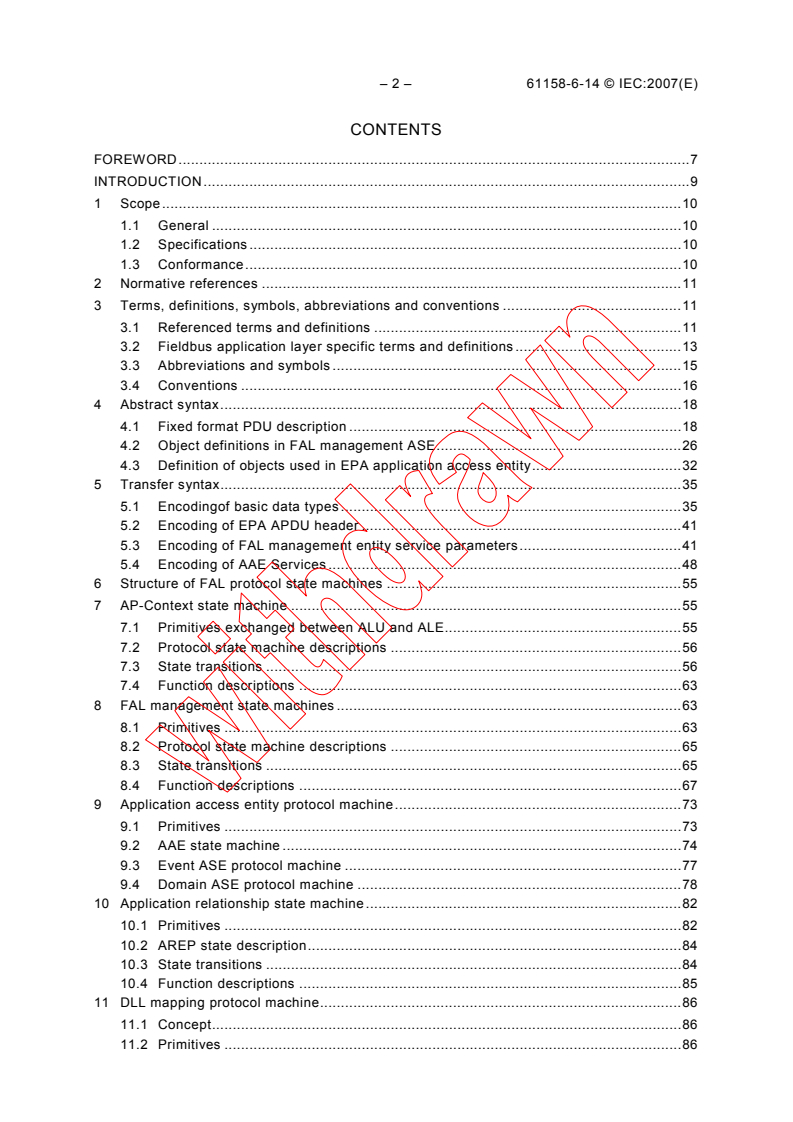
– 2 – 61158-6-14 © IEC:2007(E)
CONTENTS
FOREWORD.7
INTRODUCTION.9
1 Scope.10
1.1 General .10
1.2 Specifications .10
1.3 Conformance.10
2 Normative references .11
3 Terms, definitions, symbols, abbreviations and conventions .11
3.1 Referenced terms and definitions .11
3.2 Fieldbus application layer specific terms and definitions .13
3.3 Abbreviations and symbols .15
3.4 Conventions .16
4 Abstract syntax.18
4.1 Fixed format PDU description .18
4.2 Object definitions in FAL management ASE.26
4.3 Definition of objects used in EPA application access entity.32
5 Transfer syntax.35
5.1 Encodingof basic data types .35
5.2 Encoding of EPA APDU header .41
5.3 Encoding of FAL management entity service parameters.41
5.4 Encoding of AAE Services .48
6 Structure of FAL protocol state machines .55
7 AP-Context state machine .55
7.1 Primitives exchanged between ALU and ALE.55
7.2 Protocol state machine descriptions .56
7.3 State transitions .56
7.4 Function descriptions .63
8 FAL management state machines .63
8.1 Primitives .63
8.2 Protocol state machine descriptions .65
8.3 State transitions .65
8.4 Function descriptions .67
9 Application access entity protocol machine.73
9.1 Primitives .73
9.2 AAE state machine .74
9.3 Event ASE protocol machine .77
9.4 Domain ASE protocol machine .78
10 Application relationship state machine.82
10.1 Primitives .82
10.2 AREP state description.84
10.3 State transitions .84
10.4 Function descriptions .85
11 DLL mapping protocol machine.86
11.1 Concept.86
11.2 Primitives .86
61158-6-14 © IEC:2007(E) – 3 –
11.3 State description .87
11.4 State transitions .87
11.5 Function description .88
Bibliography.89
Figure 1 – State transition diagram .17
Figure 2 – Exchanged primitives of protocol state machine .55
Figure 3 – ACE protocol state machine .56
Figure 4 – FME protocol state machine .65
Figure 5 – AAE state transition diagrams .75
Figure 6 – Event ASE state transition diagrams .77
Figure 7 – Domain ASE state transition diagram .79
Figure 8 – AREP state transition diagrams.84
Figure 9 – ESME state transition.87
Table 1 – State machine description elements .17
Table 2 – Definition of EPA MOB header object .26
Table 3 – Definition of EPA device descriptor object .26
Table 4 – Definition of the time synchronization object.27
Table 5 – Definition of maximum response time object.28
Table 6 – Definition of the EPA communication scheduling management object .28
Table 7 – Definition of the device application information object .28
Table 8 – Definition of FB application information header.29
Table 9 – Definition of domain application information header.29
Table 10 – Definition of EPA link object header.30
Table 11 – Definition of FB application information object .30
Table 12 – Definition of EPA link object .31
Table 13 – Definition of domain application information object .31
Table 14 – Definition of domain object .32
Table 15 – Definition of simple variable object .33
Table 16 – Definition of event object .33
Table 17 – Definition of EPA socket mapping object .34
Table 18 – Definition of EPA socket timer object .34
Table 19 – Definition of ErrorType object .35
Table 20 – Encoding of Boolean value TRUE.35
Table 21 – Encoding of Boolean value FALSE .35
Table 22 – Encoding of Unsigned8 data type .35
Table 23 – Encoding of Unsigned16 data type .36
Table 24 – Encoding of Unsigned32 data type .36
Table 25 – Encoding of Unsigned64 data type .36
Table 26 – Encoding of Int8 data type .37
Table 27 – Encoding of Int16 data type .37
Table 28 – Encoding of Int32 data type .37
– 4 – 61158-6-14 © IEC:2007(E)
Table 29 – Encoding of Int64 data type .37
Table 30 – Encoding of Real type .38
Table 31 – Encoding of VisibleString data type .38
Table 32 – Encoding of OctetString data type .38
Table 33 – Encoding of BitString data type .39
Table 34 – Encoding of TimeOfDay data type .39
Table 35 – Encoding of BinaryDate data type.40
Table 36 – Encoding of TimeDifference data type .41
Table 37 – Encoding of EPA application layer service message header .41
Table 38 – Encoding of EM_DetectingDevice request parameters.42
Table 39 – Encoding of EM_OnlineReply request parameters .42
Table 40 – Encoding of EM_GetDeviceAttribute request parameters.43
Table 41 – Encoding of EM_GetDeviceAttribute positive response parameters .44
Table 42 – Encoding of EM_GetDeviceAttribute negative response parameters .45
Table 43 – Encoding of EM_ActiveNotification request parameters .45
Table 44 – Encoding of EM_ConfiguringDevice request parameters.46
Table 45 – Encoding of EM_ConfiguringDevice positive response parameters .47
Table 46 – Encoding of EM_ConfiguringDevice negative response parameters.47
Table 47 – Encoding of EM_SetDefaultValue request parameters .48
Table 48 – Encoding of EM_SetDefaultValue positive response parameters .48
Table 49 – Encoding of clear device attribute service refuse packet.48
Table 50 – Encoding of DomainDownload request parameters .49
Table 51 – Encoding of domain download service response packet .49
Table 52 – Encoding of DomainDownload negative response parameters .49
Table 53 – Encoding of DomainUpload request parameters .50
Table 54 – Encoding of DomainUpload positive response parameters.50
Table 55 – Encoding of DomainUpload negative response parameters .50
Table 56 – Encoding of EventRoport request parameters.51
Table 57 – Encoding of EventRoportAcknowledge request parameters .51
Table 58 – Encoding of EventRoportAcknowledge positive response parameters.51
Table 59 – Encoding of EventRoportAcknowledge negative response parameters .52
Table 60 – Encoding of ReportConditionChanging request parameters .52
Table 61 – Encoding of ReportConditionChanging positive response parameters.52
Table 62 – Encoding of ReportConditionChanging negative response parameters .52
Table 63 – Encoding of Read request parameters.53
Table 64 – Encoding of Read positive response parameters .53
Table 65 – Encoding of Read negative response parameters .53
Table 66 – Encoding of Write request parameters.54
Table 67 – Encoding of Write positive response parameters .54
Table 68 – Encoding of Write negative response parameters .54
Table 69 – Encoding of VariableDistribute request parameters .54
Table 70 – Primitives delivered by ALU to ALE .55
Table 71 – Primitives delivered by ALE to ALU .56
61158-6-14 © IEC:2007(E) – 5 –
Table 72 – ACE state descriptions .56
Table 73 – ACE state transitions (sender).57
Table 74 – ACE state transitions (receiver) .60
Table 75 – APServiceType() descriptions.63
Table 76 – Primitives delivered by application layer user to FME .63
Table 77 – Primitives delivered by FME to application layer user .64
Table 78 – Primitive parameters exchanged between FME and application layer user.64
Table 79 – Primitives delivered by FME to ESME.64
Table 80 – Primitives delivered by ESME to FME.64
Table 81 – Primitives parameters exchanged between FME and ESME .65
Table 82 – State transitions of EPA FME .66
Table 83 – EpaRcvNewIpAddress() descriptions .68
Table 84 – EpaAttribute_Set() descriptions .68
Table 85 – EpaRestoreDefaults() descriptions .68
Table 86 – EpaNewAddress() descriptions.68
Table 87 – Restart_EPARepeatTimer() descriptions.69
Table 88 – EpaClear_DuplicatePdTagFlag() descriptions.69
Table 89 – EPARepeatTimerExpire() descriptions.69
Table 90 – EpaSend_EM_ReqRspMessage() descriptions .70
Table 91 – EpaSend_EM_CommonErrorRsp() descriptions.70
Table 92 – EpaSntpSyncLost() descriptions .70
Table 93 – EpaIPAddressCollision() descriptions .70
Table 94 – EpaRecvMsg() descriptions .71
Table 95 – EpaQueryMatch() descriptions.71
Table 96 – EpaMessageIDMatch() descriptions.71
Table 97 – EpaDevId_Match() descriptions .72
Table 98 – EpaPdTag_Match() descriptions .72
Table 99 – EpaSet_Attribute_Data() descriptions .72
Table 100 – EpaSet_DuplicatePdTagFlag() descriptions .72
Table 101 – Primitives issued by ALU to AAE .73
Table 102 – Primitives issued by AAE to ALU .73
Table 103 – Primitives parameters exchanged between AAE and ALU.73
Table 104 – Primitives issued by AAE to ESME .74
Table 105 – Primitives issued by ESME to AAE .74
Table 106 – Primitive parameters exchanged between AAE and ESME .74
Table 107 – AAE state descriptions .74
Table 108 – AAE state transitions (sender) .75
Table 109 – AAE state transitions (receiver) .76
Table 110 – ServiceType() descriptions .77
Table 111 – State value of event management.77
Table 112 – Event ASE state transition table .78
Table 113 – Domain state value.78
Table 114 – Domain ASE state transition table .79
– 6 – 61158-6-14 © IEC:2007(E)
Table 115 – Domain_DownloadSucceed() description.81
Table 116 – Domain_WriteBuffer() description .82
Table 117 – IncreamentInvokeDomainCounter() description.82
Table 118 – DecreamentInvokeDomainCounter() description .82
Table 119 – Primitives issued by FME(or AAE) to AREP .83
Table 120 – Primitives issued by AREP to FME(or AAE) .83
Table 121 – Primitives parameters exchanged between AREP and FME(or AAE) .83
Table 122 – Primitives issued by AREP to ESME.83
Table 123 – Primitives issued by ESME to AREP.83
Table 124 – Primitive parameters exchanged between AREP and ESME .84
Table 125 – AREP state descriptions .84
Table 126 – AREP state transitions.84
Table 127 – AREPType() descriptions.85
Table 128 – ServiceType() descriptions .86
Table 129 – The primitives exchanged between transport layer and ESME .86
Table 130 – Primitives parameters exchanged between Transport Layer and ESME .87
Table 131 – ESME state description .87
Table 132 – ECFME state transitions .88
Table 133 – ServiceType()description .88
61158-6-14 © IEC:2007(E) – 7 –
INTERNATIONAL ELECTROTECHNICAL COMMISSION
____________
INDUSTRIAL COMMUNICATION NETWORKS –
FIELDBUS SPECIFICATIONS –
Part 6-14: Application layer protocol specification – Type 14 elements
FOREWORD
1) The International Electrotechnical Commission (IEC) is a worldwide organization for standardization comprising
all national electrotechnical committees (IEC National Committees). The object of IEC is to promote
international co-operation on all questions concerning standardization in the electrical and electronic fields. To
this end and in addition to other activities, IEC publishes International Standards, Technical Specifications,
Technical Reports, Publicly Available Specifications (PAS) and Guides (hereafter referred to as “IEC
Publication(s)”). Their preparation is entrusted to technical committees; any IEC National Committee interested
in the subject dealt with may participate in this preparatory work. International, governmental and non-
governmental organizations liaising with the IEC also participate in this preparation. IEC collaborates closely
with the International Organization for Standardization (ISO) in accordance with conditions determined by
agreement between the two organizations.
2) The formal decisions or agreements of IEC on technical matters express, as nearly as possible, an international
consensus of opinion on the relevant subjects since each technical committee has representation from all
interested IEC National Committees.
3) IEC Publications have the form of recommendations for international use and are accepted by IEC National
Committees in that sense. While all reasonable efforts are made to ensure that the technical content of IEC
Publications is accurate, IEC cannot be held responsible for the way in which they are used or for any
misinterpretation by any end user.
4) In order to promote international uniformity, IEC National Committees undertake to apply IEC Publications
transparently to the maximum extent possible in their national and regional publications. Any divergence
between any IEC Publication and the corresponding national or regional publication shall be clearly indicated in
the latter.
5) IEC provides no marking procedure to indicate its approval and cannot be rendered responsible for any
equipment declared to be in conformity with an IEC Publication.
6) All users should ensure that they have the latest edition of this publication.
7) No liability shall attach to IEC or its directors, employees, servants or agents including individual experts and
members of its technical committees and IEC National Committees for any personal injury, property damage or
other damage of any nature whatsoever, whether direct or indirect, or for costs (including legal fees) and
expenses arising out of the publication, use of, or reliance upon, this IEC Publication or any other IEC
Publications.
8) Attention is drawn to the Normative references cited in this publication. Use of the referenced publications is
indispensable for the correct application of this publication.
9) Attention is drawn to the possibility that some of the elements of this IEC Publication may be the subject of
patent rights. IEC shall not be held responsible for identifying any or all such patent rights.
NOTE Use of some of the associated protocol types is restricted by their intellectual-property-right holders. In all
cases, the commitment to limited release of intellectual-property-rights made by the holders of those rights permits
a particular data-link layer protocol type to be used with physical layer and application layer protocols in Type
combinations as specified explicitly in the IEC 61784 series. Use of the various protocol types in other
combinations may require permission from their respective intellectual-property-right holders.
International Standard IEC 61158-6-14 has been prepared by subcommittee 65C: Industrial
networks, of IEC technical committee 65: Industrial-process measurement, control and
automation.
This first edition and its companion parts of the IEC 61158-6 subclauses cancel and replace
IEC 61158-4:2003. This edition of this part constitutes a technical addition. This part and its
Type 14 companion parts also cancel and replace IEC/PAS 62409, published in 2005.
This edition of IEC 61158-6 includes the following significant changes from the previous
edition:
a) deletion of the former Type 6 fieldbus for lack of market relevance;
b) addition of new types of fieldbuses;
– 8 – 61158-6-14 © IEC:2007(E)
c) partition of part 6 of the third edition into multiple parts numbered -6-2, -6-3, …
The text of this standard is based on the following documents:
FDIS Report on voting
65C/476/FDIS 65C/487/RVD
Full information on the voting for the approval of this standard can be found in the report on
voting indicated in the above table.
This publication has been drafted in accordance with ISO/IEC Directives, Part 2.
The committee has decided that the contents of this publication will remain unchanged until
the maintenance result date indicated on the IEC web site under http://webstore.iec.ch in the
data related to the specific publication. At this date, the publication will be:
• reconfirmed;
• withdrawn;
• replaced by a revised edition, or
• amended.
NOTE The revision of this standard will be synchronized with the other parts of the IEC 61158 series.
The list of all the parts of the IEC 61158 series, under the general title Industrial
communication networks – Fieldbus specifications, can be found on the IEC web site.
61158-6-14 © IEC:2007(E) – 9 –
INTRODUCTION
This part of IEC 61158 is one of a series produced to facilitate the interconnection of
automation system components. It is related to other standards in the set as defined by the
“three-layer” fieldbus reference model described in IEC/TR 61158-1.
The application protocol provides the application service by making use of the services
available from the data-link or other immediately lower layer. The primary aim of this standard
is to provide a set of rules for communication expressed in terms of the procedures to be
carried out by peer application entities (AEs) at the time of communication. These rules for
communication are intended to provide a sound basis for development in order to serve a
variety of purposes:
• as a guide for implementors and designers;
• for use in the testing and procurement of equipment;
• as part of an agreement for the admittance of systems into the open systems environment;
• as a refinement to the understanding of time-critical communications within OSI.
This standard is concerned, in particular, with the communication and interworking of sensors,
effectors and other automation devices. By using this standard together with other standards
positioned within the OSI or fieldbus reference models, otherwise incompatible systems may
work together in any combination.
– 10 – 61158-6-14 © IEC:2007(E)
INDUSTRIAL COMMUNICATION NETWORKS –
FIELDBUS SPECIFICATIONS –
Part 6-14: Application layer protocol specification – Type 14 elements
1 Scope
1.1 General
The fieldbus application layer (FAL) provides user programs with a means to access the
fieldbus communication environment. In this respect, the FAL can be viewed as a “window
between corresponding application programs.”
This standard provides common elements for basic time-critical and non-time-critical
messaging communications between application programs in an automation environment and
material specific to Type 14 fieldbus. The term “time-critical” is used to represent the
presence of a time-window, within which one or more specified actions are required to be
completed with some defined level of certainty. Failure to complete specified actions within
the time window risks failure of the applications requesting the actions, with attendant risk to
equipment, plant and possibly human life.
This standard specifies interactions between remote applications and defines the externally
visible behavior provided by the Type 14 fieldbus application layer in terms of
a) the formal abstract syntax defining the application layer protocol data units conveyed
between communicating application entities;
b) the transfer syntax defining encoding rules that are applied to the application layer
protocol data units;
c) the application context state machine defining the application service behavior visible
between communicating application entities;
d) the application relationship state machines defining the communication behavior visible
between communicating application entities.
The purpose of this standard is to define the protocol provided to
1) define the wire-representation of the service primitives defined in IEC 61158-5-14, and
2) define the externally visible behavior associated with their transfer.
This standard specifies the protocol of the Type 14 fieldbus application layer, in conformance
with the OSI Basic Reference Model (ISO/IEC 7498) and the OSI application layer structure
(ISO/IEC 9545).
1.2 Specifications
The principal objective of this standard is to specify the syntax and behavior of the application
layer protocol that conveys the application layer services defined in IEC 61158-5-14.
A secondary objective is to provide migration paths from previously-existing industrial
communications protocols. It is this latter objective which gives rise to the diversity of
protocols standardized in the IEC 61158-6 series.
1.3 Conformance
This standard does not specify individual implementations or products, nor does it constrain
the implementations of application layer entities within industrial automation systems.
61158-6-14 © IEC:2007(E) – 11 –
Conformance is achieved through implementation of this application layer protocol
specification.
2 Normative references
The following referenced documents are indispensable for the application of this document.
For dated references, only the edition cited applies. For undated references, the latest edition
of the referenced document (including any amendments) applies.
IEC 60559, Binary floating-point arithmetic for microprocessor systems
IEC 61158-3-14, Industrial communication networks – Fieldbus specifications – Part 3-14:
Data-link layer service definition – Type 14 elements
IEC 61158-4-14, Industrial communication networks – Fieldbus specifications – Part 4-14:
Data-link layer protocol specification – Type 14 elements
IEC 61158-5-14, Industrial communication networks – Fieldbus specifications – Part 5-14:
Application layer service definition – Type 14 elements
ISO/IEC 10731, Information technology – Open Systems Interconnection – Basic Reference
Model – Conventions for the definition of OSI services
ISO/IEC 7498-1, Information technology – Open Systems Interconnection – Basic Reference
Model – Part 1: The Basic Model
ISO/IEC 8802-3, Information technology – Telecommunications and information exchange
between systems – Local and metropolitan area networks – Specific requirements – Part 3:
Carrier sense multiple access with collision detection (CSMA/CD) access method and physical
layer specifications
ISO/IEC 8822, Information technology – Open Systems Interconnection – Presentation service
definition
ISO/IEC 8824, Information technology – Abstract Syntax Notation One (ASN.1): Specification
of basic notation
ISO/IEC 9545, Information technology – Open Systems Interconnection – Application Layer
structure
3 Terms, definitions, symbols, abbreviations and conventions
For the purposes of this document, the following definitions apply.
3.1 Referenced terms and definitions
3.1.1 ISO/IEC 7498-1 terms
For the purposes of this document, the following terms as defined in ISO/IEC 7498-1 apply:
a) application entity
b) application process
c) application protocol data unit
d) application service element
e) application entity invocation
– 12 – 61158-6-14 © IEC:2007(E)
f) application process invocation
g) application transaction
h) real open system
i) transfer syntax
3.1.2 ISO/IEC 8822 terms
For the purposes of this document, the following terms as defined in ISO/IEC 8822 apply:
a) abstract syntax
b) presentation context
3.1.3 ISO/IEC 9545 terms
For the purposes of this document, the following terms as defined in ISO/IEC 9545 apply:
a) application-association
b) application-context
c) application context name
d) application-entity-invocation
e) application-entity-type
f) application-process-invocation
g) application-process-type
h) application-service-element
i) application control service element
3.1.4 ISO/IEC 8824 terms
For the purposes of this document, the following terms as defined in ISO/IEC 8824 apply:
a) object identifier
b) type
3.1.5 Fieldbus data-link Layer terms
For the purposes of this document, the following terms as defined in IEC 61158-3-14 and
IEC 61158-4-14 apply.
a) DL-Time
b) DL-Scheduling-policy
c) DLCEP
d) DLC
e) DL-connection-oriented mode
f) DLPDU
g) DLSDU
h) DLSAP
i) link
j) network address
k) node address
l) node
m) scheduled
61158-6-14 © IEC:2007(E) – 13 –
3.2 Fieldbus application layer specific terms and definitions
3.2.1
access control
control on the reading and writing of an object
3.2.2
access Path
association of a symbolic name with a variable for the purpose of open communication
3.2.3
communication macrocycle
set of basic cycles needed for a configured communication activity in a macro network
segment
3.2.4
communication scheduling
algorithms and operation for data transfers occurring in a deterministic and repeatable manner
3.2.5
configuration (of a system or device)
step in system design: selecting functional units, assigning their locations and defining their
interconnections.
3.2.6
cyclic
repetitive in a regular manner
3.2.7
destination FB Instance
FB instance that receives the specified parameters
3.2.8
domain
part of memory used to store code or data
3.2.9
domain download
operation to write data in a domain
3.2.10
domain upload
operation to read data from a domain
3.2.11
entity
particular thing, such as a person, place, process, object, concept, association, or event
3.2.12
Type 14 bridge
DL-relay entity which performs synchronization between links (buses) and may perform
selective store-and-forward and routing functions to connect two micro network segments
3.2.13
identifier
16-bit word associated with a system variable
– 14 – 61158-6-14 © IEC:2007(E)
3.2.14
index
address of an object within an application process
3.2.15
instance
actual physical occurrence of an object within a class that identifies one of many objects
within the same object class
3.2.16
instantiation
creation of an instance of a specified type.
3.2.17
management information
network-visible information for the purpose of managing the field system.
3.2.18 +
management information base
organized list of management information
3.2.19
mapping
set of values having defined correspondence with the quantities or values of another set.
3.2.20
member
piece of an attribute that is structured as an element of an array
3.2.21
message filtering
decision on a message according to a special rule.
3.2.22
micro segment
part of a network, where special scheduling is implemented.
3.2.23
offset
number of octets from a specially designated position.
3.2.24
phase
elapsed fraction of a cycle, measured from some fixed origin
3.2.25
process interface
data exchange and information mapping between physical process and application unit
3.2.26
real-time
ability of a system to provide a required result in a bounded time
3.2.27
real-time communication
transfer of data in real-time.
61158-6-14 © IEC:2007(E) – 15 –
3.2.28
Real-Time Ethernet (RTE)
ISO/IEC 8802-3-based network that includes real-time communication
NOTE 1 Other communication can be supported, providing the real-time communication is not compromised.
NOTE 2 This definition is dedicated, but not limited, to ISO/IEC 8802-3. It could be applicable to other IEEE 802
specifications, for example IEEE 802.11.
3.2.29
schedule
temporal arrangement of a number of related operations.
3.2.30
scheduling macrocycle
time interval to implement a specific schedule.
3.2.31
source FB Instance
FB instance that sends a specific parameter
3.2.32
time offset
time difference from a specially designated time
3.3 Abbreviations and symbols
Application Access Entity
AAE
Application Entity
AE
Application Layer
AL
Application Layer Entity
ALE
Application Layer Protocol
ALP
Application Object
APO
Application Process
AP
Application Protocol Data Unit
APDU
Application Process Identifier
API
Application Relationship
AR
Address Resolution Protocol
ARP
AREP Application Relationship End Point
Application Service Element
ASE
Confirmation
Cnf
Communication Relationship
CR
Communication Relationship End Point
CREP
Carrier Sense Multiple Access Protocol with Collision Detection
CSMA/CD
Device Description
DD
Dynamic Host Configuration Protocol
DHCP
(as a prefix) data-link-
DL-
Data-link Connection End Point
DLCEP
Data-link Layer
DLL
Data-link Entity
DLE
Data-link-management
DLM
Data-link Service
DLS
Data-link Service Access Point
DLSAP
DLSDU DL-service-data-unit
– 16 – 61158-6-14 © IEC:2007(E)
Type 14 communication scheduling management entity
ECSME
Ethernet for Plant Automation
Type 14
(as a prefix) Type 14 Management
EM_
Type 14 Socket Mapping Entity
ESME
FB Function Block
Function Block Application Process
FBAP
FAL Management Entity
FME
Indication
Ind
Internet Protocol
IP
Logical Link Control
LLC
Link Management Protocol
LMP
Medium Access Control
MAC
Medium Attachment Unit
MAU
Management Object Base
MOB
Pad (bits)
PAD
Protocol Data Unit
PDU
Publisher/Subscriber
P/S
Request
Req
Response
Rsp
RTE Real-Time Ethernet
Real-Time Ethernet
RT-Ethernet
Service Access Point
SAP
Service Data Unit
SDU
System Management Entity
SME
Simple Network Time Protocol
SNTP
Transmission Control Protocol
TCP
User Datagram Protocol
UDP
Confirm Primitive
.cnf
Indication Primitive
.ind
Request Primitive
.req
Response Primitive
.rsp
3.4 Conventions
3.4.1 Gene
...
Questions, Comments and Discussion
Ask us and Technical Secretary will try to provide an answer. You can facilitate discussion about the standard in here.
Loading comments...