

IEC TR 62422:2007
(Main)Environmental characterization of solid insulating materials
General Information
- Abstract
This technical report gives framework guidelines for collecting environmental data of insulating materials useful to engineers and designers of electrotechnical products for evaluating environmental impacts. It also provides a guideline for common format in environmental data reporting. This will enable producers to more easily evaluate the potential environmental impacts of those electrotechnical products using solid insulating materials.
- Status
- Published
- Publication Date
- 28-Mar-2007
- Technical Committee
- TC 15 - Solid electrical insulating materials
- Drafting Committee
- PT 62422 - TC 15/PT 62422
- Current Stage
- PPUB - Publication issued
- Start Date
- 29-Mar-2007
- Completion Date
- 31-Mar-2007
Overview
IEC TR 62422:2007 - "Environmental characterization of solid insulating materials" provides a framework for collecting and reporting environmental data on solid insulating materials used in electrotechnical products. The technical report guides suppliers, designers and engineers on a common format for environmental data reporting so that producers and product teams can evaluate potential environmental impacts of insulating materials across their life cycle. The methodology aligns with Life Cycle Assessment (LCA) principles (ISO 14040) and supports quick assessments and regulatory conformity checks.
Key Topics and Requirements
- Methodological framework: Life Cycle Thinking (LCT) approach based on LCA phases - goal & scope, inventory (LCI), impact assessment and interpretation.
- Goal and scope definition: Requires clear description of study background, object and functional unit (the electrotechnical product including selected insulating materials).
- System boundaries & allocation: Guidance on defining cut-offs and allocation rules for multi-output processes.
- Data quality: Requirements and recommendations for data quality to ensure comparability and usefulness.
- Life-Cycle Inventory (LCI): Collection of relevant inputs/outputs for production, use and end-of-life stages.
- Impact assessment & interpretation: Guidance on translating inventory data into potential environmental impacts.
- Material Category Requirements (MCR): Defines categories and specific environmental data needs for material types (see Annex A examples).
- Material Environmental Information Data Sheet (MEIDS): Standardized reporting format covering:
- Resource use (materials, energy)
- Pollutant emissions (expressed as potential environmental impact)
- Waste generation and end-of-life indicators (recyclability, recovery)
- Additional information such as processing hazards or disposal cautions (see Annex B example)
Applications and Who Uses It
- Product designers and electrical engineers - to compare insulating materials and make environmentally informed material choices during design.
- Materials suppliers and manufacturers - to prepare standardized MEIDS and supply consistent environmental data to customers.
- LCA practitioners and environmental managers - to incorporate insulating material data into broader product LCAs or environmental declarations.
- Regulatory and compliance teams - for quick assessment of conformity with product-related environmental regulations.
- Recycling and end-of-life planners - to evaluate recyclability, recoverability and safe disposal practices.
Related Standards
- ISO 14040 (Life Cycle Assessment principles) - methodological alignment.
- ISO 14020 (Environmental labels and declarations) - referenced for reporting principles.
- IEC Guide 109 - referenced for recyclability definitions.
IEC TR 62422 supports consistent, comparable environmental data for solid insulating materials - enabling better material selection, more reliable LCA inputs, and clearer supplier–manufacturer communication.
Get Certified
Connect with accredited certification bodies for this standard

IMQ S.p.A. (Certification)
Italian electrical product certification.

SLG Prüf- und Zertifizierungs GmbH
German testing and certification body.

UL Solutions
Global safety science company with testing, inspection and certification.
Sponsored listings
Frequently Asked Questions
IEC TR 62422:2007 is a technical report published by the International Electrotechnical Commission (IEC). Its full title is "Environmental characterization of solid insulating materials". This standard covers: This technical report gives framework guidelines for collecting environmental data of insulating materials useful to engineers and designers of electrotechnical products for evaluating environmental impacts. It also provides a guideline for common format in environmental data reporting. This will enable producers to more easily evaluate the potential environmental impacts of those electrotechnical products using solid insulating materials.
This technical report gives framework guidelines for collecting environmental data of insulating materials useful to engineers and designers of electrotechnical products for evaluating environmental impacts. It also provides a guideline for common format in environmental data reporting. This will enable producers to more easily evaluate the potential environmental impacts of those electrotechnical products using solid insulating materials.
IEC TR 62422:2007 is classified under the following ICS (International Classification for Standards) categories: 01 - GENERALITIES. TERMINOLOGY. STANDARDIZATION. DOCUMENTATION; 29.035.01 - Insulating materials in general. The ICS classification helps identify the subject area and facilitates finding related standards.
IEC TR 62422:2007 is available in PDF format for immediate download after purchase. The document can be added to your cart and obtained through the secure checkout process. Digital delivery ensures instant access to the complete standard document.
Standards Content (Sample)
TECHNICAL IEC
REPORT TR 62422
First edition
2007-03
Environmental characterization of solid
insulating materials
Reference number
IEC/TR 62422:2007(E)
Publication numbering
As from 1 January 1997 all IEC publications are issued with a designation in the
60000 series. For example, IEC 34-1 is now referred to as IEC 60034-1.
Consolidated editions
The IEC is now publishing consolidated versions of its publications. For example,
edition numbers 1.0, 1.1 and 1.2 refer, respectively, to the base publication, the
base publication incorporating amendment 1 and the base publication incorporating
amendments 1 and 2.
Further information on IEC publications
The technical content of IEC publications is kept under constant review by the IEC,
thus ensuring that the content reflects current technology. Information relating to
this publication, including its validity, is available in the IEC Catalogue of
publications (see below) in addition to new editions, amendments and corrigenda.
Information on the subjects under consideration and work in progress undertaken
by the technical committee which has prepared this publication, as well as the list
of publications issued, is also available from the following:
• IEC Web Site (www.iec.ch)
• Catalogue of IEC publications
The on-line catalogue on the IEC web site (www.iec.ch/searchpub) enables you to
search by a variety of criteria including text searches, technical committees
and date of publication. On-line information is also available on recently issued
publications, withdrawn and replaced publications, as well as corrigenda.
• IEC Just Published
This summary of recently issued publications (www.iec.ch/online_news/ justpub)
is also available by email. Please contact the Customer Service Centre (see
below) for further information.
• Customer Service Centre
If you have any questions regarding this publication or need further assistance,
please contact the Customer Service Centre:
Email: custserv@iec.ch
Tel: +41 22 919 02 11
Fax: +41 22 919 03 00
TECHNICAL IEC
REPORT TR 62422
First edition
2007-03
Environmental characterization of solid
insulating materials
© IEC 2007 ⎯ Copyright - all rights reserved
No part of this publication may be reproduced or utilized in any form or by any means, electronic or
mechanical, including photocopying and microfilm, without permission in writing from the publisher.
International Electrotechnical Commission, 3, rue de Varembé, PO Box 131, CH-1211 Geneva 20, Switzerland
Telephone: +41 22 919 02 11 Telefax: +41 22 919 03 00 E-mail: inmail@iec.ch Web: www.iec.ch
PRICE CODE
Commission Electrotechnique Internationale S
International Electrotechnical Commission
МеждународнаяЭлектротехническаяКомиссия
For price, see current catalogue
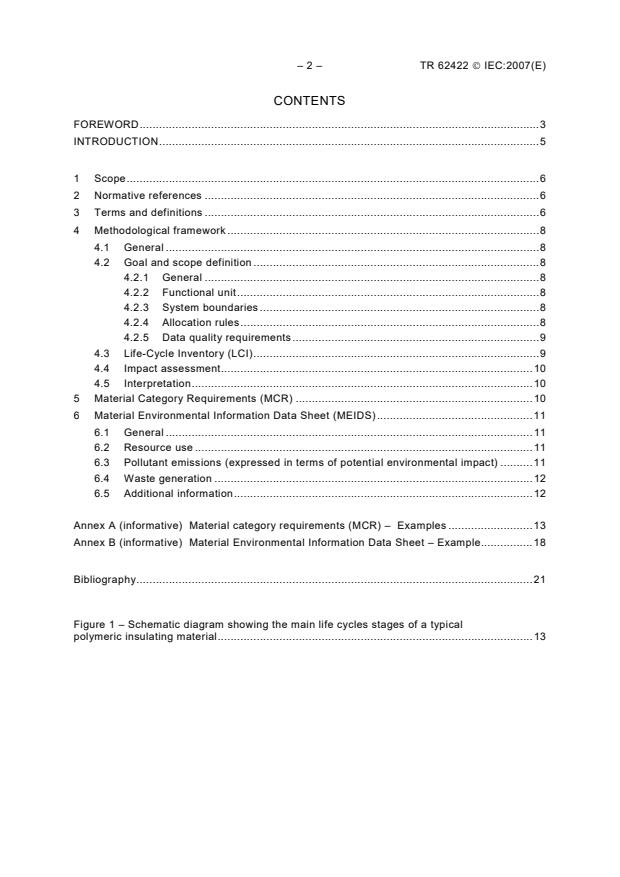
– 2 – TR 62422 © IEC:2007(E)
CONTENTS
FOREWORD.3
INTRODUCTION.5
1 Scope.6
2 Normative references .6
3 Terms and definitions .6
4 Methodological framework .8
4.1 General .8
4.2 Goal and scope definition .8
4.2.1 General .8
4.2.2 Functional unit.8
4.2.3 System boundaries .8
4.2.4 Allocation rules.8
4.2.5 Data quality requirements.9
4.3 Life-Cycle Inventory (LCI).9
4.4 Impact assessment.10
4.5 Interpretation.10
5 Material Category Requirements (MCR) .10
6 Material Environmental Information Data Sheet (MEIDS).11
6.1 General .11
6.2 Resource use .11
6.3 Pollutant emissions (expressed in terms of potential environmental impact) .11
6.4 Waste generation .12
6.5 Additional information.12
Annex A (informative) Material category requirements (MCR) – Examples .13
Annex B (informative) Material Environmental Information Data Sheet – Example.18
Bibliography.21
Figure 1 – Schematic diagram showing the main life cycles stages of a typical
polymeric insulating material.13
TR 62422 © IEC:2007(E) – 3 –
INTERNATIONAL ELECTROTECHNICAL COMMISSION
____________
ENVIRONMENTAL CHARACTERIZATION OF SOLID
INSULATING MATERIALS
FOREWORD
1) The International Electrotechnical Commission (IEC) is a worldwide organization for standardization comprising
all national electrotechnical committees (IEC National Committees). The object of IEC is to promote
international co-operation on all questions concerning standardization in the electrical and electronic fields. To
this end and in addition to other activities, IEC publishes International Standards, Technical Specifications,
Technical Reports, Publicly Available Specifications (PAS) and Guides (hereafter referred to as “IEC
Publication(s)”). Their preparation is entrusted to technical committees; any IEC National Committee interested
in the subject dealt with may participate in this preparatory work. International, governmental and non-
governmental organizations liaising with the IEC also participate in this preparation. IEC collaborates closely
with the International Organization for Standardization (ISO) in accordance with conditions determined by
agreement between the two organizations.
2) The formal decisions or agreements of IEC on technical matters express, as nearly as possible, an international
consensus of opinion on the relevant subjects since each technical committee has representation from all
interested IEC National Committees.
3) IEC Publications have the form of recommendations for international use and are accepted by IEC National
Committees in that sense. While all reasonable efforts are made to ensure that the technical content of IEC
Publications is accurate, IEC cannot be held responsible for the way in which they are used or for any
misinterpretation by any end user.
4) In order to promote international uniformity, IEC National Committees undertake to apply IEC Publications
transparently to the maximum extent possible in their national and regional publications. Any divergence
between any IEC Publication and the corresponding national or regional publication shall be clearly indicated in
the latter.
5) IEC provides no marking procedure to indicate its approval and cannot be rendered responsible for any
equipment declared to be in conformity with an IEC Publication.
6) All users should ensure that they have the latest edition of this publication.
7) No liability shall attach to IEC or its directors, employees, servants or agents including individual experts and
members of its technical committees and IEC National Committees for any personal injury, property damage or
other damage of any nature whatsoever, whether direct or indirect, or for costs (including legal fees) and
expenses arising out of the publication, use of, or reliance upon, this IEC Publication or any other IEC
Publications.
8) Attention is drawn to the Normative references cited in this publication. Use of the referenced publications is
indispensable for the correct application of this publication.
9) Attention is drawn to the possibility that some of the elements of this IEC Publication may be the subject of
patent rights. IEC shall not be held responsible for identifying any or all such patent rights.
The main task of IEC technical committees is to prepare International Standards. However, a
technical committee may propose the publication of a technical report when it has collected
data of a different kind from that which is normally published as an International Standard, for
example "state of the art".
IEC 62422, which is a technical report, has been prepared by IEC technical committee 15:
Solid electrical insulating materials.
The text of this technical report is based on the following documents:
Enquiry draft Report on voting
15/346/DTR 15/356/RVC
Full information on the voting for the approval of this technical report can be found in the
report on voting indicated in the above table.
– 4 – TR 62422 © IEC:2007(E)
This publication has been drafted in accordance with the ISO/IEC Directives, Part 2.
The committee has decided that the contents of this publication will remain unchanged until
the maintenance result date indicated on the IEC web site under "http://webstore.iec.ch" in
the data related to the specific publication. At this date, the publication will be:
• reconfirmed,
• withdrawn,
• replaced by a revised edition, or
• amended.
A bilingual version of this publication may be issued at a later date.
TR 62422 © IEC:2007(E) – 5 –
INTRODUCTION
Production, use and disposal of products may cause serious environmental problems.
Electrical and electronic products are among those that are suspected to have major impacts
to the environment due to their use of energy, the variety of hazardous substances included
and their volume on the market. It has to be noticed that the environmental performance of
these products is related to the characteristics of the insulating materials.
Environmental aspects are present in each phase of the life cycle of these materials. For
example, in some thermosetting resins, volatile hazardous chemical compounds are used in
production phase and spread during processing. On the other hand sometimes these
additives allow a better insulation performance with a lower indirect impact due to lower
electrical losses. Regarding the end of life, if these polymers are deposited at a landfill site,
the complete degradation of the material may take more than a century, and during this time
span harmful additives may be leached from the landfill site.
In order to minimize adverse environmental impacts of electrotechnical products, insulating
materials selection should be conducted by engineers and designers including environmental
considerations. The environmental information related to the investigated insulating materials
should be collected and processed, by suppliers, according to this document. The evaluation
should be developed at the design stage, in respect of specific uses and with a life cycle
perspective in mind. This means that the environmental characteristics of the materials used,
which are collected and processed according to this document, should be compared with the
environmental impacts due to the performance of the product and/or the system, with the
product before making material selection, product design, and so on.
In order to optimize the necessary trade-offs between fitness for use and environmental
impact minimization, it is important to have appropriate and comparable, i.e. standardized,
information on environmental aspects and impacts (direct and indirect) connected with
insulating materials entire life cycle. In particular, it is fundamental to have standardized
information concerning
– the production phase, such as information related to the consumption of resources and the
environmental impact, incurred during intermediate products manufacturing;
– the usage phase, such as information about harmful substances actually released and the
insulation performances;
– the end-of-life phase, such as the recyclability, the recoverability, the reusability, and
cautions to be taken into account when landfilling or chemically recycling.
The methodological framework for the environmental characterization of insulating materials
should be drafted in accordance with Life Cycle Assessment (LCA) (ISO 14040 standard)
principles.
– 6 – TR 62422 © IEC:2007(E)
ENVIRONMENTAL CHARACTERIZATION OF SOLID
INSULATING MATERIALS
1 Scope
This technical report gives framework guidelines for collecting environmental data of
insulating materials useful to engineers and designers of electrotechnical products for
evaluating environmental impacts.
It also provides a guideline for common format in environmental data reporting. This will
enable producers to more easily evaluate the potential environmental impacts of those
electrotechnical products using solid insulating materials.
Moreover, it will allow a quick assessment of conformity to relevant electrotechnical product-
related environmental regulations.
2 Normative references
The following referenced documents are indispensable for the application of this document.
For dated references, only the edition cited applies. For undated references, the latest edition
of the referenced document (including any amendments) applies.
ISO 14020, Environmental labels and declarations – General principles
3 Terms and definitions
For the purpose of this document the following terms and definitions apply.
3.1
additive
ingredient mixed into resin to improve properties
NOTE Examples include plasticizers, initiators, light stabilizers and flame retardants.
3.2
disposal
collection, sorting, transport and treatment of waste as well as its storage and tipping above
or under ground, or at sea
[EU Directive 75/442/EEC]
3.3
environment
surroundings in which an organization operates, including air, water, land, natural resources,
flora, fauna, humans, and their interrelation
[ISO 14001:2004, definition 3.5]
3.4
environmental aspect
element of an organization's activities, products or services that can interact with the
environment
TR 62422 © IEC:2007(E) – 7 –
NOTE A significant environmental aspect is an environmental aspect that has or can have a significant
environmental impact.
[ISO 14001:2004, definition 3.6]
3.5
environmental impact
any change to the environment, whether adverse or beneficial, wholly or partly resulting from
an organization's activities, products or services
[ISO 14001:2004, definition 3.7 modified]
3.6
incineration (of waste)
burning of waste at high temperatures in the presence of sufficient air to achieve complete
combustion, either to reduce its volume or its toxicity
3.7
landfill
engineered deposit of waste into or onto land in such a way that pollution or harm to the
environment is minimized or prevented and, through restoration, to provide land which may be
used for another purpose
3.8
recovery
any of the applicable operations involving reprocessing in a production process of waste
material for the purpose of reclamation of secondary materials or burning them with energy
recovery
[EU Directive 75/442/EEC]
3.9
recycling
reprocessing in a production process of the waste materials for the original purpose or for
other purposes, but excluding energy recovery which means the use of combustible waste as
a means of generating energy through direct incineration with or without other waste but with
recovery of the heat
[EU Directive 2002/96/EC]
3.10
recyclability
property of a substance or a material and parts/products made thereof that makes it possible
for them to be recycled
– 8 – TR 62422 © IEC:2007(E)
NOTE Recyclability of a product is not only determined by the recyclability of the materials it contains. Product
structure and logistics are also very important factors.
[IEC Guide 109:2003]
4 Methodological framework
4.1 General
The environmental performance of electrotechnical products should be described based on a
Life Cycle Thinking (LCT) approach. LCT approach considers a product’s life-cycle and aims
for a reduction of its cumulative environmental impacts. Although being based on the same
principles as a Life Cycle Assessment (LCA), it is more qualitative and does not require the
thorough data analysis that full scale LCA relies on. Considering the life cycle of a product
allows implementation of a range of simple comparative measures with great benefits to the
environment.
The main aspects to be considered in this LCT approach, as for LCA, are as follows:
• definition of goal and scope of the study;
• compiling an inventory analysis of relevant inputs and outputs of the product system;
• evaluating the potential environmental impacts associated with these inputs and outputs;
• interpreting the results of the inventory analysis and impact assessment phases in relation
to the objectives of the study.
4.2 Goal and scope definition
4.2.1 General
According to the ISO standards, goal and scope definition must be explicitly stated in an LCA.
The goal contains some background information on the study, and describes in detail the
object of the study.
If the aim of an LCA is the comparison of different technologies providing the same service,
good LCA praxis requires uniform scopes with particular attention to the following aspects.
4.2.2 Functional unit
The functional unit of the study shall be the electrotechnical product including the selected
insulating materials.
4.2.3 System boundaries
In a real economy the relations between sectors, companies and processes are very complex
and for the model they have to be simplified in many respects. One of the most important
simplifications in LCA is the introduction of system boundaries and cut-off criteria. Without
these boundaries, the inventory of nearly any process would require an analysis of the whole
national economy. The boundaries now systematically cut off processes that have not a
significant influence on the results for the process in focus.
4.2.4 Allocation rules
In multi-output processes, environmental impacts have to be allocated to the different outputs
in a "fair" way. The methods available can in general be classified in two groups: substitution
or system enlargement, and allocation keys. In the substitution approach, all but one of the
outputs is assumed to replace the same commodity/service from an optional process, and the
original process is credited with the environmental impacts from this replaced process.
System enlargement is equivalent; here the environmental impacts from the optional process
are added to those processes that the multi-output process is compared to. When using an
TR 62422 © IEC:2007(E) – 9 –
allocation key, however, the total environmental impacts of the multi-output process are
allocated according to appropriate properties of the commodities/services produced, such as
mass, heating value or economic value (market price).
4.2.5 Data quality requirements
Data quality is a relevant matter in LCA studies and its consolidation may absorb most of the
time spent for the study if no guidelines are provided.
The following data quality requirements are usually considered:
– precision: measure of the variability of the data values for each data category expressed
(e.g. variance);
– completeness: percentage of locations reporting primary data from the potential number in
existence for each data category in a unit process;
– representativeness: qualitative assessment of degree to which the data set reflects the
true population of interest (i.e. geographical coverage, time period and technology
coverage);
– consistency: qualitative assessment of how uniformly the methodology is applied to the
various components of the analysis;
– reproducibility: qualitative assessment of the extent to which information about the
methodology and data values allows an independent practitioner to reproduce the results
reported.
It is useful to classify data quality according to these definitions:
– “primary data” is understood to be those data that were gathered in the field and hence
guarantee the highest degree of representativity of the system analyzed;
– “secondary data” is understood as those data that were used to complete the model for
the system being examined and that were taken from data base or studies previously
conducted and published.
4.3 Life-Cycle Inventory (LCI)
In this step, all material and energy flows that are relevant to the system are described and
integrated. It is usually the most labour-intensive part of an LCA. As a result of this step, all
inputs and outputs of the system are represented, normalized to the functional unit.
In the inventory all processes are characterized by their (useful) output and by a vector
containing the following parameters:
• Inputs (materials)
• Ancillaries (e.g. energy)
• Use of other services (disposal of by-products, transports, infrastructure)
• Direct elementary interaction with the environment in the form of
– emissions
– use of resources
The resulting set of vectors represents a set of linear equations that can be solved in order to
determine all elementary interactions with the environment that are induced by any of the
processes.
Generally, inventory input data can be derived in two ways: the bottom-up approach is based
on technology-specific data; it is also called process chain analysis. In the top-down
approach, sector-wide indicators (such as total energy use) and input-output tables (that
describe the interaction of sectors in a national economy) are used to generate more generic
data, like average emission factor.
– 10 – TR 62422 © IEC:2007(E)
A widely accepted practice is to rely on the bottom-up procedure wherever possible and to
use top-down data only to cover data gaps or for verification purposes.
Although the inventory looks at first sight like a mere accounting procedure that contains no
methodological problems, it is a complex task. The analyst's choice of methodology or his
approach to close wide data gaps can have a significant influence on the final result of the
study.
This TR aims to increase the availability of specific data and therefore to reduce the
contribution and the uncertainty introduced in performance evaluation by the use of generic
top-down data.
4.4 Impact assessment
In this phase of the analysis for any included process, many different elementary interactions
with the environment such as emissions to air, water, and soil, or the use of resources have to
be listed. Interactions need to be grouped together (e.g. by means of impact classification and
characterization) to make this problem tractable.
The number and type of impacts included depends on the goal of the study, the anticipated
relevance of each impact class for the system analyzed, data availability, and other factors
...