

IEC 61094-8:2012
(Main)Measurement microphones - Part 8: Methods for determining the free-field sensitivity of working standard microphones by comparison
General Information
- Abstract
IEC 61094-8:2012 applicable to working standard microphones meeting the requirements of IEC 61094-4. It describes methods of determining the free-field sensitivity by comparison with a laboratory standard microphone or working standard microphone (where applicable) that has been calibrated according to either; IEC 61094-3; IEC 61094-2; IEC 61094-5; IEC 61094-6; or this part of IEC 61094. Methods performed in an acoustical environment that is a good approximation to an ideal free-field (e.g. a high quality free-field chamber), and methods that use post processing of results to minimise the effect of imperfections in the acoustical environment, to simulate free-field conditions, are both covered by this part of IEC 61094. Comparison methods based on the principles described in IEC 61094-3 are also possible but beyond the scope of this part of IEC 61094.
- Status
- Published
- Publication Date
- 18-Sep-2012
- Technical Committee
- TC 29 - Electroacoustics
- Drafting Committee
- WG 5 - TC 29/WG 5
- Current Stage
- PPUB - Publication issued
- Start Date
- 19-Sep-2012
- Completion Date
- 15-Dec-2012
Overview
The IEC 61094-8:2012 standard, published by the International Electrotechnical Commission (IEC), defines the methods for determining the free-field sensitivity of working standard microphones through comparative techniques. This standard is part of the IEC 61094 series focused on measurement microphones and specifically applies to microphones meeting the requirements of IEC 61094-4. It outlines procedures for calibrating working standard microphones by comparison with laboratory standard microphones or other working standard microphones calibrated according to various IEC 61094 parts.
This standard covers methods performed in acoustical environments that approximate ideal free-field conditions, such as high-quality free-field chambers. It also addresses techniques involving post-processing to compensate for any imperfections in the testing environment. IEC 61094-8 supports ensuring microphone calibration accuracy for consistent and reliable acoustic measurements.
Key Topics
Scope and Applicability: The standard is applicable to working standard microphones compliant with IEC 61094-4, and can be used with laboratory standard microphones that meet IEC 61094-1 requirements. It includes both free-field chamber testing and simulated free-field measurement methods.
Calibration by Comparison: Free-field sensitivity determination is conducted by comparing the microphone under test with a reference microphone previously calibrated according to IEC standards such as IEC 61094-2, IEC 61094-3, IEC 61094-5, IEC 61094-6, or the current part (61094-8).
Acoustical Environment: The standard emphasizes the importance of testing in a free-field or quasi-free-field environment. Techniques include using free-field chambers with sound absorbing surfaces and applying time-selective post-processing to isolate direct sound and minimize reflections.
Measurement Setup: Guidelines for microphone and sound source placement, polarizing voltage, acoustic center alignment, and mounting configurations are specified to ensure accurate sensitivity measurement.
Uncertainty Analysis: Components contributing to calibration uncertainty are addressed, including factors like reference microphone sensitivity, measurement noise, indirect sound influence, and equipment non-linearity.
Normative References: The standard references other important IEC documents within the 61094 series relevant to microphone specifications, calibration methods, and sensitivity compensation.
Applications
Acoustic Measurement Laboratories: Enables accurate calibration of working standard microphones used as transfer standards or for quality assurance in sound measurement.
Manufacturing and Quality Control: Assists microphone manufacturers in verifying free-field sensitivity of working standard microphones during production and final testing.
Acoustic Research and Development: Provides robust methods for calibrating microphones used in research environments requiring precise free-field sensitivity for experiments and product development.
Environmental and Industrial Noise Monitoring: Supports accurate microphone calibration which is critical for noise monitoring and regulatory compliance in environmental and industrial applications.
Electroacoustic Equipment Calibration: Although primarily for microphones, the principles can be adapted for calibration of other electroacoustic devices involving free-field sensitivity measurements.
Related Standards
IEC 61094-1: Specifications for laboratory standard microphones, defining characteristics and performance criteria.
IEC 61094-2: Primary pressure calibration method for laboratory standard microphones using reciprocity techniques.
IEC 61094-3: Primary free-field calibration method for laboratory standard microphones via reciprocity technique.
IEC 61094-4: Specifications for working standard microphones, including mechanical and electrical requirements.
IEC 61094-5: Methods for pressure calibration of working standard microphones by comparison.
IEC 61094-6: Electrostatic actuator methods for frequency response determination of microphones.
IEC/TS 61094-7: Provides values for differences between the free-field and pressure sensitivity levels of laboratory standard microphones.
By adhering to IEC 61094-8:2012, professionals in acoustics and electroacoustics can ensure the reliability and traceability of microphone calibration under free-field conditions. This facilitates high-precision acoustic measurements essential for sound quality assessments, noise control, and compliance with international standards.
Get Certified
Connect with accredited certification bodies for this standard

BSMI (Bureau of Standards, Metrology and Inspection)
Taiwan's standards and inspection authority.
Sponsored listings
Frequently Asked Questions
IEC 61094-8:2012 is a standard published by the International Electrotechnical Commission (IEC). Its full title is "Measurement microphones - Part 8: Methods for determining the free-field sensitivity of working standard microphones by comparison". This standard covers: IEC 61094-8:2012 applicable to working standard microphones meeting the requirements of IEC 61094-4. It describes methods of determining the free-field sensitivity by comparison with a laboratory standard microphone or working standard microphone (where applicable) that has been calibrated according to either; IEC 61094-3; IEC 61094-2; IEC 61094-5; IEC 61094-6; or this part of IEC 61094. Methods performed in an acoustical environment that is a good approximation to an ideal free-field (e.g. a high quality free-field chamber), and methods that use post processing of results to minimise the effect of imperfections in the acoustical environment, to simulate free-field conditions, are both covered by this part of IEC 61094. Comparison methods based on the principles described in IEC 61094-3 are also possible but beyond the scope of this part of IEC 61094.
IEC 61094-8:2012 applicable to working standard microphones meeting the requirements of IEC 61094-4. It describes methods of determining the free-field sensitivity by comparison with a laboratory standard microphone or working standard microphone (where applicable) that has been calibrated according to either; IEC 61094-3; IEC 61094-2; IEC 61094-5; IEC 61094-6; or this part of IEC 61094. Methods performed in an acoustical environment that is a good approximation to an ideal free-field (e.g. a high quality free-field chamber), and methods that use post processing of results to minimise the effect of imperfections in the acoustical environment, to simulate free-field conditions, are both covered by this part of IEC 61094. Comparison methods based on the principles described in IEC 61094-3 are also possible but beyond the scope of this part of IEC 61094.
IEC 61094-8:2012 is classified under the following ICS (International Classification for Standards) categories: 17.140.50 - Electroacoustics. The ICS classification helps identify the subject area and facilitates finding related standards.
IEC 61094-8:2012 is available in PDF format for immediate download after purchase. The document can be added to your cart and obtained through the secure checkout process. Digital delivery ensures instant access to the complete standard document.
Standards Content (Sample)
IEC 61094-8 ®
Edition 1.0 2012-09
INTERNATIONAL
STANDARD
NORME
INTERNATIONALE
colour
inside
Measurement microphones –
Part 8: Methods for determining the free-field sensitivity of working standard
microphones by comparison
Microphones de mesure –
Partie 8: Méthodes pour la détermination de l'efficacité en champ libre par
comparaison des microphones étalons de travail
All rights reserved. Unless otherwise specified, no part of this publication may be reproduced or utilized in any form
or by any means, electronic or mechanical, including photocopying and microfilm, without permission in writing from
either IEC or IEC's member National Committee in the country of the requester.
If you have any questions about IEC copyright or have an enquiry about obtaining additional rights to this publication,
please contact the address below or your local IEC member National Committee for further information.
Droits de reproduction réservés. Sauf indication contraire, aucune partie de cette publication ne peut être reproduite ni
utilisée sous quelque forme que ce soit et par aucun procédé, électronique ou mécanique, y compris la photocopie et les
microfilms, sans l'accord écrit de la CEI ou du Comité national de la CEI du pays du demandeur.
Si vous avez des questions sur le copyright de la CEI ou si vous désirez obtenir des droits supplémentaires sur cette
publication, utilisez les coordonnées ci-après ou contactez le Comité national de la CEI de votre pays de résidence.
IEC Central Office Tel.: +41 22 919 02 11
3, rue de Varembé Fax: +41 22 919 03 00
CH-1211 Geneva 20 info@iec.ch
Switzerland www.iec.ch
About the IEC
The International Electrotechnical Commission (IEC) is the leading global organization that prepares and publishes
International Standards for all electrical, electronic and related technologies.
About IEC publications
The technical content of IEC publications is kept under constant review by the IEC. Please make sure that you have the
latest edition, a corrigenda or an amendment might have been published.
Useful links:
IEC publications search - www.iec.ch/searchpub Electropedia - www.electropedia.org
The advanced search enables you to find IEC publications The world's leading online dictionary of electronic and
by a variety of criteria (reference number, text, technical electrical terms containing more than 30 000 terms and
committee,…). definitions in English and French, with equivalent terms in
It also gives information on projects, replaced and additional languages. Also known as the International
withdrawn publications. Electrotechnical Vocabulary (IEV) on-line.
IEC Just Published - webstore.iec.ch/justpublished Customer Service Centre - webstore.iec.ch/csc
Stay up to date on all new IEC publications. Just Published If you wish to give us your feedback on this publication
details all new publications released. Available on-line and or need further assistance, please contact the
also once a month by email. Customer Service Centre: csc@iec.ch.
A propos de la CEI
La Commission Electrotechnique Internationale (CEI) est la première organisation mondiale qui élabore et publie des
Normes internationales pour tout ce qui a trait à l'électricité, à l'électronique et aux technologies apparentées.
A propos des publications CEI
Le contenu technique des publications de la CEI est constamment revu. Veuillez vous assurer que vous possédez
l’édition la plus récente, un corrigendum ou amendement peut avoir été publié.
Liens utiles:
Recherche de publications CEI - www.iec.ch/searchpub Electropedia - www.electropedia.org
La recherche avancée vous permet de trouver des Le premier dictionnaire en ligne au monde de termes
publications CEI en utilisant différents critères (numéro de électroniques et électriques. Il contient plus de 30 000
référence, texte, comité d’études,…). termes et définitions en anglais et en français, ainsi que
Elle donne aussi des informations sur les projets et les les termes équivalents dans les langues additionnelles.
publications remplacées ou retirées. Egalement appelé Vocabulaire Electrotechnique
International (VEI) en ligne.
Just Published CEI - webstore.iec.ch/justpublished
Service Clients - webstore.iec.ch/csc
Restez informé sur les nouvelles publications de la CEI.
Just Published détaille les nouvelles publications parues. Si vous désirez nous donner des commentaires sur
Disponible en ligne et aussi une fois par mois par email. cette publication ou si vous avez des questions
contactez-nous: csc@iec.ch.
IEC 61094-8 ®
Edition 1.0 2012-09
INTERNATIONAL
STANDARD
NORME
INTERNATIONALE
colour
inside
Measurement microphones –
Part 8: Methods for determining the free-field sensitivity of working standard
microphones by comparison
Microphones de mesure –
Partie 8: Méthodes pour la détermination de l'efficacité en champ libre par
comparaison des microphones étalons de travail
INTERNATIONAL
ELECTROTECHNICAL
COMMISSION
COMMISSION
ELECTROTECHNIQUE
PRICE CODE
INTERNATIONALE
CODE PRIX V
ICS 17.140.50 ISBN 978-2-83220-380-4
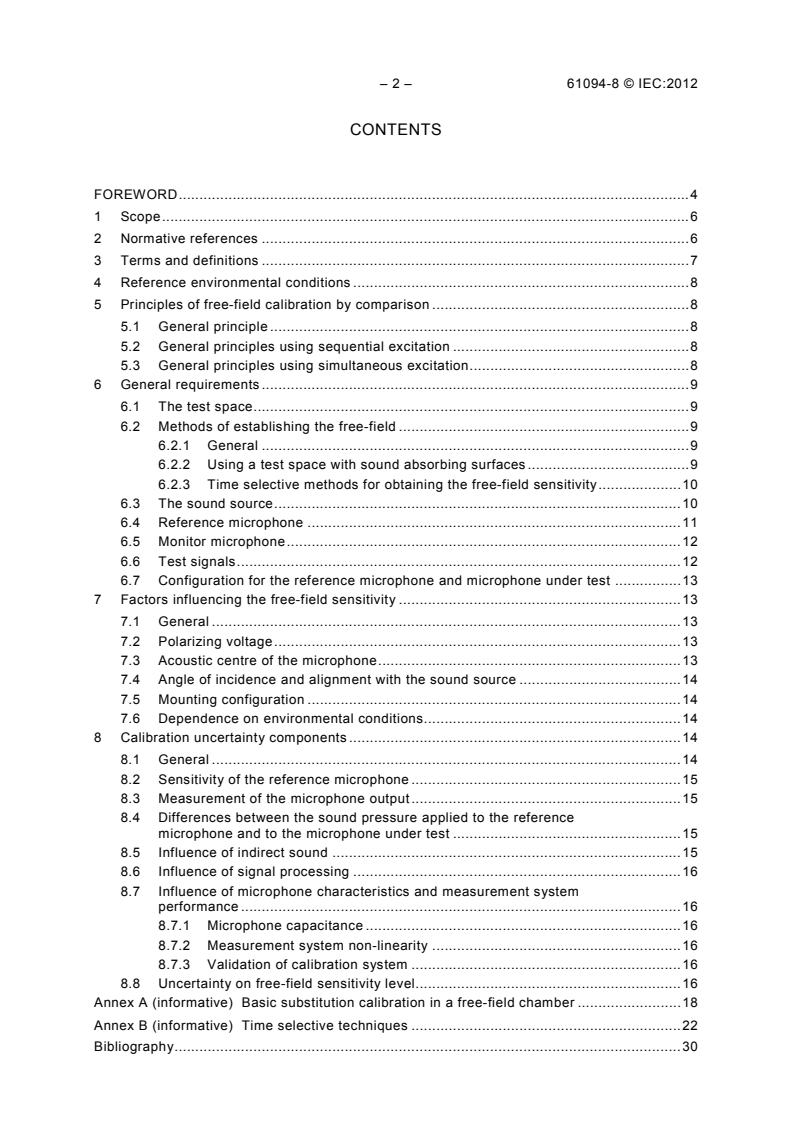
– 2 – 61094-8 © IEC:2012
CONTENTS
FOREWORD . 4
1 Scope . 6
2 Normative references . 6
3 Terms and definitions . 7
4 Reference environmental conditions . 8
5 Principles of free-field calibration by comparison . 8
5.1 General principle . 8
5.2 General principles using sequential excitation . 8
5.3 General principles using simultaneous excitation . 8
6 General requirements . 9
6.1 The test space . 9
6.2 Methods of establishing the free-field . 9
6.2.1 General . 9
6.2.2 Using a test space with sound absorbing surfaces . 9
6.2.3 Time selective methods for obtaining the free-field sensitivity . 10
6.3 The sound source . 10
6.4 Reference microphone . 11
6.5 Monitor microphone . 12
6.6 Test signals . 12
6.7 Configuration for the reference microphone and microphone under test . 13
7 Factors influencing the free-field sensitivity . 13
7.1 General . 13
7.2 Polarizing voltage . 13
7.3 Acoustic centre of the microphone . 13
7.4 Angle of incidence and alignment with the sound source . 14
7.5 Mounting configuration . 14
7.6 Dependence on environmental conditions. 14
8 Calibration uncertainty components . 14
8.1 General . 14
8.2 Sensitivity of the reference microphone . 15
8.3 Measurement of the microphone output . 15
8.4 Differences between the sound pressure applied to the reference
microphone and to the microphone under test . 15
8.5 Influence of indirect sound . 15
8.6 Influence of signal processing . 16
8.7 Influence of microphone characteristics and measurement system
performance . 16
8.7.1 Microphone capacitance . 16
8.7.2 Measurement system non-linearity . 16
8.7.3 Validation of calibration system . 16
8.8 Uncertainty on free-field sensitivity level . 16
Annex A (informative) Basic substitution calibration in a free-field chamber . 18
Annex B (informative) Time selective techniques . 22
Bibliography . 30
61094-8 © IEC:2012 – 3 –
Figure A.1 – Illustration of source and receiver setup in a free-field room, where the
monitor microphone has been integrated into the loudspeaker . 18
Figure A.2 – Practical implementation in a hemi-anechoic room with a source flush-
mounted in the floor . 19
Figure A.3 – Examples of loudspeaker sources . 21
Figure B.1 – Illustration of set-up for measurement with time selective techniques . 23
Table 1 – Calibration options for the reference microphone and associated typical
measurement uncertainty . 12
Table 2 – Typical uncertainty components . 17
– 4 – 61094-8 © IEC:2012
INTERNATIONAL ELECTROTECHNICAL COMMISSION
____________
MEASUREMENT MICROPHONES –
Part 8: Methods for determining the free-field sensitivity
of working standard microphones by comparison
FOREWORD
1) The International Electrotechnical Commission (IEC) is a worldwide organization for standardization comprising
all national electrotechnical committees (IEC National Committees). The object of IEC is to promote
international co-operation on all questions concerning standardization in the electrical and electronic fields. To
this end and in addition to other activities, IEC publishes International Standards, Technical Specifications,
Technical Reports, Publicly Available Specifications (PAS) and Guides (hereafter referred to as “IEC
Publication(s)”). Their preparation is entrusted to technical committees; any IEC National Committee interested
in the subject dealt with may participate in this preparatory work. International, governmental and non-
governmental organizations liaising with the IEC also participate in this preparation. IEC collaborates closely
with the International Organization for Standardization (ISO) in accordance with conditions determined by
agreement between the two organizations.
2) The formal decisions or agreements of IEC on technical matters express, as nearly as possible, an international
consensus of opinion on the relevant subjects since each technical committee has representation from all
interested IEC National Committees.
3) IEC Publications have the form of recommendations for international use and are accepted by IEC National
Committees in that sense. While all reasonable efforts are made to ensure that the technical content of IEC
Publications is accurate, IEC cannot be held responsible for the way in which they are used or for any
misinterpretation by any end user.
4) In order to promote international uniformity, IEC National Committees undertake to apply IEC Publications
transparently to the maximum extent possible in their national and regional publications. Any divergence
between any IEC Publication and the corresponding national or regional publication shall be clearly indicated in
the latter.
5) IEC itself does not provide any attestation of conformity. Independent certification bodies provide conformity
assessment services and, in some areas, access to IEC marks of conformity. IEC is not responsible for any
services carried out by independent certification bodies.
6) All users should ensure that they have the latest edition of this publication.
7) No liability shall attach to IEC or its directors, employees, servants or agents including individual experts and
members of its technical committees and IEC National Committees for any personal injury, property damage or
other damage of any nature whatsoever, whether direct or indirect, or for costs (including legal fees) and
expenses arising out of the publication, use of, or reliance upon, this IEC Publication or any other IEC
Publications.
8) Attention is drawn to the Normative references cited in this publication. Use of the referenced publications is
indispensable for the correct application of this publication.
9) Attention is drawn to the possibility that some of the elements of this IEC Publication may be the subject of
patent rights. IEC shall not be held responsible for identifying any or all such patent rights.
International Standard IEC 61094-8 has been prepared by IEC technical committee 29:
Electroacoustics.
The text of this standard is based on the following documents:
CDV Report on voting
29/752/CDV 29/759/RVC
Full information on the voting for the approval of this standard can be found in the report on
voting indicated in the above table.
This publication has been drafted in accordance with the ISO/IEC Directives, Part 2.
61094-8 © IEC:2012 – 5 –
A list of all the parts in the IEC 61094 series, published under the general title Measurement
microphones can be found on the IEC website.
The committee has decided that the contents of this publication will remain unchanged until
the stability date indicated on the IEC web site under "http://webstore.iec.ch" in the data
related to the specific publication. At this date, the publication will be
• reconfirmed,
• withdrawn,
• replaced by a revised edition, or
• amended.
IMPORTANT – The 'colour inside' logo on the cover page of this publication indicates
that it contains colours which are considered to be useful for the correct
understanding of its contents. Users should therefore print this document using a
colour printer.
– 6 – 61094-8 © IEC:2012
MEASUREMENT MICROPHONES –
Part 8: Methods for determining the free-field sensitivity
of working standard microphones by comparison
1 Scope
This part of the IEC 61094 series is applicable to working standard microphones meeting the
requirements of IEC 61094-4. It describes methods of determining the free-field sensitivity by
comparison with a laboratory standard microphone or working standard microphone (where
applicable) that has been calibrated according to either:
– IEC 61094-3,
– IEC 61094-2 or IEC 61094-5, and where factors given in IEC/TS 61094-7 have been
applied,
– IEC 61094-6,
– this part of IEC 61094.
Methods performed in an acoustical environment that is a good approximation to an ideal
free-field (e.g. a high quality free-field chamber), and methods that use post processing of
results to minimise the effect of imperfections in the acoustical environment, to simulate free-
field conditions, are both covered by this part of IEC 61094. Comparison methods based on
the principles described in IEC 61094-3 are also possible but beyond the scope of this part of
IEC 61094.
NOTE 1 This part of IEC 61094 is also applicable to laboratory standard microphones meeting the requirements
of IEC 61094-1, noting that these microphones also meet the electroacoustic specifications for working standard
microphones.
NOTE 2 This part of IEC 61094 is also applicable to combinations of microphone and preamplifier where the
determined sensitivity is referred to the unloaded output voltage of the preamplifier.
NOTE 3 Other devices, for example, sound level meters can be calibrated using the principles of this part of
IEC 61094, but are not within the scope of this standard.
2 Normative references
The following documents, in whole or in part, are normatively referenced in this document and
are indispensable for its application. For dated references, only the edition cited applies. For
undated references, the latest edition of the referenced document (including any
amendments) applies.
IEC 61094-1, Measurement microphones – Part 1: Specifications for laboratory standard
microphones
IEC 61094-2, Electroacoustics – Measurement microphones – Part 2: Primary method for
pressure calibration of laboratory standard microphones by the reciprocity technique
IEC 61094-3, Measurement microphones – Part 3: Primary method for free-field calibration of
laboratory standard microphones by the reciprocity technique
IEC 61094-4, Measurement microphones – Part 4: Specifications for working standard
microphones
61094-8 © IEC:2012 – 7 –
IEC 61094-5, Measurement microphones – Part 5: Methods for pressure calibration of working
standard microphones by comparison
IEC 61094-6, Measurement microphones – Part 6: Electrostatic actuators for determination of
frequency response
IEC/TS 61094-7, Measurement microphones – Part 7: Values for the difference between free-
field and pressure sensitivity levels of laboratory standard microphones
ISO/IEC Guide 98-3, Uncertainty of measurement – Part 3: Guide to the expression of
uncertainty in measurement (GUM:1995)
ISO 26101, Acoustics – Test methods for the qualification of free-field environments
3 Terms and definitions
For the purpose of this document, the terms and definitions given in IEC 61094-1 and
IEC 61094-3, as well as the following apply.
3.1
reference microphone
laboratory standard microphone or working standard microphone where the free-field
sensitivity has been previously determined
3.2
microphone under test
device under test
working standard microphone to be calibrated by comparison with a reference microphone
Note 1 to entry: Other devices, for example, sound level meters, can be calibrated using the principles of this part
of IEC 61094, but are not within the scope of this standard.
3.3
monitor microphone
microphone used to detect changes in sound pressure in the test environment
3.4
microphone reference point
point specified on the microphone or close to it, to describe the position of the microphone
Note 1 to entry: The microphone reference point may be at the centre of the diaphragm of the microphone.
3.5
reference direction
inward direction toward the microphone reference point and specified for determining the
acoustical response and directional response
Note 1 to entry: The reference direction may be specified with respect to an axis of symmetry.
3.6
angle of incidence
angle between the reference direction and a line between the acoustic centre of a sound
source and the microphone reference point
Note 1 to entry: Angle of incidence is expressed in degrees.
– 8 – 61094-8 © IEC:2012
4 Reference environmental conditions
The reference environmental conditions are:
temperature 23,0 °C
static pressure 101,325 kPa
relative humidity 50 %
5 Principles of free-field calibration by comparison
5.1 General principle
When a calibrated reference microphone and a microphone under test are exposed to the
same free-field sound pressure, either simultaneously or sequentially, and under the same
environmental conditions, then the ratio of their free-field sensitivities for those conditions is
given by the ratio of their open-circuit output voltages. Then, both the modulus and phase of
the free-field sensitivity of the microphone under test can be calculated from the known free-
field sensitivity of the reference microphone. However, determination of the phase of the free-
field sensitivity requires the definition of consistent reference phases at the acoustic centres
of the microphones.
At some frequencies, the measured free-field sensitivity of a microphone is strongly
dependent on the mounting configuration and results for the microphone cannot be
considered in isolation to the mounting configuration used (see 6.7).
The principle of the method also allows the microphone under test to be attached to
measuring equipment, e.g. a particular preamplifier, and the sensitivity may be referred to the
unloaded output of that measuring equipment.
5.2 General principles using sequential excitation
In order for the two microphones to be sequentially exposed to essentially the same sound
pressure, the output of the sound source and the environment conditions should not change.
Where there is potential for changes in the sound field, this shall be detected and corrected
for, for example by using a monitor microphone. Examples of practical arrangements are
given in Annex A.
NOTE In principle it is possible to substitute a number of microphones under test sequentially into the sound field
once the reference sound field has been established, but this places greater demands on the stability and spatial
uniformity of the sound source and can increase the measurement uncertainty.
5.3 General principles using simultaneous excitation
Simultaneous exposure of the reference and one or more microphones under test to the
sound field overcomes the issue of the sound field changing with time, but requires
identification of different points in the sound field where the sound pressures are the same.
This may be achieved by configuring the test space and sound source to ensure a
symmetrical sound field. If the effects of perturbations in the sound source are to be
eliminated, it is essential that the output voltages from the microphone under test and the
reference microphone be measured simultaneously when determining the open-circuit output
voltage ratio.
In simultaneous comparison calibration, it is important that the presence of the reference
microphone does not disturb the field incident on the microphone under test, and vice versa.
The requirement for the source to provide two or more points in the sound field where the
sound pressure is expected to be the same, places severe demands on the stability of the
source’s directional characteristics. It may only be possible to achieve this by relaxing
uncertainty requirements or by developing a source especially for this purpose.
61094-8 © IEC:2012 – 9 –
6 General requirements
6.1 The test space
The test space shall be as free as possible of any effects that cause instabilities in the sound
field, for example between measurements with the microphone under test and the reference
microphone. These include changing environment conditions, air flows, thermal gradients and
electro-magnetic disturbances.
The test space shall have a level of background noise and vibration that enables the
measurements to meet the signal-to-noise requirements of the measurement system used. In
practice steps should be taken to reduce the background noise as much as possible.
NOTE Heat sources in the test space can lead to some of the types of disturbance described above.
6.2 Methods of establishing the free-field
6.2.1 General
There are two general approaches that can be taken in making free-field measurements. The
first is to create an environment that attempts to establish a free field by using a test space
with sound absorbing surfaces to prevent reflections of the sound coming directly from the
source. The second is to use signal processing methods that enable the removal of signal
content corresponding to indirectly received sound, thus simulating a free-field environment.
There are many ways to implement both of these approaches. They can also be used in
combination for the most demanding measurements.
6.2.2 Using a test space with sound absorbing surfaces
Options for realising a true free-field environment range from free-field rooms (also known as
anechoic chambers) to smaller scale enclosures and test boxes.
A free-field room typically has its surfaces covered with sound absorbing material, configured
to present a gradually changing acoustic impedance to an incident sound wave. Often this is
in the form of wedges that protrude into the room, though other configurations can be used.
The depth of this absorbent layer, as well as its shape and design, determines the lowest
frequency where sound absorption is effective. A hemi-anechoic room, where one of the room
surfaces is formed by a reflecting plane, can also be used. In this case the sound source
should be mounted flush with the reflecting surface, so that the surface acts as an ‘infinite’
baffle. Secondary sound radiation, from the edges of the sound source or its mounting, are
thus avoided.
NOTE 1 Although edge diffraction from the sound source is eliminated, diffraction from the boundaries of the
reflecting plane will still be present.
The room shall have an identified region where the sound field can be assumed to contain
only plane progressive wave emanating from sound source (i.e. approximates a free sound
field). The sound source and measurement positions shall be located within this region.
For low frequencies long wedges with very high sound absorption are required, leading to the
need for a very large room to enable measurements to be made at a sufficient distance from
the wedge tip. Free-field calibration using a room with sound absorbing surface therefore
becomes impractical and an alternative method may be needed.
One approach is to mount the microphone, complete with its pressure equalisation vent
mechanism, inside a small enclosure, within which a low frequency sound pressure can be
generated. Although there is no acoustic propagation, the sensitivity determined in such a
field will nevertheless be a good approximation to the free-field sensitivity, because diffraction
effects are minimal when the sound wavelength is significantly greater than the dimensions of
the microphone.
– 10 – 61094-8 © IEC:2012
NOTE 2 For WS1 microphones at reference environmental conditions, diffraction effects will contribute less than
0,1 dB to the free-field sensitivity level below 500 Hz. For WS2 and WS3 microphones the contribution will be even
smaller.
NOTE 3 By using alternative techniques at low frequency, a practical low frequency limit for a free-field room of
around 500 Hz will suffice.
NOTE 4 Even an alternative calibration method for low frequency will be limited to frequencies above the low
frequency limit of the test or reference microphone, or by the ability to calibrate the reference microphone at low
frequencies.
Free-field calibration can also be carried out in smaller scale test boxes. However their limited
dimensions and depth of absorbent lining will restrict the frequency range over which they will
be effective and their overall performance.
When the measurement method used assumes that a free field exists, the performance of the
room shall be quantified in this respect. A method is described in ISO 26101.
6.2.3 Time selective methods for obtaining the free-field sensitivity
The use of time selective methods provides a possibility to measure the free-field sensitivity
of a microphone in conditions that might otherwise be unsuitable for direct free-field
calibration. With a suitable test arrangement it can be possible to distinguish between the
component of the output signal resulting from the directly received acoustic wave and that
received indirectly, as a result of reflection. Reflected sound travels a longer path to reach the
microphone and therefore takes a greater time to do so. If the direct wave propagation and
any settling effects within the microphone occur before the arrival of the first reflection, some
form of time-selective technique or time gating can be used to consider the response to the
direct sound only, thus simulating what would occur in an ideal free field.
NOTE Methods based on this approach for establishing the free-field response are sometimes referred to as
quasi-free-field techniques.
Time selective techniques often have their own low frequency limitations, which need to be
considered along with test space limitations noted above.
A variety of time-selective techniques have been developed and examples are described in
Annex B.
6.3 The sound source
The sound source typically consists of a loudspeaker fitted in an enclosure or baffle. However
alternative types of sound source may be deployed. Examples of sound sources can be found
in Annex A.
NOTE 1 A reciprocal microphone may be driven electrically and used as a sound source.
The sound source shall be capable of generating plane progressive waves at the
measurement position. In practice the sound source may not radiate plane waves, but at a
sufficiently long distance from the source, wave fronts can be considered plane across the
region occupied by the reference or microphone under test.
If the sound source is used for simultaneous calibration, the directivity pattern shall also be
known to enable a suitable choice of measurement points to be determined. The directivity
pattern shall be stable over the time period of a test.
If more than one measurement position is used, it may be desirable to use a sound source
having an omni-directional directivity pattern in the frequency range of use.
To fulfill the plane wave requirement along the length of the test object, measurements shall
be made within the region where the field is purely progressive.
61094-8 © IEC:2012 – 11 –
The further requirements listed below may have greater or lesser importance depending on
the calibration method adopted.
The sound source shall be capable of generating sufficient sound pressure level at the test
location(s) at all the frequencies of interest. Sound pressure levels typically between 70 dB
and 80 dB are usually sufficient, but the chosen level will depend on the sensitivity of the
microphones to be tested and the signal-to-noise ratio requirement of the measurement
system. The sound source shall produce a stable output over the time period of a test.
The stability of a loudspeaker sound source should be monitored by some means during the
course of a calibration. Options for monitoring the sound source include the use of an
auxiliary monitor microphone and using the repeatability in results.
At higher output levels, the loudspeaker may exhibit instabilities. The stability of the sound
source shall therefore be established for the type of test signal used. Use of the minimum
electrical input signal that provides an adequate signal-to-noise ratio in the measurement
setup is also recommended.
The sound source shall not produce distortion components that may generate a significant
response from the microphone under test and/or reference microphone at frequencies other
than the test frequency.
NOTE 2 The use of suitable band pass filters can reduce this effect with sinusoidal or narrow band test signals.
NOTE 3 Distortion can also be a problem for impulsive stimuli when high peak output levels are required.
The size of the sound source shall be small relative to the distance to the measurement
position(s), so that sound radiated or diffracted from off-axis elements of the source or its
mounting does not cause significant deviations from ideal free-field behaviour of a point
source, as the measurement distance changes.
It may be necessary to use a number of sound sources each covering different parts of the
frequency range.
6.4 Reference microphone
The reference microphone shall be a laboratory standard (LS) microphone or working
standard (WS) microphone having a known free-field sensitivity and corresponding
uncertainty at the desired range of calibration frequencies.
Table 1 shows the available calibration options and the typical measurement uncertainty for
the free-field sensitivity, for the reference microphone types available.
– 12 – 61094-8 © IEC:2012
Table 1 – Calibration options for the reference microphone
and associated typical measurement uncertainty
Reference Calibration method Reference Typical expanded
microphone uncertainty (k = 2)
type in dB
1 kHz 10 kHz
LS Primary free-field calibration IEC 61094-3 0,25 0,10
Primary pressure calibration with the addition of a IEC 61094-2 and
0,12 0,4
free-field to pressure sensitivity level difference IEC/TS 61094-7
Secondary pressure calibration with the addition of a IEC 61094-5 and
0,15 0,5
free-field to pressure sensitivity level difference IEC/TS 61094-7
LS and WS Secondary free-field calibration This part of IEC 61094 0,2 0,5
Electrostatic actuator calibration with the addition of
IEC 61094-6 0,3 0,6
a free-field to actuator response level difference
Where possible the reference microphone configuration should be chosen to match that of the
microphone under test.
An LS1P reference microphone shall be used without protection grid (where available).
Working standard microphones may be used with or without protection grid, noting that
removal of the protection grid is likely to yield the lowest uncertainty. If a protection grid is
used, the reference free-field sensitivity or quoted uncertainty shall allow for this.
6.5 Monitor microphone
A monitor microphone shall be used to detect changes in the sound field, if required to
achieve the desired level of measurement uncertainty.
The monitor microphone shall be permanently located in a sound field close to the sound
source.
The monitor microphone shall not perturb the sound field reaching the microphone being
measured. This usually requires the use of a small microphone (for example a WS3
microphone), to avoid diffraction effect that could distort plane wave propagation.
It shall therefore be validated that the choice of monitor microphone and its location do not
influence the results unduly, and that any influence is accounted for in the measurement
uncertainty.
6.6 Test signals
The test signal will be determined largely by details of the application and calibration method.
In particular signal processing methods may require specific types of signal to be used. The
source characteristics and mode of operation can also affect the choice of test signal.
Test signals can include:
– pure tone,
– swept-sine or stepped-sine,
– wide-band white noise or pink noise,
– narrow-band noise (e.g. third-octave-band noise),
– pseudo-random or periodic noise (e.g. maximum length sequences),
– warble tones (e.g. frequency modulated (FM) tones),
61094-8 © IEC:2012 – 13 –
– tone bursts or noise bursts,
– chirps,
– impulses (e.g. clicks, sparks etc.).
NOTE The test signal used can also place particular requirements on sound source, such as frequency response
or dynamic range.
6.7 Configuration for the reference microphone and microphone under test
The microphone shall be mounted on a semi-infinite cylindrical rod having the same diameter
as the body of the microphone. Any deviation from this configuration, including guide wires or
other hardware used to support the mounting rod, may influence the free-field sensitivity of
the microphone, and any such effects shall be allowed for in the measurement uncertainty.
Alternatively if the free-field sensitivity of the microphone under test is to be determined in a
specific mounting configuration, then this configuration shall be used to mount the microphone
under test during calibration.
The preamplifier shall be integrated with the mounting rod and shall provide the reference
ground-shield mechanical configuration appropriate for the type of microphone being tested,
as specified in IEC 61094-1 or IEC 61094-4.
If the instruction manual specifies a maximum mechanical force to be applied to the central
electrode contact of the microphone, this limit shall not be exceeded.
The requirement to use the reference ground-shield configuration does not apply to
combinations of microphone and preamplifier used as an integral system.
If adapters are used to convert a preamplifier for use with different sized microphones, the
adapter used shall also convert the ground-shield configuration accordingly.
7 Factors influencing the free-field sensitivity
7.1 General
The free-field sensitivity of a measurement microphone depends on the operational and
environmental conditions, as well as the geometrical configuration used in the calibration,
hence the need to specify these parameters in defining the sensitivity. In addition it is
necessary to ensure that these parameters are sufficiently controlled in the calibration
process, so that the resulting uncertainty components can be taken into account in the
uncertainty budget (see Table 2).
In addition, the calibration process itself adds further components of uncertainty that are not
directly connected with the operation of the microphone. These are listed in Clause 8.
7.2 Polarizing voltage
If the microphone under test requires an external polarizing voltage, the manufacturer’s
recommendations shall be followed. The actual polarizing voltage used during the calibration
shall be stated, along with the reported free-field sensitivity.
If the microphone is pre-polarized, care shall be taken not to apply an external polarizing
voltage.
7.3 Acoustic centre of the microphone
The definition of the free-field sensitivity of a microphone refers to the sound pressure at the
acoustic centre of the microphone, before the microphone is introduced into the field. When
comparing microphones their acoustic centres shall be positioned at the measurement points.
– 14 – 61094-8 © IEC:2012
Alternatively, a microphone reference point defined by the manufacturer (for example at the
centre of the diaphragm or protection grid) shall be specified for aligning the microphones,
and the difference between this and the acoustic centre shall be treated as an uncertainty on
the distance to the sound source, and therefore on the sound pressure.
NOTE 1 The microphone acoustic centre is a function of frequency and the distance from the sound source.
NOTE 2 At sufficiently large distances from the sound source, the acoustic centre can be considered constant.
NOTE 3 A method for determining the acoustic centre is given in IEC 61094-3.
7.4 Angle of incidence and alignment with the sound source
The free-field sensitivity of a microphone is a function of the angle of incidence, particularly at
high frequencies. Some means of setting the orientation of the microphone in a repeatable
manner shall be used.
In addition, the co-axial alignment of the microphone with the sound source can cause errors
in both the angle of incidence and applied sound pressure. Some means of setting this
alignment in a repeatable manner shall be used.
7.5 Mounting configuration
The component of the free-field sensitivity derived from diffraction is strongly influenced by
the geometric configuration of the microphone and its mounting. The microphone shall
therefore be calibrated in a specified mounting configuration. Where no such configuration is
specified, a cylinder of the same diameter as the microphone body shall be used.
7.6 Dependence on environmental conditions
The free-field sensitivity of the microphone depends on static pressure, temperature and
humidity. This dependence can be determined by comparison with a well-characterized
laboratory standard microphone over a range of conditions.
The sensitivity of the reference microphone shall be corrected to the actual environmental
conditions during the test.
Alternatively, when reporting the result of a calibration, the free-field sensitivity may be
referred to the reference environmental conditions if reliable correction data are available.
The actual conditions during the calibration shall be reported.
8 Calibration uncertainty components
8.1 General
In addition to the factors which affect the free-field sensitivity mentioned in Clause 7, further
uncertainty components are introduced by the method, the equipment and the degree of care
under which the calibration is carried out.
Factors which affect the calibration in a known way shall be measured or calculated with as
high an accuracy as is practical in order to minimize their influence on the resulting
uncertainty.
The components of uncertainty considered below relate to general requirement of free-field
calibration. Some components may not be relevant, or additional components may need to be
considered, in specific implementations.
61094-8 © IEC:2012 – 15 –
8.2 Sensitivity of the reference microphone
The uncertainty in the sensitivity of the reference microphone directly affects the uncertainty
in the sensitivity of the microphone under test.
The reference microphone sensitivity may be derived by applying free-field-to-pressure
differences according to IEC/TS 61094-7 to a pressure reciprocity calibration according to
IEC 61094-2. In this case the uncertainty of both elements shall be taken into account.
If the reference microphone requires an external polarization voltage then any difference
between the voltage applied when it was calibrated and the voltage applied when used as the
reference microphone shall be allowed for in the uncertainty calculation.
8.3 Measurement of the microphone output
Uncertainties of a random, or time-varying nature in the measurement of the outputs of the
microphones, directly affects the uncertainty in the sensitivity of the microphone under test.
Uncertainties of a systematic nature in the measurement of the outputs of the microphones
may affect the uncertainty in the sensitivity of the microphone under test or may be reduced if
the same system is used for both the test and reference microphones.
8.4 D
...