

CISPR 11:2009/AMD1:2010
(Amendment)Amendment 1 - Industrial, scientific and medical equipment - Radio-frequency disturbance characteristics - Limits and methods of measurement
General Information
- Abstract
- Status
- Published
- Publication Date
- 09-Mar-2010
- Current Stage
- DELPUB - Deleted Publication
- Start Date
- 09-Jun-2015
- Completion Date
- 28-Aug-2026
Buy Documents
CISPR 11:2009/AMD1:2010 - Amendment 1 - Industrial, scientific and medical equipment - Radio-frequency disturbance characteristics - Limits and methods of measurement Released:3/10/2010
Overview
The IEC Amendment CISPR 11:2009/AMD1:2010 focuses on the radio-frequency disturbance characteristics of industrial, scientific, and medical (ISM) equipment. This amendment updates the limits and methods of measurement for electromagnetic emissions to ensure compatibility and reduce radio interference from ISM equipment.
Developed by the International Electrotechnical Commission’s (IEC) CISPR subcommittee B, this amendment is essential for manufacturers, testing laboratories, and regulatory bodies involved with ISM apparatus. It refines measurement distances, introduces definitions for small equipment, and adjusts the limits for electromagnetic disturbance emissions.
Key Topics
Scope and Applicability
- Applies to industrial, scientific, and medical equipment that may radiate radio-frequency disturbances.
- Induction cooking appliances are in the process of being transitioned to CISPR 14-1 but can be tested under either standard until the transition completes.
Definitions
- Introduction of “small equipment”: devices positioned on a tabletop or floor that fit within a cylindrical test volume of 1.2 meters diameter and 1.5 meters height.
- Differentiates test requirements based on equipment size and class (Class A or B).
Measurement Distances and Methods
- Class A equipment can be measured at nominal distances of 3 m, 10 m, or 30 m.
- Class B equipment measurements are conducted at 3 m or 10 m distances.
- Distances below 10 m are allowed only for small equipment as defined.
- When measurements are taken at 30 m, correction factors (20 dB per decade) apply to normalize data for compliance evaluation.
- Measurement uncertainty increases when using distances shorter than 10 m.
Electromagnetic Disturbance Limits
- Revised tables detail quasi-peak and average emission limits for different frequency ranges and equipment classes.
- Limits vary depending on rated input power (> or ≤ 20 kVA) and are stricter when equipment is used near sensitive radio communication services.
- Disturbance limits apply to both electric and magnetic fields, with specifications adjusted for equipment groups such as arc welding and electronic discharge machining.
Test Volume and Ground Plane
- Measurement volume for radiation assessments is limited to the defined cylindrical test zone for small equipment.
- Peripheral equipment outside of the test volume must be excluded or decoupled during testing.
- Ground plane requirements are clarified and notes on their application removed or updated.
Measurement Conditions
- Measurements at shorter distances than specified are only permitted under high ambient noise conditions with documented reporting of actual distances used.
- Equipment cabling within the test volume is assessed specifically to avoid extraneous interference.
Applications
- Ensures radio-frequency electromagnetic compatibility (EMC) of ISM equipment, preventing interference with radio communication systems.
- Applicable for compliance testing of an extensive range of equipment in industrial, scientific, and medical sectors, including arc welders, EDM machinery, high-power instrumentation, and small-scale devices.
- Aids manufacturers in designing equipment that meets global standards for EMC, thus facilitating international product acceptance.
- Used by testing laboratories to establish standardized measurement procedures ensuring consistent and reliable emission data.
- Helps regulatory authorities establish conformity assessment requirements and enforce EMC legislation.
Related Standards
- CISPR 14-1: Covers electromagnetic compatibility requirements specifically for household appliances, electric tools, and similar apparatus, including the transfer of induction cooking appliances.
- CISPR 16-4-2: Referenced for standardized measurement methods related to radio disturbance and immunity measuring apparatus.
- International Electrotechnical Vocabulary (Electropedia): Provides definitions and terminology relevant to EMC and radio disturbance measurement.
- Other CISPR standards and IEC documents addressing measurement methodologies and limits for various equipment types to maintain EMC across industries.
By adhering to the CISPR 11:2009/AMD1:2010 amendment, stakeholders ensure improved EMC compliance, supporting reliable operation of critical equipment while minimizing unintended radio-frequency interference in industrial and medical environments.
Relations
- Effective Date
- 05-Sep-2023
- Effective Date
- 05-Sep-2023
Buy Documents
CISPR 11:2009/AMD1:2010 - Amendment 1 - Industrial, scientific and medical equipment - Radio-frequency disturbance characteristics - Limits and methods of measurement Released:3/10/2010
Get Certified
Connect with accredited certification bodies for this standard

ANCE
Mexican certification and testing association.

Intertek Slovenia
Intertek testing, inspection, and certification services in Slovenia.

LNE (Laboratoire National de Métrologie et d'Essais)
French national laboratory for metrology and testing.
Sponsored listings
Frequently Asked Questions
CISPR 11:2009/AMD1:2010 is a standard published by the International Electrotechnical Commission (IEC). Its full title is "Amendment 1 - Industrial, scientific and medical equipment - Radio-frequency disturbance characteristics - Limits and methods of measurement". This standard covers: Amendment 1 - Industrial, scientific and medical equipment - Radio-frequency disturbance characteristics - Limits and methods of measurement
Amendment 1 - Industrial, scientific and medical equipment - Radio-frequency disturbance characteristics - Limits and methods of measurement
CISPR 11:2009/AMD1:2010 is classified under the following ICS (International Classification for Standards) categories: 33.100.10 - Emission. The ICS classification helps identify the subject area and facilitates finding related standards.
CISPR 11:2009/AMD1:2010 has the following relationships with other standards: It is inter standard links to CISPR 11:2009, CISPR 11:2015. Understanding these relationships helps ensure you are using the most current and applicable version of the standard.
CISPR 11:2009/AMD1:2010 is available in PDF format for immediate download after purchase. The document can be added to your cart and obtained through the secure checkout process. Digital delivery ensures instant access to the complete standard document.
Standards Content (Sample)
CISPR 11 ®
Edition 5.0 2010-03
INTERNATIONAL
STANDARD
NORME
INTERNATIONALE
INTERNATIONAL SPECIAL COMMITTEE ON RADIO INTERFERENCE
COMITÉ INTERNATIONAL SPÉCIAL DES PERTURBATIONS RADIOÉLECTRIQUES
AMENDMENT 1
AMENDEMENT 1
Industrial, scientific and medical equipment – Radio-frequency disturbance
characteristics – Limits and methods of measurement
Appareils industriels, scientifiques et médicaux – Caractéristiques de
perturbations radioélectriques – Limites et méthodes de mesure
CISPR 11:2009/A1:2010
All rights reserved. Unless otherwise specified, no part of this publication may be reproduced or utilized in any form or by
any means, electronic or mechanical, including photocopying and microfilm, without permission in writing from either IEC or
IEC's member National Committee in the country of the requester.
If you have any questions about IEC copyright or have an enquiry about obtaining additional rights to this publication,
please contact the address below or your local IEC member National Committee for further information.
Droits de reproduction réservés. Sauf indication contraire, aucune partie de cette publication ne peut être reproduite
ni utilisée sous quelque forme que ce soit et par aucun procédé, électronique ou mécanique, y compris la photocopie
et les microfilms, sans l'accord écrit de la CEI ou du Comité national de la CEI du pays du demandeur.
Si vous avez des questions sur le copyright de la CEI ou si vous désirez obtenir des droits supplémentaires sur cette
publication, utilisez les coordonnées ci-après ou contactez le Comité national de la CEI de votre pays de résidence.
IEC Central Office
3, rue de Varembé
CH-1211 Geneva 20
Switzerland
Email: 0Hinmail@iec.ch
Web: 1Hwww.iec.ch
About the IEC
The International Electrotechnical Commission (IEC) is the leading global organization that prepares and publishes
International Standards for all electrical, electronic and related technologies.
About IEC publications
The technical content of IEC publications is kept under constant review by the IEC. Please make sure that you have the
latest edition, a corrigenda or an amendment might have been published.
ƒ Catalogue of IEC publications: 2Hwww.iec.ch/searchpub
The IEC on-line Catalogue enables you to search by a variety of criteria (reference number, text, technical committee,…).
It also gives information on projects, withdrawn and replaced publications.
ƒ IEC Just Published: 3Hwww.iec.ch/online_news/justpub
Stay up to date on all new IEC publications. Just Published details twice a month all new publications released. Available
on-line and also by email.
ƒ Electropedia: 4Hwww.electropedia.org
The world's leading online dictionary of electronic and electrical terms containing more than 20 000 terms and definitions
in English and French, with equivalent terms in additional languages. Also known as the International Electrotechnical
Vocabulary online.
ƒ Customer Service Centre: 5Hwww.iec.ch/webstore/custserv
If you wish to give us your feedback on this publication or need further assistance, please visit the Customer Service
Centre FAQ or contact us:
Email: 6Hcsc@iec.ch
Tel.: +41 22 919 02 11
Fax: +41 22 919 03 00
A propos de la CEI
La Commission Electrotechnique Internationale (CEI) est la première organisation mondiale qui élabore et publie des
normes internationales pour tout ce qui a trait à l'électricité, à l'électronique et aux technologies apparentées.
A propos des publications CEI
Le contenu technique des publications de la CEI est constamment revu. Veuillez vous assurer que vous possédez
l’édition la plus récente, un corrigendum ou amendement peut avoir été publié.
ƒ Catalogue des publications de la CEI: 7Hwww.iec.ch/searchpub/cur_fut-f.htm
Le Catalogue en-ligne de la CEI vous permet d’effectuer des recherches en utilisant différents critères (numéro de référence,
texte, comité d’études,…). Il donne aussi des informations sur les projets et les publications retirées ou remplacées.
ƒ Just Published CEI: 8Hwww.iec.ch/online_news/justpub
Restez informé sur les nouvelles publications de la CEI. Just Published détaille deux fois par mois les nouvelles
publications parues. Disponible en-ligne et aussi par email.
ƒ Electropedia: 9Hwww.electropedia.org
Le premier dictionnaire en ligne au monde de termes électroniques et électriques. Il contient plus de 20 000 termes et
définitions en anglais et en français, ainsi que les termes équivalents dans les langues additionnelles. Egalement appelé
Vocabulaire Electrotechnique International en ligne.
ƒ Service Clients: 10Hwww.iec.ch/webstore/custserv/custserv_entry-f.htm
Si vous désirez nous donner des commentaires sur cette publication ou si vous avez des questions, visitez le FAQ du
Service clients ou contactez-nous:
Email: 11Hcsc@iec.ch
Tél.: +41 22 919 02 11
Fax: +41 22 919 03 00
CISPR 11 ®
Edition 5.0 2010-03
INTERNATIONAL
STANDARD
NORME
INTERNATIONALE
INTERNATIONAL SPECIAL COMMITTEE ON RADIO INTERFERENCE
COMITÉ INTERNATIONAL SPÉCIAL DES PERTURBATIONS RADIOÉLECTRIQUES
AMENDMENT 1
AMENDEMENT 1
Industrial, scientific and medical equipment – Radio-frequency disturbance
characteristics – Limits and methods of measurement
Appareils industriels, scientifiques et médicaux – Caractéristiques de
perturbations radioélectriques – Limites et méthodes de mesure
INTERNATIONAL
ELECTROTECHNICAL
COMMISSION
COMMISSION
ELECTROTECHNIQUE
PRICE CODE
INTERNATIONALE
G
CODE PRIX
ICS 33.100.10 ISBN 978-2-88910-001-9
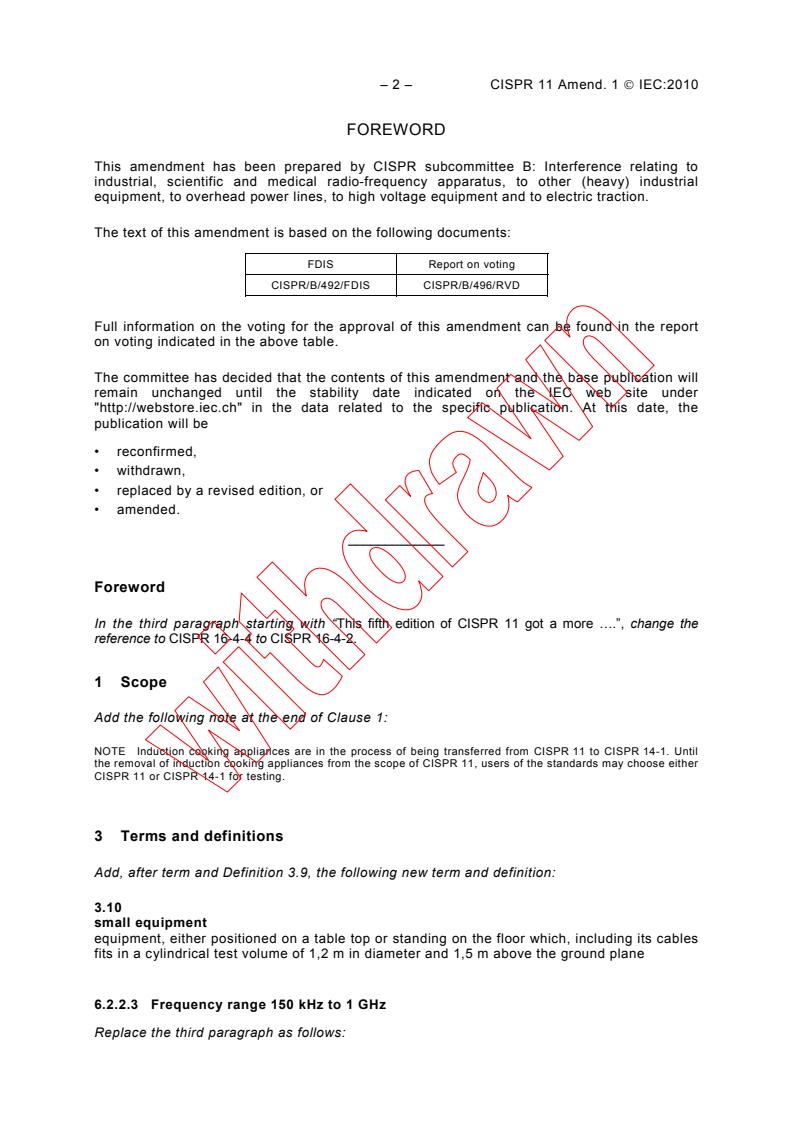
– 2 – CISPR 11 Amend. 1 © IEC:2010
FOREWORD
This amendment has been prepared by CISPR subcommittee B: Interference relating to
industrial, scientific and medical radio-frequency apparatus, to other (heavy) industrial
equipment, to overhead power lines, to high voltage equipment and to electric traction.
The text of this amendment is based on the following documents:
FDIS Report on voting
CISPR/B/492/FDIS CISPR/B/496/RVD
Full information on the voting for the approval of this amendment can be found in the report
on voting indicated in the above table.
The committee has decided that the contents of this amendment and the base publication will
remain unchanged until the stability date indicated on the IEC web site under
"http://webstore.iec.ch" in the data related to the specific publication. At this date, the
publication will be
• reconfirmed,
• withdrawn,
• replaced by a revised edition, or
• amended.
_____________
Foreword
In the third paragraph starting with “This fifth edition of CISPR 11 got a more ….”, change the
reference to CISPR 16-4-4 to CISPR 16-4-2.
1 Scope
Add the following note at the end of Clause 1:
NOTE Induction cooking appliances are in the process of being transferred from CISPR 11 to CISPR 14-1. Until
the removal of induction cooking appliances from the scope of CISPR 11, users of the standards may choose either
CISPR 11 or CISPR 14-1 for testing.
3 Terms and definitions
Add, after term and Definition 3.9, the following new term and definition:
3.10
small equipment
equipment, either positioned on a table top or standing on the floor which, including its cables
fits in a cylindrical test volume of 1,2 m in diameter and 1,5 m above the ground plane
6.2.2.3 Frequency range 150 kHz to 1 GHz
Replace the third paragraph as follows:
CISPR 11 Amend. 1 © IEC:2010 – 3 –
On a test site, class A equipment can be measured at a nominal distance of 3 m, 10 m or
30 m (see information in Table 4), and class B equipment at a nominal distance of 3 m or
10 m (see information in Table 5). A measuring distance less than 10 m is allowed only for
equipment which complies with the definition given in 3.10.
Add, after the third paragraph, the following new paragraph:
The limits specified for the 3 m separation distance apply to small equipment only.
Replace the existing Table 4 by the following:
Table 4 – Electromagnetic radiation disturbance limits for class A group 1 equipment
measured on a test site
b
3 m measuring distance
10 m measuring distance
rated input power of rated input power of
Frequency range
a a
≤ 20 kVA ≤ 20 kVA
> 20 kVA > 20 kVA
MHz
Quasi-peak Quasi-peak Quasi-peak Quasi-peak
dB(μV/m) dB(μV/m) dB(μV/m) dB(μV/m)
30 – 230 40 50 50 60
230 – 1 000 47 50 57 60
On a test site, class A equipment can be measured at a nominal distance of 3 m, 10 m or 30 m. A
measuring distance less than 10 m is allowed only for equipment which complies with the definition
given in 3.10. In case of measurements at a separation distance of 30 m, an inverse proportionality
factor of 20 dB per decade shall be used to normalize the measured data to the specified distance for
determining compliance.
At the transition frequency, the more stringent limit shall apply.
a
These limits apply to equipment with a rated input power of > 20 kVA and intended to be used at
locations where there is a distance greater than 30 m between the equipment and third party
sensitive radio communications. The manufacturer shall indicate in the technical documentation that
this equipment is intended to be used at locations where the separation distance to third party
sensitive radio services is > 30 m. If these conditions are not met, then the limits for ≤ 20 kVA
apply.
b
The limits specified for the 3 m separation distance apply only to small equipment meeting the size
criterion defined in 3.10.
Replace the existing Table 5 by the following:
Table 5 – Electromagnetic radiation disturbance limits for class B group 1 equipment
measured on a test site
a
3 m measuring distance
10 m measuring distance
Frequency range
Quasi-peak Quasi-peak
MHz
dB(μV/m) dB(μV/m)
30 – 230 30 40
230 – 1 000 37 47
On a test site, class B equipment can be measured at a nominal distance of 3 m or 10 m. A measuring
distance less than 10 m is allowed only for equipment which complies with the definition given in 3.10.
At the transition frequency, the more stringent limit shall apply.
a
The limits specified for the 3 m separation distance apply only to small equipment meeting the size
criterion defined in 3.10.
– 4 – CISPR 11 Amend. 1 © IEC:2010
6.3.2.3 Frequency range 150 kHz to 1 GHz
Replace the tenth paragraph as follows:
On a test site, class A equipment can be measured at a nominal distance of 3 m, 10 m or
30 m, and class B equipment at a nominal distance of 3 m or 10 m (see Tables 9 and 11).
A measuring distance less than 10 m is allowed only for equipment which complies with the
definition given in 3.10.
Add the following new paragraph eleven:
The limits specified for the 3 m separation distance apply to small equipment only.
Replace the existing Table 9 by the following:
CISPR 11 Amend. 1 © IEC:2010 – 5 –
Table 9 – Electromagnetic radiation disturbance limits for class A group 2 equipment
measured on a test site
Limits for a measuring distance D in m
On a test site D = 30 m On a test site D = 10 m On a test site D = 3 m
a
from the equipment from the equipment
from the equipment
Frequency
range
Electric Magnetic Electric Magnetic Electric Magnetic
MHz field field field field field field
Quasi-peak Quasi-peak Quasi-peak Quasi-peak Quasi-peak Quasi-peak
dB(μV/m) dB(μA/m) dB(μV/m) dB(μA/m) dB(μV/m) dB(μA/m)
0,15 – 0,49 – 33,5 – 57,5 – 57,5
0,49 – 1,705 – 23,5 – 47,5 – 47,5
1,705 – 2,194 – 28,5 – 52,5 – 52,5
2,194 – 3,95 – 23,5 – 43,5 – 43,5
3,95 – 20 – 8,5 – 18,5 – 18,5
20 – 30 – –1,5 – 8,5 – 8,5
30 – 47 58 – 68 – 78 –
47 – 53,91 40 – 50 – 60 –
53,91 – 54,56 40 – 50 – 60 –
54,56 – 68 40 – 50 – 60 –
68 – 80,872 53 – 63 – 73 –
78 – 88
80,872 – 81,848 68 – –
81,848 – 87 53 – 63 – 73 –
87 – 134,786 50 – 60 – 70 –
134,786 – 136,414 60 – 70 – 80 –
136,414 – 156 50 – 60 – 70 –
156 – 174 64 – 74 – 84 –
174 – 188,7 40 – 50 – 60 –
188,7 – 190,979 50 – 60 – 70 –
190,979 – 230 40 – 50 – 60 –
230 – 400 50 – 60 – 70 –
400 – 470 53 – 63 – 73 –
470 – 1 000 50 – 60 – 70 –
On a test site, class A equipment can be measured at a nominal distance of 3 m, 10 m or 30 m. A measuring
distance less than 10 m is allowed only for equipment which complies with the definition given in 3.10.
At the transition frequency, the more stringent limit shall apply.
a
The limits specified for the 3 m separation distance apply only to small equipment meeting the size
criterion defined in 3.10.
– 6 – CISPR 11 Amend. 1 © IEC:2010
Replace the existing Table 10 by the following:
Table 10 – Electromagnetic radiation disturbance limits for class A EDM and
arc welding equipment measured on a test site
Limits for a measuring distance D in m
Frequency
a
D = 3 m
D = 10 m
range
MHz Quasi-peak Quasi-peak
dB(μV/m) dB(μV/m)
80 90
Decreasing linearly with logarithm of Decreasing linearly with logarithm of
30 – 230
frequency to frequency to
60 70
230 – 1 000 60 70
On a test site, class A equipment can be measured at a nominal distance of 3 m, 10 m or 30 m. A measuring
distance less than 10 m is allowed only for equipment which complies with the definition given in 3.10. In
case of measurements at a separation distance of 30 m, an inverse proportionality factor of 20 dB per
decade shall be used to normalize the measured data to the specified distance for determining compliance.
a
The limits specified for the 3 m separation distance apply only to small equipment meeting the size
criterion defined in 3.10.
Replace the existing Table 11 by the following:
Table 11 – Electromagnetic radiation disturbance limits
for class B group 2 equipment measured on a test site
Limits for a measuring distance D in m
Electric field Magnetic field
Frequency range
b
D = 3 m
D = 3 m
D = 10 m
MHz
a a
Quasi-peak Average Quasi-peak Average Quasi-peak
dB(μV/m) dB(μV/m) dB(μA/m)
Decreasing linearly with the
0,15 – 30 – – – –
logarithm of frequency to
30 – 80,872 30 25 40 35 –
80,872 – 81,848 50 45 60 55 –
81,848 – 134,786 30 25 40 35 –
134,786 – 136,414 50 45 60 55 –
136,414 – 230 30 25 40 35 –
230 – 1 000 37 32 47 42 –
On a test site, class B equipment can be measured at a nominal distance of 3 m or 10 m. A measuring
distance less than 10 m is allowed only for equipment which complies with the definition given in 3.10.
At the transition frequency, the more stringent limit should apply.
a
The average limits apply to magnetron driven equi
...