

IEC 61196-6-4:2020
(Main)Coaxial communication cables - Part 6-4: Detail specification for 75-7 type CATV drop cables
General Information
- Abstract
IEC 61196-6-4:2020 applies to coaxial communication cables described in IEC 61196-6. It specifies the requirements for 75-7 type CATV drop cables. These cables are used in CATV distribution systems, surveillance & control systems, satellite television receiving systems and as bidirectional hybrid fibre coaxes (HFC). The operating frequency is from 5 MHz to 3 000 MHz. This part of IEC 61196 is to be used in conjunction with IEC 61196-1:2005 and IEC 61196‑6:2009. It determines the layout and style with respect to the model and type. This second edition cancels and replaces the first edition, published in 2018. This edition includes the following significant technical changes with respect to the previous edition:
- designation of variants including construction details;
- consistent screening classes;
- bending test only for flexible cables.
- Status
- Published
- Publication Date
- 26-May-2020
- Technical Committee
- SC 46A - Coaxial cables
- Drafting Committee
- WG 3 - TC 46/SC 46A/WG 3
- Current Stage
- PPUB - Publication issued
- Start Date
- 27-May-2020
- Completion Date
- 22-May-2020
Buy Documents
IEC 61196-6-4:2020 - Coaxial communication cables - Part 6-4: Detail specification for 75-7 type CATV drop cables Released:5/27/2020
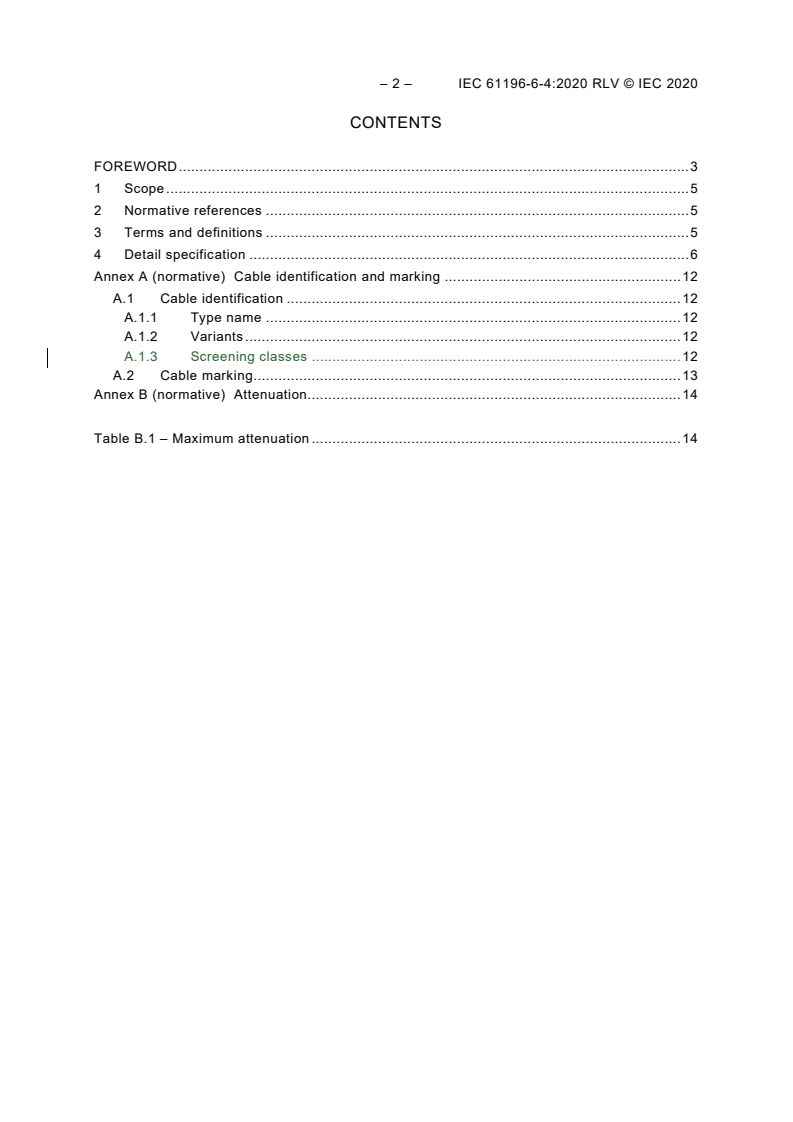
IEC 61196-6-4:2020 RLV - Coaxial communication cables - Part 6-4: Detail specification for 75-7 type CATV drop cables Released:5/27/2020
Overview
IEC 61196-6-4:2020 is the International Electrotechnical Commission detail specification for 75‑7 type CATV drop coaxial communication cables. It applies to coaxial cables covered by IEC 61196-6 and defines construction, electrical and mechanical requirements, testing and marking for drop cables used in CATV distribution, surveillance & control, satellite TV receiving and bidirectional hybrid fibre coax (HFC) systems. Operating frequency range is 5 MHz to 3 000 MHz. This Edition 2.0 replaces the 2018 edition and introduces variant designation, consistent screening classes and limits the bending test to flexible cables.
Key topics and technical requirements
- Cable types and construction: 75‑7S (standard shield), 75‑7T (tri‑shield), 75‑7Q (quad‑shield) with variant coding (e.g., 75‑7S‑Y‑Z‑A‑B). Inner conductor materials BC (bare copper) or CCS (copper‑clad steel); dielectric foamed PE; sheath options PVC, PE, LSZH.
- Mechanical dimensions: inner conductor Ø 1.63 mm ± 0.02, dielectric Ø 7.11 mm ± 0.15, typical outer diameters and sheath thicknesses defined per variant.
- Characteristic electrical parameters:
- Characteristic impedance: 75 Ω ± 3 Ω (measured at 200 MHz)
- Relative propagation velocity: nominal 85 %
- Attenuation: limits specified in Annex B (frequency‑dependent)
- Return loss (uniformity of impedance): ≥ 20 dB (5 MHz–1 000 MHz), ≥ 18 dB (1 000–2 000 MHz), ≥ 16 dB (2 000–3 000 MHz)
- Conductor resistance: ≤ 8.30 Ω/km (BC) and ≤ 40.20 Ω/km (CCS) at 20 °C; outer conductor resistance limits by shield construction
- Insulation resistance: ≥ 10 000 MΩ·km
- Voltage withstand and spark test alternatives are defined for dielectric and sheath
- Screening and EMC:
- Defined screening classes (A+, A, B, C) with transfer impedance and screening attenuation targets (e.g., A+: transfer impedance ≤ 0.9 mΩ/m from 5–30 MHz; screening attenuation ranges given up to 3 000 MHz)
- Tests referenced: IEC 62153‑4‑3 and IEC 62153‑4‑4
- Mechanical and environmental tests:
- Min bending radius: 10 × nominal outer diameter
- Operating temperature ranges depend on sheath (e.g., PE: −40 °C to 70 °C)
- Cold bend, thermal ageing, damp heat and UV stability criteria specified
- Test procedures: see referenced methods IEC 61196‑1, IEC 61196‑1‑115, IEC 61196‑1‑314.
Applications and who uses this standard
- Practical uses: specification and acceptance of CATV drop cables, satellite TV drops, surveillance/coax links, and HFC last‑mile hybrid coax segments.
- Primary users:
- Cable manufacturers (design, production and type approval)
- System integrators and CATV network designers (component selection and installation specs)
- Test laboratories and certification bodies (conformance testing)
- Procurement/specification engineers and standards committees.
Related standards
- IEC 61196‑1:2005 (generic coaxial cable spec)
- IEC 61196‑6:2009 (sectional spec for CATV drop cables)
- IEC 61196‑1‑115, IEC 61196‑1‑314 (test methods)
- IEC 62153‑4‑3 and IEC 62153‑4‑4 (screening/transfer impedance tests)
- IEC 60966‑4 (RF/coax assemblies)
Keywords: IEC 61196-6-4, 75-7 CATV drop cables, coaxial communication cables, CATV, HFC, screening classes, attenuation, characteristic impedance, return loss, transfer impedance.
Relations
- Effective Date
- 05-Sep-2023
Buy Documents
IEC 61196-6-4:2020 - Coaxial communication cables - Part 6-4: Detail specification for 75-7 type CATV drop cables Released:5/27/2020
IEC 61196-6-4:2020 RLV - Coaxial communication cables - Part 6-4: Detail specification for 75-7 type CATV drop cables Released:5/27/2020
Get Certified
Connect with accredited certification bodies for this standard

ANCE
Mexican certification and testing association.

Intertek Slovenia
Intertek testing, inspection, and certification services in Slovenia.

LNE (Laboratoire National de Métrologie et d'Essais)
French national laboratory for metrology and testing.
Sponsored listings
Frequently Asked Questions
IEC 61196-6-4:2020 is a standard published by the International Electrotechnical Commission (IEC). Its full title is "Coaxial communication cables - Part 6-4: Detail specification for 75-7 type CATV drop cables". This standard covers: IEC 61196-6-4:2020 applies to coaxial communication cables described in IEC 61196-6. It specifies the requirements for 75-7 type CATV drop cables. These cables are used in CATV distribution systems, surveillance & control systems, satellite television receiving systems and as bidirectional hybrid fibre coaxes (HFC). The operating frequency is from 5 MHz to 3 000 MHz. This part of IEC 61196 is to be used in conjunction with IEC 61196-1:2005 and IEC 61196‑6:2009. It determines the layout and style with respect to the model and type. This second edition cancels and replaces the first edition, published in 2018. This edition includes the following significant technical changes with respect to the previous edition: - designation of variants including construction details; - consistent screening classes; - bending test only for flexible cables.
IEC 61196-6-4:2020 applies to coaxial communication cables described in IEC 61196-6. It specifies the requirements for 75-7 type CATV drop cables. These cables are used in CATV distribution systems, surveillance & control systems, satellite television receiving systems and as bidirectional hybrid fibre coaxes (HFC). The operating frequency is from 5 MHz to 3 000 MHz. This part of IEC 61196 is to be used in conjunction with IEC 61196-1:2005 and IEC 61196‑6:2009. It determines the layout and style with respect to the model and type. This second edition cancels and replaces the first edition, published in 2018. This edition includes the following significant technical changes with respect to the previous edition: - designation of variants including construction details; - consistent screening classes; - bending test only for flexible cables.
IEC 61196-6-4:2020 is classified under the following ICS (International Classification for Standards) categories: 33.120.10 - Coaxial cables. Waveguides. The ICS classification helps identify the subject area and facilitates finding related standards.
IEC 61196-6-4:2020 has the following relationships with other standards: It is inter standard links to IEC 61196-6-4:2018. Understanding these relationships helps ensure you are using the most current and applicable version of the standard.
IEC 61196-6-4:2020 is available in PDF format for immediate download after purchase. The document can be added to your cart and obtained through the secure checkout process. Digital delivery ensures instant access to the complete standard document.
Standards Content (Sample)
IEC 61196-6-4 ®
Edition 2.0 2020-05
INTERNATIONAL
STANDARD
Coaxial communication cables –
Part 6-4: Detail specification for 75-7 type CATV drop cables
All rights reserved. Unless otherwise specified, no part of this publication may be reproduced or utilized in any form
or by any means, electronic or mechanical, including photocopying and microfilm, without permission in writing from
either IEC or IEC's member National Committee in the country of the requester. If you have any questions about IEC
copyright or have an enquiry about obtaining additional rights to this publication, please contact the address below or
your local IEC member National Committee for further information.
IEC Central Office Tel.: +41 22 919 02 11
3, rue de Varembé info@iec.ch
CH-1211 Geneva 20 www.iec.ch
Switzerland
About the IEC
The International Electrotechnical Commission (IEC) is the leading global organization that prepares and publishes
International Standards for all electrical, electronic and related technologies.
About IEC publications
The technical content of IEC publications is kept under constant review by the IEC. Please make sure that you have the
latest edition, a corrigendum or an amendment might have been published.
IEC publications search - webstore.iec.ch/advsearchform Electropedia - www.electropedia.org
The advanced search enables to find IEC publications by a The world's leading online dictionary on electrotechnology,
variety of criteria (reference number, text, technical containing more than 22 000 terminological entries in English
committee,…). It also gives information on projects, replaced and French, with equivalent terms in 16 additional languages.
and withdrawn publications. Also known as the International Electrotechnical Vocabulary
(IEV) online.
IEC Just Published - webstore.iec.ch/justpublished
Stay up to date on all new IEC publications. Just Published IEC Glossary - std.iec.ch/glossary
details all new publications released. Available online and 67 000 electrotechnical terminology entries in English and
once a month by email. French extracted from the Terms and Definitions clause of
IEC publications issued since 2002. Some entries have been
IEC Customer Service Centre - webstore.iec.ch/csc collected from earlier publications of IEC TC 37, 77, 86 and
If you wish to give us your feedback on this publication or CISPR.
need further assistance, please contact the Customer Service
Centre: sales@iec.ch.
IEC 61196-6-4 ®
Edition 2.0 2020-05
INTERNATIONAL
STANDARD
Coaxial communication cables –
Part 6-4: Detail specification for 75-7 type CATV drop cables
INTERNATIONAL
ELECTROTECHNICAL
COMMISSION
ICS 33.120.10 ISBN 978-2-8322-8229-8
– 2 – IEC 61196-6-4:2020 © IEC 2020
CONTENTS
FOREWORD . 3
1 Scope . 5
2 Normative references . 5
3 Terms and definitions . 5
4 Detail specification . 6
Annex A (normative) Cable identification and marking . 11
A.1 Cable identification . 11
A.1.1 Type name . 11
A.1.2 Variants . 11
A.1.3 Screening classes . 11
A.2 Cable marking . 12
Annex B (normative) Attenuation. 13
Table B.1 – Maximum attenuation . 13
INTERNATIONAL ELECTROTECHNICAL COMMISSION
____________
COAXIAL COMMUNICATION CABLES –
Part 6-4: Detail specification for 75-7 type CATV drop cables
FOREWORD
1) The International Electrotechnical Commission (IEC) is a worldwide organization for standardization comprising
all national electrotechnical committees (IEC National Committees). The object of IEC is to promote
international co-operation on all questions concerning standardization in the electrical and electronic fields. To
this end and in addition to other activities, IEC publishes International Standards, Technical Specifications,
Technical Reports, Publicly Available Specifications (PAS) and Guides (hereafter referred to as “IEC
Publication(s)”). Their preparation is entrusted to technical committees; any IEC National Committee interested
in the subject dealt with may participate in this preparatory work. International, governmental and non-
governmental organizations liaising with the IEC also participate in this preparation. IEC collaborates closely
with the International Organization for Standardization (ISO) in accordance with conditions determined by
agreement between the two organizations.
2) The formal decisions or agreements of IEC on technical matters express, as nearly as possible, an international
consensus of opinion on the relevant subjects since each technical committee has representation from all
interested IEC National Committees.
3) IEC Publications have the form of recommendations for international use and are accepted by IEC National
Committees in that sense. While all reasonable efforts are made to ensure that the technical content of IEC
Publications is accurate, IEC cannot be held responsible for the way in which they are used or for any
misinterpretation by any end user.
4) In order to promote international uniformity, IEC National Committees undertake to apply IEC Publications
transparently to the maximum extent possible in their national and regional publications. Any divergence
between any IEC Publication and the corresponding national or regional publication shall be clearly indicated in
the latter.
5) IEC itself does not provide any attestation of conformity. Independent certification bodies provide conformity
assessment services and, in some areas, access to IEC marks of conformity. IEC is not responsible for any
services carried out by independent certification bodies.
6) All users should ensure that they have the latest edition of this publication.
7) No liability shall attach to IEC or its directors, employees, servants or agents including individual experts and
members of its technical committees and IEC National Committees for any personal injury, property damage or
other damage of any nature whatsoever, whether direct or indirect, or for costs (including legal fees) and
expenses arising out of the publication, use of, or reliance upon, this IEC Publication or any other IEC
Publications.
8) Attention is drawn to the Normative references cited in this publication. Use of the referenced publications is
indispensable for the correct application of this publication.
9) Attention is drawn to the possibility that some of the elements of this IEC Publication may be the subject of
patent rights. IEC shall not be held responsible for identifying any or all such patent rights.
International Standard IEC 61196-6-4 has been prepared by subcommittee 46A: Coaxial
cables, of IEC technical committee 46: Cables, wires, waveguides, RF connectors, RF and
microwave passive components and accessories.
This second edition cancels and replaces the first edition, published in 2018. This edition
constitutes a technical revision.
This edition includes the following significant technical changes with respect to the previous
edition:
– designation of variants including construction details;
– consistent screening classes;
– bending test only for flexible cables.
– 4 – IEC 61196-6-4:2020 © IEC 2020
The text of this International Standard is based on the following documents:
FDIS Report on voting
46A/1404/FDIS 46A/1411/RVD
Full information on the voting for the approval of this International Standard can be found in
the report on voting indicated in the above table.
This document has been drafted in accordance with the ISO/IEC Directives, Part 2.
It is to be used in conjunction with IEC 61196-1:2005 and IEC 61196-6:2009.
A list of all parts in the IEC 61196 series, published under the general title Coaxial
communication cables, can be found on the IEC website.
The committee has decided that the contents of this document will remain unchanged until the
stability date indicated on the IEC website under "http://webstore.iec.ch" in the data related to
the specific document. At this date, the document will be
• reconfirmed,
• withdrawn,
• replaced by a revised edition, or
• amended.
COAXIAL COMMUNICATION CABLES –
Part 6-4: Detail specification for 75-7 type CATV drop cables
1 Scope
This part of IEC 61196 applies to coaxial communication cables described in IEC 61196-6. It
specifies the requirements for 75-7 type CATV drop cables. These cables are used in CATV
distribution systems, surveillance & control systems, satellite television receiving systems and
as bidirectional hybrid fibre coaxes (HFC). The operating frequency is from 5 MHz to
3 000 MHz.
This part of IEC 61196 is to be used in conjunction with IEC 61196-1:2005 and
IEC 61196-6:2009. It determines the layout and style with respect to the model and type.
2 Normative references
The following documents are referred to in the text in such a way that some or all of their
content constitutes requirements of this document. For dated references, only the edition
cited applies. For undated references, the latest edition of the referenced document (including
any amendments) applies.
NOTE Documents which are needed to achieve the tests according to Clause 4, item [8] or item [9], respectively,
are listed in IEC 61196-6.
IEC 60966-4 (all parts), Radio frequency and coaxial cable assemblies
IEC 61196-1:2005, Coaxial communication cables – Part 1: Generic specification – General,
definitions and requirements
IEC 61196-1-115, Coaxial communication cables – Part 1-115: Electrical test methods – Test
for regularity of impedance (pulse/step function return loss)
IEC 61196-1-314:2015, Coaxial communication cables – Part 1-314: Mechanical test methods
– Test for bending
IEC 61196-6:2009, Coaxial communication cables – Part 6: Sectional specification for CATV
drop cables
IEC 62153-4-3, Metallic communication cable test methods – Part 4-3: Electromagnetic
compatibility (EMC) – Surface transfer impedance – Triaxial method
IEC 62153-4-4, Metallic communication cable test methods – Part 4-4: Electromagnetic
compatibility (EMC) – Test method for measuring of the screening attenuation as up to and
above 3 GHz, triaxial method
3 Terms and definitions
No terms and definitions are listed in this document.
ISO and IEC maintain terminological databases for use in standardization at the following
addresses:
– 6 – IEC 61196-6-4:2020 © IEC 2020
• IEC Electropedia: available at http://www.electropedia.org/
• ISO Online browsing platform: available at http://www.iso.org/o
...
IEC 61196-6-4 ®
Edition 2.0 2020-05
REDLINE VERSION
INTERNATIONAL
STANDARD
colour
inside
Coaxial communication cables –
Part 6-4: Detail specification for 75-7 type CATV drop cables
All rights reserved. Unless otherwise specified, no part of this publication may be reproduced or utilized in any form
or by any means, electronic or mechanical, including photocopying and microfilm, without permission in writing from
either IEC or IEC's member National Committee in the country of the requester. If you have any questions about IEC
copyright or have an enquiry about obtaining additional rights to this publication, please contact the address below or
your local IEC member National Committee for further information.
IEC Central Office Tel.: +41 22 919 02 11
3, rue de Varembé info@iec.ch
CH-1211 Geneva 20 www.iec.ch
Switzerland
About the IEC
The International Electrotechnical Commission (IEC) is the leading global organization that prepares and publishes
International Standards for all electrical, electronic and related technologies.
About IEC publications
The technical content of IEC publications is kept under constant review by the IEC. Please make sure that you have the
latest edition, a corrigendum or an amendment might have been published.
IEC publications search - webstore.iec.ch/advsearchform Electropedia - www.electropedia.org
The advanced search enables to find IEC publications by a The world's leading online dictionary on electrotechnology,
variety of criteria (reference number, text, technical containing more than 22 000 terminological entries in English
committee,…). It also gives information on projects, replaced and French, with equivalent terms in 16 additional languages.
and withdrawn publications. Also known as the International Electrotechnical Vocabulary
(IEV) online.
IEC Just Published - webstore.iec.ch/justpublished
Stay up to date on all new IEC publications. Just Published IEC Glossary - std.iec.ch/glossary
details all new publications released. Available online and 67 000 electrotechnical terminology entries in English and
once a month by email. French extracted from the Terms and Definitions clause of
IEC publications issued since 2002. Some entries have been
IEC Customer Service Centre - webstore.iec.ch/csc collected from earlier publications of IEC TC 37, 77, 86 and
If you wish to give us your feedback on this publication or CISPR.
need further assistance, please contact the Customer Service
Centre: sales@iec.ch.
IEC 61196-6-4 ®
Edition 2.0 2020-05
REDLINE VERSION
INTERNATIONAL
STANDARD
colour
inside
Coaxial communication cables –
Part 6-4: Detail specification for 75-7 type CATV drop cables
INTERNATIONAL
ELECTROTECHNICAL
COMMISSION
ICS 33.120.10 ISBN 978-2-8322-8429-2
– 2 – IEC 61196-6-4:2020 RLV © IEC 2020
CONTENTS
FOREWORD . 3
1 Scope . 5
2 Normative references . 5
3 Terms and definitions . 5
4 Detail specification . 6
Annex A (normative) Cable identification and marking . 12
A.1 Cable identification . 12
A.1.1 Type name . 12
A.1.2 Variants . 12
A.1.3 Screening classes . 12
A.2 Cable marking . 13
Annex B (normative) Attenuation. 14
Table B.1 – Maximum attenuation . 14
INTERNATIONAL ELECTROTECHNICAL COMMISSION
____________
COAXIAL COMMUNICATION CABLES –
Part 6-4: Detail specification for 75-7 type CATV drop cables
FOREWORD
1) The International Electrotechnical Commission (IEC) is a worldwide organization for standardization comprising
all national electrotechnical committees (IEC National Committees). The object of IEC is to promote
international co-operation on all questions concerning standardization in the electrical and electronic fields. To
this end and in addition to other activities, IEC publishes International Standards, Technical Specifications,
Technical Reports, Publicly Available Specifications (PAS) and Guides (hereafter referred to as “IEC
Publication(s)”). Their preparation is entrusted to technical committees; any IEC National Committee interested
in the subject dealt with may participate in this preparatory work. International, governmental and non-
governmental organizations liaising with the IEC also participate in this preparation. IEC collaborates closely
with the International Organization for Standardization (ISO) in accordance with conditions determined by
agreement between the two organizations.
2) The formal decisions or agreements of IEC on technical matters express, as nearly as possible, an international
consensus of opinion on the relevant subjects since each technical committee has representation from all
interested IEC National Committees.
3) IEC Publications have the form of recommendations for international use and are accepted by IEC National
Committees in that sense. While all reasonable efforts are made to ensure that the technical content of IEC
Publications is accurate, IEC cannot be held responsible for the way in which they are used or for any
misinterpretation by any end user.
4) In order to promote international uniformity, IEC National Committees undertake to apply IEC Publications
transparently to the maximum extent possible in their national and regional publications. Any divergence
between any IEC Publication and the corresponding national or regional publication shall be clearly indicated in
the latter.
5) IEC itself does not provide any attestation of conformity. Independent certification bodies provide conformity
assessment services and, in some areas, access to IEC marks of conformity. IEC is not responsible for any
services carried out by independent certification bodies.
6) All users should ensure that they have the latest edition of this publication.
7) No liability shall attach to IEC or its directors, employees, servants or agents including individual experts and
members of its technical committees and IEC National Committees for any personal injury, property damage or
other damage of any nature whatsoever, whether direct or indirect, or for costs (including legal fees) and
expenses arising out of the publication, use of, or reliance upon, this IEC Publication or any other IEC
Publications.
8) Attention is drawn to the Normative references cited in this publication. Use of the referenced publications is
indispensable for the correct application of this publication.
9) Attention is drawn to the possibility that some of the elements of this IEC Publication may be the subject of
patent rights. IEC shall not be held responsible for identifying any or all such patent rights.
This redline version of the official IEC Standard allows the user to identify the changes
made to the previous edition. A vertical bar appears in the margin wherever a change
has been made. Additions are in green text, deletions are in strikethrough red text.
– 4 – IEC 61196-6-4:2020 RLV © IEC 2020
International Standard IEC 61196-6-4 has been prepared by subcommittee 46A: Coaxial
cables, of IEC technical committee 46: Cables, wires, waveguides, RF connectors, RF and
microwave passive components and accessories.
This second edition cancels and replaces the first edition, published in 2018. This edition
constitutes a technical revision.
This edition includes the following significant technical changes with respect to the previous
edition:
– designation of variants including construction details;
– consistent screening classes;
– bending test only for flexible cables.
The text of this International Standard is based on the following documents:
FDIS Report on voting
46A/1404/FDIS 46A/1411/RVD
Full information on the voting for the approval of this International Standard can be found in
the report on voting indicated in the above table.
This document has been drafted in accordance with the ISO/IEC Directives, Part 2.
It is to be used in conjunction with IEC 61196-1:2005 and IEC 61196-6:2009.
A list of all parts in the IEC 61196 series, published under the general title Coaxial
communication cables, can be found on the IEC website.
The committee has decided that the contents of this document will remain unchanged until the
stability date indicated on the IEC website under "http://webstore.iec.ch" in the data related to
the specific document. At this date, the document will be
• reconfirmed,
• withdrawn,
• replaced by a revised edition, or
• amended.
IMPORTANT – The 'colour inside' logo on the cover page of this publication indicates
that it contains colours which are considered to be useful for the correct
understanding of its contents. Users should therefore print this document using a
colour printer.
COAXIAL COMMUNICATION CABLES –
Part 6-4: Detail specification for 75-7 type CATV drop cables
1 Scope
This part of IEC 61196 applies to coaxial communication cables described in IEC 61196-6. It
specifies the requirements for 75-7 type CATV drop cables. These cables are used in CATV
distribution systems, surveillance & control systems, satellite television receiving systems and
as bidirectional hybrid fibre coaxes (HFC). The operating frequency is from 5 MHz to
3 000 MHz.
This part of IEC 61196 is to be used in conjunction with IEC 61196-1:2005 and
IEC 61196-6:2009. It determines the layout and style with respect to the model and type.
2 Normative references
The following documents are referred to in the text in such a way that some or all of their
content constitutes requirements of this document. For dated references, only the edition
cited applies. For undated references, the latest edition of the referenced document (including
any amendments) applies.
NOTE Documents which are needed to achieve the tests according to Clause 4, item [8] or item [9], respectively,
are listed in IEC 61196-6.
IEC 60966-4 (all parts), Radio frequency and coaxial cable assemblies
IEC 61196-1:2005, Coaxial communication cables – Part 1: Generic specification – General,
definitions and requirements
IEC 61196-1-115, Coaxial communication cables – Part 1-115: Electrical test methods – Test
for regularity of impedance (pulse/step function return loss)
IEC 61196-1-314:2015, Coaxial communication cables – Part 1-314: Mechanical test methods
– Test for bending
IEC 61196-6:2009, Coaxial communication cables – Part 6: Sectional specification for CATV
drop cables
IEC 62153-4-3, Metallic communication cable test methods – Part 4-3: Electromagnetic
compatibility (EMC) – Surface transfer impedance – Triaxial method
IEC 62153-4-4, Metallic communication cable test methods – Part 4-4: Electromagnetic
compatibility (EMC) – Test method for measuring of the screening attenuation as up to and
above 3 GHz, triaxial method
3 Terms and definitions
No terms and definitions are listed in this document.
ISO and IEC maintain terminological databases for use in standardization at the following
addresses:
– 6 – IEC 61196-6-4:2020 RLV © IEC 2020
• IEC Electropedia: available at http://www.electropedia.org/
• ISO Online browsing platform: available at http://www.iso.org/obp
4 Detail specification
COAXIAL COMMUNICATION CABLES –
Part 6-4: Detail specification for 75-7 type CATV drop cables
[1] Prepared by: [2] Document No.: IEC 61196-6-4
IEC SC 46A Issue: Edition 1.0 2.0
Date:
[3] Available from: [4] Generic specification: IEC 61196-1
IEC Sectional specification: IEC 61196-6
[5] Additional references
[6] Cable construction
75-7S (Dual Standard shield) 75-7T (Tri-shield) 75-7Q (Quad-shield)
1: Inner conductor 2: Dielectric 3: Shield 4: Sheath or jacket
a
Variant constructions 75-7S-Y-Z-A-B 75-7T-Y-Z-A-B 75-7Q-Y-Z-A-B
Material BC or CCS
Inner
Diameter (mm) 1,63
conductor
Tolerance (mm) ± 0,02
Material Foamed PE
Dielectric Diameter (mm) 7,11
Tolerance (mm) ± 0,15
ALT+A ALT+A+ALT ALT+A+ALT+A
Material
or ALT+TC or ALT+TC+ALT or ALT+TC+ALT+TC
Inner shield diameter
7,32
(mm)
Outer
Tolerance (mm) ± 0,15
conductor
Longitudinally overlap (%) 18 to 35
or shield
Inner braid ≥ 59
Braid coverage (%) ≥ 59 ≥ 59
Outer braid ≥ 32
Maximum outer diameter
8,30 8,45 9,10
(mm)
Material PVC or PE or LSZH
Minimum thickness (mm) 0,80 0,73 0,51
Sheath or
jacket Diameter (mm) 10,16 10,16 10,34
Tolerance (mm) ± 0,25
NOTE
BC - Bare copper wire
CCS - Copper clad steel wire
ALT - Aluminium-polymeric laminated tape
A - Aluminium alloy wire
TC - Tinned copper wire
PE - Polyethylene
PVC - Polyvinylchloride
LSZH - Low smoke zero halogen polyolefin
a
Variants are shown in Annex A.
Messenger construction (when applicable)
a
75-7S-Y-Z-A-B /M (Dual 75-7T-Y-Z-A-B /M (Tri-shield + 75-7Q-Y-Z-A-B /M (Quad-shield +
Standard shield + Messenger) Messenger) Messenger)
1: Dual shield cable 1: Tri-shield cable 1: Quad-shield cable
2: Messenger 2: Messenger 2: Messenger
Material Zinc coated carbon steel wire
Diameter (mm) 1,83 ± 0,05 2,11 ± 0 ,05 2,77 ± 0,05
Integral
Tensile strength (kgf) 156,9 193,7 320,2
messenger
Minimum Elongation (%) ≤ 3,0
Corrosion properties NS
NOTE Cable constructions of messenger cable are the same as described above cable.
a
Variants are shown in Annex A.
[7] Engineering information (reference only)
−40 °C to 70 °C (PE sheath)
Operating temperature range −20 °C to 70 °C (PVC sheath)
−15 °C to 70 °C (LSZH sheath)
Operating frequency range 5 MHz to 3 000 MHz
Nominal characteristic impedance 75 Ω
Minimum bending radius 10 × D (D is the nominal cable outer diameter)
Relative propagation velocity 85 % (nominal)
13 14 A (T = 20 °C); 10 A (T = 40 °C) for BC conductor
Maximum current carrying capacity a a
(Inner conductor T max = 65 °C)
c 7 A (T = 20 °C); 5 A (T = 40 °C) for CCS conductor
a a
Cable identification and marking See Annex A.
– 8 – IEC 61196-6-4:2020 RLV © IEC 2020
[9]
[8] Parameter or
[10] Value [11] Remarks
Subclause of
characteristic
IEC 61196-6:2009
Electrical testing of
7.1
finished cable
Low-frequency and DC
electrical 7.1.1
measurements
Conductor resistance
Inner conductor ≤ 8,30 Ω/km (BC conductor)
≤ 40,20 Ω/km (CCS conductor)
Outer conductor ≤ 30,20 Ω/km (ALT+A)
7.1.1.1 ≤ 14,50 Ω/km (ALT+TC) At 20 °C
≤ 20,80 Ω/km (ALT+A+ALT)
≤ 12,50 Ω/km (ALT+TC+ALT)
≤ 17,00 Ω/km (ALT+A+ALT+A)
≤ 9,00 Ω/km (ALT+TC+ALT+TC)
Insulation resistance 7.1.1.2 ≥ 10 000 MΩ•km
alternative:
Withstand voltage of
7.1.1.3 1,5 kV AC, 1 min
dielectric
3,75 kV AC, 2 s
alternative:
Withstand voltage of
7.1.1.4 2,5 kV AC, 1 min
sheath
6,25 kV AC, 2 s
Current carrying capacity 7.1.1.5 See [7]
2,5 kV AC 50 Hz, or
Spark test 7.1.1.6 3 kV AC 15 kHz, or
3,75 kV DC
High-frequency
electrical and
7.1.2
transmission
measurements
Characteristic impedance 7.1.2.1 75 Ω ± 3 Ω Measured at 200 MHz
Relative propagation
7.1.2.2 See [7]
velocity
≥ 20 dB (5 MHz to 1 000 MHz)
The measurement
Return loss (uniformity of ≥ 18 dB (1 000 MHz to 2 000 MHz)
7.1.2.3 inaccuracy ∆a shall be
r,f
impedance)
≥ 16 dB (1 000 2 000 MHz to
< 1 dB
3 000 MHz)
Do not exceed the values specified
Attenuation constant, α 7.1.2.4 At 20 °C
in Annex B.
Perform on both ends of
the cable
Regularity of impedance 7.1.2.5 ≥ 40 dB resp. ≤ 1 %
Test procedure:
IEC 61196-1-115
The flexure test according
a) Dual shield cable
to IEC 61196-1-314:2015,
no more than Screening class C:
8.3.32, Procedure 2:
≤ 50 mΩ/m from 5 MHz to 30 MHz
a) Radius: 10 × cable
b) Tri-shield cable
diameter
no more than Screening class B:
≤ 15 mΩ/m from 5 MHz to 30 MHz b) Tension: 10 N
Transfer impedance after
7.1.2.6
flex
c) Quad-shield cable c) Speed: ≤ 1 m/s
no more than Screening class A:
d) Number of cycles: 3
≤ 5 mΩ/m from 5 MHz to 30 MHz
After flexure test, measure
d) Screening class A+:
the transfer impedance
≤ 0,9 mΩ/m from 5 MHz to
according to
30 MHz
IEC 62153-4-3
[9]
[8] Parameter or
[10] Value [11] Remarks
Subclause of
characteristic
IEC 61196-6:2009
a) Dual shield cable:
no less than screening class A:
≥ 85 dB from 30 MHz to 1 000 MHz
≥ 75 dB from 1 000 MHz to
2 000MHz
≥ 65 dB from 2 000 MHz to
3 000 MHz
Screening class B & C:
The flexure test according
≥ 75 dB from 30 MHz to 1 000 MHz
to IEC 61196-1-314:2015,
≥ 65 dB from 1 000 MHz to
8.3.32, Procedure 2:
2 000 MHz
a) Radius: 10 × cable
≥ 55 dB from 2 000 MHz to
diameter
3 000 MHz
b) Tension: 10 N
Screening attenuation
7.1.2.7 b) Tri-shield cable:
after flex
c) Speed: ≤ 1 m/s
no less than Screening class A:
d) Number of cycles: 3
≥ 85 dB from 30 MHz to 1 000 MHz
≥ 75 dB from 1 000 MHz to After flexure test, measure
2 000 MHz the screening attenuation
≥ 65 dB from 2 000 MHz to according to
3 000 MHz IEC 62153-4-4
c) Quad-shield cable:
no less than screening class
Screening class A+:
≥ 95 dB from 30 MHz to 1 000 MHz
≥ 85 dB from 1 000 MHz to
2 000 MHz
≥ 75 dB from 2 000 MHz to
3 000 MHz
Environmental testing
7.2
of finished cable
a) Test method: Method B
b) Mandrel diameter:
20 × cable diameter
c) Test temperature:
PE sheath:
Cold bend 7.2.1 No physical damages of sheath
−40 °C ± 2 °C
PVC sheath:
−20 °C ± 2 °C
LSZH sheath:
−15 °C ± 2 °C
Water penetration 7.2.2 Not applicable
a) Test temperature:
PE sheath:
T = −40 °C,
a) No physical damages of sheath
A
T = 70 °C;
b) Magnitude of change in of B
PVC sheath:
attenuation constant is no more
Climatic sequence 7.2.3
T = −20 °C,T = 70 °C
than 7 % in Annex B shall be not A B
LSZH sheath:
more than 7 % of cable measured
T = −15 °C ,T = 70 °C
values before the test. A B
b) t : 24 h
c) Number of cycles: 3
a) No physical damages of sheath
b) Insulation resistance is not less
than 10 000 MΩ•km
Damp heat (steady state) 7.2.4
c) Magnitude of change in attenuation
constant is not more than 7 % in
Annex B
– 10 – IEC 61196-6-4:2020 RLV © IEC 2020
[9]
[8] Parameter or
[10] Value [11] Remarks
Subclause of
characteristic
IEC 61196-6:2009
a) No visual cracks
b) Magnitude of change in
Ultraviolet stability of sheath
7.2.5 elongation ≤ 20 % Test time: 720 h
or jacket
c) Magnitude of change in tensile
strength ≤ 20 %
a) No physical damages of sheath
a) Test temperature:
b) Magnitude of change in
80 °C ± 2 °C
Thermal ageing 7.2.6
attenuation constant is not more
b) Test times: 168 h
than 7 % in Annex B
Mechanical characteristics
7.3
of finished cable
Ovality of dielectric 7.3.1 ≤ 5 %
Ovality of sheath 7.3.2 ≤ 7 %
Eccentricity of dielectric 7.3.3 ≤ 10 %
Eccentricity of sheath 7.3.4 ≤ 10 %
Carbon black content, where Only applicable to PE
7.3.5 ≥ 2 %
applicable sheath
a) CCS inner conductor
Tensile strength: ≥ 792 MPa
Tensile strength and
Elongation: ≥ 1,5 %
elongation of the copper or 7.3.6
b) BC inner conductor
copper-clad metals
Tensile strength: Not applicable
Elongation: ≥ 25 %
CCS inner conductor shall meet
the requirement:
After 20 twists, the examination of
the surface shall not reveal any
seams, pits or slivers of sufficient
Torsion test for copper-clad Only applicable to CCS
7.3.7 magnitude inherent defects.
metals inner conductor
After continued twisting of the wire
to destruction, the examination of
the ends shall not reveal any
separation between the copper and
the metal core wire.
a) Test temperature:
20 °C ± 5 °C
Adhesion testing: Inner
7.3.8 67 N to 178 N
conductor to dielectric
b) Specimen length:
50 mm
The bending test according
to IEC 61196-1-314:2015,
Clause 5:
a) Test mandrel radius:
a) No visible physical damage of the
10 × cable diameter
sheath
b) Number of cycles: 500
b) Screening attenuation shall be
a
Bending characteristic 7.3.9 c) Test angle: ± 90°
≥ 65 dB (30 MHz to 1 000 MHz) in
d) Test temperature:
accordance to the manufacturer
20 °C ± 5 °C
specification
e) Load: 10 N
After bending, measure the
screening attenuation
according to IEC 62153-4-4
Tensile strength of cable
7.3.10 Not applicable
(longitudinal pull)
a) No physical damage of the sheath
b) After a 2 min recovery time, the
a) Test load: 700 N
Crush resistance of cable 7.3.11
maximum impedance irregularity
b) Test time: 2 min
shall be δ ≤ 1 %, when measured in
accordance with IEC 61196-1-115
Abrasion resistance 7.3.12 Not applicable
a
Applicable only for flexible cables, e.g. for cable assemblies for radio and TV receivers according to
IEC 60966-4 (all parts).
– 12 – IEC 61196-6-4:2020 RLV © IEC 2020
Annex A
(normative)
Cable identification and marking
A.1 Cable identification
A.1.1 Type name
Cable type shall be identified by the following:
– A number giving the nominal characteristic impedance of the cable in ohms, for example
"75";
– A number that corresponds to the approximate dielectric outer diameter in mm, for
example, the nominal dielectric diameter 7,11 mm shall be expressed by "7";
– A number that corresponds to the different outer conductor construction types, see A.1.2;
– A number that corresponds to the different inner conductor types, see A.1.2;
– A number that corresponds to the different outer conductor construction types, see A.1.2;
– A number that corresponds to the different outer conductor materials, see A.1.2;
– A number that corresponds to the different screening classes, see A.1.2;
– The number of the IEC standard (61196-6-4).
A.1.2 Variants
The variant of cables should be identified by the following:
1) Type name: see A.1.1. (75)
2) Approximate dielectric outer diameter (4)
3) Outer conductor construction distinguishing letters:
S – Standard shield outer conductor (foil/braid)
T – Tri-shield shield outer conductor (foil/braid/foil)
Q – Quad-shield shield outer condu
...