


IEC 60068-2-52:2017
(Main)Environmental testing - Part 2-52: Tests - Test Kb: Salt mist, cyclic (sodium chloride solution)
Environmental testing - Part 2-52: Tests - Test Kb: Salt mist, cyclic (sodium chloride solution)
IEC 60068-2-52:2017 specifies the application of the cyclic salt mist test to components or equipment designed to withstand a salt-laden atmosphere as salt can degrade the performance of parts manufactured using metallic and/or non-metallic materials. This third edition cancels and replaces the second edition published in 1996. This edition constitutes a technical revision. This edition includes the following significant technical changes with respect to the previous edition:
- the entire content has been harmonized with ISO 9227 as far as possible;
- an introduction has been added;
- the scope has been simplified;
- normative references have been updated;
- the general description of the test has been changed;
- a dry chamber has been added to the test apparatus;
- severities have been changed to test methods;
- test methods 7 and 8 have been added;
- information on the test report has been added;
- Figure 1 has been changed to Table 1;
- a typical test apparatus example has been added in a new Annex A;
- a description of each test method has been added in a new Annex B;
- bibliographical references have been added.
This bilingual version (2019-07) corresponds to the monolingual English version, published in 2017-11.
The French version of this standard has not been voted upon.
Essais d'environnement - Partie 2-52: Essais - Essai Kb: Brouillard salin, essai cyclique (solution de chlorure de sodium)
L'IEC 60068-2-52:2017 spécifie l'application de l'essai cyclique au brouillard salin aux composants ou équipements conçus pour résister à une atmosphère chargée en sel, car le sel peut détériorer le fonctionnement des parties fabriquées à partir de matériaux métalliques et/ou non métalliques.
Cette troisième édition annule et remplace la deuxième édition parue en 1996. Cette édition constitue une révision technique.
Cette édition inclut les modifications techniques majeures suivantes par rapport à l'édition précédente:
- le contenu a été harmonisé autant que possible avec l'ISO 9227;
- une introduction a été ajoutée;
- le domaine d'application a été simplifié;
- les références normatives ont été mises à jour;
- la description générale de l'essai a été modifiée;
- une chambre sèche a été ajoutée à l'appareillage d'essai;
- les sévérités ont été remplacées par les méthodes d'essai;
- les méthodes d'essai 7 et 8 ont été ajoutées;
- des informations sur le rapport d'essai ont été ajoutées;
- la Figure 1 a été remplacée par le Tableau 1;
- un exemple d'appareillage d'essai type a été ajouté à la nouvelle Annexe A;
- une description de chaque méthode d'essai a été ajoutée à la nouvelle Annexe B;
- des références bibliographiques ont été ajoutées.
La présente version bilingue (2019-07) correspond à la version anglaise monolingue publiée en 2017-11.
La version française de cette norme n'a pas été soumise au vote.
General Information
- Status
- Published
- Publication Date
- 06-Nov-2017
- Technical Committee
- TC 104 - Environmental conditions, classification and methods of test
- Drafting Committee
- MT 16 - TC 104/MT 16
- Current Stage
- PPUB - Publication issued
- Start Date
- 07-Nov-2017
- Completion Date
- 08-Dec-2017
Relations
- Effective Date
- 05-Sep-2023
Overview
IEC 60068-2-52:2017 - Environmental testing - Part 2-52: Tests - Test Kb: Salt mist, cyclic (sodium chloride solution) - is an international standard that specifies cyclic salt mist (salt spray) procedures to evaluate how components and equipment perform in salt-laden atmospheres. The third edition (2017) replaces the 1996 edition, has been harmonized with ISO 9227, and introduces significant updates such as a dry chamber, new test methods, and improved reporting requirements.
Key topics and technical requirements
This standard covers the full test program and apparatus requirements for cyclic corrosion testing with a sodium chloride solution. Major technical topics include:
- Test objectives: Assess corrosion and degradation on metallic and non‑metallic materials caused by salt-laden atmospheres.
- Cyclic test conditions: Defined sequences combining salt mist, humid, dry, and standard atmosphere phases to better simulate natural cyclic environments.
- Test apparatus: Requirements for salt mist chambers, humidity chambers, standard atmosphere chambers and the newly included dry chamber; Annex A provides a typical apparatus example.
- Salt solution preparation: Procedures for preparing, filtering and adjusting the pH of sodium chloride solutions (neutral or acidified).
- Test methods: Eight test methods are defined (test methods 1–8), reflecting different cyclic severities and exposure combinations; Annex B describes each method.
- Pre‑ and post‑test procedures: Initial measurements, preconditioning, removal, recovery and final measurements of test specimens.
- Documentation and reporting: Updated requirements for information to be included in the test report and in relevant product specifications.
- Harmonization and normative references: Content aligned with ISO 9227 and updated normative references.
Practical applications and users
IEC 60068-2-52 is used to evaluate durability and corrosion resistance in industries where salt exposure is a concern, including:
- Electronics and electrical equipment - connectors, enclosures, PCBs, and outdoor devices.
- Automotive and marine components - fasteners, coatings, sensors and structural parts.
- Telecommunications and infrastructure - base stations, cabinets and outdoor installations.
- Coating and materials manufacturers - verification of protective coatings, plating and material selection.
Typical users: test engineers, product designers, quality managers, materials scientists, and certification bodies who need standardized cyclic salt mist procedures for product validation, specification writing, and comparative testing.
Related standards
- ISO 9227 - Neutral salt spray (NSS) test (harmonized as far as possible with IEC 60068-2-52).
- Other parts of the IEC 60068 series on environmental testing (for broader environmental test planning and selection).
Keywords: IEC 60068-2-52, salt mist cyclic test, salt spray, cyclic corrosion testing, sodium chloride solution, environmental testing, corrosion testing, ISO 9227.
Buy Documents
IEC 60068-2-52:2017 - Environmental testing - Part 2-52: Tests - Test Kb: Salt mist, cyclic (sodium chloride solution) Released:11/7/2017 Isbn:9782832250044
IEC 60068-2-52:2017 RLV - Environmental testing - Part 2-52: Tests - Test Kb: Salt mist, cyclic (sodium chloride solution) Released:11/7/2017 Isbn:9782832250273
IEC 60068-2-52:2017 - Environmental testing - Part 2-52: Tests - Test Kb: Salt mist, cyclic (sodium chloride solution) Released:11/7/2017 Isbn:9782832272312
Get Certified
Connect with accredited certification bodies for this standard

IMP NDT d.o.o.
Non-destructive testing services. Radiography, ultrasonic, magnetic particle, penetrant, visual inspection.
Inštitut za kovinske materiale in tehnologije
Institute of Metals and Technology. Materials testing, metallurgical analysis, NDT.
Q Techna d.o.o.
NDT and quality assurance specialist. 30+ years experience. NDT personnel certification per ISO 9712, nuclear and thermal power plant inspections, QA/
Sponsored listings
Frequently Asked Questions
IEC 60068-2-52:2017 is a standard published by the International Electrotechnical Commission (IEC). Its full title is "Environmental testing - Part 2-52: Tests - Test Kb: Salt mist, cyclic (sodium chloride solution)". This standard covers: IEC 60068-2-52:2017 specifies the application of the cyclic salt mist test to components or equipment designed to withstand a salt-laden atmosphere as salt can degrade the performance of parts manufactured using metallic and/or non-metallic materials. This third edition cancels and replaces the second edition published in 1996. This edition constitutes a technical revision. This edition includes the following significant technical changes with respect to the previous edition: - the entire content has been harmonized with ISO 9227 as far as possible; - an introduction has been added; - the scope has been simplified; - normative references have been updated; - the general description of the test has been changed; - a dry chamber has been added to the test apparatus; - severities have been changed to test methods; - test methods 7 and 8 have been added; - information on the test report has been added; - Figure 1 has been changed to Table 1; - a typical test apparatus example has been added in a new Annex A; - a description of each test method has been added in a new Annex B; - bibliographical references have been added. This bilingual version (2019-07) corresponds to the monolingual English version, published in 2017-11. The French version of this standard has not been voted upon.
IEC 60068-2-52:2017 specifies the application of the cyclic salt mist test to components or equipment designed to withstand a salt-laden atmosphere as salt can degrade the performance of parts manufactured using metallic and/or non-metallic materials. This third edition cancels and replaces the second edition published in 1996. This edition constitutes a technical revision. This edition includes the following significant technical changes with respect to the previous edition: - the entire content has been harmonized with ISO 9227 as far as possible; - an introduction has been added; - the scope has been simplified; - normative references have been updated; - the general description of the test has been changed; - a dry chamber has been added to the test apparatus; - severities have been changed to test methods; - test methods 7 and 8 have been added; - information on the test report has been added; - Figure 1 has been changed to Table 1; - a typical test apparatus example has been added in a new Annex A; - a description of each test method has been added in a new Annex B; - bibliographical references have been added. This bilingual version (2019-07) corresponds to the monolingual English version, published in 2017-11. The French version of this standard has not been voted upon.
IEC 60068-2-52:2017 is classified under the following ICS (International Classification for Standards) categories: 19.040 - Environmental testing. The ICS classification helps identify the subject area and facilitates finding related standards.
IEC 60068-2-52:2017 has the following relationships with other standards: It is inter standard links to IEC 60068-2-52:1996. Understanding these relationships helps ensure you are using the most current and applicable version of the standard.
IEC 60068-2-52:2017 is available in PDF format for immediate download after purchase. The document can be added to your cart and obtained through the secure checkout process. Digital delivery ensures instant access to the complete standard document.
Standards Content (Sample)
IEC 60068-2-52 ®
Edition 3.0 2017-11
INTERNATIONAL
STANDARD
Environmental testing –
Part 2-52: Tests – Test Kb: Salt mist, cyclic (sodium chloride solution)
All rights reserved. Unless otherwise specified, no part of this publication may be reproduced or utilized in any form
or by any means, electronic or mechanical, including photocopying and microfilm, without permission in writing from
either IEC or IEC's member National Committee in the country of the requester. If you have any questions about IEC
copyright or have an enquiry about obtaining additional rights to this publication, please contact the address below or
your local IEC member National Committee for further information.
IEC Central Office Tel.: +41 22 919 02 11
3, rue de Varembé Fax: +41 22 919 03 00
CH-1211 Geneva 20 info@iec.ch
Switzerland www.iec.ch
About the IEC
The International Electrotechnical Commission (IEC) is the leading global organization that prepares and publishes
International Standards for all electrical, electronic and related technologies.
About IEC publications
The technical content of IEC publications is kept under constant review by the IEC. Please make sure that you have the
latest edition, a corrigenda or an amendment might have been published.
IEC Catalogue - webstore.iec.ch/catalogue Electropedia - www.electropedia.org
The stand-alone application for consulting the entire The world's leading online dictionary of electronic and
bibliographical information on IEC International Standards, electrical terms containing 20 000 terms and definitions in
Technical Specifications, Technical Reports and other English and French, with equivalent terms in 16 additional
documents. Available for PC, Mac OS, Android Tablets and languages. Also known as the International Electrotechnical
iPad. Vocabulary (IEV) online.
IEC publications search - www.iec.ch/searchpub IEC Glossary - std.iec.ch/glossary
The advanced search enables to find IEC publications by a 65 000 electrotechnical terminology entries in English and
variety of criteria (reference number, text, technical French extracted from the Terms and Definitions clause of
committee,…). It also gives information on projects, replaced IEC publications issued since 2002. Some entries have been
and withdrawn publications. collected from earlier publications of IEC TC 37, 77, 86 and
CISPR.
IEC Just Published - webstore.iec.ch/justpublished
Stay up to date on all new IEC publications. Just Published IEC Customer Service Centre - webstore.iec.ch/csc
details all new publications released. Available online and If you wish to give us your feedback on this publication or
also once a month by email. need further assistance, please contact the Customer Service
Centre: csc@iec.ch.
IEC 60068-2-52 ®
Edition 3.0 2017-11
INTERNATIONAL
STANDARD
Environmental testing –
Part 2-52: Tests – Test Kb: Salt mist, cyclic (sodium chloride solution)
INTERNATIONAL
ELECTROTECHNICAL
COMMISSION
ICS 19.040 ISBN 978-2-8322-5004-4
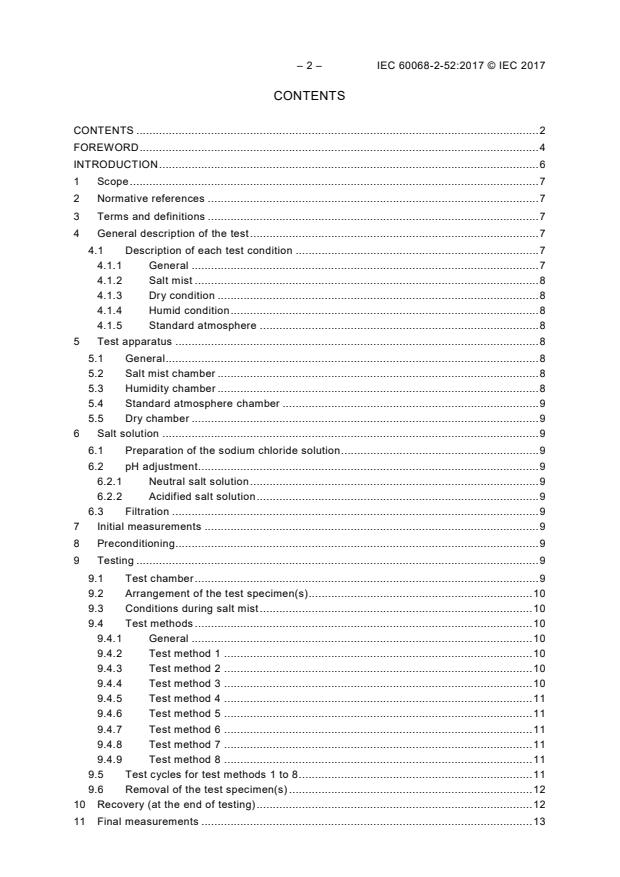
– 2 – IEC 60068-2-52:2017 © IEC 2017
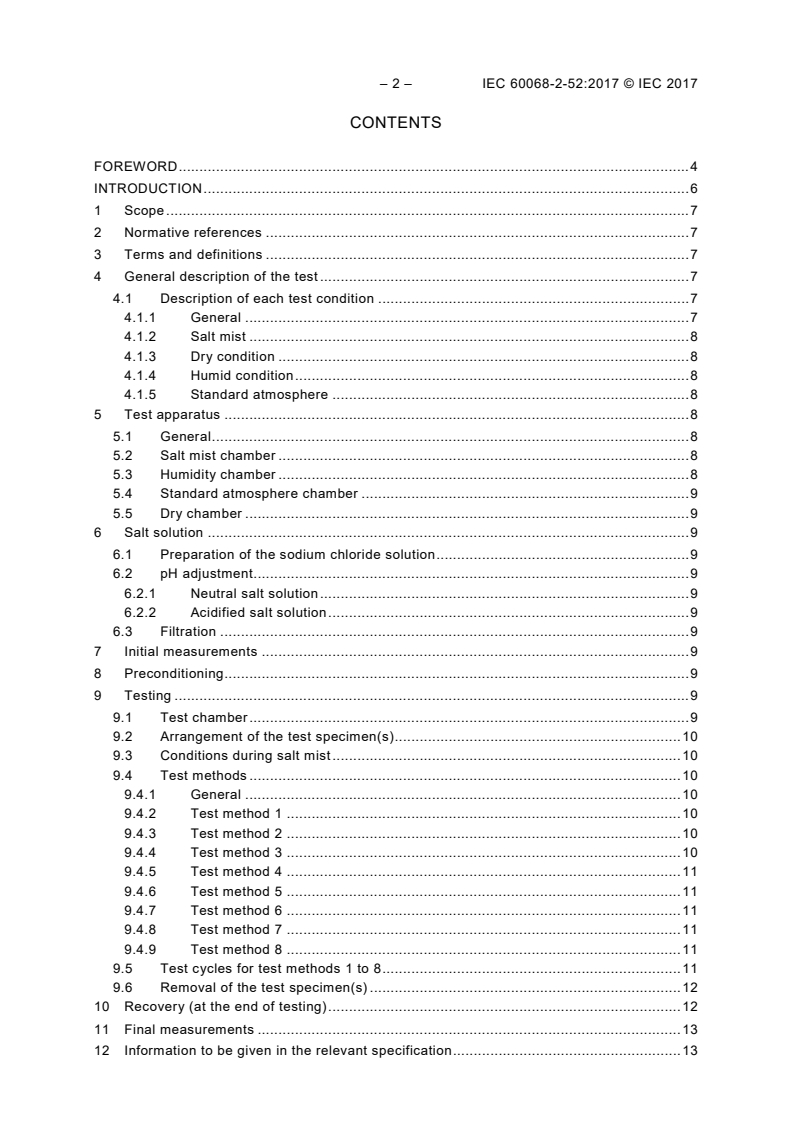
CONTENTS
FOREWORD . 4
INTRODUCTION . 6
1 Scope . 7
2 Normative references . 7
3 Terms and definitions . 7
4 General description of the test . 7
4.1 Description of each test condition . 7
4.1.1 General . 7
4.1.2 Salt mist . 8
4.1.3 Dry condition . 8
4.1.4 Humid condition . 8
4.1.5 Standard atmosphere . 8
5 Test apparatus . 8
5.1 General . 8
5.2 Salt mist chamber . 8
5.3 Humidity chamber . 8
5.4 Standard atmosphere chamber . 9
5.5 Dry chamber . 9
6 Salt solution . 9
6.1 Preparation of the sodium chloride solution . 9
6.2 pH adjustment . 9
6.2.1 Neutral salt solution . 9
6.2.2 Acidified salt solution . 9
6.3 Filtration . 9
7 Initial measurements . 9
8 Preconditioning . 9
9 Testing . 9
9.1 Test chamber . 9
9.2 Arrangement of the test specimen(s) . 10
9.3 Conditions during salt mist . 10
9.4 Test methods . 10
9.4.1 General . 10
9.4.2 Test method 1 . 10
9.4.3 Test method 2 . 10
9.4.4 Test method 3 . 10
9.4.5 Test method 4 . 11
9.4.6 Test method 5 . 11
9.4.7 Test method 6 . 11
9.4.8 Test method 7 . 11
9.4.9 Test method 8 . 11
9.5 Test cycles for test methods 1 to 8 . 11
9.6 Removal of the test specimen(s) . 12
10 Recovery (at the end of testing) . 12
11 Final measurements . 13
12 Information to be given in the relevant specification . 13
13 Information to be given in the test report. 13
Annex A (informative) Typical apparatus for cyclic salt mist, humid condition, dry
condition and standard atmosphere corrosion tests . 14
Annex B (informative) Description of each test method . 15
B.1 Test methods 1 and 2 . 15
B.2 Test methods 3 to 6 . 15
B.3 Test methods 7 and 8 . 15
Bibliography . 16
Figure A.1 – Example of test apparatus . 14
Table 1 – Test cycles for test methods 1 to 8 . 12
– 4 – IEC 60068-2-52:2017 © IEC 2017
INTERNATIONAL ELECTROTECHNICAL COMMISSION
____________
ENVIRONMENTAL TESTING –
Part 2-52: Tests – Test Kb: Salt mist, cyclic
(sodium chloride solution)
FOREWORD
1) The International Electrotechnical Commission (IEC) is a worldwide organization for standardization comprising
all national electrotechnical committees (IEC National Committees). The object of IEC is to promote
international co-operation on all questions concerning standardization in the electrical and electronic fields. To
this end and in addition to other activities, IEC publishes International Standards, Technical Specifications,
Technical Reports, Publicly Available Specifications (PAS) and Guides (hereafter referred to as “IEC
Publication(s)”). Their preparation is entrusted to technical committees; any IEC National Committee interested
in the subject dealt with may participate in this preparatory work. International, governmental and non-
governmental organizations liaising with the IEC also participate in this preparation. IEC collaborates closely
with the International Organization for Standardization (ISO) in accordance with conditions determined by
agreement between the two organizations.
2) The formal decisions or agreements of IEC on technical matters express, as nearly as possible, an international
consensus of opinion on the relevant subjects since each technical committee has representation from all
interested IEC National Committees.
3) IEC Publications have the form of recommendations for international use and are accepted by IEC National
Committees in that sense. While all reasonable efforts are made to ensure that the technical content of IEC
Publications is accurate, IEC cannot be held responsible for the way in which they are used or for any
misinterpretation by any end user.
4) In order to promote international uniformity, IEC National Committees undertake to apply IEC Publications
transparently to the maximum extent possible in their national and regional publications. Any divergence
between any IEC Publication and the corresponding national or regional publication shall be clearly indicated in
the latter.
5) IEC itself does not provide any attestation of conformity. Independent certification bodies provide conformity
assessment services and, in some areas, access to IEC marks of conformity. IEC is not responsible for any
services carried out by independent certification bodies.
6) All users should ensure that they have the latest edition of this publication.
7) No liability shall attach to IEC or its directors, employees, servants or agents including individual experts and
members of its technical committees and IEC National Committees for any personal injury, property damage or
other damage of any nature whatsoever, whether direct or indirect, or for costs (including legal fees) and
expenses arising out of the publication, use of, or reliance upon, this IEC Publication or any other IEC
Publications.
8) Attention is drawn to the Normative references cited in this publication. Use of the referenced publications is
indispensable for the correct application of this publication.
9) Attention is drawn to the possibility that some of the elements of this IEC Publication may be the subject of
patent rights. IEC shall not be held responsible for identifying any or all such patent rights.
International Standard IEC 60068-2-52 has been prepared by IEC technical committee 104:
Environmental conditions, classification and methods of test.
This third edition cancels and replaces the second edition published in 1996. This edition
constitutes a technical revision.
This edition includes the following significant technical changes with respect to the previous
edition:
a) the entire content has been harmonized with ISO 9227 as far as possible;
b) an introduction has been added;
c) the scope has been simplified;
d) normative references have been updated;
e) the general description of the test has been changed;
f) a dry chamber has been added to the test apparatus;
g) severities have been changed to test methods;
h) test methods 7 and 8 have been added;
i) information on the test report has been added;
j) Figure 1 has been changed to Table 1;
k) a typical test apparatus example has been added in a new Annex A;
l) a description of each test method has been added in a new Annex B;
m) bibliographical references have been added.
The text of this International Standard is based on the following documents:
FDIS Report on voting
104/751/FDIS 104/761/RVD
Full information on the voting for the approval of this International Standard can be found in
the report on voting indicated in the above table.
This document has been drafted in accordance with the ISO/IEC Directives, Part 2.
A list of all parts in the IEC 60068 series, published under the general title Environmental
testing, can be found on the IEC website.
The committee has decided that the contents of this document will remain unchanged until the
stability date indicated on the IEC website under "http://webstore.iec.ch" in the data related to
the specific document. At this date, the document will be
• reconfirmed,
• withdrawn,
• replaced by a revised edition, or
• amended.
A bilingual version of this publication may be issued at a later date.
– 6 – IEC 60068-2-52:2017 © IEC 2017
INTRODUCTION
The mechanism of corrosion on metallic materials in a chloride-containing atmosphere is
electrochemical, whereas the degradation effects experienced on non-metallic materials are
caused by complex chemical reactions of the salts with the materials involved. The rate at
which corrosive action takes place is dependent, to a large extent, on the supply of
oxygenated salt solution to the surface of the test specimen(s), the temperature of the test
specimen(s) and the temperature and humidity of the environment.
Apart from the corrosive effects, this cyclic salt mist test may be used to indicate deterioration
of some non-metallic materials by assimilation of salts. In the various test methods described
in this document, the period of spraying with the relevant salt solution is sufficient to wet the
test specimen(s) thoroughly. Because this wetting is repeated after intervals of storage under
humid conditions supplemented by storage under a standard atmosphere, it goes some way
to reproducing the effects of natural environments.
Furthermore, considering natural environments for corrosion on metallic materials, neutral or
acidified salt solution spray, humid, and dry conditions are also important factors as a cyclic
corrosion test. Each condition is repeated after intervals of other conditions in different
combinations to achieve corrosion on metallic materials and to get acceleration of corrosion.
The tests described in this document are accelerated compared with most expected
conditions of use. As a result, it may be difficult to establish an overall acceleration factor for
all kinds of test specimens. This also means that it is often not possible to use results gained
from these tests as a comparative guide to the long-term behaviour of different coating
systems since the corrosion stress during these tests differs significantly from the corrosion
stresses encountered during use. Nevertheless, the method described gives a means of
checking that the comparative quality of a metallic material is maintained.
This document may involve hazardous materials, operations and equipment. This document
does not purport to address all of the safety concerns, if any, associated with its use. It is the
responsibility of the user of this document to establish appropriate safety and health practices
and determine the applicability of regulatory limitations prior to use.
ENVIRONMENTAL TESTING –
Part 2-52: Tests – Test Kb: Salt mist, cyclic
(sodium chloride solution)
1 Scope
This part of IEC 60068-2 specifies the application of the cyclic salt mist test to components or
equipment designed to withstand a salt-laden atmosphere as salt can degrade the
performance of parts manufactured using metallic and/or non-metallic materials.
2 Normative references
The following documents are referred to in the text in such a way that some or all of their
content constitutes requirements of this document. For dated references, only the edition
cited applies. For undated references, the latest edition of the referenced document (including
any amendments) applies.
IEC 60068-1, Environmental testing – Part 1: General and guidance
IEC 60068-2-78, Environmental testing – Part 2-78: Tests – Test Cab: Damp heat, steady
state
ISO 9227, Corrosion tests in artificial atmospheres – Salt spray tests
3 Terms and definit
...
IEC 60068-2-52 ®
Edition 3.0 2017-11
REDLINE VERSION
INTERNATIONAL
STANDARD
colour
inside
Environmental testing –
Part 2-52: Tests – Test Kb: Salt mist, cyclic (sodium chloride solution)
All rights reserved. Unless otherwise specified, no part of this publication may be reproduced or utilized in any form
or by any means, electronic or mechanical, including photocopying and microfilm, without permission in writing from
either IEC or IEC's member National Committee in the country of the requester. If you have any questions about IEC
copyright or have an enquiry about obtaining additional rights to this publication, please contact the address below or
your local IEC member National Committee for further information.
IEC Central Office Tel.: +41 22 919 02 11
3, rue de Varembé info@iec.ch
CH-1211 Geneva 20 www.iec.ch
Switzerland
About the IEC
The International Electrotechnical Commission (IEC) is the leading global organization that prepares and publishes
International Standards for all electrical, electronic and related technologies.
About IEC publications
The technical content of IEC publications is kept under constant review by the IEC. Please make sure that you have the
latest edition, a corrigenda or an amendment might have been published.
IEC Catalogue - webstore.iec.ch/catalogue Electropedia - www.electropedia.org
The stand-alone application for consulting the entire The world's leading online dictionary of electronic and
bibliographical information on IEC International Standards, electrical terms containing 21 000 terms and definitions in
Technical Specifications, Technical Reports and other English and French, with equivalent terms in 16 additional
documents. Available for PC, Mac OS, Android Tablets and languages. Also known as the International Electrotechnical
iPad. Vocabulary (IEV) online.
IEC publications search - webstore.iec.ch/advsearchform IEC Glossary - std.iec.ch/glossary
The advanced search enables to find IEC publications by a 67 000 electrotechnical terminology entries in English and
variety of criteria (reference number, text, technical French extracted from the Terms and Definitions clause of
committee,…). It also gives information on projects, replaced IEC publications issued since 2002. Some entries have been
and withdrawn publications. collected from earlier publications of IEC TC 37, 77, 86 and
CISPR.
IEC Just Published - webstore.iec.ch/justpublished
Stay up to date on all new IEC publications. Just Published IEC Customer Service Centre - webstore.iec.ch/csc
details all new publications released. Available online and If you wish to give us your feedback on this publication or
also once a month by email. need further assistance, please contact the Customer Service
Centre: sales@iec.ch.
IEC 60068-2-52 ®
Edition 3.0 2017-11
REDLINE VERSION
INTERNATIONAL
STANDARD
colour
inside
Environmental testing –
Part 2-52: Tests – Test Kb: Salt mist, cyclic (sodium chloride solution)
INTERNATIONAL
ELECTROTECHNICAL
COMMISSION
ICS 19.040 ISBN 978-2-8322-5027-3
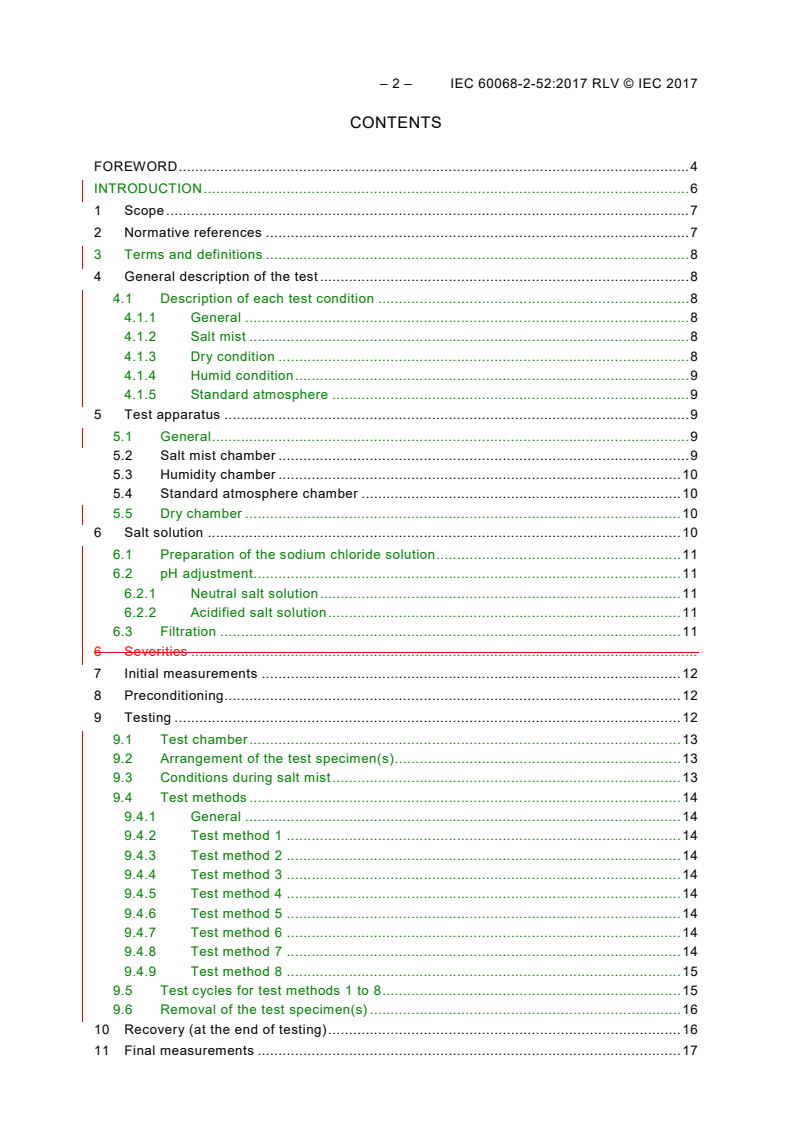
– 2 – IEC 60068-2-52:2017 RLV © IEC 2017
CONTENTS
FOREWORD . 4
INTRODUCTION . 6
1 Scope . 7
2 Normative references . 7
3 Terms and definitions . 8
4 General description of the test . 8
4.1 Description of each test condition . 8
4.1.1 General . 8
4.1.2 Salt mist . 8
4.1.3 Dry condition . 8
4.1.4 Humid condition . 9
4.1.5 Standard atmosphere . 9
5 Test apparatus . 9
5.1 General . 9
5.2 Salt mist chamber . 9
5.3 Humidity chamber . 10
5.4 Standard atmosphere chamber . 10
5.5 Dry chamber . 10
6 Salt solution . 10
6.1 Preparation of the sodium chloride solution . 11
6.2 pH adjustment . 11
6.2.1 Neutral salt solution . 11
6.2.2 Acidified salt solution . 11
6.3 Filtration . 11
6 Severities .
7 Initial measurements . 12
8 Preconditioning . 12
9 Testing . 12
9.1 Test chamber . 13
9.2 Arrangement of the test specimen(s) . 13
9.3 Conditions during salt mist . 13
9.4 Test methods . 14
9.4.1 General . 14
9.4.2 Test method 1 . 14
9.4.3 Test method 2 . 14
9.4.4 Test method 3 . 14
9.4.5 Test method 4 . 14
9.4.6 Test method 5 . 14
9.4.7 Test method 6 . 14
9.4.8 Test method 7 . 14
9.4.9 Test method 8 . 15
9.5 Test cycles for test methods 1 to 8 . 15
9.6 Removal of the test specimen(s) . 16
10 Recovery (at the end of testing) . 16
11 Final measurements . 17
12 Information to be given in the relevant specification . 17
13 Information to be given in the test report. 17
Annex A (informative) Typical apparatus for cyclic salt mist, humid condition, dry
condition and standard atmosphere corrosion tests . 19
Annex B (informative) Description of each test method . 20
B.1 Test methods 1 and 2 . 20
B.2 Test methods 3 to 6 . 20
B.3 Test methods 7 and 8 . 20
Bibliography . 21
Figure 1 – Schematic time-scale of the different test severities (1) to (6) .
Figure A.1 – Example of test apparatus . 19
Table 1 – Test cycles for test methods 1 to 8 . 16
– 4 – IEC 60068-2-52:2017 RLV © IEC 2017
INTERNATIONAL ELECTROTECHNICAL COMMISSION
____________
ENVIRONMENTAL TESTING –
Part 2-52: Tests – Test Kb: Salt mist, cyclic
(sodium chloride solution)
FOREWORD
1) The International Electrotechnical Commission (IEC) is a worldwide organization for standardization comprising
all national electrotechnical committees (IEC National Committees). The object of IEC is to promote
international co-operation on all questions concerning standardization in the electrical and electronic fields. To
this end and in addition to other activities, IEC publishes International Standards, Technical Specifications,
Technical Reports, Publicly Available Specifications (PAS) and Guides (hereafter referred to as “IEC
Publication(s)”). Their preparation is entrusted to technical committees; any IEC National Committee interested
in the subject dealt with may participate in this preparatory work. International, governmental and non-
governmental organizations liaising with the IEC also participate in this preparation. IEC collaborates closely
with the International Organization for Standardization (ISO) in accordance with conditions determined by
agreement between the two organizations.
2) The formal decisions or agreements of IEC on technical matters express, as nearly as possible, an international
consensus of opinion on the relevant subjects since each technical committee has representation from all
interested IEC National Committees.
3) IEC Publications have the form of recommendations for international use and are accepted by IEC National
Committees in that sense. While all reasonable efforts are made to ensure that the technical content of IEC
Publications is accurate, IEC cannot be held responsible for the way in which they are used or for any
misinterpretation by any end user.
4) In order to promote international uniformity, IEC National Committees undertake to apply IEC Publications
transparently to the maximum extent possible in their national and regional publications. Any divergence
between any IEC Publication and the corresponding national or regional publication shall be clearly indicated in
the latter.
5) IEC itself does not provide any attestation of conformity. Independent certification bodies provide conformity
assessment services and, in some areas, access to IEC marks of conformity. IEC is not responsible for any
services carried out by independent certification bodies.
6) All users should ensure that they have the latest edition of this publication.
7) No liability shall attach to IEC or its directors, employees, servants or agents including individual experts and
members of its technical committees and IEC National Committees for any personal injury, property damage or
other damage of any nature whatsoever, whether direct or indirect, or for costs (including legal fees) and
expenses arising out of the publication, use of, or reliance upon, this IEC Publication or any other IEC
Publications.
8) Attention is drawn to the Normative references cited in this publication. Use of the referenced publications is
indispensable for the correct application of this publication.
9) Attention is drawn to the possibility that some of the elements of this IEC Publication may be the subject of
patent rights. IEC shall not be held responsible for identifying any or all such patent rights.
This redline version of the official IEC Standard allows the user to identify the changes
made to the previous edition. A vertical bar appears in the margin wherever a change
has been made. Additions are in green text, deletions are in strikethrough red text.
International Standard IEC 60068-2-52 has been prepared by IEC technical committee 104:
Environmental conditions, classification and methods of test.
This third edition cancels and replaces the second edition published in 1996. This edition
constitutes a technical revision.
This edition includes the following significant technical changes with respect to the previous
edition:
a) the entire content has been harmonized with ISO 9227 as far as possible;
b) an introduction has been added;
c) the scope has been simplified;
d) normative references have been updated;
e) the general description of the test has been changed;
f) a dry chamber has been added to the test apparatus;
g) severities have been changed to test methods;
h) test methods 7 and 8 have been added;
i) information on the test report has been added;
j) Figure 1 has been changed to Table 1;
k) a typical test apparatus example has been added in a new Annex A;
l) a description of each test method has been added in a new Annex B;
m) bibliographical references have been added.
The text of this International Standard is based on the following documents:
FDIS Report on voting
104/751/FDIS 104/761/RVD
Full information on the voting for the approval of this International Standard can be found in
the report on voting indicated in the above table.
This document has been drafted in accordance with the ISO/IEC Directives, Part 2.
A list of all parts in the IEC 60068 series, published under the general title Environmental
testing, can be found on the IEC website.
The committee has decided that the contents of this document will remain unchanged until the
stability date indicated on the IEC website under "http://webstore.iec.ch" in the data related to
the specific document. At this date, the document will be
• reconfirmed,
• withdrawn,
• replaced by a revised edition, or
• amended.
IMPORTANT – The “colour inside” logo on the cover page of this publication indicates
that it contains colours which are considered to be useful for the correct understanding
of its contents. Users should therefore print this publication using a colour printer.
– 6 – IEC 60068-2-52:2017 RLV © IEC 2017
INTRODUCTION
The mechanism of salt corrosion on metallic materials in a chloride-containing atmosphere is
electrochemical, whereas the degradation effects experienced on non-metallic materials are
caused by complex chemical reactions of the salts with the materials involved. The rate at
which corrosive action takes place is dependent, to a large extent, on the supply of
oxygenated salt solution to the surface of the test specimen(s), the temperature of the test
specimen(s) and the temperature and humidity of the environment.
Apart from the corrosive effects, this cyclic salt mist test may be used to indicate deterioration
of some non-metallic materials by assimilation of salts. In the various test methods described
in this document, the period of spraying with the relevant salt solution is sufficient to wet the
test specimen(s) thoroughly. Because this wetting is repeated after intervals of storage under
humid conditions (severities (1) and (2)) and in some cases severities ((3) to (6)) –
supplemented by storage under a standard atmosphere for testing, it goes some way to
reproducing the effects of natural environments.
Furthermore, considering natural environments for corrosion on metallic materials, neutral or
acidified salt solution spray, humid, and dry conditions are also important factors as a cyclic
corrosion test. Each condition is repeated after intervals of other conditions in different
combinations to achieve corrosion on metallic materials and to get acceleration of corrosion.
The tests described in this document are accelerated compared with most expected
conditions of use. As a result, it may be difficult to establish an overall acceleration factor for
all kinds of test specimens. This also means that it is often not possible to use results gained
from these tests as a comparative guide to the long-term behaviour of different coating
systems since the corrosion stress during these tests differs significantly from the corrosion
stresses encountered during use. Nevertheless, the method described gives a means of
checking that the comparative quality of a metallic material is maintained.
This document may involve hazardous materials, operations and equipment. This document
does not purport to address all of the safety concerns, if any, associated with its use. It is the
responsibility of the user of this document to establish appropriate safety and health practices
and determine the applicability of regulatory limitations prior to use.
ENVIRONMENTAL TESTING –
Part 2-52: Tests – Test Kb: Salt mist, cyclic
(sodium chloride solution)
1 Scope
This test is intended for application to components or equipment designed to withstand a salt-
laden atmosphere, depending on the chosen severity. Salt can degrade the performance of
parts manufactured using metallic and/or non-metallic materials.
Severities (1) and (2) are intended to be used for testing products which are used in a marine
environment, or in close proximity to the sea. Severity (1) should be used to test products
which are exposed to the environment for much of their operational life (e.g. ship radar, deck
equipment). Severity (2) should be used to test products which may be exposed to the marine
environment from time to time but will normally be protected by an enclosure (e.g.
navigational equipment which will normally be used on the bridge or in a control room).
Additionally, severities (1) and (2) are commonly used as a general corrosion test in
component quality assurance procedures.
Severities (3) to (6) are intended for products where, under normal use, there is a frequent
change between salt-laden and dry atmosphere, e.g. automobiles and their parts.
Severities (3) to (6), compared to severities (1) and (2), therefore include an additional
storage under a standard atmosphere for testing.
The period of dry atmosphere may happen, in practice, during breaks of operation, e.g. during
the weekend. This inclusion of such a dry period in severities (3) to (6) leads to corrosion
mechanism which can be quite different from those under constant humid conditions.
The test is accelerated compared with most service conditions. However, it is not possible to
establish an overall acceleration factor for all kinds of specimens (see IEC 60355).
This part of IEC 60068-2 specifies the application of the cyclic salt mist test to components or
equipment designed to withstand a salt-laden atmosphere as salt can degrade the
performance of parts manufactured using metallic and/or non-metallic materials.
2 Normative references
The following documents are referred to in the text in such a way that some or all of their
content constitutes requirements of this document. For dated references, only the edition
cited applies. For undated references, the latest edition of the referenced document (including
any amendments) applies.
IEC 60068-1: 1988, Environmental testing – Part 1: General and guidance
IEC 60068-2-3: 1969, Environmental testing – Part 2: Tests – Test Ca: Damp heat, steady
state
IEC 60068-2-78, Environmental testing – Part 2-78: Tests – Test Cab: Damp heat, steady
state
– 8 – IEC 60068-2-52:2017 RLV © IEC 2017
IEC 60355: 1971, An appraisal of the problems of accelerated testing for atmospheric
corrosion
ISO 9227, Corrosion tests in artificial atmospheres – Salt spray tests
3 Terms and definitions
No terms and definitions are listed in this document.
ISO and IEC maintain terminological databases for use in standardization at the following
addresses:
• IEC Electropedia: available at http://www.electropedia.org/
• ISO Online browsing platform: available at http://www.iso.org/obp
4 General description of the test
For severities (1) and (2), the test procedure is separated into a specified number of periods
of spraying by a salt mist at a temperature between 15 °C and 35 °C, each followed by a
+2
storage period under humid conditions at 40 °C ± 2 °C, (93 ) % relative humidity.
−3
For severities (3), (4), (5) and (6) the test procedure is separated into a specified number of
test cycles. Each test cycle consists of four periods of spraying by a salt mist at a temperature
between 15 °C and 35 °C, each followed by a storage period under humid conditions at
+2
40 °C ± 2 °C, (93 ) % relative humidity, and of one storage period under a standard
−3
atmosphere for testing at 23 °C ± 2 °C and 45 % to 55 % relative humidity after these four
periods of spraying and storage under humid conditions.
If the spray period and storage period are carried out in different chambers, care should be
taken to avoid loss of salt solution deposits on the specimen and to avoid any damage to the
specimen due to handling.
The specimen is never energized during the spray period, and not normally during the storage
period.
4.1 Description of each test condition
4.1.1 General
This document consists of the cyclic test conditions of salt mist, dry condition, humid condition
and standard atmosphere. The effect of each test condition is as follows.
NOTE Salt mist is also called salt spray.
The test specimen(s) is typically not energized during the test.
4.1.2 Salt mist
The test specimen is corroded by an electrochemical or complex chemical reaction with
neutral or acidified salt solution. Salt solution forms a thin electrolytic film on the test
specimen surface. This can initiate corrosion and can allow it to proceed.
4.1.3 Dry condition
Heated air in the chamber may cause evaporation of water from the test specimen surface
from decreasing relative humidity and increased specimen temperature. This causes the
concentration of the solution to increase and speeds up chemical reactions, accelerating the
corrosion process. Salt precipitates out of the solution onto the test specimen surface during
this condition. Evaporation and heating rates may vary based on the test chamber and test
specimen.
4.1.4 Humid condition
4.1.4.1 Dry condition to humid condition
As the relative humidity increases, precipitated salt crystals on the specimen surface absorb
water vapour until a liquid electrolytic solution forms, reinitializing the corrosion process.
4.1.4.2 Salt mist to humid condition
The humid condition maintains the existing wetness on the test specimen surface at the end
of the salt mist period, without excessive dilution of the solution that may result from
condensing humidity.
4.1.5 Standard atmosphere
The test specimen is allowed to equilibrate with standard laboratory conditions, which results
in gradual drying and relaxation from most corrosion reactions. The period of dry atmosphere
may occur, in practice, during breaks of operation, for example during the weekend. The
inclusion of such a dry period may lead to corrosion mechanisms which can be quite different
from those under constant wet conditions. The test schedule shall be chosen in order to
respect the timelines given in 9.4. Additional dry periods (e.g. during a weekend) shall be
avoided.
5 Test apparatus
5.1 General
Each test method includes two or more environmental conditions, which may be achieved by
the use of multiple chambers or a single chamber that automatically transitions from one
condition to the next. In either case, transitions are not assumed to be instantaneous. Care
shall be taken to minimize any adverse effects associated with handling of specimens during
transfer between chambers.
5.2 Salt mist chamber
The chamber for this test shall be constructed of such materials that will not influence the
corrosive effects of the salt mist shall conform to the requirements of ISO 9227. It shall
maintain a temperature of 35 °C ± 2 K.
NOTE A schematic diagram of one possible design of spray cabinet is shown in Annex A.
The detailed construction of the chamber, including the method of producing the salt mist is
optional, provided that:
a) the conditions in the chamber are within the limits specified;
b) a sufficiently large volume with constant, homogeneous conditions (not affected by
turbulence) is available; these conditions should not be influenced by the specimen under
test;
c) no direct spray impinges upon the specimen under test;
d) drops of liquid accumulating on the ceiling, the walls, or other parts cannot drip on the
specimen;
– 10 – IEC 60068-2-52:2017 RLV © IEC 2017
e) the chamber shall be properly vented to prevent pressure build-up and allow uniform
distribution of the salt mist. The discharge end of the vent shall be protected from strong
draughts which can cause strong air currents in the chamber.
4.1.1 Atomizer(s)
The atomizer(s) shall be of such a design and construction as to produce a finely divided, wet,
dense mist. The atomizer(s) shall be made of material that is non-reactive to the salt solution.
4.1.2 The sprayed solution shall not be re-used.
4.1.3 Air supply
If use is made of compressed air, that air shall, when entering the atomizer(s), be essentially
free from all impurities, such as oil and dust.
Means shall be provided to humidify the compressed air as required to meet the operating
conditions. The air pressure shall be suitable to produce a finely divided dense mist with the
atomizer(s) used.
To ensure against clogging of the atomizer(s) by salt deposition, the air is recommended to
have a relative humidity of at least 85 % at the point of release from the nozzle. A satisfactory
method is to pass the air in very fine bubbles through a tower containing water, which should
be automatically maintained at a constant level. The temperature of this water shall be not
less than that of the chamber.
The air pressure shall be capable of adjustment so that the collection rate as specified in 9.2
can be maintained.
5.3 Humidity chamber
The chamber shall conform to the requirements of IEC 60068-2-3, i.e. IEC 60068-2-78. It shall
+2
maintain a relative humidity of (93 ) % at a temperature of 40 °C ± 2 °C 93 % ± 3 % at a
−3
temperature of 40 °C ± 2 K or a relative humidity of over 95 % at a temperature of 50 °C ± 2
K.
5.4 Standard atmosphere chamber
The chamber shall conform to the requirements of 5.2 of IEC 60068-1, (table second line,
wide range), i.e. It shall maintain a relative humidity of 45 % to 55 % at a temperature of
23 °C ± 2 °C 50 % ± 5 % at a temperature of 23 °C ± 2 K.
5.5 Dry chamber
The chamber shall maintain a relative humidity of less than 30 % at a temperature of
60 °C ± 2 K.
6 Salt solution
5.1 5 % sodium chloride (NaCl) solution
5.1.1 The salt used for the test shall be high-quality sodium chloride (NaCl) containing, when
dry, not more than 0,1 % sodium iodide and not more than 0,3 % of total impurities.
The salt solution concentration shall be 5 % ± 1 % by weight.
The solution shall be prepared by dissolving 5 ± 1 parts by weight of salt in 95 parts by weight
of distilled or demineralized water.
NOTE – The relevant specification may call for other salt solutions, the composition and characteristics (density,
pH value, etc.) of which should be stated clearly in the specification, e.g. to simulate the special effects of a marine
environment.
5.1.2 The pH value of the solution shall be between 6,5 and 7,2 at a temperature of 20 °C ± 2 °C.
The pH value shall be maintained within this range during conditioning; for this purpose,
diluted hydrochloric acid or sodium hydroxide may be used to adjust the pH value, provided
that the concentration of NaCl remains within the prescribed limits. The pH value shall be
measured when preparing each new batch of solution.
6.1 Preparation of the sodium chloride solution
The solution shall conform to the requirements of ISO 9227.
NOTE The sodium chloride concentration of the sprayed solution collected is 50 g/l ± 5 g/l.
6.2 pH adjustment
6.2.1 Neutral salt solution
The pH adjustment shall conform to the requirements of ISO 9227 for the neutral salt solution
test.
6.2.2 Acidified salt solution
Add the following reagents to 10 litres of the prepared neutral 5 % sodium chloride solution as
follows: 12 ml of nitric acid (HNO , ρ = 1,42 g/ml), 17,3 ml of sulfuric acid (H SO , ρ = 1,84
3 2 4
g/ml) and sufficient quantity of 10 % mass fraction of sodium hydroxide (NaOH) solution to
adjust the pH of the solution to 3,5 ± 0,1 (about 300 ml will be required). The pH of the
sprayed solution collected within the chamber is 3,4 to 3,6 at 25 °C ± 2 K.
6.3 Filtration
If necessary, filter the solution before placing it in the reservoir of the apparatus to remove
any solid matter which might block the apertures of the spraying device.
6 Severities
6.1 The severity of the test is defined as follows.
For severities (1) and (2):
by the combination of the number of spray periods and the duration of the storage under
humid conditions following each spray period.
For severities (3) to (6):
by the number of test cycles consisting of four spraying periods with storage under humid
conditions after each one, and one additional storage period under a standard atmosphere for
testing after these four periods of spraying and storage under humid conditions.
6.2 The relevant specification shall indicate which of the six following severities shall be
used.
Severity (1): four spray periods, each of 2 h, with a humidity storage period of seven days
after each.
– 12 – IEC 60068-2-52:2017 RLV © IEC 2017
NOTE – The humidity storage period should be suitably reduced so that the spray period plus storage period is
seven days.
Severity (2): three spray periods, each of 2 h, with a humidity storage period between 20 h
and 22 h after each.
Severity (3): one test cycle consisting of:
four spray periods, each of 2 h, with a humidity storage period between 20 h and 22 h after
each; afterwards one storage period of three days under a standard atmosphere for testing
at 23 °C ± 2 °C and 45 % to 55 % humidity.
Severity (4): two test cycles as specified in severity (3).
Severity (5): four test cycles as specified in severity (3).
Severity (6): eight test cycles as specified in severity (3).
6.3 A schematic survey of time-scale of all the test severities is given in figure 1.
7 Initial measurements
The test specimen(s) shall be visually inspected and, if necessary, electrically and
mechanically checked as required by the relevant specification.
8 Preconditioning
The relevant specification shall prescribe specify the cleaning procedure to be applied
immediately before the test; it shall also state whether temporary protective coatings shall be
removed.
NOTE – The cleaning method used should not interfere with the effect of the salt mist on the
test specimen(s), nor introduce any secondary corrosion. Touching of the test surfaces by
hand should be avoided as far as possible before the test.
9 Testing
9.1 The specimen shall be placed in the salt mist chamber, and sprayed with the salt
solution, for a period of 2 h at a temperature between 15 °C and 35 °C.
9.2 The salt mist conditions shall be maintained in all parts of the exposure zone, that a
clean collecting receptacle with a horizontal collecting area of 80 cm , placed at any point in
the exposure zone, shall collect between 1,0 ml and 2,0 ml of solution per hour, averaged
over the collecting period. A minimum of two receptacles shall be used. The receptacles shall
be placed such that they are not shielded by the specimen and so that no condensate from
any source shall be collected.
NOTE – When calibrating the spray rate of the chamber, a minimum spray period of 8 h should be used, for
accurate measurement purposes.
9.3 Severities (1) and (2)
At the end of the spray period, the specimen shall be transferred to the humidity chamber and
+2
stored at a temperature of 40 °C ± 2 °C and a relative humidity of (93 ) % in accordance
−3
with IEC 60068-2-3.
The spraying with salt solution as in 9.1 and the storage as in this subclause constitutes one
cycle.
The required severity for the number of cycles and the duration of storage shall be in
accordance with 6.2.
9.4 Severities (3) to (6)
At the end of the spray period, the specimen shall be transferred to the humidity chamber and
+2
stored at a temperature of 40 °C ± 2 °C and a relative humidity of (93 ) % in accordance
−3
with IEC 60068-2-3 for a period of 20 h to 22 h. This shall be repeated a further three times.
The specimen shall then be stored under a standard atmosphere for testing at 23 °C ± 2 °C
and 45 % to 55 % relative humidity for a period of three days.
The four spray periods (see 9.1) and storage periods of this subclause followed by three days
under a standard atmosphere for testing constitutes one test cycle.
The required severity for the number of test cycles shall be in accordance with 6.2.
9.5 The removal of the specimen from the salt mist chamber to the humidity chamber shall
be carried out so as to minimize the loss of salt solution from the specimen(s).
NOTE – If the salt mist chamber can maintain the humidity and temperature conditions of IEC 60068-2-3, the
specimen may remain in it for the humidity storage period.
9.6 If the specimen consists of more than one item they shall not be in contact with each
other or with other metal parts and shall be so arranged as to exclude any influence of one
part upon another.
9.1 Test chamber
For test methods 1 and 2, a salt mist chamber and humidity chamber are used.
For test methods 3 to 6, a salt mist chamber, humidity chamber and standard atmosphere
chamber are used.
For test methods 7 and 8, a salt mist chamber, dry chamber and humidity chamber are used.
All test methods may be performed in a single chamber provided it is capable of maintaining
the required conditions. If not, care should be taken to avoid loss of salt solution deposits on
the test specimen(s) and to avoid any damage to the test specimen(s) due to manual
handling. For test methods 7 and 8, each condition should be carried out in the same
chamber due to the difficulty in achieving the rapid drying and re-wetting intended if
specimens are manually moved from one chamber to another.
It is recommended to use a specific chamber for testing test method 8 exclusively. Cross
effects of remaining acidified salt solution when consequently using test method 1 to 7 cannot
be ignored.
9.2 Arrangement of the test specimen(s)
The arrangement shall conform to the requirements of ISO 9227.
9.3 Conditions during salt mist
The test conditions shall conform to the requirements of ISO 9227.
– 14 – IEC 60068-2-52:2017 RLV © IEC 2017
9.4 Test methods
9.4.1 General
The relevant specification shall indicate which of the eight following test methods shall be
used. A description of each test method is given in Annex B. When not specified, the test
method shall be agreed by the interested parties.
The user should be aware of mass loss for each test condition.
9.4.2 Test method 1
One cycle is seven days. One cycle shall consist of spraying the specimen with a salt solution
at 35 °C ± 2 K for 2 h, followed by the humid condition at 40 °C ± 2 K, 93 % ± 3 % RH for six
days and 22 h. The required number of cycles is four (28 days).
In the case of manual handling, the transition time (maximum 2 h) should be included in the
humid condition period of six days and 22 h.
9.4.3 Test method 2
One cycle is one day. One cycle shall consist of spraying the specimen with a salt solution at
35 °C ± 2 K for 2 h, followed by the humid condition at 40 °C ± 2 K, 93 % ± 3 % RH for 22 h.
The required number of cycles is three (three days).
In the case of manual handling, the transition time (maximum 2 h) should be included in the
humid condition period of 22 h.
9.4.4 Test method 3
One cycle is seven days. One cycle shall consist of spraying the specimen with a salt solution
at 35 °C ± 2 .K for 2 h, followed by the humid condition at 40 °C ± 2 K, 93 % ± 3 % RH for 22
h. This shall be repeated four times. The test specimens shall then be stored under standard
atmosphere at 23 °C ± 2 K and 50 % ± 5 % RH for three days. The required number of cycle
is one (seven days).
In the case of manual handling, the transition time (maximum 2 h) should be included in the
humid condition period of 22 h and standard atmosphere period of three days.
9.4.5 Test method 4
The required number of cycles as specified in test method 3 shall be two (14 days).
9.4.6 Test method 5
The required number of cycles as specified in test method 3 shall be four (28 days).
9.4.7 Test method 6
The required number of cycles as specified in test method 3 shall be eight (56 days).
9.4.8 Test method 7
One cycle is 8 h. One cycle shall consist of spraying the specimen with a salt solution at
35 °C ± 2 K for 2 h, followed by the dry condition at 60 °C ± 2 K, under 30 % RH for 4 h and
then the humid condition at 50 °C ± 2 K, over 95 % RH for 2 h.
The transition times (time allowed to reach the temperature and relative humidity specified for
a condition after changing to that condition) for temperature and humidity shall be specified
between the following choices and reported:
– salt mist to dry condition: within 30 min or between 30 min and 60 min;
– dry condition to humid condition: within 15 min or between 15 min and 30 min;
– humid condition to salt mist: within 30 min.
Those transition times shall be included in the next condition period of the pair, for example
the salt mist to dry condition transition time is included in the period of the dry condition.
Spraying the specimen with a salt solution begins instantaneously once the salt mist is
started.
The recommended number of cycles are 3 (1 day), 6 (2 days), 12 (4 days), 30 (10 days), 45
(15 days), 60 (20 days), 90 (30 days), 150 (50 days) and 180 (60 days).
9.4.9 Test method 8
One cycle is 8 h, as specified in test method 7 using acidified salt solution instead of neutral
salt solution.
The recommended number of cycles is the same as in test method 7.
9.5 Test cycles for test methods 1 to 8
The test cycles for test methods 1 to 8 shall be in accordance with Table 1.
– 16 – IEC 60068-2-52:2017 RLV © IEC 2017
Table 1 – Test cycles for test methods 1 to 8
Test Details of the cycle Recommended
methods number of cycles
Salt mist Humid condition
35 °C ± 2 K 40 °C ± 2 K
2 h 93 % ± 3 % RH
6 day and 22 h
Test method
4 cycles (28 days)
One cycle = 7 days
In the case of manual handling, the transition time (max. 2 h) should be
included in the humid condition period of 6 days and 22 h.
Salt mist Humid condition
35 °C ± 2 K 40 °C ± 2 K
2 h 93 % ± 3 % RH
22 h
Test method
3 cycles (3 days)
One cycle = 1 day
In the case of manual handling, the transition time (max. 2 h) should be
included in the humid condition period of 22 h.
Salt mist Humid condition Standard
Test method
35 °C ± 2 K 40 °C ± 2 K atmosphere 1 cycle (7 days)
2 h 93 % ± 3 % RH 23 °C ± 2 K
22 h 50 % ± 5 % RH
Test method 3 days
2 cycles (14 days)
Repeat 4 times
Test method
4 cycles (28 days)
One cycle = 7 days
In the case of manual handling, the transition time (max. 2 h) should be
Test method
8 cycles (56 days)
included in the humid condition period of 22 h and standard atmosphere
period of 3 days.
Salt mist Dry condition Humid condition
35 °C ± 2 K 60 °C ± 2 K 50 °C ± 2 K
2 h ≤ 30 % RH ≥ 95 % RH
Test method
4 h 2 h
3, 6, 12, 30, 45,
60, 90, 150, 180
One cycle = 8 h
cycles
(1, 2, 4, 10, 15,
The transition times (time allowed to reach the temperature and relative
20, 30, 50, 60
humidity specified for a condition after changing to that condition) are
days)
within 30 min or between 30 min and 60 min from salt mist to dry condition,
Test method
within 15 min or between 15 min and 30 min from dry condition to humid
condition and within 30 min from humid condition to salt mist. Those
transition times shall be included in next condition period.
NOTE The ± tolerances given for temperature and relative humidity are the allowable fluctuations which are
defined as the positive and negative deviations from the setting of the sensor at the operational control set point
during equilibrium conditions. This does not mean that the set value can vary by plus/minus the amount
indicated from the given value.
9.6 Removal of the test specimen(s)
The test is recommended to be carried out in the same chamber (see Figure A.1). If not, care
should be taken to avoid loss of salt solution deposits on the test specimen(s) and to avoid
any damage to the test specimen(s) due to handling.
10 Recovery (at the end of testing)
The relevant specification shall state whether or not the test specimen(s) shall be washed. If
the test specimen(s) is to be washed, it shall be washed using running tap water for 5 min,
rinsed in distilled or demineralized deionized water, shaken by hand or subjected to air blast
to remove droplets of water, then dried for 1 h at 55 °C ± 2 K and allowed to cool under
controlled recovery conditions (IE
...
IEC 60068-2-52 ®
Edition 3.0 2017-11
INTERNATIONAL
STANDARD
NORME
INTERNATIONALE
Environmental testing –
Part 2-52: Tests – Test Kb: Salt mist, cyclic (sodium chloride solution)
Essais d'environnement –
Partie 2-52: Essais – Essai Kb: Brouillard salin, essai cyclique (solution de
chlorure de sodium)
All rights reserved. Unless otherwise specified, no part of this publication may be reproduced or utilized in any form
or by any means, electronic or mechanical, including photocopying and microfilm, without permission in writing from
either IEC or IEC's member National Committee in the country of the requester. If you have any questions about IEC
copyright or have an enquiry about obtaining additional rights to this publication, please contact the address below or
your local IEC member National Committee for further information.
Droits de reproduction réservés. Sauf indication contraire, aucune partie de cette publication ne peut être reproduite
ni utilisée sous quelque forme que ce soit et par aucun procédé, électronique ou mécanique, y compris la photocopie
et les microfilms, sans l'accord écrit de l'IEC ou du Comité national de l'IEC du pays du demandeur. Si vous avez des
questions sur le copyright de l'IEC ou si vous désirez obtenir des droits supplémentaires sur cette publication, utilisez
les coordonnées ci-après ou contactez le Comité national de l'IEC de votre pays de résidence.
IEC Central Office Tel.: +41 22 919 02 11
3, rue de Varembé info@iec.ch
CH-1211 Geneva 20 www.iec.ch
Switzerland
About the IEC
The International Electrotechnical Commission (IEC) is the leading global organization that prepares and publishes
International Standards for all electrical, electronic and related technologies.
About IEC publications
The technical content of IEC publications is kept under constant review by the IEC. Please make sure that you have the
latest edition, a corrigendum or an amendment might have been published.
IEC publications search - webstore.iec.ch/advsearchform Electropedia - www.electropedia.org
The advanced search enables to find IEC publications by a The world's leading online dictionary on electrotechnology,
variety of criteria (reference number, text, technical containing more than 22 000 terminological entries in English
committee,…). It also gives information on projects, replaced and French, with equivalent terms in 16 additional languages.
and withdrawn publications. Also known as the International Electrotechnical Vocabulary
(IEV) online.
IEC Just Published - webstore.iec.ch/justpublished
Stay up to date on all new IEC publications. Just Published IEC Glossary - std.iec.ch/glossary
details all new publications released. Available online and 67 000 electrotechnical terminology entries in English and
once a month by email. French extracted from the Terms and Definitions clause of
IEC publications issued since 2002. Some entries have been
IEC Customer Service Centre - webstore.iec.ch/csc collected from earlier publications of IEC TC 37, 77, 86 and
If you wish to give us your feedback on this publication or CISPR.
need further assistance, please contact the Customer Service
Centre: sales@iec.ch.
A propos de l'IEC
La Commission Electrotechnique Internationale (IEC) est la première organisation mondiale qui élabore et publie des
Normes internationales pour tout ce qui a trait à l'électricité, à l'électronique et aux technologies apparentées.
A propos des publications IEC
Le contenu technique des publications IEC est constamment revu. Veuillez vous assurer que vous possédez l’édition la
plus récente, un corrigendum ou amendement peut avoir été publié.
Recherche de publications IEC - Electropedia - www.electropedia.org
webstore.iec.ch/advsearchform Le premier dictionnaire d'électrotechnologie en ligne au
La recherche avancée permet de trouver des publications IEC monde, avec plus de 22 000 articles terminologiques en
en utilisant différents critères (numéro de référence, texte, anglais et en français, ainsi que les termes équivalents dans
comité d’études,…). Elle donne aussi des informations sur les 16 langues additionnelles. Egalement appelé Vocabulaire
projets et les publications remplacées ou retirées. Electrotechnique International (IEV) en ligne.
IEC Just Published - webstore.iec.ch/justpublished Glossaire IEC - std.iec.ch/glossary
Restez informé sur les nouvelles publications IEC. Just 67 000 entrées terminologiques électrotechniques, en anglais
Published détaille les nouvelles publications parues. et en français, extraites des articles Termes et Définitions des
Disponible en ligne et une fois par mois par email. publications IEC parues depuis 2002. Plus certaines entrées
antérieures extraites des publications des CE 37, 77, 86 et
Service Clients - webstore.iec.ch/csc CISPR de l'IEC.
Si vous désirez nous donner des commentaires sur cette
publication ou si vous avez des questions contactez-nous:
sales@iec.ch.
IEC 60068-2-52 ®
Edition 3.0 2017-11
INTERNATIONAL
STANDARD
NORME
INTERNATIONALE
Environmental testing –
Part 2-52: Tests – Test Kb: Salt mist, cyclic (sodium chloride solution)
Essais d'environnement –
Partie 2-52: Essais – Essai Kb: Brouillard salin, essai cyclique (solution de
chlorure de sodium)
INTERNATIONAL
ELECTROTECHNICAL
COMMISSION
COMMISSION
ELECTROTECHNIQUE
INTERNATIONALE
ICS 19.040 ISBN 978-2-8322-7231-2
– 2 – IEC 60068-2-52:2017 © IEC 2017
CONTENTS
CONTENTS . 2
FOREWORD . 4
INTRODUCTION . 6
1 Scope . 7
2 Normative references . 7
3 Terms and definitions . 7
4 General description of the test . 7
4.1 Description of each test condition . 7
4.1.1 General . 7
4.1.2 Salt mist . 8
4.1.3 Dry condition . 8
4.1.4 Humid condition . 8
4.1.5 Standard atmosphere . 8
5 Test apparatus . 8
5.1 General . 8
5.2 Salt mist chamber . 8
5.3 Humidity chamber . 8
5.4 Standard atmosphere chamber . 9
5.5 Dry chamber . 9
6 Salt solution . 9
6.1 Preparation of the sodium chloride solution . 9
6.2 pH adjustment . 9
6.2.1 Neutral salt solution . 9
6.2.2 Acidified salt solution . 9
6.3 Filtration . 9
7 Initial measurements . 9
8 Preconditioning . 9
9 Testing . 9
9.1 Test chamber . 9
9.2 Arrangement of the test specimen(s) . 10
9.3 Conditions during salt mist . 10
9.4 Test methods . 10
9.4.1 General . 10
9.4.2 Test method 1 . 10
9.4.3 Test method 2 . 10
9.4.4 Test method 3 . 10
9.4.5 Test method 4 . 11
9.4.6 Test method 5 . 11
9.4.7 Test method 6 . 11
9.4.8 Test method 7 . 11
9.4.9 Test method 8 . 11
9.5 Test cycles for test methods 1 to 8 . 11
9.6 Removal of the test specimen(s) . 12
10 Recovery (at the end of testing) . 12
11 Final measurements . 13
12 Information to be given in the relevant specification . 13
13 Information to be given in the test report. 13
Annex A (informative) Typical apparatus for cyclic salt mist, humid condition, dry
condition and standard atmosphere corrosion tests . 14
Annex B (informative) Description of each test method . 15
B.1 Test methods 1 and 2 . 15
B.2 Test methods 3 to 6 . 15
B.3 Test methods 7 and 8 . 15
Bibliography . 16
Figure A.1 – Example of test apparatus . 14
Table 1 – Test cycles for test methods 1 to 8 . 12
– 4 – IEC 60068-2-52:2017 © IEC 2017
INTERNATIONAL ELECTROTECHNICAL COMMISSION
____________
ENVIRONMENTAL TESTING –
Part 2-52: Tests – Test Kb: Salt mist, cyclic
(sodium chloride solution)
FOREWORD
1) The International Electrotechnical Commission (IEC) is a worldwide organization for standardization comprising
all national electrotechnical committees (IEC National Committees). The object of IEC is to promote
international co-operation on all questions concerning standardization in the electrical and electronic fields. To
this end and in addition to other activities, IEC publishes International Standards, Technical Specifications,
Technical Reports, Publicly Available Specifications (PAS) and Guides (hereafter referred to as “IEC
Publication(s)”). Their preparation is entrusted to technical committees; any IEC National Committee interested
in the subject dealt with may participate in this preparatory work. International, governmental and non-
governmental organizations liaising with the IEC also participate in this preparation. IEC collaborates closely
with the International Organization for Standardization (ISO) in accordance with conditions determined by
agreement between the two organizations.
2) The formal decisions or agreements of IEC on technical matters express, as nearly as possible, an international
consensus of opinion on the relevant subjects since each technical committee has representation from all
interested IEC National Committees.
3) IEC Publications have the form of recommendations for international use and are accepted by IEC National
Committees in that sense. While all reasonable efforts are made to ensure that the technical content of IEC
Publications is accurate, IEC cannot be held responsible for the way in which they are used or for any
misinterpretation by any end user.
4) In order to promote international uniformity, IEC National Committees undertake to apply IEC Publications
transparently to the maximum extent possible in their national and regional publications. Any divergence
between any IEC Publication and the corresponding national or regional publication shall be clearly indicated in
the latter.
5) IEC itself does not provide any attestation of conformity. Independent certification bodies provide conformity
assessment services and, in some areas, access to IEC marks of conformity. IEC is not responsible for any
services carried out by independent certification bodies.
6) All users should ensure that they have the latest edition of this publication.
7) No liability shall attach to IEC or its directors, employees, servants or agents including individual experts and
members of its technical committees and IEC National Committees for any personal injury, property damage or
other damage of any nature whatsoever, whether direct or indirect, or for costs (including legal fees) and
expenses arising out of the publication, use of, or reliance upon, this IEC Publication or any other IEC
Publications.
8) Attention is drawn to the Normative references cited in this publication. Use of the referenced publications is
indispensable for the correct application of this publication.
9) Attention is drawn to the possibility that some of the elements of this IEC Publication may be the subject of
patent rights. IEC shall not be held responsible for identifying any or all such patent rights.
International Standard IEC 60068-2-52 has been prepared by IEC technical committee 104:
Environmental conditions, classification and methods of test.
This bilingual version (2019-07) corresponds to the monolingual English version, published in
2017-11.
This third edition cancels and replaces the second edition published in 1996. This edition
constitutes a technical revision.
This edition includes the following significant technical changes with respect to the previous
edition:
a) the entire content has been harmonized with ISO 9227 as far as possible;
b) an introduction has been added;
c) the scope has been simplified;
d) normative references have been updated;
e) the general description of the test has been changed;
f) a dry chamber has been added to the test apparatus;
g) severities have been changed to test methods;
h) test methods 7 and 8 have been added;
i) information on the test report has been added;
j) Figure 1 has been changed to Table 1;
k) a typical test apparatus example has been added in a new Annex A;
l) a description of each test method has been added in a new Annex B;
m) bibliographical references have been added.
The text of this International Standard is based on the following documents:
FDIS Report on voting
104/751/FDIS 104/761/RVD
Full information on the voting for the approval of this International Standard can be found in
the report on voting indicated in the above table.
The French version of this standard has not been voted upon.
This document has been drafted in accordance with the ISO/IEC Directives, Part 2.
A list of all parts in the IEC 60068 series, published under the general title Environmental
testing, can be found on the IEC website.
The committee has decided that the contents of this document will remain unchanged until the
stability date indicated on the IEC website under "http://webstore.iec.ch" in the data related to
the specific document. At this date, the document will be
• reconfirmed,
• withdrawn,
• replaced by a revised edition, or
• amended.
– 6 – IEC 60068-2-52:2017 © IEC 2017
INTRODUCTION
The mechanism of corrosion on metallic materials in a chloride-containing atmosphere is
electrochemical, whereas the degradation effects experienced on non-metallic materials are
caused by complex chemical reactions of the salts with the materials involved. The rate at
which corrosive action takes place is dependent, to a large extent, on the supply of
oxygenated salt solution to the surface of the test specimen(s), the temperature of the test
specimen(s) and the temperature and humidity of the environment.
Apart from the corrosive effects, this cyclic salt mist test may be used to indicate deterioration
of some non-metallic materials by assimilation of salts. In the various test methods described
in this document, the period of spraying with the relevant salt solution is sufficient to wet the
test specimen(s) thoroughly. Because this wetting is repeated after intervals of storage under
humid conditions supplemented by storage under a standard atmosphere, it goes some way
to reproducing the effects of natural environments.
Furthermore, considering natural environments for corrosion on metallic materials, neutral or
acidified salt solution spray, humid, and dry conditions are also important factors as a cyclic
corrosion test. Each condition is repeated after intervals of other conditions in different
combinations to achieve corrosion on metallic materials and to get acceleration of corrosion.
The tests described in this document are accelerated compared with most expected
conditions of use. As a result, it may be difficult to establish an overall acceleration factor for
all kinds of test specimens. This also means that it is often not possible to use results gained
from these tests as a comparative guide to the long-term behaviour of different coating
systems since the corrosion stress during these tests differs significantly from the corrosion
stresses encountered during use. Nevertheless, the method described gives a means of
checking that the comparative quality of a metallic material is maintained.
This document may involve hazardous materials, operations and equipment. This document
does not purport to address all of the safety concerns, if any, associated with its use. It is the
responsibility of the user of this document to establish appropriate safety and health practices
and determine the applicability of regulatory limitations prior to use.
ENVIRONMENTAL TESTING –
Part 2-52: Tests – Test Kb: Salt mist, cyclic
(sodium chloride solution)
1 Scope
This part of IEC 60068-2 specifies the application of the cyclic salt mist test to components or
equipment designed to withstand a salt-laden atmosphere as salt can degrade the
performance of parts manufactured using metallic and/or non-metallic materials.
2 Normative references
The following documents are referred to in the text in such a way that some or all of their
content constitutes requirements of this document. For dated references, only the edition
cited applies. For undated references, the latest edition of the referenced document (including
any amendments) applies.
IEC 60068-1, Environmental testing – Part 1: General and guidance
IEC 60068-2-78, Environmental testing – Part 2-78: Tests – Test Cab: Damp heat, steady
state
ISO 9227, Corrosion tests in artificial atmospheres – Salt spray tests
3 Terms and definitions
No terms and definitions are listed in this document.
ISO and IEC maintain terminological databases for use in standardization at the following
addresses:
• IEC Electropedia: available at http://www.electropedia.org/
• ISO Online browsing platform: available at http://www.iso.org/obp
4 General description of the test
4.1 Description of each test condition
4.1.1 General
This document consists of the cyclic test conditions of salt mist, dry condition, humid condition
and standard atmosphere. The effect of each test condition is as follows.
NOTE Salt mist is also called salt spray.
The test specimen(s) is typically not energized during the test.
– 8 – IEC 60068-2-52:2017 © IEC 2017
4.1.2 Salt mist
The test specimen is corroded by an electrochemical or complex chemical reaction with
neutral or acidified salt solution. Salt solution forms a thin electrolytic film on the test
specimen surface. This can initiate corrosion and can allow it to proceed.
4.1.3 Dry condition
Heated air in the chamber may cause evaporation of water from the test specimen surface
from decreasing relative humidity and increased specimen temperature. This causes the
concentration of the solution to increase and speeds up chemical reactions, accelerating the
corrosion process. Salt precipitates out of the solution onto the test specimen surface during
this condition. Evaporation and heating rates may vary based on the test chamber and test
specimen.
4.1.4 Humid condition
4.1.4.1 Dry condition to humid condition
As the relative humidity increases, precipitated salt crystals on the specimen surface absorb
water vapour until a liquid electrolytic solution forms, reinitializing the corrosion process.
4.1.4.2 Salt mist to humid condition
The humid condition maintains the existing wetness on the test specimen surface at the end
of the salt mist period, without excessive dilution of the solution that may result from
condensing humidity.
4.1.5 Standard atmosphere
The test specimen is allowed to equilibrate with standard laboratory conditions, which results
in gradual drying and relaxation from most corrosion reactions. The period of dry atmosphere
may occur, in practice, during breaks of operation, for example during the weekend. The
inclusion of such a dry period may lead to corrosion mechanisms which can be quite different
from those under constant wet conditions. The test schedule shall be chosen in order to
respect the timelines given in 9.4. Additional dry periods (e.g. during a weekend) shall be
avoided.
5 Test apparatus
5.1 General
Each test method includes two or more environmental conditions, which may be achieved by
the use of multiple chambers or a single chamber that automatically transitions from one
condition to the next. In either case, transitions are not assumed to be instantaneous. Care
shall be taken to minimize any adverse effects associated with handling of specimens during
transfer between chambers.
5.2 Salt mist chamber
The chamber shall conform to the requirements of ISO 9227. It shall maintain a temperature
of 35 °C ± 2 K.
NOTE A schematic diagram of one possible design of spray cabinet is shown in Annex A.
5.3 Humidity chamber
The chamber shall conform to the requirements of IEC 60068-2-78. It shall maintain a relative
humidity of 93 % ± 3 % at a temperature of 40 °C ± 2 K or a relative humidity of over 95 % at
a temperature of 50 °C ± 2 K.
5.4 Standard atmosphere chamber
The chamber shall conform to the requirements of IEC 60068-1. It shall maintain a relative
humidity of 50 % ± 5 % at a temperature of 23 °C ± 2 K.
5.5 Dry chamber
The chamber shall maintain a relative humidity of less than 30 % at a temperature of 60
°C ± 2 K.
6 Salt solution
6.1 Preparation of the sodium chloride solution
The solution shall conform to the requirements of ISO 9227.
NOTE The sodium chloride concentration of the sprayed solution collected is 50 g/l ± 5 g/l.
6.2 pH adjustment
6.2.1 Neutral salt solution
The pH adjustment shall conform to the requirements of ISO 9227 for the neutral salt solution
test.
6.2.2 Acidified salt solution
Add the following reagents to 10 litres of the prepared neutral 5 % sodium chloride solution as
follows: 12 ml of nitric acid (HNO , ρ = 1,42 g/ml), 17,3 ml of sulfuric acid (H SO , ρ = 1,84
3 2 4
g/ml) and sufficient quantity of 10 % mass fraction of sodium hydroxide (NaOH) solution to
adjust the pH of the solution to 3,5 ± 0,1 (about 300 ml will be required). The pH of the
sprayed solution collected within the chamber is 3,4 to 3,6 at 25 °C ± 2 K.
6.3 Filtration
If necessary, filter the solution before placing it in the reservoir of the apparatus to remove
any solid matter which might block the apertures of the spraying device.
7 Initial measurements
The test specimen(s) shall be visually inspected and, if necessary, electrically and
mechanically checked as required by the relevant specification.
8 Preconditioning
The relevant specification shall specify the cleaning procedure to be applied immediately
before the test; it shall also state whether temporary protective coatings shall be removed.
The cleaning method used should not interfere with the effect of the salt mist on the test
specimen(s), nor introduce any secondary corrosion. Touching of the test surfaces by hand
should be avoided as far as possible before the test.
9 Testing
9.1 Test chamber
For test methods 1 and 2, a salt mist chamber and humidity chamber are used.
– 10 – IEC 60068-2-52:2017 © IEC 2017
For test methods 3 to 6, a salt mist chamber, humidity chamber and standard atmosphere
chamber are used.
For test methods 7 and 8, a salt mist chamber, dry chamber and humidity chamber are used.
All test methods may be performed in a single chamber provided it is capable of maintaining
the required conditions. If not, care should be taken to avoid loss of salt solution deposits on
the test specimen(s) and to avoid any damage to the test specimen(s) due to manual
handling. For test methods 7 and 8, each condition should be carried out in the same
chamber due to the difficulty in achieving the rapid drying and re-wetting intended if
specimens are manually moved from one chamber to another.
It is recommended to use a specific chamber for testing test method 8 exclusively. Cross
effects of remaining acidified salt solution when consequently using test method 1 to 7 cannot
be ignored.
9.2 Arrangement of the test specimen(s)
The arrangement shall conform to the requirements of ISO 9227.
9.3 Conditions during salt mist
The test conditions shall conform to the requirements of ISO 9227.
9.4 Test methods
9.4.1 General
The relevant specification shall indicate which of the eight following test methods shall be
used. A description of each test method is given in Annex B. When not specified, the test
method shall be agreed by the interested parties.
The user should be aware of mass loss for each test condition.
9.4.2 Test method 1
One cycle is seven days. One cycle shall consist of spraying the specimen with a salt solution
at 35 °C ± 2 K for 2 h, followed by the humid condition at 40 °C ± 2 K, 93 % ± 3 % RH for six
days and 22 h. The required number of cycles is four (28 days).
In the case of manual handling, the transition time (maximum 2 h) should be included in the
humid condition period of six days and 22 h.
9.4.3 Test method 2
One cycle is one day. One cycle shall consist of spraying the specimen with a salt solution at
35 °C ± 2 K for 2 h, followed by the humid condition at 40 °C ± 2 K, 93 % ± 3 % RH for 22 h.
The required number of cycles is three (three days).
In the case of manual handling, the transition time (maximum 2 h) should be included in the
humid condition period of 22 h.
9.4.4 Test method 3
One cycle is seven days. One cycle shall consist of spraying the specimen with a salt solution
at 35 °C ± 2 .K for 2 h, followed by the humid condition at 40 °C ± 2 K, 93 % ± 3 % RH for 22
h. This shall be repeated four times. The test specimens shall then be stored under standard
atmosphere at 23 °C ± 2 K and 50 % ± 5 % RH for three days. The required number of cycle
is one (seven days).
In the case of manual handling, the transition time (maximum 2 h) should be included in the
humid condition period of 22 h and standard atmosphere period of three days.
9.4.5 Test method 4
The required number of cycles as specified in test method 3 shall be two (14 days).
9.4.6 Test method 5
The required number of cycles as specified in test method 3 shall be four (28 days).
9.4.7 Test method 6
The required number of cycles as specified in test method 3 shall be eight (56 days).
9.4.8 Test method 7
One cycle is 8 h. One cycle shall consist of spraying the specimen with a salt solution at 35
°C ± 2 K for 2 h, followed by the dry condition at 60 °C ± 2 K, under 30 % RH for 4 h and then
the humid condition at 50 °C ± 2 K, over 95 % RH for 2 h.
The transition times (time allowed to reach the temperature and relative humidity specified for
a condition after changing to that condition) for temperature and humidity shall be specified
between the following choices and reported:
– salt mist to dry condition: within 30 min or between 30 min and 60 min;
– dry condition to humid condition: within 15 min or between 15 min and 30 min;
– humid condition to salt mist: within 30 min.
Those transition times shall be included in the next condition period of the pair, for example
the salt mist to dry condition transition time is included in the period of the dry condition.
Spraying the specimen with a salt solution begins instantaneously once the salt mist is
started.
The recommended number of cycles are 3 (1 day), 6 (2 days), 12 (4 days), 30 (10 days), 45
(15 days), 60 (20 days), 90 (30 days), 150 (50 days) and 180 (60 days).
9.4.9 Test method 8
One cycle is 8 h, as specified in test method 7 using acidified salt solution instead of neutral
salt solution.
The recommended number of cycles is the same as in test method 7.
9.5 Test cycles for test methods 1 to 8
The test cycles for test methods 1 to 8 shall be in accordance with Table 1.
– 12 – IEC 60068-2-52:2017 © IEC 2017
Table 1 – Test cycles for test methods 1 to 8
Test Details of the cycle Recommended
methods number of
cycles
Salt mist Humid condition
35 °C ± 2 K 40 °C ± 2 K
2 h 93 % ± 3 % RH
6 day and 22 h
Test method
4 cycles (28 days)
One cycle = 7 days
In the case of manual handling, the transition time (max. 2 h) should be
included in the humid condition period of 6 days and 22 h.
Salt mist Humid condition
35 °C ± 2 K 40 °C ± 2 K
93 % ± 3 % RH
2 h
22 h
Test method
3 cycles (3 days)
One cycle = 1 day
In the case of manual handling, the transition time (max. 2 h) should be
included in the humid condition period of 22 h.
Salt mist Humid condition Standard
Test method
1 cycle (7 days)
35 °C ± 2 K 40 °C ± 2 K atmosphere
2 h 93 % ± 3 % RH 23 °C ± 2 K
22 h 50 % ± 5 % RH
Test method
3 days
2 cycles (14 days)
Repeat 4 times
Test method
4 cycles (28 days)
One cycle = 7 days
In the case of manual handling, the transition time (max. 2 h) should be
Test method
8 cycles (56 days)
included in the humid condition period of 22 h and standard atmosphere
period of 3 days.
Salt mist Dry condition Humid condition
35 °C ± 2 K 60 °C ± 2 K 50 °C ± 2 K
2 h ≤ 30 % RH ≥ 95 % RH
Test method
4 h 2 h
3, 6, 12, 30, 45,
60, 90, 150, 180
cycles
One cycle = 8 h
(1, 2, 4, 10, 15,
The transition times (time allowed to reach the temperature and relative
20, 30, 50, 60
humidity specified for a condition after changing to that condition) are within
days)
30 min or between 30 min and 60 min from salt mist to dry condition, within
Test method
15 min or between 15 min and 30 min from dry condition to humid condition
and within 30 min from humid condition to salt mist. Those transition times
shall be included in next condition period.
NOTE The ± tolerances given for temperature and relative humidity are the allowable fluctuations which are
defined as the positive and negative deviations from the setting of the sensor at the operational control set point
during equilibrium conditions. This does not mean that the set value can vary by plus/minus the amount
indicated from the given value.
9.6 Removal of the test specimen(s)
The test is recommended to be carried out in the same chamber (see Figure A.1). If not, care
should be taken to avoid loss of salt solution deposits on the test specimen(s) and to avoid
any damage to the test specimen(s) due to handling.
10 Recovery (at the end of testing)
The relevant specification shall state whether or not the test specimen(s) shall be washed. If
the test specimen(s) is to be washed, it shall be washed using running tap water for 5 min,
rinsed in distilled or deionized water, shaken by hand or subjected to air blast to remove
droplets of water, then dried for 1 h at 55 °C ± 2 K and allowed to cool under controlled
recovery conditions (IEC 60068-1) for not less than 1 h and not more than 2 h.
The relevant specification shall provide, if needed, other methods for washing and drying the
test specimen(s). The specimen shall be stored under controlled recovery conditions
(IEC 60068-1) for not less than 1 h and not more than 2 h. The temperature of the water used
for washing shall not exceed 35 °C.
11 Final measurements
The test specimen(s) shall be subjected to visual, dimensional and functional checks specified
by the relevant specification.
The relevant specification shall provide the criteria upon which the acceptance or rejection of
the test specimen(s) is to be based.
12 Information to be given in the relevant specification
The following details shall be given, in so far as they are applicable in the relevant
specification, paying particular attention to the items marked with an asterisk (*), as this
information is always required.
a) salt solution, if different from that specified in 6.1 (see Clause 6);
b) initial measurements* (see Clause 7);
c) preconditioning (see Clause 8);
d) appropriate test method* (see Clause 9);
e) recovery conditions (see Clause 10);
f) final measurements* (see Clause 11).
13 Information to be given in the test report
The following details shall be given in the test report, where applicable:
a) test standard (IEC 60068-2-52:2017);
b) test dates (dates when test was run);
c) testing test method, one of 1 to 8;
d) preconditioning;
e) method and results of initial measurement;
f) conditions and duration of test;
g) operation and loading during test;
h) recovery conditions and duration;
i) method and results of final measurement (see Clause 11);
j) any deviation from this document;
k) any unusual features observed.
– 14 – IEC 60068-2-52:2017 © IEC 2017
Annex A
(informative)
Typical apparatus for cyclic salt mist, humid condition, dry condition
and standard atmosphere corrosion tests
Key
1 Mist dispersion tower 6 Solution reservoir 11 Solution tank
2 Atomizer 7 Heater 12 Humidifier
3 Test chamber 8 Agitating fan 13 Exhaust air treatment unit
4 Test specimen 9 Saturation tower
5 Collecting device 10 Compressed air
Figure A.1 – Example of test apparatus
Annex B
(informative)
Description of each test method
B.1 Test methods 1 and 2
Test methods 1 and 2 are commonly used as a general corrosion test in component quality
assurance procedures.
Test methods 1 and 2 can be used for testing products which are used in a marine
environment, or in close proximity to the sea. Test method 1 should be used to test products
which are exposed to the environment for much of their operational life (e.g. ship radar, deck
equipment). Test method 2 should be used to test products which may be exposed to the
marine environment from time to time but will normally be protected by an enclosure (e.g.
navigational equipment which will normally be used on the bridge or in a control room).
For test methods 1 and 2, the test procedure is separated into a specified number of periods
of spraying with a salt solution each followed by a storage period under humid conditions.
B.2 Test methods 3 to 6
Test methods 3 to 6 can be used for products where, under normal use, there is a frequent
change between salt-laden and dry atmosphere, for example automobiles and their parts.
Test methods 3 to 6, compared to test methods 1 and 2, include an additional storage
exposure under a standard atmosphere.
For test methods 3 to 6, the test procedure is separated into a specified number of test
cycles. Each test cycle consists of four periods of spraying with a salt solution each followed
by a storage period under humid conditions, and of one storage period under standard
atmosphere after these four periods of spraying and storage under humid conditions.
B.3 Test methods 7 and 8
Test method 7 defines a specific number of test cycles that include spraying salt mist,
followed by dry conditions and humid conditions. The process can be used as a general
corrosion test for many materials including automobiles and their parts.
Test method 8 contains the same cyclic exposure as test method 7, but utilizes an acidified
salt solution instead of a neutral salt solution to induce a corrosion that occurs in acidified salt
environment.
Test methods 7 and 8, dry conditions provide a correlation with real-world corrosion for metals
and their alloys, as well as plating and coatings. It can be used as a quality control test or for
material qualification, where test repeatability is very important.
– 16 – IEC 60068-2-52:2017 © IEC 2017
Bibliography
[1] JASO M 609-91, Corrosion test method for automotive materials, Published by the
Society of Automotive Engineering in Japan
[2] JASO M 610-92, Cosmetic corrosion test method for automotive parts, Published by
the Society of Automotive Engineering in Japan
[3] Townsend H. E., Davidson D. D. and Ostermiller M. R., Development of laboratory
corrosion tests by the automotive and steel industries of north america, The
th
4 International Conference on Zinc and Zinc Alloy Coated Steel Sheet
(GALVATECH'98), Chiba, Japan, 1998, pp. 659-666
[4] Shigeru Suga and Shigeo Suga, Report on the results from the ISO/TC 156/WG 7
International Round Robin Test Programme on ISO 9227 Salt spray tests; J. Surface
Finish. Soc. Japan; Vol. 56, p. 28 (2005)
[5] Shigeru Suga and Shigeo Suga, Development of Simulated Acid Rain Test Using
CCT Method; Accelerated and Outdoor Durability Testing of Organic Materials;
ASTM STP 1202, (1994)
___________
– 18 – IEC 60068-2-52:2017 © IEC 2017
SOMMAIRE
SOMMAIRE . 18
AVANT-PROPOS . 20
INTRODUCTION . 22
1 Domaine d'application . 23
2 Références normatives . 23
3 Termes et définitions . 23
4 Description générale de l'essai . 23
4.1 Description de chaque condition d'essai. 23
4.1.1 Généralités . 23
4.1.2 Brouillard salin . 24
4.1.3 Condition sèche . 24
4.1.4 Condition humide . 24
4.1.5 Conditions atmosphériques normales . 24
5 Appareillage d'essai . 24
5.1 Généralités . 24
5.2 Chambre de brouillard salin . 24
5.3 Chambre d'humidité . 25
5.4 Chambre à conditions atmosphériques normales . 25
5.5 Chambre sèche . 25
6 Solution saline . 25
6.1 Préparation de la solution de chlorure de sodium . 25
6.2 Ajustement du pH . 25
6.2.1 Solution saline neutre . 25
6.2.2 Solution saline acide . 25
6.3 Filtration .
...
Questions, Comments and Discussion
Ask us and Technical Secretary will try to provide an answer. You can facilitate discussion about the standard in here.
Loading comments...