

IEC 60825-2:2000
(Main)Safety of laser products - Part 2: Safety of optical fibre communication systems
General Information
- Abstract
Provides requirements and specific guidance for the safe use of optical fibre and/or control communication systems where optical power may be accessible at great distance from the optical source. The objective of this part 2 of IEC 60825 is to: - protect people from optical radiation resulting from optical fibre communication systems. This requires the introduction of engineering requirements and work practices according to the degree of hazard; - lay down requirements for manufacturers and operating organizations in order to establish procedures and supply information so that proper precautions can be adopted; - ensure adequate warning to individuals of the hazards associated with optical fibre communication systems through signs, labels and instructions; - reduce the possibility of injury by minimizing unnecessary accessible radiation, give improved control of the optical radiation through protective features and provide safe usage of products by specifying user control measures. The contents of the interpretation sheet of August 2001 have been included in this copy.
- Status
- Published
- Publication Date
- 26-Aug-2001
- Technical Committee
- TC 76 - Optical radiation safety and laser equipment
- Drafting Committee
- WG 5 - TC 76/WG 5
- Current Stage
- DELPUB - Deleted Publication
- Start Date
- 28-Jun-2004
- Completion Date
- 28-Aug-2026
Buy Documents


IEC 60825-2:2000/ISH1:2001 - Interpretation Sheet 1 - Safety of laser products - Part 2: Safety of optical fibre communication systems Released:8/27/2001

IEC 60825-2:2000 - Safety of laser products - Part 2: Safety of optical fibre communication systems Released:5/30/2000
Overview
IEC 60825-2:2000 - Safety of laser products, Part 2: Safety of optical fibre communication systems provides requirements and specific guidance for the safe use of optical fibre and control communication systems where optical radiation (including lasers and LEDs) can be accessible far from the optical source. The standard’s objective is to protect people from hazardous optical radiation by specifying engineering controls, work practices, labelling and information that manufacturers, installers and operators must provide. This edition also incorporates the August 2001 interpretation sheet updates.
Key topics and requirements
- Hazard classification and assessment
- Defines accessible locations and assigns hazard levels (1, 1M, 2, 2M, 3R, 3B, 4) according to potential accessible emissions and IEC 60825-1 classification principles.
- Engineering requirements
- Design measures to minimize accessible radiation (enclosures, protected cables, connector design).
- Use of automatic power reduction (APR) features to reduce accessible power within specified times after events (e.g., fibre break).
- Manufacturing and installation
- Requirements for product design, connector mechanics, and installation practices to control exposure risk at distance from source.
- Labelling and information
- Obligations for signs, labels and user instructions to ensure adequate warning and safe operation.
- Operating and maintenance guidance
- Service/test procedures, safety precautions and responsibilities for operating organizations and end-users.
- Annexes and guidance material
- Includes rationale, hazard analysis methods, application notes (examples: PON systems), and clarification of “laser hazard level.”
Practical applications and users
IEC 60825-2:2000 is directly applicable to:
- Telecommunications and broadband network designers (PONs, long-haul fibre links)
- Optical equipment manufacturers (transmitters, connectors, enclosures)
- System integrators and installers implementing safe cable routing and connector designs
- Data centre and network operators establishing safe access zones and maintenance procedures
- Health & safety officers and regulatory bodies assessing compliance and labelling requirements Practical uses include specifying connector safety features, APR implementation, determining where warning signs are needed, and informing maintenance/test protocols.
Related standards
- IEC 60825-1 - Equipment classification, requirements and user’s guide (used for hazard evaluation)
- IEC 60794-2 - Optical fibre cables - product specifications
By following IEC 60825-2:2000, organizations manage optical radiation risks in fibre communication systems through design controls, operational procedures and clear safety information - improving protection for technicians, installers and the public.
Relations
- Effective Date
- 09-Feb-2026
- Effective Date
- 05-Sep-2023
- Effective Date
- 05-Sep-2023
Buy Documents
IEC 60825-2:2000/ISH1:2001 - Interpretation Sheet 1 - Safety of laser products - Part 2: Safety of optical fibre communication systems Released:8/27/2001
IEC 60825-2:2000 - Safety of laser products - Part 2: Safety of optical fibre communication systems Released:5/30/2000
Get Certified
Connect with accredited certification bodies for this standard

ANCE
Mexican certification and testing association.

Intertek Slovenia
Intertek testing, inspection, and certification services in Slovenia.

LNE (Laboratoire National de Métrologie et d'Essais)
French national laboratory for metrology and testing.
Sponsored listings
Frequently Asked Questions
IEC 60825-2:2000 is a standard published by the International Electrotechnical Commission (IEC). Its full title is "Safety of laser products - Part 2: Safety of optical fibre communication systems". This standard covers: Provides requirements and specific guidance for the safe use of optical fibre and/or control communication systems where optical power may be accessible at great distance from the optical source. The objective of this part 2 of IEC 60825 is to: - protect people from optical radiation resulting from optical fibre communication systems. This requires the introduction of engineering requirements and work practices according to the degree of hazard; - lay down requirements for manufacturers and operating organizations in order to establish procedures and supply information so that proper precautions can be adopted; - ensure adequate warning to individuals of the hazards associated with optical fibre communication systems through signs, labels and instructions; - reduce the possibility of injury by minimizing unnecessary accessible radiation, give improved control of the optical radiation through protective features and provide safe usage of products by specifying user control measures. The contents of the interpretation sheet of August 2001 have been included in this copy.
Provides requirements and specific guidance for the safe use of optical fibre and/or control communication systems where optical power may be accessible at great distance from the optical source. The objective of this part 2 of IEC 60825 is to: - protect people from optical radiation resulting from optical fibre communication systems. This requires the introduction of engineering requirements and work practices according to the degree of hazard; - lay down requirements for manufacturers and operating organizations in order to establish procedures and supply information so that proper precautions can be adopted; - ensure adequate warning to individuals of the hazards associated with optical fibre communication systems through signs, labels and instructions; - reduce the possibility of injury by minimizing unnecessary accessible radiation, give improved control of the optical radiation through protective features and provide safe usage of products by specifying user control measures. The contents of the interpretation sheet of August 2001 have been included in this copy.
IEC 60825-2:2000 is classified under the following ICS (International Classification for Standards) categories: 31.260 - Optoelectronics. Laser equipment; 33.180.01 - Fibre optic systems in general. The ICS classification helps identify the subject area and facilitates finding related standards.
IEC 60825-2:2000 has the following relationships with other standards: It is inter standard links to EN ISO 15367-1:2003, IEC 60825-2:2004, IEC 60825-2:1993/AMD1:1997. Understanding these relationships helps ensure you are using the most current and applicable version of the standard.
IEC 60825-2:2000 is available in PDF format for immediate download after purchase. The document can be added to your cart and obtained through the secure checkout process. Digital delivery ensures instant access to the complete standard document.
Standards Content (Sample)
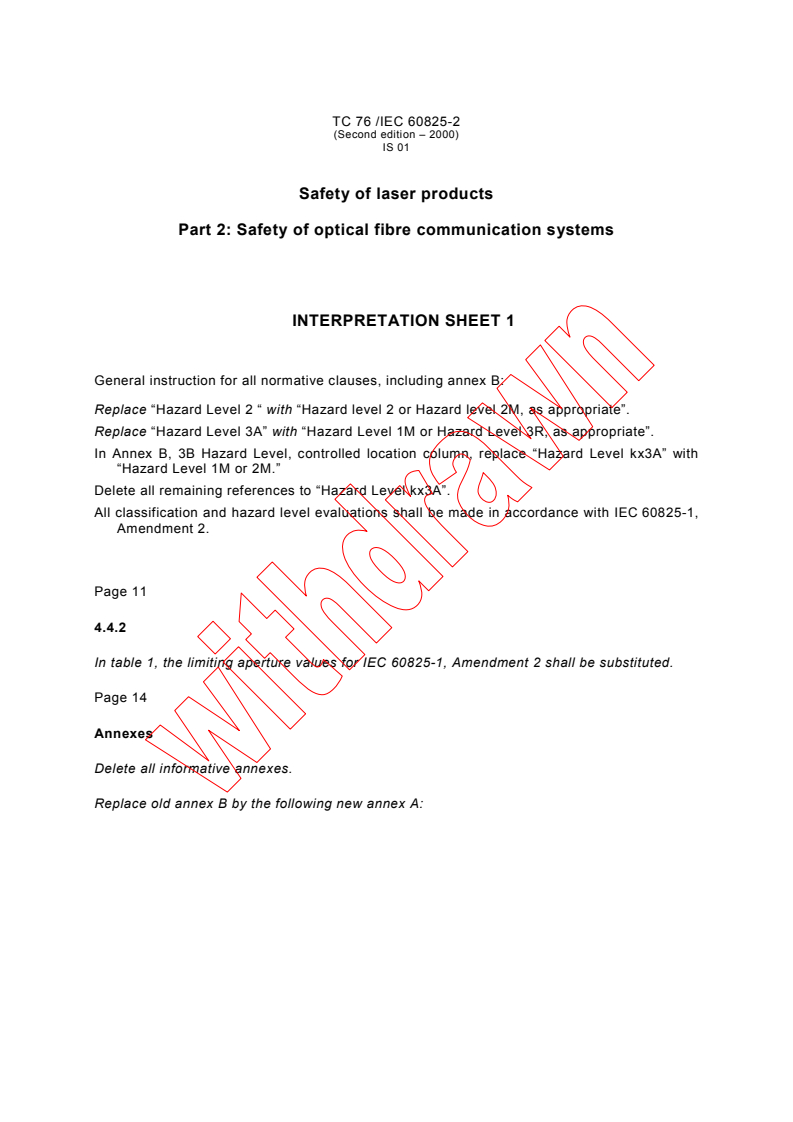
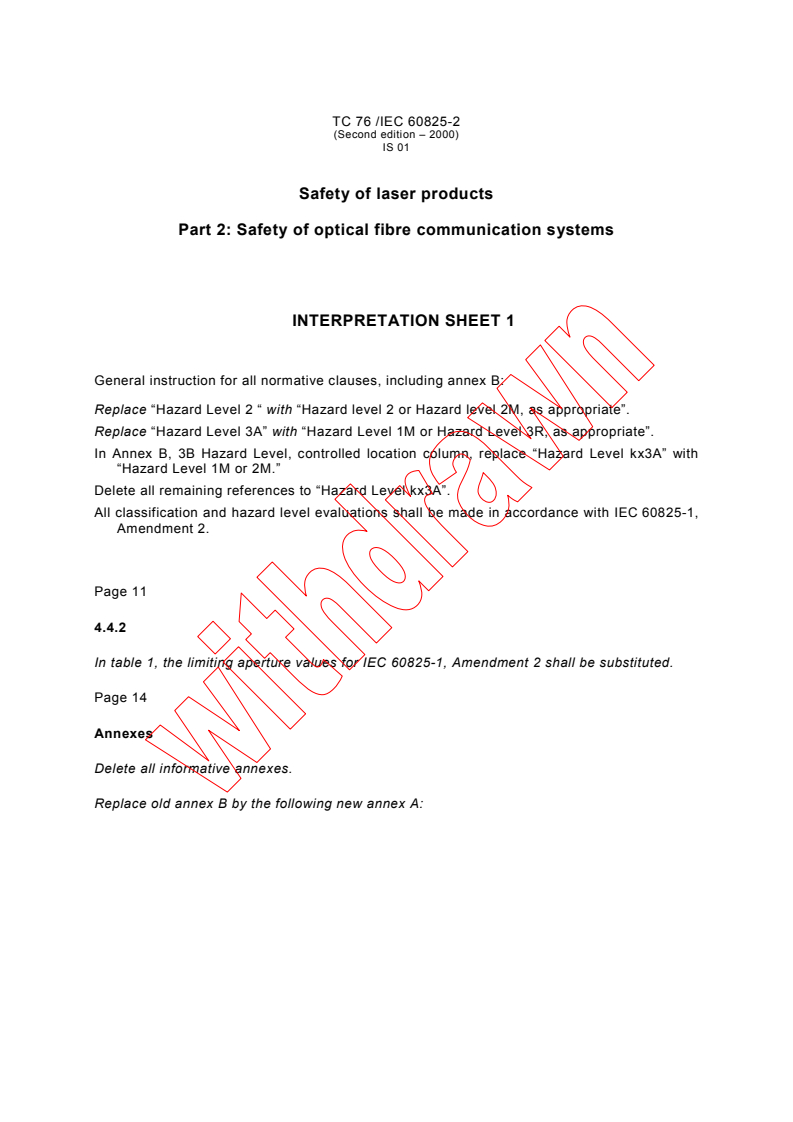
TC 76 /IEC 60825-2
(Second edition – 2000)
IS 01
Safety of laser products
Part 2: Safety of optical fibre communication systems
INTERPRETATION SHEET 1
General instruction for all normative clauses, including annex B:
Replace “Hazard Level 2 “ with “Hazard level 2 or Hazard level 2M, as appropriate”.
Replace “Hazard Level 3A” with “Hazard Level 1M or Hazard Level 3R, as appropriate”.
In Annex B, 3B Hazard Level, controlled location column, replace “Hazard Level kx3A” with
“Hazard Level 1M or 2M.”
Delete all remaining references to “Hazard Level kx3A”.
All classification and hazard level evaluations shall be made in accordance with IEC 60825-1,
Amendment 2.
Page 11
4.4.2
In table 1, the limiting aperture values for IEC 60825-1, Amendment 2 shall be substituted.
Page 14
Annexes
Delete all informative annexes.
Replace old annex B by the following new annex A:
Annex A
(normative)
Summary of engineering requirements at locations in
optical fibre communicati
...
INTERNATIONAL IEC
STANDARD
60825-2
Second edition
2000-05
Safety of laser products –
Part 2:
Safety of optical fibre communication systems
Sécurité des appareils à laser –
Partie 2:
Sécurité des systèmes de télécommunication
par fibres optiques
Reference number
Numbering
As from 1 January 1997 all IEC publications are issued with a designation in the
60000 series.
Consolidated publications
Consolidated versions of some IEC publications including amendments are
available. For example, edition numbers 1.0, 1.1 and 1.2 refer, respectively, to the
base publication, the base publication incorporating amendment 1 and the base
publication incorporating amendments 1 and 2.
Validity of this publication
The technical content of IEC publications is kept under constant review by the IEC,
thus ensuring that the content reflects current technology.
Information relating to the date of the reconfirmation of the publication is available
in the IEC catalogue.
Information on the subjects under consideration and work in progress undertaken
by the technical committee which has prepared this publication, as well as the list
of publications issued, is to be found at the following IEC sources:
• IEC web site*
•
Catalogue of IEC publications
Published yearly with regular updates
(On-line catalogue)*
• IEC Bulletin
Available both at the IEC web site* and as a printed periodical
Terminology, graphical and letter symbols
For general terminology, readers are referred to IEC 60050: International
Electrotechnical Vocabulary (IEV).
For graphical symbols, and letter symbols and signs approved by the IEC for
general use, readers are referred to publications IEC 60027: Letter symbols to be
used in electrical technology, IEC 60417: Graphical symbols for use on equipment.
Index, survey and compilation of the single sheets and IEC 60617: Graphical symbols
for diagrams.
* See web site address on title page.
INTERNATIONAL IEC
STANDARD
60825-2
Second edition
2000-05
Safety of laser products –
Part 2:
Safety of optical fibre communication systems
Sécurité des appareils à laser –
Partie 2:
Sécurité des systèmes de télécommunication
par fibres optiques
IEC 2000 Copyright - all rights reserved
No part of this publication may be reproduced or utilized in any form or by any means, electronic or
mechanical, including photocopying and microfilm, without permission in writing from the publisher.
International Electrotechnical Commission 3, rue de Varembé Geneva, Switzerland
Telefax: +41 22 919 0300 e-mail: inmail@iec.ch IEC web site http://www.iec.ch
Commission Electrotechnique Internationale
PRICE CODE
W
International Electrotechnical Commission
For price, see current catalogue
TC 76 /IEC 60825-2
(Second edition – 2000)
IS 01
Safety of laser products
Part 2: Safety of optical fibre communication systems
INTERPRETATION SHEET 1
General instruction for all normative clauses, including annex B:
Replace “Hazard Level 2 “ with “Hazard level 2 or Hazard level 2M, as appropriate”.
Replace “Hazard Level 3A” with “Hazard Level 1M or Hazard Level 3R, as appropriate”.
In Annex B, 3B Hazard Level, controlled location column, replace “Hazard Level kx3A” with
“Hazard Level 1M or 2M.”
Delete all remaining references to “Hazard Level kx3A”.
All classification and hazard level evaluations shall be made in accordance with IEC 60825-1,
Amendment 2.
Page 11
4.4.2
In table 1, the limiting aperture values for IEC 60825-1, Amendment 2 shall be substituted.
Page 14
Annexes
Delete all informative annexes.
Replace old annex B by the following new annex A:
Annex A
(normative)
Summary of engineering requirements at locations in
optical fibre communication system
Hazard level Location type
Unrestricted Restricted Controlled
1 No requirements No requirements No requirements
1M 1) Labelling, and Labelling Labelling
2) Class 1* from
connector or connector
requires tool
2 and 2M 1) Labelling, and Labelling Labelling
2) Class 1* from
connector, or connector
requires tool
3R Not permitted ** 1) Labelling, and 1) Labelling, and
2) Class 1M* from 2) class 1M or 2M* from
connector, or connector or connector
connector requires requires tool
tool
3B Not permitted ** Not permitted** 1) Labelling,
and
2) Protected cables,
and
3) class 1M or 2M* from
connector or connector
requires tool
4 Not permitted ** Not permitted ** Not permitted**
* To be achieved by mechanical design of connector, automatic power reduction or other suitable
means.
** See 4.4.3. Where systems employ power levels of class 3R or more, protection systems such as
APR may be used to obtain the acceptable hazard level for the particular location type.
August 2001
– 2 – 60825-2 IEC:2000(E)
CONTENTS
Page
FOREWORD . 3
Clause
1 Scope . 5
2 Normative references. 5
3 Definitions. 6
4 Manufacturing requirements. 8
4.1 Engineering specifications . 8
4.2 Labelling. 9
4.3 Provision of information . 10
4.4 Assessment of hazard level . 10
4.5 Requirements for installation . 11
4.6 Requirements for restart pulses . 12
5 Guidance for service and maintenance . 12
5.1 Tests and measurements. 12
5.2 Safety precautions . 12
Annex A (informative) Rationale . 14
Annex B (normative) Summary of engineering requirements at locations in optical fibre
communication system . 15
Annex C (informative) Methods of hazard/safety analysis. 16
Annex D (informative) Application notes for the safe use
of optical fibre communication systems . 17
Annex E (informative) Clarification of the meaning of “laser hazard level”. 35
Bibliography . 37
Figure D.1 – PON (passive optical network)-based system. 34
Table 1 – Assessment of hazard level during shutdown time for systems employing
automatic power reduction (see 4.4.2). 11
Table D.1 – Optical fibre system power limits for 11 microns singlemode
and 0,18 numerical aperture multimode fibres . 30
Table D.2 – Automatic power reduction – Immediately accessible situations . 31
Table D.3 – Controlled access example scenarios. 32
Table D.4 – Restricted access example scenarios . 32
Table D.5 – Unrestricted access example scenarios. 33
Table D.6 – Examples of power limits for optical fibre communication systems
having automatic power reduction to reduce emissions to a lower hazard level . 34
©
60825-2 IEC:2000(E) – 3 –
INTERNATIONAL ELECTROTECHNICAL COMMISSION
___________
SAFETY OF LASER PRODUCTS –
Part 2: Safety of optical fibre communication systems
FOREWORD
1) The IEC (International Electrotechnical Commission) is a worldwide organization for standardization comprising
all national electrotechnical committees (IEC National Committees). The object of the IEC is to promote
international co-operation on all questions concerning standardization in the electrical and electronic fields. To
this end and in addition to other activities, the IEC publishes International Standards. Their preparation is
entrusted to technical committees; any IEC National Committee interested in the subject dealt with may
participate in this preparatory work. International, governmental and non-governmental organizations liaising
with the IEC also participate in this preparation. The IEC collaborates closely with the International
Organization for Standardization (ISO) in accordance with conditions determined by agreement between the
two organizations.
2) The formal decisions or agreements of the IEC on technical matters express, as nearly as possible, an
international consensus of opinion on the relevant subjects since each technical committee has representation
from all interested National Committees.
3) The documents produced have the form of recommendations for international use and are published in the form
of standards, technical specifications, technical reports or guides and they are accepted by the National
Committees in that sense.
4) In order to promote international unification, IEC National Committees undertake to apply IEC International
Standards transparently to the maximum extent possible in their national and regional standards. Any
divergence between the IEC Standard and the corresponding national or regional standard shall be clearly
indicated in the latter.
5) The IEC provides no marking procedure to indicate its approval and cannot be rendered responsible for any
equipment declared to be in conformity with one of its standards.
6) Attention is drawn to the possibility that some of the elements of this International Standard may be the subject
of patent rights. The IEC shall not be held responsible for identifying any or all such patent rights.
International Standard IEC 60825-2 has been prepared by IEC technical committee 76:
Optical radiation safety and laser equipment.
This second edition cancels and replaces the first edition published in 1993 and amendment 1
(1997). This second edition constitutes a technical revision.
The text of this standard is based on the first edition, amendment 1 and the following
documents:
FDIS Report on voting
76/208/FDIS 76/211/RVD
Full information on the voting for the approval of this standard can be found in the report on
voting indicated in the above table.
This publication has been drafted in accordance with the ISO/IEC Directives, Part 3.
IEC 60825-2 constitutes part 2 of a series of publications under the general title: Safety of
laser products.
Annex B forms an integral part of this standard.
Annexes A, C, D and E are for information only.
– 4 – 60825-2 IEC:2000(E)
The committee has decided that the contents of this publication will remain unchanged until
2003. At this date, the publication will be
• reconfirmed;
• withdrawn;
• replaced by a revised edition, or
• amended.
A bilingual version of this standard may be issued at a later date.
©
60825-2 IEC:2000(E) – 5 –
SAFETY OF LASER PRODUCTS –
Part 2: Safety of optical fibre communication systems
1 Scope
This part 2 of IEC 60825 provides requirements and specific guidance for the safe use of
optical fibre and/or control communication systems where optical power may be accessible at
great distance from the optical source. It does not apply to optical fibre systems primarily
designed to transmit optical power for applications such as material processing or medical
treatment.
Throughout this part of IEC 60825, light emitting diodes (LEDs) are included whenever the
word "laser" is used.
The objective of this part 2 of IEC 60825 is to:
– protect people from optical radiation resulting from optical fibre communication systems.
This requires the introduction of engineering requirements and work practices according to
the degree of hazard;
– lay down requirements for manufacturers and operating organizations in order to establish
procedures and supply information so that proper precautions can be adopted;
– ensure adequate warning to individuals of the hazards associated with optical fibre
communication systems through signs, labels and instructions;
– reduce the possibility of injury by minimizing unnecessary accessible radiation, give
improved control of the optical radiation through protective features and provide safe
usage of products by specifying user control measures.
Annex A gives a more detailed rationale for this part of IEC 60825.
2 Normative references
The following normative documents contain provisions which, through reference in this text,
constitute provisions of this part of IEC 60825. For dated references, subsequent amend-
ments to, or revisions of, any of these publications do not apply. However, parties to
agreements based on this part of IEC 60825 are encouraged to investigate the possibility of
applying the most recent editions of the normative documents indicated below. For undated
references, the latest edition of the normative document referred to applies. Members of IEC
and ISO maintain registers of currently valid International Standards.
IEC 60794-2:1989, Optical fibre cables – Part 2: Product specifications
IEC 60825-1:1993, Safety of laser products – Part 1: Equipment classification, requirements
and user's guide
– 6 – 60825-2 IEC:2000(E)
3 Definitions
For the purpose of this part of IEC 60825, the following definitions apply. They are in addition
to those given in IEC 60825-1.
3.1
accessible location
any part within an optical fibre communication system at which, under reasonably foreseeable
circumstances, human access to laser radiation is possible
3.2
automatic power reduction
feature of an optical fibre communication system by which the accessible power is reduced to
a specified level within a specified time, whenever there is an event which could result in
human exposure to radiation, e.g. a fibre cable break
3.3
enclosed system
system in which, during normal operation, the optical radiation is totally enclosed, e.g. by
light-proof cabinets, components, total internal reflection or optical fibre cables and
connectors
3.4
end-user
person/organization using the optical fibre communication system in the manner the system
was designed to be used. The user cannot necessarily control the power generated and
transmitted within the system
3.5
hazard level
potential hazard at any accessible location within an optical fibre communication system. It is
based on the level of optical radiation which could become accessible in reasonably
foreseeable circumstances, e.g. a fibre cable break. It is closely related to the laser
classification procedure in IEC 60825-1
3.6
hazard level 1
hazard level 1 is allocated to any accessible location within an optical fibre communication
system at which, under reasonably foreseeable circumstances, human access to laser
radiation in excess of the accessible emission limits (AEL) of class 1 for the applicable
wavelengths and emission duration will not occur
3.7
hazard level 2
hazard level 2 is allocated to any accessible location within an optical fibre communication
system at which, under reasonably foreseeable circumstances, human access to laser
radiation in excess of the accessible emission limits of class 2 for the applicable wavelengths
and emission duration will not occur
3.8
hazard level 3A
hazard level 3A is allocated to any accessible location within an optical fibre communication
system at which, under reasonably foreseeable circumstances, human access to laser
radiation in excess of the accessible emission limits of class 3A for the applicable
wavelengths and emission duration will not occur
©
60825-2 IEC:2000(E) – 7 –
3.9
hazard level k × 3A
in the wavelength range 400 nm to 4 000 nm, a hazard level k × 3A is allocated to any
accessible location within an optical fibre communication system at which, under reasonably
foreseeable circumstances, human access to laser radiation in excess of the accessible
emission limits of hazard level k × 3A for the applicable wavelengths and emission duration
will not occur. For purposes of the k × 3A hazard level evaluation, class 3A AEL table is used;
the minimum measurement distance shall be increased to 250 mm from the apparent source
and the time base used shall be 10 s, provided longer viewing durations are not reasonably
foreseeable. For wavelengths greater than 1 400 mm, the radiant power limit shall be a factor
of 10 greater than for class 1
NOTE The value of k is not a constant and need not be calculated (see annex A for rationale).
3.10
hazard level 3B
hazard level 3B is allocated to any accessible location within an optical fibre communication
system at which, under reasonably foreseeable circumstances, human access to laser
radiation in excess of the accessible emission limits of class 3B for the applicable
wavelengths and emission duration will not occur
3.11
hazard level 4
hazard level 4 is allocated to any accessible location within an optical fibre communication
system at which, under reasonably foreseeable circumstances, human access to laser
radiation in excess of the accessible emission limits of class 3B for the applicable
wavelengths and emission duration may occur
3.12
light emitting diode (LED)
any semiconductor p-n junction device which can be made to produce electromagnetic
radiation by radiative recombination in the semiconductor, in the wavelength range from
180 nm to 1 mm. (The optical radiation is produced primarily by the process of spontaneous
emission, although some stimulated emission may be present.)
3.13
local operator control
an optical communication system is under local operator control if the operating controls and
the optical output may be directly monitored simultaneously by a single operator who has
control over the potential human access to optical radiation
3.14
location with controlled access
location where access to the protective housing (enclosure) is controlled and is accessible
only to authorized persons who have received adequate training in laser safety and the
servicing of the system involved. Examples include optical cable ducts and switching centres
3.15
location with restricted access
location where access to the protective housing (enclosure) is restricted and not open to the
public. Examples include industrial and commercial premises
3.16
location with unrestricted access
location where access to the protective housing (enclosure) is unrestricted. Examples include
domestic premises and premises open to the public
– 8 – 60825-2 IEC:2000(E)
3.17
manufacturer
organization/individual who assembles optical devices and other components in order to
construct or modify an optical fibre communication system
3.18
operating organization
organization/individual who is responsible for the installation and/or operation of an optical
fibre communication system
3.19
optical fibre communication system
engineered assembly for the generation, transference and reception of optical radiation
arising from lasers, in which the transference is by means of optical fibre for communication
and/or control purposes
3.20
reasonably foreseeable event
event the occurrence of which under given circumstances can be predicted fairly accurately,
and the occurrence probability or frequency of which is not low or very low.
Examples of reasonably foreseeable events might include the following: component failure,
fibre cable break, optical connector disconnection, operator error or inattention to safe
working practices.
Reckless use or use for completely inappropriate purposes is not to be considered as a
reasonably foreseeable event
3.21
protected cable
a cable in which the fibre or fibres are contained within a robust sheath which permits normal
handling without breakage and/or exposure of the fibre ends. See also 4.1.2.2 and annex B
3.22
subassembly
any discrete unit of an optical fibre communication system which contains an optical emitter or
optical amplifier
4 Manufacturing requirements
4.1 Engineering specifications
4.1.1 General remarks
Optical fibre communication systems require certain built-in safety features, depending on
their hazard level. The manufacturer of the optical fibre communication system is responsible
for the allocation of the hazard level and for compliance with the manufacturing requirements.
These requirements are summarized in annex B.
Whenever alterations which may affect hazard levels are made to the optical fibre
communication system, the person or organization performing such a modification shall
reassess the hazard levels by carrying out tests and measurements, wherever appropriate, for
ensuring compliance and, where the hazard level has changed, relabelling.
Manufacturers of ready-for-use optical fibre communication systems which are to be supplied
to end-users are responsible for assessing the hazard levels of the optical system under all
reasonably foreseeable circumstances and for compliance with the appropriate manufacturing
and safety requirements.
©
60825-2 IEC:2000(E) – 9 –
Manufacturers of ready-for-use optical transmission subassemblies which are intended to be
used only as part of an OFCS need not classify such equipment but are responsible for
assessing the hazard levels of the optical system under all reasonably foreseeable
circumstances and for the compliance with the appropriate manufacturing and safety
requirements.
For other optical communication systems, the operating organization has the ultimate
responsibility for the safety of the system. This includes especially:
– the identification of the location type at all subdivisions of the entire transmission path;
– the assessment of hazard level at any accessible location in the case of reasonably fore-
seeable events;
– assuring compliance with the manufacturing and safety requirements.
Optical fibre communication systems that also transmit electrical power shall meet the
requirements of this standard in addition to any applicable electrical standard.
4.1.2 Cable design
The mechanical design of optical fibre cables shall be specified according to the hazard level
and location (see clause D.3 for examples).
If such cables are not at a controlled location:
4.1.2.1 In all systems, the mechanical characteristics of the individual single or multiple fibre
cable shall be not less than those required by IEC 60794-2.
4.1.2.2 Locations with hazard levels in excess of 3A shall have the above cable
requirements with further and adequate mechanical protection.
4.1.3 Cable connectors
4.1.3.1 All systems operating in unrestricted locations in which cable connectors are
accessible require the use of a tool for disconnection if hazard level 1 can be exceeded.
4.1.3.2 All systems operating in restricted locations in which cable connectors are
accessible require the use of a tool for disconnection if hazard level 3A can be exceeded.
4.1.3.3 All systems operating in controlled locations in which cable connectors are
accessible require the use of a tool for disconnection if hazard level k × 3A can be exceeded.
4.1.3.4 The positioning of the connector in a way that prevents human access to a higher
hazard level is an acceptable feature to ensure that these requirements are met.
4.1.4 Automatic power reduction
Automatic power reduction may be used to control the hazard levels defined in 3.6 to 3.11.
4.2 Labelling
4.2.1 Optical fibre cables should carry appropriate markings to distinguish them from cables
containing other services, e.g. electricity.
4.2.2 Sleeving, a tag or a tape shall be associated with each optical connector if the hazard
level at the location is in excess of hazard level 1. The sleeving, tag or tape shall be coloured
yellow, with the warning label according to figure 14 of IEC 60825-1 and the hazard level
number incorporated in the explanatory label according to figure 15 of IEC 60825-1, both
labels appropriately reduced in size.
– 10 – 60825-2 IEC:2000(E)
4.2.3 Groups of connectors such as patch panels may be labelled as a group, with just a
single clearly visible location hazard label rather than having each connector individually
labelled. If a group of connectors is enclosed within a box, a label shall be clearly visible both
before and after the access panel is opened, which may require the use of more than one label.
4.3 Provision of information
Manufacturers of ready-for-use optical fibre communication systems and manufacturers of
ready-for-use subassemblies shall provide the operating organization with the following
information, where applicable:
a) an adequate description of the engineering design features incorporated into the product
to prevent access to hazardous levels of optical radiation;
b) adequate instructions for proper assembly, maintenance and safe use, including clear
warnings concerning the precautions to be taken in order to avoid possible exposure to
hazardous radiation;
c) a statement, in SI units, of the power propagating in the fibre at all locations in the system,
together with the pulse duration and pulse repetition frequency, or the maximum
modulation frequency. The cumulative measurement uncertainty and any expected
variation in the measured quantities at any time after manufacture shall also be provided;
d) a statement of the range of operating wavelength(s) within the optical fibre communication
system at the time of manufacture and under specified conditions as well as the range of
emission wavelengths expected during normal operation at any time after manufacture;
e) the reaction time of any automatic power reduction system;
f) legible reproductions (in appropriate colours or in black and white) of all the labels and
hazard warnings to be displayed at locations within an optical fibre communication system
or subassembly, as appropriate;
g) a clear indication of all locations of apertures and fibre connectors;
h) a listing of controls, adjustments and procedures for operation and maintenance, including
a warning, where appropriate;
i) advice on safe operating procedures, and warnings concerning known malpractices,
malfunctions and hazardous failure modes. Where maintenance procedures are detailed,
they shall, wherever possible, include explicit instructions on the safe procedures to be
followed;
j) where installation or servicing requires that an automatic power reduction system is
overridden, information to enable the operating organization to specify a safe system of
work at such times, and a safe procedure for the reinstating and safe testing of the auto-
matic power reduction system;
k) any other information relevant to the safe use of the optical fibre communication system or
subassembly, as appropriate.
4.4 Assessment of hazard level
4.4.1 The hazard level is determined by the measurement of optical radiation accessible in
any reasonably foreseeable event. The methods for the determination of compliance with the
specified radiation limit values are the same as those described for classification in
IEC 60825-1. Measurements need to be taken under the appropriate conditions, e.g.
simulated fibre cable break, and shall be based on the relevant clauses in IEC 60825-1. The
assessment of the hazard level shall take place:
– 1 s after the reasonably foreseeable event for unrestricted locations, unless measurement
at a later time would result in a larger exposure;
– 3 s after the reasonably foreseeable event for restricted and controlled locations, unless
measurement at a later time would result in a larger exposure.
©
60825-2 IEC:2000(E) – 11 –
In circumstances where it is difficult to carry out direct measurements, an assessment of
hazard level based on calculations may be acceptable. For example, the knowledge of the
laser power and fibre attenuation may allow an assessment of the hazard at any particular
location.
4.4.2 Additionally, for locations with a hazard level lower than that which would be assigned
if no automatic power reduction were employed, the irradiance or radiant exposure during the
maximum time to reach the lower hazard level specified in 4.4.1 (1 s for unrestricted, 3 s for
restricted or controlled locations) shall not exceed the irradiance or radiant exposure limits
(MPE) for the corresponding conditions listed in table 1. The measurement aperture for the
MPE at 3 s, for wavelengths greater than or equal to 1 400 nm, shall be 3,5 mm for this
subclause only.
The restart of such systems shall not take place for another 100 s minus the reduction time in
seconds, unless the continuity of the link can be assured.
NOTE The 100 s interval is the time base for classification of invisible infra-red radiation for unintentional viewing.
Table 1 – Assessment of hazard level during shutdown time
for systems employing automatic power reduction (see 4.4.2)
Location type Maximum time to reach Limiting aperture Distance
lower hazard level from aperture
400 nm to Other
to fibre
(Exposure time basis
1 400 nm wavelengths
for 4.4.2) wavelengths
Unrestricted 1 s 7 mm 1 mm 100 mm
Restricted 3 s 7 mm 3,5 mm 100 mm
Controlled 3 s 7 mm 3,5 mm 250 mm
4.4.3 Tests shall be carried out under reasonably foreseeable fault conditions.
In some complex systems (e.g. where the optical output is dependent on the integrity of other
components and the performance of circuit design and software), it may be necessary to use
other recognized methods for hazard/safety assessment (see annex C).
4.4.4 For optical fibre communication systems with automatic power reduction, the hazard
level will be determined by the normal level of power in the fibre and the speed of the
automatic power reduction. The speed of power reduction required to obtain a specific hazard
level can be determined from the AEL tables in IEC 60825-1. For example, a relatively high
optical power level on a fibre together with a high speed automatic power reduction could
have the same hazard level as a relatively low optical power on the fibre together with a
slower automatic power reduction.
4.5 Requirements for installation
4.5.1 Optical fibre communication systems operating in unrestricted locations shall have a
hazard level of 1, 2 or 3A.
4.5.2 Optical fibre communication systems operating in restricted locations shall have
a hazard level of 1, 2, 3A or k × 3A.
4.5.3 Optical fibre communication systems operating in controlled locations shall have a
hazard level of 1, 2, 3A, k × 3A or 3B.
4.5.4 No optical fibre communication system shall have locations with a hazard level of 4.
– 12 – 60825-2 IEC:2000(E)
4.6 Requirements for restart pulses
Restart pulses used after automatic power shutdown shall be limited to hazard level 1 in
unrestricted locations, hazard level 3A in restricted locations and hazard level k × 3A in
controlled locations.
5 Guidance for service and maintenance
5.1 Tests and measurements
5.1.1 Tests, measurements and operations in cable ducts and switching centres should be
considered as service or maintenance operations. Wherever possible, diagnostic tests should
be carried out in such a way as not to increase the hazard level at any location. It may be
necessary to have administrative controls which, in some cases, may involve a permit to work
system. When connecting test equipment, due regard should be given to establishing the
actual power levels introduced into the system in assessing the hazard.
5.1.2 There shall be clearly defined conditions under which automatic power reduction
facilities may be overridden.
When overridden, the hazard level shall be reassessed by the operating organization and the
appropriate safety precautions described in 5.2 and its associated subclauses shall be taken
as appropriate to the reassessed hazard level.
5.1.3 Any viewing optics for fibre examination and splicing should reduce exposure to below
the relevant maximum permissible exposure (MPE) and should be approved for use by the
operating organization.
5.1.4 Wherever reasonably practical, servicing, maintenance and repair should be carried
out with no power propagating in the fibre, otherwise the system should be operated at the
lowest power consistent with the need.
5.1.5 The system operating organization shall establish that work practices prevent human
exposure to radiation in excess of the relevant MPE.
5.2 Safety precautions
5.2.1 General remarks
5.2.1.1 In locations where, during service or maintenance, radiation levels in excess of
class 3A may be encountered (e.g. during switching, in controlled locations), appropriate eye
protection should be provided.
5.2.1.2 Before working on any optical fibre cable or system, the staff should check the
operating status and hazard level. In the case of systems that are installed and activated,
this will be indicated by the appropriate hazard level warning labels. During installation, these
labels may not have been provided yet and, in their absence, precautions appropriate to the
classification of any test equipment containing optical sources connected to the fibre should
be used.
5.2.1.3 During the installation or testing of an optical fibre cable or network, only test
equipment of laser class 1, 2 or 3A should be used.
If, in a particular instance, it is essential to use test equipment of a higher class, the
accessible fibre ends and connectors at all locations should be secured and labelled with
the appropriate hazard level before testing proceeds.
©
60825-2 IEC:2000(E) – 13 –
5.2.1.4 Entry points to controlled areas with a hazard level of k × 3A and above shall have:
– a sign bearing the warning label according to figure 14 in IEC 60825-1 and indicating the
hazard level number incorporated in the explanatory label according to figure 15 of
IEC 60825-1;
– a sign limiting access to authorized persons only and explaining the existence of a
potential hazard.
5.2.1.5 Each person engaged in the installation or service of an optical fibre cable or system
should:
– observe all rules, procedures and practices established for the safe operation of optical
fibre communication systems;
– immediately notify the supervisor of conditions or practices that have the potential to
cause personnel injury or property damage;
– immediately report to the supervisor any known or suspected abnormal exposure to optical
radiation.
5.2.2 Precautions in locations with hazard levels greater than hazard level 2
5.2.2.1 Only the staff who have attended an optical fibre safety training course should be
permitted to work on optical fibre systems in a location with hazard levels k × 3A and 3B.
5.2.2.2 The staff should not view directly any energized fibre end or connector end at a
location with a hazard level 3A, k × 3A or 3B. Only viewing aids with appropriate attenuation
should be used at a location with a hazard level 3A, k × 3A or 3B, under all circumstances.
5.2.2.3 Where possible, optical transmission or test equipment should be shut down, put into
a low-power state or disconnected before any work is done on exposed fibres, connectors etc.
In that case, unintentional switching on should be prevented by a remote control switch or
another suitable method. The status of the line (power on or off) should be clearly indicated.
5.2.2.4 The staff should ensure that optical fibre communication systems and test equipment
in locations with a hazard level k × 3A or 3B are properly operated and controlled so as to
protect unauthorized personnel.
5.2.3 Training programme
The employer of staff installing or maintaining optical fibre communication systems should
establish and maintain an adequate programme for the control of hazards. Safety and training
programmes should be instituted for staff working on fibres or communication systems with a
hazard level of k × 3A or 3B. Such programmes should be directed by individuals competent
in the field of laser and optical fibre communication system safety. The programmes should
provide, as a minimum:
– background information on optical fibre communication systems;
– safety information concerning the laser classification system and hazard levels;
– guidance on the safe use of laser optical fibre communication systems, and adequacy of
safety practices.
– 14 – 60825-2 IEC:2000(E)
Annex A
(informative)
Rationale
The safety of laser products, equipment classification, requirements and user's guide are
covered by IEC 60825-1. This part is primarily aimed at self-contained products which are
under effective local control. An optical fibre communication system would be safe under
normal operating conditions because the optical radiation is totally enclosed under intended
operation. However, because of the extended nature of these systems (where optical power,
under certain conditions, may be accessible many kilometres from the optical source), the
precautions to minimize the hazard will be different from those concerning more conventional
laser sources which are normally under local operator control. (It should be noted that many
optical fibre communication systems contain LEDs, which are included in the scope of
IEC 60825-1.)
The potential hazard of an optical fibre communication system depends on the likelihood of
the protective housing being breached (e.g. a disconnected fibre connector or a broken cable)
and on the nature of the optical radiation that might subsequently become accessible. The
engineering requirements and user precautions that are required to minimize the hazard are
specified in this part of IEC 60825.
Each accessible location within an optical fibre communication system is allocated, by the
system operating organization or his delegate, a hazard level which gives a guide as to the
potential hazard if optical radiation becomes accessible. These hazard levels are described
as hazard levels 1 to 4, in a fashion similar to the classification procedure described in
IEC 60825-1. In addition, a distinction is made between the higher and lower power ranges
within the 3B class (see later in this annex for further explanation).
Where operating organizations subcontract parts of a system to installers or manufacturers of
subsystems, the duties of all parties concerned should be clearly regulated in an agreement.
In summary, the primary differences between IEC 60825-1 and this part 2 are as follows:
– a whole optical fibre communication system will not be classified in the same way as
required by IEC 60825-1. This is because, under intended operation, the optical radiation
is totally enclosed, and it can be argued that a rigorous interpretation of IEC 60825-1
would give a class 1 allocation to all systems, which may not reflect the potential hazard
accurately. However, if the emitter can be operated separately, it must be classified
according to IEC 60825-1;
– each accessible location in the extended enclosed optical transmission system will be
designated by a hazard level on similar procedures as those for classification in
IEC 60825-1, but this level will be based not on accessible radiation but on radiation that
could become accessible under reasonably foreseeable circumstances (e.g. a fibre cable
break, a disconnected fibre connector etc.);
– the nature of the safety precautions required for any particular hazard level will depend on
the type of location, i.e. domestic premises, industrial areas where there would be limited
access, and switching centres where there would be controlled access. For example, it is
specified that, in the home, a disconnected fibre connector should only be able to emit
radiation corresponding to class 1, whilst, in controlled areas, it could be higher;
–the k × 3A hazard level was introduced to reflect more realistically the true hazard
associated with viewing optical fibre components. The longer measurement distance
reflects more common behavioural practices. The shorter time base reflects the fact that it
is not normal human behaviour to fixate on a small spot for extended periods of time.
Hence, the k × 3A level allows for increased power levels in optical fibre systems without
increasing the risk of ocular damage under reasonably foreseeable circumstances. The
value of "k" should not be calculated. The designation k × 3A is only used to indicate that
hazard level k × 3A is higher than hazard level 3A.
©
60825-2 IEC:2000(E) – 15 –
Annex B
(normative)
Summary of engineering requirements at locations in
optical fibre communication system
Hazard level Location type
Unrestricted Restricted Controlled
1 No requirements No requirements No requirements
2 1) Labelling, and Labelling Labelling
2) Class 1* from
connector, or connector
requires tool
3A 1) Labelling, and Labelling Labelling
2) Class 1* from connector
or connector requires tool
Not permitted ** 1) Labelling, and Labelling
k × 3A
2) Protected cables,
and
3) Class 3A* from
connector, or connector
requires tool
3B Not permitted ** Not permitted** 1) Labelling,
and
2) Protected cables,
and
3) k × 3A* from connector
or connector requires tool
4 Not permitted ** Not permitted ** Not permitted**
* To be achieved by mechanical design of connector, automatic power reduction or other suitable means.
** See 4.4.3. Where systems employ power levels of class 3A or more, protection systems such as APR may be
used to obtain the acceptable hazard level for the particular location type.
– 16 – 60825-2 IEC:2000(E)
Annex C
(informative)
Methods of hazard/safety analysis
Some methods of hazard/safety analysis are as follows:
a) preliminary hazard analysis (PHA) including circuit analysis. This method may be used in
its own right, but is an essential first stage in the application of other methods of
hazard/safety assessment;
b) failure modes and effects analysis (FMEA);
*
c) failure modes, effects and criticality analysis (FMECA) (see IEC 60812 [1] );
d) fault tree analysis (FTA);
e) event tree analysis;
f) hazards and operability studies (HAZOPS);
g) cause-consequence analysis.
Appropriate testing should be implemented to supplement the analysis whenever necessary.
The method of analysis and any assumptions made in the performance of the analysis are to
be stated by the manufacturer.
___________
*
Figures in square brackets refer to the bibliography.
©
60825-2 IEC:2000(E) – 17 –
Annex D
(informative)
Application notes for the safe use
of optical fibre communication systems
D.1 Introduction
This annex provides guidance on the application of this standard to specific practical
situations. It applie
...