

IEC 60870-6-802:2014
(Main)Telecontrol equipment and systems - Part 6-802: Telecontrol protocols compatible with ISO standards and ITU-T recommendations - TASE.2 Object models
General Information
- Abstract
IEC 60870-6-802:2014 specifies a method of exchanging time-critical control centre data through wide-area and local-area networks using a full ISO compliant protocol stack. It contains provisions for supporting both centralized and distributed architectures. The standard includes the exchange of real-time data indications, control operations, time series data, scheduling and accounting information, remote program control and event notification. This new edition includes the following significant technical changes with respect to the previous edition:
- certain objects have been changed from informative to normative;
- certain TASE.2 conformance blocks have been made out of scope.
- Status
- Published
- Publication Date
- 14-Jul-2014
- Technical Committee
- TC 57 - Power systems management and associated information exchange
- Drafting Committee
- WG 19 - TC 57/WG 19
- Current Stage
- PPUB - Publication issued
- Start Date
- 15-Jul-2014
- Completion Date
- 15-Jul-2014
Buy Documents
IEC 60870-6-802:2014 - Telecontrol equipment and systems - Part 6-802: Telecontrol protocols compatible with ISO standards and ITU-T recommendations - TASE.2 Object models Released:7/15/2014
Overview
IEC 60870-6-802:2014 is a core international standard for telecontrol equipment and systems, focusing on the exchange of time-critical data between control centers. It defines object models for telecontrol protocols compatible with ISO standards and ITU-T recommendations, specifically targeting TASE.2 (Telecontrol Application Service Element 2) object models. Utilizing a full ISO-compliant protocol stack, this standard is crucial for enabling interoperability across wide-area and local-area networks in power system control and automation environments.
Key features:
- Supports real-time and time-critical data exchange.
- Facilitates both centralized and distributed system architectures.
- Defines standardized objects for data indications, control operations, scheduling, accounting, remote program execution, and event notifications.
Key Topics
- Object Models: The standard introduces abstract and functional object models tailored to support typical Supervisory Control and Data Acquisition (SCADA) and energy management operations. These include Indication Points, Control Points, Protection Event models, Device Outages, and more.
- Data Attributes: Each object model includes essential data attributes like value, quality, source, timestamp, and change-of-value counters, providing a robust structure for reliable and accurate data exchange.
- Compatibility: The protocol stack and object models are designed to be fully compliant with ISO and ITU-T standards, ensuring seamless integration into existing and future telecontrol solutions.
Applications
IEC 60870-6-802:2014 is widely used in:
- Utility Control Centers: Supporting operation, monitoring, and control through standardized telecontrol data exchange.
- Inter-Control Center Communication: Enabling real-time exchange of operational information across distributed control systems in power transmission networks.
- Grid Automation: Providing the basis for reliable, secure, and interoperable data transfer-vital for grid stability, outage management, and event response.
- SCADA and EMS Integration: Standardizing the representation of control and indication points, event reporting, and scheduling between disparate systems.
- Wide-Area Networking: Supporting both LAN and WAN-based communication architectures for geographically dispersed facilities.
Related Standards
IEC 60870-6-802:2014 operates in an international standards ecosystem. Related standardization documents include:
- IEC 60870-6-503: Specifies TASE.2 services and protocol, foundational for understanding the protocols and services underpinning object model exchange.
- ISO 9506-1 and ISO 9506-2: Define the Manufacturing Message Specification (MMS), providing service definitions and protocol specifications critical to the mapped data exchanges.
- IEC 60870-5-101: Lays out companion standards for transmission protocols, offering essential references for telecontrol communications.
- IEC 61850: For substation automation and communication protocols, often used alongside IEC 60870 standards in modern smart grids.
Practical Value
By establishing a consistent method to model, exchange, and interpret telecontrol data, IEC 60870-6-802:2014:
- Enhances Interoperability: Utilities and vendors can interface and expand systems with confidence, promoting vendor-neutral solutions.
- Improves Reliability: Standardized object models reduce ambiguity and errors in control center data exchanges, contributing to greater grid stability.
- Supports Scalability: Provisions for both centralized and distributed architectures enable stepwise expansion from local to wide-area implementations.
- Future-Proofs Investments: Compliance with ISO and ITU-T standards and ongoing IEC maintenance ensures long-term relevance in global energy sectors.
For organizations in the energy, utility, and automation sectors, implementing IEC 60870-6-802:2014 is a decisive step toward efficient, secure, and standardized telecontrol communication.
Relations
- Effective Date
- 05-Sep-2023
- Effective Date
- 05-Sep-2023
Buy Documents
IEC 60870-6-802:2014 - Telecontrol equipment and systems - Part 6-802: Telecontrol protocols compatible with ISO standards and ITU-T recommendations - TASE.2 Object models Released:7/15/2014
Get Certified
Connect with accredited certification bodies for this standard

ANCE
Mexican certification and testing association.

Intertek Slovenia
Intertek testing, inspection, and certification services in Slovenia.

LNE (Laboratoire National de Métrologie et d'Essais)
French national laboratory for metrology and testing.
Sponsored listings
Frequently Asked Questions
IEC 60870-6-802:2014 is a standard published by the International Electrotechnical Commission (IEC). Its full title is "Telecontrol equipment and systems - Part 6-802: Telecontrol protocols compatible with ISO standards and ITU-T recommendations - TASE.2 Object models". This standard covers: IEC 60870-6-802:2014 specifies a method of exchanging time-critical control centre data through wide-area and local-area networks using a full ISO compliant protocol stack. It contains provisions for supporting both centralized and distributed architectures. The standard includes the exchange of real-time data indications, control operations, time series data, scheduling and accounting information, remote program control and event notification. This new edition includes the following significant technical changes with respect to the previous edition: - certain objects have been changed from informative to normative; - certain TASE.2 conformance blocks have been made out of scope.
IEC 60870-6-802:2014 specifies a method of exchanging time-critical control centre data through wide-area and local-area networks using a full ISO compliant protocol stack. It contains provisions for supporting both centralized and distributed architectures. The standard includes the exchange of real-time data indications, control operations, time series data, scheduling and accounting information, remote program control and event notification. This new edition includes the following significant technical changes with respect to the previous edition: - certain objects have been changed from informative to normative; - certain TASE.2 conformance blocks have been made out of scope.
IEC 60870-6-802:2014 is classified under the following ICS (International Classification for Standards) categories: 33.200 - Telecontrol. Telemetering. The ICS classification helps identify the subject area and facilitates finding related standards.
IEC 60870-6-802:2014 has the following relationships with other standards: It is inter standard links to IEC 60870-6-802:2002/AMD1:2005, IEC 60870-6-802:2002. Understanding these relationships helps ensure you are using the most current and applicable version of the standard.
IEC 60870-6-802:2014 is available in PDF format for immediate download after purchase. The document can be added to your cart and obtained through the secure checkout process. Digital delivery ensures instant access to the complete standard document.
Standards Content (Sample)
IEC 60870-6-802 ®
Edition 3.0 2014-07
INTERNATIONAL
STANDARD
NORME
INTERNATIONALE
Telecontrol equipment and systems –
Part 6-802: Telecontrol protocols compatible with ISO standards and
ITU-T recommendations – TASE.2 Object models
Matériels et systèmes de téléconduite –
Partie 6-802: Protocoles de téléconduite compatibles avec les normes ISO
et les recommandations de l’UIT-T – Modèles d'objets TASE.2
All rights reserved. Unless otherwise specified, no part of this publication may be reproduced or utilized in any form
or by any means, electronic or mechanical, including photocopying and microfilm, without permission in writing from
either IEC or IEC's member National Committee in the country of the requester. If you have any questions about IEC
copyright or have an enquiry about obtaining additional rights to this publication, please contact the address below or
your local IEC member National Committee for further information.
Droits de reproduction réservés. Sauf indication contraire, aucune partie de cette publication ne peut être reproduite
ni utilisée sous quelque forme que ce soit et par aucun procédé, électronique ou mécanique, y compris la photocopie
et les microfilms, sans l'accord écrit de l'IEC ou du Comité national de l'IEC du pays du demandeur. Si vous avez des
questions sur le copyright de l'IEC ou si vous désirez obtenir des droits supplémentaires sur cette publication, utilisez
les coordonnées ci-après ou contactez le Comité national de l'IEC de votre pays de résidence.
IEC Central Office Tel.: +41 22 919 02 11
3, rue de Varembé Fax: +41 22 919 03 00
CH-1211 Geneva 20 info@iec.ch
Switzerland www.iec.ch
About the IEC
The International Electrotechnical Commission (IEC) is the leading global organization that prepares and publishes
International Standards for all electrical, electronic and related technologies.
About IEC publications
The technical content of IEC publications is kept under constant review by the IEC. Please make sure that you have the
latest edition, a corrigenda or an amendment might have been published.
IEC Catalogue - webstore.iec.ch/catalogue Electropedia - www.electropedia.org
The stand-alone application for consulting the entire The world's leading online dictionary of electronic and
bibliographical information on IEC International Standards, electrical terms containing more than 30 000 terms and
Technical Specifications, Technical Reports and other definitions in English and French, with equivalent terms in 14
documents. Available for PC, Mac OS, Android Tablets and additional languages. Also known as the International
iPad. Electrotechnical Vocabulary (IEV) online.
IEC publications search - www.iec.ch/searchpub IEC Glossary - std.iec.ch/glossary
The advanced search enables to find IEC publications by a More than 55 000 electrotechnical terminology entries in
variety of criteria (reference number, text, technical English and French extracted from the Terms and Definitions
committee,…). It also gives information on projects, replaced clause of IEC publications issued since 2002. Some entries
and withdrawn publications. have been collected from earlier publications of IEC TC 37,
77, 86 and CISPR.
IEC Just Published - webstore.iec.ch/justpublished
Stay up to date on all new IEC publications. Just Published IEC Customer Service Centre - webstore.iec.ch/csc
details all new publications released. Available online and If you wish to give us your feedback on this publication or
also once a month by email. need further assistance, please contact the Customer Service
Centre: csc@iec.ch.
A propos de l'IEC
La Commission Electrotechnique Internationale (IEC) est la première organisation mondiale qui élabore et publie des
Normes internationales pour tout ce qui a trait à l'électricité, à l'électronique et aux technologies apparentées.
A propos des publications IEC
Le contenu technique des publications IEC est constamment revu. Veuillez vous assurer que vous possédez l’édition la
plus récente, un corrigendum ou amendement peut avoir été publié.
Catalogue IEC - webstore.iec.ch/catalogue Electropedia - www.electropedia.org
Application autonome pour consulter tous les renseignements
Le premier dictionnaire en ligne de termes électroniques et
bibliographiques sur les Normes internationales,
électriques. Il contient plus de 30 000 termes et définitions en
Spécifications techniques, Rapports techniques et autres
anglais et en français, ainsi que les termes équivalents dans
documents de l'IEC. Disponible pour PC, Mac OS, tablettes
14 langues additionnelles. Egalement appelé Vocabulaire
Android et iPad.
Electrotechnique International (IEV) en ligne.
Recherche de publications IEC - www.iec.ch/searchpub
Glossaire IEC - std.iec.ch/glossary
Plus de 55 000 entrées terminologiques électrotechniques, en
La recherche avancée permet de trouver des publications IEC
en utilisant différents critères (numéro de référence, texte, anglais et en français, extraites des articles Termes et
comité d’études,…). Elle donne aussi des informations sur les Définitions des publications IEC parues depuis 2002. Plus
projets et les publications remplacées ou retirées. certaines entrées antérieures extraites des publications des
CE 37, 77, 86 et CISPR de l'IEC.
IEC Just Published - webstore.iec.ch/justpublished
Service Clients - webstore.iec.ch/csc
Restez informé sur les nouvelles publications IEC. Just
Published détaille les nouvelles publications parues. Si vous désirez nous donner des commentaires sur cette
Disponible en ligne et aussi une fois par mois par email. publication ou si vous avez des questions contactez-nous:
csc@iec.ch.
IEC 60870-6-802 ®
Edition 3.0 2014-07
INTERNATIONAL
STANDARD
NORME
INTERNATIONALE
Telecontrol equipment and systems –
Part 6-802: Telecontrol protocols compatible with ISO standards and
ITU-T recommendations – TASE.2 Object models
Matériels et systèmes de téléconduite –
Partie 6-802: Protocoles de téléconduite compatibles avec les normes ISO
et les recommandations de l’UIT-T – Modèles d'objets TASE.2
INTERNATIONAL
ELECTROTECHNICAL
COMMISSION
COMMISSION
ELECTROTECHNIQUE
PRICE CODE
INTERNATIONALE
CODE PRIX XD
ICS 33.200 ISBN 978-2-8322-1652-1
– 2 – IEC 60870-6-802:2014 © IEC 2014
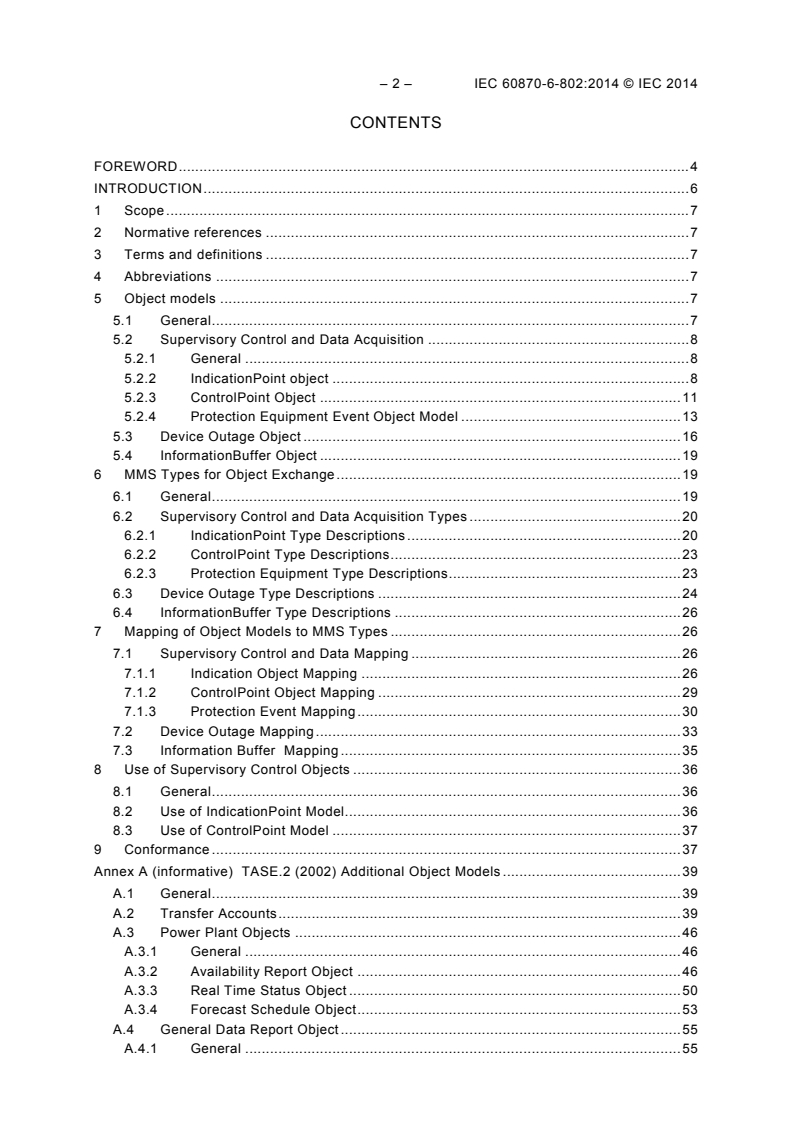
CONTENTS
FOREWORD . 4
INTRODUCTION . 6
1 Scope . 7
2 Normative references . 7
3 Terms and definitions . 7
4 Abbreviations . 7
5 Object models . 7
5.1 General . 7
5.2 Supervisory Control and Data Acquisition . 8
5.2.1 General . 8
5.2.2 IndicationPoint object . 8
5.2.3 ControlPoint Object . 11
5.2.4 Protection Equipment Event Object Model . 13
5.3 Device Outage Object . 16
5.4 InformationBuffer Object . 19
6 MMS Types for Object Exchange . 19
6.1 General . 19
6.2 Supervisory Control and Data Acquisition Types . 20
6.2.1 IndicationPoint Type Descriptions . 20
6.2.2 ControlPoint Type Descriptions . 23
6.2.3 Protection Equipment Type Descriptions . 23
6.3 Device Outage Type Descriptions . 24
6.4 InformationBuffer Type Descriptions . 26
7 Mapping of Object Models to MMS Types . 26
7.1 Supervisory Control and Data Mapping . 26
7.1.1 Indication Object Mapping . 26
7.1.2 ControlPoint Object Mapping . 29
7.1.3 Protection Event Mapping . 30
7.2 Device Outage Mapping . 33
7.3 Information Buffer Mapping . 35
8 Use of Supervisory Control Objects . 36
8.1 General . 36
8.2 Use of IndicationPoint Model. 36
8.3 Use of ControlPoint Model . 37
9 Conformance . 37
Annex A (informative) TASE.2 (2002) Additional Object Models . 39
A.1 General . 39
A.2 Transfer Accounts . 39
A.3 Power Plant Objects . 46
A.3.1 General . 46
A.3.2 Availability Report Object . 46
A.3.3 Real Time Status Object . 50
A.3.4 Forecast Schedule Object . 53
A.4 General Data Report Object . 55
A.4.1 General . 55
A.4.2 General Data Request Object . 56
A.4.3 General Data Response Object . 59
Annex B (informative) TASE.2 (2002) Additional MMS Object Types . 61
B.1 General . 61
B.2 Transfer Account Types . 61
B.3 Power Plant Type Descriptions . 63
B.4 Power System Dynamics . 66
B.4.1 General . 66
B.4.2 Matrix Data Types . 67
B.5 GeneralDataReport Type Descriptions . 68
B.6 GeneralDataResponse Type Descriptions . 68
Annex C (informative) TASE.2 (2002) Mapping of Objects to MMS Types . 69
C.1 General . 69
C.2 Transfer Accounts Mapping. 69
C.2.1 TransferAccount Mapping . 69
C.2.2 TransmissionSegment Mapping . 73
C.2.3 ProfileValue Mapping . 76
C.2.4 AccountRequest Mapping . 76
C.3 Power Plant Mapping . 77
C.3.1 Availability Report Mapping . 77
C.3.2 Real Time Status Mapping . 80
C.3.3 Forecast Mapping . 82
C.3.4 Curve Mapping . 83
C.4 General Data Report Mapping . 85
C.4.1 General Data Request Mapping . 85
C.4.2 General Data Response Mapping . 88
Annex D (informative) Transfer account examples . 90
– 4 – IEC 60870-6-802:2014 © IEC 2014
INTERNATIONAL ELECTROTECHNICAL COMMISSION
____________
TELECONTROL EQUIPMENT AND SYSTEMS –
Part 6-802: Telecontrol protocols compatible with
ISO standards and ITU-T recommendations –
TASE.2 Object models
FOREWORD
1) The International Electrotechnical Commission (IEC) is a worldwide organization for standardization comprising
all national electrotechnical committees (IEC National Committees). The object of IEC is to promote
international co-operation on all questions concerning standardization in the electrical and electronic fields. To
this end and in addition to other activities, IEC publishes International Standards, Technical Specifications,
Technical Reports, Publicly Available Specifications (PAS) and Guides (hereafter referred to as “IEC
Publication(s)”). Their preparation is entrusted to technical committees; any IEC National Committee interested
in the subject dealt with may participate in this preparatory work. International, governmental and non-
governmental organizations liaising with the IEC also participate in this preparation. IEC collaborates closely
with the International Organization for Standardization (ISO) in accordance with conditions determined by
agreement between the two organizations.
2) The formal decisions or agreements of IEC on technical matters express, as nearly as possible, an international
consensus of opinion on the relevant subjects since each technical committee has representation from all
interested IEC National Committees.
3) IEC Publications have the form of recommendations for international use and are accepted by IEC National
Committees in that sense. While all reasonable efforts are made to ensure that the technical content of IEC
Publications is accurate, IEC cannot be held responsible for the way in which they are used or for any
misinterpretation by any end user.
4) In order to promote international uniformity, IEC National Committees undertake to apply IEC Publications
transparently to the maximum extent possible in their national and regional publications. Any divergence
between any IEC Publication and the corresponding national or regional publication shall be clearly indicated in
the latter.
5) IEC itself does not provide any attestation of conformity. Independent certification bodies provide conformity
assessment services and, in some areas, access to IEC marks of conformity. IEC is not responsible for any
services carried out by independent certification bodies.
6) All users should ensure that they have the latest edition of this publication.
7) No liability shall attach to IEC or its directors, employees, servants or agents including individual experts and
members of its technical committees and IEC National Committees for any personal injury, property damage or
other damage of any nature whatsoever, whether direct or indirect, or for costs (including legal fees) and
expenses arising out of the publication, use of, or reliance upon, this IEC Publication or any other IEC
Publications.
8) Attention is drawn to the Normative references cited in this publication. Use of the referenced publications is
indispensable for the correct application of this publication.
9) Attention is drawn to the possibility that some of the elements of this IEC Publication may be the subject of
patent rights. IEC shall not be held responsible for identifying any or all such patent rights.
International Standard IEC 60870-6-802 has been prepared by IEC technical committee 57:
Power systems management and associated information exchange.
This third edition cancels and replaces the second edition published in 2002 and its
amendment 1 (2005). This edition constitutes a technical revision.
This edition includes the following significant technical changes with respect to the previous
edition:
a) Accounts, Programs, Event Enrollment and Event Condition objects have been changed
from informative to normative. As a result, the conformance tables have been updated.
b) The services associated with Accounts, Programs, Event Enrollment and Event Conditions
are now out of scope.
c) The TASE.2 conformance blocks 6, 7, 8 and 9 have been made out of scope.
d) The MMS Mappings for Accounts, Programs, Event Enrollment and Event Condition
objects have been changed from normative to informative.
The text of this standard is based on the following documents:
FDIS Report on voting
57/1455/FDIS 57/1479/RVD
Full information on the voting for the approval of this standard can be found in the report on
voting indicated in the above table.
This publication has been drafted in accordance with the ISO/IEC Directives, Part 2.
A list of all parts in the IEC 60870 series, published under the general title Telecontrol
equipment and systems, can be found on the IEC website.
The committee has decided that the contents of this publication will remain unchanged until
the stability date indicated on the IEC web site under "http://webstore.iec.ch" in the data
related to the specific publication. At this date, the publication will be
• reconfirmed,
• withdrawn,
• replaced by a revised edition, or
• amended.
– 6 – IEC 60870-6-802:2014 © IEC 2014
INTRODUCTION
The primary purpose of Telecontrol Application Service Element (TASE.2) is to transfer data
between control systems and to initiate control actions. Data is represented by object
instances. This part of IEC 60870 proposes object models from which to define object
instances. The object models represent objects for transfer. The local system may not
maintain a copy of every attribute of an object instance.
The object models presented herein are specific to "control centre" or "utility" operations and
applications; objects required to implement the TASE.2 protocol and services are found in
IEC 60870-6-503. Since needs will vary, the object models presented here provide only a
base; extensions or additional models may be necessary for two systems to exchange data
not defined within this standard.
It is by definition that the attribute values (i.e. data) are managed by the owner (i.e. source) of
an object instance. The method of acquiring the values is implementation dependent;
therefore accuracy is a local matter.
The notation of the object modelling used for the objects specified in Clause 5 is defined in
IEC 60870-6-503. This part of IEC 60870 is based on the TASE.2 services and protocol. To
understand the modelling and semantics of this standard, some basic knowledge of
IEC 60870-6-503 would be advisable.
The notation of the object modelling used for the objects specified in Clause B.2 is defined in
IEC 60870-6-503. This part of IEC 60870-6 is based on the TASE.2 services and protocol. To
understand the modelling and semantics of this part of IEC 60870-6, some basic knowledge of
IEC 60870-6-503 would be advisable.
Clause 5 describes the control centre-specific object models and their application. They are
intended to provide information to explain the function of the data.
Clause 6 defines a set of MMS type descriptions for use in exchanging the values of instances
of the defined object models. It is important to note that not all attributes of the object models
are mapped to types. Some attributes are described simply to define the processing required
by the owner of the data and are never exchanged between control centres. Other attributes
are used to determine the specific types of MMS variables used for the mapping, and
therefore do not appear as exchanged values themselves. A single object model may also be
mapped onto several distinct MMS variables, based on the type of access and the TASE.2
services required.
Clause 7 describes the mapping of instances of each object type MMS variables and named
variable lists for implementing the exchange.
Clause 8 describes device-specific codes and semantics to be used with the general objects.
Clause 9 is the standards conformance table.
An informative Annex A is included which describes some typical interchange scheduling
scenarios, along with the use of TASE.2 objects to implement the schedule exchange.
TELECONTROL EQUIPMENT AND SYSTEMS –
Part 6-802: Telecontrol protocols compatible with
ISO standards and ITU-T recommendations –
TASE.2 Object models
1 Scope
This part of IEC 60870 specifies a method of exchanging time-critical control centre data
through wide-area and local-area networks using a full ISO compliant protocol stack. It
contains provisions for supporting both centralized and distributed architectures. The standard
includes the exchange of real-time data indications, control operations, time series data,
scheduling and accounting information, remote program control and event notification.
2 Normative references
The following documents, in whole or in part, are normatively referenced in this document and
are indispensable for its application. For dated references, only the edition cited applies. For
undated references, the latest edition of the referenced document (including any
amendments) applies.
IEC 60870-5-101:2003, Telecontrol equipment and systems – Part 5-101: Transmission
protocols – Companion standard for basic telecontrol tasks
IEC 60870-6-503:2014, Telecontrol equipment and systems – Part 6-503: Telecontrol
protocols compatible with ISO standards and ITU-T recommendations – TASE.2 Services and
protocol
ISO 9506-1:2003, Industrial automation systems – Manufacturing Message Specification –
Part 1: Service definition
ISO 9506-2:2003, Industrial automation systems – Manufacturing Message Specification –
Part 2: Protocol specification
3 Terms and definitions
For the purposes of this part of IEC 60870, the terms and definitions in the above referenced
standards apply.
4 Abbreviations
For the purposes of this part of IEC 60870, all the abbreviations defined in the above
referenced standards apply.
5 Object models
5.1 General
Object models are required for various functions within a system. Clause 5 delineates abstract
object models based on functionality. Object models within one functional area may be used
in another functional area.
– 8 – IEC 60870-6-802:2014 © IEC 2014
5.2 Supervisory Control and Data Acquisition
5.2.1 General
The object models in this clause are derived from the historical perspective of Supervisory
Control and Data Acquisition (SCADA) systems. This subclause presents the context within
which the object models are defined.
Fundamental to SCADA systems are two key functions: control and indication. The control
function is associated with the output of data whereas the indication function is associated
with the input of data. A more recent concept that is finding usage is the control and indication
function where data output may also be input (i.e. bi-directional).
The previous identified functions within SCADA systems are mapped to point equipment
(point). The primary attribute of a point is the data value. SCADA systems define three types
of data for points: analog, digital and state.
The association of one or more points together is used to represent devices. For example, a
breaker device may be represented by a control point and an indication point. The control
point represents the new state that one desires for the breaker device. The indication point
represents the current state of the breaker device. For SCADA to SCADA data exchange (e.g.
control centre to control centre, control centre to SCADA master, etc.), additional data is often
associated with point data. Quality of point data is often exchanged to defined whether the
data is valid or not. In addition, for data that may be updated from alternate sources, quality
often identifies the alternate source. Select-Before-Operate control is associated with Control
Points for momentary inhibiting access except from one source. Two other informative data
values are: time stamp and change of value counter. The time stamp, when available, details
when a data value last changed. The change of value counter, when available, details the
number of changes to the value.
From the context presented, the primary object models required are: Indication Point, and
Control Point. The attributes Point Value, Quality, Select-Before-Operate, Time Stamp, and
Change of Value Counter are required to meet the desired functionality for data exchange.
The Indication Point and Control Point models may be logically combined to a single model to
represent a device which implements a control function with a status indication as to its
success/failure. The combined logical model will result in the same logical attributes, and map
onto the same MMS types as the independent models.
5.2.2 IndicationPoint object
An IndicationPoint object represents an actual input point.
Object: IndicationPoint (Read Only)
Key Attribute: PointName
Attribute: PointType (REAL, STATE, DISCRETE, STATESUPPLEMENTAL)
Constraint PointType=REAL
Attribute: PointRealValue
Constraint PointType=STATE
Attribute:PointStateValue
Constraint PointType=DISCRETE
Attribute: PointDiscreteValue
Constraint PointType= STATESUPPLEMENTAL
Attribute:PointStateSupplementalValue
Attribute: QualityClass: (QUALITY, NOQUALITY)
Constraint: QualityClass = QUALITY
Attribute: Validity (VALID, HELD, SUSPECT, NOTVALID)
Attribute: CurrentSource (TELEMETERED, CALCULATED, ENTERED,
ESTIMATED)
Attribute: NormalSource (TELEMETERED, CALCULATED, ENTERED,
ESTIMATED)
Attribute: NormalValue (NORMAL,ABNORMAL)
Attribute: TimeStampClass: (TIMESTAMP, TIMESTAMPEXTENDED, NOTIMESTAMP)
Constraint: TimeStampClass = TIMESTAMP
Attribute: TimeStamp
Attribute: TimeStampQuality: (VALID, INVALID)
Constraint: TimeStampClass = TIMESTAMPEXTENDED
Attribute: TimeStampExtended
Attribute: TimeStampQuality: (VALID, INVALID)
Attribute: COVClass: (COV, NOCOV)
Constraint: COVClass = COV
Attribute: COVCounter
PointName
The PointName attribute uniquely identifies the object.
PointType
The PointType attribute identifies the type of input point, and must be one of the following:
REAL, STATE, DISCRETE, STATESUPPLEMENTAL.
PointRealValue
The current value of the IndicationPoint, if the PointType attribute is REAL.
PointStateValue
The current value of the IndicationPoint, if the PointType attribute is STATE.
PointDiscreteValue
The current value of the IndicationPoint, if the PointType attribute is DISCRETE.
PointStateSupplementalValue
The current value of the IndicationPoint, if the PointType attribute is STATESUPPLEMENTAL.
A PointStateSupplementalValue shall have the ability to indicate the current value (State),
tagging information (Tag), and the expected value/state (ExpectedState). If the ExpectedState
value does not match the State value, this indicates that the provider of the ExpectedState
value is indicating a potential issue.
QualityClass
The QualityClass has the value QUALITY if the object instance has any of the quality
attributes (Validity, CurrentSource, or NormalValue), and takes the value NOQUALITY if none
of the attributes are present.
Validity
The Validity attribute specifies the validity or quality of the PointValue data it is associated
with. These are based on the source system's interpretation as follows:
– 10 – IEC 60870-6-802:2014 © IEC 2014
Validity Description
VALID Data value is valid
HELD Previous data value has been held over. Interpretation is local
SUSPECT Data value is questionable. Interpretation is local
NOTVALID Data value is not valid
CurrentSource
The CurrentSource attribute specifies the current source of the PointValue data it is
associated with as follows:
CurrentSource Description
TELEMETERED The data value was received from a telemetered site
CALCULATED The data value was calculated based on other data values
ENTERED The data value was entered manually
ESTIMATED The data value was estimated (State Estimator, etc.)
NormalSource
The NormalSource attribute specifies the normal source of the PointValue data it is
associated with as follows:
NormalSource Description
TELEMETERED The data value is normally received from a telemetered site
CALCULATED The data value is normally calculated based on other data values
ENTERED The data value is normally entered manually
ESTIMATED The data value is normally estimated (State Estimator, etc.)
NormalValue
The NormalValue attribute reports whether value of the PointValue attribute is normal. Only
one bit is set, it is defined as follows:
NormalValue Description
NORMAL The point value is that which has been configured as normal for the point
ABNORMAL The point value is not that which has been configured as normal for the point
TimeStampClass
The TimeStampClass attribute has the value TIMESTAMP or TIMESTAMPEXTENDED if the
IndicationPoint is time stamped, and has the value NOTIMESTAMP if the IndicationPoint
contains no TimeStamp attribute.
TimeStamp
The TimeStamp attribute provides a time stamp (with a minimum resolution of one second) of
when the value (attribute PointRealValue, PointStateValue, PointDiscreteValue, or
PointStateSupplementalValue) of the IndicationPoint was last changed. It is set at the earliest
possible time after collection of the IndicationPoint value from the end device.
TimeStampExtended
The TimeStampExtended attribute provides a time stamp (with a resolution of one
millisecond) of when the value (attribute PointRealValue, PointStateValue,
PointDiscreteValue, or PointStateSupplementalValue) of the IndicationPoint was last
changed. It is set at the earliest possible time after collection of the IndicationPoint value from
the end device.
TimeStampQuality
The TimeStampQuality attribute has the value VALID if the current value of the TimeStamp
attribute contains the time stamp of when the value was last changed, and has the value
INVALID at all other times.
COVClass
The COVClass (Change Of Value Counter) attribute has the value COV if the IndicationPoint
contains a COVCounter attribute, otherwise it has the value NOCOV.
COVCounter
The COVCounter attribute specifies the number of times the value (attribute PointRealValue,
PointStateValue, PointDiscreteValue, or PointStateSupplementalValue) of the IndicationPoint
has changed. It is incremented each time the owner sets a new value for the IndicationPoint.
5.2.3 ControlPoint Object
A ControlPoint Object is an integral part of the services provided by TASE.2. It is used to
represent values of various types of data typical of SCADA and energy management systems.
Typically, a ControlPoint object will be associated with some real world object.
Object: ControlPoint (Write Only, except for attributes CheckBackName, Tag, State and Reason)
Key Attribute: ControlPointName
Attribute: ControlPointType: (COMMAND, SETPOINT)
Constraint: ControlPointType = COMMAND
Attribute: CommandValue
Constraint: ControlPointType = SETPOINT
Attribute: SetPointType: (REAL, DISCRETE)
Constraint SetpointType=REAL
Attribute: SetpointRealValue
Constraint SetpointType=DISCRETE
Attribute: SetpointDiscreteValue
Attribute: DeviceClass: (SBO, NONSBO)
Constraint: DeviceClass = SBO
Attribute: CheckBackName
Attribute: State: (SELECTED, NOTSELECTED)
Attribute: Timeout
Attribute: TagClass: (TAGGABLE, NONTAGGABLE)
Constraint: TagClass = TAGGABLE
Attribute: Tag: (NO-TAG, OPEN-AND-CLOSE-INHIBIT, CLOSE-ONLY-
INHIBIT)
Attribute: State: (IDLE, ARMED)
Attribute: Reason
ControlPointName
– 12 – IEC 60870-6-802:2014 © IEC 2014
The ControlPointName attribute uniquely identifies the object.
ControlPointType
The value of the ControlPointType attribute for an instance of a ControlPoint will be
COMMAND or SETPOINT, indicating the type of controlled device.
CommandValue
The CommandValue attribute indicates the command for a device.
SetPointType
The value of the SetPointType attribute for an instance of a ControlPoint of ControlPointType
SETPOINT will be REAL or DISCRETE, indicating the type of setpoint.
SetPointRealValue
The SetPointRealValue attribute may be set with the floating point value requested for the
setpoint control.
SetPointDiscreteValue
The SetPointDiscreteValue attribute may be set with the integer value requested for the
setpoint control.
DeviceClass
The DeviceClass attribute of an instance of a ControlPoint has the value SBO if the device
requires a Select operation before being operated, and the value NONSBO otherwise.
CheckBackName
The CheckBackName attribute contains a symbolic description of the physical object being
controlled. This data is returned by the system operating the physical object to the system
requesting the operation so that the person or system requesting the operation can be
assured the proper object has been selected.
State
The State attribute indicates whether the ControlPoint is SELECTED or NOTSELECTED.
Timeout
The Timeout attribute of an instance of a ControlPoint has the value of the maximum allowed
time for which the ControlPoint of DeviceClass SBO may remain SELECTED before
operation.
TagClass
The TagClass attribute of an instance of a ControlPoint has the value TAGGABLE if the
instance contains a Tag attribute, and otherwise has the value NONTAGGABLE.
Tag
The Tag attribute indicates whether or not the ControlPoint is tagged, and if it is, what the
level of tagging is. The Tag attribute can take on the values NO-TAG, OPEN-AND-CLOSE-
INHIBIT, CLOSE-ONLY-INHIBIT.
Reason
The Reason attribute contains a message that indicates the reason for tagging.
5.2.4 Protection Equipment Event Object Model
The following object model represents the events generated in the operation of protection
equipment. Start events are generated by the protection equipment when it detects faults. Trip
events report commands to output circuits which are generated by the protection equipment
when it decides to trip the circuit-breaker. Both events are transient information. The
protection event models are based on IEC 60870-5-101.
Object: ProtectionEvent
KeyAttribute: Name
Attribute: ElapsedTimeValidity (VALID, INVALID)
Attribute: Blocked (NOTBLOCKED, BLOCKED)
Attribute: Substituted (NOTSUBSTITUTED, SUBSTITUTED)
Attribute: Topical (TOPICAL, NOTTOPICAL)
Attribute: EventValidity (VALID, INVALID)
Attribute: ProtectionClass (SINGLE, PACKED)
Constraint: ProtectionClass = SINGLE
Attribute: EventState (INDETERMINATE, OFF, ON)
Attribute: EventDuration
Attribute: EventTime
Constraint: ProtectionClass = PACKED
Attribute: EventClass (START, TRIP)
Constraint: EventClass = START
Attribute: StartGeneral (NOSTART, START)
Attribute: StartPhase1 (NOSTART, START)
Attribute: StartPhase2 (NOSTART, START)
Attribute: StartPhase3 (NOSTART, START)
Attribute: StartEarth (NOSTART, START)
Attribute: StartReverse (NOSTART, START)
Attribute: DurationTime
Attribute: StartTime
Constraint: EventClass = TRIP
Attribute: TripGeneral (NOTRIP, TRIP)
Attribute: TripPhase1 (NOTRIP, TRIP)
Attribute: TripPhase2 (NOTRIP, TRIP)
Attribute: TripPhase3 (NOTRIP, TRIP)
Attribute: OperatingTime
Attribute: TripTime
Name
The Name attribute uniquely identifies the protection event.
– 14 – IEC 60870-6-802:2014 © IEC 2014
ElapsedTimeValidity
The elapsed time (attribute EventDuration, DurationTime, or OperatingTime depending on the
event type) is valid if it was correctly acquired. If the acquisition function detects invalid
conditions, the ElapsedTimeValidity attribute is INVALID, otherwise it is VALID.
Blocked
The Blocked attribute is BLOCKED if the value of protection event is blocked for transmission,
and is NOTBLOCKED otherwise. The value remains in the state that was acquired before it
was blocked. Blocking and deblocking may be initiated by a local lock or by a local automatic
cause.
Substituted
The Substituted attribute takes the value SUBSTITUTED if the event was provided by input of
an operator (dispatcher) or by an automated source.
Topical
The Topical attribute is TOPICAL if the most recent update was successful, and is
NOTTOPICAL if it was not updated successfully during a specified time interval or is
unavailable.
EventValidity
The EventValidity attribute takes the value INVALID if the acquisition function recognizes
abnormal conditions of the information source, otherwise it is VALID.
ProtectionClass
The ProtectionClass attribute identifies the type of protection event, and must be one of the
following: SINGLE or PACKED.
EventState
The EventState attribute of a SINGLE protection event takes the value of the protection event:
OFF, ON or INDETERMINATE.
EventDuration
The EventDuration attribute takes the value of the event duration (total time the fault was
detected) or operation time (time between start of operation and trip command execution).
EventTime
The EventTime attribute signifies the time of the start of the operation.
EventClass
The type of protection event being reported. The value START signifies a start event, and
TRIP signifies a trip event.
StartGeneral
The value NOSTART signifies no general start of operation, and START signifies that the
event includes a general start of operation.
StartPhase1
The value NOSTART for StartPhase1 implies that Phase L1 was not involved in the event,
START implies that it was involved.
StartPhase2
The value NOSTART for StartPhase2 implies that Phase L2 was not involved in the event,
START implies that it was involved.
StartPhase3
The value NOSTART for StartPhase3 implies that Phase L3 was not involved in the event,
START implies that it was involved.
StartEarth
The value NOSTART for StartEarth implies that earth current was not involved in the event,
START implies that it was involved.
StartReverse
The value NOSTART for StartReverse implies that reverse direction was not involved in the
event, START implies that it was involved.
DurationTime
Time in milliseconds from the start of operation until the end of operation.
StartTime
Time of the start of operation of the protection equipment.
TripGeneral
The TripGeneral attribute takes on the value of TRIP if a general command to the output
circuit was issued during the operation, NOTRIP otherwise.
TripPhase1
The TripPhase1 attribute takes on the value of TRIP if a command to output circuit Phase L1
command was issued during the operation, NOTRIP otherwise.
TripPhase2
The TripPhase2 attribute takes on the value of TRIP if a command to output circuit Phase L2
command was issued during the operation, NOTRIP otherwise.
– 16 – IEC 60870-6-802:2014 © IEC 2014
TripPhase3
The TripPhase3 attribute takes on the value of TRIP if a command to output circuit Phase L3
command was issued during the operation, NOTRIP otherwise.
OperatingTime
The time in milliseconds from the start of operation until the first command to an output circuit
was issued.
TripTime
Time of the start of the operation.
5.3 Device Outage Object
A DeviceOutage object is used to communicate schedule information regarding device
outages. It is composed of a number of objects which define the device which will be (was)
affected and describe the time period for which the outage will occur.
Object: DeviceOutage
Key Attribute: OutageReferenceId
Attribute: OwningUtilityID
Attribute: Timestamp
Attribute: StationName
Attribute: DeviceType (GENERATOR, TRANSFORMER, CAPACITOR,
TRANSMISSION_CIRCUIT, BREAKER_SWITCH, INDUCTOR, OTHER)
Attribute: DeviceName
Attribute: DeviceNumber
Attribute: DeviceRating
Attribute: ActivityDateAndTime
Attribute: Activity (NEWPLAN, REVISE, CANCEL, ACTUAL)
Constraint: Activity = NEWPLAN, REVISE
Attribute: PlanType (SCHEDULED, ESTIMATED)
Attribute: PlannedOpenOrOutOfServiceDateAndTime
Attribute: PlannedCloseOrInServiceDateAndTime
Attribute: OutagePeriod (CONTINUOUS, DAILY, WEEKDAYS, OTHER)
Attribute: OutageType (FORCED, MAINTENANCE, PARTIAL, ECONOMY,
UNPLANNED, OTHER)
Attribute: OutageAmountType (PARTIAL, FULL)
Constraint: OutageAmountType = PARTIAL
Attribute: Amount
Attribute: UpperOperatingLimit
Attribu
...