

IEC 60743:2001
(Main)Live working - Terminology for tools, equipment and devices
General Information
- Abstract
Applies to terminology for tools and equipment used in live working. This standard is not intended to be a dictionary giving detailed definitions of all the terms used in live working, but only the necessary details, without indications of their components and their methods of use, to permit identification of the tools and equipment and to standardize their names.
- Status
- Published
- Publication Date
- 24-Jun-2008
- Technical Committee
- TC 78 - Live working
- Drafting Committee
- WG 1 - TC 78/WG 1
- Current Stage
- DELPUB - Deleted Publication
- Start Date
- 26-Jul-2013
- Completion Date
- 28-Aug-2026
Buy Documents


IEC 60743:2001 - Live working - Terminology for tools, equipment and devices Released:11/8/2001
IEC 60743:2001+AMD1:2008 CSV - Live working - Terminology for tools, equipment and devices Released:6/25/2008
Overview
IEC 60743:2001 is an international standard developed by the International Electrotechnical Commission (IEC) that specifies the terminology for tools, equipment, and devices used in live working. Live working refers to activities where personnel interact with energized electrical equipment. This standard is essential for professionals involved in electrical maintenance, repair, and operations, providing unified definitions to promote clarity and consistency worldwide.
The document does not serve as an exhaustive dictionary-rather, it offers necessary terminology to identify and standardize the names of tools and equipment designed for live working. These standardized terms enhance communication across industries and national borders, supporting safety and operational efficiency.
Key Topics
The standard covers a comprehensive set of terms and definitions pertinent to live working, including:
- Live Parts and Live Working Zone: Definitions clarify what constitutes a live part and the area around live equipment where special precautions must be taken.
- Working Methods: Includes hot stick working (using insulating rods), insulating glove working, and bare hand working, each with specific equipment requirements.
- Tools for Live Working: Specifies devices, tools, and their essential components, including differences between insulated and insulating tools.
- Insulating Sticks and Hand Sticks: Terminology for devices used to allow remote or insulated manipulation of energized equipment.
- Insulating and Protective Covers: Terms for flexible or rigid insulating materials to prevent accidental contact with live or grounded parts.
- Personal Protective Equipment (PPE): Standardizes names for gloves, sleeves, and other equipment used to protect workers.
- Other Equipment: Covers items such as by-passing equipment, detecting and diagnostic devices, stringing equipment, and equipment for earthing and short-circuiting.
Applications
IEC 60743:2001 is broadly applicable in any context where live working is conducted, such as:
- Electric power utilities: Maintenance and repair of power lines and substations without interrupting supply.
- Industrial and commercial electrical installation: On-site electrical work where de-energizing is impractical or not possible.
- Safety and training: Used in worker instruction, procedures, and documentation to ensure everyone understands the same terminology.
- Procurement and specification: Simplifies sourcing and specification of live working tools internationally by providing clear, standardized names.
By employing the standardized terminology, organizations can ensure compliance with safety procedures, reduce the risk of accidents, and improve cross-border collaboration.
Related Standards
Several international standards closely relate to IEC 60743:2001 and support its scope:
- IEC 60050(651):1999 - International Electrotechnical Vocabulary: Live Working: Contains comprehensive definitions for live working.
- IEC 60050(195):1998 - International Electrotechnical Vocabulary: Earthing and Protection Against Electric Shock: Provides foundational concepts for electrical safety.
- ISO/IEC Guide 51:1990 - Guidelines for the Inclusion of Safety Aspects in Standards: Outlines incorporating safety in standardization processes.
- ISO 472:1999 - Plastics - Vocabulary: Supports terminology for plastics frequently used in insulating materials for live working equipment.
Practical Value
By adhering to IEC 60743:2001, organizations and workers benefit from:
- Consistent terminology: Reduces ambiguity in safety documents, procurement, and communication.
- Improved safety: Clear identification of tools and equipment enhances understanding of safety practices.
- International alignment: Facilitates interoperability in multinational projects and compliance with international best practices.
- Streamlined training and documentation: Standardized vocabulary simplifies the creation of effective training programs and technical manuals.
Adopting this standard is a strategic step for any organization engaged in live electrical work, ensuring terminology remains up to date and globally consistent.
Relations
- Amended By
IEC 60743:2001/AMD1:2008 - Amendment 1 - Live working - Terminology for tools, equipment and devices - Effective Date
- 05-Sep-2023
- Effective Date
- 05-Sep-2023
Buy Documents
IEC 60743:2001 - Live working - Terminology for tools, equipment and devices Released:11/8/2001
IEC 60743:2001+AMD1:2008 CSV - Live working - Terminology for tools, equipment and devices Released:6/25/2008
Get Certified
Connect with accredited certification bodies for this standard

IMQ S.p.A. (Certification)
Italian electrical product certification.

SLG Prüf- und Zertifizierungs GmbH
German testing and certification body.

UL Solutions
Global safety science company with testing, inspection and certification.
Sponsored listings
Frequently Asked Questions
IEC 60743:2001 is a standard published by the International Electrotechnical Commission (IEC). Its full title is "Live working - Terminology for tools, equipment and devices". This standard covers: Applies to terminology for tools and equipment used in live working. This standard is not intended to be a dictionary giving detailed definitions of all the terms used in live working, but only the necessary details, without indications of their components and their methods of use, to permit identification of the tools and equipment and to standardize their names.
Applies to terminology for tools and equipment used in live working. This standard is not intended to be a dictionary giving detailed definitions of all the terms used in live working, but only the necessary details, without indications of their components and their methods of use, to permit identification of the tools and equipment and to standardize their names.
IEC 60743:2001 is classified under the following ICS (International Classification for Standards) categories: 13.260 - Protection against electric shock. Live working; 29.240.20 - Power transmission and distribution lines; 29.260.99 - Other electrical equipment for working in special conditions. The ICS classification helps identify the subject area and facilitates finding related standards.
IEC 60743:2001 has the following relationships with other standards: It is inter standard links to IEC 60743:2001/AMD1:2008, IEC 60743:2013. Understanding these relationships helps ensure you are using the most current and applicable version of the standard.
IEC 60743:2001 is available in PDF format for immediate download after purchase. The document can be added to your cart and obtained through the secure checkout process. Digital delivery ensures instant access to the complete standard document.
Standards Content (Sample)
NORME CEI
INTERNATIONALE IEC
INTERNATIONAL
Deuxième édition
STANDARD
Second edition
2001-11
Travaux sous tension –
Terminologie pour l'outillage,
le matériel et les dispositifs
Live working–
Terminology for tools,
equipment and devices
Numéro de référence
Reference number
CEI/IEC 60743:2001
Numérotation des publications Publication numbering
Depuis le 1er janvier 1997, les publications de la CEI As from 1 January 1997 all IEC publications are
sont numérotées à partir de 60000. Ainsi, la CEI 34-1 issued with a designation in the 60000 series. For
devient la CEI 60034-1. example, IEC 34-1 is now referred to as IEC 60034-1.
Editions consolidées Consolidated editions
Les versions consolidées de certaines publications de la The IEC is now publishing consolidated versions of its
CEI incorporant les amendements sont disponibles. Par publications. For example, edition numbers 1.0, 1.1
exemple, les numéros d’édition 1.0, 1.1 et 1.2 indiquent and 1.2 refer, respectively, to the base publication,
respectivement la publication de base, la publication de the base publication incorporating amendment 1 and
base incorporant l’amendement 1, et la publication de the base publication incorporating amendments 1
base incorporant les amendements 1 et 2. and 2.
Informations supplémentaires Further information on IEC publications
sur les publications de la CEI
Le contenu technique des publications de la CEI est The technical content of IEC publications is kept
constamment revu par la CEI afin qu'il reflète l'état under constant review by the IEC, thus ensuring that
actuel de la technique. Des renseignements relatifs à the content reflects current technology. Information
cette publication, y compris sa validité, sont dispo- relating to this publication, including its validity, is
nibles dans le Catalogue des publications de la CEI available in the IEC Catalogue of publications
(voir ci-dessous) en plus des nouvelles éditions, (see below) in addition to new editions, amendments
amendements et corrigenda. Des informations sur les and corrigenda. Information on the subjects under
sujets à l’étude et l’avancement des travaux entrepris consideration and work in progress undertaken by the
par le comité d’études qui a élaboré cette publication, technical committee which has prepared this
ainsi que la liste des publications parues, sont publication, as well as the list of publications issued,
également disponibles par l’intermédiaire de: is also available from the following:
• Site web de la CEI (www.iec.ch) • IEC Web Site (www.iec.ch)
• Catalogue des publications de la CEI • Catalogue of IEC publications
Le catalogue en ligne sur le site web de la CEI The on-line catalogue on the IEC web site
(www.iec.ch/catlg-f.htm) vous permet de faire des (www.iec.ch/catlg-e.htm) enables you to search
recherches en utilisant de nombreux critères, by a variety of criteria including text searches,
comprenant des recherches textuelles, par comité technical committees and date of publication. On-
d’études ou date de publication. Des informations line information is also available on recently
en ligne sont également disponibles sur les issued publications, withdrawn and replaced
nouvelles publications, les publications rempla- publications, as well as corrigenda.
cées ou retirées, ainsi que sur les corrigenda.
• IEC Just Published
• IEC Just Published
Ce résumé des dernières publications parues
This summary of recently issued publications
(www.iec.ch/JP.htm) est aussi disponible par
(www.iec.ch/JP.htm) is also available by email.
courrier électronique. Veuillez prendre contact
Please contact the Customer Service Centre (see
avec le Service client (voir ci-dessous) pour plus
below) for further information.
d’informations.
• Service clients
• Customer Service Centre
Si vous avez des questions au sujet de cette
If you have any questions regarding this
publication ou avez besoin de renseignements
publication or need further assistance, please
supplémentaires, prenez contact avec le Service
contact the Customer Service Centre:
clients:
Email: custserv@iec.ch
Email: custserv@iec.ch
Tél: +41 22 919 02 11
Tel: +41 22 919 02 11
Fax: +41 22 919 03 00
Fax: +41 22 919 03 00
.
NORME CEI
INTERNATIONALE IEC
INTERNATIONAL
Deuxième édition
STANDARD
Second edition
2001-11
Travaux sous tension –
Terminologie pour l'outillage,
le matériel et les dispositifs
Live working–
Terminology for tools,
equipment and devices
IEC 2001 Droits de reproduction réservés Copyright - all rights reserved
Aucune partie de cette publication ne peut être reproduite ni No part of this publication may be reproduced or utilized in
utilisée sous quelque forme que ce soit et par aucun procédé, any form or by any means, electronic or mechanical,
électronique ou mécanique, y compris la photocopie et les including photocopying and microfilm, without permission in
microfilms, sans l'accord écrit de l'éditeur. writing from the publisher.
International Electrotechnical Commission 3, rue de Varembé Geneva, Switzerland
Telefax: +41 22 919 0300 e-mail: inmail@iec.ch IEC web site http://www.iec.ch
CODE PRIX
Commission Electrotechnique Internationale
X
PRICE CODE
International Electrotechnical Commission
Pour prix, voir catalogue en vigueur
For price, see current catalogue
– 2 – 60743 CEI:2001
SOMMAIRE
AVANT-PROPOS.6
1 Généralités.8
1.1 Domaine d’application .8
1.2 Références normatives.8
2 Termes généraux .8
2.1 Travaux sous tension et méthodes .8
3 Perches isolantes .20
3.1 Perches à main .20
3.2 Perches de maintien.25
3.3 Divers.27
4 Outils adaptables.28
4.1 Outils à embouts crantés.28
4.2 Outils à chape et tenon .37
4.3 Divers.38
5 Protecteurs isolants et assimilés .39
5.1 Protecteurs formés .39
5.2 Matériels assimilés.42
6 Matériel de shuntage .44
6.1 Appareils de shuntage.44
6.2 Shunts.45
7 Petits outils à main .46
7.1 Matériel isolant.46
7.2 Matériel isolé.47
8 Équipements de protection individuelle.52
8.1 Protection mécanique.52
8.2 Protection électrique .54
8.3 Protection mécanique et électrique.59
8.4 Divers.59
9 Matériel d'ascension ou de positionnement du travailleur .60
9.1 Equipement de positionnement.60
10 Matériel de manutention et accessoires de fixation.67
10.1 Cordes, estropes, moufles et accessoires .67
10.2 Palonniers et accessoires.69
10.3 Selles et accessoires.70
10.4 Divers.73
11 Dispositifs de contrôle et de diagnostic.75
11.1 Détecteurs et contrôleurs mécaniques.75
11.2 Détecteurs et contrôleurs électriques .77
12 Matériels hydrauliques.80
12.1 Matériel hydraulique .80
60743 IEC:2001 – 3 –
CONTENTS
FOREWORD.7
1 General .9
1.1 Scope.9
1.2 Normative references .9
2 General terms .9
2.1 Live working and methods .9
2.3 Difference between insulated and insulating tools .11
3 Insulating sticks.20
3.1 Hand sticks .20
3.2 Support sticks .25
3.3 Miscellaneous .27
4 Attachable universal devices (fittings) .28
4.1 Splined end devices .28
4.2 Clevis and tongue stick devices.37
4.3 Miscellaneous .38
5 Insulating protective covers and similar assemblies.39
5.1 Shaped covers .39
5.2 Similar assemblies .42
6 By-passing equipment .44
6.1 Shunting equipment.44
6.2 Shunts.45
7 Small hand tools.46
7.1 Insulating equipment .46
7.2 Insulated equipment .47
8 Personal protective equipment .52
8.1 Mechanical protection .52
8.2 Electrical protection.54
8.3 Mechanical and electrical protection .59
8.4 Miscellaneous .59
9 Equipment for climbing and/or positioning a worker .60
9.1 Positioning equipment .60
10 Handling and anchoring equipment.67
10.1 Ropes, slings, rope block and accessories .67
10.2 Yokes and accessories.69
10.3 Saddles and accessories.70
10.4 Miscellaneous .73
11 Detecting and diagnostic devices.75
11.1 Mechanical detectors and testers .75
11.2 Electrical detectors and testers .77
12 Hydraulic equipment.80
12.1 Hydraulic equipment.80
– 4 – 60743 CEI:2001
13 Matériels de maintien .82
14 Matériel de déroulage.88
15 Matériel de mise à la terre et en court-circuit .92
16 Nettoyage sous tension .94
Bibliographie.96
60743 IEC:2001 – 5 –
13 Support assembly equipment.82
14 Stringing equipment.88
15 Earthing and short-circuiting equipment.92
16 Live cleaning .94
Bibliography.96
– 6 – 60743 CEI:2001
COMMISSION ÉLECTROTECHNIQUE INTERNATIONALE
____________
TRAVAUX SOUS TENSION –
TERMINOLOGIE POUR L’OUTILLAGE, LE MATÉRIEL ET LES DISPOSITIFS
AVANT-PROPOS
1) La CEI (Commission Électrotechnique Internationale) est une organisation mondiale de normalisation
composée de l'ensemble des comités électrotechniques nationaux (Comités nationaux de la CEI). La CEI a
pour objet de favoriser la coopération internationale pour toutes les questions de normalisation dans les
domaines de l'électricité et de l'électronique. A cet effet, la CEI, entre autres activités, publie des Normes
internationales. Leur élaboration est confiée à des comités d'études, aux travaux desquels tout Comité national
intéressé par le sujet traité peut participer. Les organisations internationales, gouvernementales et non
gouvernementales, en liaison avec la CEI, participent également aux travaux. La CEI collabore étroitement
avec l'Organisation Internationale de Normalisation (ISO), selon des conditions fixées par accord entre les
deux organisations.
2) Les décisions ou accords officiels de la CEI concernant les questions techniques représentent, dans la mesure
du possible, un accord international sur les sujets étudiés, étant donné que les Comités nationaux intéressés
sont représentés dans chaque comité d’études.
3) Les documents produits se présentent sous la forme de recommandations internationales. Ils sont publiés
comme normes, spécifications techniques, rapports techniques ou guides et agréés comme tels par les
Comités nationaux.
4) Dans le but d'encourager l'unification internationale, les Comités nationaux de la CEI s'engagent à appliquer de
façon transparente, dans toute la mesure possible, les Normes internationales de la CEI dans leurs normes
nationales et régionales. Toute divergence entre la norme de la CEI et la norme nationale ou régionale
correspondante doit être indiquée en termes clairs dans cette dernière.
5) La CEI n’a fixé aucune procédure concernant le marquage comme indication d’approbation et sa responsabilité
n’est pas engagée quand un matériel est déclaré conforme à l’une de ses normes.
6) L’attention est attirée sur le fait que certains des éléments de la présente Norme internationale peuvent faire
l’objet de droits de propriété intellectuelle ou de droits analogues. La CEI ne saurait être tenue pour
responsable de ne pas avoir identifié de tels droits de propriété et de ne pas avoir signalé leur existence.
La Norme internationale CEI 60743 a été établie par le comité d'études 78 de la CEI: Travaux
sous tension.
Cette deuxième édition annule et remplace la première édition publiée en 1983 et son
amendement 1 (1998), et constitue une révision technique.
Le texte de cette norme est issu des documents suivants:
FDIS Rapport de vote
78/393/FDIS 78/403/RVD
Le rapport de vote indiqué dans le tableau ci-dessus donne toute information sur le vote ayant
abouti à l'approbation de cette norme.
Cette publication a été rédigée selon les Directives ISO/CEI, Partie 3.
Le comité a décidé que le contenu de cette publication ne sera pas modifié avant 2006.
A cette date, la publication sera
• reconduite;
• supprimée;
• remplacée par une édition révisée, ou
• amendée.
60743 IEC:2001 – 7 –
INTERNATIONAL ELECTROTECHNICAL COMMISSION
____________
LIVE WORKING –
TERMINOLOGY FOR TOOLS, EQUIPMENT AND DEVICES
FOREWORD
1) The IEC (International Electrotechnical Commission) is a worldwide organization for standardization comprising
all national electrotechnical committees (IEC National Committees). The object of the IEC is to promote
international co-operation on all questions concerning standardization in the electrical and electronic fields. To
this end and in addition to other activities, the IEC publishes International Standards. Their preparation is
entrusted to technical committees; any IEC National Committee interested in the subject dealt with may
participate in this preparatory work. International, governmental and non-governmental organizations liaising
with the IEC also participate in this preparation. The IEC collaborates closely with the International
Organization for Standardization (ISO) in accordance with conditions determined by agreement between the
two organizations.
2) The formal decisions or agreements of the IEC on technical matters express, as nearly as possible, an
international consensus of opinion on the relevant subjects since each technical committee has representation
from all interested National Committees.
3) The documents produced have the form of recommendations for international use and are published in the form
of standards, technical specifications, technical reports or guides and they are accepted by the National
Committees in that sense.
4) In order to promote international unification, IEC National Committees undertake to apply IEC International
Standards transparently to the maximum extent possible in their national and regional standards. Any
divergence between the IEC Standard and the corresponding national or regional standard shall be clearly
indicated in the latter.
5) The IEC provides no marking procedure to indicate its approval and cannot be rendered responsible for any
equipment declared to be in conformity with one of its standards.
6) Attention is drawn to the possibility that some of the elements of this International Standard may be the subject
of patent rights. The IEC shall not be held responsible for identifying any or all such patent rights.
International Standard IEC 60743 has been prepared by IEC technical committee 78: Live
working.
This second edition cancels and replaces the first edition, published in 1983, and its
amendment 1 (1995), and constitutes a technical revision.
The text of this standard is based on the following documents:
FDIS Report on voting
78/393/FDIS 78/403/RVD
Full information on the voting for the approval of this standard can be found in the report on
voting indicated in the above table.
This publication has been drafted in accordance with the ISO/IEC Directives, Part 3.
The committee has decided that the contents of this publication will remain unchanged until 2006.
At this date, the publication will be
• reconfirmed;
• withdrawn;
• replaced by a revised edition, or
• amended.
– 8 – 60743 CEI:2001
TRAVAUX SOUS TENSION –
TERMINOLOGIE POUR L’OUTILLAGE, LE MATÉRIEL ET LES DISPOSITIFS
1 Généralités
1.1 Domaine d’application
La présente Norme internationale s’applique à la terminologie utilisée pour décrire les outils,
le matériel, les dispositifs et les méthodes utilisés dans les travaux sous tension.
La CEI 60050(651) contient les définitions de tous les termes utilisés pour les travaux sous
tension. La présente norme permet l’identification des outils, du matériel et des dispositifs, et
normalise leurs noms.
1.2 Références normatives
Les documents normatifs suivants contiennent des dispositions qui, par suite de la référence
qui y est faite, constituent des dispositions valables pour la présente Norme internationale.
Pour les références datées, les amendements ultérieurs ou les révisions de ces publications
ne s’appliquent pas. Toutefois, les parties prenantes aux accords fondés sur la présente
Norme internationale sont invitées à rechercher la possibilité d'appliquer les éditions les plus
récentes des documents normatifs indiqués ci-après. Pour les références non datées, la
dernière édition du document normatif en référence s’applique. Les membres de la CEI et de
l'ISO possèdent le registre des Normes internationales en vigueur.
CEI 60050(195):1998, Vocabulaire Électrotechnique International – Chapitre 195: Mise à la
terre et protection contre les chocs électriques
CEI 60050(651):1999, Vocabulaire Électrotechnique International – Chapitre 651: Travaux
sous tension
Guide ISO/CEI 51 :1990, Principes directeurs pour inclure dans les normes les aspects liés à
la sécurité
ISO 472:1999, Plastiques – Vocabulaire (disponible en anglais seulement)
2 Termes généraux
2.1 Travaux sous tension et méthodes
2.1.1
travaux sous tension
activité au cours de laquelle un travailleur entre en contact avec des parties actives sous
tension ou chargées, ou pénètre dans une zone de travail sous tension soit avec tout ou
partie de son corps, soit avec des outils, des équipements ou des dispositifs qu'il manipule
NOTE 1 Exemples de travail sous tension: maintenance, connexions et déconnexions.
NOTE 2 Le travail sous tension est réalisé en utilisant des méthodes spécifiques: le travail à distance, le travail
au contact, le travail au potentiel.
[VEI 651-01-01 modifiée]
60743 IEC:2001 – 9 –
LIVE WORKING –
TERMINOLOGY FOR TOOLS, EQUIPMENT AND DEVICES
1 General
1.1 Scope
This International Standard applies to the terminology used to describe tools, equipment,
devices and methods used in live working.
IEC 60050(651) gives the definitions of all terms used in live working. The present standard
permits identification of the tools, equipment and devices and standardizes their names.
1.2 Normative references
The following normative documents contain provisions which, through reference in this text,
constitute provisions of this International Standard. For dated references, subsequent
amendments to, or revisions of, any of these publications do not apply. However, parties to
agreements based on this International Standard are encouraged to investigate the possibility
of applying the most recent editions of the normative documents indicated below. For undated
references, the latest edition of the normative document referred to applies. Members of IEC
and ISO maintain registers of currently valid International Standards.
IEC 60050(195):1998, International Electrotechnical Vocabulary – Chapter 195: Earthing and
protection against electric shock
IEC 60050(651):1999, International Electrotechnical Vocabulary – Chapter 651: Live working
Guide ISO-IEC 51 :1990, Guidelines for the inclusion of safety aspects in standards
ISO 472:1999, Plastics - Vocabulary
2 General terms
2.1 Live working and methods
2.1.1
live working (live work)
activity in which a worker makes contact with energized or charged live parts or penetrates
inside a live working zone with either parts of his or her body or with tools, equipment or
devices being handled
NOTE 1 Examples of live working include maintenance, connection and disconnection operations.
NOTE 2 Live working is performed using specific methods: hot stick working, insulating glove working and bare
hand working.
[IEV 651-01-01 modified]
– 10 – 60743 CEI:2001
2.1.2
partie active
conducteur ou partie conductrice destiné à être sous tension en service normal, y compris le
conducteur de neutre, mais par convention, excepté le conducteur PEN [VEI 195-02-12], le
conducteur PEM [VEI 195-02-13] ou le conducteur PEL [VEI 195-02-14]
NOTE Cette notion n’implique pas nécessairement un risque de choc électrique.
[VEI 651-01-03 modifiée]
2.1.3
zone de travail sous tension
espace autour des parties actives où la prévention du risque électrique est assurée par des
mesures appropriées de protection telles que la limitation de l'accès aux personnes
qualifiées, le maintien de distances d'air appropriées et l'usage d'outils de travail sous tension
NOTE 1 Les limites de la zone de travail sous tension sont à une distance égale ou plus grande que la distance
minimale de travail.
NOTE 2 La zone de travail sous tension et les précautions spécifiques à appliquer sont généralement définies
dans la réglementation nationale ou dans celle de l'entreprise.
NOTE 3 Dans certains pays, les termes «zone de danger» ou «zone de garde» sont employés au lieu de zone de
travail sous tension.
[VEI 651-01-06 modifiée]
2.1.4
travail à distance
travail sous tension effectué suivant une méthode dans laquelle le travailleur reste à une
distance spécifiée des parties actives et intervient au moyen de perches isolantes
[VEI 651-01-09]
2.1.5
travail au contact
travail sous tension effectué suivant une méthode dans laquelle le travailleur, protégé
électriquement par des gants isolants et d’autres équipements isolants, intervient directement
en contact mécanique avec les parties actives
[VEI 651-01-10]
2.1.6
travail au potentiel
travail sous tension effectué suivant une méthode dans laquelle le travailleur intervient en
contact électrique avec les parties actives, après avoir été porté au potentiel de ces parties et
en étant convenablement isolé des autres potentiels de son environnement
[VEI 651-01-11]
2.2
outils pour travaux sous tension
outils, dispositifs et équipements spécifiquement conçus ou adaptés, essayés et entretenus
pour les travaux sous tension
[VEI 651-01-24 modifiée]
2.3 Différence entre outils isolés et outils isolants
2.3.1
outil isolé
outil en matériau conducteur partiellement ou complètement recouvert de matériau isolant
[VEI 651-01-25 modifiée]
60743 IEC:2001 – 11 –
2.1.2
live part
conductor or conductive part intended to be energized in normal operation, including a neutral
conductor, but by convention not a PEN conductor [IEV 195-02-12] or PEM conductor
[IEV 195-02-13] or PEL conductor [IEV 195-02-14]
NOTE This concept does not necessarily imply a risk of shock.
[IEV 651-01-03 modified]
2.1.3
live working zone
space around live parts where prevention of electrical hazard is assured by suitable means
such as limiting access to skilled persons, maintaining the appropriate air distances and using
tools for live working
NOTE 1 The limits of a live working zone are equal to or greater than the minimum working distance.
NOTE 2 The live working zone and the specific precautions that apply are generally defined by national or
company regulations.
NOTE 3 In some countries the terms "danger zone" or “guard zone” are used instead of live working zone.
[IEV 651-01-06 modified]
2.1.4
hot stick working
live working according to a method whereby the worker remains at a specified distance from
the live parts and carries out the work by means of insulating sticks
[IEV 651-01-09]
2.1.5
insulating glove working
live working according to a method whereby the worker is electrically protected by insulating
gloves and other insulating equipment and carries out the work in direct mechanical contact
with live parts
[IEV 651-01-10]
2.1.6
bare hand working
live working according to a method whereby the worker carries out the work in electrical
contact with live parts, having the potential of the worker's body raised to the voltage of the
live parts by electrical connection, and suitably isolated from the surroundings at a different
potential
[IEV 651-01-11]
2.2
tools for live working
tools, devices and equipment specifically designed or adapted, tested and maintained as
apparatus for live working
[IEV 651-01-24 modified]
2.3 Difference between insulated and insulating tools
2.3.1
insulated tool
tool made of conductive material, fully or partially covered by insulating material
[IEV 651-01-25]
– 12 – 60743 CEI:2001
2.3.2
outil isolant
outil essentiellement ou totalement réalisé en matériau isolant
[VEI 651-01-26]
2.4 Composants d’outils isolants
2.4.1
embout de perche
partie fixée de manière permanente à l'extrémité du tube ou de la tige isolante
[VEI 651-02-02 modifiée]
2.4.2
mousse (en travaux sous tension)
matériau isolant constitué d’alvéoles, généralement fabriqué de polyuréthane, utilisé pour
empêcher la pénétration et le cheminement de l'humidité
NOTE La mousse est généralement utilisée pour remplir un tube ou des structures isolantes similaires.
[VEI 651-02-03]
2.4.3
élastomère
terme général comprenant les caoutchoucs, les latex et les composés élastomères pouvant
être naturels ou synthétiques ou un mélange ou combinaison des deux
2.4.4
plastique
matière qui contient comme ingrédient essentiel un haut polymère et qui, à une certaine étape
de sa transformation en produit fini, peut être mise en forme par écoulement
NOTE 1 Les élastomères, qui sont aussi mis en forme par fluage, ne sont pas considérés comme des plastiques.
NOTE 2 Cette note ne concerne pas le texte français.
[ISO 472]
2.4.5
tige isolante (en travaux sous tension)
pièce de forme allongée, normalement de section circulaire, constituée en matériau
synthétique isolant et rigide et pouvant être renforcée
[VEI 651-02-04 modifiée]
2.4.6
tube isolant (en travaux sous tension)
pièce creuse de forme allongée, normalement de section circulaire, constituée d’un matériau
synthétique isolant et rigide, normalement renforcé, dont l’intérieur peut être rempli de
mousse
[VEI 651-02-05 modifiée]
2.5 Perches isolantes, assemblages et outils
2.5.1
perche isolante
outil isolant essentiellement composé d’un tube isolant ou d'une tige isolante avec des
embouts
[VEI 651-02-01]
60743 IEC:2001 – 13 –
2.3.2
insulating tool
tool made essentially or totally from insulating material
[IEV 651-01-26]
2.4 Components of insulating tools
2.4.1
end fitting
part permanently fitted to the end of the insulating tube or rod
[IEV 651-02-02 modified]
2.4.2
foam (in live working)
insulating material composed of closed cells, generally made of polyurethane, used to prevent
the ingress and migration of moisture
NOTE Foam is generally used to fill tubes and similar insulating structures.
[IEV 651-02-03]
2.4.3
elastomer
generic term that includes rubber, latex and elastomeric compounds that may be natural or
synthetic or a mixture or a combination of both
2.4.4
plastic
material which contains as an essential ingredient a high polymer and which at some stage in
its processing into finished products can be shaped by flow
NOTE 1 Elastomeric materials, which also are shaped by flow, are not considered as plastics.
NOTE 2 In some countries, particularly in the United Kingdom, it is a permitted option to use the term « plastics »
as the singular form as well as the plural form.
[ISO 472]
2.4.5
insulating rod (in live working)
long-shaped piece, normally of circular cross section, which is constructed or formed from
synthetic insulating and rigid material and which may be reinforced
[IEV 651-02-04 modified]
2.4.6
insulating tube (in live working)
long-shaped hollow piece, normally of circular cross section, which is constructed or formed
from synthetic insulating and rigid material and is normally reinforced, the interior of which
can be foam-filled
[IEV 651-02-05 modified]
2.5 Insulating sticks, assemblies and tools
2.5.1
insulating stick
insulating tool essentially made of insulating tube and/or rod with end fittings
[IEV 651-02-01]
– 14 – 60743 CEI:2001
2.5.2
perche à main
perche isolante manipulée à la main, utilisée pour intervenir à distance sur une partie active
[VEI 651-02-07]
2.5.3
outil adaptable (en travaux sous tension)
outil destiné à être fixé à l'extrémité d'une perche à embouts universels
NOTE Cet outil permet de nombreux travaux tels que
– maintenir des pièces diverses: par exemple pince à isolateur, pince à capot, porte-boulon;
– monter ou démonter des pièces: par exemple goupilleur, dégoupilleur;
– faire ou défaire des attaches: par exemple lames tournantes, crochets tournants.
[VEI 651-03-01]
2.5.4
perche de maintien
perche isolante utilisée pour supporter ou déplacer des conducteurs et autres matériels
[VEI 651-12-12]
2.5.5
assemblages isolants
assemblages variés de perches de maintien et d’accessoires pour le levé, le déplacement
et/ou le support des charges telles que conducteurs, isolateurs, etc.
2.6
protecteur
protecteur rigide ou souple réalisé en matériau isolant utilisé pour recouvrir les parties sous
tension ou hors tension ou les parties adjacentes mises à la terre de manière à prévenir tout
contact avec ces parties
NOTE 1 Un protecteur est seulement utilisé pour procurer une protection quand un travailleur entre de façon
fortuite en contact avec le protecteur momentanément.
NOTE 2 La sélection d’un protecteur est fonction de la tension de service de l’installation.
[VEI 651-04-01 modifiée]
2.7
distance de travail
distance d'air dans la zone de travail déterminée pour tenir le niveau d'isolation requis pour
un travail sous tension et dont le respect est assuré soit par des moyens physiques soit par
une personne qualifiée selon des instructions et des procédures
[VEI 651- 01-19 modifiée]
2.7.1
distance minimale de travail
distance minimale d'approche
distance minimale dans l'air à maintenir entre le corps du travailleur, y compris les objets
(excepté les outils appropriés pour les travaux sous tension) qu'il manipule, et les parties
portées à des potentiels différents
NOTE 1 La distance minimale de travail est la somme de la distance électrique correspondant à la tension
nominale maximale et calculée selon la CEI 61472, et la distance ergonomique convenablement choisie pour le
travail à entreprendre.
NOTE 2 Les « outils appropriés » sont les outils pour travaux sous tension convenables à la tension nominale
maximale des parties actives.
[VEI 651-01-20 modifiée]
60743 IEC:2001 – 15 –
2.5.2
hand stick
insulating stick manipulated by hand, used to operate on live parts at a distance
[IEV 651-02-07]
2.5.3
attachable universal tool (in live working)
tool designed to be affixed at the end of a universal hand stick
NOTE This tool permits a variety of tasks to be carried out such as:
– to hold various parts: e.g. adjustable insulator fork, screw clamp, pin holder;
– to install or to pull out parts: e.g. split-pin installer, split-pin remover;
– to manipulate binding ties: e.g. rotary blades, rotary prongs.
[IEV 651-03-01]
2.5.4
support stick
insulating stick used to hold or move conductors and other equipment
[IEV 651-12-12]
2.5.5
insulating assemblies
various arrangements of support sticks and accessories for lifting, moving and/or supporting
loads such as conductors, insulators, etc.
2.6
protective cover
rigid or flexible cover made of insulating material used to cover live and/or dead parts and/or
adjacent earthed (grounded) parts in order to prevent contact
NOTE 1 A protective cover is only used to provide protection when a worker inadvertently comes into momentary
contact with the protective cover.
NOTE 2 The selection of the protective cover is based on the system operating voltage.
[IEV 651-04-01 modified]
2.7
working distance
air distance in the work location, determined to sustain the required insulation level for live
working, and being ensured either by physical means or by skilled person following
instructions and procedures
[IEV 651-01-19 modified]
2.7.1
minimum working distance
minimum approach distance
minimum distance in air to be maintained between any part of the body of a worker, including
any object (except appropriate tools for live working) being directly handled, and any parts at
different potentials
NOTE 1 The minimum working distance is the sum of the electrical distance, corresponding to the maximum
nominal voltage calculated in accordance with IEC 61472, and the selected ergonomic distance appropriate to the
work being undertaken.
NOTE 2 “Appropriate tools” are tools for live working suitable for the maximum nominal voltage of the live parts.
[IEV 651-01-20 modified]
– 16 – 60743 CEI:2001
2.7.2
distance électrique
distance dans l'air requise pour empêcher un amorçage entre les parties sous tension entre
elles ou entre les parties sous tension et les parties à la terre pendant le travail sous tension
NOTE Quand les mesures de sécurité sont prises, la probabilité de décharge disruptive est négligeable. La
sécurité est définie comme l’absence de risque de dommage inacceptable (voir Guide ISO-CEI 51:1990).
[VEI 651-01-21 modifiée]
2.7.3
distance ergonomique
distance dans l'air pour tenir compte des mouvements involontaires et des erreurs de
jugement des distances pendant l'exécution du travail
[VEI 651-01-22]
2.7.4
zone de préhension (en travaux sous tension)
emplacement marqué sur les outils isolants ou isolés, prévu pour manipuler l'outil
NOTE Cet emplacement assure que les prescriptions équivalentes à la distance minimale de travail sont remplies
lorsque l’outil est utilisé suivant ses instructions d'emploi.
[VEI 651-02-06]
2.7.5
zone de voisinage
espace délimité extérieur à la zone de travail sous tension où un risque électrique peut
exister
[VEI 651-01-07]
2.7.6
travail au voisinage des pièces sous tension
activité au cours de laquelle un travailleur pénètre dans la zone de voisinage soit avec une
partie de son corps soit avec un outil ou tout autre objet qu'il manipule, sans pénétrer dans la
zone de travail sous tension
[VEI 651-01-02]
2.7.7
décharge disruptive
passage d'un arc à la suite d'un claquage
NOTE 1 Le terme «amorçage» (en anglais «sparkover») est utilisé lorsque la décharge disruptive se produit dans
un diélectrique gazeux ou liquide.
NOTE 2 Le terme «contournement» (en anglais «flashover») est utilisé lorsque la décharge disruptive longe la
surface d’un diélectrique solide entouré d'un gaz ou d'un liquide isolant.
NOTE 3 Le terme «perforation» (en anglais «puncture») est utilisé lorsque la décharge disruptive se produit à
travers un diélectrique solide.
[VEI 651-01-18]
2.7.8
personne qualifiée (sur le plan électrique)
personne ayant la formation et l’expérience appropriées pour lui permettre d’analyser les
risques et d’éviter les dangers que peut présenter l’électricité
[VEI 651-01-33 modifiée]
60743 IEC:2001 – 17 –
2.7.2
electrical distance
distance in air required to prevent a disruptive discharge between energized parts or between
energized parts and earthed parts during live working
NOTE When safety precautions are taken, the probability of a disruptive discharge is negligible. Safety is defined
as freedom from unacceptable risk of harm (see Guide ISO-IEC 51:1990).
[IEV 651-01-21 modified]
2.7.3
ergonomic distance
distance in air to take into account inadvertent movement and errors in judgement of
distances while performing work
[IEV 651-01-22]
2.7.4
handling zone (in live working)
area marked on the insulated or insulating tool in which it is permissible to handle the tool
NOTE This zone gives the assurance that requirements equivalent to the minimum working distance are fulfilled
when the tool is used according to its instructions.
[IEV 651-02-06]
2.7.5
vicinity zone
limited space outside the live working zone where an electrical hazard can exist
[IEV 651-01-07]
2.7.6
working in the vicinity of live parts
activity in which a worker with part of his or her body, with a tool or with any other object
enters into the vicinity zone without encroaching into the live working zone
[IEV 651-01-02]
2.7.7
disruptive discharge
passage of an arc following dielectric breakdown
NOTE 1 The term “sparkover” (in French “amorçage”) is used when a disruptive discharge occurs in a gaseous or
liquid dielectric.
NOTE 2 The term “flashover” (in French “contournement”) is used when a disruptive discharge occurs over the
surface of a solid dielectric surrounded by a gaseous or liquid medium.
NOTE 3 The term “puncture” (in French “pe
...
IEC 60743
Edition 2.1 2008-06
INTERNATIONAL
STANDARD
NORME
INTERNATIONALE
Live working – Terminology for tools, equipment and devices
Travaux sous tension – Terminologie pour l'outillage, le matériel et les
dispositifs
All rights reserved. Unless otherwise specified, no part of this publication may be reproduced or utilized in any form or by
any means, electronic or mechanical, including photocopying and microfilm, without permission in writing from either IEC or
IEC's member National Committee in the country of the requester.
If you have any questions about IEC copyright or have an enquiry about obtaining additional rights to this publication,
please contact the address below or your local IEC member National Committee for further information.
Droits de reproduction réservés. Sauf indication contraire, aucune partie de cette publication ne peut être reproduite
ni utilisée sous quelque forme que ce soit et par aucun procédé, électronique ou mécanique, y compris la photocopie
et les microfilms, sans l'accord écrit de la CEI ou du Comité national de la CEI du pays du demandeur.
Si vous avez des questions sur le copyright de la CEI ou si vous désirez obtenir des droits supplémentaires sur cette
publication, utilisez les coordonnées ci-après ou contactez le Comité national de la CEI de votre pays de résidence.
IEC Central Office
3, rue de Varembé
CH-1211 Geneva 20
Switzerland
Email: inmail@iec.ch
Web: www.iec.ch
About the IEC
The International Electrotechnical Commission (IEC) is the leading global organization that prepares and publishes
International Standards for all electrical, electronic and related technologies.
About IEC publications
The technical content of IEC publications is kept under constant review by the IEC. Please make sure that you have the
latest edition, a corrigenda or an amendment might have been published.
ƒ Catalogue of IEC publications: www.iec.ch/searchpub
The IEC on-line Catalogue enables you to search by a variety of criteria (reference number, text, technical committee,…).
It also gives information on projects, withdrawn and replaced publications.
ƒ IEC Just Published: www.iec.ch/online_news/justpub
Stay up to date on all new IEC publications. Just Published details twice a month all new publications released. Available
on-line and also by email.
ƒ Electropedia: www.electropedia.org
The world's leading online dictionary of electronic and electrical terms containing more than 20 000 terms and definitions
in English and French, with equivalent terms in additional languages. Also known as the International Electrotechnical
Vocabulary online.
ƒ Customer Service Centre: www.iec.ch/webstore/custserv
If you wish to give us your feedback on this publication or need further assistance, please visit the Customer Service
Centre FAQ or contact us:
Email: csc@iec.ch
Tel.: +41 22 919 02 11
Fax: +41 22 919 03 00
A propos de la CEI
La Commission Electrotechnique Internationale (CEI) est la première organisation mondiale qui élabore et publie des
normes internationales pour tout ce qui a trait à l'électricité, à l'électronique et aux technologies apparentées.
A propos des publications CEI
Le contenu technique des publications de la CEI est constamment revu. Veuillez vous assurer que vous possédez
l’édition la plus récente, un corrigendum ou amendement peut avoir été publié.
ƒ Catalogue des publications de la CEI: www.iec.ch/searchpub/cur_fut-f.htm
Le Catalogue en-ligne de la CEI vous permet d’effectuer des recherches en utilisant différents critères (numéro de référence,
texte, comité d’études,…). Il donne aussi des informations sur les projets et les publications retirées ou remplacées.
ƒ Just Published CEI: www.iec.ch/online_news/justpub
Restez informé sur les nouvelles publications de la CEI. Just Published détaille deux fois par mois les nouvelles
publications parues. Disponible en-ligne et aussi par email.
ƒ Electropedia: www.electropedia.org
Le premier dictionnaire en ligne au monde de termes électroniques et électriques. Il contient plus de 20 000 termes et
définitions en anglais et en français, ainsi que les termes équivalents dans les langues additionnelles. Egalement appelé
Vocabulaire Electrotechnique International en ligne.
ƒ Service Clients: www.iec.ch/webstore/custserv/custserv_entry-f.htm
Si vous désirez nous donner des commentaires sur cette publication ou si vous avez des questions, visitez le FAQ du
Service clients ou contactez-nous:
Email: csc@iec.ch
Tél.: +41 22 919 02 11
Fax: +41 22 919 03 00
IEC 60743
Edition 2.1 2008-06
INTERNATIONAL
STANDARD
NORME
INTERNATIONALE
Live working – Terminology for tools, equipment and devices
Travaux sous tension – Terminologie pour l'outillage, le matériel et les
dispositifs
INTERNATIONAL
ELECTROTECHNICAL
COMMISSION
COMMISSION
ELECTROTECHNIQUE
PRICE CODE
INTERNATIONALE
CP
CODE PRIX
ICS 29.240.20; 29.260; 29.260.99 ISBN 2-8318-9735-1
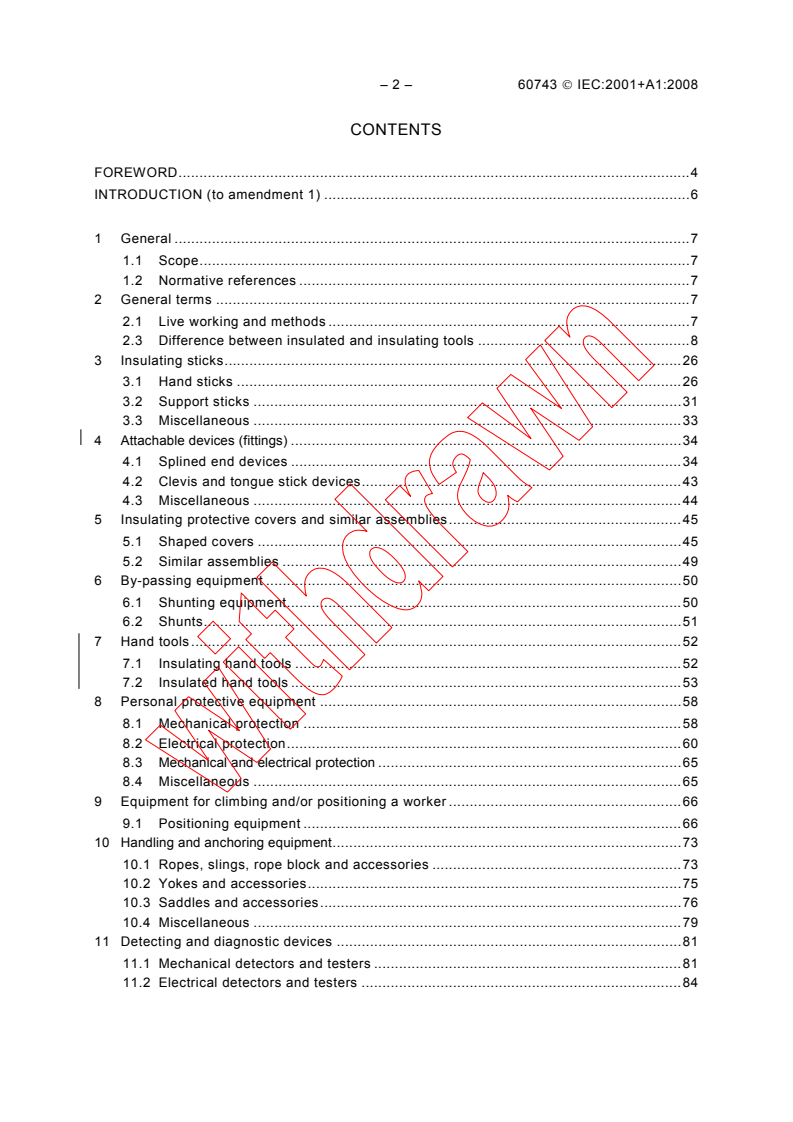
– 2 – 60743 © IEC:2001+A1:2008
CONTENTS
FOREWORD.4
INTRODUCTION (to amendment 1) .6
1 General.7
1.1 Scope.7
1.2 Normative references.7
2 General terms.7
2.1 Live working and methods .7
2.3 Difference between insulated and insulating tools .8
3 Insulating sticks.26
3.1 Hand sticks.26
3.2 Support sticks.31
3.3 Miscellaneous.33
4 Attachable devices (fittings) .34
4.1 Splined end devices .34
4.2 Clevis and tongue stick devices.43
4.3 Miscellaneous.44
5 Insulating protective covers and similar assemblies.45
5.1 Shaped covers.45
5.2 Similar assemblies.49
6 By-passing equipment.50
6.1 Shunting equipment.50
6.2 Shunts.51
7 Hand tools.52
7.1 Insulating hand tools .52
7.2 Insulated hand tools .53
8 Personal protective equipment .58
8.1 Mechanical protection.58
8.2 Electrical protection.60
8.3 Mechanical and electrical protection .65
8.4 Miscellaneous.65
9 Equipment for climbing and/or positioning a worker .66
9.1 Positioning equipment.66
10 Handling and anchoring equipment.73
10.1 Ropes, slings, rope block and accessories .73
10.2 Yokes and accessories.75
10.3 Saddles and accessories.76
10.4 Miscellaneous .79
11 Detecting and diagnostic devices .81
11.1 Mechanical detectors and testers .81
11.2 Electrical detectors and testers .84
60743 © IEC:2001+A1:2008 – 3 –
12 Hydraulic equipment.89
12.1 Hydraulic equipment.89
13 Support assembly equipment.90
14 Stringing equipment.97
15 Earthing and short-circuiting equipment.101
16 Live cleaning.103
Bibliography. 106
– 4 – 60743 © IEC:2001+A1:2008
INTERNATIONAL ELECTROTECHNICAL COMMISSION
____________
LIVE WORKING –
TERMINOLOGY FOR TOOLS, EQUIPMENT AND DEVICES
FOREWORD
1) The International Electrotechnical Commission (IEC) is a worldwide organization for standardization comprising
all national electrotechnical committees (IEC National Committees). The object of IEC is to promote
international co-operation on all questions concerning standardization in the electrical and electronic fields. To
this end and in addition to other activities, IEC publishes International Standards, Technical Specifications,
Technical Reports, Publicly Available Specifications (PAS) and Guides (hereafter referred to as “IEC
Publication(s)”). Their preparation is entrusted to technical committees; any IEC National Committee interested
in the subject dealt with may participate in this preparatory work. International, governmental and non-
governmental organizations liaising with the IEC also participate in this preparation. IEC collaborates closely
with the International Organization for Standardization (ISO) in accordance with conditions determined by
agreement between the two organizations.
2) The formal decisions or agreements of IEC on technical matters express, as nearly as possible, an international
consensus of opinion on the relevant subjects since each technical committee has representation from all
interested IEC National Committees.
3) IEC Publications have the form of recommendations for international use and are accepted by IEC National
Committees in that sense. While all reasonable efforts are made to ensure that the technical content of IEC
Publications is accurate, IEC cannot be held responsible for the way in which they are used or for any
misinterpretation by any end user.
4) In order to promote international uniformity, IEC National Committees undertake to apply IEC Publications
transparently to the maximum extent possible in their national and regional publications. Any divergence
between any IEC Publication and the corresponding national or regional publication shall be clearly indicated in
the latter.
5) IEC provides no marking procedure to indicate its approval and cannot be rendered responsible for any
equipment declared to be in conformity with an IEC Publication.
6) All users should ensure that they have the latest edition of this publication.
7) No liability shall attach to IEC or its directors, employees, servants or agents including individual experts and
members of its technical committees and IEC National Committees for any personal injury, property damage or
other damage of any nature whatsoever, whether direct or indirect, or for costs (including legal fees) and
expenses arising out of the publication, use of, or reliance upon, this IEC Publication or any other IEC
Publications.
8) Attention is drawn to the Normative references cited in this publication. Use of the referenced publications is
indispensable for the correct application of this publication.
9) Attention is drawn to the possibility that some of the elements of this IEC Publication may be the subject of
patent rights. IEC shall not be held responsible for identifying any or all such patent rights.
International Standard IEC 60743 has been prepared by IEC technical committee 78: Live
working.
This consolidated version of IEC 60743 consists of the second edition (2001) [documents
78/393/FDIS and 78/403/RVD] and its amendment 1 (2008) [documents 78/695/CDV and
78/723/RVC].
The technical content is therefore identical to the base edition and its amendment and has
been prepared for user convenience.
It bears the edition number 2.1.
A vertical line in the margin shows where the base publication has been modified by
amendment 1.
60743 © IEC:2001+A1:2008 – 5 –
The committee has decided that the contents of the base publication and its amendments will
remain unchanged until the maintenance result date indicated on the IEC web site under
"http://webstore.iec.ch" in the data related to the specific publication. At this date,
the publication will be
• reconfirmed,
• withdrawn,
• replaced by a revised edition, or
• amended.
– 6 – 60743 © IEC:2001+A1:2008
INTRODUCTION
(to amendment 1)
This amendment modifies a list of terms and definitions, as a contribution to the
harmonization of terms and definitions used in product standards of technical committee 78,
improving at the same time some illustrations of tools as well as the internal coherence of the
existing edition of IEC 60743.
60743 © IEC:2001+A1:2008 – 7 –
LIVE WORKING –
TERMINOLOGY FOR TOOLS, EQUIPMENT AND DEVICES
1 General
1.1 Scope
This International Standard applies to the terminology used to describe tools, equipment,
devices and methods used in live working.
IEC 60050(651) gives the definitions of all terms used in live working. The present standard
permits identification of the tools, equipment and devices and standardizes their names.
1.2 Normative references
The following normative documents contain provisions which, through reference in this text,
constitute provisions of this International Standard. For dated references, subsequent
amendments to, or revisions of, any of these publications do not apply. However, parties to
agreements based on this International Standard are encouraged to investigate the possibility
of applying the most recent editions of the normative documents indicated below. For undated
references, the latest edition of the normative document referred to applies. Members of IEC
and ISO maintain registers of currently valid International Standards.
IEC 60050(195):1998, International Electrotechnical Vocabulary – Chapter 195: Earthing and
protection against electric shock
IEC 60050(651):1999, International Electrotechnical Vocabulary – Chapter 651: Live working
Guide ISO-IEC 51 :1990, Guidelines for the inclusion of safety aspects in standards
ISO 472:1999, Plastics - Vocabulary
2 General terms
2.1 Live working and methods
2.1.1
live working (live work)
activity in which a worker makes contact with energized or charged live parts or penetrates
inside a live working zone with either parts of his or her body or with tools, equipment or
devices being handled
NOTE 1 Examples of live working include maintenance, connection and disconnection operations.
NOTE 2 Live working is performed using specific methods: hot stick working, insulating glove working and bare
hand working.
[IEV 651-01-01 modified]
– 8 – 60743 © IEC:2001+A1:2008
2.1.2
live part
conductor or conductive part intended to be energized in normal operation, including a neutral
conductor, but by convention not a PEN conductor [IEV 195-02-12] or PEM conductor
[IEV 195-02-13] or PEL conductor [IEV 195-02-14]
NOTE This concept does not necessarily imply a risk of shock.
[IEV 651-01-03 modified]
2.1.3
live working zone
space around live parts where prevention of electrical hazard is assured by suitable means
such as limiting access to skilled persons, maintaining the appropriate air distances and using
tools for live working
NOTE 1 The limits of a live working zone are equal to or greater than the minimum working distance.
NOTE 2 The live working zone and the specific precautions that apply are generally defined by national or
company regulations.
NOTE 3 In some countries the terms "danger zone" or “guard zone” are used instead of live working zone.
[IEV 651-01-06 modified]
2.1.4
hot stick working
live working according to a method whereby the worker remains at a specified distance from
the live parts and carries out the work by means of insulating sticks
[IEV 651-01-09]
2.1.5
insulating glove working
live working according to a method whereby the worker is electrically protected by insulating
gloves and other insulating equipment and carries out the work in direct mechanical contact
with live parts
[IEV 651-01-10]
2.1.6
bare hand working
live working according to a method whereby the worker carries out the work in electrical
contact with live parts, having the potential of the worker's body raised to the voltage of the
live parts by electrical connection, and suitably isolated from the surroundings at a different
potential
[IEV 651-01-11]
2.2
tools for live working
tools, devices and equipment specifically designed or adapted, tested and maintained as
apparatus for live working
[IEV 651-01-24 modified]
2.3 Difference between insulated and insulating tools
2.3.1
insulated tool
tool made of conductive material(s), fully or partially covered by insulating material(s)
[IEV 651-01-25 modified]
60743 © IEC:2001+A1:2008 – 9 –
2.3.2
insulating tool
tool made essentially or totally from insulating material(s)
[IEV 651-01-26 modified]
2.4 Components of insulating tools
2.4.1
end fitting
part permanently fitted to the end of the insulating tube or rod
[IEV 651-02-02 modified]
2.4.2
foam (in live working)
insulating material composed of closed cells, generally made of polyurethane, used to prevent
the ingress and migration of moisture
NOTE Foam is generally used to fill tubes and similar insulating structures.
[IEV 651-02-03]
2.4.3
elastomer
generic term that includes rubber, latex and elastomeric compounds that may be natural or
synthetic or a mixture or a combination of both
2.4.4
plastic
material which contains as an essential ingredient a high polymer and which at some stage in
its processing into finished products can be shaped by flow
NOTE 1 Elastomeric materials, which also are shaped by flow, are not considered as plastics.
NOTE 2 In some countries, particularly in the United Kingdom, it is a permitted option to use the term « plastics »
as the singular form as well as the plural form.
[ISO 472]
2.4.5
insulating rod (in live working)
long-shaped piece, normally of circular cross section, which is constructed or formed from
synthetic insulating and rigid material and which may be reinforced
[IEV 651-02-04 modified]
2.4.6
insulating tube (in live working)
long-shaped hollow piece, normally of circular cross section, which is constructed or formed
from synthetic insulating and rigid material and is normally reinforced, the interior of which
can be foam-filled
[IEV 651-02-05 modified]
2.5 Insulating sticks, assemblies and tools
2.5.1
insulating stick
insulating tool essentially made of insulating tube and/or rod with end fittings
[IEV 651-02-01]
– 10 – 60743 © IEC:2001+A1:2008
2.5.2
hand stick
insulating stick manipulated by hand, used to operate on live parts at a distance
[IEV 651-02-07]
2.5.3
attachable universal tool (in live working)
tool designed to be affixed at the end of a universal hand stick
NOTE This tool permits a variety of tasks to be carried out such as:
– to hold various parts: e.g. adjustable insulator fork, screw clamp, pin holder;
– to install or to pull out parts: e.g. split-pin installer, split-pin remover;
– to manipulate binding ties: e.g. rotary blades, rotary prongs.
[IEV 651-03-01]
2.5.4
support stick
insulating stick used to hold or move conductors and other equipment
[IEV 651-12-12]
2.5.5
insulating assemblies
various arrangements of support sticks and accessories for lifting, moving and/or supporting
loads such as conductors, insulators, etc.
2.5.6
attachable device (fitting)
device to be affixed at the end of a universal hand stick or at the end of a support stick
2.5.7
splined end device
attachable device to be affixed at the end of a universal hand stick
2.5.8
clevis and tongue stick device
attachable device to be affixed at the end of a support stick
2.5.9
hand tool
insulated or insulating tool manipulated by hand to work at low voltage
NOTE Hand tools are generally tools such as screwdrivers, pliers, wrenches and knifes.
2.6
protective cover
rigid or flexible cover made of insulating material used to cover energized and/or dead parts
and/or adjacent earthed parts in order to prevent inadvertent contact between these parts and
a worker
[IEV 651-04-01 modified]
60743 © IEC:2001+A1:2008 – 11 –
2.7
working distance
air distance in the work location, determined to sustain the required insulation level for live
working, and being ensured either by physical means or by skilled person following
instructions and procedures
[IEV 651-01-19 modified]
2.7.1
minimum working distance
minimum approach distance
minimum distance in air to be maintained between any part of the body of a worker, including
any object (except appropriate tools for live working) being directly handled, and any parts at
different potentials
NOTE 1 The minimum working distance is the sum of the electrical distance, corresponding to the maximum
nominal voltage calculated in accordance with IEC 61472, and the selected ergonomic distance appropriate to the
work being undertaken.
NOTE 2 “Appropriate tools” are tools for live working suitable for the maximum nominal voltage of the live parts.
[IEV 651-01-20 modified]
2.7.2
electrical distance
distance in air required to prevent a disruptive discharge between energized parts or between
energized parts and earthed parts during live working
NOTE When safety precautions are taken, the probability of a disruptive discharge is negligible. Safety is defined
as freedom from unacceptable risk of harm (see Guide ISO-IEC 51:1990).
[IEV 651-01-21 modified]
2.7.3
ergonomic distance
distance in air to take into account inadvertent movement and errors in judgement of
distances while performing work
[IEV 651-01-22]
2.7.4
handling zone (in live working)
area marked on the insulated or insulating tool in which it is permissible to handle the tool
NOTE This zone gives the assurance that requirements equivalent to the minimum working distance are fulfilled
when the tool is used according to its instructions.
[IEV 651-02-06]
2.7.5
vicinity zone
limited space outside the live working zone where an electrical hazard can exist
[IEV 651-01-07]
2.7.6
working in the vicinity of live parts
activity in which a worker with part of his or her body, with a tool or with any other object
enters into the vicinity zone without encroaching into the live working zone
[IEV 651-01-02]
– 12 – 60743 © IEC:2001+A1:2008
2.7.7
disruptive discharge
passage of an arc following dielectric breakdown
NOTE 1 The term “sparkover” (in French “amorçage”) is used when a disruptive discharge occurs in a gaseous or
liquid dielectric.
NOTE 2 The term “flashover” (in French “contournement”) is used when a disruptive discharge occurs over the
surface of a solid dielectric surrounded by a gaseous or liquid medium.
NOTE 3 The term “puncture” (in French “perforation”) is used when a disruptive discharge occurs through a solid
dielectric.
[IEV 651-01-18]
2.7.8
skilled person (electrically)
person with relevant education and experience to enable him or her to analyse risks and to
avoid hazards which electricity can create
[IEV 651-01-33 modified]
2.8
washing zone
zone within the range of sprayed water
[IEV 651-15-03]
2.8.1
full jet
jet of water which is closed on issuing from a nozzle and which disperses into individual drops
at a certain distance from the nozzle
NOTE A jet can be regarded as closed when it is as transparent as a glass rod when it issues from the nozzle.
[IEV 651-15-04]
2.8.2
spray jet
jet of water which, on issuing from a nozzle is formed from a close sequence of individual
drops of water making no contact with one another
[IEV 651-15-05]
– 14 – 60743 © CEI:2001+A1:2008
SOMMAIRE
AVANT-PROPOS.16
INTRODUCTION (à l’amendement 1).18
1 Généralités.19
1.1 Domaine d’application .19
1.2 Références normatives.19
2 Termes généraux .19
2.1 Travaux sous tension et méthodes .19
2.3 Différence entre outils isolés et outils isolants .20
3 Perches isolantes .26
3.1 Perches à main .26
3.2 Perches de maintien.31
3.3 Divers .33
4 Outils adaptables .34
4.1 Outils à embouts crantés.34
4.2 Outils à chape et tenon .43
4.3 Divers .44
5 Protecteurs isolants et assimilés .45
5.1 Protecteurs formés .45
5.2 Matériels assimilés.49
6 Matériel de shuntage .50
6.1 Appareils de shuntage.50
6.2 Shunts.51
7 Outils à main .52
7.1 Outils à main isolants .52
7.2 Outils à main isolés .53
8 Équipements de protection individuelle.58
8.1 Protection mécanique.58
8.2 Protection électrique .60
8.3 Protection mécanique et électrique.65
8.4 Divers .65
9 Matériel d'ascension ou de positionnement du travailleur .66
9.1 Equipement de positionnement.66
10 Matériel de manutention et accessoires de fixation.73
10.1 Cordes, estropes, moufles et accessoires .73
10.2 Palonniers et accessoires.75
10.3 Selles et accessoires.76
10.4 Divers .79
11 Dispositifs de contrôle et de diagnostic.81
11.1 Détecteurs et contrôleurs mécaniques.81
11.2 Détecteurs et contrôleurs électriques .84
12 Matériels hydrauliques.89
12.1 Matériel hydraulique .89
60743 © CEI:2001+A1:2008 – 15 –
13 Matériels de maintien .90
14 Matériel de déroulage.97
15 Matériel de mise à la terre et en court-circuit.101
16 Nettoyage sous tension .103
Bibliographie. 107
– 16 – 60743 © CEI:2001+A1:2008
COMMISSION ÉLECTROTECHNIQUE INTERNATIONALE
____________
TRAVAUX SOUS TENSION –
TERMINOLOGIE POUR L’OUTILLAGE, LE MATÉRIEL ET LES DISPOSITIFS
AVANT-PROPOS
1) La Commission Electrotechnique Internationale (CEI) est une organisation mondiale de normalisation
composée de l'ensemble des comités électrotechniques nationaux (Comités nationaux de la CEI). La CEI a
pour objet de favoriser la coopération internationale pour toutes les questions de normalisation dans les
domaines de l'électricité et de l'électronique. A cet effet, la CEI – entre autres activités – publie des Normes
internationales, des Spécifications techniques, des Rapports techniques, des Spécifications accessibles au
public (PAS) et des Guides (ci-après dénommés "Publication(s) de la CEI"). Leur élaboration est confiée à des
comités d'études, aux travaux desquels tout Comité national intéressé par le sujet traité peut participer. Les
organisations internationales, gouvernementales et non gouvernementales, en liaison avec la CEI, participent
également aux travaux. La CEI collabore étroitement avec l'Organisation Internationale de Normalisation (ISO),
selon des conditions fixées par accord entre les deux organisations.
2) Les décisions ou accords officiels de la CEI concernant les questions techniques représentent, dans la mesure
du possible, un accord international sur les sujets étudiés, étant donné que les Comités nationaux de la CEI
intéressés sont représentés dans chaque comité d’études.
3) Les Publications de la CEI se présentent sous la forme de recommandations internationales et sont agréées
comme telles par les Comités nationaux de la CEI. Tous les efforts raisonnables sont entrepris afin que la CEI
s'assure de l'exactitude du contenu technique de ses publications; la CEI ne peut pas être tenue responsable
de l'éventuelle mauvaise utilisation ou interprétation qui en est faite par un quelconque utilisateur final.
4) Dans le but d'encourager l'uniformité internationale, les Comités nationaux de la CEI s'engagent, dans toute la
mesure possible, à appliquer de façon transparente les Publications de la CEI dans leurs publications
nationales et régionales. Toutes divergences entre toutes Publications de la CEI et toutes publications
nationales ou régionales correspondantes doivent être indiquées en termes clairs dans ces dernières.
5) La CEI n’a prévu aucune procédure de marquage valant indication d’approbation et n'engage pas sa
responsabilité pour les équipements déclarés conformes à une de ses Publications.
6) Tous les utilisateurs doivent s'assurer qu'ils sont en possession de la dernière édition de cette publication.
7) Aucune responsabilité ne doit être imputée à la CEI, à ses administrateurs, employés, auxiliaires ou
mandataires, y compris ses experts particuliers et les membres de ses comités d'études et des Comités
nationaux de la CEI, pour tout préjudice causé en cas de dommages corporels et matériels, ou de tout autre
dommage de quelque nature que ce soit, directe ou indirecte, ou pour supporter les coûts (y compris les frais
de justice) et les dépenses découlant de la publication ou de l'utilisation de cette Publication de la CEI ou de
toute autre Publication de la CEI, ou au crédit qui lui est accordé.
8) L'attention est attirée sur les références normatives citées dans cette publication. L'utilisation de publications
référencées est obligatoire pour une application correcte de la présente publication.
9) L’attention est attirée sur le fait que certains des éléments de la présente Publication de la CEI peuvent faire
l’objet de droits de propriété intellectuelle ou de droits analogues. La CEI ne saurait être tenue pour
responsable de ne pas avoir identifié de tels droits de propriété et de ne pas avoir signalé leur existence.
La Norme internationale CEI 60743 a été établie par le comité d'études 78 de la CEI: Travaux
sous tension.
Cette version consolidée de la CEI 60743 comprend la deuxième édition (2001) [documents
78/393/FDIS et 78/403/RVD] et son amendement 1 (2008) [documents 78/695/CDV et
78/723/RVC].
Le contenu technique de cette version consolidée est donc identique à celui de l'édition de base
et à son amendement; cette version a été préparée par commodité pour l'utilisateur.
Elle porte le numéro d'édition 2.1.
Une ligne verticale dans la marge indique où la publication de base a été modifiée par
l'amendement 1.
60743 © CEI:2001+A1:2008 – 17 –
Le comité a décidé que le contenu de la publication de base et de ses amendements ne sera
pas modifié avant la date de maintenance indiquée sur le site web de la CEI sous
"http://webstore.iec.ch" dans les données relatives à la publication recherchée. A cette date,
la publication sera
• reconduite,
• supprimée,
• remplacée par une édition révisée, ou
• amendée.
– 18 – 60743 © CEI:2001+A1:2008
INTRODUCTION
(à l’amendement 1)
Le présent amendement modifie une série de termes et de définitions, en contribution à
l’harmonisation des termes et des définitions utilisés dans les normes de produit du comité
d'études 78, et améliore en même temps quelques illustrations d’outils ainsi que la cohérence
interne de l’édition actuellement en vigueur de la CEI 60743.
60743 © CEI:2001+A1:2008 – 19 –
TRAVAUX SOUS TENSION –
TERMINOLOGIE POUR L’OUTILLAGE, LE MATÉRIEL ET LES DISPOSITIFS
1 Généralités
1.1 Domaine d’application
La présente Norme internationale s’applique à la terminologie utilisée pour décrire les outils,
le matériel, les dispositifs et les méthodes utilisés dans les travaux sous tension.
La CEI 60050(651) contient les définitions de tous les termes utilisés pour les travaux sous
tension. La présente norme permet l’identification des outils, du matériel et des dispositifs, et
normalise leurs noms.
1.2 Références normatives
Les documents normatifs suivants contiennent des dispositions qui, par suite de la référence
qui y est faite, constituent des dispositions valables pour la présente Norme internationale.
Pour les références datées, les amendements ultérieurs ou les révisions de ces publications
ne s’appliquent pas. Toutefois, les parties prenantes aux accords fondés sur la présente
Norme internationale sont invitées à rechercher la possibilité d'appliquer les éditions les plus
récentes des documents normatifs indiqués ci-après. Pour les références non datées, la
dernière édition du document normatif en référence s’applique. Les membres de la CEI et de
l'ISO possèdent le registre des Normes internationales en vigueur.
CEI 60050(195):1998, Vocabulaire Électrotechnique International – Chapitre 195: Mise à la
terre et protection contre les chocs électriques
CEI 60050(651):1999, Vocabulaire Électrotechnique International – Chapitre 651: Travaux
sous tension
Guide ISO/CEI 51 :1990, Principes directeurs pour inclure dans les normes les aspects liés à
la sécurité
ISO 472:1999, Plastiques – Vocabulaire (disponible en anglais seulement)
2 Termes généraux
2.1 Travaux sous tension et méthodes
2.1.1
travaux sous tension
activité au cours de laquelle un travailleur entre en contact avec des parties actives sous
tension ou chargées, ou pénètre dans une zone de travail sous tension soit avec tout ou
partie de son corps, soit avec des outils, des équipements ou des dispositifs qu'il manipule
NOTE 1 Exemples de travail sous tension: maintenance, connexions et déconnexions.
NOTE 2 Le travail sous tension est réalisé en utilisant des méthodes spécifiques: le travail à distance, le travail
au contact, le travail au potentiel.
[VEI 651-01-01 modifiée]
– 20 – 60743 © CEI:2001+A1:2008
2.1.2
partie active
conducteur ou partie conductrice destiné à être sous tension en service normal, y compris le
conducteur de neutre, mais par convention, excepté le conducteur PEN [VEI 195-02-12], le
conducteur PEM [VEI 195-02-13] ou le conducteur PEL [VEI 195-02-14]
NOTE Cette notion n’implique pas nécessairement un risque de choc électrique.
[VEI 651-01-03 modifiée]
2.1.3
zone de travail sous tension
espace autour des parties actives où la prévention du risque électrique est assurée par des
mesures appropriées de protection telles que la limitation de l'accès aux personnes
qualifiées, le maintien de distances d'air appropriées et l'usage d'outils de travail sous tension
NOTE 1 Les limites de la zone de travail sous tension sont à une distance égale ou plus grande que la distance
minimale de travail.
NOTE 2 La zone de travail sous tension et les précautions spécifiques à appliquer sont généralement définies
dans la réglementation nationale ou dans celle de l'entreprise.
NOTE 3 Dans certains pays, les termes «zone de danger» ou «zone de garde» sont employés au lieu de zone de
travail sous tension.
[VEI 651-01-06 modifiée]
2.1.4
travail à distance
travail sous tension effectué suivant une méthode dans laquelle le travailleur reste à une
distance spécifiée des parties actives et intervient au moyen de perches isolantes
[VEI 651-01-09]
2.1.5
travail au contact
travail sous tension effectué suivant une méthode dans laquelle le travailleur, protégé
électriquement par des gants isolants et d’autres équipements isolants, intervient directement
en contact mécanique avec les parties actives
[VEI 651-01-10]
2.1.6
travail au potentiel
travail sous tension effectué suivant une méthode dans laquelle le travailleur intervient en
contact électrique avec les parties actives, après avoir été porté au potentiel de ces parties et
en étant convenablement isolé des autres potentiels de son environnement
[VEI 651-01-11]
2.2
outils pour travaux sous tension
outils, dispositifs et équipements spécifiquement conçus ou adaptés, essayés et entretenus
pour les travaux sous tension
[VEI 651-01-24 modifiée]
2.3 Différence entre outils isolés et outils isolants
2.3.1
outil isolé
outil en matériau(x) conducteur(s), partiellement ou complètement recouvert de matériau(x)
isolant(s)
[VEI 651-01-25 modifiée]
60743 © CEI:2001+A1:2008 – 21 –
2.3.2
outil isolant
outil essentiellement ou totalement réalisé en matériau(x) isolant(s)
[VEI 651-01-26 modifiée]
2.4 Composants d’outils isolants
2.4.1
embout de perche
partie fixée de manière permanente à l'extrémité du tube ou de la tige isolante
[VEI 651-02-02 modifiée]
2.4.2
mousse (en travaux sous tension)
matériau isolant constitué d’alvéoles, généralement fabriqué de polyuréthane, utilisé pour
empêcher la pénétration et le cheminement de l'humidité
NOTE La mousse est généralement utilisée pour remplir un tube ou des structures isolantes similaires.
[VEI 651-02-03]
2.4.3
élastomère
terme général comprenant les caoutchoucs, les latex
...