

IEC 61850-7-3:2010
(Main)Communication networks and systems for power utility automation - Part 7-3: Basic communication structure - Common data classes
General Information
- Abstract
IEC 61850-7-3:2010 is applicable to the description of device models and functions of substations and feeder equipment. It specifies constructed attribute classes and common data classes related to substation applications. In particular, it specifies common data classes for status information, common data classes for measured information, common data classes for control, common data classes for status settings, common data classes for analogue settings and attribute types used in these common data classes. This second edition defines new common data classes used for new standards defining object models for other domains based on IEC 61850 and for the representation of statistical and historical data.
This publication is of core relevance for Smart Grid.
- Status
- Published
- Publication Date
- 09-Feb-2020
- Technical Committee
- TC 57 - Power systems management and associated information exchange
- Drafting Committee
- WG 10 - TC 57/WG 10
- Current Stage
- PPUB - Publication issued
- Start Date
- 16-Dec-2010
- Completion Date
- 15-Dec-2010
Buy Documents
iec61850-7-3{ed2.1}en - IEC 61850-7-3:2010+AMD1:2020 CSV - Communication networks and systems for power utility automation - Part 7-3: Basic communication structure - Common data classes Released:2/10/2020
IEC 61850-7-3:2010 - Communication networks and systems for power utility automation - Part 7-3: Basic communication structure - Common data classes Released:12/16/2010
Overview
IEC 61850-7-3:2010 - part of the IEC 61850 family - defines the Basic Communication Structure: Common Data Classes (CDCs) for power utility automation. It specifies constructed attribute classes and a comprehensive set of common data classes used to describe device models and functions of substations and feeder equipment. The second edition (consolidated to 2020) adds CDCs for new object models and for representing statistical and historical data, making this publication central to modern substation automation and Smart Grid implementations.
Key topics and technical requirements
- Constructed attribute classes: standard building blocks for attributes (e.g., units, vectors, configuration objects) used across device models.
- Common Data Classes (CDCs): formal definitions for data types used in substations, including:
- Status information (e.g., SPS, DPS, enumerated and statistical status classes)
- Measured information (e.g., MV, CMV, SAV, harmonic and sequence data)
- Controls (controllable single/double points, analogue controls)
- Status settings and analogue settings (setpoints, curves, configuration tables)
- Description and nameplate information
- Attribute types and enumerations: standard enumerated types (units, control models, periods, severity, etc.) to ensure semantic interoperability.
- Service tracking and functional constraints: CDCs for monitoring reporting services (GOOSE, reports, logs) and annexes describing functional constraints and compatibility rules.
- Configuration and compatibility: SCL enumerations, revision tracking, and guidance for backward/forward compatibility between revisions.
Practical applications
- Modeling of substation devices, logical nodes and data objects in Substation Configuration Language (SCL).
- Defining interoperable measurement and control points for protection, metering, and SCADA interfaces.
- Enabling vendor-neutral data exchange across devices from relays, bay controllers, RTUs, and IEC 61850-enabled sensors.
- Supporting Smart Grid features such as historical/statistical reporting, advanced metering, and cross-domain object models.
Who uses this standard
- Utility engineers and system architects designing substation automation and Smart Grid solutions.
- Device manufacturers and firmware developers implementing IEC 61850 models.
- System integrators and consultants responsible for SCL configuration, testing and interoperability.
- Standards bodies and project teams extending IEC 61850 to other domains.
Related standards
- IEC 61850 (overall series) - device modelling, communication services, mapping and configuration (other parts such as communication services, SCL, mappings to MMS/GOOSE/SMV).
- Useful for projects requiring compliance with IEC 61850 for substation automation and Smart Grid interoperability.
Keywords: IEC 61850-7-3:2010, common data classes, substation automation, power utility automation, Smart Grid, device model, SCL, measurand, protection, control.
Relations
- Effective Date
- 05-Sep-2023
Buy Documents
iec61850-7-3{ed2.1}en - IEC 61850-7-3:2010+AMD1:2020 CSV - Communication networks and systems for power utility automation - Part 7-3: Basic communication structure - Common data classes Released:2/10/2020
IEC 61850-7-3:2010 - Communication networks and systems for power utility automation - Part 7-3: Basic communication structure - Common data classes Released:12/16/2010
Get Certified
Connect with accredited certification bodies for this standard

ANCE
Mexican certification and testing association.

Intertek Slovenia
Intertek testing, inspection, and certification services in Slovenia.

LNE (Laboratoire National de Métrologie et d'Essais)
French national laboratory for metrology and testing.
Sponsored listings
Frequently Asked Questions
IEC 61850-7-3:2010 is a standard published by the International Electrotechnical Commission (IEC). Its full title is "Communication networks and systems for power utility automation - Part 7-3: Basic communication structure - Common data classes". This standard covers: IEC 61850-7-3:2010 is applicable to the description of device models and functions of substations and feeder equipment. It specifies constructed attribute classes and common data classes related to substation applications. In particular, it specifies common data classes for status information, common data classes for measured information, common data classes for control, common data classes for status settings, common data classes for analogue settings and attribute types used in these common data classes. This second edition defines new common data classes used for new standards defining object models for other domains based on IEC 61850 and for the representation of statistical and historical data. This publication is of core relevance for Smart Grid.
IEC 61850-7-3:2010 is applicable to the description of device models and functions of substations and feeder equipment. It specifies constructed attribute classes and common data classes related to substation applications. In particular, it specifies common data classes for status information, common data classes for measured information, common data classes for control, common data classes for status settings, common data classes for analogue settings and attribute types used in these common data classes. This second edition defines new common data classes used for new standards defining object models for other domains based on IEC 61850 and for the representation of statistical and historical data. This publication is of core relevance for Smart Grid.
IEC 61850-7-3:2010 is classified under the following ICS (International Classification for Standards) categories: 33.200 - Telecontrol. Telemetering. The ICS classification helps identify the subject area and facilitates finding related standards.
IEC 61850-7-3:2010 has the following relationships with other standards: It is inter standard links to IEC 61850-7-3:2003. Understanding these relationships helps ensure you are using the most current and applicable version of the standard.
IEC 61850-7-3:2010 is available in PDF format for immediate download after purchase. The document can be added to your cart and obtained through the secure checkout process. Digital delivery ensures instant access to the complete standard document.
Standards Content (Sample)
IEC 61850-7-3 ®
Edition 2.1 2020-02
CONSOLIDATED VERSION
INTERNATIONAL
STANDARD
Communication networks and systems for power utility automation –
Part 7-3: Basic communication structure – Common data classes
All rights reserved. Unless otherwise specified, no part of this publication may be reproduced or utilized in any form
or by any means, electronic or mechanical, including photocopying and microfilm, without permission in writing from
either IEC or IEC's member National Committee in the country of the requester. If you have any questions about IEC
copyright or have an enquiry about obtaining additional rights to this publication, please contact the address below or
your local IEC member National Committee for further information.
IEC Central Office Tel.: +41 22 919 02 11
3, rue de Varembé info@iec.ch
CH-1211 Geneva 20 www.iec.ch
Switzerland
About the IEC
The International Electrotechnical Commission (IEC) is the leading global organization that prepares and publishes
International Standards for all electrical, electronic and related technologies.
About IEC publications
The technical content of IEC publications is kept under constant review by the IEC. Please make sure that you have the
latest edition, a corrigendum or an amendment might have been published.
IEC publications search - webstore.iec.ch/advsearchform Electropedia - www.electropedia.org
The advanced search enables to find IEC publications by a The world's leading online dictionary on electrotechnology,
variety of criteria (reference number, text, technical containing more than 22 000 terminological entries in English
committee,…). It also gives information on projects, replaced and French, with equivalent terms in 16 additional languages.
and withdrawn publications. Also known as the International Electrotechnical Vocabulary
(IEV) online.
IEC Just Published - webstore.iec.ch/justpublished
Stay up to date on all new IEC publications. Just Published IEC Glossary - std.iec.ch/glossary
details all new publications released. Available online and 67 000 electrotechnical terminology entries in English and
once a month by email. French extracted from the Terms and definitions clause of
IEC publications issued between 2002 and 2015. Some
IEC Customer Service Centre - webstore.iec.ch/csc entries have been collected from earlier publications of IEC
If you wish to give us your feedback on this publication or TC 37, 77, 86 and CISPR.
need further assistance, please contact the Customer Service
Centre: sales@iec.ch.
IEC 61850-7-3 ®
Edition 2.1 2020-02
CONSOLIDATED VERSION
INTERNATIONAL
STANDARD
Communication networks and systems for power utility automation –
Part 7-3: Basic communication structure – Common data classes
INTERNATIONAL
ELECTROTECHNICAL
COMMISSION
ICS 33.200 ISBN 978-2-8322-7868-0
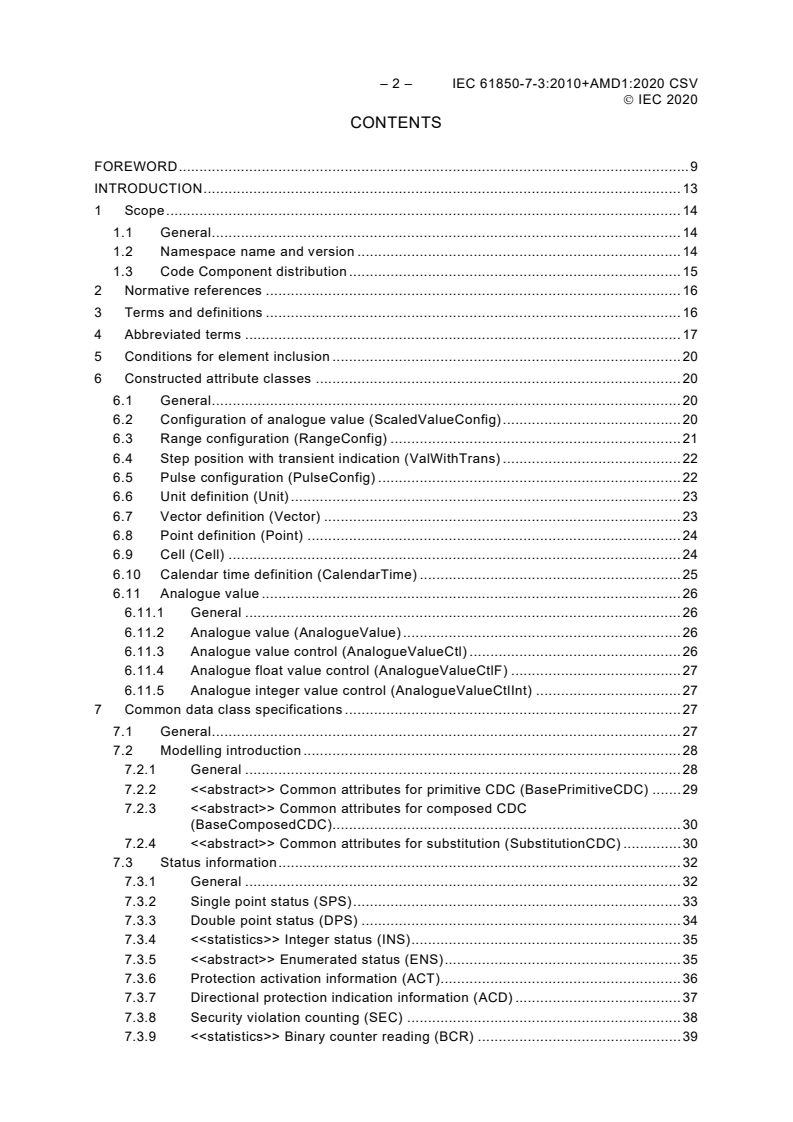
– 2 – IEC 61850-7-3:2010+AMD1:2020 CSV
IEC 2020
CONTENTS
FOREWORD . 9
INTRODUCTION . 13
1 Scope . 14
1.1 General . 14
1.2 Namespace name and version . 14
1.3 Code Component distribution . 15
2 Normative references . 16
3 Terms and definitions . 16
4 Abbreviated terms . 17
5 Conditions for element inclusion . 20
6 Constructed attribute classes . 20
6.1 General . 20
6.2 Configuration of analogue value (ScaledValueConfig) . 20
6.3 Range configuration (RangeConfig) . 21
6.4 Step position with transient indication (ValWithTrans) . 22
6.5 Pulse configuration (PulseConfig) . 22
6.6 Unit definition (Unit) . 23
6.7 Vector definition (Vector) . 23
6.8 Point definition (Point) . 24
6.9 Cell (Cell) . 24
6.10 Calendar time definition (CalendarTime) . 25
6.11 Analogue value . 26
6.11.1 General . 26
6.11.2 Analogue value (AnalogueValue) . 26
6.11.3 Analogue value control (AnalogueValueCtl) . 26
6.11.4 Analogue float value control (AnalogueValueCtlF) . 27
6.11.5 Analogue integer value control (AnalogueValueCtlInt) . 27
7 Common data class specifications . 27
7.1 General . 27
7.2 Modelling introduction . 28
7.2.1 General . 28
7.2.2 <> Common attributes for primitive CDC (BasePrimitiveCDC) . 29
7.2.3 <> Common attributes for composed CDC
(BaseComposedCDC). 30
7.2.4 <> Common attributes for substitution (SubstitutionCDC) . 30
7.3 Status information . 32
7.3.1 General . 32
7.3.2 Single point status (SPS) . 33
7.3.3 Double point status (DPS) . 34
7.3.4 <> Integer status (INS) . 35
7.3.5 <> Enumerated status (ENS) . 35
7.3.6 Protection activation information (ACT). 36
7.3.7 Directional protection indication information (ACD) . 37
7.3.8 Security violation counting (SEC) . 38
7.3.9 <> Binary counter reading (BCR) . 39
IEC 2020
7.3.10 Histogram (HST) . 40
7.3.11 Visible string status (VSS) . 43
7.3.12 Object reference status (ORS) . 43
7.3.13 Time value status (TCS) . 44
7.4 Measurand information . 44
7.4.1 General . 44
7.4.2 <> Common harmonic measurand information
(HarmonicMeasurandCDC) . 46
7.4.3 <> Measured value (MV) . 48
7.4.4 <> Complex measured value (CMV) . 52
7.4.5 <> Sampled value (SAV) . 54
7.4.6 <> Phase to ground/neutral related measured values of a
three-phase system (WYE) . 54
7.4.7 <> Phase to phase related measured values of a three-
phase system (DEL) . 56
7.4.8 <> Sequence (SEQ) . 57
7.4.9 <> Harmonic value (HMV) . 58
7.4.10 <> Harmonic value for WYE (HWYE) . 59
7.4.11 <> Harmonic value for DEL (HDEL) . 60
7.5 Controls . 61
7.5.1 General . 61
7.5.2 <> Control testing (ControlTestingCDC) . 65
7.5.3 Controllable single point (SPC) . 66
7.5.4 Controllable double point (DPC) . 68
7.5.5 <> Controllable integer status (INC) . 69
7.5.6 <> Controllable enumerated status (ENC) . 70
7.5.7 <> Binary controlled step position information (BSC) . 71
7.5.8 <> Integer controlled step position information (ISC) . 72
7.5.9 <> Controllable analogue process value (APC) . 73
7.5.10 <> Binary controlled analogue process value (BAC) . 75
7.6 Status settings . 76
7.6.1 General . 76
7.6.2 Single point setting . 77
7.6.3 Integer status setting . 79
7.6.4 Enumerated status setting . 81
7.6.5 Object reference setting . 84
7.6.6 Time setting . 86
7.6.7 Currency setting . 89
7.6.8 Visible string setting . 91
7.7 Analogue settings . 94
7.7.1 General . 94
7.7.2 Analogue setting . 94
7.7.3 Setting curve . 97
7.7.4 Curve shape setting . 100
7.8 Description information . 104
7.8.1 General . 104
7.8.2 Device name plate (DPL) . 105
7.8.3 Logical node name plate (LPL) . 106
7.8.4 Curve shape description (CSD). 107
– 4 – IEC 61850-7-3:2010+AMD1:2020 CSV
IEC 2020
7.8.5 Visible string description (VSD) . 108
7.9 Common data class specifications for service tracking . 108
7.9.1 General . 108
7.9.2 Common service tracking (CST) . 110
7.9.3 Buffered report tracking service (BTS) . 110
7.9.4 Unbuffered report tracking service (UTS) . 112
7.9.5 Log control block tracking service (LTS) . 113
7.9.6 GOOSE control block tracking service (GTS) . 113
7.9.7 MSVCB tracking service (MTS) . 114
7.9.8 USVCB tracking service (NTS) . 115
7.9.9 SGCB tracking service (STS) . 116
7.9.10 <> Control service tracking (CTS) . 117
8 Enumerated data attribute types . 118
8.1 General . 118
8.2 Angle reference (AngleReferenceKind enumeration) . 118
8.3 Control model (CtlModelKind enumeration) . 119
8.4 Curve characteristic (CurveCharKind enumeration) . 119
8.5 Fault direction (FaultDirectionKind enumeration) . 121
8.6 Harmonic value reference (HvReferenceKind enumeration) . 121
8.7 Month (MonthKind enumeration) . 122
8.8 Unit multiplier (MultiplierKind enumeration) . 122
8.9 Occurrence (OccurrenceKind enumeration) . 123
8.10 Output signal (OutputSignalKind enumeration) . 123
8.11 Period (PeriodKind enumeration) . 123
8.12 Phase angle reference (PhaseAngleReferenceKind enumeration) . 124
8.13 Phase fault direction (PhaseFaultDirectionKind enumeration) . 124
8.14 Phase reference (PhaseReferenceKind enumeration) . 125
8.15 Range (RangeKind enumeration) . 125
8.16 SI unit (SIUnitKind enumeration) . 125
8.17 Select-before-operate class (SboClassKind enumeration) . 128
8.18 Sequence (SequenceKind enumeration) . 128
8.19 Severity (SeverityKind enumeration) . 128
8.20 Week day (WeekdayKind enumeration) . 129
Annex A (normative) Value range for units and multiplier . 130
Annex B (informative) Functional constraints (FcKind) . 131
Annex C (normative) Tracking of configuration revisions . 135
Annex D (normative) SCL enumerations . 136
Annex E (informative) Conditions for element presence . 137
Annex F (normative) Compatibility of the different revisions of the standard . 139
F.1 General . 139
F.2 List of the modifications to consider for backward / forward compatibility . 139
F.3 List of modifications requiring specific treatment . 142
F.4 Special compatibility rules and discussion. 143
F.4.1 Use case 3a – Dead band, db and dbRef . 143
F.4.2 Use case 3a – maxPts . 144
F.4.3 Use case 10 – cdcNs . 144
F.4.4 Use case f13 – CDC BCR . 144
F.4.5 Use case f13 – CDC HMW, HWYE, HDEL . 144
IEC 2020
F.4.6 Use case f13 – CDC CMV . 144
F.4.7 Use case f14 – NTS . 144
F.4.8 CDC APC . 144
F.4.9 CDC ENS, ENC, ENG . 144
Bibliography . 146
Figure 1 – Range configuration . 21
Figure 2 – Configuration of command output pulse . 23
Figure 3 – Cell definition . 24
Figure 4 – Interpretation of calendar time settings . 25
Figure 5 – Class diagram CommonDataClasses::CommonDataClasses . 28
Figure 6 – Class diagram CoreAbstractCDCs::CoreAbstractCDCs . 29
Figure 7 – Concept of substitution . 31
Figure 8 – Class diagram CDCStatusInfo::CDCStatusInfo . 33
Figure 9 – One-dimensional histogram . 41
Figure 10 – Two-dimensional histogram . 42
Figure 11 – Class diagram CDCAnalogueInfo::CDCAnalogueInfo-1 . 45
Figure 12 – Class diagram CDCAnalogueInfo::CDCAnalogueInfo-2 . 46
Figure 13 – Array indexing ('har'/'*Har') based on 'numCyc' . 47
Figure 14 – Deadbanded value . 49
Figure 15 – Zero deadband . 49
Figure 16 – Relation between phase values . 55
Figure 17 – Class diagram CDCControl::CDCControl-1 . 63
Figure 18 – Class diagram CDCControl::CDCControl-2 . 65
Figure 19 – Attributes for command testing . 65
Figure 20 – Class diagram SPG::SPG . 77
Figure 21 – Class diagram ING::ING . 79
Figure 22 – Class diagram ENG::ENG . 82
Figure 23 – Class diagram ORG::ORG . 84
Figure 24 – Switching to test object reference . 85
Figure 25 – Class diagram TSG::TSG . 87
Figure 26 – Class diagram CUG::CUG . 89
Figure 27 – Class diagram VSG::VSG . 92
Figure 28 – Class diagram ASG::ASG . 94
Figure 29 – Class diagram CURVE::CURVE . 97
Figure 30 – Class diagram CSG::CSG . 100
Figure 31 – Two-dimensional curve . 101
Figure 32 – Three-dimensional surface . 101
Figure 33 – Class diagram CDCDescription::CDCDescription . 105
Figure 34 – Class diagram CDCServiceTracking::CDCServiceTracking . 109
Table 1 – Attributes of ScaledValueConfig . 21
Table 2 – Attributes of RangeConfig . 21
– 6 – IEC 61850-7-3:2010+AMD1:2020 CSV
IEC 2020
Table 3 – Attributes of ValWithTrans . 22
Table 4 – Attributes of PulseConfig . 23
Table 5 – Attributes of Unit . 23
Table 6 – Attributes of Vector . 24
Table 7 – Attributes of Point. 24
Table 8 – Attributes of Cell . 25
Table 9 – Attributes of CalendarTime . 25
Table 10 – Attributes of AnalogueValue . 26
Table 11 – Attributes of AnalogueValueCtl . 27
Table 12 – Attributes of AnalogueValueCtlF . 27
Table 13 – Attributes of AnalogueValueCtlInt . 27
Table 14 – Attributes of BasePrimitiveCDC . 30
Table 15 – Attributes of BaseComposedCDC . 30
Table 16 – Attributes of SubstitutionCDC . 32
Table 17 – Attributes of SPS . 34
Table 18 – Attributes of DPS . 34
Table 19 – Attributes of INS . 35
Table 20 – Attributes of ENS . 36
Table 21 – Attributes of ACT . 36
Table 22 – Attributes of ACD . 37
Table 23 – Attributes of SEC . 39
Table 24 – Attributes of BCR . 39
Table 25 – Attributes of HST . 42
Table 26 – Attributes of VSS . 43
Table 27 – Attributes of ORS . 44
Table 28 – Attributes of TCS . 44
Table 29 – Attributes of HarmonicMeasurandCDC . 48
Table 30 – Attributes of MV . 50
Table 31 – Attributes of CMV . 52
Table 32 – Attributes of SAV . 54
Table 33 – Attributes of WYE . 56
Table 34 – Attributes of DEL . 57
Table 35 – Attributes of SEQ . 58
Table 36 – Attributes of HMV . 59
Table 37 – Attributes of HWYE . 59
Table 38 – Attributes of HDEL . 61
Table 39 – Attributes of ControlTestingCDC . 66
Table 40 – Attributes of SPC . 66
Table 41 – Attributes of DPC . 68
Table 42 – Attributes of INC . 69
Table 43 – Attributes of ENC . 70
Table 44 – Attributes of BSC . 71
Table 45 – Attributes of ISC . 73
IEC 2020
Table 46 – Attributes of APC . 74
Table 47 – Attributes of BAC . 75
Table 48 – Attributes of SPG . 77
Table 49 – Attributes of SPG_SP . 78
Table 50 – Attributes of SPG_SG . 78
Table 51 – Attributes of SPG_SE . 79
Table 52 – Attributes of ING . 80
Table 53 – Attributes of ING_SP . 80
Table 54 – Attributes of ING_SG . 81
Table 55 – Attributes of ING_SE . 81
Table 56 – Attributes of ENG . 82
Table 57 – Attributes of ENG_SP . 83
Table 58 – Attributes of ENG_SG . 83
Table 59 – Attributes of ENG_SE . 83
Table 60 – Attributes of ORG . 85
Table 61 – Attributes of TSG . 87
Table 62 – Attributes of TSG_SP . 88
Table 63 – Attributes of TSG_SG . 88
Table 64 – Attributes of TSG_SE . 89
Table 65 – Attributes of CUG . 90
Table 66 – Attributes of CUG_SP . 90
Table 67 – Attributes of CUG_SG . 90
Table 68 – Attributes of CUG_SE . 91
Table 69 – Attributes of VSG . 92
Table 70 – Attributes of VSG_SP . 93
Table 71 – Attributes of VSG_SG . 93
Table 72 – Attributes of VSG_SE . 93
Table 73 – Attributes of ASG . 95
Table 74 – Attributes of ASG_SP . 95
Table 75 – Attributes of ASG_SG . 96
Table 76 – Attributes of ASG_SE . 96
Table 77 – Attributes of CURVE . 98
Table 78 – Attributes of CURVE_SP . 98
Table 79 – Attributes of CURVE_SG . 99
Table 80 – Attributes of CURVE_SE . 99
Table 81 – Attributes of CSG . 102
Table 82 – Attributes of CSG_SP . 102
Table 83 – Attributes of CSG_SG . 103
Table 84 – Attributes of CSG_SE . 104
Table 85 – Attributes of DPL . 105
Table 86 – Attributes of LPL . 106
Table 87 – Attributes of CSD . 107
Table 88 – Attributes of VSD . 108
– 8 – IEC 61850-7-3:2010+AMD1:2020 CSV
IEC 2020
Table 89 – Attributes of CST . 110
Table 90 – Attributes of BTS . 111
Table 91 – Attributes of UTS . 112
Table 92 – Attributes of LTS . 113
Table 93 – Attributes of GTS . 114
Table 94 – Attributes of MTS . 115
Table 95 – Attributes of NTS . 116
Table 96 – Attributes of STS . 117
Table 97 – Attributes of CTS . 118
Table 98 – Literals of AngleReferenceKind . 119
Table 99 – Literals of CtlModelKind . 119
Table 100 – Literals of CurveCharKind. 119
Table 101 – Literals of FaultDirectionKind . 121
Table 102 – Literals of HvReferenceKind . 121
Table 103 – Literals of MonthKind . 122
Table 104 – Literals of MultiplierKind . 122
Table 105 – Literals of OccurrenceKind . 123
Table 106 – Literals of OutputSignalKind . 123
Table 107 – Literals of PeriodKind . 124
Table 108 – Literals of PhaseAngleReferenceKind . 124
Table 109 – Literals of PhaseFaultDirectionKind . 124
Table 110 – Literals of PhaseReferenceKind . 125
Table 111 – Literals of RangeKind . 125
Table 112 – Literals of SIUnitKind . 126
Table 113 – Literals of SboClassKind . 128
Table 114 – Literals of SequenceKind . 128
Table 115 – Literals of SeverityKind . 128
Table 116 – Literals of WeekdayKind . 129
Table B.1 – Functional constraints (FcKind) . 131
Table E.1 – Conditions for presence of elements within a context . 137
IEC 2020
INTERNATIONAL ELECTROTECHNICAL COMMISSION
____________
COMMUNICATION NETWORKS AND
SYSTEMS FOR POWER UTILITY AUTOMATION –
Part 7-3: Basic communication structure –
Common data classes
FOREWORD
1) The International Electrotechnical Commission (IEC) is a worldwide organization for standardization comprising
all national electrotechnical committees (IEC National Committees). The object of IEC is to promote international
co-operation on all questions concerning standardization in the electrical and electronic fields. To this end and
in addition to other activities, IEC publishes International Standards, Technical Specifications, Technical Reports,
Publicly Available Specifications (PAS) and Guides (hereafter referred to as “IEC Publication(s)”). Their
preparation is entrusted to technical committees; any IEC National Committee interested in the subject dealt with
may participate in this preparatory work. International, governmental and non-governmental organizations liaising
with the IEC also participate in this preparation. IEC collaborates closely with the International Organization for
Standardization (ISO) in accordance with conditions determined by agreement between the two organizations.
2) The formal decisions or agreements of IEC on technical matters express, as nearly as possible, an international
consensus of opinion on the relevant subjects since each technical committee has representation from all
interested IEC National Committees.
3) IEC Publications have the form of recommendations for international use and are accepted by IEC National
Committees in that sense. While all reasonable efforts are made to ensure that the technical content of IEC
Publications is accurate, IEC cannot be held responsible for the way in which they are used or for any
misinterpretation by any end user.
4) In order to promote international uniformity, IEC National Committees undertake to apply IEC Publications
transparently to the maximum extent possible in their national and regional publications. Any divergence between
any IEC Publication and the corresponding national or regional publication shall be clearly indicated in the latter.
5) IEC itself does not provide any attestation of conformity. Independent certification bodies provide conformity
assessment services and, in some areas, access to IEC marks of conformity. IEC is not responsible for any
services carried out by independent certification bodies.
6) All users should ensure that they have the latest edition of this publication.
7) No liability shall attach to IEC or its directors, employees, servants or agents including individual experts and
members of its technical committees and IEC National Committees for any personal injury, property damage or
other damage of any nature whatsoever, whether direct or indirect, or for costs (including legal fees) and
expenses arising out of the publication, use of, or reliance upon, this IEC Publication or any other IEC
Publications.
8) Attention is drawn to the Normative references cited in this publication. Use of the referenced publications is
indispensable for the correct application of this publication.
9) Attention is drawn to the possibility that some of the elements of this IEC Publication may be the subject of patent
rights. IEC shall not be held responsible for identifying any or all such patent rights.
This consolidated version of the official IEC Standard and its amendment has been
prepared for user convenience.
IEC 61850-7-3 edition 2.1 contains the second edition (2010-12) [documents 57/1087/
FDIS and 57/1085/RVD] and its amendment 1 (2020-02) [documents 57/2101/FDIS and
57/2132/RVD].
International Standard IEC 61850-7-3 has been prepared by IEC technical committee 57: Power
systems management and associated information exchange.
This second edition cancels and replaces the first edition, published in 2003.
– 10 – IEC 61850-7-3:2010+AMD1:2020 CSV
IEC 2020
Compared to the first edition, this second edition:
• defines new common data classes used for new standards defining object models for other
domains based on IEC 61850 and for the representation of statistical and historical data;
• provides clarifications and corrections to the first edition of IEC 61850-7-3;
Compared to the second edition, this first revision of the second edition:
a) provides clarifications and corrections to the second edition of IEC 61850-7-3, based on the
tissues = { 690, 691, 692, 697, 698, 707, 709, 711, 722, 814, 816, 819, 832, 839, 846, 868,
887, 919, 924, 925, 926, 929, 953, 954, 962, 968, 996, 1078, 1079, 1122, 1127, 1184, 1187,
1189, 1220, 1233, 1240, 1242, 1247, 1253, 1265, 1270, 1311, 1372, 1387, 1388, 1403,
1430, 1438, 1578, 1581, 1598, 1602, 1623 };
b) includes semantic of attributes within tables in clauses 6 and 7 and thus removes the need
for explicit semantic definition in Clause 8;
c) Clause 8 now contains definitions of newly introduced explicit enumerated types (with
tables); this is fully backward compatible as the value of the literals have
...
IEC 61850-7-3 ®
Edition 2.0 2010-12
INTERNATIONAL
STANDARD
NORME
INTERNATIONALE
colour
inside
Communication networks and systems for power utility automation –
Part 7-3: Basic communication structure – Common data classes
Réseaux et systèmes de communication pour l'automatisation des systèmes
électriques –
Partie 7-3: Structure de communication de base – Classes de données
communes
All rights reserved. Unless otherwise specified, no part of this publication may be reproduced or utilized in any form or by
any means, electronic or mechanical, including photocopying and microfilm, without permission in writing from either IEC or
IEC's member National Committee in the country of the requester.
If you have any questions about IEC copyright or have an enquiry about obtaining additional rights to this publication,
please contact the address below or your local IEC member National Committee for further information.
Droits de reproduction réservés. Sauf indication contraire, aucune partie de cette publication ne peut être reproduite
ni utilisée sous quelque forme que ce soit et par aucun procédé, électronique ou mécanique, y compris la photocopie
et les microfilms, sans l'accord écrit de la CEI ou du Comité national de la CEI du pays du demandeur.
Si vous avez des questions sur le copyright de la CEI ou si vous désirez obtenir des droits supplémentaires sur cette
publication, utilisez les coordonnées ci-après ou contactez le Comité national de la CEI de votre pays de résidence.
IEC Central Office
3, rue de Varembé
CH-1211 Geneva 20
Switzerland
Email: inmail@iec.ch
Web: www.iec.ch
About the IEC
The International Electrotechnical Commission (IEC) is the leading global organization that prepares and publishes
International Standards for all electrical, electronic and related technologies.
About IEC publications
The technical content of IEC publications is kept under constant review by the IEC. Please make sure that you have the
latest edition, a corrigenda or an amendment might have been published.
§ Catalogue of IEC publications: www.iec.ch/searchpub
The IEC on-line Catalogue enables you to search by a variety of criteria (reference number, text, technical committee,…).
It also gives information on projects, withdrawn and replaced publications.
§ IEC Just Published: www.iec.ch/online_news/justpub
Stay up to date on all new IEC publications. Just Published details twice a month all new publications released. Available
on-line and also by email.
§ Electropedia: www.electropedia.org
The world's leading online dictionary of electronic and electrical terms containing more than 20 000 terms and definitions
in English and French, with equivalent terms in additional languages. Also known as the International Electrotechnical
Vocabulary online.
§ Customer Service Centre: www.iec.ch/webstore/custserv
If you wish to give us your feedback on this publication or need further assistance, please visit the Customer Service
Centre FAQ or contact us:
Email: csc@iec.ch
Tel.: +41 22 919 02 11
Fax: +41 22 919 03 00
A propos de la CEI
La Commission Electrotechnique Internationale (CEI) est la première organisation mondiale qui élabore et publie des
normes internationales pour tout ce qui a trait à l'électricité, à l'électronique et aux technologies apparentées.
A propos des publications CEI
Le contenu technique des publications de la CEI est constamment revu. Veuillez vous assurer que vous possédez
l’édition la plus récente, un corrigendum ou amendement peut avoir été publié.
§ Catalogue des publications de la CEI: www.iec.ch/searchpub/cur_fut-f.htm
Le Catalogue en-ligne de la CEI vous permet d’effectuer des recherches en utilisant différents critères (numéro de référence,
texte, comité d’études,…). Il donne aussi des informations sur les projets et les publications retirées ou remplacées.
§ Just Published CEI: www.iec.ch/online_news/justpub
Restez informé sur les nouvelles publications de la CEI. Just Published détaille deux fois par mois les nouvelles
publications parues. Disponible en-ligne et aussi par email.
§ Electropedia: www.electropedia.org
Le premier dictionnaire en ligne au monde de termes électroniques et électriques. Il contient plus de 20 000 termes et
définitions en anglais et en français, ainsi que les termes équivalents dans les langues additionnelles. Egalement appelé
Vocabulaire Electrotechnique International en ligne.
§ Service Clients: www.iec.ch/webstore/custserv/custserv_entry-f.htm
Si vous désirez nous donner des commentaires sur cette publication ou si vous avez des questions, visitez le FAQ du
Service clients ou contactez-nous:
Email: csc@iec.ch
Tél.: +41 22 919 02 11
Fax: +41 22 919 03 00
IEC 61850-7-3 ®
Edition 2.0 2010-12
INTERNATIONAL
STANDARD
NORME
INTERNATIONALE
colour
inside
Communication networks and systems for power utility automation –
Part 7-3: Basic communication structure – Common data classes
Réseaux et systèmes de communication pour l'automatisation des systèmes
électriques –
Partie 7-3: Structure de communication de base – Classes de données
communes
INTERNATIONAL
ELECTROTECHNICAL
COMMISSION
COMMISSION
ELECTROTECHNIQUE
PRICE CODE
INTERNATIONALE
XD
CODE PRIX
ICS 33.200 ISBN 978-2-88912-258-5
– 2 – 61850-7-3 Ó IEC:2010
CONTENTS
FOREW ORD . 6
INTRODUCTION . 8
1 Sc o pe . 9
2 Normative references . 9
3 Terms and definitions . 10
4 Abbreviated terms . 10
5 Conditions for attribute inclusion . 10
6 Constructed attribute classes . 11
6.1 General . 11
6.2 Quality . 11
6.2.1 Ov erv iew . 11
6.2.2 Validity . 12
6.2.3 Detail quality . 13
6.2.4 Source . 14
6.2.5 Test . 14
6.2.6 Frozen by operator . 14
6.2.7 Quality in the client server context . 15
6.2.8 Relation between quality identifiers . 16
6.3 Analogue value . 18
6.4 Configuration of analogue value . 18
6.5 Range configuration . 19
6.6 Step position with transient indication. 19
6.7 Pulse configuration. 20
6.8 Originator . 20
6.9 Unit definition . 21
6.10 Vector definition . 21
6.11 Point definition . 22
6.12 CtlModels definition . 22
6.13 SboClasses definition . 22
6.14 Cell. 22
6.15 CalendarTime definition . 23
7 Common data class specifications . 25
7.1 General . 25
7.2 Name spaces . 25
7.3 Common data class specifications for status information . 25
7.3.1 Application of services . 25
7.3.2 Single point status (SPS) . 26
7.3.3 Double point status (DPS) . 27
7.3.4 Integer status (INS) . 27
7.3.5 Enumerated status (ENS). 28
7.3.6 Protection activation information (ACT) . 28
7.3.7 Directional protection activation information (ACD) . 29
7.3.8 Security violation counting (SEC) . 30
7.3.9 Binary counter reading (BCR) . 30
7.3.10 Histogram (HST) . 31
61850-7-3 Ó IEC:2010 – 3 –
7.3.11 Visible string status (VSS). 31
7.4 Common data class specifications for measurand information . 32
7.4.1 Application of services . 32
7.4.2 Measured value (MV) . 33
7.4.3 Complex measured value (CMV) . 34
7.4.4 Sampled value (SAV) . 35
7.4.5 Phase to ground/neutral related measured values of a three-phase
system (WYE) . 36
7.4.6 Phase to phase related measured values of a three-phase system
(DEL) . 37
7.4.7 Sequence (SEQ) . 38
7.4.8 Harmonic value (HMV) . 39
7.4.9 Harmonic value for WYE (HWYE) . 40
7.4.10 Harmonic value for DEL (HDEL) . 41
7.5 Common data class specifications for controls . 42
7.5.1 Application of services . 42
7.5.2 Controllable single point (SPC) . 43
7.5.3 Controllable double point (DPC) . 44
7.5.4 Controllable integer status (INC) . 45
7.5.5 Controllable enumerated status (ENC) . 46
7.5.6 Binary controlled step position information (BSC) . 47
7.5.7 Integer controlled step position information (ISC) . 48
7.5.8 Controllable analogue process value (APC) . 49
7.5.9 Binary controlled analog process value (BAC) . 50
7.6 Common data class specifications for status settings . 51
7.6.1 Application of services . 51
7.6.2 Single point setting (SPG) . 51
7.6.3 Integer status setting (ING) . 52
7.6.4 Enumerated status setting (ENG) . 52
7.6.5 Object reference setting (ORG) . 53
7.6.6 Time setting group (TSG) . 53
7.6.7 Currency setting group (CUG) . 54
7.6.8 Visible string setting (VSG) . 54
7.7 Common data class specifications for analogue settings . 55
7.7.1 Application of services . 55
7.7.2 Analogue setting (ASG) . 56
7.7.3 Setting curve (CURVE) . 57
7.7.4 Curve shape setting (CSG) . 58
7.8 Common data class specifications for description information . 59
7.8.1 Application of services . 59
7.8.2 Device name plate (DPL) . 60
7.8.3 Logical node name plate (LPL) . 61
7.8.4 Curve shape description (CSD). 62
8 Data attribute semantic . 63
Annex A (normative) Value range for units and multiplier . 78
Annex B (informative) Functional constraints . 81
Annex C (normative) Tracking of configuration revisions . 83
Annex D (normative) SCL enumerations . 84
– 4 – 61850-7-3 Ó IEC:2010
Bibliography . 90
Figure 1 – Quality identifiers in a single client-server relationship . 15
Figure 2 – Quality identifiers in a multiple client-server relationship . 15
Figure 3 – Interaction of substitution and validity . 17
Figure 4 – Configuration of command output pulse . 20
Figure 5 – Cell definition . 23
Figure 6 – Two-dimensional curve represented by CSG . 58
Figure 7 – Two-dimensional shape created by multiple CSG . 59
Table 1 – Conditions for presence of attributes . 10
Table 2 – Quality . 12
Table 3 – Relation of the detailed quality identifiers with invalid or questionable quality . 13
Table 4 – Analogue value . 18
Table 5 – Configuration of analogue value . 18
Table 6 – Range configuration . 19
Table 7 – Step position with transient indication . 19
Table 8 – Pulse configuration . 20
Table 9 – Originator . 21
Table 10 – Values for orCat . 21
Table 11 – Unit . 21
Table 12 – Vector . 21
Table 13 – Point . 22
Table 14 – Cell . 23
Table 15 – CalendarTime . 24
Table 16 – Semantic interpretation of calendar time settings . 24
Table 17 – Name space attributes . 25
Table 18 – Basic status information template. 26
Table 19 – Single point status common data class definition . 26
Table 20 – Double point status common data class specification . 27
Table 21 – Integer status common data class specification . 27
Table 22 – Enumerated status common data class specification . 28
Table 23 – Protection activation information common data class specification. 28
Table 24 – Directional protection activation information common data class
specification. 29
Table 25 – Security violation counting common data class specification . 30
Table 26 – Binary counter reading common data class specification . 30
Table 27 – Histogram common data class specification . 31
Table 28 – Visible string status common data class definition . 31
Table 29 – Basic measurand information template . 32
Table 30 – Measured value . 33
Table 31 – Complex measured value . 34
Table 32 – Sampled value . 35
61850-7-3 Ó IEC:2010 – 5 –
Table 33 – WYE . 36
Table 34 – Delta . 37
Table 35 – Sequence . 38
Table 36 – Harmonic value . 39
Table 37 – Harmonic values for WYE . 40
Table 38 – Harmonic values for delta. 41
Table 39 – Basic controllable status information template . 42
Table 40 – Controllable single point. 43
Table 41 – Controllable double point . 44
Table 42 – Controllable integer status . 45
Table 43 – Controllable enumerated status . 46
Table 44 – Binary controlled step position information . 47
Table 45 – Integer controlled step position information . 48
Table 46 – Controllable analogue process value . 49
Table 47 – Binary controlled analog process value . 50
Table 48 – Basic status setting template . 51
Table 49 – Single point setting . 51
Table 50 – Integer status setting . 52
Table 51 – Enumerated status setting . 52
Table 52 – Object reference setting common data class specification . 53
Table 53 – Time setting group common data class specification . 53
Table 54 – Currency setting group common data class specification . 54
Table 55 – Visible string setting group common data class specification . 54
Table 56 – Basic analogue setting template . 55
Table 57 – Analogue setting . 56
Table 58 – Setting curve . 57
Table 59 – Curve shape setting. 58
Table 60 – Basic description information template . 59
Table 61 – Device name plate common data class specification . 60
Table 62 – Logical node name plate common data class specification . 61
Table 63 – Curve shape description common data class specification . 62
Table 64 – Semantics of data attributes and data. 63
Table A.1 – SI units: base units . 78
Table A.2 – SI units: derived units . 78
Table A.3 – SI units: extended units . 79
Table A.4 – SI units: industry specific units . 79
Table A.5 – Multiplier . 80
Table B.1 – Functional constraints . 82
– 6 – 61850-7-3 Ó IEC:2010
INTERNATIONAL ELECTROTECHNICAL COMMISSION
____________
COMMUNICATION NETWORKS AND
SYSTEMS FOR POWER UTILITY AUTOMATION –
Part 7-3: Basic communication structure –
Common data classes
FOREWORD
1) The International Electrotechnical Commission (IEC) is a worldwide organization for standardization comprising
all national electrotechnical committees (IEC National Committees). The object of IEC is to promote
international co-operation on all questions concerning standardization in the electrical and electronic fields. To
this end and in addition to other activities, IEC publishes International Standards, Technical Specifications,
Technical Reports, Publicly Available Specifications (PAS) and Guides (hereafter referred to as “IEC
Publication(s)”). Their preparation is entrusted to technical committees; any IEC National Committee interested
in the subject dealt with may participate in this preparatory work. International, governmental and non-
governmental organizations liaising with the IEC also participate in this preparation. IEC collaborates closely
with the International Organization for Standardization (ISO) in accordance with conditions determined by
agreement between the two organizations.
2) The formal decisions or agreements of IEC on technical matters express, as nearly as possible, an international
consensus of opinion on the relevant subjects since each technical committee has representation from all
interested IEC National Committees.
3) IEC Publications have the form of recommendations for international use and are accepted by IEC National
Committees in that sense. While all reasonable efforts are made to ensure that the technical content of IEC
Publications is accurate, IEC cannot be held responsible for the way in which they are used or for any
misinterpretation by any end user.
4) In order to promote international uniformity, IEC National Committees undertake to apply IEC Publications
transparently to the maximum extent possible in their national and regional publications. Any divergence
between any IEC Publication and the corresponding national or regional publication shall be clearly indicated in
the latter.
5) IEC itself does not provide any attestation of conformity. Independent certification bodies provide conformity
assessment services and, in some areas, access to IEC marks of conformity. IEC is not responsible for any
services carried out by independent certification bodies.
6) All users should ensure that they have the latest edition of this publication.
7) No liability shall attach to IEC or its directors, employees, servants or agents including individual experts and
members of its technical committees and IEC National Committees for any personal injury, property damage or
other damage of any nature whatsoever, whether direct or indirect, or for costs (including legal fees) and
expenses arising out of the publication, use of, or reliance upon, this IEC Publication or any other IEC
Publications.
8) Attention is drawn to the Normative references cited in this publication. Use of the referenced publications is
indispensable for the correct application of this publication.
9) Attention is drawn to the possibility that some of the elements of this IEC Publication may be the subject of
patent rights. IEC shall not be held responsible for identifying any or all such patent rights.
International Standard IEC 61850-7-3 has been prepared by IEC technical committee 57:
Power systems management and associated information exchange.
This second edition cancels and replaces the first edition, published in 2003.
Compared to the first edition, this second edition:
· defines new common data classes used for new standards defining object models for
other domains based on IEC 61850 and for the representation of statistical and historical
data,
· provides clarifications and corrections to the first edition of IEC 61850-7-3.
61850-7-3 Ó IEC:2010 – 7 –
The text of this standard is based on the following documents:
FDIS RVD
57/1087/FDIS 57/1095/RVD
Full information on the voting for the approval of this standard can be found in the report on
voting indicated in the above table.
This publication has been drafted in accordance with the ISO/IEC Directives, Part 2.
A list of all parts in the IEC 61850 series, published under the general title: Communication networks
and systems for power utility automation, can be found on the IEC website.
The general title of the series was Communication networks and systems in substations. To
address the extension of the scope of IEC 61850, it has been changed to Communication
networks and systems for power utility automation.
The committee has decided that the contents of this publication will remain unchanged until
the stability date indicated on the IEC web site under "http://webstore.iec.ch" in the data
related to the specific publication. At this date, the publication will be
• reconfirmed,
• withdrawn,
• replaced by a revised edition, or
• amended.
IMPORTANT – The 'colour inside' logo on the cover page of this publication indicates
that it contains colours which are considered to be useful for the correct
understanding of its contents. Users should therefore print this document using a
colour printer.
– 8 – 61850-7-3 Ó IEC:2010
INTRODUCTION
This document is part of a set of specifications, which details layered substation com-
munication architecture. This architecture has been chosen to provide abstract definitions of
classes and services such that the specifications are independent of specific protocol stacks
and objects. The mapping of these abstract classes and services to communication stacks is
outside the scope of IEC 61850-7-x and may be found in IEC 61850-8-x (station bus) and
IEC 61850-9-x (process bus).
IEC 61850-7-1 gives an overview of this communication architecture. This part of IEC 61850
defines constructed attributed classes and common data classes related to applications in the
power system using IEC 61850 modeling concepts like substations, hydro power or distributed
energy resources. These common data classes are used in IEC 61850-7-4 to define
compatible dataObject classes. The SubDataObjects, DataAttributes or SubAttributes of the
instances of dataObject are accessed using services defined in IEC 61850-7-2.
This part of IEC 61850 is used to specify the abstract common data class and constructed
attribute class definitions. These abstract definitions are mapped into concrete object
definitions that are to be used for a particular protocol (for example MMS, ISO 9506 series).
Note that there are common data classes used for service tracking, that are defined in
IEC 61850-7-2.
61850-7-3 Ó IEC:2010 – 9 –
COMMUNICATION NETWORKS AND
SYSTEMS FOR POWER UTILITY AUTOMATION –
Part 7-3: Basic communication structure –
Common data classes
1 Scope
This part of IEC 61850 specifies constructed attribute classes and common data classes
related to substation applications. In particular, it specifies:
· common data classes for status information,
· common data classes for measured information,
· common data classes for control,
· common data classes for status settings,
· common data classes for analogue settings and
· attribute types used in these common data classes.
This International Standard is applicable to the description of device models and functions of
substations and feeder equipment.
This International Standard may also be applied, for example, to describe device models and
functions for:
· substation to substation information exchange,
· substation to control centre information exchange,
· power plant to control centre information exchange,
· information exchange for distributed generation, or
· information exchange for metering.
2 Normative references
The following referenced documents are indispensable for the application of this document.
For dated references, only the edition cited applies. For undated references, the latest edition
of the referenced document (including any amendments) applies.
IEC/TS 61850-2, Communication networks and systems in substations – Part 2: Glossary
IEC 61850-7-1, Communication networks and systems for power utility automation – Part 7-1:
Basic communication structure – Principles and models
IEC 61850-7-2, Communication networks and systems for power utility automation – Part 7-2:
Basic information and communication structure – Abstract communication service interface
(ACSI)
IEC 61850-7-4, Communication networks and systems for power utility automation – Part 7-4:
Basic communication structure – Compatible logical node classes and data object classes
———————
To be published.
– 10 – 61850-7-3 Ó IEC:2010
IEEE C37.118:2005, IEEE Standard for Synchrophasors for Power Systems
ISO 4217, Codes for the representation of currencies and funds
3 Terms and definitions
For the purposes of this document, the terms and definitions given in
IEC/TS 61850-2 and IEC 61850-7-2 apply.
4 Abbreviated terms
CDC common data class
dchg trigger option for data-change
dupd trigger option for data-update
FC functional constraint
qchg trigger option for quality-change
TrgOp trigger option
NOTE Abbreviations used for the identification of the common data classes and as names of the attributes are
specified in the specific clauses of this document and are not repeated here.
5 Conditions for attribute inclusion
This clause lists general conditions that specify the presence of an attribute. Table 1 gives the
conditions for presence of attributes.
Table 1 – Conditions for presence of attributes
Abbreviation Condition
M Attribute is mandatory. Attribute shall exist on any CDC type instance.
O Attribute is optional. Attribute may or may not exist on any CDC type instance.
PICS_SUBST Attribute is mandatory, if substitution is supported (for substitution, see IEC 61850-7-2),
otherwise forbidden.
GC_1 At least one of the attributes shall be present for a given instance of DataObject /
SubDataObject.
GC_2_n All or none of the data attributes belonging to the same group (n) shall be present for a
given instance of DataObject / SubDataObject.
GC_1_EXCL At most one of the data objects shall be present for a given instance.
GC_CON_attr A configuration data attribute shall only be present, if the (optional) specific data attribute
(attr) to which this configuration relates is also present.
GC_2_XOR_n
All or none of a group (n) shall be present. Groups are exclusive, but one group shall be
present.
AC_LN0_M
The attribute shall be present if the DataObject NamPlt belongs to LLN0; otherwise it may
be optional.
AC_LN0_EX
The attribute shall be present only if the DataObject NamPlt belongs to LLN0 (applies to
ldNs in CDC LPL only).
AC_DLD_M
The attribute shall be present, if LN name space of this LN deviates from the LN name
space referenced by ldNs of the logical device in which this LN is contained (applies to
lnNs in CDC LPL only).
AC_DLN_M
The attribute shall be present, if the data name space of this data deviates from the data
name space referenced by either lnNs of the logical node in which the data is contained or,
if there is no lnNs, ldNs of the logical device in which the data is contained (applies to
dataNs in all CDCs only).
AC_DLNDA_M
The attribute shall be present, if CDC name space of this data deviates from the CDC
61850-7-3 Ó IEC:2010 – 11 –
Abbreviation Condition
name space referenced by either the dataNs of the data, the lnNs of the logical node in
which the data is defined or ldNs of the logical device in which the data is contained
(applies to cdcNs and cdcName in all CDCs only).
AC_SCAV The presence of the configuration data attribute depends on the presence of i and f of the
Analog Value of the data attribute to which this configuration attribute relates. For a given
data object, that attribute
1) shall be present, if both i and f are present,
2) shall be optional if only i is present, and
3) is not required if only f is present.
NOTE If only i is present in a device without floating point capabilities, the configuration
parameter may be exchanged offline.
AC_ST The attribute is mandatory, if the controllable status class supports status information.
AC_CO_O If the controllable status class supports control, this attribute is available and an optional
attribute.
AC_CO_SBO If the controllable status class supports control and if the control model supports the
values "sbo-with-normal-security" or "sbo-with-enhanced-security" or both, that attribute
shall be mandatory.
AC_SG_M The attribute is mandatory, if this data shall be member of a setting group.
AC_SG_O The attribute is optional, if this data shall be member of a setting group.
AC_SG_C1 One of the attributes is mandatory, if this data shall be member of a setting group.
AC_NSG_M The attribute is mandatory, if this data shall be a setting outside a setting group.
AC_NSG_O The attribute is optional, if this data shall be a setting outside a setting group.
AC_NSG_C1 One of the attributes is mandatory, if this data shall be a setting outside a setting group.
AC_RMS_M The attribute is mandatory when the harmonics reference type is rms.
AC_CLC_O The attribute shall be optional, when the calculation type (according to data ClcMth) for
this LN is Peak fundamental or RMS fundamental. The attribute shall not be available, if
ClcMth is TRUE RMS.
6 Constructed attribute classes
6.1 General
Constructed attribute classes are defined for the use in common data classes (CDC) in
Clause 7.
IEC 61850-7-1 provides an overview of all IEC 61850-7 documents (IEC 61850-7-2,
IEC 61850-7-3, and IEC 61850-7-4). IEC 61850-7-1 also describes the basic notation used in
IEC 61850-7-3 and the description of the relations between the IEC 61850-7 documents.
NOTE The common ACSI type "TimeStamp" is specified in IEC 61850-7-2.
6.2 Quality
6.2.1 Overview
Quality type shall be as defined in Table 2.
– 12 – 61850-7-3 Ó IEC:2010
Table 2 – Quality
Quality type definition
Attribute name Attribute type Value/Value range M/O/C
PACKED LIST
validity CODED ENUM good | invalid | reserved | questionable M
detailQual PACKED LIST M
overflow BOOLEAN DEFAULT FALSE M
outOfRange BOOLEAN DEFAULT FALSE M
badReference BOOLEAN DEFAULT FALSE M
oscillatory BOOLEAN DEFAULT FALSE M
failure BOOLEAN DEFAULT FALSE M
oldData BOOLEAN DEFAULT FALSE M
inconsistent BOOLEAN DEFAULT FALSE M
inaccurate BOOLEAN DEFAULT FALSE M
source CODED ENUM process | substituted M
DEFAULT process
test BOOLEAN DEFAULT FALSE M
operatorBlocked BOOLEAN DEFAULT FALSE M
The DEFAULT value shall be applied, if the functionality of the related attribute is not
supported. The mapping may specify to exclude the attribute from the message, if it is not
supported or if the DEFAULT value applies.
Quality shall be an attribute that contains information on the quality of the information from
the server. Quality of the data is also related to the mode of a logical node. Further details
can be found in IEC 61850-7-4. The different quality identifiers are not independent. Basically,
there are the following quality identifiers:
· validity;
· detail quality;
· source;
· test;
· frozen by operator.
6.2.2 Validity
Validity shall be good, questionable or invalid.
good: The value shall be marked good if no abnormal condition of the acquisition function or
the information source is detected.
invalid: The value shall be marked invalid when an abnormal condition of the acquisition
function or the information source (missing or non-operating updating devices) is detected.
The value shall not be defined under this condition. The mark invalid shall be used to indicate
to the client that the value may be incorrect and shall not be used.
EXAMPLE If an input unit detects an oscillation of one input, it will mark the related information as invalid.
questionable: The value shall be marked questionable if a supervision function detects an
abnormal behaviour, however the value could still be valid. The client shall be responsible for
determining whether or not values marked "questionable" should be used.
61850-7-3 Ó IEC:2010 – 13 –
6.2.3 Detail quality
The reason for an invalid or questionable value of an attribute may be specified in more detail
with further quality identifiers. If one of these identifiers is set then validity shall be set to
invalid or questionable. Table 3 shows the relation of the detailed quality identifiers with
invalid or questionable quality.
Table 3 – Relation of the detailed quality identifiers with invalid or questionable quality
detailQual invalid questionable
overflow
X
outOfRange
X X
badReference
X X
oscillatory
X X
failure
X
OldData
X
inconsistent
X
inaccurate
X
overflow: this identifier shall indicate a quality issue that the value of the attribute to which the
quality has been associated is beyond the capability of being represented properly (used for
measurand information only).
EXAMPLE A measured value may exceed the range that may be represented by the selected data type, for
example the data type is a 16-bit unsigned integer and the value exceeds 65 535.
outOfRange: this identifier shall indicate a quality issue that the attribute to which the quality
has been associated is beyond a predefined range of values. The server shall decide if
validity shall be set to invalid or questionable (used for measurand information only).
EXAMPLE A measured value may exceed a predefined range, however the selected data type can still represent
the value, for example the data type is a 16-bit unsigned integer, the predefined range is 0 to 40 000, if the value is
between 40 001 and 65 535 it is considered to be out of range.
badReference: this identifier shall indicate that the value may not be a correct value due to a
reference being out of calibration. The server shall decide if validity shall be set to invalid or
questionable (used for measurand information and binary counter information only).
oscillatory: to prevent overloading of event driven communication channels, it is desirable to
detect and suppress oscillating (fast changing) binary inputs. If a signal changes in a defined
time (t ) twice in the same direction (from 0 to 1 or from 1 to 0) then it shall be defined as an
osc
oscillation and the detail quality identifier “oscillatory” shall be set. If a configured number of
transient changes is detected, they shall be suppressed. In this time, the validity status
"questionable” shall be set. If the signal is still in the oscillating state after the defined number
of changes, the value shall be left in the state it was in when the oscillatory flag was set. In
this case, the validity status "questionable” shall be reset and “invalid” shall be set as long as
the signal is oscillating. If the configuration is such that all transient changes should be
suppressed, the validit
...