

IEC 62984-1:2020
(Main)High-temperature secondary batteries - Part 1: General requirements
General Information
- Abstract
IEC 62984-1:2020 specifies general aspects, definitions and tests for high-temperature secondary batteries for mobile and/or stationary use and whose nominal voltage does not exceed 1 500 V.
This document does not cover aircraft batteries, which are covered by IEC 60952 (all parts), or batteries for the propulsion of electric road vehicles, covered by IEC 61982 (all parts).
- Status
- Published
- Publication Date
- 10-Mar-2020
- Technical Committee
- TC 21 - Secondary cells and batteries
- Drafting Committee
- WG 11 - TC 21/WG 11
- Current Stage
- PPUB - Publication issued
- Start Date
- 11-Mar-2020
- Completion Date
- 20-Mar-2020
Overview
IEC 62984-1:2020 is an international standard published by the International Electrotechnical Commission (IEC) that establishes the general requirements for high-temperature secondary batteries. These batteries are designed for both mobile and stationary applications with a nominal voltage up to 1,500 V. The standard specifically covers electrochemical battery systems with a minimum operating temperature above 100 °C. It excludes aircraft batteries, governed by IEC 60952, and batteries for electric road vehicle propulsion, regulated by IEC 61982.
This standard aims to provide manufacturers, designers, and users of high-temperature secondary batteries with a comprehensive framework including definitions, design requirements, environmental considerations, testing protocols, and safety markings. Ensuring compliance with IEC 62984-1:2020 aids in promoting battery safety, performance reliability, and interoperability in various high-temperature applications.
Key Topics
Battery Definitions and Terminology: Provides clear definitions related to battery construction, functionality, symbols, and abbreviations specific to high-temperature secondary batteries.
Environmental Conditions: Details normal and special service conditions for both stationary and mobile installations, including indoor and outdoor environments. This ensures batteries are designed for real-world conditions they will endure.
Design and Mechanical Requirements: Covers battery architecture including modules, battery assembly, and thermal management subsystems. Mechanical robustness against vibration and impact is addressed along with enclosure protections.
Electromagnetic Compatibility (EMC): Specifies EMC performance requirements to ensure batteries function properly without causing or suffering from electromagnetic disturbances.
Testing Protocols: Classifies various tests including mechanical, environmental, EMC, routine, and special tests that batteries must undergo to verify compliance with the standard.
Markings and Documentation: Defines data plate markings and necessary documentation like instruction manuals and test reports to ensure traceability and user guidance.
Transportation, Installation, and Maintenance: Provides rules and recommendations for the safe handling of high-temperature secondary batteries throughout their lifecycle.
Applications
IEC 62984-1:2020 is essential for industries and sectors where high-temperature secondary batteries are utilized, including:
Industrial Energy Storage: Batteries for backup power, grid stabilization, and load leveling where high-temperature tolerance enhances durability.
Mobile Equipment Power Supplies: Batteries used in off-road vehicles, remote equipment, or mobile machinery that operate in harsh thermal environments.
Stationary Power Systems: Energy storage for facilities operating in high ambient temperatures requiring reliable battery performance.
Specialized Electronics and Instruments: Equipment that demands batteries capable of withstanding elevated operational temperatures without performance degradation.
By following this standard, manufacturers can design and produce batteries that meet robust safety and performance criteria, enabling reliable operation in challenging thermal environments and extending battery lifetime.
Related Standards
IEC 60952 (all parts): Governs batteries specifically designed for aircraft applications, focusing on aviation safety and operational requirements.
IEC 61982 (all parts): Covers batteries used for propulsion in electric road vehicles such as electric cars and commercial EVs, addressing the unique demands of vehicular power systems.
Other IEC Battery Standards: Technical committees develop additional national and international standards that may complement IEC 62984-1, ensuring comprehensive coverage of battery technologies.
Understanding and referencing related standards supports comprehensive compliance strategies and integration of high-temperature secondary batteries into broader electrical and energy systems.
Keywords: IEC 62984-1, high-temperature secondary batteries, battery general requirements, IEC battery standards, high-temperature battery testing, secondary battery design, battery safety, electrochemical batteries, mobile battery applications, stationary battery systems, battery environmental conditions, battery electromagnetic compatibility.
Get Certified
Connect with accredited certification bodies for this standard

IMQ S.p.A. (Certification)
Italian electrical product certification.

SLG Prüf- und Zertifizierungs GmbH
German testing and certification body.

UL Solutions
Global safety science company with testing, inspection and certification.
Sponsored listings
Frequently Asked Questions
IEC 62984-1:2020 is a standard published by the International Electrotechnical Commission (IEC). Its full title is "High-temperature secondary batteries - Part 1: General requirements". This standard covers: IEC 62984-1:2020 specifies general aspects, definitions and tests for high-temperature secondary batteries for mobile and/or stationary use and whose nominal voltage does not exceed 1 500 V. This document does not cover aircraft batteries, which are covered by IEC 60952 (all parts), or batteries for the propulsion of electric road vehicles, covered by IEC 61982 (all parts).
IEC 62984-1:2020 specifies general aspects, definitions and tests for high-temperature secondary batteries for mobile and/or stationary use and whose nominal voltage does not exceed 1 500 V. This document does not cover aircraft batteries, which are covered by IEC 60952 (all parts), or batteries for the propulsion of electric road vehicles, covered by IEC 61982 (all parts).
IEC 62984-1:2020 is classified under the following ICS (International Classification for Standards) categories: 29.220.20 - Acid secondary cells and batteries. The ICS classification helps identify the subject area and facilitates finding related standards.
IEC 62984-1:2020 is available in PDF format for immediate download after purchase. The document can be added to your cart and obtained through the secure checkout process. Digital delivery ensures instant access to the complete standard document.
Standards Content (Sample)
IEC 62984-1 ®
Edition 1.0 2020-03
INTERNATIONAL
STANDARD
NORME
INTERNATIONALE
colour
inside
High-temperature secondary batteries –
Part 1: General requirements
Batteries d'accumulateurs à haute température –
Partie 1: Exigences générales
All rights reserved. Unless otherwise specified, no part of this publication may be reproduced or utilized in any form
or by any means, electronic or mechanical, including photocopying and microfilm, without permission in writing from
either IEC or IEC's member National Committee in the country of the requester. If you have any questions about IEC
copyright or have an enquiry about obtaining additional rights to this publication, please contact the address below or
your local IEC member National Committee for further information.
Droits de reproduction réservés. Sauf indication contraire, aucune partie de cette publication ne peut être reproduite
ni utilisée sous quelque forme que ce soit et par aucun procédé, électronique ou mécanique, y compris la photocopie
et les microfilms, sans l'accord écrit de l'IEC ou du Comité national de l'IEC du pays du demandeur. Si vous avez des
questions sur le copyright de l'IEC ou si vous désirez obtenir des droits supplémentaires sur cette publication, utilisez
les coordonnées ci-après ou contactez le Comité national de l'IEC de votre pays de résidence.
IEC Central Office Tel.: +41 22 919 02 11
3, rue de Varembé info@iec.ch
CH-1211 Geneva 20 www.iec.ch
Switzerland
About the IEC
The International Electrotechnical Commission (IEC) is the leading global organization that prepares and publishes
International Standards for all electrical, electronic and related technologies.
About IEC publications
The technical content of IEC publications is kept under constant review by the IEC. Please make sure that you have the
latest edition, a corrigendum or an amendment might have been published.
IEC publications search - webstore.iec.ch/advsearchform Electropedia - www.electropedia.org
The advanced search enables to find IEC publications by a The world's leading online dictionary on electrotechnology,
variety of criteria (reference number, text, technical containing more than 22 000 terminological entries in English
committee,…). It also gives information on projects, replaced and French, with equivalent terms in 16 additional languages.
and withdrawn publications. Also known as the International Electrotechnical Vocabulary
(IEV) online.
IEC Just Published - webstore.iec.ch/justpublished
Stay up to date on all new IEC publications. Just Published IEC Glossary - std.iec.ch/glossary
details all new publications released. Available online and 67 000 electrotechnical terminology entries in English and
once a month by email. French extracted from the Terms and Definitions clause of
IEC publications issued since 2002. Some entries have been
IEC Customer Service Centre - webstore.iec.ch/csc collected from earlier publications of IEC TC 37, 77, 86 and
If you wish to give us your feedback on this publication or CISPR.
need further assistance, please contact the Customer Service
Centre: sales@iec.ch.
A propos de l'IEC
La Commission Electrotechnique Internationale (IEC) est la première organisation mondiale qui élabore et publie des
Normes internationales pour tout ce qui a trait à l'électricité, à l'électronique et aux technologies apparentées.
A propos des publications IEC
Le contenu technique des publications IEC est constamment revu. Veuillez vous assurer que vous possédez l’édition la
plus récente, un corrigendum ou amendement peut avoir été publié.
Recherche de publications IEC - Electropedia - www.electropedia.org
webstore.iec.ch/advsearchform Le premier dictionnaire d'électrotechnologie en ligne au
La recherche avancée permet de trouver des publications IEC monde, avec plus de 22 000 articles terminologiques en
en utilisant différents critères (numéro de référence, texte, anglais et en français, ainsi que les termes équivalents dans
comité d’études,…). Elle donne aussi des informations sur les 16 langues additionnelles. Egalement appelé Vocabulaire
projets et les publications remplacées ou retirées. Electrotechnique International (IEV) en ligne.
IEC Just Published - webstore.iec.ch/justpublished Glossaire IEC - std.iec.ch/glossary
Restez informé sur les nouvelles publications IEC. Just 67 000 entrées terminologiques électrotechniques, en anglais
Published détaille les nouvelles publications parues. et en français, extraites des articles Termes et Définitions des
Disponible en ligne et une fois par mois par email. publications IEC parues depuis 2002. Plus certaines entrées
antérieures extraites des publications des CE 37, 77, 86 et
Service Clients - webstore.iec.ch/csc CISPR de l'IEC.
Si vous désirez nous donner des commentaires sur cette
publication ou si vous avez des questions contactez-nous:
sales@iec.ch.
IEC 62984-1 ®
Edition 1.0 2020-03
INTERNATIONAL
STANDARD
NORME
INTERNATIONALE
colour
inside
High-temperature secondary batteries –
Part 1: General requirements
Batteries d'accumulateurs à haute température –
Partie 1: Exigences générales
INTERNATIONAL
ELECTROTECHNICAL
COMMISSION
COMMISSION
ELECTROTECHNIQUE
INTERNATIONALE
ICS 29.220.20 ISBN 978-2-8322-7922-9
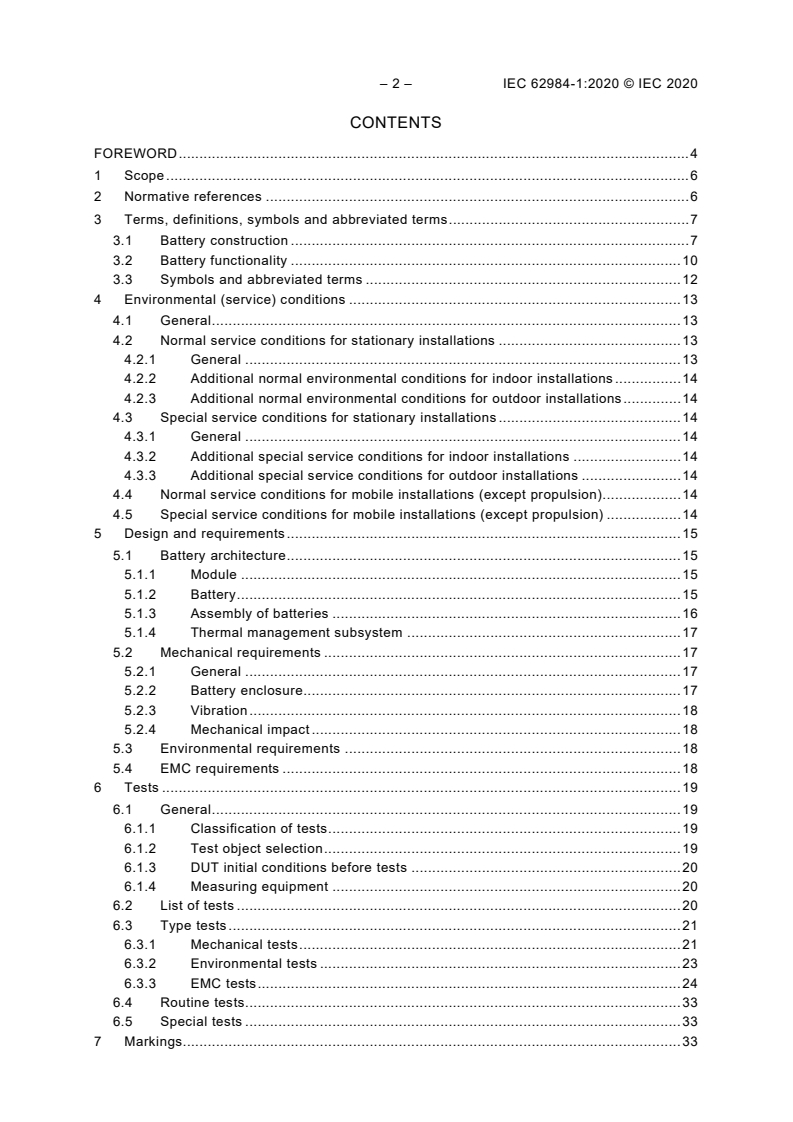
– 2 – IEC 62984-1:2020 © IEC 2020
CONTENTS
FOREWORD . 4
1 Scope . 6
2 Normative references . 6
3 Terms, definitions, symbols and abbreviated terms . 7
3.1 Battery construction . 7
3.2 Battery functionality . 10
3.3 Symbols and abbreviated terms . 12
4 Environmental (service) conditions . 13
4.1 General . 13
4.2 Normal service conditions for stationary installations . 13
4.2.1 General . 13
4.2.2 Additional normal environmental conditions for indoor installations . 14
4.2.3 Additional normal environmental conditions for outdoor installations . 14
4.3 Special service conditions for stationary installations . 14
4.3.1 General . 14
4.3.2 Additional special service conditions for indoor installations . 14
4.3.3 Additional special service conditions for outdoor installations . 14
4.4 Normal service conditions for mobile installations (except propulsion). 14
4.5 Special service conditions for mobile installations (except propulsion) . 14
5 Design and requirements . 15
5.1 Battery architecture . 15
5.1.1 Module . 15
5.1.2 Battery . 15
5.1.3 Assembly of batteries . 16
5.1.4 Thermal management subsystem . 17
5.2 Mechanical requirements . 17
5.2.1 General . 17
5.2.2 Battery enclosure. 17
5.2.3 Vibration . 18
5.2.4 Mechanical impact . 18
5.3 Environmental requirements . 18
5.4 EMC requirements . 18
6 Tests . 19
6.1 General . 19
6.1.1 Classification of tests . 19
6.1.2 Test object selection . 19
6.1.3 DUT initial conditions before tests . 20
6.1.4 Measuring equipment . 20
6.2 List of tests . 20
6.3 Type tests . 21
6.3.1 Mechanical tests . 21
6.3.2 Environmental tests . 23
6.3.3 EMC tests . 24
6.4 Routine tests. 33
6.5 Special tests . 33
7 Markings. 33
7.1 General . 33
7.2 Data plate marking . 33
8 Rules for transportation, installation and maintenance . 33
8.1 Transportation . 33
8.2 Installation . 33
8.3 Maintenance . 33
9 Documentation . 33
9.1 Instruction manual . 33
9.2 Test report . 34
Bibliography . 35
Figure 1 – Components of a battery . 16
Figure 2 – Components of an assembly of batteries . 16
Figure 3 – Thermal management subsystem . 17
Table 1 – List of symbols and abbreviated terms . 13
Table 2 – Electromagnetic environments . 19
Table 3 – Type tests . 21
Table 4 – Damp heat test – Steady state . 23
Table 5 – EMC tests severity level . 25
Table 6 – Assessment criteria description for immunity tests. 26
Table 7 – EFT/Burst test parameters . 28
Table 8 – Surge test levels . 29
– 4 – IEC 62984-1:2020 © IEC 2020
INTERNATIONAL ELECTROTECHNICAL COMMISSION
____________
HIGH-TEMPERATURE SECONDARY BATTERIES –
Part 1: General requirements
FOREWORD
1) The International Electrotechnical Commission (IEC) is a worldwide organization for standardization comprising
all national electrotechnical committees (IEC National Committees). The object of IEC is to promote international
co-operation on all questions concerning standardization in the electrical and electronic fields. To this end and
in addition to other activities, IEC publishes International Standards, Technical Specifications, Technical Reports,
Publicly Available Specifications (PAS) and Guides (hereafter referred to as “IEC Publication(s)”). Their
preparation is entrusted to technical committees; any IEC National Committee interested in the subject dealt with
may participate in this preparatory work. International, governmental and non-governmental organizations liaising
with the IEC also participate in this preparation. IEC collaborates closely with the International Organization for
Standardization (ISO) in accordance with conditions determined by agreement between the two organizations.
2) The formal decisions or agreements of IEC on technical matters express, as nearly as possible, an international
consensus of opinion on the relevant subjects since each technical committee has representation from all
interested IEC National Committees.
3) IEC Publications have the form of recommendations for international use and are accepted by IEC National
Committees in that sense. While all reasonable efforts are made to ensure that the technical content of IEC
Publications is accurate, IEC cannot be held responsible for the way in which they are used or for any
misinterpretation by any end user.
4) In order to promote international uniformity, IEC National Committees undertake to apply IEC Publications
transparently to the maximum extent possible in their national and regional publications. Any divergence between
any IEC Publication and the corresponding national or regional publication shall be clearly indicated in the latter.
5) IEC itself does not provide any attestation of conformity. Independent certification bodies provide conformity
assessment services and, in some areas, access to IEC marks of conformity. IEC is not responsible for any
services carried out by independent certification bodies.
6) All users should ensure that they have the latest edition of this publication.
7) No liability shall attach to IEC or its directors, employees, servants or agents including individual experts and
members of its technical committees and IEC National Committees for any personal injury, property damage or
other damage of any nature whatsoever, whether direct or indirect, or for costs (including legal fees) and
expenses arising out of the publication, use of, or reliance upon, this IEC Publication or any other IEC Publications.
8) Attention is drawn to the Normative references cited in this publication. Use of the referenced publications is
indispensable for the correct application of this publication.
9) Attention is drawn to the possibility that some of the elements of this IEC Publication may be the subject of patent
rights. IEC shall not be held responsible for identifying any or all such patent rights.
International Standard IEC 62984-1 has been prepared by IEC technical committee 21:
Secondary cells and batteries.
The text of this International Standard is based on the following documents:
FDIS Report on voting
21/1031/FDIS 21/1041/RVD
Full information on the voting for the approval of this International Standard can be found in the
report on voting indicated in the above table.
This document has been drafted in accordance with the ISO/IEC Directives, Part 2.
A list of all parts in the IEC 62984 series, published under the general title High-temperature
secondary batteries, can be found on the IEC website.
The committee has decided that the contents of this document will remain unchanged until the
stability date indicated on the IEC website under "http://webstore.iec.ch" in the data related to
the specific document. At this date, the document will be
• reconfirmed,
• withdrawn,
• replaced by a revised edition, or
• amended.
IMPORTANT – The 'colour inside' logo on the cover page of this publication indicates
that it contains colours which are considered to be useful for the correct understanding
of its contents. Users should therefore print this document using a colour printer.
– 6 – IEC 62984-1:2020 © IEC 2020
HIGH-TEMPERATURE SECONDARY BATTERIES –
Part 1: General requirements
1 Scope
This part of IEC 62984 specifies general aspects, definitions and tests for high-temperature
secondary batteries for mobile and/or stationary use and whose nominal voltage does not
exceed 1 500 V.
This document does not cover aircraft batteries, which are covered by IEC 60952 (all parts), or
batteries for the propulsion of electric road vehicles, covered by IEC 61982 (all parts).
NOTE High-temperature batteries are electrochemical systems whose cells’ internal minimum operating
temperature is above 100 °C.
2 Normative references
The following documents are referred to in the text in such a way that some or all of their content
constitutes requirements of this document. For dated references, only the edition cited applies.
For undated references, the latest edition of the referenced document (including any
amendments) applies.
IEC 60068-2-1:2007, Environmental testing – Part 2-1: Tests – Test A: Cold
IEC 60068-2-2:2007, Environmental testing – Part 2-2: Tests – Test B: Dry heat
IEC 60068-2-30:2005, Environmental testing – Part 2-30: Tests – Test Db: Damp heat, cyclic
(12 h + 12 h cycle)
IEC 60068-2-52:2017, Environmental testing – Part 2-52: Tests – Test Kb: Salt mist, cyclic
(sodium chloride solution)
IEC 60068-2-64:2008, Environmental testing – Part 2-64: Tests – Test Fh: Vibration, broadband
random and guidance
IEC 60068-2-75:2014, Environmental testing – Part 2-75: Tests – Test Eh: Hammer tests
IEC 60068-2-78, Environmental testing – Part 2-78: Tests – Test Cab: Damp heat, steady state
IEC 60529, Degrees of protection provided by enclosures (IP Code)
IEC 61000-4-2, Electromagnetic compatibility (EMC) – Part 4-2: Testing and measurement
techniques – Electrostatic discharge immunity test
IEC 61000-4-3, Electromagnetic compatibility (EMC) – Part 4-3: Testing and measurement
techniques – Radiated, radio-frequency, electromagnetic field immunity test
IEC 61000-4-4, Electromagnetic compatibility (EMC) – Part 4-4: Testing and measurement
techniques – Electrical fast transient/burst immunity test
IEC 61000-4-5, Electromagnetic compatibility (EMC) – Part 4-5: Testing and measurement
techniques – Surge immunity test
IEC 61000-4-6, Electromagnetic compatibility (EMC) – Part 4-6: Testing and measurement
techniques – Immunity to conducted disturbances, induced by radio-frequency fields
IEC 61000-4-11, Electromagnetic compatibility (EMC) – Part 4-11: Testing and measurement
techniques – Voltage dips, short interruptions and voltage variations immunity tests
IEC 61000-4-29, Electromagnetic compatibility (EMC) – Part 4-29: Testing and measurement
techniques – Voltage dips, short interruptions and voltage variations on d.c. input power port
immunity tests
IEC 61000-4-34, Electromagnetic compatibility (EMC) – Part 4-34: Testing and measurement
techniques – Voltage dips, short interruptions and voltage variations immunity tests for
equipment with mains current more than 16 A per phase
IEC 61000-6-3, Electromagnetic compatibility (EMC) – Part 6-3: Generic standards – Emission
standard for residential, commercial and light-industrial environments
IEC 61000-6-4, Electromagnetic compatibility (EMC) – Part 6-4: Generic standards – Emission
standard for industrial environments
IEC 61373, Railway applications – Rolling stock equipment – Shock and vibration tests
IEC 62236-3-2, Railway applications – Electromagnetic compatibility – Part 3-2: Rolling stock
– Apparatus
IEC 62262, Degrees of protection provided by enclosures for electrical equipment against
external mechanical impacts (IK code)
CISPR 25, Vehicles, boats and internal combustion engines – Radio disturbance characteristics
– Limits and methods of measurement for the protection of on-board receivers
3 Terms, definitions, symbols and abbreviated terms
For the purposes of this document, the following terms and definitions apply.
ISO and IEC maintain terminological databases for use in standardization at the following
addresses:
• IEC Electropedia: available at http://www.electropedia.org/
• ISO Online browsing platform: available at http://www.iso.org/obp
3.1 Battery construction
3.1.1
cell
basic functional unit, consisting of an assembly of electrodes, electrolyte, container, terminals
and usually separators, that is a source of electric energy obtained by direct conversion of
chemical energy
Note 1 to entry: See primary cell and secondary cell.
[SOURCE: IEC 60050-482:2004, 482-01-01]
3.1.2
secondary cell
cell which is designed to be electrically recharged
– 8 – IEC 62984-1:2020 © IEC 2020
Note 1 to entry: The recharge is accomplished by way of a reversible chemical reaction.
[SOURCE: IEC 60050-482:2004, 482-01-03]
3.1.3
module
standardized and interchangeable assembly of cells connected in series and/or parallel and
associated hardware designed for easy assembly into a commercial battery
[SOURCE: IEC 61427-2:2015, 3.29]
3.1.4
battery
one or more cells fitted with devices necessary for use, for example case, terminals, marking
and protective devices
[SOURCE: IEC 60050-482:2004, 482-01-04]
3.1.5
high-temperature battery
battery whose cells' internal minimum operating temperature is above 100 °C
Note 1 to entry: A high-temperature battery is inactive when the cells are at room temperature or lower.
3.1.6
(cell) electrode
electrode, electrically connected to one terminal of a cell, in electric contact with the electrolyte
of that cell and on which the electrode reaction occurs
Note 1 to entry: For "electrode", see IEC 60050-151:2001, 151-13-01.
Note 2 to entry: The active material may be part of the electrode.
[SOURCE: IEC 60050-482:2004, 482-02-21]
3.1.7
terminal
conductive part of a device, electric circuit or electric network, provided for connecting that
device, electric circuit or electric network to one or more external conductors
[SOURCE: IEC 60050-482:2004, 482-02-22]
3.1.8
negative terminal
accessible conductive part provided for the connection of an external electric circuit to the
negative electrode of the cell
[SOURCE: IEC 60050-482:2004, 482-02-24]
3.1.9
positive terminal
accessible conductive part provided for the connection of an external electric circuit to the
positive electrode of the cell
[SOURCE: IEC 60050-482:2004, 482-02-25]
3.1.10
electrolyte
liquid or solid substance containing mobile ions which render it ionically conductive
[SOURCE: IEC 60050-482:2004, 482-02-29, modified – The note has been omitted.]
3.1.11
active material
material which reacts chemically to produce electric energy when the cell discharges
Note 1 to entry: In secondary cells, the active material is restored to its original state during charge.
[SOURCE: IEC 60050-482:2004, 482-02-33]
3.1.12
enclosure
housing affording the type and degree of protection suitable for the intended application
[SOURCE: IEC 60050-195:1998, 195-02-35]
3.1.13
electrochemical reaction
chemical reaction involving oxidation or reduction of chemical components with a transfer of
electrons to or from the active material
Note 1 to entry: The electrode reaction can also involve other chemical reactions including subreactions on a cell
electrode.
[SOURCE: IEC 60050-482:2004, 482-03-01]
3.1.14
parallel connection (related to cells or batteries)
arrangement of cells or batteries wherein all the positive terminals and all the negative terminals,
respectively, are connected together
[SOURCE: IEC 60050-482:2004, 482-03-39]
3.1.15
parallel series connection (related to cells or batteries)
arrangement of cells or batteries wherein parallel connected cells or batteries are connected in
series
[SOURCE: IEC 60050-482:2004, 482-03-40]
3.1.16
series connection (related to cells or batteries)
arrangement of cells or batteries wherein the positive terminal of each cell or battery is
connected to the negative terminal of the next cell or battery in sequence
[SOURCE: IEC 60050-482:2004, 482-03-41]
3.1.17
series parallel connection (related to cells or batteries)
arrangement of cells or batteries wherein in series connected cells or batteries are connected
in parallel
[SOURCE: IEC 60050-482:2004, 482-03-42]
3.1.18
assembly of batteries
battery arrangement
cluster of several batteries, connected in parallel and in series
– 10 – IEC 62984-1:2020 © IEC 2020
3.1.19
battery management system
BMS
electronic system associated with a battery which monitors and/or manages its state, calculates
secondary data, reports that data and/or controls its environment to influence the battery’s
performance and/or service life
Note 1 to entry: The function of the battery management system can be fully or partially assigned to the battery
pack and/or to equipment that uses this battery.
Note 2 to entry: A battery management system is also called a "battery management unit" (BMU).
Note 3 to entry: This note applies to the French language only.
3.1.20
battery support system
BSS
system which supports a battery and which includes functions, such as communication, fire
prevention, electrical protection and control, air conditioning, anti-intrusion sensors, etc.
Note 1 to entry: This note applies to the French language only.
3.2 Battery functionality
3.2.1
capacity (for cells or batteries)
electric charge which a cell or battery can deliver under specified discharge conditions
Note 1 to entry: The SI unit for electric charge, or quantity of electricity, is the coulomb (1 C = 1 A∙s) but in practice,
capacity is usually expressed in ampere hours (A∙h).
[SOURCE: IEC 60050-482:2004, 482-03-14]
3.2.2
rated capacity
C
r
capacity value of a battery determined under specified conditions and declared by the
manufacturer
[SOURCE: IEC 60050-482:2004, 482-03-15, modified – The symbol has been added.]
3.2.3
battery energy
electric energy which a battery delivers under specified conditions
Note 1 to entry: The SI unit for energy is joule (1 J = 1 W·s), but in practice, battery energy is usually expressed in
watthours (W∙h) (1 W∙h = 3 600 J).
[SOURCE: IEC 60050-482:2004, 482-03-21]
3.2.4
discharge (of a battery)
operation by which a battery delivers, to an external electric circuit and under specified
conditions, electric energy produced in the cells
[SOURCE: IEC 60050-482:2004, 482-03-23]
3.2.5
discharge current
electric current delivered by a battery during its discharge
[SOURCE: IEC 60050-482:2004, 482-03-24]
3.2.6
discharge rate
electric current at which a battery is discharged
Note 1 to entry: The discharge rate is calculated as the rated capacity divided by the corresponding discharge time
which results in an electric current.
[SOURCE: IEC 60050-482:2004, 482-03-25]
3.2.7
nominal value
value of a quantity used to designate and identify a component, device, equipment, or system
[SOURCE: IEC 60050-482:2004, 482-03-43, modified – The note has been omitted.]
3.2.8
nominal voltage
U
n
suitable approximate value of the voltage used to designate or identify a cell, a battery or an
electrochemical system
[SOURCE: IEC 60050-482:2004, 482-03-31, modified – The symbol has been added.]
3.2.9
service life
total period of useful life of a cell or a battery in operation
Note 1 to entry: For primary batteries, service life relates to the total discharge time or capacity under specific
conditions.
Note 2 to entry: For secondary cells and batteries, the service life may be expressed in time, number of
charge/discharge cycles, or capacity in ampere hours (Ah).
[SOURCE: IEC 60050-482:2004, 482-03-46]
3.2.10
charging of a battery
operation during which a secondary cell or battery is supplied with electric energy from an
external circuit which results in chemical changes within the cell and thus the storage of energy
as chemical energy
[SOURCE: IEC 60050-482:2004, 482-05-27]
3.2.11
full charge
state of charge wherein all available active material is in a state such that the charging under
the selected conditions produces no significant increase of capacity
[SOURCE: IEC 60050-482:2004, 482-05-42]
3.2.12
charge rate (relating to secondary cells and batteries)
I
t
electric current at which a secondary cell or battery is charged
Note 1 to entry: The charge rate is expressed as the reference current I = C /n where C is the rated capacity
t r r
declared by the manufacturer and n is the time base in hours for which the rated capacity is declared.
– 12 – IEC 62984-1:2020 © IEC 2020
[SOURCE: IEC 60050-482:2004, 482-05-45, modified – The symbol has been added.]
3.2.13
state of charge
SOC
ratio of the actual electric charge available in a battery and the electric charge in fully charged
state
Note 1 to entry: This note applies to the French language only.
3.2.14
standby state
state in which the battery does not actually charge or discharge but is immediately ready to
operate
Note 1 to entry: Content based on IEC 60050-192:2015, 192-02-12.
3.2.15
idle state
non-operating up state during non-required time
Note 1 to entry: The adjective "idle" designates an item in an idle state.
Note 2 to entry: In some applications, an item in an idle state has some functioning subsystems, and is therefore
considered to be operating.
Note 3 to entry: The idle state is related to charge/discharge of the battery and therefore a high-temperature
secondary battery is in an idle state when it is within its operating temperature range but cannot charge or discharge.
[SOURCE: IEC 60050-192: 2015, 192-02-14, modified – " and the deprecated term
"free state" have been deleted from the term and Note 3 has been added.]
3.3 Symbols and abbreviated terms
The list of symbols and abbreviated terms is given in Table 1.
Table 1 – List of symbols and abbreviated terms
Symbol / Abbreviated term Full term Reference
AM Amplitude modulation
BMS Battery management system See 3.1.19
BSS Battery support system See 3.1.20
C
Rated capacity See 3.2.2
r
CDN Coupling decoupling network
DUT Device under test
EESS Electrical energy storage system
EFT Electrical fast transient
EMC Electromagnetic compatibility
ESD Electrostatic discharge
I
Charge rate See 3.2.12
t
PCS Power conversion system
SOC State of charge See 3.2.13
TDMA Time division multiple access
U
Nominal voltage See 3.2.8
n
UFA Uniform field area
4 Environmental (service) conditions
4.1 General
In high-temperature secondary batteries, cells are kept at high temperature and enclosed within
a thermal insulated enclosure. These batteries are therefore relatively insensitive to external
ambient temperature.
However auxiliary parts such as temperature controllers, BMS etc., are not operating at high
temperature and are therefore impacted by environmental conditions, which have to be taken
into account.
Unless otherwise specified, high-temperature batteries are intended to be used at their rated
characteristics under the normal environmental conditions listed in 4.2 or 4.4.
If the actual service conditions differ from these normal service conditions, high-temperature
batteries will be designed to comply with the special service conditions listed in 4.3 or 4.5.
4.2 Normal service conditions for stationary installations
4.2.1 General
– Altitude: height above sea-level not exceeding 1 000 m
– Vibrations: vibrations during normal operation may be neglected; however
vibrations occurring during transportation shall be taken into account.
– Humidity: RH ≤ 95 %, non-condensing
– 14 – IEC 62984-1:2020 © IEC 2020
4.2.2 Additional normal environmental conditions for indoor installations
– Temperature range: −5 °C to 40 °C
– Solar radiation: may be neglected
– Pollution: not significant
4.2.3 Additional normal environmental conditions for outdoor installations
– Temperature range: −20 °C to 40 °C
– Solar radiation: up to 1 000 W/m
– Pollution: the air may be polluted by dust, smoke, vapours or light salt mist
– Moisture: condensation or precipitation may occur
– Ice coating: < 20 mm
4.3 Special service conditions for stationary installations
4.3.1 General
– Altitude: height above sea-level not exceeding 2 000 m
– Vibrations: vibrations during normal operation may be neglected; however vibrations
occurring during transportation shall be taken into account.
– Humidity: RH ≤ 98 %, condensing
– Pollution: not significant
4.3.2 Additional special service conditions for indoor installations
– Temperature range: −15 °C to 50 °C
– Solar radiation: may be neglected
– Pollution: not significant
4.3.3 Additional special service conditions for outdoor installations
– Temperature range: −15 °C to 50 °C or −40 °C to 40 °C
– Solar radiation: up to 1 180 W/m
– Pollution: the air may be polluted by dust, smoke or vapour.
– Moisture: condensation or precipitation may occur
– Ice coating: < 40 mm
– For coastal or offshore installations, the presence of salt mist shall be taken into account.
4.4 Normal service conditions for mobile installations (except propulsion)
– On-board mounting not exposed to weather conditions
– Temperature range: −15 °C to +55 °C
– Solar radiation: may be neglected
– Altitude: height above sea-level not exceeding 1 000 m
– Vibrations: non-negligible vibrations during normal operation shall be taken into
account
– Humidity: RH ≤ 95 %, non-condensing
4.5 Special service conditions for mobile installations (except propulsion)
– On-board mount exposed to sun and/or rain
– Temperature range: −25 °C to +70 °C
– Solar radiation: up to 1 180 W/m
– Altitude: height above sea-level not exceeding 3 000 m
– Vibrations: non-negligible vibrations during normal operation shall be taken into
account
– Humidity: RH ≤ 98 %, condensing
– Moisture: condensation or precipitation may occur
– Pollution: the air may be polluted by dust, smoke or vapour
– For coastal or ship environments, the presence of salt mist shall be taken into account.
5 Design and requirements
5.1 Battery architecture
5.1.1 Module
High-temperature batteries are normally constructed with multiple cells connected together,
which are assembled with suitable heaters, coolers (if necessary), temperature sensors, etc.,
and contained inside thermally insulated housings. This arrangement is called a "module".
The modular structure is often used due to the wide use of high-temperature batteries for energy
storage applications. Such applications require high capacities and relatively high system
voltages, so the modular structure is fairly common.
A module cannot be used as it is because it contains cells and other components such as
sensors, heaters and coolers but may be missing the logic controls and components needed
for proper operation.
5.1.2 Battery
A battery is composed (see Figure 1) of one or more modules connected together and controlled
by a suitable battery management system (BMS) which provides all the electronic controls
necessary to ensure optimal management of the cells and prevent operation outside reliable
conditions.
A battery is thus necessarily composed of at least a BMS and one or more modules.
– 16 – IEC 62984-1:2020 © IEC 2020
Figure 1 – Components of a battery
5.1.3 Assembly of batteries
Assemblies of batteries, such as those used in electrical energy storage systems (EESS), are
composed of several batteries, connected in parallel and/or in series and all the auxiliary
systems necessary to manage the whole system, often called the battery support system (BSS),
see Figure 2.
Figure 2 – Components of an assembly of batteries
The battery support system (BSS) may include, for example, functions such as communication,
fire prevention, electrical protection and control, air conditioning, anti-intrusion sensors, etc.
In energy storage applications, battery assemblies are typically connected to a power
conditioning system (PCS) which in turn is connected to the grid.
5.1.4 Thermal management subsystem
The specific feature of high-temperature batteries is that they can work only when the internal
temperature of the cells is within the (relatively high) specified operating temperature range, in
which the relevant active materials are in the fused state.
An essential part of this type of battery is therefore the temperature management subsystem,
which forms part of the BMS. A typical structure of such a thermal management subsystem is
depicted in Figure 3.
Figure 3 – Thermal management subsystem
5.2 Mechanical requirements
5.2.1 General
The enclosure and support structures shall be resistant to the deteriorating effects in the
environment in which they are installed, including the effects of water exposure, ultraviolet (UV)
exposure, temperature extremes, corrosion and mechanical impacts and stresses, as applicable
to the installation. Batteries intended for installation in seismic zones shall be designed and
rated for the particular intended zone as noted in the installation documents and system design
specification.
5.2.2 Battery enclosure
The battery enclosure shall be rated to prevent ingress of moisture, dirt or other deteriorating
effects of the environment based upon its intended installation. The battery enclosure shall be
rated not less than IP54 (according to IEC 60529) for outdoor applications and IP43 for indoor
applications.
– 18 – IEC 62984-1:2020 © IEC 2020
5.2.3 Vibration
5.2.3.1 Stationary installations
Stationary battery installations are normally not supposed to be subject to vibrations during
normal operation.
Vibration resistance requirements are thus applicable only to modules or batteries to take into
account vibrations due to transportation. During transportation, modules are generally in cold
state (inactive) and properly packed for shipment. This means that the battery is supposed to
be protected by the package and furthermore that it is impossible for it to release energy.
References for vibration levels encountered during transportation are given in IEC 60721-3-2.
The test procedure is given in 6.3.1.2.
5.2.3.2 Mobile installations
Batteries mounted on board ground vehicles are subjected to vibrations not only during
transportation, but also during normal operation. During normal operation the battery is
electrically connected to its load and is possibly within the operating temperature range, which
means it may be active.
These kinds of batteries are therefore required to withstand the vibrations typical of a ground
vehicle installation during normal operation.
Batteries intended to be used on board ground vehicles shall be tested according to the test
procedure given in 6.3.1.3.
5.2.4 Mechanical impact
The enclosure of the battery shall protect the content against impact and shall have a minimum
IK rating of IK08 with reference to IEC 62262.
The mechanical impact test is described in 6.3.1.4.
5.3 Environmental requirements
The battery shall be designed to withstand the environmental conditions as specified in
Clause 4, according to the relevant application(s). This capability shall be demonstrated with
suitable environmental tests, listed in 6.3.2.
5.4 EMC requirements
All high-temperature secondary batteries rely on an electronic BMS for proper operation. This
poses some concern about the compatibility of this electronic subsystem with the
electromagnetic environments typical of the relevant application.
For this reason some electromagnetic environments are listed in Table 2 according to the most
diffused typical applications. The battery shall be designed to withstand the electromagnetic
disturbances of the selected environment without introducing unacceptable disturbance. This
shall be proven by the tests described in 6.3.
Table 2 – Electromagnetic environments
R I S M
Residential Industrial Substation Mobile
Homes, shops, On-board
Industrial plants Power stations
offices, hospitals, applications on
schools, light buses, railways,
industries, etc. etc.
6 Tests
6.1 General
6.1.1 Classification of tests
The tests specified in this document are classified as follows:
Type test: test made on one or more devices made to a given design, to show that these
devices comply with the requirements of this document.
NOTE 1 This test is typically intended to validate the design.
Routine test: test made on each produced unit during or after manufacture to check if it
complies with the requirements of the standard concerned or the criteria
specified. Routine tests do not impair the properties and reliability of the test
object.
NOTE 2 This test is typically intended to reveal manuf
...