

IEC 62631-3-1:2023
(Main)Dielectric and resistive properties of solid insulating materials - Part 3-1: Determination of resistive properties (DC methods) - Volume resistance and volume resistivity - General method
General Information
- Abstract
IEC 62631-3-1:2023 specifies a method of test for the determination of volume resistance and volume resistivity of electrical insulating materials by applying a DC voltage. This edition includes the following significant technical changes with respect to the previous edition:
- following the withdrawal of IEC 60093 and its partial replacement with the first edition of IEC 62631-3-1, the missing editorial and technical texts have been added and incorporated into this second edition of IEC 62631-3-1;
- the alignment of normative texts and informative notes have been addressed as well as the normative references and bibliography.
- Status
- Published
- Publication Date
- 22-Jan-2023
- Technical Committee
- TC 112 - Evaluation and qualification of electrical insulating materials and systems
- Drafting Committee
- WG 4 - TC 112/WG 4
- Current Stage
- PPUB - Publication issued
- Start Date
- 23-Jan-2023
- Completion Date
- 17-Feb-2023
Buy Documents
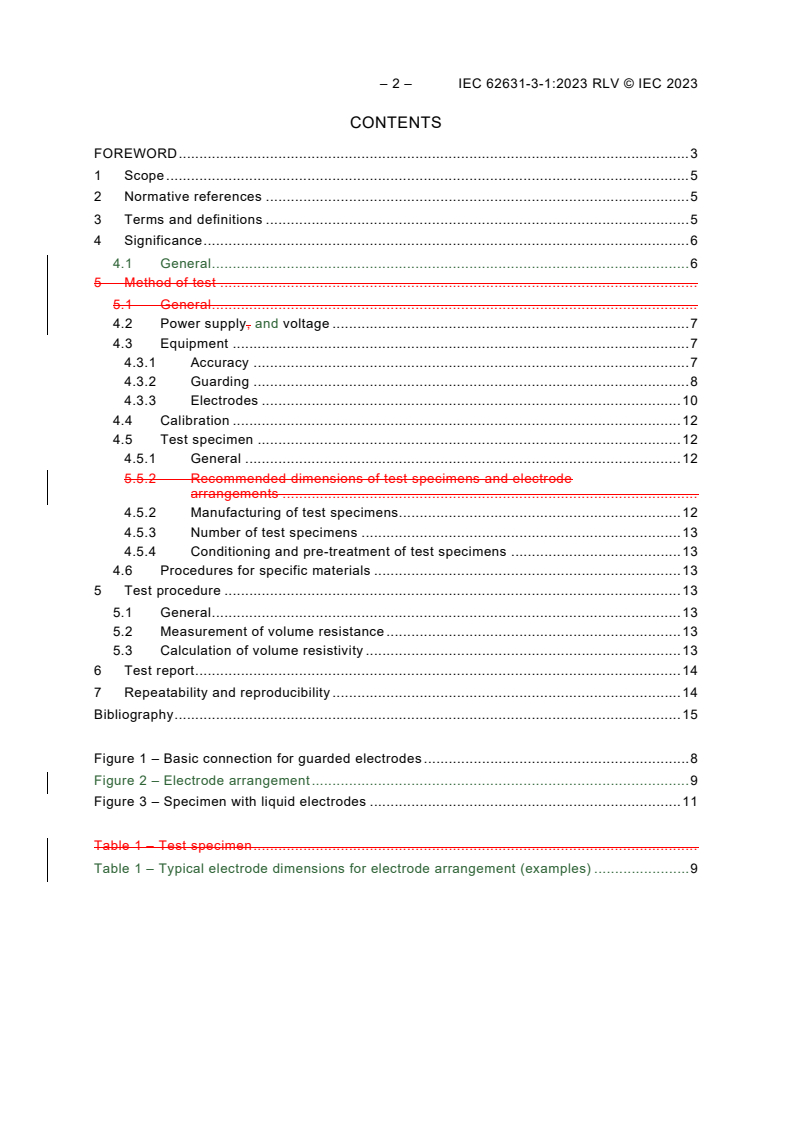
IEC 62631-3-1:2023 RLV - Dielectric and resistive properties of solid insulating materials - Part 3-1: Determination of resistive properties (DC methods) - Volume resistance and volume resistivity - General method Released:1/23/2023
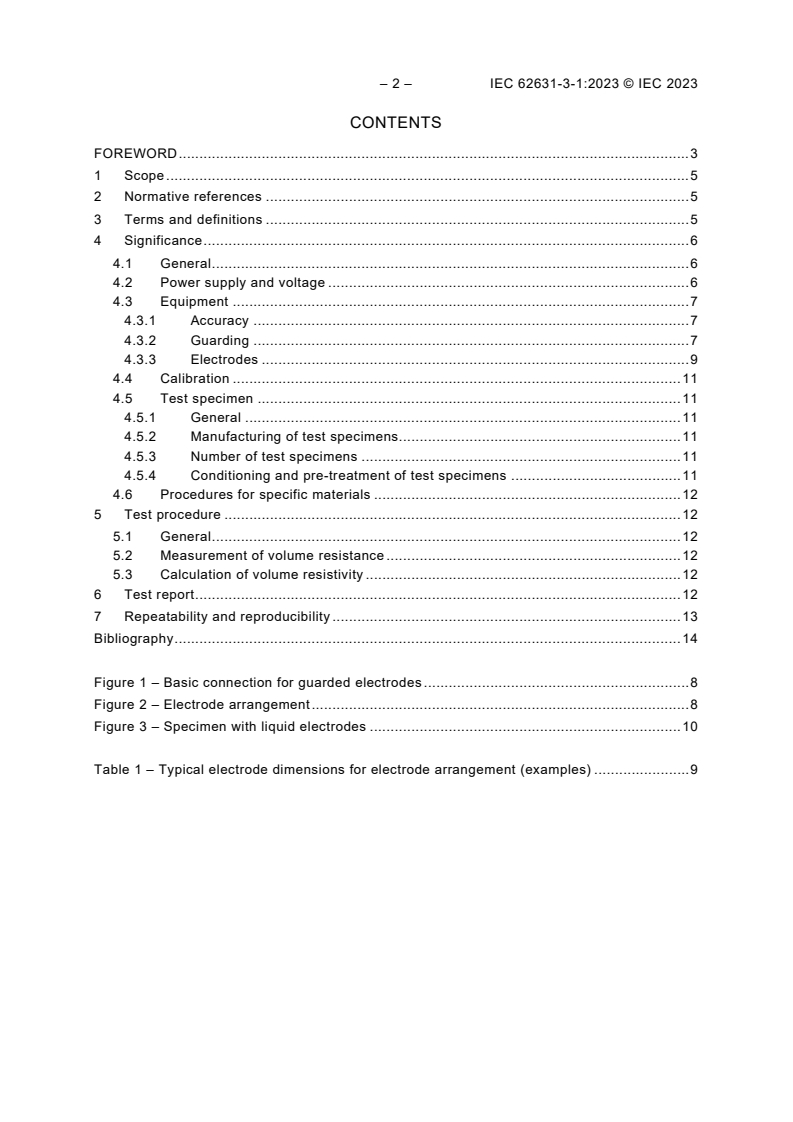
IEC 62631-3-1:2023 - Dielectric and resistive properties of solid insulating materials - Part 3-1: Determination of resistive properties (DC methods) - Volume resistance and volume resistivity - General method Released:1/23/2023
Overview
IEC 62631-3-1:2023 defines a general DC method for measuring the volume resistance and volume resistivity of solid electrical insulating materials. This second edition updates and completes the first edition (2016) by incorporating missing editorial and technical text following the withdrawal of IEC 60093, and by aligning normative texts, informative notes, references and bibliography. The standard describes how to apply a DC voltage to a specimen, monitor the current response, and calculate resistive properties for material selection, quality control and research.
Key topics and technical requirements
- Scope and definitions: precise definitions of volume resistance (Ω) and volume resistivity (Ω·m) and discussion of polarization, conductivity and stray currents.
- DC test method: application of a DC voltage and measurement of the resulting current decay toward steady state; guidance on appropriate electrification times.
- Time dependence: for materials with volume resistivity below about 10 Ω·m, steady state is often reached within ~1 minute; higher-resistivity materials may require minutes to weeks to stabilize-test duration must account for this.
- Instrumentation and accuracy: requirements for power supplies, measurement equipment accuracy, guarding techniques and electrode design (including guarded electrode arrangements shown in the standard).
- Specimen preparation: recommended specimen dimensions, manufacturing, conditioning and pre-treatment to ensure reliable results.
- Calibration and verification: procedures for calibrating the measuring circuit and electrodes.
- Measurement procedure and calculations: stepwise method to determine volume resistance and compute volume resistivity from measured values.
- Reporting and quality: required test-report items and notes on repeatability and reproducibility.
- Polarization and measurement integrity: notes on avoiding spurious repeatability (allow sufficient time between repeated tests to avoid polarization effects).
Practical applications and users
IEC 62631-3-1 is used by:
- Test laboratories performing electrical characterization of insulating materials.
- Insulation and polymer manufacturers for material specification and quality control.
- R&D teams investigating dielectric/resistive behavior, aging and environmental effects (temperature, humidity).
- Product designers and engineers in power, electrical equipment and electronics industries who need reliable resistivity data for insulation selection and safety assessments.
- Certification bodies and procurement groups verifying material performance against standardized test methods.
Practical uses include material comparison, acceptance testing, lifetime/aging studies, and supporting dielectric design decisions where DC leakage or insulation resistance are critical.
Related standards
Normative references cited in IEC 62631-3-1:2023 include:
- IEC 60212 (standard conditions for testing)
- IEC 60455 series (resin-based compounds)
- IEC 60464 series (varnishes)
- IEC 61212 series (industrial materials – rods/tubes)
- ISO 868 (Shore hardness)
For accurate application, users should obtain the latest edition from the IEC Webstore and consult the referenced documents.
Relations
- Effective Date
- 09-Feb-2026
- Effective Date
- 09-Feb-2026
- Effective Date
- 09-Feb-2026
- Effective Date
- 05-Sep-2023
Buy Documents
IEC 62631-3-1:2023 RLV - Dielectric and resistive properties of solid insulating materials - Part 3-1: Determination of resistive properties (DC methods) - Volume resistance and volume resistivity - General method Released:1/23/2023
IEC 62631-3-1:2023 - Dielectric and resistive properties of solid insulating materials - Part 3-1: Determination of resistive properties (DC methods) - Volume resistance and volume resistivity - General method Released:1/23/2023
Get Certified
Connect with accredited certification bodies for this standard

IMQ S.p.A. (Certification)
Italian electrical product certification.

SLG Prüf- und Zertifizierungs GmbH
German testing and certification body.

UL Solutions
Global safety science company with testing, inspection and certification.
Sponsored listings
Frequently Asked Questions
IEC 62631-3-1:2023 is a standard published by the International Electrotechnical Commission (IEC). Its full title is "Dielectric and resistive properties of solid insulating materials - Part 3-1: Determination of resistive properties (DC methods) - Volume resistance and volume resistivity - General method". This standard covers: IEC 62631-3-1:2023 specifies a method of test for the determination of volume resistance and volume resistivity of electrical insulating materials by applying a DC voltage. This edition includes the following significant technical changes with respect to the previous edition: - following the withdrawal of IEC 60093 and its partial replacement with the first edition of IEC 62631-3-1, the missing editorial and technical texts have been added and incorporated into this second edition of IEC 62631-3-1; - the alignment of normative texts and informative notes have been addressed as well as the normative references and bibliography.
IEC 62631-3-1:2023 specifies a method of test for the determination of volume resistance and volume resistivity of electrical insulating materials by applying a DC voltage. This edition includes the following significant technical changes with respect to the previous edition: - following the withdrawal of IEC 60093 and its partial replacement with the first edition of IEC 62631-3-1, the missing editorial and technical texts have been added and incorporated into this second edition of IEC 62631-3-1; - the alignment of normative texts and informative notes have been addressed as well as the normative references and bibliography.
IEC 62631-3-1:2023 is classified under the following ICS (International Classification for Standards) categories: 17.220.99 - Other standards related to electricity and magnetism; 29.035.01 - Insulating materials in general. The ICS classification helps identify the subject area and facilitates finding related standards.
IEC 62631-3-1:2023 has the following relationships with other standards: It is inter standard links to EN ISO 17855-2:2024, EN ISO 10350-1:2025, EN ISO 19069-2:2024, IEC 62631-3-1:2016. Understanding these relationships helps ensure you are using the most current and applicable version of the standard.
IEC 62631-3-1:2023 is available in PDF format for immediate download after purchase. The document can be added to your cart and obtained through the secure checkout process. Digital delivery ensures instant access to the complete standard document.
Standards Content (Sample)
IEC 62631-3-1 ®
Edition 2.0 2023-01
REDLINE VERSION
INTERNATIONAL
STANDARD
colour
inside
Dielectric and resistive properties of solid insulating materials –
Part 3-1: Determination of resistive properties (DC methods) – Volume
resistance and volume resistivity – General method
All rights reserved. Unless otherwise specified, no part of this publication may be reproduced or utilized in any form
or by any means, electronic or mechanical, including photocopying and microfilm, without permission in writing from
either IEC or IEC's member National Committee in the country of the requester. If you have any questions about IEC
copyright or have an enquiry about obtaining additional rights to this publication, please contact the address below or
your local IEC member National Committee for further information.
IEC Secretariat Tel.: +41 22 919 02 11
3, rue de Varembé info@iec.ch
CH-1211 Geneva 20 www.iec.ch
Switzerland
About the IEC
The International Electrotechnical Commission (IEC) is the leading global organization that prepares and publishes
International Standards for all electrical, electronic and related technologies.
About IEC publications
The technical content of IEC publications is kept under constant review by the IEC. Please make sure that you have the
latest edition, a corrigendum or an amendment might have been published.
IEC publications search - webstore.iec.ch/advsearchform IEC Products & Services Portal - products.iec.ch
The advanced search enables to find IEC publications by a Discover our powerful search engine and read freely all the
variety of criteria (reference number, text, technical publications previews. With a subscription you will always have
committee, …). It also gives information on projects, replaced access to up to date content tailored to your needs.
and withdrawn publications.
Electropedia - www.electropedia.org
IEC Just Published - webstore.iec.ch/justpublished
The world's leading online dictionary on electrotechnology,
Stay up to date on all new IEC publications. Just Published
containing more than 22 300 terminological entries in English
details all new publications released. Available online and once
and French, with equivalent terms in 19 additional languages.
a month by email.
Also known as the International Electrotechnical Vocabulary
(IEV) online.
IEC Customer Service Centre - webstore.iec.ch/csc
If you wish to give us your feedback on this publication or need
further assistance, please contact the Customer Service
Centre: sales@iec.ch.
IEC 62631-3-1 ®
Edition 2.0 2023-01
REDLINE VERSION
INTERNATIONAL
STANDARD
colour
inside
Dielectric and resistive properties of solid insulating materials –
Part 3-1: Determination of resistive properties (DC methods) – Volume
resistance and volume resistivity – General method
INTERNATIONAL
ELECTROTECHNICAL
COMMISSION
ICS 17.220.99; 29.035.01 ISBN 978-2-8322-6413-3
– 2 – IEC 62631-3-1:2023 RLV © IEC 2023
CONTENTS
FOREWORD . 3
1 Scope . 5
2 Normative references . 5
3 Terms and definitions . 5
4 Significance . 6
4.1 General . 6
5 Method of test .
5.1 General .
4.2 Power supply, and voltage . 7
4.3 Equipment . 7
4.3.1 Accuracy . 7
4.3.2 Guarding . 8
4.3.3 Electrodes . 10
4.4 Calibration . 12
4.5 Test specimen . 12
4.5.1 General . 12
5.5.2 Recommended dimensions of test specimens and electrode
arrangements .
4.5.2 Manufacturing of test specimens. 12
4.5.3 Number of test specimens . 13
4.5.4 Conditioning and pre-treatment of test specimens . 13
4.6 Procedures for specific materials . 13
5 Test procedure . 13
5.1 General . 13
5.2 Measurement of volume resistance . 13
5.3 Calculation of volume resistivity . 13
6 Test report . 14
7 Repeatability and reproducibility . 14
Bibliography . 15
Figure 1 – Basic connection for guarded electrodes . 8
Figure 2 – Electrode arrangement . 9
Figure 3 – Specimen with liquid electrodes . 11
Table 1 – Test specimen .
Table 1 – Typical electrode dimensions for electrode arrangement (examples) . 9
INTERNATIONAL ELECTROTECHNICAL COMMISSION
____________
DIELECTRIC AND RESISTIVE PROPERTIES
OF SOLID INSULATING MATERIALS –
Part 3-1: Determination of resistive properties (DC methods) –
Volume resistance and volume resistivity – General method
FOREWORD
1) The International Electrotechnical Commission (IEC) is a worldwide organization for standardization comprising
all national electrotechnical committees (IEC National Committees). The object of IEC is to promote international
co-operation on all questions concerning standardization in the electrical and electronic fields. To this end and
in addition to other activities, IEC publishes International Standards, Technical Specifications, Technical Reports,
Publicly Available Specifications (PAS) and Guides (hereafter referred to as "IEC Publication(s)"). Their
preparation is entrusted to technical committees; any IEC National Committee interested in the subject dealt with
may participate in this preparatory work. International, governmental and non-governmental organizations liaising
with the IEC also participate in this preparation. IEC collaborates closely with the International Organization for
Standardization (ISO) in accordance with conditions determined by agreement between the two organizations.
2) The formal decisions or agreements of IEC on technical matters express, as nearly as possible, an international
consensus of opinion on the relevant subjects since each technical committee has representation from all
interested IEC National Committees.
3) IEC Publications have the form of recommendations for international use and are accepted by IEC National
Committees in that sense. While all reasonable efforts are made to ensure that the technical content of IEC
Publications is accurate, IEC cannot be held responsible for the way in which they are used or for any
misinterpretation by any end user.
4) In order to promote international uniformity, IEC National Committees undertake to apply IEC Publications
transparently to the maximum extent possible in their national and regional publications. Any divergence between
any IEC Publication and the corresponding national or regional publication shall be clearly indicated in the latter.
5) IEC itself does not provide any attestation of conformity. Independent certification bodies provide conformity
assessment services and, in some areas, access to IEC marks of conformity. IEC is not responsible for any
services carried out by independent certification bodies.
6) All users should ensure that they have the latest edition of this publication.
7) No liability shall attach to IEC or its directors, employees, servants or agents including individual experts and
members of its technical committees and IEC National Committees for any personal injury, property damage or
other damage of any nature whatsoever, whether direct or indirect, or for costs (including legal fees) and
expenses arising out of the publication, use of, or reliance upon, this IEC Publication or any other IEC
Publications.
8) Attention is drawn to the Normative references cited in this publication. Use of the referenced publications is
indispensable for the correct application of this publication.
9) Attention is drawn to the possibility that some of the elements of this IEC Publication may be the subject of patent
rights. IEC shall not be held responsible for identifying any or all such patent rights.
This redline version of the official IEC Standard allows the user to identify the changes made to
the previous edition IEC 62631-3-1:2016. A vertical bar appears in the margin wherever a change
has been made. Additions are in green text, deletions are in strikethrough red text.
– 4 – IEC 62631-3-1:2023 RLV © IEC 2023
IEC 62631-3-1 has been prepared by IEC technical committee 112: Evaluation and qualification
of electrical insulating materials and systems. It is an International Standard.
This second edition cancels and replaces the first edition published in 2016. This edition
constitutes a technical revision.
This edition includes the following significant technical changes with respect to the previous
edition:
a) following the withdrawal of IEC 60093 and its partial replacement with the first edition of
IEC 62631-3-1, the missing editorial and technical texts have been added and incorporated
into this second edition of IEC 62631-3-1;
b) the alignment of normative texts and informative notes have been addressed as well as the
normative references and bibliography.
The text of this International Standard is based on the following documents:
Draft Report on voting
112/597/FDIS 112/604/RVD
Full information on the voting for its approval can be found in the report on voting indicated in
the above table.
The language used for the development of this International Standard is English.
This document was drafted in accordance with ISO/IEC Directives, Part 2, and developed in
accordance with ISO/IEC Directives, Part 1 and ISO/IEC Directives, IEC Supplement, available
at www.iec.ch/members_experts/refdocs. The main document types developed by IEC are
described in greater detail at www.iec.ch/publications.
A list of all parts in the IEC 62631 series, published under the general title Dielectric and
resistive properties of solid insulating materials, can be found on the IEC website.
The committee has decided that the contents of this document will remain unchanged until the
stability date indicated on the IEC website under webstore.iec.ch in the data related to the
specific document. At this date, the document will be
• reconfirmed,
• withdrawn,
• replaced by a revised edition, or
• amended.
IMPORTANT – The "colour inside" logo on the cover page of this document indicates that it
contains colours which are considered to be useful for the correct understanding of its
contents. Users should therefore print this document using a colour printer.
DIELECTRIC AND RESISTIVE PROPERTIES
OF SOLID INSULATING MATERIALS –
Part 3-1: Determination of resistive properties (DC methods) –
Volume resistance and volume resistivity – General method
1 Scope
This part of IEC 62631 covers specifies a method of test for the determination of volume
resistance and volume resistivity of electrical insulation insulating materials by applying a DC
voltage.
2 Normative references
The following documents are referred to in the text in such a way that some or all of their content
constitutes requirements of this document. For dated references, only the edition cited applies.
For undated references, the latest edition of the referenced document (including any
amendments) applies.
IEC 60212, Standard conditions for use prior to and during the testing of solid electrical
insulating materials
IEC 60455 (all parts), Resin based reactive compounds used for electrical insulation
IEC 60455-2, Resin based reactive compounds used for electrical insulation – Part 2: Methods
of test
IEC 60464 (all parts), Varnishes used for electrical insulation
IEC 60464-2, Varnishes used for electrical insulation – Part 2: Methods of test
IEC 61212 (all parts), Industrial materials – Industrial rigid round laminated tubes and rods
based on thermosetting resins for electrical purposes
IEC 61212-2, Industrial materials – Industrial rigid round laminated tubes and rods based on
thermosetting resins for electrical purposes – Part 2: Methods of test
ISO 868, Plastics and ebonite – Determination of indentation hardness by means of a durometer
(Shore hardness)
3 Terms and definitions
For the purposes of this document, the following terms and definitions apply.
ISO and IEC maintain terminology databases for use in standardization at the following
addresses:
• IEC Electropedia: available at https://www.electropedia.org/
• ISO Online browsing platform: available at https://www.iso.org/obp
– 6 – IEC 62631-3-1:2023 RLV © IEC 2023
3.1
volume resistance
part of the insulation resistance which is due to conduction through the volume
quotient of a direct voltage applied between two electrodes in contact with an insulating medium
and the current through it at a given duration of voltage application
Note 1 to entry: Volume resistance is expressed in Ω.
3.2
volume resistivity
volume resistance of a material related to its volume
quotient of a DC electric field system and the current density within an insulating medium at a
given time of voltage application
Note 1 to entry: Volume resistivity is expressed in Ω · m.
Note 2 to entry: For insulating materials, the volume resistivity is usually determined by means of measuring
electrodes arranged on a sheet of the material.
Note 3 2 to entry: According to IEC 60050-121: Electromagnetism, "conductivity" (IEV 121-12-03) is defined as
"scalar or tensor quantity, the product of which by the electric field strength in a medium is equal to the electric
current density" and "resistivity" (IEV 121-12-04) as "the inverse of the conductivity when this inverse exists".
Measured in this way, the volume resistivity is an average of the resistivity over possible heterogeneities in the
volume incorporated in the measurement; it includes the effect of possible polarization phenomena at the electrodes.
3.3
stray current
leakage current into the earth or into metallic structures buried in the ground and resulting from
their intended or unintended earthing at earth potential resulting in unintended energy losses
4 Significance
4.1 General
Insulating materials are used in general to electrically isolate components of an electrical
system from each other and from earth. For these purposes it is generally desirable to have the
insulation resistance as high as possible, consistent with acceptable mechanical, chemical and
heat resistance properties. Volume resistance is a part of the insulating insulation resistance.
Solid insulating material may can also provide mechanical support.
Volume resistivity can be used as an aid in the choice of an insulating material for a specific
application. The change in resistivity with temperature and humidity may can be great high and
has to be known when designing for operation conditions.
When a direct voltage is applied between the electrodes in contact with a specimen, the current
through it decreases asymptotically towards a steady-state value. The decrease of current with
time may can be due to dielectric polarization and the sweep of mobile ions to the electrodes.
For materials with a volume resistivity less than approximately 10 Ω · m, the steady state is
generally reached within 1 min and the resistance is determined after this time of electrification.
For materials with a higher volume resistivity, the current may can continue to decrease for
several minutes, hours, days or even weeks. For such materials, therefore, longer electrification
times may can be necessary.
NOTE 1 For very high electric field strengths different behaviours can occur.
NOTE 2 For materials with volume resistivity of not more than 10 Ω · m, a period of 1 h after voltage application
can be sufficient to prevent electric shock.
Polarization effects can influence the measurement. Therefore, it is not acceptable to achieve
the measured resistance twice in two consecutive experiments without a sufficient space of
time in-between.
5 Method of test
5.1 General
This general method describes common values for general measurements. If a method for a
specific type of material is described in this standard, the specific method shall be used.
The measurement of volume resistance (and volume resistivity respectively) shall be carried
out carefully and taking into account the electric properties of the measuring circuit as well as
the specific electric properties of the material.
To carry out the test, in most cases the use of high voltages is necessary. Care shall be taken
to prevent electric shock.
Polarization effects can influence the measurement. Therefore it is not acceptable to achieve
the measured resistance twice in two consecutive experiments without a sufficient space of
time in-between.
NOTE For materials with volume resistance of not more than 10 Ω a period of 1 h after voltage application might
be sufficient.
4.2 Power supply, and voltage
A source of very steady direct voltage is required. This may be provided either by batteries or
by rectified and stabilized power supply. The required degree of stability is such that the change
in current due to any change in voltage is negligible compared with the current to be measured.
−5
NOTE 1 The ripple of the voltage source is important. A typical value for 100 V is < 5 × 10 peak to peak.
Commonly specified test voltages to be applied to the complete specimen are 10 V, 100 V,
500 V, 1 000 V, and 10 000 V depending on the thicknesses of samples.
A test voltage selected divided by the thickness of the specimen under test shall not exceed
3 kV/mm.
If otherwise stipulated, a voltage of 100 V is to be used.
Unless otherwise specified, a voltage of 100 V shall be used.
NOTE 2 The maximum voltage expected in the final product application can be used. If it is unknown, 100 V can be
used.
NOTE 3 In air, below 340 V, no partial discharges will occur. Partial discharge can lead to erroneous measurements
of the resistance when a specific inception voltage is exceeded.
4.3 Equipment
4.3.1 Accuracy
Any suitable equipment may be used. The measuring device should be capable of determining
the unknown resistance with an overall accuracy of at least:
• ±10 % for resistances below 10 Ω,
10 14
• ±20 % for resistances between 10 Ω and 10 Ω,
• ±50 % for values resistances higher than 10 Ω.
– 8 – IEC 62631-3-1:2023 RLV © IEC 2023
4.3.2 Guarding
The insulation of the measuring circuit is composed of materials which, at best, have properties
comparable with those of the material under test. Errors in the measurement of the specimen
may can arise from:
• stray current from spurious external voltages which are usually unknown in magnitude and
often sporadic in character;
• inadequate shunting of the specimen resistance, reference resistors or the current
measuring device by insulation, having resistance of unknown, and possibly variable
magnitude;
• the surface resistance may that can be lower than the volume resistance by one order of
magnitude.
An approximate correction of these difficulties may be obtained by making the insulation
resistance of all parts of the circuit as high as possible under the conditions of use. This may
can lead to unwieldy apparatus which is still inadequate for measurement of insulation
resistances higher than the magnitude of some hundred MΩ. A more satisfactory correction is
obtained by using the technique of guarding.
Guarding depends on interposing, in all critical insulated parts, guard conductors which
intercept all stray currents that might can otherwise cause errors. The guard conductors are
connected together, constituting the guard system and forming with the measuring terminals a
three-terminal network. When suitable connections are made, stray currents from spurious
external voltages are shunted away from the measuring circuit by the guard system, the
insulation resistance from either measuring terminal to the guard system shunts a circuit
element which should be of very much lower resistance, and the resistance of the specimen
constitutes the only direct path between the measuring terminals. With this technique the
probability of error is considerably reduced. The basic connections for guarded electrodes used
for volume resistance is shown in Figure 1. The three-electrode arrangement is shown in
Figure 2 and the typical dimensions of the electrodes are given in Table 1.
Key
1 measuring area
2 electrode 1
3 specimen
4 electrode 2 (guard electrode)
5 electrode 3
Figure 1 – Basic connection for guarded electrodes
Key
1 specimen
2 electrode 1
3 measuring area
4 electrode 2 (guard electrode)
5 electrode 3
h average thickness of the specimen
d d d d See Table 1 for examples of electrode dimensions.
1, 2, 3, m
Figure 2 – Electrode arrangement
Table 1 – Typical electrode dimensions for electrode arrangement (examples)
d d d
1 2 3
mm mm mm
Example 1 50 54 74
Example 2 50 60 80
Example 3 50 52 72
Example 4 25 27 47
NOTE 1 Dimensions of specimens are given in 4.5.
NOTE 2 Besides the electrodes in Figure 1 (i.e. the passive guarded electrodes), other types of active guarded
electrodes, which have become popular in recent years, can be used. The active guarded electrode system can
reduce stray current almost to zero by driving the guard conductor with an operational amplifier which keeps the
same potential as the lead (signal) carrying the measured current.
Voltages (e.g. electrochemically or thermally induced) between guard and guarded terminals
can be compensated if they are small. Care Measures shall be taken so that such voltages do
not introduce significant errors in the measurements.
Errors in the measurement of current may can result from the fact that the current-measuring
device is shunted by the resistance between the guarded terminal and the guard system. To
ensure satisfactory operation of the equipment, a measurement should be made with the lead
from the voltage source to the specimen disconnected. Under this condition, the equipment
should indicate infinite resistance within its sensitivity. If suitable standards of known values
are available, they may be used to test the operation of the equipment.
– 10 – IEC 62631-3-1:2023 RLV © IEC 2023
4.3.3 Electrodes
4.3.3.1 General
The electrodes for insulating materials should be of a material that is readily applied, allows
intimate contact with the specimen surface and introduces no appreciable error because of
electrode resistance or contamination of the specimen. The electrode material should be
corrosion resistant under the conditions of the test. The electrodes shall be used with suitable
backing plates of the given form and dimensions. It may can be advantageous to use two
different electrode materials or two methods of application to see if any significant error is
introduced. The following subclauses 4.3.3.2 to 4.3.3.7 list typical electrode materials that may
be used.
4.3.3.2 Conductive silver paint
Certain types of commercially available, high-conductivity silver paints, either air-drying or low-
temperature-baking varieties are sufficiently porous to permit diffusion of moisture through them
and thereby allow the test specimens to be conditioned after application of the electrodes. This
is a particularly useful feature in studying resistance-humidity effects as well as changes with
temperature. However, before conductive paint is used as an electrode material, it should be
established that the solvent in the paint does not affect the electrical properties of the specimen.
Reasonably smooth edges of guard electrodes may be obtained with a fine-bristle brush.
However, for circular electrodes, sharper edges may be obtained by the use of a compass for
drawing the outline circles of the electrodes and filling in the enclosed areas by brush. Clamp-on
masks may be used if the electrode paint is sprayed on.
4.3.3.3 Evaporated or sputtered metal
Evaporated or sputtered metal can be used where it can be shown that the material is not
affected by ion bombardment, temperature stress or vacuum treatment.
4.3.3.4 Liquid electrodes
Liquid electrodes can be used and give satisfactory results. The liquid forming the upper
electrode should be confined, for example, by stainless steel rings, each of which should have
its lower rim reduced to a sharp edge by bevelling on the side away from the liquid. Figure 3
shows the electrode arrangement. Alloys for example containing gallium, indium and tin, which
are liquid at room temperature, have been proved suitable. Mercury is not recommended.
Key
1 Measurement liquid metal electrode
2 specimen
3 guard electrode
4 Liquid metal measuring electrode
Figure 3 – Specimen with liquid electrodes
4.3.3.5 Colloidal graphite
Colloidal graphite dispersed in water or other suitable medium, may be used under the same
conditions as given for conductive silver paint.
4.3.3.6 Conducting rubber
Conducting rubber may be used as an electrode material. It has the advantage that it can be
applied and removed from the specimen quickly and easily. As the electrodes are applied only
during the time of measurement they do not interfere with the conditioning of the specimen. The
resistance of the rubber electrode shall be less than 1 000 Ω.
The conducting rubber material shall be soft enough to ensure that effective contact to the
specimen is obtained when a reasonable pressure, for example 2 kPa (0,2 N/cm ), is applied.
Shore A hardness according to ISO 868 ISO 48-4 in the range of 65 to 85 has been found
suitable.
NOTE Results of resistivity measurements obtained with the application of electrodes made of conducting rubber
are always higher (few tens to few hundreds per cent) in comparison to those obtained for metallic electrodes.
4.3.3.7 Metal foil
Metal foil can be applied to specimen surfaces as electrodes for volume resistance
measurement, but it is not suitable for surface resistance measurement. Aluminum and tin foil
are in common use. They are usually attached to the specimen by a minimum quantity of
petrolatum, silicone grease, oil or other suitable material, as an adhesive.
All adhesive materials may can be of influence to the measurement results and their use should
be minimized.
NOTE A pharmaceutically obtainable jelly of the following composition is suitable as a conductive adhesive:
– anhydrous polyethylene glycol of molecular mass 600 to 800 parts by mass;
– water: 200 parts by mass;
– soft soap (pharmaceutical quality): 1 part by mass;
– potassium chloride: 10 parts by mass;
Soft soap is a non-corrosive neutral soap used for medical purposes.
– 12 – IEC 62631-3-1:2023 RLV © IEC 2023
The electrodes shall be applied under a smoothing pressure sufficient to eliminate all wrinkles
and to work excess adhesive towards the edge of the foil where it can be wiped off with a
cleansing tissue. Rubbing with a soft material such as the finger, has been used successfully.
This technique can be used satisfactorily only on specimens that have very smooth surfaces.
With care, The adhesive film can be reduced to 0,002 5 mm or less.
4.4 Calibration
The equipment shall be calibrated in the magnitude of the volume resistance measured.
NOTE Calibration resistors in the range up to 100 TΩ are commercially available.
4.5 Test specimen
4.5.1 General
The specimen under test shall have a thickness close to that of its application.
If not otherwise specified, a plate ≥ 100 mm × ≥ 100 mm × (1 mm ± 0,5 mm) is recommended.
Unless otherwise specified in the relevant product standard, a plate ≥ 100 mm × ≥ 100 mm ×
(1,00 mm ± 0,1 mm) is recommended.
NOTE 1 A plate thickness of 3 mm is preferred for elastomeric materials, and a plate thickness range between
3 mm and 5 mm is preferred for long fibre reinforced polyester resin or vinyl ester resin moulding components (SMB
BMC).
NOTE 2 For insulating materials, the volume resistivity is usually determined by means of measuring electrodes
arranged on a sheet of the material.
5.5.2 Recommended dimensions of test specimens and electrode arrangements
If not otherwise stipulated in the relevant product standard, the following dimensions, as shown
in Table 1, for test specimens are recommended:
Table 1 – Test specimen
Type of product Recommended dimensions Remarks
of test specimen
Thermoplastic moulding
components
Thermosetting moulding
components
Long fibre reinforced polyester and 100 mm × 100 mm × (3 to 5) mm
vinyl ester moulding components
(SMB BMC)
Epoxy based sheets and laminates
Impregnating resins and varnishes See IEC 62631-3-11 Materials described in
IEC 60455 and IEC 60464
Casting resins Materials described in IEC 60455
Pipes, bars, rods Materials described in IEC 61212
Elastomeric material 100 mm × 100 mm × 3 mm
4.5.2 Manufacturing of test specimens
The production and shape of the test specimens shall be determined by the relevant standards
for the material. During removal and the production of the specimens, the condition of the
material shall not be changed and the specimen shall not be damaged.
If the surface of the test specimen is machined at the contact areas of the electrodes, the type
of machining shall be specified in the test report. The test specimens shall have a geometrically
simple shape (e.g. plate with parallel measuring areas, cylinder etc.).
The specimens from products shall be prepared with by using the product thickness, if possible
known.
4.5.3 Number of test specimens
The number of specimens to be tested shall be determined by the relevant product standards.
If no such data is available, at least three specimens shall be tested.
4.5.4 Conditioning and pre-treatment of test specimens
Conditioning and any other pre-treatment of the test specimens shall be carried out in
accordance with the relevant product standard. If no product standard exists, conditioning shall
be done for at least four days at (23 ± 2) °C and (50 ± 5) % RH in accordance with IEC 60212
(standard climate B) waiting the weight stability of the test specimen (less than 0,1 % of weight
variation assessed with high resolution weighing machine).
4.6 Procedures for specific materials
Specific materials are described in material specifications. IEC 60455-2, IEC 60464-2 and
IEC 61212-2 contain methods of test. If a specific procedure for a specified material exists, this
specification shall be used.
5 Test procedure
5.1 General
A number of specimens as described in the relevant specification shall be prepared. If not
otherwise specified, three specimens shall be tested. The thickness of the sample should be
measured at least at five points before application of the electrodes. The thickness of the
specimens and electrode dimensions shall be measured with an accuracy of ±1 %.
5.2 Measurement of volume resistance
Before measurement, the specimen shall be brought into an electrically stable condition. To
obtain this, short-circuit the measuring electrodes of the specimen through the measuring
device and observe the changing short-circuit current, while increasing the sensitivity of the
current measuring device. The short-circuit current shall attain a fairly constant value. If not
Unless otherwise stipulated specified, the volume resistance shall be determined after a fixed
time of electrification of 1 min. Before the measurement, the specimen shall be stored for at
least 24 h under climate conditions.
NOTE Quality control measurements are typically measured after 1 min.
It is not allowed to repeat the measurement unless the specimen is brought into a stable
condition again.
As the time-dependent behaviour of the material under test is of interest, apply the specified
direct voltage and start a timing device simultaneously. Unless otherwise specified, a
measurement is taken after each of the following times of electrification: 1 min, 2 min, 5 min,
10 min, 50 min and 100 min. If two successive measurements give the same results, the test
shall be terminated.
5.3 Calculation of volume resistivity
The volume resistivity shall be calculated from the following formula:
– 14 – IEC 62631-3-1:2023 RLV © IEC 2023
A
ρ = R ×
x
h
where
ρ is the volume resistivity in Ω · m;
R is the volume resistance measured in Ω;
x
A is the effective area of the electrode in m ;
h is the thickness of the specimen in m (average).
6 Test report
The test report shall include the following:
– complete identification and description of the material tested, including source and
manufacturer's code;
– shape, thickness and number of test specimens;
– test voltage;
– description of electrodes, test set-up and instrument used for the test;
– accuracy of the instrument and calibration method, depending on the measured values of
resistance, if necessary;
– curing conditions of the material and any pre-treatment;
– conditioning of samples and climatic conditions under test test specimens and ambient
conditions during testing;
– number of samples;
– date of test;
– each single value and the median of volume resistance and volume resistivity, respectively;
– ambient conditions during testing;
– any other important observations if applicable.
7 Repeatability and reproducibility
Measurements of volume resistance and volume resistivity are dependent on numerous aspects.
The experience has shown that the reproducibility is in the range of > can be more than 50 %
(of the measured value).
The repeatability is typically between 20 % and 50 %.
NOTE Repeatability and reproducibility are under consideration. IEC TC 112 intends to perform a round robin test
to specify the repeatability and reproducibility with more precision.
Bibliography
IEC 60050-121, International Electrotechnical Vocabulary (IEV) – Part 121: Electromagnetism,
available at https://www.electropedia.org
IEC 62631-3-11, Dielectric and resistive properties of solid insulating materials – Part 3-11:
Determination of resistive properties (DC methods) – Volume resistance and volume resistivity
– Method for impregnation and coating materials
ISO 48-4, Rubber, vulcanized or thermoplastics – Determination of hardness – Part 4:
Indentation hardness by durometer method (Shore hardness)
___________
___________
Under consideration.
IEC 62631-3-1 ®
Edition 2.0 2023-01
INTERNATIONAL
STANDARD
NORME
INTERNATIONALE
Dielectric and resistive properties of solid insulating materials –
Part 3-1: Determination of resistive properties (DC methods) – Volume
resistance and volume resistivity – General method
Propriétés diélectriques et résistives des matériaux isolants solides –
Partie 3-1: Détermination des propriétés résistives (méthodes en courant
continu) – Résistance volumique et résistivité volumique – Méthode générale
– 2 – IEC 62631-3-1:2023 © IEC 2023
CONTENTS
FOREWORD . 3
1 Scope . 5
2 Normative references . 5
3 Terms and definitions . 5
4 Significance . 6
4.1 General . 6
4.2 Power supply and voltage . 6
4.3 Equipment . 7
4.3.1 Accuracy . 7
4.3.2 Guarding . 7
4.3.3 Electrodes . 9
4.4 Calibration . 11
4.5 Test specimen . 11
4.5.1 General . 11
4.5.2 Manufacturing of test specimens. 11
4.5.3 Number of test specimens . 11
4.5.4 Conditioning and pre-treatment of test specimens . 11
4.6 Procedures for specific materials . 12
5 Test procedure . 12
5.1 General . 12
5.2 Measurement of volume resistance . 12
5.3 Calculation of volume resistivity . 12
6 Test report . 12
7 Repeatability and reproducibility . 13
Bibliography . 14
Figure 1 – Basic connection for guarded electrodes . 8
Figure 2 – Electrode arrangement . 8
Figure 3 – Specimen with liquid electrodes . 10
Table 1 – Typical electrode dimensions for electrode arrangement (examples) . 9
INTERNATIONAL ELECTROTECHNICAL COMMISSION
____________
DIELECTRIC AND RESISTIVE PROPERTIES
OF SOLID INSULATING MATERIALS –
Part 3-1: Determination of resistive properties (DC methods) –
Volume resistance and volume resistivity – General method
FOREWORD
1) The International Electrotechnical Commission (IEC) is a worldwide organization for standardization comprising
all national electrotechnical committees (IEC National Committees). The object of IEC is to promote international
co-operation on all questions concerning standardization in the electrical and electronic fields. To this end and
in addition to other activities, IEC publishes International Standards, Technical Specifications, Technical Reports,
Publicly Available Specifications (PAS) and Guides (hereafter referred to as "IEC Publication(s)"). Their
preparation is entrusted to technical committees; any IEC National Committee interested in the subject dealt with
may participate in this preparatory work. International, governmental and non-governmental organizations liaising
with the IEC also participate in this preparation. IEC collaborates closely with the International Organization for
Standardization (ISO) in accordance with conditions determined by agreement between the two organizations.
2) The formal decisions or agreements of IEC on technical matters express, as nearly as possible, an international
consensus of opinion on the relevant subjects since each technical committee has representation from all
interested IEC National Committees.
3) IEC Publications have the form of recommendations for international use and are accepted by IEC National
Committees in that sense. While all reasonable efforts are made to ensure that the technical content of IEC
Publications is accurate, IEC cannot be held responsible for the way in which they are used or for any
misinterpretation by any end user.
4) In order to promote international uniformit
...
IEC 62631-3-1 ®
Edition 2.0 2023-01
INTERNATIONAL
STANDARD
NORME
INTERNATIONALE
Dielectric and resistive properties of solid insulating materials –
Part 3-1: Determination of resistive properties (DC methods) – Volume
resistance and volume resistivity – General method
Propriétés diélectriques et résistives des matériaux isolants solides –
Partie 3-1: Détermination des propriétés résistives (méthodes en courant
continu) – Résistance volumique et résistivité volumique – Méthode générale
All rights reserved. Unless otherwise specified, no part of this publication may be reproduced or utilized in any form
or by any means, electronic or mechanical, including photocopying and microfilm, without permission in writing from
either IEC or IEC's member National Committee in the country of the requester. If you have any questions about IEC
copyright or have an enquiry about obtaining additional rights to this publication, please contact the address below or
your local IEC member National Committee for further information.
Droits de reproduction réservés. Sauf indication contraire, aucune partie de cette publication ne peut être reproduite ni
utilisée sous quelque forme que ce soit et par aucun procédé, électronique ou mécanique, y compris la photocopie et
les microfilms, sans l'accord écrit de l'IEC ou du Comité national de l'IEC du pays du demandeur. Si vous avez des
questions sur le copyright de l'IEC ou si vous désirez obtenir des droits supplémentaires sur cette publication, utilisez
les coordonnées ci-après ou contactez le Comité national de l'IEC de votre pays de résidence.
IEC Secretariat Tel.: +41 22 919 02 11
3, rue de Varembé info@iec.ch
CH-1211 Geneva 20 www.iec.ch
Switzerland
About the IEC
The International Electrotechnical Commission (IEC) is the leading global organization that prepares and publishes
International Standards for all electrical, electronic and related technologies.
About IEC publications
The technical content of IEC publications is kept under constant review by the IEC. Please make sure that you have the
latest edition, a corrigendum or an amendment might have been published.
IEC publications search - webstore.iec.ch/advsearchform IEC Products & Services Portal - products.iec.ch
The advanced search enables to find IEC publications by a Discover our powerful search engine and read freely all the
variety of criteria (reference number, text, technical publications previews. With a subscription you will always have
committee, …). It also gives information on projects, replaced access to up to date content tailored to your needs.
and withdrawn publications.
Electropedia - www.electropedia.org
IEC Just Published - webstore.iec.ch/justpublished
The world's leading online dictionary on electrotechnology,
Stay up to date on all new IEC publications. Just Published
containing more than 22 300 terminological entries in English
details all new publications released. Available online and once
and French, with equivalent terms in 19 additional languages.
a month by email.
Also known as the International Electrotechnical Vocabulary
(IEV) online.
IEC Customer Service Centre - webstore.iec.ch/csc
If you wish to give us your feedback on this publication or need
further assistance, please contact the Customer Service
Centre: sales@iec.ch.
A propos de l'IEC
La Commission Electrotechnique Internationale (IEC) est la première organisation mondiale qui élabore et publie des
Normes internationales pour tout ce qui a trait à l'électricité, à l'électronique et aux technologies apparentées.
A propos des publications IEC
Le contenu technique des publications IEC est constamment revu. Veuillez vous assurer que vous possédez l’édition la
plus récente, un corrigendum ou amendement peut avoir été publié.
Recherche de publications IEC - Découvrez notre puissant moteur de recherche et consultez
webstore.iec.ch/advsearchform gratuitement tous les aperçus des publications. Avec un
La recherche avancée permet de trouver des publications IEC abonnement, vous aurez toujours accès à un contenu à jour
en utilisant différents critères (numéro de référence, texte, adapté à vos besoins.
comité d’études, …). Elle donne aussi des informations sur les
projets et les publications remplacées ou retirées. Electropedia - www.electropedia.org
Le premier dictionnaire d'électrotechnologie en ligne au monde,
IEC Just Published - webstore.iec.ch/justpublished
avec plus de 22 300 articles terminologiques en anglais et en
Restez informé sur les nouvelles publications IEC. Just
français, ainsi que les termes équivalents dans 19 langues
Published détaille les nouvelles publications parues.
additionnelles. Egalement appelé Vocabulaire
Disponible en ligne et une fois par mois par email.
Electrotechnique International (IEV) en ligne.
Service Clients - webstore.iec.ch/csc
Si vous désirez nous donner des commentaires sur cette
publication ou si vous avez des questions contactez-nous:
sales@iec.ch.
IEC Products & Services Portal - products.iec.ch
IEC 62631-3-1 ®
Edition 2.0 2023-01
INTERNATIONAL
STANDARD
NORME
INTERNATIONALE
Dielectric and resistive properties of solid insulating materials –
Part 3-1: Determination of resistive properties (DC methods) – Volume
resistance and volume resistivity – General method
Propriétés diélectriques et résistives des matériaux isolants solides –
Partie 3-1: Détermination des propriétés résistives (méthodes en courant
continu) – Résistance volumique et résistivité volumique – Méthode générale
INTERNATIONAL
ELECTROTECHNICAL
COMMISSION
COMMISSION
ELECTROTECHNIQUE
INTERNATIONALE
ICS 17.220.99; 29.035.01 ISBN 978-2-8322-6359-4
– 2 – IEC 62631-3-1:2023 © IEC 2023
CONTENTS
FOREWORD . 3
1 Scope . 5
2 Normative references . 5
3 Terms and definitions . 5
4 Significance . 6
4.1 General . 6
4.2 Power supply and voltage . 6
4.3 Equipment . 7
4.3.1 Accuracy . 7
4.3.2 Guarding . 7
4.3.3 Electrodes . 9
4.4 Calibration . 11
4.5 Test specimen . 11
4.5.1 General . 11
4.5.2 Manufacturing of test specimens. 11
4.5.3 Number of test specimens . 11
4.5.4 Conditioning and pre-treatment of test specimens . 11
4.6 Procedures for specific materials . 12
5 Test procedure . 12
5.1 General . 12
5.2 Measurement of volume resistance . 12
5.3 Calculation of volume resistivity . 12
6 Test report . 12
7 Repeatability and reproducibility . 13
Bibliography . 14
Figure 1 – Basic connection for guarded electrodes . 8
Figure 2 – Electrode arrangement . 8
Figure 3 – Specimen with liquid electrodes . 10
Table 1 – Typical electrode dimensions for electrode arrangement (examples) . 9
INTERNATIONAL ELECTROTECHNICAL COMMISSION
____________
DIELECTRIC AND RESISTIVE PROPERTIES
OF SOLID INSULATING MATERIALS –
Part 3-1: Determination of resistive properties (DC methods) –
Volume resistance and volume resistivity – General method
FOREWORD
1) The International Electrotechnical Commission (IEC) is a worldwide organization for standardization comprising
all national electrotechnical committees (IEC National Committees). The object of IEC is to promote international
co-operation on all questions concerning standardization in the electrical and electronic fields. To this end and
in addition to other activities, IEC publishes International Standards, Technical Specifications, Technical Reports,
Publicly Available Specifications (PAS) and Guides (hereafter referred to as "IEC Publication(s)"). Their
preparation is entrusted to technical committees; any IEC National Committee interested in the subject dealt with
may participate in this preparatory work. International, governmental and non-governmental organizations liaising
with the IEC also participate in this preparation. IEC collaborates closely with the International Organization for
Standardization (ISO) in accordance with conditions determined by agreement between the two organizations.
2) The formal decisions or agreements of IEC on technical matters express, as nearly as possible, an international
consensus of opinion on the relevant subjects since each technical committee has representation from all
interested IEC National Committees.
3) IEC Publications have the form of recommendations for international use and are accepted by IEC National
Committees in that sense. While all reasonable efforts are made to ensure that the technical content of IEC
Publications is accurate, IEC cannot be held responsible for the way in which they are used or for any
misinterpretation by any end user.
4) In order to promote international uniformity, IEC National Committees undertake to apply IEC Publications
transparently to the maximum extent possible in their national and regional publications. Any divergence between
any IEC Publication and the corresponding national or regional publication shall be clearly indicated in the latter.
5) IEC itself does not provide any attestation of conformity. Independent certification bodies provide conformity
assessment services and, in some areas, access to IEC marks of conformity. IEC is not responsible for any
services carried out by independent certification bodies.
6) All users should ensure that they have the latest edition of this publication.
7) No liability shall attach to IEC or its directors, employees, servants or agents including individual experts and
members of its technical committees and IEC National Committees for any personal injury, property damage or
other damage of any nature whatsoever, whether direct or indirect, or for costs (including legal fees) and
expenses arising out of the publication, use of, or reliance upon, this IEC Publication or any other IEC
Publications.
8) Attention is drawn to the Normative references cited in this publication. Use of the referenced publications is
indispensable for the correct application of this publication.
9) Attention is drawn to the possibility that some of the elements of this IEC Publication may be the subject of patent
rights. IEC shall not be held responsible for identifying any or all such patent rights.
IEC 62631-3-1 has been prepared by IEC technical committee 112: Evaluation and qualification
of electrical insulating materials and systems. It is an International Standard.
This second edition cancels and replaces the first edition published in 2016. This edition
constitutes a technical revision.
This edition includes the following significant technical changes with respect to the previous
edition:
a) following the withdrawal of IEC 60093 and its partial replacement with the first edition of
IEC 62631-3-1, the missing editorial and technical texts have been added and incorporated
into this second edition of IEC 62631-3-1;
b) the alignment of normative texts and informative notes have been addressed as well as the
normative references and bibliography.
– 4 – IEC 62631-3-1:2023 © IEC 2023
The text of this International Standard is based on the following documents:
Draft Report on voting
112/597/FDIS 112/604/RVD
Full information on the voting for its approval can be found in the report on voting indicated in
the above table.
The language used for the development of this International Standard is English.
This document was drafted in accordance with ISO/IEC Directives, Part 2, and developed in
accordance with ISO/IEC Directives, Part 1 and ISO/IEC Directives, IEC Supplement, available
at www.iec.ch/members_experts/refdocs. The main document types developed by IEC are
described in greater detail at www.iec.ch/publications.
A list of all parts in the IEC 62631 series, published under the general title Dielectric and
resistive properties of solid insulating materials, can be found on the IEC website.
The committee has decided that the contents of this document will remain unchanged until the
stability date indicated on the IEC website under webstore.iec.ch in the data related to the
specific document. At this date, the document will be
• reconfirmed,
• withdrawn,
• replaced by a revised edition, or
• amended.
DIELECTRIC AND RESISTIVE PROPERTIES
OF SOLID INSULATING MATERIALS –
Part 3-1: Determination of resistive properties (DC methods) –
Volume resistance and volume resistivity – General method
1 Scope
This part of IEC 62631 specifies a method of test for the determination of volume resistance
and volume resistivity of electrical insulating materials by applying a DC voltage.
2 Normative references
The following documents are referred to in the text in such a way that some or all of their content
constitutes requirements of this document. For dated references, only the edition cited applies.
For undated references, the latest edition of the referenced document (including any
amendments) applies.
IEC 60212, Standard conditions for use prior to and during the testing of solid electrical
insulating materials
IEC 60455-2, Resin based reactive compounds used for electrical insulation – Part 2: Methods
of test
IEC 60464-2, Varnishes used for electrical insulation – Part 2: Methods of test
IEC 61212-2, Industrial materials – Industrial rigid round laminated tubes and rods based on
thermosetting resins for electrical purposes – Part 2: Methods of test
3 Terms and definitions
For the purposes of this document, the following terms and definitions apply.
ISO and IEC maintain terminology databases for use in standardization at the following
addresses:
• IEC Electropedia: available at https://www.electropedia.org/
• ISO Online browsing platform: available at https://www.iso.org/obp
3.1
volume resistance
quotient of a direct voltage applied between two electrodes in contact with an insulating medium
and the current through it at a given duration of voltage application
Note 1 to entry: Volume resistance is expressed in Ω.
3.2
volume resistivity
quotient of a DC electric field system and the current density within an insulating medium at a
given time of voltage application
– 6 – IEC 62631-3-1:2023 © IEC 2023
Note 1 to entry: Volume resistivity is expressed in Ω · m.
Note 2 to entry: According to IEC 60050-121, "conductivity" (IEV 121-12-03) is defined as "scalar or tensor quantity,
the product of which by the electric field strength in a medium is equal to the electric current density" and "resistivity"
(IEV 121-12-04) as "the inverse of the conductivity when this inverse exists". Measured in this way, the volume
resistivity is an average of the resistivity over possible heterogeneities in the volume incorporated in the
measurement; it includes the effect of possible polarization phenomena at the electrodes.
3.3
stray current
leakage current into the earth or into metallic structures at earth potential resulting in
unintended energy losses
4 Significance
4.1 General
Insulating materials are used in general to electrically isolate components of an electrical
system from each other and from earth. For these purposes it is generally desirable to have the
insulation resistance as high as possible, consistent with acceptable mechanical, chemical and
heat resistance properties. Volume resistance is a part of the insulation resistance. Solid
insulating material can also provide mechanical support.
Volume resistivity can be used as an aid in the choice of an insulating material for a specific
application. The change in resistivity with temperature and humidity can be high and has to be
known when designing for operation conditions.
When a direct voltage is applied between the electrodes in contact with a specimen, the current
through it decreases asymptotically towards a steady-state value. The decrease of current with
time can be due to dielectric polarization and the sweep of mobile ions to the electrodes. For
materials with a volume resistivity less than approximately 10 Ω · m, the steady state is
generally reached within 1 min and the resistance is determined after this time of electrification.
For materials with a higher volume resistivity, the current can continue to decrease for several
minutes, hours, days or even weeks. For such materials, therefore, longer electrification times
can be necessary.
NOTE 1 For very high electric field strengths different behaviours can occur.
NOTE 2 For materials with volume resistivity of not more than 10 Ω · m, a period of 1 h after voltage application
can be sufficient to prevent electric shock.
Polarization effects can influence the measurement. Therefore, it is not acceptable to achieve
the measured resistance twice in two consecutive experiments without a sufficient space of
time in-between.
4.2 Power supply and voltage
A source of very steady direct voltage is required. This may be provided either by batteries or
by rectified and stabilized power supply. The required degree of stability is such that the change
in current due to any change in voltage is negligible compared with the current to be measured.
−5
NOTE 1 The ripple of the voltage source is important. A typical value for 100 V is < 5 × 10 peak to peak.
Commonly specified test voltages to be applied to the complete specimen are 100 V, 500 V,
1 000 V, and 10 000 V depending on the thicknesses of samples.
A test voltage selected divided by the thickness of the specimen under test shall not exceed
3 kV/mm.
Unless otherwise specified, a voltage of 100 V shall be used.
NOTE 2 The maximum voltage expected in the final product application can be used. If it is unknown, 100 V can be
used.
NOTE 3 In air, below 340 V, no partial discharges will occur. Partial discharge can lead to erroneous measurements
of the resistance when a specific inception voltage is exceeded.
4.3 Equipment
4.3.1 Accuracy
Any suitable equipment may be used. The measuring device should be capable of determining
the unknown resistance with an overall accuracy of at least:
• ±10 % for resistances below 10 Ω,
10 14
• ±20 % for resistances between 10 Ω and 10 Ω,
• ±50 % for resistances higher than 10 Ω.
4.3.2 Guarding
The insulation of the measuring circuit is composed of materials which, at best, have properties
comparable with those of the material under test. Errors in the measurement of the specimen
can arise from:
• stray current from spurious external voltages which are usually unknown in magnitude and
often sporadic in character;
• inadequate shunting of the specimen resistance, reference resistors or the current
measuring device by insulation, having resistance of unknown, and possibly variable
magnitude;
• the surface resistance that can be lower than the volume resistance by one order of
magnitude.
An approximate correction of these difficulties may be obtained by making the insulation
resistance of all parts of the circuit as high as possible under the conditions of use. This can
lead to unwieldy apparatus which is still inadequate for measurement of insulation resistances
higher than the magnitude of some hundred MΩ. A more satisfactory correction is obtained by
using the technique of guarding.
Guarding depends on interposing, in all critical insulated parts, guard conductors which
intercept all stray currents that can otherwise cause errors. The guard conductors are
connected together, constituting the guard system and forming with the measuring terminals a
three-terminal network. When suitable connections are made, stray currents from spurious
external voltages are shunted away from the measuring circuit by the guard system, the
insulation resistance from either measuring terminal to the guard system shunts a circuit
element which should be of very much lower resistance, and the resistance of the specimen
constitutes the only direct path between the measuring terminals. With this technique the
probability of error is considerably reduced. The basic connections for guarded electrodes used
for volume resistance is shown in Figure 1. The three-electrode arrangement is shown in
Figure 2 and the typical dimensions of the electrodes are given in Table 1.
– 8 – IEC 62631-3-1:2023 © IEC 2023
Key
1 measuring area
2 electrode 1
3 specimen
4 electrode 2 (guard electrode)
5 electrode 3
Figure 1 – Basic connection for guarded electrodes
Key
1 specimen
2 electrode 1
3 measuring area
4 electrode 2 (guard electrode)
5 electrode 3
h average thickness of the specimen
d d d d See Table 1 for examples of electrode dimensions.
1, 2, 3, m
Figure 2 – Electrode arrangement
Table 1 – Typical electrode dimensions for electrode arrangement (examples)
d d d
1 2 3
mm mm mm
Example 1 50 54 74
Example 2 50 60 80
Example 3 50 52 72
Example 4 25 27 47
NOTE 1 Dimensions of specimens are given in 4.5.
NOTE 2 Besides the electrodes in Figure 1 (i.e. the passive guarded electrodes), other types of active guarded
electrodes, which have become popular in recent years, can be used. The active guarded electrode system can
reduce stray current almost to zero by driving the guard conductor with an operational amplifier which keeps the
same potential as the lead (signal) carrying the measured current.
Voltages (e.g. electrochemically or thermally induced) between guard and guarded terminals
can be compensated if they are small. Measures shall be taken so that such voltages do not
introduce significant errors in the measurements.
Errors in the measurement of current can result from the fact that the current-measuring device
is shunted by the resistance between the guarded terminal and the guard system. To ensure
satisfactory operation of the equipment, a measurement should be made with the lead from the
voltage source to the specimen disconnected. Under this condition, the equipment should
indicate infinite resistance within its sensitivity. If suitable standards of known values are
available, they may be used to test the operation of the equipment.
4.3.3 Electrodes
4.3.3.1 General
The electrodes for insulating materials should be of a material that is readily applied, allows
intimate contact with the specimen surface and introduces no appreciable error because of
electrode resistance or contamination of the specimen. The electrode material should be
corrosion resistant under the conditions of the test. The electrodes shall be used with suitable
backing plates of the given form and dimensions. It can be advantageous to use two different
electrode materials or two methods of application to see if any significant error is introduced.
The following subclauses 4.3.3.2 to 4.3.3.7 list typical electrode materials that may be used.
4.3.3.2 Conductive silver paint
Certain types of commercially available, high-conductivity silver paints, either air-drying or low-
temperature-baking varieties are sufficiently porous to permit diffusion of moisture through them
and thereby allow the test specimens to be conditioned after application of the electrodes. This
is a particularly useful feature in studying resistance-humidity effects as well as changes with
temperature. However, before conductive paint is used as an electrode material, it should be
established that the solvent in the paint does not affect the electrical properties of the specimen.
Reasonably smooth edges of guard electrodes may be obtained with a fine-bristle brush.
However, for circular electrodes, sharper edges may be obtained by the use of a compass for
drawing the outline circles of the electrodes and filling in the enclosed areas by brush. Clamp-on
masks may be used if the electrode paint is sprayed on.
4.3.3.3 Evaporated or sputtered metal
Evaporated or sputtered metal can be used where it can be shown that the material is not
affected by ion bombardment, temperature stress or vacuum treatment.
– 10 – IEC 62631-3-1:2023 © IEC 2023
4.3.3.4 Liquid electrodes
Liquid electrodes can be used and give satisfactory results. The liquid forming the upper
electrode should be confined, for example, by stainless steel rings, each of which should have
its lower rim reduced to a sharp edge by bevelling on the side away from the liquid. Figure 3
shows the electrode arrangement. Alloys for example containing gallium, indium and tin, which
are liquid at room temperature, have been proved suitable. Mercury is not recommended.
Key
1 liquid metal electrode
2 specimen
3 guard electrode
4 measuring electrode
Figure 3 – Specimen with liquid electrodes
4.3.3.5 Colloidal graphite
Colloidal graphite dispersed in water or other suitable medium, may be used under the same
conditions as given for conductive silver paint.
4.3.3.6 Conducting rubber
Conducting rubber may be used as an electrode material. It has the advantage that it can be
applied and removed from the specimen quickly and easily. As the electrodes are applied only
during the time of measurement they do not interfere with the conditioning of the specimen. The
resistance of the rubber electrode shall be less than 1 000 Ω.
The conducting rubber material shall be soft enough to ensure that effective contact to the
specimen is obtained when a reasonable pressure, for example 2 kPa (0,2 N/cm ), is applied.
Shore A hardness according to ISO 48-4 in the range of 65 to 85 has been found suitable.
NOTE Results of resistivity measurements obtained with the application of electrodes made of conducting rubber
are always higher (few tens to few hundreds per cent) in comparison to those obtained for metallic electrodes.
4.3.3.7 Metal foil
Metal foil can be applied to specimen surfaces as electrodes for volume resistance
measurement. Aluminum and tin foil are in common use. They are usually attached to the
specimen by a minimum quantity of petrolatum, silicone grease, oil or other suitable material,
as an adhesive.
All adhesive materials can be of influence to the measurement results and their use should be
minimized.
NOTE A pharmaceutically obtainable jelly of the following composition is suitable as a conductive adhesive:
– anhydrous polyethylene glycol of molecular mass 600 to 800 parts by mass;
– water: 200 parts by mass;
– soft soap (pharmaceutical quality): 1 part by mass;
– potassium chloride: 10 parts by mass;
Soft soap is a non-corrosive neutral soap used for medical purposes.
The electrodes shall be applied under a smoothing pressure sufficient to eliminate all wrinkles
and to work excess adhesive towards the edge of the foil where it can be wiped off with a
cleansing tissue. Rubbing with a soft material such as the finger, has been used successfully.
This technique can be used satisfactorily only on specimens that have very smooth surfaces.
The adhesive film can be reduced to 0,002 5 mm or less.
4.4 Calibration
The equipment shall be calibrated in the magnitude of the volume resistance measured.
NOTE Calibration resistors in the range up to 100 TΩ are commercially available.
4.5 Test specimen
4.5.1 General
The specimen under test shall have a thickness close to that of its application.
Unless otherwise specified in the relevant product standard, a plate ≥ 100 mm × ≥ 100 mm ×
(1,00 mm ± 0,1 mm) is recommended.
NOTE 1 A plate thickness of 3 mm is preferred for elastomeric materials, and a plate thickness range between
3 mm and 5 mm is preferred for long fibre reinforced polyester resin or vinyl ester resin moulding components (SMB
BMC).
NOTE 2 For insulating materials, the volume resistivity is usually determined by means of measuring electrodes
arranged on a sheet of the material.
4.5.2 Manufacturing of test specimens
The production and shape of the test specimens shall be determined by the relevant standards
for the material. During the production of the specimens, the condition of the material shall not
be changed and the specimen shall not be damaged.
If the surface of the test specimen is machined at the contact areas of the electrodes, the type
of machining shall be specified in the test report. The test specimens shall have a geometrically
simple shape (e.g. plate with parallel measuring areas, cylinder).
The specimens from products shall be prepared by using the product thickness, if known.
4.5.3 Number of test specimens
The number of specimens to be tested shall be determined by the relevant product standards.
If no such data is available, at least three specimens shall be tested.
4.5.4 Conditioning and pre-treatment of test specimens
Conditioning and any other pre-treatment of the test specimens shall be carried out in
accordance with the relevant product standard. If no product standard exists, conditioning shall
be done for at least four days at (23 ± 2) °C and (50 ± 5) % RH in accordance with IEC 60212
(standard climate B) waiting the weight stability of the test specimen (less than 0,1 % of weight
variation assessed with high resolution weighing machine).
– 12 – IEC 62631-3-1:2023 © IEC 2023
4.6 Procedures for specific materials
Specific materials are described in material specifications. IEC 60455-2, IEC 60464-2 and
IEC 61212-2 contain methods of test. If a specific procedure for a specified material exists, this
specification shall be used.
5 Test procedure
5.1 General
A number of specimens as described in the relevant specification shall be prepared. If not
otherwise specified, three specimens shall be tested. The thickness of the sample should be
measured at least at five points before application of the electrodes. The thickness of the
specimens and electrode dimensions shall be measured with an accuracy of ±1 %.
5.2 Measurement of volume resistance
Before measurement, the specimen shall be brought into an electrically stable condition. To
obtain this, short-circuit the measuring electrodes of the specimen through the measuring
device and observe the changing short-circuit current, while increasing the sensitivity of the
current measuring device. The short-circuit current shall attain a fairly constant value. Unless
otherwise specified, the volume resistance shall be determined after a fixed time of
electrification of 1 min. Before the measurement, the specimen shall be stored for at least 24 h
under climate conditions.
NOTE Quality control measurements are typically measured after 1 min.
It is not allowed to repeat the measurement unless the specimen is brought into a stable
condition again.
As the time-dependent behaviour of the material under test is of interest, apply the specified
direct voltage and start a timing device simultaneously. Unless otherwise specified, a
measurement is taken after each of the following times of electrification: 1 min, 2 min, 5 min,
10 min, 50 min and 100 min. If two successive measurements give the same results, the test
shall be terminated.
5.3 Calculation of volume resistivity
The volume resistivity shall be calculated from the following formula:
A
ρ= R ×
x
h
where
ρ is the volume resistivity in Ω · m;
R is the volume resistance measured in Ω;
x
A is the effective area of the electrode in m ;
h is the thickness of the specimen in m (average).
6 Test report
The test report shall include the following:
– complete identification and description of the material tested, including source and
manufacturer's code;
– shape, thickness and number of test specimens;
– test voltage;
– description of electrodes, test set-up and instrument used for the test;
– accuracy of the instrument and calibration method, depending on the measured values of
resistance, if necessary;
– curing conditions of the material and any pre-treatment;
– conditioning of test specimens and ambient conditions during testing;
– number of samples;
– date of test;
– each single value and the median of volume resistance and volume resistivity, respectively;
– any other important observations if applicable.
7 Repeatability and reproducibility
Measurements of volume resistance and volume resistivity are dependent on numerous aspects.
The experience has shown that the reproducibility can be more than 50 % (of the measured
value).
The repeatability is typically between 20 % and 50 %.
NOTE Repeatability and reproducibility are under consideration. IEC TC 112 intends to perform a round robin test
to specify the repeatability and reproducibility with more precision.
– 14 – IEC 62631-3-1:2023 © IEC 2023
Bibliography
IEC 60050-121, International Electrotechnical Vocabulary (IEV) – Part 121: Electromagnetism,
available at https://www.electropedia.org
IEC 62631-3-11, Dielectric and resistive properties of solid insulating materials – Part 3-11:
Determination of resistive properties (DC methods) – Volume resistance and volume resistivity
– Method for impregnation and coating materials
ISO 48-4, Rubber, vulcanized or thermoplastics – Determination of hardness – Part 4:
Indentation hardness by durometer method (Shore hardness)
___________
– 16 – IEC 62631-3-1:2023 © IEC 2023
SOMMAIRE
AVANT-PROPOS . 17
1 Domaine d'application . 19
2 Références normatives . 19
3 Termes et définitions . 19
4 Signification . 20
4.1 Généralités . 20
4.2 Alimentation et tension. 20
4.3 Équipement. 21
4.3.1 Exactitude . 21
4.3.2 Garde . 21
4.3.3 Électrodes . 23
4.4 Étalonnage . 25
4.5 Éprouvette . 25
4.5.1 Généralités . 25
4.5.2 Confection des éprouvettes . 25
4.5.3 Nombre d'éprouvettes . 26
4.5.4 Conditionnement et prétraitement des éprouvettes . 26
4.6 Procédures pour matériaux spécifiques . 26
5 Procédure d'essai . 26
5.1 Généralités . 26
5.2 Mesurage de la résistance volumique . 26
5.3 Calcul de la résistivité volumique . 26
6 Rapport d'essai . 27
7 Répétabilité et reproductibilité . 27
Bibliographie . 28
Figure 1 – Connexions de base d'électrodes gardées . 22
Figure 2 – Montage d'électrodes . 22
Figure 3 – Eprouvette avec électrodes liquides . 24
Tableau 1 – Dimensions types des électrodes pour le montage d'électrodes
(exemples) . 23
COMMISSION ÉLECTROTECHNIQUE INTERNATIONALE
____________
PROPRIÉTÉS DIÉLECTRIQUES ET RÉSISTIVES
DES MATÉRIAUX ISOLANTS SOLIDES –
Partie 3-1: Détermination des propriétés résistives (méthodes
en courant continu) – Résistance volumique et résistivité
volumique – Méthode générale
AVANT-PROPOS
1) La Commission Électrotechnique Internationale (IEC) est une organisation mondiale de normalisation composée
de l'ensemble des comités électrotechniques nationaux (Comités nationaux de l’IEC). L’IEC a pour objet de
favoriser la coopération internationale pour toutes les questions de normalisation dans les domaines de
l'électricité et de l'électronique. À cet effet, l’IEC – entre autres activités – publie des Normes internationales,
des Spécifications techniques, des Rapports techniques, des Spécifications accessibles au public (PAS) et des
Guides (ci-après dénommés "Publication(s) de l’IEC"). Leur élaboration est confiée à des comités d'études, aux
travaux desquels tout Comité national intéressé par le sujet traité peut participer. Les organisations
internationales, gouvernementales et non gouvernementales, en liaison avec l’IEC, participent également aux
travaux. L’IEC collabore étroitement avec l'Organisation Internationale de Normalisation (ISO), selon des
conditions fixées par accord entre les deux organisations.
2) Les décisions ou accords officiels de l’IEC concernant les questions techniques représentent, dans la mesure du
possible, un accord international sur les sujets étudiés, étant donné que les Comités nationaux de l’IEC intéressés
sont représentés dans chaque comité d’études.
3) Les Publications de l’IEC se présentent sous la forme de recommandations internationales et sont agréées
comme telles par les Comités nationaux de l’IEC. Tous les efforts raisonnables sont entrepris afin que l’IEC
s'assure de l'exactitude du contenu technique de ses publications; l’IEC ne peut pas être tenue responsable de
l'éventuelle mauvaise utilisation ou interprétation qui en est faite par un quelconque utilisateur final.
4) Dans le but d'encourager l'uniformité internationale, les Comités nationaux de l’IEC s'engagent, dans toute la
mesure possible, à appliquer de façon transparente les Publications de l’IEC dans leurs publications nationales
et régionales. Toutes divergences entre toutes Publications de l’IEC et toutes publications nationales ou
régionales correspondantes doivent être indiquées en termes clairs dans ces dernières.
5) L’IEC elle-même ne fournit aucune attestation de conformité. Des organismes de certification indépendants
fournissent des services d'évaluation de conformité et, dans certains secteurs, accèdent aux marques de
conformité de l’IEC. L’IEC n'est responsable d'aucun des services effectués par les organismes de certification
indépendants.
6) Tous les utilisateurs doivent s'assurer qu'ils sont en possession de la dernière édition de cette publication.
7) Aucune responsabilité ne doit être imputée à l’IEC, à ses administrateurs, employés, auxiliaires ou mandataires,
y compris ses experts particuliers et les membres de ses comités d'études et des Comités nationaux de l’IEC,
pour tout préjudice causé en cas de dommages corporels et matériels, ou de tout autre dommage de quelque
nature que ce soit, directe ou indirecte, ou pour supporter les coûts (y compris les frais de justice) et les dépenses
découlant de la publication ou de l'utilisation de cette Publication de l’IEC ou de toute autre Publication de l’IEC,
ou au crédit qui lui est accordé.
8) L'attention est attirée sur les références normatives citées dans cette publication. L'utilisation de publications
référencées est obligatoire pour une application correcte de la prés
...