

IEC 62631-2-2:2022
(Main)Dielectric and resistive properties of solid insulating materials - Part 2-2: Relative permittivity and dissipation factor - High frequencies (1 MHz to 300 MHz) - AC methods
General Information
- Abstract
IEC 62631-2-2:2022 specifies test methods for the determination of permittivity and dissipation factor properties of solid insulating materials in a high frequency range from 1 MHz to 300 MHz.
- Status
- Published
- Publication Date
- 06-Apr-2022
- Technical Committee
- TC 112 - Evaluation and qualification of electrical insulating materials and systems
- Drafting Committee
- WG 4 - TC 112/WG 4
- Current Stage
- PPUB - Publication issued
- Start Date
- 07-Apr-2022
- Completion Date
- 06-May-2022
Buy Documents
IEC 62631-2-2:2022 - Dielectric and resistive properties of solid insulating materials - Part 2-2: Relative permittivity and dissipation factor - High frequencies (1 MHz to 300 MHz) - AC methods Released:4/7/2022
Overview
IEC 62631-2-2:2022 is an international standard developed by the International Electrotechnical Commission (IEC) that defines test methods for determining the relative permittivity and dissipation factor of solid insulating materials when exposed to high frequencies ranging from 1 MHz to 300 MHz. This standard focuses on AC measurement techniques designed specifically for the challenges encountered in the high-frequency domain, crucial for evaluating the dielectric and resistive properties of insulation materials used in various electrical and electronic applications.
The ability to accurately measure these parameters at high frequencies supports quality control, research, and development in material science and electrical insulation technology. IEC 62631-2-2 helps ensure consistent testing procedures worldwide, enabling reliable comparison of material performance data and facilitating innovation in insulation materials and systems.
Key Topics
Scope and Purpose
- Specifies standardized test methods for high-frequency (1 MHz to 300 MHz) measurement of permittivity and dissipation factor in solid insulating materials.
- Provides AC methods to address the complexity of measurement at such frequencies.
Measurement Principles
- Fundamental theory for determining dielectric properties including relative permittivity (dielectric constant) and dielectric dissipation factor (tan δ).
- Influence of frequency, environmental factors (temperature, moisture), specimen conditioning, and apparatus design on measurement accuracy.
Equipment and Calibration
- Requirements for measurement accuracy and calibration procedures to ensure reliability at high frequencies.
- Distinctive features of test setups including electrodes, power supplies, and instrumentation optimized for 1 MHz to 300 MHz range.
- Detailed information on electrode arrangements and specimen dimensions to minimize stray capacitance and residual impedance effects.
Test Procedures
- Step-by-step methodology for preparation, measurement, data acquisition, and calculation of relative permittivity and dissipation factor.
- Guidance on repeatability, reproducibility, and reporting of results for consistent data interpretation.
Annexes for Practical Clarification
- Informative annexes covering compensation methods, electrode configurations with shield rings, detailed apparatus diagrams, and non-contacting electrode methods.
Applications
IEC 62631-2-2:2022 is essential for professionals and organizations engaged in:
Insulating Material Quality Assessment
- Manufacturers and testing laboratories evaluating dielectric performance of solid insulation materials used in high-speed electronics, telecommunications, and power systems.
Research and Development
- Material scientists and engineers developing new polymers, composites, and ceramics with improved electrical insulation properties at high frequencies.
Product Certification and Compliance Testing
- Ensures insulation materials meet international performance standards for safety and reliability in applications involving high-frequency electrical signals.
Failure Analysis and Quality Control
- Detects degradation or loss of insulating properties due to aging, moisture ingress, or environmental exposure under high-frequency operational conditions.
Design and Simulation Validation
- Provides verified data for modeling electromagnetic behavior of insulation in advanced electrical and electronic components, improving device design.
Related Standards
IEC 62631-2-2:2022 complements other related standards within the IEC 62631 series and beyond:
- IEC 62631-1 Series - General principles and other parts detailing dielectric and resistive testing of solid insulating materials at varying frequencies and conditions.
- IEC 60212 - Standard conditions for use prior to and during testing of solid electrical insulating materials, referenced within IEC 62631-2-2 to ensure uniform test environments.
- Industry-specific standards addressing insulation properties in particular applications such as power transformers, cables, and electronic components.
By aligning with these standards, test laboratories and manufacturers can leverage a comprehensive framework to assess insulation material performance across a broad frequency spectrum and environmental conditions.
Keywords: IEC 62631-2-2, dielectric properties, relative permittivity, dissipation factor, high frequency testing, solid insulating materials, AC measurement methods, electrical insulation testing, high frequency dielectric measurement, insulating material standards.
Buy Documents
IEC 62631-2-2:2022 - Dielectric and resistive properties of solid insulating materials - Part 2-2: Relative permittivity and dissipation factor - High frequencies (1 MHz to 300 MHz) - AC methods Released:4/7/2022
Get Certified
Connect with accredited certification bodies for this standard

IMQ S.p.A. (Certification)
Italian electrical product certification.

SLG Prüf- und Zertifizierungs GmbH
German testing and certification body.

UL Solutions
Global safety science company with testing, inspection and certification.
Sponsored listings
Frequently Asked Questions
IEC 62631-2-2:2022 is a standard published by the International Electrotechnical Commission (IEC). Its full title is "Dielectric and resistive properties of solid insulating materials - Part 2-2: Relative permittivity and dissipation factor - High frequencies (1 MHz to 300 MHz) - AC methods". This standard covers: IEC 62631-2-2:2022 specifies test methods for the determination of permittivity and dissipation factor properties of solid insulating materials in a high frequency range from 1 MHz to 300 MHz.
IEC 62631-2-2:2022 specifies test methods for the determination of permittivity and dissipation factor properties of solid insulating materials in a high frequency range from 1 MHz to 300 MHz.
IEC 62631-2-2:2022 is classified under the following ICS (International Classification for Standards) categories: 17.220.99 - Other standards related to electricity and magnetism; 29.035.01 - Insulating materials in general. The ICS classification helps identify the subject area and facilitates finding related standards.
IEC 62631-2-2:2022 is available in PDF format for immediate download after purchase. The document can be added to your cart and obtained through the secure checkout process. Digital delivery ensures instant access to the complete standard document.
Standards Content (Sample)
IEC 62631-2-2 ®
Edition 1.0 2022-04
INTERNATIONAL
STANDARD
NORME
INTERNATIONALE
Dielectric and resistive properties of solid insulating materials –
Part 2-2: Relative permittivity and dissipation factor – High frequencies
(1 MHz to 300 MHz) – AC methods
Propriétés diélectriques et résistives des matériaux isolants solides –
Partie 2-2: Permittivité relative et facteur de dissipation – Hautes fréquences
(1 MHz à 300 MHz) – Méthodes en courant alternatif
All rights reserved. Unless otherwise specified, no part of this publication may be reproduced or utilized in any form
or by any means, electronic or mechanical, including photocopying and microfilm, without permission in writing from
either IEC or IEC's member National Committee in the country of the requester. If you have any questions about IEC
copyright or have an enquiry about obtaining additional rights to this publication, please contact the address below or
your local IEC member National Committee for further information.
Droits de reproduction réservés. Sauf indication contraire, aucune partie de cette publication ne peut être reproduite
ni utilisée sous quelque forme que ce soit et par aucun procédé, électronique ou mécanique, y compris la photocopie
et les microfilms, sans l'accord écrit de l'IEC ou du Comité national de l'IEC du pays du demandeur. Si vous avez des
questions sur le copyright de l'IEC ou si vous désirez obtenir des droits supplémentaires sur cette publication, utilisez
les coordonnées ci-après ou contactez le Comité national de l'IEC de votre pays de résidence.
IEC Secretariat Tel.: +41 22 919 02 11
3, rue de Varembé info@iec.ch
CH-1211 Geneva 20 www.iec.ch
Switzerland
About the IEC
The International Electrotechnical Commission (IEC) is the leading global organization that prepares and publishes
International Standards for all electrical, electronic and related technologies.
About IEC publications
The technical content of IEC publications is kept under constant review by the IEC. Please make sure that you have the
latest edition, a corrigendum or an amendment might have been published.
IEC publications search - webstore.iec.ch/advsearchform IEC Products & Services Portal - products.iec.ch
The advanced search enables to find IEC publications by a Discover our powerful search engine and read freely all the
variety of criteria (reference number, text, technical publications previews. With a subscription you will always
committee, …). It also gives information on projects, replaced have access to up to date content tailored to your needs.
and withdrawn publications.
Electropedia - www.electropedia.org
IEC Just Published - webstore.iec.ch/justpublished
The world's leading online dictionary on electrotechnology,
Stay up to date on all new IEC publications. Just Published
containing more than 22 300 terminological entries in English
details all new publications released. Available online and
and French, with equivalent terms in 19 additional languages.
once a month by email.
Also known as the International Electrotechnical Vocabulary
(IEV) online.
IEC Customer Service Centre - webstore.iec.ch/csc
If you wish to give us your feedback on this publication or
need further assistance, please contact the Customer Service
Centre: sales@iec.ch.
A propos de l'IEC
La Commission Electrotechnique Internationale (IEC) est la première organisation mondiale qui élabore et publie des
Normes internationales pour tout ce qui a trait à l'électricité, à l'électronique et aux technologies apparentées.
A propos des publications IEC
Le contenu technique des publications IEC est constamment revu. Veuillez vous assurer que vous possédez l’édition la
plus récente, un corrigendum ou amendement peut avoir été publié.
Recherche de publications IEC - IEC Products & Services Portal - products.iec.ch
webstore.iec.ch/advsearchform Découvrez notre puissant moteur de recherche et consultez
La recherche avancée permet de trouver des publications IEC gratuitement tous les aperçus des publications. Avec un
en utilisant différents critères (numéro de référence, texte, abonnement, vous aurez toujours accès à un contenu à jour
comité d’études, …). Elle donne aussi des informations sur adapté à vos besoins.
les projets et les publications remplacées ou retirées.
Electropedia - www.electropedia.org
IEC Just Published - webstore.iec.ch/justpublished
Le premier dictionnaire d'électrotechnologie en ligne au
Restez informé sur les nouvelles publications IEC. Just
monde, avec plus de 22 300 articles terminologiques en
Published détaille les nouvelles publications parues.
anglais et en français, ainsi que les termes équivalents dans
Disponible en ligne et une fois par mois par email.
19 langues additionnelles. Egalement appelé Vocabulaire
Electrotechnique International (IEV) en ligne.
Service Clients - webstore.iec.ch/csc
Si vous désirez nous donner des commentaires sur cette
publication ou si vous avez des questions contactez-nous:
sales@iec.ch.
IEC 62631-2-2 ®
Edition 1.0 2022-04
INTERNATIONAL
STANDARD
NORME
INTERNATIONALE
Dielectric and resistive properties of solid insulating materials –
Part 2-2: Relative permittivity and dissipation factor – High frequencies
(1 MHz to 300 MHz) – AC methods
Propriétés diélectriques et résistives des matériaux isolants solides –
Partie 2-2: Permittivité relative et facteur de dissipation – Hautes fréquences
(1 MHz à 300 MHz) – Méthodes en courant alternatif
INTERNATIONAL
ELECTROTECHNICAL
COMMISSION
COMMISSION
ELECTROTECHNIQUE
INTERNATIONALE
ICS 17.220.99; 29.035.01 ISBN 978-2-8322-1096-7
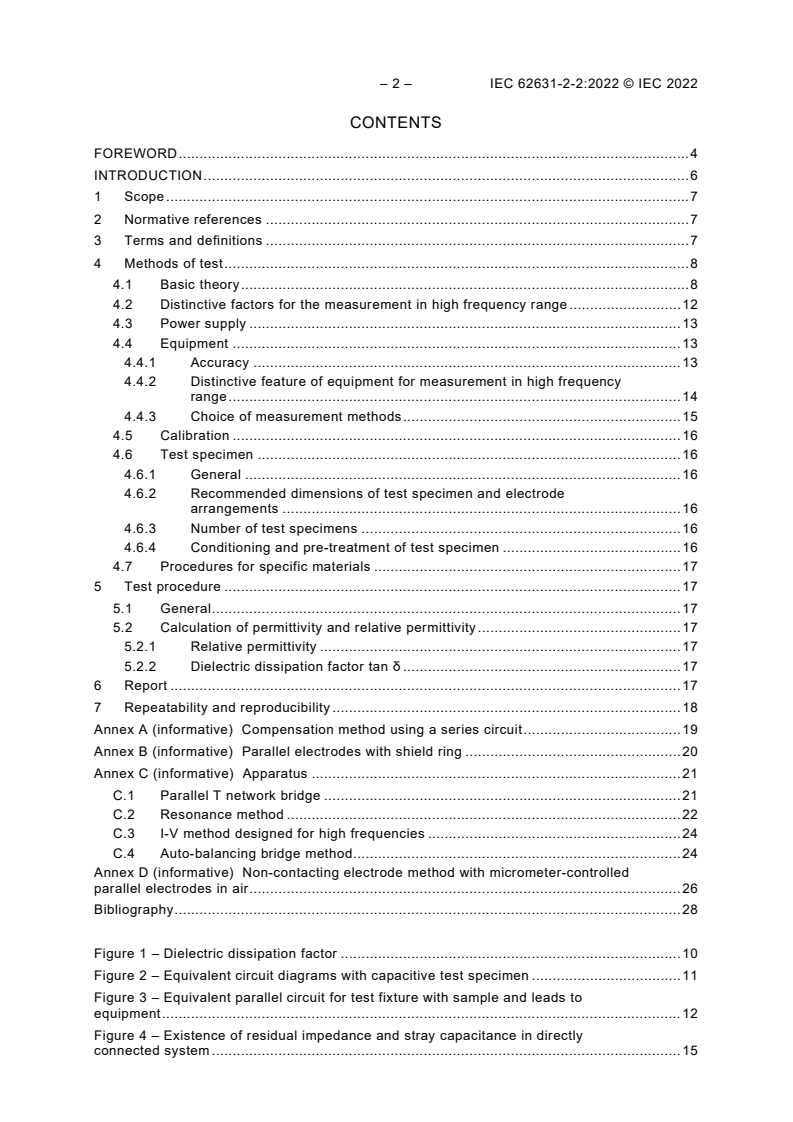
– 2 – IEC 62631-2-2:2022 © IEC 2022
CONTENTS
FOREWORD . 4
INTRODUCTION . 6
1 Scope . 7
2 Normative references . 7
3 Terms and definitions . 7
4 Methods of test . 8
4.1 Basic theory . 8
4.2 Distinctive factors for the measurement in high frequency range . 12
4.3 Power supply . 13
4.4 Equipment . 13
4.4.1 Accuracy . 13
4.4.2 Distinctive feature of equipment for measurement in high frequency
range . 14
4.4.3 Choice of measurement methods . 15
4.5 Calibration . 16
4.6 Test specimen . 16
4.6.1 General . 16
4.6.2 Recommended dimensions of test specimen and electrode
arrangements . 16
4.6.3 Number of test specimens . 16
4.6.4 Conditioning and pre-treatment of test specimen . 16
4.7 Procedures for specific materials . 17
5 Test procedure . 17
5.1 General . 17
5.2 Calculation of permittivity and relative permittivity . 17
5.2.1 Relative permittivity . 17
5.2.2 Dielectric dissipation factor tan δ . 17
6 Report . 17
7 Repeatability and reproducibility . 18
Annex A (informative) Compensation method using a series circuit . 19
Annex B (informative) Parallel electrodes with shield ring . 20
Annex C (informative) Apparatus . 21
C.1 Parallel T network bridge . 21
C.2 Resonance method . 22
C.3 I-V method designed for high frequencies . 24
C.4 Auto-balancing bridge method . 24
Annex D (informative) Non-contacting electrode method with micrometer-controlled
parallel electrodes in air . 26
Bibliography . 28
Figure 1 – Dielectric dissipation factor . 10
Figure 2 – Equivalent circuit diagrams with capacitive test specimen . 11
Figure 3 – Equivalent parallel circuit for test fixture with sample and leads to
equipment . 12
Figure 4 – Existence of residual impedance and stray capacitance in directly
connected system . 15
Figure A.1 – Compensation method using a series circuit . 19
Figure B.1 – Configuration of parallel electrode with shield ring . 20
Figure C.1 – Parallel T network, principal circuit diagram . 21
Figure C.2 – Parallel T network, practical circuit diagram . 21
Figure C.3 – Principle of resonance method, circuit diagram (originally from Q meter) . 23
Figure C.4 – Auto-balancing circuit . 25
Figure D.1 – Non-contacting electrode method . 27
Table 1 – Applicable frequency range in effective apparatus . 16
– 4 – IEC 62631-2-2:2022 © IEC 2022
INTERNATIONAL ELECTROTECHNICAL COMMISSION
____________
DIELECTRIC AND RESISTIVE PROPERTIES OF
SOLID INSULATING MATERIALS –
Part 2-2: Relative permittivity and dissipation factor –
High frequencies (1 MHz to 300 MHz) – AC methods
FOREWORD
1) The International Electrotechnical Commission (IEC) is a worldwide organization for standardization comprising
all national electrotechnical committees (IEC National Committees). The object of IEC is to promote international
co-operation on all questions concerning standardization in the electrical and electronic fields. To this end and
in addition to other activities, IEC publishes International Standards, Technical Specifications, Technical Reports,
Publicly Available Specifications (PAS) and Guides (hereafter referred to as “IEC Publication(s)”). Their
preparation is entrusted to technical committees; any IEC National Committee interested in the subject dealt with
may participate in this preparatory work. International, governmental and non-governmental organizations liaising
with the IEC also participate in this preparation. IEC collaborates closely with the International Organization for
Standardization (ISO) in accordance with conditions determined by agreement between the two organizations.
2) The formal decisions or agreements of IEC on technical matters express, as nearly as possible, an international
consensus of opinion on the relevant subjects since each technical committee has representation from all
interested IEC National Committees.
3) IEC Publications have the form of recommendations for international use and are accepted by IEC National
Committees in that sense. While all reasonable efforts are made to ensure that the technical content of IEC
Publications is accurate, IEC cannot be held responsible for the way in which they are used or for any
misinterpretation by any end user.
4) In order to promote international uniformity, IEC National Committees undertake to apply IEC Publications
transparently to the maximum extent possible in their national and regional publications. Any divergence between
any IEC Publication and the corresponding national or regional publication shall be clearly indicated in the latter.
5) IEC itself does not provide any attestation of conformity. Independent certification bodies provide conformity
assessment services and, in some areas, access to IEC marks of conformity. IEC is not responsible for any
services carried out by independent certification bodies.
6) All users should ensure that they have the latest edition of this publication.
7) No liability shall attach to IEC or its directors, employees, servants or agents including individual experts and
members of its technical committees and IEC National Committees for any personal injury, property damage or
other damage of any nature whatsoever, whether direct or indirect, or for costs (including legal fees) and
expenses arising out of the publication, use of, or reliance upon, this IEC Publication or any other IEC
Publications.
8) Attention is drawn to the Normative references cited in this publication. Use of the referenced publications is
indispensable for the correct application of this publication.
9) Attention is drawn to the possibility that some of the elements of this IEC Publication may be the subject of patent
rights. IEC shall not be held responsible for identifying any or all such patent rights.
IEC 62631-2-2 has been prepared by of IEC technical committee 112: Evaluation and
qualification of electrical insulating materials and systems. It is an International Standard.
The text of this International Standard is based on the following documents:
Draft Report on voting
112/562/FDIS 112/565/RVD
Full information on the voting for its approval can be found in the report on voting indicated in
the above table.
The language used for the development of this International Standard is English.
This document was drafted in accordance with ISO/IEC Directives, Part 2, and developed in
accordance with ISO/IEC Directives, Part 1 and ISO/IEC Directives, IEC Supplement, available
at www.iec.ch/members_experts/refdocs. The main document types developed by IEC are
described in greater detail at www.iec.ch/standardsdev/publications.
A list of all parts in the IEC 62631 series, published under the general title Dielectric and
resistive properties of solid insulating materials, can be found on the IEC website.
The committee has decided that the contents of this document will remain unchanged until the
stability date indicated on the IEC website under webstore.iec.ch in the data related to the
specific document. At this date, the document will be
• reconfirmed,
• withdrawn,
• replaced by a revised edition, or
• amended.
– 6 – IEC 62631-2-2:2022 © IEC 2022
INTRODUCTION
Permittivity and dissipation factor (tan δ) are basic parameters for the quality of insulating
materials. The dissipation factor depends on several parameters, such as environmental factors,
moisture, temperature, applied voltage, and highly depends on frequency, the accuracy of
measuring apparatus and other parameters applied to the measured specimen.
The frequency range measurable for permittivity and dissipation factor is highly limited by the
design of the electrode system, dimension of the sample and impedance of the wiring lead.
Special consideration should be given to the measurement in the high frequency range. This
document focuses on the method for measurements of permittivity and dissipation factor in the
high frequency range from 1 MHz to 300 MHz.
DIELECTRIC AND RESISTIVE PROPERTIES OF
SOLID INSULATING MATERIALS –
Part 2-2: Relative permittivity and dissipation factor –
High frequencies (1 MHz to 300 MHz) – AC methods
1 Scope
This part of IEC 62631 specifies test methods for the determination of permittivity and
dissipation factor properties of solid insulating materials in a high frequency range from 1 MHz
to 300 MHz.
2 Normative references
The following documents are referred to in the text in such a way that some or all of their content
constitutes requirements of this document. For dated references, only the edition cited applies.
For undated references, the latest edition of the referenced document (including any
amendments) applies.
IEC 60212, Standard conditions for use prior to and during the testing of solid electrical
insulating materials
3 Terms and definitions
For the purposes of this document, the following terms and definitions apply.
ISO and IEC maintain terminological databases for use in standardization at the following
addresses:
• ISO Online browsing platform: available at https://www.iso.org/obp
• IEC Electropedia: available at http://www.electropedia.org/
3.1
solid electrical insulating material
solid with negligibly low electric conductivity, used to separate conducting parts at different
electrical potentials
Note 1 to entry: The term "electrical insulating material" is sometimes used in a broader sense to designate also
insulating liquids and gases. Insulating liquids are covered by IEC 60247 [1].
3.2
dielectric properties
comprehensive behaviour of an insulating material measured with an alternating current
comprising the capacitance, absolute permittivity, relative permittivity, relative complex
permittivity, dielectric dissipation factor
3.3
absolute permittivity
ε
electric flux density divided by the electric field strength
– 8 – IEC 62631-2-2:2022 © IEC 2022
3.4
vacuum permittivity
ε
permittivity of a vacuum, which is related to the magnetic constant ε μ and to the speed of light
0 0
in vacuum c by the relation ε μ c = 1
0 0 0 0
3.5
relative permittivity
ε
r
ratio of the absolute permittivity to the permittivity of a vacuum ε
3.6
relative complex permittivity
ε
r
permittivity in a complex number representation, under steady sinusoidal field conditions
3.7
dielectric dissipation factor tan δ (loss tangent)
numerical value of the ratio of the imaginary to the real part of the complex permittivity
3.8
capacitance
C
property of an arrangement of conductors and dielectrics which permits the storage of electrical
charge when a potential difference exists between the conductors
3.9
voltage application
application of a voltage between electrodes
Note 1 to entry: Voltage application is sometimes referred to as electrification.
3.10
measuring electrodes
conductors applied to, or embedded in, a material to make contact with it to measure its
dielectric or resistive properties
Note 1 to entry: The design of the measuring electrodes depends on the specimen and the purpose of the test.
4 Methods of test
4.1 Basic theory
Capacitance C is the property of an arrangement of conductors and dielectrics which permits
the storage of electrical charge when a potential difference exists between the conductors.
C is the ratio of a quantity q of charge to a potential difference U. A capacitance value is always
positive. The unit is farad when the charge is expressed in coulomb and the potential in volts.
q
C= (1)
U
The measured permittivity (formerly known as dielectric constant) ε of an insulating material is
the product of its relative permittivity ε and the permittivity of a vacuum ε :
r 0
ε = ε · ε
(2)
0 r
This general method describes common values for general measurements. If a method for a
specific type of material is described in this document, the specific method shall be used.
The permittivity is expressed in farad per metre (F/m); the permittivity of vacuum ε has the
following value:
−12
(3)
ε 8,854187817×10
Relative permittivity is the ratio of the absolute permittivity to the permittivity of a vacuum ε .
In the case of constant fields and alternating fields of sufficiently low frequency, the relative
permittivity of an isotropic or quasi-isotropic dielectric is equal to the ratio of the capacitance of
a capacitor, in which the space between and around the electrodes is entirely and exclusively
filled with the dielectric, to the capacitance of the same configuration of electrodes in vacuum.
C
x
ε =
(4)
r
C
The relative permittivity ε of dry air, at normal atmospheric pressure, equals 1,000 59, so that
r
in practice, the capacitances C of the configuration of electrodes in air can normally be used
a
instead of C to determine the relative permittivity ε with sufficient accuracy.
0 r
Relative complex permittivity is permittivity in a complex number representation under steady
sinusoidal field conditions expressed as
'" − jδ
ε=ε−jε=ε e (5)
rr r r
' "
where ε and ε have positive values.
r r
' "
NOTE 1 The complex permittivity ε is customarily quoted either in terms of ε and ε , or in terms of ε and tan δ.
r
r r r
"
NOTE 2 ε is termed loss index.
r
The dielectric dissipation factor tan δ (loss tangent) is the numerical value of the ratio of the
imaginary to the real part of the complex permittivity.
=
– 10 – IEC 62631-2-2:2022 © IEC 2022
Key
U applied voltage
I current
I real part of current
w
I imaginary part of current
o
φ phase difference between applied voltage and current
π
δ subtracted angle of φ from
Figure 1 – Dielectric dissipation factor
"
ε
r
tanδ= (6)
'
ε
r
Thus, the dielectric dissipation factor tan δ of an insulating material is the tangent of the angle
δ by which the phase difference φ between the applied voltage and the resulting current deviates
from π/2 rad when the solid insulating material is exclusively used as dielectric in a capacitive
test specimen (capacitor), compared with Figure 1. The dielectric dissipation factor can also be
expressed by an equivalent circuit diagram using an ideal capacitor with a resistor in series or
parallel connection (see Figure 2).
tanδ ωC ×R
ss (7)
ωC ×R
pp
with
C
p
=
(8)
C
1+ tan δ
s
==
and
R
p
1+
(9)
R
tan δ
s
NOTE 3 R and R respectively are not directly related to but affected by the volume and the surface resistance of
s p
an insulating material. Therefore, the dielectric dissipation factor can also be affected by these resistive materials
properties.
Key
C and R capacitance and resistance for equivalent parallel circuit, respectively
p p
C and R capacitance and resistance for equivalent series circuit, respectively
s s
Figure 2 – Equivalent circuit diagrams with capacitive test specimen
This general method describes common values for general measurements. If a method for a
specific type of material is described in this document, the specific method shall be used.
=
– 12 – IEC 62631-2-2:2022 © IEC 2022
Key
a and b terminals
C R and Z capacitance, resistance and impedance for equivalent parallel circuit with sample P,
p p P
respectively
R , L , C and Z Z is the impedance due to the residual resistance R and residual inductance L
lead lead
lead lead lead lead lead
existing with leads from the equipment to the test fixture. The stray capacitor, C is
lead
the stray capacitor involved in Z
lead
C , R and Z Z is the impedance due to the edge capacitance of the electrode and leakage
edge leak edge edge
resistance on sample and insulators of the electrode fixture
Figure 3 – Equivalent parallel circuit for test fixture with sample and leads to equipment
The measurement of permittivity and dielectric dissipation factor shall be made taking into
consideration the electric properties of the measuring circuit as well as the specific electric
properties of the material. To carry out the test, in most cases, the use of high voltage is
necessary. Care should be taken to prevent any electric shock.
The basic principles of apparatus and methods are not described here. Some references to the
literature are given in the bibliography of IEC 62631-2-1 [2] .
4.2 Distinctive factors for the measurement in high frequency range
Figure 3 shows an equivalent parallel circuit comprising an electrode system with a sample and
wiring leads from terminals a and b.
The impedance of C , , decreases when the frequency is increased, which causes the
p
jωC
p
increase in current through C in the high frequency range. When the frequency is increased
p
from 100 kHz to 100 MHz, the current through C increases 1 000 times more than that at
p
100 kHz. This causes a decrease of accuracy in the obtained results.
___________
Numbers in square brackets refer to the bibliography.
The impedances due to the inductance of leads (L ), and the stray capacitance (C ) also
lead lead
depend on the frequency. That kind of impedance can be ignored in the measurements in the
low frequency range. In the high frequency range, on the other hand, the effect of the impedance
of Z on the measured values cannot be ignored and causes errors in the measured results.
edge
The impedance due to Z is also a significant factor in the high frequency range. R which
edge leak
is independent of the frequency could be negligible, because the leakage current on the sample
surface is much smaller than the current through the edge capacitance in the high frequency
range.
In the low frequency range, as described in IEC 62631-2-1, effective guarding and shielding
should be applied to avoid measurement errors resulting from the stray capacitance and the
residual impedance. In the frequency range higher than 100 kHz, however, the current through
the guard and shielding are significant in comparison with the current through the specimen in
the lower frequency range. Furthermore, care should be taken to prevent any electromagnetic
interference (EMI) during measurements in the radio frequency range.
NOTE 1 Since the impedance of a capacitor is inversely proportional to frequency, at high frequencies it is
essentially acting as a wire.
NOTE 2 The stray capacitance is the additional capacitance which exists in parallel with the capacitance of the test
specimen. The stray capacitance also exists between the ground and a lead line connecting a terminal of an
equipment to an electrode.
NOTE 3 The residual impedance is the impedance existing in series with the impedance of the test specimen. The
residual impedance includes an impedance of the electrode produced on the surface of the specimen (e.g. by
evaporation), and a lead line for the connection between a terminal of an instrument and an electrode.
4.3 Power supply
The power source shall provide a stable sinusoidal voltage. For the measuring duration the
measured value of the supplied voltage shall be maintained within ±5 %.
The voltage wave shape shall approximate to a sinusoid with the difference between the
magnitudes of the positive and negative peak values being less than 2 %.
The deviation from the sinusoidal shape (the ratio of peak to RMS values equals 2 ) shall be
within ±5 %.
Preferred voltages are 0,1 V; 0,5 V; 10 V; 100 V; 500 V; 1 000 V; 2 000 V. Other voltage levels
shall be documented in the report.
NOTE 1 Higher voltages can be applicable in order to perform tests at operating field strength.
NOTE 2 Partial discharge can lead to erroneous measurements when a specific inception voltage is exceeded. In
air, below 340 V, no partial discharges will occur at atmospheric pressure.
4.4 Equipment
4.4.1 Accuracy
The measuring device should be capable of determining the unknown permittivity and dielectric
dissipation factor in accordance with the expected material properties. The accuracy of the
measuring system shall be documented in the report.
NOTE The user can choose the measuring system accuracy according to the requirements of the measuring results.
– 14 – IEC 62631-2-2:2022 © IEC 2022
4.4.2 Distinctive feature of equipment for measurement in high frequency range
4.4.2.1 General
As described in 4.2, the impedances of Z and Z in Figure 3 significantly affect the
lead
edge
accuracy of the measured data in the frequency range higher than 1 MHz. To avoid a significant
decrease in the accuracy, the following recommendations should be taken into account:
– a disc type specimen with a small area of flat surface and considerably thick (see 4.6.2);
– small residual impedance of the measuring circuit;
– small residual impedance of the two-terminal electrode system;
– usage of a high reliability conductance and capacitance for the reference.
The impedance of Z in Figure 3 decreases in the high frequency range, so that a sufficient
P
quantity of current through Z can be obtained even under a low voltage application. The three-
P
terminal electrode, which includes a guard ring (IEC 62631-2-1:2018, Figure 3), results in the
increase in the edge capacitance (C in Figure 3). C becomes significantly large in
edge edge
comparison with the capacitance of the sample (C ) when the area of the cylindrical electrode
p
surface is diminished. Accordingly, an electrode without the guard ring should be used in the
high frequency range measurement. The leakage current on the sample surface, R is
leak
independent of frequency and reaches small value as a result of the low voltage application.
Therefore, the resistance R of the two-terminal electrode does not affect significantly the
leak
accuracy of the measured value even in the high frequency range.
The compensation method should be used to eliminate the stray capacitance and residual
impedance, which requires the use of highly reliable conductance and capacitance as reference.
4.4.2.2 Two-terminal electrode system
As described in 4.4.2.1, the electrode system without guard ring electrode (i.e. two-terminal
electrode system) is generally used in the high frequency range measurement. The thickness
of the electrode should be sufficiently smaller than that of the specimen to prevent the increase
in the stray capacitance around the electrode. For example, the thickness of electrode should
be smaller than 1 mm for a specimen with a thickness of 5 mm.
When the capacitance of the specimen is measured using the two-terminal electrode system,
the measured capacitance should be compensated by the calculation of the edge effect
(see IEC 62631-2-1:2018, Annex A).
The parallel electrodes with a shield ring are an effective arrangement of electrodes to diminish
the edge effect in the measurements in the high frequency range, and is described in Annex B.
4.4.2.3 Guarding
Guarding is effective to eliminate errors due to the stray leakage current for the measurement
in the low frequency range as indicated in IEC 62631-2-1. However, the guarding of the lead
, as shown
wiring from the equipment to the electrode system increases the capacitance, C
lead
in Figure 3. The impedance due to C and the admittance due to C increase with the rise
lead lead
in frequency, which results in the decrease in the voltage applied to the electrode system. The
insufficient current through the electrode system makes the accuracy of results low. For this
reason, guarding should not be applied in most cases of the high frequency range measurement.
4.4.2.4 Compensation method for elimination of stray capacitance and residual
impedance
In the low frequency range, the equipment for impedance measurement is often directly
connected to the electrode system with specimen, as shown in Figure 4. The residual
impedance in the lead line between the electrode system and terminal (between a and b) is
involved in the measured value when the directly connected system is used. The stray
capacitance is also involved in that case. In the high frequency range, however, the residual
and stray impedances are not negligible in the measurement. The compensation method should
be applied in order to eliminate the effects of stray capacitance and residual impedance in the
high frequency range. An example of the compensation method using the series circuit system
is given in Annex A.
Key
a and b terminals
R , L , C and Z Z is the impedance due to the residual resistance R and residual inductance L
lead lead lead lead lead lead lead
existing with leads from the equipment to the test fixture. C is the stray capacitor
lead
involved in Z
lead
Z equivalent impedance of sample
x
Figure 4 – Existence of residual impedance and
stray capacitance in directly connected system
4.4.3 Choice of measurement methods
The measurement methods used for the high frequency range can be divided into three groups:
a) null method (balancing method);
b) resonance method;
c) I-V method.
The resonance method can be used in the range from 10 kHz to several 100 MHz. It is based
on the measurement of voltage appearing across a resonant circuit when a small known voltage
is induced in it. The method can accomplish the measurement up to the frequency near 300 MHz
when used in combination with the non-contacting electrode method. These methods cannot
easily be adapted when a guard electrode is used.
The null method and impedance analyser method are introduced in IEC 62631-2-1:2018, 4.3.2.2
and 4.3.2.3, respectively.
– 16 – IEC 62631-2-2:2022 © IEC 2022
The apparatus used for the measurements in the frequencies higher than 10 MHz are shown in
Table 1. It is necessary to use the two-terminal electrode system. These apparatuses are
introduced in Annex C.
Table 1 – Applicable frequency range in effective apparatus
Effective apparatus Measuring group Applicable
frequency range
Parallel T networks method Null method 1 MHz to 150 MHz
Resonant circuit Resonance method 10 kHz to 300 MHz
a
Impedance analyser I-V method
20 Hz to 300 MHz
Auto balancing bridge Null method 20 Hz to 120 MHz
a
Specially designed for a measurement in high frequency (Clause C.3).
4.5 Calibration
The equipment shall be calibrated using a standard load accurately known.
4.6 Test specimen
4.6.1 General
To measure the permittivity and dissipation factor of a material, a sheet specimen is preferable.
4.6.2 Recommended dimensions of test specimen and electrode arrangements
For the high frequency measurement, the impedance due to the capacitance of the electrode
system with specimen is so low that a small area of electrode surface and large thickness of
specimen are recommended. An adequate diameter of electrode is about 30 mm and an
adequate thickness of specimen appropriately ranges from 0,3 mm to 5,0 mm. The edge effect
correction should be required in the two-terminal electrode system (see IEC 62631-2-1:2018,
Annex A). In the case of thin film, the specimen is formed by the films with multiple layers.
It is possible that the two-terminal electrodes with a shield ring will not require the edge effect
correction, when the diameter of specimen is larger than that of the electrode by two times the
specimen's thickness or more. The shield ring is introduced in Annex B.
The conductive thin film electrode on the specimen, such as silver paint, evaporated metal film
and metal foil, should not be used in the high frequency range, because this kind of conductive
thin films involves an inductive component. The non-contacting electrode method should be
used instead. This method does not require thin film electrodes, but still solves the airgap effect.
The non-contacting electrode method and fluid displacement method are introduced in Annex D.
4.6.3 Number of test specimens
The number of specimens to be tested shall be determined by the relevant product standards.
If no such data is available, at least three specimens shall be tested.
4.6.4 Conditioning and pre-treatment of test specimen
Conditioning and any other pre-treatment of the test specimen shall be done according to the
relevant product standard. If no product standard exists, conditioning shall be done for at least
four days at 23 °C and 50 % RH according to IEC 60212 (standard climate B).
4.7 Procedures for specific materials
Procedures for specific materials are described in material specifications. If a specific procedure
for a specified material exists, this specification shall be used. The measuring procedure
including preparation of the test specimen shall be described in the report.
5 Test procedure
5.1 General
General recommendations concerning the preparation of the sample in the test procedure are
described in IEC 62631-2-1:2018, 5.1.
5.2 Calculation of permittivity and relative permittivity
5.2.1 Relative permittivity
After the measurements of C and C , the relative permittivity ε can be calculated using
x 0 r
Formula (10).
C
x
ε =
(10)
r
C
where C is the capacitance of the test specimen, in which the space between the two electrodes
x
is entirely and exclusively filled with the insulating material in question, and C is the
capacitance of the same configuration of electrodes in vacuum.
5.2.2 Dielectric dissipation factor tan δ
The dielectric dissipation factor, tan δ, shall be calculated from the measured values in
accordance with Formula (11).
tan δ=
(11)
ωC ×R
p p
6 Report
The report shall include the following:
– name, identification, material specification, colour, source and manufacturer's code for the
specimen;
– shape and dimensions of the test specimen and test fixture;
– temperature of the test specimen and relative humidity of the environment;
– curing conditions of the specimen and any pre-treatment;
– number of tests, describing the procedure;
– test method and measurement circuit used;
– manufacturer's instrument identification and accuracy of test equipment;
– location and date of testing;
– ambient temperature, relative humidity and air pressure;
– 18 – IEC 62631-2-2:2022 © IEC 2022
– test voltage;
– test frequency;
– electrode arrangement and type of electrode applied to the sample used;
– mechanical electrode pressure in Pascal (if applicable);
– number of specimens;
– date and time of test;
– each single value and the average of permittivity and dielectric loss factor respectively;
– any other important observations, if applicable;
– values of parallel capacitance, relative permittivity and dielectric dissipation factor with
estimated accuracy, error correction of effective area of specimen and the values calculated
from them as loss index and loss angle (The mean value shall be given, if multiple tests on
one sample are made, in relation to temperature and frequency. Not all are necessary or
even appropriate in all cases.).
7 Repeatability and reproducibility
In general, the repeatability and reproducibility of the measurements in the high frequency
range are lower than those in the measurements in the low frequency range.
Annex A
(informative)
Compensation method using a series circuit
As described in 4.4.2.4, the residual impedance and the stray capacitance are involved in the
measured value when the directly connected system is used (Figure A.1 a)).
The compensation method using a series circuit is shown in Figure A.1 b). At first, the value of
Z
the reference impedance ( ), is measured keeping the switch K closed. The measured value
R
is designated as Z . Then, K is switched to open. After K is open, an impedance
R(K:close)
between P and P is compensated to the same value as Z by adjusting the reference
1 2 R(K:close)
impedance Z . The adjusted value is designated as Z . The impedance of the
R R(K:open)
specimen with electrode ( Z ) can be obtained by Formula (A.1).
x
ZZ − Z
x R(K:open) R(K:close) (A.1)
In this method, the equipment for impedance measurement is used only to obtain the impedance
between P and P . Therefore, the obtained impedance Z does not include the residual
1 2 x
impedance of the lead wiring. This compensation method can be used in the frequency range
up to several 100 MHz.
NOTE A compensation method with a parallel circuit system is improper in the high frequency range, because the
current flowing through each element of the parallel component before the compensation is not the same as that
after the compensation, even though the combined impedances of the parallel elements before and after the
compensation are the same.
a) Direct system b) Series circuit system
Key
a, b and P , P terminals
1 2
Z reference impedance
R
Z impedance of sample
x
K switch
Figure A.1 – Compensation method using a series circuit
=
– 20 – IEC 62631-2-2:2022 © IEC 2022
Annex B
(informative)
Parallel electrodes with shield ring
Figure B.1 shows a configuration of parallel electrodes with shield ring. The high voltage
electrode (B) is a disk shape with a knife edge. The shield ring (A) is set 0,5 mm above the high
voltage electrode. When a diameter of the high voltage electrode is 30 mm, the edge effect is
diminished to 1/20 of the effect in the electrode system without shield ring. Th
...