


IEC 61988-1:2003
(Main)Plasma display panels - Part 1: Terminology and letter symbols
General Information
- Abstract
Gives the preferred terms, their definitions and symbols for colour AC plasma display panels (AC PDP); with the object of using the same terminology when publications are prepared in different countries. Guidance on the technology is provided in the annexes.
- Status
- Published
- Publication Date
- 11-May-2003
- Technical Committee
- TC 110 - Electronic displays
- Drafting Committee
- WG 4 - TC 110/WG 4
- Current Stage
- DELPUB - Deleted Publication
- Start Date
- 26-Jul-2011
- Completion Date
- 28-Aug-2026
Buy Documents

IEC 61988-1:2003 - Plasma display panels - Part 1: Terminology and letter symbols Released:5/12/2003

IEC 61988-1:2003 - Plasma display panels - Part 1: Terminology and letter symbols Released:5/12/2003
Overview
IEC 61988-1:2003 - Plasma display panels - Part 1: Terminology and letter symbols defines the preferred terms, exact definitions and letter symbols used for colour AC plasma display panels (AC PDP). Its primary objective is to standardize vocabulary and symbols so publications, test reports and product documentation use consistent language across countries. Informative annexes provide technical guidance on PDP technology, discharge characteristics, gaps, manufacturing and interconnect pads.
Key topics
This part focuses on vocabulary and symbolic notation rather than performance limits. Major technical topics covered include:
- Fundamental terms and definitions for AC PDP components and phenomena (e.g., cell, subpixel, barrier rib, cathode/anode, bus electrode).
- Driving and addressing terminology (address pulse, address voltage Va, address cycle, ADS - address/display separation, AWD - address while display).
- Electrical and optical descriptors (cell voltage Vc, breakdown voltage, centre firing/sustain voltages, black level luminance, contrast ratio, chromatic uniformity).
- Manufacturing and conditioning terms (annealing, bakeout, ageing, burn-in, binder burnout).
- Defect and quality terms (bright/dark defect, crosstalk).
- Symbol lists: organized both by term and by symbol for unambiguous notation in technical documents.
- Informative annexes giving technology context: discharge behavior, static/dynamic characteristics, gap definitions, manufacturing flow and interconnect pad dimensions.
Applications and users
IEC 61988-1:2003 is a reference for anyone who needs clear, consistent PDP terminology or symbol conventions:
- Display manufacturers and designers - to produce consistent datasheets, design documentation and interface specifications.
- Test and calibration laboratories - to write reports and measurement procedures with standardized terms (used alongside IEC 61988-2-series optical/optoelectrical methods).
- Standards writers, regulators and procurement teams - to harmonize requirements and contracts internationally.
- R&D engineers and technical writers - to ensure unambiguous internal and external communications.
- Translators and international teams - to map terms reliably between languages and regional standards.
Using the standard improves clarity in technical communication, interoperability of documentation, and comparability of test results across suppliers and countries.
Related standards
- IEC 61988-2-1 - Measuring methods - Optical (normative reference)
- IEC 61988-2-2 - Measuring methods - Optoelectrical (normative reference)
- CIE 15.2:1986 - Colorimetry (referenced)
Keywords: IEC 61988-1:2003, plasma display panels, AC PDP terminology, letter symbols, PDP standards, plasma display terminology, PDP manufacturing terms.
Relations
- Effective Date
- 05-Sep-2023
Buy Documents
IEC 61988-1:2003 - Plasma display panels - Part 1: Terminology and letter symbols Released:5/12/2003
IEC 61988-1:2003 - Plasma display panels - Part 1: Terminology and letter symbols Released:5/12/2003
Frequently Asked Questions
IEC 61988-1:2003 is a standard published by the International Electrotechnical Commission (IEC). Its full title is "Plasma display panels - Part 1: Terminology and letter symbols". This standard covers: Gives the preferred terms, their definitions and symbols for colour AC plasma display panels (AC PDP); with the object of using the same terminology when publications are prepared in different countries. Guidance on the technology is provided in the annexes.
Gives the preferred terms, their definitions and symbols for colour AC plasma display panels (AC PDP); with the object of using the same terminology when publications are prepared in different countries. Guidance on the technology is provided in the annexes.
IEC 61988-1:2003 is classified under the following ICS (International Classification for Standards) categories: 31.260 - Optoelectronics. Laser equipment. The ICS classification helps identify the subject area and facilitates finding related standards.
IEC 61988-1:2003 has the following relationships with other standards: It is inter standard links to IEC 61988-1:2011. Understanding these relationships helps ensure you are using the most current and applicable version of the standard.
IEC 61988-1:2003 is available in PDF format for immediate download after purchase. The document can be added to your cart and obtained through the secure checkout process. Digital delivery ensures instant access to the complete standard document.
Standards Content (Sample)
INTERNATIONAL IEC
STANDARD
61988-1
First edition
2003-05
Plasma display panels –
Part 1:
Terminology and letter symbols
Panneaux d'affichage à plasma –
Partie 1:
Terminologie et symboles littéraux
Reference number
Publication numbering
As from 1 January 1997 all IEC publications are issued with a designation in the
60000 series. For example, IEC 34-1 is now referred to as IEC 60034-1.
Consolidated editions
The IEC is now publishing consolidated versions of its publications. For example,
edition numbers 1.0, 1.1 and 1.2 refer, respectively, to the base publication, the
base publication incorporating amendment 1 and the base publication incorporating
amendments 1 and 2.
Further information on IEC publications
The technical content of IEC publications is kept under constant review by the IEC,
thus ensuring that the content reflects current technology. Information relating to
this publication, including its validity, is available in the IEC Catalogue of
publications (see below) in addition to new editions, amendments and corrigenda.
Information on the subjects under consideration and work in progress undertaken
by the technical committee which has prepared this publication, as well as the list
of publications issued, is also available from the following:
• IEC Web Site (www.iec.ch)
• Catalogue of IEC publications
The on-line catalogue on the IEC web site (http://www.iec.ch/searchpub/cur_fut.htm)
enables you to search by a variety of criteria including text searches, technical
committees and date of publication. On-line information is also available on
recently issued publications, withdrawn and replaced publications, as well as
corrigenda.
• IEC Just Published
This summary of recently issued publications (http://www.iec.ch/online_news/
justpub/jp_entry.htm) is also available by email. Please contact the Customer
Service Centre (see below) for further information.
• Customer Service Centre
If you have any questions regarding this publication or need further assistance,
please contact the Customer Service Centre:
Email: custserv@iec.ch
Tel: +41 22 919 02 11
Fax: +41 22 919 03 00
INTERNATIONAL IEC
STANDARD
61988-1
First edition
2003-05
Plasma display panels –
Part 1:
Terminology and letter symbols
Panneaux d'affichage à plasma –
Partie 1:
Terminologie et symboles littéraux
IEC 2003 Copyright - all rights reserved
No part of this publication may be reproduced or utilized in any form or by any means, electronic or
mechanical, including photocopying and microfilm, without permission in writing from the publisher.
International Electrotechnical Commission, 3, rue de Varembé, PO Box 131, CH-1211 Geneva 20, Switzerland
Telephone: +41 22 919 02 11 Telefax: +41 22 919 03 00 E-mail: inmail@iec.ch Web: www.iec.ch
PRICE CODE
Commission Electrotechnique Internationale
X
International Electrotechnical Commission
Международная Электротехническая Комиссия
For price, see current catalogue
– 2 – 61988-1 IEC:2003(E)
CONTENTS
FOREWORD . 3
1 Scope . 5
2 Normative references. 5
3 Terms and definitions . 5
4 Symbols.28
4.1 Symbol list by term name.28
4.2 Symbol list by symbol .29
Annex A (informative) Description of the technology.30
Annex B (informative) Relationship between voltage terms and discharge
characteristics.41
Annex C (informative) Gaps .42
Annex D (informative) Manufacturing .43
Annex E (informative) Interconnect pad.46
Figure A.1 – Principal structures and discharge characteristics of a DC PDP cell and
an AC PDP cell .30
Figure A.2 – Discharge characteristics of a cell (single cell static characteristics) .32
Figure A.3 – Static characteristics of cells in a panel or a group of cells.33
Figure A.4 – Write waveform components .34
Figure A.5 – Operation of a two-electrode type AC PDP.35
Figure A.6 – Relation between margins and applied voltages .36
Figure A.7 – Structure of a three-electrode type, surface discharge colour AC PDP .37
Figure A.8 – Address-, Display-period separation method .38
Figure A.9 – A driving waveform for ADS method applied to a three-electrode .39
Figure A.10 – Address while display method .40
Figure C.1 – Gaps (sustain gap, plate gap and interpixel gap) in a three-electrode
type AC PDP.42
Figure D.1 – PDP manufacturing flow chart .44
Figure E.1 – Interconnect pad group .46
Figure E.2 – Dimensions of interconnect pads.46
Table B.1 – Relation between static, dynamic and operating discharge characteristics
in a cell, a panel or a group of cells.41
61988-1 IEC:2003(E) – 3 –
INTERNATIONAL ELECTROTECHNICAL COMMISSION
––––––––––––
PLASMA DISPLAY PANELS –
Part 1: Terminology and letter symbols
FOREWORD
1) The IEC (International Electrotechnical Commission) is a worldwide organization for standardization comprising
all national electrotechnical committees (IEC National Committees). The object of the IEC is to promote
international co-operation on all questions concerning standardization in the electrical and electronic fields. To
this end and in addition to other activities, the IEC publishes International Standards. Their preparation is
entrusted to technical committees; any IEC National Committee interested in the subject dealt with may
participate in this preparatory work. International, governmental and non-governmental organizations liaising
with the IEC also participate in this preparation. The IEC collaborates closely with the International
Organization for Standardization (ISO) in accordance with conditions determined by agreement between the
two organizations.
2) The formal decisions or agreements of the IEC on technical matters express, as nearly as possible, an
international consensus of opinion on the relevant subjects since each technical committee has representation
from all interested National Committees.
3) The documents produced have the form of recommendations for international use and are published in the form
of standards, technical specifications, technical reports or guides and they are accepted by the National
Committees in that sense.
4) In order to promote international unification, IEC National Committees undertake to apply IEC International
Standards transparently to the maximum extent possible in their national and regional standards. Any
divergence between the IEC Standard and the corresponding national or regional standard shall be clearly
indicated in the latter.
5) The IEC provides no marking procedure to indicate its approval and cannot be rendered responsible for any
equipment declared to be in conformity with one of its standards.
6) Attention is drawn to the possibility that some of the elements of this International Standard may be the subject
of patent rights. The IEC shall not be held responsible for identifying any or all such patent rights.
International Standard IEC 61988-1 has been prepared by subcommittee 47C: Flat panel
display devices, of IEC technical committee 47: Semiconductor devices.
The text of this standard is based on the following documents:
FDIS Report on voting
47C/289/FDIS 47C/296/RVD
Full information on the voting for the approval on this standard can be found in the report on
voting indicated in the above table.
This publication has been drafted in accordance with the ISO/IEC Directives, Part 2.
IEC 61988 will consist of the following parts, under the general title Plasma display panels:
Part 1: Terminology and letter symbols;
Part 2-1: Measuring methods – Optical;
Part 2-2: Measuring methods – Optoelectrical;
Part 3: Guidelines of mechanical interface;
Part 4: Environmental, endurance and mechanical test methods.
– 4 – 61988-1 IEC:2003(E)
The committee has decided that the contents of this publication will remain unchanged until
2008. At this date, the publication will be
• reconfirmed;
• withdrawn;
• replaced by a revised edition, or
• amended.
A bilingual version of this standard may be issued at a later date.
61988-1 IEC:2003(E) – 5 –
PLASMA DISPLAY PANELS –
Part 1: Terminology and letter symbols
1 Scope
This part of IEC 61988 gives the preferred terms, their definitions and symbols for colour
AC plasma display panels (AC PDP); with the object of using the same terminology when
publications are prepared in different countries. Guidance on the technology is provided
in the annexes.
2 Normative references
The following referenced documents are indispensable for the application of this document.
For dated references, only the edition cited applies. For undated references, the latest edition
of the referenced document (including any amendments) applies.
IEC 61988-2-1, Plasma display panels – Part 2-1: Measuring methods – Optical
IEC 61988-2-2, Plasma display panels – Part 2-2: Measuring methods – Optoelectrical
nd
CIE 15.2:1986, Colorimetry, 2 Edition
3 Terms and definitions
For the purposes of this document, the following definitions apply.
3.1
AC PDP
NOTE See AC plasma display panel.
3.2
AC plasma display panel
AC PDP
plasma display panel in which the gas discharge region is insulated from the electrodes that
are driven with AC voltage pulses
3.3
address bias
Vba
data bias
common voltage applied to all address electrodes during addressing
3.4
address cycle period
time interval between initiation of the closest spaced successive address pulses
3.5
address discharge
discharge that changes the state of a PDP subpixel
———————
To be published.
– 6 – 61988-1 IEC:2003(E)
3.6
address electrode
data electrode
electrode, orthogonal to the scan electrode, that is used in driving the subpixels with
the image data
3.7
address pulse
data pulse
incremental voltage pulse applied to a single address (data) electrode for addressing,
to select a subpixel according to an image to be displayed
NOTE See scan pulse.
3.8
address voltage
Va
data voltage
amplitude of the voltage pulses applied to the address (data) electrode during addressing
(excludes the address bias on the electrode)
3.9
address while display method
AWD method
grey scale drive technique that addresses only a portion of the pixels of the panel in any time
within a sustain period
NOTE See also ADS.
3.10
addressability
number of pixels in the horizontal and vertical directions, that can have their luminance
changed
NOTE Usually expressed in the number of horizontal pixels by the number of vertical pixels. This term is not
synonymous with resolution. See resolution.
3.11
addressing
setting or changing the state of a subpixel with an address pulse
3.12
ADS method
address, display-period separation method
grey scale drive technique that consists of addressing all the pixels in the panel in one time
period and sustaining all the pixels in the panel in a separate time period
3.13
ageing
manufacturing process consisting of operating the panel under conditions that stabilize its
performance
3.14
annealing
process of heating the glass above its annealing point and cooling at a controlled rate
to minimize dimensional changes during subsequent high temperature cycles
61988-1 IEC:2003(E) – 7 –
3.15
anode
positively charged surface of a device that collects electrons from the discharge
NOTE In an AC PDP, the cathode and anode exchange their roles on alternate half-cycles.
3.16
aspect ratio
ratio of screen width to screen height
3.17
auto power control
APC
circuit means to control the peak and/or average power of the display
3.18
auxiliary anode
anode in a DC PDP whose discharge contributes to supply priming particles to ignite a
discharge in a cell
3.19
back plate
rear plate
plate furthest from the viewer
3.20
back-filling
NOTE See filling.
3.21
bake
NOTE See bakeout, baking.
3.22
bakeout
high temperature processing of a vacuum system and/or PDP to assist in achieving low
pressures
3.23
baking
high temperature process used to evaporate water and decompose organic materials
NOTE Baking is used to clean the parts by dispersing unwanted material into the atmosphere.
3.24
barrier rib
rib that separates the cells of the panel, electrically, optically and physically
NOTE The barrier ribs may extend from the front plate to the back plate and control the spacing between
the plates.
3.25
binder burnout
process during which organic binders are remove by decomposition and/or oxidation
3.26
black level luminance
luminance of the panel in its minimum luminance state in a dark ambient
NOTE See IEC 61988-2-1, subclause 6.3.3.b
– 8 – 61988-1 IEC:2003(E)
3.27
black matrix
black material placed in the space between subpixel areas in order to improve contrast by
reducing reflectivity
3.28
black stripe
black material placed in the space between subpixel areas in order to improve contrast by
reducing reflectivity, having the form of stripes
NOTE Black stripe is a specific type of black matrix contrast enhancement.
3.29
black uniformity, sampled
uniformity of the black level luminance expressed in terms of the percentage non-uniformity
(difference in luminance between measuring points divided by the average black level
luminance) at the specified measuring points
3.30
BRCR-#/#
NOTE See bright room contrast ratio #/#.
3.31
breakdown voltage
smallest voltage between the cathode and the anode causing a gas discharge to grow to a
breakdown condition
3.32
bright defect
defect in the image reproduction that appears brighter than the correct image
3.33
bright room contrast ratio #/#
BRCR-#/#
contrast ratio with ambient illumination on the screen other than the nominal 100/70 levels
NOTE The symbol #/# describes the ambient illumination on the vertical plane/horizontal plane (see IEC 61988-2-2,
subclause 6.1).
3.34
bright room contrast ratio 100/70
BRCR-100/70
contrast ratio with an ambient illumination on the screen of 100 lx on the vertical plane and
70 lx on the horizontal plane
NOTE See IEC 61988-2-2, subclause 6.1
3.35
brightness
visual and subjective quality of how bright an object appears, or how much visible light is
coming off the object being perceived by the eye
NOTE See luminance.
3.36
bulk erase
operation of applying a voltage pulse to the panel that switches all of the cells in the panel to
the off-state
61988-1 IEC:2003(E) – 9 –
3.37
bulk write
operation of applying a voltage pulse to the panel that switches all of the cells in the panel to
the on-state
3.38
burn-in
process of increasing the reliability performance of hardware employing functional operation
of every item in a prescribed environment with successive corrective maintenance at every
failure during the early failure period
3.39
bus electrode
high conductivity electrode intimately connected along its length to the transparent electrode
in order to reduce total resistance
3.40
cathode
negatively charged surface of a device that emits secondary electrons to the discharge
NOTE In an AC PDP, the cathode and anode exchange their roles on alternate half-cycles.
3.41
cell
physical structure of a subpixel or a subpixel itself (adjective – referring to the characteristics
of a single cell)
3.42
cell pitch
subpixel pitch
3.43
cell voltage
Vc
time-dependent voltage across the gas in a plasma display cell
3.44
centre firing voltage
average of the first-on voltage and the last-on voltage
3.45
centre minimum sustain voltage
average of the first-off voltage and the last-off voltage
3.46
chromatic uniformity
uniformity of the chromaticity produced by different areas of the PDP
NOTE Usually expressed in the inverse sense of the nonuniformity, as Δx and Δy or the difference between the
i i,
chromaticity at the specified measuring points and the chromaticity at the centre of the display screen. See
luminance uniformity and IEC 61988-2-1, subclause 6.4.
3.47
column electrode
address electrode
NOTE The column electrode was historically continuous in the vertical direction. When the panel is oriented in
portrait orientation, the column electrode can be aligned horizontally. See row electrode.
– 10 – 61988-1 IEC:2003(E)
3.48
contrast ratio
ratio of white luminance to black luminance of the image, including light reflected from the
display
NOTE This ratio is strongly dependent on the ambient light and two forms are reported, bright room contrast ratio
(BRCR) and dark room contrast ratio (DRCR). See IEC 61988-2-1, subclauses 6.3 and 6.1.
3.49
contrast ratio, sampled
CR
ratio of a white luminance to a black luminance at the specified measuring points
NOTE See IEC 61988-2-1, subclause 6.3 and IEC 61988-2-2, subclause 6.1.
3.50
coplanar PDP
NOTE See surface discharge PDP.
3.51
crosstalk
phenomenon initiated by a discharge in one cell that causes an unwanted discharge in
a neighbouring cell
3.52
dark defect
defect in the image reproduction that appears less bright than the correct image
3.53
dark room contrast ratio
DRCR
contrast ratio measured in a dark room ambient, typically less than 1 lx
NOTE See IEC 61988-2-1, subclause 6.3.
3.54
data bias
NOTE See address bias.
3.55
data electrode
NOTE See address electrode.
3.56
data pulse
NOTE See address pulse.
3.57
data voltage
NOTE See address voltage.
3.58
DC PDP
NOTE See DC plasma display panel.
3.59
DC plasma display panel
DC PDP
plasma display panel in which the conductive electrodes are directly in contact with the gas
discharge
61988-1 IEC:2003(E) – 11 –
3.60
dielectric layer
layer or layers of non-conductive material that cover the electrodes, on which charges are
accumulated from the discharge
NOTE The accumulated charge allows the memory function in AC PDPs.
3.61
dielectric voltage
Vd
voltage across a dielectric layer due to the wall charge that usually varies with time
Vd = Qw/Cd
where Qw is the wall charge and Cd is the effective dielectric layer capacitance
NOTE Charges other than wall charges may also appear on the dielectric surfaces, so that the total voltage
across a dielectric can be greater than its dielectric voltage.
3.62
diffuse reflection
reflection of incident light back in all directions
3.63
discharge current
component of current of a gas discharge resulting from the flow of electrons and ions in the
gas
3.64
displacement current
current flowing through the capacitance of a plasma display panel resulting from the changing
voltage applied to the electrodes
NOTE Does not include the discharge current.
3.65
display anode
anode electrode of a DC PDP that is driven with positive DC voltage for the display discharge
3.66
display diagonal
diagonal dimension of the addressable screen area
3.67
display electrode
scan and/or sustain electrodes in a three-electrode type PDP that provide the principal power
for the plasma discharge
3.68
driving waveform
time-dependent voltage of a driving signal
3.69
drying process
manufacturing process that removes water and other volatile materials from the PDP sub-
assemblies
NOTE This often involves heating in an oven.
– 12 – 61988-1 IEC:2003(E)
3.70
dynamic false contour
phenomenon wherein moving images create false contours
3.71
dynamic margin
margin that remains when addressing is active
NOTE This term can be applied to various margins such as sustain margin or write margin, etc.
3.72
dynamic sustain range
sustain voltage range that allows proper addressing of all pixels over the entire range of write
voltage
3.73
efficacy
NOTE See luminous efficacy.
3.74
energy recovery circuit
circuitry that recaptures the reactive power of the plasma display panel capacitance by means
of an inductance
3.75
erase
change the state of a subpixel from on to off
3.76
erase pulse
voltage waveform applied to an electrode pair to selectively change the state of a subpixel
from on to off
3.77
erase voltage
Ver
voltage amplitude of the erase pulse
3.78
evacuating
manufacturing process of removing the atmospheric gases by a vacuum process
3.79
exhaust tube
exhaust tubulation
exhaust pipe
tubular port in the device envelope that is connected to an external vacuum pump to evacuate
the air from the device during processing
NOTE This is typically a glass tube that can be closed after filling with the appropriate gas by melting.
3.80
field
time interval during which a subset of all of the pixels is addressed and sustained at the full
range of grey levels
NOTE See subfield.
EXAMPLE In the case of an interlaced display, half of the pixels are addressed during the odd field and the other
half are addressed during the even field.
61988-1 IEC:2003(E) – 13 –
3.81
filling
process of filling the panel with gas after evacuating all of the air
3.82
firing
high temperature manufacturing process where various materials mixed with glass frit are
heated to make electrodes, barrier ribs or dielectric layers, etc.
NOTE The heating is used to sinter the glass frit.
3.83
firing voltage
Vf
smallest sustain voltage at which a sustain discharge sequence spontaneously starts in a cell
NOTE Not to be confused with the breakdown voltage. Typically, cells have slightly different firing voltages.
3.84
firing voltage range
ΔVf
range of sustain voltages between the first-on voltage and the last-on voltage or the
difference in voltage between the two
3.85
first-off
cell which turns off at the largest sustain voltage as the sustain voltage is decreased
NOTE Defective cells are ignored.
3.86
first-off voltage
Vsm
n
sustain voltage for first-off
3.87
first-on
cell which turns on at the smallest sustain voltage as the sustain voltage is increased
NOTE Defective cells are ignored.
3.88
first-on voltage
Vf
minimum firing voltage
sustain voltage for first-on
3.89
frame
period during which all of the pixels in the panel are addressed
3.90
front plate
transparent plate facing the viewer
3.91
full-colour display
display with the capability to produce at least 0,25 million different colours
– 14 – 61988-1 IEC:2003(E)
3.92
gap
distance in the gas between the anode and the cathode
NOTE The relevant gaps within the PDP are the sustain gap, the plate gap and the interpixel gap.
3.93
gas
normally neutral, but ionizable atmosphere, that fills the PDP
NOTE It is typically a mixture of various inert gaseous elements, such as xenon, neon and helium.
3.94
gas discharge
phenomenon in a gas accompanied with light emission and significant current flow
3.95
gas mixture
composition of the gas inside the PDP
NOTE This is typically expressed as the partial pressure percentages of the constituent gasses.
3.96
half-select
applied drive level to non-selected cells that lie along the address or scan electrodes
performing an addressing (write or erase) operation
3.97
high strain point glass
13,5
glass that has a strain point (the temperature at which the viscosity is 10 Pa-s) that is
relatively high, and shows little compaction or deformation at temperatures of the thermal
processes
3.98
image retention
continued presence of a weak image (or its inverse) after a bright image is removed
NOTE It disappears after a few minutes operation.
3.99
image shadowing
reduction in luminance of the white surround of a black object, extending horizontally or
vertically from the black object
3.100
image smear
noticeable tail on a moving object caused by a slow decay of light emission from the phosphor
NOTE May be a different colour than that of the moving object when the decay times of the various phosphors
are different.
3.101
image sticking
general term that refers to a burned-in image, a ghost image or an image that decays slowly
over time
3.102
image streaking
luminance produced on the surround of a white block, extending horizontally or vertically from
the white block
61988-1 IEC:2003(E) – 15 –
3.103
interconnect pad
single electrode at the edge of a PDP that is used for connection to external circuits
3.104
interconnect pad group
group of interconnect pads that attaches to a single connector
3.105
interconnect pad group spacing
width of the non-conductive area between adjacent interconnect pad groups
3.106
interconnect pad pitch
distance between the centre of the pads of an interconnect pad group
3.107
interconnect pad spacing
dimension of the non-conductive area between the individual interconnect pads
3.108
interconnect pad width
width of the interconnect pad
3.109
interpixel gap
gap between a sustain or scan electrode of one pixel and an adjacent sustain or scan
electrode of another pixel
3.110
ion bombardment
impact of energetic ions on a solid surface
NOTE The transfer of energy from the ion to the surface may cause electron, ion or neutral emission and
chemical or thermal changes in the surface. These changes may result in permanent damage to the protecting
layer of an AC PDP, the cathode electrode of a DC PDP and the phosphor in any PDP.
3.111
last-off
last cell which turns off as the sustain voltage is decreased
NOTE Defective cells are ignored.
3.112
last-off voltage
Vsm
sustain voltage for last-off
3.113
last-on
last cell to turn on as the sustain voltage is increased
NOTE Defective cells are ignored.
3.114
last-on voltage
Vf
n
maximum firing voltage
sustain voltage for last-on
– 16 – 61988-1 IEC:2003(E)
3.115
lifetime
time period during which a device continues to function, often further qualified as luminance
lifetime or operating lifetime
3.116
low melting point glass
glass that has a softening point (the temperature at which the viscosity of the glass is
approximately 4,5 × 10 Pa-s) that is relatively low
NOTE Glass, being amorphous and not crystalline, does not “melt” but becomes progressively more fluid as it
becomes hotter.
3.117
luminance
L
quantitative measure of the CIE tristimulus component Y
NOTE Expressed in cd/m .
3.118
luminance deviation
∆L
i
difference in luminance in the measured points compared to the average luminance
3.119
luminance lifetime
time period during which the device continues to function at 50 % or more of its initial
luminance
3.120
luminance maintenance
ratio of the current luminance to the initial luminance
3.121
luminance uniformity
uniformity of luminance produced by different areas of the PDP
NOTE Usually expressed in the inverse sense of the non-uniformity, or the difference in luminance at specified
measuring points as a percentage of the average luminance. See 61988-2-1, subclause 6.2.
3.122
luminous efficacy
η
incremental luminous flux (measured as the luminous flux of a white display minus the
luminous flux of a black display) divided by the incremental power input applied to the sustain
driver for operating the panel (measured as the white display power minus the black
display power)
NOTE Expressed in lumens/watt.
3.123
luminous efficiency
efficiency of visible light produced only from the sustain power applied to the gas discharge
NOTE It is the luminous power divided by the difference in power needed for sustaining the panel with a white
display and the sustain power consumed in operating with a black display. This is expressed as a percentage and
usually measured in a small area (often misapplied to luminous efficacy).
61988-1 IEC:2003(E) – 17 –
3.124
magnesium oxide
MgO
protective layer material that has a high secondary electron emission yield
NOTE This is the most common material used for this purpose.
3.125
margin
voltage range over which proper operation is achieved
NOTE The important margins are the sustain margin and the write margin. See also static margin and dynamic
margin.
3.126
matrix PDP
plasma display panel organised as a matrix of cells in rows and columns
3.127
maximum dynamic sustain voltage limit
maximum sustain voltage over the entire range of write voltage that allows proper addressing
of all pixels
3.128
maximum firing voltage
Vf
n
NOTE See last-on voltage.
3.129
maximum sustain voltage
Vs
max
largest sustain voltage that allows proper addressing of all pixels at the specified operating
conditions
3.130
maximum write voltage
Vwr
max
largest write voltage that allows proper addressing of all pixels at the specified operating
conditions
3.131
maximum write voltage limit
largest write voltage over the entire range of sustain voltages that allows proper addressing
of all pixels
3.132
memory coefficient
α
M
ratio of two times the memory margin to the firing voltage defined as
α = 2(Vf – Vsm)/Vf
M
where Vf is the firing voltage and Vsm is the minimum cell sustain voltage
– 18 – 61988-1 IEC:2003(E)
3.133
memory margin
∆Vmm
difference of the firing voltage and the minimum cell sustain voltage for a single cell
3.134
memory type PDP
reference to a plasma display panel that has a memory effect
NOTE The cells which are on, continue to be in the on-state and cells which are in the off-state, remain off (until
switched).
3.135
minimum cell sustain voltage
Vsm
smallest sustain voltage that maintains the sustain discharge sequence in a cell
NOTE Typically, cells have slightly different minimum cell sustain voltages.
3.136
minimum dynamic sustain voltage limit
minimum sustain voltage over the entire range of write voltage that allows proper addressing
of all pixels
3.137
minimum firing voltage
Vf
NOTE See first-on voltage.
3.138
minimum luminance
luminance of the display when displaying a black image with the power on
NOTE See IEC 61988-2-2, subclause 6.1
3.139
minimum sustain voltage
Vs
min
smallest sustain voltage that allows proper addressing of all pixels at the specified operating
conditions
3.140
minimum sustain voltage range
∆Vsm
range of sustain voltages between the first-off voltage and the last-off voltage or
the difference in voltage between the two
3.141
minimum write voltage
Vwr
min
smallest write voltage that allows proper addressing of all pixels at the specified operating
conditions
3.142
minimum write voltage limit
smallest write voltage over the entire range of sustain voltages that allows proper addressing
of all pixels
3.143
module
plasma display device including electronic sub-assemblies
61988-1 IEC:2003(E) – 19 –
3.144
module luminous efficacy
η
m
luminous flux of a full-screen white display without any external contrast enhancement filter
divided by the total power consumption of the module
NOTE See IEC 61988-2-2, subclause 6.3.
3.145
monochrome PDP
PDP with a fixed colour hue, typically neon orange
3.146
multi-colour display
display with the capability to produce multiple colours, but typically not having a full-colour
capability
3.147
mura
anomalous non-uniformity of the reproduced image
3.148
off-cell
cell in the off-state
3.149
off-state
state of a cell which does not discharge while being excited by the sustain waveform
3.150
on-cell
cell in the on-state
3.151
on-state
state of a cell which discharges on every half-cycle of the sustain waveform
3.152
operating lifetime
time period during which a device meets its functions satisfactorily
3.153
operating window
multidimensional range of voltages that allows proper addressing of all pixels
3.154
opposed discharge PDP
two-electrode type PDP geometry in which the discharge occurs between the electrodes
located on opposite plates
3.155
panel
plasma display device excluding its electronic sub-assemblies
3.156
peak luminance
maximum luminance value of the screen
– 20 – 61988-1 IEC:2003(E)
3.157
phosphor baking
thermal process during which the organic binders in the phosphor layer are decomposed and
solvents evaporated
3.158
phosphor burn-in
image that continues to be visible after the stimulus for that image is removed, caused by the
phosphor degradation
NOTE Phosphor burn-in does not disappear. Burn-in is not used in the sense of definition 3.38.
3.159
phosphor degradation
gradual reduction in phosphor performance (luminance decreases or colour shifts) during
processing or during operation
3.160
phosphor layer
thin coating of phosphor that converts ultra violet radiation from the gas discharge into visible
radiation
3.161
pixel
pixel is the smallest element of the display that can reproduce the full range of luminances
and colours of the display
NOTE Often, the pixel is composed of three primary colour subpixels (red, blue and green).
3.162
pixel pitch
separation between the centre of two adjacent pixels
3.163
plasma display
display using a plasma display panel
3.164
plasma display panel
PDP
display device in which the electrical drive excites an electrical discharge in the gas
within the device
NOTE The discharge may produce visible radiation directly or ultraviolet radiation which may excite phosphors
of the appropriate colour.
3.165
plate
subassembly created by depositing layers on a substrate
NOTE The layers can include metallic electrodes, dielectric layers, barrier ribs, phosphors, secondary electron
emitting materials, etc.
3.166
plate gap
gap between the front and rear plates measured between the internal surfaces over the
electrodes
3.167
power consumption
total power required by the PDP, which is a function of the display image
61988-1 IEC:2003(E) – 21 –
NOTE In an PDP, the power consumption is a strong function of the image displayed.
3.168
power cord efficacy
η
pc
ratio of the luminous flux generated by the display to the power consumed in the whole panel,
drive circuits and power supplies, when displaying a full white image
NOTE Expressed in lumens/watt.
3.169
power cord efficiency
efficiency of visible light produced only from the sustain power applied to the gas discharge to
the power consumed in the whole panel, drive circuits and power supplies
NOTE Expressed in watts/watt. This is highly variable depending on the luminance, active image area and
luminance limiting. For most applications, one should use power cord efficacy.
3.170
priming
method to generate priming particles (electrons, metastables, ions, etc.) that aids in starting a
gas discharge
3.171
priming particles
particles in cells that aid initiating a discharge, such as ions, electrons, excited atoms,
metastable atoms and photons
3.172
priming pulse
voltage waveform that generates a gas discharge for priming
3.173
protective layer
layer with low sputter yield and high secondary electron emission that covers the dielectric
layer in an AC PDP
3.174
pulse memory operation
DC PDP driving system that exhibits inherent memory
3.175
quantum efficiency
measure of efficiency as a direct ratio of the output particles (quanta) to the input particles
(quanta)
NOTE For plasma display panel phosphors, the number of photons of visible radiation produced from each
absorbed ultraviolet photon is the phosphor quantum efficiency.
3.176
rear plate
back plate
plate furthest from the viewer
3.177
reflected luminance
luminance of the screen resulting from ambient illumination with the display power source
turned off
3.178
reflective layer
coating placed beneath the phosphor layer to enhance the luminance of the display
– 22 – 61988-1 IEC:2003(E)
3.179
refresh type PDP
PDP that has no memory effect
NOTE See memory type PDP.
3.180
reset
setup
process that primes and sets up the wall voltage to a well defined level for addressing
3.181
reset waveform
setup waveform
waveform that primes and sets up the wall voltage to a well-defined level for the addressing
operation
3.182
resolution
ability of the display to reproduce objects that are close together and which remain
distinguishable
NOTE Often confused with address ability.
3.183
row electrode
display electrode
NOTE The row electrode was historically continuous in the horizontal direction. When the panel is oriented in
portrait orientation, the row electrode could be aligned vertically. See column electrode.
3.184
sandblasting
manufacturing process of abrading a surface with fine sand-like particles
NOTE This process is used to create three-dimensional surfaces in plates or slits in a sheet. This process is used
in PDP manufacture to shape the barrier ribs.
3.185
scan bias
Vbscan
common voltage applied to all scan electrodes during addressing
3.186
scan electrode
electrode that addresses one line of pixels at a time and also sustains
3.187
scan pulse
incremental voltage pulse applied to the scan electrode that selects a line of subpixels in a
periodic predetermined order by enabling address discharges
3.188
scan voltage
Vscan
amplitude of the voltage pulses applied to the scan electrode during addressing (excludes the
scan bias)
3.189
scratch defect
optical defect in a transparent substrate that has the size and appearance of a scratch
61988-1 IEC:2003(E) – 23 –
3.190
screen area
maximum image reproducing area of the device
3.191
screen height
V
height of screen area
3.192
screen width
H
width of the screen area
3.193
seal
bonding between the front plate and rear plate, that forms a hermetic seal to contain the gas
3.194
sealing
process of hermetically bonding the plates
NOTE This may be a high temperature process during which the solder glass (frit) is softened to effect bonding
of the front plate and rear plate.
3.195
secondary electron emission
process wherein energetic particles (electrons or ions) impinge on a surface and produce free
electrons
3.196
self erase
process by which a waveform may turn off a cell which has been discharging
NOTE This can occur when the wall charge at the end of a discharge cycle is great enough to initiate a spurious
discharge that erases the wall charge.
3.197
setup
reset
process that primes and sets up the wall voltage to a well defined level for addressing
3.198
setup waveform
reset waveform
waveform that primes and sets up the wall voltage to a well-defined level for the addressing
operation
3.199
single substrate PDP
surface discharge PDP
3.200
specular reflection
reflection of incident light without diffusion, like a mirror
3.201
static margin
static sustain margin
– 24 – 61988-1 IEC:2003(E)
3.202
static sustain margin
ΔVss
difference between the first-off voltage and the first-on voltage with addressing operations
turned off
NOTE This is measured by observing the states of a panel or a group of cells while raising and lowering the
sustain voltage. See sustain margin.
3.203
subfield
one portion of a field period in which a selected set of pixels will produce a specific amount
of light
NOTE Multiple subfields are composed to make a field in order to achieve grey scale in plasma displays.
3.204
subpixel
smallest element of a display that can be addressed, typically a primary colour element
3.205
subpixel arrangement
description of the positions of the colour subpixels making up a pixel
3.206
subpixel pitch
spacing of the subpixels in the plane of a plate
NOTE Typically different along the row and column directions and may be different between different colour
subpixels.
3.207
substrate
bare sheet material used as the base structural element to make plate(s)
NOTE Commonly this is glass material.
3.208
surface discharge
discharge in an AC PDP in which the display electrodes are on the same substrate surface
3.209
surface discharge PDP
form of an AC PDP in which the display electrodes are on the same surface
NOTE Also called coplanar PDP or single substrate PDP.
3.210
sustain
mode of operation of an AC PDP wherein electrodes are driven with an ac voltage and the
cells either continue discharging or remain inactive
NOTE This AC drive provides the principal energy to the display.
3.211
sustain address bias
Vbsus
common voltage applied to all sustain electrodes during addressing
3.212
sustain driver
circuit that generates the sustain waveform
61988-1 IEC:2003(E) – 25 –
3.213
sustain duty factor
percentage of time when the sustain driver is active during a field period for the ADS method
3.214
sustain electrode
electrode in a three-electrode type PDP that sustains, but is not driven with scan pulses
NOTE Sustain electrodes are frequently connected together inside the panel.
3.215
sustain frequency
f
s
frequency of the sustain waveform during a display period
NOTE See sustain pulse number.
3.216
sustain gap
gap between the sustain electrode and the scan electrode within a cell
3.217
sustain loading
change in luminance of a display image due to state changes in a large number of pixels
located anywhere in the panel (not related to the APC)
3.218
sustain margin
ΔVs
sustain voltage range that allows proper addressing of all pixels at the specified operating
conditions
3.219
sustain pulse
single pulse of the sustain waveform (one half cycle)
3.220
sustain pulse number
number of sustain pulses that a subpixel receives per frame
3.221
sustain voltage
Vs
zero to peak voltage level of the sustain waveform
3.222
sustain waveform
time dependent voltage(s) generated by the sustain driver(s) that facilitates the sustain
operation
NOTE The sustain waveform typically consists of two different waveforms that drive different electrodes in
the plasma display panel so that the subpixels are stimulated b
...
IEC 61988-1
Edition 1.0 2003-05
INTERNATIONAL
STANDARD
NORME
INTERNATIONALE
Plasma display panels –
Part 1: Terminology and letter symbols
Panneaux d’affichage à plasma –
Partie 1: Terminologie et symboles littéraux
All rights reserved. Unless otherwise specified, no part of this publication may be reproduced or utilized in any form or by
any means, electronic or mechanical, including photocopying and microfilm, without permission in writing from either IEC or
IEC's member National Committee in the country of the requester.
If you have any questions about IEC copyright or have an enquiry about obtaining additional rights to this publication,
please contact the address below or your local IEC member National Committee for further information.
Droits de reproduction réservés. Sauf indication contraire, aucune partie de cette publication ne peut être reproduite
ni utilisée sous quelque forme que ce soit et par aucun procédé, électronique ou mécanique, y compris la photocopie
et les microfilms, sans l'accord écrit de la CEI ou du Comité national de la CEI du pays du demandeur.
Si vous avez des questions sur le copyright de la CEI ou si vous désirez obtenir des droits supplémentaires sur cette
publication, utilisez les coordonnées ci-après ou contactez le Comité national de la CEI de votre pays de résidence.
IEC Central Office
3, rue de Varembé
CH-1211 Geneva 20
Switzerland
Email: inmail@iec.ch
Web: www.iec.ch
About the IEC
The International Electrotechnical Commission (IEC) is the leading global organization that prepares and publishes
International Standards for all electrical, electronic and related technologies.
About IEC publications
The technical content of IEC publications is kept under constant review by the IEC. Please make sure that you have the
latest edition, a corrigenda or an amendment might have been published.
ƒ Catalogue of IEC publications: www.iec.ch/searchpub
The IEC on-line Catalogue enables you to search by a variety of criteria (reference number, text, technical committee,…).
It also gives information on projects, withdrawn and replaced publications.
ƒ IEC Just Published: www.iec.ch/online_news/justpub
Stay up to date on all new IEC publications. Just Published details twice a month all new publications released. Available
on-line and also by email.
ƒ Electropedia: www.electropedia.org
The world's leading online dictionary of electronic and electrical terms containing more than 20 000 terms and definitions
in English and French, with equivalent terms in additional languages. Also known as the International Electrotechnical
Vocabulary online.
ƒ Customer Service Centre: www.iec.ch/webstore/custserv
If you wish to give us your feedback on this publication or need further assistance, please visit the Customer Service
Centre FAQ or contact us:
Email: csc@iec.ch
Tel.: +41 22 919 02 11
Fax: +41 22 919 03 00
A propos de la CEI
La Commission Electrotechnique Internationale (CEI) est la première organisation mondiale qui élabore et publie des
normes internationales pour tout ce qui a trait à l'électricité, à l'électronique et aux technologies apparentées.
A propos des publications CEI
Le contenu technique des publications de la CEI est constamment revu. Veuillez vous assurer que vous possédez
l’édition la plus récente, un corrigendum ou amendement peut avoir été publié.
ƒ Catalogue des publications de la CEI: www.iec.ch/searchpub/cur_fut-f.htm
Le Catalogue en-ligne de la CEI vous permet d’effectuer des recherches en utilisant différents critères (numéro de référence,
texte, comité d’études,…). Il donne aussi des informations sur les projets et les publications retirées ou remplacées.
ƒ Just Published CEI: www.iec.ch/online_news/justpub
Restez informé sur les nouvelles publications de la CEI. Just Published détaille deux fois par mois les nouvelles
publications parues. Disponible en-ligne et aussi par email.
ƒ Electropedia: www.electropedia.org
Le premier dictionnaire en ligne au monde de termes électroniques et électriques. Il contient plus de 20 000 termes et
définitions en anglais et en français, ainsi que les termes équivalents dans les langues additionnelles. Egalement appelé
Vocabulaire Electrotechnique International en ligne.
ƒ Service Clients: www.iec.ch/webstore/custserv/custserv_entry-f.htm
Si vous désirez nous donner des commentaires sur cette publication ou si vous avez des questions, visitez le FAQ du
Service clients ou contactez-nous:
Email: csc@iec.ch
Tél.: +41 22 919 02 11
Fax: +41 22 919 03 00
IEC 61988-1
Edition 1.0 2003-05
INTERNATIONAL
STANDARD
NORME
INTERNATIONALE
Plasma display panels –
Part 1: Terminology and letter symbols
Panneaux d’affichage à plasma –
Partie 1: Terminologie et symboles littéraux
INTERNATIONAL
ELECTROTECHNICAL
COMMISSION
COMMISSION
ELECTROTECHNIQUE
PRICE CODE
INTERNATIONALE
X
CODE PRIX
ICS 31.260 ISBN 2-8318-7161-1
– 2 – 61988-1 CEI:2003
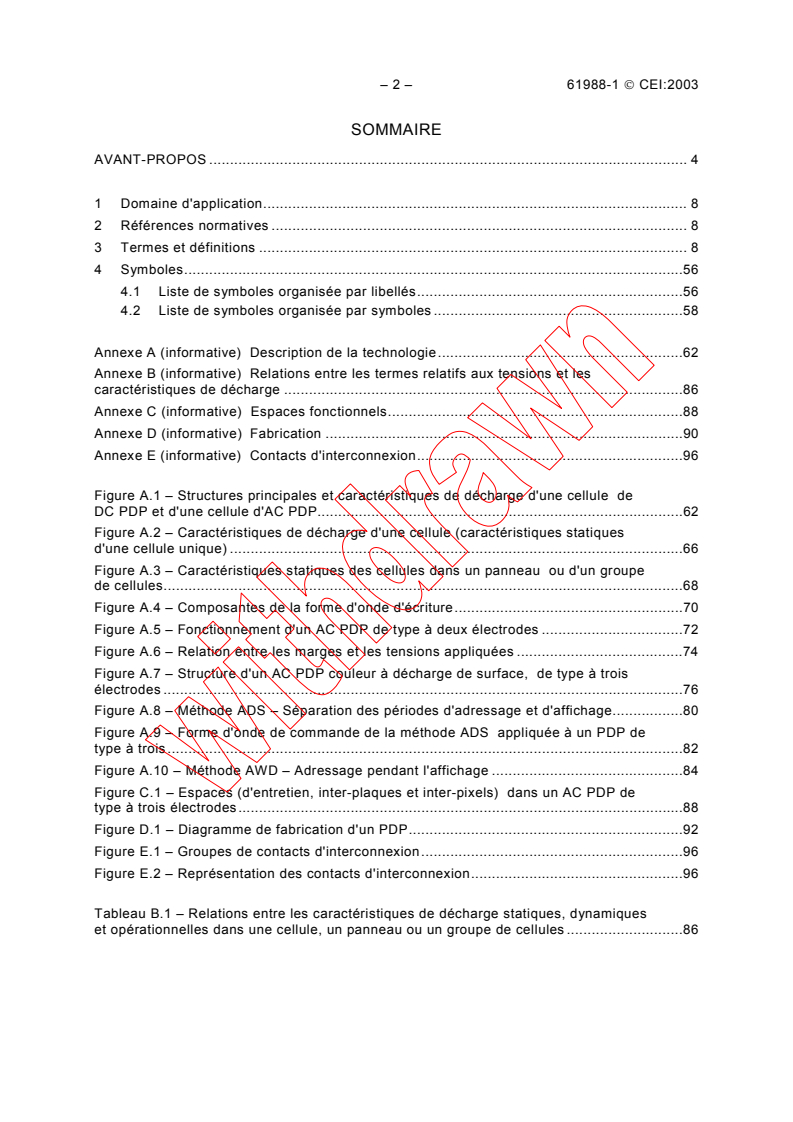
SOMMAIRE
AVANT-PROPOS . 4
1 Domaine d'application. 8
2 Références normatives . 8
3 Termes et définitions . 8
4 Symboles.56
4.1 Liste de symboles organisée par libellés.56
4.2 Liste de symboles organisée par symboles .58
Annexe A (informative) Description de la technologie.62
Annexe B (informative) Relations entre les termes relatifs aux tensions et les
caractéristiques de décharge .86
Annexe C (informative) Espaces fonctionnels.88
Annexe D (informative) Fabrication .90
Annexe E (informative) Contacts d'interconnexion.96
Figure A.1 – Structures principales et caractéristiques de décharge d'une cellule de
DC PDP et d'une cellule d'AC PDP.62
Figure A.2 – Caractéristiques de décharge d'une cellule (caractéristiques statiques
d'une cellule unique) .66
Figure A.3 – Caractéristiques statiques des cellules dans un panneau ou d'un groupe
de cellules.68
Figure A.4 – Composantes de la forme d'onde d'écriture.70
Figure A.5 – Fonctionnement d'un AC PDP de type à deux électrodes .72
Figure A.6 – Relation entre les marges et les tensions appliquées .74
Figure A.7 – Structure d'un AC PDP couleur à décharge de surface, de type à trois
électrodes .76
Figure A.8 – Méthode ADS – Séparation des périodes d'adressage et d'affichage.80
Figure A.9 – Forme d'onde de commande de la méthode ADS appliquée à un PDP de
type à trois.82
Figure A.10 – Méthode AWD – Adressage pendant l'affichage .84
Figure C.1 – Espaces (d'entretien, inter-plaques et inter-pixels) dans un AC PDP de
type à trois électrodes.88
Figure D.1 – Diagramme de fabrication d'un PDP.92
Figure E.1 – Groupes de contacts d'interconnexion.96
Figure E.2 – Représentation des contacts d'interconnexion.96
Tableau B.1 – Relations entre les caractéristiques de décharge statiques, dynamiques
et opérationnelles dans une cellule, un panneau ou un groupe de cellules .86
61988-1 IEC:2003 – 3 –
CONTENTS
FOREWORD . 5
1 Scope . 9
2 Normative references. 9
3 Terms and definitions . 9
4 Symbols.57
4.1 Symbol list by term name.57
4.2 Symbol list by symbol .59
Annex A (informative) Description of the technology.63
Annex B (informative) Relationship between voltage terms and discharge
characteristics.87
Annex C (informative) Gaps .89
Annex D (informative) Manufacturing .91
Annex E (informative) Interconnect pad.97
Figure A.1 – Principal structures and discharge characteristics of a DC PDP cell and
an AC PDP cell .63
Figure A.2 – Discharge characteristics of a cell (single cell static characteristics) .67
Figure A.3 – Static characteristics of cells in a panel or a group of cells.69
Figure A.4 – Write waveform components .71
Figure A.5 – Operation of a two-electrode type AC PDP.73
Figure A.6 – Relation between margins and applied voltages .75
Figure A.7 – Structure of a three-electrode type, surface discharge colour AC PDP .77
Figure A.8 – Address-, Display-period separation method .81
Figure A.9 – A driving waveform for ADS method applied to a three-electrode .83
Figure A.10 – Address while display method .85
Figure C.1 – Gaps (sustain gap, plate gap and interpixel gap) in a three-electrode
type AC PDP.89
Figure D.1 – PDP manufacturing flow chart .93
Figure E.1 – Interconnect pad group .97
Figure E.2 – Dimensions of interconnect pads.97
Table B.1 – Relation between static, dynamic and operating discharge characteristics
in a cell, a panel or a group of cells.87
– 4 – 61988-1 © CEI:2003
COMMISSION ÉLECTROTECHNIQUE INTERNATIONALE
––––––––––––
PANNEAUX D'AFFICHAGE À PLASMA –
Partie 1: Terminologie et symboles littéraux
AVANT-PROPOS
1) La Commission Electrotechnique Internationale (CEI) est une organisation mondiale de normalisation
composée de l'ensemble des comités électrotechniques nationaux (Comités nationaux de la CEI). La CEI a
pour objet de favoriser la coopération internationale pour toutes les questions de normalisation dans les
domaines de l'électricité et de l'électronique. A cet effet, la CEI – entre autres activités – publie des Normes
internationales, des Spécifications techniques, des Rapports techniques et des Guides (ci-après dénommés
"Publication(s) de la CEI"). Leur élaboration est confiée à des comités d'études, aux travaux desquels tout
Comité national intéressé par le sujet traité peut participer. Les organisations internationales,
gouvernementales et non gouvernementales, en liaison avec la CEI, participent également aux travaux. La CEI
collabore étroitement avec l'Organisation Internationale de Normalisation (ISO), selon des conditions fixées par
accord entre les deux organisations.
2) Les décisions ou accords officiels de la CEI concernant les questions techniques représentent, dans la mesure
du possible, un accord international sur les sujets étudiés, étant donné que les Comités nationaux de la CEI
intéressés sont représentés dans chaque comité d’études.
3) Les Publications de la CEI se présentent sous la forme de recommandations internationales et sont agréées
comme telles par les Comités nationaux de la CEI. Tous les efforts raisonnables sont entrepris afin que la CEI
s'assure de l'exactitude du contenu technique de ses publications; la CEI ne peut pas être tenue responsable
de l'éventuelle mauvaise utilisation ou interprétation qui en est faite par un quelconque utilisateur final.
4) Dans le but d'encourager l'uniformité internationale, les Comités nationaux de la CEI s'engagent, dans toute la
mesure possible, à appliquer de façon transparente les Publications de la CEI dans leurs publications
nationales et régionales. Toutes divergences entre toutes Publications de la CEI et toutes publications
nationales ou régionales correspondantes doivent être indiquées en termes clairs dans ces dernières.
5) La CEI n’a prévu aucune procédure de marquage valant indication d’approbation et n'engage pas sa
responsabilité pour les équipements déclarés conformes à une de ses Publications.
6) Tous les utilisateurs doivent s'assurer qu'ils sont en possession de la dernière édition de cette publication.
7) Aucune responsabilité ne doit être imputée à la CEI, à ses administrateurs, employés, auxiliaires ou
mandataires, y compris ses experts particuliers et les membres de ses comités d'études et des Comités
nationaux de la CEI, pour tout préjudice causé en cas de dommages corporels et matériels, ou de tout autre
dommage de quelque nature que ce soit, directe ou indirecte, ou pour supporter les coûts (y compris les frais
de justice) et les dépenses découlant de la publication ou de l'utilisation de cette Publication de la CEI ou de
toute autre Publication de la CEI, ou au crédit qui lui est accordé.
8) L'attention est attirée sur les références normatives citées dans cette publication. L'utilisation de publications
référencées est obligatoire pour une application correcte de la présente publication.
9) L’attention est attirée sur le fait que certains des éléments de la présente Publication de la CEI peuvent faire
l’objet de droits de propriété intellectuelle ou de droits analogues. La CEI ne saurait être tenue pour
responsable de ne pas avoir identifié de tels droits de propriété et de ne pas avoir signalé leur existence.
La Norme internationale CEI 61988-1 a été établie par le sous-comité 47C: Dispositifs
d'affichage à panneaux plats , du comité d'études 47 de la CEI: Dispositifs à semi-
conducteurs.
La présente version bilingue, publiée en 2003-08, correspond à la version anglaise.
Le texte anglais de cette norme est issu des documents 47C/289/FDIS et 47C/296/RVD.
Le rapport de vote 47C/296/RVD donne toute information sur le vote ayant abouti à
l’approbation de cette norme.
———————
Le sous-comité 47C a été transformé en comité 110: Dispositifs d’affichage à panneaux plats.
61988-1 © IEC:2003 – 5 –
INTERNATIONAL ELECTROTECHNICAL COMMISSION
––––––––––––
PLASMA DISPLAY PANELS –
Part 1: Terminology and letter symbols
FOREWORD
1) The International Electrotechnical Commission (IEC) is a worldwide organization for standardization comprising
all national electrotechnical committees (IEC National Committees). The object of IEC is to promote
international co-operation on all questions concerning standardization in the electrical and electronic fields. To
this end and in addition to other activities, IEC publishes International Standards, Technical Specifications,
Technical Reports, and Guides (hereafter referred to as “IEC Publication(s)”). Their preparation is entrusted to
technical committees; any IEC National Committee interested in the subject dealt with may participate in this
preparatory work. International, governmental and non-governmental organizations liaising with the IEC also
participate in this preparation. IEC collaborates closely with the International Organization for Standardization
(ISO) in accordance with conditions determined by agreement between the two organizations.
2) The formal decisions or agreements of IEC on technical matters express, as nearly as possible, an international
consensus of opinion on the relevant subjects since each technical committee has representation from all
interested IEC National Committees.
3) IEC Publications have the form of recommendations for international use and are accepted by IEC National
Committees in that sense. While all reasonable efforts are made to ensure that the technical content of IEC
Publications is accurate, IEC cannot be held responsible for the way in which they are used or for any
misinterpretation by any end user.
4) In order to promote international uniformity, IEC National Committees undertake to apply IEC Publications
transparently to the maximum extent possible in their national and regional publications. Any divergence
between any IEC Publication and the corresponding national or regional publication shall be clearly indicated in
the latter.
5) IEC provides no marking procedure to indicate its approval and cannot be rendered responsible for any
equipment declared to be in conformity with an IEC Publication.
6) All users should ensure that they have the latest edition of this publication.
7) No liability shall attach to IEC or its directors, employees, servants or agents including individual experts and
members of its technical committees and IEC National Committees for any personal injury, property damage or
other damage of any nature whatsoever, whether direct or indirect, or for costs (including legal fees) and
expenses arising out of the publication, use of, or reliance upon, this IEC Publication or any other IEC
Publications.
8) Attention is drawn to the Normative references cited in this publication. Use of the referenced publications is
indispensable for the correct application of this publication.
9) Attention is drawn to the possibility that some of the elements of this IEC Publication may be the subject of
patent rights. IEC shall not be held responsible for identifying any or all such patent rights.
International Standard IEC 61988-1 has been prepared by subcommittee 47C: Flat panel
display devices , of IEC technical committee 47: Semiconductor devices.
This bilingual version, published in 2003-08, corresponds to the English version.
The text of this standard is based on the following documents:
FDIS Report on voting
47C/289/FDIS 47C/296/RVD
Full information on the voting for the approval on this standard can be found in the report on
voting indicated in the above table.
———————
Subcommittee 47C has been converted into committee 110: Flat panel display devices.
– 6 – 61988-1 CEI:2003
La version française de cette norme n’a pas été soumise au vote.
Cette publication a été rédigée selon les Directives ISO/CEI, Partie 2.
La CEI 61988 comprendra, sous le titre général Panneaux d'affichage à plasma, les parties
suivantes:
Partie 1: Terminologie et symboles littéraux;
Partie 2-1: Méthodes de mesure – Optiques;
Partie 2-2: Méthodes de mesure – Méthodes opto-électriques;
Partie 3: Lignes directrices sur l’interface mécanique;
Partie 4: Méthodes d'essais environnementaux, d'endurance et mécaniques.
Le comité a décidé que le contenu de cette publication ne sera pas modifié avant 2008.
A cette date, la publication sera
• reconduite;
• supprimée;
• remplacée par une édition révisée, ou
• amendée.
61988-1 IEC:2003 – 7 –
The French version of this standard has not been voted upon.
This publication has been drafted in accordance with the ISO/IEC Directives, Part 2.
IEC 61988 will consist of the following parts, under the general title Plasma display panels:
Part 1: Terminology and letter symbols;
Part 2-1: Measuring methods – Optical;
Part 2-2: Measuring methods – Optoelectrical;
Part 3: Guidelines of mechanical interface;
Part 4: Environmental, endurance and mechanical test methods.
The committee has decided that the contents of this publication will remain unchanged until
2008. At this date, the publication will be
• reconfirmed;
• withdrawn;
• replaced by a revised edition, or
• amended.
– 8 – 61988-1 CEI:2003
PANNEAUX D'AFFICHAGE À PLASMA –
Partie 1: Terminologie et symboles littéraux
1 Domaine d'application
La présente partie de la CEI 61988 donne les termes à utiliser, de préférence, leurs
définitions et leurs symboles pour les panneaux d'affichage couleur à plasma à tension
alternative (AC Plasma Display Panels ou AC PDP); le but recherché est d'encourager
l'utilisation de ces mêmes termes lorsque des publications sont préparées dans différents
pays. Des lignes directrices concernant la technologie sont données dans les annexes.
2 Références normatives
Les documents de référence suivants sont indispensables à l'application de cette publication.
Pour les références datées seule l'édition citée s'applique. Dans le cas de références sans
date la dernière édition du document cité s'applique (incluant tous ses amendements).
CEI 61988-2-1, Panneaux d'affichage à plasma – Partie 2-1: Méthodes de mesure – Optiques
CEI 61988-2-2, Panneaux d'affichage à plasma – Partie 2-2: Méthodes de mesure –
Méthodes opto-électriques
CIE 15.2:1986, Colorimétrie, 2ème édition
3 Termes et définitions
Pour les besoins du présent document, les définitions suivantes s'appliquent.
3.1
AC PDP
NOTE Voir panneau d'affichage à plasma à tension d'entretien alternative.
3.2
panneau d'affichage à plasma à tension d'entretien alternative
AC PDP (AC plasma display panel)
panneau d'affichage à plasma dans lequel la région de décharge dans le gaz est isolée des
électrodes qui reçoivent les impulsions de tension de polarités alternées
3.3
polarisation d'adressage
Vba
polarisation des signaux de données
tension commune appliquée à toutes les électrodes d'adressage pendant l'adressage
3.4
période du cycle d'adressage
intervalle de temps entre les débuts des impulsions d'adressage successives les plus
rapprochées
61988-1 IEC:2003 – 9 –
PLASMA DISPLAY PANELS –
Part 1: Terminology and letter symbols
1 Scope
This part of IEC 61988 gives the preferred terms, their definitions and symbols for colour
AC plasma display panels (AC PDP); with the object of using the same terminology when
publications are prepared in different countries. Guidance on the technology is provided
in the annexes.
2 Normative references
The following referenced documents are indispensable for the application of this document.
For dated references, only the edition cited applies. For undated references, the latest edition
of the referenced document (including any amendments) applies.
IEC 61988-2-1, Plasma display panels – Part 2-1: Measuring methods – Optical
IEC 61988-2-2, Plasma display panels – Part 2-2: Measuring methods – Optoelectrical
nd
CIE 15.2:1986, Colorimetry, 2 Edition
3 Terms and definitions
For the purposes of this document, the following definitions apply.
3.1
AC PDP
NOTE See AC plasma display panel.
3.2
AC plasma display panel
AC PDP
plasma display panel in which the gas discharge region is insulated from the electrodes that
are driven with AC voltage pulses
3.3
address bias
Vba
data bias
common voltage applied to all address electrodes during addressing
3.4
address cycle period
time interval between initiation of the closest spaced successive address pulses
– 10 – 61988-1 CEI:2003
3.5
décharge d'adressage
décharge qui change l'état d'un sous-pixel du PDP
3.6
électrode d'adressage
électrode de données
électrode, orthogonale à l'électrode de balayage, qui est utilisée pour piloter les sous-pixels
avec les données de l'image
3.7
impulsion d'adressage
Impulsion de données
impulsion de tension incrémentale appliquée à une seule électrode d'adressage pour
adresser, sélectionner un sous-pixel correspondant à une image à afficher
NOTE Voir impulsion de balayage.
3.8
tension d'adressage
Va
tension de données
amplitude des impulsions de tension appliquées à l'électrode d'adressage (de données)
pendant l'adressage (exclut la tension de polarisation d'adressage sur l'électrode)
3.9
méthode d'adressage et d'affichage simultanés
méthode AWD
technique de pilotage de l'échelle de gris qui adresse seulement une partie des pixels du
panneau à un instant quelconque inclus dans une période d'entretien
NOTE Voir aussi ADS.
3.10
capacité d'adressage
définition
nombre de pixels dans les directions horizontale et verticale, dont la luminance peut être
modifiée
NOTE Habituellement exprimée en nombre de pixels horizontaux par nombre de pixels verticaux. Ce terme n'est
pas un synonyme de résolution. Voir résolution.
3.11
adressage
établissement ou changement de l'état d'un sous-pixel par une impulsion d'adressage
3.12
méthode ADS
méthode de la séparation des périodes d'adressage et d'affichage
technique de pilotage de l'échelle de gris qui consiste en un adressage de tous les pixels du
panneau dans une certaine période temporelle puis à entretenir (afficher) tous les pixels du
panneau pendant une période temporelle distincte
3.13
vieillissement
processus de fabrication qui consiste à faire fonctionner le panneau dans des conditions qui
accélèrent la stabilisation de ses caractéristiques
61988-1 IEC:2003 – 11 –
3.5
address discharge
discharge that changes the state of a PDP subpixel
3.6
address electrode
data electrode
electrode, orthogonal to the scan electrode, that is used in driving the subpixels with
the image data
3.7
address pulse
data pulse
incremental voltage pulse applied to a single address (data) electrode for addressing,
to select a subpixel according to an image to be displayed
NOTE See scan pulse.
3.8
address voltage
Va
data voltage
amplitude of the voltage pulses applied to the address (data) electrode during addressing
(excludes the address bias on the electrode)
3.9
address while display method
AWD method
grey scale drive technique that addresses only a portion of the pixels of the panel in any time
within a sustain period
NOTE See also ADS.
3.10
addressability
number of pixels in the horizontal and vertical directions, that can have their luminance
changed
NOTE Usually expressed in the number of horizontal pixels by the number of vertical pixels. This term is not
synonymous with resolution. See resolution.
3.11
addressing
setting or changing the state of a subpixel with an address pulse
3.12
ADS method
address, display-period separation method
grey scale drive technique that consists of addressing all the pixels in the panel in one time
period and sustaining all the pixels in the panel in a separate time period
3.13
ageing
manufacturing process consisting of operating the panel under conditions that stabilize its
performance
– 12 – 61988-1 CEI:2003
3.14
recuit
processus consistant à chauffer le verre au-dessus de son point de recuit et à le refroidir à
une vitesse maîtrisée, afin de réduire au minimum les changements dimensionnels pendant
les cycles de températures élevées ultérieurs
3.15
anode
surface d'un dispositif chargée positivement qui collecte les électrons de la décharge
NOTE Dans un AC PDP, la cathode et l'anode échangent leur rôle en fonction du sens des demi-périodes de la
tension alternative.
3.16
format d'image
rapport entre la largeur de l'écran et la hauteur de l'écran
3.17
gestion automatique de puissance
APC (auto power control)
circuit qui a pour but de gérer la puissance crête et/ou moyenne de l'afficheur
3.18
anode auxiliaire
anode, dans un DC PDP, dont la décharge contribue à fournir des particules de
préconditionnement initiant une décharge dans une cellule
3.19
contre-plaque
plaque arrière
plaque la plus éloignée de l'observateur
3.20
remplissage par l'arrière
NOTE Voir remplissage.
3.21
brûlage
NOTE Voir dégazage et brûlage.
3.22
dégazage
traitement à hautes températures d'un système en cours de pompage et/ou d'un PDP pour
favoriser l'obtention de basses pressions
3.23
brûlage (pyrolyse)
processus à hautes températures qui évapore l'eau et décompose les matériaux organiques
NOTE Le brûlage est utilisé pour nettoyer les pièces en dispersant les matériaux non désirés dans l'atmosphère.
3.24
barrière
barrière qui sépare les cellules du panneau, électriquement, optiquement et physiquement
NOTE La barrière peut s’étendre de la plaque la plus proche à la plaque la plus éloignée et contrôler l’espace
entre les plaques.
61988-1 IEC:2003 – 13 –
3.14
annealing
process of heating the glass above its annealing point and cooling at a controlled rate
to minimize dimensional changes during subsequent high temperature cycles
3.15
anode
positively charged surface of a device that collects electrons from the discharge
NOTE In an AC PDP, the cathode and anode exchange their roles on alternate half-cycles.
3.16
aspect ratio
ratio of screen width to screen height
3.17
auto power control
APC
circuit means to control the peak and/or average power of the display
3.18
auxiliary anode
anode in a DC PDP whose discharge contributes to supply priming particles to ignite a
discharge in a cell
3.19
back plate
rear plate
plate furthest from the viewer
3.20
back-filling
NOTE See filling.
3.21
bake
NOTE See bakeout, baking.
3.22
bakeout
high temperature processing of a vacuum system and/or PDP to assist in achieving low
pressures
3.23
baking
high temperature process used to evaporate water and decompose organic materials
NOTE Baking is used to clean the parts by dispersing unwanted material into the atmosphere.
3.24
barrier rib
rib that separates the cells of the panel, electrically, optically and physically
NOTE The barrier ribs may extend from the front plate to the back plate and control the spacing between
the plates.
– 14 – 61988-1 CEI:2003
3.25
brûlage des liants
processus pendant lequel les liants organiques sont éliminés par décomposition et/ou par
oxydation
3.26
luminance du niveau du noir
luminance du panneau dans son état de luminance minimale dans un environnement sombre
NOTE Voir 6.3.3 b) de la CEI 61988-2-1.
3.27
réseau noir
matériau noir placé dans l'espace entre les zones des sous-pixels, qui améliore le contraste
en réduisant la réflectivité
3.28
réseau noir en bandes
matériau noir placé dans l'espace entre les zones des sous-pixels, qui améliore le contraste
en réduisant la réflectivité et ayant l'aspect de bandes
NOTE Le réseau noir en bandes est un type particulier de perfectionnement du réseau noir.
3.29
uniformité du noir, échantillonnée
uniformité de la luminance du niveau du noir décrit en termes de pourcentage de disparité
(différence de luminance entre les points d'échantillonnage divisée par la moyenne des
luminances du niveau du noir) aux points d'échantillonnage prescrits
3.30
BRCR-#/#
NOTE Voir rapport de contraste en environnement lumineux #/#.
3.31
tension d'allumage
tension la plus faible entre la cathode et l'anode provoquant une décharge dans le gaz
évoluant vers un état disruptif
3.32
défaut brillant
défaut dans la reproduction de l'image, qui semble plus lumineuse que l'image correcte
3.33
rapport de contraste en environnement lumineux #/#
BRCR-#/# (bright room contrast ratio#/#)
rapport de contraste sous éclairage ambiant de l'écran, autres que les niveaux nominaux
100/70
NOTE Le symbole #/# décrit l'illumination ambiante sur les plan vertical/plan horizontal (voir 6.1 de la CEI 61988-
2-2).
3.34
rapport de contraste en environnement lumineux 100/70
BRCR-100/70
rapport de contraste sous éclairage ambiant de l'écran de 100 lx sur le plan vertical et de
70 lx sur le plan horizontal
NOTE Voir 6.1 de la CEI 61988-2-2.
61988-1 IEC:2003 – 15 –
3.25
binder burnout
process during which organic binders are remove by decomposition and/or oxidation
3.26
black level luminance
luminance of the panel in its minimum luminance state in a dark ambient
NOTE See 6.3.3.b of IEC 61988-2-1.
3.27
black matrix
black material placed in the space between subpixel areas in order to improve contrast by
reducing reflectivity
3.28
black stripe
black material placed in the space between subpixel areas in order to improve contrast by
reducing reflectivity, having the form of stripes
NOTE Black stripe is a specific type of black matrix contrast enhancement.
3.29
black uniformity, sampled
uniformity of the black level luminance expressed in terms of the percentage non-uniformity
(difference in luminance between measuring points divided by the average black level
luminance) at the specified measuring points
3.30
BRCR-#/#
NOTE See bright room contrast ratio #/#.
3.31
breakdown voltage
smallest voltage between the cathode and the anode causing a gas discharge to grow to a
breakdown condition
3.32
bright defect
defect in the image reproduction that appears brighter than the correct image
3.33
bright room contrast ratio #/#
BRCR-#/#
contrast ratio with ambient illumination on the screen other than the nominal 100/70 levels
NOTE The symbol #/# describes the ambient illumination on the vertical plane/horizontal plane (see 6.1 of
IEC 61988-2-2).
3.34
bright room contrast ratio 100/70
BRCR-100/70
contrast ratio with an ambient illumination on the screen of 100 lx on the vertical plane and
70 lx on the horizontal plane
NOTE See 6.1 of IEC 61988-2-2.
– 16 – 61988-1 CEI:2003
3.35
luminosité
qualité visuelle et subjective de la façon dont un objet apparaît brillant, ou bien quelle
quantité de lumière visible émane de l'objet telle que perçue par l'œil
NOTE Voir luminance.
3.36
effacement global
commande qui consiste à appliquer une impulsion de tension au panneau, qui commute
toutes les cellules du panneau à l'état désexcité
3.37
écriture globale
commande qui consiste à appliquer une impulsion de tension au panneau, qui commute
toutes les cellules du panneau à l'état excité
3.38
déverminage
processus dont le but est d'améliorer les performances de fiabilité du matériel en mettant en
œuvre l'exploitation fonctionnelle de chaque constituant, dans un environnement prescrit,
avec des actions successives de maintenance corrective à chaque défaillance, pendant la
période des défaillances précoces
3.39
électrode de bus
électrode de haute conductivité mise en parallèle avec l'électrode transparente afin de
diminuer leur résistance globale
3.40
cathode
surface d'un dispositif chargée négativement qui émet des électrons secondaires vers la
décharge
NOTE Dans un AC PDP, la cathode et l'anode s'échangent en fonction du sens des demi-périodes de la tension
alternative d'entretien.
3.41
cellule
structure physique d'un sous-pixel ou un sous-pixel lui-même (de cellule: se rapportant aux
caractéristiques d'une cellule unique)
3.42
pas de cellule
(le) pas des sous-pixels
3.43
tension de cellule
Vc
tension, dépendante du temps, appliquée au gaz d'une cellule de l'afficheur à plasma
3.44
tension médiane d'allumage
moyenne entre la tension de la première allumée et la tension de la dernière allumée
3.45
tension minimale d'entretien médiane
moyenne entre la tension de la première éteinte et la tension de la dernière éteinte
61988-1 IEC:2003 – 17 –
3.35
brightness
visual and subjective quality of how bright an object appears, or how much visible light is
coming off the object being perceived by the eye
NOTE See luminance.
3.36
bulk erase
operation of applying a voltage pulse to the panel that switches all of the cells in the panel to
the off-state
3.37
bulk write
operation of applying a voltage pulse to the panel that switches all of the cells in the panel to
the on-state
3.38
burn-in
process of increasing the reliability performance of hardware employing functional operation
of every item in a prescribed environment with successive corrective maintenance at every
failure during the early failure period
3.39
bus electrode
high conductivity electrode intimately connected along its length to the transparent electrode
in order to reduce total resistance
3.40
cathode
negatively charged surface of a device that emits secondary electrons to the discharge
NOTE In an AC PDP, the cathode and anode exchange their roles on alternate half-cycles.
3.41
cell
physical structure of a subpixel or a subpixel itself (adjective – referring to the characteristics
of a single cell)
3.42
cell pitch
subpixel pitch
3.43
cell voltage
Vc
time-dependent voltage across the gas in a plasma display cell
3.44
centre firing voltage
average of the first-on voltage and the last-on voltage
3.45
centre minimum sustain voltage
average of the first-off voltage and the last-off voltage
– 18 – 61988-1 CEI:2003
3.46
uniformité chromatique
homogénéité de la chrominance produite par différentes zones du PDP
NOTE Habituellement exprimée dans le sens inverse de la non-uniformité, en tant que Δx et Δy ou bien de la
i i,
différence de chrominance des points d'échantillonnage prescrits, comparée avec celle du centre de l'écran
d'affichage. Voir uniformité de la luminance et 6.4 de la CEI 61988-2-1.
3.47
électrode colonne
électrode d'adressage
NOTE L'électrode colonne était historiquement une électrode continue dans la direction verticale. Lorsque le
panneau est orienté dans le sens portrait, l'électrode colonne peut être alignée horizontalement. Voir électrode
ligne.
3.48
rapport de contraste
rapport entre la luminance du blanc et la luminance du niveau du noir de l'image, y compris la
lumière réfléchie (rétro-diffusée) par l'afficheur
NOTE Ce rapport dépend fortement de la lumière ambiante et deux sortes de taux sont consignés, le rapport de
contraste en environnement lumineux (BRCR) et le rapport de contraste en environnement sombre (DRCR). Voir 6.3
et 6.1 de la CEI 61988-2-1.
3.49
rapport de contraste, échantillonné
CR
rapport entre la luminance du blanc et la luminance du niveau du noir aux points d'échan-
tillonnage prescrits
NOTE Voir 6.3 de la CEI 61988-2-1 ainsi que 6.3 et 6.1 de la CEI 61988-2-2.
3.50
PDP coplanaire
NOTE Voir PDP à décharge de surface.
3.51
couplage parasite (diaphotie)
phénomène initié par la décharge d'une cellule provoquant une décharge non désirée dans
une cellule voisine
3.52
défaut sombre
défaut dans la reproduction de l'image, qui semble moins lumineux que l'image correcte
3.53
rapport de contraste en chambre noire
rapport de contraste en environnement sombre
DRCR
rapport de contraste mesuré en environnement sombre, normalement inférieur à 1 lx
NOTE Voir 6.3 de la CEI 61988-2-1.
3.54
polarisation des données
NOTE Voir polarisation d'adressage.
3.55
électrode de données
NOTE Voir électrode d'adressage.
61988-1 IEC:2003 – 19 –
3.46
chromatic uniformity
uniformity of the chromaticity produced by different areas of the PDP
NOTE Usually expressed in the inverse sense of the nonuniformity, as Δx and Δy or the difference between the
i i,
chromaticity at the specified measuring points and the chromaticity at the centre of the display screen. See
luminance uniformity and 6.4 of IEC 61988-2-1.
3.47
column electrode
address electrode
NOTE The column electrode was historically continuous in the vertical direction. When the panel is oriented in
portrait orientation, the column electrode can be aligned horizontally. See row electrode.
3.48
contrast ratio
ratio of white luminance to black luminance of the image, including light reflected from the
display
NOTE This ratio is strongly dependent on the ambient light and two forms are reported, bright room contrast ratio
(BRCR) and dark room contrast ratio (DRCR). See 6.3 and 6.1 of IEC 61988-2-1.
3.49
contrast ratio, sampled
CR
ratio of a white luminance to a black luminance at the specified measuring points
NOTE See 6.3 of IEC 61988-2-1, and 6.3 and 6.1 of IEC 61988-2-2.
3.50
coplanar PDP
NOTE See surface discharge PDP.
3.51
crosstalk
phenomenon initiated by a discharge in one cell that causes an unwanted discharge in
a neighbouring cell
3.52
dark defect
defect in the image reproduction that appears less bright than the correct image
3.53
dark room contrast ratio
DRCR
contrast ratio measured in a dark room ambient, typically less than 1 lx
NOTE See 6.3 of IEC 61988-2-1.
3.54
data bias
NOTE See address bias.
3.55
data electrode
NOTE See address electrode.
– 20 – 61988-1 CEI:2003
3.56
impulsion de données
NOTE Voir impulsion d'adressage.
3.57
tension des signaux de données
NOTE Voir tension d'adressage.
3.58
DC PDC
NOTE Voir panneau d’affichage à plasma à tension d’entretien continue
3.59
panneau d'affichage à plasma à tension d'entretien continue
DC PDP
panneau d'affichage à plasma dans lequel les électrodes conductrices sont directement en
contact avec la décharge dans le gaz
3.60
couche diélectrique
couche ou couches de matériau non conducteur qui recouvre(nt) les électrodes, sur
lesquelles des charges, provenant de la décharge, se sont accumulées
NOTE La charge accumulée permet de réaliser la fonction mémoire des AC PDP.
3.61
potentiel du diélectrique
Vd
tension de diélectrique
tension entre les faces du diélectrique due aux charges de paroi qui sont elles-mêmes
variable en fonction du temps
Vd = Qw/Cd
où
...