

IEC 60598-2-4:1997
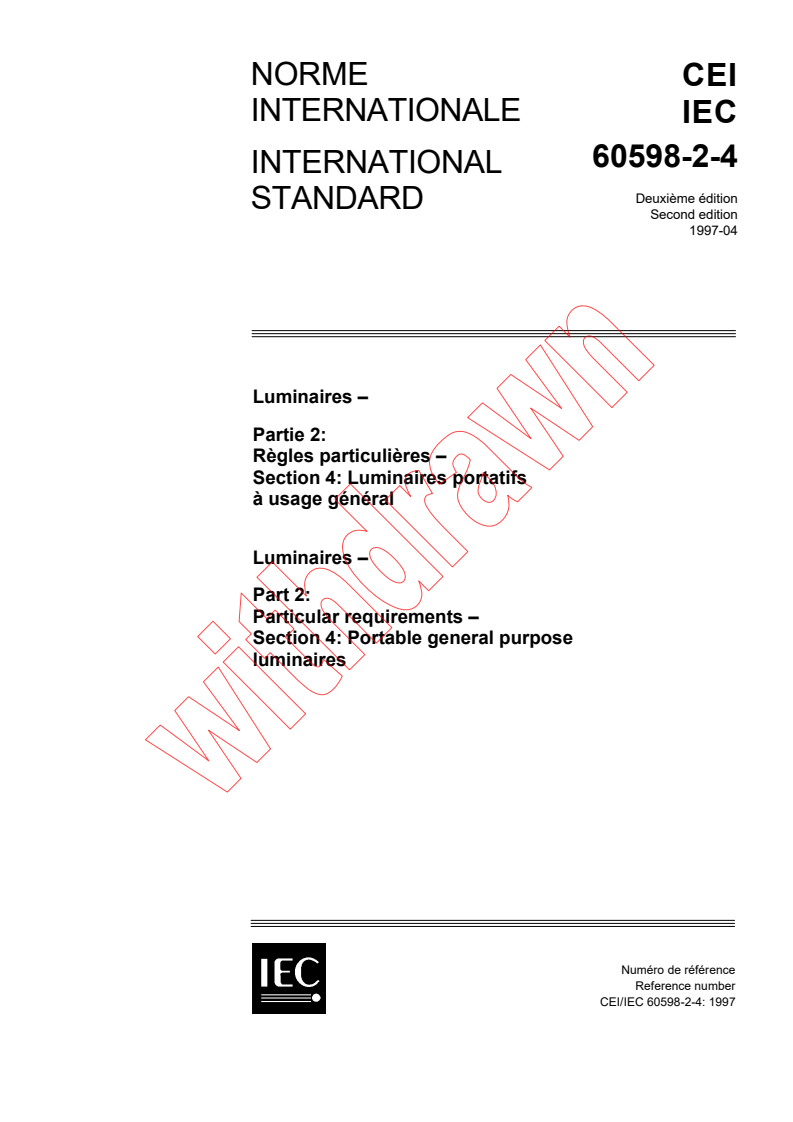
(Main)Luminaires - Part 2: Particular requirements - Section 4: Portable general purpose luminaires
General Information
- Abstract
Specifies requirements for portable general purpose luminaires, other than handlamps, for use with tungsten filament, tubular fluorescent and other discharge lamps on supply voltages not exceeding 250 V.
- Status
- Published
- Publication Date
- 27-Apr-1997
- Technical Committee
- SC 34D - Luminaires
- Current Stage
- DELPUB - Deleted Publication
- Start Date
- 21-Apr-2017
- Completion Date
- 28-Aug-2026
Overview
IEC 60598-2-4:1997 is an International Electrotechnical Commission (IEC) standard detailing the particular requirements for portable general purpose luminaires. This applies to portable luminaires, excluding handlamps, designed for use with tungsten filament, tubular fluorescent, and other discharge lamps on supply voltages not exceeding 250 V. The standard is intended to ensure safety, durability, and performance of these portable lighting products in general use environments. It must be read in conjunction with IEC 60598-1, which covers general requirements and tests for luminaires.
Key Topics
IEC 60598-2-4 addresses several critical aspects for compliance and safety:
- Scope and Application: Defines which products fall under its coverage-specifically portable general purpose luminaires, except handlamps, for voltages up to 250 V.
- Normative References: Utilizes IEC 60529 for degrees of protection provided by enclosures (IP codes).
- Construction Requirements: Specifies design rules for insulation, wiring stability, and physical stability to prevent accidents or electrical hazards during use and handling.
- Classification: Requires portable luminaires designed for standing on floors or tables to be suitable for direct mounting on normally flammable surfaces.
- Marking: Outlines clear marking criteria to ensure correct product identification and compliance tracking.
- Electrical Protection: Sets out conditions for protection against electric shock, ensuring non-accessibility to live parts and proper earthing where necessary.
- Thermal & Mechanical Safety: Details endurance and thermal test protocols, including resistance to dust, moisture, and fire, to confirm long-term safety and reliability.
- Types of Lampholders: Includes criteria for candlestick luminaires and the use of E5 and E10 lampholders, with strict conditions on rated voltage and maximum wattage.
Applications
Portable luminaires that must comply with IEC 60598-2-4 are commonly used in:
- Domestic and Residential Lighting: Desk lamps, table lamps, floor lamps, and decorative lighting fixtures.
- Commercial and Hospitality Settings: Portable luminaires for offices, hotels, restaurants, and other temporary installations.
- Retail and Exhibitions: Lighting products intended for flexible, portable use in shops, stands, and showrooms.
Compliance with IEC 60598-2-4 ensures that these products are suitable for safe general use where mobility, flexibility, and reliability are critical-helping manufacturers meet international market requirements and supporting user safety.
Related Standards
For full compliance and comprehensive understanding, reference should also be made to:
- IEC 60598-1: Luminaires - Part 1: General requirements and tests
- IEC 60529: Degrees of protection provided by enclosures (IP codes)
- IEC 27, 417, 617, 878: For letter and graphical symbols used in electrical equipment
- IEC 60598-2-x: Other sections of Part 2 focusing on different types of luminaires (e.g., recessed, outdoor, handlamps)
Manufacturers, testing laboratories, and regulatory agencies should remain updated on the latest editions of these documents to ensure comprehensive conformity and up-to-date safety practices.
Keywords: IEC 60598-2-4, portable luminaires, general purpose lighting, safety requirements, international standard, electrical safety, lamp holders, IP ratings, compliance, lighting products.
Relations
- Effective Date
- 05-Sep-2023
Get Certified
Connect with accredited certification bodies for this standard

IMQ S.p.A. (Certification)
Italian electrical product certification.

SLG Prüf- und Zertifizierungs GmbH
German testing and certification body.

UL Solutions
Global safety science company with testing, inspection and certification.
Sponsored listings
Frequently Asked Questions
IEC 60598-2-4:1997 is a standard published by the International Electrotechnical Commission (IEC). Its full title is "Luminaires - Part 2: Particular requirements - Section 4: Portable general purpose luminaires". This standard covers: Specifies requirements for portable general purpose luminaires, other than handlamps, for use with tungsten filament, tubular fluorescent and other discharge lamps on supply voltages not exceeding 250 V.
Specifies requirements for portable general purpose luminaires, other than handlamps, for use with tungsten filament, tubular fluorescent and other discharge lamps on supply voltages not exceeding 250 V.
IEC 60598-2-4:1997 is classified under the following ICS (International Classification for Standards) categories: 29.140.40 - Luminaires. The ICS classification helps identify the subject area and facilitates finding related standards.
IEC 60598-2-4:1997 has the following relationships with other standards: It is inter standard links to IEC 60598-2-4:2017. Understanding these relationships helps ensure you are using the most current and applicable version of the standard.
IEC 60598-2-4:1997 is available in PDF format for immediate download after purchase. The document can be added to your cart and obtained through the secure checkout process. Digital delivery ensures instant access to the complete standard document.
Standards Content (Sample)
NORME CEI
INTERNATIONALE
IEC
60598-2-4
INTERNATIONAL
Deuxième édition
STANDARD
Second edition
1997-04
Luminaires –
Partie 2:
Règles particulières –
Section 4: Luminaires portatifs
à usage général
Luminaires –
Part 2:
Particular requirements –
Section 4: Portable general purpose
luminaires
Numéro de référence
Reference number
CEI/IEC 60598-2-4: 1997
Validité de la présente publication Validity of this publication
Le contenu technique des publications de la CEI est cons- The technical content of IEC publications is kept under
tamment revu par la CEI afin qu'il reflète l'état actuel de constant review by the IEC, thus ensuring that the content
la technique. reflects current technology.
Des renseignements relatifs à la date de reconfirmation de Information relating to the date of the reconfirmation of the
la publication sont disponibles auprès du Bureau Central de publication is available from the IEC Central Office.
la CEI.
Les renseignements relatifs à ces révisions, à l'établis- Information on the revision work, the issue of revised
sement des éditions révisées et aux amendements peuvent editions and amendments may be obtained from IEC
être obtenus auprès des Comités nationaux de la CEI et National Committees and from the following IEC
dans les documents ci-dessous: sources:
• Bulletin de la CEI • IEC Bulletin
• Annuaire de la CEI • IEC Yearbook
Publié annuellement Published yearly
• Catalogue des publications de la CEI • Catalogue of IEC publications
Publié annuellement et mis à jour régulièrement Published yearly with regular updates
Terminologie Terminology
En ce qui concerne la terminologie générale, le lecteur se For general terminology, readers are referred to IEC 50:
reportera à la CEI 50: Vocabulaire Electrotechnique Inter- International Electrotechnical Vocabulary (IEV), which is
national (VEI), qui se présente sous forme de chapitres issued in the form of separate chapters each dealing
séparés traitant chacun d'un sujet défini. Des détails with a specific field. Full details of the IEV will be
complets sur le VEI peuvent être obtenus sur demande. supplied on request. See also the IEC Multilingual
Voir également le dictionnaire multilingue de la CEI. Dictionary.
Les termes et définitions figurant dans la présente publi- The terms and definitions contained in the present publi-
cation ont été soit tirés du VEI, soit spécifiquement cation have either been taken from the IEV or have been
approuvés aux fins de cette publication. specifically approved for the purpose of this publication.
Symboles graphiques et littéraux Graphical and letter symbols
Pour les symboles graphiques, les symboles littéraux et les For graphical symbols, and letter symbols and signs
signes d'usage général approuvés par la CEI, le lecteur approved by the IEC for general use, readers are referred to
consultera: publications:
– la CEI 27: Symboles littéraux à utiliser en – IEC 27: Letter symbols to be used in electrical
électrotechnique; technology;
– la CEI 417: Symboles graphiques utilisables – IEC 417: Graphical symbols for use on
sur le matériel. Index, relevé et compilation des equipment. Index, survey and compilation of the
feuilles individuelles; single sheets;
– la CEI 617: Symboles graphiques pour schémas; – IEC 617: Graphical symbols for diagrams;
et pour les appareils électromédicaux, and for medical electrical equipment,
– la CEI 878: Symboles graphiques pour – IEC 878: Graphical symbols for electromedical
équipements électriques en pratique médicale. equipment in medical practice.
Les symboles et signes contenus dans la présente publi- The symbols and signs contained in the present publication
cation ont été soit tirés de la CEI 27, de la CEI 417, de la have either been taken from IEC 27, IEC 417, IEC 617
CEI 617 et/ou de la CEI 878, soit spécifiquement approuvés and/or IEC 878, or have been specifically approved for the
aux fins de cette publication. purpose of this publication.
Publications de la CEI établies par le IEC publications prepared by the same
même comité d'études technical committee
L'attention du lecteur est attirée sur les listes figurant à la fin The attention of readers is drawn to the end pages of this
de cette publication, qui énumèrent les publications de la publication which list the IEC publications issued by the
CEI préparées par le comité d'études qui a établi la technical committee which has prepared the present
présente publication. publication.
NORME
CEI
INTERNATIONALE
IEC
60598-2-4
INTERNATIONAL
Deuxième édition
STANDARD
Second edition
1997-04
Luminaires –
Partie 2:
Règles particulières –
Section 4: Luminaires portatifs
à usage général
Luminaires –
Part 2:
Particular requirements –
Section 4: Portable general purpose
luminaires
IEC 1997 Droits de reproduction réservés Copyright - all rights reserved
Aucune partie de cette publication ne peut être reproduite ni utilisée No part of this publication may be reproduced or utilized in
sous quelque forme que ce soit et par aucun procédé, électronique any form or by any means, electronic or mechanical, including
ou mécanique, y compris la photocopie et les microfilms, sans photocopying and microfilm, without permission in writing from
l'accord écrit de l'éditeur. the publisher.
International Electrotechnical Commission 3, rue de Varembé Geneva, Switzerland
Telefax: +41 22 919 0300 e-mail: inmail@iec.ch IEC web site http: //www.iec.ch
CODE PRIX
Commission Electrotechnique Internationale
PRICE CODE G
International Electrotechnical Commission
Pour prix, voir catalogue en vigueur
For price, see current catalogue
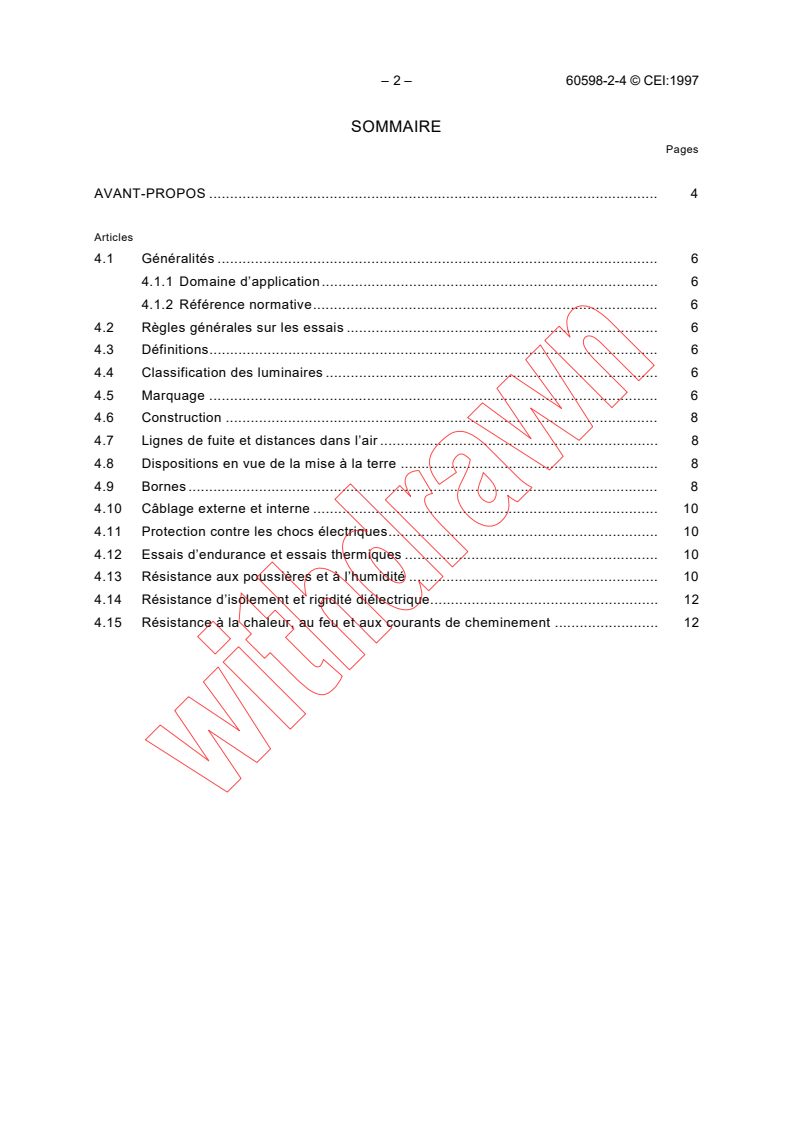
– 2 – 60598-2-4 © CEI:1997
SOMMAIRE
Pages
AVANT-PROPOS . 4
Articles
4.1 Généralités. 6
4.1.1 Domaine d’application. 6
4.1.2 Référence normative. 6
4.2 Règles générales sur les essais . 6
4.3 Définitions. 6
4.4 Classification des luminaires . 6
4.5 Marquage . 6
4.6 Construction. 8
4.7 Lignes de fuite et distances dans l’air . 8
4.8 Dispositions en vue de la mise à la terre . 8
4.9 Bornes. 8
4.10 Câblage externe et interne . 10
4.11 Protection contre les chocs électriques. 10
4.12 Essais d’endurance et essais thermiques . 10
4.13 Résistance aux poussières et à l’humidité . 10
4.14 Résistance d’isolement et rigidité diélectrique. 12
4.15 Résistance à la chaleur, au feu et aux courants de cheminement . 12
60598-2-4 © IEC:1997 – 3 –
CONTENTS
Page
FOREWORD . 5
Clause
4.1 General. 7
4.1.1 Scope . 7
4.1.2 Normative reference. 7
4.2 General test requirements . 7
4.3 Definitions. 7
4.4 Classification of luminaires. 7
4.5 Marking. 7
4.6 Construction. 9
4.7 Creepage distances and clearances . 9
4.8 Provision for earthing . 9
4.9 Terminals. 9
4.10 External and internal wiring . 11
4.11 Protection against electric shock . 11
4.12 Endurance tests and thermal tests . 11
4.13 Resistance to dust and moisture. 11
4.14 Insulation resistance and electric strength . 13
4.15 Resistance to heat, fire and tracking. 13
– 4 – 60598-2-4 © CEI:1997
COMMISSION ÉLECTROTECHNIQUE INTERNATIONALE
____________
LUMINAIRES –
Partie 2: Règles particulières –
Section 4: Luminaires portatifs à usage général
AVANT-PROPOS
1) La CEI (Commission Electrotechnique Internationale) est une organisation mondiale de normalisation
composée de l'ensemble des comités électrotechniques nationaux (Comités nationaux de la CEI). La CEI a
pour objet de favoriser la coopération internationale pour toutes les questions de normalisation dans les
domaines de l'électricité et de l'électronique. A cet effet, la CEI, entre autres activités, publie des Normes
Internationales. Leur élaboration est confiée à des comités d'études, aux travaux desquels tout Comité
national intéressé par le sujet traité peut participer. Les organisations internationales, gouvernementales et
non gouvernementales, en liaison avec la CEI, participent également aux travaux. La CEI collabore
étroitement avec l'Organisation Internationale de Normalisation (ISO), selon des conditions fixées par accord
entre les deux organisations.
2) Les décisions ou accords officiels de la CEI concernant les questions techniques, représentent, dans la
mesure du possible un accord international sur les sujets étudiés, étant donné que les Comités nationaux
intéressés sont représentés dans chaque comité d’études.
3) Les documents produits se présentent sous la forme de recommandations internationales. Ils sont publiés
comme normes, rapports techniques ou guides et agréés comme tels par les Comités nationaux.
4) Dans le but d'encourager l'unification internationale, les Comités nationaux de la CEI s'engagent à appliquer
de façon transparente, dans toute la mesure possible, les Normes internationales de la CEI dans leurs normes
nationales et régionales. Toute divergence entre la norme de la CEI et la norme nationale ou régionale
correspondante doit être indiquée en termes clairs dans cette dernière.
5) La CEI n’a fixé aucune procédure concernant le marquage comme indication d’approbation et sa
responsabilité n’est pas engagée quand un matériel est déclaré conforme à l’une de ses normes.
6) L’attention est attirée sur le fait que certains des éléments de la présente Norme internationale peuvent faire
l’objet de droits de propriété intellectuelle ou de droits analogues. La CEI ne saurait être tenue pour
responsable de ne pas avoir identifié de tels droits de propriété et de ne pas avoir signalé leur existence.
La Norme internationale CEI 60598-2-4 a été établie par le sous-comité 34D: Luminaires, du
comité d’études 34 de la CEI: Lampes et équipements associés.
Cette deuxième édition annule et remplace la première édition parue en 1979 et la modifi-
cation 3, parue en 1990, et constitue une révision technique.
Le texte de la présente norme est issu de la première édition, de la modification 3 et des
documents suivants:
FDIS Rapport de vote
34D/433/FDIS 34D/452/RVD
Le rapport de vote indiqué dans le tableau ci-dessus donne toute information sur le vote ayant
abouti à l’approbation de cette norme.
La présente publication doit être lue conjointement avec la CEI 60598-1: Luminaires – Partie 1:
Prescriptions générales et essais.
60598-2-4 © IEC:1997 – 5 –
INTERNATIONAL ELECTROTECHNICAL COMMISSION
___________
LUMINAIRES –
Part 2: Particular requirements –
Section 4: Portable general purpose luminaires
FOREWORD
1) The IEC (International Electrotechnical Commission) is a worldwide organization for standardization
comprising all national electrotechnical committees (IEC National Committees). The object of the IEC is to
promote international co-operation on all questions concerning standardization in the electrical and electronic
fields. To this end and in addition to other activities, the IEC publishes International Standards. Their
preparation is entrusted to technical committees; any IEC National Committee interested in the subject dealt
with may participate in this preparatory work. International, governmental and non-governmental organizations
liaising with the IEC also participate in this preparation. The IEC collaborates closely with the International
Organization for Standardization (ISO) in accordance with conditions determined by agreement between the
two organizations.
2) The formal decisions or agreements of the IEC on technical matters express, as nearly as possible, an
international consensus of opinion on the relevant subjects since each technical committee has representation
from all interested National Committees.
3) The documents produced have the form of recommendations for international use and are published in the
form of standards, technical reports or guides and they are accepted by the National Committees in that
sense.
4) In order to promote international unification, IEC National Committees undertake to apply IEC International
Standards transparently to the maximum extent possible in their national and regional standards. Any
divergence between the IEC Standard and the corresponding national or regional standard shall be clearly
indicated in the latter.
5) The IEC provides no marking procedure to indicate its approval and cannot be rendered responsible for any
equipment declared to be in conformity with one of its standards.
6) Attention is drawn to the possibility that some of the elements of this International Standard may be the
subject of patent rights. The IEC shall not be held responsible for identifying any or all such patent rights.
International Standard IEC 60598-2-4 has been prepared by subcommittee 34D: Luminaires, of
IEC tech
...