

IEC 63159-1:2021
(Main)Household electric instantaneous water heaters - Methods for measuring the performance - Part 1: General aspects
General Information
- Abstract
IEC 63159-1:2021 applies to electric instantaneous water heaters for domestic hot water heating for household and similar applications, which show both of the following characteristics:
– fulfilling at least one load pattern from Annex A;
– heating up to temperatures below the boiling temperature.
This document specifies terms, definitions and measurement methods for the assessment of energy efficiency.
This document does not take into account requirements regarding the safety of the appliances.
- Status
- Published
- Publication Date
- 20-Oct-2021
- Technical Committee
- SC 59C - Electrical heating appliances for household and similar purposes
- Drafting Committee
- WG 3 - TC 59/SC 59C/WG 3
- Current Stage
- PPUB - Publication issued
- Start Date
- 21-Oct-2021
- Completion Date
- 19-Nov-2021
Overview
IEC 63159-1:2021 is an international standard published by the International Electrotechnical Commission (IEC) that addresses household electric instantaneous water heaters. Specifically, it covers the methods for measuring the performance of these appliances, focusing on general aspects that ensure consistent and accurate evaluation of energy efficiency for domestic hot water heating applications. This standard applies to models that heat water below boiling temperature and fulfill at least one load pattern specified by Annex A of the document.
The standard primarily defines essential terms and definitions, outlines measurement methods, and specifies test conditions to enable uniform assessment but does not address appliance safety requirements. IEC 63159-1:2021 forms the foundational part of a multipart series related to performance testing of electric instantaneous water heaters.
Key Topics
- Scope and Application: Applies to electric instantaneous water heaters for household use with sub-boiling water heating capability, covering a variety of load profiles.
- Terminology: Standardizes definitions such as electric instantaneous water heater, closed/open outlet types, temperature selectors, flow regulators, smart control, static electric losses, and more to ensure clear communication in testing and documentation.
- Measurement Equipment: Specifies requirements for monitoring temperature, flow, and power with defined accuracy to ensure precise performance evaluation.
- Testing Protocols: Describes general test setup, including the number of appliances to be tested, environmental conditions, and methodology for capturing efficiency data.
- Energy Efficiency Metrics: Defines test methods for static efficiency, start-up losses, daily energy demand, and the calculation of overall efficiency, embedding concepts like the smart control factor (SCF) and declared load profiles.
- Load Patterns: Outlines a series of operational load profiles (Annex A) representing typical usage scenarios to simulate real-world energy consumption during tests.
- Test Setup Details: Provides schematic diagrams and detailed instructions for testing both open and closed instantaneous water heater designs (Annex B).
Applications
IEC 63159-1:2021 is essential for:
- Manufacturers developing or improving household electric instantaneous water heaters aiming to verify and optimize their products' energy efficiency performance.
- Testing laboratories and certification bodies conducting standardized performance assessments for regulatory compliance or product benchmarking.
- Regulators and policy makers establishing minimum energy performance standards and labeling schemes for household water heating appliances.
- Energy auditors and consultants assessing appliance efficiency and recommending energy-saving improvements in residential hot water systems.
- Consumers and end-users looking for reliable, energy-efficient water heating solutions aligned with international performance standards.
Using this standard ensures transparency and comparability of energy efficiency claims, thereby fostering energy savings, reducing greenhouse gas emissions, and supporting sustainable energy consumption in households.
Related Standards
- IEC 63159-2-1: Methods for measuring the performance of multifunctional electric instantaneous water heaters.
- IEC 63159-2-2: Efficiency testing procedures for single point of use electric instantaneous water heaters.
- ISO 2768-1: General tolerances for linear and angular dimensions without individual tolerance indications, often referenced for precise appliance manufacturing.
- ISO 228-1: Standard for pipe threads where pressure-tight joints are not made on the threads, relevant to water heater plumbing connections.
These complementary standards support the comprehensive testing and certification framework necessary for full product evaluation across performance and safety aspects.
By adopting IEC 63159-1:2021, stakeholders can ensure accurate energy performance measurement for household electric instantaneous water heaters, aligning with international best practices for sustainable and efficient domestic hot water solutions.
Get Certified
Connect with accredited certification bodies for this standard

DIBt (Deutsches Institut für Bautechnik)
German Institute for Building Technology.
DIN CERTCO
DIN Group product certification.

Aboma Certification B.V.
Specialized in construction, metal, and transport sectors.
Sponsored listings
Frequently Asked Questions
IEC 63159-1:2021 is a standard published by the International Electrotechnical Commission (IEC). Its full title is "Household electric instantaneous water heaters - Methods for measuring the performance - Part 1: General aspects". This standard covers: IEC 63159-1:2021 applies to electric instantaneous water heaters for domestic hot water heating for household and similar applications, which show both of the following characteristics: – fulfilling at least one load pattern from Annex A; – heating up to temperatures below the boiling temperature. This document specifies terms, definitions and measurement methods for the assessment of energy efficiency. This document does not take into account requirements regarding the safety of the appliances.
IEC 63159-1:2021 applies to electric instantaneous water heaters for domestic hot water heating for household and similar applications, which show both of the following characteristics: – fulfilling at least one load pattern from Annex A; – heating up to temperatures below the boiling temperature. This document specifies terms, definitions and measurement methods for the assessment of energy efficiency. This document does not take into account requirements regarding the safety of the appliances.
IEC 63159-1:2021 is classified under the following ICS (International Classification for Standards) categories: 91.140.65 - Water heating equipment. The ICS classification helps identify the subject area and facilitates finding related standards.
IEC 63159-1:2021 is available in PDF format for immediate download after purchase. The document can be added to your cart and obtained through the secure checkout process. Digital delivery ensures instant access to the complete standard document.
Standards Content (Sample)
IEC 63159-1 ®
Edition 1.0 2021-10
INTERNATIONAL
STANDARD
NORME
INTERNATIONALE
Household electric instantaneous water heaters – Methods for measuring the
performance –
Part 1: General aspects
Chauffe-eau instantanés électrodomestiques – Méthodes de mesure de
l'aptitude à la fonction –
Partie 1: Aspects généraux
All rights reserved. Unless otherwise specified, no part of this publication may be reproduced or utilized in any form
or by any means, electronic or mechanical, including photocopying and microfilm, without permission in writing from
either IEC or IEC's member National Committee in the country of the requester. If you have any questions about IEC
copyright or have an enquiry about obtaining additional rights to this publication, please contact the address below or
your local IEC member National Committee for further information.
Droits de reproduction réservés. Sauf indication contraire, aucune partie de cette publication ne peut être reproduite
ni utilisée sous quelque forme que ce soit et par aucun procédé, électronique ou mécanique, y compris la photocopie
et les microfilms, sans l'accord écrit de l'IEC ou du Comité national de l'IEC du pays du demandeur. Si vous avez des
questions sur le copyright de l'IEC ou si vous désirez obtenir des droits supplémentaires sur cette publication, utilisez
les coordonnées ci-après ou contactez le Comité national de l'IEC de votre pays de résidence.
IEC Central Office Tel.: +41 22 919 02 11
3, rue de Varembé info@iec.ch
CH-1211 Geneva 20 www.iec.ch
Switzerland
About the IEC
The International Electrotechnical Commission (IEC) is the leading global organization that prepares and publishes
International Standards for all electrical, electronic and related technologies.
About IEC publications
The technical content of IEC publications is kept under constant review by the IEC. Please make sure that you have the
latest edition, a corrigendum or an amendment might have been published.
IEC publications search - webstore.iec.ch/advsearchform IEC online collection - oc.iec.ch
The advanced search enables to find IEC publications by a Discover our powerful search engine and read freely all the
variety of criteria (reference number, text, technical publications previews. With a subscription you will always
committee, …). It also gives information on projects, replaced have access to up to date content tailored to your needs.
and withdrawn publications.
Electropedia - www.electropedia.org
IEC Just Published - webstore.iec.ch/justpublished
The world's leading online dictionary on electrotechnology,
Stay up to date on all new IEC publications. Just Published
containing more than 22 000 terminological entries in English
details all new publications released. Available online and
and French, with equivalent terms in 18 additional languages.
once a month by email.
Also known as the International Electrotechnical Vocabulary
(IEV) online.
IEC Customer Service Centre - webstore.iec.ch/csc
If you wish to give us your feedback on this publication or
need further assistance, please contact the Customer Service
Centre: sales@iec.ch.
A propos de l'IEC
La Commission Electrotechnique Internationale (IEC) est la première organisation mondiale qui élabore et publie des
Normes internationales pour tout ce qui a trait à l'électricité, à l'électronique et aux technologies apparentées.
A propos des publications IEC
Le contenu technique des publications IEC est constamment revu. Veuillez vous assurer que vous possédez l’édition la
plus récente, un corrigendum ou amendement peut avoir été publié.
Recherche de publications IEC - IEC online collection - oc.iec.ch
webstore.iec.ch/advsearchform Découvrez notre puissant moteur de recherche et consultez
La recherche avancée permet de trouver des publications IEC gratuitement tous les aperçus des publications. Avec un
en utilisant différents critères (numéro de référence, texte, abonnement, vous aurez toujours accès à un contenu à jour
comité d’études, …). Elle donne aussi des informations sur adapté à vos besoins.
les projets et les publications remplacées ou retirées.
Electropedia - www.electropedia.org
IEC Just Published - webstore.iec.ch/justpublished
Le premier dictionnaire d'électrotechnologie en ligne au
Restez informé sur les nouvelles publications IEC. Just
monde, avec plus de 22 000 articles terminologiques en
Published détaille les nouvelles publications parues.
anglais et en français, ainsi que les termes équivalents dans
Disponible en ligne et une fois par mois par email.
16 langues additionnelles. Egalement appelé Vocabulaire
Electrotechnique International (IEV) en ligne.
Service Clients - webstore.iec.ch/csc
Si vous désirez nous donner des commentaires sur cette
publication ou si vous avez des questions contactez-nous:
sales@iec.ch.
IEC 63159-1 ®
Edition 1.0 2021-10
INTERNATIONAL
STANDARD
NORME
INTERNATIONALE
Household electric instantaneous water heaters – Methods for measuring the
performance –
Part 1: General aspects
Chauffe-eau instantanés électrodomestiques – Méthodes de mesure de
l'aptitude à la fonction –
Partie 1: Aspects généraux
INTERNATIONAL
ELECTROTECHNICAL
COMMISSION
COMMISSION
ELECTROTECHNIQUE
INTERNATIONALE
ICS 91.140.65 ISBN 978-2-8322-1040-5
– 2 – IEC 63159-1:2021 © IEC 2021
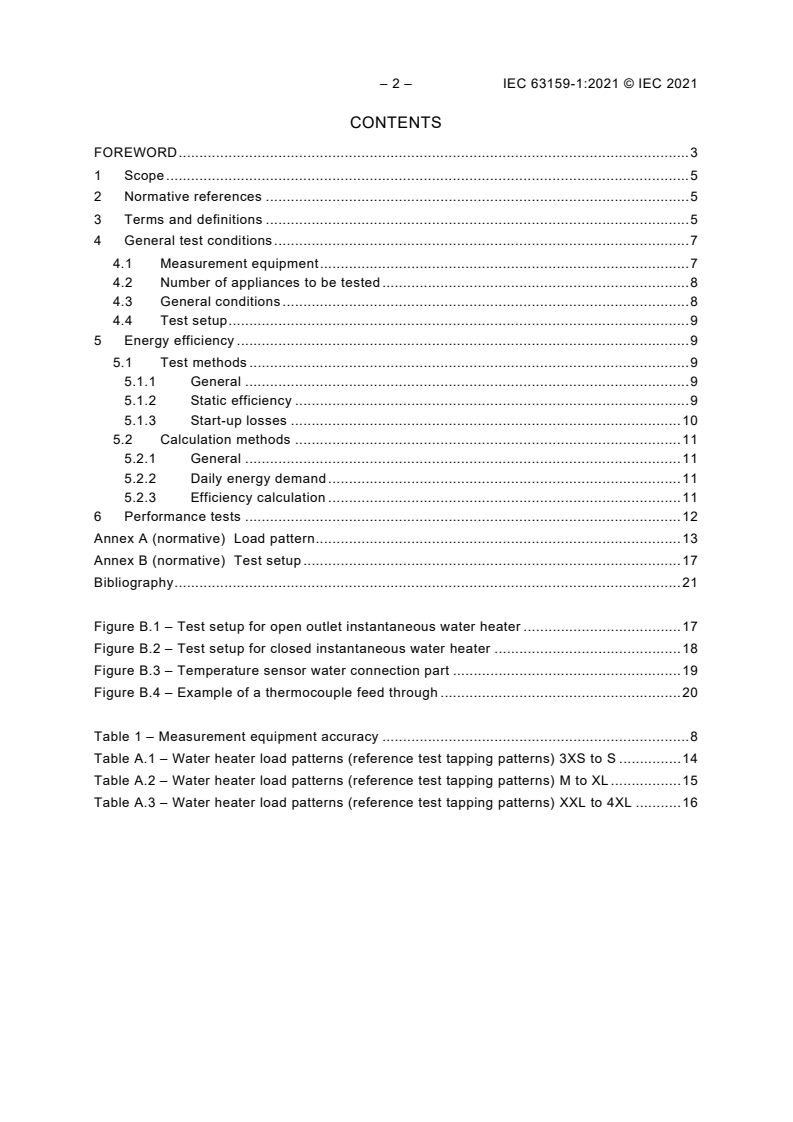
CONTENTS
FOREWORD . 3
1 Scope . 5
2 Normative references . 5
3 Terms and definitions . 5
4 General test conditions . 7
4.1 Measurement equipment . 7
4.2 Number of appliances to be tested . 8
4.3 General conditions . 8
4.4 Test setup . 9
5 Energy efficiency . 9
5.1 Test methods . 9
5.1.1 General . 9
5.1.2 Static efficiency . 9
5.1.3 Start-up losses . 10
5.2 Calculation methods . 11
5.2.1 General . 11
5.2.2 Daily energy demand . 11
5.2.3 Efficiency calculation . 11
6 Performance tests . 12
Annex A (normative) Load pattern . 13
Annex B (normative) Test setup . 17
Bibliography . 21
Figure B.1 – Test setup for open outlet instantaneous water heater . 17
Figure B.2 – Test setup for closed instantaneous water heater . 18
Figure B.3 – Temperature sensor water connection part . 19
Figure B.4 – Example of a thermocouple feed through . 20
Table 1 – Measurement equipment accuracy . 8
Table A.1 – Water heater load patterns (reference test tapping patterns) 3XS to S . 14
Table A.2 – Water heater load patterns (reference test tapping patterns) M to XL . 15
Table A.3 – Water heater load patterns (reference test tapping patterns) XXL to 4XL . 16
INTERNATIONAL ELECTROTECHNICAL COMMISSION
____________
HOUSEHOLD ELECTRIC INSTANTANEOUS WATER HEATERS –
METHODS FOR MEASURING THE PERFORMANCE –
Part 1: General aspects
FOREWORD
1) The International Electrotechnical Commission (IEC) is a worldwide organization for standardization comprising
all national electrotechnical committees (IEC National Committees). The object of IEC is to promote international
co-operation on all questions concerning standardization in the electrical and electronic fields. To this end and
in addition to other activities, IEC publishes International Standards, Technical Specifications, Technical Reports,
Publicly Available Specifications (PAS) and Guides (hereafter referred to as “IEC Publication(s)”). Their
preparation is entrusted to technical committees; any IEC National Committee interested in the subject dealt with
may participate in this preparatory work. International, governmental and non-governmental organizations liaising
with the IEC also participate in this preparation. IEC collaborates closely with the International Organization for
Standardization (ISO) in accordance with conditions determined by agreement between the two organizations.
2) The formal decisions or agreements of IEC on technical matters express, as nearly as possible, an international
consensus of opinion on the relevant subjects since each technical committee has representation from all
interested IEC National Committees.
3) IEC Publications have the form of recommendations for international use and are accepted by IEC National
Committees in that sense. While all reasonable efforts are made to ensure that the technical content of IEC
Publications is accurate, IEC cannot be held responsible for the way in which they are used or for any
misinterpretation by any end user.
4) In order to promote international uniformity, IEC National Committees undertake to apply IEC Publications
transparently to the maximum extent possible in their national and regional publications. Any divergence between
any IEC Publication and the corresponding national or regional publication shall be clearly indicated in the latter.
5) IEC itself does not provide any attestation of conformity. Independent certification bodies provide conformity
assessment services and, in some areas, access to IEC marks of conformity. IEC is not responsible for any
services carried out by independent certification bodies.
6) All users should ensure that they have the latest edition of this publication.
7) No liability shall attach to IEC or its directors, employees, servants or agents including individual experts and
members of its technical committees and IEC National Committees for any personal injury, property damage or
other damage of any nature whatsoever, whether direct or indirect, or for costs (including legal fees) and
expenses arising out of the publication, use of, or reliance upon, this IEC Publication or any other IEC
Publications.
8) Attention is drawn to the Normative references cited in this publication. Use of the referenced publications is
indispensable for the correct application of this publication.
9) Attention is drawn to the possibility that some of the elements of this IEC Publication may be the subject of patent
rights. IEC shall not be held responsible for identifying any or all such patent rights.
International Standard IEC 63159-1 has been prepared by subcommittee 59C: Electrical
heating appliances for household and similar purposes, of IEC technical committee 59:
Performance of household and similar electrical appliances.
The text of this International Standard is based on the following documents:
Draft Report on voting
59C/267/FDIS 59C/271/RVD
Full information on the voting for its approval can be found in the report on voting indicated in
the above table.
The language used for the development of this International Standard is English.
– 4 – IEC 63159-1:2021 © IEC 2021
A list of all the parts in the IEC 63159 series, published under the general title Household
electric instantaneous water heaters – Methods for measuring the performance, can be found
on the IEC website.
This document was drafted in accordance with ISO/IEC Directives, Part 2, and developed in
accordance with ISO/IEC Directives, Part 1 and ISO/IEC Directives, IEC Supplement, available
at www.iec.ch/members_experts/refdocs. The main document types developed by IEC are
described in greater detail at www.iec.ch/standardsdev/publications.
The committee has decided that the contents of this document will remain unchanged until the
stability date indicated on the IEC website under webstore.iec.ch in the data related to the
specific document. At this date, the document will be
• reconfirmed,
• withdrawn,
• replaced by a revised edition, or
• amended.
HOUSEHOLD ELECTRIC INSTANTANEOUS WATER HEATERS –
METHODS FOR MEASURING THE PERFORMANCE –
Part 1: General aspects
1 Scope
This document applies to electric instantaneous water heaters for domestic hot water heating
for household and similar applications, which show both of the following characteristics:
– fulfilling at least one load pattern from Annex A;
– heating up to temperatures below the boiling temperature.
This document specifies terms, definitions and measurement methods for the assessment of
energy efficiency.
This document does not take into account requirements regarding the safety of the appliances.
2 Normative references
The following documents are referred to in the text in such a way that some or all of their content
constitutes requirements of this document. For dated references, only the edition cited applies.
For undated references, the latest edition of the referenced document (including any
amendments) applies.
IEC 63159-2-1, Household electric instantaneous water heaters – Methods for measuring the
performance – Part 2-1: Multifunctional electric instantaneous water heaters
IEC 63159-2-2, Household electric instantaneous water heaters – Methods for measuring the
performance – Part 2-2: Efficiency of single point of use electric instantaneous water heaters
ISO 2768-1, General tolerances – Part 1: Tolerances for linear and angular dimensions without
individual tolerance indications
ISO 228-1, Pipe threads where pressure-tight joints are not made on the threads – Part 1:
Dimensions, tolerances and designation
3 Terms and definitions
For the purposes of this document, the following terms and definitions apply.
ISO and IEC maintain terminological databases for use in standardization at the following
addresses:
• IEC Electropedia: available at http://www.electropedia.org/
• ISO Online browsing platform: available at http://www.iso.org/obp
3.1
instantaneous water heater
appliance intended to heat water while it flows through the appliance
– 6 – IEC 63159-1:2021 © IEC 2021
3.1.1
electric instantaneous water heater
instantaneous water heater using electric energy as its energy source
3.1.2
closed instantaneous water heater
instantaneous water heater intended to operate at the pressure of the water system, the flow of
water being controlled by one or more valves in the outlet system
3.1.3
open-outlet instantaneous water heater
instantaneous water heater in which the flow of water is controlled by a valve in the inlet pipe,
there being no valve in the outlet pipe
3.1.4
hydraulic instantaneous water heater
instantaneous water heater whose heating elements are each switched on or off, depending on
the water flow rate or water pressure
3.2
temperature selector
actuator that presets the temperature set-point value of the water outlet and that can be
adjusted by the user
3.3
temperature control
actuator that adjusts the temperature of the outlet water by varying the flow of water through
the appliance or by varying the power applied to the heater(s), or by varying a combination of
the two
3.4
independent flow control
actuator that adjusts the flow of water through the appliance with no significant change in the
outlet's water temperature
3.5
flow regulator
actuator that limits the flow of water through the appliance regardless of variations in line
pressure
3.6
flow restrictor
device that defines a flow of water through the appliance for a set pressure
3.7
power selector
actuator that presets electrical power of the unit and that can be adjusted by the user
Note 1 to entry: The water outlet temperature depends on flow rate and/or inlet temperature.
3.8
load profile
load pattern
means of illustrating the power consumption of an instantaneous water heater over a 24-hour
period
3.9
smart control
system that can demonstrate a reduction in energy consumption
3.10
useable water
water at or above the temperature T for the relevant draw-off and load pattern specified in the
m
tables of Annex A
3.11
static electric losses
part of the energy that is dissipated by unwanted effects, including energy lost by unwanted
heating of resistive components
3.12
smart control factor
SCF
factor describing the water heating energy efficiency gain due to smart control
Note 1 to entry: The SCF value is between 0 and 1.
3.13
energy-related product
ErP
product that uses energy, or that does not use energy but has an impact on energy consumption
3.14
conversion coefficient
CC
factor to indicate how much primary energy is used to generate a unit of electricity
3.15
annual electricity consumption
AEC
electricity consumption per year
3.16
declared load profile
load profile declared by the manufacturer for the appliance
4 General test conditions
4.1 Measurement equipment
Table 1 gives the accuracy of measurement equipment.
– 8 – IEC 63159-1:2021 © IEC 2021
Table 1 – Measurement equipment accuracy
Measurement Unit Measurement Remarks
parameters uncertainty (accuracy)
e)
Ambient temperature °C/K ±1,0 K
b)
Time s ±0,1 s
Cold inlet water
b)
°C/K ±0,2 K
temperature
Hot outlet water
a) b)
°C/K ±1,0 K
temperature
b) d)
Water flow rate l/min ±0,1 l/min or ±1 %
c)
Water pressure Mpa ±5 %
b)
Input power kW ±1 %
e)
Input power W ±1 %
b)
Voltage V ±0,5 %
b)
Current A ±0,5 %
a)
Thermocouple with a diameter of maximum 0,5 mm, in midstream, positioned directly at the outlet and inlet of
the appliance.
b)
The measured values shall be expressed rounded to one decimal place.
c)
The measured values shall be expressed rounded to three decimal places.
d)
Whichever is higher.
e)
The measured values shall be expressed rounded to integer.
4.2 Number of appliances to be tested
The test shall be performed on a single appliance.
4.3 General conditions
Unless otherwise specified, the appliance shall be installed, commissioned and operated in
accordance with the information provided in the installation and operating instructions.
Commissioning procedures shall be repeated following a supply voltage interruption, if required
by the installation and operating instructions.
The supply voltage shall be maintained at the main terminal at the maximum rated voltage
marked on the appliance ±1 % as defined by the manufacturer’s installation guide, while the
heating elements are switched on. The supply frequency shall be at a nominal 50 Hz ± 0,05 Hz
or 60 Hz ± 0,06 Hz, in accordance with the manufacturer's instructions.
The measured voltage and frequency of the power supply used during testing shall be reported.
The tests shall be carried out in a draft free environment at an ambient temperature of 20 °C
± 5 °C. The environment shall not deviate by more than 2 K during the test period.
NOTE See conditions (t ) for other countries.
amb
The flow rates provided to the appliance for the test shall be maintained within a tolerance of
±0,3 l/min or ±3 %, whichever is higher, but shall not be below the minimum required for the
individual draw-off. The flow rates supplied during the test shall be reported.
Unless otherwise specified, the cold inlet water temperature shall be 10 °C ± 1 °C.
4.4 Test setup
The appliance shall be installed in accordance with the installation instructions.
The declared load profile in accordance with Annex A can be the maximum, or one below the
maximum load profile the water heater can fulfil.
The measurement setup shall correspond to Annex B (Figure B.1 to Figure B.4).
5 Energy efficiency
5.1 Test methods
5.1.1 General
The following tests are required to determine the values of Q .
elec
5.1.2 Static efficiency
5.1.2.1 Defined value
The static losses in electronic instantaneous water heaters are mainly determined by lines and
electronic components (active power losses). The ratio of static losses to the rated power is
very small, so the static loss Eta is set to 0,99. Alternatively, the measurement procedure of
stat
5.1.2.2 shall be used.
5.1.2.2 Measurement procedure
This test shall measure the static loss of the appliance P at nominal load P under steady-
loss nom
state conditions.
If the appliance has a power selector, the selector should be adjusted to the highest value. If
the appliance has an independent flow control, it shall be adjusted to achieve the value stated
in the manufacturer's installation instructions, or where this is not stated, it shall be set to the
highest value.
If the appliance has a temperature control, the selector shall be adjusted to the highest value.
For the purposes of this test, the result is independent from the water inlet temperature;
therefore, this test can be carried out with a cold water inlet temperature in the range of 10 °C
to 25 °C. The inlet water temperature and flow rate shall be such that the appliance is caused
to operate at full power continuously.
The value of P is the power consumption of the appliance measured after a minimum of
nom
30 min of operation under full load conditions.
The value of P is the sum of all internal power losses (product of current and voltage losses
loss
between the terminals and the heating elements) of the appliance measured after a minimum
of 30 min of operation under full load conditions.
For instantaneous water heaters with semiconductor power switches (e.g. triacs), the voltage
across the semiconductor power terminals is subtracted from the measured voltage losses if
the semiconductor power switches are thermally connected to the water pipe. In this case, the
heat developed by the semiconductor power switches is transferred to useful energy to heat up
the water.
The static efficiency is calculated from the formula:
– 10 – IEC 63159-1:2021 © IEC 2021
−
PP
nom loss
η =
static
P
nom
where
P nominal power consumption of the appliance, in kW;
nom
P measured internal static losses of the appliance, in kW;
loss
η static efficiency of the appliance as a factor.
static
5.1.3 Start-up losses
This test shall measure the time t that elapses between energizing the heating elements
start
i
and the delivery of useable water and the power consumption P of the appliance at steady
static
i
state during the delivery of useable water for each different draw-off of the declared load pattern
of Annex A. The test method assumes the power consumption of the appliance during the start-
up period is equal to the power consumed in steady-state conditions of the appliance for the
specific draw-off i.
If the appliance has a power selector, the selector should be adjusted to the highest value. If
the appliance has an independent flow control, it shall be adjusted to achieve the value stated
in the manufacturer's installation instructions, or where this is not stated, it shall be set to the
highest value.
If the appliance has a temperature control, the selector should be adjusted to the highest value.
The prescribed minimum flow rate f of each individual draw-off of the tapping pattern is used
i
in accordance with Annex A. If this is not achievable, increase the flow rate until the appliance
is able to provide hot water continuously with static heating conditions. This increased flow rate
is used for the individual draw-off instead of the prescribed minimum flow rate. It can be
necessary to determine the required flow rate for each individual draw-off where the product
may not be able to run continuously at the prescribed minimum flow rate by experimentation
before beginning the full series of draw-offs for the declared load pattern of Annex A.
Three measurements shall be performed for each specific draw-off type i and the mean value
calculated from these measurements. Each of these measurements shall be performed with the
product flushed. This should be done by flowing cold water through the product without the
heating elements being energized and by monitoring the inlet and outlet temperatures until the
difference between the inlet and outlet temperatures is within 1 K.
The start-up loss for each specific draw-off i is calculated from the formula:
t
start
i
QP ×
start static
ii
3 600
where
is the measured start-up time, in s;
t
start
i
P is the measured steady-state power consumption, in kW, for specific draw-off i;
static
i
Q is the start-up losses, in kWh, for specific draw-off i.
start
i
=
5.2 Calculation methods
5.2.1 General
The following calculation methods enable the values of Q to be calculated using the results
elec
from the tests described in 5.1 for a chosen tapping pattern, in accordance with Annex A.
5.2.2 Daily energy demand
The daily energy demand Q is the sum of losses and useful energy of all individual draw-off
elec
i per day, in accordance with Annex A.
The daily energy demand is calculated from the formula:
n
Q
tap
i
QQ+
elec ∑ start
i
η
static
i=1
Where
Q is the daily energy demand, in kWh;
elec
Q is the start-up loss for specific draw-off i, in kWh, determined in 5.1.3;
start
i
Q is the predefined useful energy content per draw-off i, in kWh, as specified for the
tap
i
relevant load pattern in Annex A;
η is the static efficiency of the appliance determined in 5.1.2.
static
5.2.3 Efficiency calculation
5.2.3.1 Determination of the smart control factor SCF
For instantaneous water heaters, to be set as SCF = 0.
NOTE The value of SCF can differ for other appliances, such as electrical storage water heaters. Nevertheless, the
formulas used are the same.
5.2.3.2 Correction factor
The correction factor is calculated from the formula:
Q =−k×CC× Q −Q
( )
cor elec ref
where
k is 0,23 for load profiles 3XS to XL and 0 for profiles XXL to 4XL;
CC is the primary energy factor;
NOTE The value of CC is given by the local regulation. In Europe, the value of CC is currently 2,5.
Q is the daily energy demand determined in 5.2.2;
elec
Q is the daily (24 h) useful energy content as specified for the declared load pattern in
ref
Annex A.
5.2.3.3 Energy efficiency
The efficiency of the appliance is calculated from the formula:
=
– 12 – IEC 63159-1:2021 © IEC 2021
Q
ref
η ×100 %
iwh
CC×Q ×−1 SCF +Q
( )
elec cor
Where
CC is the primary energy factor;
NOTE The value of CC is given by the local regulation. In Europe the value of CC is currently 2,5.
Q is the daily energy demand, as determined in 5.2.2;
elec
Q is the correction factor, as determined in 5.2.3.2;
cor
Q is the daily (24 h) useful energy content as specified for the relevant load pattern in
ref
Annex A;
SCF is the smart control factor, as determined in 5.2.3.1.
5.2.3.4 Annual electricity consumption
The annual electricity consumption of the appliance is calculated from the formula:
Q
cor
AEC 219,6× Q×−1 SCF+
( )
elec
CC
Where
219,6 is the number of days the appliance is used per year;
CC is the primary energy factor;
Q is the daily energy demand, as determined in 5.2.2;
elec
Q is the correction factor, as determined in 5.2.3.2;
cor
SCF is the smart control factor, as determined in 5.2.3.1.
6 Performance tests
See the relevant part of IEC 63159-2.
=
=
Annex A
(normative)
Load pattern
Table A.1, Table A.2 and Table A.3 specify the tapping patterns for the declared load pattern.
Parameters in the tables are:
• load pattern [3XS-4XL, in header row of the tables];
• h: hour [hh:mm] starting at 0:00 h;
• Q : useful energy content of water withdrawal to be achieved in the draw-off [in kWh];
tap
• f: minimum flow rate to be reached during tapping [in l/min];
• T : temperature from which counting of useful energy content starts [in ºC];
m
• T : minimum (peak) temperature to be achieved during tapping [in ºC];
p
• Q : daily (24 h) useful energy content of all water draw-offs [in kWh/d, effectively the sum
ref
of all Q ].
tap
– 14 – IEC 63159-1:2021 © IEC 2021
Table A.1 – Water heater load patterns (reference test tapping patterns) 3XS to S
3XS XXS XS S
Q T T Q T T Q T T Q T T
f f f f
tap m p tap m p tap m p tap m p
h
kWh l/min ºC ºC kWh l/min ºC ºC kWh l/min ºC ºC kWh l/min ºC ºC
07:00 0,015 2 25 0,105 2 25 0,105 3 25
07:05 0,015 2 25
07:15 0,015 2 25
07:26 0,015 2 25
07:30 0,015 2 25 0,105 2 25 0,525 3 35 - 0,105 3 25
07:45
08:01
08:05
08:15
08:25
08:30 0,105 2 25 0,105 3 25
08:45
09:00 0,015 2 25
09:30 0,015 2 25 0,105 2 25 0,105 3 25
10:00
10:30
11:00
11:30 0,015 2 25 0,105 2 25 0,105 3 25
11:45 0,015 2 25 0,105 2 25 0,105 3 25
12:00 0,015 2 25 0,105 2 25
12:30 0,015 2 25 0,105 2 25
12:45 0,015 2 25 0,105 2 25 0,525 3 35 - 0,315 4 10 55
14:30 0,015 2 25
15:00 0,015 2 25
15:30 0,015 2 25
16:00 0,015 2 25
16:30
17:00
18:00 0,105 2 25 0,105 3 25
18:15 0,105 2 25 0,105 3 40
18:30 0,015 2 25 0,105 2 25
19:00 0,015 2 25 0,105 2 25
19:30 0,015 2 25 0,105 2 25
20:00 0,105 2 25
20:30 1,050 3 35 - 0,420 4 10 55
20:45 0,105 2 25
20:46
21:00 0,105 2 25
21:15 0,015 2 25 0,105 2 25
21:30 0,015 2 25 0,525 5 45
21:30 0,015 2 25 0,105 2 25
21:45 0,015 2 25 0,105 2 25
Q
ref 0,345 2,100 2,100 2,100
Table A.2 – Water heater load patterns (reference test tapping patterns) M to XL
M L XL
Q T T Q T T Q T T
f f f
tap m p tap m p tap m p
h kWh l/min ºC ºC kWh l/min ºC ºC kWh l/min ºC ºC
07:00 0,105 3 25 0,105 3 25 0,105 3 25
07:05 1,400 6 40 1,400 6 40
07:15 1,820 6 40
07:26 0,105 3 25
07:30 0,105 3 25 0,105 3 25
07:45 0,105 3 25 4,420 10 10 40
08:01 0,105 3 25 0,105 3 25
08:05 3,605 10 10 40
08:15 0,105 3 25 0,105 3 25
08:25 0,105 3 25
08:30 0,105 3 25 0,105 3 25 0,105 3 25
08:45 0,105 3 25 0,105 3 25 0,105 3 25
09:00 0,105 3 25 0,105 3 25 0,105 3 25
09:30 0,105 3 25 0,105 3 25 0,105 3 25
10:00 0,105 3 25
10:30 0,105 3 10 40 0,105 3 10 40 0,105 3 10 40
11:00 0,105 3 25
11:30 0,105 3 25 0,105 3 25 0,105 3 25
11:45 0,105 3 25 0,105 3 25 0,105 3 25
12:00
12:30
12:45 0,315 4 10 55 0,315 4 10 55 0,735 4 10 55
14:30 0,105 3 25 0,105 3 25 0,105 3 25
15:00 0,105 3 25
15:30 0,105 3 25 0,105 3 25 0,105 3 25
16:00 0,105 3 25
16:30 0,105 3 25 0,105 3 25 0,105 3 25
17:00 0,105 3 25
18:00 0,105 3 25 0,105 3 25 0,105 3 25
18:15 0,105 3 40 0,105 3 40 0,105 3 40
18:30 0,105 3 40 0,105 3 40 0,105 3 40
19:00 0,105 3 25 0,105 3 25 0,105 3 25
19:30
20:00
20:30 0,735 4 10 55 0,735 4 10 55 0,735 4 10 55
20:45
20:46 4,420 10 10 40
21:00 3,605 10 10 40
21:15 0,105 3 25 0,105 3 25
21:30 1,400 6 40 0,105 3 25 4,420 10 10 40
21:30
21:45
Q
5,845 11,655 19,070
ref
– 16 – IEC 63159-1:2021 © IEC 2021
Table A.3 – Water heater load patterns (reference test tapping patterns) XXL to 4XL
XXL 3XL 4XL
Q T T Q T T Q T T
f f f
tap m p tap m p tap m p
h kWh l/min ºC ºC kWh l/min ºC ºC kWh l/min ºC ºC
07:00 0,105 3 25 11,2 48 40 22,4 96 40
07:05
07:15 1,820 6 40
07:26 0,105 3 25
07:30
07:45 6,240 16 10 40
08:01 0,105 3 25 5,04 24 25 10,08 48 25
08:05
08:15 0,105 3 25
08:25
08:30 0,105 3 25
08:45 0,105 3 25
09:00 0,105 3 25 1,68 24 25 3,36 48 25
09:30 0,105 3 25
10:00 0,105 3 25
10:30 0,105 3 10 40 0,84 24 10 40 1,68 48 10 40
11:00 0,105 3 25
11:30 0,105 3 25
11:45 0,105 3 25 1,68 24 25 3,36 48 25
12:00
12:30
12:45 0,735 4 10 55 2,52 32 10 55 5,04 64 10 55
14:30 0,105 3 25
15:00 0,105 3 25
15:30 0,105 3 25 2,52 24 25 5,04 48 25
16:00 0,105 3 25
16:30 0,105 3 25
17:00 0,105 3 25
18:00 0,105 3 25
18:15 0,105 3 40
18:30 0,105 3 40 3,36 24 25 6,72 48 25
19:00 0,105 3 25
19:30
20:00
20:30 0,735 4 10 55 5,88 32 10 55 11,76 64 10 55
20:45
20:46 6,240 16 10 40
21:00
21:15 0,105 3 25
21:30 6,240 16 10 40 12,04 48 40 24,08 96 40
21:30
21:45
Q
24,530 46,760 93,520
ref
Annex B
(normative)
Test setup
Key
1 appliance under test 8 connection to the water distribution network
2 power meter – power meter or ammeter required 9 electrical power connection
3 voltmeter 10 magnetic valves
ampere meter – power meter or ammeter
4 11 flow regulator
required
5 inlet temperature sensor 12 open water outlet
6 flow meter 13 outlet temperature sensor
temperature sensor water connection part (see
7 pressure reducing/regulating device 14
Figure B.3)
Figure B.1 – Test setup for open outlet instantaneous water heater
– 18 – IEC 63159-1:2021 © IEC 2021
Key
1 appliance under test 8 connection to the water distribution network
2 power meter 9 electrical power connection
3 voltmeter 10 magnetic valves
4 ampere meter 11 flow regulator (can be included in the appliance itself)
5 inlet temperature sensor 12 open water outlet
6 flow meter 13 outlet temperature sensor
7 pressure reducing/regulating device 14 temperature sensor water connection part (see Figure B.3)
(can be included in the appliance itself)
Figure B.2 – Test setup for closed instantaneous water heater
Dimensions in millimetres
Material: PA66.
Thread in accordance with EN ISO 228-1.
Dimension tolerances in accordance with ISO 2768-1.
Figure B.3 – Temperature sensor water connection part
– 20 – IEC 63159-1:2021 © IEC 2021
Key
1 screw
2 seal
3 screw
4 thermocouple
Material: PA66.
Thread in accordance with EN ISO 228-1.
Figure B.4 – Example of a thermocouple feed through
Bibliography
IEC 60335-1, Household and similar electrical appliances – Safety – Part 1: General
requirements
IEC 60335-2-35, Household and similar electrical appliances – Safety – Part 2-35: Particular
requirements for instantaneous water heaters
IEC 60584-1, Thermocouples – Part 1: Reference tables
IEC 60584-2, Thermocouples – Part 2: Tolerances
DIRECTIVE 2009/125/EC OF THE EUROPEAN PARLIAMENT AND OF THE COUNCIL of 21
October 2009 establishing a framework for the setting of ecodesign requirements for energy-
related products
Commission Regulation (EU) No 814/2013 of 2 August 2013 implementing Directive
2009/125/EC of the European Parliament and of the Council with regard to ecodesign
requirements for water heaters and hot water storage tanks
DIRECTIVE 2010/30/EU OF THE EUROPEAN PARLIAMENT AND OF THE COUNCIL of 19
May 2010 on the indication by labelling and standard product information of the consumption of
energy and other resources by energy-related products
Commission Delegated Regulation (EU) No 812/2013 of 18 February 2013 supplementing
Directive 2010/30/EU of the European Parliament and of the Council with regard to the energy
labelling of water heaters, hot water storage tanks and packages of water heater and solar
device
____________
– 22 – IEC 63159-1:2021 © IEC 2021
SOMMAIRE
AVANT-PROPOS . 23
1 Domaine d'application . 25
2 Références normatives . 25
3 Termes et définitions . 25
4 Conditions générales d'essais . 27
4.1 Equipement de mesure . 27
4.2 Nombre d'appareils à soumettre à l'essai . 28
4.3 Conditions générales . 28
4.4 Montage d'essai . 29
5 Rendement énergétique . 29
5.1 Méthodes d'essai . 29
5.1.1 Généralités . 29
5.1.2 Rendement statique . 29
5.1.3 Pertes de démarrage . 30
5.2 Méthodes de calcul . 31
5.2.1 Généralités . 31
5.2.2 Demande énergétique quotidienne . 31
5.2.3 Calcul du rendement . 31
6 Essais d'aptitude à la fonction . 32
Annexe A (normative) Diagramme de charge . 33
Annexe B (normative) Montage d'essai . 37
Bibliographie . 41
Figure B.1 – Montage d'essai pour chauffe-eau instantané à écoulement libre . 37
Figure B.2 – Montage d'essai pour chauffe-eau instantané fermé . 38
Figure B.3 – Partie raccordement d'eau du capteur de température . 39
Figure B.4 – Exemple d'alimentation par thermocouple . 40
Tableau 1 – Précision de l'équipement de mesure . 28
Tableau A.1 – Diagrammes de charge du chauffe-eau (cycles de puisage d'essai de
référence) 3XS à S . 34
Tableau A.2 – Diagrammes de charge du chauffe-eau (cycles de puisage d'essai de
référence) M à XL . 35
Tableau A.3 – Diagrammes de charge du chauffe-eau (cycles de puisage d'essai de
référence) XXL à 4XL . 36
...