

IEC 62787:2021
(Main)Concentrator photovoltaic (CPV) solar cells and cell on carrier (CoC) assemblies - Qualification
General Information
- Abstract
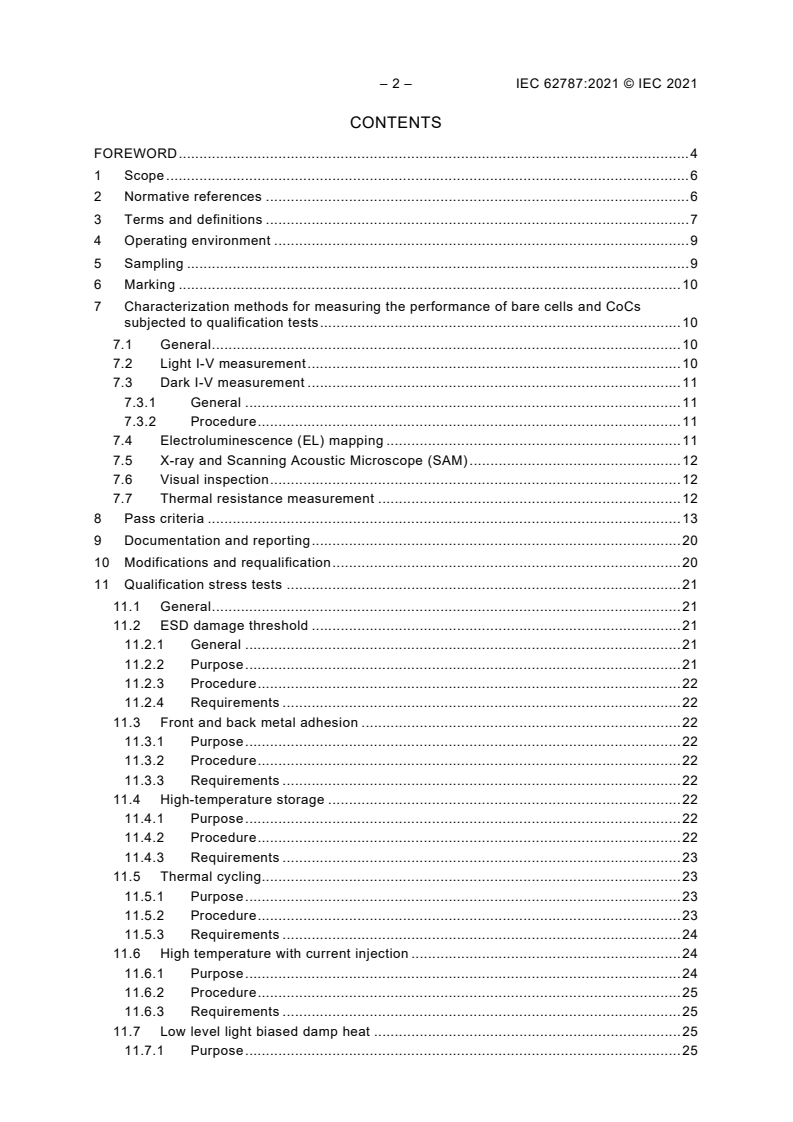
IEC 62787:2021 specifies the minimum requirements for the qualification of concentrator photovoltaic (CPV) cells and Cell on Carrier (CoC) assemblies for incorporation into CPV receivers, modules and systems. The object of this qualification standard is to determine the optoelectronic, mechanical, thermal, and processing characteristics of CPV cells and CoCs to show that they are capable of withstanding assembly processes and CPV application environments. The qualification tests of this document are designed to demonstrate that cells or CoCs are suitable for typical assembly processes, and when properly assembled, are capable of passing IEC 62108.
This document defines qualification testing for two levels of concentrator photovoltaic device assembly:
a) cell, or bare cell; and
b) cell on carrier (CoC).
- Status
- Published
- Publication Date
- 02-Feb-2021
- Technical Committee
- TC 82 - Solar photovoltaic energy systems
- Drafting Committee
- WG 7 - TC 82/WG 7
- Current Stage
- PPUB - Publication issued
- Start Date
- 03-Feb-2021
- Completion Date
- 28-Aug-2026
Overview
IEC 62787:2021, established by the International Electrotechnical Commission (IEC), sets out the qualification requirements for concentrator photovoltaic (CPV) solar cells and cell on carrier (CoC) assemblies. It provides a standardized approach to assess the optoelectronic, mechanical, thermal, and processing characteristics of CPV cells and CoCs intended for integration into CPV receivers, modules, and systems. The standard ensures that these components can reliably withstand assembly and operational environments, as well as meet the requirements for downstream CPV module qualification (e.g., IEC 62108 compliance).
By defining comprehensive qualification tests at both the bare cell and CoC assembly levels, IEC 62787:2021 supports manufacturers, engineers, and quality assurance professionals in validating the robustness and performance of high-concentration PV components. It is a critical reference for stakeholders seeking to ensure longevity, safety, and efficiency in advanced solar energy systems.
Key Topics
- Scope of Qualification: Outlines minimum qualification criteria for both bare CPV solar cells and cell on carrier (CoC) assemblies.
- Optoelectronic and Mechanical Testing: Details tests for electrical performance (e.g., illumination I-V, dark I-V), physical durability (adhesion, bond strength, solderability), and thermal performance.
- Environmental and Process Resilience: Ensures CPV cells and CoCs can withstand high temperature, thermal cycling, humidity, and mechanical stresses typical of CPV operation.
- Sample Selection & Marking: Provides procedures for random sampling across production lots and requirements for product identification, ensuring traceability and quality control.
- Characterization Methods: Specifies accepted test methods including light/dark I-V measurements, scanning acoustic microscopy (SAM) for CoCs, visual inspections, and thermal resistance measurements.
- Performance Pass Criteria: Defines pass/fail metrics, including thresholds for power degradation, mechanical failures, and visual defects, in line with industry best practices.
- Documentation Requirements: Stipulates comprehensive reporting and traceability for all qualification tests, including modifications or requalification triggers.
Applications
IEC 62787 is essential for:
- Manufacturers of CPV components: To validate product quality before market entry or integration into CPV systems.
- System Integrators and Developers: For ensuring that components sourced and assembled meet international performance and reliability benchmarks.
- Quality Assurance and Certification Bodies: As the basis for product certification, conformity assessment, and compliance auditing in the CPV industry.
- Research and Development Teams: To support innovation in solar cell technologies where robust environmental and mechanical performance is critical.
- Procurement and Supply Chain Management: For specifying component requirements and establishing supplier qualification standards.
By adopting IEC 62787, stakeholders in the solar photovoltaic sector gain confidence in the durability and suitability of CPV solar cells and assemblies used in high concentration photovoltaic systems, especially where demanding outdoor and assembly conditions are prevalent.
Related Standards
- IEC 62108: Concentrator photovoltaic (CPV) modules and assemblies - Design qualification and type approval
- IEC 60904-1-1: Photovoltaic devices - Measurement of current-voltage characteristics of multi-junction PV devices
- IEC 60749 series: Semiconductor devices - Mechanical and climatic test methods (including bond strength, solderability, and storage at high temperature)
- IEC 62670-1: Photovoltaic concentrators (CPV) - Performance testing - Standard conditions
- IEC TS 61836: Solar photovoltaic energy systems - Terms, definitions, and symbols
- IEC 61000-4-2: Electromagnetic compatibility (EMC) - Electrostatic discharge immunity test
- IEC 61193-2: Quality assessment systems - Sampling plans for inspection of electronic components and packages
For organizations working with CPV solar cells and CoC assemblies, adhering to IEC 62787:2021 not only supports compliance with industry-recognized benchmarks but also facilitates seamless integration with related standards across the photovoltaic industry.
Get Certified
Connect with accredited certification bodies for this standard

DNV
DNV is an independent assurance and risk management provider.

Lloyd's Register
Lloyd's Register is a global professional services organisation specialising in engineering and technology.
DNV Energy Systems
Energy and renewable energy certification.
Sponsored listings
Frequently Asked Questions
IEC 62787:2021 is a standard published by the International Electrotechnical Commission (IEC). Its full title is "Concentrator photovoltaic (CPV) solar cells and cell on carrier (CoC) assemblies - Qualification". This standard covers: IEC 62787:2021 specifies the minimum requirements for the qualification of concentrator photovoltaic (CPV) cells and Cell on Carrier (CoC) assemblies for incorporation into CPV receivers, modules and systems. The object of this qualification standard is to determine the optoelectronic, mechanical, thermal, and processing characteristics of CPV cells and CoCs to show that they are capable of withstanding assembly processes and CPV application environments. The qualification tests of this document are designed to demonstrate that cells or CoCs are suitable for typical assembly processes, and when properly assembled, are capable of passing IEC 62108. This document defines qualification testing for two levels of concentrator photovoltaic device assembly: a) cell, or bare cell; and b) cell on carrier (CoC).
IEC 62787:2021 specifies the minimum requirements for the qualification of concentrator photovoltaic (CPV) cells and Cell on Carrier (CoC) assemblies for incorporation into CPV receivers, modules and systems. The object of this qualification standard is to determine the optoelectronic, mechanical, thermal, and processing characteristics of CPV cells and CoCs to show that they are capable of withstanding assembly processes and CPV application environments. The qualification tests of this document are designed to demonstrate that cells or CoCs are suitable for typical assembly processes, and when properly assembled, are capable of passing IEC 62108. This document defines qualification testing for two levels of concentrator photovoltaic device assembly: a) cell, or bare cell; and b) cell on carrier (CoC).
IEC 62787:2021 is classified under the following ICS (International Classification for Standards) categories: 27.160 - Solar energy engineering. The ICS classification helps identify the subject area and facilitates finding related standards.
IEC 62787:2021 is available in PDF format for immediate download after purchase. The document can be added to your cart and obtained through the secure checkout process. Digital delivery ensures instant access to the complete standard document.
Standards Content (Sample)
IEC 62787 ®
Edition 1.0 2021-02
INTERNATIONAL
STANDARD
NORME
INTERNATIONALE
colour
inside
Concentrator photovoltaic (CPV) solar cells and cell on carrier (CoC) assemblies –
qualification
Cellules solaires photovoltaïques à concentration (PVC) et ensembles de
cellules sur support (CoC) – Qualification
All rights reserved. Unless otherwise specified, no part of this publication may be reproduced or utilized in any form
or by any means, electronic or mechanical, including photocopying and microfilm, without permission in writing from
either IEC or IEC's member National Committee in the country of the requester. If you have any questions about IEC
copyright or have an enquiry about obtaining additional rights to this publication, please contact the address below or
your local IEC member National Committee for further information.
Droits de reproduction réservés. Sauf indication contraire, aucune partie de cette publication ne peut être reproduite
ni utilisée sous quelque forme que ce soit et par aucun procédé, électronique ou mécanique, y compris la photocopie
et les microfilms, sans l'accord écrit de l'IEC ou du Comité national de l'IEC du pays du demandeur. Si vous avez des
questions sur le copyright de l'IEC ou si vous désirez obtenir des droits supplémentaires sur cette publication, utilisez
les coordonnées ci-après ou contactez le Comité national de l'IEC de votre pays de résidence.
IEC Central Office Tel.: +41 22 919 02 11
3, rue de Varembé info@iec.ch
CH-1211 Geneva 20 www.iec.ch
Switzerland
About the IEC
The International Electrotechnical Commission (IEC) is the leading global organization that prepares and publishes
International Standards for all electrical, electronic and related technologies.
About IEC publications
The technical content of IEC publications is kept under constant review by the IEC. Please make sure that you have the
latest edition, a corrigendum or an amendment might have been published.
IEC publications search - webstore.iec.ch/advsearchform IEC online collection - oc.iec.ch
The advanced search enables to find IEC publications by a Discover our powerful search engine and read freely all the
variety of criteria (reference number, text, technical publications previews. With a subscription you will always
committee, …). It also gives information on projects, replaced have access to up to date content tailored to your needs.
and withdrawn publications.
Electropedia - www.electropedia.org
IEC Just Published - webstore.iec.ch/justpublished
The world's leading online dictionary on electrotechnology,
Stay up to date on all new IEC publications. Just Published
containing more than 22 000 terminological entries in English
details all new publications released. Available online and
and French, with equivalent terms in 18 additional languages.
once a month by email.
Also known as the International Electrotechnical Vocabulary
(IEV) online.
IEC Customer Service Centre - webstore.iec.ch/csc
If you wish to give us your feedback on this publication or
need further assistance, please contact the Customer Service
Centre: sales@iec.ch.
A propos de l'IEC
La Commission Electrotechnique Internationale (IEC) est la première organisation mondiale qui élabore et publie des
Normes internationales pour tout ce qui a trait à l'électricité, à l'électronique et aux technologies apparentées.
A propos des publications IEC
Le contenu technique des publications IEC est constamment revu. Veuillez vous assurer que vous possédez l’édition la
plus récente, un corrigendum ou amendement peut avoir été publié.
Recherche de publications IEC - IEC online collection - oc.iec.ch
webstore.iec.ch/advsearchform Découvrez notre puissant moteur de recherche et consultez
La recherche avancée permet de trouver des publications IEC gratuitement tous les aperçus des publications. Avec un
en utilisant différents critères (numéro de référence, texte, abonnement, vous aurez toujours accès à un contenu à jour
comité d’études, …). Elle donne aussi des informations sur adapté à vos besoins.
les projets et les publications remplacées ou retirées.
Electropedia - www.electropedia.org
IEC Just Published - webstore.iec.ch/justpublished
Le premier dictionnaire d'électrotechnologie en ligne au
Restez informé sur les nouvelles publications IEC. Just
monde, avec plus de 22 000 articles terminologiques en
Published détaille les nouvelles publications parues.
anglais et en français, ainsi que les termes équivalents dans
Disponible en ligne et une fois par mois par email.
16 langues additionnelles. Egalement appelé Vocabulaire
Electrotechnique International (IEV) en ligne.
Service Clients - webstore.iec.ch/csc
Si vous désirez nous donner des commentaires sur cette
publication ou si vous avez des questions contactez-nous:
sales@iec.ch.
IEC 62787 ®
Edition 1.0 2021-02
INTERNATIONAL
STANDARD
NORME
INTERNATIONALE
colour
inside
Concentrator photovoltaic (CPV) solar cells and cell on carrier (CoC) assemblies –
qualification
Cellules solaires photovoltaïques à concentration (PVC) et ensembles de
cellules sur support (CoC) – Qualification
INTERNATIONAL
ELECTROTECHNICAL
COMMISSION
COMMISSION
ELECTROTECHNIQUE
INTERNATIONALE
ICS 27.160 ISBN 978-2-8322-9326-3
– 2 – IEC 62787:2021 © IEC 2021
CONTENTS
FOREWORD . 4
1 Scope . 6
2 Normative references . 6
3 Terms and definitions . 7
4 Operating environment . 9
5 Sampling . 9
6 Marking . 10
7 Characterization methods for measuring the performance of bare cells and CoCs
subjected to qualification tests . 10
7.1 General . 10
7.2 Light I-V measurement . 10
7.3 Dark I-V measurement . 11
7.3.1 General . 11
7.3.2 Procedure . 11
7.4 Electroluminescence (EL) mapping . 11
7.5 X-ray and Scanning Acoustic Microscope (SAM) . 12
7.6 Visual inspection . 12
7.7 Thermal resistance measurement . 12
8 Pass criteria . 13
9 Documentation and reporting . 20
10 Modifications and requalification . 20
11 Qualification stress tests . 21
11.1 General . 21
11.2 ESD damage threshold . 21
11.2.1 General . 21
11.2.2 Purpose . 21
11.2.3 Procedure . 22
11.2.4 Requirements . 22
11.3 Front and back metal adhesion . 22
11.3.1 Purpose . 22
11.3.2 Procedure . 22
11.3.3 Requirements . 22
11.4 High-temperature storage . 22
11.4.1 Purpose . 22
11.4.2 Procedure . 22
11.4.3 Requirements . 23
11.5 Thermal cycling. 23
11.5.1 Purpose . 23
11.5.2 Procedure . 23
11.5.3 Requirements . 24
11.6 High temperature with current injection . 24
11.6.1 Purpose . 24
11.6.2 Procedure . 25
11.6.3 Requirements . 25
11.7 Low level light biased damp heat . 25
11.7.1 Purpose . 25
11.7.2 Procedure . 25
11.7.3 Requirements . 25
11.8 Solderability . 26
11.8.1 Purpose . 26
11.8.2 Procedure . 26
11.8.3 Requirements . 27
11.9 Illumination . 27
11.9.1 Purpose . 27
11.9.2 Procedure . 27
11.9.3 Requirements . 28
11.10 Wire/Ribbon bond strength . 28
11.10.1 Purpose . 28
11.10.2 Procedure . 28
11.10.3 Requirements . 30
11.11 Die adhesion . 31
11.11.1 Purpose . 31
11.11.2 Procedure . 31
11.11.3 Requirements . 31
11.12 Connector shear strength . 32
11.12.1 Purpose . 32
11.12.2 Procedure . 32
11.12.3 Pass/fail criteria . 33
11.13 Bypass diode shear strength . 33
11.13.1 Purpose . 33
11.13.2 Procedure . 33
11.13.3 Requirements . 33
Figure 1 – Schematics and photos of Cells on Carrier and bare cell test assembly . 8
Figure 2 – Representative samples of CPV systems, where cells and CoCs are
deployed . 9
Figure 3 – Flow chart of qualification tests for bare solar cells . 18
Figure 4 – Flow chart of qualification tests for CoCs . 19
Figure 5 – Thermal Cycle Diagram for the CoC test and TCO-1 . 24
Figure 6 – Force diagram in the bond strength test (taken from IEC 60749-22:2002,
Annex A, Method B) . 29
Figure 7 – Minimum bond pull limits (normal to die) (taken from IEC 60749-22:2002,
Annex A, Method B) . 30
Figure 8 – Schematic of the test set up for the die adhesion test. 31
Figure 9 – Die shear strength criteria (minimum force versus die attach area) (taken
from MIL.ST-883-K) . 32
Figure 10 – Schematics of the position of the pushing tool (taken from
IEC 62137-1-2:2007) . 33
Table 1 – Qualification tests description for bare solar cells . 14
Table 2 – Qualification tests description for CoCs . 16
Table 3 – Thermal Cycle Options (TCO) of test 11.5 for CoCs . 23
Table 4 – Minimum pulling forces, PW (taken from IEC60749-22:2002, Method B) . 29
– 4 – IEC 62787:2021 © IEC 2021
INTERNATIONAL ELECTROTECHNICAL COMMISSION
____________
CONCENTRATOR PHOTOVOLTAIC (CPV) SOLAR CELLS
AND CELL ON CARRIER (CoC) ASSEMBLIES –
QUALIFICATION
FOREWORD
1) The International Electrotechnical Commission (IEC) is a worldwide organization for standardization comprising
all national electrotechnical committees (IEC National Committees). The object of IEC is to promote international
co-operation on all questions concerning standardization in the electrical and electronic fields. To this end and
in addition to other activities, IEC publishes International Standards, Technical Specifications, Technical Reports,
Publicly Available Specifications (PAS) and Guides (hereafter referred to as “IEC Publication(s)”). Their
preparation is entrusted to technical committees; any IEC National Committee interested in the subject dealt with
may participate in this preparatory work. International, governmental and non-governmental organizations liaising
with the IEC also participate in this preparation. IEC collaborates closely with the International Organization for
Standardization (ISO) in accordance with conditions determined by agreement between the two organizations.
2) The formal decisions or agreements of IEC on technical matters express, as nearly as possible, an international
consensus of opinion on the relevant subjects since each technical committee has representation from all
interested IEC National Committees.
3) IEC Publications have the form of recommendations for international use and are accepted by IEC National
Committees in that sense. While all reasonable efforts are made to ensure that the technical content of IEC
Publications is accurate, IEC cannot be held responsible for the way in which they are used or for any
misinterpretation by any end user.
4) In order to promote international uniformity, IEC National Committees undertake to apply IEC Publications
transparently to the maximum extent possible in their national and regional publications. Any divergence between
any IEC Publication and the corresponding national or regional publication shall be clearly indicated in the latter.
5) IEC itself does not provide any attestation of conformity. Independent certification bodies provide conformity
assessment services and, in some areas, access to IEC marks of conformity. IEC is not responsible for any
services carried out by independent certification bodies.
6) All users should ensure that they have the latest edition of this publication.
7) No liability shall attach to IEC or its directors, employees, servants or agents including individual experts and
members of its technical committees and IEC National Committees for any personal injury, property damage or
other damage of any nature whatsoever, whether direct or indirect, or for costs (including legal fees) and
expenses arising out of the publication, use of, or reliance upon, this IEC Publication or any other IEC Publications.
8) Attention is drawn to the Normative references cited in this publication. Use of the referenced publications is
indispensable for the correct application of this publication.
9) Attention is drawn to the possibility that some of the elements of this IEC Publication may be the subject of patent
rights. IEC shall not be held responsible for identifying any or all such patent rights.
International Standard IEC 62787 has been prepared by subcommittee 82: Solar photovoltaic
energy systems.
The text of this International Standard is based on the following documents:
FDIS Report on voting
82/1818/FDIS 82/1834/RVD
Full information on the voting for the approval of this International Standard can be found in the
report on voting indicated in the above table.
This document has been drafted in accordance with the ISO/IEC Directives, Part 2.
The committee has decided that the contents of this document will remain unchanged until the
stability date indicated on the IEC website under "http://webstore.iec.ch" in the data related to
the specific document. At this date, the document will be
• reconfirmed,
• withdrawn,
• replaced by a revised edition, or
• amended.
IMPORTANT – The "colour inside" logo on the cover page of this document indicates
that it contains colours which are considered to be useful for the correct understanding
of its contents. Users should therefore print this document using a colour printer.
– 6 – IEC 62787:2021 © IEC 2021
CONCENTRATOR PHOTOVOLTAIC (CPV) SOLAR CELLS
AND CELL ON CARRIER (CoC) ASSEMBLIES –
QUALIFICATION
1 Scope
This document specifies the minimum requirements for the qualification of concentrator
photovoltaic (CPV) cells and Cell on Carrier (CoC) assemblies for incorporation into CPV
receivers, modules and systems.
The object of this qualification standard is to determine the optoelectronic, mechanical, thermal,
and processing characteristics of CPV cells and CoCs to show that they are capable of
withstanding assembly processes and CPV application environments. The qualification tests of
this document are designed to demonstrate that cells or CoCs are suitable for typical assembly
processes, and when properly assembled, are capable of passing IEC 62108.
This document defines qualification testing for two levels of concentrator photovoltaic device
assembly:
a) cell, or bare cell; and
b) cell on carrier (CoC).
NOTE Note that a variety of alternate names are used within the industry, such as solar cell assembly, receiver,
etc.
2 Normative references
The following documents are referred to in the text in such a way that some or all of their content
constitutes requirements of this document. For dated references, only the edition cited applies.
For undated references, the latest edition of the referenced document (including any
amendments) applies.
IEC 60721-2-1:2013, Classification of environmental conditions – Part 2-1: Environmental
conditions appearing in nature – Temperature and humidity
IEC 60749-3:2017, Semiconductor devices – Mechanical and climatic test methods – Part 3:
External visual examination
IEC 60749-6:2017, Semiconductor devices – Mechanical and climatic test methods – Part 6:
Storage at high temperature
IEC 60749-14:2003, Semiconductor devices – Mechanical and climatic test methods – Part 14:
Robustness of terminations (lead integrity)
IEC 60749-21:2011, Semiconductor devices – Mechanical and climatic test methods – Part 21:
Solderability
IEC 60749-22:2002, Semiconductor devices – Mechanical and climatic test methods – Part 22:
Bond strength
IEC 60904-1-1:2017, Photovoltaic devices – Part 1-1: Measurement of current-voltage
characteristics of multi-junction photovoltaic (PV) devices
IEC 61000-4-2:2008, Electromagnetic compatibility (EMC) – Part 4-2: Testing and
measurement techniques – Electrostatic discharge immunity test
IEC 61193-2:2007, Quality assessment systems – Part 2 selection and use of sampling plans
for inspection of electronic components and packages
IEC TS 61836:2016, Solar photovoltaic energy systems – Terms, definitions and symbols
IEC 62108:2016, Concentrator photovoltaic (CPV) modules and assemblies – Design
qualification and type approval
IEC 62137-1-2:2007, Surface mounting technology – Environmental and endurance test
methods for surface mount solder joint – Part 1-2: Shear strength test
IEC 62670-1:2013, Photovoltaic concentrators (CPV) – Performance testing – Part 1: Standard
conditions
IEC TS 62789:2014, Photovoltaic concentrator cell documentation
IEC 63202-2, Photovoltaic cells – Part 2: Electroluminescence image for crystalline silicon
solar cells
ECSS-E-ST-20-08C Rev 1, 18 July 2012, Space engineering – Photovoltaic assemblies and
components – Part 7.5.8: Coating adherence (CA)
MIL.ST-883-K, Test Method Standard – Microcircuits Method 2019.9 Die shear strength
3 Terms and definitions
For the purposes of this document, the terms and definitions given in IEC TS 61836 and
IEC 62108 apply, as well as the following.
ISO and IEC maintain terminological databases for use in standardization at the following
addresses:
• IEC Electropedia: available at http://www.electropedia.org/
• ISO Online browsing platform: available at http://www.iso.org/obp
3.1
bare cell
refers to a semiconductor die level. The physical form during a commercial transaction may be
a separated solar cell, a diced wafer on tape, or even a processed wafer. The one common
denominator is that the qualified configuration is completely unprotected and not ready for
interconnection with the rest of a CPV module
Note 1 to entry: For this qualified configuration, the customer is responsible for all integration and assembly.
Note 2 to entry: For some qualification tests, bare cells are mounted on a substrate, heatsink, or other type of
carrier (see Figure 1c). This provides mechanical stability, robust electrical contacts, and appropriate thermal
management, but it is not considered in the bare solar cell qualification.
3.2
Cell on Carrier
CoC
cell bonded and interconnected with a cell carrier, at a minimum (see Figure 1b). This is a
relatively small, assembled unit in a relatively complete and rugged package
– 8 – IEC 62787:2021 © IEC 2021
Note 1 to entry: A cell on carrier can optionally include a bypass diode, encapsulation of the cell and/or
interconnects and a connector to simplify series or parallel connection. Alternatively, a CoC can also include multiple
cells. A CoC does not include any optical element.
Note 2 to entry: Figure 1 shows an expanded schematic of common components in a CoC, along with two photos.
Note that these photos illustrate relatively simple packages containing one primary photovoltaic device.
a) CoC exploded schematic
b) Cell on Carrier (CoC) with connectors and 2x c) Bare cell test assembly is intended to provide a
packaged diodes. Intended for sale in this test vehicle for bare cell qualification. Bypass diodes
configuration. can be included or not. Not a CoC offered for sale.
Figure 1 – Schematics and photos of Cells on Carrier and bare cell test assembly
3.3
supplier
any entity that supplies CPV wafers (diced or undiced), CPV solar cells (separated on foils in
sawing frames, single cells in trays or in reel) or CoCs to a customer
3.4
customer
any entity that buys some of these products from the supplier
4 Operating environment
CPV systems are typically designed to be operated in the “open-air climates" defined in
IEC 60721-2-1 except the Polar one. Depending on the details of the system design, the bare
solar cells and CoCs may or may not be protected from exposure to damp heat, freezing,
condensation, and other elements of the CPV application environment. Figure 2 shows
schematics of two CPV system designs.
Figure 2 – Representative samples of CPV systems, where cells and CoCs are deployed
Regardless of the specific design approach taken, the high incident irradiance impinging on the
solar cells in CPV systems will cause them to operate at (local) temperatures that can be
significantly higher than the maximum ambient temperature specified for the system as a whole.
5 Sampling
Device samples used in qualification testing shall be selected randomly in accordance with
IEC 61193-2 from a minimum of two manufacturing batches and subjected to the defined
Process Identification Document (PID) manufacturing and screening steps.
– 10 – IEC 62787:2021 © IEC 2021
The number of devices to be tested in each qualification test shall not be less than the sample
sizes specified in Clause 8. In order to provide statistical meaning to the number of devices,
IEC 61193-2 has been used since it assigns a defect probability as a function of number of
samples.
The samples for each test of Table 1 and Table 2 shall be chosen randomly from the
000 bare cells/CoCs.
qualification lot. The qualification lot shall be a production lot of at least 1
The production lot shall be formed from at least two epitaxial runs and three metal/ARC
depositions carried out in different weeks.
6 Marking
Due to the very small bare solar cell dimensions any marking on cell is usually not possible.
Therefore, an ID mapping needs to be applied. Regarding CoC under test, they shall be clearly
marked or identified for later tracking of data records. The required information for both bare
cells and CoCs are:
– name, monogram, or symbol of manufacturer;
– type or model number;
– serial number;
– polarity of terminals or leads;
– the date, place of manufacture, and cell materials should be marked, or be traceable from
the serial number.
7 Characterization methods for measuring the performance of bare cells and
CoCs subjected to qualification tests
7.1 General
The optoelectronic performance characterization based on illumination I-V curves tries to
identify optoelectronic performance degradation of test samples caused by the required
qualification tests. Therefore, illumination I-V curve has to be performed before and after
qualification tests. The goal of the illumination I-V curve is on the relative power degradation,
not on the absolute power output. Scanning Acoustic Microscopy (SAM) is also required but
only for CoCs.
In addition, electroluminescence mapping and dark I-V curve can provide diagnostic information
about defects and changes within the device. Before and after qualification testing, dark I-V
curve can be carried out for the voltage and current ranges of interest. Electroluminescence
images are not explicitly suggested through this document, but they could be of great help when
captured for each device at different current injection levels before and after some qualification
tests.
7.2 Light I-V measurement
This is a compulsory characterization method. All test samples shall be measured at 25 °C,
under AM1.5D spectrum as specified in IEC 62670-1, and at an overall light intensity
representative of the intended application. For the purposes of this characterization method, 1
,
sun equivalent of the AM1.5D spectrum will have a total power density (irradiance) of 0,1 W/cm
so that a light intensity of 100 W/cm = 1 000 suns. The parameters and measurement methods
for the light I-V measurement are defined in IEC 60904-1-1:2017.
Illumination I-V curve has to be performed before and after qualification tests. The focus of the
illumination I-V curve is on the relative power degradation, not on the absolute power output.
The relative power degradation, P , is defined as follows:
d
𝑃𝑃−𝑃𝑃
i f
𝑃𝑃 (%) = 100 (1)
d
𝑃𝑃
i
where
P is the maximum power measured after the given test, and
f
P is the maximum power measured before the given test.
i
At a minimum, J (short circuit current density), V (open circuit voltage), FF (fill factor), P
sc oc max
(maximum power) and efficiency should be used in this document and have to be included in
the qualification report for pre/post stress test evaluation.
7.3 Dark I-V measurement
7.3.1 General
This is a compulsory characterization method for the Electrostatic Discharge (ESD) Damage
Threshold test while is optional for the rest. The high operating current density of CPV devices,
can sometimes mask detection of low level defects or the onset of degradation. Dark I-V
measurements performed before and after a qualification test can provide a more sensitive
measure of damage or degradation.
The dark I-V measurement is a cost-effective method to monitor and diagnose power
degradation of bare solar cells and CoCs following intermediate stress tests, or to monitor the
electric performance stability of the control samples.
7.3.2 Procedure
If the dark I-V is used for diagnostic purpose, it should be measured during initial measurements
to establish a reference for later dark I-Vs.
a) Choose a suitable power source, which could be a conventional DC power supply, as long
as it will generate current up to 1,5 times the rated current point corresponding to the
photocurrent at the specified maximum concentration. The current should be adjustable so
-4
that there are at least 30 separate points in the range of 10 to 1,5 times rated I at the
sc
specified maximum concentration. The interval of the points should be nearly equal-spaced
with a lower pitch around I ;
sc
b) For CoCs, short the blocking diode by placing a jumper lead across the leads of the blocking
diode, if there is one installed;
c) Connect the power source’s positive lead to sample’s positive lead, and the power source’s
negative lead to sample’s negative lead;
d) Block completely the light impinging the cells;
e) Temperature shall be controlled and repetitive in order to comparing measured I-V results;
f) Apply current to the device and record current, voltage and temperature. Complete this
procedure as quickly as possible to avoid significant heating of the devices during the test.
7.4 Electroluminescence (EL) mapping
This is an optional characterization method. Forward bias current injected into the cells can
recombine at defects, or recombine radiatively. To capture the full range of information, EL
images are recommended to be taken with current injection within the range from 1 % to 10 %
of I at maximum concentration in order to prevent false failures. No matter this
sc
recommendation, other current injection levels are allowed as well as to capture EL maps at
different injected current levels. When characterizing bare solar cells they have to be properly
heat sunk in order to avoid thermal runaway. Any spiking due to power source or circuit
connection/disconnection has to be avoided. See IEC 63202-2 for guidance.
– 12 – IEC 62787:2021 © IEC 2021
7.5 X-ray and Scanning Acoustic Microscope (SAM)
SAM is the characterization method preferred to know the state of the joint between the back
of the solar cell and the carrier. So, its use is compulsory only for CoCs. Since the availability
of SAM is not as widespread as X-ray, the following protocol is recommended:
– To measure by x-ray before the qualification test in order to measure the voids area. Only
<5 % voids in total area and <1 % for the biggest void are allowed.
– After the qualification test, SAM is performed and no cracks are allowed.
In order to know the scientific background of SAM, some references can be followed.
7.6 Visual inspection
In several tests of Table 1 and Table 2 the pass criteria is the absence of Major Visual Defects
(MVD). Optical devices with magnification between 3x and 10x and large vision field shall be
used. For the purposes of design qualification and type approval, the following are considered
to be major visual defects:
• broken, cracked, bent, misaligned or torn external surfaces, terminals and contacts;
• broken or cracked solar cells;
• voids, pits, visible corrosion, contamination or delamination;
• loss of mechanical integrity;
• plate of CoC delaminated, peeling, dented or with detachments;
• hot spots and burnt parts;
• non-uniformity of the antireflection coating.
For additional details about visual defects consider IEC 60749-3:2017 and also check the
product specifications in the supplier brochure.
Furthermore, some CoC qualification tests require the visual confirmation of some defects such
as dice displacement, wire breakage, area of solder coverage, etc.
7.7 Thermal resistance measurement
This is a characterization method for CoC test at high temperature with current injection for
identifying thermal defects that shall be carried out before and after test. The procedure is:
• Place the CoC in good thermal contact onto a carrier with a programmable temperature
controller, under natural convection. Place a very thin thermocouple between the CoC and
the carrier just beneath the solar cell location. The programmable temperature can be
achieved by Peltier cooling module, liquid chiller, etc. Set the temperature at (40 ± 0,4) °C.
• Forward bias the CoC at 0,5 I (achieved at maximum concentration). After a transient
sc
period the steady state solar cell temperature is achieved where the voltage of the CoC is
measure so, the dissipated power of CoC (P ) can be determined.
CoC
• Measure the backplate CoC temperature (T ) by the thermocouple.
bp
• Take a picture of the solar cell with an Infrared Thermographic Camera (ITC), at the normal
direction to the CoC surface. This ITC shall have a pixel resolution well below the solar cell
size. Take the maximum solar cell temperature (T ) shown by infrared picture.
c
___________
, “An Overview of
M. Yazdan Mehr, A. Bahrami, H. Fischer, S. Gielen, R. Corbei, W.D. van Driel, G. Q. Zhang
Scanning Acoustic Microscope, a Reliable Method for Non-destructive Failure Analysis of Microelectronic
th
Components”, 2015 16 international Conference on Thermal, Mechanical and Multi-Physics Simulation and
Experiments in Microelectronics and Microsystems, DOI: 10.1109/EuroSimE.2015.7103077.
• Calculate the thermal resistance between the cell and the back plate of the CoC (R )
th,c−bp
with formula (2).
𝑇𝑇−𝑇𝑇
c bp
𝑅𝑅 = (2)
th,c−bp
𝑃𝑃
CoC
8 Pass criteria
A bare cell type should be judged to have passed the qualification tests and therefore to be
IEC 62787 type approved, if all test samples meet the requirements of all tests shown in Table 1.
Similarly, a CoC type should be judged to have passed the qualification tests and therefore to
be IEC 62787 type approved, if all test samples meet the requirements of all tests shown in
Table 2. Besides, bare solar cells used in manufacturing CoCs shall be previously qualified
following this document.
Unless otherwise specified in the applicable test procedure, all failures observed in stress tests
shall be documented regardless of the failure mode. Omission of any failures from the test
analysis and results shall be clearly justified and the information related to those failures shall
be available for review upon request (NCR – non-conformance report).
If there are some failures observed during the tests, the following judgment and re-test
procedure shall apply:
a) Three or more tests failed of Table 1 or Table 2 are not allowed, the device shall be deemed
not to have met the qualification requirements.
b) When one or two test types fail because of two or more samples do not meet the pass
criteria of the same test of Table 1 (for bare cells) or Table 2 (for CoCs), the device shall be
deemed not to have met the qualification requirements.
c) When one or two test types fail because one sample fails the same test, another two
samples meeting the requirements could be subjected to test from the beginning.
d) In case c), if all samples pass the test, the device shall be judged to have met the
qualification requirements.
e) In case c), if one or more of these samples also fails, the device shall be deemed not to
have met the qualification requirements.
f) In case a), b) or e), all the tests described in Table 1 (for bare cells) or in Table 2 (for CoCs)
shall be re-performed, usually after some design or processing improvement. A non-
conformance report shall be required.
– 14 – IEC 62787:2021 © IEC 2021
Table 1 – Qualification tests description for bare solar cells
Test name Subclause Reference Test description Number of Pass criteria Remarks
standards samples
<10 % dark voltage
loss at the current
Incremental voltage 5 (on
ESD damage point corresponding to Dark I-V measurement before and after. Report passing and failing
tests to establish ESD representative
11.2 IEC 61000-4-2
threshold the photocurrent at the voltage levels.
damage threshold. carriers)
specified maximum
concentration.
To introduce solar
Front and cells 24 h in a climatic
ECSS-E-ST-20- No contact material on
back metal 11.3 chamber at 95 °C / 32
08C Rev 1 the adhesive tape
adhesion 90 %RH (pure water
and no condensation)
• No MVD
1 000 h at 80 °C
High IEC 60749-6
(climatic chamber The test shall be carried out on solar cells/wafer inside their
• <5 % illumination
temperature 11.4 customized to 32
packaging
temperature) and
power degradation
storage 80 °C
<40 % RH
for each individual
• No cell cracks.
300 cycles within a T
ranging from −40 °C • No MVD (with 10x
Thermal to 125 °C, dwell > magnification)
11.5 IEC 62108 32 Dark I-V (info only) and light I-V before and after test
cycling 5 min within ±3 °C of
• <5 % nominal
extremes. No current
power degradation
injection
for each individual.
1 000 h at 130 °C
(solar cell
temperature, i.e. pn
junction temperature)
• No MVD
High with a simultaneous
Dark I-V (info only) recommendable before and after test.
20 (on
temperature current injection of 0,5
• <5 % nominal
11.6 N/A representative
The way to know the pn junction temperature is by measuring
I . I is the achieved
with current
sc sc
power degradation
carriers)
voltage variations at a given current injection.
injection
at the maximum
for each individual
concentration
specified in the
manufacturer
brochure
• No MVD,
Low level Light biased to 150 5 (on
light biased 11.7 N/A suns, 65 °C /65 % RH representative Dark I-V (info only) and Light I-V before and after test
• <5 % power
damp heat for 500 h carriers)
degradation.
Test name Subclause Reference Test description Number of Pass criteria Remarks
standards samples
• Evidence of proper
solder wetting:
solder coverage:
Two alternative
The areas to be
methods:
inspected of shall
have a minimum of
• Reflow process at
95 % solder
a temperature of
coverage minimum.
240 °C for 10 s.
Pinholes, voids,
Alternatively,
porosity,
apply the time and
Solderability 11.8 IEC 60749-21 5 Dark I-V (info only) and Light I-V before and after test
nonwetting, or
temperature
dewetting shall not
suggested by the
exceed 5 % of the
supplier
total area to be
• Application of flux,
inspected.
solder dip in a
• No MVD
solder bath and
flux removal
• <3 % nominal
power degradation
for each individual
• N/A for
indoor test.
200 h continuous
• For outdoor
illumination (at
test: to
maximum specified
• No MVD
follow the
concentration ratio)
2 (on
specs of
and at open circuit Cell temperature determined from open circuit voltage
• <5 % nominal
Illumination 11.9 representative
IEC 62108
condition with a solar measurements. Cell temperature is externally controlled
power degradation
carriers).
(outdoor
cell temperature (i.e.
for each individual
exposure
pn junction
test) that do
temperature) of
not infringe
120 °C
the rest of
this test.
The conditions shown correspond to minimum acceptable levels of stress, and higher levels of stress may be used (with technical justification included in the fina
...