

IEC TS 61586:2017
(Main)Estimation of the reliability of electrical connectors
General Information
- Abstract
IEC TS 61586:2017 deals with the estimation of the inherent design reliability of electrical connectors through the definition and development of an appropriate accelerated testing programme. The basic intrinsic degradation mechanisms of connectors, which are those mechanisms which exist as a result of the materials and geometries chosen for the connector design, are reviewed to provide a context for the development of the desired test programme. While extrinsic degradation mechanisms may also significantly affect the performance of connectors, they vary widely by application and thus are not addressed in this document. This second edition cancels and replaces the first edition published in 1997. This edition constitutes a technical revision. The main technical changes with regard to the previous edition are as follows: A specific “basic” testing protocol is defined which utilizes a single test group subjecting connectors to multiple stresses, Additional information is provided concerning test acceleration factors, A discussion of the limitations of providing MTTF/MTBF estimates for connectors has been added and the bibliography has been expanded.
- Status
- Published
- Publication Date
- 24-Jan-2017
- Technical Committee
- TC 48 - Electrical connectors and mechanical structures for electrical and electronic equipment
- Drafting Committee
- MT 1 - TC 7/MT 1
- Current Stage
- PPUB - Publication issued
- Start Date
- 25-Jan-2017
- Completion Date
- 19-Jan-2017
Overview
IEC TS 61586:2017, titled "Estimation of the Reliability of Electrical Connectors," is a technical specification published by the International Electrotechnical Commission (IEC) that provides a standardized framework for assessing the intrinsic design reliability of electrical connectors. It focuses on the definition and development of an accelerated testing program designed to evaluate connectors based on their basic material and geometric degradation mechanisms.
This document is a crucial resource for connector manufacturers, electrical engineers, and quality assurance professionals seeking to understand and quantify connector reliability under controlled environmental and stress conditions. The 2017 edition supersedes the first 1997 edition and introduces important technical revisions including a unified testing protocol and enhanced guidance on acceleration factors and reliability metrics.
Key Topics
Intrinsic vs. Extrinsic Degradation: IEC TS 61586 distinguishes between intrinsic degradation mechanisms inherent to the connector materials and design, and extrinsic factors influenced by specific applications. The specification concentrates on intrinsic factors to establish a clear baseline reliability estimation.
Accelerated Testing Program: A core feature of the standard is the development of an accelerated test protocol, employing a single test group exposed to multiple stressors to efficiently simulate long-term usage and failure modes.
Reliability Metrics and Statistics: The specification provides methodologies for statistical treatment of test data, including guidance on estimating mean time to failure (MTTF) and mean time between failures (MTBF). It also discusses limitations and application-specific considerations in interpreting these metrics.
Failure Modes and Mechanisms: The document reviews typical failure modes (e.g., contact resistance changes) and degradation mechanisms, enabling targeted testing and accurate reliability modeling.
Acceptance Criteria: IEC TS 61586 outlines criteria to determine whether electrical connectors meet reliability requirements based on test results and statistical confidence levels.
Test Acceleration Factors: Detailed information is provided on calculating acceleration factors to translate accelerated testing data into realistic lifetime predictions, including thermal stress and environmental considerations.
Applications
IEC TS 61586:2017 is a valuable standard for multiple practical applications, including:
Connector Design Validation: Helps manufacturers verify the inherent reliability of new connector designs before market release.
Quality Assurance and Compliance: Supports consistent product quality benchmarking and compliance with industry demands for reliability documentation.
Product Development: Assists in optimizing connector materials and geometries to enhance reliability performance under anticipated operating stresses.
Risk Management: Enables users and engineers to quantify reliability and plan maintenance or replacement schedules based on statistically sound lifetime estimations.
Accelerated Aging Studies: Facilitates accelerated life testing to predict real-world performance in a significantly shorter time frame.
Industry Sectors: Applicable across industries such as automotive, aerospace, telecommunications, and consumer electronics, where reliable electrical interconnections are critical.
Related Standards
To complement IEC TS 61586:2017, consider reviewing related IEC publications and international standards that cover aspects of connector design, testing, and reliability:
IEC 60512 Series: Tests and measurements on electrical connectors, focusing on mechanical and electrical performance.
IEC 60068 Series: Environmental testing procedures applicable to electrical and electronic equipment, relevant for extrinsic degradation mechanism considerations.
ISO/IEC Directives Part 2: Guidelines on the drafting and development of international standards.
Industry-Specific Reliability Standards: Depending on the application, standards like ISO 26262 (automotive functional safety) or MIL-STD-883 (microelectronic device testing) may apply complementary reliability requirements.
Using IEC TS 61586:2017 in conjunction with these standards will ensure a holistic approach to connector reliability design, testing, and assessment.
Keywords: IEC TS 61586, electrical connector reliability, accelerated testing, intrinsic degradation, MTTF, MTBF, reliability estimation, electrical connectors, connector testing protocol, electrical connector failure modes, reliability standards, connector design validation.
Relations
- Effective Date
- 05-Sep-2023
Frequently Asked Questions
IEC TS 61586:2017 is a technical specification published by the International Electrotechnical Commission (IEC). Its full title is "Estimation of the reliability of electrical connectors". This standard covers: IEC TS 61586:2017 deals with the estimation of the inherent design reliability of electrical connectors through the definition and development of an appropriate accelerated testing programme. The basic intrinsic degradation mechanisms of connectors, which are those mechanisms which exist as a result of the materials and geometries chosen for the connector design, are reviewed to provide a context for the development of the desired test programme. While extrinsic degradation mechanisms may also significantly affect the performance of connectors, they vary widely by application and thus are not addressed in this document. This second edition cancels and replaces the first edition published in 1997. This edition constitutes a technical revision. The main technical changes with regard to the previous edition are as follows: A specific “basic” testing protocol is defined which utilizes a single test group subjecting connectors to multiple stresses, Additional information is provided concerning test acceleration factors, A discussion of the limitations of providing MTTF/MTBF estimates for connectors has been added and the bibliography has been expanded.
IEC TS 61586:2017 deals with the estimation of the inherent design reliability of electrical connectors through the definition and development of an appropriate accelerated testing programme. The basic intrinsic degradation mechanisms of connectors, which are those mechanisms which exist as a result of the materials and geometries chosen for the connector design, are reviewed to provide a context for the development of the desired test programme. While extrinsic degradation mechanisms may also significantly affect the performance of connectors, they vary widely by application and thus are not addressed in this document. This second edition cancels and replaces the first edition published in 1997. This edition constitutes a technical revision. The main technical changes with regard to the previous edition are as follows: A specific “basic” testing protocol is defined which utilizes a single test group subjecting connectors to multiple stresses, Additional information is provided concerning test acceleration factors, A discussion of the limitations of providing MTTF/MTBF estimates for connectors has been added and the bibliography has been expanded.
IEC TS 61586:2017 is classified under the following ICS (International Classification for Standards) categories: 31.220.10 - Plug-and-socket devices. Connectors. The ICS classification helps identify the subject area and facilitates finding related standards.
IEC TS 61586:2017 has the following relationships with other standards: It is inter standard links to IEC TS 61586:1997. Understanding these relationships helps ensure you are using the most current and applicable version of the standard.
IEC TS 61586:2017 is available in PDF format for immediate download after purchase. The document can be added to your cart and obtained through the secure checkout process. Digital delivery ensures instant access to the complete standard document.
Standards Content (Sample)
IEC TS 61586 ®
Edition 2.0 2017-01
TECHNICAL
SPECIFICATION
SPECIFICATION
TECHNIQUE
colour
inside
Estimation of the reliability of electrical connectors
Estimation de la fiabilité des connecteurs électriques
All rights reserved. Unless otherwise specified, no part of this publication may be reproduced or utilized in any form
or by any means, electronic or mechanical, including photocopying and microfilm, without permission in writing from
either IEC or IEC's member National Committee in the country of the requester. If you have any questions about IEC
copyright or have an enquiry about obtaining additional rights to this publication, please contact the address below or
your local IEC member National Committee for further information.
Droits de reproduction réservés. Sauf indication contraire, aucune partie de cette publication ne peut être reproduite
ni utilisée sous quelque forme que ce soit et par aucun procédé, électronique ou mécanique, y compris la photocopie
et les microfilms, sans l'accord écrit de l'IEC ou du Comité national de l'IEC du pays du demandeur. Si vous avez des
questions sur le copyright de l'IEC ou si vous désirez obtenir des droits supplémentaires sur cette publication, utilisez
les coordonnées ci-après ou contactez le Comité national de l'IEC de votre pays de résidence.
IEC Central Office Tel.: +41 22 919 02 11
3, rue de Varembé Fax: +41 22 919 03 00
CH-1211 Geneva 20 info@iec.ch
Switzerland www.iec.ch
About the IEC
The International Electrotechnical Commission (IEC) is the leading global organization that prepares and publishes
International Standards for all electrical, electronic and related technologies.
About IEC publications
The technical content of IEC publications is kept under constant review by the IEC. Please make sure that you have the
latest edition, a corrigenda or an amendment might have been published.
IEC Catalogue - webstore.iec.ch/catalogue Electropedia - www.electropedia.org
The stand-alone application for consulting the entire The world's leading online dictionary of electronic and
bibliographical information on IEC International Standards, electrical terms containing 20 000 terms and definitions in
Technical Specifications, Technical Reports and other English and French, with equivalent terms in 16 additional
documents. Available for PC, Mac OS, Android Tablets and languages. Also known as the International Electrotechnical
iPad. Vocabulary (IEV) online.
IEC publications search - www.iec.ch/searchpub IEC Glossary - std.iec.ch/glossary
The advanced search enables to find IEC publications by a 65 000 electrotechnical terminology entries in English and
variety of criteria (reference number, text, technical French extracted from the Terms and Definitions clause of
committee,…). It also gives information on projects, replaced IEC publications issued since 2002. Some entries have been
and withdrawn publications. collected from earlier publications of IEC TC 37, 77, 86 and
CISPR.
IEC Just Published - webstore.iec.ch/justpublished
Stay up to date on all new IEC publications. Just Published IEC Customer Service Centre - webstore.iec.ch/csc
details all new publications released. Available online and If you wish to give us your feedback on this publication or
also once a month by email. need further assistance, please contact the Customer Service
Centre: csc@iec.ch.
A propos de l'IEC
La Commission Electrotechnique Internationale (IEC) est la première organisation mondiale qui élabore et publie des
Normes internationales pour tout ce qui a trait à l'électricité, à l'électronique et aux technologies apparentées.
A propos des publications IEC
Le contenu technique des publications IEC est constamment revu. Veuillez vous assurer que vous possédez l’édition la
plus récente, un corrigendum ou amendement peut avoir été publié.
Catalogue IEC - webstore.iec.ch/catalogue Electropedia - www.electropedia.org
Application autonome pour consulter tous les renseignements
Le premier dictionnaire en ligne de termes électroniques et
bibliographiques sur les Normes internationales,
électriques. Il contient 20 000 termes et définitions en anglais
Spécifications techniques, Rapports techniques et autres
et en français, ainsi que les termes équivalents dans 16
documents de l'IEC. Disponible pour PC, Mac OS, tablettes
langues additionnelles. Egalement appelé Vocabulaire
Android et iPad.
Electrotechnique International (IEV) en ligne.
Recherche de publications IEC - www.iec.ch/searchpub
Glossaire IEC - std.iec.ch/glossary
65 000 entrées terminologiques électrotechniques, en anglais
La recherche avancée permet de trouver des publications IEC
en utilisant différents critères (numéro de référence, texte, et en français, extraites des articles Termes et Définitions des
comité d’études,…). Elle donne aussi des informations sur les publications IEC parues depuis 2002. Plus certaines entrées
projets et les publications remplacées ou retirées. antérieures extraites des publications des CE 37, 77, 86 et
CISPR de l'IEC.
IEC Just Published - webstore.iec.ch/justpublished
Service Clients - webstore.iec.ch/csc
Restez informé sur les nouvelles publications IEC. Just
Published détaille les nouvelles publications parues. Si vous désirez nous donner des commentaires sur cette
Disponible en ligne et aussi une fois par mois par email. publication ou si vous avez des questions contactez-nous:
csc@iec.ch.
IEC TS 61586 ®
Edition 2.0 2017-01
TECHNICAL
SPECIFICATION
SPECIFICATION
TECHNIQUE
colour
inside
Estimation of the reliability of electrical connectors
Estimation de la fiabilité des connecteurs électriques
INTERNATIONAL
ELECTROTECHNICAL
COMMISSION
COMMISSION
ELECTROTECHNIQUE
INTERNATIONALE
ICS 31.220.10 ISBN 978-2-8322-3816-5
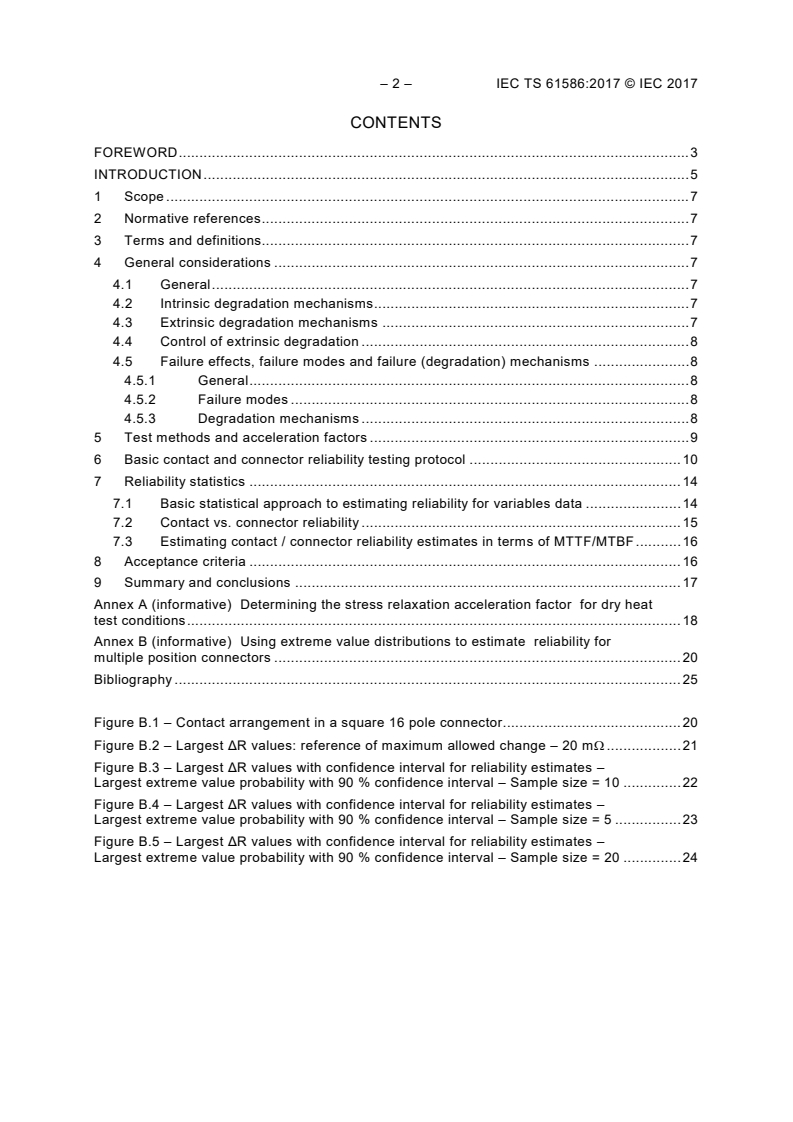
– 2 – IEC TS 61586:2017 © IEC 2017
CONTENTS
FOREWORD . 3
INTRODUCTION . 5
1 Scope . 7
2 Normative references . 7
3 Terms and definitions. 7
4 General considerations . 7
4.1 General . 7
4.2 Intrinsic degradation mechanisms . 7
4.3 Extrinsic degradation mechanisms . 7
4.4 Control of extrinsic degradation . 8
4.5 Failure effects, failure modes and failure (degradation) mechanisms . 8
4.5.1 General . 8
4.5.2 Failure modes . 8
4.5.3 Degradation mechanisms . 8
5 Test methods and acceleration factors . 9
6 Basic contact and connector reliability testing protocol . 10
7 Reliability statistics . 14
7.1 Basic statistical approach to estimating reliability for variables data . 14
7.2 Contact vs. connector reliability . 15
7.3 Estimating contact / connector reliability estimates in terms of MTTF/MTBF . 16
8 Acceptance criteria . 16
9 Summary and conclusions . 17
Annex A (informative) Determining the stress relaxation acceleration factor for dry heat
test conditions . 18
Annex B (informative) Using extreme value distributions to estimate reliability for
multiple position connectors . 20
Bibliography . 25
Figure B.1 – Contact arrangement in a square 16 pole connector. 20
Figure B.2 – Largest ΔR values: reference of maximum allowed change – 20 mΩ . 21
Figure B.3 – Largest ΔR values with confidence interval for reliability estimates –
Largest extreme value probability with 90 % confidence interval – Sample size = 10 . 22
Figure B.4 – Largest ΔR values with confidence interval for reliability estimates –
Largest extreme value probability with 90 % confidence interval – Sample size = 5 . 23
Figure B.5 – Largest ΔR values with confidence interval for reliability estimates –
Largest extreme value probability with 90 % confidence interval – Sample size = 20 . 24
INTERNATIONAL ELECTROTECHNICAL COMMISSION
____________
ESTIMATION OF THE RELIABILITY OF ELECTRICAL CONNECTORS
FOREWORD
1) The International Electrotechnical Commission (IEC) is a worldwide organization for standardization comprising
all national electrotechnical committees (IEC National Committees). The object of IEC is to promote
international co-operation on all questions concerning standardization in the electrical and electronic fields. To
this end and in addition to other activities, IEC publishes International Standards, Technical Specifications,
Technical Reports, Publicly Available Specifications (PAS) and Guides (hereafter referred to as “IEC
Publication(s)”). Their preparation is entrusted to technical committees; any IEC National Committee interested
in the subject dealt with may participate in this preparatory work. International, governmental and non-
governmental organizations liaising with the IEC also participate in this preparation. IEC collaborates closely
with the International Organization for Standardization (ISO) in accordance with conditions determined by
agreement between the two organizations.
2) The formal decisions or agreements of IEC on technical matters express, as nearly as possible, an international
consensus of opinion on the relevant subjects since each technical committee has representation from all
interested IEC National Committees.
3) IEC Publications have the form of recommendations for international use and are accepted by IEC National
Committees in that sense. While all reasonable efforts are made to ensure that the technical content of IEC
Publications is accurate, IEC cannot be held responsible for the way in which they are used or for any
misinterpretation by any end user.
4) In order to promote international uniformity, IEC National Committees undertake to apply IEC Publications
transparently to the maximum extent possible in their national and regional publications. Any divergence
between any IEC Publication and the corresponding national or regional publication shall be clearly indicated in
the latter.
5) IEC itself does not provide any attestation of conformity. Independent certification bodies provide conformity
assessment services and, in some areas, access to IEC marks of conformity. IEC is not responsible for any
services carried out by independent certification bodies.
6) All users should ensure that they have the latest edition of this publication.
7) No liability shall attach to IEC or its directors, employees, servants or agents including individual experts and
members of its technical committees and IEC National Committees for any personal injury, property damage or
other damage of any nature whatsoever, whether direct or indirect, or for costs (including legal fees) and
expenses arising out of the publication, use of, or reliance upon, this IEC Publication or any other IEC
Publications.
8) Attention is drawn to the Normative references cited in this publication. Use of the referenced publications is
indispensable for the correct application of this publication.
9) Attention is drawn to the possibility that some of the elements of this IEC Publication may be the subject of
patent rights. IEC shall not be held responsible for identifying any or all such patent rights.
The main task of IEC technical committees is to prepare International Standards. In
exceptional circumstances, a technical committee may propose the publication of a technical
specification when
• the required support cannot be obtained for the publication of an International Standard,
despite repeated efforts, or
• the subject is still under technical development or where, for any other reason, there is the
future but no immediate possibility of an agreement on an International Standard.
Technical specifications are subject to review within three years of publication to decide
whether they can be transformed into International Standards.
IEC TS 61586, which is a technical specification, has been prepared by IEC technical
committee 48: Electrical connectors and mechanical structures for electrical and electronic
equipment.
This second edition cancels and replaces the first edition published in 1997. This edition
constitutes a technical revision.
– 4 – IEC TS 61586:2017 © IEC 2017
The main technical changes with regard to the previous edition are as follows:
• A specific “basic” testing protocol is defined which utilizes a single test group subjecting
connectors to multiple stresses.
• Additional information is provided concerning test acceleration factors.
• A discussion of the limitations of providing MTTF/MTBF estimates for connectors has been
added.
• The bibliography has been expanded.
The text of this technical specification is based on the following documents:
Enquiry draft Report on voting
48/563/DTS 48/568/RVC
Full information on the voting for the approval of this technical specification can be found in the
report on voting indicated in the above table.
This document has been drafted in accordance with the ISO/IEC Directives, Part 2.
The committee has decided that the contents of this publication will remain unchanged until the
stability date indicated on the IEC website under "http://webstore.iec.ch" in the data related to
the specific publication. At this date, the publication will be
• transformed into an International standard,
• reconfirmed,
• withdrawn,
• replaced by a revised edition, or
• amended.
IMPORTANT – The 'colour inside' logo on the cover page of this publication indicates
that it contains colours which are considered to be useful for the correct understanding
of its contents. Users should therefore print this document using a colour printer.
INTRODUCTION
The reliability of electronic assemblies depends on the reliability of the passive electrical
connections between the active components, as well as on the reliability of the components
themselves. There is a common perception that interconnections, specifically connectors, are a
major source of failures, often of the "no fault found" variety, in electronic assemblies. Whether
this perception is true is not the subject of this technical document, but connector reliability is a
concern. Much of the increasing attention being given to reliability of electrical connectors
focuses on the basic question of how the reliability of electrical contacts and connectors can be
meaningfully determined.
The definition of reliability which will be assumed in this document is the following:
The probability of a product performing a specific function under defined operating
conditions for a specified period of time.
Reliability is therefore a function of:
a) The expected lifetime of the part.
b) The application stresses (electrical, thermal, mechanical, chemical, etc.) the part will be
subjected to during its life.
c) The specified failure criteria.
Since these factors will be different for every application in which the connector may be used, a
given connector will have a different reliability for every application in which it may be used.
Therefore, a connector manufacturer cannot provide a reliability estimate for a contact or
connector until the customer has provided a detailed description of the factors listed above for
the application in which the connector will be used. To provide a numerical estimate of
connector reliability, the manufacturer will then need to use the information provided by the
customer to design a test program to simulate the application intended.
Some factors which are to be taken into account in addressing this definition are the subject of
this document. The reliability assessment methodology to be discussed centres on appropriate
statistical analysis of test data, based on proper consideration of the following issues.
d) The active degradation mechanisms are to be identified and categorized by their
importance for the application.
e) Appropriate environmental tests, with corresponding acceleration factors, where practical
and appropriate, and exposures, are to be determined for these degradation mechanisms.
f) Use of a test sequence which provides an opportunity for the interaction of the potential
degradation mechanisms as is necessary to realistically simulate the effects of the
expected application.
g) The statistical approach to estimating reliability from the test data is to be agreed upon.
h) An acceptance criterion appropriate for the application of interest is to be established.
Items d), e and f) relate to the ability of the product to continue to perform its designated
function under the degradation mechanisms it is subjected to in its operating environment. In
addition, the need for an acceleration factor is fundamental to assessing the operating life of
the product.
Item g) is necessary, since the reliability definition is based on probability which requires
statistical treatment of appropriate data.
Finally, item h) is a result of the fact that the reliability to be assessed is based on the product
performing a defined function.
The level of knowledge and understanding available to address these issues varies
appreciably. Each topic is considered in a separate subclause.
– 6 – IEC TS 61586:2017 © IEC 2017
It is to be noted that there are a number of other factors which have an effect on connector
reliability. Among these are:
i) the connector manufacturing process;
j) assembly/application procedures of the equipment manufacturer;
k) abuse/misuse of the equipment by the end user.
The importance of these application or extrinsic factors cannot be denied and may well be the
final determinants of connector reliability. However, extrinsic factors are highly variable and,
therefore, difficult to account for in any estimation of reliability. For these reasons, this
document will focus on intrinsic connector reliability, i.e. the reliability of the design/materials of
the connector itself as evaluated by the procedures listed previously. This intrinsic reliability
represents the greatest reliability which the connector can achieve. The extrinsic factors will
result in a reduction in reliability.
It is also to be noted that the approach to reliability estimation in this document differs
significantly from that based on a base failure rate which is modified by application-specific
factors as, for example, in IEC 60863 or MIL Handbook 217.
The two approaches are related in that the base failure rate could be determined by a different
statistical treatment from the same data which are used in assessing reliability by the method
to be discussed. The test environments and exposures would determine the standard
conditions which are defined for the base failure rate. In addition, the derating factors used in
the failure rate approach can, in principle, be derived from the same data used to determine
acceleration factors in the proposed statistical method.
The advantage of the approach recommended in this document is that the standard conditions,
acceptance criteria, and statistical treatment are specifically defined for the application under
consideration. This is in contrast to a base failure rate starting point which is frequently poorly
defined and documented.
ESTIMATION OF THE RELIABILITY OF ELECTRICAL CONNECTORS
1 Scope
This technical specification deals with the estimation of the inherent design reliability of
electrical connectors through the definition and development of an appropriate accelerated
testing programme. The basic intrinsic degradation mechanisms of connectors, which are
those mechanisms which exist as a result of the materials and geometries chosen for the
connector design, are reviewed to provide a context for the development of the desired test
programme. While extrinsic degradation mechanisms may also significantly affect the
performance of connectors, they vary widely by application and thus are not addressed in this
document.
2 Normative references
There are no normative references in this document
3 Terms and definitions
No terms and definitions are listed in this document.
ISO and IEC maintain terminological databases for use in standardization at the following
addresses:
• IEC Electropedia: available at http://www.electropedia.org/
• ISO Online browsing platform: available at http://www.iso.org/obp
4 General considerations
4.1 General
Degradation leading to failure of a contact or connector can occur in many ways. For our
purpose, it is convenient to divide the mechanisms into two categories, intrinsic and extrinsic.
4.2 Intrinsic degradation mechanisms
As mentioned in the introduction, intrinsic degradation mechanisms are those related to the
design and materials of manufacture of the contact or connector. Examples are corrosion, loss
of normal force through stress relaxation, and excessive Joule heating leading to temperature-
related degradation.
4.3 Extrinsic degradation mechanisms
Extrinsic degradation mechanisms are related to the application of the contact or connector.
Examples are inadequate controls during manufacture of the connector, improper assembly
processes during equipment manufacture, contamination during application, degradation
caused by use of the connector outside its rated temperature range (both ambient and
enclosure-related) or by application of currents exceeding the product specification (in both
single and distributed modes), and contact abuse resulting from improper mating practices
(mating at excessive angles, pulling on cables, etc.) by the end user.
– 8 – IEC TS 61586:2017 © IEC 2017
4.4 Control of extrinsic degradation
Extrinsic degradation can be taken into account by incorporating design features in the
connector to reduce the potential for such degradation by proper specification of product
performance by the connector manufacturer, and by proper use of the available information by
the equipment manufacturer and end user. This is a joint responsibility which merits attention.
The connector manufacturer can include strain relief for cables, finishes on contacts, improved
crimps and other features intended to provide robustness against extrinsic degradation, but
these can always be overcome through abuse or misapplication by the user. The concept of
user includes the electrical equipment manufacturer as well as the ultimate user of the
equipment. However, extrinsic degradation mechanisms, due to their variety and application
dependence, are not something which can be straightforwardly analyzed, modelled or
simulated. This limitation makes estimation of the effects of extrinsic degradation mechanisms
on connector reliability problematic despite the fact that, as mentioned, such degradation
mechanisms may be the major determinant of connector reliability in actual use. For this
reason, when evaluating a system in which a connector will be used, an estimate of the
reliability of a connector based on testing of the connector in isolation should be primarily used
in conjunction with estimates of reliability of other components of the system to provide an
initial prediction of system reliability. But as with any other component, the actual reliability of
the connector in a system can be determined only through appropriate testing of the system in
which it is used.
4.5 Failure effects, failure modes and failure (degradation) mechanisms
4.5.1 General
Given the context of the previous remarks, in this document the discussion is limited to a few
aspects of intrinsic degradation, in order to describe an approach to connector reliability
evaluation. For clarity, it is important to distinguish between failure effects, failure modes and
failure (degradation) mechanisms.
A failure effect is the specific problem in operation which the customer will see. Examples
specific to contact and connector failures are loss of signal, loss of power,
overheating/burning, shorting, etc.
A failure mode is a physical description of the change in a part which may directly or
indirectly result in a failure effect observed by the customer. Examples of failure modes
specific to connectors or contacts are high resistance, reduced normal force, low insulation
resistance, etc.
A failure or degradation mechanism is the physical, chemical or other process which
resulted in the failure mode.
Note that while the term failure mechanism is often used, the term degradation mechanism
more clearly describes what is being discussed. A degradation mechanism can often occur
without causing failure if the level of degradation remains below some critical value. Therefore,
for the remainder of this document, the term degradation mechanism will be used.
4.5.2 Failure modes
Only one failure mode, the variation in contact resistance, will be considered in this document,
although many others exist, both mechanical (broken latches, bent pins, etc.) and electrical
(crosstalk, leakage between contacts, etc.).
4.5.3 Degradation mechanisms
Three intrinsic degradation mechanisms which are well understood and which are known to
have a major impact on contact resistance stability are considered:
• corrosion;
• stress relaxation;
• plating wear.
Corrosion of the contact interface causes an increase in contact resistance due to the
formation of non conductive material in the contact interface. Stress relaxation results in loss of
contact normal force which in turn can lead to increased contact resistance either directly, in
the case of extreme loss of normal force, or indirectly through increased susceptibility to
mechanical or corrosive degradation. Plating wear can lead to increased contact resistance if
wear-through occurs to the contact underplate or base material, both of which are typically
more susceptible to corrosion than the surface plating materials. These degradation
mechanisms result, generally, in increases in contact resistance. The amount of degradation
which occurs before reliability is affected depends on the application in which the connector is
used and is, therefore, application specific, as will be discussed. A primary concern is that
individually these degradation mechanisms may cause little or no increase in resistance.
However, they can interact to cause contact failure.
Experience with the product, or with similar products or applications, allows us to categorize
and rank the degradation mechanisms. Such categorization and ranking is necessary to define
an appropriate testing programme and identify, when possible, how the test conditions relate to
field performance and lifetime.
5 Test methods and acceleration factors
The objective of reliability testing is to cause in the test specimens levels of degradation which
accurately reflect the levels of degradation which will be found in parts when they are used in
the application being simulated. Once these levels of degradation have been caused by
subjecting the test specimens to the specified test conditions, the performance of the test
specimens can be evaluated against appropriate application failure criteria and the reliability of
the parts in the application simulated by the test can be estimated. To be of use, the testing
needs to accelerate the rates of degradation so that the required performance evaluation can
be completed in a reasonable time. To know how much application time has been simulated by
the test, it is necessary to know the acceleration factor of the test. In simple terms, the
objective is to be able to state that X days of exposure to the test conditions used, which may
activate a given degradation mechanism, are equivalent to Y years of service in the expected
application conditions. The acceleration factor between the test exposure and field exposure is
the time in the field which the test simulated divided by the time in the test. Note that other test
duration units such as cycles may be used in place of time as appropriate.
Unfortunately, there are only a few tests appropriate for contacts and connectors for which
such acceleration factors have been developed or determined. One of these tests, MFG (mixed
flowing gas) exposure, stresses the degradation mechanism of corrosion and is primarily
designed for use on contacts with noble metal based plating systems. Work to develop various
MFG tests has been done at several laboratories in different countries and in some cases
provides the required data from which acceleration factors can be derived.
Another test exposure for which acceleration factors can be determined is dry heat exposure,
also known as temperature life or heat age exposure. This test accelerates the degradation
mechanism of stress relaxation. Stress relaxation data are available for a broad range of
copper alloys used in connectors. Consideration of these data will allow an acceleration factor
to be defined for temperature life testing. However, stress relaxation is not linear with time.
Therefore given a known application operating temperature and a specified test temperature it
is still not possible to determine the acceleration factor of the test since the acceleration factor
will change as the time in test increases. As a result of this non linear response of stress
relaxation with time, increasing the test duration by a factor of X will not increase the lifetime
simulated by the test by the same factor of X. In fact for a given test temperature, small
increases in the lifetime which the test is used to simulate can cause very large increases in
the required duration of the test. A method for determining the acceleration factor for dry heat
exposures is provided in informative Annex A.
An important issue to note with stress relaxation testing is that stress relaxation relates only to
the contact normal force and not directly to reliability as evaluated by resistance stability.
Studies have shown that a large reduction in stress relaxation, and therefore normal force, can
occur with minimal change in resistance Therefore, the effects of stress relaxation on contact
– 10 – IEC TS 61586:2017 © IEC 2017
reliability as assessed by contact resistance stability shall be evaluated in conjunction with
other test exposures following a temperature life exposure. For example, exposing contacts in
a mated state to a dry heat test and then exposing the same contacts to a vibration test which
may cause motion at the contact interface may reveal a reduction in resistance stability which
would be expected in actual use of the contact but which would not be evident through the use
of a dry heat test only.
Other tests applied to electrical contacts and connectors but for which no acceleration factors
are typically defined include:
• temperature cycling with high humidity typically used to assess corrosion effects in non
noble metal plated contacts;
• mating/unmating or durability cycling used to assess wear effects;
• mechanical shock and/or vibration used to assess wear effects in general, fretting corrosion
of non noble plated contacts, and fretting corrosion of noble plated contacts in which the
noble metal surface plating has been worn through in vibration or other testing such as
durability cycling performed prior to vibration;
• salt spray used to assess corrosion effects for products used in harsh environments such
as marine applications and automotive applications in which the connector is directly
exposed to the outside environment.
As these tests have no established acceleration factors, when used in isolation they indicate
only the relative performance of connectors. The resulting data indicate only the behaviour of
the connector system under the tests. They are not reliability tests yielding data on which
estimates of behaviour under operating conditions can be based. However, these tests can be
used within a properly designed sequence of test exposures which also includes MFG
exposure and/or dry heat exposure to create a useful estimate of contact and/or connector
reliability.
6 Basic contact and connector reliability testing protocol
The primary degradation mechanisms of concern when assessing changes in contact
resistance may occur individually without having a significant detrimental effect on contact
resistance. For example, environmental corrosion of a contact surface can create corrosion
products around the contact interface. But as the actual microscopic points of metal to metal
contact within the interface are essentially gas tight, the corrosion processes which occur in
most applications will take much longer than the expected lifetimes of contacts before
disrupting these points of contact and causing a noticeable increase in resistance. Similarly
with stress relaxation, a significant decrease in contact normal force may occur without a
significant increase in contact resistance. During mating, to create a clean metal to metal
interface with a low electrical resistance, a relatively high normal force may be required,
especially for non noble plated contacts. This force is necessary to displace oxides and other
non conductive materials which may have accumulated the contact surface prior to mating.
However, once this interface is created, in the absence of stresses which will cause the contact
interface to move, the normal force required to maintain the low resistance interface is much
less than that which was required to create the interface initially. Thus, if the contact interface
does not move, normal may be reduced significantly without a detrimental increase in
resistance. Since the primary degradation mechanisms in contacts have limited effect in most
cases when occurring individually, a well designed contact will usually exhibit only a few mΩ of
resistance change in testing when subjected to individual stresses which activate a single
degradation mechanism.
However, in actual use, contacts are subjected to multiple stresses which can activate all of
primary degradation mechanisms simultaneously. And these stresses can interact directly and
indirectly to cause changes in resistance which are sufficiently large to cause failures in the
systems in which the contacts are used. For example, an environment which may cause
minimal corrosion on a new contact with intact plating may cause significant levels of corrosion
if the contact plating has been worn through due to the action of mating and unmating or
vibration. Further, the motion which caused the plating damage allowing corrosion to occur will
also shift the location of the contact potentially moving it into a location where corrosion exists.
If in addition to these stresses, stress relaxation has occurred causing a reduction in contact
normal force, the contact interface will have a lower mechanical stability. As a result, vibration
levels and temperature cycling which may not have caused motion at the interface when the
contact was new may now cause motion. And with the reduced normal force, the ability of the
contact to displace non conductive material such as corrosion products will be reduced. In
addition, the reduced normal force may make the contact susceptible to small (typically less
than 0,1 mm) cyclic motions when subjected to vibration or temperature cycling. If these
motions do occur in non noble metal plated interfaces or in noble metal plated interfaces in
which the non noble metal under-plating or base metal is exposed, the degradation mechanism
of fretting corrosion can occur and cause increased resistance.
Because it is the interactions of these degradation mechanisms which are most likely to cause
contact failures, an effective reliability test protocol shall include tests which can potentially
activate all these mechanisms in the same parts and in conjunction with potential contact
interface motion drivers. A basic reliability test protocol should thus include the following:
a) Tests such as vibration and durability cycling which can cause damage to plating.
b) Tests such as mixed flowing gas (MFG) for noble metal plated contacts and temperature
cycling with humidity for non noble plated contacts which can cause corrosion. Vibration
and temperature cycling may also cause fretting corrosion in non noble plated contacts or
noble plated contacts with damaged plating.
c) Dry heat exposure to accelerate stress relaxation and cause reduced normal force.
d) Tests such as temperature cycling, thermal shock, vibration, and mechanical shock which
can cause motion at the contact interface.
Additional test exposures may be included as needed depending on the intended application.
For example, power contacts which carry sufficient current to create increases in temperature
sufficient to accelerate various degradation mechanisms should be subjected to current
cycling. Testing of contacts to be used in areas of high particulate exposure may include dust
exposure.
For each test method included in the reliability test sequence, the level of stress applied and
the duration should be chosen such that the exposure causes a degradation which equals that
expected to be caused during the life of the product in its intended application. In other words,
they should place the test specimens in an end-of-life state. Therefore, it is desired that there
be known acceleration factors for all the tests used. But as noted earlier, reliable acceleration
factors are known for only dry heat stress relaxation tests and some MFG corrosion tests.
Fortunately, due to the way the contact interfaces respond to certain stresses, a lack of
acceleration factors for some tests does not prevent them being used in reliability evaluations.
One of the most important aspects of contact interface behaviour which allows tests without
acceleration factors to still be used in reliability testing is that the degradation of contacts to
certain stresses is not continuous. In other words, certain stresses do not cause a change in
the contact interface until they cross some threshold level of severity. Further, once crossing a
certain level of stress, these degradation mechanisms will then occur very quickly. One
example of this type of stress is temperature cycling. As temperature increases and decreases,
expansion and contraction of the contact or connector components will occur resulting in
mechanical forces on the contact interface. Unless these forces are sufficient to overcome the
frictional force at the interface, which is a function of the normal force and the coefficient of
friction between the contact surface materials, no motion and thus no degradation will occur.
But if the temperature cycles are at a level to cause motion at the interface in a non noble
plated contact, fretting corrosion will occur and significant resistance change will be identified
in relatively few test cycles, e.g. fewer than 1 000 cycles in tin interfaces and fewer than 100 in
nickel interfaces.
Another common test that behaves in this manner is vibration. Within some domain of
frequency, amplitude and/or acceleration levels, no movement will be caused in the contact
interface. Beyond these levels, once movement is caused millions of cycles of motion will often
– 12 – IEC TS 61586:2017 © IEC 2017
occur in less than an hour which may cause significant wear and possibly fretting corrosion
depending on the metallurgy of the contact interface.
When these types of tests, which do not cause degradation below some stress threshold and
then can potentially cause rapid degradation above these levels, are used in a reliability test
program they essentially determine if the application stresses are too severe for the contact or
connector design. Given this, a critical aspect to ensure when these tests are used is that they
do not significantly exceed the expected application stresses. If they do, they may cause
motions in the contact interface which will not occur in actual use and thus cause failures in
testing which are not representative of performance which would occur in the application.
Another category of tests which do not have an acceleration factor but which can still be used
in a reliability test program includes tests which can be performed at the same level and rate as
the expected application stress and still place the product in its expected end-of-life
degradation state in a reasonable amount of time. One example from this category of tests is
durability, or mate/unmate, cycling. Obviously one unmate/mate cycle in a test is equivalent to
one unmate/mate cycle in the application. Therefore, if during the life of a product it is
expected that 100 durability cycles will occur, then a reliability test duplicating this with 100
cycles can be done.
A valid reliability test program can therefore be created using tests which both do and do not
have known acceleration factors if those without known acceleration factors fit in one of the
categories described above. Further, as was previously discussed, the reliability test shall be
designed such that all the critical degradation mechanisms can interact. Ideally the design
would excite all the degradation mechanisms simultaneously. In practice this is not possible.
The tests required have conditions which are mutually exclusive. For example, MFG corrosion
tests are normally run at temperatu
...