

IEC 62381:2006
(Main)Automation systems in the process industry - Factory acceptance test (FAT), site acceptance test (SAT), and site integration test (SIT)
General Information
- Abstract
IEC 62381:2006 defines procedures and specifications for the Factory Acceptance Test (FAT), the Site Acceptance Test (SAT), and the Site Integration Test (SIT). These tests are carried out to prove that the automation system is in accordance with the specification. It cancels and replaces IEC/PAS 62381 published in 2004. This first edition constitutes a technical revision. This bilingual version (2013-04) corresponds to the monolingual English version, published in 2006-11.
- Status
- Published
- Publication Date
- 14-Nov-2006
- Technical Committee
- SC 65E - Devices and integration in enterprise systems
- Drafting Committee
- WG 3 - TC 65/SC 65E/WG 3
- Current Stage
- DELPUB - Deleted Publication
- Start Date
- 22-Feb-2012
- Completion Date
- 28-Aug-2026
Buy Documents
iec62381{ed1.0}en - IEC 62381:2006 - Automation systems in the process industry - Factory acceptance test (FAT), site acceptance test (SAT), and site integration test (SIT) Released:11/15/2006
iec62381{ed1.0}b - IEC 62381:2006 - Automation systems in the process industry - Factory acceptance test (FAT), site acceptance test (SAT), and site integration test (SIT) Released:11/15/2006
Overview
IEC 62381:2006 - "Automation systems in the process industry - Factory acceptance test (FAT), site acceptance test (SAT), and site integration test (SIT)" - defines procedures and specifications for acceptance testing of automation systems in the process industry. The standard specifies how to demonstrate that distributed control systems (DCS), PLC-based systems and associated subsystems meet the agreed functional and installation requirements. IEC 62381 cancels and replaces IEC/PAS 62381 (2004) and provides checklists, certificates and punch‑list formats to support FAT, SAT and SIT execution and documentation.
Key Topics
- Scope and purpose
- Defines FAT, SAT and SIT objectives: verify vendor-supplied system, site installation, and integration of subsystems into a single working system.
- Engineering and manufacturing prior to testing are outside the standard’s scope.
- Test sequencing and prerequisites
- Typical sequence: vendor in‑house tests → FAT → shipment/installation → SAT → SIT → commissioning.
- Vendor must complete full in‑house testing and provide test reports for FAT.
- Documentation requirements
- Lists documents typically prepared by owner/contractor (specifications, function plans, cause-and-effect diagrams, operator display sketches, instrument index, alarm lists, interlocks) and by vendor (system layout, hardware/software documentation, I/O lists, configuration printouts, in‑house test reports).
- Test procedures and schedules
- Guidance on FAT, SAT and SIT schedules, test procedures, rework handling and formal documentation of results.
- Annexed tools
- Informative annexes include FAT/SAT/SIT checklists, certificates, and punch‑list templates to standardize acceptance records.
- Terminology
- Definitions for automation system, tag, FAT, SAT, SIT, buyer, owner, contractor, vendor, PFS/PDS and abbreviations.
Applications and Users
- Practical applications:
- Use during procurement, vendor acceptance, installation verification and pre-commissioning of process automation systems (chemical, petrochemical, waste treatment, paper, cement, etc.).
- Helps reduce negotiation time and clarify responsibilities between owner, contractor and vendor to accelerate project schedules.
- Primary users:
- Owners, contractors, vendors/system integrators, commissioning engineers, QA/validation teams, and procurement specialists responsible for DCS/PLC/fieldbus projects.
Related Standards and Notes
- Complementary guidelines for regulated industries: Good Automated Manufacturing Practice (GAMP), FDA 21 CFR (GMP) and EMA SOPs (referenced in IEC 62381 for pharmaceutical validation contexts).
- Prepared by IEC TC65; follows ISO/IEC Directives for standard development.
Keywords: IEC 62381, FAT, SAT, SIT, factory acceptance test, site acceptance test, site integration test, automation systems, DCS, PLC, process industry, commissioning, vendor testing.
Relations
- Effective Date
- 05-Sep-2023
- Effective Date
- 05-Sep-2023
Buy Documents
iec62381{ed1.0}en - IEC 62381:2006 - Automation systems in the process industry - Factory acceptance test (FAT), site acceptance test (SAT), and site integration test (SIT) Released:11/15/2006
iec62381{ed1.0}b - IEC 62381:2006 - Automation systems in the process industry - Factory acceptance test (FAT), site acceptance test (SAT), and site integration test (SIT) Released:11/15/2006
Get Certified
Connect with accredited certification bodies for this standard

DVS-ZERT GmbH
German welding certification society.
CARES (UK Certification Authority for Reinforcing Steels)
UK certification for reinforcing steels and construction.
EWF/IIW (European/International Welding Federation)
International welding personnel certification.
Sponsored listings
Frequently Asked Questions
IEC 62381:2006 is a standard published by the International Electrotechnical Commission (IEC). Its full title is "Automation systems in the process industry - Factory acceptance test (FAT), site acceptance test (SAT), and site integration test (SIT)". This standard covers: IEC 62381:2006 defines procedures and specifications for the Factory Acceptance Test (FAT), the Site Acceptance Test (SAT), and the Site Integration Test (SIT). These tests are carried out to prove that the automation system is in accordance with the specification. It cancels and replaces IEC/PAS 62381 published in 2004. This first edition constitutes a technical revision. This bilingual version (2013-04) corresponds to the monolingual English version, published in 2006-11.
IEC 62381:2006 defines procedures and specifications for the Factory Acceptance Test (FAT), the Site Acceptance Test (SAT), and the Site Integration Test (SIT). These tests are carried out to prove that the automation system is in accordance with the specification. It cancels and replaces IEC/PAS 62381 published in 2004. This first edition constitutes a technical revision. This bilingual version (2013-04) corresponds to the monolingual English version, published in 2006-11.
IEC 62381:2006 is classified under the following ICS (International Classification for Standards) categories: 25.040.40 - Industrial process measurement and control. The ICS classification helps identify the subject area and facilitates finding related standards.
IEC 62381:2006 has the following relationships with other standards: It is inter standard links to IEC PAS 62381:2004, IEC 62381:2012. Understanding these relationships helps ensure you are using the most current and applicable version of the standard.
IEC 62381:2006 is available in PDF format for immediate download after purchase. The document can be added to your cart and obtained through the secure checkout process. Digital delivery ensures instant access to the complete standard document.
Standards Content (Sample)
INTERNATIONAL IEC
STANDARD 62381
First edition
2006-11
Automation systems in the process industry –
Factory acceptance test (FAT), site acceptance
test (SAT), and site integration test (SIT)
Reference number
Publication numbering
As from 1 January 1997 all IEC publications are issued with a designation in the
60000 series. For example, IEC 34-1 is now referred to as IEC 60034-1.
Consolidated editions
The IEC is now publishing consolidated versions of its publications. For example,
edition numbers 1.0, 1.1 and 1.2 refer, respectively, to the base publication, the
base publication incorporating amendment 1 and the base publication incorporating
amendments 1 and 2.
Further information on IEC publications
The technical content of IEC publications is kept under constant review by the IEC,
thus ensuring that the content reflects current technology. Information relating to
this publication, including its validity, is available in the IEC Catalogue of
publications (see below) in addition to new editions, amendments and corrigenda.
Information on the subjects under consideration and work in progress undertaken
by the technical committee which has prepared this publication, as well as the list
of publications issued, is also available from the following:
• IEC Web Site (www.iec.ch)
• Catalogue of IEC publications
The on-line catalogue on the IEC web site (www.iec.ch/searchpub) enables you to
search by a variety of criteria including text searches, technical committees
and date of publication. On-line information is also available on recently issued
publications, withdrawn and replaced publications, as well as corrigenda.
• IEC Just Published
This summary of recently issued publications (www.iec.ch/online_news/ justpub)
is also available by email. Please contact the Customer Service Centre (see
below) for further information.
• Customer Service Centre
If you have any questions regarding this publication or need further assistance,
please contact the Customer Service Centre:
Email: custserv@iec.ch
Tel: +41 22 919 02 11
Fax: +41 22 919 03 00
INTERNATIONAL IEC
STANDARD 62381
First edition
2006-11
Automation systems in the process industry –
Factory acceptance test (FAT), site acceptance
test (SAT), and site integration test (SIT)
© IEC 2006 ⎯ Copyright - all rights reserved
No part of this publication may be reproduced or utilized in any form or by any means, electronic or
mechanical, including photocopying and microfilm, without permission in writing from the publisher.
International Electrotechnical Commission, 3, rue de Varembé, PO Box 131, CH-1211 Geneva 20, Switzerland
Telephone: +41 22 919 02 11 Telefax: +41 22 919 03 00 E-mail: inmail@iec.ch Web: www.iec.ch
PRICE CODE
Commission Electrotechnique Internationale w
International Electrotechnical Commission
МеждународнаяЭлектротехническаяКомиссия
For price, see current catalogue
– 2 – 62381 © IEC:2006(E)
CONTENTS
INTRODUCTION.5
FOREWORD.3
1 Scope.6
2 Terms and definitions.9
3 Abbreviations .10
4 General preparation before conducting the FAT .11
4.1 Documents typically prepared by owner/contractor .11
4.2 Documents typically prepared by vendor .11
5 Factory acceptance test .12
5.1 General .12
5.2 FAT test schedule .12
5.3 Test procedure .13
5.4 FAT rework .16
5.5 Documentation of FAT in accordance with Annex A.16
6 Site acceptance test .16
6.1 General .16
6.2 SAT test schedule .16
7 Site integration test .17
7.1 General .17
7.2 SIT test schedule .17
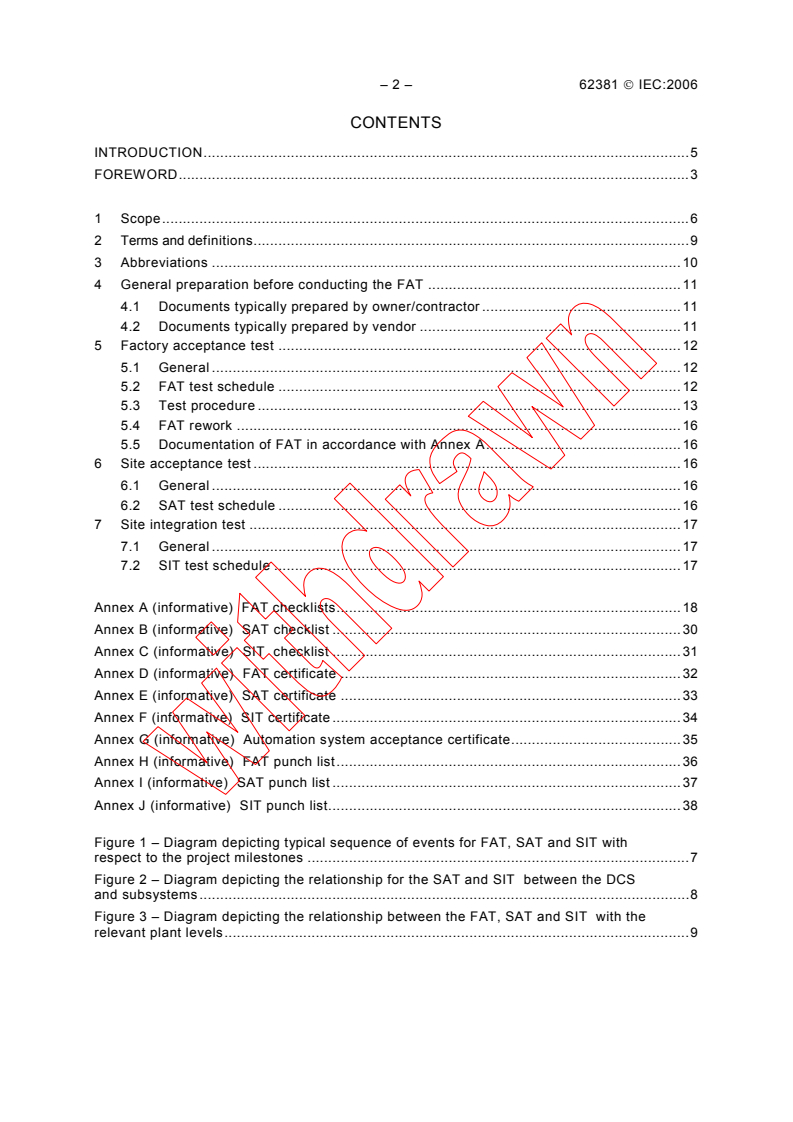
Annex A (informative) FAT checklists.18
Annex B (informative) SAT checklist .30
Annex C (informative) SIT checklist .31
Annex D (informative) FAT certificate .32
Annex E (informative) SAT certificate .33
Annex F (informative) SIT certificate .34
Annex G (informative) Automation system acceptance certificate.35
Annex H (informative) FAT punch list.36
Annex I (informative) SAT punch list .37
Annex J (informative) SIT punch list.38
Figure 1 – Diagram depicting typical sequence of events for FAT, SAT and SIT with
respect to the project milestones .7
Figure 2 – Diagram depicting the relationship for the SAT and SIT between the DCS
and subsystems.8
Figure 3 – Diagram depicting the relationship between the FAT, SAT and SIT with the
relevant plant levels.9
62381 © IEC:2006(E) – 3 –
INTERNATIONAL ELECTROTECHNICAL COMMISSION
____________
AUTOMATION SYSTEMS IN THE PROCESS INDUSTRY –
FACTORY ACCEPTANCE TEST (FAT),
SITE ACCEPTANCE TEST (SAT), AND SITE INTEGRATION TEST (SIT)
FOREWORD
1) The International Electrotechnical Commission (IEC) is a worldwide organization for standardization comprising
all national electrotechnical committees (IEC National Committees). The object of IEC is to promote
international co-operation on all questions concerning standardization in the electrical and electronic fields. To
this end and in addition to other activities, IEC publishes International Standards, Technical Specifications,
Technical Reports, Publicly Available Specifications (PAS) and Guides (hereafter referred to as “IEC
Publication(s)”). Their preparation is entrusted to technical committees; any IEC National Committee interested
in the subject dealt with may participate in this preparatory work. International, governmental and non-
governmental organizations liaising with the IEC also participate in this preparation. IEC collaborates closely
with the International Organization for Standardization (ISO) in accordance with conditions determined by
agreement between the two organizations.
2) The formal decisions or agreements of IEC on technical matters express, as nearly as possible, an international
consensus of opinion on the relevant subjects since each technical committee has representation from all
interested IEC National Committees.
3) IEC Publications have the form of recommendations for international use and are accepted by IEC National
Committees in that sense. While all reasonable efforts are made to ensure that the technical content of IEC
Publications is accurate, IEC cannot be held responsible for the way in which they are used or for any
misinterpretation by any end user.
4) In order to promote international uniformity, IEC National Committees undertake to apply IEC Publications
transparently to the maximum extent possible in their national and regional publications. Any divergence
between any IEC Publication and the corresponding national or regional publication shall be clearly indicated in
the latter.
5) IEC provides no marking procedure to indicate its approval and cannot be rendered responsible for any
equipment declared to be in conformity with an IEC Publication.
6) All users should ensure that they have the latest edition of this publication.
7) No liability shall attach to IEC or its directors, employees, servants or agents including individual experts and
members of its technical committees and IEC National Committees for any personal injury, property damage or
other damage of any nature whatsoever, whether direct or indirect, or for costs (including legal fees) and
expenses arising out of the publication, use of, or reliance upon, this IEC Publication or any other IEC
Publications.
8) Attention is drawn to the Normative references cited in this publication. Use of the referenced publications is
indispensable for the correct application of this publication.
9) Attention is drawn to the possibility that some of the elements of this IEC Publication may be the subject of
patent rights. IEC shall not be held responsible for identifying any or all such patent rights.
International Standard IEC 62381 has been prepared by IEC technical committee 65:
Industrial-process measurement and control.
This standard cancels and replaces IEC/PAS 62381 published in 2004. This first edition
constitutes a technical revision.
The text of this standard is based on the following documents:
FDIS Report on voting
65/385/FDIS 65/394/RVD
Full information on the voting for the approval of this standard can be found in the report on
voting indicated in the above table.
This publication has been drafted in accordance with the ISO/IEC Directives, Part 2.
– 4 – 62381 © IEC:2006(E)
The committee has decided that the contents of this publication will remain unchanged until
the maintenance result date indicated on the IEC web site under "http://webstore.iec.ch" in
the data related to the specific publication. At this date, the publication will be
• reconfirmed,
• withdrawn,
• replaced by a revised edition, or
• amended.
A bilingual version of this publication may be issued at a later date.
62381 © IEC:2006(E) – 5 –
INTRODUCTION
There is an increasing trend in the process industry to shorten the time period for project
execution. At the same time, the complexity of automation systems is being increased due to
the number of connected systems and the use of new technologies, for example, fieldbus
systems.
Experience has shown that the owner, the contractor and the vendor have long and extensive
discussions to unambiguously lay down the scope of activities and responsibilities in order to
achieve a timely delivery and acceptance of automation systems.
This standard should lead to an improvement and acceleration of the negotiation phase and to
a mutual understanding about the scope of activities of each party
The annexes of this standard contain forms which may be used in the test procedures. Buyers
of this standard may copy these forms for their own purposes only in the required amount.
For application in the pharmaceutical or other highly specialized industries, additional
guidelines (for example, Good Automated Manufacturing Practice (GAMP)), definitions and
stipulations should apply in accordance with existing standards, for example, for GMP
Compliance 21 CFR (FDA) and the Standard Operating Procedure of the European Medicines
Agency (SOP/INSP/2003).
– 6 – 62381 © IEC:2006(E)
AUTOMATION SYSTEMS IN THE PROCESS INDUSTRY –
FACTORY ACCEPTANCE TEST (FAT),
SITE ACCEPTANCE TEST (SAT), AND SITE INTEGRATION TEST (SIT)
1 Scope
This International Standard defines procedures and specifications for the Factory Acceptance
Test (FAT), the Site Acceptance Test (SAT), and the Site Integration Test (SIT). These tests
are carried out to prove that the automation system is in accordance with the specification.
Engineering and manufacturing activities prior to these tests are not covered by this standard.
The description of activities described in this standard can be taken as a guideline and
adapted to the specific requirements of the process/plant/equipment. A typical sequence of
activities and events is shown in Figure 1, their relationship in Figures 2 and 3.
62381 © IEC:2006(E) – 7 –
Construction Precommissioning Commissioning
Mechanical Completion
Start up
Loop check * Cold commissioning Hot commissioning
Process control system completion
ESD ESD
ESD/DCS
DCS DCS
FAT SAT SIT
Prerequisite for FAT Prerequisite for SAT Prerequisite for SIT
- SW complete - Shipment of system to site - Systems properly connected
- System hooked up - SAT complete
- Proper installation
- Vendor in-house test completed
- System start-up
IEC 2059/06
*The loop check can actually be started during the construction phase once the required infrastructure has been installed
Figure 1 – Diagram depicting typical sequence of events for FAT, SAT and SIT with respect to the project milestones
– 8 – 62381 © IEC:2006(E)
DCS Subsystem 1
Subsystem n
Communication SIT System SAT
IEC 2060/06
Figure 2 – Diagram depicting the relationship for the SAT and SIT
between the DCS and subsystems
62381 © IEC:2006(E) – 9 –
Typical DCS
Operator level
FAT
SAT
Process level
FAT FAT, partly
SAT SAT or SIT
Rack I/O
Fieldbus
Remote I/O
Fieldbus
Field device
device
Hart, etc
Loop check Loop check Loop check
Process
IEC 2061/06
Figure 3 – Diagram depicting the relationship between the FAT, SAT and SIT
with the relevant plant levels
2 Terms and definitions
For the purposes of this document, the following terms and definitions apply.
2.1
automation system
DCS- or PLC-based system for the monitoring and controlling of production facilities in the
process industry, including control systems based on fieldbus technologies
2.2
tag
unambiguous alphanumerical descriptor which identifies a sensor or actuator
2.3
factory acceptance test
activity to demonstrate that the vendor system and additionally supplied systems are in
accordance with the specification
2.4
site acceptance test
activity to demonstrate that the installation of the various vendor systems are in accordance
with the applicable specifications and installation instructions
Wiring test
Wiring test
Wiring test
– 10 – 62381 © IEC:2006(E)
2.5
site integration test
activity to demonstrate that the merging of the various systems to one overall system is
completed and that all components work together as specified
2.6
buyer
company which is functionally responsible for the automation system purchased from vendor,
i.e. either the owner or the contractor
2.7
owner
company that hired a contractor to build a chemical plant, petrochemical plant, etc.
2.8
contractor
company which is hired by the owner to design and build a chemical plant, petrochemical
plant, etc.
NOTE The function of contractor can be fulfilled by the owner.
2.9
vendor
manufacturer or distributor of the automation system.
2.10
process industry
industry that uses chemical reactions, separations, or mixing techniques in order to create
new products, modify existing products or treat waste and includes the following types of
industries: chemical, petrochemical, waste treatment, paper, cement, etc. It does not include
such industries as equipment/machine manufacturing or other similar industries. Industries
which are subject to special requirements and or validation, etc. are also not included
2.11
project design specification
PDS
document that defines detailed information needed to implement the functionality described in
the PFS
2.12
project functional specification
PFS
document that contains the vendor's response to the requirements the buyer stipulated prior
to starting the project with the vendor
3 Abbreviations
C&E Cause and effect diagram
DCS Distributed control system
ESD Emergency shut-down system
FAT Factory acceptance testing
FBD Functional block diagram
FUP Function plan
HMI Human machine interface
HW Hardware
62381 © IEC:2006(E) – 11 –
MC Mechanical completion
PDS Project design specifications
PFS Project functional specification
PLC Programmable logic controller
SAT Site acceptance test
SIT Site integration test
SW Software
4 General preparation before conducting the FAT
Prior to commencing the FAT, the vendor shall complete full in-house testing. Test reports
shall be available for inspection.
All relevant documents shall be prepared for use during the FAT. The following list shows
documents typically used. The list should be adapted to be specific project.
4.1 Documents typically prepared by OWNER/CONTRACTOR
– Specifications
– Preceding agreement(s)
– Function plans
– Cause and effect diagrams
– Sequential functional charts
– Sketches of operator displays and relevant text
– Control narratives
– Instrument index, for example, TAG – service text – I/O type – scaling – units
– Alarm message list, for example, TAG – type of alarm –sorting criteria (priority, plant area)
– Setpoint, control, effect and safety directions
– Interlock list, for example, interlocks assigned to each sensor/actuator, software (DCS)
and hardware (ESD)
4.2 Documents typically prepared by vendor
– System documentation
– Manuals, system data sheets, certificates
– System layout
– Hardware layout
– Description of interfaces
– I/O list and tag name conventions
– Graphic printouts
– Configuration printout
– In-house test reports
– Loop typicals (hardware and software) list of deliveries (hardware, software, application
and licenses)
– Test plan
– 12 – 62381 © IEC:2006(E)
5 Factory acceptance test
5.1 General
The FAT shall be performed by the vendor. The buyer should witness the test activities. There
may be buyers who want to carry out some parts of the FAT themselves. This has to be laid
down on a project-related basis.
The FAT shall comprise the following areas:
– project-relevant scope of supply;
– application-related functions of the automation system from signal source;
– system-related functions;
– adequate infrastructure shall be provided by vendor.
The FAT shall be conducted using the checklists given in Annex A.
With respect to the specification, any incomplete work or nonconformances detected during
the FAT shall be recorded on a punch list (Annex H).
Punch items will be categorized as follows:
• to be cleared on the spot, FAT to continue after rectification;
• on-going rectification during FAT;
• FAT to be repeated;
• modifications to be made after FAT, before the system is shipped to the site;
• remaining work to be rectified, i.e. at site.
The FAT shall be considered complete when the vendor has successfully proven all
necessary functions according to the FAT procedures and specifications, with the exception of
the mutually agreed remaining punch-list items.
Upon successful completion of the FAT, authorized representatives of the buyer and the
vendor shall sign the FAT certificate (for an example, see Annex D).
5.2 FAT test schedule
A test schedule (activities and time-schedule) shall be mutually agreed upon between the
buyer and the vendor. The schedule shall include, but is not limited to, the following activities:
Item Description
1 Start-up meeting (document review, schedule, etc.)
2 Vendor documentation (including in-house test reports) check
3 HW and SW inventory check
4 Mechanical inspection
5 Wiring and termination inspection
6 Start-up test
7 General system functions including hardware redundancy and diagnostic check
8 Visualization/operation
9 Test of functionality against all documents mentioned in Clause 4
10 Complex functionality and operation modes (for example, batch, sequence control)
62381 © IEC:2006(E) – 13 –
Item Description
11 Subsystem interface test
12 FAT rework, punch list for onsite (SAT) work
13 FAT close-out meeting
5.3 Test procedure
5.3.1 Test set-up
5.3.1.1 Rack/remote I/O
According to one or more of the following typical scenarios, a complete test shall be carried
out.
The following scenario is customary.
• Forcing of rack/remote I/O by means of simulation devices hooked up at I/O modules.
The scenarios listed below depend upon contract/specification requirements.
• Forcing of I/O by means of SW simulation on processor level.
• Forcing of I/O by means of SW simulation on the I/O modules.
• Forcing of I/O by means of simulation devices hooked up at field terminals (thus test
inclusive marshalling, process interface (Ex), cross-wiring, system cabling, and I/O
modules).
5.3.1.2 Bus interfaces
A generic test shall be carried out for each specified type of field device which is compliant to
the relevant standard. This test shall cover the interoperability of the automation system and
the device.
• One segment shall be built up and tested with all associated devices linked to it. Selection
of the segment shall be mutually agreed upon.
• In the case of distributed control functionality, all concerned segments shall be tested.
• Signals related to segments not built up shall be simulated.
• All relevant documents, data sheets, figures (load, cycle time, architecture) shall be
reviewed for all segments.
5.3.1.3 Subsystem connection
The following scenario is customary.
The test of the link itself and selected loops should be performed by means of a subsystem
simulation device. The value of the signal is forced/monitored in the simulation
device/automation system. The specified architecture, for example, redundancy, medium of
link, for example, glass-fibre or copper cable connection, etc. should be provided as far as
practicable.
Other scenarios such as listed below depend upon contract/specification requirements.
• Subsystem is emulated in the automation system; the signals are forced/monitored in the
automation system.
• Subsystem with limited configuration (processor and link devices only) are available to
check real communication and the signals are simulated in the subsystem.
– 14 – 62381 © IEC:2006(E)
• Complete subsystem, link devices and automation system are available, forcing/monitoring
of I/O at the subsystem/automation system.
The manner of testing shall be defined for each subsystem individually and after consideration
of the project requirements.
5.3.2 Conducting of test
The test activities can be divided into check of system features, project-related scope of
supply and application. For checklists
...
IEC 62381 ®
Edition 1.0 2006-11
INTERNATIONAL
STANDARD
NORME
INTERNATIONALE
Automation systems in the process industry – Factory acceptance test (FAT),
site acceptance test (SAT), and site integration test (SIT)
Systèmes d’automatisation pour les procédés industriels – Essais d’acceptation
en usine (FAT), essais d’acceptation sur site (SAT) et essais d’intégration sur
site (SIT)
All rights reserved. Unless otherwise specified, no part of this publication may be reproduced or utilized in any form
or by any means, electronic or mechanical, including photocopying and microfilm, without permission in writing from
either IEC or IEC's member National Committee in the country of the requester.
If you have any questions about IEC copyright or have an enquiry about obtaining additional rights to this publication,
please contact the address below or your local IEC member National Committee for further information.
Droits de reproduction réservés. Sauf indication contraire, aucune partie de cette publication ne peut être reproduite ni
utilisée sous quelque forme que ce soit et par aucun procédé, électronique ou mécanique, y compris la photocopie et les
microfilms, sans l'accord écrit de la CEI ou du Comité national de la CEI du pays du demandeur.
Si vous avez des questions sur le copyright de la CEI ou si vous désirez obtenir des droits supplémentaires sur cette
publication, utilisez les coordonnées ci-après ou contactez le Comité national de la CEI de votre pays de résidence.
IEC Central Office Tel.: +41 22 919 02 11
3, rue de Varembé Fax: +41 22 919 03 00
CH-1211 Geneva 20 info@iec.ch
Switzerland www.iec.ch
About the IEC
The International Electrotechnical Commission (IEC) is the leading global organization that prepares and publishes
International Standards for all electrical, electronic and related technologies.
About IEC publications
The technical content of IEC publications is kept under constant review by the IEC. Please make sure that you have the
latest edition, a corrigenda or an amendment might have been published.
Useful links:
IEC publications search - www.iec.ch/searchpub Electropedia - www.electropedia.org
The advanced search enables you to find IEC publications The world's leading online dictionary of electronic and
by a variety of criteria (reference number, text, technical electrical terms containing more than 30 000 terms and
committee,…). definitions in English and French, with equivalent terms in
It also gives information on projects, replaced and additional languages. Also known as the International
withdrawn publications. Electrotechnical Vocabulary (IEV) on-line.
IEC Just Published - webstore.iec.ch/justpublished Customer Service Centre - webstore.iec.ch/csc
Stay up to date on all new IEC publications. Just Published If you wish to give us your feedback on this publication
details all new publications released. Available on-line and or need further assistance, please contact the
also once a month by email. Customer Service Centre: csc@iec.ch.
A propos de la CEI
La Commission Electrotechnique Internationale (CEI) est la première organisation mondiale qui élabore et publie des
Normes internationales pour tout ce qui a trait à l'électricité, à l'électronique et aux technologies apparentées.
A propos des publications CEI
Le contenu technique des publications de la CEI est constamment revu. Veuillez vous assurer que vous possédez
l’édition la plus récente, un corrigendum ou amendement peut avoir été publié.
Liens utiles:
Recherche de publications CEI - www.iec.ch/searchpub Electropedia - www.electropedia.org
La recherche avancée vous permet de trouver des Le premier dictionnaire en ligne au monde de termes
publications CEI en utilisant différents critères (numéro de électroniques et électriques. Il contient plus de 30 000
référence, texte, comité d’études,…). termes et définitions en anglais et en français, ainsi que
Elle donne aussi des informations sur les projets et les les termes équivalents dans les langues additionnelles.
publications remplacées ou retirées. Egalement appelé Vocabulaire Electrotechnique
International (VEI) en ligne.
Just Published CEI - webstore.iec.ch/justpublished
Service Clients - webstore.iec.ch/csc
Restez informé sur les nouvelles publications de la CEI.
Just Published détaille les nouvelles publications parues. Si vous désirez nous donner des commentaires sur
Disponible en ligne et aussi une fois par mois par email. cette publication ou si vous avez des questions
contactez-nous: csc@iec.ch.
IEC 62381 ®
Edition 1.0 2006-11
INTERNATIONAL
STANDARD
NORME
INTERNATIONALE
Automation systems in the process industry – Factory acceptance test (FAT),
site acceptance test (SAT), and site integration test (SIT)
Systèmes d’automatisation pour les procédés industriels – Essais d’acceptation
en usine (FAT), essais d’acceptation sur site (SAT) et essais d’intégration sur
site (SIT)
INTERNATIONAL
ELECTROTECHNICAL
COMMISSION
COMMISSION
ELECTROTECHNIQUE
PRICE CODE
INTERNATIONALE
CODE PRIX W
ICS 25.040 ISBN 978-2-83220-720-8
– 2 – 62381 IEC:2006
CONTENTS
INTRODUCTION . 5
FOREWORD . 3
1 Scope . 6
2 Terms and definitions. 9
3 Abbreviations . 10
4 General preparation before conducting the FAT . 11
4.1 Documents typically prepared by owner/contractor . 11
4.2 Documents typically prepared by vendor . 11
5 Factory acceptance test . 12
5.1 General . 12
5.2 FAT test schedule . 12
5.3 Test procedure . 13
5.4 FAT rework . 16
5.5 Documentation of FAT in accordance with Annex A . 16
6 Site acceptance test . 16
6.1 General . 16
6.2 SAT test schedule . 16
7 Site integration test . 17
7.1 General . 17
7.2 SIT test schedule . 17
Annex A (informative) FAT checklists . 18
Annex B (informative) SAT checklist . 30
Annex C (informative) SIT checklist . 31
Annex D (informative) FAT certificate . 32
Annex E (informative) SAT certificate . 33
Annex F (informative) SIT certificate . 34
Annex G (informative) Automation system acceptance certificate . 35
Annex H (informative) FAT punch list . 36
Annex I (informative) SAT punch list . 37
Annex J (informative) SIT punch list . 38
Figure 1 – Diagram depicting typical sequence of events for FAT, SAT and SIT with
respect to the project milestones . 7
Figure 2 – Diagram depicting the relationship for the SAT and SIT between the DCS
and subsystems . 8
Figure 3 – Diagram depicting the relationship between the FAT, SAT and SIT with the
relevant plant levels . 9
62381 IEC:2006 – 3 –
INTERNATIONAL ELECTROTECHNICAL COMMISSION
____________
AUTOMATION SYSTEMS IN THE PROCESS INDUSTRY –
FACTORY ACCEPTANCE TEST (FAT),
SITE ACCEPTANCE TEST (SAT), AND SITE INTEGRATION TEST (SIT)
FOREWORD
1) The International Electrotechnical Commission (IEC) is a worldwide organization for standardization comprising
all national electrotechnical committees (IEC National Committees). The object of IEC is to promote
international co-operation on all questions concerning standardization in the electrical and electronic fields. To
this end and in addition to other activities, IEC publishes International Standards, Technical Specifications,
Technical Reports, Publicly Available Specifications (PAS) and Guides (hereafter referred to as “IEC
Publication(s)”). Their preparation is entrusted to technical committees; any IEC National Committee interested
in the subject dealt with may participate in this preparatory work. International, governmental and non-
governmental organizations liaising with the IEC also participate in this preparation. IEC collaborates closely
with the International Organization for Standardization (ISO) in accordance with conditions determined by
agreement between the two organizations.
2) The formal decisions or agreements of IEC on technical matters express, as nearly as possible, an international
consensus of opinion on the relevant subjects since each technical committee has representation from all
interested IEC National Committees.
3) IEC Publications have the form of recommendations for international use and are accepted by IEC National
Committees in that sense. While all reasonable efforts are made to ensure that the technical content of IEC
Publications is accurate, IEC cannot be held responsible for the way in which they are used or for any
misinterpretation by any end user.
4) In order to promote international uniformity, IEC National Committees undertake to apply IEC Publications
transparently to the maximum extent possible in their national and regional publications. Any divergence
between any IEC Publication and the corresponding national or regional publication shall be clearly indicated in
the latter.
5) IEC provides no marking procedure to indicate its approval and cannot be rendered responsible for any
equipment declared to be in conformity with an IEC Publication.
6) All users should ensure that they have the latest edition of this publication.
7) No liability shall attach to IEC or its directors, employees, servants or agents including individual experts and
members of its technical committees and IEC National Committees for any personal injury, property damage or
other damage of any nature whatsoever, whether direct or indirect, or for costs (including legal fees) and
expenses arising out of the publication, use of, or reliance upon, this IEC Publication or any other IEC
Publications.
8) Attention is drawn to the Normative references cited in this publication. Use of the referenced publications is
indispensable for the correct application of this publication.
9) Attention is drawn to the possibility that some of the elements of this IEC Publication may be the subject of
patent rights. IEC shall not be held responsible for identifying any or all such patent rights.
International Standard IEC 62381 has been prepared by IEC technical committee 65:
Industrial-process measurement and control.
This standard cancels and replaces IEC/PAS 62381 published in 2004. This first edition
constitutes a technical revision.
This bilingual version (2013-04) corresponds to the monolingual English version, published in
2006-11.
The text of this standard is based on the following documents:
FDIS Report on voting
65/385/FDIS 65/394/RVD
Full information on the voting for the approval of this standard can be found in the report on
voting indicated in the above table.
– 4 – 62381 IEC:2006
The French version of this standard has not been voted upon.
This publication has been drafted in accordance with the ISO/IEC Directives, Part 2.
The committee has decided that the contents of this publication will remain unchanged until
the maintenance result date indicated on the IEC web site under "http://webstore.iec.ch" in
the data related to the specific publication. At this date, the publication will be
• reconfirmed,
• withdrawn,
• replaced by a revised edition, or
• amended.
62381 IEC:2006 – 5 –
INTRODUCTION
There is an increasing trend in the process industry to shorten the time period for project
execution. At the same time, the complexity of automation systems is being increased due to
the number of connected systems and the use of new technologies, for example, fieldbus
systems.
Experience has shown that the owner, the contractor and the vendor have long and extensive
discussions to unambiguously lay down the scope of activities and responsibilities in order to
achieve a timely delivery and acceptance of automation systems.
This standard should lead to an improvement and acceleration of the negotiation phase and to
a mutual understanding about the scope of activities of each party
The annexes of this standard contain forms which may be used in the test procedures. Buyers
of this standard may copy these forms for their own purposes only in the required amount.
For application in the pharmaceutical or other highly specialized industries, additional
guidelines (for example, Good Automated Manufacturing Practice (GAMP)), definitions and
stipulations should apply in accordance with existing standards, for example, for GMP
Compliance 21 CFR (FDA) and the Standard Operating Procedure of the European Medicines
Agency (SOP/INSP/2003).
– 6 – 62381 IEC:2006
AUTOMATION SYSTEMS IN THE PROCESS INDUSTRY –
FACTORY ACCEPTANCE TEST (FAT),
SITE ACCEPTANCE TEST (SAT), AND SITE INTEGRATION TEST (SIT)
1 Scope
This International Standard defines procedures and specifications for the Factory Acceptance
Test (FAT), the Site Acceptance Test (SAT), and the Site Integration Test (SIT). These tests
are carried out to prove that the automation system is in accordance with the specification.
Engineering and manufacturing activities prior to these tests are not covered by this standard.
The description of activities described in this standard can be taken as a guideline and
adapted to the specific requirements of the process/plant/equipment. A typical sequence of
activities and events is shown in Figure 1, their relationship in Figures 2 and 3.
62381 IEC:2006 – 7 –
Construction Precommissioning Commissioning
Mechanical Completion
Start up
Loop check * Cold commissioning Hot commissioning
Process control system completion
ESD ESD
ESD/DCS
DCS DCS
FAT SAT SIT
Prerequisite for FAT Prerequisite for SAT Prerequisite for SIT
- SW complete - Shipment of system to site - Systems properly connected
- System hooked up - SAT complete
- Proper installation
- Vendor in-house test completed
- System start-up
IEC 2059/06
* The loop check can actually be started during the construction phase once the required infrastructure has been installed
Figure 1 – Diagram depicting typical sequence of events for FAT, SAT and SIT with respect to the project milestones
– 8 – 62381 IEC:2006
DCS Subsystem 1
Subsystem n
Communication SIT System SAT
IEC 2060/06
Figure 2 – Diagram depicting the relationship for the SAT and SIT
between the DCS and subsystems
62381 IEC:2006 – 9 –
Typical DCS
Operator level
FAT
SAT
Process level
FAT FAT, partly
SAT SAT or SIT
Rack I/O
Fieldbus
Remote I/O
Fieldbus
Field device
device
Hart, etc
Loop check Loop check Loop check
Process
IEC 2061/06
Figure 3 – Diagram depicting the relationship between the FAT, SAT and SIT
with the relevant plant levels
2 Terms and definitions
For the purposes of this document, the following terms and definitions apply.
2.1
automation system
DCS- or PLC-based system for the monitoring and controlling of production facilities in the
process industry, including control systems based on fieldbus technologies
2.2
tag
unambiguous alphanumerical descriptor which identifies a sensor or actuator
2.3
factory acceptance test
activity to demonstrate that the vendor system and additionally supplied systems are in
accordance with the specification
2.4
site acceptance test
activity to demonstrate that the installation of the various vendor systems are in accordance
with the applicable specifications and installation instructions
Wiring test
Wiring test
Wiring test
– 10 – 62381 IEC:2006
2.5
site integration test
activity to demonstrate that the merging of the various systems to one overall system is
completed and that all components work together as specified
2.6
buyer
company which is functionally responsible for the automation system purchased from vendor,
i.e. either the owner or the contractor
2.7
owner
company that hired a contractor to build a chemical plant, petrochemical plant, etc.
2.8
contractor
company which is hired by the owner to design and build a chemical plant, petrochemical
plant, etc.
NOTE The function of contractor can be fulfilled by the owner.
2.9
vendor
manufacturer or distributor of the automation system.
2.10
process industry
industry that uses chemical reactions, separations, or mixing techniques in order to create
new products, modify existing products or treat waste and includes the following types of
industries: chemical, petrochemical, waste treatment, paper, cement, etc. It does not include
such industries as equipment/machine manufacturing or other similar industries. Industries
which are subject to special requirements and or validation, etc. are also not included
2.11
project design specification
PDS
document that defines detailed information needed to implement the functionality described in
the PFS
2.12
project functional specification
PFS
document that contains the vendor's response to the requirements the buyer stipulated prior
to starting the project with the vendor
3 Abbreviations
C&E Cause and effect diagram
DCS Distributed control system
ESD Emergency shut-down system
FAT Factory acceptance testing
FBD Functional block diagram
FUP Function plan
HMI Human machine interface
HW Hardware
62381 IEC:2006 – 11 –
MC Mechanical completion
PDS Project design specifications
PFS Project functional specification
PLC Programmable logic controller
SAT Site acceptance test
SIT Site integration test
SW Software
4 General preparation before conducting the FAT
Prior to commencing the FAT, the vendor shall complete full in-house testing. Test reports
shall be available for inspection.
All relevant documents shall be prepared for use during the FAT. The following list shows
documents typically used. The list should be adapted to be specific project.
4.1 Documents typically prepared by OWNER/CONTRACTOR
– Specifications
– Preceding agreement(s)
– Function plans
– Cause and effect diagrams
– Sequential functional charts
– Sketches of operator displays and relevant text
– Control narratives
– Instrument index, for example, TAG – service text – I/O type – scaling – units
– Alarm message list, for example, TAG – type of alarm –sorting criteria (priority, plant area)
– Setpoint, control, effect and safety directions
– Interlock list, for example, interlocks assigned to each sensor/actuator, software (DCS)
and hardware (ESD)
4.2 Documents typically prepared by vendor
– System documentation
– Manuals, system data sheets, certificates
– System layout
– Hardware layout
– Description of interfaces
– I/O list and tag name conventions
– Graphic printouts
– Configuration printout
– In-house test reports
– Loop typicals (hardware and software) list of deliveries (hardware, software, application
and licenses)
– Test plan
– 12 – 62381 IEC:2006
5 Factory acceptance test
5.1 General
The FAT shall be performed by the vendor. The buyer should witness the test activities. There
may be buyers who want to carry out some parts of the FAT themselves. This has to be laid
down on a project-related basis.
The FAT shall comprise the following areas:
– project-relevant scope of supply;
– application-related functions of the automation system from signal source;
– system-related functions;
– adequate infrastructure shall be provided by vendor.
The FAT shall be conducted using the checklists given in Annex A.
With respect to the specification, any incomplete work or nonconformances detected during
the FAT shall be recorded on a punch list (Annex H).
Punch items will be categorized as follows:
• to be cleared on the spot, FAT to continue after rectification;
• on-going rectification during FAT;
• FAT to be repeated;
• modifications to be made after FAT, before the system is shipped to the site;
• remaining work to be rectified, i.e. at site.
The FAT shall be considered complete when the vendor has successfully proven all
necessary functions according to the FAT procedures and specifications, with the exception of
the mutually agreed remaining punch-list items.
Upon successful completion of the FAT, authorized representatives of the buyer and the
vendor shall sign the FAT certificate (for an example, see Annex D).
5.2 FAT test schedule
A test schedule (activities and time-schedule) shall be mutually agreed upon between the
buyer and the vendor. The schedule shall include, but is not limited to, the following activities:
Item Description
1 Start-up meeting (document review, schedule, etc.)
2 Vendor documentation (including in-house test reports) check
3 HW and SW inventory check
4 Mechanical inspection
5 Wiring and termination inspection
6 Start-up test
7 General system functions including hardware redundancy and diagnostic check
8 Visualization/operation
9 Test of functionality against all documents mentioned in Clause 4
10 Complex functionality and operation modes (for example, batch, sequence control)
62381 IEC:2006 – 13 –
Item Description
11 Subsystem interface test
12 FAT rework, punch list for onsite (SAT) work
13 FAT close-out meeting
5.3 Test procedure
5.3.1 Test set-up
5.3.1.1 Rack/remote I/O
According to one or more of the following typical scenarios, a complete test shall be carried
out.
The following scenario is customary.
• Forcing of rack/remote I/O by means of simulation devices hooked up at I/O modules.
The scenarios listed below depend upon contract/specification requirements.
• Forcing of I/O by means of SW simulation on processor level.
• Forcing of I/O by means of SW simulation on the I/O modules.
• Forcing of I/O by means of simulation devices hooked up at field terminals (thus test
inclusive marshalling, process interface (Ex), cross-wiring, system cabling, and I/O
modules).
5.3.1.2 Bus interfaces
A generic test shall be carried out for each specified type of field device which is compliant to
the relevant standard. This test shall cover the interoperability of the automation system and
the device.
• One segment shall be built up and tested with all associated devices linked to it. Selection
of the segment shall be mutually agreed upon.
• In the case of distributed control functionality, all concerned segments shall be tested.
• Signals related to segments not built up shall be simulated.
• All relevant documents, data sheets, figures (load, cycle time, architecture) shall be
reviewed for all segments.
5.3.1.3 Subsystem connection
The following scenario is customary.
The test of the link itself and selected loops should be performed by means of a subsystem
simulation device. The value of the signal is forced/monitored in the simulation
device/automation system. The specified architecture, for example, redundancy, medium of
link, for example, glass-fibre or copper cable connection, etc. should be provided as far as
practicable.
Other scenarios such as listed below depend upon contract/specification requirements.
• Subsystem is emulated in the automation system; the signals are forced/monitored in the
automation system.
• Subsystem with limited configuration (processor and link devices only) are available to
check real communication and the signals are simulated in the subsystem.
– 14 – 62381 IEC:2006
• Complete subsystem, link devices and automation system are available, forcing/monitoring
of I/O at the subsystem/automation system.
The manner of testing shall be defined for each subsystem individually and after consideration
of the project requirements.
5.3.2 Conducting of test
The test activities can be divided into check of system features, project-related scope of
supply and application. For checklists, see Annex A.
5.3.2.1 Checklists for the test of system features
– Start-up test
– General system functions including hardware redundancy and diagnostic check
5.3.2.2 Checklists for project-related scope of supply
– Documentation check
– HW and SW inventory check
– Mechanical inspection
– Wiring and termination inspection
5.3.2.3 Reference documents
The documents listed below shall serve as the basis for the functionality test. Completed tags
shall be marked and the resulting documents shall be considered as FAT record.
– P&ID
– Function plan
– Control narrative
– Cause and effects, interlock lists
– Function logic diagrams
– Complex control schemes
– Interface documents
– Colour coding information (process stream colours, block status colours, etc.)
– Definition of plant units and alarm philosophy
– Assignment of plant units to operator workstations
– Operating philosophy (access from graphic displays, group displays or faceplates)
– History collection definition
5.3.3 Application check procedures
5.3.3.1 Check of HMI displays
Prior to the loop-oriented test, the static parts of the HMI displays shall be tested.
The following display functionality (static) shall be verified.
– Symbols for vessels, process lines, valves, transmitters, motors, pumps, etc.
– Colours for static items, for example, hand valves, process lines, etc.
– Process flow direction and path, i.e., process line arrows, shall be verified.
– Correct linking of split range control schemes shall be verified.
– Hierarchies and linking of displays shall be verified.
62381 IEC:2006 – 15 –
– The dynamic changes of colours, subpictures and data entry points shall be verified.
5.3.3.2 Tag-oriented test
A master document shall be identified prior to the FAT to ensure complete coverage of all
tags. The instrument index including all tags connected to DCS and all subsystems visible on
DCS (ESD, PLC, unit controllers, analyser subsystems, etc.) is the preferred master.
All tags shall be tested as follows.
The faceplate, for example, functionality, service text, range, units, etc., shall be checked.
– Link to I/O level
– Related group display
– Related trends
It shall be verified that the tag target on the graphic is in the correct location and that the
colour changes for dynamic targets, for example, valves, motors, bar graphs, etc. are correct.
Check of alarm assignments – Sorting criteria (priority, plant area, etc.)
Check of user log-on level for operation and control
5.3.3.3 Check of complex functionality and interlocks
The test of complex functionality and interlocks shall be carried out after the tag-oriented test
for the related tags.
5.3.3.4 Additional functionality (reporting)
To be defined by the project.
5.3.3.5 Test of communication links to subsystems
The simulation of signals shall be carried out according to the chosen scenario.
The related functions shall be checked according to the tag-oriented test specification.
In addition to the application-related test, system features such as
– recovery from failure;
– redundancy;
– alternative modes of operation
shall be checked
5.3.3.6 Check of system functionalities
In addition to the application-related test, system features such as
– recovery from failure;
– redundancy;
– log-on strategy and levels;
– alarm processing strategy and acknowledgement;
– guaranteed system performance (refresh rate, etc.).
– 16 – 62381 IEC:2006
5.4 FAT rework
All rectification and subsequent re-check should be executed during the FAT. If this is not
possible, it should be undertaken after the FAT on the basis of a mutual agreement.
– Identification of re-work
– Action plan/time schedule
– Execution of re-work
– Re-check
– Notification of completion
5.5 Documentation of FAT in accordance with Annex A
a) Print and sign the tested function plans.
b) Date and sign all other documents generated during the FAT.
c) Review the punch list
d) Document the actual HW and SW tested, prepare the complete system and application
SW back-up.
e) Document spare and system load.
f) Provide an index and color copies of all applicable graphic displays.
6 Site acceptance test
6.1 General
The SAT shall be performed after the delivery/installation of the system at the buyer’s site.
The SAT is performed to prove the functionality of the system after delivery and installation.
Prior to conducting the SAT, the relevant HW/SW components shall be delivered to the site
and properly installed. The following items shall be completed during the installation of the
DCS/PLC before the SAT can be carried out.
– HW installation (controllers, I/O cards, marshalling racks, operating/engineering stations).
– Power supply installed for the relevant HW being tested.
– Grounding system installed for the relevant HW being tested.
– Network communications installed (for example, hubs, switches, fibre optics, Ethernet).
A checklist for the activities carried out during the SAT is included in Annex B.
6.2 SAT test schedule
A test schedule (activities and time-schedule) shall be mutually agreed upon between the
buyer and the vendor. The schedule shall include, but is not limited to, the following activities.
Item Description
1 Start-up meeting (document review, schedule, etc.)
2 Vendor documentation check
3 HW and SW inventory check
4 Mechanical inspection (grounding system, power supply, network connections, etc.)
5 Start-up/diagnostic check (turn on power supply, initialize/commission controllers,
perform diagnostic check)
62381 IEC:2006 – 17 –
Item Description
6 Download SW
7 Site integration test
7.1 General
The SIT shall be performed by the buyer after the SAT for each system that has been
successfully completed.
The SIT is performed to test the combination of two or more independent systems that have
been combined in order to obtain the functionality desired by the project control philosophy.
For example, SITs can and should be carried out when integrating the following types of
systems.
– Package units having their own DCS/PLC or unit controller.
– Analyser systems that communicate with DCS/PLCs using non-conventional I/O signals.
– ESD systems.
– Combining DCS/PLCs from several manufacturers.
– Integration of DCS into higher structure factory network.
– Other combinations of systems requiring a SIT can also exist.
The SIT should ensure that both systems function together in order to achieve the results
based on the control philosophy. The SIT basically consists of testing the communication and
interaction between the automation system and the subsystem to ensure properly and
sufficiently performed function.
A checklist for the basic activities carried out during the SIT is included in Annex C.
7.2 SIT test schedule
A test schedule (activities and time-schedule) shall be mutually agreed upon between the
buyer and the vendor. The schedule shall include, but is not limited to, the following activities.
Item Description
1 Start-up meeting (document review, schedule, etc.)
2 Vendor documentation check
4 Mechanical inspection (communication link between systems)
5 Diagnostic check (inspect communication between systems, baud rate, etc.)
6 Download SW (if applicable)
– 18 – 62381 IEC:2006
Annex A
(informative)
FAT checklists
A.1 Documentation check
Purpose
To review all FAT relevant documents.
Item Verify document Test result Remarks
1 . P F NA
Comments
Nonconformity to be recorded in the punch list, categorized and treated as agreed in the start-
up meeting.
P = Pass
F = Fail
NA = Not applicable
Signature:
62381 IEC:2006 – 19 –
A.2 HW and SW inventory check
Purpose
To verify that HW architecture, quantities, dimensions, painting, etc. are in accordance with
the relevant documents. Furthermore, SW licences, spares and consumables shall be
checked.
Reference documents
• Approved vendor HW drawings
• Order
Note
Recommendation: Copies of the relevant drawings shall be checked off and signed by the
customer and user to serve as proof.
Item Description Test result
1 HW check P F NA
2 Check of SW licences/versions including firmware P F NA
3 Spares, consumables, and tools P F NA
Comments
Nonconformity to be recorded in the punch list, categorized and treated as agreed in the start-
up meeting.
P = Pass
F = Fail
NA = Not applicable
Signature:
– 20 – 62381 IEC:2006
A.3 Mechanical inspection
Purpose
To inspect HW architecture and layout as against the approved documents.
Reference documents
• Approved vendor HW drawings
• Project specification
• Applicable standards and codes
Note
Items under 4 will be randomly selected for test.
Item Description Test result
1 Cable entry, support bars and accessories (cable clamps, P F NA
glands, etc.)
2 Labelling, tagging P F NA
3 Mounting of components and modules P F NA
4 Screwed connections, terminal connections P F NA
5 Earthing, equipotential bonding P F NA
6 Electric shock protection, warning labels P F NA
7 Maintainability of cabinet fans, construction of cabinets P F NA
8 Spare capacity P F NA
Comments
Nonconformity to be recorded in the punch list, categorized and treated as agreed in the start-
up meeting.
P = Pass
F = Fail
NA = Not applicable
Signature:
62381 IEC:2006 – 21 –
A.4 Wiring and termination inspection
Purpose
To verify that the wiring is in accordance with the guidelines given by the project specification
and that the approved HW documents and workmanship are in compliance with industry
standards.
Reference documents
• Approved vendor HW drawings
• Project specification
• Applicable standards and codes
Note
Items 5 and 6 will be randomly selected for test.
Item Description Test result
1 Wiring and cabling, cabling of internal circuits P F NA
2 Fusing, circuit-breakers P F NA
3 Tagging, labelling P F NA
4 Segregation of lines, colours, cross-section, voltages, Exi P F NA
5 Wire crimp inspection P F NA
6 Manual wire crimp pull test P F NA
7 Cable duct loading P F NA
8 I/O wiring to terminals and connector labelling P F NA
9 System cable plug orientation P F NA
10 System voltage insulation test P F NA
Comments
Nonconformity to be recorded in the punch list, categorized and treated as agreed in the start-
up meeting.
P = Pass
F = Fail
NA = Not applicable
Signature:
– 22 – 62381 IEC:2006
A.5 Start-up text and general system functions
Purpose
To verify that the system has no problems to start up, recover from a power failure and
perform on-line loading. Furthermore, it shall be verified that the system is operating within
the given limits.
Reference documents
• Relevant product documentation
• Specified system limits
Item Description Test result
a
1 New start (start from zero point , stop/start) P F NA
2 On-line change P F NA
3 Controller cycle time P F NA
4 Display call-up time P F NA
5 Value update time P F NA
6 System load (memory capacity, storage capacity, etc.) P F NA
7 Log-on strategy and level P F NA
8 Alarm processing strategy and acknowledgement P F NA
a
New disc and controller back-up batteries removed.
Comments
Nonconformity to be recorded in the punch list, categorized and treated as agreed in the start-
up meeting.
P = Pass
F = Fail
NA = Not applicable
Signature:
62381 IEC:2006 – 23 –
A.6 System alarm test
Purpose
To verify the announcement of system-related failures, cabinet alarms and system-generated
alarms to appear on system.
Reference documents
Product relevant documentation
• Alarm message list
Item Description Test result
1 Power-supply failure, UPS monitoring P F NA
2 Fuse, breaker monitoring P F NA
3 Cooling fans P F NA
4 Communication, network monitoring P F NA
5 Short circuit, wire break, out of range, earth fault P F NA
6 Watchdog, if any P F NA
Comments
Nonconformity to be recorded in the punch list, categorized and treated as agreed in the start-
up meeting.
P = Pass
F = Fail
NA = Not applicable
Signature:
– 24 – 62381 IEC:2006
A.7 Hardware redundancy and diagnostic check
Purpose
To ensure proper operation and monitoring of redundant components.
Reference documents
Product relevant documentation
Note
No single action shall effect the operation of the overall system.
Item Description Test result
1 Redundant operation and monitoring of controllers P F NA
2 Redundant operation and monitoring of communication and P F NA
networks
3 Redundant operation and monitoring of power supplies P F NA
4 Redundant operation and monitoring of operator stations P F NA
5 Redundant operation and monitoring of I/Os, if any P F NA
6 Redundant operation and monitoring of all other devices not P F NA
mentioned before
Comments:
Nonconformity to be recorded in the punch list, categorized and treated as agreed in the start-
up meeting.
P = Pass
F = Fail
NA = Not Applicable
Signature:
62381 IEC:2006 – 25 –
A.8 Visualization/Operation
Purpose
To verify the functionality of standard and graphic display arrangements in accordance with
the specification
Reference documents
• Relevant product information
• Handed over sketches
Note
This item covers the static part of the display only. The dynamic part will be tested later,
together with the configuration functions.
Recommendation: The graphic design shall be agreed upon with the end-user well in
advance.
Item Description Test result
1 Colours of background and colour changes P F NA
2 Symbols P F NA
3 Static text and dynamic changes P F NA
4 Organization (jumps, transitions, subpictures) P F NA
Comments
Nonconformity to be recorded in the punch list, categorized and treated as agreed in the start-
up meeting.
P = Pass
F = Fail
NA = Not applicable
Signature:
– 26 – 62381 IEC:2006
A.9 Test of functionality against FBD, FUP, etc.
Purpose
To verify the functionality of the system according to the given documents.
Reference documents
Project relevant documents, for example:
• FBD(s)
• FUP(s)
• C&E(s)
• Interlocks
• Narrative(s)
• Pre-defined typical
Note
Test as defined in the specification, for example, 100%, spot check, etc.
Below is a list of the items that need to be tested for the system. A project-specific detailed
checklist should be developed and used to evaluate the individual loops. An example test
sheet is provided on the following page.
Item Description Test result
1 Identification and labelling of the loop/function P F NA
2 Test relevant I/O up to the display P F NA
3 Check of functionality in detail with all related interlocks, P F NA
alarms, messages, displays, trends, signal updating on
graphics and face plates
4 Operation of tags, trend archiving functions (internal and P F NA
external)
5 Priority of alarm texts P F NA
Comments
Nonconformity to be recorded in the punch list, categorized and treated as agreed in the start-
up meeting.
P = Pass
F = Fail
NA = Not applicable
Signature:
62381 IEC:2006 – 27 –
Example of test sheet for individual loop evaluation
LOOP TEST RESULTS
OK Not
FUNCTION: LIRCA+-
Loop Text:
DCS/PLC: Controller 12
Loop Signal Type: Analog Input
Interlocks:
HW Loop: V0108 AB86 L001
Location in software display:
Measurement Range: 0 – 800
Measurement Units: mbar
Alarm settings/switchpoints:
Alarm/Switch Setpoints (mbar): Loop signal to DCS:
S+ A+ 712
S++ A++ Display dynamics/color settings:
S+++ A+++
Comments when not OK
S- A- 152
S-- A--
S--- A---
Operation:
Local
DCS/PLC X
Other
DCS Input DCS Output
Analog 1 Analog 1
Binary 0 Binary 1
Measurement Technique: Diff. Pressure Trsmtr
Device Manufacturer: XXXX
Device Type: XXXX
Signature:
– 28 – 62381 IEC:2006
A.10 Complex functionality and operation mod
...