


IEC 60598-2-22:2014/AMD1:2017
(Amendment)Amendment 1 - Luminaires - Part 2-22: Particular requirements - Luminaires for emergency lighting
Amendment 1 - Luminaires - Part 2-22: Particular requirements - Luminaires for emergency lighting
Amendement 1 - Luminaires - Partie 2-22: Règles particulières - Luminaires pour éclairage de secours
General Information
- Status
- Published
- Publication Date
- 21-Sep-2017
- Technical Committee
- SC 34D - Luminaires
- Drafting Committee
- JWG 2 - TC 34/SC 34D/JWG 2
- Current Stage
- DELPUB - Deleted Publication
- Start Date
- 06-Dec-2021
- Completion Date
- 26-Oct-2025
Relations
- Effective Date
- 05-Sep-2023
- Effective Date
- 05-Sep-2023
Overview
IEC 60598-2-22:2014/AMD1:2017 is an essential international standard amendment focused on luminaires for emergency lighting. Developed by the International Electrotechnical Commission (IEC), this amendment updates the particular requirements related to emergency luminaires-lighting devices that provide illumination in the event of a power failure or emergency. This document refines testing methods, performance criteria, and technical specifications specifically for LED and other light sources used in emergency lighting.
The aim is to ensure a consistent, safe, and reliable performance of emergency luminaires worldwide. This amendment addresses critical factors such as light output at varying temperatures, electrical current control, and photometric data requirements-helping manufacturers, safety engineers, and facility managers implement compliant emergency lighting solutions.
Key Topics
Emergency Luminaire Requirements: Specifies unique conditions and performance standards for emergency lighting devices, emphasizing continuous safety and proper illumination during emergencies.
LED Light Source Performance: Introduces the Emergency Operating Factor (EOF) as a key parameter for assessing LED light output under emergency conditions. It is calculated as the ratio of current in emergency mode versus normal mode current, reflecting how LED brightness depends on electrical current and temperature controlled through heat sinks.
Photometric Data for Emergency Lighting: Manufacturers must provide precise intensity distribution data and emergency luminous flux values compliant with ISO 30061 and CIE S025 testing methods. The amendment defines requirements for measuring emergency photometric performance at intervals (5 seconds, 60 seconds, and throughout operation duration) after power failure.
Normative References and Terminology Updates: The amendment updates references, replacing and adding key standards such as CIE S025: Test Method for LED Lamps, LED Luminaires and LED Modules. New terms like Practical Emergency Light Source Flux (PELSF) establish measurable benchmarks for light output under emergency conditions.
Controlgear Requirements: Links LED current controlgear standards (IEC 61347-2-7 and IEC 61347-2-13) with emergency luminaire performance, ensuring that LED current regulation directly correlates with enhanced reliability in emergency lighting.
Compliance Testing Conditions: Details testing protocols for self-contained and centrally supplied emergency luminaires, including battery charge conditions, supply voltage levels, and lamp aging for accurate luminous flux measurement in emergency mode.
Applications
Safety and Emergency Systems: IEC 60598-2-22:2014/AMD1:2017 applies directly to emergency lighting installations in commercial, industrial, healthcare, and public infrastructure buildings.
LED Luminaire Design and Manufacturing: Provides essential guidelines for product development teams designing LED luminaires with emergency lighting functions, ensuring they meet safety and performance standards during power outages.
Building Code Compliance: Architects and electrical engineers utilize this standard to specify compliant emergency lighting that satisfies international safety codes and enhances occupant safety.
Quality Assurance and Testing: Test laboratories rely on the photometric and electrical testing criteria outlined in the amendment to verify emergency luminaire performance before market release.
Maintenance and Retrofit Projects: Facility managers use the standard’s parameters to evaluate existing emergency lighting systems and guide upgrades to LED-based luminaires, optimizing energy efficiency and safety compliance.
Related Standards
IEC 61347-2-7: Controls electronic gear for emergency lighting; integral to calculating electrical parameters affecting LED emergency light output.
IEC 61347-2-13: Specifies controlgear for LED modules, including current regulation critical for accurate emergency lighting performance.
ISO 30061: Provides calculation methods for emergency lighting installations based on photometric data, referenced for compliance verification.
CIE S025: Test method focused on LED lamps, luminaires, and modules, adopted here for photometric measurement of LED emergency luminaires.
IEC 62034: Addresses automatic testing systems in emergency lighting, referenced for luminaires equipped with self-diagnostic features.
IEC 60364-5-56: Relevant for installation details of safety services electrical equipment; informed the optional bibliography mentioned in the amendment.
This amendment to IEC 60598-2-22 strengthens global safety and performance criteria for emergency luminaires, especially those using LED technology. It facilitates harmonized testing and certification processes, contributing to resilient, energy-efficient, and reliable emergency lighting solutions that protect lives and property during power failures.
Frequently Asked Questions
IEC 60598-2-22:2014/AMD1:2017 is a standard published by the International Electrotechnical Commission (IEC). Its full title is "Amendment 1 - Luminaires - Part 2-22: Particular requirements - Luminaires for emergency lighting". This standard covers: Amendment 1 - Luminaires - Part 2-22: Particular requirements - Luminaires for emergency lighting
Amendment 1 - Luminaires - Part 2-22: Particular requirements - Luminaires for emergency lighting
IEC 60598-2-22:2014/AMD1:2017 is classified under the following ICS (International Classification for Standards) categories: 29.140.40 - Luminaires. The ICS classification helps identify the subject area and facilitates finding related standards.
IEC 60598-2-22:2014/AMD1:2017 has the following relationships with other standards: It is inter standard links to IEC 60598-2-22:2014, IEC 60598-2-22:2021. Understanding these relationships helps ensure you are using the most current and applicable version of the standard.
IEC 60598-2-22:2014/AMD1:2017 is available in PDF format for immediate download after purchase. The document can be added to your cart and obtained through the secure checkout process. Digital delivery ensures instant access to the complete standard document.
Standards Content (Sample)
IEC 60598-2-22 ®
Edition 4.0 2017-09
INTERNATIONAL
STANDARD
NORME
INTERNATIONALE
A MENDMENT 1
AM ENDEMENT 1
Luminaires –
Part 2-22: Particular requirements – Luminaires for emergency lighting
Luminaires –
Partie 2-22: Règles particulières – Luminaires pour éclairage de secours
IEC 60598-2-22:2014-06/AMD1:2017-09(en-fr)
All rights reserved. Unless otherwise specified, no part of this publication may be reproduced or utilized in any form
or by any means, electronic or mechanical, including photocopying and microfilm, without permission in writing from
either IEC or IEC's member National Committee in the country of the requester. If you have any questions about IEC
copyright or have an enquiry about obtaining additional rights to this publication, please contact the address below or
your local IEC member National Committee for further information.
Droits de reproduction réservés. Sauf indication contraire, aucune partie de cette publication ne peut être reproduite
ni utilisée sous quelque forme que ce soit et par aucun procédé, électronique ou mécanique, y compris la photocopie
et les microfilms, sans l'accord écrit de l'IEC ou du Comité national de l'IEC du pays du demandeur. Si vous avez des
questions sur le copyright de l'IEC ou si vous désirez obtenir des droits supplémentaires sur cette publication, utilisez
les coordonnées ci-après ou contactez le Comité national de l'IEC de votre pays de résidence.
IEC Central Office Tel.: +41 22 919 02 11
3, rue de Varembé Fax: +41 22 919 03 00
CH-1211 Geneva 20 info@iec.ch
Switzerland www.iec.ch
About the IEC
The International Electrotechnical Commission (IEC) is the leading global organization that prepares and publishes
International Standards for all electrical, electronic and related technologies.
About IEC publications
The technical content of IEC publications is kept under constant review by the IEC. Please make sure that you have the
latest edition, a corrigenda or an amendment might have been published.
IEC Catalogue - webstore.iec.ch/catalogue Electropedia - www.electropedia.org
The stand-alone application for consulting the entire The world's leading online dictionary of electronic and
bibliographical information on IEC International Standards, electrical terms containing 20 000 terms and definitions in
Technical Specifications, Technical Reports and other English and French, with equivalent terms in 16 additional
documents. Available for PC, Mac OS, Android Tablets and languages. Also known as the International Electrotechnical
iPad. Vocabulary (IEV) online.
IEC publications search - www.iec.ch/searchpub IEC Glossary - std.iec.ch/glossary
The advanced search enables to find IEC publications by a 65 000 electrotechnical terminology entries in English and
variety of criteria (reference number, text, technical French extracted from the Terms and Definitions clause of
committee,…). It also gives information on projects, replaced IEC publications issued since 2002. Some entries have been
and withdrawn publications. collected from earlier publications of IEC TC 37, 77, 86 and
CISPR.
IEC Just Published - webstore.iec.ch/justpublished
Stay up to date on all new IEC publications. Just Published IEC Customer Service Centre - webstore.iec.ch/csc
details all new publications released. Available online and If you wish to give us your feedback on this publication or
also once a month by email. need further assistance, please contact the Customer Service
Centre: csc@iec.ch.
A propos de l'IEC
La Commission Electrotechnique Internationale (IEC) est la première organisation mondiale qui élabore et publie des
Normes internationales pour tout ce qui a trait à l'électricité, à l'électronique et aux technologies apparentées.
A propos des publications IEC
Le contenu technique des publications IEC est constamment revu. Veuillez vous assurer que vous possédez l’édition la
plus récente, un corrigendum ou amendement peut avoir été publié.
Catalogue IEC - webstore.iec.ch/catalogue Electropedia - www.electropedia.org
Application autonome pour consulter tous les renseignements Le premier dictionnaire en ligne de termes électroniques et
bibliographiques sur les Normes internationales, électriques. Il contient 20 000 termes et définitions en anglais
Spécifications techniques, Rapports techniques et autres et en français, ainsi que les termes équivalents dans 16
documents de l'IEC. Disponible pour PC, Mac OS, tablettes langues additionnelles. Egalement appelé Vocabulaire
Android et iPad. Electrotechnique International (IEV) en ligne.
Recherche de publications IEC - www.iec.ch/searchpub Glossaire IEC - std.iec.ch/glossary
La recherche avancée permet de trouver des publications IEC 65 000 entrées terminologiques électrotechniques, en anglais
en utilisant différents critères (numéro de référence, texte, et en français, extraites des articles Termes et Définitions des
comité d’études,…). Elle donne aussi des informations sur les publications IEC parues depuis 2002. Plus certaines entrées
projets et les publications remplacées ou retirées. antérieures extraites des publications des CE 37, 77, 86 et
CISPR de l'IEC.
IEC Just Published - webstore.iec.ch/justpublished
Restez informé sur les nouvelles publications IEC. Just Service Clients - webstore.iec.ch/csc
Published détaille les nouvelles publications parues. Si vous désirez nous donner des commentaires sur cette
Disponible en ligne et aussi une fois par mois par email. publication ou si vous avez des questions contactez-nous:
csc@iec.ch.
IEC 60598-2-22 ®
Edition 4.0 2017-09
INTERNATIONAL
STANDARD
NORME
INTERNATIONALE
A MENDMENT 1
AM ENDEMENT 1
Luminaires –
Part 2-22: Particular requirements – Luminaires for emergency lighting
Luminaires –
Partie 2-22: Règles particulières – Luminaires pour éclairage de secours
INTERNATIONAL
ELECTROTECHNICAL
COMMISSION
COMMISSION
ELECTROTECHNIQUE
INTERNATIONALE
ICS 29.140.40 ISBN 978-2-8322-4809-6
– 2 – IEC 60598-2-22:2014/AMD1:2017
© IEC 2017
FOREWORD
This amendment has been prepared by subcommittee 34D: Luminaires, of IEC technical
committee 34: Lamps and related equipment.
The text of this amendment is based on the following documents:
FDIS Report on voting
34D/1296/FDIS 34D/1304/RVD
Full information on the voting for the approval of this amendment can be found in the report
on voting indicated in the above table.
The committee has decided that the contents of this amendment and the base publication will
remain unchanged until the stability date indicated on the IEC website under
"http://webstore.iec.ch" in the data related to the specific publication. At this date, the
publication will be
• reconfirmed,
• withdrawn,
• replaced by a revised edition, or
• amended.
_____________
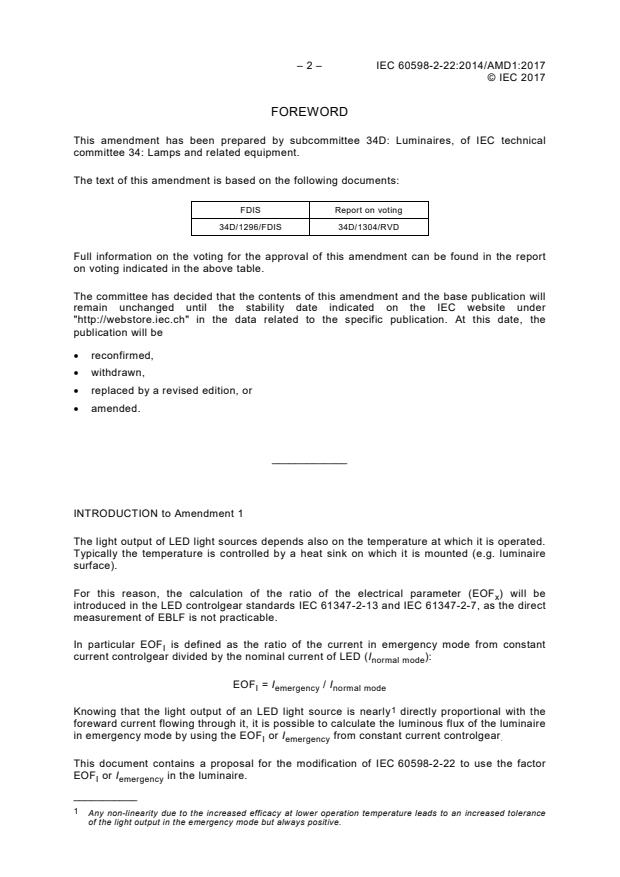
INTRODUCTION to Amendment 1
The light output of LED light sources depends also on the temperature at which it is operated.
Typically the temperature is controlled by a heat sink on which it is mounted (e.g. luminaire
surface).
For this reason, the calculation of the ratio of the electrical parameter (EOF ) will be
x
introduced in the LED controlgear standards IEC 61347-2-13 and IEC 61347-2-7, as the direct
measurement of EBLF is not practicable.
In particular EOF is defined as the ratio of the current in emergency mode from constant
I
current controlgear divided by the nominal current of LED (I ):
normal mode
EOF = I / I
I emergency normal mode
Knowing that the light output of an LED light source is nearly directly proportional with the
foreward current flowing through it, it is possible to calculate the luminous flux of the luminaire
in emergency mode by using the EOF or I from constant current controlgear
.
I emergency
This document contains a proposal for the modification of IEC 60598-2-22 to use the factor
EOF or I in the luminaire.
I emergency
___________
Any non-linearity due to the increased efficacy at lower operation temperature leads to an increased tolerance
of the light output in the emergency mode but always positive.
© IEC 2017
22.2 Normative references
Delete the reference to IEC 60354-5-56
Add the following new reference:
CIE S025, Test Method for LED Lamps, LED Luminaires and LED Modules
22.3 Terms and definitions
22.3.23
Replace the existing note 1 to entry with the following new note 1 to entry:
Note 1 to entry: PELF = LDL × EBLF
where LDL is the rated luminous flux of fluorescent or discharge lamp, this is taken as the initial lighting design
lumens at 100 h.
Add, at the end of 22.3, the following new terminological entry:
22.3.28
practical emergency light source flux
PELSF
minimum luminous flux of the light source observed during the rated duration of the
emergency mode
Note 1 to entry: For LED light sources:
a) if EOF is given: PELSF = LDL x EOF
I I
b) if I from constant current controlgear is defined: PELSF = LDL x (I / I )
emergency emergency normal mode
where LDL is the lumen output of the LED module under the condition corresponding to the operation in the
luminaire (identical tp) operated at the same current (I ).
normal mode
Note 2 to entry: This note only applies to the French language.
22.7 Construction
In the first paragraph, replace the last two sentences with the following new text:
In addition, emergency luminaires with automatic testing systems shall comply with the
additional requirements of IEC 62034 as identified in Annex K of IEC 61347-2-7.
22.7.2
In the first paragraph, replace the text "… IEC 61347-2-7, IEC 61347-2-3: Annex J,
IEC 61347-2-2, IEC 61347-2-12 and IEC 61347-2-13 as appropriate" with the following new
text:
IEC 61347-2-2, IEC 61347-2-3: IEC 61347-2-7, IEC 61347-2-12 and IEC 61347-2-13 as
appropriate and with the additional safety requirements for electronic controlgear for
emergency lighting in the appropriate annex of the standards (e.g. Annex J of
IEC 61347-2-3).”
22.7.10
Delete the existing third paragraph and add the following new note:
NOTE Installation details can be found in IEC 60364-5-56.
– 4 – IEC 60598-2-22:2014/AMD1:2017
© IEC 2017
22.17 Photometric data
22.17.1
Replace the existing text with the following new text:
The manufacturer shall make available the intensity distribution data necessary for the
calculation of the emergency lighting installation according to ISO 30061. The intensity data in
emergency mode may be provided in candelas or in relative cd/1 000 lm. If the values are
declared in candelas, the manufacturer shall provide the emergency luminaire rated luminous
flux derived from the intensity distribution table.
Compliance is checked by direct measurements in emergency operating condition taking into
account the test operating condition described in 22.17.3 or by measurements in normal
operating condition and calculation as described in 22.17.2.
22.17.2
Replace "Void" with the following new text:
If values are declared in cd/1 000 lm, the manufacturer shall also provide the reference flux in
emergency mode.
In the case of luminaires with tubular fluorescent lamps or other discharge lamps the
reference flux is the practical emergency light source flux PELF calculated as the rated flux of
the lamp multiplied by the EBLF of the associated emergency ballast.
In the case of luminaires with LED light source the reference flux is:
– the practical emergency light source flux PELSF
The value may be calculated as the light source luminous flux of the LED module (LDL) in
reference condition corresponding to the luminaire (at the same t ) and at rated current
p
(I ) multiplied by the EOF or (I / I ) of the associated constant
normal mode I emergency normal mode
.
current emergency controlgear
NOTE 1 In this case the LOR of the luminaire has influence on the calculation of the emergency rated luminaire
flux.
– the emergency luminaire rated luminous flux
This value shows the rated luminous flux of the luminaire in normal mode (I )
normal mode
multiplied by the EOF or (I / I ) of the associated constant current
I emergency normal mode
emergency controlgear.
NOTE 2 In this case the LOR of the luminaire is considered as 1.
The factor EOF can only be used under the following conditions:
I
– The forward current of the LED is controlled by the controlgear only.
– All LEDs mounted in the luminaire are supplied both in normal operating conditions and in
emergency mode.
– The luminaire luminous flux and/or the LED light source luminous flux is measured at
I corresponding to the I of the controlgear (e.g. in the case of a
normal mode normal mode
luminaire to be used with independent controlgear).
– The current in emergency mode is equal or lower than I (EOF equal or lower
normal mode I
than 1).
NOTE 3 The use of emergency output factors different from EOF (e.g. EOF or EOF ) are not part of the scope
I U P
of 22.17.2. They can only be used for design purposes and not for testing.
© IEC 2017
22.17.3
Replace "Void" with the following new text:
Emergency luminaires shall provide at least 50 % of the level declared photometric data
claimed by the manufacturer during operation in emergency mode 5 s after failure of the
normal supply, and full rated photometric performance after 60 s and continuously to the end
of the rated duration of the emerge
...
Questions, Comments and Discussion
Ask us and Technical Secretary will try to provide an answer. You can facilitate discussion about the standard in here.
Loading comments...