


IEC 62530-2:2023
(Main)SystemVerilog - Part 2: Universal Verification Methodology Language Reference Manual
SystemVerilog - Part 2: Universal Verification Methodology Language Reference Manual
IEC 62530-2:2023 establishes the Universal Verification Methodology (UVM), a set of application programming interfaces (APIs) that defines a base class library (BCL) definition used to develop modular, scalable, and reusable components for functional verification environments. The APIs and BCL are based on the IEEE standard for SystemVerilog, IEEE Std 1800™.1. This is an IEC/IEEE dual logo standard.
General Information
- Status
- Published
- Publication Date
- 10-Oct-2023
- Technical Committee
- TC 91 - Electronics assembly technology
- Drafting Committee
- WG 13 - TC 91/WG 13
- Current Stage
- PPUB - Publication issued
- Start Date
- 11-Oct-2023
- Completion Date
- 08-Sep-2023
Relations
- Effective Date
- 05-Sep-2023
Overview
IEC 62530-2:2023 - SystemVerilog Part 2: Universal Verification Methodology (UVM) Language Reference Manual - is an IEC/IEEE dual‑logo standard that defines the Universal Verification Methodology, including the UVM application programming interfaces (APIs) and the UVM Base Class Library (BCL). Built on the IEEE SystemVerilog language (IEEE Std 1800™), this language reference manual standardizes the classes, interfaces and conventions used to create modular, scalable and reusable functional verification environments.
Key topics and technical scope
The standard provides a detailed class and API reference for UVM. Major technical topics include:
- Base classes (uvm_object, uvm_transaction, uvm_component, etc.) for building verification elements
- Reporting and recording mechanisms (report handlers, report servers, transaction databases)
- Factory and object/component creation (UVM factory patterns for run‑time configurability and substitution)
- Phasing and synchronization (predefined phases, domain handling, objections, events and barriers)
- Transaction‑level modeling (TLM) - UVM TLM-1 and TLM-2 interfaces for streaming and layered communication
- Sequencer, sequence and driver abstractions for stimulus generation and control flow
- Policy and utility classes (printers, copiers, packers, comparers, recorders)
- Register layer and register model classes for abstracting memory-mapped registers, maps, fields and memories
- Container classes (queues, pools) and synchronization helpers (heartbeat, callbacks, barriers)
These topics are presented as normative API and class references that verification tools and teams use to implement compliant UVM testbenches.
Practical applications
IEC 62530-2 is used to create consistent, portable, and reusable verification infrastructure across teams and EDA tools. Typical applications:
- Building modular UVM testbenches for ASIC, SoC and FPGA functional verification
- Implementing TLM-based component communication and verification IP (VIP)
- Creating register‑abstraction layers and verification models for memory-mapped IP
- Standardizing reporting, logging and regression infrastructure for large verification projects
- Enabling runtime configurability and component substitution via the UVM factory
Who should use this standard
- Verification engineers and architects designing UVM testbenches
- EDA tool vendors and verification IP developers implementing UVM support
- QA and methodology leads establishing verification process and best practices
- Educators and trainers teaching SystemVerilog/UVM-based verification
Related standards and keywords
- Related: IEEE Std 1800™ (SystemVerilog language standard) - UVM APIs in IEC 62530-2 are based on SystemVerilog
- SEO keywords: UVM, SystemVerilog, Universal Verification Methodology, UVM BCL, functional verification, verification environment, TLM, register model, UVM factory, verification testbench
This IEC/IEEE reference manual is essential for teams seeking a vendor-neutral, standardized specification for building robust UVM verification environments.

Frequently Asked Questions
IEC 62530-2:2023 is a standard published by the International Electrotechnical Commission (IEC). Its full title is "SystemVerilog - Part 2: Universal Verification Methodology Language Reference Manual". This standard covers: IEC 62530-2:2023 establishes the Universal Verification Methodology (UVM), a set of application programming interfaces (APIs) that defines a base class library (BCL) definition used to develop modular, scalable, and reusable components for functional verification environments. The APIs and BCL are based on the IEEE standard for SystemVerilog, IEEE Std 1800™.1. This is an IEC/IEEE dual logo standard.
IEC 62530-2:2023 establishes the Universal Verification Methodology (UVM), a set of application programming interfaces (APIs) that defines a base class library (BCL) definition used to develop modular, scalable, and reusable components for functional verification environments. The APIs and BCL are based on the IEEE standard for SystemVerilog, IEEE Std 1800™.1. This is an IEC/IEEE dual logo standard.
IEC 62530-2:2023 is classified under the following ICS (International Classification for Standards) categories: 25.040.01 - Industrial automation systems in general; 35.060 - Languages used in information technology. The ICS classification helps identify the subject area and facilitates finding related standards.
IEC 62530-2:2023 has the following relationships with other standards: It is inter standard links to IEC 62530-2:2021. Understanding these relationships helps ensure you are using the most current and applicable version of the standard.
IEC 62530-2:2023 is available in PDF format for immediate download after purchase. The document can be added to your cart and obtained through the secure checkout process. Digital delivery ensures instant access to the complete standard document.
Standards Content (Sample)
IEC 62530-2 ®
Edition 2.0 2023-10
™
IEEE Std 1800.2
INTERNATIONAL
STANDARD
SystemVerilog –
Part 2: Universal Verification Methodology Language Reference Manual
All rights reserved. IEEE is a registered trademark in the U.S. Patent & Trademark Office, owned by the Institute of
Electrical and Electronics Engineers, Inc. Unless otherwise specified, no part of this publication may be reproduced or
utilized in any form or by any means, electronic or mechanical, including photocopying and microfilm, without
permission in writing from the IEC Central Office. Any questions about IEEE copyright should be addressed to the
IEEE. Enquiries about obtaining additional rights to this publication and other information requests should be addressed
to the IEC or your local IEC member National Committee.
IEC Secretariat Institute of Electrical and Electronics Engineers, Inc.
3, rue de Varembé 3 Park Avenue
CH-1211 Geneva 20 New York, NY 10016-5997
Switzerland United States of America
Tel.: +41 22 919 02 11 stds.info@ieee.org
info@iec.ch www.ieee.org
www.iec.ch
About the IEC
The International Electrotechnical Commission (IEC) is the leading global organization that prepares and publishes
International Standards for all electrical, electronic and related technologies.
About IEC publications
The technical content of IEC publications is kept under constant review by the IEC. Please make sure that you have the
latest edition, a corrigendum or an amendment might have been published.
IEC publications search - webstore.iec.ch/advsearchform IEC Products & Services Portal - products.iec.ch
The advanced search enables to find IEC publications by a Discover our powerful search engine and read freely all the
variety of criteria (reference number, text, technical publications previews. With a subscription you will always have
committee, …). It also gives information on projects, replaced access to up to date content tailored to your needs.
and withdrawn publications.
Electropedia - www.electropedia.org
IEC Just Published - webstore.iec.ch/justpublished
The world's leading online dictionary on electrotechnology,
Stay up to date on all new IEC publications. Just Published
containing more than 22 300 terminological entries in English
details all new publications released. Available online and once
and French, with equivalent terms in 19 additional languages.
a month by email.
Also known as the International Electrotechnical Vocabulary
(IEV) online.
IEC Customer Service Centre - webstore.iec.ch/csc
If you wish to give us your feedback on this publication or need
further assistance, please contact the Customer Service
Centre: sales@iec.ch.
IEC 62530-2 ®
Edition 2.0 2023-10
IEEE Std 1800.2™
INTERNATIONAL
STANDARD
SystemVerilog –
Part 2: Universal Verification Methodology Language Reference Manual
INTERNATIONAL
ELECTROTECHNICAL
COMMISSION
ICS 25.040.01, 35.060 ISBN 978-2-8322-7516-0
– i – IEEE Std 1800.2™-2020
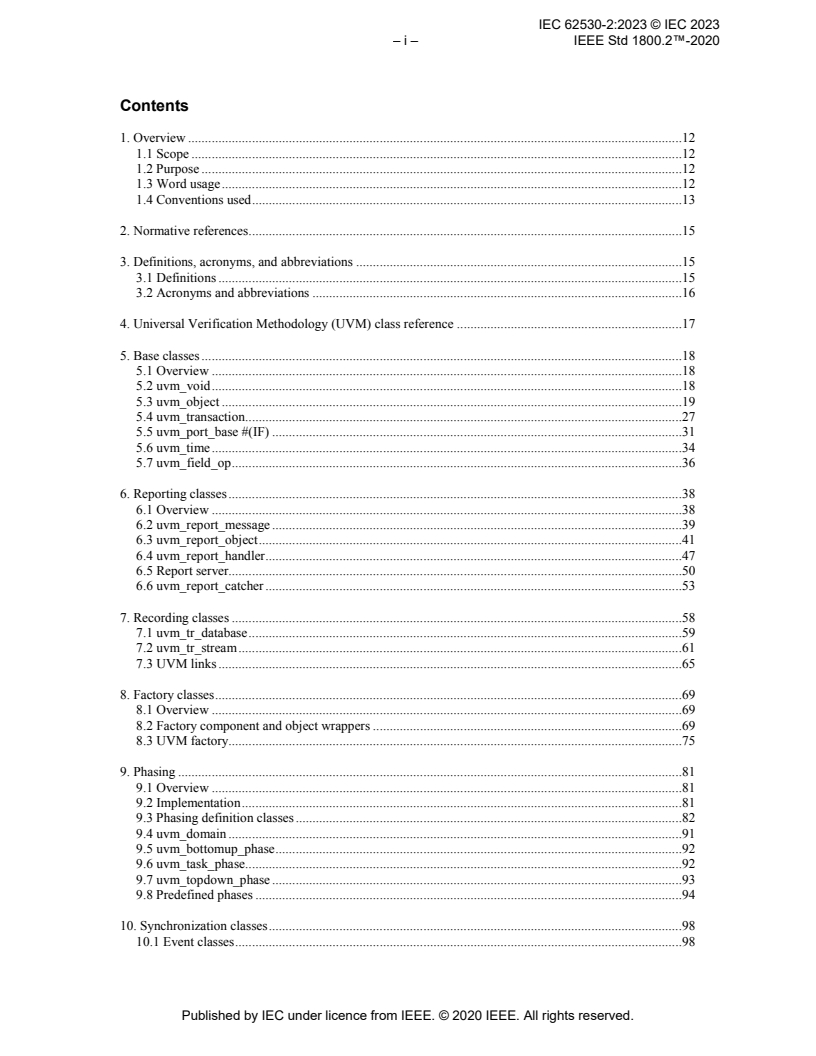
Contents
1. Overview .12
1.1 Scope .12
1.2 Purpose .12
1.3 Word usage .12
1.4 Conventions used .13
2. Normative references .15
3. Definitions, acronyms, and abbreviations .15
3.1 Definitions .15
3.2 Acronyms and abbreviations .16
4. Universal Verification Methodology (UVM) class reference .17
5. Base classes .18
5.1 Overview .18
5.2 uvm_void .18
5.3 uvm_object .19
5.4 uvm_transaction .27
5.5 uvm_port_base #(IF) .31
5.6 uvm_time .34
5.7 uvm_field_op .36
6. Reporting classes .38
6.1 Overview .38
6.2 uvm_report_message .39
6.3 uvm_report_object .41
6.4 uvm_report_handler .47
6.5 Report server.50
6.6 uvm_report_catcher .53
7. Recording classes .58
7.1 uvm_tr_database .59
7.2 uvm_tr_stream .61
7.3 UVM links .65
8. Factory classes .69
8.1 Overview .69
8.2 Factory component and object wrappers .69
8.3 UVM factory.75
9. Phasing .81
9.1 Overview .81
9.2 Implementation .81
9.3 Phasing definition classes .82
9.4 uvm_domain .91
9.5 uvm_bottomup_phase .92
9.6 uvm_task_phase.92
9.7 uvm_topdown_phase .93
9.8 Predefined phases .94
10. Synchronization classes .98
10.1 Event classes .98
Published by IEC under licence from IEEE. © 2020 IEEE. All rights reserved.
IEEE Std 1800.2™-2020 – ii –
10.2 uvm_event_callback .101
10.3 uvm_barrier .102
10.4 Pool classes .104
10.5 Objection mechanism .105
10.6 uvm_heartbeat .110
10.7 Callbacks classes .112
11. Container classes .115
11.1 Overview .115
11.2 uvm_pool #(KEY,T) .116
11.3 uvm_queue #(T) .118
12. UVM TLM interfaces .120
12.1 Overview .120
12.2 UVM TLM 1 .120
12.3 UVM TLM 2 .138
13. Predefined component classes .159
13.1 uvm_component .159
13.2 uvm_test .172
13.3 uvm_env .173
13.4 uvm_agent .173
13.5 uvm_monitor .174
13.6 uvm_scoreboard .174
13.7 uvm_driver #(REQ,RSP) .175
13.8 uvm_push_driver #(REQ,RSP) .175
13.9 uvm_subscriber .176
14. Sequence classes .177
14.1 uvm_sequence_item .177
14.2 uvm_sequence_base .181
14.3 uvm_sequence #(REQ,RSP) .189
14.4 uvm_sequence_library .191
15. Sequencer classes .194
15.1 Overview .194
15.2 Sequencer interface .195
15.3 uvm_sequencer_base .197
15.4 Common sequencer API .203
15.5 uvm_sequencer #(REQ,RSP).204
15.6 uvm_push_sequencer #(REQ,RSP) .207
16. Policy classes .208
16.1 uvm_policy .208
16.2 uvm_printer .211
16.3 uvm_comparer .226
16.4 uvm_recorder .231
16.5 uvm_packer .240
16.6 uvm_copier .245
17. Register layer .247
17.1 Overview .247
17.2 Global declarations .247
18. Register model .251
18.1 uvm_reg_block .251
Published by IEC under licence from IEEE. © 2020 IEEE. All rights reserved.
– iii – IEEE Std 1800.2™-2020
18.2 uvm_reg_map .263
18.3 uvm_reg_file .271
18.4 uvm_reg .273
18.5 uvm_reg_field .290
18.6 uvm_mem .301
18.7 uvm_reg_indirect_data .315
18.8 uvm_reg_fifo .315
18.9 uvm_vreg .319
18.10 uvm_vreg_field .328
18.11 uvm_reg_cbs .334
18.12 uvm_mem_mam .339
19. Register layer interaction with the design .347
19.1 Generic register operation descriptors .347
19.2 Classes for adapting between register and bus operations .352
19.3 uvm_reg_predictor .353
19.4 Register sequence classes .355
19.5 uvm_reg_backdoor .363
19.6 UVM HDL backdoor access support routines .365
Annex A (informative) Bibliography .367
Annex B (normative) Macros and defines .368
B.1 Report macros .368
B.2 Utility and field macros for components and objects .369
B.3 Sequence-related macros .384
B.4 Callback macros .385
B.5 UVM TLM implementation port declaration macros .387
B.6 Size defines .390
B.7 UVM version globals .391
Annex C (normative) Configuration and resource classes .392
C.1 Overview .392
C.2 Resources .392
C.3 UVM resource database .401
C.4 UVM configuration database .404
Annex D (normative) Convenience classes, interface, and methods .407
D.1 uvm_callback_iter .407
D.2 Component interfaces .408
D.3 uvm_reg_block access methods .412
D.4 Callback typedefs .414
Annex E (normative) Test sequences .416
E.1 uvm_reg_hw_reset_seq .416
E.2 Bit bashing test sequences .416
E.3 Register access test sequences .418
E.4 Shared register and memory access test sequences .420
E.5 Memory access test sequences .422
E.6 Memory walking-ones test sequences .423
E.7 uvm_reg_mem_hdl_paths_seq .425
E.8 uvm_reg_mem_built_in_seq .425
Annex F (normative) Package scope functionality .427
F.1 Overview .427
F.2 Types and enumerations .427
Published by IEC under licence from IEEE. © 2020 IEEE. All rights reserved.
IEEE Std 1800.2™-2020 – iv –
F.3 Methods and types .434
F.4 Core service .438
F.5 Traversal .442
F.6 uvm_run_test_callback .445
F.7 uvm_root .446
Annex G (normative) Command line arguments .450
G.1 Command line processing .450
G.2 Built-in UVM-aware command line arguments .452
Annex H (normative) Deprecation .455
H.1 General .455
H.2 Constructs that have been deprecated .455
Annex I (informative) Participants .457
Published by IEC under licence from IEEE. © 2020 IEEE. All rights reserved.
– v – IEEE Std 1800.2™-2020
SystemVerilog –
Part 2: Universal Verification Methodology Language Reference Manual
FOREWORD
1) The International Electrotechnical Commission (IEC) is a worldwide organization for standardization comprising
all national electrotechnical committees (IEC National Committees). The object of IEC is to promote international
co-operation on all questions concerning standardization in the electrical and electronic fields. To this end and
in addition to other activities, IEC publishes International Standards, Technical Specifications, Technical
Reports, Publicly Available Specifications (PAS) and Guides (hereafter referred to as "IEC document(s)"). Their
preparation is entrusted to technical committees; any IEC National Committee interested in the subject dealt with
may participate in this preparatory work. International, governmental and non-governmental organizations
liaising with the IEC also participate in this preparation.
IEEE Standards documents are developed within IEEE Societies and Standards Coordinating Committees of the
IEEE Standards Association (IEEE SA) Standards Board. IEEE develops its standards through a consensus
development process, approved by the American National Standards Institute, which brings together volunteers
representing varied viewpoints and interests to achieve the final product. Volunteers are not necessarily members
of IEEE and serve without compensation. While IEEE administers the process and establishes rules to promote
fairness in the consensus development process, IEEE does not independently evaluate, test, or verify the
accuracy of any of the information contained in its standards. Use of IEEE Standards documents is wholly
voluntary. IEEE documents are made available for use subject to important notices and legal disclaimers (see
https://standards.ieee.org/ipr/disclaimers.html for more information).
IEC collaborates closely with IEEE in accordance with conditions determined by agreement between the two
organizations. This Dual Logo International Standard was jointly developed by the IEC and IEEE under the terms
of that agreement.
2) The formal decisions of IEC on technical matters express, as nearly as possible, an international consensus of
opinion on the relevant subjects since each technical committee has representation from all interested IEC
National Committees. The formal decisions of IEEE on technical matters, once consensus within IEEE Societies
and Standards Coordinating Committees has been reached, is determined by a balanced ballot of materially
interested parties who indicate interest in reviewing the proposed standard. Final approval of the IEEE standards
document is given by the IEEE Standards Association (IEEE SA) Standards Board.
3) IEC/IEEE Publications have the form of recommendations for international use and are accepted by IEC National
Committees/IEEE Societies in that sense. While all reasonable efforts are made to ensure that the technical
content of IEC/IEEE Publications is accurate, IEC or IEEE cannot be held responsible for the way in which they
are used or for any misinterpretation by any end user.
4) In order to promote international uniformity, IEC National Committees undertake to apply IEC Publications
(including IEC/IEEE Publications) transparently to the maximum extent possible in their national and re gional
publications. Any divergence between any IEC/IEEE Publication and the corresponding national or regional
publication shall be clearly indicated in the latter.
5) IEC and IEEE do not provide any attestation of conformity. Independent certification bo dies provide conformity
assessment services and, in some areas, access to IEC marks of conformity. IEC and IEEE are not responsible
for any services carried out by independent certification bodies.
6) All users should ensure that they have the latest edition of this publication.
7) No liability shall attach to IEC or IEEE or their directors, employees, servants or agents including individual
experts and members of technical committees and IEC National Committees, or volunteers of IEEE Societies
and the Standards Coordinating Committees of the IEEE Standards Association (IEEE SA) Standards Board, for
any personal injury, property damage or other damage of any nature whatsoever, whether direct or indirect, or
for costs (including legal fees) and expenses arising out of the publication, use of, or reliance upon, this IEC/IEEE
Publication or any other IEC or IEEE Publications.
8) Attention is drawn to the normative references cited in this publication. Use of the referenced publications is
indispensable for the correct application of this publication.
9) Attention is drawn to the possibility that implementation of this IEC/IEEE Publication may require use of material
covered by patent rights. By publication of this standard, no position is taken with respect to the existence or
validity of any patent rights in connection therewith. IEC or IEEE shall not be held responsible for identifying
Essential Patent Claims for which a license may be required, for conducting inquiries into the legal validity or
scope of Patent Claims or determining whether any licensing terms or conditions provided in connection with
submission of a Letter of Assurance, if any, or in any licensing agreements are reasonable or non -discriminatory.
Users of this standard are expressly advised that determination of the validity of any patent rights, and the risk
of infringement of such rights, is entirely their own responsibility.
Published by IEC under licence from IEEE. © 2020 IEEE. All rights reserved.
IEEE Std 1800.2™-2020 – vi –
IEC 62530-2/IEEE Std 1800.2 was processed through IEC technical committee 91: Electronics
assembly technology, under the IEC/IEEE Dual Logo Agreement. It is an International
Standard.
The text of this International Standard is based on the following documents:
IEEE Std FDIS Report on voting
1800.2 (2020) 91/1872/FDIS 91/1886/RVD
Full information on the voting for its approval can be found in the report on voting indicated in
the above table.
The language used for the development of this International Standard is English.
The IEC Technical Committee and IEEE Technical Committee have decided that the contents
of this document will remain unchanged until the stability date indicated on the IEC website
under webstore.iec.ch in the data related to the specific document. At this date, the document
will be
• reconfirmed,
• withdrawn, or
• revised.
Published by IEC under licence from IEEE. © 2020 IEEE. All rights reserved.
IEEE Std 1800.2™-2020
IEEE Standard for Universal
Verification Methodology Language
Reference Manual
Developed by the
Design Automation Standards Committee
of the
IEEE Computer Society
Approved 4 June 2020
IEEE SA Standards Board
Published by IEC under licence from IEEE. © 2020 IEEE. All rights reserved.
IEEE Std 1800.2™-2020
Grateful acknowledgment is made for permission to use the following source material:
Accellera Systems Initiative—The Universal Verification Methodology (UVM) Pre-
IEEE Class Reference.
Abstract: The Universal Verification Methodology (UVM) that can improve interoperability, reduce
the cost of using intellectual property (IP) for new projects or electronic design automation (EDA)
tools, and make it easier to reuse verification components is provided. Overall, using this standard
will lower verification costs and improve design quality throughout the industry. The primary
audiences for this standard are the implementors of the UVM base class library, the implementors of
tools supporting the UVM base class library, and the users of the UVM base class library.
Keywords: agent, blocking, callback, class, component, consumer, driver, event, export, factory,
function, generator, IEEE 1800.2™, member, method, monitor, non-blocking, phase, port, register,
resource, sequence, sequencer, transaction-level modeling, verification methodology
•
Published by IEC under licence from IEEE. © 2020 IEEE. All rights reserved.
IEEE Std 1800.2™-2020
Important Notices and Disclaimers Concerning IEEE Standards Documents
IEEE documents are made available for use subject to important notices and legal disclaimers. These notices
and disclaimers, or a reference to this page, appear in all standards and may be found under the heading
“Important Notices and Disclaimers Concerning IEEE Standards Documents.” They can also be obtained on
request from IEEE or viewed at http://standards.ieee.org/IPR/disclaimers.html.
Notice and Disclaimer of Liability Concerning the Use of IEEE Standards
Documents
IEEE Standards documents (standards, recommended practices, and guides), both full-use and trial-use, are
developed within IEEE Societies and the Standards Coordinating Committees of the IEEE Standards
Association (“IEEE SA”) Standards Board. IEEE (“the Institute”) develops its standards through a consensus
development process, approved by the American National Standards Institute (“ANSI”), which brings together
volunteers representing varied viewpoints and interests to achieve the final product. IEEE Standards are
documents developed through scientific, academic, and industry-based technical working groups. Volunteers in
IEEE working groups are not necessarily members of the Institute and participate without compensation from
IEEE. While IEEE administers the process and establishes rules to promote fairness in the consensus
development process, IEEE does not independently evaluate, test, or verify the accuracy of any of the
information or the soundness of any judgments contained in its standards.
IEEE Standards do not guarantee or ensure safety, security, health, or environmental protection, or ensure
against interference with or from other devices or networks. Implementers and users of IEEE Standards
documents are responsible for determining and complying with all appropriate safety, security, environmental,
health, and interference protection practices and all applicable laws and regulations.
IEEE does not warrant or represent the accuracy or content of the material contained in its standards, and
expressly disclaims all warranties (express, implied and statutory) not included in this or any other document
relating to the standard, including, but not limited to, the warranties of: merchantability; fitness for a particular
purpose; non-infringement; and quality, accuracy, effectiveness, currency, or completeness of material. In
addition, IEEE disclaims any and all conditions relating to: results; and workmanlike effort. IEEE standards
documents are supplied “AS IS” and “WITH ALL FAULTS.”
Use of an IEEE standard is wholly voluntary. The existence of an IEEE standard does not imply that there are
no other ways to produce, test, measure, purchase, market, or provide other goods and services related to the
scope of the IEEE standard. Furthermore, the viewpoint expressed at the time a standard is approved and issued
is subject to change brought about through developments in the state of the art and comments received from
users of the standard.
In publishing and making its standards available, IEEE is not suggesting or rendering professional or other
services for, or on behalf of, any person or entity nor is IEEE undertaking to perform any duty owed by any
other person or entity to another. Any person utilizing any IEEE Standards document, should rely upon his or
her own independent judgment in the exercise of reasonable care in any given circumstances or, as appropriate,
seek the advice of a competent professional in determining the appropriateness of a given IEEE standard.
IN NO EVENT SHALL IEEE BE LIABLE FOR ANY DIRECT, INDIRECT, INCIDENTAL, SPECIAL,
EXEMPLARY, OR CONSEQUENTIAL DAMAGES (INCLUDING, BUT NOT LIMITED TO:
PROCUREMENT OF SUBSTITUTE GOODS OR SERVICES; LOSS OF USE, DATA, OR PROFITS; OR
BUSINESS INTERRUPTION) HOWEVER CAUSED AND ON ANY THEORY OF LIABILITY,
WHETHER IN CONTRACT, STRICT LIABILITY, OR TORT (INCLUDING NEGLIGENCE OR
OTHERWISE) ARISING IN ANY WAY OUT OF THE PUBLICATION, USE OF, OR RELIANCE UPON
ANY STANDARD, EVEN IF ADVISED OF THE POSSIBILITY OF SUCH DAMAGE AND
REGARDLESS OF WHETHER SUCH DAMAGE WAS FORESEEABLE.
Published by IEC under licence from IEEE. © 2020 IEEE. All rights reserved.
IEEE Std 1800.2™-2020
Translations
The IEEE consensus development process involves the review of documents in English only. In the event that
an IEEE standard is translated, only the English version published by IEEE should be considered the approved
IEEE standard.
Official statements
A statement, written or oral, that is not processed in accordance with the IEEE SA Standards Board Operations
Manual shall not be considered or inferred to be the official position of IEEE or any of its committees and shall
not be considered to be, or be relied upon as, a formal position of IEEE. At lectures, symposia, seminars, or
educational courses, an individual presenting information on IEEE standards shall make it clear that his or her
views should be considered the personal views of that individual rather than the formal position of IEEE.
Comments on standards
Comments for revision of IEEE Standards documents are welcome from any interested party, regardless of
membership affiliation with IEEE. However, IEEE does not provide consulting information or advice
pertaining to IEEE Standards documents. Suggestions for changes in documents should be in the form of a
proposed change of text, together with appropriate supporting comments. Since IEEE standards represent a
consensus of concerned interests, it is important that any responses to comments and questions also receive the
concurrence of a balance of interests. For this reason, IEEE and the members of its societies and Standards
Coordinating Committees are not able to provide an instant response to comments or questions except in those
cases where the matter has previously been addressed. For the same reason, IEEE does not respond to
interpretation requests. Any person who would like to participate in revisions to an IEEE standard is welcome
to join the relevant IEEE working group.
Comments on standards should be submitted to the following address:
Secretary, IEEE SA Standards Board
445 Hoes Lane
Piscataway, NJ 08854 USA
Laws and regulations
Users of IEEE Standards documents should consult all applicable laws and regulations. Compliance with the
provisions of any IEEE Standards document does not imply compliance to any applicable regulatory
requirements. Implementers of the standard are responsible for observing or referring to the applicable
regulatory requirements. IEEE does not, by the publication of its standards, intend to urge action that is not in
compliance with applicable laws, and these documents may not be construed as doing so.
Copyrights
IEEE draft and approved standards are copyrighted by IEEE under US and international copyright laws. They
are made available by IEEE and are adopted for a wide variety of both public and private uses. These include
both use, by reference, in laws and regulations, and use in private self-regulation, standardization, and the
promotion of engineering practices and methods. By making these documents available for use and adoption by
public authorities and private users, IEEE does not waive any rights in copyright to the documents.
Published by IEC under licence from IEEE. © 2020 IEEE. All rights reserved.
IEEE Std 1800.2™-2020
Photocopies
Subject to payment of the appropriate fee, IEEE will grant users a limited, non-exclusive license to photocopy
portions of any individual standard for company or organizational internal use or individual, non-commercial
use only. To arrange for payment of licensing fees, please contact Copyright Clearance Center, Customer
Service, 222 Rosewood Drive, Danvers, MA 01923 USA; +1 978 750 8400. Permission to photocopy portions
of any individual standard for educational classroom use can also be obtained through the Copyright Clearance
Center.
Updating of IEEE Standards documents
Users of IEEE Standards documents should be aware that these documents may be superseded at any time by
the issuance of new editions or may be amended from time to time through the issuance of amendments,
corrigenda, or errata. An official IEEE document at any point in time consists of the current edition of the
document together with any amendments, corrigenda, or errata then in effect.
Every IEEE standard is subjected to review at least every 10 years. When a document is more than 10 years old
and has not undergone a revision process, it is reasonable to conclude that its contents, although still of some
value, do not wholly reflect the present state of the art. Users are cautioned to check to determine that they have
the latest edition of any IEEE standard.
In order to determine whether a given document is the current edition and whether it has been amended through
the issuance of amendments, corrigenda, or errata, visit IEEE Xplore at
...
Questions, Comments and Discussion
Ask us and Technical Secretary will try to provide an answer. You can facilitate discussion about the standard in here.
Loading comments...