

IEC 60870-5-104:2006
(Main)Telecontrol equipment and systems - Part 5-104: Transmission protocols - Network access for IEC 60870-5-101 using standard transport profiles
General Information
- Abstract
Defines a telecontrol companion standard that enables interoperability among compatible telecontrol equipment. Applies to telecontrol equipment and systems with coded bit serial data transmission for monitoring and controlling geographically widespread processes.
This publication is of high relevance for Smart Grid.
- Status
- Published
- Publication Date
- 06-Jun-2016
- Technical Committee
- TC 57 - Power systems management and associated information exchange
- Drafting Committee
- WG 3 - TC 57/WG 3
- Current Stage
- PPUB - Publication issued
- Start Date
- 13-Jun-2006
- Completion Date
- 15-Jul-2006
Buy Documents
iec60870-5-104{ed2.0}en_d - IEC 60870-5-104:2006 - Telecontrol equipment and systems - Part 5-104: Transmission protocols - Network access for IEC 60870-5-101 using standard transport profiles Released:6/13/2006

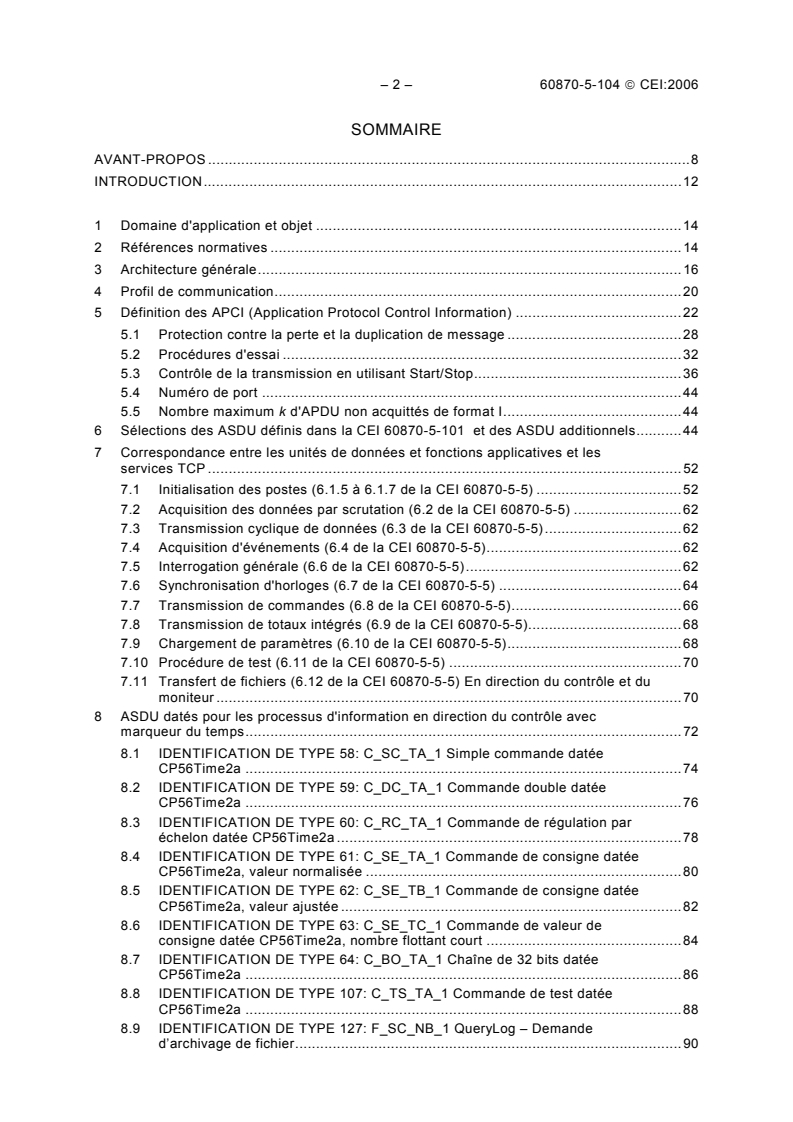
iec60870-5-104{ed2.0}fr_d - IEC 60870-5-104:2006 - Matériels et systemes de téléconduite - Partie 5-104: Protocoles de transmission - Acces aux réseaux utilisant des profils de transport normalisés pour la CEI 60870-5-101 Released:6/13/2006


iec60870-5-104{ed2.1}b - IEC 60870-5-104:2006+AMD1:2016 CSV - Telecontrol equipment and systems - Part 5-104: Transmission protocols - Network access for IEC 60870-5-101 using standardtransport profiles Released:6/7/2016
Overview
IEC 60870-5-104:2006 is an international standard published by the International Electrotechnical Commission (IEC) that focuses on telecontrol equipment and systems. Specifically, Part 5-104 addresses transmission protocols for network access to IEC 60870-5-101 using standard transport profiles such as TCP/IP. The standard ensures interoperability among compatible telecontrol equipment, providing reliable coded bit serial data transmission for monitoring and control of geographically distributed industrial processes.
This standard is highly relevant to Smart Grid and modern energy management systems, as it supports efficient, scalable, and secure communication between control centers and substations.
Key Topics
- Interoperability: Defines requirements for seamless operation between different vendors’ telecontrol devices that conform to IEC 60870-5-104.
- Protocol Structure: Utilizes a layered approach, combining the application layer of IEC 60870-5-101 with transport functions provided by TCP/IP, as defined in referenced RFCs.
- Network Integration: Supports a variety of networks such as LANs and WANs (X.25, Frame Relay, ISDN), enabling direct and widespread remote monitoring and control.
- APCI (Application Protocol Control Information): Ensures message delimitation, integrity, and correct sequencing, drawing on established ITU-T X.25 mechanisms for error protection.
- Data Unit Transmission: Defines Application Service Data Units (ASDUs) for exchanging real-time process data and commands between central and remote systems.
- Redundancy and Reliability: Supports redundant network configurations for enhanced availability and fault tolerance.
- Scalability: Facilitates expanding telecontrol systems, making it suitable for both current and future Smart Grid applications.
Applications
IEC 60870-5-104 plays a key role in a wide range of automation and telecontrol scenarios, especially in the energy and utilities sectors:
- Smart Grid: Standardizes substation and grid automation communications, which is critical for grid modernization and integration of renewable resources.
- Utility Control Centers: Enables communication between SCADA (Supervisory Control and Data Acquisition) systems and geographically dispersed substations.
- Process Automation: Supports transmission of control signals and monitoring data in water treatment plants, transportation systems, and large-scale industrial operations.
- Modernization of Legacy Systems: Permits seamless integration of traditional IEC 60870-5-101-based installations with modern IP-based networks using standardized transport mechanisms.
- Redundant Operation: Ensures high availability of control infrastructure by supporting redundant configurations both at the network interface and within telecontrol equipment.
Related Standards
IEC 60870-5-104 is part of the larger IEC 60870-5 series, which details various aspects of telecontrol data transmission. Key related standards include:
- IEC 60870-5-101: Defines the basic companion standard for telecontrol tasks using serial communication.
- IEC 60870-5-102: Addresses transmission protocols for transmission of integrated totals in electric power systems.
- IEC 60870-5-103: Specifies protocols for interfaces of protection equipment.
- IEC 60870-5-3, -5-4, -5-5: Cover the general structure, coding, and application functions for telecontrol transmission.
- IEC 60870-5-6xx: Provide guidance on conformance and test cases for ensuring standard compliance.
Other relevant protocol and network standards:
- RFC 791: Internet Protocol (IP)
- RFC 793: Transmission Control Protocol (TCP)
- IEEE 802.3: Ethernet physical and data link layer standards
- ITU-T Recommendation X.25: Packet-mode data transmission in public networks
Summary
IEC 60870-5-104 is a fundamental standard for telecontrol communications in the energy sector, supporting modern network protocols for the efficient exchange of process and control information in distributed automation systems. Its alignment with TCP/IP network architectures makes it a crucial building block for Smart Grid and Industry 4.0 implementations, ensuring robust, interoperable, and scalable automation solutions across diverse infrastructures.
Relations
- Effective Date
- 05-Sep-2023
- Effective Date
- 05-Sep-2023
Buy Documents
iec60870-5-104{ed2.0}en_d - IEC 60870-5-104:2006 - Telecontrol equipment and systems - Part 5-104: Transmission protocols - Network access for IEC 60870-5-101 using standard transport profiles Released:6/13/2006
iec60870-5-104{ed2.0}fr_d - IEC 60870-5-104:2006 - Matériels et systemes de téléconduite - Partie 5-104: Protocoles de transmission - Acces aux réseaux utilisant des profils de transport normalisés pour la CEI 60870-5-101 Released:6/13/2006
iec60870-5-104{ed2.1}b - IEC 60870-5-104:2006+AMD1:2016 CSV - Telecontrol equipment and systems - Part 5-104: Transmission protocols - Network access for IEC 60870-5-101 using standardtransport profiles Released:6/7/2016
Get Certified
Connect with accredited certification bodies for this standard

ANCE
Mexican certification and testing association.

Intertek Slovenia
Intertek testing, inspection, and certification services in Slovenia.

LNE (Laboratoire National de Métrologie et d'Essais)
French national laboratory for metrology and testing.
Sponsored listings
Frequently Asked Questions
IEC 60870-5-104:2006 is a standard published by the International Electrotechnical Commission (IEC). Its full title is "Telecontrol equipment and systems - Part 5-104: Transmission protocols - Network access for IEC 60870-5-101 using standard transport profiles". This standard covers: Defines a telecontrol companion standard that enables interoperability among compatible telecontrol equipment. Applies to telecontrol equipment and systems with coded bit serial data transmission for monitoring and controlling geographically widespread processes. This publication is of high relevance for Smart Grid.
Defines a telecontrol companion standard that enables interoperability among compatible telecontrol equipment. Applies to telecontrol equipment and systems with coded bit serial data transmission for monitoring and controlling geographically widespread processes. This publication is of high relevance for Smart Grid.
IEC 60870-5-104:2006 is classified under the following ICS (International Classification for Standards) categories: 33.200 - Telecontrol. Telemetering. The ICS classification helps identify the subject area and facilitates finding related standards.
IEC 60870-5-104:2006 has the following relationships with other standards: It is inter standard links to IEC 60870-5-104:2006/AMD1:2016, IEC 60870-5-104:2000. Understanding these relationships helps ensure you are using the most current and applicable version of the standard.
IEC 60870-5-104:2006 is available in PDF format for immediate download after purchase. The document can be added to your cart and obtained through the secure checkout process. Digital delivery ensures instant access to the complete standard document.
Standards Content (Sample)
INTERNATIONAL IEC
STANDARD 60870-5-104
Second edition
2006-06
Telecontrol equipment and systems –
Part 5-104:
Transmission protocols –
Network access for IEC 60870-5-101
using standard transport profiles
This English-language version is derived from the original
bilingual publication by leaving out all French-language
pages. Missing page numbers correspond to the French-
language pages.
Reference number
Publication numbering
As from 1 January 1997 all IEC publications are issued with a designation in the
60000 series. For example, IEC 34-1 is now referred to as IEC 60034-1.
Consolidated editions
The IEC is now publishing consolidated versions of its publications. For example,
edition numbers 1.0, 1.1 and 1.2 refer, respectively, to the base publication, the
base publication incorporating amendment 1 and the base publication incorporating
amendments 1 and 2.
Further information on IEC publications
The technical content of IEC publications is kept under constant review by the IEC,
thus ensuring that the content reflects current technology. Information relating to
this publication, including its validity, is available in the IEC Catalogue of
publications (see below) in addition to new editions, amendments and corrigenda.
Information on the subjects under consideration and work in progress undertaken
by the technical committee which has prepared this publication, as well as the list
of publications issued, is also available from the following:
• IEC Web Site (www.iec.ch)
• Catalogue of IEC publications
The on-line catalogue on the IEC web site (www.iec.ch/searchpub) enables you to
search by a variety of criteria including text searches, technical committees
and date of publication. On-line information is also available on recently issued
publications, withdrawn and replaced publications, as well as corrigenda.
• IEC Just Published
This summary of recently issued publications (www.iec.ch/online_news/ justpub)
is also available by email. Please contact the Customer Service Centre (see
below) for further information.
• Customer Service Centre
If you have any questions regarding this publication or need further assistance,
please contact the Customer Service Centre:
Email: custserv@iec.ch
Tel: +41 22 919 02 11
Fax: +41 22 919 03 00
INTERNATIONAL IEC
STANDARD 60870-5-104
Second edition
2006-06
Telecontrol equipment and systems –
Part 5-104:
Transmission protocols –
Network access for IEC 60870-5-101
using standard transport profiles
IEC 2006 Copyright - all rights reserved
No part of this publication may be reproduced or utilized in any form or by any means, electronic or mechanical,
including photocopying and microfilm, without permission in writing from the publisher.
International Electrotechnical Commission, 3, rue de Varembé, PO Box 131, CH-1211 Geneva 20, Switzerland
Telephone: +41 22 919 02 11 Telefax: +41 22 919 03 00 E-mail: inmail@iec.ch Web: www.iec.ch
PRICE CODE
XB
Commission Electrotechnique Internationale
International Electrotechnical Commission
МеждународнаяЭлектротехническаяКомиссия
For price, see current catalogue
60870-5-104 IEC:2006 – 3 –
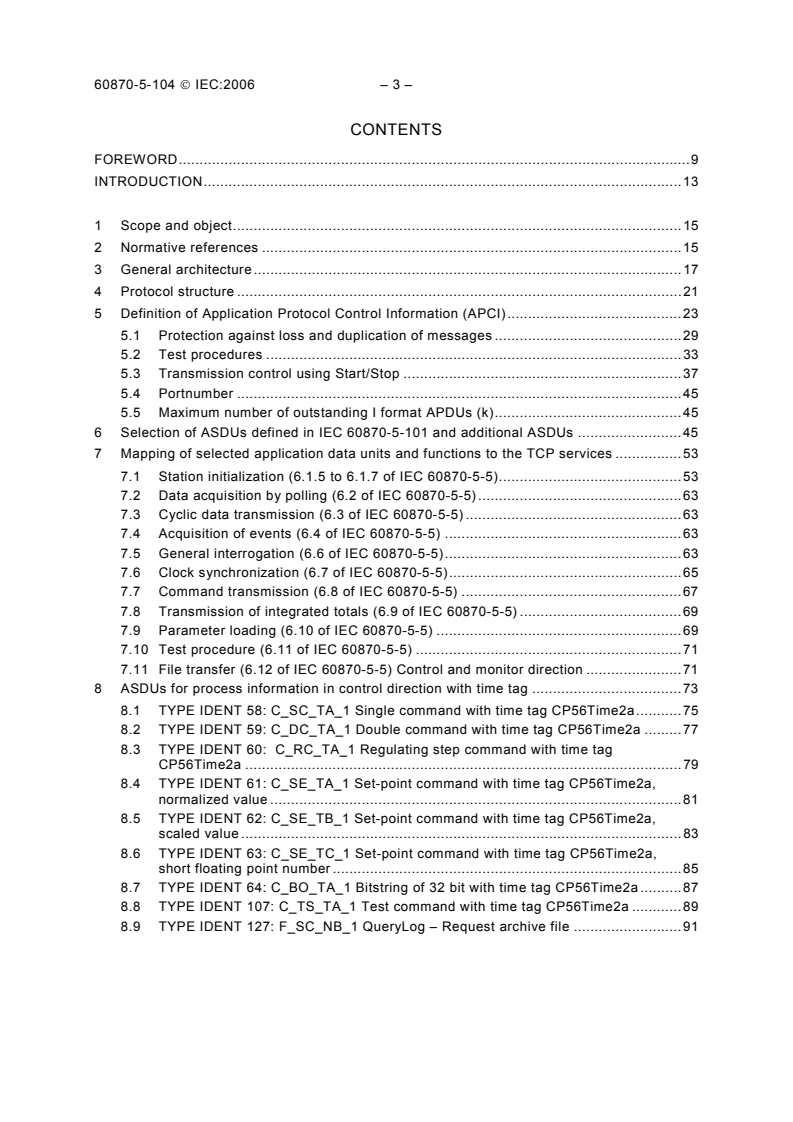
CONTENTS
FOREWORD.9
INTRODUCTION.13
1 Scope and object.15
2 Normative references .15
3 General architecture.17
4 Protocol structure .21
5 Definition of Application Protocol Control Information (APCI).23
5.1 Protection against loss and duplication of messages .29
5.2 Test procedures .33
5.3 Transmission control using Start/Stop .37
5.4 Portnumber .45
5.5 Maximum number of outstanding I format APDUs (k).45
6 Selection of ASDUs defined in IEC 60870-5-101 and additional ASDUs .45
7 Mapping of selected application data units and functions to the TCP services .53
7.1 Station initialization (6.1.5 to 6.1.7 of IEC 60870-5-5).53
7.2 Data acquisition by polling (6.2 of IEC 60870-5-5) .63
7.3 Cyclic data transmission (6.3 of IEC 60870-5-5) .63
7.4 Acquisition of events (6.4 of IEC 60870-5-5) .63
7.5 General interrogation (6.6 of IEC 60870-5-5).63
7.6 Clock synchronization (6.7 of IEC 60870-5-5).65
7.7 Command transmission (6.8 of IEC 60870-5-5) .67
7.8 Transmission of integrated totals (6.9 of IEC 60870-5-5) .69
7.9 Parameter loading (6.10 of IEC 60870-5-5) .69
7.10 Test procedure (6.11 of IEC 60870-5-5) .71
7.11 File transfer (6.12 of IEC 60870-5-5) Control and monitor direction .71
8 ASDUs for process information in control direction with time tag .73
8.1 TYPE IDENT 58: C_SC_TA_1 Single command with time tag CP56Time2a.75
8.2 TYPE IDENT 59: C_DC_TA_1 Double command with time tag CP56Time2a .77
8.3 TYPE IDENT 60: C_RC_TA_1 Regulating step command with time tag
CP56Time2a .79
8.4 TYPE IDENT 61: C_SE_TA_1 Set-point command with time tag CP56Time2a,
normalized value .81
8.5 TYPE IDENT 62: C_SE_TB_1 Set-point command with time tag CP56Time2a,
scaled value .83
8.6 TYPE IDENT 63: C_SE_TC_1 Set-point command with time tag CP56Time2a,
short floating point number .85
8.7 TYPE IDENT 64: C_BO_TA_1 Bitstring of 32 bit with time tag CP56Time2a .87
8.8 TYPE IDENT 107: C_TS_TA_1 Test command with time tag CP56Time2a .89
8.9 TYPE IDENT 127: F_SC_NB_1 QueryLog – Request archive file .91
60870-5-104 IEC:2006 – 5 –
9 Interoperability .93
9.1 System or device.93
9.2 Network configuration.93
9.3 Physical layer.95
9.4 Link layer .95
9.5 Application layer.97
9.6 Basic application functions .107
10 Redundant connections .115
10.1 General .115
10.2 General requirements.115
10.3 Initialisation of controlling station .119
10.4 Initialisation of controlled station .123
10.5 User data from controlling station .127
10.6 User data from controlled station.131
10.7 State transition diagrams.135
Figure 1 – General architecture (example) .19
Figure 2 – Selected standard provisions of the defined telecontrol companion standard.21
Figure 3 – Selected standard provisions of the TCP/IP protocol suite RFC 2200
(example) .23
Figure 4 – APDU of the defined telecontrol companion standard.25
Figure 5 – APCI of the defined telecontrol companion standard .25
Figure 6 – Control field of type Information transfer format (I format) .27
Figure 7 – Control field of type numbered supervisory functions (S format) .27
Figure 8 – Control field of type unnumbered control functions (U format) .27
Figure 9 – Undisturbed sequences of numbered I format APDUs .29
Figure 10 – Undisturbed sequences of numbered I format APDUs acknowledged by an
S format APDU .31
Figure 11 – Disturbed sequence of numbered I format APDUs.31
Figure 12 – Time-out in case of a not acknowledged last I format APDU.33
Figure 13 – Undisturbed test procedure .35
Figure 14 – Unconfirmed test procedure .35
Figure 15 – Start data transfer procedure .37
Figure 16 – Stop data transfer procedure.39
Figure 17 – State transition diagram for Start/Stop procedure (controlled station) .41
Figure 18 – State transition diagram for Start/Stop procedure (controlling station) .43
Figure 19 – TCP connection establishment and close .55
Figure 20 – Initialization of the controlling station .57
Figure 21 – Local initialization of the controlled station .59
Figure 22 – Remote initialization of the controlled station .61
Figure 23 – ASDU: C_SC_TA_1 Single command with time tag CP56Time2a .75
Figure 24 – ASDU: C_DC_TA_1 Double command with time tag CP56Time2a.77
Figure 25 – ASDU: C_RC_TA_1 Regulating step command with time tag CP56Time2a .79
60870-5-104 IEC:2006 – 7 –
Figure 26 – ASDU: C_SE_TA_1 Set-point command with time tag CP56Time2a,
normalized value.81
Figure 27 – ASDU: C_SE_TB_1 Set-point command with time tag CP56Time2a, scaled
value .83
Figure 28 – ASDU: C_SE_TC_1 Set-point command with time tag CP56Time2a, short
floating point number .85
Figure 29 – ASDU: C_BO_TA_1 Bitstring of 32 bit with time tag CP56Time2a .87
Figure 30 – ASDU: C_TS_TA_1 Test command with time tag CP56Time2a .89
Figure 31 – ASDU: F_SC_NB_1 QueryLog – Request archive file.91
Figure 32 – Initialisation of controlling station with redundant connections .121
Figure 33 – Initialisation of controlled station with redundant connections.125
Figure 34 – Redundant connections – User data from controlling station .129
Figure 35 – Redundant connections – User data from controlled station .133
Figure 36 – State transition diagram for redundant connections (controlled station) .137
Figure 37 – State transition diagram for redundant connections (controlling station) .139
Table 1 – Process information in monitor direction.47
Table 2 – Process information in control direction .49
Table 3 – System information in monitor direction.51
Table 4 – System information in control direction .51
Table 5 – Parameter in control direction.51
Table 6 – File transfer.51
60870-5-104 IEC:2006 – 9 –
INTERNATIONAL ELECTROTECHNICAL COMMISSION
____________
TELECONTROL EQUIPMENT AND SYSTEMS –
Part 5-104: Transmission protocols –
Network access for IEC 60870-5-101 using
standard transport profiles
FOREWORD
1) The International Electrotechnical Commission (IEC) is a worldwide organization for standardization comprising
all national electrotechnical committees (IEC National Committees). The object of IEC is to promote
international co-operation on all questions concerning standardization in the electrical and electronic fields. To
this end and in addition to other activities, IEC publishes International Standards, Technical Specifications,
Technical Reports, Publicly Available Specifications (PAS) and Guides (hereafter referred to as “IEC
Publication(s)”). Their preparation is entrusted to technical committees; any IEC National Committee interested
in the subject dealt with may participate in this preparatory work. International, governmental and non-
governmental organizations liaising with the IEC also participate in this preparation. IEC collaborates closely
with the International Organization for Standardization (ISO) in accordance with conditions determined by
agreement between the two organizations.
2) The formal decisions or agreements of IEC on technical matters express, as nearly as possible, an international
consensus of opinion on the relevant subjects since each technical committee has representation from all
interested IEC National Committees.
3) IEC Publications have the form of recommendations for international use and are accepted by IEC National
Committees in that sense. While all reasonable efforts are made to ensure that the technical content of IEC
Publications is accurate, IEC cannot be held responsible for the way in which they are used or for any
misinterpretation by any end user.
4) In order to promote international uniformity, IEC National Committees undertake to apply IEC Publications
transparently to the maximum extent possible in their national and regional publications. Any divergence
between any IEC Publication and the corresponding national or regional publication shall be clearly indicated in
the latter.
5) IEC provides no marking procedure to indicate its approval and cannot be rendered responsible for any
equipment declared to be in conformity with an IEC Publication.
6) All users should ensure that they have the latest edition of this publication.
7) No liability shall attach to IEC or its directors, employees, servants or agents including individual experts and
members of its technical committees and IEC National Committees for any personal injury, property damage or
other damage of any nature whatsoever, whether direct or indirect, or for costs (including legal fees) and
expenses arising out of the publication, use of, or reliance upon, this IEC Publication or any other IEC
Publications.
8) Attention is drawn to the Normative references cited in this publication. Use of the referenced publications is
indispensable for the correct application of this publication.
9) Attention is drawn to the possibility that some of the elements of this IEC Publication may be the subject of
patent rights. IEC shall not be held responsible for identifying any or all such patent rights.
International Standard IEC 60870-5-104 Ed.2 has been prepared by IEC technical
committee 57: Power systems management and associated information exchange.
This second edition cancels and replaces the first edition published in 2000 and constitutes a
technical revision. The main changes of this second edition with respect to the previous
edition are as follows: improvement of the sequences and interoperability of the protocol and
addition of new functions for the handling of redundant connections.
60870-5-104 IEC:2006 – 11 –
The text of this standard is based on the following documents:
FDIS Report on voting
57/812/FDIS 57/819/RVD
Full information on the voting for the approval of this standard can be found in the report on
voting indicated in the above table.
This publication has been drafted in accordance with the ISO/IEC directives, Part 2.
IEC 60870-5 consists of the following parts, under the general title Telecontrol equipment and
systems – Part 5: Transmission protocols
Part 5: Transmission protocols – Section One: Transmission frame formats
Part 5: Transmission protocols – Section 2: Link transmission procedures
Part 5: Transmission protocols – Section 3: General structure of application data
Part 5: Transmission protocols – Section 4: Definition and coding of application
information elements
Part 5: Transmission protocols – Section 5: Basic application functions
Part 5-6: Guidelines for conformance testing for the IEC 60870-5 companion standards
Part 5-101: Transmission protocols – Companion standard for basic telecontrol tasks
Part 5: Transmission protocols – Section 102: Companion standard for the
transmission of integrated totals in electric power systems
Part 5-103: Transmission protocols – Companion standard for the informative interface of
protection equipment
Part 5-104: Transmission protocols – Network access for IEC 60870-5-101 using standard
transport profiles
Part 5-601: Conformance test cases for the IEC 60870-5-101 companion standard
The committee has decided that the contents of this publication will remain unchanged until
the maintenance result date indicated on the IEC web site under "http://webstore.iec.ch" in
the data related to the specific publication. At this date, the publication will be
• reconfirmed;
• withdrawn;
• replaced by a revised edition, or
• amended.
60870-5-104 IEC:2006 – 13 –
INTRODUCTION
IEC 60870-5-101 provides a communication profile for sending basic telecontrol messages
between a central telecontrol station and telecontrol outstations, which uses permanent
directly connected data circuits between the central station and individual outstations.
In some applications, it may be required to send the same types of application messages
between telecontrol stations using a data network containing relay stations which store and
forward the messages and provide only a virtual circuit between the telecontrol stations. This
type of network delays messages by varying amounts of time depending on the network traffic
load.
In general, the variable message delay times mean that it is not possible to use the link layer
as defined in IEC 60870-5-101 between telecontrol stations. However, in some cases it is
possible to connect telecontrol stations having all three layers of the companion standard
IEC 60870-5-101 to suitable data networks using Packet Assembler Disassembler (PAD) type
stations to provide access for balanced communication.
In all other cases this companion standard, which does not use the link functions of
IEC 60870-5-101, may be used to provide balanced access via a suitable transport profile.
60870-5-104 IEC:2006 – 15 –
TELECONTROL EQUIPMENT AND SYSTEMS –
Part 5-104: Transmission protocols –
Network access for IEC 60870-5-101 using
standard transport profiles
1 Scope and object
This part of IEC 60870 applies to telecontrol equipment and systems with coded bit serial data
transmission for monitoring and controlling geographically widespread processes. It defines a
telecontrol companion standard that enables interoperability among compatible telecontrol
equipment. The defined telecontrol companion standard utilizes standards of the IEC 60870-5
series. The specifications of this part present a combination of the application layer of
IEC 60870-5-101 and the transport functions provided by a TCP/IP (Transmission Control
Protocol/Internet Protocol). Within TCP/IP, various network types can be utilized, including
X.25, FR (Frame Relay), ATM (Asynchronous Transfer Mode) and ISDN (Integrated Service
Data Network). Using the same definitions, alternative ASDUs (Application Service Data Unit)
as specified in other IEC 60870-5 companion standards (for example, IEC 60870-5-102) may
be combined with TCP/IP, but this is not described further in this part.
NOTE Security mechanisms are outside the scope of this standard.
2 Normative references
The following referenced documents are indispensable for the application of this document.
For dated references, only the edition cited applies. For undated references, the latest edition
of the referenced document (including any amendments) applies.
IEC 60870-5-3:1992, Telecontrol equipment and systems – Part 5: Transmission protocols –
Section 3: General structure of application data
IEC 60870-5-4:1993, Telecontrol equipment and systems – Part 5: Transmission protocols –
Section 4: Definition and coding of application information elements
IEC 60870-5-5:1995, Telecontrol equipment and systems – Part 5: Transmission protocols –
Section 5: Basic application functions
IEC 60870-5-101:2003, Telecontrol equipment and systems – Part 5-101: Transmission
protocols – Companion standard for basic telecontrol tasks
IEC 60870-5-102:1996, Telecontrol equipment and systems – Part 5: Transmission protocols
– Section 102: Companion standard for the transmission of integrated totals in electric power
systems
ITU-T Recommendation X.25:1996, Interface between Data Terminal Equipment (DTE) and
Data Circuit-terminating Equipment (DCE) for terminals operating in the packet mode and
connected to public data networks by dedicated circuit
IEEE 802.3:1998, Information technology – Telecommunications and information exchange
between systems – Local and metropolitan area networks – Specific requirements – Part 3:
Carrier sense multiple access with collision detection (CSMA/CD) access method and
physical layer specifications
60870-5-104 IEC:2006 – 17 –
RFC 791, Internet Protocol, Request for Comments 791 (MILSTD 1777) (September, 1981)
RFC 793, Transmission Control Protocol, Request for Comments 793 (MILSTD 1778)
(September, 1981)
RFC 894, Internet Protocol on Ethernet Networks
RFC 1661, Point-to-Point Protocol (PPP)
RFC 1662, PPP in HDLC Framing
RFC 1700, Assigned Numbers, Request for Comments 1700 (STD 2) (October, 1994)
RFC 2200, Internet Official Protocol Standards, Request for Comments 2200 (June, 1997)
3 General architecture
This standard defines the use of an open TCP/IP-interface to a network, containing for
example a LAN for telecontrol equipment, which transports IEC 60870-5-101 ASDUs. Routers
which include the different WAN-types (for example, X.25, Frame Relay, ISDN, etc.) may be
connected via a common TCP/IP-LAN-interface (see figure 1). Figure 1 shows a redundant
configuration in the central station in addition to a non-redundant system.
Motivations:
The use of separate routers offers the following advantages.
– There is no need for network-specific software in end systems.
– There is no need for routing functionality in end systems.
– There is no need for network management in end systems.
– It facilitates obtaining end systems from manufacturers that specialize in telecontrol
equipment.
– It facilitates obtaining individual separate routers, to suit a variety of networks from
manufacturers specializing in this non-telecontrol specific field.
– It is possible to change the network type by replacing only the router type, without
affecting the end systems.
– It is particularly suitable for converting existing end systems that conform to
IEC 60870-5-101.
– It is suitable for present and future implementations.
60870-5-104 IEC:2006 – 19 –
Application 101
Application 101
CENTRAL
STATION
Transport interface
Transport interface
End system
TCP/IP TCP/IP
LAN interface*
LAN interface*
Router (X.25, FR, ISDN.)
Router
Router
Network
Network
X.25, FR, ISDN.
X.25, FR, ISDN.
Router (X.25, FR, ISDN.)
Router (X.25, FR, ISDN.)
LAN interface* LAN interface*
OUTSTATION
TCP/IP TCP/IP
End system
Transport interface
Transport interface
Application 101 Application 101
Without redundancy With redundancy
IEC 2785/2000
* The LAN interface may be redundant.
Figure 1 – General architecture (example)
60870-5-104 IEC:2006 – 21 –
4 Protocol structure
Figure 2 shows the protocol structure of the end system.
Initialization
Selection of application functions of
User process
IEC 60870-5-5 according to IEC 60870-5-101
Selection of ASDUs from IEC 60870-5-101 and IEC 60870-5-104
Application (layer 7)
APCI (Application Protocol Control Information)
Transport Interface (user to TCP interface)
Transport (layer 4)
Selection of
Network (layer 3)
TCP/IP protocol suite (RFC 2200)
Link (layer 2)
Physical (layer 1)
NOTE Layers 5 and 6 are not used.
IEC 2786/2000
Figure 2 – Selected standard provisions of the defined telecontrol companion standard
Figure 3 shows the recommended selection of the TCP/IP Protocol suite (RFC 2200) used in
this standard. At the time of publication, the RFCs indicated were valid, but may have been
replaced in the meantime by equivalent, relevant RFCs. The relevant RFCs are available at
the Internet address http://www.ietf.org.
The Ethernet 802.3 stack shown may be used by a telecontrol station end system or DTE
(Data Terminal Equipment) to drive a separate router as shown in the example in figure 1. If a
redundant configuration is not required, a point-to-point interface (for example, X.21) to the
separate router may be used instead of a LAN interface, thus retaining more of the original
hardware when converting end systems originally conforming to IEC 60870-5-101.
Other compatible selections from RFC 2200 are also permitted.
This standard uses the TCP/IP transport profile as defined in other referenced standards,
without alteration.
60870-5-104 IEC:2006 – 23 –
Transport Interface (user to TCP interface)
Transport
RFC 793 (Transmission control protocol)
(layer 4)
Network
RFC 791 (Internet protocol)
(layer 3)
RFC 1661
RFC 894
(PPP)
(Transmission of
IP datagrams
Data link
over ethernet
RFC 1662 (layer 2)
networks)
(PPP in HDLC-like
framing)
Physical
X.21 IEEE 802.3
(layer 1)
Serial line Ethernet
IEC 2787/2000
Figure 3 – Selected standard provisions of the TCP/IP
protocol suite RFC 2200 (example)
5 Definition of Application Protocol Control Information (APCI)
The transport interface (User to TCP interface) is a stream-oriented interface which does not
define any start or stop mechanism for the ASDUs of IEC 60870-5-101. In order to detect the
start and the end of the ASDUs, each APCI includes the following delimiting elements: a start
character, the specification of the length of the ASDU, plus the control field (see figure 4).
Either a complete APDU (or, for control purposes, only the APCI fields) may be transferred
(see figure 5).
NOTE The abbreviations used above are taken from clause 5 of IEC 60870-5-3 as follows.
APCI Application Protocol Control Information
ASDU Application Service Data Unit
APDU Application Protocol Data Unit
60870-5-104 IEC:2006 – 25 –
START 68H
Length of the APDU (max. 253)
Control field octet 1
APCI
Control field octet 2
Control field octet 3
Control field octet 4
APDU
Length
ASDU defined
in IEC 60870-5-101
ASDU
and IEC 60870-5-104
IEC 2788/2000
Figure 4 – APDU of the defined telecontrol companion standard
START 68H
Length of APDU
Control field octet 1
APCI
Control field octet 2
Length = 4
Control field octet 3
Control field octet 4
IEC 2789/2000
Figure 5 – APCI of the defined telecontrol companion standard
START 68H defines the point of start within the data stream.
The length of the APDU defines the length of the body of the APDU, which consists of the four
control field octets of the APCI plus the ASDU. The first counted octet is the first octet of the
control field, the last counted octet is the last octet of the ASDU. The maximum length of
the ASDU is limited to 249 because the maximum value of the field length of APDU is
253 (APDU = 255 minus start and length octet) and the length of the control field is
max
4 octets.
The control field defines control information for the protection against loss and duplication of
messages, start and stop of message transfers and the supervision of transport connections.
The counter mechanism of the control field is defined according to 2.3.2.2.1 to 2.3.2.2.5 of the
ITU-T X.25 recommendation.
60870-5-104 IEC:2006 – 27 –
Figures 6, 7 and 8 show the definition of the control field.
Three types of control field formats are used to perform numbered information transfer (I format),
numbered supervisory functions (S format) and unnumbered control functions (U format).
Control field octet 1 bit 1 = 0 defines the I format. I format APDUs always contain an ASDU.
The control information of an I format is shown in figure 6.
Bit 18 7 6 5 4 3 2
Send Sequence Number N(S) LSB
octet 1
Send Sequence Number N(S)
MSB
octet 2
Receive Sequence Number N(R) LSB 0
octet 3
MSB Receive Sequence Number N(R)
octet 4
IEC 2790/2000
Figure 6 – Control field of type Information transfer format (I format)
Control field octet 1 bit 1 = 1 and bit 2 = 0 defines the S format. S format APDUs consist of
the APCI only. The control information of an S format is shown in figure 7.
Bit 18 7 6 5 4 3 2
0 1
0 octet 1
0 octet 2
LSB
Receive Sequence Number N(R) 0
octet 3
MSB
Receive Sequence Number N(R)
octet 4
IEC 2791/2000
Figure 7 – Control field of type numbered supervisory functions (S format)
Control field octet 1 bit 1 = 1 and bit 2 = 1 defines the U format. U format APDUs consist of
the APCI only. The control information of a U format is shown in figure 8. Only one function –
TESTFR, STOPDT or STARTDT – may be active at the same time.
Bit 18 7 6 5 4 3 2
STOPDT STARTDT
TESTFR
octet 1
1 1
con act con act con act
octet 2
0 0 octet 3
octet 4
IEC 2792/2000
Figure 8 – Control field of type unnumbered control functions (U format)
60870-5-104 IEC:2006 – 29 –
5.1 Protection against loss and duplication of messages
The use of the Send Sequence Number N(S) and the Receive Sequence Number N(R) is
identical to the method defined in ITU-T X.25. For simplification purposes, the additional
sequences are defined in figures 9 to 12.
Both sequence numbers are sequentially increased by one for each APDU and each direction.
The transmitter increases the Send Sequence Number N(S) and the receiver increases the
Receive Sequence Number N(R). The receiving station acknowledges each APDU or a
number of APDUs when it returns the Receive Sequence Number up to the number whose
APDUs are properly received. The sending station holds the APDU or APDUs in a buffer until
it receives back its own Send Sequence Number as a Receive Sequence Number which is a
valid acknowledge for all numbers <= the received number. Then it may delete the correctly
transmitted APDUs from the buffer. In case of longer data transmission in one direction only,
an S format has to be sent in the other direction to acknowledge the APDUs before buffer
overflow or time out. This method should be used in both directions. After the establishment
of a TCP connection, the send and receive sequence numbers are set to zero.
The following definitions are valid for figures 9 to 16:
V(S) = Send state variable (see ITU-T X.25);
V(R) = Receive state variable (see ITU-T X.25);
Ack = Indicates that the DTE has received correctly all I format APDUs numbered up to and including this number;
I(a,b) = Information format APDU with a = send sequence number and b = receive sequence number;
S(b) = Supervisory format APDU with b = receive sequence number;
U = Unnumbered control function APDU.
Station A
Station B
Internal counters V after
Internal counters V after
APDU was sent or received
APDU was sent or received
Ack V(S) V(R) V(S) V(R) Ack
0 0 0 0 0 0
I (0,0) 1
I (1,0) 2
I (2,0) 3
I (0,3)
I (1,3)
2 1 3
I (3,2) 4
2 4
IEC 2793/2000
Figure 9 – Undisturbed sequences of numbered I format APDUs
60870-5-104 IEC:2006 – 31 –
Station B
Station A
Internal counters V after Internal counters V after
APDU was sent or received APDU was sent or received
Ack V(S) V(R) V(S) V(R) Ack
0 0 0 0 0 0
I (0,0) 1
I (1,0) 2
I (2,0) 3
Time-out t2
S(3)
IEC 929/06
Figure 10 – Undisturbed sequences of numbered I
format APDUs acknowledged by an S format APDU
Station A Station B
Internal counters V after
Internal counters V after
APDU was sent or received APDU was sent or received
Ack V(S) V(R) V(S) V(R) Ack
0 0 0 0 0 0
I (0,0)
2 1
I (2,0)
Sequence error
S(1) (optional)
Active close
Active open follows
(see Figures 19
to 22)
IEC 930/06
NOTE To avoid retransmission of APDU’s that have already been accepted, an S-frame should, if possible, be
sent prior to the active close.
Figure 11 – Disturbed sequence of numbered I format APDUs
60870-5-104 IEC:2006 – 33 –
Station B
Station A
Internal counters V after
Internal counters V after
APDU was sent or received
APDU was sent or received
Ack V(S) V(R) V(S) V(R) Ack
0 0 0 0 0 0
I (0,0)
Time-out
cancelled
S (1)
X
Time-out
t1
Active close
Active open follows
(see Figures 19
to 22)
IEC 931/06
Figure 12 – Time-out in case of a not acknowledged last I format APDU
5.2 Test procedures
Unused, but open, connections may be periodically tested in both directions by sending test APDUs
(TESTFR = act) which are confirmed by the receiving station sending TESTFR = con. Both stations
may initiate the test procedure after a specified period of time in which no data transfers occur
(time out). The reception of every frame – I frame, S frame or U frame – retriggers timer t3.
Station B has to supervise the connection independently. However, as long as it receives test
frames from station A, it will not send test frames.
The test procedure can also be initiated on "active” connections where absence of activity is
possible for extended times and connectivity needs to be assured.
60870-5-104 IEC:2006 – 35 –
Station B
Station A
Internal counters V after Internal counters V after
APDU was sent or received APDU was sent or received
Ack V(S) V(R) V(S) V(R) Ack
0 0 0 0 0 0
I (0,0) 1
I (1,0) 2
S (2)
Time-out t3
U (TESTFR act)
U (TESTFR con)
IEC 932/06
Figure 13 – Undisturbed test procedure
Station A Station B
Internal counters V after Internal counters V after
APDU was sent or received APDU was sent or received
Ack V(S) V(R) V(S) V(R) Ack
0 0 0 0 0 0
I (0,0)
I (1,0) 2
S (2)
Time-out t3
U (TESTFR act)
Time-out
t1
Active close
Active open follows
(see Figures 19
to 22)
IEC 933/06
Figure 14 – Unconfirmed test procedure
60870-5-104 IEC:2006 – 37 –
5.3 Transmission control using Start/Stop
STARTDT (Start Data Transfer) and STOPDT (Stop Data Transfer) are used by the controlling
station (for example, Station A), to control the data transfer from a controlled station (Station
B). This is useful, for example, when more than one connection between the stations is open
and therefore available, but only one connection at a time is used for the data transfer. The
defined functionality for STARTDT and STOPDT avoids loss of data in the case of switchover
from one connection to another. STARTDT and STOPDT are also used with single
connections between the stations to control the traffic on the connection.
When the connection is established, user data transfer is not automatically enabled from the
controlled station on that connection, i.e. STOPDT is the default state when a connection is
established. In this state, the controlled station does not send any data via this connection,
except unnumbered control functions and confirmations to such functions. The controlling
station must activate the user data transfer on a connection by sending a STARTDT act via
this connection. The controlled station responds to this command with a STARTDT con. If the
STARTDT is not confirmed, the connection is closed by the controlling station. This implies
that after station initialization (see 7.1) STARTDT must always be sent before any user data
transfer from the controlled station (for example, general interrogated information) is initiated.
Any pending user data in the controlled station is sent only after the STARTDT con.
STARTDT/STOPDT is a mechanism for the controlling station to activate/deactivate the
monitoring direction. The controlling station may send commands or setpoints even if it has
not yet received the activation confirmation. Send and receive counters continue their
functionality independent of the use of STARTDT/STOPDT.
Station A Station B
Internal counters V after
Internal counters V after
APDU was sent or received
APDU was sent or received
Ack V(S) V(S) V(R) Ack
V(R)
0 0 0 0 0 0
Connection
established
U (STARTDT act)
U (STARTDT con)
Data transfer
enabled
or
U (STARTDT act)
Time-out t1
Active close
Active open follows
(see Figures 19
to 22)
IEC 934/06
Figure 15 – Start data transfer procedure
60870-5-104 IEC:2006 – 39 –
In the case of, for example, a switchover from an active connection to another connection (for
example, by an operator), the controlling station first transmits a STOPDT act on the active
connection. The controlled station stops the user data transfer via this connection and returns
a STOPDT con. Pending ACKs to user data can be sent from the point of time when the
controlled station receives STOPDT act to the point of time when it returns STOPDT con.
After receiving the STOPDT con, the controlling station may close the connection. A
STARTDT on the other established connection is needed to start the data transfer from the
controlled station on that connection (see figure 17).
Station B
Station A
Internal counters V after
Internal counters V after
APDU was sent or received
APDU was sent or received
Ack V(S) V(R) V(S) V(R) Ack
0 0 0 0 0 0
Connection
established
U (STOPDT act)
U (STOPDT con)
or
U (STOPDT act)
Data loss
Time-out t1
possible
Active close
Active open follows
(see Figures 19
to 22)
IEC 935/06
Figure 16 – Stop data transfer procedure
60870-5-104 IEC:2006 – 41 –
start Connection established
U-frame[]/
STOPPED
S-frame [no unconfirmed I-frames]
connection
/Send STOPDT con
__________
Timeout t1[]/Active close
or S-frame[]/Active close
or I-frame[]/Active close
U-frame[]/
or S-frame[]/
Pending
STARTDT act[]
UNCONFIRMED
/Send STARTDT con
STOPPED
connection
__________
STOPDT act[no unconfirmed I-frames]
/Send STOPDT con
Timeout t1[]/Active close
U-frame[]/
or I-frame[]/Active close
or S-frame[]/
or I-frame[]/
STARTED
connection
STOPDT act[unconfirmed I-frames]
__________
Timeout t1[]/Active close
stop
Connection terminated
IEC 936/06
NOTE 1 Connection terminated means that there is no longer any data exchange betwen TCP and the application
protocol (CS104).
NOTE 2 t1 is the timeout of a sent U-frame or I-frame.
Figure 17 – State transition diagram for Start/Stop procedure (controlled station)
60870-5-104 IEC:2006 – 43 –
start
Connection established
U-frame[]/
STOPPED
connection
__________
STOPDT con[]/
Timeout t1[]/Active close
U-frame[]/
or S-frame[]/Active close
or S-frame[]/
or I-frame[]/Active close
Start connection[]
or I-frame[]/
/Send STARTDT act
Pending
STOPPED
connection
__________
U-frame[]/
Pending
STARTED
Timeout t1[]/Active close
connection
__________
Timeout t1[]/Active close S-frame or I-frame
STOPDT con[]/
or S-frame[]/Active close [No unconfirmed I-frames]/
or I-frame[]/Active close
STARTDT con[]/
U-frame[]/
Pending
or S-frame[]/
UNCONFIRMED
or I-frame[]/
STOPPED
U-frame[]/ connection
or S-frame[]/ __________
or I-frame[]/
STARTED
Stop connection[no unconfirmed I-frames]
connection
Timeout t1[]/Active close
/Send STOPDT act
__________
Stop connection[unconfirmed I-frames]
/Send STOPDT act
Timeout t1[]/Active close
stop
Connection terminated
IEC 937/06
NOTE 1 Connection terminated means that there is no longer any data exchange betwen TCP and the application
protocol (CS104).
NOTE 2 t1 is the timeout of a sent U-frame or I-frame.
Figure 18 – State transition diagram for Start/Stop procedure (controlling station)
STOPDT act stops the transmission of I-frames immediately.
The controlling station should, however, confirm all received messages before sending
STOPDT act, and the controlled station should confirm all received messages before
returning STOPDT con. This is similar to th
...
NORME CEI
INTERNATIONALE 60870-5-104
Deuxième édition
2006-06
Matériels et systèmes de téléconduite –
Partie 5-104:
Protocoles de transmission –
Accès aux réseaux utilisant des profils de
transport normalisés pour la CEI 60870-5-101
Cette version française découle de la publication d’origine
bilingue dont les pages anglaises ont été supprimées.
Les numéros de page manquants sont ceux des pages
supprimées.
Numéro de référence
CEI 60870-5-104:2006(F)
Numérotation des publications
Depuis le 1er janvier 1997, les publications de la CEI sont numérotées à partir de
60000. Ainsi, la CEI 34-1 devient la CEI 60034-1.
Editions consolidées
Les versions consolidées de certaines publications de la CEI incorporant les
amendements sont disponibles. Par exemple, les numéros d’édition 1.0, 1.1 et 1.2
indiquent respectivement la publication de base, la publication de base incorporant
l’amendement 1, et la publication de base incorporant les amendements 1 et 2
Informations supplémentaires sur les publications de la CEI
Le contenu technique des publications de la CEI est constamment revu par la CEI
afin qu'il reflète l'état actuel de la technique. Des renseignements relatifs à cette
publication, y compris sa validité, sont disponibles dans le Catalogue des
publications de la CEI (voir ci-dessous) en plus des nouvelles éditions, amende-
ments et corrigenda. Des informations sur les sujets à l’étude et l’avancement des
travaux entrepris par le comité d’études qui a élaboré cette publication, ainsi que la
liste des publications parues, sont également disponibles par l’intermédiaire de:
• Site web de la CEI (www.iec.ch)
• Catalogue des publications de la CEI
Le catalogue en ligne sur le site web de la CEI (www.iec.ch/searchpub) vous permet
de faire des recherches en utilisant de nombreux critères, comprenant des
recherches textuelles, par comité d’études ou date de publication. Des informations
en ligne sont également disponibles sur les nouvelles publications, les publications
remplacées ou retirées, ainsi que sur les corrigenda.
• IEC Just Published
Ce résumé des dernières publications parues (www.iec.ch/online_news/justpub)
est aussi disponible par courrier électronique. Veuillez prendre contact avec le
Service client (voir ci-dessous) pour plus d’informations.
• Service clients
Si vous avez des questions au sujet de cette publication ou avez besoin de
renseignements supplémentaires, prenez contact avec le Service clients:
Email: custserv@iec.ch
Tél: +41 22 919 02 11
Fax: +41 22 919 03 00
NORME CEI
INTERNATIONALE 60870-5-104
Deuxième édition
2006-06
Matériels et systèmes de téléconduite –
Partie 5-104:
Protocoles de transmission –
Accès aux réseaux utilisant des profils de
transport normalisés pour la CEI 60870-5-101
IEC 2006 Droits de reproduction réservés
Aucune partie de cette publication ne peut être reproduite ni utilisée sous quelque forme que ce soit et par aucun
procédé, électronique ou mécanique, y compris la photocopie et les microfilms, sans l'accord écrit de l'éditeur.
International Electrotechnical Commission, 3, rue de Varembé, PO Box 131, CH-1211 Geneva 20, Switzerland
Telephone: +41 22 919 02 11 Telefax: +41 22 919 03 00 E-mail: inmail@iec.ch Web: www.iec.ch
CODE PRIX
XB
Commission Electrotechnique Internationale
International Electrotechnical Commission
МеждународнаяЭлектротехническаяКомиссия
Pour prix, voir catalogue en vigueur
– 2 – 60870-5-104 CEI:2006
SOMMAIRE
AVANT-PROPOS .8
INTRODUCTION.12
1 Domaine d'application et objet .14
2 Références normatives .14
3 Architecture générale.16
4 Profil de communication.20
5 Définition des APCI (Application Protocol Control Information) .22
5.1 Protection contre la perte et la duplication de message .28
5.2 Procédures d'essai .32
5.3 Contrôle de la transmission en utilisant Start/Stop.36
5.4 Numéro de port .44
5.5 Nombre maximum k d'APDU non acquittés de format I.44
6 Sélections des ASDU définis dans la CEI 60870-5-101 et des ASDU additionnels.44
7 Correspondance entre les unités de données et fonctions applicatives et les
services TCP .52
7.1 Initialisation des postes (6.1.5 à 6.1.7 de la CEI 60870-5-5) .52
7.2 Acquisition des données par scrutation (6.2 de la CEI 60870-5-5) .62
7.3 Transmission cyclique de données (6.3 de la CEI 60870-5-5).62
7.4 Acquisition d'événements (6.4 de la CEI 60870-5-5).62
7.5 Interrogation générale (6.6 de la CEI 60870-5-5).62
7.6 Synchronisation d'horloges (6.7 de la CEI 60870-5-5) .64
7.7 Transmission de commandes (6.8 de la CEI 60870-5-5).66
7.8 Transmission de totaux intégrés (6.9 de la CEI 60870-5-5).68
7.9 Chargement de paramètres (6.10 de la CEI 60870-5-5).68
7.10 Procédure de test (6.11 de la CEI 60870-5-5) .70
7.11 Transfert de fichiers (6.12 de la CEI 60870-5-5) En direction du contrôle et du
moniteur .70
8 ASDU datés pour les processus d'information en direction du contrôle avec
marqueur du temps.72
8.1 IDENTIFICATION DE TYPE 58: C_SC_TA_1 Simple commande datée
CP56Time2a .74
8.2 IDENTIFICATION DE TYPE 59: C_DC_TA_1 Commande double datée
CP56Time2a .76
8.3 IDENTIFICATION DE TYPE 60: C_RC_TA_1 Commande de régulation par
échelon datée CP56Time2a .78
8.4 IDENTIFICATION DE TYPE 61: C_SE_TA_1 Commande de consigne datée
CP56Time2a, valeur normalisée .80
8.5 IDENTIFICATION DE TYPE 62: C_SE_TB_1 Commande de consigne datée
CP56Time2a, valeur ajustée .82
8.6 IDENTIFICATION DE TYPE 63: C_SE_TC_1 Commande de valeur de
consigne datée CP56Time2a, nombre flottant court .84
8.7 IDENTIFICATION DE TYPE 64: C_BO_TA_1 Chaîne de 32 bits datée
CP56Time2a .86
8.8 IDENTIFICATION DE TYPE 107: C_TS_TA_1 Commande de test datée
CP56Time2a .88
8.9 IDENTIFICATION DE TYPE 127: F_SC_NB_1 QueryLog – Demande
d’archivage de fichier.90
– 4 – 60870-5-104 CEI:2006
9 Interopérabilité.92
9.1 Système complet ou partiel.92
9.2 Configuration de réseau.92
9.3 Couche physique .94
9.4 Couche liaison.94
9.5 Couche application .96
9.6 Fonctions élémentaires d'application. 106
10 Connexions redondantes . 114
10.1 Généralités. 114
10.2 Exigences générales. 114
10.3 Initialisation du poste de commande . 118
10.4 Initialisation du poste commandé . 122
10.5 Données utilisateur provenant d’un poste de commande . 126
10.6 Données utilisateur provenant du poste commandé. 130
10.7 Diagrammes de transition d’état. 134
Figure 1 – Architecture générale (exemple) .18
Figure 2 – Sélection des standards pour la présente norme d'accompagnement de
télécontrôle .20
Figure 3 – Sélection dans l'ensemble des normes du protocole TCP/RFC 2200 (exemple) .22
Figure 4 – APDU pour la présente norme d'accompagnement de téléconduite .24
Figure 5 – APCI pour la présente norme d'accompagnement de téléconduite.24
Figure 6 – Champ de contrôle du type transfert d'information (format I) .26
Figure 7 – Champ de contrôle du type fonction de supervision (format S) .26
Figure 8 – Champ de contrôle du type fonction de contrôle non numéroté (format U) .26
Figure 9 – Séquence non perturbée d'APDU numéroté de format I.28
Figure 10 – Séquence non perturbée d'APDU de format numéroté I acquittée par un
APDU de format S.30
Figure 11 – Séquence perturbée d'APDU de format I.30
Figure 12 – Expiration du temporisateur dans le cas d'un APDU de format I non acquitté.32
Figure 13 – Procédure d'essai non perturbée.34
Figure 14 – Procédure d'essai non confirmée .34
Figure 15 – Procédure de démarrage du transfert de données .36
Figure 16 – Procédure d'arrêt de transfert de données .38
Figure 17 – Diagramme de transition d’état pour une procédure de Démarrage/Arrêt
(Start/Stop) (poste commandé) .40
Figure 18 – Diagramme de transition d’état pour une procédure de Démarrage/Arrêt
(Start/Stop) (poste de commande).42
Figure 19 – TCP établissement et fermeture de la connexion.54
Figure 20 – Initialisation du poste de commande .56
Figure 21 – Initialisation locale du poste commandé .58
Figure 22 – Initialisation à distance du poste commandé.60
Figure 23 – ASDU: C_SC_TA_1 Simple commande datée CP56Time2a .74
Figure 24 – ASDU: C_DC_TA_1 Commande double datée CP56Time2a.76
Figure 25 – ASDU: C_RC_TA_1 Commande de régulation par échelon datée CP56Time2a .78
– 6 – 60870-5-104 CEI:2006
Figure 26 – ASDU: C_SE_TA_1 Commande de consigne datée CP56Time2a,
valeur normalisée.80
Figure 27 – ASDU: C_SE_TB_1 Commande de consigne datée CP56Time2a,
valeur ajustée .82
Figure 28 – ASDU: C_SE_TC_1 Commande de valeur de consigne datée CP56Time2a,
nombre flottant court .84
Figure 29 – ASDU: C_BO_TA_1 Chaîne de 32 bits datée CP56Time2a.86
Figure 30 – ASDU: C_TS_TA_1 Commande de test datée CP56Time2a .88
Figure 31 – ASDU: F_SC_NB_1 QueryLog – Demande d’archivage de fichier .90
Figure 32 – Initialisation du poste de commande avec des connexions redondantes . 120
Figure 33 – Initialisation du poste commandé avec des connexions redondantes . 124
Figure 34 – Connexions redondantes – Données utilisateur provenant du poste
de commande . 128
Figure 35 – Connexions redondantes – Données utilisateur provenant du poste
commandé . 132
Figure 36 – Diagramme de transition d’état pour des connexions redondantes
(poste commandé) . 136
Figure 37 – Diagramme de transition d’état pour des connexions redondantes
(poste de commande) . 138
Tableau 1 – Processus d'information en direction du moniteur .46
Tableau 2 – Processus d'information en direction du contrôle .48
Tableau 3 – Information système en direction du moniteur.50
Tableau 4 – Information système en direction du contrôle.50
Tableau 5 – Paramètres en direction du contrôle .50
Tableau 6 – Transfert de fichier.50
– 8 – 60870-5-104 CEI:2006
COMMISSION ÉLECTROTECHNIQUE INTERNATIONALE
____________
MATÉRIELS ET SYSTÈMES DE TÉLÉCONDUITE –
Partie 5-104: Protocoles de transmission –
Accès aux réseaux utilisant des profils de transport
normalisés pour la CEI 60870-5-101
AVANT-PROPOS
1) La Commission Electrotechnique Internationale (CEI) est une organisation mondiale de normalisation composée
de l'ensemble des comités électrotechniques nationaux (Comités nationaux de la CEI). La CEI a pour objet de
favoriser la coopération internationale pour toutes les questions de normalisation dans les domaines de
l'électricité et de l'électronique. A cet effet, la CEI – entre autres activités – publie des Normes internationales,
des Spécifications techniques, des Rapports techniques, des Spécifications accessibles au public (PAS) et des
Guides (ci-après dénommés "Publication(s) de la CEI"). Leur élaboration est confiée à des comités d'études,
aux travaux desquels tout Comité national intéressé par le sujet traité peut participer. Les organisations
internationales, gouvernementales et non gouvernementales, en liaison avec la CEI, participent également aux
travaux. La CEI collabore étroitement avec l'Organisation Internationale de Normalisation (ISO), selon des
conditions fixées par accord entre les deux organisations.
2) Les décisions ou accords officiels de la CEI concernant les questions techniques représentent, dans la mesure
du possible, un accord international sur les sujets étudiés, étant donné que les Comités nationaux de la CEI
intéressés sont représentés dans chaque comité d’études.
3) Les Publications de la CEI se présentent sous la forme de recommandations internationales et sont agréées
comme telles par les Comités nationaux de la CEI. Tous les efforts raisonnables sont entrepris afin que la CEI
s'assure de l'exactitude du contenu technique de ses publications; la CEI ne peut pas être tenue responsable de
l'éventuelle mauvaise utilisation ou interprétation qui en est faite par un quelconque utilisateur final.
4) Dans le but d'encourager l'uniformité internationale, les Comités nationaux de la CEI s'engagent, dans toute la
mesure possible, à appliquer de façon transparente les Publications de la CEI dans leurs publications
nationales et régionales. Toutes divergences entre toutes Publications de la CEI et toutes publications
nationales ou régionales correspondantes doivent être indiquées en termes clairs dans ces dernières.
5) La CEI n’a prévu aucune procédure de marquage valant indication d’approbation et n'engage pas sa
responsabilité pour les équipements déclarés conformes à une de ses Publications.
6) Tous les utilisateurs doivent s'assurer qu'ils sont en possession de la dernière édition de cette publication.
7) Aucune responsabilité ne doit être imputée à la CEI, à ses administrateurs, employés, auxiliaires ou
mandataires, y compris ses experts particuliers et les membres de ses comités d'études et des Comités
nationaux de la CEI, pour tout préjudice causé en cas de dommages corporels et matériels, ou de tout autre
dommage de quelque nature que ce soit, directe ou indirecte, ou pour supporter les coûts (y compris les frais
de justice) et les dépenses découlant de la publication ou de l'utilisation de cette Publication de la CEI ou de
toute autre Publication de la CEI, ou au crédit qui lui est accordé.
8) L'attention est attirée sur les références normatives citées dans cette publication. L'utilisation de publications
référencées est obligatoire pour une application correcte de la présente publication.
9) L’attention est attirée sur le fait que certains des éléments de la présente Publication de la CEI peuvent faire
l’objet de droits de propriété intellectuelle ou de droits analogues. La CEI ne saurait être tenue pour
responsable de ne pas avoir identifié de tels droits de propriété et de ne pas avoir signalé leur existence.
La Norme internationale CEI 60870-5-104 a été établie par le comité d'études 57 de la CEI:
Gestion des systèmes de puissance et échanges d'informations associés.
Cette deuxième édition annule et remplace la première édition parue en 2000. Cette édition
constitue une révision technique. Les principaux changements dans cette deuxième édition par
rapport à l’édition précédente sont ceux qui suivent: amélioration des séquences et de
l’interopérabilité du protocole et ajouts de nouvelles fonctions pour l’utilisation des connexions
redondantes.
– 10 – 60870-5-104 CEI:2006
Le texte de cette norme est issu des documents suivants:
FDIS Rapport de vote
57/812/FDIS 57/819/RVD
Le rapport de vote indiqué dans le tableau ci-dessus donne toute information sur le vote ayant
abouti à l'approbation de cette norme.
Cette publication a été rédigée selon les Directives ISO/CEI, Partie 2.
La CEI 60870-5 comprend les parties suivantes, sous le titre général Matériels et systèmes
de téléconduite – Partie 5: Protocoles de transmission:
Partie 5: Protocoles de transmission – Section Une: Formats de trames de transmission
Partie 5: Protocoles de transmission – Section 2: Procédures de transmission de liaison
de données
Partie 5: Protocoles de transmission – Section 3: Structure générale des données
d'application
Partie 5: Protocoles de transmission – Section 4: Définition et codages des éléments
d'information d'application
Partie 5: Protocoles de transmission – Section 5: Fonctions d'application de base
Part 5-6: Guidelines for conformance testing for the IEC 60870-5 companion standards
(disponible en anglais seulement)
Partie 5-101: Protocoles de transmission – Norme d'accompagnement pour les tâches
élémentaires de téléconduite
Partie 5: Protocoles de transmission – Section 102: Norme d'accompagnement pour la
transmission de totaux intégrés dans un système électrique de puissance
Partie 5-103: Protocoles de transmission – Norme d'accompagnement pour l'interface de
communication d'information des équipements de protection
Partie 5-104: Protocoles de transmission – Accès aux réseaux utilisant des profils de
transport normalisés pour la CEI 60870-5-101
Part 5-601: Conformance test cases for the IEC 60870-5-101 companion standard
(disponible en anglais seulement)
Le comité a décidé que le contenu de cette publication ne sera pas modifié avant la date de
maintenance indiquée sur le site web de la CEI sous «http://webstore.iec.ch» dans les données
relatives à la publication recherchée. A cette date, la publication sera
• reconduite;
• supprimée;
• remplacée par une édition révisée, ou
• amendée.
– 12 – 60870-5-104 CEI:2006
INTRODUCTION
La CEI 60870-5-101 fournit un profil de communication pour l'émission de messages entre un
centre et des postes de télécontrôle, qui utilise des circuits de données connectés de façon
permanente.
Dans certaines applications, il peut être demandé d'envoyer le même type de messages
d'application entre les différents postes de télécontrôle utilisant un réseau contenant des
postes intermédiaires qui stockent, retransmettent les messages et fournissent un circuit
virtuel entre les différents postes. Ce type de réseau retarde les messages par accumulation
des délais dépendant de la charge du réseau.
En général, ces différents délais pour la transmission des messages démontrent qu'il n'est pas
possible d'utiliser la couche de liaison telle qu'elle est définie dans la CEI 60870-5-101 entre
les différents postes. Toutefois, dans certains cas il est possible de connecter les postes de
télécontrôle ayant les trois couches de la norme d'accompagnement CEI 60870-5-101 à travers
un réseau utilisant des PAD (Packet Assembler Disassembler) qui fournit un accès pour des
transmissions en mode symétrique.
Dans tous les autres cas, la présente norme d'accompagnement, qui n'utilise pas les fonctions
de la CEI 60870-5-101, doit être utilisée pour permettre des échanges en mode symétrique à
travers un ensemble de profils de transport.
– 14 – 60870-5-104 CEI:2006
MATÉRIELS ET SYSTÈMES DE TÉLÉCONDUITE –
Partie 5-104: Protocoles de transmission –
Accès aux réseaux utilisant des profils de transport
normalisés pour la CEI 60870-5-101
1 Domaine d'application et objet
La présente partie de la CEI 60870 s'applique à la téléconduite d'équipement et de systèmes
dotés d'une transmission binaire série codés pour la conduite et le contrôle de processus
dispersés géographiquement. Elle définit une norme d'accompagnement de téléconduite qui
rend possible l'interopérabilité entre des équipements de téléconduite compatibles. La norme
d'accompagnement ainsi définie est conforme aux spécifications de la série CEI 60870-5. Les
spécifications de la présente norme utilisent une combinaison entre la couche application de la
CEI 60870-5-101 et les fonctions de transport supportées par TCP/IP (Transmission Control
Protocol/Internet Protocol). Avec TCP/IP, il est possible d'utiliser différents types de réseaux, entre
autres X.25, FR (Frame Relay), ATM (Asynchronous Transfer Mode) et ISDN (Integrated Service
Data Network). En utilisant les mêmes définitions, les ASDU (Application Service Data Units)
spécifiées en variantes dans les normes d'accompagnement de la série CEI 60870-5-102
peuvent être combinées avec TCP, mais cela ne sera pas décrit dans la présente partie.
NOTE Les mécanismes de sécurité ne font pas partie de cette norme.
2 Références normatives
Les documents de référence suivants sont indispensables pour l'application du présent
document. Pour les références datées, seule l'édition citée s'applique. Pour les références non
datées, la dernière édition du document de référence s'applique (y compris les éventuels
amendements).
CEI 60870-5-3:1992, Matériels et systèmes de téléconduite – Partie 5: Protocoles de trans-
mission – Section 3: Structures générales des données d'application
CEI 60870-5-4:1993, Matériels et systèmes de téléconduite – Partie 5: Protocoles de trans-
mission – Section 4: Définition et codages des éléments d'information d'application
CEI 60870-5-5:1995, Matériels et systèmes de téléconduite – Partie 5: Protocoles de trans-
mission – Section 5: Fonctions d'application de base
CEI 60870-5-101:2003, Matériels et systèmes de téléconduite – Partie 5-101: Protocoles de
transmission – Norme d'accompagnement pour les tâches élémentaires de téléconduite
CEI 60870-5-102:1996, Matériels et systèmes de téléconduite – Partie 5: Protocoles de trans-
mission – Section 102: Norme d'accompagnement pour la transmission des totaux intégrés
dans un système électrique de puissance
Recommandation X.25 de l'UIT-T:1996, Interface entre équipement terminal de traitement de
données et équipement de circuits de données pour terminaux fonctionnant en mode paquet et
raccordés par circuit spécialisé à des réseaux publics pour données
IEEE 802.3:1998, Information technology – Telecommunications and information exchange
between systems – Local and metropolitan area networks – Specific requirements – Part 3:
Carrier sense multiple access with collision detection (CSMA/CD) access method and physical
layer specifications (publié en anglais seulement)
– 16 – 60870-5-104 CEI:2006
RFC 791, Internet Protocol, Request for Comments 791 (MILSTD 1777) (September, 1981)
RFC 793, Transmission Control Protocol, Request for Comments 793 (MILSTD 1778)
(September, 1981)
RFC 894, Internet Protocol on Ethernet Networks
RFC 1661, Point-to-Point Protocol (PPP)
RFC 1662, PPP in HDLC Framing
RFC 1700, Assigned Numbers, Request for Comments 1700 (STD 2) (October, 1994)
RFC 2200, Internet Official Protocol, Standard Request for Comments 2200 (June, 1997)
3 Architecture générale
La présente norme définit l'utilisation d'un réseau utilisant le protocole TCP/IP, comprenant
par exemple un LAN pour des équipements de téléconduite, qui transporte des ASDU de type
CEI 60870-5-101. Des routeurs qui incluent les différents types de WAN (par exemple X25,
Frame Relay, ISDN, etc.) peuvent être connectés via une interface LAN TCP/IP (voir figure 1).
La figure 1 montre une configuration redondante du côté du centre de contrôle qui s'ajoute à
un système non redondant.
Motivations:
L'utilisation de différents routeurs offre les avantages suivants.
– Il n'est pas nécessaire d'avoir une application spécifique dans les systèmes terminaux.
– Il n'est pas nécessaire d'avoir la fonctionnalité routeur dans les systèmes terminaux.
– Il n'est pas nécessaire d'avoir la fonctionnalité de gestion de réseaux dans les systèmes
terminaux.
– Il est facile d'obtenir des systèmes terminaux provenant de constructeurs spécialisés en
téléconduite.
– Il est facile d'obtenir séparément des routeurs. pour connecter les différents réseaux,
provenant de constructeurs spécialisés en réseaux (et non en téléconduite).
– Il est possible de modifier le type de réseau, en remplaçant uniquement les routeurs, sans
affecter les systèmes terminaux.
– Il est particulièrement adapté pour remplacer les systèmes existants conformes à la
CEI 60870-5-101.
– Il est adapté pour des réalisations présentes et futures.
– 18 – 60870-5-104 CEI:2006
CENTRE DE
CONTRÔLE
Application 101
Application 101
Interface de transport
Interface de transport Système
terminal
TCP/IP
TCP/IP
Interface LAN*
Interface LAN*
Routeur (X.25, FR, ISDN.)
Routeur
Routeur
Réseau
X.25, FR, ISDN.
Réseau
X.25, FR, ISDN.
Routeur (X.25, FR, ISDN.)
Routeur (X.25, FR, ISDN.)
Interface LAN* Interface LAN*
SOUS-STATION
TCP/IP TCP/IP
Système
Interface de transport Interface de transport
terminal
Application 101 Application 101
Non redondant Redondant
IEC 2785/2000
* L'interface LAN peut être redondante.
Figure 1 – Architecture générale (exemple)
– 20 – 60870-5-104 CEI:2006
4 Profil de communication
La figure 2 montre le profil de communication pour un système terminal.
Sélection des fonctions d’application de
Initialisation
Processus utilisateur
la CEI 60870-5-5 en accord avec la CEI 60870-5-101
Sélection des ASDU de la CEI 60870-5-101 et CEI 60870-5-104
Application (couche 7)
APCI (Application Protocol Control Information)
Interface de transport (user to TCP interface)
Transport (couche 4)
Réseau (couche 3)
Sélection de
TCP/IP protocole suite (RFC 2200)
Liaison (couche 2)
Physique (couche 1)
NOTE Les couches 5 et 6 ne sont pas utilisées.
IEC 2786/2000
Figure 2 – Sélection des standards pour la présente
norme d'accompagnement de télécontrôle
La figure 3 montre la sélection dans l'ensemble de normes du protocole TCP/IP (RFC 2200)
utilisée dans la présente norme. Au moment de la publication, les RFC étaient valides, mais ils
peuvent depuis avoir été remplacés par des RFC plus spécialisés. Ces nouveaux RFC peuvent
être consultés à l'adresse Internet http://www.ietf.org.
La pile Ethernet 802.3 décrite peut être utilisée par un système terminal de téléconduite ou par
un DTE (Data Terminal Equipment) pour piloter un routeur séparé comme le montre en
exemple la figure 1. Si une configuration redondante n'est pas exigée, une interface point à
point (par exemple X.21) pour le routeur isolé peut être utilisée à la place de l'interface LAN, ce
qui permet de conserver une partie du matériel d'origine lorsqu'on convertit des systèmes
terminaux originellement conformes à la CEI 6870-5-101.
D'autres sélections compatibles avec le RFC 2200 sont autorisées.
Cette norme utilise le profil de transport TCP/IP, défini dans d'autres normes, sans aucune
modification.
– 22 – 60870-5-104 CEI:2006
Interface de transport (utilisateur-interface TCP)
Transport
RFC 793 (Transmission control protocol)
(couche 4)
Réseau
RFC 791 (Internet protocol)
(couche 3)
RFC 1661
RFC 894
(PPP)
(Transmission of
IP datagrams
Liaison
over ethernet
(couche 2)
RFC 1662
networks)
(PPP in HDLC-like
framing)
Physique
IEEE 802.3
X.21
(couche 1)
Ligne série Ethernet
IEC 2787/2000
Figure 3 – Sélection dans l'ensemble des normes
du protocole TCP/RFC 2200 (exemple)
5 Définition des APCI (Application Protocol Control Information)
L'interface de transport (utilisateur-interface TCP/IP) est une interface de type flot de données
qui ne définit aucun mécanisme de début ni de fin pour les ASDU de la CEI 60870-5-101. Pour
détecter le début et la fin des ADSU, un caractère de début, la longueur de l'ASDU et un
champ de contrôle sont définis pour chaque APDU (voir figure 4). Ainsi il est possible de
transférer un APDU complet ou, pour des besoins de contrôle, les champs de l'APCI seulement
(voir figure 5).
NOTE Les abréviations utilisées ci-dessus proviennent de l'article 5 de la CEI 60870-5-3.
APCI Application Protocol Control Information
ASDU Application Service Data Unit
APDU Application Protocol Data Unit
– 24 – 60870-5-104 CEI:2006
START 68H
Longueur de l’APDU (max.253)
Champ de contrôle octet 1
APCI
Champ de contrôle octet 2
Champ de contrôle octet 3
Champ de contrôle octet 4
APDU
Longueur
ASDU défini dans
la CEI 60870-5-101
ASDU
et la CEI 60870-5-104
IEC 2788/2000
Figure 4 – APDU pour la présente norme d'accompagnement de téléconduite
START 68H
Longueur de l’APDU
Champ de contrôle octet 1
APCI
Champ de contrôle octet 2
Longueur = 4
Champ de contrôle octet 3
Champ de contrôle octet 4
IEC 2789/2000
Figure 5 – APCI pour la présente norme d'accompagnement de téléconduite
START 68H définit le début des données.
La longueur de l'APDU définit la longueur de l'APDU qui contient les 4 octets de contrôle de
l'APCI plus celle de l'ASDU. Le premier octet compté est le premier octet du champ de
contrôle, le dernier est le dernier octet de l'ASDU. La longueur maximale de l'ASDU est limitée
à 249 à cause de la valeur maximale de l'APDU qui est 253 (APDU = 255 moins le début et
max
la longueur) et la longueur du champ de contrôle est de 4 octets.
Le champ de contrôle définit les informations pour la protection contre la perte ou la duplication
des messages, le début et la fin des transferts de messages, et supervise la connexion de la
couche de transport. Le mécanisme de comptage du champ de contrôle est défini en accord
avec 2.3.2.2.1 à 2.3.2.2.5 de la recommandation UIT-T X.25.
– 26 – 60870-5-104 CEI:2006
Les figures 6, 7 et 8 montrent la définition du champ contrôle.
Trois types de formats pour le champ contrôle sont utilisés pour permettre le transfert des
informations numérotées (format I), les fonctions de supervision (format S) et les fonctions de
contrôle non numérotées (format U).
Le format I est défini dans le premier octet du champ de contrôle, par le bit 1 mis à 0. L'APDU
de format I contient toujours un ASDU. L'information de contrôle du format I est montrée à la
figure 6.
Bit
8 7 6 5 4 3 2 1
Numéro de séquence émis N(S)
LSB
0 octet 1
Numéro de séquence émis N(S)
MSB
octet 2
Numéro de séquence reçu N(R)
LSB 0
octet 3
Numéro de séquence reçu N(R)
MSB
octet 4
IEC 2790/2000
Figure 6 – Champ de contrôle du type transfert d'information (format I)
Le format S est défini dans le premier octet du champ de contrôle, par le bit 1 mis à 1 et le
bit 2 mis à 0. Les APDU de format S contiennent seulement l'APCI. L'information de contrôle
du format S est montrée à la figure 7.
Bit
8 7 6 5 4 3 2 1
0 1
0 octet 1
0 octet 2
Numéro de séquence reçu N(R) LSB
0 octet 3
Numéro de séquence reçu N(R)
MSB
octet 4
IEC 2791/2000
Figure 7 – Champ de contrôle du type fonction de supervision (format S)
Le format U est défini dans le premier octet du champ de contrôle, par le bit 1 mis à 1 et le
bit 2 mis à 1. Les APDU du format U contiennent seulement l'APCI. L'information du contrôle
du format U est montrée à la figure 8. Une seule fonction à la fois – TESTFR, STOPDT ou
STARTDT – peut être active.
Bit
8 7 6 5 4 3 2 1
TESTFR STOPDT STARTDT
1 1 octet 1
con act con act con act
octet 2
0 0 octet 3
octet 4
IEC 2792/2000
Figure 8 – Champ de contrôle du type fonction de contrôle non numéroté (format U)
– 28 – 60870-5-104 CEI:2006
5.1 Protection contre la perte et la duplication de message
L'utilisation du numéro de séquence émis N(S) et du numéro de séquence reçu N(R) est
identique à la méthode définie dans la norme UIT-T X.25. Pour des raisons de simplification,
les séquences additionnelles sont définies aux figures 9 à 12.
Les deux numéros de séquence sont séquentiellement incrémentés de un pour chaque APDU
dans chaque direction. L'émetteur incrémente le numéro de séquence émis N(S) et le
récepteur incrémente le numéro de séquence reçu N(R). Le poste récepteur acquitte chaque
APDU ou plusieurs APDU quand il retourne le numéro de séquence reçu du dernier APDU
correctement reçu. Le poste émetteur place l'APDU ou les APDU dans une zone mémoire
jusqu'à ce qu'elle reçoive le numéro de séquence émis comme numéro de séquence reçu, ce
qui acquitte tous les nombres inférieurs ou égaux au nombre reçu. Alors, il peut détruire de sa
zone mémoire les ASDU transmis. En cas de transmission longue dans une direction
seulement, un format S doit être envoyé dans l'autre direction pour acquitter les APDU avant le
dépassement de capacité de la zone mémoire ou l'expiration du temporisateur. Il convient
d'utiliser cette méthode dans les deux directions. Après l'établissement de la connexion, les
numéros de séquence émis et reçus sont mis à zéro.
Les définitions suivantes sont valides pour les figures 9 à 16:
V(S) = Variable d'état d'émission (voir UIT-T X.25);
V(R) = Variable d'état de réception (voir UIT-T X.25);
Ack = Indique que le DTE a reçu correctement tous les APDU de format I jusqu'à ce nombre (inclus);
I(a,b) = APDU d'information de format I avec a = numéro de séquence émis et b = numéro de séquence reçu;
S(b) = APDU de contrôle de format S avec b = numéro de séquence reçu;
U = APDU de commande non numérotée.
Poste B
Poste A
Compteurs V internes après
Compteurs V internes après
l’envoi ou la réception d’APDU
l’envoi ou la réception d’APDU
Ack V(S) V(R) V(S) V(R) Ack
0 0 0 0 0 0
I (0,0) 1
I (1,0) 2
I (2,0) 3
I (0,3)
I (1,3)
2 3
I (3,2) 4
2 4
IEC 2793/2000
Figure 9 – Séquence non perturbée d'APDU numéroté de format I
– 30 – 60870-5-104 CEI:2006
Poste A Poste B
Compteurs V internes après Compteurs V internes après
l’envoi ou la réception d’APDU l’envoi ou la réception d’APDU
Ack V(S) V(R) V(S) V(R) Ack
0 0 0 0 0 0
I (0,0) 1
I (1,0) 2
I (2,0) 3
Temporisateur t2
S(3)
IEC 929/06
Figure 10 – Séquence non perturbée d'APDU de format numéroté I
acquittée par un APDU de format S
Poste A Poste B
Compteurs V internes après Compteurs V internes après
l’envoi ou la réception d’APDU l’envoi ou la réception d’APDU
Ack V(S) V(R) V(S) V(R) Ack
0 0 0 0 0 0
I (0,0)
2 1
I (2,0)
Erreur de séquence
S(1) (optionnel)
Fermeture
active
Suivie d’une
ouverture active
(voir Figures 19
à 22)
IEC 930/06
NOTE Pour éviter la retransmission d’APDU qui ont déjà été acceptés, il convient si possible qu’un S-frame soit
envoyé avant la fermeture active.
Figure 11 – Séquence perturbée d'APDU de format I
– 32 – 60870-5-104 CEI:2006
Poste B
Poste A
Compteurs V internes après
Compteurs V internes après
l’envoi ou la réception d’APDU
l’envoi ou la réception d’APDU
Ack V(S) V(R) V(S) V(R) Ack
0 0 0 0 0 0
I (0,0)
Temporisateur
annulé
S (1)
X
Temporisateur t1
Fermeture
active
Suivie d’une
ouverture active
(voir Figures 19
à 22)
IEC 931/06
Figure 12 – Expiration du temporisateur dans le cas d'un APDU de format I non acquitté
5.2 Procédures d'essai
Les connexions ouvertes mais non utilisées peuvent être vérifiées dans les deux sens en
envoyant des APDU d'essai (TESTFR = act) qui sont confirmés par le poste récepteur en
envoyant TESTFR = con. Les deux postes peuvent initialiser la procédure d'essai après
une période spécifiée quand aucune donnée n'est reçue (expiration du temporisateur). La
réception de chaque trame – trame I, trame S ou trame U – redéclenche le temporisateur t3.
Le poste B supervise la connexion de façon indépendante. Toutefois, aussi longtemps qu'il
reçoit des trames d'essai venant du poste A, il n'enverra pas de trames d'essai.
La procédure d'essai peut aussi être initialisée sur des connexions «actives» lorsqu'il est
possible qu'il y ait absence d'activité pour des périodes prolongées et lorsqu'il est nécessaire
que la connectivité soit assurée.
– 34 – 60870-5-104 CEI:2006
Poste B
Poste A
Compteurs V internes après
Compteurs V internes après
l’envoi ou la réception d’APDU
l’envoi ou la réception d’APDU
Ack V(S) V(R) V(S) V(R) Ack
0 0 0 0 0 0
I (0,0) 1
I (1,0) 2
S (2)
Temporisateur t3
U (TESTFR act)
U (TESTFR con)
IEC 932/06
Figure 13 – Procédure d'essai non perturbée
Poste B
Poste A
Compteurs V internes après
Compteurs V internes après
l’envoi ou la réception d’APDU
l’envoi ou la réception d’APDU
Ack V(S) V(R) V(S) V(R) Ack
0 0 0 0 0 0
I (0,0)
I (1,0) 2
S (2)
Temporisateur t3
U (TESTFR act)
Temporisateur t1
Fermeture active
Suivie d’une
ouverture active (voir
Figures 19 à 22)
IEC 933/06
Figure 14 – Procédure d'essai non confirmée
– 36 – 60870-5-104 CEI:2006
5.3 Contrôle de la transmission en utilisant Start/Stop
STARTDT (Start Data Transfer) et STOPDT (Stop Data Transfer) sont utilisés pour contrôler,
par le poste principal (poste A, par exemple), le transfert de données. Cela est utile, par
exemple, quand plusieurs connexions au poste commandé sont ouvertes, et par conséquent
disponibles, mais qu'une seule est utilisée pour le transfert de données. Les fonctionnalités
décrites évitent la perte de données en cas de basculement d'une connexion à l'autre.
STARTDT et STOPDT sont aussi utilisés dans le cas d'une connexion simple entre postes
pour contrôler le trafic de données.
Après l'établissement de la connexion, le transfert de données est automatiquement inhibé
pour le poste commandé; STOPDT est l'état par défaut de la connexion. Dans cet état, le poste
commandé ne peut pas émettre des données via cette connexion, mais peut envoyer des
fonctions de contrôle non numérotées et des confirmations pour de telles fonctions. Le poste
de commande active le transfert de données sur une connexion en envoyant STARTDT act
via cette connexion. Le poste commandé répond à cette demande avec un STARTDT con.
Cela implique qu'après l'initialisation du poste commandé (voir 7.1) STARTDT doit toujours
être envoyé avant tout début d'échange de données (interrogation générale). Toutes les
données en attente dans le poste commandé ne sont envoyées qu'après avoir transmis le
STARTDT con.
STARTDT/STOPDT est un mécanisme pour le poste de commande pour activer/désactiver le
transfert dans le sens du moniteur. Le poste de commande peut envoyer des commandes
même s'il n'a pas encore reçu STARTDT con. Les compteurs continuent à s'incrémenter
indépendamment de l'utilisation de STARTDT/STOPDT.
Poste A Poste B
Compteurs V internes après Compteurs V internes après
l’envoi ou la réception d’APDU
l’envoi ou la réception d’APDU
Ack V(S) V(S) V(R) Ack
V(R)
0 0 0 0 0 0
Connexion
établie
U (STARTDT act)
U (STARTDT con)
Transfert de
données établi
ou
U (STARTDT act)
Temporisateur t1
Fermeture active
Suivie d’une
ouverture active
(voir Figures 19
à 22)
IEC 934/06
Figure 15 – Procédure de démarrage du transfert de données
– 3
...
IEC 60870-5-104 ®
Edition 2.1 2016-06
CONSOLIDATED VERSION
INTERNATIONAL
STANDARD
NORME
INTERNATIONALE
colour
inside
Telecontrol equipment and systems –
Part 5-104: Transmission protocols – Network access for IEC 60870-5-101 using
standard transport profiles
Matériels et systèmes de téléconduite –
Partie 5-104: Protocoles de transmission – Accès aux réseaux utilisant des
profils de transport normalisés pour l’IEC 60870-5-101
All rights reserved. Unless otherwise specified, no part of this publication may be reproduced or utilized in any form
or by any means, electronic or mechanical, including photocopying and microfilm, without permission in writing from
either IEC or IEC's member National Committee in the country of the requester. If you have any questions about IEC
copyright or have an enquiry about obtaining additional rights to this publication, please contact the address below or
your local IEC member National Committee for further information.
Droits de reproduction réservés. Sauf indication contraire, aucune partie de cette publication ne peut être reproduite
ni utilisée sous quelque forme que ce soit et par aucun procédé, électronique ou mécanique, y compris la photocopie
et les microfilms, sans l'accord écrit de l'IEC ou du Comité national de l'IEC du pays du demandeur. Si vous avez des
questions sur le copyright de l'IEC ou si vous désirez obtenir des droits supplémentaires sur cette publication, utilisez
les coordonnées ci-après ou contactez le Comité national de l'IEC de votre pays de résidence.
IEC Central Office Tel.: +41 22 919 02 11
3, rue de Varembé Fax: +41 22 919 03 00
CH-1211 Geneva 20 info@iec.ch
Switzerland www.iec.ch
About the IEC
The International Electrotechnical Commission (IEC) is the leading global organization that prepares and publishes
International Standards for all electrical, electronic and related technologies.
About IEC publications
The technical content of IEC publications is kept under constant review by the IEC. Please make sure that you have the
latest edition, a corrigenda or an amendment might have been published.
IEC Catalogue - webstore.iec.ch/catalogue Electropedia - www.electropedia.org
The stand-alone application for consulting the entire The world's leading online dictionary of electronic and
bibliographical information on IEC International Standards, electrical terms containing 20 000 terms and definitions in
Technical Specifications, Technical Reports and other English and French, with equivalent terms in 15 additional
documents. Available for PC, Mac OS, Android Tablets and languages. Also known as the International Electrotechnical
iPad. Vocabulary (IEV) online.
IEC publications search - www.iec.ch/searchpub IEC Glossary - std.iec.ch/glossary
The advanced search enables to find IEC publications by a 65 000 electrotechnical terminology entries in English and
variety of criteria (reference number, text, technical French extracted from the Terms and Definitions clause of
committee,…). It also gives information on projects, replaced IEC publications issued since 2002. Some entries have been
and withdrawn publications. collected from earlier publications of IEC TC 37, 77, 86 and
CISPR.
IEC Just Published - webstore.iec.ch/justpublished
Stay up to date on all new IEC publications. Just Published IEC Customer Service Centre - webstore.iec.ch/csc
details all new publications released. Available online and If you wish to give us your feedback on this publication or
also once a month by email. need further assistance, please contact the Customer Service
Centre: csc@iec.ch.
A propos de l'IEC
La Commission Electrotechnique Internationale (IEC) est la première organisation mondiale qui élabore et publie des
Normes internationales pour tout ce qui a trait à l'électricité, à l'électronique et aux technologies apparentées.
A propos des publications IEC
Le contenu technique des publications IEC est constamment revu. Veuillez vous assurer que vous possédez l’édition la
plus récente, un corrigendum ou amendement peut avoir été publié.
Catalogue IEC - webstore.iec.ch/catalogue Electropedia - www.electropedia.org
Application autonome pour consulter tous les renseignements
Le premier dictionnaire en ligne de termes électroniques et
bibliographiques sur les Normes internationales,
électriques. Il contient 20 000 termes et définitions en anglais
Spécifications techniques, Rapports techniques et autres
et en français, ainsi que les termes équivalents dans 15
documents de l'IEC. Disponible pour PC, Mac OS, tablettes
langues additionnelles. Egalement appelé Vocabulaire
Android et iPad.
Electrotechnique International (IEV) en ligne.
Recherche de publications IEC - www.iec.ch/searchpub
Glossaire IEC - std.iec.ch/glossary
La recherche avancée permet de trouver des publications IEC
65 000 entrées terminologiques électrotechniques, en anglais
en utilisant différents critères (numéro de référence, texte,
et en français, extraites des articles Termes et Définitions des
comité d’études,…). Elle donne aussi des informations sur les
publications IEC parues depuis 2002. Plus certaines entrées
projets et les publications remplacées ou retirées.
antérieures extraites des publications des CE 37, 77, 86 et
CISPR de l'IEC.
IEC Just Published - webstore.iec.ch/justpublished
Restez informé sur les nouvelles publications IEC. Just Service Clients - webstore.iec.ch/csc
Published détaille les nouvelles publications parues. Si vous désirez nous donner des commentaires sur cette
Disponible en ligne et aussi une fois par mois par email. publication ou si vous avez des questions contactez-nous:
csc@iec.ch.
IEC 60870-5-104 ®
Edition 2.1 2016-06
CONSOLIDATED VERSION
INTERNATIONAL
STANDARD
NORME
INTERNATIONALE
colour
inside
Telecontrol equipment and systems –
Part 5-104: Transmission protocols – Network access for IEC 60870-5-101 using
standard transport profiles
Matériels et systèmes de téléconduite –
Partie 5-104: Protocoles de transmission – Accès aux réseaux utilisant des
profils de transport normalisés pour l’IEC 60870-5-101
INTERNATIONAL
ELECTROTECHNICAL
COMMISSION
COMMISSION
ELECTROTECHNIQUE
INTERNATIONALE
ICS 33.200 ISBN 978-2-8322-3459-4
IEC 60870-5-104 ®
Edition 2.1 2016-06
CONSOLIDATED VERSION
REDLINE VERSION
VERSION REDLINE
colour
inside
Telecontrol equipment and systems –
Part 5-104: Transmission protocols – Network access for IEC 60870-5-101 using
standard transport profiles
Matériels et systèmes de téléconduite –
Partie 5-104: Protocoles de transmission – Accès aux réseaux utilisant des
profils de transport normalisés pour l’IEC 60870-5-101
– 2 – IEC 60870-5-104:2006+AMD1:2016 CSV
IEC 2016
CONTENTS
FOREWORD. 9
INTRODUCTION . 7
1 Scope and object . 8
2 Normative references . 8
3 General architecture . 9
4 Protocol structure . 11
5 Definition of Application Protocol Control Information (APCI) . 12
5.1 Protection against loss and duplication of messages . 15
5.2 Test procedures . 17
5.3 Transmission control using Start/Stop . 19
5.4 Portnumber . 23
5.5 Maximum number of outstanding I format APDUs (k) . 23
6 Selection of ASDUs defined in IEC 60870-5-101 and additional ASDUs . 23
7 Mapping of selected application data units and functions to the TCP services . 27
7.1 Station initialization (6.1.5 to 6.1.7 of IEC 60870-5-5) . 27
7.2 Data acquisition by polling (6.2 of IEC 60870-5-5) . 32
7.3 Cyclic data transmission (6.3 of IEC 60870-5-5) . 32
7.4 Acquisition of events (6.4 of IEC 60870-5-5) . 32
7.5 General interrogation (6.6 of IEC 60870-5-5) . 32
7.6 Clock synchronization (6.7 of IEC 60870-5-5) . 33
7.7 Command transmission (6.8 of IEC 60870-5-5) . 34
7.8 Transmission of integrated totals (6.9 of IEC 60870-5-5) . 34
7.9 Parameter loading (6.10 of IEC 60870-5-5) . 35
7.10 Test procedure (6.11 of IEC 60870-5-5) . 36
7.11 File transfer (6.12 of IEC 60870-5-5) Control and monitor direction . 36
8 ASDUs for process information in control direction with time tag . 37
8.1 TYPE IDENT 58: C_SC_TA_1 Single command with time tag CP56Time2a . 38
8.2 TYPE IDENT 59: C_DC_TA_1 Double command with time tag CP56Time2a . 39
8.3 TYPE IDENT 60: C_RC_TA_1 Regulating step command with time tag
CP56Time2a . 40
8.4 TYPE IDENT 61: C_SE_TA_1 Set-point command with time tag CP56Time2a,
normalized value . 41
8.5 TYPE IDENT 62: C_SE_TB_1 Set-point command with time tag CP56Time2a,
scaled value . 42
8.6 TYPE IDENT 63: C_SE_TC_1 Set-point command with time tag CP56Time2a,
short floating point number . 43
8.7 TYPE IDENT 64: C_BO_TA_1 Bitstring of 32 bit with time tag CP56Time2a . 44
8.8 TYPE IDENT 107: C_TS_TA_1 Test command with time tag CP56Time2a . 45
8.9 TYPE IDENT 127: F_SC_NB_1 QueryLog – Request archive file . 46
9 Interoperability . 47
9.1 System or device . 47
9.2 Network configuration . 47
9.3 Physical layer . 48
9.4 Link layer . 48
9.5 Application layer . 49
9.6 Basic application functions . 54
IEC 2016
10 Redundant connections . 58
10.1 General . 58
10.2 General requirements . 58
10.3 Initialisation of controlling station . 60
10.4 Initialisation of controlled station . 62
10.5 User data from controlling station . 64
10.6 User data from controlled station . 66
10.7 State transition diagrams . 68
Figure 1 – General architecture (example) . 10
Figure 2 – Selected standard provisions of the defined telecontrol companion standard . 11
Figure 3 – Selected standard provisions of the TCP/IP protocol suite RFC 2200
(example) . 12
Figure 4 – APDU of the defined telecontrol companion standard . 13
Figure 5 – APCI of the defined telecontrol companion standard . 13
Figure 6 – Control field of type Information transfer format (I format) . 14
Figure 7 – Control field of type numbered supervisory functions (S format) . 14
Figure 8 – Control field of type unnumbered control functions (U format) . 14
Figure 9 – Undisturbed sequences of numbered I format APDUs . 15
Figure 10 – Undisturbed sequences of numbered I format APDUs acknowledged by an
S format APDU . 16
Figure 11 – Disturbed sequence of numbered I format APDUs . 16
Figure 12 – Time-out in case of a not acknowledged last I format APDU . 17
Figure 13 – Undisturbed test procedure . 18
Figure 14 – Unconfirmed test procedure . 18
Figure 15 – Start data transfer procedure . 19
Figure 16 – Stop data transfer procedure . 20
Figure 17 – State transition diagram for Start/Stop procedure (controlled station) . 21
Figure 18 – State transition diagram for Start/Stop procedure (controlling station) . 22
Figure 19 – TCP connection establishment and close . 28
Figure 20 – Initialization of the controlling station . 29
Figure 21 – Local initialization of the controlled station . 30
Figure 22 – Remote initialization of the controlled station . 31
Figure 23 – ASDU: C_SC_TA_1 Single command with time tag CP56Time2a . 38
Figure 24 – ASDU: C_DC_TA_1 Double command with time tag CP56Time2a . 39
Figure 25 – ASDU: C_RC_TA_1 Regulating step command with time tag CP56Time2a . 40
Figure 26 – ASDU: C_SE_TA_1 Set-point command with time tag CP56Time2a,
normalized value . 41
Figure 27 – ASDU: C_SE_TB_1 Set-point command with time tag CP56Time2a, scaled
value . 42
Figure 28 – ASDU: C_SE_TC_1 Set-point command with time tag CP56Time2a, short
floating point number . 43
Figure 29 – ASDU: C_BO_TA_1 Bitstring of 32 bit with time tag CP56Time2a . 44
Figure 30 – ASDU: C_TS_TA_1 Test command with time tag CP56Time2a . 45
Figure 31 – ASDU: F_SC_NB_1 QueryLog – Request archive file . 46
– 4 – IEC 60870-5-104:2006+AMD1:2016 CSV
IEC 2016
Figure 32 – Initialisation of controlling station with redundant connections . 61
Figure 33 – Initialisation of controlled station with redundant connections . 63
Figure 34 – Redundant connections – User data from controlling station . 65
Figure 35 – Redundant connections – User data from controlled station . 67
Figure 36 – State transition diagram for redundant connections (controlled station) . 69
Figure 37 – State transition diagram for redundant connections (controlling station) . 70
Table 1 – Process information in monitor direction . 24
Table 2 – Process information in control direction . 25
Table 3 – System information in monitor direction . 26
Table 4 – System information in control direction . 26
Table 5 – Parameter in control direction . 26
Table 6 – File transfer . 26
IEC 2016
INTERNATIONAL ELECTROTECHNICAL COMMISSION
____________
TELECONTROL EQUIPMENT AND SYSTEMS –
Part 5-104: Transmission protocols –
Network access for IEC 60870-5-101 using
standard transport profiles
FOREWORD
1) The International Electrotechnical Commission (IEC) is a worldwide organization for standardization comprising
all national electrotechnical committees (IEC National Committees). The object of IEC is to promote
international co-operation on all questions concerning standardization in the electrical and electronic fields. To
this end and in addition to other activities, IEC publishes International Standards, Technical Specifications,
Technical Reports, Publicly Available Specifications (PAS) and Guides (hereafter referred to as “IEC
Publication(s)”). Their preparation is entrusted to technical committees; any IEC National Committee interested
in the subject dealt with may participate in this preparatory work. International, governmental and non-
governmental organizations liaising with the IEC also participate in this preparation. IEC collaborates closely
with the International Organization for Standardization (ISO) in accordance with conditions determined by
agreement between the two organizations.
2) The formal decisions or agreements of IEC on technical matters express, as nearly as possible, an international
consensus of opinion on the relevant subjects since each technical committee has representation from all
interested IEC National Committees.
3) IEC Publications have the form of recommendations for international use and are accepted by IEC National
Committees in that sense. While all reasonable efforts are made to ensure that the technical content of IEC
Publications is accurate, IEC cannot be held responsible for the way in which they are used or for any
misinterpretation by any end user.
4) In order to promote international uniformity, IEC National Committees undertake to apply IEC Publications
transparently to the maximum extent possible in their national and regional publications. Any divergence
between any IEC Publication and the corresponding national or regional publication shall be clearly indicated in
the latter.
5) IEC itself does not provide any attestation of conformity. Independent certification bodies provide conformity
assessment services and, in some areas, access to IEC marks of conformity. IEC is not responsible for any
services carried out by independent certification bodies.
6) All users should ensure that they have the latest edition of this publication.
7) No liability shall attach to IEC or its directors, employees, servants or agents including individual experts and
members of its technical committees and IEC National Committees for any personal injury, property damage or
other damage of any nature whatsoever, whether direct or indirect, or for costs (including legal fees) and
expenses arising out of the publication, use of, or reliance upon, this IEC Publication or any other IEC
Publications.
8) Attention is drawn to the Normative references cited in this publication. Use of the referenced publications is
indispensable for the correct application of this publication.
9) Attention is drawn to the possibility that some of the elements of this IEC Publication may be the subject of
patent rights. IEC shall not be held responsible for identifying any or all such patent rights.
This consolidated version of the official IEC Standard and its amendment has been prepared
for user convenience.
IEC 60870-5-104 edition 2.1 contains the second edition (2006-06) [documents 57/812/FDIS and
57/819/RVD] and its amendment 1 (2016-06) [documents 57/1613/CDV and 57/1667/RVC].
In this Redline version, a vertical line in the margin shows where the technical content is
modified by amendment 1. Additions are in green text, deletions are in strikethrough red text.
A separate Final version with all changes accepted is available in this publication.
– 6 – IEC 60870-5-104:2006+AMD1:2016 CSV
IEC 2016
International Standard IEC 60870-5-104 Ed.2 has been prepared by IEC technical
committee 57: Power systems management and associated information exchange.
This publication has been drafted in accordance with the ISO/IEC directives, Part 2.
IEC 60870-5 consists of the following parts, under the general title Telecontrol equipment and
systems – Part 5: Transmission protocols
Part 5: Transmission protocols – Section One: Transmission frame formats
Part 5: Transmission protocols – Section 2: Link transmission procedures
Part 5: Transmission protocols – Section 3: General structure of application data
Part 5: Transmission protocols – Section 4: Definition and coding of application
information elements
Part 5: Transmission protocols – Section 5: Basic application functions
Part 5-6: Guidelines for conformance testing for the IEC 60870-5 companion standards
Part 5-101: Transmission protocols – Companion standard for basic telecontrol tasks
Part 5: Transmission protocols – Section 102: Companion standard for the
transmission of integrated totals in electric power systems
Part 5-103: Transmission protocols – Companion standard for the informative interface of
protection equipment
Part 5-104: Transmission protocols – Network access for IEC 60870-5-101 using standard
transport profiles
Part 5-601: Conformance test cases for the IEC 60870-5-101 companion standard
The committee has decided that the contents of the base publication and its amendment will
remain unchanged until the stability date indicated on the IEC web site under
"http://webstore.iec.ch" in the data related to the specific publication. At this date, the
publication will be
• reconfirmed,
• withdrawn,
• replaced by a revised edition, or
• amended.
IMPORTANT – The 'colour inside' logo on the cover page of this publication indicates
that it contains colours which are considered to be useful for the correct
understanding of its contents. Users should therefore print this document using a
colour printer.
The contents of the corrigendum 1 (2023-08) have been included in this copy.
IEC 2016
INTRODUCTION
IEC 60870-5-101 provides a communication profile for sending basic telecontrol messages
between a central telecontrol station and telecontrol outstations, which uses permanent
directly connected data circuits between the central station and individual outstations.
In some applications, it may be required to send the same types of application messages
between telecontrol stations using a data network containing relay stations which store and
forward the messages and provide only a virtual circuit between the telecontrol stations. This
type of network delays messages by varying amounts of time depending on the network traffic
load.
In general, the variable message delay times mean that it is not possible to use the link layer
as defined in IEC 60870-5-101 between telecontrol stations. However, in some cases it is
possible to connect telecontrol stations having all three layers of the companion standard
IEC 60870-5-101 to suitable data networks using Packet Assembler Disassembler (PAD) type
stations to provide access for balanced communication.
In all other cases this companion standard, which does not use the link functions of
IEC 60870-5-101, may be used to provide balanced access via a suitable transport profile.
– 8 – IEC 60870-5-104:2006+AMD1:2016 CSV
IEC 2016
TELECONTROL EQUIPMENT AND SYSTEMS –
Part 5-104: Transmission protocols –
Network access for IEC 60870-5-101 using
standard transport profiles
1 Scope and object
This part of IEC 60870 applies to telecontrol equipment and systems with coded bit serial data
transmission for monitoring and controlling geographically widespread processes. It defines a
telecontrol companion standard that enables interoperability among compatible telecontrol
equipment. The defined telecontrol companion standard utilizes standards of the IEC 60870-5
series. The specifications of this part present a combination of the application layer of
IEC 60870-5-101 and the transport functions provided by a TCP/IP (Transmission Control
Protocol/Internet Protocol). Within TCP/IP, various network types can be utilized, including
X.25, FR (Frame Relay), ATM (Asynchronous Transfer Mode) and ISDN (Integrated Service
Data Network). Using the same definitions, alternative ASDUs (Application Service Data Unit)
as specified in other IEC 60870-5 companion standards (for example, IEC 60870-5-102) may
be combined with TCP/IP, but this is not described further in this part.
NOTE Security mechanisms are outside the scope of this standard.
2 Normative references
The following referenced documents are indispensable for the application of this document.
For dated references, only the edition cited applies. For undated references, the latest edition
of the referenced document (including any amendments) applies.
IEC 60870-5-3:1992, Telecontrol equipment and systems – Part 5: Transmission protocols –
Section 3: General structure of application data
IEC 60870-5-4:1993, Telecontrol equipment and systems – Part 5: Transmission protocols –
Section 4: Definition and coding of application information elements
IEC 60870-5-5:1995, Telecontrol equipment and systems – Part 5: Transmission protocols –
Section 5: Basic application functions
IEC 60870-5-101:2003, Telecontrol equipment and systems – Part 5-101: Transmission
protocols – Companion standard for basic telecontrol tasks
IEC 60870-5-102:1996, Telecontrol equipment and systems – Part 5: Transmission protocols
– Section 102: Companion standard for the transmission of integrated totals in electric power
systems
ITU-T Recommendation X.25:1996, Interface between Data Terminal Equipment (DTE) and
Data Circuit-terminating Equipment (DCE) for terminals operating in the packet mode and
connected to public data networks by dedicated circuit
IEEE 802.3:1998, Information technology – Telecommunications and information exchange
between systems – Local and metropolitan area networks – Specific requirements – Part 3:
Carrier sense multiple access with collision detection (CSMA/CD) access method and
physical layer specifications
RFC 791, Internet Protocol, Request for Comments 791 (MILSTD 1777) (September, 1981)
IEC 2016
RFC 793, Transmission Control Protocol, Request for Comments 793 (MILSTD 1778)
(September, 1981)
RFC 894, Internet Protocol on Ethernet Networks
RFC 1661, Point-to-Point Protocol (PPP)
RFC 1662, PPP in HDLC Framing
RFC 1700, Assigned Numbers, Request for Comments 1700 (STD 2) (October, 1994)
RFC 2200, Internet Official Protocol Standards, Request for Comments 2200 (June, 1997)
3 General architecture
This standard defines the use of an open TCP/IP-interface to a network, containing for
example a LAN for telecontrol equipment, which transports IEC 60870-5-101 ASDUs. Routers
which include the different WAN-types (for example, X.25, Frame Relay, ISDN, etc.) may be
connected via a common TCP/IP-LAN-interface (see figure 1). Figure 1 shows a redundant
configuration in the central station in addition to a non-redundant system.
Motivations:
The use of separate routers offers the following advantages.
– There is no need for network-specific software in end systems.
– There is no need for routing functionality in end systems.
– There is no need for network management in end systems.
– It facilitates obtaining end systems from manufacturers that specialize in telecontrol
equipment.
– It facilitates obtaining individual separate routers, to suit a variety of networks from
manufacturers specializing in this non-telecontrol specific field.
– It is possible to change the network type by replacing only the router type, without
affecting the end systems.
– It is particularly suitable for converting existing end systems that conform to
IEC 60870-5-101.
– It is suitable for present and future implementations.
– 10 – IEC 60870-5-104:2006+AMD1:2016 CSV
IEC 2016
Application 101
Application 101
CENTRAL
STATION
Transport interface
Transport interface
End system
TCP/IP TCP/IP
LAN interface* LAN interface*
Router (X.25, FR, ISDN.)
Router
Router
Network
Network
X.25, FR, ISDN.
X.25, FR, ISDN.
Router (X.25, FR, ISDN.)
Router (X.25, FR, ISDN.)
LAN interface* LAN interface*
OUTSTATION
TCP/IP TCP/IP
End system
Transport interface
Transport interface
Application 101 Application 101
Without redundancy With redundancy
IEC 2785/2000
* The LAN interface may be redundant.
Figure 1 – General architecture (example)
IEC 2016
4 Protocol structure
Figure 2 shows the protocol structure of the end system.
Initialization
Selection of application functions of
User process
IEC 60870-5-5 according to IEC 60870-5-101
Selection of ASDUs from IEC 60870-5-101 and IEC 60870-5-104
Application (layer 7)
APCI (Application Protocol Control Information)
Transport Interface (user to TCP interface)
Transport (layer 4)
Selection of
Network (layer 3)
TCP/IP protocol suite (RFC 2200)
Link (layer 2)
Physical (layer 1)
NOTE Layers 5 and 6 are not used.
IEC 2786/2000
Figure 2 – Selected standard provisions of the defined telecontrol companion standard
Figure 3 shows the recommended selection of the TCP/IP Protocol suite (RFC 2200) used in
this standard. At the time of publication, the RFCs indicated were valid, but may have been
replaced in the meantime by equivalent, relevant RFCs. The relevant RFCs are available at
the Internet address http://www.ietf.org.
The Ethernet 802.3 stack shown may be used by a telecontrol station end system or DTE
(Data Terminal Equipment) to drive a separate router as shown in the example in figure 1. If a
redundant configuration is not required, a point-to-point interface (for example, X.21) to the
separate router may be used instead of a LAN interface, thus retaining more of the original
hardware when converting end systems originally conforming to IEC 60870-5-101.
Other compatible selections from RFC 2200 are also permitted.
This standard uses the TCP/IP transport profile as defined in other referenced standards,
without alteration.
– 12 – IEC 60870-5-104:2006+AMD1:2016 CSV
IEC 2016
Transport Interface (user to TCP interface)
Transport
RFC 793 (Transmission control protocol)
(layer 4)
Network
RFC 791 (Internet protocol)
(layer 3)
RFC 1661
RFC 894
(PPP)
(Transmission of
IP datagrams
Data link
over ethernet
RFC 1662 (layer 2)
networks)
(PPP in HDLC-like
framing)
Physical
X.21
IEEE 802.3
(layer 1)
Serial line Ethernet
IEC 2787/2000
Figure 3 – Selected standard provisions of the TCP/IP
protocol suite RFC 2200 (example)
5 Definition of Application Protocol Control Information (APCI)
The transport interface (User to TCP interface) is a stream-oriented interface which does not
define any start or stop mechanism for the ASDUs of IEC 60870-5-101. In order to detect the
start and the end of the ASDUs, each APCI includes the following delimiting elements: a start
character, the specification of the length of the ASDU, plus the control field (see figure 4).
Either a complete APDU (or, for control purposes, only the APCI fields) may be transferred
(see figure 5).
NOTE The abbreviations used above are taken from clause 5 of IEC 60870-5-3 as follows.
APCI Application Protocol Control Information
ASDU Application Service Data Unit
APDU Application Protocol Data Unit
IEC 2016
START 68H
Length of the APDU (max. 253)
Control field octet 1
APCI
Control field octet 2
Control field octet 3
Control field octet 4
APDU
Length
ASDU defined
in IEC 60870-5-101
ASDU
and IEC 60870-5-104
IEC 2788/2000
Figure 4 – APDU of the defined telecontrol companion standard
START 68H
Length of APDU
Control field octet 1
APCI
Control field octet 2
Length = 4
Control field octet 3
Control field octet 4
IEC 2789/2000
Figure 5 – APCI of the defined telecontrol companion standard
START 68H defines the point of start within the data stream.
The length of the APDU defines the length of the body of the APDU, which consists of the four
control field octets of the APCI plus the ASDU. The first counted octet is the first octet of the
control field, the last counted octet is the last octet of the ASDU. The maximum length of
the ASDU is limited to 249 because the maximum value of the field length of APDU is
253 (APDU = 255 minus start and length octet) and the length of the control field is
max
4 octets.
The control field defines control information for the protection against loss and duplication of
messages, start and stop of message transfers and the supervision of transport connections.
The counter mechanism of the control field is defined according to 2.3.2.2.1 to 2.3.2.2.5 of the
ITU-T X.25 recommendation.
– 14 – IEC 60870-5-104:2006+AMD1:2016 CSV
IEC 2016
Figures 6, 7 and 8 show the definition of the control field.
Three types of control field formats are used to perform numbered information transfer (I format),
numbered supervisory functions (S format) and unnumbered control functions (U format).
Control field octet 1 bit 1 = 0 defines the I format. I format APDUs always contain an ASDU.
The control information of an I format is shown in figure 6.
Bit 8 7 6 5 4 3 2 1
Send Sequence Number N(S) LSB 0
octet 1
Send Sequence Number N(S)
MSB
octet 2
Receive Sequence Number N(R) LSB 0
octet 3
MSB
Receive Sequence Number N(R)
octet 4
IEC 2790/2000
Figure 6 – Control field of type Information transfer format (I format)
Control field octet 1 bit 1 = 1 and bit 2 = 0 defines the S format. S format APDUs consist of
the APCI only. The control information of an S format is shown in figure 7.
Bit 8 7 6 5 4 3 2 1
0 1
0 octet 1
0 octet 2
LSB
Receive Sequence Number N(R) 0
octet 3
MSB Receive Sequence Number N(R)
octet 4
IEC 2791/2000
Figure 7 – Control field of type numbered supervisory functions (S format)
Control field octet 1 bit 1 = 1 and bit 2 = 1 defines the U format. U format APDUs consist of
the APCI only. The control information of a U format is shown in figure 8. Only one function –
TESTFR, STOPDT or STARTDT – may be active at the same time.
Bit 8 7 6 5 4 3 2 1
TESTFR STOPDT STARTDT
1 1 octet 1
con act con act con act
octet 2
0 0 octet 3
octet 4
IEC 2792/2000
Figure 8 – Control field of type unnumbered control functions (U format)
IEC 2016
5.1 Protection against loss and duplication of messages
The use of the Send Sequence Number N(S) and the Receive Sequence Number N(R) is
identical to the method defined in ITU-T X.25. For simplification purposes, the additional
sequences are defined in figures 9 to 12.
Both sequence numbers are sequentially increased by one for each APDU and each direction.
The transmitter increases the Send Sequence Number N(S) and the receiver increases the
Receive Sequence Number N(R). The receiving station acknowledges each APDU or a
number of APDUs when it returns the Receive Sequence Number up to the number whose
APDUs are properly received. The sending station holds the APDU or APDUs in a buffer until
it receives back its own Send Sequence Number as a Receive Sequence Number which is a
valid acknowledge for all numbers <= the received number. Then it may delete the correctly
transmitted APDUs from the buffer. In case of longer data transmission in one direction only,
an S format has to be sent in the other direction to acknowledge the APDUs before buffer
overflow or time out. This method should be used in both directions. After the establishment
of a TCP connection, the send and receive sequence numbers are set to zero.
The following definitions are valid for figures 9 to 16:
V(S) = Send state variable (see ITU-T X.25);
V(R) = Receive state variable (see ITU-T X.25);
Ack = Indicates that the DTE has received correctly all I format APDUs numbered up to and including this number;
I(a,b) = Information format APDU with a = send sequence number and b = receive sequence number;
S(b) = Supervisory format APDU with b = receive sequence number;
U = Unnumbered control function APDU.
Station A
Station B
Internal counters V after
Internal counters V after
APDU was sent or received
APDU was sent or received
Ack V(S) V(R) V(S) V(R) Ack
0 0 0 0 0 0
I (0,0) 1
I (1,0) 2
I (2,0) 3
I (0,3)
I (1,3)
2 1 3
I (3,2) 4
2 4
IEC 2793/2000
Figure 9 – Undisturbed sequences of numbered I format APDUs
– 16 – IEC 60870-5-104:2006+AMD1:2016 CSV
IEC 2016
Station B
Station A
Internal counters V after Internal counters V after
APDU was sent or received APDU was sent or received
Ack V(S) V(R) V(S) V(R) Ack
0 0 0 0 0 0
I (0,0) 1
I (1,0) 2
I (2,0) 3
Time-out t2
S(3)
IEC 929/06
Figure 10 – Undisturbed sequences of numbered I
format APDUs acknowledged by an S format APDU
Station A Station B
Internal counters V after Internal counters V after
APDU was sent or received APDU was sent or received
Ack V(S) V(R) V(S) V(R) Ack
0 0 0 0 0 0
I (0,0)
2 1
I (2,0)
Sequence error
S(1) (optional)
Active close
Active open follows
(see Figures 19
to 22)
IEC 930/06
NOTE To avoid retransmission of APDU’s that have already been accepted, an S-frame should, if possible, be
sent prior to the active close.
Figure 11 – Disturbed sequence of numbered I format APDUs
IEC 2016
Station B
Station A
Internal counters V after
Internal counters V after
APDU was sent or received
APDU was sent or received
Ack V(S) V(R) V(S) V(R) Ack
0 0 0 0 0 0
I (0,0)
Time-out
cancelled
S (1)
X
Time-out
t1
Active close
Active open follows
(see Figures 19
to 22)
IEC 931/06
Figure 12 – Time-out in case of a not acknowledged last I format APDU
5.2 Test procedures
Unused, but open, connections may be periodically tested in both directions by sending test APDUs
(TESTFR = act) which are confirmed by the receiving station sending TESTFR = con. Both stations
may initiate the test procedure after a specified period of time in which no data transfers occur
(time out). The reception of every frame – I frame, S frame or U frame – retriggers timer t3.
Station B has to supervise the connection independently. However, as long as it receives test
frames from station A, it will not send test frames.
The test procedure can also be initiated on "active” connections where absence of activity is
possible for extended times and connectivity needs to be assured.
– 18 – IEC 60870-5-104:2006+AMD1:2016 CSV
IEC 2016
Station B
Station A
Internal counters V after Internal counters V after
APDU was sent or received APDU was sent or received
Ack V(S) V(R) V(S) V(R) Ack
0 0 0 0 0 0
I (0,0) 1
I (1,0) 2
S (2)
Time-out t3
U (TESTFR act)
U (TESTFR con)
IEC 932/06
Figure 13 – Undisturbed test procedure
Station A Station B
Internal counters V after Internal counters V after
APDU was sent or received APDU was sent or received
Ack V(S) V(R) V(S) V(R) Ack
0 0 0 0 0 0
I (0,0)
I (1,0) 2
S (2)
Time-out t3
U (TESTFR act)
Time-out
t1
Active close
Active open follows
(see Figures 19
to 22)
IEC 933/06
Figure 14 – Unconfirmed test procedure
IEC 2016
5.3 Transmission control using Start/Stop
STARTDT (Start Data Transfer) and STOPDT (Stop Data Transfer) are used by the controlling
station (for example, Station A), to control the data transfer from a controlled station (Station
B). This is useful, for example, when more than one connection between the stations is open
and therefore available, but only one connection at a time is used for the data transfer. The
defined functionality for STARTDT and STOPDT avoids loss of data in the case of switchover
from one connection to another. STARTDT and STOPDT are also used with single
connections between the stations to control the traffic on the connection.
When the connection is established, user data transfer is not automatically enabled from the
controlled station on that connection, i.e. STOPDT is the default state
...