

IEC TS 62257-6:2005
(Main)Recommendations for small renewable energy and hybrid systems for rural electrification - Part 6: Acceptance, operation, maintenance and replacement
General Information
- Abstract
Describes the various rules to be applied for acceptance, operation, maintenance and replacement of decentralized rural electrification systems which are designed to supply electric power for sites which are not connected to a large interconnected system, or a national grid, in order to meet basic needs.
- Status
- Published
- Publication Date
- 21-Jun-2005
- Technical Committee
- TC 82 - Solar photovoltaic energy systems
- Drafting Committee
- JWG 1 - TC 82/JWG 1
- Current Stage
- DELPUB - Deleted Publication
- Start Date
- 11-Dec-2015
- Completion Date
- 28-Aug-2026
Buy Documents
IEC TS 62257-6:2005 - Recommendations for small renewable energy and hybrid systems for rural electrification - Part 6: Acceptance, operation, maintenance and replacement Released:6/22/2005
Overview
IEC TS 62257-6:2005 provides recommendations for acceptance, operation, maintenance and replacement (AOMR) of small renewable energy and hybrid decentralized rural electrification systems (DRES). It is part of the IEC 62257 series focused on off‑grid electrification (a.c. nominal voltage < 500 V, d.c. < 750 V, and nominal power < 100 kVA). The Technical Specification sets out a methodology to ensure systems installed in isolated dwellings, village services, community facilities and small economic activities meet functional, safety and lifecycle expectations.
Key topics and requirements
- AOMR framework: Definition and structure of Acceptance, Operation, Maintenance and Replacement actions for decentralized rural systems.
- Acceptance procedures: Tests and checks to verify installations meet the implementation contract and functional requirements prior to transfer of responsibility.
- Operation management: Guidelines for normal operation, monitoring, electrical configuration changes and responses to abnormal conditions.
- Maintenance planning: Recommended preventive and corrective maintenance actions, scheduling and record keeping to maximise system availability and life‑cycle value.
- Replacement criteria: Factors and methodologies for timely replacement of components and equipment to avoid service interruption.
- System identification & documentation: Requirements for operational data records, traceability and conformity checks against contractual commitments.
- Organizational & training aspects: Roles and responsibilities, participant involvement, and skill levels for safe operation and maintenance.
- Electric equipment rules: Specific considerations for generation, conversion, distribution and utilization equipment in off‑grid contexts.
- Practical tools: The specification includes tabulated examples for AOMR actions, acceptance processes, maintenance planning, skill levels and verification checks.
Practical applications
IEC TS 62257-6 is intended to be used when implementing, commissioning and managing off‑grid renewable or hybrid systems in rural settings. Typical applications include:
- Solar home systems and village microgrids
- PV‑diesel hybrid systems for community services (lighting, pumping, clinics)
- Small workshops and micro‑enterprise electrification projects
Using the guidance helps ensure reliable service delivery, predictable maintenance costs and safer long‑term operation of decentralized energy assets.
Who should use this standard
- Project developers and implementers
- Installers and commissioning teams
- Operation & maintenance contractors
- NGOs and rural electrification programme managers
- Equipment suppliers and system designers
- Local utilities and microgrid operators
Related standards
Refer to the broader IEC 62257 series (Parts 1–9) for system selection, design, safety and project management guidance. IEC TS 62257-6 is prepared by IEC TC 82 (solar photovoltaic energy systems) and complements manufacturer manuals rather than replacing them.
Relations
- Effective Date
- 05-Sep-2023
Buy Documents
IEC TS 62257-6:2005 - Recommendations for small renewable energy and hybrid systems for rural electrification - Part 6: Acceptance, operation, maintenance and replacement Released:6/22/2005
Get Certified
Connect with accredited certification bodies for this standard

DNV
DNV is an independent assurance and risk management provider.

Lloyd's Register
Lloyd's Register is a global professional services organisation specialising in engineering and technology.
DNV Energy Systems
Energy and renewable energy certification.
Sponsored listings
Frequently Asked Questions
IEC TS 62257-6:2005 is a technical specification published by the International Electrotechnical Commission (IEC). Its full title is "Recommendations for small renewable energy and hybrid systems for rural electrification - Part 6: Acceptance, operation, maintenance and replacement". This standard covers: Describes the various rules to be applied for acceptance, operation, maintenance and replacement of decentralized rural electrification systems which are designed to supply electric power for sites which are not connected to a large interconnected system, or a national grid, in order to meet basic needs.
Describes the various rules to be applied for acceptance, operation, maintenance and replacement of decentralized rural electrification systems which are designed to supply electric power for sites which are not connected to a large interconnected system, or a national grid, in order to meet basic needs.
IEC TS 62257-6:2005 is classified under the following ICS (International Classification for Standards) categories: 27.160 - Solar energy engineering; 27.180 - Wind turbine energy systems. The ICS classification helps identify the subject area and facilitates finding related standards.
IEC TS 62257-6:2005 has the following relationships with other standards: It is inter standard links to IEC TS 62257-6:2015. Understanding these relationships helps ensure you are using the most current and applicable version of the standard.
IEC TS 62257-6:2005 is available in PDF format for immediate download after purchase. The document can be added to your cart and obtained through the secure checkout process. Digital delivery ensures instant access to the complete standard document.
Standards Content (Sample)
IEC/TS 62257-6 ®
Edition 1.0 2005-06
TECHNICAL
SPECIFICATION
Recommendations for small renewable energy and hybrid systems for rural
electrification –
Part 5: Acceptance, operation, maintenance and replacement
IEC/TS 62257-6:2005(E)
All rights reserved. Unless otherwise specified, no part of this publication may be reproduced or utilized in any form or by
any means, electronic or mechanical, including photocopying and microfilm, without permission in writing from either IEC or
IEC's member National Committee in the country of the requester.
If you have any questions about IEC copyright or have an enquiry about obtaining additional rights to this publication,
please contact the address below or your local IEC member National Committee for further information.
Droits de reproduction réservés. Sauf indication contraire, aucune partie de cette publication ne peut être reproduite
ni utilisée sous quelque forme que ce soit et par aucun procédé, électronique ou mécanique, y compris la photocopie
et les microfilms, sans l'accord écrit de la CEI ou du Comité national de la CEI du pays du demandeur.
Si vous avez des questions sur le copyright de la CEI ou si vous désirez obtenir des droits supplémentaires sur cette
publication, utilisez les coordonnées ci-après ou contactez le Comité national de la CEI de votre pays de résidence.
IEC Central Office
3, rue de Varembé
CH-1211 Geneva 20
Switzerland
Email: inmail@iec.ch
Web: www.iec.ch
About IEC publications
The technical content of IEC publications is kept under constant review by the IEC. Please make sure that you have the
latest edition, a corrigenda or an amendment might have been published.
Catalogue of IEC publications: www.iec.ch/searchpub
The IEC on-line Catalogue enables you to search by a variety of criteria (reference number, text, technical committee,…).
It also gives information on projects, withdrawn and replaced publications.
IEC Just Published: www.iec.ch/online_news/justpub
Stay up to date on all new IEC publications. Just Published details twice a month all new publications released. Available
on-line and also by email.
Electropedia: www.electropedia.org
The world's leading online dictionary of electronic and electrical terms containing more than 20 000 terms and definitions
in English and French, with equivalent terms in additional languages. Also known as the International Electrotechnical
Vocabulary online.
Customer Service Centre: www.iec.ch/webstore/custserv
If you wish to give us your feedback on this publication or need further assistance, please visit the Customer Service
Centre FAQ or contact us:
Email: csc@iec.ch
Tel.: +41 22 919 02 11
Fax: +41 22 919 03 00
IEC/TS 62257-6 ®
Edition 1.0 2005-06
TECHNICAL
SPECIFICATION
Recommendations for small renewable energy and hybrid systems for rural
electrification –
Part 5: Acceptance, operation, maintenance and replacement
INTERNATIONAL
ELECTROTECHNICAL
COMMISSION
PRICE CODE
R
ICS 27.160; 27.180 ISBN 2-8318-8042-4
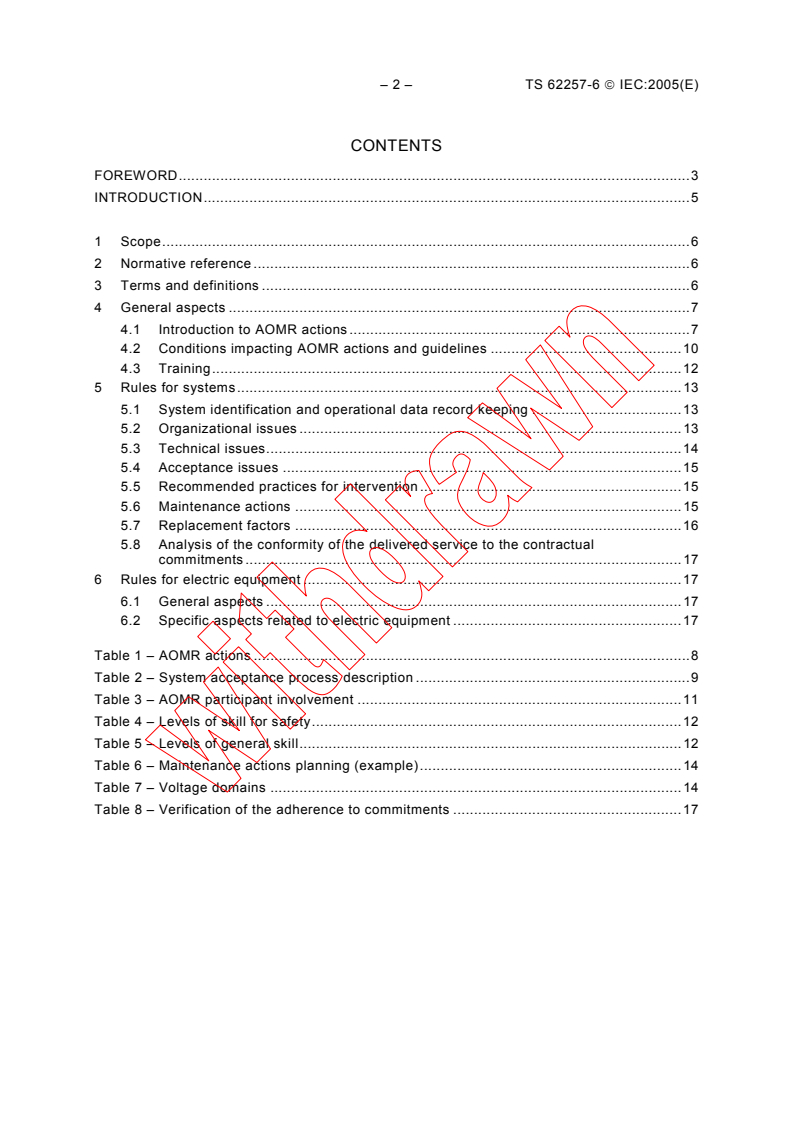
– 2 – TS 62257-6 IEC:2005(E)
CONTENTS
FOREWORD.3
INTRODUCTION.5
1 Scope.6
2 Normative reference .6
3 Terms and definitions .6
4 General aspects .7
4.1 Introduction to AOMR actions.7
4.2 Conditions impacting AOMR actions and guidelines .10
4.3 Training.12
5 Rules for systems.13
5.1 System identification and operational data record keeping .13
5.2 Organizational issues .13
5.3 Technical issues.14
5.4 Acceptance issues .15
5.5 Recommended practices for intervention .15
5.6 Maintenance actions .15
5.7 Replacement factors .16
5.8 Analysis of the conformity of the delivered service to the contractual
commitments .17
6 Rules for electric equipment .17
6.1 General aspects .17
6.2 Specific aspects related to electric equipment .17
Table 1 – AOMR actions .8
Table 2 – System acceptance process description .9
Table 3 – AOMR participant involvement .11
Table 4 – Levels of skill for safety.12
Table 5 – Levels of general skill.12
Table 6 – Maintenance actions planning (example).14
Table 7 – Voltage domains .14
Table 8 – Verification of the adherence to commitments .17
TS 62257-6 IEC:2005(E) – 3 –
INTERNATIONAL ELECTROTECHNICAL COMMISSION
____________
RECOMMENDATIONS FOR SMALL RENEWABLE ENERGY
AND HYBRID SYSTEMS FOR RURAL ELECTRIFICATION –
Part 6: Acceptance, operation, maintenance and replacement
FOREWORD
1) The International Electrotechnical Commission (IEC) is a worldwide organization for standardization comprising
all national electrotechnical committees (IEC National Committees). The object of IEC is to promote
international co-operation on all questions concerning standardization in the electrical and electronic fields. To
this end and in addition to other activities, IEC publishes International Standards, Technical Specifications,
Technical Reports, Publicly Available Specifications (PAS) and Guides (hereafter referred to as “IEC
Publication(s)”). Their preparation is entrusted to technical committees; any IEC National Committee interested
in the subject dealt with may participate in this preparatory work. International, governmental and non-
governmental organizations liaising with the IEC also participate in this preparation. IEC collaborates closely
with the International Organization for Standardization (ISO) in accordance with conditions determined by
agreement between the two organizations.
2) The formal decisions or agreements of IEC on technical matters express, as nearly as possible, an international
consensus of opinion on the relevant subjects since each technical committee has representation from all
interested IEC National Committees.
3) IEC Publications have the form of recommendations for international use and are accepted by IEC National
Committees in that sense. While all reasonable efforts are made to ensure that the technical content of IEC
Publications is accurate, IEC cannot be held responsible for the way in which they are used or for any
misinterpretation by any end user.
4) In order to promote international uniformity, IEC National Committees undertake to apply IEC Publications
transparently to the maximum extent possible in their national and regional publications. Any divergence
between any IEC Publication and the corresponding national or regional publication shall be clearly indicated in
the latter.
5) IEC provides no marking procedure to indicate its approval and cannot be rendered responsible for any
equipment declared to be in conformity with an IEC Publication.
6) All users should ensure that they have the latest edition of this publication.
7) No liability shall attach to IEC or its directors, employees, servants or agents including individual experts and
members of its technical committees and IEC National Committees for any personal injury, property damage or
other damage of any nature whatsoever, whether direct or indirect, or for costs (including legal fees) and
expenses arising out of the publication, use of, or reliance upon, this IEC Publication or any other IEC
Publications.
8) Attention is drawn to the Normative references cited in this publication. Use of the referenced publications is
indispensable for the correct application of this publication.
9) Attention is drawn to the possibility that some of the elements of this IEC Publication may be the subject of
patent rights. IEC shall not be held responsible for identifying any or all such patent rights.
The main task of IEC technical committees is to prepare International Standards. In
exceptional circumstances, a technical committee may propose the publication of a technical
specification when
• the required support cannot be obtained for the publication of an International Standard,
despite repeated efforts, or
• the subject is still under technical development or where, for any other reason, there is the
future but no immediate possibility of an agreement on an International Standard.
Technical specifications are subject to review within three years of publication to decide
whether they can be transformed into International Standards.
IEC 62257-6, which is a technical specification, has been prepared by IEC technical
committee 82: Solar photovoltaic energy systems.
This technical specification is based on IEC/PAS 62111(1999); it cancels and replaces the
relevant parts of IEC/PAS 62111.
– 4 – TS 62257-6 IEC:2005(E)
This technical specification is to be used in conjunction with
IEC 62257-1: Recommendations for small renewable energy and hybrid systems for rural
electrification – Part 1: General introduction to rural electrification
IEC 62257-2: Recommendations for small renewable energy and hybrid systems for rural
electrification – Part 2: From requirements to a range of electrification systems
IEC 62257-3: Recommendations for small renewable energy and hybrid systems for rural
electrification – Part 3: Project development and management
IEC 62257-4: Recommendations for small renewable energy and hybrid systems for rural
electrification – Part 4: System selection and design (to be published)
IEC 62257-5: Recommendations for small renewable energy and hybrid systems for rural
electrification – Part 5: Safety rules: Protection against electrical hazards (to be published)
IEC 62257-6: Recommendations for small renewable energy and hybrid systems for rural
electrification – Part 6: Acceptance, operation, maintenance and replacement
IEC 62257-7-1: Recommendations for small renewable energy and hybrid systems for rural
electrification – Part 7-1: Generators photovoltaic arrays (under consideration)
IEC 62257-9-2: Recommendations for small renewable energy and hybrid systems for rural
electrification – Part 9-2: Microgrid (under consideration)
IEC 62257-9-3: Recommendations for small renewable energy and hybrid systems for rural
electrification – Part 9-3: Integrated system – User's interface (under consideration)
IEC 62257-9-4: Recommendations for small renewable energy and hybrid systems for rural
electrification – Part 9-4: Integrated system – User's installation (under consideration)
The text of this technical specification is based on the following documents:
Enquiry draft Report on voting
82/371/FDIS 82/384/RVC
Full information on the voting for the approval of this technical specification can be found in
the report on voting indicated in the above table.
This publication has been drafted in accordance with the ISO/IEC Directives, Part 2.
The committee has decided that the contents of this publication will remain unchanged until
the maintenance result date indicated on the IEC web site under "http://webstore.iec.ch" in
the data related to the specific publication. At this date, the publication will be
• transformed into an International Standard;
• reconfirmed;
• withdrawn;
• replaced by a revised edition, or
• amended.
A bilingual version of this publication may be issued at a later date.
TS 62257-6 IEC:2005(E) – 5 –
INTRODUCTION
The IEC 62257 series intends to provide to the different players involved in rural electrification
projects (such as project implementers, project contractors, project supervisors, installers,
etc.) documents for the setting-up of renewable energy and hybrid systems with a.c. nominal
voltage below 500 V, d.c. nominal voltage below 750 V and nominal power below 100 kVA.
These documents are recommendations:
• to choose the right system for the right place;
• to design the system;
• to operate and maintain the system.
These documents are focused only on rural electrification concentrating on but not specific to
developing countries. They must not be considered as all inclusive to rural electrification. The
documents try to promote the use of renewable energies in rural electrification; they do not
deal with clean mechanisms developments at this time (CO emission, carbon credit, etc.).
Further developments in this field could be introduced in future steps.
This consistent set of documents is best considered as a whole with different parts
corresponding to items for safety, sustainability of systems and at the lowest life cycle cost as
possible. One of the main objectives is to provide the minimum sufficient requirements,
relevant to the field of application that is: small renewable energy and hybrid off-grid systems.
The purpose of this technical specification is to propose a methodology to achieve the best
technical and economic conditions for acceptance, operation, maintenance and replacement
of equipment and complete system life cycle.
– 6 – TS 62257-6 IEC:2005(E)
RECOMMENDATIONS FOR SMALL RENEWABLE ENERGY
AND HYBRID SYSTEMS FOR RURAL ELECTRIFICATION –
Part 6: Acceptance, operation, maintenance and replacement
1 Scope
This technical specification is intended to describe the various rules to be applied for
acceptance, operation, maintenance and replacement (AOMR) of decentralized rural
electrification systems (DRES) which are designed to supply electric power for sites which are
not connected to a large interconnected system, or a national grid, in order to meet basic
needs.
The majority of these sites are:
• isolated dwellings;
• village houses;
• community services (public lighting, pumping, health centers, places of worship or cultural
activities, administrative buildings, etc.);
• economic activities (workshops, micro-industry, etc.).
It proposes a methodology to achieve the best technical and economic conditions for accept-
ance, operation, maintenance and replacement of equipment and complete system life cycle.
It does not substitute for technical manuals provided by manufacturers for each equipment.
The complexity of the system and application will dictate the level of required AOMR
documentation.
2 Normative reference
The following referenced documents are indispensable for the application of this document.
For dated references, only the edition cited applies. For undated references, the latest edition
of the referenced document (including any amendments) applies.
IEC 62257 (all parts) Recommendations for small renewable energy and hybrid systems for
rural electrification
3 Terms and definitions
For the purposes of this document, the following terms and definitions apply.
3.1
AOMR actions
acceptance, operation , maintenance and replacement actions
3.2
implementation contract
contract between project developer and project implementer usually the result of a
competitive sollicitation for proposals developed by the project developer on the basis of the
general specification
TS 62257-6 IEC:2005(E) – 7 –
3.3
electric equipment
item used for such puposes as generation, conversion, transmission, distribution or utilization
of electric energy, such as electric machines, transformers, switchgear and controlgear,
measuring instruments, protective devices, wiring systems, current-using equipment
[IEV 826-16-01].
3.4
REN
renewable energy
4 General aspects
4.1 Introduction to AOMR actions
Isolated electrification systems are designed to supply power to those individuals,
communities or loads located in remote areas not connected to national grids.
These systems can be broken down into three categories:
• process electrification systems (for instance for pumping),
• individual electrification systems (IES) (single user, load or application),
• collective electrification systems (CES) (multiple user load or application).
In order to satisfy the various energy requirements both in terms of quality and quantity, six
types of isolated micropower systems have been identified (see IEC 62257-2).
AOMR actions are introduced in Table 1.
A basic system acceptance process description is given in Table 2.
– 8 – TS 62257-6 IEC:2005(E)
Table 1 – AOMR actions
Acceptance
• checking process to ensure that the system installation meets the requirement set forth in the
implementation contract between the project developer and the project implementer
• testing process to ensure that the micropower system operates according to the functional part
of the implementation contract
• once the parties have come to agreement, transfer the responsibility of the system
Operation
• managing business of system operation
• monitoring «normal» system operation
("normal" operation = system supplies power complying with all the characteristics of the expected
service, with the original designed configuration)
• managing system electrical operation = executing actions on electrical circuits (configuration
changes)
• response to abnormal operating conditions = to provide service outside of the boundaries of the
implementation contract (prolonged absence of REN sources)
• response to abnormal system operation
corrective actions (manual or automatic), troubleshooting and repair system or system
components (diagnosing the cause(s) for failure fault finding = to service the plant and restore
its operating conditions further to an unpredictable failure
• guaranteeing safety while performing (servicing) actions on the plant
• performing analysis and retrofit of the system to account for new operating conditions
Maintenance
• preventive maintenance: keeping and maintaining the system to its «normal» operating state
• corrective maintenance: adjusting, fixing or replacing components after fault recognition
• conducting periodic tests and inspection
Replacement • replacing the equipment on «normal» life cycle completion
• replacing the equipment for upgrading purpose
• dismantling and recycling at end of life cycle
TS 62257-6 IEC:2005(E) – 9 –
Table 2 – System acceptance process description
Acceptance process Objective Responsible Implementers Content of a suggested data sheet
Party
Phase 1 Preparation To collect all information on Project Project List of contractual documents to be provided
the system implementer implementer/
subcontractor
Phase 2 Check of existing To check that all non Project Consultant List of contractual documents to be provided
documentation, contract operational contractual developer engineer
clauses requirements are met:
Documentation, manuals,
spare parts, drawings,
procedures, warranty
contracts, etc.
Phase 3 Commissioning step 1: To check that the equipment Project Consultant Equipment list:
Evaluation of the conformity of complies to the contractual developer engineer
Initial design list/as built list/comments
the installed system with the accepted design and any
accepted design differences are explained
Commissioning step 2: To check that the system is Project Project Letter
Evaluation of qualification of ready to be operated implementer implementer/
the installation subcontractor
Commissioning step 3: To test that the system Project Consultant Component by component, verification:
Preliminary tests components operate correctly developer engineer
Proper type and reference according to the as built list
Proper installation: check list of key points
Proper operation: list of tests with targeted performances
to be obtained
Commissioning step 4: To check all the operating Project Consultant List of system tests with targeted performances to be
Performance testing performances of the whole developer engineer obtained
system
Phase 4 Agreement Transfer of responsibility Project Letter of acceptance
implementer/
developer/
operator/
owner
– 10 – TS 62257-6 IEC:2005(E)
4.2 Conditions impacting AOMR actions and guidelines
4.2.1 Characteristics of the project/systems to be managed
Characteristics of systems and their installation environment will have an influence on the
organizational schemes to perform AOMR actions.
Among these influence factors the following are highlighted:
• geographical layout: number of systems, their location and dispersion will determine spare
parts and tool requirements, technician and equipment transportation means, mean time
to repair and perhaps methodology for collecting money;
• systems size and technology will have an influence on the maintenance program, the skill
level of technician, and final user’s involvement;
• the degree of m
...