

IEC TS 62257-8-1:2007
(Main)Recommendations for small renewable energy and hybrid systems for rural electrification - Part 8-1: Selection of batteries and battery management systems for stand-alone electrification systems - Specific case of automotive flooded lead-acid batteries available in developing countries
General Information
- Abstract
Proposes simple, inexpensive, comparative tests in order to discriminate easily, in a panel of automotive flooded lead-acid batteries the most acceptable model for PV Individual Electrification Systems.
- Status
- Published
- Publication Date
- 20-Jun-2007
- Technical Committee
- TC 82 - Solar photovoltaic energy systems
- Drafting Committee
- JWG 1 - TC 82/JWG 1
- Current Stage
- DELPUB - Deleted Publication
- Start Date
- 27-Feb-2018
- Completion Date
- 28-Aug-2026
Buy Documents
IEC TS 62257-8-1:2007 - Recommendations for small renewable energy and hybrid systems for rural electrification - Part 8-1: Selection of batteries and battery management systems for stand-alone electrification systems - Specific case of automotive flooded lead-acid batteries available in developing countries Released:6/21/2007
Overview
IEC TS 62257-8-1:2007 provides practical recommendations for selecting automotive flooded lead‑acid batteries and associated battery management systems (BMS) for small, stand‑alone photovoltaic (PV) electrification in rural and developing‑country contexts. Part of the IEC 62257 series on rural electrification, this Technical Specification (not a type‑approval standard) proposes simple, inexpensive comparative tests and installation rules so project teams can evaluate locally available car or truck batteries for PV individual electrification systems.
Key topics and requirements
- Purpose and scope
- Guidance to discriminate between locally available automotive flooded lead‑acid battery models for off‑grid PV use.
- Designed for inexpensive laboratory testing in developing countries using common equipment.
- Comparative testing procedures
- Test 1 – Battery endurance test: evaluates battery performance under charge/discharge cycles relevant to PV systems.
- Test 2 – Endurance test for battery + BMS: verifies battery behavior when paired with battery management/protection devices.
- Test 3 – Battery storability test: assesses capacity retention and self‑discharge during storage.
- Includes methods to determine test charge/discharge current and temperature‑related voltage regulation guidance.
- Battery characteristics and selection
- Practical checks of battery cases, terminals and electrolyte handling for safety and site durability.
- Recommendations for documentation and marking to prevent spillage and ensure safe handling.
- Installation, safety and lifecycle
- Rules for packing, shipping, environment, battery housing, venting and protection against short circuits.
- Final inspection, safety information, administrative formalities and recycling considerations.
Practical applications and users
This Technical Specification is aimed at organizations and individuals involved in rural electrification projects:
- Project implementers, contractors and supervisors needing to choose cost‑effective local batteries for PV individual systems.
- Field engineers and installers who must ensure safe battery accommodation and basic BMS compatibility.
- Local testing laboratories in developing countries that require low‑cost, pragmatic test methods to compare battery models.
- NGOs and rural energy programs looking to optimize life‑cycle performance and safety of off‑grid battery systems.
Benefits: enables selection of the most acceptable locally‑available automotive flooded lead‑acid battery for PV use, reduces project risk, and supports safer, longer‑lasting stand‑alone electrification systems.
Related standards
- IEC 62257 (all parts) – Recommendations for small renewable and hybrid rural electrification systems.
- IEC 61427 – Secondary cells and batteries for photovoltaic energy systems (general requirements and test methods).
- IEC 60050‑482 – Terminology for primary and secondary cells and batteries.
Keywords: IEC TS 62257-8-1:2007, automotive flooded lead‑acid batteries, battery management system, BMS, rural electrification, PV individual electrification systems, comparative tests, developing countries.
Relations
- Effective Date
- 05-Sep-2023
Buy Documents
IEC TS 62257-8-1:2007 - Recommendations for small renewable energy and hybrid systems for rural electrification - Part 8-1: Selection of batteries and battery management systems for stand-alone electrification systems - Specific case of automotive flooded lead-acid batteries available in developing countries Released:6/21/2007
Get Certified
Connect with accredited certification bodies for this standard

DNV
DNV is an independent assurance and risk management provider.

Lloyd's Register
Lloyd's Register is a global professional services organisation specialising in engineering and technology.
DNV Energy Systems
Energy and renewable energy certification.
Sponsored listings
Frequently Asked Questions
IEC TS 62257-8-1:2007 is a technical specification published by the International Electrotechnical Commission (IEC). Its full title is "Recommendations for small renewable energy and hybrid systems for rural electrification - Part 8-1: Selection of batteries and battery management systems for stand-alone electrification systems - Specific case of automotive flooded lead-acid batteries available in developing countries". This standard covers: Proposes simple, inexpensive, comparative tests in order to discriminate easily, in a panel of automotive flooded lead-acid batteries the most acceptable model for PV Individual Electrification Systems.
Proposes simple, inexpensive, comparative tests in order to discriminate easily, in a panel of automotive flooded lead-acid batteries the most acceptable model for PV Individual Electrification Systems.
IEC TS 62257-8-1:2007 is classified under the following ICS (International Classification for Standards) categories: 27.160 - Solar energy engineering; 27.180 - Wind turbine energy systems. The ICS classification helps identify the subject area and facilitates finding related standards.
IEC TS 62257-8-1:2007 has the following relationships with other standards: It is inter standard links to IEC TS 62257-8-1:2018. Understanding these relationships helps ensure you are using the most current and applicable version of the standard.
IEC TS 62257-8-1:2007 is available in PDF format for immediate download after purchase. The document can be added to your cart and obtained through the secure checkout process. Digital delivery ensures instant access to the complete standard document.
Standards Content (Sample)
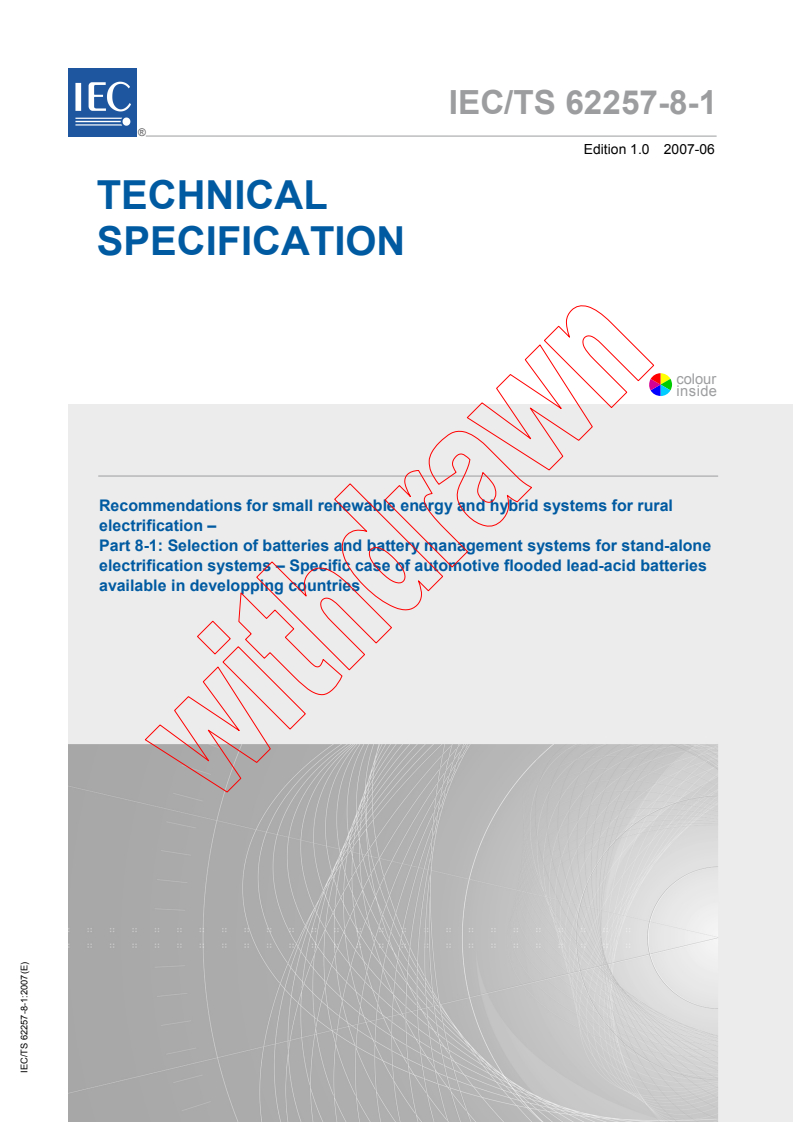
IEC/TS 62257-8-1 ®
Edition 1.0 2007-06
TECHNICAL
SPECIFICATION
colour
inside
Recommendations for small renewable energy and hybrid systems for rural
electrification –
Part 8-1: Selection of batteries and battery management systems for stand-alone
electrification systems – Specific case of automotive flooded lead-acid batteries
available in developping countries
IEC/TS 62257-8-1:2007(E)
All rights reserved. Unless otherwise specified, no part of this publication may be reproduced or utilized in any form or by
any means, electronic or mechanical, including photocopying and microfilm, without permission in writing from either IEC or
IEC's member National Committee in the country of the requester.
If you have any questions about IEC copyright or have an enquiry about obtaining additional rights to this publication,
please contact the address below or your local IEC member National Committee for further information.
Droits de reproduction réservés. Sauf indication contraire, aucune partie de cette publication ne peut être reproduite
ni utilisée sous quelque forme que ce soit et par aucun procédé, électronique ou mécanique, y compris la photocopie
et les microfilms, sans l'accord écrit de la CEI ou du Comité national de la CEI du pays du demandeur.
Si vous avez des questions sur le copyright de la CEI ou si vous désirez obtenir des droits supplémentaires sur cette
publication, utilisez les coordonnées ci-après ou contactez le Comité national de la CEI de votre pays de résidence.
IEC Central Office
3, rue de Varembé
CH-1211 Geneva 20
Switzerland
Email: inmail@iec.ch
Web: www.iec.ch
About IEC publications
The technical content of IEC publications is kept under constant review by the IEC. Please make sure that you have the
latest edition, a corrigenda or an amendment might have been published.
Catalogue of IEC publications: www.iec.ch/searchpub
The IEC on-line Catalogue enables you to search by a variety of criteria (reference number, text, technical committee,…).
It also gives information on projects, withdrawn and replaced publications.
IEC Just Published: www.iec.ch/online_news/justpub
Stay up to date on all new IEC publications. Just Published details twice a month all new publications released. Available
on-line and also by email.
Electropedia: www.electropedia.org
The world's leading online dictionary of electronic and electrical terms containing more than 20 000 terms and definitions
in English and French, with equivalent terms in additional languages. Also known as the International Electrotechnical
Vocabulary online.
Customer Service Centre: www.iec.ch/webstore/custserv
If you wish to give us your feedback on this publication or need further assistance, please visit the Customer Service
Centre FAQ or contact us:
Email: csc@iec.ch
Tel.: +41 22 919 02 11
Fax: +41 22 919 03 00
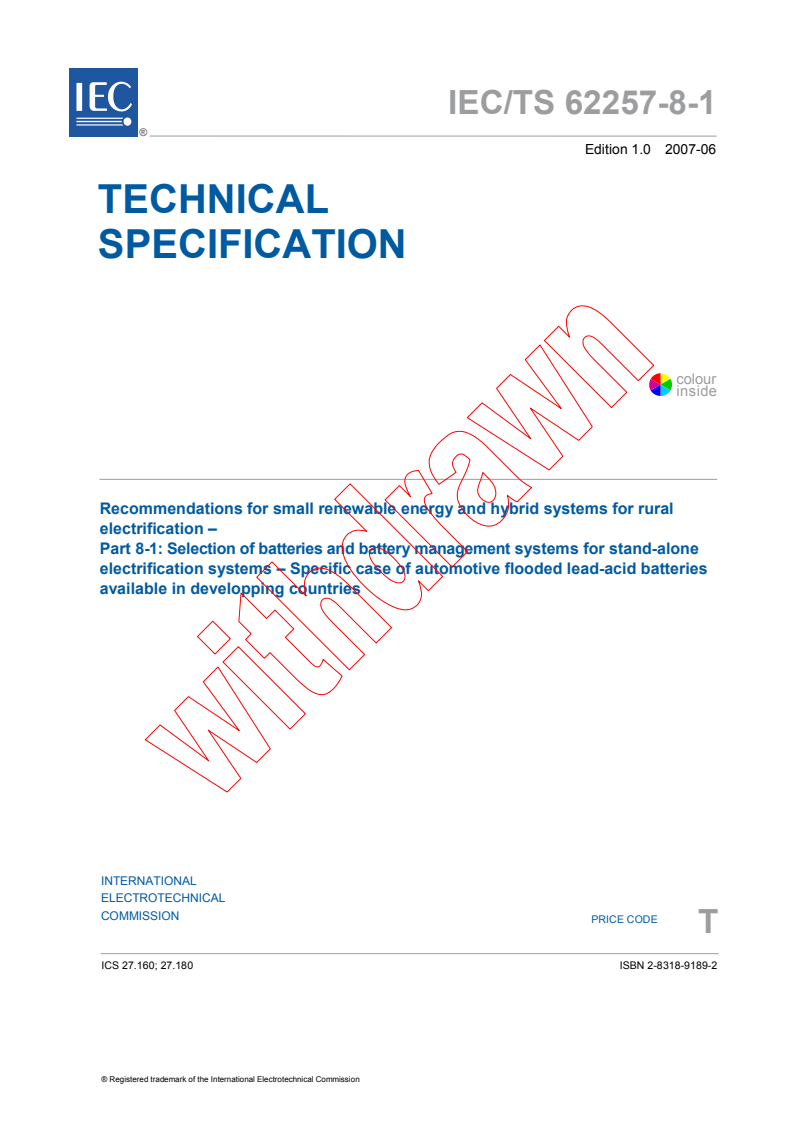
IEC/TS 62257-8-1 ®
Edition 1.0 2007-06
TECHNICAL
SPECIFICATION
colour
inside
Recommendations for small renewable energy and hybrid systems for rural
electrification –
Part 8-1: Selection of batteries and battery management systems for stand-alone
electrification systems – Specific case of automotive flooded lead-acid batteries
available in developping countries
INTERNATIONAL
ELECTROTECHNICAL
COMMISSION
PRICE CODE
T
ICS 27.160; 27.180 ISBN 2-8318-9189-2
– 2 – TS 62257-8-1 © IEC:2007(E)
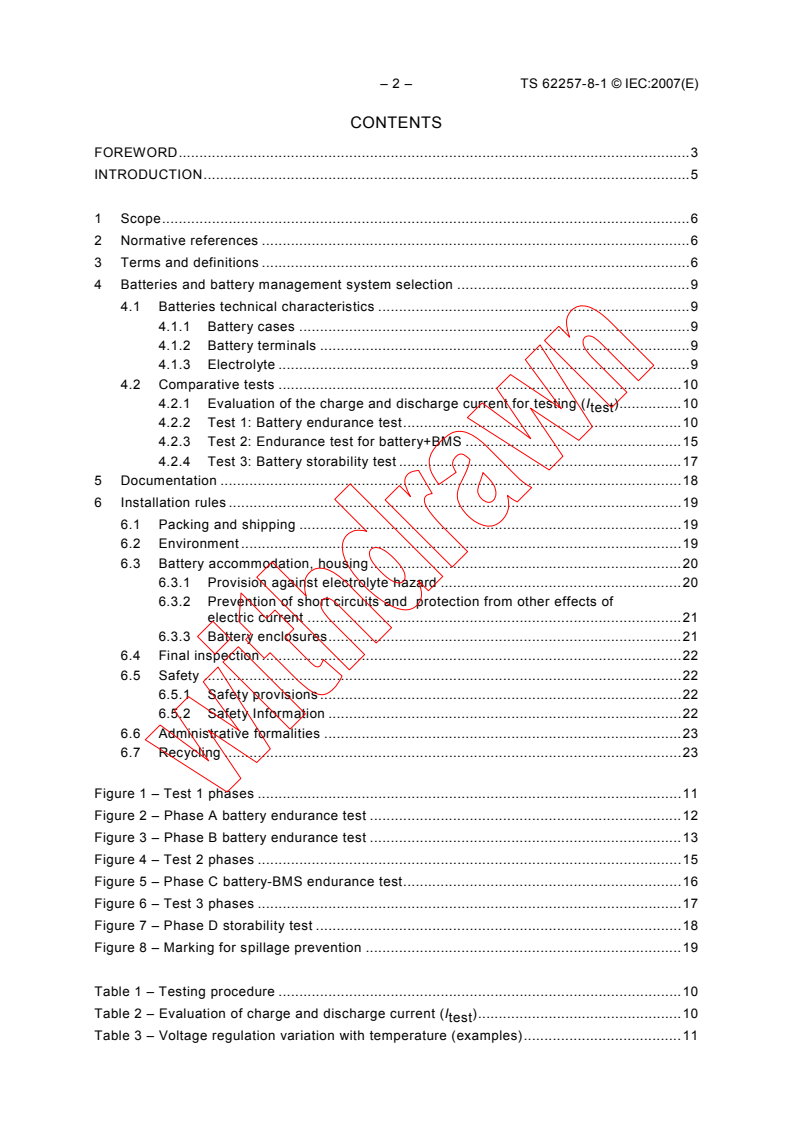
CONTENTS
FOREWORD.3
INTRODUCTION.5
1 Scope.6
2 Normative references .6
3 Terms and definitions .6
4 Batteries and battery management system selection .9
4.1 Batteries technical characteristics .9
4.1.1 Battery cases .9
4.1.2 Battery terminals .9
4.1.3 Electrolyte .9
4.2 Comparative tests .10
4.2.1 Evaluation of the charge and discharge current for testing (I ).10
test
4.2.2 Test 1: Battery endurance test.10
4.2.3 Test 2: Endurance test for battery+BMS .15
4.2.4 Test 3: Battery storability test .17
5 Documentation .18
6 Installation rules .19
6.1 Packing and shipping .19
6.2 Environment .19
6.3 Battery accommodation, housing.20
6.3.1 Provision against electrolyte hazard .20
6.3.2 Prevention of short circuits and protection from other effects of
electric current .21
6.3.3 Battery enclosures.21
6.4 Final inspection .22
6.5 Safety .22
6.5.1 Safety provisions .22
6.5.2 Safety Information .22
6.6 Administrative formalities .23
6.7 Recycling .23
Figure 1 – Test 1 phases .11
Figure 2 – Phase A battery endurance test .12
Figure 3 – Phase B battery endurance test .13
Figure 4 – Test 2 phases .15
Figure 5 – Phase C battery-BMS endurance test.16
Figure 6 – Test 3 phases .17
Figure 7 – Phase D storability test .18
Figure 8 – Marking for spillage prevention .19
Table 1 – Testing procedure .10
Table 2 – Evaluation of charge and discharge current (I ).10
test
Table 3 – Voltage regulation variation with temperature (examples).11
TS 62257-8-1 © IEC:2007(E) – 3 –
INTERNATIONAL ELECTROTECHNICAL COMMISSION
____________
RECOMMENDATIONS FOR SMALL RENEWABLE ENERGY AND
HYBRID SYSTEMS FOR RURAL ELECTRIFICATION –
Part 8-1: Selection of batteries and battery management
systems for stand-alone electrification systems –
Specific case of automotive flooded lead-acid batteries
available in developing countries
FOREWORD
1) The International Electrotechnical Commission (IEC) is a worldwide organization for standardization comprising
all national electrotechnical committees (IEC National Committees). The object of IEC is to promote
international co-operation on all questions concerning standardization in the electrical and electronic fields. To
this end and in addition to other activities, IEC publishes International Standards, Technical Specifications,
Technical Reports, Publicly Available Specifications (PAS) and Guides (hereafter referred to as “IEC
Publication(s)”). Their preparation is entrusted to technical committees; any IEC National Committee interested
in the subject dealt with may participate in this preparatory work. International, governmental and non-
governmental organizations liaising with the IEC also participate in this preparation. IEC collaborates closely
with the International Organization for Standardization (ISO) in accordance with conditions determined by
agreement between the two organizations.
2) The formal decisions or agreements of IEC on technical matters express, as nearly as possible, an international
consensus of opinion on the relevant subjects since each technical committee has representation from all
interested IEC National Committees.
3) IEC Publications have the form of recommendations for international use and are accepted by IEC National
Committees in that sense. While all reasonable efforts are made to ensure that the technical content of IEC
Publications is accurate, IEC cannot be held responsible for the way in which they are used or for any
misinterpretation by any end user.
4) In order to promote international uniformity, IEC National Committees undertake to apply IEC Publications
transparently to the maximum extent possible in their national and regional publications. Any divergence
between any IEC Publication and the corresponding national or regional publication shall be clearly indicated in
the latter.
5) IEC provides no marking procedure to indicate its approval and cannot be rendered responsible for any
equipment declared to be in conformity with an IEC Publication.
6) All users should ensure that they have the latest edition of this publication.
7) No liability shall attach to IEC or its directors, employees, servants or agents including individual experts and
members of its technical committees and IEC National Committees for any personal injury, property damage or
other damage of any nature whatsoever, whether direct or indirect, or for costs (including legal fees) and
expenses arising out of the publication, use of, or reliance upon, this IEC Publication or any other IEC
Publications.
8) Attention is drawn to the Normative references cited in this publication. Use of the referenced publications is
indispensable for the correct application of this publication.
9) Attention is drawn to the possibility that some of the elements of this IEC Publication may be the subject of
patent rights. IEC shall not be held responsible for identifying any or all such patent rights.
The main task of IEC technical committees is to prepare International Standards. In
exceptional circumstances, a technical committee may propose the publication of a technical
specification when
• the required support cannot be obtained for the publication of an International Standard,
despite repeated efforts, or
• the subject is still under technical development or where, for any other reason, there is the
future but no immediate possibility of an agreement on an International Standard.
Technical specifications are subject to review within three years of publication to decide
whether they can be transformed into International Standards.
IEC 62257-8-1, which is a technical specification, has been prepared by IEC technical
committee 82: Solar photovoltaic energy systems.
– 4 – TS 62257-8-1 © IEC:2007(E)
This document is based on IEC/PAS 62111 (1999); it cancels and replaces the relevant parts
of IEC/PAS 62111.
This part of IEC 62257 is to be used in conjunction with the IEC 62257 series.
It is also to be used with future parts of this series as and when they are published.
The text of this technical specification is based on the following documents:
Enquiry draft Report on voting
82/457/DTS 82/476/RVC
Full information on the voting for the approval of this technical specification can be found in
the report on voting indicated in the above table.
This publication has been drafted in accordance with the ISO/IEC Directives, Part 2.
The committee has decided that the contents of this publication will remain unchanged until
the maintenance result date indicated on the IEC web site under "http://webstore.iec.ch" in
the data related to the specific publication. At this date, the publication will be
• transformed into an International Standard,
• reconfirmed,
• withdrawn,
• replaced by a revised edition, or
• amended.
A bilingual version of this publication may be issued at a later date.
IMPORTANT – The “colour inside” logo on the cover page of this publication indicates
that it contains colours which are considered to be useful for the correct understanding
of its contents. Users should therefore print this publication using a colour printer.
TS 62257-8-1 © IEC:2007(E) – 5 –
INTRODUCTION
The IEC 62257 series of documents intends to provide to different players involved in rural
electrification projects (such as project implementers, project contractors, project supervisors,
installers, etc.) documents for the setting up of renewable energy and hybrid systems with a.c.
voltage below 500 V, d.c. voltage below 750 V and power below 100 kVA.
These documents are recommendations:
• to choose the right system for the right place;
• to design the system;
• to operate and maintain the system.
These documents are focused only on rural electrification concentrating on but not specific to
developing countries. They must not be considered as all inclusive to rural electrification. The
documents try to promote the use of renewable energies in rural electrification; they do not
deal with clean mechanisms developments at this time (CO emission, carbon credit, etc.).
Further developments in this field could be introduced in future steps.
This consistent set of documents is best considered as a whole with different parts
corresponding to items for safety, sustainability of systems and at the lowest life cycle cost as
possible. One of the main objectives is to provide the minimum sufficient requirements,
relevant to the field of application that is: small renewable energy and hybrid off-grid systems.
For rural electrification project using PV systems, it is recommended to use solar batteries
defined in IEC 61427.
Nevertheless in many situations, it is a fact that most of the rural electrification projects are
implemented using locally made automotive flooded lead–acid batteries. But these products
are not designed for photovoltaic systems application. There is presently no test to
discriminate, in a panel of models of such batteries, which one could provide the best service
as close as possible to the requirement of the General Specification as a storage application
for small PV individual electrification systems (see IEC 62257-2) in an economically viable
way.
The purpose of Part 8-1 of IEC 62257 is to propose tests for automotive lead acid batteries
and batteries management systems used in small PV Individual Electrification Systems
This document and the others in the IEC 62257 series are only guidance and so cannot be
international standards. Additionally, their subject is still under technical development and so
they shall be published as Technical Specifications.
NOTE The IEC 62257 series of Technical Specifications is based on IEC/PAS 62111 (1999-07) and is developed
in accordance with the PAS procedure.
– 6 – TS 62257-8-1 © IEC:2007(E)
RECOMMENDATIONS FOR SMALL RENEWABLE ENERGY AND
HYBRID SYSTEMS FOR RURAL ELECTRIFICATION –
Part 8-1: Selection of batteries and battery management
systems for stand-alone electrification systems –
Specific case of automotive flooded lead-acid batteries
available in developing countries
1 Scope
This Technical Specification proposes simple, cheap, comparative tests in order to
discriminate easily, in a panel of automotive flooded lead-acid batteries the most acceptable
model for PV Individual Electrification Systems.
It could be particularly useful for project implementers to test in laboratories of developing
countries, the capability of locally made car or truck batteries to be used for their project.
Furthermore battery testing specifications usually need too costly and too much sophisticated
test equipment to be applied in developing countries laboratories.
The tests provided in this document allow to assess batteries performances according to the
general specification of the project (see IEC 62257-2) and batteries associated with their
Battery Management System (BMS) in a short time and with common technical means. They
can be performed locally, as close as possible to the real site operating conditions.
The document provides also regulations and installation conditions to be complied with in
order to ensure the life and proper operation of the installations as well as the safety of
people living in proximity to the installation.
This document is not a type approval standard. It is a technical specification to be used as
guidelines and does not replace any existing IEC standard on batteries.
2 Normative references
The following referenced documents are indispensable for the application of this document.
For dated references, only the edition cited applies. For undated references, the latest edition
of the referenced document (including any amendments) applies.
IEC 60050-482, International Electrotechnical Vocabulary (IEV) – Part 482: Primary and
secondary cells and batteries
IEC 61427, Secondary cells and batteries for photovoltaic energy systems (PVES) – General
requirements and methods of test
IEC 62257 (all parts), Recommendations for small renewable energy and hybrid systems for
rural electrification
3 Terms and definitions
For the purposes of this document, the terms and definitions for secondary cells and batteries
given in IEC 60050-482 and the following apply.
TS 62257-8-1 © IEC:2007(E) – 7 –
3.1
electrochemical cell or battery
electrochemical system capable of storing in chemical form the electric energy received and
which can give it back by conversion
3.2
secondary cell
cell which is designed to be electrically recharged
NOTE The recharge is accomplished by way of a reversible chemical reaction.
[IEV 482-01-03]
3.3
storage battery (secondary battery)
two or more secondary cells connected together and used as a source of electric energy
3.4
lead-acid battery
storage battery in which the electrodes are made mainly from lead and the electrolyte is a
sulphuric acid solution
3.5
terminal (pole)
conductive part provided for the connection of a cell or battery to external conductors
3.6
density
commonly considered as the volumic mass, in kg / dm
NOTE Density is also defined as a dimensionless magnitude expressing the ratio of the electrolyte mass to the
water mass occupying the same volume at 4°C.
3.7
electrolyte
liquid or solid substance containing mobile ions which render it ionically conductive
NOTE The electrolyte may be liquid, solid or a gel.
[IEV 482-02-29]
3.8
dry charged battery
state of delivery of some types of secondary battery where the cells contain no electrolyte and
the plates are dry and in a charged state
[IEV 482-05-30]
3.9
self-discharge
phenomenon by which a cell or battery loses energy in other ways than by discharge into and
external circuit
[IEV 482-03-27]
3.10
observed battery capacity
quantity of electricity or electrical charge that a battery in high state of charge can deliver
under the proposed test conditions. In practice, battery capacity is expressed in Ampere-
hours(Ah)
– 8 – TS 62257-8-1 © IEC:2007(E)
3.11
nominal capacity
suitable approximate quantity of electricity, used to identify the capacity of a cell or a battery
NOTE This value is usually expressed in Ampere-hours (Ah).
3.12
rated capacity (of a cell or a battery)
quantity of electricity, declared by the manufacturer, which a cell or a battery can deliver
under specified conditions after a full charge
NOTE 1 The rated capacity shown on the battery label is given for a discharge period which depends on the
technology used in the battery.
NOTE 2 The capacity of a battery is higher when it is discharged slowly. For example, variations are in the order
of 10 % to 20 % between a capacity measured over 5 hours and a capacity measured over 100 hours.
3.13
short-circuit current
maximum current given by a battery into a circuit of a very low resistance compared with that
of the battery, under specified conditions
3.14
charge rate
electric current at which a secondary cell or battery is charged
NOTE The charge rate is expressed as the reference current I = C /n where C is the rated capacity declared by
t r r
the manufacturer and n is the time base in hours for which the rated capacity is declared.
[IEV 482-05-45]
3.15
ambient temperature
temperature of the medium in the immediate vicinity of a battery
3.16
gassing of a cell
evolution of a gas resulting from electrolysis of the water in the electrolyte of a cell
[IEV 482-05-51]
3.17
constant current charge
charge during which the electric current is maintained at a constant value regardless of the
battery voltage or temperature
[IEV 482-05-38]
3.18
initial charge
commissioning charge given to a new battery to bring it to the fully charged state
3.19
cycling (of a cell or battery)
set of operations that is carried out on a secondary cell or battery and is repeated regularly in
the same sequence
NOTE In a secondary battery these operations may consist of a sequence of a discharge followed by a charge of
a charge followed by a discharge under specified conditions. This sequence may include rest periods.
[IEV 482-05-28]
TS 62257-8-1 © IEC:2007(E) – 9 –
3.20
commissioning
final checking of installation and operation of a battery on site.
3.21
BMS
battery management system (or battery charge/discharge controller)
4 Batteries and battery management system selection
4.1 Battery technical characteristics
4.1.1 Battery cases
Battery cases shall be made of suitable materials capable of withstanding impacts and shocks
and resistant to acid.
4.1.2 Battery terminals
Terminals shall be protected against accidental short circuits. Positive and negative polarities
shall be identified.
4.1.3 Electrolyte
The electrolyte for lead acid batteries is prepared from special sulphuric acid for storage
batteries. It shall be colorless, odorless and free of all insoluble material deposits. As there is
no standard for such an electrolyte, impurity levels shall follow the battery manufacturer
requirements.
The electrolyte level checking interval varies depending on:
• the type of battery;
• the temperature;
• the use;
• the regulation algorithms of the charge controller;
• the battery age;
• the quality of distilled water;
• the PV resource.
The service interval would be determined by the above parameters and electrolyte reservoir
size which is a specification of the specific battery used. Care should be used to ensure that
the service interval is within the capability of the maintenance organization.
The batteries shall be designed in order to be able to check the electrolyte levels and to add
distilled water.
NOTE 1 Faradic water consumption for vented batteries:
when a battery reaches its fully state of charge, water electrolysis occurs according to the Faraday’s Law.
Under standard conditions:
3 3
1 Ah decomposes H O into 0,42 dm H + 0,21 dm O
2 2 2
Decomposition of 1 cm (1 g) H O requires 3 Ah
An estimation of water consumption of a battery is given by
Battery H2O (g) consumption = (X Ah charged – Y Ah discharged) × number of cells in battery / 3.
– 10 – TS 62257-8-1 © IEC:2007(E)
NOTE 2 The number of cells for a 12 V lead acid battery is 6.
4.2 Comparative tests
The proposed comparative tests are designed to discriminate the most appropriate batteries
taking in consideration the techno economic context of the project.
These comparative tests include a sequence of three tests as indicated in Table 1.
IMPORTANT: All the batteries shall be tested simultaneously in order to ensure that they are
tested in the same conditions (insulation, temperature, etc.).
Table 1 – Testing procedure
Test 2: the couple battery-BMS is selected with another
endurance test
Test 1: most durable batteries are first selected with a
battery endurance test
See 4.2.3
See 4.2.2 Test 3: in parallel to test 2, the selected batteries are
subjected to a storability test
See 4.2.4
The installation rules for batteries provided in Clause 6 are also applicable to test installations.
4.2.1 Evaluation of the charge and discharge current for testing (I )
test
Automotive lead acid batteries are typically rated at C .
The proposed test uses a C I . The C capacity of any battery may be obtained from its
10 test 10
manufacturer.
If not, Table 2 gives an assessment of the C I value for a 100 Ah C battery.
10 test 20
Table 2 – Evaluation of charge and discharge current (I )
test
Nominal Evaluation of Value of I
test
C capacity C capacity
(C × 0,1)
20 10
(Ah) (Ah)
(A)
100 87 8,7
For anot
...