

IEC TS 62257-9-5:2007
(Main)Recommendations for small renewable energy and hybrid systems for rural electrification - Part 9-5: Integrated system - Selection of portable PV lanterns for rural electrification projects
General Information
- Abstract
Applies to portable solar photovoltaic lanterns (portable PV lantern) and is independent of the technology used to provide the light.
- Status
- Published
- Publication Date
- 20-Jun-2007
- Technical Committee
- TC 82 - Solar photovoltaic energy systems
- Current Stage
- DELPUB - Deleted Publication
- Start Date
- 03-Apr-2013
- Completion Date
- 28-Aug-2026
Buy Documents
IEC TS 62257-9-5:2007 - Recommendations for small renewable energy and hybrid systems for rural electrification - Part 9-5: Integrated system - Selection of portable PV lanterns for rural electrification projects Released:6/21/2007
Overview
IEC TS 62257-9-5:2007 offers technical recommendations for the selection of portable solar photovoltaic (PV) lanterns used in rural electrification projects. Developed by the International Electrotechnical Commission (IEC), this specification supports implementers of small renewable energy and hybrid systems, focusing on off-grid and rural communities. The standard provides a methodology for assessing and comparing portable PV lanterns, ensuring their suitability for delivering reliable, safe, and cost-effective lighting. The guidance is independent of lighting technology, addressing solutions that promote access to energy for underserved populations.
Key Topics
- Scope of Application: Applies exclusively to portable PV lanterns, regardless of the underlying lighting technology (e.g., LED, CFL).
- System Components: Defines necessary elements for a portable PV lantern, including casing, PV module (integrated or separate), light source(s), battery, charge controller, switches, and indicators.
- Specification and Pre-selection: Recommends establishing minimum requirements for illuminance, daily service duration, product lifetime, enclosure protection (IP and IK codes), and operating conditions relevant to the project’s geographical context.
- Performance Testing: Outlines comparative test procedures:
- Visual inspection (initial and final)
- Lighting service tests (single-use and repeated-use performance)
- Durability and reliability under real-use scenarios
- Storability and resilience to environmental factors
- Documentation and Supplier Evaluation: Emphasizes the need for user manuals, technical datasheets, and clear demonstration that products meet project specifications.
Applications
Rural electrification project developers, contractors, NGOs, and government agencies use IEC TS 62257-9-5 as a reference for:
- Product Evaluation and Procurement: The standard provides a basis for comparing portable solar lanterns, streamlining the selection process, and ensuring only compliant products are procured.
- Quality Assurance: By following the recommended tests for illuminance, service duration, and robustness, stakeholders can ensure products are suitable for harsh rural environments and meet user needs.
- Project Planning and Implementation: Ensures that selected PV lanterns align with the technical, environmental, and user requirements defined in the project's general specifications (GS).
- Sustainable Development: Supports the adoption of renewable energy technologies in off-grid communities, contributing to broader goals like energy access, reduced reliance on fossil fuels, and improved safety.
By adopting these recommendations, organizations can enhance the reliability, sustainability, and user satisfaction of rural lighting projects. The standard is particularly valuable in contexts where technical resources are limited, enabling local testing and validation of products prior to broad deployment.
Related Standards
For a comprehensive approach to rural electrification with small renewable systems, IEC TS 62257-9-5 should be used in conjunction with:
- IEC 62257 Series: Covers broader aspects of renewable and hybrid systems for rural electrification, including design, installation, operation, and maintenance.
- IEC 62262: Specifies degrees of protection provided by enclosures for electrical equipment (IK code).
- IEC/PAS 62111: Earlier specification for PV-based lighting, partially replaced by the IEC 62257-9-5.
- Other IEC Standards: Referenced for testing, safety, and environmental performance.
Conclusion
IEC TS 62257-9-5:2007 is a key standard for rural electrification initiatives, enabling the selection of portable solar PV lanterns that deliver reliable, safe, and efficient lighting. By following its structured approach, project implementers can make informed decisions, enhance energy access, and foster sustainable development in rural communities.
Keywords: IEC TS 62257-9-5, portable PV lantern, rural electrification, renewable energy, solar lighting standard, off-grid lighting, product testing, IEC standards, system selection, sustainable energy solutions.
Relations
- Effective Date
- 05-Sep-2023
Buy Documents
IEC TS 62257-9-5:2007 - Recommendations for small renewable energy and hybrid systems for rural electrification - Part 9-5: Integrated system - Selection of portable PV lanterns for rural electrification projects Released:6/21/2007
Get Certified
Connect with accredited certification bodies for this standard

DNV
DNV is an independent assurance and risk management provider.

Lloyd's Register
Lloyd's Register is a global professional services organisation specialising in engineering and technology.
DNV Energy Systems
Energy and renewable energy certification.
Sponsored listings
Frequently Asked Questions
IEC TS 62257-9-5:2007 is a technical specification published by the International Electrotechnical Commission (IEC). Its full title is "Recommendations for small renewable energy and hybrid systems for rural electrification - Part 9-5: Integrated system - Selection of portable PV lanterns for rural electrification projects". This standard covers: Applies to portable solar photovoltaic lanterns (portable PV lantern) and is independent of the technology used to provide the light.
Applies to portable solar photovoltaic lanterns (portable PV lantern) and is independent of the technology used to provide the light.
IEC TS 62257-9-5:2007 is classified under the following ICS (International Classification for Standards) categories: 27.160 - Solar energy engineering; 27.180 - Wind turbine energy systems. The ICS classification helps identify the subject area and facilitates finding related standards.
IEC TS 62257-9-5:2007 has the following relationships with other standards: It is inter standard links to IEC TS 62257-9-5:2013. Understanding these relationships helps ensure you are using the most current and applicable version of the standard.
IEC TS 62257-9-5:2007 is available in PDF format for immediate download after purchase. The document can be added to your cart and obtained through the secure checkout process. Digital delivery ensures instant access to the complete standard document.
Standards Content (Sample)
IEC/TS 62257-9-5 ®
Edition 1.0 2007-06
TECHNICAL
SPECIFICATION
colour
inside
Recommendations for small renewable energy and hybrid systems for rural
electrification –
Part 9-5: Integrated system – Selection of portable PV lanterns for rural
electrification projects
IEC/TS 62257-9-5:2007(E)
All rights reserved. Unless otherwise specified, no part of this publication may be reproduced or utilized in any form or by
any means, electronic or mechanical, including photocopying and microfilm, without permission in writing from either IEC or
IEC's member National Committee in the country of the requester.
If you have any questions about IEC copyright or have an enquiry about obtaining additional rights to this publication,
please contact the address below or your local IEC member National Committee for further information.
Droits de reproduction réservés. Sauf indication contraire, aucune partie de cette publication ne peut être reproduite
ni utilisée sous quelque forme que ce soit et par aucun procédé, électronique ou mécanique, y compris la photocopie
et les microfilms, sans l'accord écrit de la CEI ou du Comité national de la CEI du pays du demandeur.
Si vous avez des questions sur le copyright de la CEI ou si vous désirez obtenir des droits supplémentaires sur cette
publication, utilisez les coordonnées ci-après ou contactez le Comité national de la CEI de votre pays de résidence.
IEC Central Office
3, rue de Varembé
CH-1211 Geneva 20
Switzerland
Email: inmail@iec.ch
Web: www.iec.ch
About IEC publications
The technical content of IEC publications is kept under constant review by the IEC. Please make sure that you have the
latest edition, a corrigenda or an amendment might have been published.
Catalogue of IEC publications: www.iec.ch/searchpub
The IEC on-line Catalogue enables you to search by a variety of criteria (reference number, text, technical committee,…).
It also gives information on projects, withdrawn and replaced publications.
IEC Just Published: www.iec.ch/online_news/justpub
Stay up to date on all new IEC publications. Just Published details twice a month all new publications released. Available
on-line and also by email.
Electropedia: www.electropedia.org
The world's leading online dictionary of electronic and electrical terms containing more than 20 000 terms and definitions
in English and French, with equivalent terms in additional languages. Also known as the International Electrotechnical
Vocabulary online.
Customer Service Centre: www.iec.ch/webstore/custserv
If you wish to give us your feedback on this publication or need further assistance, please visit the Customer Service
Centre FAQ or contact us:
Email: csc@iec.ch
Tel.: +41 22 919 02 11
Fax: +41 22 919 03 00
IEC/TS 62257-9-5 ®
Edition 1.0 2007-06
TECHNICAL
SPECIFICATION
colour
inside
Recommendations for small renewable energy and hybrid systems for rural
electrification –
Part 9-5: Integrated system – Selection of portable PV lanterns for rural
electrification projects
INTERNATIONAL
ELECTROTECHNICAL
COMMISSION
PRICE CODE
V
ICS 27.160; 27.180 ISBN 2-8318-9190-6
– 2 – TS 62257-9-5 © IEC:2007(E)
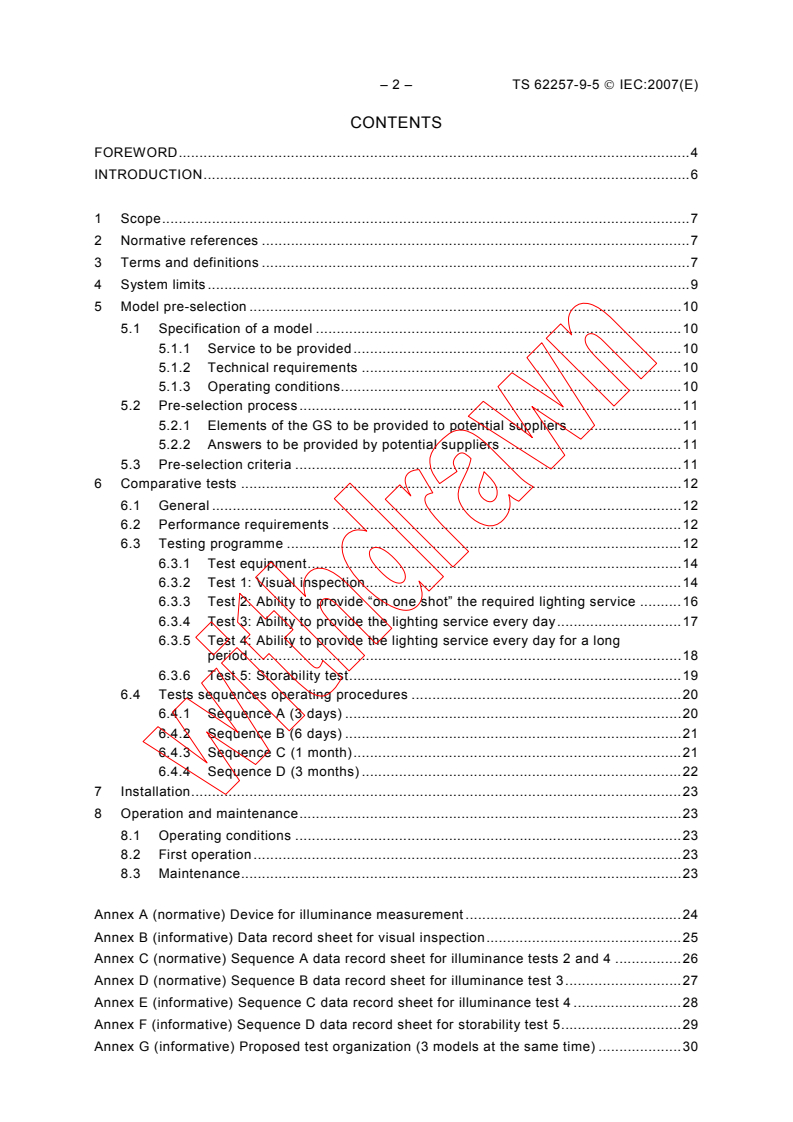
CONTENTS
FOREWORD.4
INTRODUCTION.6
1 Scope.7
2 Normative references .7
3 Terms and definitions .7
4 System limits .9
5 Model pre-selection .10
5.1 Specification of a model .10
5.1.1 Service to be provided.10
5.1.2 Technical requirements .10
5.1.3 Operating conditions.10
5.2 Pre-selection process.11
5.2.1 Elements of the GS to be provided to potential suppliers .11
5.2.2 Answers to be provided by potential suppliers .11
5.3 Pre-selection criteria .11
6 Comparative tests .12
6.1 General .12
6.2 Performance requirements .12
6.3 Testing programme .12
6.3.1 Test equipment.14
6.3.2 Test 1: Visual inspection.14
6.3.3 Test 2: Ability to provide “on one shot” the required lighting service .16
6.3.4 Test 3: Ability to provide the lighting service every day.17
6.3.5 Test 4: Ability to provide the lighting service every day for a long
period.18
6.3.6 Test 5: Storability test.19
6.4 Tests sequences operating procedures .20
6.4.1 Sequence A (3 days) .20
6.4.2 Sequence B (6 days) .21
6.4.3 Sequence C (1 month).21
6.4.4 Sequence D (3 months) .22
7 Installation.23
8 Operation and maintenance.23
8.1 Operating conditions .23
8.2 First operation .23
8.3 Maintenance.23
Annex A (normative) Device for illuminance measurement .24
Annex B (informative) Data record sheet for visual inspection.25
Annex C (normative) Sequence A data record sheet for illuminance tests 2 and 4 .26
Annex D (normative) Sequence B data record sheet for illuminance test 3.27
Annex E (informative) Sequence C data record sheet for illuminance test 4 .28
Annex F (informative) Sequence D data record sheet for storability test 5.29
Annex G (informative) Proposed test organization (3 models at the same time) .30
TS 62257-9-5 © IEC:2007(E) – 3 –
Figure 1 – Testing programme .14
Figure 2 – Test 4 sequences.18
Figure A.1 – Outlines for an illuminance testing device for PV lanterns .24
Figure G.1 – Initial measure sequence.30
Figure G.2 – Final measure sequence.31
Table 1 – Suggested minimum values for IP and IK .10
Table 2 – Climatic conditions (example).11
Table 3 – Testing programme .13
Table 4 – Storability test options.14
Table 5 – Sequence A operating procedure .20
Table 6 – equence B operating procedure.21
Table 7 – Sequence C operating procedure .22
Table 8 – Sequence D operating procedure .22
– 4 – TS 62257-9-5 © IEC:2007(E)
INTERNATIONAL ELECTROTECHNICAL COMMISSION
____________
RECOMMENDATIONS FOR SMALL RENEWABLE ENERGY AND
HYBRID SYSTEMS FOR RURAL ELECTRIFICATION –
Part 9-5: Integrated system –
Selection of portable PV lanterns for rural electrification projects
FOREWORD
1) The International Electrotechnical Commission (IEC) is a worldwide organization for standardization comprising
all national electrotechnical committees (IEC National Committees). The object of IEC is to promote
international co-operation on all questions concerning standardization in the electrical and electronic fields. To
this end and in addition to other activities, IEC publishes International Standards, Technical Specifications,
Technical Reports, Publicly Available Specifications (PAS) and Guides (hereafter referred to as “IEC
Publication(s)”). Their preparation is entrusted to technical committees; any IEC National Committee interested
in the subject dealt with may participate in this preparatory work. International, governmental and non-
governmental organizations liaising with the IEC also participate in this preparation. IEC collaborates closely
with the International Organization for Standardization (ISO) in accordance with conditions determined by
agreement between the two organizations.
2) The formal decisions or agreements of IEC on technical matters express, as nearly as possible, an international
consensus of opinion on the relevant subjects since each technical committee has representation from all
interested IEC National Committees.
3) IEC Publications have the form of recommendations for international use and are accepted by IEC National
Committees in that sense. While all reasonable efforts are made to ensure that the technical content of IEC
Publications is accurate, IEC cannot be held responsible for the way in which they are used or for any
misinterpretation by any end user.
4) In order to promote international uniformity, IEC National Committees undertake to apply IEC Publications
transparently to the maximum extent possible in their national and regional publications. Any divergence
between any IEC Publication and the corresponding national or regional publication shall be clearly indicated in
the latter.
5) IEC provides no marking procedure to indicate its approval and cannot be rendered responsible for any
equipment declared to be in conformity with an IEC Publication.
6) All users should ensure that they have the latest edition of this publication.
7) No liability shall attach to IEC or its directors, employees, servants or agents including individual experts and
members of its technical committees and IEC National Committees for any personal injury, property damage or
other damage of any nature whatsoever, whether direct or indirect, or for costs (including legal fees) and
expenses arising out of the publication, use of, or reliance upon, this IEC Publication or any other IEC
Publications.
8) Attention is drawn to the Normative references cited in this publication. Use of the referenced publications is
indispensable for the correct application of this publication.
9) Attention is drawn to the possibility that some of the elements of this IEC Publication may be the subject of
patent rights. IEC shall not be held responsible for identifying any or all such patent rights.
The main task of IEC technical committees is to prepare International Standards. In
exceptional circumstances, a technical committee may propose the publication of a technical
specification when
• the required support cannot be obtained for the publication of an International Standard,
despite repeated efforts, or
• the subject is still under technical development or where, for any other reason, there is the
future but no immediate possibility of an agreement on an International Standard.
Technical specifications are subject to review within three years of publication to decide
whether they can be transformed into International Standards.
IEC 62257-9-5, which is a technical specification, has been prepared by IEC technical
committee 82: Solar photovoltaic energy systems.
TS 62257-9-5 © IEC:2007(E) – 5 –
This part of IEC 62257 is based on IEC/PAS 62111 (1999); it cancels and replaces the
relevant parts of IEC/PAS 62111.
This part of IEC 62257 is to be used in conjunction with the IEC 62257 series.
The text of this technical specification is based on the following documents:
Enquiry draft Report on voting
82/462A/DTS 82/477/RVC
Full information on the voting for the approval of this technical specification can be found in
the report on voting indicated in the above table.
This publication has been drafted in accordance with the ISO/IEC Directives, Part 2.
A list of all parts of the IEC 62257 series, under the general title Recommendations for small
renewable energy and hybrid systems for rural electrification, can be found on the IEC
website.
The committee has decided that the contents of this publication will remain unchanged until
the maintenance result date indicated on the IEC web site under "http://webstore.iec.ch" in
the data related to the specific publication. At this date, the publication will be
• transformed into an International Standard,
• reconfirmed,
• withdrawn,
• replaced by a revised edition, or
• amended.
A bilingual version of this publication may be issued at a later date.
IMPORTANT – The “colour inside” logo on the cover page of this publication indicates
that it contains colours which are considered to be useful for the correct understanding
of its contents. Users should therefore print this publication using a colour printer.
– 6 – TS 62257-9-5 © IEC:2007(E)
INTRODUCTION
The IEC 62257 series intends to provide to different players involved in rural electrification
projects (such as project implementers, project contractors, project supervisors, installers,
etc.) documents for the setting up of renewable energy and hybrid systems with a.c. nominal
voltage below 500 V, d.c. nominal voltage below 750 V and nominal power below 100 kVA.
These documents are recommendations:
• to choose the right system for the right place,
• to design the system,
• to operate and maintain the system.
These documents are focused only on rural electrification concentrating on but not specific to
developing countries. They must not be considered as all inclusive to rural electrification. The
documents try to promote the use of renewable energies in rural electrification; they do not
deal with clean mechanisms developments at this time (CO emission, carbon credit, etc.).
Further developments in this field could be introduced in future steps.
This consistent set of documents is best considered as a whole with different parts
corresponding to items for safety, sustainability of systems and at the lowest life cycle cost as
possible. One of the main objectives is to provide the minimum sufficient requirements,
relevant to the field of application that is: small renewable energy and hybrid off-grid systems.
The purpose of this part of IEC 62257 is to specify tests in order to help project developers
and project implementers in the selection of relevant products (PV portable lanterns), able to
match the techno-economic requirements of the project they have in charge, portable PV
lantern. This technical specification and the others of the 62257 series are only guidance and
so cannot be International Standards.
TS 62257-9-5 © IEC:2007(E) – 7 –
RECOMMENDATIONS FOR SMALL RENEWABLE ENERGY AND
HYBRID SYSTEMS FOR RURAL ELECTRIFICATION –
Part 9-5: Integrated system –
Selection of portable PV lanterns for rural electrification projects
1 Scope
This Technical Specification applies to portable solar photovoltaic lanterns (portable PV
lantern). This specification is independent of the technology used to provide the light.
The tests provided in this specification are able to help the project implementer to
discriminate easily the most appropriate product within some different market offer and
choose among them those which match the requirements expressed in the GS of the
electrification project (see IEC/TS 62257-3).
The specification also provides provisions of regulations and installation conditions to be
complied with in order to ensure the life and proper operation of the selected lantern as well
as the safety of people living in proximity to the installation.
This technical specification does not replace any existing IEC standard.
2 Normative references
The following referenced documents are indispensable for the application of this document.
For dated references, only the edition cited applies. For undated references, the latest edition
of the referenced document (including any amendments) applies.
IEC 62262, Degrees of protection provided by enclosures for electrical equipment against
external mechanical impacts (IK code)
3 Terms and definitions
For the purposes of this document, the following terms and definitions apply.
3.1
illuminance (of an elementary surface) (symbol E)
the luminous flux received by an elementary surface divided by the area of this surface.
[IEV 723-08-30]
NOTE In the SI system of units illuminance is expressed in lux (lx) or lumens per square metre (lm/m ).
1 lux is the illuminance produced on a surface of 1 square metre by a luminous flux of 1 lumen uniformly distributed
over that surface.
– 8 – TS 62257-9-5 © IEC:2007(E)
3.2
capacity (of a cell or a battery)
quantity of electricity (electric charge), usually expressed in amperes-hour (Ah), which a fully
charged battery can deliver under specified conditions
3.3
light application
light produced by the lantern to allow a given activity
NOTE Examples of categories of applications of the light are given in 5.1.
3.4
life (of a lamp)
the total time for which a lamp has been operated before it becomes useless, or is considered
to be so according to specified criteria
NOTE Lamp life is usually expressed in hours.
[IEV 845-07-61]
3.5
life test
test in which lamps are operated under specified conditions for a specified time or to the end
of life and during which photometric and electrical measurements may be made at specified
intervals
[IEV 845-07-62]
3.6
service life (of a battery)
the period of useful life of a battery under specified conditions
3.7
light output ratio (of a luminaire); luminaire efficiency (USA)
ratio of the total flux of the luminaire, measured under specified practical conditions with its
own lamps and equipment, to the sum of the individual luminous fluxes of the same lamps
when operated outside the luminaire with the same equipment, under specified conditions
[IEV 845-09-39]
3.8
light unit
assembly inside a casing of all parts such as lamps, optical apparatus, coloured glass,
terminals, necessary to exhibit a light aspect
[821-02-38]
3.9
lighting performance
ability of a product to provide the right illuminance for a given application
TS 62257-9-5 © IEC:2007(E) – 9 –
3.10
illuminance meter
instrument for measuring illuminance
[IEV 845-05-16]
3.11
GS
general specification of the electrification project (see definition in IEC/TS 62257-3, 3.1)
3.12
IP degree
degree of protection provided by enclosures for electrical equipment against penetration by
foreign bodies and dust/water.
3.13
IK code
degree of protection provided by enclosures for electrical equipment against external
mechanical impacts
3.14
portable
capable to be carried by one person
NOTE The term “portable” implies often the additional ability to operate when carried.
[IEV 151-16-47]
3.15
luminaire
apparatus which distributes, filters or transforms the light transmitted from one or more lamps
and which includes, except the lamps themselves, all the parts necessary for fixing and
protecting the lamps and, where necessary, circuit auxiliaries together with the means for
connecting them to the electric supply
[IEV 845-10-01]
4 System limits
A PV portable lantern comprises:
• a casing (including in most cases a luminaire);
• a PV source (integrated, supported by or completely separate from the casing);
• one or several light sources: Compact Fluoescent Lamp (CFL), leds;
• a battery;
• a power manager (battery charge and discharge controller);
• one or several light control/selection switches;
• cables and connectors (when PV source is separate from the casing);
• status indication device (optional).
NOTE If the light is provided by means of CFL, the latter could be tested according to IEC 62257-12-1 if
necessary.
– 10 – TS 62257-9-5 © IEC:2007(E)
5 Model pre-selection
5.1 Specification of a model
5.1.1 Service to be provided
The project implementer shall define within the GS the required minimum level of illuminance,
the minimum daily duration of lighting service and the lifetime.
The project implementer shall define within the GS the required minimum level of illuminance
measured as defined in Annex A, the minimum daily duration of lighting service and the
minimum expected lifetime of the lamp and the ballast.
Three lantern applications with different required illuminance could be considered:
Application 1 (A1): accurate activities such as reading, sewing, preparing meals, etc. (for
example, illuminance > 200 lx could be considered as a basic performance needed for
accurate activities on a table).
Application 2 (A2): common household activities such as taking meals, feeding animals,
(indoor or outdoor), etc.; illuminance of 100 lx could be considered as a basic performance for
this application.
Application 3 (A3): movements from one room to another with no other lighting; illuminance
> 20 lx could be considered as a basic performance for this application
NOTE 1 For each of these activities, the required illuminance may differ from one user to another one.
NOTE 2 For a given distance between the lantern and the user, the lighting performance of the lantern may vary
in relation to the installation mode of the lantern. The proposed tests are relative to different installation modes as
explained in Annex A.
NOTE 3 Caution: Generally, manufacturers do not provide the illuminance but do provide the following information
on the system:
• light output provided on a given duration (lm x h), for each level of application as indicated above
and in relation to the installation mode of the lantern (laid on the ground or hung up);
• maximum service duration availability for a given application.
NOTE 4 Products must be tested for the same application. The position “standing” or “hung up” is dependant on
the design of the product and should be as defined by the manufacturer.
5.1.2 Technical requirements
The project implementer shall also define the IP degree and IK code of the expected products.
Table 1 gives some values that could be considered as a minimum.
Table 1 – Suggested minimum values for IP and IK
Protection degree Minimum suggested value
IP 33
IK 8
5.1.3 Operating conditions
The project implementer shall also define the operating conditions to which the portable PV
lantern can be subjected. Examples of such conditions are given in Table 2.
TS 62257-9-5 © IEC:2007(E) – 11 –
Table 2 – Climatic conditions (example)
Nominal operating range Storage - Transport
Temperature
–10 to +50 °C –40 to +80 °C
Humidity at 28 °C 5 % to 95 %
Atmospheric pressure 860 hPa to 1 060 hPa
NOTE In certain areas where low temperatures are usual (−40 °C for example) or high temperatures are
excessive, it is recommended to keep the lamp protected from extreme temperature; technology of batteries has to
be chosen in relation to the climatic condition. Control devices should be also considered.
5.2 Pre-selection process
5.2.1 Elements of the GS to be provided to potential suppliers
The project implementer shall check the locally available solar irradiation.
This information as well as the requirements defined in 5.1 shall be provided to potential
suppliers in order to receive proposals for relevant products.
5.2.2 Answers to be provided by potential suppliers
A technical sheet shall be provided by the supplier in order to demonstrate the ability of its
product to match the requirements defined in 5.1.
A user’s manual shall also be provided including PV lantern operating guidelines such as:
• initial operations before first use;
• instructions to use the lantern properly;
• mounting the solar panel (when needed);
• charging instructions;
• maintenance and troubleshooting instructions.
5.3 Pre-selection criteria
The performances claimed by the manufacturer shall be compared to the performances
required by the GS in order to make a pre-selection of available products.
The following general criteria can be used as an initial help for product pre-selection:
• lighting service characteristics as given by the manufacturer;
• overall dimensions and weights (for adaptability to the user);
• battery type and characteristics (for adaptability to the local conditions);
• lamp type and characteristics (for potential local replacement);
• PV module characteristics (to assess the easiness of installation and use);
• product architecture (PV module integrated or not in the lantern);
• additional features.
A short list of products potentially able to match the requirements of the GS shall be
addressed.
– 12 – TS 62257-9-5 © IEC:2007(E)
6 Comparative tests
6.1 General
After the pre-selection process, samples of products of the short list shall be processed
through comparative technical tests.
6.2 Performance requirements
For the three applications mentioned in 5.1.1, pre-selected models shall be compared through
performances in accordance with the requirements of the GS, including as a minimum:
a) illuminance associated with a daily service duration (example: 100 lx during 3 continuous
hours) = lighting service;
As the customer will not accept a delay of one month or two to get the full illuminance of the
PV lantern (100 h stabilization), the lamp provided with the PV lantern must be able to provide
the full illuminance ± 20 % as early as the first utilization.
Additionally, every time the customer switches on the PV lantern, the full illuminance must be
provided within 2 min maximum.
NOTE The service duration corresponds to an average d
...