

IEC 61753-111-08:2021
(Main)Fibre optic interconnecting devices and passive components - Performance standard - Part 111-08: Sealed closures for category G - Ground
- Abstract
IEC 61753-111-08:2021 contains the minimum tests, test severities and measurement requirements which a sealed fibre optic closure need to meet in order to be categorised as meeting the IEC standard for category G - Ground, as defined in Table A.14 of IEC 61753-1:2018. Free breathing closures are not covered in this document. This first edition cancels and replaces IEC 61753-111-8 published in 2009. This edition constitutes a technical revision. This edition includes the following significant technical changes with respect to IEC 61753-111-8:
a) terms and definitions updated according to IEC 61753-1:2018 and IEC 61756-1:2019;
b) test severities updated according to IEC 61753-1:2018;
c) sealing tests are done with 20 kPa overpressure;
d) pass-fail criterion of pressure loss during test added to mechanical sealing tests;
e) vibration sealing test changed to 10 Hz, 3 mm amplitude and 1 000 000 cycles;
f) reduced loads added in cable retention test for small diameter cables and tubes;
g) reduced loads for cable axial compression test for small diameter cables;
h) the duration of the cycles in torsion and bending test is added;
i) free fall test removed (is covered by the optical shock test);
j) crush resistance test of 1 000 N for 10 min is added;
k) assembly and disassembly test: duration reduced to 5 cycles;
l) resistance to solvents and contaminating fluids: added immersion in diesel with duration of 1 h and 24 h drying time and added immersion in petroleum jelly for 5 days;
m) resistance to stress cracking solvents added for 5 days;
n) duration of the change of temperature reduced to 12 cycles;
o) water immersion test at 1 m for 7 days added.
- Status
- Published
- Publication Date
- 06-Apr-2021
- Technical Committee
- SC 86B - Fibre optic interconnecting devices and passive components
- Current Stage
- PPUB - Publication issued - 60 Publication
- Start Date
- 07-Apr-2021
- Due Date
- 07-May-2021
- Completion Date
- 07-May-2021
Buy Documents
IEC 61753-111-08:2021 - Fibre optic interconnecting devices and passive components - Performance standard - Part 111-08: Sealed closures for category G - Ground Released:4/7/2021
IEC 61753-111-08:2021 - Fibre optic interconnecting devices and passive components - Performance standard - Part 111-08: Sealed closures for category G - Ground Released:4/7/2021
Overview - IEC 61753-111-08:2021 (Sealed closures for category G – Ground)
IEC 61753-111-08:2021 is an IEC performance standard that specifies the minimum tests, test severities and measurement requirements for sealed fibre optic closures classified as category G (Ground). It defines how a sealed closure must perform under mechanical, environmental and optical stress to be declared conformant. Free-breathing closures are excluded. This edition (2021) is a technical revision that replaces the 2009 edition and updates terminology and test severities to align with IEC 61753-1:2018 and IEC 61756-1:2019.
Key topics and technical requirements
The standard focuses on practical, measurable verification of sealed closure performance. Key technical topics include:
- Sealing and pressure tests
- Sealing tests performed with 20 kPa overpressure
- Pass/fail criterion for pressure loss added to mechanical sealing tests
- Mechanical resilience
- Vibration sealing test: 10 Hz, 3 mm amplitude, 1,000,000 cycles
- Crush resistance: 1 000 N for 10 minutes added
- Cable retention, axial compression: reduced loads for small-diameter cables/tubes
- Torsion and bending tests: cycle duration specified
- Assembly/disassembly test: duration reduced to 5 cycles
- Free-fall test removed (covered by optical shock test)
- Chemical and contamination resistance
- Immersion in diesel (1 h) with 24 h drying; petroleum jelly immersion for 5 days
- Resistance to stress-cracking solvents for 5 days
- Environmental exposure
- Water immersion: 1 m for 7 days (added)
- Temperature cycling: reduced to 12 cycles
- Optical and visual performance
- Optical loss and visual inspection pass/fail criteria defined for tested samples
Practical applications and users
Who uses IEC 61753-111-08:
- Manufacturers of sealed fibre optic closures (design verification and product classification)
- Test laboratories performing standardized performance tests
- Telecom operators and utilities specifying closures for ground-level and buried applications
- Procurement and quality assurance teams writing tender specifications and acceptance criteria
- Certification bodies assessing claims of compliance
Benefits:
- Ensures consistent minimum performance for field-deployed sealed closures
- Provides objective pass/fail criteria for sealing, mechanical, chemical and optical tests
- Helps reduce deployment risk for ground-level fiber infrastructure
Related standards
- IEC 61753-1:2018 (general test severities and definitions)
- IEC 61756-1:2019 (relevant terminology updates)
- IEC 61300 series (basic test and measurement procedures: vibration, shock, retention, torsion)
- IEC 60793-2-50, IEC 60068-2-10 (referenced fibre and environmental tests)
- IEC 62005 (guidance on reliability testing)
Keywords: IEC 61753-111-08, sealed closures, category G, ground, fibre optic closures, sealing tests, cable retention, vibration test, water immersion, crush resistance, optical performance.
Relations
- Effective Date
- 05-Sep-2023
Buy Documents
IEC 61753-111-08:2021 - Fibre optic interconnecting devices and passive components - Performance standard - Part 111-08: Sealed closures for category G - Ground Released:4/7/2021
IEC 61753-111-08:2021 - Fibre optic interconnecting devices and passive components - Performance standard - Part 111-08: Sealed closures for category G - Ground Released:4/7/2021
Get Certified
Connect with accredited certification bodies for this standard

ANCE
Mexican certification and testing association.

Intertek Slovenia
Intertek testing, inspection, and certification services in Slovenia.

LNE (Laboratoire National de Métrologie et d'Essais)
French national laboratory for metrology and testing.
Sponsored listings
Frequently Asked Questions
IEC 61753-111-08:2021 is a standard published by the International Electrotechnical Commission (IEC). Its full title is "Fibre optic interconnecting devices and passive components - Performance standard - Part 111-08: Sealed closures for category G - Ground". This standard covers: IEC 61753-111-08:2021 contains the minimum tests, test severities and measurement requirements which a sealed fibre optic closure need to meet in order to be categorised as meeting the IEC standard for category G - Ground, as defined in Table A.14 of IEC 61753-1:2018. Free breathing closures are not covered in this document. This first edition cancels and replaces IEC 61753-111-8 published in 2009. This edition constitutes a technical revision. This edition includes the following significant technical changes with respect to IEC 61753-111-8: a) terms and definitions updated according to IEC 61753-1:2018 and IEC 61756-1:2019; b) test severities updated according to IEC 61753-1:2018; c) sealing tests are done with 20 kPa overpressure; d) pass-fail criterion of pressure loss during test added to mechanical sealing tests; e) vibration sealing test changed to 10 Hz, 3 mm amplitude and 1 000 000 cycles; f) reduced loads added in cable retention test for small diameter cables and tubes; g) reduced loads for cable axial compression test for small diameter cables; h) the duration of the cycles in torsion and bending test is added; i) free fall test removed (is covered by the optical shock test); j) crush resistance test of 1 000 N for 10 min is added; k) assembly and disassembly test: duration reduced to 5 cycles; l) resistance to solvents and contaminating fluids: added immersion in diesel with duration of 1 h and 24 h drying time and added immersion in petroleum jelly for 5 days; m) resistance to stress cracking solvents added for 5 days; n) duration of the change of temperature reduced to 12 cycles; o) water immersion test at 1 m for 7 days added.
IEC 61753-111-08:2021 contains the minimum tests, test severities and measurement requirements which a sealed fibre optic closure need to meet in order to be categorised as meeting the IEC standard for category G - Ground, as defined in Table A.14 of IEC 61753-1:2018. Free breathing closures are not covered in this document. This first edition cancels and replaces IEC 61753-111-8 published in 2009. This edition constitutes a technical revision. This edition includes the following significant technical changes with respect to IEC 61753-111-8: a) terms and definitions updated according to IEC 61753-1:2018 and IEC 61756-1:2019; b) test severities updated according to IEC 61753-1:2018; c) sealing tests are done with 20 kPa overpressure; d) pass-fail criterion of pressure loss during test added to mechanical sealing tests; e) vibration sealing test changed to 10 Hz, 3 mm amplitude and 1 000 000 cycles; f) reduced loads added in cable retention test for small diameter cables and tubes; g) reduced loads for cable axial compression test for small diameter cables; h) the duration of the cycles in torsion and bending test is added; i) free fall test removed (is covered by the optical shock test); j) crush resistance test of 1 000 N for 10 min is added; k) assembly and disassembly test: duration reduced to 5 cycles; l) resistance to solvents and contaminating fluids: added immersion in diesel with duration of 1 h and 24 h drying time and added immersion in petroleum jelly for 5 days; m) resistance to stress cracking solvents added for 5 days; n) duration of the change of temperature reduced to 12 cycles; o) water immersion test at 1 m for 7 days added.
IEC 61753-111-08:2021 is classified under the following ICS (International Classification for Standards) categories: 33.180.20 - Fibre optic interconnecting devices. The ICS classification helps identify the subject area and facilitates finding related standards.
IEC 61753-111-08:2021 has the following relationships with other standards: It is inter standard links to IEC 61753-111-8:2009. Understanding these relationships helps ensure you are using the most current and applicable version of the standard.
IEC 61753-111-08:2021 is available in PDF format for immediate download after purchase. The document can be added to your cart and obtained through the secure checkout process. Digital delivery ensures instant access to the complete standard document.
Standards Content (Sample)
IEC 61753-111-08 ®
Edition 1.0 2021-04
INTERNATIONAL
STANDARD
colour
inside
Fibre optic interconnecting devices and passive components – Performance
standard –
Part 111-08: Sealed closures for category G – Ground
All rights reserved. Unless otherwise specified, no part of this publication may be reproduced or utilized in any form
or by any means, electronic or mechanical, including photocopying and microfilm, without permission in writing from
either IEC or IEC's member National Committee in the country of the requester. If you have any questions about IEC
copyright or have an enquiry about obtaining additional rights to this publication, please contact the address below or
your local IEC member National Committee for further information.
IEC Central Office Tel.: +41 22 919 02 11
3, rue de Varembé info@iec.ch
CH-1211 Geneva 20 www.iec.ch
Switzerland
About the IEC
The International Electrotechnical Commission (IEC) is the leading global organization that prepares and publishes
International Standards for all electrical, electronic and related technologies.
About IEC publications
The technical content of IEC publications is kept under constant review by the IEC. Please make sure that you have the
latest edition, a corrigendum or an amendment might have been published.
IEC publications search - webstore.iec.ch/advsearchform IEC online collection - oc.iec.ch
The advanced search enables to find IEC publications by a Discover our powerful search engine and read freely all the
variety of criteria (reference number, text, technical publications previews. With a subscription you will always have
committee, …). It also gives information on projects, replaced access to up to date content tailored to your needs.
and withdrawn publications.
Electropedia - www.electropedia.org
IEC Just Published - webstore.iec.ch/justpublished
The world's leading online dictionary on electrotechnology,
Stay up to date on all new IEC publications. Just Published
containing more than 22 000 terminological entries in English
details all new publications released. Available online and once
and French, with equivalent terms in 18 additional languages.
a month by email.
Also known as the International Electrotechnical Vocabulary
(IEV) online.
IEC Customer Service Centre - webstore.iec.ch/csc
If you wish to give us your feedback on this publication or need
further assistance, please contact the Customer Service
Centre: sales@iec.ch.
IEC 61753-111-08 ®
Edition 1.0 2021-04
INTERNATIONAL
STANDARD
colour
inside
Fibre optic interconnecting devices and passive components – Performance
standard –
Part 111-08: Sealed closures for category G – Ground
INTERNATIONAL
ELECTROTECHNICAL
COMMISSION
ICS 33.180.20 ISBN 978-2-8322-9659-2
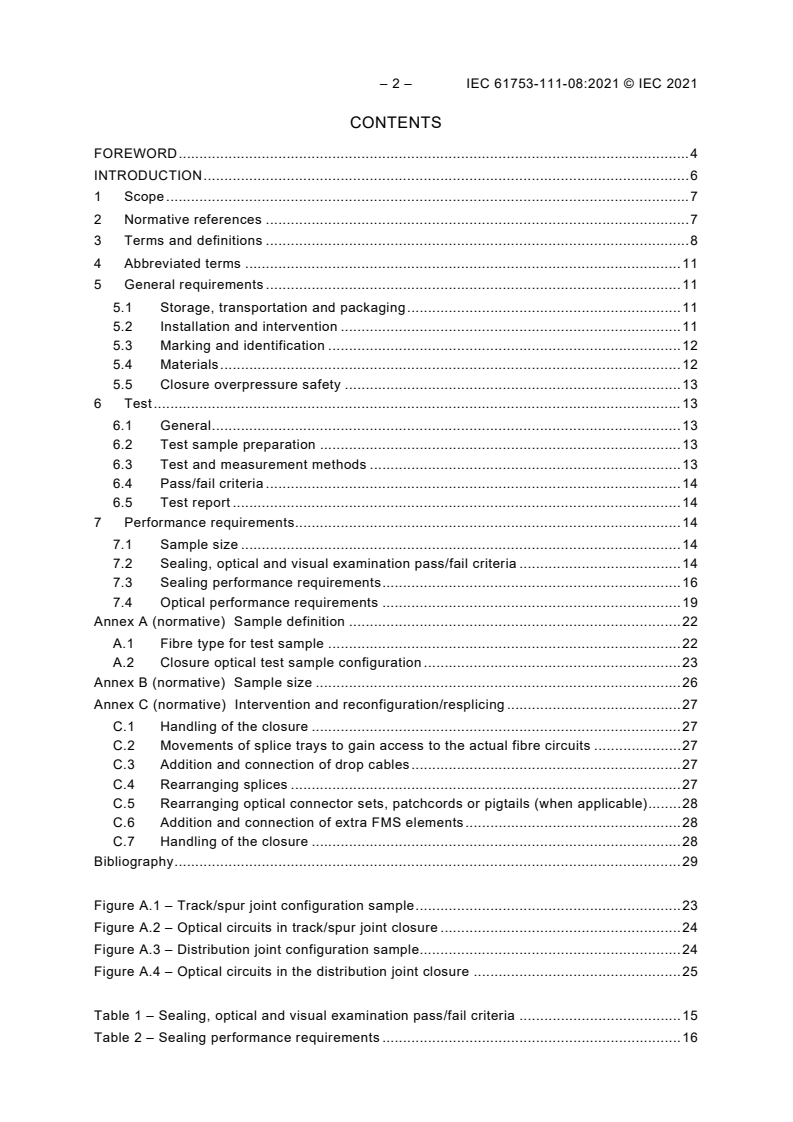
– 2 – IEC 61753-111-08:2021 © IEC 2021
CONTENTS
FOREWORD . 4
INTRODUCTION . 6
1 Scope . 7
2 Normative references . 7
3 Terms and definitions . 8
4 Abbreviated terms . 11
5 General requirements . 11
5.1 Storage, transportation and packaging . 11
5.2 Installation and intervention . 11
5.3 Marking and identification . 12
5.4 Materials . 12
5.5 Closure overpressure safety . 13
6 Test . 13
6.1 General . 13
6.2 Test sample preparation . 13
6.3 Test and measurement methods . 13
6.4 Pass/fail criteria . 14
6.5 Test report . 14
7 Performance requirements. 14
7.1 Sample size . 14
7.2 Sealing, optical and visual examination pass/fail criteria . 14
7.3 Sealing performance requirements . 16
7.4 Optical performance requirements . 19
Annex A (normative) Sample definition . 22
A.1 Fibre type for test sample . 22
A.2 Closure optical test sample configuration . 23
Annex B (normative) Sample size . 26
Annex C (normative) Intervention and reconfiguration/resplicing . 27
C.1 Handling of the closure . 27
C.2 Movements of splice trays to gain access to the actual fibre circuits . 27
C.3 Addition and connection of drop cables . 27
C.4 Rearranging splices . 27
C.5 Rearranging optical connector sets, patchcords or pigtails (when applicable) . 28
C.6 Addition and connection of extra FMS elements . 28
C.7 Handling of the closure . 28
Bibliography . 29
Figure A.1 – Track/spur joint configuration sample . 23
Figure A.2 – Optical circuits in track/spur joint closure . 24
Figure A.3 – Distribution joint configuration sample. 24
Figure A.4 – Optical circuits in the distribution joint closure . 25
Table 1 – Sealing, optical and visual examination pass/fail criteria . 15
Table 2 – Sealing performance requirements . 16
Table 3 – Optical performance requirements . 19
Table A.1 – Fibre references for IEC 60793-2-50, sub-category B-652.D . 22
Table A.2 – Fibre references for IEC 60793-2-50, sub-category B-657.A1. 22
Table A.3 – Fibre references for IEC 60793-2-50, sub-category B-657.A2. 23
Table B.1 – Sample size . 26
– 4 – IEC 61753-111-08:2021 © IEC 2021
INTERNATIONAL ELECTROTECHNICAL COMMISSION
____________
FIBRE OPTIC INTERCONNECTING
DEVICES AND PASSIVE COMPONENTS –
PERFORMANCE STANDARD –
Part 111-08: Sealed closures for category G – Ground
FOREWORD
1) The International Electrotechnical Commission (IEC) is a worldwide organization for standardization comprising
all national electrotechnical committees (IEC National Committees). The object of IEC is to promote international
co-operation on all questions concerning standardization in the electrical and electronic fields. To this end and
in addition to other activities, IEC publishes International Standards, Technical Specifications, Technical Reports,
Publicly Available Specifications (PAS) and Guides (hereafter referred to as "IEC Publication(s)"). Their
preparation is entrusted to technical committees; any IEC National Committee interested in the subject dealt with
may participate in this preparatory work. International, governmental and non-governmental organizations liaising
with the IEC also participate in this preparation. IEC collaborates closely with the International Organization for
Standardization (ISO) in accordance with conditions determined by agreement between the two organizations.
2) The formal decisions or agreements of IEC on technical matters express, as nearly as possible, an international
consensus of opinion on the relevant subjects since each technical committee has representation from all
interested IEC National Committees.
3) IEC Publications have the form of recommendations for international use and are accepted by IEC National
Committees in that sense. While all reasonable efforts are made to ensure that the technical content of IEC
Publications is accurate, IEC cannot be held responsible for the way in which they are used or for any
misinterpretation by any end user.
4) In order to promote international uniformity, IEC National Committees undertake to apply IEC Publications
transparently to the maximum extent possible in their national and regional publications. Any divergence between
any IEC Publication and the corresponding national or regional publication shall be clearly indicated in the latter.
5) IEC itself does not provide any attestation of conformity. Independent certification bodies provide conformity
assessment services and, in some areas, access to IEC marks of conformity. IEC is not responsible for any
services carried out by independent certification bodies.
6) All users should ensure that they have the latest edition of this publication.
7) No liability shall attach to IEC or its directors, employees, servants or agents including individual experts and
members of its technical committees and IEC National Committees for any personal injury, property damage or
other damage of any nature whatsoever, whether direct or indirect, or for costs (including legal fees) and
expenses arising out of the publication, use of, or reliance upon, this IEC Publication or any other IEC Publications.
8) Attention is drawn to the Normative references cited in this publication. Use of the referenced publications is
indispensable for the correct application of this publication.
9) Attention is drawn to the possibility that some of the elements of this IEC Publication may be the subject of patent
rights. IEC shall not be held responsible for identifying any or all such patent rights.
IEC 61753-111-08 has been prepared by subcommittee 86B: Fibre optic interconnecting
devices and passive components, of IEC technical committee 86: Fibre optics. It is an
International Standard.
This first edition cancels and replaces IEC 61753-111-8 published in 2009. This edition
constitutes a technical revision.
This edition includes the following significant technical changes with respect to
IEC 61753-111-8:
a) terms and definitions updated according to IEC 61753-1:2018 and IEC 61756-1:2019;
b) test severities updated according to IEC 61753-1:2018;
c) sealing tests are done with 20 kPa overpressure;
d) pass-fail criterion of pressure loss during test added to mechanical sealing tests;
e) vibration sealing test changed to 10 Hz, 3 mm amplitude and 1 000 000 cycles;
f) reduced loads added in cable retention test for small diameter cables and tubes;
g) reduced loads for cable axial compression test for small diameter cables;
h) the duration of the cycles in torsion and bending test is added;
i) free fall test removed (is covered by the optical shock test);
j) crush resistance test of 1 000 N for 10 min is added;
k) assembly and disassembly test: duration reduced to 5 cycles;
l) resistance to solvents and contaminating fluids: added immersion in diesel with duration of
1 h and 24 h drying time and added immersion in petroleum jelly for 5 days;
m) resistance to stress cracking solvents added for 5 days;
n) duration of the change of temperature reduced to 12 cycles;
o) water immersion test at 1 m for 7 days added.
The text of this International Standard is based on the following documents:
FDIS Report on voting
86B/4426/FDIS 86B/4455/RVD
Full information on the voting for its approval can be found in the report on voting indicated in
the above table.
The language used for the development of this International Standard is English.
This document was drafted in accordance with the ISO/IEC Directives, Part 2, and developed
in accordance with ISO/IEC Directives, Part 1 and ISO/IEC Directives, IEC Supplement,
available at www.iec.ch/members_experts/refdocs. The main document types developed by IEC
are described in greater detail at www.iec.ch/standardsdev/publications.
A list of all parts of IEC 61753 series, published under the general title Fibre optic
interconnecting devices and passive components – Performance standard, can be found on the
IEC website.
The committee has decided that the contents of this document will remain unchanged until the
stability date indicated on the IEC website under webstore.iec.ch in the data related to the
specific document. At this date, the document will be
• reconfirmed,
• withdrawn,
• replaced by a revised edition, or
• amended.
IMPORTANT – The 'colour inside' logo on the cover page of this publication indicates
that it contains colours which are considered to be useful for the correct understanding
of its contents. Users should therefore print this document using a colour printer.
– 6 – IEC 61753-111-08:2021 © IEC 2021
INTRODUCTION
Performance standards for sealed closures define the requirements for standard optical
performance under a set of specified conditions. This subpart of the IEC 61753-111 series
contains a series or a set of tests and measurements with clearly stated conditions, severities
and pass/fail criteria. The set of tests is intended to be a basis to prove the product’s ability to
satisfy the requirements of a specific application, market sector or user group.
A product that has been shown to meet all the requirements of this performance standard may
be declared as complying with this performance standard. Products having the same
classification from one manufacturer that satisfy this performance standard will operate within
the boundaries set by the performance standard. There is no guarantee that products from
different manufacturers, having the same classification and which conform to the same
performance standard, will provide an equivalent level of performance when they are used
together.
Conformance with IEC environmental policy according to IEC Guide 109 and concerning the
need to reduce the impacts on the natural environment of fibre optic closures during all phases
of their life – from acquiring materials to manufacturing, distribution, use, and end-of-life
treatment (i.e. re-use, recycling – recovery and disposal) – are not part of this document, but
will be covered in the generic specification.
Conformance to a performance standard demonstrates that a product has passed a design
verification test. It is not a guarantee of lifetime assured performance or reliability. Reliability
testing is the subject of a separate test schedule, where the tests and severities selected are
such that they are truly representative of the requirements of this reliability test programme.
Consistency of manufacture should be maintained using a recognised quality assurance
programme whilst the reliability of product should be evaluated using the procedures
recommended in IEC 62005 (all parts).
FIBRE OPTIC INTERCONNECTING
DEVICES AND PASSIVE COMPONENTS –
PERFORMANCE STANDARD –
Part 111-08: Sealed closures for category G – Ground
1 Scope
This part of IEC 61753 contains the minimum tests, test severities and measurement
requirements which a sealed fibre optic closure need to meet in order to be categorised as
meeting the IEC standard for category G – Ground, as defined in Table A.14 of
IEC 61753-1:2018. Free breathing closures are not covered in this document.
2 Normative references
The following documents are referred to in the text in such a way that some or all of their content
constitutes requirements of this document. For dated references, only the edition cited applies.
For undated references, the latest edition of the referenced document (including any
amendments) applies.
IEC 60068-2-10, Environmental testing – Part 2-10: Tests – Test J and guidance: Mould growth
IEC 60793-2-50, Optical fibres – Part 2-50: Product specifications – Sectional specification for
class B single-mode fibres
IEC 61300-1, Fibre optic interconnecting devices and passive components – Basic test and
measurement procedures – Part 1: General and guidance
IEC 61300-2-1, Fibre optic interconnecting devices and passive components – Basic test and
measurement procedures – Part 2-1: Tests – Vibration (sinusoidal)
IEC 61300-2-4, Fibre optic interconnecting devices and passive components – Basic test and
measurement procedures – Part 2-4: Tests – Fibre or cable retention
IEC 61300-2-5, Fibre optic interconnecting devices and passive components – Basic test and
measurement procedures – Part 2-5: Tests – Torsion
IEC 61300-2-9, Fibre optic interconnecting devices and passive components – Basic test and
measurement procedures – Part 2-9: Tests – Shock
IEC 61300-2-10, Fibre optic interconnecting devices and passive components – Basic test and
measurement procedures – Part 2-10: Tests – Crush resistance
IEC 61300-2-11, Fibre optic interconnecting devices and passive components – Basic test and
measurement procedures – Part 2-11: Tests – Axial compression
IEC 61300-2-12, Fibre optic interconnecting devices and passive components – Basic test and
measurement procedures – Part 2-12: Tests – Impact
IEC 61300-2-22, Fibre optic interconnecting devices and passive components – Basic test and
measurement procedures – Part 2-22: Tests – Change of temperature
– 8 – IEC 61753-111-08:2021 © IEC 2021
IEC 61300-2-23, Fibre optic interconnecting devices and passive components – Basic test and
measurement procedures – Part 2-23: Tests – Sealing for non-pressurized closures of fibre
optic devices
IEC 61300-2-26, Fibre optic interconnecting devices and passive components – Basic test and
measurement procedures – Part 2-26: Tests – Salt mist
IEC 61300-2-33, Fibre optic interconnecting devices and passive components – Basic test and
measurement procedures – Part 2-33: Tests – Assembly and disassembly of fibre optic
mechanical splices, fibre management systems and closures
IEC 61300-2-34, Fibre optic interconnecting devices and passive components – Basic test and
measurement procedures – Part 2-34: Tests – Resistance to solvents and contaminating fluids
of interconnecting components and closures
IEC 61300-2-37, Fibre optic interconnecting devices and passive components – Basic test and
measurement procedures – Part 2-37: Tests – Cable bending for fibre optic closures
IEC 61300-2-38, Fibre optic interconnecting devices and passive components – Basic test and
measurement procedures – Part 2-38: Tests – Sealing for pressurised fibre optic closures
IEC 61300-3-1, Fibre optic interconnecting devices and passive components – Basic test and
measurement procedures – Part 3-1: Examinations and measurements – Visual examination
IEC 61300-3-3, Fibre optic interconnecting devices and passive components – Basic test and
measurement procedures – Part 3-3: Examinations and measurements – Active monitoring of
changes in attenuation and return loss
IEC 61300-3-28, Fibre optic interconnecting devices and passive components – Basic test and
measurement procedures – Part 3-28: Examinations and measurements – Transient loss
IEC 61753-1:2018, Fibre optic interconnecting devices and passive components – Performance
standard – Part 1: General and guidance
IEC 61756-1:2019, Fibre optic interconnecting devices and passive components – Interface
standard for fibre management systems – Part 1: General and guidance
ISO 4892-3, Plastics – Methods of exposure to laboratory light sources – Fluorescent UV lamps
3 Terms and definitions
For the purposes of this document, the following terms and definitions apply.
ISO and IEC maintain terminological databases for use in standardization at the following
addresses:
• IEC Electropedia: available at http://www.electropedia.org/
• ISO Online browsing platform: available at http://www.iso.org/obp
3.1
distribution joint
protective housing that allows the splicing of the fibres from a feeder cable to the fibres of
multiple smaller drop cable and that allows easy fibre access, maintenance, re-arrangement
and addition of fibre circuits or passive optical components
Note 1 to entry: Storage of uncut fibres and fibre cable elements is allowed.
Note 2 to entry: A distribution joint is typically used in access and distribution networks.
3.2
excursion loss
change in optical attenuation during the slow variations of environmental parameters
Note 1 to entry: Excursion loss is the ± deviation from the original value of the transmitted power at the start of the
test.
3.3
fibre management system
system to control, protect and store splices, connectors, passive optical components and fibres
from incoming to outgoing cables
Note 1 to entry: A fibre management system is intended for installation within a protective housing.
Note 2 to entry: A fibre management system is often called an "organiser".
[SOURCE: IEC 61756-1:2019, 3.1.2]
3.4
intervention
gain access to modify, add, remove or repair fibre circuits, splices, connectors or other
components between the incoming and outgoing cables of an existing closure
3.5
installation
activities and handling operations to establish and install a protective housing including the
cables or by adding new circuits, splices, connectors and other components
3.6
installation conditions
circumstances that shall be fulfilled for an installation, which includes environmental conditions,
size interface between the closure and the fibre management system, optical performance,
additional/special conditions and safety requirements
3.7
multiple element
physical fibre separation level consisting of more than one single element
Note 1 to entry: This separation level has fibres from multiple cable elements on one splice tray and is also called
mass storage. It is the lowest (worst) degree of physical circuit separation.
[SOURCE: IEC 61756-1:2019, 3.1.3]
3.8
multiple ribbon
multiple element consisting of multiple optical fibres (circuits) arranged in ribbons (fibres in
parallel) which are also arranged (for example, in stacks)
[SOURCE: IEC 61756-1:2019, 3.1.5]
3.9
residual loss
change in optical power between initial and final measurements
– 10 – IEC 61753-111-08:2021 © IEC 2021
3.10
sealed closure
watertight and dust-tight housing that can hold a varying overpressure or underpressure caused
by temperature changes or atmospheric pressure changes
Note 1 to entry: There is no exchange of air with the outside environment when exposed to temperatures over the
specified operating temperature range.
Note 2 to entry: Although sealed closures are often referred to as hermetic sealed closures, humidity can enter the
inner closure by diffusion.
[SOURCE: IEC 61753-1:2018, 3.3.5, modified – Note 2 to entry has been rephrased, and Note 3
to entry and Note 4 to entry have been deleted.]
3.11
single circuit
physical fibre separation level where the optical circuit consists of one fibre (single fibre), or
more than one fibre, providing all services for one subscriber
Note 1 to entry: This fibre separation level has the fibre(s) of only one customer on one splice tray. It is the highest
(best) degree of physical circuit separation.
[SOURCE: IEC 61756-1:2019, 3.1.7]
3.12
single element
physical fibre separation level in the cable subassembly comprising one or more optical fibres
inside a common covering for example in a tube or inside one groove of a grooved cable (slotted
core cable)
Note 1 to entry: A single element provides services to more than one subscriber.
Note 2 to entry: This fibre separation level has all fibres from a cable element (e.g. loose tube) on one splice tray.
It is an intermediate degree of physical circuit separation (between single circuit and multiple element).
[SOURCE: IEC 61756-1:2019, 3.1.9]
3.13
single ribbon
single element designed to carry all fibres of one ribbon
Note 1 to entry: Depending on the fibres deployment, a single ribbon can contain all the fibres of one circuit (single
circuit) or the fibres of more than one circuit (single element).
[SOURCE: IEC 61756-1:2019, 3.1.11]
3.14
splice tray
structure that organises and controls storage of fibre splices in an orderly manner, together with
the associated excess uncabled fibre length
Note 1 to entry: It can be a part of a fibre management system.
[SOURCE: IEC 61756-1:2019, 3.1.12]
3.15
track/spur joint
protective housing that allows the splicing of all the fibres of at least three cables
Note 1 to entry: The track/spur joint acts as a reinstatement of the cable length. It will not be re-entered except for
repair or reinstatement of damaged cables.
Note 2 to entry: This closure configuration is typically used in trunk and junction networks to connect the cable
sections from various cable reels or to split one cable into at least two smaller cables.
3.16
transient loss
short term (ms) reversible change of optical transmission characteristics arising from optical
discontinuity, physical defects and modifications of the attenuation (e.g. bending loss) normally
caused by mechanical stress
3.17
uncut fibre
fibres from a continuous cable with the cable sheath removed over a defined length without
cutting the fibres or tubes
Note 1 to entry: The uncut tubes or fibres are stored e.g. in a space saving loop. When required, the fibres are cut
and spliced or connected.
[SOURCE: IEC 61756-1:2019, 3.1.14]
4 Abbreviated terms
FMS fibre management system
ME multiple element
MR multiple ribbons
NA not applicable
SC single circuit
SE single element
SR single ribbon
5 General requirements
5.1 Storage, transportation and packaging
The classes of environmental conditions and their severities to which sealed closures may be
exposed during transportation are defined in IEC 60721-3-2. Normal transportation time is
considered to be 30 days or less.
The product, in its original packaging, shall be suitable for normal public or commercial
transportation and storage in weather protected non-temperature controlled storage
environments and, after installation, meet the requirements as specified in Table 1, Table 2 and
Table 3.
5.2 Installation and intervention
The minimum and maximum temperatures at which a closure may be installed (installation
conditions) or re-entered (intervention) are not necessarily equal to the maximum temperature
excursion of the environment in which it will reside, once installed. Accessing fibres and the
fibre management system inside the closure is typically done in a more controlled environment.
Closures and the fibre management system shall be installable in the temperature range
between −5 °C and +45 °C. Closure and cable handling alone shall be possible at temperatures
between −15 °C and +45 °C.
– 12 – IEC 61753-111-08:2021 © IEC 2021
Typically, the following operations are carried out during an intervention:
– handling of closure;
– opening closure;
– getting access to fibres and splices (e.g. hinging, pivoting, sliding, removal of splice trays,
or other FMS components);
– breaking a splice, rerouting fibres and connecting to another fibre end;
– cutting one or more uncut fibres, rerouting and connecting to another fibre end;
– disconnecting a connector and mating with another connector (when applicable);
– adding FMS elements/components and connecting the fibres;
– closing and sealing the closure.
5.3 Marking and identification
Product marking and identification shall survive the storage and transportation.
Each test sample should contain the following information at a minimum:
– manufacturer’s identification mark or logo;
– product designation, model or type;
– one of the following: lot number, batch number, date (at least month and year) of production
or serial number;
– expiry date (at least year) if the product contains components with a limited shelf-life.
5.4 Materials
For all applied materials, a material safety data sheet shall be made available upon request.
All materials that are likely to come in contact with personnel shall meet appropriate health and
safety regulations.
The materials of the sealed closure and fibre management system shall be compatible with the
other materials or solvents that can come into contact with it during installation and operation,
for example water, cable filling compounds and degreasing agents. Exposure to these solvents
shall not adversely affect the product’s performance.
The effect of ultraviolet (UV) light on all polymeric materials that are directly exposed to the
UV test shall be according
environment shall not adversely affect the product’s performance.
to ISO 4892-3, lamp type 1A (UVA-340), cycle 1, duration 2 160 h. The effect of UV light shall
be determined by measuring a suitable property (e.g. tensile strength and elongation at yield)
both before and after exposure of the material slabs. The average change in mechanical
characteristics of the tested material slabs shall be less than 20 %.
Polymeric materials shall not support mould growth causing mechanical degradation of the
materials. Mould growth shall be tested according to IEC 60068-2-10. The effect of mould
growth shall be determined by measuring a suitable property (e.g. tensile strength and
elongation at yield) both before and after exposure of the material slabs. The average change
in mechanical characteristics of the tested material slabs shall be less than 20 %.
Metallic elements shall be corrosion resis
...
IEC 61753-111-08 ®
Edition 1.0 2021-04
INTERNATIONAL
STANDARD
NORME
INTERNATIONALE
colour
inside
Fibre optic interconnecting devices and passive components – Performance
standard –
Part 111-08: Sealed closures for category G – Ground
Dispositifs d’interconnexion et composants passifs fibroniques – Norme de
qualité de fonctionnement –
Partie 111-08: Boîtiers scellés pour catégorie G – Au niveau du sol
All rights reserved. Unless otherwise specified, no part of this publication may be reproduced or utilized in any form
or by any means, electronic or mechanical, including photocopying and microfilm, without permission in writing from
either IEC or IEC's member National Committee in the country of the requester. If you have any questions about IEC
copyright or have an enquiry about obtaining additional rights to this publication, please contact the address below or
your local IEC member National Committee for further information.
Droits de reproduction réservés. Sauf indication contraire, aucune partie de cette publication ne peut être reproduite ni
utilisée sous quelque forme que ce soit et par aucun procédé, électronique ou mécanique, y compris la photocopie et
les microfilms, sans l'accord écrit de l'IEC ou du Comité national de l'IEC du pays du demandeur. Si vous avez des
questions sur le copyright de l'IEC ou si vous désirez obtenir des droits supplémentaires sur cette publication, utilisez
les coordonnées ci-après ou contactez le Comité national de l'IEC de votre pays de résidence.
IEC Central Office Tel.: +41 22 919 02 11
3, rue de Varembé info@iec.ch
CH-1211 Geneva 20 www.iec.ch
Switzerland
About the IEC
The International Electrotechnical Commission (IEC) is the leading global organization that prepares and publishes
International Standards for all electrical, electronic and related technologies.
About IEC publications
The technical content of IEC publications is kept under constant review by the IEC. Please make sure that you have the
latest edition, a corrigendum or an amendment might have been published.
IEC publications search - webstore.iec.ch/advsearchform IEC online collection - oc.iec.ch
The advanced search enables to find IEC publications by a Discover our powerful search engine and read freely all the
variety of criteria (reference number, text, technical publications previews. With a subscription you will always have
committee, …). It also gives information on projects, replaced access to up to date content tailored to your needs.
and withdrawn publications.
Electropedia - www.electropedia.org
IEC Just Published - webstore.iec.ch/justpublished
The world's leading online dictionary on electrotechnology,
Stay up to date on all new IEC publications. Just Published
containing more than 22 000 terminological entries in English
details all new publications released. Available online and once
and French, with equivalent terms in 18 additional languages.
a month by email.
Also known as the International Electrotechnical Vocabulary
(IEV) online.
IEC Customer Service Centre - webstore.iec.ch/csc
If you wish to give us your feedback on this publication or need
further assistance, please contact the Customer Service
Centre: sales@iec.ch.
A propos de l'IEC
La Commission Electrotechnique Internationale (IEC) est la première organisation mondiale qui élabore et publie des
Normes internationales pour tout ce qui a trait à l'électricité, à l'électronique et aux technologies apparentées.
A propos des publications IEC
Le contenu technique des publications IEC est constamment revu. Veuillez vous assurer que vous possédez l’édition la
plus récente, un corrigendum ou amendement peut avoir été publié.
Recherche de publications IEC - Découvrez notre puissant moteur de recherche et consultez
webstore.iec.ch/advsearchform gratuitement tous les aperçus des publications. Avec un
La recherche avancée permet de trouver des publications IEC abonnement, vous aurez toujours accès à un contenu à jour
en utilisant différents critères (numéro de référence, texte, adapté à vos besoins.
comité d’études, …). Elle donne aussi des informations sur les
projets et les publications remplacées ou retirées. Electropedia - www.electropedia.org
Le premier dictionnaire d'électrotechnologie en ligne au monde,
IEC Just Published - webstore.iec.ch/justpublished
avec plus de 22 000 articles terminologiques en anglais et en
Restez informé sur les nouvelles publications IEC. Just
français, ainsi que les termes équivalents dans 16 langues
Published détaille les nouvelles publications parues.
additionnelles. Egalement appelé Vocabulaire
Disponible en ligne et une fois par mois par email.
Electrotechnique International (IEV) en ligne.
Service Clients - webstore.iec.ch/csc
Si vous désirez nous donner des commentaires sur cette
publication ou si vous avez des questions contactez-nous:
sales@iec.ch.
IEC online collection - oc.iec.ch
IEC 61753-111-08 ®
Edition 1.0 2021-04
INTERNATIONAL
STANDARD
NORME
INTERNATIONALE
colour
inside
Fibre optic interconnecting devices and passive components – Performance
standard –
Part 111-08: Sealed closures for category G – Ground
Dispositifs d’interconnexion et composants passifs fibroniques – Norme de
qualité de fonctionnement –
Partie 111-08: Boîtiers scellés pour catégorie G – Au niveau du sol
INTERNATIONAL
ELECTROTECHNICAL
COMMISSION
COMMISSION
ELECTROTECHNIQUE
INTERNATIONALE
ICS 33.180.20 ISBN 978-2-8322-1037-1
– 2 – IEC 61753-111-08:2021 © IEC 2021
CONTENTS
FOREWORD . 4
INTRODUCTION . 6
1 Scope . 7
2 Normative references . 7
3 Terms and definitions . 8
4 Abbreviated terms . 11
5 General requirements . 11
5.1 Storage, transportation and packaging . 11
5.2 Installation and intervention . 11
5.3 Marking and identification . 12
5.4 Materials . 12
5.5 Closure overpressure safety . 13
6 Test . 13
6.1 General . 13
6.2 Test sample preparation . 13
6.3 Test and measurement methods . 13
6.4 Pass/fail criteria . 14
6.5 Test report . 14
7 Performance requirements. 14
7.1 Sample size . 14
7.2 Sealing, optical and visual examination pass/fail criteria . 14
7.3 Sealing performance requirements . 16
7.4 Optical performance requirements . 19
Annex A (normative) Sample definition . 22
A.1 Fibre type for test sample . 22
A.2 Closure optical test sample configuration . 23
Annex B (normative) Sample size . 26
Annex C (normative) Intervention and reconfiguration/resplicing . 27
C.1 Handling of the closure . 27
C.2 Movements of splice trays to gain access to the actual fibre circuits . 27
C.3 Addition and connection of drop cables . 27
C.4 Rearranging splices . 27
C.5 Rearranging optical connector sets, patchcords or pigtails (when applicable) . 28
C.6 Addition and connection of extra FMS elements . 28
C.7 Handling of the closure . 28
Bibliography . 29
Figure A.1 – Track/spur joint configuration sample . 23
Figure A.2 – Optical circuits in track/spur joint closure . 24
Figure A.3 – Distribution joint configuration sample. 24
Figure A.4 – Optical circuits in the distribution joint closure . 25
Table 1 – Sealing, optical and visual examination pass/fail criteria . 15
Table 2 – Sealing performance requirements . 16
Table 3 – Optical performance requirements . 19
Table A.1 – Fibre references for IEC 60793-2-50, sub-category B-652.D . 22
Table A.2 – Fibre references for IEC 60793-2-50, sub-category B-657.A1. 22
Table A.3 – Fibre references for IEC 60793-2-50, sub-category B-657.A2. 23
Table B.1 – Sample size . 26
– 4 – IEC 61753-111-08:2021 © IEC 2021
INTERNATIONAL ELECTROTECHNICAL COMMISSION
____________
FIBRE OPTIC INTERCONNECTING
DEVICES AND PASSIVE COMPONENTS –
PERFORMANCE STANDARD –
Part 111-08: Sealed closures for category G – Ground
FOREWORD
1) The International Electrotechnical Commission (IEC) is a worldwide organization for standardization comprising
all national electrotechnical committees (IEC National Committees). The object of IEC is to promote international
co-operation on all questions concerning standardization in the electrical and electronic fields. To this end and
in addition to other activities, IEC publishes International Standards, Technical Specifications, Technical Reports,
Publicly Available Specifications (PAS) and Guides (hereafter referred to as "IEC Publication(s)"). Their
preparation is entrusted to technical committees; any IEC National Committee interested in the subject dealt with
may participate in this preparatory work. International, governmental and non-governmental organizations liaising
with the IEC also participate in this preparation. IEC collaborates closely with the International Organization for
Standardization (ISO) in accordance with conditions determined by agreement between the two organizations.
2) The formal decisions or agreements of IEC on technical matters express, as nearly as possible, an international
consensus of opinion on the relevant subjects since each technical committee has representation from all
interested IEC National Committees.
3) IEC Publications have the form of recommendations for international use and are accepted by IEC National
Committees in that sense. While all reasonable efforts are made to ensure that the technical content of IEC
Publications is accurate, IEC cannot be held responsible for the way in which they are used or for any
misinterpretation by any end user.
4) In order to promote international uniformity, IEC National Committees undertake to apply IEC Publications
transparently to the maximum extent possible in their national and regional publications. Any divergence between
any IEC Publication and the corresponding national or regional publication shall be clearly indicated in the latter.
5) IEC itself does not provide any attestation of conformity. Independent certification bodies provide conformity
assessment services and, in some areas, access to IEC marks of conformity. IEC is not responsible for any
services carried out by independent certification bodies.
6) All users should ensure that they have the latest edition of this publication.
7) No liability shall attach to IEC or its directors, employees, servants or agents including individual experts and
members of its technical committees and IEC National Committees for any personal injury, property damage or
other damage of any nature whatsoever, whether direct or indirect, or for costs (including legal fees) and
expenses arising out of the publication, use of, or reliance upon, this IEC Publication or any other IEC Publications.
8) Attention is drawn to the Normative references cited in this publication. Use of the referenced publications is
indispensable for the correct application of this publication.
9) Attention is drawn to the possibility that some of the elements of this IEC Publication may be the subject of patent
rights. IEC shall not be held responsible for identifying any or all such patent rights.
IEC 61753-111-08 has been prepared by subcommittee 86B: Fibre optic interconnecting
devices and passive components, of IEC technical committee 86: Fibre optics. It is an
International Standard.
This first edition cancels and replaces IEC 61753-111-8 published in 2009. This edition
constitutes a technical revision.
This edition includes the following significant technical changes with respect to
IEC 61753-111-8:
a) terms and definitions updated according to IEC 61753-1:2018 and IEC 61756-1:2019;
b) test severities updated according to IEC 61753-1:2018;
c) sealing tests are done with 20 kPa overpressure;
d) pass-fail criterion of pressure loss during test added to mechanical sealing tests;
e) vibration sealing test changed to 10 Hz, 3 mm amplitude and 1 000 000 cycles;
f) reduced loads added in cable retention test for small diameter cables and tubes;
g) reduced loads for cable axial compression test for small diameter cables;
h) the duration of the cycles in torsion and bending test is added;
i) free fall test removed (is covered by the optical shock test);
j) crush resistance test of 1 000 N for 10 min is added;
k) assembly and disassembly test: duration reduced to 5 cycles;
l) resistance to solvents and contaminating fluids: added immersion in diesel with duration of
1 h and 24 h drying time and added immersion in petroleum jelly for 5 days;
m) resistance to stress cracking solvents added for 5 days;
n) duration of the change of temperature reduced to 12 cycles;
o) water immersion test at 1 m for 7 days added.
The text of this International Standard is based on the following documents:
FDIS Report on voting
86B/4426/FDIS 86B/4455/RVD
Full information on the voting for its approval can be found in the report on voting indicated in
the above table.
The language used for the development of this International Standard is English.
This document was drafted in accordance with the ISO/IEC Directives, Part 2, and developed
in accordance with ISO/IEC Directives, Part 1 and ISO/IEC Directives, IEC Supplement,
available at www.iec.ch/members_experts/refdocs. The main document types developed by IEC
are described in greater detail at www.iec.ch/standardsdev/publications.
A list of all parts of IEC 61753 series, published under the general title Fibre optic
interconnecting devices and passive components – Performance standard, can be found on the
IEC website.
The committee has decided that the contents of this document will remain unchanged until the
stability date indicated on the IEC website under webstore.iec.ch in the data related to the
specific document. At this date, the document will be
• reconfirmed,
• withdrawn,
• replaced by a revised edition, or
• amended.
IMPORTANT – The 'colour inside' logo on the cover page of this publication indicates
that it contains colours which are considered to be useful for the correct understanding
of its contents. Users should therefore print this document using a colour printer.
– 6 – IEC 61753-111-08:2021 © IEC 2021
INTRODUCTION
Performance standards for sealed closures define the requirements for standard optical
performance under a set of specified conditions. This subpart of the IEC 61753-111 series
contains a series or a set of tests and measurements with clearly stated conditions, severities
and pass/fail criteria. The set of tests is intended to be a basis to prove the product’s ability to
satisfy the requirements of a specific application, market sector or user group.
A product that has been shown to meet all the requirements of this performance standard may
be declared as complying with this performance standard. Products having the same
classification from one manufacturer that satisfy this performance standard will operate within
the boundaries set by the performance standard. There is no guarantee that products from
different manufacturers, having the same classification and which conform to the same
performance standard, will provide an equivalent level of performance when they are used
together.
Conformance with IEC environmental policy according to IEC Guide 109 and concerning the
need to reduce the impacts on the natural environment of fibre optic closures during all phases
of their life – from acquiring materials to manufacturing, distribution, use, and end-of-life
treatment (i.e. re-use, recycling – recovery and disposal) – are not part of this document, but
will be covered in the generic specification.
Conformance to a performance standard demonstrates that a product has passed a design
verification test. It is not a guarantee of lifetime assured performance or reliability. Reliability
testing is the subject of a separate test schedule, where the tests and severities selected are
such that they are truly representative of the requirements of this reliability test programme.
Consistency of manufacture should be maintained using a recognised quality assurance
programme whilst the reliability of product should be evaluated using the procedures
recommended in IEC 62005 (all parts).
FIBRE OPTIC INTERCONNECTING
DEVICES AND PASSIVE COMPONENTS –
PERFORMANCE STANDARD –
Part 111-08: Sealed closures for category G – Ground
1 Scope
This part of IEC 61753 contains the minimum tests, test severities and measurement
requirements which a sealed fibre optic closure need to meet in order to be categorised as
meeting the IEC standard for category G – Ground, as defined in Table A.14 of
IEC 61753-1:2018. Free breathing closures are not covered in this document.
2 Normative references
The following documents are referred to in the text in such a way that some or all of their content
constitutes requirements of this document. For dated references, only the edition cited applies.
For undated references, the latest edition of the referenced document (including any
amendments) applies.
IEC 60068-2-10, Environmental testing – Part 2-10: Tests – Test J and guidance: Mould growth
IEC 60793-2-50, Optical fibres – Part 2-50: Product specifications – Sectional specification for
class B single-mode fibres
IEC 61300-1, Fibre optic interconnecting devices and passive components – Basic test and
measurement procedures – Part 1: General and guidance
IEC 61300-2-1, Fibre optic interconnecting devices and passive components – Basic test and
measurement procedures – Part 2-1: Tests – Vibration (sinusoidal)
IEC 61300-2-4, Fibre optic interconnecting devices and passive components – Basic test and
measurement procedures – Part 2-4: Tests – Fibre or cable retention
IEC 61300-2-5, Fibre optic interconnecting devices and passive components – Basic test and
measurement procedures – Part 2-5: Tests – Torsion
IEC 61300-2-9, Fibre optic interconnecting devices and passive components – Basic test and
measurement procedures – Part 2-9: Tests – Shock
IEC 61300-2-10, Fibre optic interconnecting devices and passive components – Basic test and
measurement procedures – Part 2-10: Tests – Crush resistance
IEC 61300-2-11, Fibre optic interconnecting devices and passive components – Basic test and
measurement procedures – Part 2-11: Tests – Axial compression
IEC 61300-2-12, Fibre optic interconnecting devices and passive components – Basic test and
measurement procedures – Part 2-12: Tests – Impact
IEC 61300-2-22, Fibre optic interconnecting devices and passive components – Basic test and
measurement procedures – Part 2-22: Tests – Change of temperature
– 8 – IEC 61753-111-08:2021 © IEC 2021
IEC 61300-2-23, Fibre optic interconnecting devices and passive components – Basic test and
measurement procedures – Part 2-23: Tests – Sealing for non-pressurized closures of fibre
optic devices
IEC 61300-2-26, Fibre optic interconnecting devices and passive components – Basic test and
measurement procedures – Part 2-26: Tests – Salt mist
IEC 61300-2-33, Fibre optic interconnecting devices and passive components – Basic test and
measurement procedures – Part 2-33: Tests – Assembly and disassembly of fibre optic
mechanical splices, fibre management systems and closures
IEC 61300-2-34, Fibre optic interconnecting devices and passive components – Basic test and
measurement procedures – Part 2-34: Tests – Resistance to solvents and contaminating fluids
of interconnecting components and closures
IEC 61300-2-37, Fibre optic interconnecting devices and passive components – Basic test and
measurement procedures – Part 2-37: Tests – Cable bending for fibre optic closures
IEC 61300-2-38, Fibre optic interconnecting devices and passive components – Basic test and
measurement procedures – Part 2-38: Tests – Sealing for pressurised fibre optic closures
IEC 61300-3-1, Fibre optic interconnecting devices and passive components – Basic test and
measurement procedures – Part 3-1: Examinations and measurements – Visual examination
IEC 61300-3-3, Fibre optic interconnecting devices and passive components – Basic test and
measurement procedures – Part 3-3: Examinations and measurements – Active monitoring of
changes in attenuation and return loss
IEC 61300-3-28, Fibre optic interconnecting devices and passive components – Basic test and
measurement procedures – Part 3-28: Examinations and measurements – Transient loss
IEC 61753-1:2018, Fibre optic interconnecting devices and passive components – Performance
standard – Part 1: General and guidance
IEC 61756-1:2019, Fibre optic interconnecting devices and passive components – Interface
standard for fibre management systems – Part 1: General and guidance
ISO 4892-3, Plastics – Methods of exposure to laboratory light sources – Fluorescent UV lamps
3 Terms and definitions
For the purposes of this document, the following terms and definitions apply.
ISO and IEC maintain terminological databases for use in standardization at the following
addresses:
• IEC Electropedia: available at http://www.electropedia.org/
• ISO Online browsing platform: available at http://www.iso.org/obp
3.1
distribution joint
protective housing that allows the splicing of the fibres from a feeder cable to the fibres of
multiple smaller drop cable and that allows easy fibre access, maintenance, re-arrangement
and addition of fibre circuits or passive optical components
Note 1 to entry: Storage of uncut fibres and fibre cable elements is allowed.
Note 2 to entry: A distribution joint is typically used in access and distribution networks.
3.2
excursion loss
change in optical attenuation during the slow variations of environmental parameters
Note 1 to entry: Excursion loss is the ± deviation from the original value of the transmitted power at the start of the
test.
3.3
fibre management system
system to control, protect and store splices, connectors, passive optical components and fibres
from incoming to outgoing cables
Note 1 to entry: A fibre management system is intended for installation within a protective housing.
Note 2 to entry: A fibre management system is often called an "organiser".
[SOURCE: IEC 61756-1:2019, 3.1.2]
3.4
intervention
gain access to modify, add, remove or repair fibre circuits, splices, connectors or other
components between the incoming and outgoing cables of an existing closure
3.5
installation
activities and handling operations to establish and install a protective housing including the
cables or by adding new circuits, splices, connectors and other components
3.6
installation conditions
circumstances that shall be fulfilled for an installation, which includes environmental conditions,
size interface between the closure and the fibre management system, optical performance,
additional/special conditions and safety requirements
3.7
multiple element
physical fibre separation level consisting of more than one single element
Note 1 to entry: This separation level has fibres from multiple cable elements on one splice tray and is also called
mass storage. It is the lowest (worst) degree of physical circuit separation.
[SOURCE: IEC 61756-1:2019, 3.1.3]
3.8
multiple ribbon
multiple element consisting of multiple optical fibres (circuits) arranged in ribbons (fibres in
parallel) which are also arranged (for example, in stacks)
[SOURCE: IEC 61756-1:2019, 3.1.5]
3.9
residual loss
change in optical power between initial and final measurements
– 10 – IEC 61753-111-08:2021 © IEC 2021
3.10
sealed closure
watertight and dust-tight housing that can hold a varying overpressure or underpressure caused
by temperature changes or atmospheric pressure changes
Note 1 to entry: There is no exchange of air with the outside environment when exposed to temperatures over the
specified operating temperature range.
Note 2 to entry: Although sealed closures are often referred to as hermetic sealed closures, humidity can enter the
inner closure by diffusion.
[SOURCE: IEC 61753-1:2018, 3.3.5, modified – Note 2 to entry has been rephrased, and Note 3
to entry and Note 4 to entry have been deleted.]
3.11
single circuit
physical fibre separation level where the optical circuit consists of one fibre (single fibre), or
more than one fibre, providing all services for one subscriber
Note 1 to entry: This fibre separation level has the fibre(s) of only one customer on one splice tray. It is the highest
(best) degree of physical circuit separation.
[SOURCE: IEC 61756-1:2019, 3.1.7]
3.12
single element
physical fibre separation level in the cable subassembly comprising one or more optical fibres
inside a common covering for example in a tube or inside one groove of a grooved cable (slotted
core cable)
Note 1 to entry: A single element provides services to more than one subscriber.
Note 2 to entry: This fibre separation level has all fibres from a cable element (e.g. loose tube) on one splice tray.
It is an intermediate degree of physical circuit separation (between single circuit and multiple element).
[SOURCE: IEC 61756-1:2019, 3.1.9]
3.13
single ribbon
single element designed to carry all fibres of one ribbon
Note 1 to entry: Depending on the fibres deployment, a single ribbon can contain all the fibres of one circuit (single
circuit) or the fibres of more than one circuit (single element).
[SOURCE: IEC 61756-1:2019, 3.1.11]
3.14
splice tray
structure that organises and controls storage of fibre splices in an orderly manner, together with
the associated excess uncabled fibre length
Note 1 to entry: It can be a part of a fibre management system.
[SOURCE: IEC 61756-1:2019, 3.1.12]
3.15
track/spur joint
protective housing that allows the splicing of all the fibres of at least three cables
Note 1 to entry: The track/spur joint acts as a reinstatement of the cable length. It will not be re-entered except for
repair or reinstatement of damaged cables.
Note 2 to entry: This closure configuration is typically used in trunk and junction networks to connect the cable
sections from various cable reels or to split one cable into at least two smaller cables.
3.16
transient loss
short term (ms) reversible change of optical transmission characteristics arising from optical
discontinuity, physical defects and modifications of the attenuation (e.g. bending loss) normally
caused by mechanical stress
3.17
uncut fibre
fibres from a continuous cable with the cable sheath removed over a defined length without
cutting the fibres or tubes
Note 1 to entry: The uncut tubes or fibres are stored e.g. in a space saving loop. When required, the fibres are cut
and spliced or connected.
[SOURCE: IEC 61756-1:2019, 3.1.14]
4 Abbreviated terms
FMS fibre management system
ME multiple element
MR multiple ribbons
NA not applicable
SC single circuit
SE single element
SR single ribbon
5 General requirements
5.1 Storage, transportation and packaging
The classes of environmental conditions and their severities to which sealed closures may be
exposed during transportation are defined in IEC 60721-3-2. Normal transportation time is
considered to be 30 days or less.
The product, in its original packaging, shall be suitable for normal public or commercial
transportation and storage in weather protected non-temperature controlled storage
environments and, after installation, meet the requirements as specified in Table 1, Table 2 and
Table 3.
5.2 Installation and intervention
The minimum and maximum temperatures at which a closure may be installed (installation
conditions) or re-entered (intervention) are not necessarily equal to the maximum temperature
excursion of the environment in which it will reside, once installed. Accessing fibres and the
fibre management system inside the closure is typically done in a more controlled environment.
Closures and the fibre management system shall be installable in the temperature range
between −5 °C and +45 °C. Closure and cable handling alone shall be possible at temperatures
between −15 °C and +45 °C.
– 12 – IEC 61753-111-08:2021 © IEC 2021
Typically, the following operations are carried out during an intervention:
– handling of closure;
– opening closure;
– getting access to fibres and splices (e.g. hinging, pivoting, sliding, removal of splice trays,
or other FMS components);
– breaking a splice, rerouting fibres and connecting to another fibre end;
– cutting one or more uncut fibres, rerouting and connecting to another fibre end;
– disconnecting a connector and mating with another connector (when applicable);
– adding FMS elements/components and connecting the fibres;
– closing and sealing the closure.
5.3 Marking and identification
Product marking and identification shall survive the storage and transportation.
Each test sample should contain the following information at a minimum:
– manufacturer’s identification mark or logo;
– product designation, model or type;
– one of the following: lot number, batch number, date (at least month and year) of production
or serial number;
– expiry date (at least year) if the product contains components with a limited shelf-life.
5.4 Materials
For all applied materials, a material safety data sheet shall be made available upon request.
All materials that are likely to come in contact with personnel shall meet appropriate health and
safety regulations.
The materials of the sealed closure and fibre management system shall be compatible with the
other materials or solvents that can come into contact with it during installation and operation,
for example water, cable filling compounds and degreasing agents. Exposure to these solvents
shall not adversely affect the product’s performance.
The effect of ultraviolet (UV) light on all polymeric materials that are directly exposed to the
UV test shall be according
environment shall not adversely affect the product’s performance.
to ISO 4892-3, lamp type 1A (UVA-340), cycle 1, duration 2 160 h. The effect of UV light shall
be determined by measuring a suitable property (e.g. tensile strength and elongation at yield)
both before and after exposure of the material slabs. The average change in mechanical
characteristics of the tested material slabs shall be less than 20 %.
Polymeric materials shall not support mould growth causing mechanical degradation of the
materials. Mould growth shall be tested according to IEC 60068-2-10. The effect of mould
growth shall be determined by measuring a suitable property (e.g. tensile strength and
elongation at yield) both before and after exposure of the material slabs. The average change
in mechanical characteristics of the tested material slabs shall be less than 20 %.
Metallic elements shall be corrosion resistant. Dissimilar metals should not be used in contact
with each other unless they are suitably finished to prevent electrolytic corrosion.
Materials which are not specified or which are not specifically described are left to the discretion
of the manufacturer.
5.5 Closure overpressure safety
Special attention should be taken when opening sealed closures that are carrying an
overpressure. Overpressure can build up in sealed closures due to temperature differentials,
atmospheric pressure changes over a period of time, flash testing of the seals after installation
or incorrect installation techniques. Care should be taken when opening a sealed closure.
Provisions shall be made that overpressure is exhausted when opening the closure prior to
complete removal of the cover.
6 Test
6.1 General
The mechanical and environmental performance of a closure is vital to the optical cabling
system. The purpose of testing is to demonstrate that the closure can survive under defined
environmental conditions, without irreversible or reversible failures and perform according to
the requirements.
The performance test procedure of a closure shall:
– evaluate the product for three basic acceptance criteria: sealing, mechanical integrity by
visual inspection and optical transmission requirements,
– simulate the effects of exposure to the environment in which it will be installed, and
– simulate installation and intervention conditions.
Optical performance testing is accomplished by subjecting the test sample to a number of
mechanical and environmental conditions and measuring any optical performance deviations at
prescribed intervals during and after completion of each test.
6.2 Test sample preparation
Sealing performance test samples shall be provided with an air pressure test access valve. The
length of the cables extending the closure shall be long enough to perform the tests. The free
ends of the cables shall be sealed. Each applicable cable type with minimum and maximum
cable dimensions shall be represented in the test program. When applicable, open closure ports
shall be sealed with a cap or a plug.
Optical test samples shall be constructed in such a way that they will cover all allowed functions
as specified by the manufacturer, being "track joint" configuration or "track joint and distribution
joint" configuration. This shall be realised by building optical circuits for each fibre separation
level (typical SC, SE, SR, ME or MR splicing and uncut fibre storage). The type of fibre for the
optical test samples and the test sample preparation are single-mode fibres as described in
Annex A.
6.3 Test and measurement methods
All tests and measurements have been selected from IEC 61300 (all parts).
All optical losses indicated are referenced to the initial attenuation at the start of the test.
No deviation from the specified test method is allowed.
Since only optical fusion splices are used, the optical effects of other passive optical
components are not considered for the evaluation of the closure system.
Closures under test shall be mounted and connected in accordance with the manufacturer's
guidelines.
– 14 – IEC 61753-111-08:2021 © IEC 2021
Unless otherwise specified, tests shall be carried out under standard atmospheric conditions
according to IEC 61300-1.
6.4 Pass/fail criteria
A product meets the requirements of this document provided no failures occur in any test. The
pass/fail criteria for sealed closures are specified in Table 1.
In the event of a failure occurring on a sealing performance test sample, the test shall be re-
run using a sample size double that of the original.
Due to the complexity of the optical test samples, consecutive testing on the same optical
sample is allowed. In case of a failure during the consecutive testing, a new sample shall be
prepared and the failed test shall be re-done.
6.5 Test report
Conformance to a performance standard shall be supported by a test report. The test report
shall clearly demonstrate that the tests were carried out in accordance with the requirements
of the performance standard and provide full details of the tests together with a pass/fail
declaration. An analysis of the cause of the failure shall be undertaken and any corrective
actions taken shall be described.
If design changes are made, a risk assessment should be carried out to determine whether full
or partial requalification should be done.
7 Performance requirements
7.1 Sample size
A detailed description of the sample size can be found in Annex B.
7.2 Sealing, optical and visual examination pass/fail criteria
The sealing, optical and visual examination pass/fail criteria are described in Table 1.
Table 1 – Sealing, optical and visual examination pass/fail criteria
No. Test Requirement Details
1 Sealing for No emission of air Method: IEC 61300-2-38, method A
pressurised closures bubbles indicating a
Test temperature: +23 °C ± 5 °C
of fibre optic devices – leak
sealing performance
Test pressure: Internal overpressure
after test
20 kPa ± 2 kPa
Immersion depth: Just below the surface of the water
Duration: 15 min
Pressure detector: Minimum resolution 0,1 kPa
Pre-conditioning Sample conditioned to room
procedure: temperature for at least 4 h
2 Pressure loss during Difference in pressure Method: IEC 61300-2-38, method B
test before and after test
Test temperature: As specified by individual test
shall be less than
2 kPa. Measurements
Test pressure: Internal overpressure 20 kPa ± 2 kPa
taken at same
sealed at test temperature
atmospheric test
conditions
Pressure detector: Minimum resolution 0,1 kPa
Pre-conditioning Sample conditioned to test
procedure: temperature and test pressure for at
least 4 h
3 Visual examination No defects which would Method: IEC 61300-3-1
affect functionality of
Examination: Product shall be checked with naked
the closure
eye
4 Active monitoring of Excursion losses: Method: IEC 61300-3-3, method 1
a
change in attenuation
b
δ ≤ 0,2 dB at 1 310 nm 1 310 nm ± 25 nm
Wavelengths :
and return loss
and 1 550 nm per
1 550 nm ± 25 nm
incoming fibre during
test.
1 625 nm ± 25 nm
δ ≤ 0,5 dB at 1 625 nm
Source stability: Within ±0,05 dB over the measuring
per incoming fibre
period
during test.
Detector linearity: Within ±0,05 dB over the dynamic
range to be measured
Residual losses:
Measurements Before, during and after the test
required:
δ ≤ 0,1 dB at 1 310 nm,
Sampling rate: Every 10 min
1 550 nm and 1 625 nm
per incoming fibre after
test.
a
5 Transient losses: Method: IEC 61300-3-28
Transient loss
b
δ ≤ 0,5 dB at 1 550 nm
1 550 nm ± 30 nm
Wavelengths :
per active circuit during
1 625 nm ± 30 nm
test.
Source stability: Within ±0,05 dB over the measuring
δ ≤ 1 dB at 1 625 nm
period
per active circuit during
test.
Detector linearity: Within ±0,05 dB over the dynamic
range to be measured
Measurements Before, during and after the test
Residual losses:
required:
δ ≤ 0,1 dB at 1 550 nm
Active circuit: 10 incoming fibres in series
and 1 625 nm per
active circuit after test
a
The change in attenuation values refer to the ± deviation from the original value of the transmitted power at the
start of the test.
b
Testing at 1 625 nm is optional for enterprise applications but required for carrier applications.
– 16 – IEC 61753-111-08:2021 © IEC 2021
7.3 Sealing performance requirements
The sealing performance requirements are described in Table 2.
Table 2 – Sealing performance requirements
No. Test Requirement Details
6 Vibration (sinusoidal) Sealing performance Method: IEC 61300-2-1
(test 1)
Frequency range: 10 Hz
Visual examination
Amplitude: 3 mm
(test 3)
Cable clamping 500 mm from closure
distance:
Number of cycles: 1 000 000 (about 28 h)
Test temperature: +23 °C ± 5 °C
Test pressure: Internal overpressure 20 kPa ± 2 kPa
Pre-conditioning Sample conditioned at room
procedure: temperature for at least 4 h
7 Cable retention Sealing performance Method: IEC 61300-2-4
(test 1)
Test temperatures: −15 °C ± 2 °C and +45 °C ± 2 °C
Pressure loss (test 2)
Load (N): 20 × Ø (mm) for Ø > 7 mm
Cable Cable
Visual examination
(test 3)
10 × Ø (mm) for Ø ≤ 7 mm
Cable Cable
10 N for tubes and cables without
strength member attachment
Load application: The greater of 400 mm or 50 × cable
diameter measured from closure
Duration: 1 h per cable
Test pressure: Internal overpressure 20 kPa ± 2 kPa
sealed at test temperature
Pre-conditioning Sample conditioned at the specified
procedure: test temperature and test pressure
for at least 4 h
8 Axial compression of Visual
...