

IEC 61969-3:2023
(Main)Mechanical structures for electrical and electronic equipment - Outdoor enclosures - Part 3: Environmental requirements, tests and safety aspects
General Information
- Abstract
IEC 61969-3:2023 specifies a set of basic environmental requirements and tests, as well as safety aspects for outdoor enclosures for electrical and electronic equipment, under conditions of non-weatherprotected locations above ground. The purpose of this document is to define a minimum level of environmental performance in order to meet requirements of storage, transport and final installation. The intention is to establish basic environmental performance criteria for outdoor enclosure compliance.
- Status
- Published
- Publication Date
- 19-Nov-2023
- Technical Committee
- SC 48D - Mechanical structures for electrical and electronic equipment
- Drafting Committee
- MT 1 - TC 48/SC 48D/MT 1
- Current Stage
- PPUB - Publication issued
- Start Date
- 20-Nov-2023
- Completion Date
- 01-Dec-2023
Buy Documents
IEC 61969-3:2023 RLV - Mechanical structures for electrical and electronic equipment - Outdoor enclosures - Part 3: Environmental requirements, tests and safety aspects Released:11/20/2023
IEC 61969-3:2023 - Mechanical structures for electrical and electronic equipment - Outdoor enclosures - Part 3: Environmental requirements, tests and safety aspects Released:11/20/2023
Overview
IEC 61969-3:2023 - Mechanical structures for electrical and electronic equipment - Outdoor enclosures - Part 3: Environmental requirements, tests and safety aspects - defines minimum environmental performance, test methods and safety aspects for empty outdoor enclosures intended for non-weatherprotected locations above ground. Edition 4.0 (2023-11) provides a structured set of requirements to ensure enclosures survive storage, transport and final installation while protecting housed electrical and electronic equipment.
Key topics and technical requirements
- Scope and objective: Establishes basic environmental performance criteria and pass/fail criteria for outdoor enclosures to meet storage, transport and installation requirements.
- Classification of environmental conditions: Aligns with IEC 60721-3-4 and ETSI EN 300 019 to define climatic and severity classes for stationary outdoor use.
- Environmental tests:
- Climatic tests (cold, dry heat, damp heat, temperature change cycles)
- Biological tests (mould growth and related assessments)
- Corrosion and chemically active substances (salt mist, mixed gas corrosion)
- Resistance to mechanically active substances (dust, sand)
- Mechanical tests:
- Operational mechanical tests (doors, hinges, seals under load)
- Transport tests (vibration and shock, rough handling)
- Lifting and stiffness tests
- Safety aspects:
- Locking devices, vandalism resistance, optional firearms resistance for metal enclosures
- Seismic requirements for mounting stability
- Performance aspects:
- Electromagnetic shielding performance
- Thermal management guidance (heat dissipation solutions and relation to acoustic noise)
- Acoustic noise emission considerations
- Normative references: Integrates established test standards such as IEC 60068 series, IEC 60529 (IP Code), IEC 61587 and others.
Practical applications - who uses this standard
- Outdoor enclosure manufacturers - design and validate enclosures for telecommunications cabinets, power distribution cabinets, street cabinets and outdoor network nodes.
- System integrators and specifiers - select enclosures that meet environmental and safety requirements for specific deployment sites.
- Test labs and certification bodies - use specified tests and pass/fail criteria for compliance assessment.
- Utilities, telecom operators and infrastructure owners - ensure deployed enclosures meet minimum durability, corrosion resistance, thermal and electromagnetic performance.
- Consultants and standards writers - reference the standard when creating procurement specs or local regulatory documents.
Related standards
- IEC 61969-1:2023 (design guidelines) and IEC 61969-2 (coordination dimensions)
- IEC 60068 series (environmental testing)
- IEC 60529 (IP Code - degrees of protection)
- IEC 60721 series (classification of environmental conditions)
- IEC 61587 (mechanical tests for cabinets/racks)
- ETSI EN 300 019 (alignment for transport/use conditions)
IEC 61969-3:2023 is the technical baseline to define consistent environmental and safety testing for outdoor enclosures, helping manufacturers and users ensure reliable field performance and regulatory alignment.
Relations
- Effective Date
- 05-Sep-2023
Buy Documents
IEC 61969-3:2023 RLV - Mechanical structures for electrical and electronic equipment - Outdoor enclosures - Part 3: Environmental requirements, tests and safety aspects Released:11/20/2023
IEC 61969-3:2023 - Mechanical structures for electrical and electronic equipment - Outdoor enclosures - Part 3: Environmental requirements, tests and safety aspects Released:11/20/2023
Frequently Asked Questions
IEC 61969-3:2023 is a standard published by the International Electrotechnical Commission (IEC). Its full title is "Mechanical structures for electrical and electronic equipment - Outdoor enclosures - Part 3: Environmental requirements, tests and safety aspects". This standard covers: IEC 61969-3:2023 specifies a set of basic environmental requirements and tests, as well as safety aspects for outdoor enclosures for electrical and electronic equipment, under conditions of non-weatherprotected locations above ground. The purpose of this document is to define a minimum level of environmental performance in order to meet requirements of storage, transport and final installation. The intention is to establish basic environmental performance criteria for outdoor enclosure compliance.
IEC 61969-3:2023 specifies a set of basic environmental requirements and tests, as well as safety aspects for outdoor enclosures for electrical and electronic equipment, under conditions of non-weatherprotected locations above ground. The purpose of this document is to define a minimum level of environmental performance in order to meet requirements of storage, transport and final installation. The intention is to establish basic environmental performance criteria for outdoor enclosure compliance.
IEC 61969-3:2023 is classified under the following ICS (International Classification for Standards) categories: 31.240 - Mechanical structures for electronic equipment. The ICS classification helps identify the subject area and facilitates finding related standards.
IEC 61969-3:2023 has the following relationships with other standards: It is inter standard links to IEC 61969-3:2020. Understanding these relationships helps ensure you are using the most current and applicable version of the standard.
IEC 61969-3:2023 is available in PDF format for immediate download after purchase. The document can be added to your cart and obtained through the secure checkout process. Digital delivery ensures instant access to the complete standard document.
Standards Content (Sample)
IEC 61969-3 ®
Edition 4.0 2023-11
REDLINE VERSION
INTERNATIONAL
STANDARD
colour
inside
Mechanical structures for electrical and electronic equipment – Outdoor
enclosures –
Part 3: Environmental requirements, tests and safety aspects
All rights reserved. Unless otherwise specified, no part of this publication may be reproduced or utilized in any form
or by any means, electronic or mechanical, including photocopying and microfilm, without permission in writing from
either IEC or IEC's member National Committee in the country of the requester. If you have any questions about IEC
copyright or have an enquiry about obtaining additional rights to this publication, please contact the address below or
your local IEC member National Committee for further information.
IEC Secretariat Tel.: +41 22 919 02 11
3, rue de Varembé info@iec.ch
CH-1211 Geneva 20 www.iec.ch
Switzerland
About the IEC
The International Electrotechnical Commission (IEC) is the leading global organization that prepares and publishes
International Standards for all electrical, electronic and related technologies.
About IEC publications
The technical content of IEC publications is kept under constant review by the IEC. Please make sure that you have the
latest edition, a corrigendum or an amendment might have been published.
IEC publications search - webstore.iec.ch/advsearchform IEC Products & Services Portal - products.iec.ch
The advanced search enables to find IEC publications by a Discover our powerful search engine and read freely all the
variety of criteria (reference number, text, technical publications previews. With a subscription you will always have
committee, …). It also gives information on projects, replaced access to up to date content tailored to your needs.
and withdrawn publications.
Electropedia - www.electropedia.org
IEC Just Published - webstore.iec.ch/justpublished
The world's leading online dictionary on electrotechnology,
Stay up to date on all new IEC publications. Just Published
containing more than 22 300 terminological entries in English
details all new publications released. Available online and once
and French, with equivalent terms in 19 additional languages.
a month by email.
Also known as the International Electrotechnical Vocabulary
(IEV) online.
IEC Customer Service Centre - webstore.iec.ch/csc
If you wish to give us your feedback on this publication or need
further assistance, please contact the Customer Service
Centre: sales@iec.ch.
IEC 61969-3 ®
Edition 4.0 2023-11
REDLINE VERSION
INTERNATIONAL
STANDARD
colour
inside
Mechanical structures for electrical and electronic equipment – Outdoor
enclosures –
Part 3: Environmental requirements, tests and safety aspects
INTERNATIONAL
ELECTROTECHNICAL
COMMISSION
ICS 31.240 ISBN 978-2-8322-7928-1
– 2 – IEC 61969-3:2023 RLV © IEC 2023
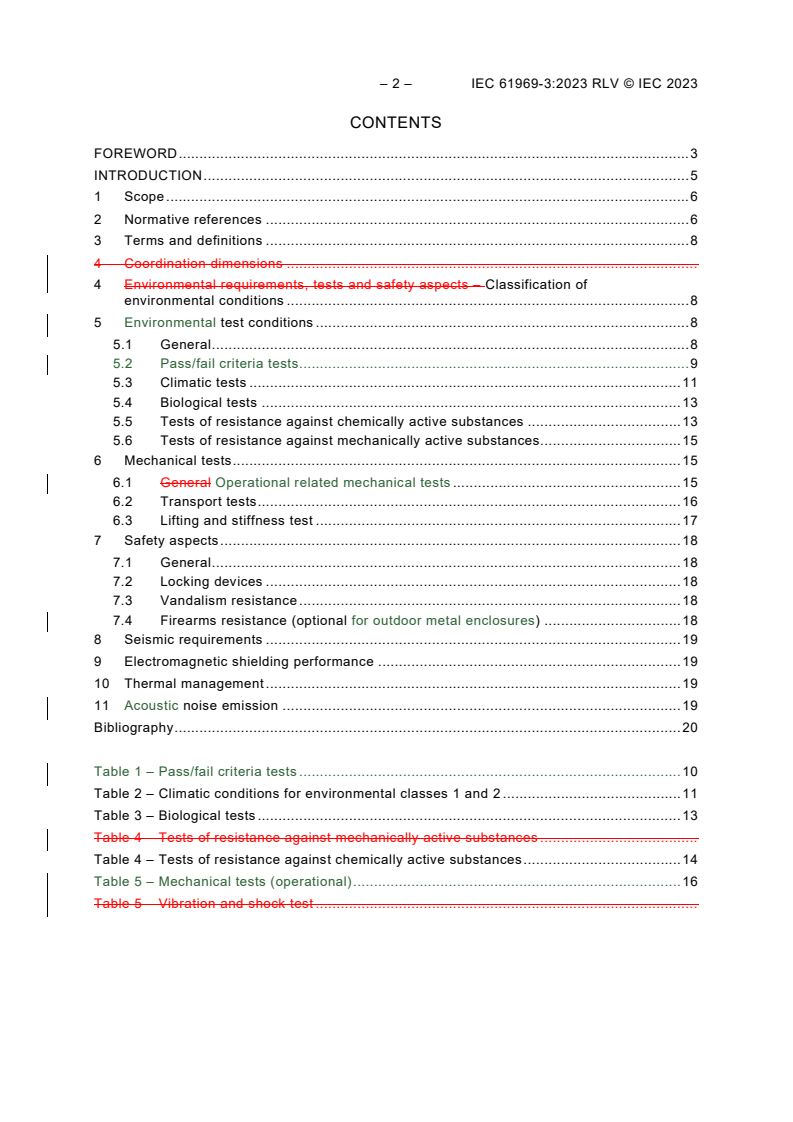
CONTENTS
FOREWORD . 3
INTRODUCTION . 5
1 Scope . 6
2 Normative references . 6
3 Terms and definitions . 8
4 Coordination dimensions .
4 Environmental requirements, tests and safety aspects – Classification of
environmental conditions . 8
5 Environmental test conditions . 8
5.1 General . 8
5.2 Pass/fail criteria tests . 9
5.3 Climatic tests . 11
5.4 Biological tests . 13
5.5 Tests of resistance against chemically active substances . 13
5.6 Tests of resistance against mechanically active substances . 15
6 Mechanical tests . 15
6.1 General Operational related mechanical tests . 15
6.2 Transport tests . 16
6.3 Lifting and stiffness test . 17
7 Safety aspects . 18
7.1 General . 18
7.2 Locking devices . 18
7.3 Vandalism resistance . 18
7.4 Firearms resistance (optional for outdoor metal enclosures) . 18
8 Seismic requirements . 19
9 Electromagnetic shielding performance . 19
10 Thermal management . 19
11 Acoustic noise emission . 19
Bibliography . 20
Table 1 – Pass/fail criteria tests . 10
Table 2 – Climatic conditions for environmental classes 1 and 2 . 11
Table 3 – Biological tests . 13
Table 4 – Tests of resistance against mechanically active substances .
Table 4 – Tests of resistance against chemically active substances . 14
Table 5 – Mechanical tests (operational) . 16
Table 5 – Vibration and shock test .
INTERNATIONAL ELECTROTECHNICAL COMMISSION
____________
MECHANICAL STRUCTURES FOR ELECTRICAL AND
ELECTRONIC EQUIPMENT – OUTDOOR ENCLOSURES –
Part 3: Environmental requirements, tests and safety aspects
FOREWORD
1) The International Electrotechnical Commission (IEC) is a worldwide organization for standardization comprising
all national electrotechnical committees (IEC National Committees). The object of IEC is to promote international
co-operation on all questions concerning standardization in the electrical and electronic fields. To this end and
in addition to other activities, IEC publishes International Standards, Technical Specifications, Technical Reports,
Publicly Available Specifications (PAS) and Guides (hereafter referred to as “IEC Publication(s)”). Their
preparation is entrusted to technical committees; any IEC National Committee interested in the subject dealt with
may participate in this preparatory work. International, governmental and non-governmental organizations liaising
with the IEC also participate in this preparation. IEC collaborates closely with the International Organization for
Standardization (ISO) in accordance with conditions determined by agreement between the two organizations.
2) The formal decisions or agreements of IEC on technical matters express, as nearly as possible, an international
consensus of opinion on the relevant subjects since each technical committee has representation from all
interested IEC National Committees.
3) IEC Publications have the form of recommendations for international use and are accepted by IEC National
Committees in that sense. While all reasonable efforts are made to ensure that the technical content of IEC
Publications is accurate, IEC cannot be held responsible for the way in which they are used or for any
misinterpretation by any end user.
4) In order to promote international uniformity, IEC National Committees undertake to apply IEC Publications
transparently to the maximum extent possible in their national and regional publications. Any divergence between
any IEC Publication and the corresponding national or regional publication shall be clearly indicated in the latter.
5) IEC itself does not provide any attestation of conformity. Independent certification bodies provide conformity
assessment services and, in some areas, access to IEC marks of conformity. IEC is not responsible for any
services carried out by independent certification bodies.
6) All users should ensure that they have the latest edition of this publication.
7) No liability shall attach to IEC or its directors, employees, servants or agents including individual experts and
members of its technical committees and IEC National Committees for any personal injury, property damage or
other damage of any nature whatsoever, whether direct or indirect, or for costs (including legal fees) and
expenses arising out of the publication, use of, or reliance upon, this IEC Publication or any other IEC
Publications.
8) Attention is drawn to the Normative references cited in this publication. Use of the referenced publications is
indispensable for the correct application of this publication.
9) IEC draws attention to the possibility that the implementation of this document may involve the use of (a)
patent(s). IEC takes no position concerning the evidence, validity or applicability of any claimed patent rights in
respect thereof. As of the date of publication of this document, IEC had not received notice of (a) patent(s), which
may be required to implement this document. However, implementers are cautioned that this may not represent
the latest information, which may be obtained from the patent database available at https://patents.iec.ch. IEC
shall not be held responsible for identifying any or all such patent rights.
This redline version of the official IEC Standard allows the user to identify the changes
made to the previous edition IEC 61969-3:2020. A vertical bar appears in the margin
wherever a change has been made. Additions are in green text, deletions are in
strikethrough red text.
– 4 – IEC 61969-3:2023 RLV © IEC 2023
IEC 61969-3 has been prepared by subcommittee 48D: Mechanical structures for electrical and
electronic equipment, of IEC technical committee 48: Electrical connectors and mechanical
structures for electrical and electronic equipment. It is an International Standard.
This fourth edition cancels and replaces the third edition published in 2020. This edition
constitutes a technical revision.
This edition includes the following significant technical changes with respect to the previous
edition:
a) alignment with the content of ETSI EN 300 019 and IEC 60721 series latest editions,
particularly with the actualization of climate conditions;
b) rationale for the selected operating conditions from IEC 60721-3-4 are added;
c) tests are grouped according to the classification of conditions in IEC 60721-3-4;
d) test severities for vibration and shock tests are aligned with ETSI EN 300 019-2-4;
e) addition of pass/fail criteria for each test.
The text of this International Standard is based on the following documents:
Draft Report on voting
48D/765/FDIS 48D/766/RVD
Full information on the voting for its approval can be found in the report on voting indicated in
the above table.
The language used for the development of this International Standard is English.
This document was drafted in accordance with ISO/IEC Directives, Part 2, and developed in
accordance with ISO/IEC Directives, Part 1 and ISO/IEC Directives, IEC Supplement, available
at www.iec.ch/members_experts/refdocs. The main document types developed by IEC are
described in greater detail at www.iec.ch/publications.
This International Standard is to be used in conjunction with IEC 61969-1:2023.
A list of all parts in the IEC 61969 series, published under the general title Mechanical structures
for electrical and electronic equipment – Outdoor enclosures, can be found on the IEC website.
The committee has decided that the contents of this document will remain unchanged until the
stability date indicated on the IEC website under webstore.iec.ch in the data related to the
specific document. At this date, the document will be
• reconfirmed,
• withdrawn, or
• revised.
IMPORTANT – The "colour inside" logo on the cover page of this document indicates
that it contains colours which are considered to be useful for the correct understanding
of its contents. Users should therefore print this document using a colour printer.
INTRODUCTION
The products covered by IEC 61969 series are empty enclosures for outdoor locations, to be
equipped with application-specific combinations of electrical and electronic equipment, and to
be used at non-weatherprotected locations above ground.
IEC 61969 series consists of:
– a design guidelines general part: IEC 61969-1;
– a coordination dimensions standard: IEC 61969-2;
– an environmental requirements and tests, safety aspects standard: IEC 61969-3.
This document provides basic environmental requirements and tests, as well as safety aspects,
to be used for outdoor enclosures in absence of local regulatory documents, or of application-
specific environmental test requirements.
This document provides manufacturers and users of generic outdoor enclosures with minimum
performance compliance criteria. The thermal management solution depends on the specific
environment of the outdoor enclosure.
Since forced air heat dissipation and acoustic noise are closely related, noise limitations are
typically defined by local regulatory documents.
It is responsibility of the outdoor enclosure vendor to provide a solution for thermal management
within the local regulatory noise limitations.
– 6 – IEC 61969-3:2023 RLV © IEC 2023
MECHANICAL STRUCTURES FOR ELECTRICAL AND
ELECTRONIC EQUIPMENT – OUTDOOR ENCLOSURES –
Part 3: Environmental requirements, tests and safety aspects
1 Scope
This part of IEC 61969 specifies a set of basic environmental requirements and tests, as well
as safety aspects for outdoor enclosures for electrical and electronic equipment, under
conditions of non-weatherprotected locations above ground.
The purpose of this document is to define a minimum level of environmental performance in
order to meet requirements of storage, transport and final installation. The intention is to
establish basic environmental performance criteria for outdoor enclosure compliance.
2 Normative references
The following documents are referred to in the text in such a way that some or all of their content
constitutes requirements of this document. For dated references, only the edition cited applies.
For undated references, the latest edition of the referenced document (including any
amendments) applies.
IEC 60068-2-1, Environmental testing – Part 2-1: Tests – Test A: Cold
IEC 60068-2-2, Environmental testing – Part 2-2: Tests – Test B: Dry heat
IEC 60068-2-6, Environmental testing – Part 2-6: Tests – Test Fc: Vibration (sinusoidal)
IEC 60068-2-10, Environmental testing – Part 2-10: Tests – Test J and guidance: Mould growth
IEC 60068-2-11, Basic Environmental testing procedures – Part 2-11: Tests – Test Ka: Salt mist
IEC 60068-2-14, Environmental testing – Part 2-14: Tests – Test N: Change of temperature
IEC 60068-2-27, Environmental testing – Part 2-27: Tests – Test Ea and guidance: Shock
IEC 60068-2-30, Environmental testing – Part 2-30: Tests – Test Db: Damp heat, cyclic
(12 h + 12 h cycle)
IEC 60068-2-31, Environmental testing – Part 2-31: Tests – Test Ec: Rough handling shocks,
primarily for equipment-type specimens
IEC 60068-2-60, Environmental testing – Part 2-60: Tests – Test Ke: Flowing mixed gas
corrosion test
IEC 60068-2-78, Environmental testing – Part 2-78: Tests – Test Cab: Damp heat, steady state
IEC 60529, Degrees of protection provided by enclosures (IP Code)
IEC 60950-1, Information technology equipment – Safety – Part 1: General requirements
IEC 60721-3-2, Classification of environmental conditions – Part 3-2: Classification of groups
of environmental parameters and their severities –Transportation and handling
IEC 60721-3-4, Classification of environmental conditions – Part 3-4: Classification of groups
of environmental parameters and their severities – Stationary use at non-weatherprotected
locations
IEC 60794-1-21, Optical fibre cables – Part 1-21: Generic specification – Basic optical cable
test procedures – Mechanical tests methods
IEC 61300-2-10, Fibre optic interconnecting devices and passive components – Basic test and
measurement procedures – Part 2-10: Tests – Crush and load resistance
IEC 61300-2-56:2020, Fibre optic interconnecting devices and passive components – Basic test
and measurement procedures – Part 2-56: Tests – Wind resistance of mounted housing
IEC 61439-5, Low-voltage switchgear and controlgear assemblies – Part 5: Assemblies for
power distribution in public networks
IEC 61587-1, Mechanical structures for electrical and electronic equipment – Tests for
IEC 60917 and IEC 60297 series – Part 1: Environmental requirements, test setups and safety
aspects for cabinets, racks, subracks and chassis under indoor condition use and transportation
IEC 61587-2, Mechanical structures for electronic equipment – Tests for IEC 60917 and
IEC 60297 – Part 2: Seismic tests for cabinets and racks
IEC 61587-3, Mechanical structures for electronic equipment – Tests for IEC 60917 and
IEC 60297 – Part 3: Electromagnetic shielding performance tests for cabinets and subracks
IEC 61969-1:20202023, Mechanical structures for electrical and electronic equipment –
Outdoor enclosures – Part 1: Design guidelines
IEC 62194, Methods of evaluating the thermal performance of enclosures
IEC 62262, Degrees of protection provided by enclosures for electrical equipment against
external mechanical impacts (IK code)
IEC 62368-1, Audio/video, information and communication technology equipment – Part 1:
Safety requirements
ISO 2533, Standard atmosphere
ISO 3744, Acoustics – Determination of sound power levels and sound energy levels of noise
sources using sound pressure – Engineering methods for an essentially free field over a
reflecting plane
ISO 4892-2, Plastics – Methods of exposure to laboratory light sources – Part 2: Xenon-arc
lamps
ISO 4892-3, Plastics – Methods of exposure to laboratory light sources – Part 3: Fluorescent
UV lamps
ETSI EN 300 019-2-2, Environmental Engineering (EE) – Environmental conditions and
environmental tests for telecommunications equipment – Part 2-2: Specification of
environmental tests – Transportation
– 8 – IEC 61969-3:2023 RLV © IEC 2023
ETSI EN 300 019-2-4, Environmental Engineering (EE) – Environmental conditions and
environmental tests for telecommunications equipment – Part 2-4: Specification of
environmental tests – Stationary use at non-weatherprotected locations
3 Terms and definitions
For the purposes of this document, the terms and definitions given in IEC 61969-1 apply.
No terms and definitions are listed in this document.
ISO and IEC maintain terminology databases for use in standardization at the following
addresses:
• IEC Electropedia: available at https://www.electropedia.org/
• ISO Online browsing platform: available at https://www.iso.org/obp
4 Coordination dimensions
This clause of IEC 61969-1:2020 applies.
4 Environmental requirements, tests and safety aspects – Classification of
environmental conditions
The environmental operating conditions are derived from IEC 60721-3-4, with the focus on
empty outdoor enclosures relevant requirements. Two classes of environmental performance
are described:
– class 1: Non-weatherprotected locations, standard performance: Covers all regions with a
moderate climate;
– class 2: Non-weatherprotected locations, extended performance: Covers all regions with
severe an extremely cold or extremely warm climate.
The individual outdoor enclosure tested to these basic environmental test requirements may
claim compliance to either class 1 or class 2 or a combination of class 1/class 2.
5 Environmental test conditions
5.1 General
The basic test conditions shown in Table 1, Table 2, Table 3 and Table 4 reflect typical outdoor
enclosure environments to be endured.
The minimum tests and test severities for the non-weatherprotected conditions as defined in
IEC 60721-3-4 can be found as:
– climatic conditions (K) given in Table 2;
– biological conditions (B) given in Table 3;
– chemical active substance (C) given in Table 4;
– mechanical active substance (S) given as pass/fail criterion PF2 in Table 1;
– mechanical conditions during operation (M) given in Table 5;
Two classes of test severities for the operating conditions are defined, each corresponding to
the relevant class of environmental performance defined in Clause 4:
– class 1 for operating conditions in temperate climatic environments. The refence for this
environment in IEC 60721-3-4 is 4K26/4Z4/4B2/4C2/4S12/4M11;
– class 2 for operating conditions with more extreme tropical and polar conditions
4K25/4Z5/4B2/4C2/4S12/4M11 and 4K27/4Z5/4B2/4C2/4S12/4M11 from IEC 60721-3-4.
5.2 Pass/fail criteria tests
Table 1 contains the pass/fail criteria tests that shall be performed after the climatic tests
(Table 2), the biological tests (Table 3), the resistance against chemically active substances
tests (Table 4) and the mechanical tests (Table 5). When the same test sample is used for
several tests, it is allowed to perform the relevant pass/fail tests at the end of the test sequence.
– 10 – IEC 61969-3:2023 RLV © IEC 2023
Table 1 – Pass/fail criteria tests
Test Environmental Test severity Acceptance conditions
parameters and test
Class 1 Class 2
methods
Examination of the internal and external
parts.
No defects which would
Inspection with the naked eye for flaws,
PF1 Visual examination adversely affect product
deformation, surface changes, rust, cracks
performance.
or other deteriorations that could impair
functionality.
The protection is satisfactory
if talcum powder has not
accumulated in a quantity or
location such that, as with
Protection against
any other kind of dust, it
a ingress of dust
PF2 IP5X could interfere with the
correct operation of the
IEC 60529
equipment or impair safety.
No dust shall deposit where
it could lead to tracking
along the creepage distance.
If any water has entered, it
shall not:
– be sufficient to interfere
with the correct operation
of the equipment or
impair safety;
– deposit on insulation
parts where it could lead
to tracking along the
creepage distance;
– reach live parts or
windings not designed to
operate when wet;
– accumulate near the
Protection against
IPX4
cable end or enter the
ingress of water
PF3
cable if any.
IEC 60529
If the enclosure is provided
with drain-holes, it should be
proved by inspection that
any water which enters does
not accumulate and that it
drains away without doing
any harm to the equipment.
For enclosures without
drain-holes, the relevant
product standard shall
specify the acceptance
conditions if water can
accumulate to reach live
parts.
IPX5 No ingress of water
a
The IP5X pass/fail criterion for protection against ingress of dust is used to cover the mechanical active
substance condition 4S12 of IEC 60721-3-4.
5.3 Climatic tests
The climatic tests from Table 2 shall be performed on test samples with hinges, locks and
handles in operating condition.
Table 2 – Climatic conditions for environmental classes 1 and 2
Test severity
Environmental
Duration Method
parameters
Class 1 Class 2
IEC 60068-2-1:
a Low air temperature −40 °C −50 °C 16 h
A
IEC 60068-2-2:
b High air temperature +85 °C +85 °C 16 h
B
IEC 60068-2-78:
c Damp heat +30 °C, 93 % +30 °C, 93 % 96 h
Cb
−40 °C to +23 °C −40 °C to + 85 °C
IEC 60068-2-14:
d Change of temperature 2 cycles
Nb
1 °C/min 1 °C/min
144 h
IEC 60068-2-30:
e Condensation 90 % to 100 % RH 90 % to 100 % RH
Db
(6 cycles)
Precipitation (rain, snow,
f IPX4 IPX5 - IEC 60529
hail, etc.)
Movement of the
g 50 m/s 60 m/s - -
surrounding air
h Formation of ice and frost Minimum requirement: No mechanical deformation -
Minimum requirement: No reduction in mechanical
i Ultraviolet degradation properties (tensile strength and elongation at yield) by ISO 4892-2
more than 20 %.
For comparable conditions, the International Standard Air, in accordance to ISO 2533 (15 °C at 1 013, 25 hPa)
shall be used.
This maximum temperature includes the effects of heat dissipation caused by active electronics and includes
solar load.
– 12 – IEC 61969-3:2023 RLV © IEC 2023
Test Environmental Test severity
Pass/fail criteria to be
parameters and test
checked
Class 1 Class 2
methods
a
Visual examination (PF1)
Cold
Protection against ingress of
IEC 60068-2-1: Test A
K1 −40 °C for 16 h −50 °C for 16 h
dust (PF2) and water (PF3)
after test.
b
Visual examination (PF1)
Dry heat
Protection against ingress of
IEC 60068-2-2: Test B
K2 +85 °C for 16 h
dust (PF2) and water (PF3)
after test.
Change of temperature Temperature range: −40 °C to + 85 °C Visual examination (PF1)
IEC 60068-2-14: Test Nb Dwell time at extreme temperatures: 4 h Protection against ingress of
K3
dust (PF2) and water (PF3)
Rate of change of temperature:1 °C/min
after test.
Number of cycles: 2 (12 h/cycle)
c
K4 Temperature range: +25 °C to +55 °C Visual examination (PF1)
Damp heat, cyclic
Humidity: >90 % RH Protection against ingress of
IEC 60068-2-30: Test Db
dust (PF2) and water (PF3)
Number of cycles: 6 (24 h/cycle)
after test.
K5 Ultraviolet light resistance Xenon lamp (340 nm) Visual examination (PF1)
ISO 4892-2 (for painted or Exposure cycle: Cycle 1 No reduction in mechanical
polymer coated metal) properties after test (for
Exposure time: 1 000 h
example: average tensile
strength and elongation at
Ultraviolet light resistance Fluorescent lamp type 1A (340 nm)
yield) by more than 20 %.
ISO 4892-3 (for full Exposure cycle: Cycle 1 with alternating
polymer outer enclosures) UV and condensation cycles:
– UV cycle: 8 h at (+60 ± 3) °C
– Condensation cycle: 4 h at (+50 ±
3) °C
Exposure time: 2 160 h
Test are performed on moulded dumbbells
For comparable conditions, the International Standard Air, in accordance with ISO 2533 (15 °C at 1 013, 25 hPa)
shall be used.
a
This minimum temperature includes the effects of heat radiation during the night with open sky.
b
This maximum temperature includes the effects of heat dissipation caused by active electronics and includes
solar load.
c
The damp heat, cyclic test replaces the less severe IEC 60068-2-78 damp heat, steady state test.
Following the test, compliance is checked by visual inspection of the internal and external parts;
no rust, cracking or other deterioration shall be detected with impact to the required function;
no ingress of water.
Hinges, locks and handles for example shall be in operating condition.
The test in accordance with Table 1, item h, shall prove that access to the internal equipment
is possible without causing permanent degradation of protection levels.
5.4 Biological tests
Table 3 – Biological tests
Test severity
Environmental
Purpose Method
parameters
Class 1 Class 2
Flora: Presence of mould, IEC 60068-2-10:
a
Minimum requirement: No reduction
fungus, etc. J
To check the
in mechanical properties (tensile
material for
Fauna: Presence of rodents
strength and elongation at yield) by
resistance
b and others harmful to the
more than 20 %.
equipment
Environmental
Pass/fail criteria to be
Test parameters and test Test severities for class 1 and 2
checked
method
Flora: Presence of mould, Test samples: moulded dumbbells Visual grading ≤2
fungus, etc.
Test variant 1 In case visual rating is 0, no
IEC 60068-2-10: Test J further tests are required.
Inoculation conditions:
In case of visual grading 1 or
– Temperature: (29 ± 1) °C
2 the degradation of material
B1
properties will be checked.
– Relative humidity: ≥ 90 % RH
No reduction in mechanical
Duration: 28 days properties (for example
average tensile strength and
elongation at yield) by more
than 20 %.
Fauna: Presence of rodents
B2 and others harmful to the None None
equipment
Following the test, compliance is checked by visual inspection.
5.5 Tests of resistance against chemically active substances
The resistance tests to corrosion by chemically active substances are listed in Table 4. The test
severities were taken from ETSI EN 300 019-2-2 and ETSI EN 300 019-2-4.
Large housings (like street cabinets) can be tested by using representative samples of used
materials.
– 14 – IEC 61969-3:2023 RLV © IEC 2023
Table 4 – Tests of resistance against chemically active substances
Test severity
Environmental
Duration Method
Class 1 Class 2
parameters
Mean value Maximum value
Salts: Sea and road salt 4 weeks IEC 60068-2-11:
a +35 °C,5 % NaCl
mist (672 h) Ka
3 3
0,3 mg/m 1,0 mg/m
b Sulphur dioxide
3 3 3 3
0,11 cm /m 0,37 cm /m
3 3
0,1 mg/m 0,5 mg/m
c
Hydrogen sulphide
3 3 3 3
0,071 cm /m 0,36 cm /m
IEC 60068-2-60:
10 days
Ke
3 3
0,1 mg/m 0,3 mg/m
d Chlorine
3 3 3
0,034 cm /m 0,1 cm /m
3 3
0,5 mg/m 1,0 mg/m
e Nitrogen oxides
3 3 3 3
0,26 cm /m 0,52 cm /m
Tests of Table 3 may be combined with tests of Table 1.
Environmental Test severity
Pass/fail criteria to be
Test parameters and test
checked
Class 1 Class 2
method
Salt mist Temperature: Temperature: Visual examination (PF1)
+35 °C +35 °C
IEC 60068-2-11: Test Ka Contact materials for the
Solution: 5 % NaCl Solution: 5 % NaCl electromagnetic shielding
and grounding shall remain
Duration: 5 days Duration: 28 days
free of corrosion.
Class 1: No signs of surface
corrosion of protective
C1
enclosure. A colour change
due to passivation is
allowed.
Class 2: Surface corrosion of
the protective enclosure is
allowed. It shall remain
possible to open and close
the door(s).
Flowing mixed gas Temperature: (25 ± 1) °C Visual examination (PF1)
corrosion test
Relative humidity: (75 ± 3) % RH Surface corrosion of the
IEC 60068-2-60: Test Ke protective enclosure is
Duration: 10 days
method 4 with severities allowed. It shall remain
from ETSI EN 300 019-2-4 possible to open and close
the door(s).
1,0 mg/m
Sulphur dioxide SO
Contact materials for the
3 3
0,37 cm /m electromagnetic shielding
and grounding shall remain
C2
0,5 mg/m
free of corrosion.
Hydrogen sulphide H S
3 3
0,36 cm /m
0,3 mg/m
Chlorine Cl
3 3
0,1 cm /m
1,0 mg/m
Nitrogen oxides NO
3 3
0,52 cm /m
Following each of the tests of Table 3, compliance is checked by visual inspection of the outside
of the used materials or coatings.
Surface corrosion of the protective enclosure is allowed.
The enclosure design shall provide protection for electromagnetic interference gaskets and for
protective earthing contacts, where no corrosion is permitted.
5.6 Tests of resistance against mechanically active substances
Table 4 – Tests of resistance against mechanically active substances
Test severity
Environmental
Method
parameters
Classes 1 and 2
a Sand
b Dust (suspension) IP5X IEC 60529
c Dust (sedimentation)
Following the test, shall be executed according to the next assessment: no measurable dust
shall have entered the enclosure (this is more severe than in IEC 60529 for IP5X, and IP6X
may be applied for an intended requirement).
The resistance against mechanical active substances like sand and dust is covered by the
test PF2 in Table 1.
6 Mechanical tests
6.1 General Operational related mechanical tests
The purpose of these mechanical tests is to ensure that the outdoor enclosure will withstand
handling, storage, transport and protect installed equipment from exposure to mechanical stress.
For seismic compliance, see Clause 9. Installations in public areas typically require compliance
to more severe local regulatory laws. These and any additional application specific
requirements need to be observed. Should the outdoor enclosure be installed in a public place,
the power input requirements may have to be in compliance with IEC 61439-5.
The purpose of the mechanical tests in Table 5 is to ensure that the outdoor enclosure will
withstand handling and give protection of installed equipment from exposure to mechanical
stress during operation. The test severities of tests M1, M2 and M3 were taken from
ETSI EN 300 019-2-4, T 4.1E. For seismic compliance, see Clause 8.
– 16 – IEC 61969-3:2023 RLV © IEC 2023
Table 5 – Mechanical tests (operational)
Environmental Test severities
Pass/fail criteria to be
Test parameters and test
checked
Class 1 Class 2
methods
M1 Wind resistance 30 m/s (110 km/h) 50 m/s (180 km/h) Visual inspection (PF1). No
deformation or damage of
The applied force
IEC 61300-2-56:2020 The applied force
parts that affect form, fit and
shall be calculated shall be calculated
function shall be observed.
according to the according to the
method described method described
in Annex B of in Annex B of
IEC 61300-2-56: IEC 61300-2-56:
2020 2020
a
M2 5 Hz to 9 Hz: 1,2 mm displacement Visual inspection (PF1). No
Vibration, sinusoidal
deformation or damage of
IEC 60068-2-6: Test Fc 9 Hz to 500 Hz: 4 m/s acceleration
parts that affect form, fit and
function shall be observed.
Axes: 3 mutually perpendicular
Protection against ingress of
10 sweeps per axis
dust (PF2) and water (PF3)
after test.
a
M3 Half sine pulse Visual inspection (PF1). No
Shock (operational)
deformation or damage of
Duration: 11 ms
IEC 60068-2-27: Test Ea
parts that affect form, fit and
function shall be found.
Acceleration: 50 m/s
Protection against ingress of
Axes 3
dust (PF2) and water (PF3)
after test.
Number of shocks: 3 shocks in each
direction per axis (= 18 shocks in total)
M4 Crush Load (N): 1 750 (Pa) × Width (m) Visual inspection (PF1). No
× Depth (m) deformation or damage of
IEC 61300-2-10
parts that affect form, fit and
Load evenly distributed on top surface of
function shall be found.
the housing.
Protection against ingress of
Duration: 10 min
dust (PF2) and water (PF3)
after test.
M5 Impact IK09 (10 J) IK10 (20 J) Visual inspection (PF1). No
deformation or damage of
IEC 62262
parts that affect form, fit and
function shall be found.
Protection against ingress of
dust (PF2) and water (PF3)
after test.
a
The outdoor enclosure shall be mounted to the shock/vibration table by using the intended ground/floor
mounting features.
6.2 Transport tests
The dynamic tests of an outdoor enclosure shall be conducted under the intended transport
conditions. Since outdoor enclosure dynamic transport stress is considerably more severe than
typical handling and storage stress, no further dynamic tests are required. For the purpose of
this test, no transport packing material is used. The outdoor enclosure shall be mounted to the
shock/vibration table by using the intended ground/floor mounting features.
Table 5 shows the chosen severity classes.
Table 5 – Vibration and shock test
Test severity
Class 1 Class 2
Environmental parameters Method
(controlled transport (limited transport
condition) condition)
5 Hz to 9 Hz/3,5 mm 5 Hz to 9 Hz/3,5 mm
displacement displacement
9 Hz to
9 Hz-200 Hz/10 m/s
Vibration, sinusoidal 200 Hz/10 m/s
a acceleration IEC 60068-2-6: Fc
3 axes, 10 cycles acceleration
200 Hz to 200 Hz to
2 2
500 Hz/15 m/s 500 Hz/15 m/s
acceleration acceleration
5 Hz to 20 Hz:
2 3
11 m /s
ETSI EN 300 019-2-2
b Vibration, random -
Class 2.3
20 Hz to 200 Hz:
−3 dB/oct.
Peak acceleration Peak acceleration
Shock, 1/2 sine wave vertical IEC 60068-2-27: Ea
2 2
c axes only Shock response
100 m/s 100 m/s
No of shocks: 3 spectrum type I
Time: 11 ms Time: 11 ms
Free fall:
enclosure mass < 20 kg 0,25 m 1,25 m
IEC 60068-2-31: Ec
d
20 kg to 100 kg 0,25 m 1,00 m
> 100 kg 0,10 m 0,25 m
Alternative test.
2 The test is excited in the packaging condition.
Following the test, no deformation or damage of parts that affect form, fit and function shall be
found.
Two classes for the test severities for the transport tests are defined:
– class 1: Conditions according to classification 2K12/2B2/2C2/2S2/2M4 of IEC 60721-3-2.
This applies to handling, transport by rail, river, sea, air (jet aircraft only) and road transport
using good vehicles on good roads. This category includes transport of goods within
ISO containers;
– class 2: Conditions according to classification 2K12/2B2/2C2/2S2/2M5 of IEC 60721-3-2.
This includes the conditions of class 1 plus road transport using poor vehicles and/or on
poor roads as well as handling using trolleys with no suspension.
The requirements and relevant tests covering transport and handling of the packaged product
can be agreed between vendor and user.
6.3 Lifting and stiffness test
If lifting eyes are provided, the performance test as per IEC 61587-1 shall be applied.
Following the test, no deformation or damage of parts that affect form, fit and function shall be
found.
– 18 – IEC 61969-3:2023 RLV © IEC 2023
7 Safety aspects
7.1 General
General safety requirements: The outdoor enclosure, once fully equipped and installed, shall
not present a danger or hazard to people and shall prevent unauthorized access. To protect
authorized personnel (during assembly, installation, test and maintenance phases), the outdoor
enclosure shall be free of defects such as sharp edges, burrs, etc. Compliance to IEC 60950-1
and IEC 62368-1 is required, as applicable, for the electrical and electronic equipment that is
installed inside the outdoor enclosure.
NOTE The above safety standards do not directly apply to an empty outdoor enclosure.
Regulatory safety requirements: The outdoor enclosure shall also comply with the local
enforced regulatory safety requirements.
Provisions shall be made for providing electrical safety measures according to the relevant
requirements in IEC 62368-1, for the electrical and electronic equipment that can be installed
inside the outdoor enclosure.
Installations in public areas typically require compliance to more severe local regulatory laws.
These and any additional application specific requirements need to be observed. Should the
outdoor enclosure be installed in a public place, the power input requirements may have to be
in compliance with IEC 61439-5.
For requirements and relevant tests covering safety aspects, both general and of local
regulatory (to be agreed between vendor and user), Table 2 of IEC 61969-1:20202023 shall
apply.
7.2 Locking devices
Outdoor enclosure access locking functions such as used on doors, covers, roofs, etc., are
application and/or regulatory specific. The outdoor enclosure shall have the capability to be
locked and unlocked only by authorized crafts people.
7.3 Vandalism resistance
Outdoor enclosure vandalism resistance required on any locking functions such as used with
doors, covers, roofs, etc., are application and/or regulatory specific. The outdoor enclosure
shall provide for heavy duty key locking and hinges hardware.
Compliance check: The outdoor enclosure shall be resistant to provide resistance against
unauthorized access. Test method shall be agreed between vendor and user.
7.4 Firearms resistance (optional for outdoor metal enclosures)
Outdoor enclosure firearms resistance is application and/or regulatory specific.
The outdoor metal enclosure shall be designed for withstanding a 12-gauge shotgun blast of
no. 7 ½ shot at a distance of 15 m without penetration of the enclosure wall by any pellets.
Test procedure (IEC 60794-1-21 method E13A):
The enclosure shall be positioned as in a typical installation and all unique vertical surfaces
shall be subjected to a blast from a 12-gauge shotgun fired at a distance of 15 m. The load
used shall be a 70 mm shell loaded with 28 or 32 grams of no. 6 steel shot fired from a 28 inch
modified choke barrel.
Assessment following the test:
The outer skin shell of the enclosure may be deformed but still maintaining protection, and
without any penetration of the enclosure wall by any pellets.
8 Seismic requirements
Outdoor enclosure seismic compliance is application and/or regulatory specific. If seismic
compliance is requested, tests shall be conducted in accordance with IEC 61587-2.
9 Electromagnetic shielding performance
This requirement is optional, dependent on the area where needed.
If electromagnetic shielding compliance is required, test should be conducted in accordance
with IEC 61587-3 unless otherwise specified.
10 Thermal management
For the operation of electronic equipment housed in outdoor enclosures, passive and/or active
thermal management devices are used. Since the active heat management devices typically
include fans, noise emission may have to comply with local regulatory requirements. Preferably,
outdoor enclosure heat management should be based on convection air cooling (passive). If
environmental compliance testing is required, tests should be conducted in accordance with
IEC 62194 unless otherwise specified.
11 Acoustic noise emission
The final location of the installed outdoor enclosure will determine the acoustic noise limits
tolerated. Typically, regional and location specific regulatory requirements are in place. Sound
power noise tests shall be conducted in accordance with ISO 3
...
IEC 61969-3 ®
Edition 4.0 2023-11
INTERNATIONAL
STANDARD
NORME
INTERNATIONALE
Mechanical structures for electrical and electronic equipment – Outdoor
enclosures –
Part 3: Environmental requirements, tests and safety aspects
Structures mécaniques pour équipement électrique et électronique –
Enveloppes de plein air –
Partie 3: Exigences et essais d'environnement, et aspects liés à la sécurité
All rights reserved. Unless otherwise specified, no part of this publication may be reproduced or utilized in any form
or by any means, electronic or mechanical, including photocopying and microfilm, without permission in writing from
either IEC or IEC's member National Committee in the country of the requester. If you have any questions about IEC
copyright or have an enquiry about obtaining additional rights to this publication, please contact the address below or
your local IEC member National Committee for further information.
Droits de reproduction réservés. Sauf indication contraire, aucune partie de cette publication ne peut être reproduite ni
utilisée sous quelque forme que ce soit et par aucun procédé, électronique ou mécanique, y compris la photocopie et
les microfilms, sans l'accord écrit de l'IEC ou du Comité national de l'IEC du pays du demandeur. Si vous avez des
questions sur le copyright de l'IEC ou si vous désirez obtenir des droits supplémentaires sur cette publication, utilisez
les coordonnées ci-après ou contactez le Comité national de l'IEC de votre pays de résidence.
IEC Secretariat Tel.: +41 22 919 02 11
3, rue de Varembé info@iec.ch
CH-1211 Geneva 20 www.iec.ch
Switzerland
About the IEC
The International Electrotechnical Commission (IEC) is the leading global organization that prepares and publishes
International Standards for all electrical, electronic and related technologies.
About IEC publications
The technical content of IEC publications is kept under constant review by the IEC. Please make sure that you have the
latest edition, a corrigendum or an amendment might have been published.
IEC publications search - webstore.iec.ch/advsearchform IEC Products & Services Portal - products.iec.ch
The advanced search enables to find IEC publications by a Discover our powerful search engine and read freely all the
variety of criteria (reference number, text, technical publications previews. With a subscription you will always have
committee, …). It also gives information on projects, replaced access to up to date content tailored to your needs.
and withdrawn publications.
Electropedia - www.electropedia.org
IEC Just Published - webstore.iec.ch/justpublished
The world's leading online dictionary on electrotechnology,
Stay up to date on all new IEC publications. Just Published
containing more than 22 300 terminological entries in English
details all new publications released. Available online and once
and French, with equivalent terms in 19 additional languages.
a month by email.
Also known as the International Electrotechnical Vocabulary
(IEV) online.
IEC Customer Service Centre - webstore.iec.ch/csc
If you wish to give us your feedback on this publication or need
further assistance, please contact the Customer Service
Centre: sales@iec.ch.
A propos de l'IEC
La Commission Electrotechnique Internationale (IEC) est la première organisation mondiale qui élabore et publie des
Normes internationales pour tout ce qui a trait à l'électricité, à l'électronique et aux technologies apparentées.
A propos des publications IEC
Le contenu technique des publications IEC est constamment revu. Veuillez vous assurer que vous possédez l’édition la
plus récente, un corrigendum ou amendement peut avoir été publié.
Recherche de publications IEC - IEC Products & Services Portal - products.iec.ch
webstore.iec.ch/advsearchform Découvrez notre puissant moteur de recherche et consultez
La recherche avancée permet de trouver des publications IEC gratuitement tous les aperçus des publications. Avec un
en utilisant différents critères (numéro de référence, texte, abonnement, vous aurez toujours accès à un contenu à jour
comité d’études, …). Elle donne aussi des informations sur les adapté à vos besoins.
projets et les publications remplacées ou retirées.
Electropedia - www.electropedia.org
IEC Just Published - webstore.iec.ch/justpublished
Le premier dictionnaire d'électrotechnologie en ligne au monde,
Restez informé sur les nouvelles publications IEC. Just
avec plus de 22 300 articles terminologiques en anglais et en
Published détaille les nouvelles publications parues.
français, ainsi que les termes équivalents dans 19 langues
Disponible en ligne et une fois par mois par email.
additionnelles. Egalement appelé Vocabulaire
Electrotechnique International (IEV) en ligne.
Service Clients - webstore.iec.ch/csc
Si vous désirez nous donner des commentaires sur cette
publication ou si vous avez des questions contactez-nous:
sales@iec.ch.
IEC 61969-3 ®
Edition 4.0 2023-11
INTERNATIONAL
STANDARD
NORME
INTERNATIONALE
Mechanical structures for electrical and electronic equipment – Outdoor
enclosures –
Part 3: Environmental requirements, tests and safety aspects
Structures mécaniques pour équipement électrique et électronique –
Enveloppes de plein air –
Partie 3: Exigences et essais d'environnement, et aspects liés à la sécurité
INTERNATIONAL
ELECTROTECHNICAL
COMMISSION
COMMISSION
ELECTROTECHNIQUE
INTERNATIONALE
ICS 31.240 ISBN 978-2-8322-7748-5
– 2 – IEC 61969-3:2023 © IEC 2023
CONTENTS
FOREWORD . 3
INTRODUCTION . 5
1 Scope . 6
2 Normative references . 6
3 Terms and definitions . 8
4 Classification of environmental conditions . 8
5 Environmental test conditions . 8
5.1 General . 8
5.2 Pass/fail criteria tests . 8
5.3 Climatic tests . 9
5.4 Biological tests . 11
5.5 Tests of resistance against chemically active substances . 11
5.6 Tests of resistance against mechanically active substances . 12
6 Mechanical tests . 12
6.1 Operational related mechanical tests . 12
6.2 Transport tests . 13
6.3 Lifting and stiffness test . 14
7 Safety aspects . 14
7.1 General . 14
7.2 Locking devices . 14
7.3 Vandalism resistance . 14
7.4 Firearms resistance (optional for outdoor metal enclosures) . 14
8 Seismic requirements . 15
9 Electromagnetic shielding performance . 15
10 Thermal management . 15
11 Acoustic noise emission . 15
Bibliography . 16
Table 1 – Pass/fail criteria tests . 9
Table 2 – Climatic conditions for environmental classes 1 and 2 . 10
Table 3 – Biological tests . 11
Table 4 – Tests of resistance against chemically active substances . 12
Table 5 – Mechanical tests (operational) . 13
INTERNATIONAL ELECTROTECHNICAL COMMISSION
____________
MECHANICAL STRUCTURES FOR ELECTRICAL AND
ELECTRONIC EQUIPMENT – OUTDOOR ENCLOSURES –
Part 3: Environmental requirements, tests and safety aspects
FOREWORD
1) The International Electrotechnical Commission (IEC) is a worldwide organization for standardization comprising
all national electrotechnical committees (IEC National Committees). The object of IEC is to promote international
co-operation on all questions concerning standardization in the electrical and electronic fields. To this end and
in addition to other activities, IEC publishes International Standards, Technical Specifications, Technical Reports,
Publicly Available Specifications (PAS) and Guides (hereafter referred to as “IEC Publication(s)”). Their
preparation is entrusted to technical committees; any IEC National Committee interested in the subject dealt with
may participate in this preparatory work. International, governmental and non-governmental organizations liaising
with the IEC also participate in this preparation. IEC collaborates closely with the International Organization for
Standardization (ISO) in accordance with conditions determined by agreement between the two organizations.
2) The formal decisions or agreements of IEC on technical matters express, as nearly as possible, an international
consensus of opinion on the relevant subjects since each technical committee has representation from all
interested IEC National Committees.
3) IEC Publications have the form of recommendations for international use and are accepted by IEC National
Committees in that sense. While all reasonable efforts are made to ensure that the technical content of IEC
Publications is accurate, IEC cannot be held responsible for the way in which they are used or for any
misinterpretation by any end user.
4) In order to promote international uniformity, IEC National Committees undertake to apply IEC Publications
transparently to the maximum extent possible in their national and regional publications. Any divergence between
any IEC Publication and the corresponding national or regional publication shall be clearly indicated in the latter.
5) IEC itself does not provide any attestation of conformity. Independent certification bodies provide conformity
assessment services and, in some areas, access to IEC marks of conformity. IEC is not responsible for any
services carried out by independent certification bodies.
6) All users should ensure that they have the latest edition of this publication.
7) No liability shall attach to IEC or its directors, employees, servants or agents including individual experts and
members of its technical committees and IEC National Committees for any personal injury, property damage or
other damage of any nature whatsoever, whether direct or indirect, or for costs (including legal fees) and
expenses arising out of the publication, use of, or reliance upon, this IEC Publication or any other IEC
Publications.
8) Attention is drawn to the Normative references cited in this publication. Use of the referenced publications is
indispensable for the correct application of this publication.
9) IEC draws attention to the possibility that the implementation of this document may involve the use of (a)
patent(s). IEC takes no position concerning the evidence, validity or applicability of any claimed patent rights in
respect thereof. As of the date of publication of this document, IEC had not received notice of (a) patent(s), which
may be required to implement this document. However, implementers are cautioned that this may not represent
the latest information, which may be obtained from the patent database available at https://patents.iec.ch. IEC
shall not be held responsible for identifying any or all such patent rights.
IEC 61969-3 has been prepared by subcommittee 48D: Mechanical structures for electrical and
electronic equipment, of IEC technical committee 48: Electrical connectors and mechanical
structures for electrical and electronic equipment. It is an International Standard.
This fourth edition cancels and replaces the third edition published in 2020. This edition
constitutes a technical revision.
This edition includes the following significant technical changes with respect to the previous
edition:
a) alignment with the content of ETSI EN 300 019 and IEC 60721 series latest editions,
particularly with the actualization of climate conditions;
b) rationale for the selected operating conditions from IEC 60721-3-4 are added;
– 4 – IEC 61969-3:2023 © IEC 2023
c) tests are grouped according to the classification of conditions in IEC 60721-3-4;
d) test severities for vibration and shock tests are aligned with ETSI EN 300 019-2-4;
e) addition of pass/fail criteria for each test.
The text of this International Standard is based on the following documents:
Draft Report on voting
48D/765/FDIS 48D/766/RVD
Full information on the voting for its approval can be found in the report on voting indicated in
the above table.
The language used for the development of this International Standard is English.
This document was drafted in accordance with ISO/IEC Directives, Part 2, and developed in
accordance with ISO/IEC Directives, Part 1 and ISO/IEC Directives, IEC Supplement, available
at www.iec.ch/members_experts/refdocs. The main document types developed by IEC are
described in greater detail at www.iec.ch/publications.
This International Standard is to be used in conjunction with IEC 61969-1:2023.
A list of all parts in the IEC 61969 series, published under the general title Mechanical structures
for electrical and electronic equipment – Outdoor enclosures, can be found on the IEC website.
The committee has decided that the contents of this document will remain unchanged until the
stability date indicated on the IEC website under webstore.iec.ch in the data related to the
specific document. At this date, the document will be
• reconfirmed,
• withdrawn, or
• revised.
INTRODUCTION
The products covered by IEC 61969 series are empty enclosures for outdoor locations, to be
equipped with application-specific combinations of electrical and electronic equipment, and to
be used at non-weatherprotected locations above ground.
IEC 61969 series consists of:
– a design guidelines general part: IEC 61969-1;
– a coordination dimensions standard: IEC 61969-2;
– an environmental requirements and tests, safety aspects standard: IEC 61969-3.
This document provides basic environmental requirements and tests, as well as safety aspects,
to be used for outdoor enclosures in absence of local regulatory documents, or of application-
specific environmental test requirements.
This document provides manufacturers and users of generic outdoor enclosures with minimum
performance compliance criteria. The thermal management solution depends on the specific
environment of the outdoor enclosure.
Since forced air heat dissipation and acoustic noise are closely related, noise limitations are
typically defined by local regulatory documents.
It is responsibility of the outdoor enclosure vendor to provide a solution for thermal management
within the local regulatory noise limitations.
– 6 – IEC 61969-3:2023 © IEC 2023
MECHANICAL STRUCTURES FOR ELECTRICAL AND
ELECTRONIC EQUIPMENT – OUTDOOR ENCLOSURES –
Part 3: Environmental requirements, tests and safety aspects
1 Scope
This part of IEC 61969 specifies a set of basic environmental requirements and tests, as well
as safety aspects for outdoor enclosures for electrical and electronic equipment, under
conditions of non-weatherprotected locations above ground.
The purpose of this document is to define a minimum level of environmental performance in
order to meet requirements of storage, transport and final installation. The intention is to
establish basic environmental performance criteria for outdoor enclosure compliance.
2 Normative references
The following documents are referred to in the text in such a way that some or all of their content
constitutes requirements of this document. For dated references, only the edition cited applies.
For undated references, the latest edition of the referenced document (including any
amendments) applies.
IEC 60068-2-1, Environmental testing – Part 2-1: Tests – Test A: Cold
IEC 60068-2-2, Environmental testing – Part 2-2: Tests – Test B: Dry heat
IEC 60068-2-6, Environmental testing – Part 2-6: Tests – Test Fc: Vibration (sinusoidal)
IEC 60068-2-10, Environmental testing – Part 2-10: Tests – Test J and guidance: Mould growth
IEC 60068-2-11, Environmental testing – Part 2-11: Tests – Test Ka: Salt mist
IEC 60068-2-14, Environmental testing – Part 2-14: Tests – Test N: Change of temperature
IEC 60068-2-27, Environmental testing – Part 2-27: Tests – Test Ea and guidance: Shock
IEC 60068-2-30, Environmental testing – Part 2-30: Tests – Test Db: Damp heat, cyclic
(12 h + 12 h cycle)
IEC 60068-2-60, Environmental testing – Part 2-60: Tests – Test Ke: Flowing mixed gas
corrosion test
IEC 60529, Degrees of protection provided by enclosures (IP Code)
IEC 60721-3-2, Classification of environmental conditions – Part 3-2: Classification of groups
of environmental parameters and their severities –Transportation and handling
IEC 60721-3-4, Classification of environmental conditions – Part 3-4: Classification of groups
of environmental parameters and their severities – Stationary use at non-weatherprotected
locations
IEC 60794-1-21, Optical fibre cables – Part 1-21: Generic specification – Basic optical cable
test procedures – Mechanical tests methods
IEC 61300-2-10, Fibre optic interconnecting devices and passive components – Basic test and
measurement procedures – Part 2-10: Tests – Crush and load resistance
IEC 61300-2-56:2020, Fibre optic interconnecting devices and passive components – Basic test
and measurement procedures – Part 2-56: Tests – Wind resistance of mounted housing
IEC 61439-5, Low-voltage switchgear and controlgear assemblies – Part 5: Assemblies for
power distribution in public networks
IEC 61587-1, Mechanical structures for electrical and electronic equipment – Tests for
IEC 60917 and IEC 60297 series – Part 1: Environmental requirements, test setups and safety
aspects
IEC 61587-2, Mechanical structures for electronic equipment – Tests for IEC 60917 and
IEC 60297 – Part 2: Seismic tests for cabinets and racks
IEC 61587-3, Mechanical structures for electronic equipment – Tests for IEC 60917 and
IEC 60297 – Part 3: Electromagnetic shielding performance tests for cabinets and subracks
IEC 61969-1:2023, Mechanical structures for electrical and electronic equipment – Outdoor
enclosures – Part 1: Design guidelines
IEC 62194, Methods of evaluating the thermal performance of enclosures
IEC 62262, Degrees of protection provided by enclosures for electrical equipment against
external mechanical impacts (IK code)
IEC 62368-1, Audio/video, information and communication technology equipment – Part 1:
Safety requirements
ISO 2533, Standard atmosphere
ISO 3744, Acoustics – Determination of sound power levels and sound energy levels of noise
sources using sound pressure – Engineering methods for an essentially free field over a
reflecting plane
ISO 4892-2, Plastics – Methods of exposure to laboratory light sources – Part 2: Xenon-arc
lamps
ISO 4892-3, Plastics – Methods of exposure to laboratory light sources – Part 3: Fluorescent
UV lamps
ETSI EN 300 019-2-2, Environmental Engineering (EE) – Environmental conditions and
environmental tests for telecommunications equipment – Part 2-2: Specification of
environmental tests – Transportation
ETSI EN 300 019-2-4, Environmental Engineering (EE) – Environmental conditions and
environmental tests for telecommunications equipment – Part 2-4: Specification of
environmental tests – Stationary use at non-weatherprotected locations
– 8 – IEC 61969-3:2023 © IEC 2023
3 Terms and definitions
No terms and definitions are listed in this document.
ISO and IEC maintain terminology databases for use in standardization at the following
addresses:
• IEC Electropedia: available at https://www.electropedia.org/
• ISO Online browsing platform: available at https://www.iso.org/obp
4 Classification of environmental conditions
The environmental operating conditions are derived from IEC 60721-3-4, with the focus on
empty outdoor enclosures relevant requirements. Two classes of environmental performance
are described:
– class 1: Non-weatherprotected locations, standard performance: Covers all regions with a
moderate climate;
– class 2: Non-weatherprotected locations, extended performance: Covers regions with an
extremely cold or extremely warm climate.
The individual outdoor enclosure tested to these basic environmental test requirements may
claim compliance to either class 1 or class 2 or a combination of class 1/class 2.
5 Environmental test conditions
5.1 General
The minimum tests and test severities for the non-weatherprotected conditions as defined in
IEC 60721-3-4 can be found as:
– climatic conditions (K) given in Table 2;
– biological conditions (B) given in Table 3;
– chemical active substance (C) given in Table 4;
– mechanical active substance (S) given as pass/fail criterion PF2 in Table 1;
– mechanical conditions during operation (M) given in Table 5;
Two classes of test severities for the operating conditions are defined, each corresponding to
the relevant class of environmental performance defined in Clause 4:
– class 1 for operating conditions in temperate climatic environments. The refence for this
environment in IEC 60721-3-4 is 4K26/4Z4/4B2/4C2/4S12/4M11;
– class 2 for operating conditions with more extreme tropical and polar conditions
4K25/4Z5/4B2/4C2/4S12/4M11 and 4K27/4Z5/4B2/4C2/4S12/4M11 from IEC 60721-3-4.
5.2 Pass/fail criteria tests
Table 1 contains the pass/fail criteria tests that shall be performed after the climatic tests
(Table 2), the biological tests (Table 3), the resistance against chemically active substances
tests (Table 4) and the mechanical tests (Table 5). When the same test sample is used for
several tests, it is allowed to perform the relevant pass/fail tests at the end of the test sequence.
Table 1 – Pass/fail criteria tests
Test Environmental Test severity Acceptance conditions
parameters and test
Class 1 Class 2
methods
Examination of the internal and external
parts.
No defects which would
Inspection with the naked eye for flaws,
PF1 Visual examination adversely affect product
deformation, surface changes, rust, cracks
performance.
or other deteriorations that could impair
functionality.
The protection is satisfactory
if talcum powder has not
accumulated in a quantity or
location such that, as with
Protection against
any other kind of dust, it
a ingress of dust
PF2 IP5X could interfere with the
correct operation of the
IEC 60529
equipment or impair safety.
No dust shall deposit where
it could lead to tracking
along the creepage distance.
If any water has entered, it
shall not:
– be sufficient to interfere
with the correct operation
of the equipment or
impair safety;
– deposit on insulation
parts where it could lead
to tracking along the
creepage distance;
– reach live parts or
windings not designed to
operate when wet;
– accumulate near the
Protection against
IPX4
cable end or enter the
ingress of water
PF3
cable if any.
IEC 60529
If the enclosure is provided
with drain-holes, it should be
proved by inspection that
any water which enters does
not accumulate and that it
drains away without doing
any harm to the equipment.
For enclosures without
drain-holes, the relevant
product standard shall
specify the acceptance
conditions if water can
accumulate to reach live
parts.
IPX5 No ingress of water
a
The IP5X pass/fail criterion for protection against ingress of dust is used to cover the mechanical active
substance condition 4S12 of IEC 60721-3-4.
5.3 Climatic tests
The climatic tests from Table 2 shall be performed on test samples with hinges, locks and
handles in operating condition.
– 10 – IEC 61969-3:2023 © IEC 2023
Table 2 – Climatic conditions for environmental classes 1 and 2
Test Environmental Test severity
Pass/fail criteria to be
parameters and test
checked
Class 1 Class 2
methods
a
Visual examination (PF1)
Cold
Protection against ingress of
K1 IEC 60068-2-1: Test A −40 °C for 16 h −50 °C for 16 h
dust (PF2) and water (PF3)
after test.
b
Visual examination (PF1)
Dry heat
Protection against ingress of
K2 IEC 60068-2-2: Test B +85 °C for 16 h
dust (PF2) and water (PF3)
after test.
Change of temperature Temperature range: −40 °C to + 85 °C Visual examination (PF1)
IEC 60068-2-14: Test Nb Dwell time at extreme temperatures: 4 h Protection against ingress of
K3
dust (PF2) and water (PF3)
Rate of change of temperature:1 °C/min
after test.
Number of cycles: 2 (12 h/cycle)
c
K4 Temperature range: +25 °C to +55 °C Visual examination (PF1)
Damp heat, cyclic
Humidity: >90 % RH Protection against ingress of
IEC 60068-2-30: Test Db
dust (PF2) and water (PF3)
Number of cycles: 6 (24 h/cycle)
after test.
K5 Ultraviolet light resistance Xenon lamp (340 nm) Visual examination (PF1)
ISO 4892-2 (for painted or Exposure cycle: Cycle 1 No reduction in mechanical
polymer coated metal) properties after test (for
Exposure time: 1 000 h
example: average tensile
strength and elongation at
Ultraviolet light resistance Fluorescent lamp type 1A (340 nm)
yield) by more than 20 %.
ISO 4892-3 (for full Exposure cycle: Cycle 1 with alternating
polymer outer enclosures) UV and condensation cycles:
– UV cycle: 8 h at (+60 ± 3) °C
– Condensation cycle: 4 h at (+50 ±
3) °C
Exposure time: 2 160 h
Test are performed on moulded dumbbells
For comparable conditions, the International Standard Air, in accordance with ISO 2533 (15 °C at 1 013, 25 hPa)
shall be used.
a
This minimum temperature includes the effects of heat radiation during the night with open sky.
b
This maximum temperature includes the effects of heat dissipation caused by active electronics and includes
solar load.
c
The damp heat, cyclic test replaces the less severe IEC 60068-2-78 damp heat, steady state test.
5.4 Biological tests
Table 3 – Biological tests
Environmental
Pass/fail criteria to be
Test parameters and test Test severities for class 1 and 2
checked
method
Flora: Presence of mould, Test samples: moulded dumbbells Visual grading ≤2
fungus, etc.
Test variant 1 In case visual rating is 0, no
IEC 60068-2-10: Test J further tests are required.
Inoculation conditions:
In case of visual grading 1 or
– Temperature: (29 ± 1) °C
2 the degradation of material
B1
properties will be checked.
– Relative humidity: ≥ 90 % RH
No reduction in mechanical
Duration: 28 days properties (for example
average tensile strength and
elongation at yield) by more
than 20 %.
Fauna: Presence of rodents
B2 and others harmful to the None None
equipment
5.5 Tests of resistance against chemically active substances
The resistance tests to corrosion by chemically active substances are listed in Table 4. The test
severities were taken from ETSI EN 300 019-2-2 and ETSI EN 300 019-2-4.
Large housings (like street cabinets) can be tested by using representative samples of used
materials.
– 12 – IEC 61969-3:2023 © IEC 2023
Table 4 – Tests of resistance against chemically active substances
Environmental Test severity
Pass/fail criteria to be
Test parameters and test
checked
Class 1 Class 2
method
Salt mist Temperature: Temperature: Visual examination (PF1)
+35 °C +35 °C
IEC 60068-2-11: Test Ka Contact materials for the
Solution: 5 % NaCl Solution: 5 % NaCl electromagnetic shielding
and grounding shall remain
Duration: 5 days Duration: 28 days
free of corrosion.
Class 1: No signs of surface
corrosion of protective
C1
enclosure. A colour change
due to passivation is
allowed.
Class 2: Surface corrosion of
the protective enclosure is
allowed. It shall remain
possible to open and close
the door(s).
Flowing mixed gas Temperature: (25 ± 1) °C Visual examination (PF1)
corrosion test
Relative humidity: (75 ± 3) % RH Surface corrosion of the
IEC 60068-2-60: Test Ke protective enclosure is
Duration: 10 days
method 4 with severities allowed. It shall remain
from ETSI EN 300 019-2-4 possible to open and close
the door(s).
1,0 mg/m
Sulphur dioxide SO
Contact materials for the
3 3
0,37 cm /m electromagnetic shielding
and grounding shall remain
C2
0,5 mg/m
free of corrosion.
Hydrogen sulphide H S
3 3
0,36 cm /m
0,3 mg/m
Chlorine Cl
3 3
0,1 cm /m
1,0 mg/m
Nitrogen oxides NO
3 3
0,52 cm /m
5.6 Tests of resistance against mechanically active substances
The resistance against mechanical active substances like sand and dust is covered by the
test PF2 in Table 1.
6 Mechanical tests
6.1 Operational related mechanical tests
The purpose of the mechanical tests in Table 5 is to ensure that the outdoor enclosure will
withstand handling and give protection of installed equipment from exposure to mechanical
stress during operation. The test severities of tests M1, M2 and M3 were taken from
ETSI EN 300 019-2-4, T 4.1E. For seismic compliance, see Clause 8.
Table 5 – Mechanical tests (operational)
Environmental Test severities
Pass/fail criteria to be
Test parameters and test
checked
Class 1 Class 2
methods
M1 Wind resistance 30 m/s (110 km/h) 50 m/s (180 km/h) Visual inspection (PF1). No
deformation or damage of
The applied force
IEC 61300-2-56:2020 The applied force
parts that affect form, fit and
shall be calculated shall be calculated
function shall be observed.
according to the according to the
method described method described
in Annex B of in Annex B of
IEC 61300-2-56: IEC 61300-2-56:
2020 2020
a
M2 5 Hz to 9 Hz: 1,2 mm displacement Visual inspection (PF1). No
Vibration, sinusoidal
deformation or damage of
IEC 60068-2-6: Test Fc 9 Hz to 500 Hz: 4 m/s acceleration
parts that affect form, fit and
function shall be observed.
Axes: 3 mutually perpendicular
Protection against ingress of
10 sweeps per axis
dust (PF2) and water (PF3)
after test.
a
M3 Half sine pulse Visual inspection (PF1). No
Shock (operational)
deformation or damage of
Duration: 11 ms
IEC 60068-2-27: Test Ea
parts that affect form, fit and
function shall be found.
Acceleration: 50 m/s
Protection against ingress of
Axes 3
dust (PF2) and water (PF3)
after test.
Number of shocks: 3 shocks in each
direction per axis (= 18 shocks in total)
M4 Crush Load (N): 1 750 (Pa) × Width (m) Visual inspection (PF1). No
× Depth (m) deformation or damage of
IEC 61300-2-10
parts that affect form, fit and
Load evenly distributed on top surface of
function shall be found.
the housing.
Protection against ingress of
Duration: 10 min
dust (PF2) and water (PF3)
after test.
M5 Impact IK09 (10 J) IK10 (20 J) Visual inspection (PF1). No
deformation or damage of
IEC 62262
parts that affect form, fit and
function shall be found.
Protection against ingress of
dust (PF2) and water (PF3)
after test.
a
The outdoor enclosure shall be mounted to the shock/vibration table by using the intended ground/floor
mounting features.
6.2 Transport tests
Two classes for the test severities for the transport tests are defined:
– class 1: Conditions according to classification 2K12/2B2/2C2/2S2/2M4 of IEC 60721-3-2.
This applies to handling, transport by rail, river, sea, air (jet aircraft only) and road transport
using good vehicles on good roads. This category includes transport of goods within
ISO containers;
– class 2: Conditions according to classification 2K12/2B2/2C2/2S2/2M5 of IEC 60721-3-2.
This includes the conditions of class 1 plus road transport using poor vehicles and/or on
poor roads as well as handling using trolleys with no suspension.
The requirements and relevant tests covering transport and handling of the packaged product
can be agreed between vendor and user.
– 14 – IEC 61969-3:2023 © IEC 2023
6.3 Lifting and stiffness test
If lifting eyes are provided, the performance test as per IEC 61587-1 shall be applied.
Following the test, no deformation or damage of parts that affect form, fit and function shall be
found.
7 Safety aspects
7.1 General
The outdoor enclosure, once fully equipped and installed, shall not present a danger or hazard
to people and shall prevent unauthorized access. To protect authorized personnel (during
assembly, installation, test and maintenance phases), the outdoor enclosure shall be free of
defects such as sharp edges, burrs, etc.
Provisions shall be made for providing electrical safety measures according to the relevant
requirements in IEC 62368-1, for the electrical and electronic equipment that can be installed
inside the outdoor enclosure.
Installations in public areas typically require compliance to more severe local regulatory laws.
These and any additional application specific requirements need to be observed. Should the
outdoor enclosure be installed in a public place, the power input requirements may have to be
in compliance with IEC 61439-5.
For requirements and relevant tests covering safety aspects, both general and of local
regulatory (to be agreed between vendor and user), Table 2 of IEC 61969-1:2023 shall apply.
7.2 Locking devices
Outdoor enclosure access locking functions such as used on doors, covers, roofs, etc., are
application and/or regulatory specific. The outdoor enclosure shall have the capability to be
locked and unlocked only by authorized crafts people.
7.3 Vandalism resistance
Outdoor enclosure vandalism resistance required on any locking functions such as used with
doors, covers, roofs, etc., are application and/or regulatory specific. The outdoor enclosure
shall provide for heavy duty key locking and hinges hardware.
Compliance check: The outdoor enclosure shall provide resistance against unauthorized access.
Test method shall be agreed between vendor and user.
7.4 Firearms resistance (optional for outdoor metal enclosures)
Outdoor enclosure firearms resistance is application and/or regulatory specific.
The outdoor metal enclosure shall be designed for withstanding a 12-gauge shotgun blast of
no. 7 ½ shot at a distance of 15 m without penetration of the enclosure wall by any pellets.
Test procedure (IEC 60794-1-21 method E13A):
The enclosure shall be positioned as in a typical installation and all unique vertical surfaces
shall be subjected to a blast from a 12-gauge shotgun fired at a distance of 15 m. The load
used shall be a 70 mm shell loaded with 28 or 32 grams of no. 6 steel shot fired from a 28 inch
modified choke barrel.
Assessment following the test:
The outer shell of the enclosure may be deformed but still maintaining protection, and without
any penetration of the enclosure wall by any pellets.
8 Seismic requirements
Outdoor enclosure seismic compliance is application and/or regulatory specific. If seismic
compliance is requested, tests shall be conducted in accordance with IEC 61587-2.
9 Electromagnetic shielding performance
This requirement is optional, dependent on the area where needed.
If electromagnetic shielding compliance is required, test should be conducted in accordance
with IEC 61587-3 unless otherwise specified.
10 Thermal management
For the operation of electronic equipment housed in outdoor enclosures, passive and/or active
thermal management devices are used. Since the active heat management devices typically
include fans, noise emission may have to comply with local regulatory requirements. Preferably,
outdoor enclosure heat management should be based on convection air cooling (passive). If
environmental compliance testing is required, tests should be conducted in accordance with
IEC 62194 unless otherwise specified.
11 Acoustic noise emission
The final location of the installed outdoor enclosure will determine the acoustic noise limits
tolerated. Typically, regional and location specific regulatory requirements are in place. Sound
power noise tests shall be conducted in accordance with ISO 3744, unless otherwise specified.
The noise may be generated by the installed equipment and/or by thermal management
solutions.
To simplify the approval process it is always recommended to explore the possibilities of
passive convection cooling first. This may be achieved by applying strategically placed heat
sinks and/or double wall enclosure designs. Power emission, thermal management and noise
limitations will have to be considered for the final application.
– 16 – IEC 61969-3:2023 © IEC 2023
Bibliography
IEC 60068-2-5, Environmental testing – Part 2-5: Tests – Test S: Simulated solar radiation at
ground level and guidance for solar radiation testing and weathering
IEC 60417, Graphical symbols for use on equipment (available at http://www.graphical-
symbols.info/equipment)
IEC 60695-11-10, Fire hazard testing – Part 11-10: Test flames – 50 W horizontal and vertical
flame test methods
IEC 60825-1, Safety of laser products – Part 1: Equipment classification and requirements
IEC 61010-1, Safety requirements for electrical equipment for measurement, control, and
laboratory use – Part 1: General requirements
IEC 61140, Protection against electric shock – Common aspects for installation and equipment
IEC 62305-4, Protection against lightning – Part 4: Electrical and electronic systems within
structures
ISO 3864-2, Graphical symbols – Safety colours and safety signs – Part 2: Design principles
for product safety labels
ETSI EN 300 019-1-2, Environmental Engineering (EE) – Environmental conditions and
environmental tests for telecommunications equipment – Part 1-2: Classification of
environmental conditions; Transportation
ETSI EN 300 019-1-4, Environmental Engineering (EE) – Environmental conditions and
environmental tests for telecommunications equipment – Part 1-4: Classification of
environmental conditions – Stationary use at non-weatherprotected locations
___________
– 18 – IEC 61969-3:2023 © IEC 2023
SOMMAIRE
AVANT-PROPOS . 19
INTRODUCTION . 21
1 Domaine d’application . 22
2 Références normatives . 22
3 Termes et définitions . 24
4 Classification des conditions d’environnement . 24
5 Conditions d’environnement d’essai . 24
5.1 Généralités . 24
5.2 Essais et critères d’acceptation/de rejet . 25
5.3 Essais climatiques . 26
5.4 Essais biologiques . 27
5.5 Essais de résistance aux substances chimiquement actives . 27
5.6 Essais de résistance aux substances mécaniquement actives . 28
6 Essais mécaniques . 28
6.1 Essais mécaniques liés au fonctionnement . 28
6.2 Essais de transport . 30
6.3 Essai de grutage et de rigidité . 30
7 Aspects liés à la sécurité . 30
7.1 Généralités . 30
7.2 Dispositifs de verrouillage . 30
7.3 Résistance au vandalisme . 31
7.4 Résistance aux armes à feu (facultatif enveloppes métalliques de plein air) . 31
8 Exigences sismiques . 31
9 Performances du blindage électromagnétique . 31
10 Maîtrise de la chaleur . 31
11 Émission du bruit acoustique .
...