

IEC 62610-6:2020
(Main)Mechanical structures for electrical and electronic equipment - Thermal management for cabinets in accordance with IEC 60297 and IEC 60917 series - Part 6: Air recirculation and bypass of indoor cabinets
General Information
- Abstract
IEC 62610-6:2020 deals with thermal management for cabinets in accordance with IEC 60297 and IEC 60917 series, provides compatible measurement methods of recirculation ratio and bypass ratio which are indicators for defining quality of airflow in the forced air cooling that can be commonly applied to indoor cabinets for mounting subrack and/or chassis-based equipment.
This document contains the following:
a) the definition of recirculation and bypass flow rates in the cooling of the cabinet,
b) the levels of the recirculation ratio RC,
c) the definition of the formula for the recirculation ratio RCs of forced air cooling subrack and/or chassis-based equipment installed in the cabinet,
d) the definition formula of recirculation ratio RCr and bypass rate BPr of the entire cabinet,
e) the requirements of the measuring method of each temperature necessary for calculating the recirculation ratio RCs, RCr and bypass ratio BPr.
The purpose of this document is to provide:
• for the equipment integrator and development designer of the cabinet the criteria for efficiently and correctly determining the specification, and
• for the supplier of the cabinet the measuring and classifying method for the airflow recirculation rate of the subrack and/or chassis-based equipment installed in the cabinet.
- Status
- Published
- Publication Date
- 24-Mar-2020
- Technical Committee
- SC 48D - Mechanical structures for electrical and electronic equipment
- Drafting Committee
- WG 5 - TC 48/SC 48D/WG 5
- Current Stage
- PPUB - Publication issued
- Start Date
- 25-Mar-2020
- Completion Date
- 30-Mar-2020
Buy Documents
IEC 62610-6:2020 - Mechanical structures for electrical and electronic equipment - Thermal management for cabinets in accordance with IEC 60297 and IEC 60917 series - Part 6: Air recirculation and bypass of indoor cabinets Released:3/25/2020
IEC 62610-6:2020 - Mechanical structures for electrical and electronic equipment - Thermal management for cabinets in accordance with IEC 60297 and IEC 60917 series - Part 6: Air recirculation and bypass of indoor cabinets Released:3/25/2020
Overview
IEC 62610-6:2020 specifies measurement methods and performance indicators for air recirculation and bypass in indoor cabinets built to IEC 60297 and IEC 60917 series dimensions. The standard defines the recirculation ratio (RC) and bypass ratio (BP) as indicators of airflow quality in forced-air-cooled cabinets that host subrack and/or chassis-based equipment. It provides definitions, formulae and temperature measurement procedures needed to quantify how much exhaust air is re-ingested by equipment (recirculation) and how much conditioned supply air bypasses the equipment (bypass).
Keywords: IEC 62610-6, recirculation ratio, bypass ratio, thermal management, forced air cooling, IEC 60297, IEC 60917, cabinet airflow.
Key topics and technical requirements
- Definitions and scope
- Formal definitions of recirculation and bypass flow rates applicable to indoor cabinets.
- Recirculation levels
- Classification of recirculation severity (performance levels) to assess cooling effectiveness.
- Formulas for calculation
- Prescribed formulae for:
- RCs - recirculation ratio of a forced-air-cooled subrack/chassis,
- RCr - recirculation ratio of the entire cabinet, and
- BPr - bypass rate of the entire cabinet.
- Prescribed formulae for:
- Measurement methods
- Temperature measurement locations and procedures for intake and exhaust air of subracks, subrack groups and entire cabinets.
- Test guidance for empty cabinets and for using dummy thermal loads (DTL) to emulate installed equipment (see Annex A).
- Test and evaluation
- Requirements for environmental conditions, measurement points and evaluation methods to ensure repeatable, comparable recirculation and bypass results.
Practical applications and users
IEC 62610-6 is intended to help:
- Cabinet suppliers - measure and classify cabinet airflow performance (recirculation and bypass) for product specifications and quality control.
- Equipment integrators and designers - select cabinet configurations and cooling strategies that meet thermal-spec objectives and avoid overheating of subracks and chassis-based equipment.
- Data center and telecom engineers / HVAC designers - assess room-level interactions between air conditioning and cabinet cooling effectiveness.
- Test laboratories - perform standardized measurements using specified temperature probe locations and dummy loads.
Benefits include improved thermal reliability, predictable intake temperatures, and better energy efficiency by reducing unnecessary bypass and recirculation.
Related standards
- IEC 60297 and IEC 60917 series (cabinet and subrack mechanical dimensions)
- IEC 62610 series (other parts addressing forced-air cooling and thermal management), including IEC 62610-2 which addresses ideal airflow for forced-air cooled cabinets
Using IEC 62610-6 supports consistent, repeatable evaluation of cabinet airflow performance and helps stakeholders specify, test and validate thermal management in rack-mounted systems.
Buy Documents
IEC 62610-6:2020 - Mechanical structures for electrical and electronic equipment - Thermal management for cabinets in accordance with IEC 60297 and IEC 60917 series - Part 6: Air recirculation and bypass of indoor cabinets Released:3/25/2020
IEC 62610-6:2020 - Mechanical structures for electrical and electronic equipment - Thermal management for cabinets in accordance with IEC 60297 and IEC 60917 series - Part 6: Air recirculation and bypass of indoor cabinets Released:3/25/2020
Frequently Asked Questions
IEC 62610-6:2020 is a standard published by the International Electrotechnical Commission (IEC). Its full title is "Mechanical structures for electrical and electronic equipment - Thermal management for cabinets in accordance with IEC 60297 and IEC 60917 series - Part 6: Air recirculation and bypass of indoor cabinets". This standard covers: IEC 62610-6:2020 deals with thermal management for cabinets in accordance with IEC 60297 and IEC 60917 series, provides compatible measurement methods of recirculation ratio and bypass ratio which are indicators for defining quality of airflow in the forced air cooling that can be commonly applied to indoor cabinets for mounting subrack and/or chassis-based equipment. This document contains the following: a) the definition of recirculation and bypass flow rates in the cooling of the cabinet, b) the levels of the recirculation ratio RC, c) the definition of the formula for the recirculation ratio RCs of forced air cooling subrack and/or chassis-based equipment installed in the cabinet, d) the definition formula of recirculation ratio RCr and bypass rate BPr of the entire cabinet, e) the requirements of the measuring method of each temperature necessary for calculating the recirculation ratio RCs, RCr and bypass ratio BPr. The purpose of this document is to provide: • for the equipment integrator and development designer of the cabinet the criteria for efficiently and correctly determining the specification, and • for the supplier of the cabinet the measuring and classifying method for the airflow recirculation rate of the subrack and/or chassis-based equipment installed in the cabinet.
IEC 62610-6:2020 deals with thermal management for cabinets in accordance with IEC 60297 and IEC 60917 series, provides compatible measurement methods of recirculation ratio and bypass ratio which are indicators for defining quality of airflow in the forced air cooling that can be commonly applied to indoor cabinets for mounting subrack and/or chassis-based equipment. This document contains the following: a) the definition of recirculation and bypass flow rates in the cooling of the cabinet, b) the levels of the recirculation ratio RC, c) the definition of the formula for the recirculation ratio RCs of forced air cooling subrack and/or chassis-based equipment installed in the cabinet, d) the definition formula of recirculation ratio RCr and bypass rate BPr of the entire cabinet, e) the requirements of the measuring method of each temperature necessary for calculating the recirculation ratio RCs, RCr and bypass ratio BPr. The purpose of this document is to provide: • for the equipment integrator and development designer of the cabinet the criteria for efficiently and correctly determining the specification, and • for the supplier of the cabinet the measuring and classifying method for the airflow recirculation rate of the subrack and/or chassis-based equipment installed in the cabinet.
IEC 62610-6:2020 is classified under the following ICS (International Classification for Standards) categories: 31.240 - Mechanical structures for electronic equipment. The ICS classification helps identify the subject area and facilitates finding related standards.
IEC 62610-6:2020 is available in PDF format for immediate download after purchase. The document can be added to your cart and obtained through the secure checkout process. Digital delivery ensures instant access to the complete standard document.
Standards Content (Sample)
IEC 62610-6 ®
Edition 1.0 2020-03
INTERNATIONAL
STANDARD
Mechanical structures for electrical and electronic equipment – Thermal
management for cabinets in accordance with IEC 60297 and IEC 60917 series –
Part 6: Air recirculation and bypass of indoor cabinets
All rights reserved. Unless otherwise specified, no part of this publication may be reproduced or utilized in any form
or by any means, electronic or mechanical, including photocopying and microfilm, without permission in writing from
either IEC or IEC's member National Committee in the country of the requester. If you have any questions about IEC
copyright or have an enquiry about obtaining additional rights to this publication, please contact the address below or
your local IEC member National Committee for further information.
IEC Central Office Tel.: +41 22 919 02 11
3, rue de Varembé info@iec.ch
CH-1211 Geneva 20 www.iec.ch
Switzerland
About the IEC
The International Electrotechnical Commission (IEC) is the leading global organization that prepares and publishes
International Standards for all electrical, electronic and related technologies.
About IEC publications
The technical content of IEC publications is kept under constant review by the IEC. Please make sure that you have the
latest edition, a corrigendum or an amendment might have been published.
IEC publications search - webstore.iec.ch/advsearchform Electropedia - www.electropedia.org
The advanced search enables to find IEC publications by a The world's leading online dictionary on electrotechnology,
variety of criteria (reference number, text, technical containing more than 22 000 terminological entries in English
committee,…). It also gives information on projects, replaced and French, with equivalent terms in 16 additional languages.
and withdrawn publications. Also known as the International Electrotechnical Vocabulary
(IEV) online.
IEC Just Published - webstore.iec.ch/justpublished
Stay up to date on all new IEC publications. Just Published IEC Glossary - std.iec.ch/glossary
details all new publications released. Available online and 67 000 electrotechnical terminology entries in English and
once a month by email. French extracted from the Terms and Definitions clause of
IEC publications issued since 2002. Some entries have been
IEC Customer Service Centre - webstore.iec.ch/csc collected from earlier publications of IEC TC 37, 77, 86 and
If you wish to give us your feedback on this publication or CISPR.
need further assistance, please contact the Customer Service
Centre: sales@iec.ch.
IEC 62610-6 ®
Edition 1.0 2020-03
INTERNATIONAL
STANDARD
Mechanical structures for electrical and electronic equipment – Thermal
management for cabinets in accordance with IEC 60297 and IEC 60917 series –
Part 6: Air recirculation and bypass of indoor cabinets
INTERNATIONAL
ELECTROTECHNICAL
COMMISSION
ICS 31.240 ISBN 978-2-8322-8006-5
– 2 – IEC 62610-6:2020 © IEC 2020
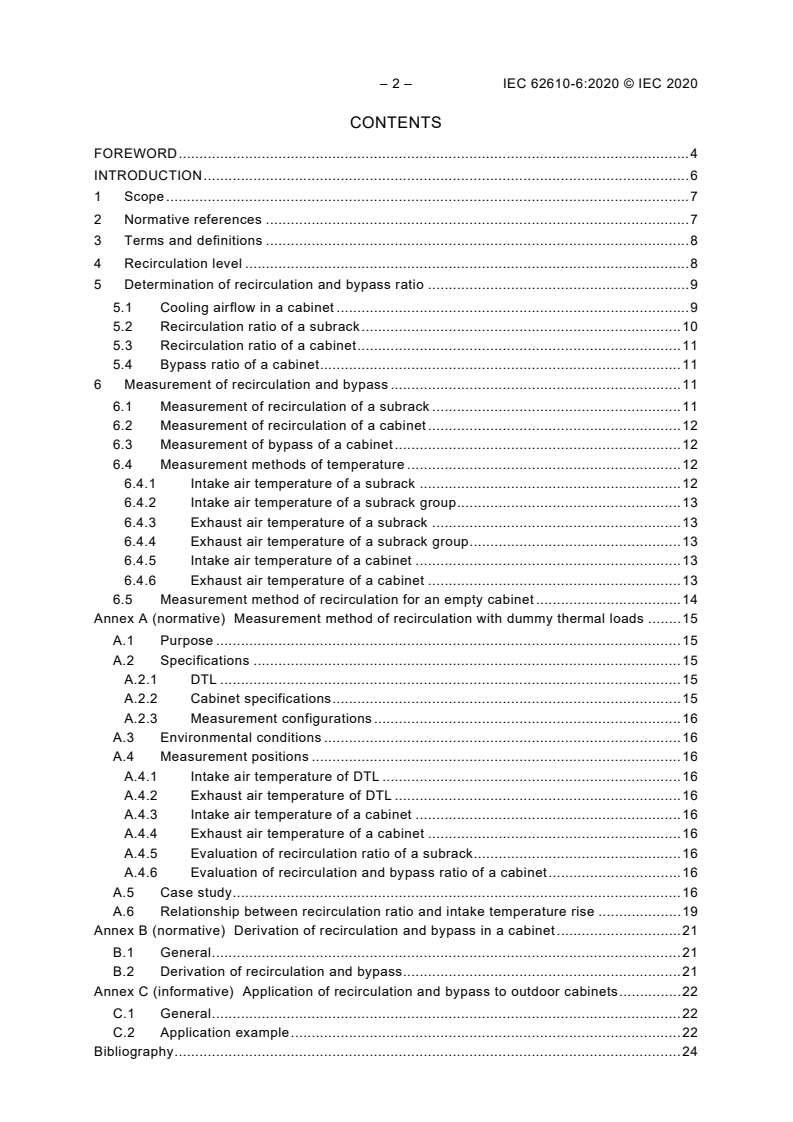
CONTENTS
FOREWORD . 4
INTRODUCTION . 6
1 Scope . 7
2 Normative references . 7
3 Terms and definitions . 8
4 Recirculation level . 8
5 Determination of recirculation and bypass ratio . 9
5.1 Cooling airflow in a cabinet . 9
5.2 Recirculation ratio of a subrack . 10
5.3 Recirculation ratio of a cabinet . 11
5.4 Bypass ratio of a cabinet . 11
6 Measurement of recirculation and bypass . 11
6.1 Measurement of recirculation of a subrack . 11
6.2 Measurement of recirculation of a cabinet . 12
6.3 Measurement of bypass of a cabinet . 12
6.4 Measurement methods of temperature . 12
6.4.1 Intake air temperature of a subrack . 12
6.4.2 Intake air temperature of a subrack group . 13
6.4.3 Exhaust air temperature of a subrack . 13
6.4.4 Exhaust air temperature of a subrack group . 13
6.4.5 Intake air temperature of a cabinet . 13
6.4.6 Exhaust air temperature of a cabinet . 13
6.5 Measurement method of recirculation for an empty cabinet . 14
Annex A (normative) Measurement method of recirculation with dummy thermal loads . 15
A.1 Purpose . 15
A.2 Specifications . 15
A.2.1 DTL . 15
A.2.2 Cabinet specifications . 15
A.2.3 Measurement configurations . 16
A.3 Environmental conditions . 16
A.4 Measurement positions . 16
A.4.1 Intake air temperature of DTL . 16
A.4.2 Exhaust air temperature of DTL . 16
A.4.3 Intake air temperature of a cabinet . 16
A.4.4 Exhaust air temperature of a cabinet . 16
A.4.5 Evaluation of recirculation ratio of a subrack . 16
A.4.6 Evaluation of recirculation and bypass ratio of a cabinet . 16
A.5 Case study . 16
A.6 Relationship between recirculation ratio and intake temperature rise . 19
Annex B (normative) Derivation of recirculation and bypass in a cabinet . 21
B.1 General . 21
B.2 Derivation of recirculation and bypass . 21
Annex C (informative) Application of recirculation and bypass to outdoor cabinets . 22
C.1 General . 22
C.2 Application example . 22
Bibliography . 24
Figure 1 – Airflow in a cabinet . 9
Figure 2 – Diagram of cabinet airflows . 10
Figure A.1 – Outline drawings of DTL . 17
Figure A.2 – Experimental setup of a cabinet and DTL . 17
Figure A.3 – Measurement points of intake air temperature of DTL . 18
Figure A.4 – Measurement points of exhaust air temperature of DTL . 18
Figure A.5 – Measurement points of intake air temperature of a cabinet . 18
Figure A.6 – Measurement points of exhaust air temperature of a cabinet . 18
Figure A.7 – Recirculation ratio vs intake air temperature rise. 20
Figure C.1 – Outdoor cabinet airflow schematic . 23
Figure C.2 – Airflow diagram and air temperature in outdoor cabinet . 23
Table 1 – Recirculation level . 9
Table A.1 – Specifications of DTL . 15
Table A.2 – Specifications of DTL . 17
Table A.3 – Test result . 19
Table A.4 – Recirculation and bypass ratio of a cabinet . 19
Table C.1 – A case study of an outdoor cabinet . 23
– 4 – IEC 62610-6:2020 © IEC 2020
INTERNATIONAL ELECTROTECHNICAL COMMISSION
____________
MECHANICAL STRUCTURES FOR ELECTRICAL AND ELECTRONIC
EQUIPMENT – THERMAL MANAGEMENT FOR CABINETS IN
ACCORDANCE WITH IEC 60297 AND IEC 60917 SERIES –
Part 6: Air recirculation and bypass of indoor cabinets
FOREWORD
1) The International Electrotechnical Commission (IEC) is a worldwide organization for standardization comprising
all national electrotechnical committees (IEC National Committees). The object of IEC is to promote international
co-operation on all questions concerning standardization in the electrical and electronic fields. To this end and
in addition to other activities, IEC publishes International Standards, Technical Specifications, Technical Reports,
Publicly Available Specifications (PAS) and Guides (hereafter referred to as “IEC Publication(s)”). Their
preparation is entrusted to technical committees; any IEC National Committee interested in the subject dealt with
may participate in this preparatory work. International, governmental and non-governmental organizations liaising
with the IEC also participate in this preparation. IEC collaborates closely with the International Organization for
Standardization (ISO) in accordance with conditions determined by agreement between the two organizations.
2) The formal decisions or agreements of IEC on technical matters express, as nearly as possible, an international
consensus of opinion on the relevant subjects since each technical committee has representation from all
interested IEC National Committees.
3) IEC Publications have the form of recommendations for international use and are accepted by IEC National
Committees in that sense. While all reasonable efforts are made to ensure that the technical content of IEC
Publications is accurate, IEC cannot be held responsible for the way in which they are used or for any
misinterpretation by any end user.
4) In order to promote international uniformity, IEC National Committees undertake to apply IEC Publications
transparently to the maximum extent possible in their national and regional publications. Any divergence between
any IEC Publication and the corresponding national or regional publication shall be clearly indicated in the latter.
5) IEC itself does not provide any attestation of conformity. Independent certification bodies provide conformity
assessment services and, in some areas, access to IEC marks of conformity. IEC is not responsible for any
services carried out by independent certification bodies.
6) All users should ensure that they have the latest edition of this publication.
7) No liability shall attach to IEC or its directors, employees, servants or agents including individual experts and
members of its technical committees and IEC National Committees for any personal injury, property damage or
other damage of any nature whatsoever, whether direct or indirect, or for costs (including legal fees) and
expenses arising out of the publication, use of, or reliance upon, this IEC Publication or any other IEC Publications.
8) Attention is drawn to the Normative references cited in this publication. Use of the referenced publications is
indispensable for the correct application of this publication.
9) Attention is drawn to the possibility that some of the elements of this IEC Publication may be the subject of patent
rights. IEC shall not be held responsible for identifying any or all such patent rights.
International Standard IEC 62610-6 has been prepared by subcommittee 48D: Mechanical
structures for electrical and electronic equipment, of IEC technical committee 48: Electrical
connectors and mechanical structures for electrical and electronic equipment.
The text of this International Standard is based on the following documents:
CDV Report on voting
48D/700/CDV 48D/715/RVC
Full information on the voting for the approval of this International Standard can be found in the
report on voting indicated in the above table.
This document has been drafted in accordance with the ISO/IEC Directives, Part 2.
A list of all parts in the IEC 62610 series, published under the general title Mechanical structures
for electrical and electronic equipment – Thermal management for cabinets in accordance with
iec 60297 and iec 60917 series, can be found on the IEC website.
The committee has decided that the contents of this document will remain unchanged until the
stability date indicated on the IEC website under "http://webstore.iec.ch" in the data related to
the specific document. At this date, the document will be
• reconfirmed,
• withdrawn,
• replaced by a revised edition, or
• amended.
– 6 – IEC 62610-6:2020 © IEC 2020
INTRODUCTION
The signal speed and component density of electrical and electronic equipment in the ICT field
and the FA field, such as high performance servers, communications equipment, and electronic
control equipment have been steadily increasing. As a result, the heat generation density of the
integrated circuits, the power consumption of the equipment, and therefore the cooling task has
also been increasing. In a computer room common in the ICT field, where many cabinets for
mounting subrack and/or chassis-based equipment are installed and high availability is required,
it is necessary to pay attention so that the equipment does not experience high temperature
problems.
To prevent high temperature problems with the electronic equipment, it is important that the air
conditioning installed in a computer room effectively contributes to the cooling of the cabinet
for mounting subrack and/or chassis-based equipment. Indicators relating to airflow such as
recirculation and bypass, are used to judge the effectiveness of the air conditioning system.
Recirculation is the ratio at which the cabinets in the computer room suck in their own exhaust
air, which affects the thermal problems of the equipment as it raises the intake air temperature.
Bypass is the ratio at which the cooled supply air does not pass through the cabinets in the
computer room, and affects the energy efficiency as it increases the air conditioning energy. If
these ratios, especially the recirculation ratio, are kept low, the airflow of the computer room
can be regarded as effectively cooling the cabinets. Conversely, if air recirculation or bypass
occurs, the temperature of subracks and/or chassis-based equipment in the cabinet rises.
Therefore it is necessary to provide similar indices to measure the effectiveness of the cooling
airflow for the equipment in the cabinet.
The existing standard for forced air cooling, IEC 62610-2, introduces a method for determining
the ideal airflow for a forced air cooled cabinet assembled with associated subrack and/or
chassis-based equipment. The standard also defines qualitative guidelines for avoiding
recirculation in such cabinets and a server(computer) room. However, concrete numerical
values and the evaluation method of the recirculation have not been defined. It was impossible
to judge in advance whether the cabinet for mounting subrack and/or chassis-based equipment
satisfies the environmental conditions, or whether the empty cabinet has sufficient cooling when
subrack and/or chassis-based equipment are mounted.
This document defines a method for easily measuring the recirculation ratio (RC) and the
bypass ratio (BP) of the airflow in a cabinet and provides performance levels of recirculation on
effectiveness of the cooling airflow in such cabinets. This can be regarded as the degree of
conformity with respect to behaviour of the airflow in the cabinet in the computer room.
Alternatively, even for an outdoor cabinet including a heat exchanger and an air conditioner,
this method can be effectively utilized as an index for knowing the degree of airflow
appropriately contributing to cooling the internal space in which the equipment is mounted.
The purpose of this document is to provide:
• for the equipment integrator and development designer of the cabinet the criteria for
efficiently and correctly determining the specification, and
• for the supplier of the cabinet the measuring and classifying method for the airflow
recirculation rate of the subrack and/or chassis-based equipment installed in the cabinet.
This document is addressed to the mechanical structures in accordance with IEC 60297 and
IEC 60917 series.
MECHANICAL STRUCTURES FOR ELECTRICAL AND ELECTRONIC
EQUIPMENT – THERMAL MANAGEMENT FOR CABINETS IN
ACCORDANCE WITH IEC 60297 AND IEC 60917 SERIES –
Part 6: Air recirculation and bypass of indoor cabinets
1 Scope
This part of IEC 62610 which deals with thermal management for cabinets in accordance with
IEC 60297 and IEC 60917 series, provides compatible measurement methods of recirculation
ratio and bypass ratio which are indicators for defining quality of airflow in the forced air cooling
that can be commonly applied to indoor cabinets for mounting subrack and/or chassis-based
equipment.
NOTE 1 Both recirculation and bypass represent leakage airflows, i.e. detrimental phenomena in terms of cooling
efficiency; their measurement is obviously aimed at their mitigation.
This document contains the following:
a) the definition of recirculation and bypass flow rates in the cooling of the cabinet,
b) the levels of the recirculation ratio RC,
of forced air cooling subrack and/or
c) the definition of the formula for the recirculation ratio RC
s
chassis-based equipment installed in the cabinet,
d) the definition formula of recirculation ratio RC and bypass rate BP of the entire cabinet,
r r
e) the requirements of the measuring method of each temperature necessary for calculating
the recirculation ratio RC , RC and bypass ratio BP .
s r r
NOTE 2 This document includes the definition of measuring bypass ratio, but excludes the definition of levels of
bypass ratio.
The drawings used are not intended to indicate product design. They are only for explanatory
indications for defining forced air cooling airflows.
The recirculation and bypass measurement methods dealt with in this document are assumed
to be applied to a cabinet installed indoors. The cooling air inlet is at the front or the bottom of
the cabinet and the heated air is exhausted to the rear or the top. These methods are also
applicable to a cabinet that is installed outdoors and has a cooling device such as a heat
exchanger or an air conditioner on the front or the back (see Annex C).
The recirculation ratio of a subrack or a cabinet is defined for each individual subrack or chassis-
based equipment mounted in the cabinet or for the entire cabinet. The bypass ratio of a cabinet
is defined for the entire cabinet.
2 Normative references
The following documents are referred to in the text in such a way that some or all of their content
constitutes requirements of this document. For dated references, only the edition cited applies.
For undated references, the latest edition of the referenced document (including any
amendments) applies.
IEC 60297-3-100, Mechanical structures for electronic equipment – Dimensions of mechanical
structures of the 482,6 mm (19 in) series – Part 3-100: Basic dimensions of front panels,
subracks, chassis, racks and cabinets
– 8 – IEC 62610-6:2020 © IEC 2020
IEC 60917-1, Modular order for the development of mechanical structures for electrical and
electronic equipment practices – Part 1: Generic standard
3 Terms and definitions
For the purposes of this document, the following terms and definitions apply.
ISO and IEC maintain terminological databases for use in standardization at the following
addresses:
• IEC Electropedia: available at http://www.electropedia.org/
• ISO Online browsing platform: available at http://www.iso.org/obp
3.1
recirculation flow rate
f
RC
flow rate of the air that returns directly from the exhaust of the equipment to be cooled to the
intake side of the equipment
3.2
bypass flow rate
f
BP
flow rate of the air going through a cabinet without going through any of the equipment to be
cooled
3.3
recirculation ratio of a subrack
RC
s
ratio of the recirculation flow rate of a subrack or a chassis-based equipment to the flow rate of
the equipment
3.4
recirculation ratio of a cabinet
RC
r
ratio of the total recirculation flow rate of all of the subracks mounted in a cabinet to the total
flow rate of all of the subracks mounted in a cabinet
3.5
bypass ratio of a cabinet
BP
r
ratio of the bypass flow rate of a cabinet to the airflow rate of a cabinet
3.6
dummy thermal load
DTL
simulator that reproduces thermal fluid behaviour such as heat dissipation and flow rate
generated by subrack and/or chassis-based equipment
Note 1 to entry: Generally, a heater and a fan mounted in a chassis are used, and the amount of heat dissipation
and the fan flow rate can be adjusted.
4 Recirculation level
The recirculation level RL indicates the degree of recirculation of a subrack or a chassis or a
cabinet and is represented by levels RL1 throug
...
IEC 62610-6 ®
Edition 1.0 2020-03
INTERNATIONAL
STANDARD
NORME
INTERNATIONALE
Mechanical structures for electrical and electronic equipment – Thermal
management for cabinets in accordance with IEC 60297 and IEC 60917 series –
Part 6: Air recirculation and bypass of indoor cabinets
Structures mécaniques pour équipements électriques et électroniques – Gestion
thermique pour les armoires conformes aux séries IEC 60297 et IEC 60917 –
Partie 6: Recyclage et dérivation de l’air des armoires intérieures
All rights reserved. Unless otherwise specified, no part of this publication may be reproduced or utilized in any form
or by any means, electronic or mechanical, including photocopying and microfilm, without permission in writing from
either IEC or IEC's member National Committee in the country of the requester. If you have any questions about IEC
copyright or have an enquiry about obtaining additional rights to this publication, please contact the address below or
your local IEC member National Committee for further information.
Droits de reproduction réservés. Sauf indication contraire, aucune partie de cette publication ne peut être reproduite
ni utilisée sous quelque forme que ce soit et par aucun procédé, électronique ou mécanique, y compris la photocopie
et les microfilms, sans l'accord écrit de l'IEC ou du Comité national de l'IEC du pays du demandeur. Si vous avez des
questions sur le copyright de l'IEC ou si vous désirez obtenir des droits supplémentaires sur cette publication, utilisez
les coordonnées ci-après ou contactez le Comité national de l'IEC de votre pays de résidence.
IEC Central Office Tel.: +41 22 919 02 11
3, rue de Varembé info@iec.ch
CH-1211 Geneva 20 www.iec.ch
Switzerland
About the IEC
The International Electrotechnical Commission (IEC) is the leading global organization that prepares and publishes
International Standards for all electrical, electronic and related technologies.
About IEC publications
The technical content of IEC publications is kept under constant review by the IEC. Please make sure that you have the
latest edition, a corrigendum or an amendment might have been published.
IEC publications search - webstore.iec.ch/advsearchform IEC online collection - oc.iec.ch
The advanced search enables to find IEC publications by a Discover our powerful search engine and read freely all the
variety of criteria (reference number, text, technical publications previews. With a subscription you will always
committee, …). It also gives information on projects, replaced have access to up to date content tailored to your needs.
and withdrawn publications.
Electropedia - www.electropedia.org
IEC Just Published - webstore.iec.ch/justpublished
The world's leading online dictionary on electrotechnology,
Stay up to date on all new IEC publications. Just Published
containing more than 22 000 terminological entries in English
details all new publications released. Available online and
and French, with equivalent terms in 18 additional languages.
once a month by email.
Also known as the International Electrotechnical Vocabulary
(IEV) online.
IEC Customer Service Centre - webstore.iec.ch/csc
If you wish to give us your feedback on this publication or
need further assistance, please contact the Customer Service
Centre: sales@iec.ch.
A propos de l'IEC
La Commission Electrotechnique Internationale (IEC) est la première organisation mondiale qui élabore et publie des
Normes internationales pour tout ce qui a trait à l'électricité, à l'électronique et aux technologies apparentées.
A propos des publications IEC
Le contenu technique des publications IEC est constamment revu. Veuillez vous assurer que vous possédez l’édition la
plus récente, un corrigendum ou amendement peut avoir été publié.
Recherche de publications IEC - IEC online collection - oc.iec.ch
webstore.iec.ch/advsearchform Découvrez notre puissant moteur de recherche et consultez
La recherche avancée permet de trouver des publications IEC gratuitement tous les aperçus des publications. Avec un
en utilisant différents critères (numéro de référence, texte, abonnement, vous aurez toujours accès à un contenu à jour
comité d’études, …). Elle donne aussi des informations sur adapté à vos besoins.
les projets et les publications remplacées ou retirées.
Electropedia - www.electropedia.org
IEC Just Published - webstore.iec.ch/justpublished
Le premier dictionnaire d'électrotechnologie en ligne au
Restez informé sur les nouvelles publications IEC. Just
monde, avec plus de 22 000 articles terminologiques en
Published détaille les nouvelles publications parues.
anglais et en français, ainsi que les termes équivalents dans
Disponible en ligne et une fois par mois par email.
16 langues additionnelles. Egalement appelé Vocabulaire
Electrotechnique International (IEV) en ligne.
Service Clients - webstore.iec.ch/csc
Si vous désirez nous donner des commentaires sur cette
publication ou si vous avez des questions contactez-nous:
sales@iec.ch.
IEC 62610-6 ®
Edition 1.0 2020-03
INTERNATIONAL
STANDARD
NORME
INTERNATIONALE
Mechanical structures for electrical and electronic equipment – Thermal
management for cabinets in accordance with IEC 60297 and IEC 60917 series –
Part 6: Air recirculation and bypass of indoor cabinets
Structures mécaniques pour équipements électriques et électroniques – Gestion
thermique pour les armoires conformes aux séries IEC 60297 et IEC 60917 –
Partie 6: Recyclage et dérivation de l’air des armoires intérieures
INTERNATIONAL
ELECTROTECHNICAL
COMMISSION
COMMISSION
ELECTROTECHNIQUE
INTERNATIONALE
ICS 31.240 ISBN 978-2-8322-9384-3
– 2 – IEC 62610-6:2020 © IEC 2020
CONTENTS
FOREWORD . 4
INTRODUCTION . 6
1 Scope . 7
2 Normative references . 7
3 Terms and definitions . 8
4 Recirculation level . 8
5 Determination of recirculation and bypass ratio . 9
5.1 Cooling airflow in a cabinet . 9
5.2 Recirculation ratio of a subrack . 10
5.3 Recirculation ratio of a cabinet . 11
5.4 Bypass ratio of a cabinet . 11
6 Measurement of recirculation and bypass . 11
6.1 Measurement of recirculation of a subrack . 11
6.2 Measurement of recirculation of a cabinet . 12
6.3 Measurement of bypass of a cabinet . 12
6.4 Measurement methods of temperature . 12
6.4.1 Intake air temperature of a subrack . 12
6.4.2 Intake air temperature of a subrack group . 13
6.4.3 Exhaust air temperature of a subrack . 13
6.4.4 Exhaust air temperature of a subrack group . 13
6.4.5 Intake air temperature of a cabinet . 13
6.4.6 Exhaust air temperature of a cabinet . 13
6.5 Measurement method of recirculation for an empty cabinet . 14
Annex A (normative) Measurement method of recirculation with dummy thermal loads . 15
A.1 Purpose . 15
A.2 Specifications . 15
A.2.1 DTL . 15
A.2.2 Cabinet specifications . 15
A.2.3 Measurement configurations . 16
A.3 Environmental conditions . 16
A.4 Measurement positions . 16
A.4.1 Intake air temperature of DTL . 16
A.4.2 Exhaust air temperature of DTL . 16
A.4.3 Intake air temperature of a cabinet . 16
A.4.4 Exhaust air temperature of a cabinet . 16
A.4.5 Evaluation of recirculation ratio of a subrack . 16
A.4.6 Evaluation of recirculation and bypass ratio of a cabinet . 16
A.5 Case study . 16
A.6 Relationship between recirculation ratio and intake temperature rise . 19
Annex B (normative) Derivation of recirculation and bypass in a cabinet . 21
B.1 General . 21
B.2 Derivation of recirculation and bypass . 21
Annex C (informative) Application of recirculation and bypass to outdoor cabinets . 22
C.1 General . 22
C.2 Application example . 22
Bibliography . 24
Figure 1 – Airflow in a cabinet . 9
Figure 2 – Diagram of cabinet airflows . 10
Figure A.1 – Outline drawings of DTL . 17
Figure A.2 – Experimental setup of a cabinet and DTL . 17
Figure A.3 – Measurement points of intake air temperature of DTL . 18
Figure A.4 – Measurement points of exhaust air temperature of DTL . 18
Figure A.5 – Measurement points of intake air temperature of a cabinet . 18
Figure A.6 – Measurement points of exhaust air temperature of a cabinet . 18
Figure A.7 – Recirculation ratio vs intake air temperature rise. 20
Figure C.1 – Outdoor cabinet airflow schematic . 23
Figure C.2 – Airflow diagram and air temperature in outdoor cabinet . 23
Table 1 – Recirculation level . 9
Table A.1 – Specifications of DTL . 15
Table A.2 – Specifications of DTL . 17
Table A.3 – Test result . 19
Table A.4 – Recirculation and bypass ratio of a cabinet . 19
Table C.1 – A case study of an outdoor cabinet . 23
– 4 – IEC 62610-6:2020 © IEC 2020
INTERNATIONAL ELECTROTECHNICAL COMMISSION
____________
MECHANICAL STRUCTURES FOR ELECTRICAL AND ELECTRONIC
EQUIPMENT – THERMAL MANAGEMENT FOR CABINETS IN
ACCORDANCE WITH IEC 60297 AND IEC 60917 SERIES –
Part 6: Air recirculation and bypass of indoor cabinets
FOREWORD
1) The International Electrotechnical Commission (IEC) is a worldwide organization for standardization comprising
all national electrotechnical committees (IEC National Committees). The object of IEC is to promote international
co-operation on all questions concerning standardization in the electrical and electronic fields. To this end and
in addition to other activities, IEC publishes International Standards, Technical Specifications, Technical Reports,
Publicly Available Specifications (PAS) and Guides (hereafter referred to as “IEC Publication(s)”). Their
preparation is entrusted to technical committees; any IEC National Committee interested in the subject dealt with
may participate in this preparatory work. International, governmental and non-governmental organizations liaising
with the IEC also participate in this preparation. IEC collaborates closely with the International Organization for
Standardization (ISO) in accordance with conditions determined by agreement between the two organizations.
2) The formal decisions or agreements of IEC on technical matters express, as nearly as possible, an international
consensus of opinion on the relevant subjects since each technical committee has representation from all
interested IEC National Committees.
3) IEC Publications have the form of recommendations for international use and are accepted by IEC National
Committees in that sense. While all reasonable efforts are made to ensure that the technical content of IEC
Publications is accurate, IEC cannot be held responsible for the way in which they are used or for any
misinterpretation by any end user.
4) In order to promote international uniformity, IEC National Committees undertake to apply IEC Publications
transparently to the maximum extent possible in their national and regional publications. Any divergence between
any IEC Publication and the corresponding national or regional publication shall be clearly indicated in the latter.
5) IEC itself does not provide any attestation of conformity. Independent certification bodies provide conformity
assessment services and, in some areas, access to IEC marks of conformity. IEC is not responsible for any
services carried out by independent certification bodies.
6) All users should ensure that they have the latest edition of this publication.
7) No liability shall attach to IEC or its directors, employees, servants or agents including individual experts and
members of its technical committees and IEC National Committees for any personal injury, property damage or
other damage of any nature whatsoever, whether direct or indirect, or for costs (including legal fees) and
expenses arising out of the publication, use of, or reliance upon, this IEC Publication or any other IEC Publications.
8) Attention is drawn to the Normative references cited in this publication. Use of the referenced publications is
indispensable for the correct application of this publication.
9) Attention is drawn to the possibility that some of the elements of this IEC Publication may be the subject of patent
rights. IEC shall not be held responsible for identifying any or all such patent rights.
International Standard IEC 62610-6 has been prepared by subcommittee 48D: Mechanical
structures for electrical and electronic equipment, of IEC technical committee 48: Electrical
connectors and mechanical structures for electrical and electronic equipment.
The text of this International Standard is based on the following documents:
CDV Report on voting
48D/700/CDV 48D/715/RVC
Full information on the voting for the approval of this International Standard can be found in the
report on voting indicated in the above table.
This document has been drafted in accordance with the ISO/IEC Directives, Part 2.
A list of all parts in the IEC 62610 series, published under the general title Mechanical structures
for electrical and electronic equipment – Thermal management for cabinets in accordance with
iec 60297 and iec 60917 series, can be found on the IEC website.
The committee has decided that the contents of this document will remain unchanged until the
stability date indicated on the IEC website under "http://webstore.iec.ch" in the data related to
the specific document. At this date, the document will be
• reconfirmed,
• withdrawn,
• replaced by a revised edition, or
• amended.
– 6 – IEC 62610-6:2020 © IEC 2020
INTRODUCTION
The signal speed and component density of electrical and electronic equipment in the ICT field
and the FA field, such as high performance servers, communications equipment, and electronic
control equipment have been steadily increasing. As a result, the heat generation density of the
integrated circuits, the power consumption of the equipment, and therefore the cooling task has
also been increasing. In a computer room common in the ICT field, where many cabinets for
mounting subrack and/or chassis-based equipment are installed and high availability is required,
it is necessary to pay attention so that the equipment does not experience high temperature
problems.
To prevent high temperature problems with the electronic equipment, it is important that the air
conditioning installed in a computer room effectively contributes to the cooling of the cabinet
for mounting subrack and/or chassis-based equipment. Indicators relating to airflow such as
recirculation and bypass, are used to judge the effectiveness of the air conditioning system.
Recirculation is the ratio at which the cabinets in the computer room suck in their own exhaust
air, which affects the thermal problems of the equipment as it raises the intake air temperature.
Bypass is the ratio at which the cooled supply air does not pass through the cabinets in the
computer room, and affects the energy efficiency as it increases the air conditioning energy. If
these ratios, especially the recirculation ratio, are kept low, the airflow of the computer room
can be regarded as effectively cooling the cabinets. Conversely, if air recirculation or bypass
occurs, the temperature of subracks and/or chassis-based equipment in the cabinet rises.
Therefore it is necessary to provide similar indices to measure the effectiveness of the cooling
airflow for the equipment in the cabinet.
The existing standard for forced air cooling, IEC 62610-2, introduces a method for determining
the ideal airflow for a forced air cooled cabinet assembled with associated subrack and/or
chassis-based equipment. The standard also defines qualitative guidelines for avoiding
recirculation in such cabinets and a server(computer) room. However, concrete numerical
values and the evaluation method of the recirculation have not been defined. It was impossible
to judge in advance whether the cabinet for mounting subrack and/or chassis-based equipment
satisfies the environmental conditions, or whether the empty cabinet has sufficient cooling when
subrack and/or chassis-based equipment are mounted.
This document defines a method for easily measuring the recirculation ratio (RC) and the
bypass ratio (BP) of the airflow in a cabinet and provides performance levels of recirculation on
effectiveness of the cooling airflow in such cabinets. This can be regarded as the degree of
conformity with respect to behaviour of the airflow in the cabinet in the computer room.
Alternatively, even for an outdoor cabinet including a heat exchanger and an air conditioner,
this method can be effectively utilized as an index for knowing the degree of airflow
appropriately contributing to cooling the internal space in which the equipment is mounted.
The purpose of this document is to provide:
• for the equipment integrator and development designer of the cabinet the criteria for
efficiently and correctly determining the specification, and
• for the supplier of the cabinet the measuring and classifying method for the airflow
recirculation rate of the subrack and/or chassis-based equipment installed in the cabinet.
This document is addressed to the mechanical structures in accordance with IEC 60297 and
IEC 60917 series.
MECHANICAL STRUCTURES FOR ELECTRICAL AND ELECTRONIC
EQUIPMENT – THERMAL MANAGEMENT FOR CABINETS IN
ACCORDANCE WITH IEC 60297 AND IEC 60917 SERIES –
Part 6: Air recirculation and bypass of indoor cabinets
1 Scope
This part of IEC 62610 which deals with thermal management for cabinets in accordance with
IEC 60297 and IEC 60917 series, provides compatible measurement methods of recirculation
ratio and bypass ratio which are indicators for defining quality of airflow in the forced air cooling
that can be commonly applied to indoor cabinets for mounting subrack and/or chassis-based
equipment.
NOTE 1 Both recirculation and bypass represent leakage airflows, i.e. detrimental phenomena in terms of cooling
efficiency; their measurement is obviously aimed at their mitigation.
This document contains the following:
a) the definition of recirculation and bypass flow rates in the cooling of the cabinet,
b) the levels of the recirculation ratio RC,
of forced air cooling subrack and/or
c) the definition of the formula for the recirculation ratio RC
s
chassis-based equipment installed in the cabinet,
d) the definition formula of recirculation ratio RC and bypass rate BP of the entire cabinet,
r r
e) the requirements of the measuring method of each temperature necessary for calculating
the recirculation ratio RC , RC and bypass ratio BP .
s r r
NOTE 2 This document includes the definition of measuring bypass ratio, but excludes the definition of levels of
bypass ratio.
The drawings used are not intended to indicate product design. They are only for explanatory
indications for defining forced air cooling airflows.
The recirculation and bypass measurement methods dealt with in this document are assumed
to be applied to a cabinet installed indoors. The cooling air inlet is at the front or the bottom of
the cabinet and the heated air is exhausted to the rear or the top. These methods are also
applicable to a cabinet that is installed outdoors and has a cooling device such as a heat
exchanger or an air conditioner on the front or the back (see Annex C).
The recirculation ratio of a subrack or a cabinet is defined for each individual subrack or chassis-
based equipment mounted in the cabinet or for the entire cabinet. The bypass ratio of a cabinet
is defined for the entire cabinet.
2 Normative references
The following documents are referred to in the text in such a way that some or all of their content
constitutes requirements of this document. For dated references, only the edition cited applies.
For undated references, the latest edition of the referenced document (including any
amendments) applies.
IEC 60297-3-100, Mechanical structures for electronic equipment – Dimensions of mechanical
structures of the 482,6 mm (19 in) series – Part 3-100: Basic dimensions of front panels,
subracks, chassis, racks and cabinets
– 8 – IEC 62610-6:2020 © IEC 2020
IEC 60917-1, Modular order for the development of mechanical structures for electrical and
electronic equipment practices – Part 1: Generic standard
3 Terms and definitions
For the purposes of this document, the following terms and definitions apply.
ISO and IEC maintain terminological databases for use in standardization at the following
addresses:
• IEC Electropedia: available at http://www.electropedia.org/
• ISO Online browsing platform: available at http://www.iso.org/obp
3.1
recirculation flow rate
f
RC
flow rate of the air that returns directly from the exhaust of the equipment to be cooled to the
intake side of the equipment
3.2
bypass flow rate
f
BP
flow rate of the air going through a cabinet without going through any of the equipment to be
cooled
3.3
recirculation ratio of a subrack
RC
s
ratio of the recirculation flow rate of a subrack or a chassis-based equipment to the flow rate of
the equipment
3.4
recirculation ratio of a cabinet
RC
r
ratio of the total recirculation flow rate of all of the subracks mounted in a cabinet to the total
flow rate of all of the subracks mounted in a cabinet
3.5
bypass ratio of a cabinet
BP
r
ratio of the bypass flow rate of a cabinet to the airflow rate of a cabinet
3.6
dummy thermal load
DTL
simulator that reproduces thermal fluid behaviour such as heat dissipation and flow rate
generated by subrack and/or chassis-based equipment
Note 1 to entry: Generally, a heater and a fan mounted in a chassis are used, and the amount of heat dissipation
and the fan flow rate can be adjusted.
4 Recirculation level
The recirculation level RL indicates the degree of recirculation of a subrack or a chassis or a
cabinet and is represented by levels RL1 through RL4 according to the recirculation ratio of a
subrack RC or recirculation ratio of a cabinet RC . See Table 1.
s r
Table 1 – Recirculation level
Recirculation level Recirculation ratio of a subrack RC
s
or of a cabinet RC
r
%
RL1 more than 33
RL2 20 to 33
RL3 10 to 20
RL4 0 to 10
If the RC or RC value varies depending on the mounting condition or position of the subrack
s r
and/or chassis, or the conditions of cables and/or other mechanical parts, etc., the manufacturer
shall clearly indicate the configuration and the corresponding recirculation level in the data
sheet.
5 Determination of recirculation and bypass ratio
5.1 Cooling airflow in a cabinet
Figure 1 schematically shows the airflow in the cabinet in which the subrack is mounted, with
arrows by size and direction according to the flow balance. In the equipment cabinet, cooling
air is supplied from the front, enters from the inlet of the subrack into the interior, cools the
interior of the subrack, exhausts from the subrack, and is exhausted from the rear of the cabinet.
A part of the cabinet intake bypasses the subrack and is directly exhausted to the outside of
the cabinet without passing through the subrack. A part of the subrack exhaust air is recirculated,
returning to the subrack intake and not exhausting outside the cabinet.
Figure 1 – Airflow in a cabinet
Figure 2 is a diagram showing the airflow balance of the equipment cabinet. Figure 2a) shows
an airflow diagram in which all subracks mounted in the cabinet are regarded as a subrack
group. The airflow of each subrack in the subrack group is shown by a diagram of Figure 2b).
– 10 – IEC 62610-6:2020 © IEC 2020
Symbols of flow rate and temperature are defined as follows.
F airflow rate of a cabinet
R
F airflow rate of a group of subracks
S
airflow rate of n-th subrack
F
S−n
f recirculation flow rate of a cabinet
RC
f bypass flow rate of a cabinet
BP
f recirculation flow rate of n-th subrack
RC−n
T intake air temperature of a cabinet
Ri
T intake air temperature of a group of subracks
Si
T intake air temperature of n-th subrack
Si−n
T exhaust air temperature of a cabinet
Ro
T exhaust air temperature of a group of subracks
So
T exhaust air temperature of n-th subrack.
So−n
a) Diagram of all subracks b) Diagram of each subrack
as a subrack group
Figure 2 – Diagram of cabinet airflows
5.2 Recirculation ratio of a subrack
The recirculation ratio of a subrack RC represents the ratio of the flow rate of exhaust of the
s
n-th subrack recirculated to the intake of n-th subrack f to the flow rate of the n-th subrack
RC-n
F in the cabinet.
S-n
When n subracks and/or chassis-based equipment are mounted in a cabinet, recirculation ratio
of a subrack RC for each subrack and/or chassis is defined by the following formula.
s
f
RC−n
RC =
s
F
S−n
where
f is the recirculation flow rate of n-th subrack;
RC−n
F is the airflow rate of n-th subrack.
S−n
5.3 Recirculation ratio of a cabinet
is the recirculation rate for all the subrack and/or chassis-
The recirculation ratio of a cabinet RC
r
based equipment mounted in the cabinet, that is, for the subrack group, and is defined as follows.
f
RC−n
∑
f
RC n
RC = =
r
F
F
S S−n
∑
n
where
F is the airflow rate of a group of subracks;
S
f is the recirculation flow rate of a cabinet;
RC
is the airflow rate of n-th subrack;
F
S−n
f is the recirculation flow rate of n-th subrack.
RC−n
5.4 Bypass ratio of a cabinet
The bypass ratio of a cabinet BP is defined as the ratio of the flow rate directly exhausted
r
without passing through the subrack group to the cabinet flow rate, and is represented as
following formula.
f
BP
BP =
r
F
R
where
F is the airflow rate of a cabinet;
R
f is the bypass flow rate of a cabinet.
BP
6 Measurement of recirculation and bypass
6.1 Measurement of recirculation of a subrack
The recirculation ratio of a subrack RC is the ratio of the flow rate, but by measuring the
s
temperatures at some points of the cabinet, it should be calculated as the ratio of those
temperatures as specified in Annex B. The definition formula of the measurement value of the
recirculation ratio of a subrack is shown.
T − T
Si−n Ri
RC =
s
T − T
So−n Ri
– 12 – IEC 62610-6:2020 © IEC 2020
where
T is the intake air temperature of n-th subrack;
Si−n
T is the exhaust air temperature of n-th subrack;
So−n
is the intake air temperature of a cabinet.
T
Ri
6.2 Measurement of recirculation of a cabinet
The recirculation ratio of a cabinet RC is the ratio of the flow rate, but by measuring the
r
temperatures at some points of the cabinet, it should be calculated as the ratio of those
temperatures as specified in Annex B. The definition formula of the measurement value of the
recirculation ratio of a cabinet is shown.
T − T
Si Ri
RC =
r
T − T
So Ri
where
T is the intake air temperature of a group of subracks;
Si
T is the exhaust air temperature of a group of subracks;
So
is the intake air temperature of a cabinet.
T
Ri
6.3 Measurement of bypass of a cabinet
The bypass ratio of a cabinet BP is the ratio of the flow rate, but by measuring the temperatures
r
at some points of the cabinet, it should be calculated as the ratio of those temperatures as
specified in Annex B. The definition formula of the measurement value of the bypass ratio of a
cabinet is shown.
T − T
So Ro
BP =
r
T − T
So Ri
where
T is the exhaust air temperature of a group of subracks;
So
T is the intake air temperature of a cabinet;
Ri
T is the exhaust air temperature of a cabinet.
Ro
6.4 Measurement methods of temperature
6.4.1 Intake air temperature of a subrack
The measurement value of the intake air temperature of a subrack T is measured at three
Si
points 30 mm away from the intake face of the subrack and/or chassis-based equipment, and
the average value of them is taken as the measurement value.
In the case where the intake fans are mounted at the position of the intake port, the
measurement value is set as the average value of the fan intake air temperatures.
6.4.2 Intake air temperature of a subrack group
When obtaining the intake air temperature of the subrack group consisting of all subracks and/or
chassis-based equipment mounted on the cabinet, the following weighted average value is used.
(F ⋅T )
S−n Si−n
∑
n
T =
Si
F
∑ S−n
n
However, if it is difficult to know the individual subrack flow rates and it can be determined that
the individual subrack flow rates are about the same, the arithmetic mean value may also be
used.
6.4.3 Exhaust air temperature of a subrack
The measurement value of the exhaust air temperature of a subrack T is measured at three
So
points 10 mm away from the exhaust face of the subrack and/or chassis-based equipment, and
the average value of them is taken as the measurement value.
Where the exhaust fans are mounted at the exhaust position, the measurement value is set as
the average value of the fan exhaust air temperatures.
6.4.4 Exhaust air temperature of a subrack group
When obtaining the exhaust air temperature of the subrack group consisting of all subracks
and/or chassis-based equipment mounted on the cabinet, the following weighted average value
is used.
(F ⋅ T )
∑ S−n So−n
n
T =
So
F
∑ S−n
n
However, if it is difficult to know the individual subrack flow rates and it can be determined that
the individual subrack flow rates are about the same, the arithmetic mean value can also be
used.
6.4.5 Intake air temperature of a cabinet
The intake air temperature of a cabinet T is measured at three points in the upper, middle,
Ri
and lower parts of the intake face of the cabinet, the distance from the face is 50 mm to 200
mm away, and the average value of the three points is taken as the measurement value. If the
cabinet is configured as a cold aisle containment, the temperature at a position representing
the cold aisle may be used. And, if the cabinet is installed in an indoor open space, the
temperature at a position representing the room temperature may be used.
6.4.6 Exhaust air temperature of a cabinet
The exhaust air temperature of a cabinet T is measured at three points in the upper, middle,
Ro
and lower parts of the exhaust face of the cabinet, the distance from the face is 10 mm to 30
mm away, and the average value of the three points is taken as the measurement value. If the
cabinet is configured as a hot aisle containment, the temperature at a position representing the
hot aisle may be used.
– 14 – IEC 62610-6:2020 © IEC 2020
6.5 Measurement method of recirculation for an empty cabinet
Some reasons for recirculation are gaps due to unequal airflow pattern of the subrack, absence
of blanking panels, inadequate separation inside the cabinet, gaps of cable entries, and other
mechanical features. In addition, the cause of the bypass is that the flow rate of the cabinet fan
is too high, and in this case, the pressure on the intake side is higher than that on the exhaust
side of the cabinet.
From such points of view, it is important to measure the recirculation and bypass of the empty
cabinet, since the mechanical structure of the cabinet is a major cause of recirculation and
bypass. Especially the recirculation level evaluation of the empty cabinet is an effective method
for assessing the degree of factors causing recirculation of the mechanical structure of the
cabinet itself.
The measurement method of RC , RC and BP using DTL (dummy thermal loads) shall be
s r r
carried out as specified in Annex A.
Annex A
(normative)
Measurement method of recirculation with dummy thermal loads
A.1 Purpose
This annex specifies a method of evaluating the thermal separation performance on the low
temperature side (intake side) and the high temperature side (exhaust side) of the cabinet by
measuring the values of recirculation ratio of the DTL(dummy thermal load) mounted in the
cabinet.
A.2 Specifications
A.2.1 DTL
The specifications that the DTL shall meet are shown in Table A.1.
Table A.1 – Specifications of DTL
Function Specification
Standard IEC 60297-3-100 or IEC 60917-1
Equipment height less than or equal to 10 U (444,5 mm)
Equipment width less than or equal to 440 mm
Equipment depth less than or equal to 600 mm
Heat dissipation 100 W to 1 000 W per 1 U
Airflow direction front intake / rear exhaust
Airflow qualification uniform exhaust air speed distribution
Heater radiation minimum influence of heater radiation
Exhaust temperature rise 10 K to 20 K
Fan arrangement arrange so that uniform air flows in the equipment on the front side
Fan static pressure sufficiently high enough not to deviate from the exhaust temperature rise limit
A.2.2 Cabinet specifications
The specifications that the cabinet to be measured shall meet are shown below.
a) The cabinet shall be measured with the panels actually used on its exterior surface mounted.
b) Basically, openings other than the intake and the exhaust such as the cable entries are
measured by simulating the intended use. However, if it is difficult to reproduce or the use
status is unknown, the measurement may be done by blocking, but the state at the
measurement should be specified.
c) The exhaust surface of the rear panel at the time of measurement shall have an opening
ratio of 50 % or less with respect to the area of the entire rear surface of the cabinet. When
the opening ratio of the rear panel of the cabinet to be measured is larger than 50 %, it shall
be adjusted to 50 % or less by covering a part of the opening or replacing it with another
rear panel.
d) Measurement should not be performed by blocking the short-circuited flow path using
members other than parts originally provided in the cabinet. In the case of measurement
using parts provided as optional parts of a cabinet, it shall be stated to that effect.
– 16 – IEC 62610-6:2020 © IEC 2020
A.2.3 Measurement configurations
a) Measurement may be carried out by attaching leakage protection parts such as blanking
panels and side panels, however, this shall be specified in the result.
b) In experiments related to the evaluation of gaps generated by cable entry and exit and the
performance evaluation of the leakage protection parts to the gaps are also allowed to apply
such an experimental configuration. In that case as well, it shall be specified in the result.
c) DTLs shall be implemented throughout the mountable slot of the cabinet.
d) It shall be measured with all DTLs running.
A.3 Environmental conditions
a) The temperature of a measurement room shall be 20 °C to 25 °C.
b) The exhaust air of the cabinet shall not go around to the intake side. Partitions may be
installed to prevent this.
A.4 Measurement positions
A.4.1 Intake air temperature of DTL
The intake air temperature of DTL shall be measured in accordance with 6.4.1.
A.4.2 Exhaust air temperature of DTL
The exhaust air temperature of DTL shall be measured in accordance with 6.4.3.
A.4.3 Intake air temperature of a cabinet
The intake air temperature of a cabinet shall be measured in accordance with 6.4.5.
A.4.4 Exhaust air temperature of a cabinet
The exhaust air temperature of a cabinet shall be measured in accordance with 6.4.6.
A.4.5 Evaluation of recirculation ratio of a subrack
Based on the temperatures measurement result, RC of each DTL are calculated using the
s
formula in accordance with 6.1 and the recirculation level of subracks are evaluated.
A.4.6 Evaluation of recirculation and bypass ratio of a cabinet
Based on the temperatures measurement result, RC and BP are calculated using the formula
r r
in accordance with 6.2 and 6.3, and the recirculation level of a cabinet is evaluated.
A.5 Case study
An example of measuring the recirculation ratio of a subrack and recirculation ratio of a cabinet
based on the temperature measurement values of the cabinet with DTL mounted is shown.
The specifications of the cabinet and DTL are shown in Table A.2.
The outline of the cabinet and DTL are shown in Figure A.1 and Figure A.2, and the temperature
measurement points are shown in Figure A.3 to Figure A.6.
Table A.2 – Specifications of DTL
Function Specification
Cabinet dimension WDH = 600 mm x 900 mm x 2 000 mm
Leakage protection parts heat shutters, blanking panels, flange fillers, cage nut hole covers
Cable entry blocking at the bottom and the ceiling
Rear panel opening 50 % opening
Number of DTLs 5
DTL height 6U (IEC 60297-3-100)
DTL outline size WDH = 430 mm x 550 mm x 266 mm
Power supply voltage AC 200 V
Heat dissipation 3 250 W
Fan 120 mm x 4 units
Airflow rate
463 m /h
Maximum static pressure 224 Pa
a) Front view b) Rear view
Figure A.1 – Outline drawings of DTL
Figure A.2 – Experimental setup of a cabinet and DTL
– 18 – IEC 62610-6:2020 © IEC 2020
NOTE The measuring locations are applied as 6.4.1. NOTE The measuring locations are applied as 6.4.3.
Figure A.3 – Measurement points of Figure A.4 – Measurement points of
intake air temperature of DTL exhaust air temperature of DTL
NOTE The measuring locations are applied as 6.4.5. NOTE The measuring locations are applied as 6.4.6.
Figure A.5 – Measurement points of Figure A.6 – Measurement points of
intake air temperature of a cabinet exhaust air temperature of a cabinet
Table A.3 shows the temperature measurement results of each point, the RC value of each
s
DTL, and the calculation result of the RC level of each DTL.
Table A.4 shows the average temperature of the group of DTLs and the calculation results of
, BP , and the RC level of the cabinet.
the RC
r r
Table A.3 – Test result
Object No T Average No T Average
Ri Ro
°C °C
°C °C
1 22,8 1 41,8
Cabinet 2 22,8 22,8 2 40,1 39,6
3 22,8 3 37,1
Object No T Average No T Average RC RC level
Si So s
°C °C
°C °C %
1 24,5 1 38,8
2 24,5 2 45,2
DTL 1 24,6 44,7 8,2 RL4
3 24,7 3 50,2
4 24,7 - ---
1 24,6 1 38,8
2 24,8 2 46,6
DTL 2 24,7 43,9 8,8 RL4
3 24,6 3 46,4
4 24,8 - ---
1 24,2 1 42,5
2 23,7 2 49,0
DTL 3 23,9 47,2 4,5 RL4
3 23,8 3 50,1
4 24,0 - ---
1 23,4 1 37,1
2 23,3 2 48,9
DTL 4 23,1 44,5 1,2 RL4
3 22,9 3 47,6
4 22,7 - ---
1 22,8 1 45,9
2 22,8 2 46,8
DTL 5 23,0 44,2 1,0 RL4
3 23,2 3 39,8
4 23,2 - ---
Table A.4 – Recirculation and bypass ratio of a cabinet
Object Point Value Point Value RC BP RC level
r r
°C °C
% %
T T
22,8 39,6
Ri Ro
A group of DTLs 4,7 23,9 RL4
T T
23,9 44,9
Si So
A.
...