

IEC 61010-2-081:2001
(Main)Safety requirements for electrical equipment for measurement, control and laboratory use - Part 2-081: Particular requirements for automatic and semi-automatic laboratory equipment for analysis and other purposes
General Information
- Abstract
Applies to automatic and semi-automatic laboratory equipment for analysis and other purposes. Automatic and semi-automatic laboratory equipment consists of instruments or systems for measuring or modifying characteristics of samples, performing the process without manual intervention. Examples of such equipment are: analytical equipment, automatic sampler (e.g. pipettor), equipment for sample replication and amplification. It has the status of a group safety publication in accordance with IEC Guide 104.
- Status
- Published
- Publication Date
- 30-Aug-2009
- Technical Committee
- TC 66 - Safety of measuring, control and laboratory equipment
- Current Stage
- DELPUB - Deleted Publication
- Start Date
- 23-Jan-2015
- Completion Date
- 28-Aug-2026
Buy Documents
IEC 61010-2-081:2001 - Safety requirements for electrical equipment for measurement, control and laboratory use - Part 2-081: Particular requirements for automatic and semi-automatic laboratory equipment for analysis and other purposes Released:6/6/2001
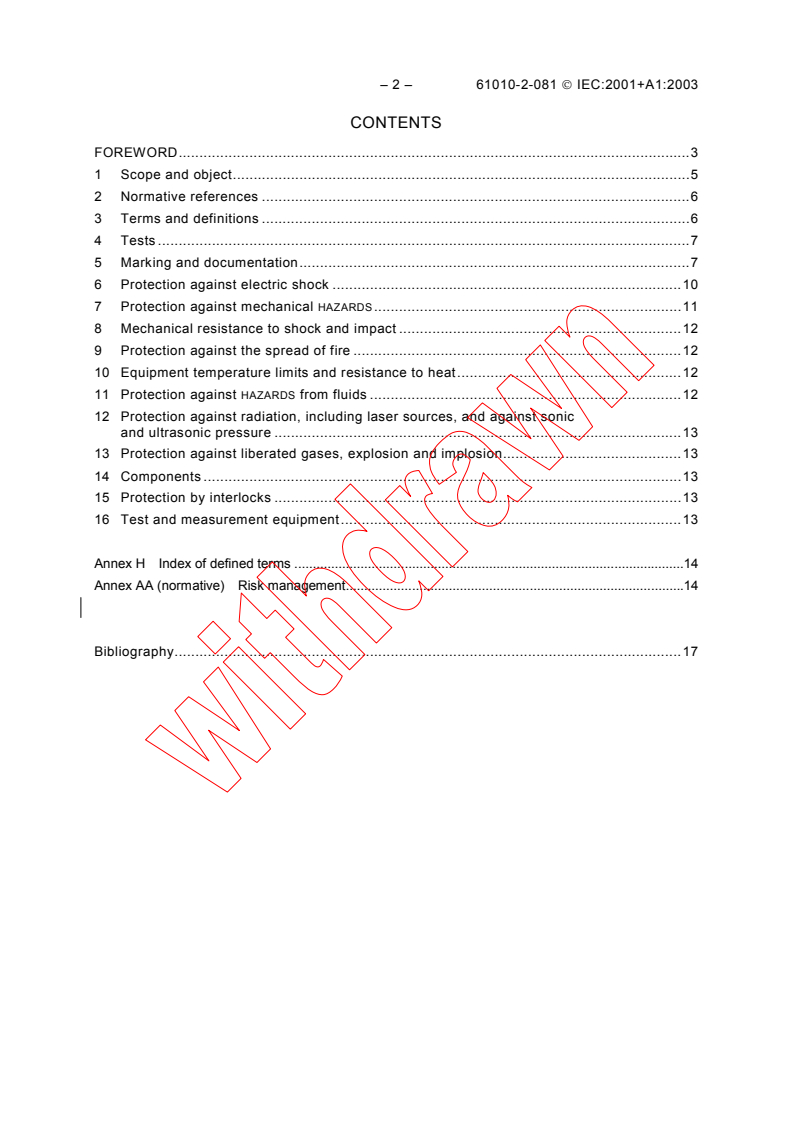
IEC 61010-2-081:2001+AMD1:2003 CSV - Safety requirements for electrical equipment for measurement, control, and laboratory use - Part 2-081: Particular requirements for automatic and semi-automatic laboratory equipment for analysis and other purposes Released:8/31/2009
Overview
IEC 61010-2-081:2001 specifies the safety requirements for automatic and semi-automatic laboratory equipment used for analysis and related purposes. As part of the IEC 61010 series, this international standard addresses unique hazards associated with automated instruments and systems that measure or modify the characteristics of samples without manual intervention. The standard is recognized as a group safety publication under IEC Guide 104, complementing the general requirements set out in IEC 61010-1.
Automatic and semi-automatic laboratory equipment covered by this standard includes:
- Analytical equipment
- Automatic samplers (e.g., pipettors, aliquoters)
- Devices for sample replication and amplification
The main goal of IEC 61010-2-081 is to ensure a high level of safety for operators and the environment by requiring manufacturers to apply risk management processes and implement effective safety controls.
Key Topics
IEC 61010-2-081 covers the following essential areas for laboratory equipment safety:
- Risk Management: The standard mandates a documented risk analysis and risk evaluation process to achieve at least a tolerable risk level for all identified hazards, including biohazards and hazardous chemical substances.
- Protection Measures: Requirements include protection against electric shock, mechanical hazards (such as moving parts), mechanical resistance to shock and impact, spread of fire, hazardous fluids, and radiation.
- Marking and Documentation: Clear marking of terminal connections, gas or liquid connections, and biohazard risks is required. Warning signs, durability of markings, and comprehensive operation and disposal instructions contribute to safer equipment handling.
- Operator Guidance: There are detailed provisions for operating procedures, including instructions on protective equipment, handling hazardous materials, decontamination, and disposal of waste and potentially infectious materials.
- Compatibility with Other Standards: IEC 61010-2-081 supplements and, where applicable, modifies the requirements of IEC 61010-1 to address the specific dangers of automatic and semi-automatic laboratory equipment.
Applications
This standard applies to a wide range of automated and semi-automated laboratory devices used for:
- Clinical and Biochemical Analysis: Equipment such as analyzers, sample processors, and automatic pipettors used in medical, pharmaceutical, and research laboratories.
- Environmental and Industrial Testing: Automated instrumentation for chemical analysis in water, air, and soil testing.
- Sample Preparation Systems: Devices that perform replication, amplification, or modification of samples with minimal operator intervention.
Manufacturers, laboratory managers, and safety officers rely on IEC 61010-2-081 to ensure:
- Equipment is designed and maintained for high operational safety.
- Operators receive proper information and training regarding equipment-related risks.
- Compliance with global regulatory and procurement requirements.
Related Standards
IEC 61010-2-081 works alongside other International Electrotechnical Commission (IEC) and ISO standards, including:
- IEC 61010-1: Safety requirements for electrical equipment for measurement, control, and laboratory use - General requirements.
- IEC 61010-2-101: Particular requirements for in vitro diagnostic (IVD) medical equipment.
- ISO 14971: Application of risk management to medical devices.
- ISO 14121: Safety of machinery - Principles of risk assessment.
- IEC 60073 & ISO 7000: Standards for graphical symbols and coding principles on equipment.
- WHO Laboratory Biosafety Manual: Guidance on laboratory biosafety practices.
Adhering to IEC 61010-2-081 helps organizations achieve recognized benchmarks for equipment safety, supporting laboratory accreditation and facilitating international market access.
Relations
- Effective Date
- 05-Sep-2023
- Effective Date
- 05-Sep-2023
Buy Documents
IEC 61010-2-081:2001 - Safety requirements for electrical equipment for measurement, control and laboratory use - Part 2-081: Particular requirements for automatic and semi-automatic laboratory equipment for analysis and other purposes Released:6/6/2001
IEC 61010-2-081:2001+AMD1:2003 CSV - Safety requirements for electrical equipment for measurement, control, and laboratory use - Part 2-081: Particular requirements for automatic and semi-automatic laboratory equipment for analysis and other purposes Released:8/31/2009
Get Certified
Connect with accredited certification bodies for this standard

ECOCERT
Organic and sustainability certification.

Eurofins Food Testing Global
Global leader in food, environment, and pharmaceutical product testing.

IMP NDT d.o.o.
Non-destructive testing services. Radiography, ultrasonic, magnetic particle, penetrant, visual inspection.
Sponsored listings
Frequently Asked Questions
IEC 61010-2-081:2001 is a standard published by the International Electrotechnical Commission (IEC). Its full title is "Safety requirements for electrical equipment for measurement, control and laboratory use - Part 2-081: Particular requirements for automatic and semi-automatic laboratory equipment for analysis and other purposes". This standard covers: Applies to automatic and semi-automatic laboratory equipment for analysis and other purposes. Automatic and semi-automatic laboratory equipment consists of instruments or systems for measuring or modifying characteristics of samples, performing the process without manual intervention. Examples of such equipment are: analytical equipment, automatic sampler (e.g. pipettor), equipment for sample replication and amplification. It has the status of a group safety publication in accordance with IEC Guide 104.
Applies to automatic and semi-automatic laboratory equipment for analysis and other purposes. Automatic and semi-automatic laboratory equipment consists of instruments or systems for measuring or modifying characteristics of samples, performing the process without manual intervention. Examples of such equipment are: analytical equipment, automatic sampler (e.g. pipettor), equipment for sample replication and amplification. It has the status of a group safety publication in accordance with IEC Guide 104.
IEC 61010-2-081:2001 is classified under the following ICS (International Classification for Standards) categories: 19.080 - Electrical and electronic testing; 71.040.10 - Chemical laboratories. Laboratory equipment. The ICS classification helps identify the subject area and facilitates finding related standards.
IEC 61010-2-081:2001 has the following relationships with other standards: It is inter standard links to IEC 61010-2-081:2001/AMD1:2003, IEC 61010-2-081:2015. Understanding these relationships helps ensure you are using the most current and applicable version of the standard.
IEC 61010-2-081:2001 is available in PDF format for immediate download after purchase. The document can be added to your cart and obtained through the secure checkout process. Digital delivery ensures instant access to the complete standard document.
Standards Content (Sample)
NORME CEI
INTERNATIONALE IEC
61010-2-081
INTERNATIONAL
Première édition
STANDARD
First edition
2001-12
PUBLICATION GROUPÉE DE SÉCURITÉ
GROUP SAFETY PUBLICATION
Règles de sécurité pour appareils électriques
de mesurage, de régulation et de laboratoire –
Partie 2-081:
Prescriptions particulières pour les appareils de
laboratoire, automatiques et semi-automatiques,
destinés à l'analyse et autres usages
Safety requirements for electrical equipment
for measurement, control, and laboratory use –
Part 2-081:
Particular requirements for automatic and semi-
automatic laboratory equipment for analysis
and other purposes
Numéro de référence
Reference number
CEI/IEC 61010-2-081:2001
Numérotation des publications Publication numbering
Depuis le 1er janvier 1997, les publications de la CEI As from 1 January 1997 all IEC publications are
sont numérotées à partir de 60000. Ainsi, la CEI 34-1 issued with a designation in the 60000 series. For
devient la CEI 60034-1. example, IEC 34-1 is now referred to as IEC 60034-1.
Editions consolidées Consolidated editions
Les versions consolidées de certaines publications de la The IEC is now publishing consolidated versions of its
CEI incorporant les amendements sont disponibles. Par publications. For example, edition numbers 1.0, 1.1
exemple, les numéros d’édition 1.0, 1.1 et 1.2 indiquent and 1.2 refer, respectively, to the base publication,
respectivement la publication de base, la publication de the base publication incorporating amendment 1 and
base incorporant l’amendement 1, et la publication de the base publication incorporating amendments 1
base incorporant les amendements 1 et 2. and 2.
Informations supplémentaires Further information on IEC publications
sur les publications de la CEI
Le contenu technique des publications de la CEI est The technical content of IEC publications is kept
constamment revu par la CEI afin qu'il reflète l'état under constant review by the IEC, thus ensuring that
actuel de la technique. Des renseignements relatifs à the content reflects current technology. Information
cette publication, y compris sa validité, sont dispo- relating to this publication, including its validity, is
nibles dans le Catalogue des publications de la CEI available in the IEC Catalogue of publications
(voir ci-dessous) en plus des nouvelles éditions, (see below) in addition to new editions, amendments
amendements et corrigenda. Des informations sur les and corrigenda. Information on the subjects under
sujets à l’étude et l’avancement des travaux entrepris consideration and work in progress undertaken by the
par le comité d’études qui a élaboré cette publication, technical committee which has prepared this
ainsi que la liste des publications parues, sont publication, as well as the list of publications issued,
également disponibles par l’intermédiaire de: is also available from the following:
• Site web de la CEI (www.iec.ch) • IEC Web Site (www.iec.ch)
• Catalogue des publications de la CEI • Catalogue of IEC publications
Le catalogue en ligne sur le site web de la CEI The on-line catalogue on the IEC web site
(www.iec.ch/catlg-f.htm) vous permet de faire des (www.iec.ch/catlg-e.htm) enables you to search
recherches en utilisant de nombreux critères, by a variety of criteria including text searches,
comprenant des recherches textuelles, par comité technical committees and date of publication. On-
d’études ou date de publication. Des informations line information is also available on recently
en ligne sont également disponibles sur les issued publications, withdrawn and replaced
nouvelles publications, les publications rempla- publications, as well as corrigenda.
cées ou retirées, ainsi que sur les corrigenda.
• IEC Just Published
• IEC Just Published
Ce résumé des dernières publications parues
This summary of recently issued publications
(www.iec.ch/JP.htm) est aussi disponible par
(www.iec.ch/JP.htm) is also available by email.
courrier électronique. Veuillez prendre contact
Please contact the Customer Service Centre (see
avec le Service client (voir ci-dessous) pour plus
below) for further information.
d’informations.
• Service clients
• Customer Service Centre
Si vous avez des questions au sujet de cette
If you have any questions regarding this
publication ou avez besoin de renseignements
publication or need further assistance, please
supplémentaires, prenez contact avec le Service
contact the Customer Service Centre:
clients:
Email: custserv@iec.ch
Email: custserv@iec.ch
Tél: +41 22 919 02 11
Tel: +41 22 919 02 11
Fax: +41 22 919 03 00
Fax: +41 22 919 03 00
.
NORME CEI
INTERNATIONALE IEC
61010-2-081
INTERNATIONAL
Première édition
STANDARD
First edition
2001-12
PUBLICATION GROUPÉE DE SÉCURITÉ
GROUP SAFETY PUBLICATION
Règles de sécurité pour appareils électriques
de mesurage, de régulation et de laboratoire –
Partie 2-081:
Prescriptions particulières pour les appareils de
laboratoire, automatiques et semi-automatiques,
destinés à l'analyse et autres usages
Safety requirements for electrical equipment
for measurement, control, and laboratory use –
Part 2-081:
Particular requirements for automatic and semi-
automatic laboratory equipment for analysis
and other purposes
IEC 2001 Droits de reproduction réservés Copyright - all rights reserved
Aucune partie de cette publication ne peut être reproduite ni No part of this publication may be reproduced or utilized in
utilisée sous quelque forme que ce soit et par aucun procédé, any form or by any means, electronic or mechanical,
électronique ou mécanique, y compris la photocopie et les including photocopying and microfilm, without permission in
microfilms, sans l'accord écrit de l'éditeur. writing from the publisher.
International Electrotechnical Commission 3, rue de Varembé Geneva, Switzerland
Telefax: +41 22 919 0300 e-mail: inmail@iec.ch IEC web site http://www.iec.ch
CODE PRIX
Commission Electrotechnique Internationale
R
PRICE CODE
International Electrotechnical Commission
Pour prix, voir catalogue en vigueur
For price, see current catalogue
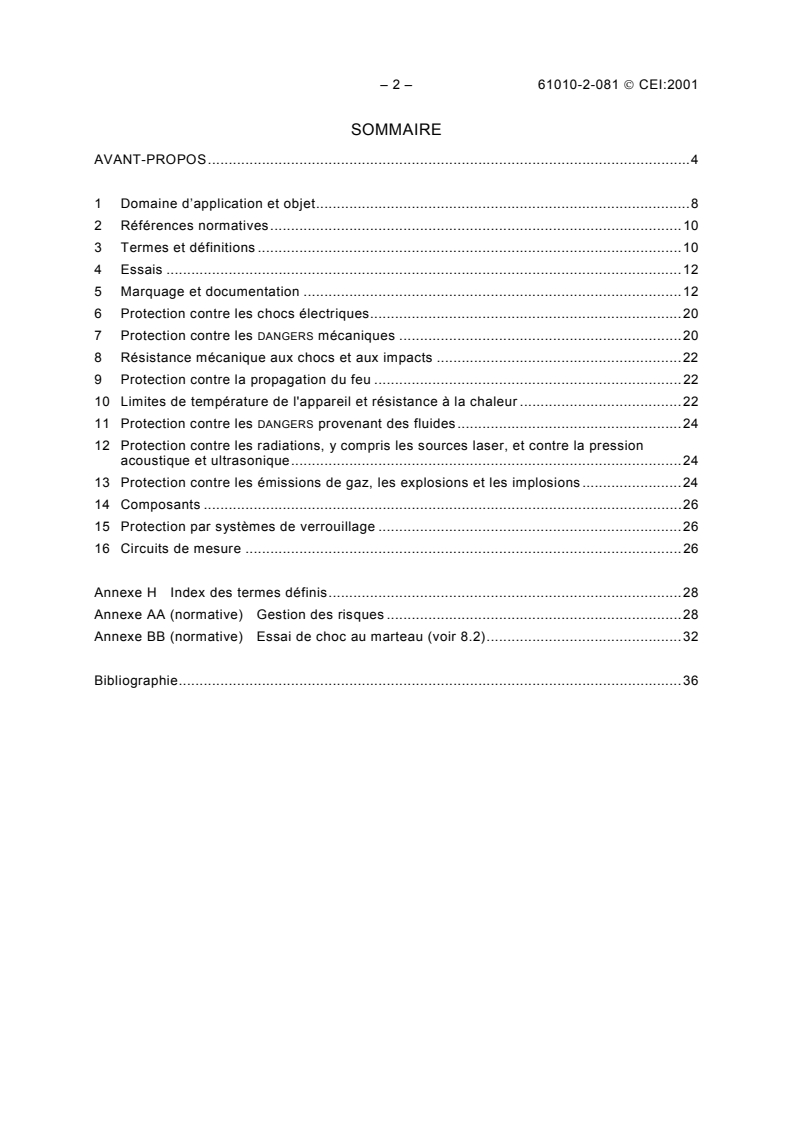
– 2 – 61010-2-081 CEI:2001
SOMMAIRE
AVANT-PROPOS.4
1 Domaine d’application et objet.8
2 Références normatives.10
3 Termes et définitions .10
4 Essais .12
5 Marquage et documentation .12
6 Protection contre les chocs électriques.20
7 Protection contre les DANGERS mécaniques .20
8 Résistance mécanique aux chocs et aux impacts .22
9 Protection contre la propagation du feu .22
10 Limites de température de l'appareil et résistance à la chaleur .22
11 Protection contre les DANGERS provenant des fluides.24
12 Protection contre les radiations, y compris les sources laser, et contre la pression
acoustique et ultrasonique.24
13 Protection contre les émissions de gaz, les explosions et les implosions.24
14 Composants .26
15 Protection par systèmes de verrouillage .26
16 Circuits de mesure .26
Annexe H Index des termes définis.28
Annexe AA (normative) Gestion des risques .28
Annexe BB (normative) Essai de choc au marteau (voir 8.2).32
Bibliographie.36
61010-2-081 IEC:2001 – 3 –
CONTENTS
FOREWORD.5
1 Scope and object.9
2 Normative references .11
3 Terms and definitions .11
4 Tests .13
5 Marking and documentation.13
6 Protection against electric shock .21
7 Protection against mechanical HAZARDS.21
8 Mechanical resistance to shock and impact .23
9 Protection against the spread of fire .23
10 Equipment temperature limits and resistance to heat.23
11 Protection against HAZARDS from fluids .25
12 Protection against radiation, including laser sources, and against sonic and
ultrasonic pressure .25
13 Protection against liberated gases, explosion and implosion.25
14 Components .27
15 Protection by interlocks .27
16 Test and measurement equipment.27
Annex H Index of defined terms.29
Annex AA (normative) Risk management .29
Annex BB (normative) Impact spring hammer (see 8.2) .33
Bibliography.37
– 4 – 61010-2-081 CEI:2001
COMMISSION ÉLECTROTECHNIQUE INTERNATIONALE
____________
RÈGLES DE SÉCURITÉ POUR APPAREILS ÉLECTRIQUES DE MESURAGE,
DE RÉGULATION ET DE LABORATOIRE –
Partie 2-081: Prescriptions particulières pour les appareils de laboratoire,
automatiques et semi-automatiques, destinés à l’analyse et autres usages
AVANT-PROPOS
1) La CEI (Commission Électrotechnique Internationale) est une organisation mondiale de normalisation
composée de l'ensemble des comités électrotechniques nationaux (Comités nationaux de la CEI). La CEI a
pour objet de favoriser la coopération internationale pour toutes les questions de normalisation dans les
domaines de l'électricité et de l'électronique. A cet effet, la CEI, entre autres activités, publie des Normes
internationales. Leur élaboration est confiée à des comités d'études, aux travaux desquels tout Comité national
intéressé par le sujet traité peut participer. Les organisations internationales, gouvernementales et non
gouvernementales, en liaison avec la CEI, participent également aux travaux. La CEI collabore étroitement
avec l'Organisation Internationale de Normalisation (ISO), selon des conditions fixées par accord entre les
deux organisations.
2) Les décisions ou accords officiels de la CEI concernant les questions techniques représentent, dans la mesure
du possible, un accord international sur les sujets étudiés, étant donné que les Comités nationaux intéressés
sont représentés dans chaque comité d’études.
3) Les documents produits se présentent sous la forme de recommandations internationales. Ils sont publiés
comme normes, spécifications techniques, rapports techniques ou guides et agréés comme tels par les
Comités nationaux.
4) Dans le but d'encourager l'unification internationale, les Comités nationaux de la CEI s'engagent à appliquer de
façon transparente, dans toute la mesure possible, les Normes internationales de la CEI dans leurs normes
nationales et régionales. Toute divergence entre la norme de la CEI et la norme nationale ou régionale
correspondante doit être indiquée en termes clairs dans cette dernière.
5) La CEI n’a fixé aucune procédure concernant le marquage comme indication d’approbation et sa responsabilité
n’est pas engagée quand un matériel est déclaré conforme à l’une de ses normes.
6) L’attention est attirée sur le fait que certains des éléments de la présente Norme internationale peuvent faire
l’objet de droits de propriété intellectuelle ou de droits analogues. La CEI ne saurait être tenue pour
responsable de ne pas avoir identifié de tels droits de propriété et de ne pas avoir signalé leur existence.
La Norme internationale CEI 61010-2-081 a été établie par le comité technique 66 de la CEI:
Sécurité des appareils de mesure, de commande et de laboratoire.
Cette norme a le statut de publication groupée de sécurité, conformément au Guide 104 de
la CEI.
Le texte de cette norme est issu des documents suivants:
FDIS Rapport de vote
66/260/FDIS 66/269/RVD
Toute information sur le vote ayant abouti à l’approbation de cette norme se trouve dans le
rapport de vote indiqué dans le tableau ci-dessus.
Cette publication a été rédigée selon les Directives ISO/CEI, Partie 3.
La présente partie 2 doit être utilisée conjointement avec la CEI 61010-1. Elle a été établie sur la
base de la deuxième édition (2001). Les éditions ou amendements futurs de la CEI 61010-1
pourront être pris en considération.
La présente partie 2 complète ou modifie les articles correspondants de la CEI 61010-1 de
façon à la transformer en norme CEI: Règles de sécurité pour les appareils de laboratoire,
automatiques et semi-automatiques, destinés à l’analyse et autres usages.
61010-2-081 IEC:2001 – 5 –
INTERNATIONAL ELECTROTECHNICAL COMMISSION
____________
SAFETY REQUIREMENTS FOR ELECTRICAL EQUIPMENT FOR
MEASUREMENT, CONTROL, AND LABORATORY USE –
Part 2-081: Particular requirements for automatic and
semi-automatic laboratory equipment for analysis and other purposes
FOREWORD
1) The IEC (International Electrotechnical Commission) is a worldwide organization for standardization comprising
all national electrotechnical committees (IEC National Committees). The object of the IEC is to promote
international co-operation on all questions concerning standardization in the electrical and electronic fields. To
this end and in addition to other activities, the IEC publishes International Standards. Their preparation is
entrusted to technical committees; any IEC National Committee interested in the subject dealt with may
participate in this preparatory work. International, governmental and non-governmental organizations liaising
with the IEC also participate in this preparation. The IEC collaborates closely with the International
Organization for Standardization (ISO) in accordance with conditions determined by agreement between the
two organizations.
2) The formal decisions or agreements of the IEC on technical matters express, as nearly as possible, an
international consensus of opinion on the relevant subjects since each technical committee has representation
from all interested National Committees.
3) The documents produced have the form of recommendations for international use and are published in the form
of standards, technical specifications, technical reports or guides and they are accepted by the National
Committees in that sense.
4) In order to promote international unification, IEC National Committees undertake to apply IEC International
Standards transparently to the maximum extent possible in their national and regional standards. Any
divergence between the IEC Standard and the corresponding national or regional standard shall be clearly
indicated in the latter.
5) The IEC provides no marking procedure to indicate its approval and cannot be rendered responsible for any
equipment declared to be in conformity with one of its standards.
6) Attention is drawn to the possibility that some of the elements of this International Standard may be the subject
of patent rights. The IEC shall not be held responsible for identifying any or all such patent rights.
International Standard IEC 61010-2-081 has been prepared by IEC technical committee 66:
Safety of measuring, control and laboratory equipment.
It has the status of a group safety publication in accordance with IEC Guide 104.
The text of this standard is based on the following documents:
FDIS Report on voting
66/260/FDIS 66/269/RVD
Full information on the voting for the approval of this standard can be found in the report on
voting indicated in the above table.
This publication has been drafted in accordance with the ISO/IEC Directives, Part 3.
This part 2 is intended to be used in conjunction with IEC 61010-1. It was established on the
basis of the second edition (2001). Consideration may be given to future editions of, or
amendments to, IEC 61010-1.
This part 2 supplements or modifies the corresponding clauses in IEC 61010-1 so as to
convert that publication into the IEC standard: Safety requirements for automatic and semi-
automatic laboratory equipment for analysis and other purposes
– 6 – 61010-2-081 CEI:2001
Lorsqu’un paragraphe particulier de la partie 1 n’est pas mentionné dans cette partie 2, ce
paragraphe s’applique pour autant qu’il est raisonnable. Lorsque cette partie spécifie
«addition», «modification», «remplacement», ou «suppression», la prescription, la modalité
d’essai ou la note correspondante de la partie 1 doit être adaptée en conséquence.
Dans la présente norme:
1) les caractères d’imprimerie suivants sont employés:
− prescriptions: caractères romains;
− NOTES: petits caractères romains;
− conformité et test: caractères italiques;
− termes définis à l’article 3 et utilisés dans cette norme: PETITES CAPITALES EN
CARACTÈRES ROMAINS.
2) les paragraphes ou figures complémentaires à ceux de la partie 1 sont numérotés à partir
de 101. Les annexes complémentaires à celles de la partie 1 sont nommées à partir de
AA.
Les annexes AA et BB font partie intégrante de la présente norme.
Le comité a décidé que le contenu de cette publication ne sera pas modifié avant 2004.
A cette date, la publication sera
– reconduite;
– supprimée;
– remplacée par une édition révisée, ou
– amendée.
61010-2-081 IEC:2001 – 7 –
Where a particular subclause of part 1 is not mentioned in this part 2, that subclause applies
as far as is reasonable. Where this part states “addition”, “modification”, “replacement”, or
“deletion”, the relevant requirement, test specification or note in part 1 should be adapted
accordingly.
In this standard:
1) the following print types are used:
• requirements: in roman type;
• NOTES: in smaller roman type;
• conformity and test: in italic type;
• terms used throughout this standard which have been defined in clause 3: SMALL
ROMAN CAPITALS.
2) subclauses or figures which are additional to those in part 1 are numbered starting
from 101; additional annexes are lettered starting from AA.
Annexes AA and BB form an integral part of this standard.
The committee has decided that the contents of this publication will remain unchanged until
2004. At this date, the publication will be
• reconfirmed;
• withdrawn;
• replaced by a revised edition, or
• amended.
– 8 – 61010-2-081 CEI:2001
RÈGLES DE SÉCURITÉ POUR APPAREILS ÉLECTRIQUES DE MESURAGE,
DE RÉGULATION ET DE LABORATOIRE –
Partie 2-081: Prescriptions particulières pour les appareils de laboratoire,
automatiques et semi-automatiques, destinés à l’analyse et autres usages
1 Domaine d’application et objet
Cet article de la partie 1 est applicable, à l'exception de ce qui suit:
1.1 Domaine d’application
Remplacement:
Cette partie 2 s’applique aux appareils de laboratoire, automatiques et semi-automatiques,
destinés à l’analyse et autres usages.
Les appareils d’analyse automatiques et semi-automatiques comprennent les appareils ou
systèmes utilisés pour mesurer ou modifier un ou plusieurs paramètres ou caractéristiques
d'échantillons, réalisant tout ou partie du processus sans intervention manuelle. Les
équipements faisant partie d'un tel système sont couverts par le domaine d'application de la
présente norme.
Exemples d'équipements entrant dans le domaine d'application de la présente norme:
– équipement réalisant des analyses;
– échantillonneur automatique (pipeteur, préparation d'alicot);
– équipement réalisant la réplication ou l'amplification d'échantillon.
NOTE 1 En ce qui concerne les équipements réalisant des analyses, le processus complet comprend habituel-
lement les phases suivantes:
– prélèvement d’une quantité déterminée de l’échantillon;
– préparation de l’échantillon par des moyens chimiques, thermiques, mécaniques ou autres;
– mesurage;
– affichage, transmission ou impression des résultats de mesurage.
NOTE 2 Si l'équipement dans sa totalité ou quelques-uns de ses sous-ensembles relèvent du domaine
d’application d’autres parties 2 de la norme CEI 61010 ainsi que du domaine d’application de la présente norme,
l'ensemble des prescriptions de ces parties 2 doivent également être satisfaites.
1.2 Objet
1.2.1 Aspects inclus dans le domaine d’application
Remplacement:
Remplacer la première phrase par ce qui suit:
Le but de cette norme est de garantir que la conception ainsi que les méthodes de
construction utilisées apportent un niveau élevé de protection et garantissent un RISQUE
TOLÉRABLE pour l’OPÉRATEUR et son environnement, en utilisant des méthodes de gestion des
RISQUES lorsque cela est spécifié (voir 7.2.101 ainsi que l'annexe AA).
61010-2-081 IEC:2001 – 9 –
SAFETY REQUIREMENTS FOR ELECTRICAL EQUIPMENT FOR
MEASUREMENT, CONTROL, AND LABORATORY USE –
Part 2-081: Particular requirements for automatic and
semi-automatic laboratory equipment for analysis and other purposes
1 Scope and object
This clause of part 1 is applicable except as follows:
1.1 Scope
Replacement:
This part 2 applies to automatic and semi-automatic laboratory equipment for analysis and
other purposes.
Automatic and semi-automatic laboratory equipment consists of instruments or systems for
measuring or modifying one or more characteristics or parameters of samples, performing the
complete process or parts of the process without manual intervention. Equipment forming part
of such a system is within the scope of this standard.
Examples of equipment within the scope of this standard include:
• analytical equipment;
• automatic sampler (pipettor, aliquoter);
• equipment for sample replication and amplification.
NOTE 1 In the case of analytical equipment the complete process usually includes the following steps:
• taking a specific quantity of the sample;
• preparing the sample by chemical, thermal, mechanical or other means;
• measurement;
• display, transmission or printing of the results of measurement.
NOTE 2 If all or part of the equipment falls within the scope of one or more other part 2 standards of IEC 61010
as well as within the scope of this standard, it will also need to meet the requirements of those other parts 2
standards.
1.2 Object
1.2.1 Aspects included in scope
Replacement:
Replace the first sentence by the following:
The purpose of this standard is to ensure that the design and methods of construction used
provide a high degree of protection at a TOLERABLE RISK for the OPERATOR and the surrounding
area, using RISK management where specified (see 7.2.101 and annex AA).
– 10 – 61010-2-081 CEI:2001
Addition:
Ajouter les deux nouveaux points suivants:
h) DANGERS biologiques;
i) produits chimiques dangereux.
1.2.2 Aspects exclus du domaine d’application
Addition:
Ajouter un nouveau point ainsi que la note suivante:
g) la manutention ou la manipulation de substances en dehors de l'équipement.
NOTE Les exigences applicables à ces sujets sont de la responsabilité des comités préparant les normes qui s’y
appliquent.
2 Références normatives
Cet article de la partie 1 est applicable, à l'exception de ce qui suit:
Addition:
CEI 60068-2-75:1997, Essais d’environnement – Partie 2-75: Essai Eh: Essais aux marteaux
3 Termes et définitions
Cet article de la partie 1 est applicable, à l’exception de ce qui suit:
3.1 Appareils et états des appareils
Additions:
Définitions complémentaires:
3.101
DOMMAGE
blessure physique ou atteinte à la santé des personnes, ou atteinte aux biens ou à
l’environnement
[ISO/CEI Guide 51:1999, définition 3.3]
3.102
RISQUE
combinaison de la probabilité d’occurrence d’un DOMMAGE et de sa gravité
[ISO/CEI Guide 51:1999, définition 3.2]
3.103
RISQUE TOLÉRABLE
RISQUE accepté dans un certain contexte, fondé sur les valeurs admises par la société
[ISO/CEI Guide 51:1999, définition 3.7]
NOTE Le RISQUE TOLÉRABLE est le résultat d'un équilibre entre l'idéal de la sécurité absolue, les exigences à
satisfaire par un produit, procédé ou service et des facteurs tels que le bénéfice pour l'utilisateur, l'adéquation à
l'usage, la rentabilité économique, l'évaluation des RISQUES, les conventions en usage dans la société concernée
et l'état de l'art.
61010-2-081 IEC:2001 – 11 –
Addition:
Add two new items:
a) biohazards;
b) hazardous chemical substances.
1.2.2 Aspects excluded from scope
Addition:
Add a new item and the following note:
g) handling or manipulation of material outside the equipment.
NOTE Requirements covering these subjects are the responsibility of committees preparing the relevant standards.
2 Normative references
This clause of part 1 is applicable except as follows:
Addition:
IEC 60068-2-75:1997, Environmental testing – Part 2-75: Test – Test Eh: Hammer tests
3 Terms and definitions
This clause of part 1 is applicable except as follows:
3.1 Equipment and states of equipment
Additions:
Additional definitions:
3.101
HARM
physical injury or damage to the health of people, or damage to property or the environment
[ISO/IEC Guide 51:1999, definition 3.3]
3.102
RISK
combination of the probability of occurrence of HARM and the severity of that HARM
[ISO/IEC Guide 51:1999, definition 3.2]
3.103
TOLERABLE RISK
RISK which is accepted in a given context based on the current values of society
[ISO/IEC Guide 51:1999, definition 3.7]
NOTE TOLERABLE RISK is the result of a balance between the ideal of absolute safety, the demands to be met by a
product, process or service, and factors such as benefit to the user, suitability of purpose, cost effectiveness, RISK
evaluation, conventions of the society concerned, and the state of the art.
– 12 – 61010-2-081 CEI:2001
4 Essais
Cet article de la partie 1 est applicable, à l’exception de ce qui suit:
4.4.2 Application des conditions de défaut
Addition:
Paragraphe additionnel:
4.4.2.101 Sélection de tension incorrecte
Les appareils multi-tensions, pour lesquels l’OPÉRATEUR peut sélectionner différentes tensions
d’alimentation, doivent être configurés à tour de rôle pour chacune de ces tensions puis
connectés successivement à toutes les autres tensions d’alimentation ASSIGNÉES.
5 Marquage et documentation
Cet article de la partie 1 est applicable, à l’exception de ce qui suit:
5.1.1 Généralités
Remplacement:
Remplacer le troisième alinéa par ce qui suit:
Les symboles littéraux pour les grandeurs et les unités doivent être conformes à la
CEI 60027. Les symboles internationaux reconnus, y compris ceux du tableau 1, doivent dans
la mesure du possible être utilisés prioritairement. Si d’autres symboles complémentaires sont
nécessaires, il ne doit pas être possible de les confondre avec les symboles internationaux.
Aucune prescription n’est spécifiée en ce qui concerne les couleurs des symboles, à l’exception
du symbole 101 (voir le tableau 1). Les symboles graphiques doivent être expliqués dans la
documentation.
Tableau 1 – Symboles
Addition:
Ajouter le nouveau symbole suivant:
Numéro Symbole Publication Description
Couleur de fond – jaune
101 ISO 7000 – 0659 DANGER biologique
Symbole et cadre – noir
5.1.5 BORNES, connexions et dispositifs de manœuvre
Additions:
Ajouter la nouvelle note 3 ci-dessous:
NOTE 3 Tous les connecteurs, dispositifs de contrôle ou de signalisation destinés à l'usage de l'OPÉRATEUR
doivent être identifiés.
61010-2-081 IEC:2001 – 13 –
4 Tests
This clause of part 1 is applicable except as follows:
4.4.2 Application of fault conditions
Addition:
Additional subclause:
4.4.2.101 Incorrect voltage selection
Multivoltage equipment that can be set by the OPERATOR to different supply voltages shall be
set to each voltage in turn and then connected to all other RATED supply voltages in turn.
5 Marking and documentation
This clause of part 1 is applicable except as follows:
5.1.1 General
Replacement:
Replace the third paragraph by the following:
Letter symbols for quantities and units shall be in accordance with IEC 60027. Internationally
recognized symbols, including those of Table 1, shall be used as far as possible. If other
additional symbols are required, it shall not be possible to confuse them with the international
symbols. There are no colour requirements for symbols except for symbol 101 (see Table 1).
Graphic symbols shall be explained in the documentation.
Table 1 – Symbols
Addition:
Add the following new symbol:
Number Symbol Publication Description
Background colour – yellow
101 ISO 7000 – 0659 Biohazard
Symbol and outline – black
5.1.5 , connections and operating devices
TERMINALS
Additions:
Add the following new note 3:
NOTE 3 All connectors, controls and indicators necessary for use by the OPERATOR should be marked.
– 14 – 61010-2-081 CEI:2001
Paragraphe additionnel:
5.1.5.101 Connexions des gaz et liquides
Un marquage figurant sur l’appareil, à proximité des raccordements, doit faire apparaître
clairement
a) les moyens d’identifier le gaz ou le liquide à utiliser. Lorsqu’il n’y a pas de symbole
international reconnu (y compris les formules chimiques), l’appareil doit être marqué du
symbole 14 du tableau 1;
b) la pression maximale autorisée ou, à défaut, le symbole 14 du tableau 1 (voir 5.4.3).
La conformité est vérifiée par examen.
5.2 Marques d'avertissement
Remplacement:
Remplacer le cinquième alinéa par les cinq alinéas suivants:
Les appareils pouvant être potentiellement infectieux en raison des prélèvements ou des
réactifs utilisés, doivent être marqués de façon nettement visible, par le symbole 101 du
tableau 1.
Les appareils présentant un DANGER potentiel en raison de l’utilisation de produits chimiques
doivent être marqués avec le symbole approprié ou (à défaut) avec le symbole 14 du tableau 1.
Les capots de protection doivent être marqués d’un avertissement à l’OPÉRATEUR de ne pas
les ouvrir ni les enlever sauf dans les conditions où cela est autorisé en 7.2.101 ou 7.2.102.
Toute partie de l’appareil qui contient des déchets de matériaux présentant un DANGER
biologique et qui peut être retirée de l’appareil en UTILISATION NORMALE doit être marquée du
symbole 101 du tableau 1.
D’autres marques d’avertissement sont spécifiées en 5.1.5.1 c), 6.1.2 b), 6.5.1.2 g), 6.6.2,
7.2 c), 7.2.101 f), 7.2.102 c), 7.3, 10.1, 13.2.2.
5.3 Durabilité du marquage
Remplacement:
Remplacer le premier alinéa par le nouvel alinéa suivant:
Les marquages prescrits de 5.1.2 à 5.2, doivent être apposés de façon permanente et doivent
rester clairs et lisibles dans les conditions d’UTILISATION NORMALE et résister aux effets de la
température, de l’abrasion, des solvants et réactifs susceptibles d’être rencontrés en
UTILISATION NORMALE, y compris aux agents de nettoyage et de décontamination spécifiés par
le fabricant.
Addition:
Ajouter après le premier alinéa un nouvel alinéa relatif à la conformité, comme suit:
Si la durabilité de marquages particuliers peut être affectée par un solvant ou par un réactif
spécifié pour utilisation avec l’appareil, ces marquages seront également frottés durant 30 s
avec chaque solvant ou réactif (ou avec un échantillonnage représentatif de solvants ou
réactifs pouvant produire le même effet).
61010-2-081 IEC:2001 – 15 –
Additional subclause:
5.1.5.101 Gas and liquid connections
The equipment shall be clearly marked near to the connector on the equipment with
a) a means of identifying the gas or liquid to be used. Where no internationally recognized
symbol (including chemical formulae) exists, the equipment shall be marked with
symbol 14 of Table 1;
b) the maximum permitted pressure, or alternatively symbol 14 of Table 1 (see 5.4.3).
Conformity is checked by inspection.
5.2 Warning markings
Replacement:
Replace the fifth paragraph by the following five paragraphs:
Equipment that can be potentially infectious due to the samples or reagents used shall be
prominently marked with symbol 101 of Table 1.
Equipment that can be hazardous due to the use of chemical substances shall be marked with
the appropriate symbol, or (if none is available) symbol 14 of Table 1.
Protective covers shall be marked to warn the OPERATOR not to open or remove them except
as permitted by 7.2.101 or 7.2.102.
Any part of the equipment that contains biohazardous waste material which can be removed
from the equipment during NORMAL USE shall be marked with symbol 101 of Table 1.
Other warning markings are specified in 5.1.5.1 c), 6.1.2 b), 6.5.1.2 g), 6.6.2, 7.2 c),
7.2.101 f), 7.2.102 c), 7.3, 10.1, 13.2.2.
5.3 Durability of markings
Replacement:
Replace the first paragraph by the following new paragraph:
Markings required by 5.1.2 to 5.2 shall be permanently affixed and shall remain clear and
legible under conditions of NORMAL USE, and resist the effects of temperature and rubbing, and
of solvent and reagents likely to be encountered in NORMAL USE, including cleaning and
decontaminating agents specified by the manufacturer.
Addition:
Add after the first paragraph a new paragraph to the conformity as follows:
If a solvent or reagent specified for use with the equipment could affect the durability of
particular marking, that marking is also rubbed for 30 s with each solvent or reagent (or with a
representative sample of groups of solvents or reagents likely to have a similar effect).
– 16 – 61010-2-081 CEI:2001
5.4.1 Généralités
Suppression:
Supprimer la note du deuxième alinéa.
Addition:
Ajouter un nouveau troisième alinéa comme suit:
Une information doit être donnée pour tout RISQUE qui ne serait pas réduit à un niveau de
RISQUE TOLÉRABLE par les mesures de protection spécifiées dans cette norme. Si des formations
sont nécessaires, ou si des dispositifs ou équipements de protection individuels supplé-
mentaires sont nécessaires pour réduire les RISQUES au niveau de RISQUES TOLÉRABLES, ceci
doit être spécifié.
5.4.3 Installation des appareils
Remplacement:
Remplacer le titre et le texte par ce qui suit:
5.4.3 Instructions pour le transport, l’installation et la montage des appareils
La documentation destinée à l’AUTORITÉ RESPONSABLE doit comprendre les éléments suivants,
dans la mesure où ils s’appliquent:
a) les instructions pour le transport après livraison à l’AUTORITÉ RESPONSABLE;
b) les caractéristiques de charge au sol (portance);
c) la masse individuelle des principaux sous-ensembles lourds;
d) les instructions pour l’emplacement et le montage y compris une indication sur l’espace
nécessaire pour la ventilation et pour l’entretien efficace et en toute sécurité par
l'OPÉRATEUR;
e) les instructions d'assemblage;
f) les instructions pour le raccordement de la terre de protection;
g) les données relatives à la puissance sonore conformément aux prescriptions données en
12.5.1;
h) les instructions relatives à la manutention, au confinement et à l'évacuation des
substances dangereuses, y compris les prescriptions pour la prévention des retours de
siphon;
i) tout système d’évacuation nécessaire au retrait de substances biologiques et chimiques
ou de fluides chauds pouvant provoquer un DANGER;
j) les informations détaillées sur les moyens de protection vis-à-vis des radiations
dangereuses (voir article 12);
k) les instructions de raccordement à l’alimentation;
l) pour les APPAREILS BRANCHES EN PERMANENCE seulement:
1) les prescriptions relatives à l'alimentation réseau ainsi que le détail des connexions, y
compris la température ASSIGNÉE du câble pour une tenue à la température ambiante
maximale ASSIGNÉE;
2) les prescriptions pour tout interrupteur ou tout disjoncteur extérieur (voir 6.11.2.1) et
pour tous dispositifs extérieurs de protection contre les surintensités (voir 9.5) ainsi
que, si nécessaire pour la sécurité, une recommandation pour que l'interrupteur ou le
disjoncteur soit placé à côté de l'appareil;
61010-2-081 IEC:2001 – 17 –
5.4.1 General
Deletion:
Delete the note to the second paragraph.
Addition:
Add a new third paragraph as follows:
Information shall be given about any RISKS not reduced to a TOLERABLE RISK level by the
protective measures specified in this standard. If there is a need for training or for the use of
additional protective devices or personal protective equipment to reduce RISKS to a TOLERABLE
RISK level, these shall be specified.
5.4.3 Equipment installation
Replacement:
Replace the title and text by the following:
5.4.3 Equipment transportation, installation and assembly instructions
Documentation for the RESPONSIBLE BODY shall include the following as applicable:
a) instructions for transportation after delivery to the RESPONSIBLE BODY;
b) floor loading requirements;
c) individual weights of principal heavy sub-assemblies;
d) location and mounting instructions, including the space required for ventilation, and for
safe and efficient OPERATOR maintenance;
e) assembly instructions;
f) instructions for protective earthing;
g) the sound data required by 12.5.1;
h) instructions relating to the handling, containment and exhaust of hazardous substances,
including any requirements for preventing back-syphonage;
i) any drainage systems required where a HAZARD could occur from the discharge of
biological and chemical substances and hot fluids;
j) details of protective measures relating to hazardous radiation (see clause 12);
k) instructions for connections to the supply;
l) for PERMANENTLY CONNECTED EQUIPMENT only:
1) mains supply requirements and details of connections, including the RATED
temperature of the cable required at maximum RATED ambient temperature;
2) requirements for any external switches, circuit-breakers (see 6.11.2.1) or overcurrent
protection devices (see 9.5). A recommendation that a switch or circuit breaker be
near the equipment shall also be included if this is necessary for safety;
– 18 – 61010-2-081 CEI:2001
m) les prescriptions pour les services spéciaux (par exemple: air, liquide de refroidissement)
y compris les limites de pression.
La conformité est vérifiée par examen de la documentation
5.4.4 Fonctionnement des appareils
Remplacement:
Lorsque cela est applicable, les instructions d’utilisation doivent comprendre les éléments
suivants:
a) le détail des commandes de fonctionnement et leur utilisation pour toutes les séquences
et tous les modes de fonctionnement;
NOTE 1 La norme CEI 60073 donne des recommandations pour les couleurs et symboles des commandes de
fonctionnement.
b) une instruction de ne pas mettre l’appareil dans une position telle que la manœuvre du
dispositif de déconnexion soit difficile (voir 6.11);
c) les instructions d'interconnexion avec les accessoires et les autres appareils y compris des
informations détaillées concernant les accessoires adaptables, les parties détachables et
toutes substances spécifiques;
d) les limites en cas de fonctionnement intermittent;
e) l’explication des symboles utilisés sur l'appareil et lorsque cela concerne un DANGER, la
raison de l’utilisation d’un symbole adapté à chaque cas particulier;
f) les instructions concernant les actions qu'un OPÉRATEUR doit entreprendre en cas de
mauvais fonctionnement;
g) les instructions et recommandations de nettoyage et de décontamination ainsi que les
produits recommandés (voir 11.2);
h) les instructions relatives à l’élimination des déchets;
i) si l’UTILISATION NORMALE nécessite la manipulation de substances dangereuses, les
instructions pour une utilisation correcte ainsi que les formations ou les moyens de
protection individuels nécessaires;
j) en cas de possibilité de contact avec la peau, lors de la manipulation de substances
potentiellement infectieuses (telles que des prélèvements humains ou des réactifs), le
besoin d’utiliser des gants de protection;
k) si l’appareil peut émettre des vapeurs d'aérosols dangereuses en UTILISATION NORMALE,
les prescriptions pour la protection de la bouche, du nez ou des yeux;
l) en cas de radiation potentiellement dangereuse, visible ou invisible, susceptible d’être
émise par l’appareil, les instructions et prescriptions relatives aux dispositifs de protection
nécessaires tels que lunettes de protection;
m) les instructions relatives à l'accès à des pièces mobiles (voir 7.2.101 et 7.2.102).
Une information dans la documentation doit indiquer que, si l'appareil n'est pas utilisé selon
les recommandations du fabricant, le niveau de protection donné par l'équipement peut être
altéré.
NOTE 2 Il convient d’attirer l’attention des fabricants au sujet de la publication mondialement reconnue, Manuel
de sécurité biologique en laboratoire, publiée par l’Organisation Mondiale de la Santé. Cette dernière donne les
informations sur les décontaminants, leurs utilisations, les dilutions et applications potentielles. Il existe également
des règles nationales qui couvrent ces domaines.
NOTE 3 Un nettoyage ou une décontamination peut être nécessaire comme mesure de sécurité lors de la
maintenance, de la réparation ou du transfert de l’appareil et de ses accessoires. Il convient que les fabricants
fournissent un formulaire à l’AUTORITÉ RESPONSABLE pour attester à ceux qui réalisent la maintenance, la réparation
ou le transfert de l'appareil, qu’un tel traitement a été réalisé.
La conformité est vérifiée par examen de la documentation.
61010-2-081 IEC:2001 – 19 –
m) requirements for special services (for example air, cooling liquid) including pressure limits.
Conformity is checked by inspection of the documentation.
5.4.4 Equipment operation
Replacement:
Instructions for use shall include if applicable:
a) details of operating controls and their use in all operating modes with any sequence of
operation;
NOTE 1 IEC 60073 gives guidance on colours and symbols of operating controls.
b) an instruction not to position the equipment so that it is difficult to operate the
disconnecting devi
...
IEC 61010-2-081 ®
Edition 1.1 2009-08
INTERNATIONAL
STANDARD
NORME
INTERNATIONALE
GROUP SAFETY PUBLICATION
PUBLICATION GROUPÉE DE SÉCURITÉ
Safety requirements for electrical equipment for measurement, control and
laboratory use –
Part 2-081: Particular requirements for automatic and semi-automatic laboratory
equipment for analysis and other purposes
Règles de sécurité pour appareils électriques de mesurage, de régulation et de
laboratoire –
Partie 2-081: Prescriptions particulières pour les appareils de laboratoire,
automatiques et semi-automatiques, destinés à l’analyse et autres usages
All rights reserved. Unless otherwise specified, no part of this publication may be reproduced or utilized in any form or by
any means, electronic or mechanical, including photocopying and microfilm, without permission in writing from either IEC or
IEC's member National Committee in the country of the requester.
If you have any questions about IEC copyright or have an enquiry about obtaining additional rights to this publication,
please contact the address below or your local IEC member National Committee for further information.
Droits de reproduction réservés. Sauf indication contraire, aucune partie de cette publication ne peut être reproduite
ni utilisée sous quelque forme que ce soit et par aucun procédé, électronique ou mécanique, y compris la photocopie
et les microfilms, sans l'accord écrit de la CEI ou du Comité national de la CEI du pays du demandeur.
Si vous avez des questions sur le copyright de la CEI ou si vous désirez obtenir des droits supplémentaires sur cette
publication, utilisez les coordonnées ci-après ou contactez le Comité national de la CEI de votre pays de résidence.
IEC Central Office
3, rue de Varembé
CH-1211 Geneva 20
Switzerland
Email: inmail@iec.ch
Web: www.iec.ch
About the IEC
The International Electrotechnical Commission (IEC) is the leading global organization that prepares and publishes
International Standards for all electrical, electronic and related technologies.
About IEC publications
The technical content of IEC publications is kept under constant review by the IEC. Please make sure that you have the
latest edition, a corrigenda or an amendment might have been published.
ƒ Catalogue of IEC publications: www.iec.ch/searchpub
The IEC on-line Catalogue enables you to search by a variety of criteria (reference number, text, technical committee,…).
It also gives information on projects, withdrawn and replaced publications.
ƒ IEC Just Published: www.iec.ch/online_news/justpub
Stay up to date on all new IEC publications. Just Published details twice a month all new publications released. Available
on-line and also by email.
ƒ Electropedia: www.electropedia.org
The world's leading online dictionary of electronic and electrical terms containing more than 20 000 terms and definitions
in English and French, with equivalent terms in additional languages. Also known as the International Electrotechnical
Vocabulary online.
ƒ Customer Service Centre: www.iec.ch/webstore/custserv
If you wish to give us your feedback on this publication or need further assistance, please visit the Customer Service
Centre FAQ or contact us:
Email: csc@iec.ch
Tel.: +41 22 919 02 11
Fax: +41 22 919 03 00
A propos de la CEI
La Commission Electrotechnique Internationale (CEI) est la première organisation mondiale qui élabore et publie des
normes internationales pour tout ce qui a trait à l'électricité, à l'électronique et aux technologies apparentées.
A propos des publications CEI
Le contenu technique des publications de la CEI est constamment revu. Veuillez vous assurer que vous possédez
l’édition la plus récente, un corrigendum ou amendement peut avoir été publié.
ƒ Catalogue des publications de la CEI: www.iec.ch/searchpub/cur_fut-f.htm
Le Catalogue en-ligne de la CEI vous permet d’effectuer des recherches en utilisant différents critères (numéro de référence,
texte, comité d’études,…). Il donne aussi des informations sur les projets et les publications retirées ou remplacées.
ƒ Just Published CEI: www.iec.ch/online_news/justpub
Restez informé sur les nouvelles publications de la CEI. Just Published détaille deux fois par mois les nouvelles
publications parues. Disponible en-ligne et aussi par email.
ƒ Electropedia: www.electropedia.org
Le premier dictionnaire en ligne au monde de termes électroniques et électriques. Il contient plus de 20 000 termes et
définitions en anglais et en français, ainsi que les termes équivalents dans les langues additionnelles. Egalement appelé
Vocabulaire Electrotechnique International en ligne.
ƒ Service Clients: www.iec.ch/webstore/custserv/custserv_entry-f.htm
Si vous désirez nous donner des commentaires sur cette publication ou si vous avez des questions, visitez le FAQ du
Service clients ou contactez-nous:
Email: csc@iec.ch
Tél.: +41 22 919 02 11
Fax: +41 22 919 03 00
IEC 61010-2-081 ®
Edition 1.1 2009-09
INTERNATIONAL
STANDARD
NORME
INTERNATIONALE
GROUP SAFETY PUBLICATION
PUBLICATION GROUPÉE DE SÉCURITÉ
Safety requirements for electrical equipment for measurement, control and
laboratory use –
Part 2-081: Particular requirements for automatic and semi-automatic laboratory
equipment for analysis and other purposes
Règles de sécurité pour appareils électriques de mesurage, de régulation et de
laboratoire –
Partie 2-081: Prescriptions particulières pour les appareils de laboratoire,
automatiques et semi-automatiques, destinés à l’analyse et autres usages
INTERNATIONAL
ELECTROTECHNICAL
COMMISSION
COMMISSION
ELECTROTECHNIQUE
PRICE CODE
INTERNATIONALE
CF
CODE PRIX
ICS 19.080; 71.040.20 ISBN 978-2-88910-400-0
– 2 – 61010-2-081 © IEC:2001+A1:2003
CONTENTS
FOREWORD.3
1 Scope and object.5
2 Normative references .6
3 Terms and definitions .6
4 Tests .7
5 Marking and documentation.7
6 Protection against electric shock .10
7 Protection against mechanical HAZARDS.11
8 Mechanical resistance to shock and impact .12
9 Protection against the spread of fire .12
10 Equipment temperature limits and resistance to heat.12
11 Protection against HAZARDS from fluids .12
12 Protection against radiation, including laser sources, and against sonic
and ultrasonic pressure .13
13 Protection against liberated gases, explosion and implosion.13
14 Components .13
15 Protection by interlocks .13
16 Test and measurement equipment.13
Annex H Index of defined terms .14
Annex AA (normative) Risk management.14
Bibliography.17
61010-2-081 © IEC:2001+A1:2003 – 3 –
INTERNATIONAL ELECTROTECHNICAL COMMISSION
____________
SAFETY REQUIREMENTS FOR ELECTRICAL EQUIPMENT FOR
MEASUREMENT, CONTROL, AND LABORATORY USE –
Part 2-081: Particular requirements for automatic and
semi-automatic laboratory equipment for analysis and other purposes
FOREWORD
1) The International Electrotechnical Commission (IEC) is a worldwide organization for standardization comprising
all national electrotechnical committees (IEC National Committees). The object of IEC is to promote
international co-operation on all questions concerning standardization in the electrical and electronic fields. To
this end and in addition to other activities, IEC publishes International Standards, Technical Specifications,
Technical Reports, Publicly Available Specifications (PAS) and Guides (hereafter referred to as “IEC
Publication(s)”). Their preparation is entrusted to technical committees; any IEC National Committee interested
in the subject dealt with may participate in this preparatory work. International, governmental and non-
governmental organizations liaising with the IEC also participate in this preparation. IEC collaborates closely
with the International Organization for Standardization (ISO) in accordance with conditions determined by
agreement between the two organizations.
2) The formal decisions or agreements of IEC on technical matters express, as nearly as possible, an international
consensus of opinion on the relevant subjects since each technical committee has representation from all
interested IEC National Committees.
3) IEC Publications have the form of recommendations for international use and are accepted by IEC National
Committees in that sense. While all reasonable efforts are made to ensure that the technical content of IEC
Publications is accurate, IEC cannot be held responsible for the way in which they are used or for any
misinterpretation by any end user.
4) In order to promote international uniformity, IEC National Committees undertake to apply IEC Publications
transparently to the maximum extent possible in their national and regional publications. Any divergence
between any IEC Publication and the corresponding national or regional publication shall be clearly indicated in
the latter.
5) IEC provides no marking procedure to indicate its approval and cannot be rendered responsible for any
equipment declared to be in conformity with an IEC Publication.
6) All users should ensure that they have the latest edition of this publication.
7) No liability shall attach to IEC or its directors, employees, servants or agents including individual experts and
members of its technical committees and IEC National Committees for any personal injury, property damage or
other damage of any nature whatsoever, whether direct or indirect, or for costs (including legal fees) and
expenses arising out of the publication, use of, or reliance upon, this IEC Publication or any other IEC
Publications.
8) Attention is drawn to the Normative references cited in this publication. Use of the referenced publications is
indispensable for the correct application of this publication.
9) Attention is drawn to the possibility that some of the elements of this IEC Publication may be the subject of
patent rights. IEC shall not be held responsible for identifying any or all such patent rights.
International Standard IEC 61010-2-081 has been prepared by IEC technical committee 66:
Safety of measuring, control and laboratory equipment.
It has the status of a group safety publication in accordance with IEC Guide 104.
This consolidated version of IEC 61010-2-081 consists of the first edition (2001) [documents
66/260/FDIS and 66/269/RVD] and its amendment 1 (2003) [documents 66/327/FDIS and
66/332/RVD].
The technical content is therefore identical to the base edition and its amendment and has
been prepared for user convenience.
It bears the edition number 1.1.
A vertical line in the margin shows where the base publication has been modified by
amendment 1.
– 4 – 61010-2-081 © IEC:2001+A1:2003
This part 2 is intended to be used in conjunction with IEC 61010-1. It was established on the
basis of the second edition (2001). Consideration may be given to future editions of, or
amendments to, IEC 61010-1.
This part 2 supplements or modifies the corresponding clauses in IEC 61010-1 so as to
convert that publication into the IEC standard: Safety requirements for automatic and semi-
automatic laboratory equipment for analysis and other purposes
Where a particular subclause of part 1 is not mentioned in this part 2, that subclause applies
as far as is reasonable. Where this part states “addition”, “modification”, “replacement”, or
“deletion”, the relevant requirement, test specification or note in part 1 should be adapted
accordingly.
In this standard:
1) the following print types are used:
• requirements: in roman type;
• NOTES: in smaller roman type;
• conformity and test: in italic type;
• terms used throughout this standard which have been defined in clause 3: SMALL
ROMAN CAPITALS.
2) subclauses or figures which are additional to those in part 1 are numbered starting
from 101; additional annexes are lettered starting from AA.
Annexes AA and BB form an integral part of this standard.
The committee has decided that the contents of the base publication and its amendments will
remain unchanged until the maintenance result date indicated on the IEC web site under
"http://webstore.iec.ch" in the data related to the specific publication. At this date,
the publication will be
• reconfirmed,
• withdrawn,
• replaced by a revised edition, or
• amended.
61010-2-081 © IEC:2001+A1:2003 – 5 –
SAFETY REQUIREMENTS FOR ELECTRICAL EQUIPMENT FOR
MEASUREMENT, CONTROL, AND LABORATORY USE –
Part 2-081: Particular requirements for automatic and
semi-automatic laboratory equipment for analysis and other purposes
1 Scope and object
This clause of part 1 is applicable except as follows:
1.1 Scope
Replacement:
This part 2 applies to automatic and semi-automatic laboratory equipment for analysis and
other purposes.
Automatic and semi-automatic laboratory equipment consists of instruments or systems for
measuring or modifying one or more characteristics or parameters of samples, performing the
complete process or parts of the process without manual intervention. Equipment forming part
of such a system is within the scope of this standard.
Examples of equipment within the scope of this standard include:
• analytical equipment;
• automatic sampler (pipettor, aliquoter);
• equipment for sample replication and amplification.
NOTE 1 In the case of analytical equipment the complete process usually includes the following steps:
• taking a specific quantity of the sample;
• preparing the sample by chemical, thermal, mechanical or other means;
• measurement;
• display, transmission or printing of the results of measurement.
NOTE 2 If all or part of the equipment falls within the scope of one or more other part 2 standards of IEC 61010
as well as within the scope of this standard, it will also need to meet the requirements of those other parts 2
standards.
1.2 Object
1.2.1 Aspects included in scope
Replacement:
Replace the first sentence by the following:
The purpose of this standard is to ensure that the design and methods of construction used
provide a high degree of protection at a TOLERABLE RISK for the OPERATOR and the surrounding
area, using RISK management where specified (see 7.2.101 and annex AA).
– 6 – 61010-2-081 © IEC:2001+A1:2003
Addition:
Add two new items:
a) biohazards;
b) hazardous chemical substances.
1.2.2 Aspects excluded from scope
Addition:
Add a new item and the following note:
g) handling or manipulation of material outside the equipment.
NOTE Requirements covering these subjects are the responsibility of committees preparing the relevant standards.
2 Normative references
This clause of part 1 is applicable except as follows:
Addition:
IEC 60068-2-75:1997, Environmental testing – Part 2-75: Test – Test Eh: Hammer tests
3 Terms and definitions
This clause of part 1 is applicable except as follows:
3.1 Equipment and states of equipment
Additions:
Additional definitions:
3.101
HARM
physical injury or damage to the health of people, or damage to property or the environment
[ISO/IEC Guide 51:1999, definition 3.3]
3.102
RISK
combination of the probability of occurrence of HARM and the severity of that HARM
[ISO/IEC Guide 51:1999, definition 3.2]
3.103
TOLERABLE RISK
RISK which is accepted in a given context based on the current values of society
[ISO/IEC Guide 51:1999, definition 3.7]
NOTE TOLERABLE RISK is the result of a balance between the ideal of absolute safety, the demands to be met by a
product, process or service, and factors such as benefit to the user, suitability of purpose, cost effectiveness, RISK
evaluation, conventions of the society concerned, and the state of the art.
61010-2-081 © IEC:2001+A1:2003 – 7 –
4 Tests
This clause of part 1 is applicable except as follows:
4.4.2 Application of fault conditions
Addition:
Additional subclause:
4.4.2.101 Incorrect voltage selection
Multivoltage equipment that can be set by the OPERATOR to different supply voltages shall be
set to each voltage in turn and then connected to all other RATED supply voltages in turn.
5 Marking and documentation
This clause of part 1 is applicable except as follows:
5.1.1 General
Replacement:
Replace the third paragraph by the following:
Letter symbols for quantities and units shall be in accordance with IEC 60027. Internationally
recognized symbols, including those of Table 1, shall be used as far as possible. If other
additional symbols are required, it shall not be possible to confuse them with the international
symbols. There are no colour requirements for symbols except for symbol 101 (see Table 1).
Graphic symbols shall be explained in the documentation.
Table 1 – Symbols
Addition:
Add the following new symbol:
Number Symbol Publication Description
Background colour – yellow
101 ISO 7000 – 0659 Biohazard
Symbol and outline – black
5.1.5 TERMINALS, connections and operating devices
Additions:
Add the following new note 3:
NOTE 3 All connectors, controls and indicators necessary for use by the OPERATOR should be marked.
– 8 – 61010-2-081 © IEC:2001+A1:2003
Additional subclause:
5.1.5.101 Gas and liquid connections
The equipment shall be clearly marked near to the connector on the equipment with
a) a means of identifying the gas or liquid to be used. Where no internationally recognized
symbol (including chemical formulae) exists, the equipment shall be marked with
symbol 14 of Table 1;
b) the maximum permitted pressure, or alternatively symbol 14 of Table 1 (see 5.4.3).
Conformity is checked by inspection.
5.2 Warning markings
Replacement:
Replace the fifth paragraph by the following five paragraphs:
Equipment that can be potentially infectious due to the samples or reagents used shall be
prominently marked with symbol 101 of Table 1.
Equipment that can be hazardous due to the use of chemical substances shall be marked with
the appropriate symbol, or (if none is available) symbol 14 of Table 1.
Protective covers shall be marked to warn the OPERATOR not to open or remove them except
as permitted by 7.2.101 or 7.2.102.
Any part of the equipment that contains biohazardous waste material which can be removed
from the equipment during NORMAL USE shall be marked with symbol 101 of Table 1.
Other warning markings are specified in 5.1.5.1 c), 6.1.2 b), 6.5.1.2 g), 6.6.2, 7.2 c),
7.2.101 f), 7.2.102 c), 7.3, 10.1, 13.2.2.
5.3 Durability of markings
Replacement:
Replace the first paragraph by the following new paragraph:
Markings required by 5.1.2 to 5.2 shall be permanently affixed and shall remain clear and
legible under conditions of NORMAL USE, and resist the effects of temperature and rubbing, and
of solvent and reagents likely to be encountered in NORMAL USE, including cleaning and
decontaminating agents specified by the manufacturer.
Addition:
Add after the first paragraph a new paragraph to the conformity as follows:
If a solvent or reagent specified for use with the equipment could affect the durability of
particular marking, that marking is also rubbed for 30 s with each solvent or reagent (or with a
representative sample of groups of solvents or reagents likely to have a similar effect).
61010-2-081 © IEC:2001+A1:2003 – 9 –
5.4.1 General
Deletion:
Delete the note to the second paragraph.
Addition:
Add a new third paragraph as follows:
Information shall be given about any RISKS not reduced to a TOLERABLE RISK level by the
protective measures specified in this standard. If there is a need for training or for the use of
additional protective devices or personal protective equipment to reduce RISKS to a TOLERABLE
RISK level, these shall be specified.
5.4.3 Equipment installation
Replacement:
Replace the title and text by the following:
5.4.3 Equipment transportation, installation and assembly instructions
Documentation for the RESPONSIBLE BODY shall include the following as applicable:
a) instructions for transportation after delivery to the RESPONSIBLE BODY;
b) floor loading requirements;
c) individual weights of principal heavy sub-assemblies;
d) location and mounting instructions, including the space required for ventilation, and for
safe and efficient OPERATOR maintenance;
e) assembly instructions;
f) instructions for protective earthing;
g) the sound data required by 12.5.1;
h) instructions relating to the handling, containment and exhaust of hazardous substances,
including any requirements for preventing back-syphonage;
i) any drainage systems required where a HAZARD could occur from the discharge of
biological and chemical substances and hot fluids;
j) details of protective measures relating to hazardous radiation (see clause 12);
k) instructions for connections to the supply;
l) for PERMANENTLY CONNECTED EQUIPMENT only:
1) mains supply requirements and details of connections, including the RATED
temperature of the cable required at maximum RATED ambient temperature;
2) requirements for any external switches, circuit-breakers (see 6.11.2.1) or overcurrent
protection devices (see 9.5). A recommendation that a switch or circuit breaker be
near the equipment shall also be included if this is necessary for safety;
m) requirements for special services (for example air, cooling liquid) including pressure limits.
Conformity is checked by inspection of the documentation.
– 10 – 61010-2-081 © IEC:2001+A1:2003
5.4.4 Equipment operation
Replacement:
Instructions for use shall include if applicable:
a) details of operating controls and their use in all operating modes with any sequence of
operation;
NOTE 1 IEC 60073 gives guidance on colours and symbols of operating controls.
b) an instruction not to position the equipment so that it is difficult to operate the
disconnecting device (see 6.11);
c) instructions for interconnections to accessories and other equipment, including details of
suitable accessories, detachable parts and any special materials;
d) limits for intermittent operation;
e) an explanation of symbols used on the equipment and, where HAZARDS are involved, the
reason for using a symbol in each particular case;
f) instructions for any actions to be taken by an OPERATOR in case of a malfunction;
g) instructions and recommendations for cleaning and decontamination, with materials
recommended (see 11.2);
h) instructions for the disposal of waste;
i) if NORMAL USE involves the handling of hazardous substances, instructions on correct use
and any need for training or personal protection measures;
j) if there could be contact with the skin when handling potentially infectious substances
(such as human samples or reagents), the need to use protective gloves;
k) if the equipment could emit hazardous aerosol vapours in NORMAL USE, instructions for
protection of the mouth, nose or eyes;
l) if potentially hazardous visible or invisible radiation could be emitted, instructions and
requirements for protective devices, such as protective glasses;
m) instructions relating to access to moving parts (see 7.2.101 and 7.2.102).
There shall be a statement in the instructions that, if the equipment is used in a manner not
specified by the manufacturer, the protection provided by the equipment may be impaired.
NOTE 2 Manufacturers should be aware of the internationally recognized Laboratory Biosafety Manual, published
by the World Health Organization. This gives information on decontaminants, their use, dilutions, and potential
applications. There are also national guidelines that cover these areas.
NOTE 3 Cleaning and decontamination may be necessary as a safeguard when equipment and its accessories
are maintained, repaired, or transferred. Manufacturers should provide a format for RESPONSIBLE BODIES to certify
to those maintaining, repairing or transferring equipment that such a treatment has been carried out.
Conformity is checked by inspection of the documentation.
Additional subclauses:
5.4.101 Removal of equipment from use for repair or disposal
Instructions shall be provided for the RESPONSIBLE BODY for eliminating or reducing HAZARDS
involved in removal from use, transportation or disposal. These instructions shall include
requirements for minimizing biohazards, if any.
Conformity is checked by inspection of the documentation.
6 Protection against electric shock
This clause of part 1 is applicable.
61010-2-081 © IEC:2001+A1:2003 – 11 –
7 Protection against mechanical HAZARDS
This clause of part 1 is applicable except as follows:
7.2 Moving parts
Deletion
Delete paragraphs two and three.
Addition:
Additional subclauses:
7.2.101 Accessibility during NORMAL USE
As an exception, if moving parts are unavoidably exposed in NORMAL USE, RISK management
(see annex AA) shall be carried out to establish whether the moving parts could cause injury
to the OPERATOR. Any RISKS shall be minimized as far as practible by protective measures, in
the following order of priority:
a) protective devices (interlock systems or other means, removable only with a TOOL);
b) protective covers;
c) mechanical BARRIERS;
d) sufficient distance between safe areas and moving parts;
e) warning signals (audible or visible);
f) warning markings (see 5.2).
Measures b) to d) shall be combined with warnings regarding hazardous areas (see 5.4.1).
If moving parts are unavoidably exposed during NORMAL USE, the instructions shall specify that
procedures which could result in injury are carried out only by OPERATORS who have been
warned of the potential HAZARDS and have received adequate training in carrying out the
procedures in the safest possible manner.
Conformity is checked by inspection and as specified in annex AA.
7.2.102 Accessibility outside NORMAL USE
If an OPERATOR carrying out routine maintenance outside NORMAL USE has, for unavoidable
technical reasons, to perform a procedure, such as adjustment which requires access to
hazardous moving parts, access is permitted provided that all of the following precautions
have been taken:
a) access to moving parts protected by devices specified in 7.2.101 a) is not possible without
the use of a TOOL;
b) the instructions for the RESPONSIBLE BODY include a statement that OPERATORS must be
trained before being allowed to perform the hazardous procedure;
c) there are warning markings (see 5.2) on any covers or parts which have to be removed to
obtain access and the warning prohibits access by untrained OPERATORS. As an alternative,
symbol 14 of Table 1 shall be placed on the covers or parts and the warnings included in the
documentation.
Conformity is checked by inspection and as specified in annex AA.
– 12 – 61010-2-081 © IEC:2001+A1:2003
8 Mechanical resistance to shock and impact
This clause of part 1 is applicable except as follows:
8.2.1 Equipment other than HAND-HELD EQUIPMENT and direct plug-in equipment
Replacement:
Replace the text of c) by the following:
c) no test is required for FIXED EQUIPMENT, for equipment with a mass over 100 kg, or for
equipment whose size and weight make unintentional movement unlikely and which is not
moved in NORMAL USE;
9 Protection against the spread of fire
This clause of part 1 is applicable.
10 Equipment temperature limits and resistance to heat
This clause of part 1 is applicable.
11 Protection against HAZARDS from fluids
This clause of part 1 is applicable except as follows:
11.3 Spillage
Replacement:
If in NORMAL USE, liquid is likely to be spilled into the equipment, the equipment shall be
designed so that no HAZARD will occur, as a result of the wetting of insulation or of internal
uninsulated parts which are HAZARDOUS LIVE, or as a result of the contact of potentially
aggressive substances (such as corrosive, toxic or flammable liquids) with parts of the
equipment.
Conformity is checked by inspection. In case of doubt, 0,2 l of water is poured steadily from a
height of 0,1 m over a period of 15 s onto each point in turn at the area where the OPERATOR
has to pour in or handle liquids, and where the liquid might gain access to electrical parts.
In areas where an automatic dosing process is performed, the above test is also carried out
using a volume of water equal to 5 times the maximum amount of liquid which is likely to be
spilled during NORMAL USE by the equipment itself.
Immediately after this treatment, the equipment shall pass the voltage tests of 6.8 (without
humidity preconditioning) and ACCESSIBLE parts shall not exceed the limits of 6.3.1.
Where appropriate, conformity is also checked by an examination of the compatibility of
potentially aggressive substances with contacted parts of the equipment.
61010-2-081 © IEC:2001+A1:2003 – 13 –
12 Protection against radiation, including laser sources, and against sonic
and ultrasonic pressure
This clause of part 1 is applicable.
13 Protection against liberated gases, explosion and implosion
This clause of part 1 is applicable except as follows:
Modification:
Modify the title of the clause as follows:
13 Protection against liberated gases and substances, explosion and
implosion
13.1 Poisonous and injurious gases
Modification:
Modify the title as follows:
13.1 Poisonous and injurious gases and substances
Replacement:
Replace the first paragraph by the following two new paragraphs:
Equipment shall not liberate dangerous amounts of poisonous or injurious gases or
substances in NORMAL CONDITION or in SINGLE FAULT CONDITION.
If potentially hazardous substances are liberated, the OPERATOR shall not be wetted nor be
able to inhale quantities likely to be hazardous. The areas of the equipment containing such
substances shall be equipped with protective covers or similar means of protection.
14 Components
This clause of part 1 is applicable.
15 Protection by interlocks
This clause of part 1 is applicable.
16 Test and measurement equipment
This clause of part 1 is applicable.
– 14 – 61010-2-081 © IEC:2001+A1:2003
Annexes
The annexes of part 1 are applicable except as follows:
Additions:
Annex H
Index of defined terms
Additional defined terms:
HARM. 3.101
RISK . 3.102
TOLERABLE RISK . 3.103
Add the following two new annexes AA and BB as follows:
Annex AA
(normative)
Risk management
To meet the requirements of 7.2.101, a satisfactory level of safety shall be achieved by RISK
reduction to achieve at least a TOLERABLE RISK. RISK management shall be carried out, and
documented, to achieve at least a TOLERABLE RISK by an iterative process covering the
following.
a) RISK analysis
RISK analysis is the process to identify hazards and to estimate the RISKS based on the
use of available information.
b) RISK evaluation
Each RISK analysis requires a plan to work out the estimated severity and probability of a
RISK level, and to judge the acceptability of the resulting RISK level. Acceptability of RISK
levels is judged as follows (see Figure AA.1):
1) Broadly acceptable region
In some cases, the RISK is so low, that it is negligible in comparison with other RISKS
and in view of the benefit of using the equipment. In such cases the RISK is acceptable
RISK control need not be actively pursued. This level fulfils the requirement for
and
TOLERABLE RISK.
2) RISK as low as reasonably practicable region (ALARP)
This level does not automatically fulfil the requirement for TOLERABLE RISK. ALARP as a
result in a RISK analysis always needs a justification of why the RISK cannot be reduced
further in a practicable way.
61010-2-081 © IEC:2001+A1:2003 – 15 –
3) Intolerable region
This level contains RISKS that are not TOLERABLE RISKS.
c) RISK reduction
If the initial RISK is not acceptable, counter measures shall be identified and put into force.
The process of RISK analysis and RISK evaluation shall then be repeated, including
checking that counter measures have not introduced new RISKS.
NOTE 1 For IVD medical equipment within the scope of IEC 61010-2-101, the RISK management process
specified in that standard applies.For other equipment, guidance on RISK management is given in the following
standards: ISO 14971 and ISO 14121.
NOTE 2 Where ISO 14121 requires conformity with a recommendation of ISO/TR 12100-2, that recommendation
is replaced by the relevant requirement of IEC 61010.
Intolerable
region
ALARP
region
Broadly
acceptable
region
Increasing SEVERITY of HARM
IEC 1747/03
Figure AA.1 – RISK acceptability
Increasing probability of occurance
– 16 – 61010-2-081 © IEC:2001+A1:2003
Annex BB
(deleted)
61010-2-081 © IEC:2001+A1:2003 – 17 –
Bibliography
Add the following publications:
IEC 60073:1996, Basic and safety principles for man-machine interface, marking and
identification – Coding principles for induction devices and actuators
ISO/IEC Guide 51:1999, Safety aspects – Guidelines for their inclusions in standards
ISO 7000:1989, Graphical symbols for use on equipment – Index and synopsis
ISO/TR 12100-2:1992, Safety of machines – Basic concepts, general principles for design –
Part 2: Technical principles and specifications
ISO 14121:1999, Safety of machinery – Principles of risk assessment
ISO 14971:2000, Medical devices – Application of risk management to medical devices
Laboratory Biosafety Manual, World Health Organization, 1984
___________
– 18 – 61010-2-081 © CEI:2001+A1:2003
SOMMAIRE
AVANT-PROPOS.19
1 Domaine d’application et objet.21
2 Références normatives.22
3 Termes et définitions .22
4 Essais.23
5 Marquage et documentation .23
6 Protection contre les chocs électriques.27
7 Protection contre les DANGERS mécaniques .27
8 Résistance mécanique aux chocs et aux impacts .28
9 Protection contre la propagation du feu .28
10 Limites de température de l'appareil et résistance à la chaleur .28
11 Protection contre les DANGERS provenant des fluides.28
12 Protection contre les radiations, y compris les sources laser, et contre la pression
acoustique et ultrasonique.29
13 Protection contre les émissions de gaz, les explosions et les implosions.29
14 Composants.30
15 Protection par systèmes de verrouillage .30
16 Circuits de mesure.30
Annexe H Index des termes définis.31
Annexe AA (normative) Gestion des risques .31
Bibliographie.34
61010-2-081 © CEI:2001+A1:2003 – 19 –
COMMISSION ÉLECTROTECHNIQUE INTERNATIONALE
____________
RÈGLES DE SÉCURITÉ POUR APPAREILS ÉLECTRIQUES DE MESURAGE,
DE RÉGULATION ET DE LABORATOIRE –
Partie 2-081: Prescriptions particulières pour les appareils de laboratoire,
automatiques et semi-automatiques, destinés à l’analyse et autres usages
AVANT-PROPOS
1) La Commission Electrotechnique Internationale (CEI) est une organisation mondiale de normalisation
composée de l'ensemble des comités électrotechniques nationaux (Comités nationaux de la CEI). La CEI a
pour objet de favoriser la coopération internationale pour toutes les questions de normalisation dans les
domaines de l'électricité et de l'électronique. A cet effet, la CEI – entre autres activités – publie des Normes
internationales, des Spécifications techniques, des Rapports techniques, des Spécifications accessibles au
public (PAS) et des Guides (ci-après dénommés "Publication(s) de la CEI"). Leur élaboration est confiée à des
comités d'études, aux travaux desquels tout Comité national intéressé par le sujet traité peut participer. Les
organisations internationales, gouvernementales et non gouvernementales, en liaison avec la CEI, participent
également aux travaux. La CEI collabore étroitement avec l'Organisation Internationale de Normalisation (ISO),
selon des conditions fixées par accord entre les deux organisations.
2) Les décisions ou accords officiels de la CEI concernant les questions techniques représentent, dans la mesure
du possible, un accord international sur les sujets étudiés, étant donné que les Comités nationaux de la CEI
intéressés sont représentés dans chaque comité d’études.
3) Les Publications de la CEI se présentent sous la forme de recommandations internationales et sont agréées
comme telles par les Comités nationaux de la CEI. Tous les efforts raisonnables sont entrepris afin que la CEI
s'assure de l'exactitude du contenu technique de ses publications; la CEI ne peut pas être tenue responsable
de l'éventuelle mauvaise utilisation ou interprétation qui en est faite par un quelconque utilisateur final.
4) Dans le but d'encourager l'uniformité internationale, les Comités nationaux de la CEI s'engagent, dans toute la
mesure possible, à appliquer de façon transparente les Publications de la CEI dans leurs publications
nationales et régionales. Toutes divergences entre toutes Publications de la CEI et toutes publications
nationales ou régionales correspondantes doivent être indiquées en termes clairs dans ces dernières.
5) La CEI n’a prévu aucune procédure de marquage valant indication d’approbation et n'engage pas sa
responsabilité pour les équipements déclarés conformes à une de ses Publications.
6) Tous les utilisateurs doivent s'assurer qu'ils sont en possession de la dernière édition de cette publication.
7) Aucune responsabilité ne doit être imputée à la CEI, à ses administrateurs, employés, auxiliaires ou
mandataires, y compris ses experts particuliers et les membres de ses comités d'études et des Comités
nationaux de la CEI, pour tout préjudice causé en cas de dommages corporels et matériels, ou de tout autre
dommage de quelque nature que ce soit, directe ou indirecte, ou pour supporter les coûts (y compris les frais
de justice) et les dépenses découlant de la publication ou de l'utilisation de cette Publication de la CEI ou de
toute autre Publication de la CEI, ou au crédit qui lui est accordé.
8) L'attention est attirée sur les références normatives citées dans cette publication. L'utilisation de publications
référencées est obligatoire pour une application correcte de la présente publication.
9) L’attention est attirée sur le fait que certains des éléments de la présente Publication de la CEI peuvent faire
l’objet de droits de propriété intellectuelle ou de droits analogues. La CEI ne saurait être tenue pour
responsable de ne pas avoir identifié de tels droits de propriété et de ne pas avoir signalé leur existence.
La Norme internationale CEI 61010-2-081 a été établie par le comité technique 66 de la CEI:
Sécurité des appareils de mesure, de commande et de laboratoire.
Cette norme a le statut de publication groupée de sécurité, conformément au Guide 104 de
la CEI.
Cette version consolidée de la CEI 61010-2-081 comprend la première édition (2001)
[documents 66/260/FDIS et 66/269/RVD] et son amendement 1 (2003) [documents
66/327/FDIS et 66/332/RVD].
Le contenu technique de cette version consolidée est donc identique à celui de l'édition de base
et à son amendement; cette version a été préparée par commodité pour l'utilisateur.
Elle porte le numéro d'édition 1.1.
– 20 – 61010-2-081 © CEI:2001+A1:2003
Une ligne verticale dans la marge indique où la publication de base a été modifiée par
l'amendement 1.
La présente partie 2 doit être utilisée conjointement avec la CEI 61010-1. Elle a été établie sur la
base de la deuxième édition (2001). Les éditions ou amendements futurs de la CEI 61010-1
pourront être pris en considération.
La présente partie 2 complète ou modifie les articles correspondants de la CEI 61010-1 de
façon à la transformer en norme CEI: Règles de sécurité pour les appareils de laboratoire,
automatiques et semi-automatiques, destinés à l’analyse et autres usages.
Lorsqu’un paragraphe particulie
...