

IEC 61853-1:2011
(Main)Photovoltaic (PV) module performance testing and energy rating - Part 1: Irradiance and temperature performance measurements and power rating
General Information
- Abstract
IEC 61853-1:2011 describes requirements for evaluating PV module performance in terms of power (watts) rating over a range of irradiances and temperatures. The object is to define a testing and rating system, which provides the PV module power (watts) at maximum power operation for a set of defined conditions. A second purpose is to provide a full set of characterization parameters for the module under various values of irradiance and temperature.
- Status
- Published
- Publication Date
- 25-Jan-2011
- Technical Committee
- TC 82 - Solar photovoltaic energy systems
- Drafting Committee
- WG 2 - TC 82/WG 2
- Current Stage
- PPUB - Publication issued
- Start Date
- 26-Jan-2011
- Completion Date
- 15-Jan-2011
Overview
IEC 61853-1:2011 is an international standard published by the International Electrotechnical Commission (IEC) that defines the methodology for performance testing and energy rating of photovoltaic (PV) modules. This part of the IEC 61853 series specifically addresses the measurement of PV module power output as a function of irradiance and temperature, providing a robust framework for evaluating PV modules under different environmental conditions. It establishes requirements for testing maximum power (watts) output at various combinations of solar irradiance and module temperature, leading to a detailed characterization of module performance.
This standard plays a critical role in the solar photovoltaic industry by ensuring consistent, reliable, and comparable data on PV module performance, facilitating better design, selection, and deployment of solar modules under real-world conditions.
Key Topics
Performance Evaluation
IEC 61853-1 provides a systematic testing protocol to determine maximum power output across a range of irradiance levels and temperatures. This includes defining power ratings at:- Standard Test Conditions (STC)
- Nominal Operating Cell Temperature (NOCT)
- Low Irradiance Condition (LIC)
- High Temperature Condition (HTC)
- Low Temperature Condition (LTC)
Characterization Parameters
The standard mandates measurement of current (I), voltage (V), and power (P) parameters across the predefined environmental conditions. These parameters allow for detailed performance mapping of PV modules, essential for energy yield prediction and module comparison.Sampling and Pre-Conditioning
Procedures for sample selection and pre-conditioning of PV modules ensure test repeatability and reliability. Modules selected must come from typical production batches or prototypes with clear identification and manufacturing traceability.Testing Procedures
The standard includes multiple testing methodologies:- Natural sunlight testing with or without solar trackers
- Testing with solar simulators for controlled laboratory conditions
- Simplified procedures for linear modules
Power Rating Methodology
Rigorous procedures for interpolating measured data enable accurate power rating under various test conditions. This helps ensure that published module power ratings reflect realistic operating environments rather than only idealized conditions.
Applications
Module Performance Certification
IEC 61853-1 is widely used by manufacturers and certification agencies to validate and certify PV module power ratings. This assures stakeholders of the quality and expected performance of modules prior to deployment.Energy Yield Predictions
By providing detailed performance data over a range of irradiance and temperature conditions, this standard supports accurate energy production estimates crucial for system design, financial modeling, and performance guarantees.Product Development and Quality Control
Manufacturers utilize this standard to characterize new PV technologies and optimize module designs. Consistent testing protocols help maintain product quality and identify performance improvements.Technical Procurement
Utilities, project developers, and engineers rely on IEC 61853-1 ratings to compare PV modules quantitatively and make informed purchasing decisions based on predictable system output.
Related Standards
IEC 61853 Series
- Part 2: Addresses the effect of angle of incidence, spectral response, and module temperature estimation based on environmental factors.
- Part 3: Defines the calculation methods for energy rating (watt-hour capacity) of PV modules.
- Part 4: Provides standard climatic reference profiles for energy rating calculations.
IEC 60904 Series
A critical companion set of standards detailing measurement of PV current-voltage characteristics, reference solar devices, solar simulators, and spectral mismatch corrections.IEC 61215 and IEC 61646
Standards for design qualification and type approval of crystalline silicon and thin-film PV modules respectively, complementing performance testing with durability assessments.
Conclusion
IEC 61853-1:2011 is an essential standard for photovoltaic module performance evaluation, offering comprehensive guidelines for irradiance and temperature-dependent power testing. By adopting this standard, the solar energy sector benefits from improved consistency, transparency, and reliability in PV module power ratings - driving innovation, confidence, and efficiency in solar energy projects worldwide.
Keywords: IEC 61853-1, photovoltaic module testing, PV power rating, irradiance performance, temperature effects, solar module characterization, PV energy rating, solar simulator, standard test conditions, IEC photovoltaic standards
Relations
- Effective Date
- 10-Feb-2026
- Effective Date
- 10-Feb-2026
- Effective Date
- 10-Feb-2026
Get Certified
Connect with accredited certification bodies for this standard

DNV
DNV is an independent assurance and risk management provider.

Lloyd's Register
Lloyd's Register is a global professional services organisation specialising in engineering and technology.
DNV Energy Systems
Energy and renewable energy certification.
Sponsored listings
Frequently Asked Questions
IEC 61853-1:2011 is a standard published by the International Electrotechnical Commission (IEC). Its full title is "Photovoltaic (PV) module performance testing and energy rating - Part 1: Irradiance and temperature performance measurements and power rating". This standard covers: IEC 61853-1:2011 describes requirements for evaluating PV module performance in terms of power (watts) rating over a range of irradiances and temperatures. The object is to define a testing and rating system, which provides the PV module power (watts) at maximum power operation for a set of defined conditions. A second purpose is to provide a full set of characterization parameters for the module under various values of irradiance and temperature.
IEC 61853-1:2011 describes requirements for evaluating PV module performance in terms of power (watts) rating over a range of irradiances and temperatures. The object is to define a testing and rating system, which provides the PV module power (watts) at maximum power operation for a set of defined conditions. A second purpose is to provide a full set of characterization parameters for the module under various values of irradiance and temperature.
IEC 61853-1:2011 is classified under the following ICS (International Classification for Standards) categories: 27.160 - Solar energy engineering. The ICS classification helps identify the subject area and facilitates finding related standards.
IEC 61853-1:2011 has the following relationships with other standards: It is inter standard links to EN IEC 62108:2022, EN IEC 62941:2020, EN 61215:2005. Understanding these relationships helps ensure you are using the most current and applicable version of the standard.
IEC 61853-1:2011 is available in PDF format for immediate download after purchase. The document can be added to your cart and obtained through the secure checkout process. Digital delivery ensures instant access to the complete standard document.
Standards Content (Sample)
IEC 61853-1 ®
Edition 1.0 2011-01
INTERNATIONAL
STANDARD
NORME
INTERNATIONALE
Photovoltaic (PV) module performance testing and energy rating –
Part 1: Irradiance and temperature performance measurements and power rating
Essais de performance et caractéristiques assignées d'énergie des modules
photovoltaïques (PV) –
Partie 1: Mesures de performance en fonction de l'éclairement et de la
température, et caractéristiques de puissance
All rights reserved. Unless otherwise specified, no part of this publication may be reproduced or utilized in any form or by
any means, electronic or mechanical, including photocopying and microfilm, without permission in writing from either IEC or
IEC's member National Committee in the country of the requester.
If you have any questions about IEC copyright or have an enquiry about obtaining additional rights to this publication,
please contact the address below or your local IEC member National Committee for further information.
Droits de reproduction réservés. Sauf indication contraire, aucune partie de cette publication ne peut être reproduite
ni utilisée sous quelque forme que ce soit et par aucun procédé, électronique ou mécanique, y compris la photocopie
et les microfilms, sans l'accord écrit de la CEI ou du Comité national de la CEI du pays du demandeur.
Si vous avez des questions sur le copyright de la CEI ou si vous désirez obtenir des droits supplémentaires sur cette
publication, utilisez les coordonnées ci-après ou contactez le Comité national de la CEI de votre pays de résidence.
IEC Central Office
3, rue de Varembé
CH-1211 Geneva 20
Switzerland
Email: inmail@iec.ch
Web: www.iec.ch
About the IEC
The International Electrotechnical Commission (IEC) is the leading global organization that prepares and publishes
International Standards for all electrical, electronic and related technologies.
About IEC publications
The technical content of IEC publications is kept under constant review by the IEC. Please make sure that you have the
latest edition, a corrigenda or an amendment might have been published.
Catalogue of IEC publications: www.iec.ch/searchpub
The IEC on-line Catalogue enables you to search by a variety of criteria (reference number, text, technical committee,…).
It also gives information on projects, withdrawn and replaced publications.
IEC Just Published: www.iec.ch/online_news/justpub
Stay up to date on all new IEC publications. Just Published details twice a month all new publications released. Available
on-line and also by email.
Electropedia: www.electropedia.org
The world's leading online dictionary of electronic and electrical terms containing more than 20 000 terms and definitions
in English and French, with equivalent terms in additional languages. Also known as the International Electrotechnical
Vocabulary online.
Customer Service Centre: www.iec.ch/webstore/custserv
If you wish to give us your feedback on this publication or need further assistance, please visit the Customer Service
Centre FAQ or contact us:
Email: csc@iec.ch
Tel.: +41 22 919 02 11
Fax: +41 22 919 03 00
A propos de la CEI
La Commission Electrotechnique Internationale (CEI) est la première organisation mondiale qui élabore et publie des
normes internationales pour tout ce qui a trait à l'électricité, à l'électronique et aux technologies apparentées.
A propos des publications CEI
Le contenu technique des publications de la CEI est constamment revu. Veuillez vous assurer que vous possédez
l’édition la plus récente, un corrigendum ou amendement peut avoir été publié.
Catalogue des publications de la CEI: www.iec.ch/searchpub/cur_fut-f.htm
Le Catalogue en-ligne de la CEI vous permet d’effectuer des recherches en utilisant différents critères (numéro de référence,
texte, comité d’études,…). Il donne aussi des informations sur les projets et les publications retirées ou remplacées.
Just Published CEI: www.iec.ch/online_news/justpub
Restez informé sur les nouvelles publications de la CEI. Just Published détaille deux fois par mois les nouvelles
publications parues. Disponible en-ligne et aussi par email.
Electropedia: www.electropedia.org
Le premier dictionnaire en ligne au monde de termes électroniques et électriques. Il contient plus de 20 000 termes et
définitions en anglais et en français, ainsi que les termes équivalents dans les langues additionnelles. Egalement appelé
Vocabulaire Electrotechnique International en ligne.
Service Clients: www.iec.ch/webstore/custserv/custserv_entry-f.htm
Si vous désirez nous donner des commentaires sur cette publication ou si vous avez des questions, visitez le FAQ du
Service clients ou contactez-nous:
Email: csc@iec.ch
Tél.: +41 22 919 02 11
Fax: +41 22 919 03 00
IEC 61853-1 ®
Edition 1.0 2011-01
INTERNATIONAL
STANDARD
NORME
INTERNATIONALE
Photovoltaic (PV) module performance testing and energy rating –
Part 1: Irradiance and temperature performance measurements and power
rating
Essais de performance et caractéristiques assignées d'énergie des modules
photovoltaïques (PV) –
Partie 1: Mesures de performance en fonction de l'éclairement et de la
température, et caractéristiques de puissance
INTERNATIONAL
ELECTROTECHNICAL
COMMISSION
COMMISSION
ELECTROTECHNIQUE
PRICE CODE
INTERNATIONALE
CODE PRIX Q
ICS 27.160 ISBN 978-2-88912-301-8
– 2 – 61853-1 IEC:2011
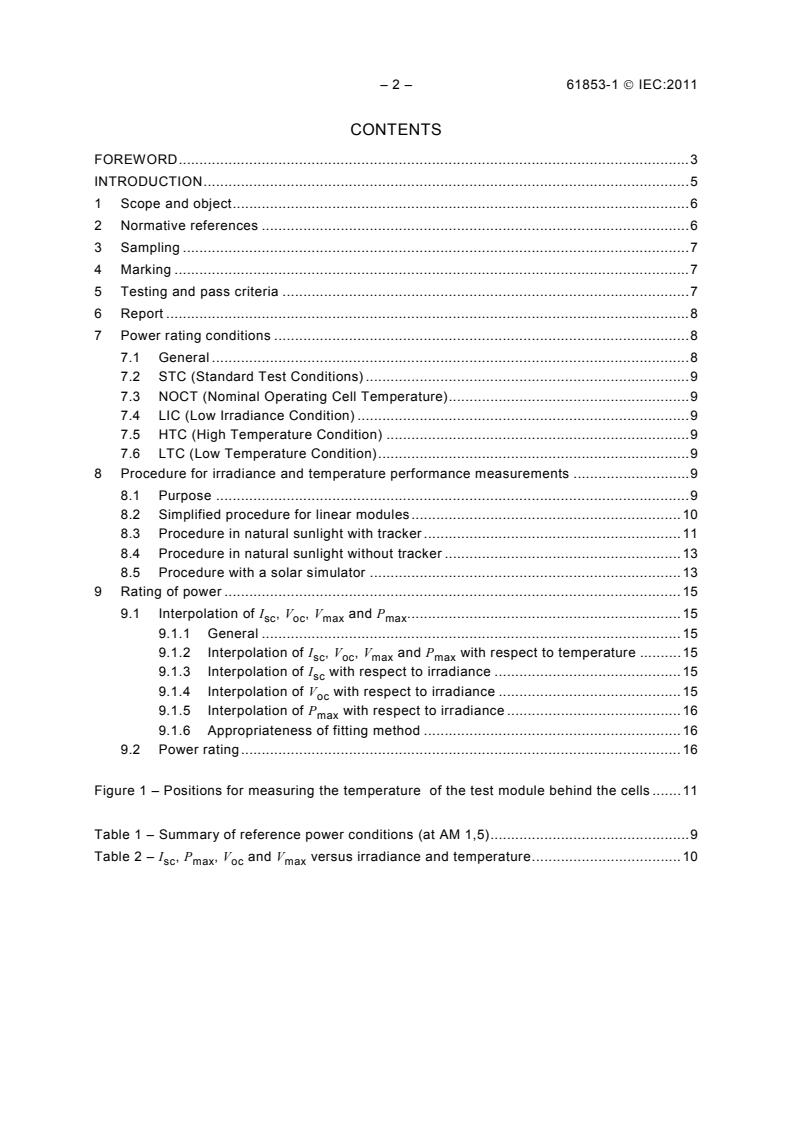
CONTENTS
FOREWORD . 3
INTRODUCTION . 5
1 Scope and object . 6
2 Normative references . 6
3 Sampling . 7
4 Marking . 7
5 Testing and pass criteria . 7
6 Report . 8
7 Power rating conditions . 8
7.1 General . 8
7.2 STC (Standard Test Conditions) . 9
7.3 NOCT (Nominal Operating Cell Temperature) . 9
7.4 LIC (Low Irradiance Condition) . 9
7.5 HTC (High Temperature Condition) . 9
7.6 LTC (Low Temperature Condition) . 9
8 Procedure for irradiance and temperature performance measurements . 9
8.1 Purpose . 9
8.2 Simplified procedure for linear modules . 10
8.3 Procedure in natural sunlight with tracker . 11
8.4 Procedure in natural sunlight without tracker . 13
8.5 Procedure with a solar simulator . 13
9 Rating of power . 15
9.1 Interpolation of I , V , V and P . 15
sc oc max max
9.1.1 General . 15
9.1.2 Interpolation of I , V , V and P with respect to temperature . 15
sc oc max max
9.1.3 Interpolation of I with respect to irradiance . 15
sc
9.1.4 Interpolation of V with respect to irradiance . 15
oc
9.1.5 Interpolation of P with respect to irradiance . 16
max
9.1.6 Appropriateness of fitting method . 16
9.2 Power rating . 16
Figure 1 – Positions for measuring the temperature of the test module behind the cells . 11
Table 1 – Summary of reference power conditions (at AM 1,5) . 9
Table 2 – I , P , V and V versus irradiance and temperature . 10
sc max oc max
61853-1 IEC:2011 – 3 –
INTERNATIONAL ELECTROTECHNICAL COMMISSION
____________
PHOTOVOLTAIC (PV) MODULE
PERFORMANCE TESTING AND ENERGY RATING –
Part 1: Irradiance and temperature performance
measurements and power rating
FOREWORD
1) The International Electrotechnical Commission (IEC) is a worldwide organization for standardization comprising
all national electrotechnical committees (IEC National Committees). The object of IEC is to promote
international co-operation on all questions concerning standardization in the electrical and electronic fields. To
this end and in addition to other activities, IEC publishes International Standards, Technical Specifications,
Technical Reports, Publicly Available Specifications (PAS) and Guides (hereafter referred to as “IEC
Publication(s)”). Their preparation is entrusted to technical committees; any IEC National Committee interested
in the subject dealt with may participate in this preparatory work. International, governmental and non-
governmental organizations liaising with the IEC also participate in this preparation. IEC collaborates closely
with the International Organization for Standardization (ISO) in accordance with conditions determined by
agreement between the two organizations.
2) The formal decisions or agreements of IEC on technical matters express, as nearly as possible, an international
consensus of opinion on the relevant subjects since each technical committee has representation from all
interested IEC National Committees.
3) IEC Publications have the form of recommendations for international use and are accepted by IEC National
Committees in that sense. While all reasonable efforts are made to ensure that the technical content of IEC
Publications is accurate, IEC cannot be held responsible for the way in which they are used or for any
misinterpretation by any end user.
4) In order to promote international uniformity, IEC National Committees undertake to apply IEC Publications
transparently to the maximum extent possible in their national and regional publications. Any divergence
between any IEC Publication and the corresponding national or regional publication shall be clearly indicated in
the latter.
5) IEC itself does not provide any attestation of conformity. Independent certification bodies provide conformity
assessment services and, in some areas, access to IEC marks of conformity. IEC is not responsible for any
services carried out by independent certification bodies.
6) All users should ensure that they have the latest edition of this publication.
7) No liability shall attach to IEC or its directors, employees, servants or agents including individual experts and
members of its technical committees and IEC National Committees for any personal injury, property damage or
other damage of any nature whatsoever, whether direct or indirect, or for costs (including legal fees) and
expenses arising out of the publication, use of, or reliance upon, this IEC Publication or any other IEC
Publications.
8) Attention is drawn to the Normative references cited in this publication. Use of the referenced publications is
indispensable for the correct application of this publication.
9) Attention is drawn to the possibility that some of the elements of this IEC Publication may be the subject of
patent rights. IEC shall not be held responsible for identifying any or all such patent rights.
International Standard IEC 61853-1 has been prepared by IEC technical committee 82: Solar
photovoltaic energy systems.
The text of this standard is based on the following documents:
FDIS Report on voting
82/613/FDIS 82/622/RVD
Full information on the voting for the approval of this standard can be found in the report on
voting indicated in the above table.
This publication has been drafted in accordance with the ISO/IEC Directives, Part 2.
– 4 – 61853-1 IEC:2011
A list of all parts of the IEC 61853 series can be found, under the general title Photovoltaic
(PV) module performance testing and energy rating, on the IEC website.
The committee has decided that the contents of this publication will remain unchanged until
the stability date indicated on the IEC web site under "http://webstore.iec.ch" in the data
related to the specific publication. At this date, the publication will be
• reconfirmed,
• withdrawn,
• replaced by a revised edition, or
• amended.
61853-1 IEC:2011 – 5 –
INTRODUCTION
This International Standard series establishes IEC requirements for evaluating PV module
performance based on power (watts), energy (watt-hours) and performance ratio (PR). It is
written to be applicable to all PV technologies including non-linear devices, but the
methodology does not take into account transient behaviour such as light induced changes
and/or thermal annealing.
Included in the IEC 61853 series of standards are: a guide to mapping module performance
over a wide range of temperature and irradiance conditions; methods for characterising
spectral and angular effects; definition of reference climatic profiles (temperature and
irradiance); methods for evaluating instantaneous power and energy results; and a method for
stating these results in the form of a numerical rating.
– 6 – 61853-1 IEC:2011
PHOTOVOLTAIC (PV) MODULE
PERFORMANCE TESTING AND ENERGY RATING –
Part 1: Irradiance and temperature performance
measurements and power rating
1 Scope and object
This part of IEC 61853 describes requirements for evaluating PV module performance in
terms of power (watts) rating over a range of irradiances and temperatures. IEC 61853-2
describes test procedures for measuring the performance effect of angle of incidence; the
estimation of module temperature from irradiance, ambient temperature and wind speed; and
impact of spectral response on energy production. IEC 61853-3 describes the calculations of
PV module energy (watt-hours) ratings. IEC 61853-4 describes the standard time periods and
weather conditions that can be utilized for calculating standardized energy ratings.
The object of this part of IEC 61853 is to define a testing and rating system, which provides
the PV module power (watts) at maximum power operation for a set of defined conditions. A
second purpose is to provide a full set of characterization parameters for the module under
various values of irradiance and temperature. This set of measurements is required in order to
perform the module energy rating described in IEC 61853-3.
2 Normative references
The following referenced documents are indispensable for the application of this document.
For dated references, only the edition cited applies. For undated references, the latest edition
of the referenced document (including any amendments) applies.
IEC 60410, Sampling plans and procedures for inspection by attributes
IEC 60891:2009, Photovoltaic devices – Procedures for temperature and irradiance
corrections to measured I-V characteristics
IEC 60904-1, Photovoltaic devices – Part 1: Measurement of photovoltaic current-voltage
characteristics
IEC 60904-2, Photovoltaic devices – Part 2: Requirements for reference solar devices
IEC 60904-3, Photovoltaic devices – Part 3: Measurement principles for terrestrial
photovoltaic (PV) solar devices with reference spectral irradiance data
IEC 60904-5, Photovoltaic devices – Part 5: Determination of equivalent cell temperature
(ECT) of photovoltaic (PV) devices by the open-circuit voltage method
IEC 60904-7, Photovoltaic devices – Part 7: Computation of spectral mismatch correction for
measurements of photovoltaic devices
IEC 60904-9, Photovoltaic devices – Part 9: Solar simulator performance requirements
IEC 60904-10, Photovoltaic devices – Part 10: Methods of linearity measurement
61853-1 IEC:2011 – 7 –
IEC 61215:2005, Crystalline silicon terrestrial photovoltaic (PV) modules – Design
qualification and type approval
IEC 61646:2008, Thin film terrestrial photovoltaic (PV) modules – Design qualification and
type approval
3 Sampling
For performance qualification testing three modules shall be selected at random from a
production batch or batches in accordance with the procedure given in IEC 60410. The
modules shall be pre-conditioned in accordance with Clause 5 to ensure the stability of the
power values.
The modules shall have been manufactured from specified materials and components in
accordance with the relevant drawings and process sheets and shall have been subjected to
the manufacture’s normal inspection, quality control and production acceptance procedures.
The modules shall be complete in every detail and shall be accompanied by the
manufacturer’s handling and final assembly instructions regarding the recommended
installation of any diodes, frames, brackets, etc.
When the modules to be tested are prototypes of a new design and not from production, this
fact shall be noted in the test report (see Clause 6).
4 Marking
Each module shall carry the following clear and indelible markings:
– name, monogram or symbol of the manufacturer;
– type or model number;
– serial number;
– polarity of terminals or leads (colour coding is permissible);
– nominal and minimum values of maximum output power at STC after preconditioning, as
specified by the manufacturer for the product type (see Clause 5).
The date and place of manufacture shall be marked on the module or be traceable from the
serial number.
For future production the power ratings for NOCT, LIC, HTC and LTC determined by this
standard as defined in Clause 7 and Table 1 and determined via the procedure in 9.2 shall be
marked on a label, or be stated in the manufacturer’s literature provided with each module of
this type.
5 Testing and pass criteria
The modules shall be subjected to the procedure for irradiance and temperature performance
measurements defined in Clause 8. In carrying out the tests, the manufacturer’s handling,
mounting and connection instructions shall be observed.
Special considerations: Preconditioning - Before beginning the measurements, the device
under test shall be stabilized by light soaking, as specified in IEC 61215 (Clause 5) or
IEC 61646 (10.19).
The values of STC power measured after preconditioning shall fall within the power range
specified by the manufacturer of this product.
– 8 – 61853-1 IEC:2011
NOTE The pass/fail criteria must consider the laboratory uncertainty of the measurement. As an example, if the
laboratory extended uncertainty of the STC measurement is ±5 %, then a nominal nameplate rated power greater
than 95 % of the laboratory measured power would meet the pass criteria.
After generating the matrix of parameters in Section 8 the modules should be remeasured at
STC to verify that the performance is stable.
6 Report
Following completion of the procedure, a certified report of the performance tests, with
measured power characteristics shall be prepared by the test agency in accordance with the
procedures of ISO/IEC 17025. Each certificate or test report shall include at least the
following information:
a) a title;
b) name and address of the test laboratory and location where the calibration or tests were
carried out;
c) unique identification of the certification or report and of each page;
d) name and address of client, where appropriate;
e) description and identification of the item calibrated or tested;
f) characterization and condition of the calibration or test item;
g) date of receipt of test item and date(s) of calibration or test, where appropriate;
h) identification of calibration or test method used;
i) reference to sampling procedure, where relevant;
j) any deviations from, additions to or exclusions from the calibration or test method, and
any other information relevant to a specific calibration or test, such as environmental
conditions;
k) a statement as to whether the simplified method in section 8 was used to complete the
matrix. If the simplified method was used, the test report should give the values of relative
temperature coefficients for maximum power and open circuit voltage for the two different
irradiances used to validate the use of the simplified method;
l) measurements, examinations and derived results, including as a minimum table 2 for I ,
sc
P , V and V , values of the module thermal coefficients α β , the average power
max oc max I, I
and the values for each of the three test modules at all reference power conditions
(defined in section 7) and the temperature coefficient of module power (W) at the
maximum power point (γ );
I
m) a statement of the estimated uncertainty of the calibration or test result (where relevant);
n) a statement as to whether the measured STC power agrees with the manufacturer’s rated
power range within the test laboratories measurement uncertainty;
o) a signature and title, or equivalent identification of the person(s) accepting responsibility
for the content of the certificate or report, and the date of issue;
p) where relevant, a statement to the effect that the results relate only to the items calibrated
or tested;
q) a statement that the certificate or report shall not be reproduced except in full, without the
written approval of the laboratory.
7 Power rating conditions
7.1 General
The reference power conditions are shown in Table 1 and are described in more detail in the
following subclauses. The first three reference power conditions are defined in
IEC 61215/IEC 61646. The modules shall be tested and the maximum power determined for
61853-1 IEC:2011 – 9 –
the following rating conditions. For each rating condition the Air Mass 1,5 spectral irradiance
distribution as given in IEC 60904-3 shall be used as well as normal incidence irradiance.
7.2 STC (Standard Test Conditions)
– Cell temperature: 25 °C.
–2
– Irradiance: 1 000 W⋅m .
7.3 NOCT (Nominal Operating Cell Temperature)
– Cell temperature: NOCT (As determined in accordance with 10.5 of IEC 61215 or
IEC 61646).
–2
– Irradiance: 800 W⋅m .
7.4 LIC (Low Irradiance Condition)
– Cell temperature: 25 °C.
–2
– Irradiance: 200 W⋅m .
7.5 HTC (High Temperature Condition)
– Cell temperature: 75 °C.
–2
– Irradiance: 1 000 W⋅m .
7.6 LTC (Low Temperature Condition)
– Cell temperature: 15 °C.
–2
– Irradiance: 500 W⋅m .
Table 1 – Summary of reference power conditions (at AM 1,5)
Condition Irradiance
Temperature
–2
W⋅m °C
STC 1 000 25 of cell
Standard Test Conditions
NOCT 800 20 of ambient
Nominal Operating Cell
Temperature
(Determined according to
IEC 61215 or IEC 61646)
LIC 200 25 of cell
Low Irradiance Condition
HTC 1000 75 of cell
High Temperature Condition
LTC 500 15 of cell
Low Temperature Condition
NOTE The conditions provided in this table may be measured directly as part of the performance matrix
defined in Clause 8.
8 Procedure for irradiance and temperature performance measurements
8.1 Purpose
To determine the impact of irradiance and temperature on module performance:
The power delivery of photovoltaic devices is a direct function of module temperature and
incident irradiance level. PV device performance is linear with temperature for many
– 10 – 61853-1 IEC:2011
crystalline silicon materials, but no general relation can be given for thin film materials. The
short circuit current is often linear with respect to irradiance. The logarithmic variation of open
circuit voltage and nonlinear variations of fill factor with the irradiance often render the
maximum power a nonlinear function of light levels. Rather than using extensive modelling of
these processes, the relations will be measured as functions of irradiance and temperature.
NOTE If I of the module has been demonstrated to be linear (IEC 60904-10), I can be utilized as the
sc sc
measurement of the irradiance level used in the test.
Matrices of module performance with respect to temperature and irradiance shall be
measured. Separate tables for I , V , V and P shall be generated using sufficient data
sc oc max max
to assure statistical validity to the measurements (see 8.3.11 and 8.5.11). The tables for V
oc
and V are not utilized for energy ratings, but are useful characteristics of the module type
max
particularly for system design purposes.
Measurements need not be taken at exactly the irradiances and temperatures specified.
Translation of I-V curves from the actual irradiance and/or temperature values to the values
prescribed by the tables can be performed in accordance with IEC 60891. Such interpolation
–2
should be over no more than 100 W⋅m . All such interpolations shall be noted in the test
report and their impact on uncertainly shall be included in the uncertainly analysis.
Nevertheless, measurements shall be taken at or beyond the extremes of irradiance specified
in Table 2 within the measurement accuracy of the instrumentation and the constraints of
section 8.3.2.
A table of each of the parameters I , P , V and V , shall be made according to the
sc max oc max
example in Table 2.
2 2
NOTE 1 To assess nonlinearities, measurements at 300 W/m and 50 W/m can be helpful.
NOTE 2 Tables of the parameters I and Fill Factor (FF) can be generated from the four measured parameters.
max
Table 2 – I , P , V and V versus irradiance and temperature
sc max oc max
Irradiance Spectrum Module temperature
–2
W⋅m 15 °C 25 °C 50 °C 75 °C
1 100 AM1,5 NA
1 000 AM1,5
800 AM1,5
600 AM1,5
400 AM1,5 NA
200 AM1,5 NA NA
100 AM1,5 NA NA
AM1,5 is defined in IEC 60904-3.
There are four procedures for performing the test matrix of module performance with respect
to temperature and irradiance. The simplified procedure can only be utilized for linear
modules per IEC 60904-10. Two of the procedures are performed outdoors in natural sunlight
(one requiring a tracker and one that does not require a tracker). The fourth method is
performed indoors using a solar simulator.
8.2 Simplified procedure for linear modules
For modules that have been determined to be linear (per IEC 60904-10), the maximum power
dependence on irradiance and the maximum power dependence on temperature are
independent. In this case it is sufficient to measure:
61853-1 IEC:2011 – 11 –
a) the parameters (I , V , P and V ) dependence on irradiance at fixed temperature
sc oc max max
–2 –2
over the range of 100 W⋅m to 1 100 W⋅m .
b) The parameters (I , V , P and V ) dependence on temperature at two fixed
sc oc max max
–2 –2
irradiances, one of which is between 800 W⋅m and 1 000 W⋅m and the second of
–2 –2
which is between 100 W⋅m to 300 W⋅m .
Compare the relative temperature coefficients for maximum power and open circuit voltage
determined from the two irradiance sets. If the two values for the relative temperature
coefficient of open circuit voltage agree within 10 % and the two values for the relative
temperature coefficient of maximum power agree within 15 %, the average of the two
temperature coefficients measured in b above can be utilized to fill out the tables. If not the
table should be completed by measuring at each set of conditions.
NOTE Because of its small value the relative temperature coefficient of short circuit current is not considered in
the above criteria.
8.3 Procedure in natural sunlight with tracker
8.3.1 Equipment required for this procedure is defined in IEC 60904-1.
The temperature of the test module shall be measured at approximately the three positions
shown in Figure 1 (assuring that each position is directly behind a cell) and their values shall
be averaged. For crystalline silicon modules an alternate approach is to use the Equivalent
Cell Temperature measured using the method specified in IEC 60904-5.
IEC 2859/10
Figure 1 – Positions for measuring the temperature
of the test module behind the cells
8.3.2 Measurement in natural sunlight shall be performed over the range of irradiance
conditions occurring during the day. Short term irradiance variations caused by clouds, haze,
or smoke shall be less than ±1 % of the total irradiance as measured by the reference device
during the collection of each measurement point as specified in IEC 60904-1. The wind speed
–1
should be less than 2 m⋅s . To increase the range and improve the accuracy data should be
taken over at least three days.
8.3.3 Mount the reference device (as defined in IEC 60904-2) co-planar with the module on
the two-axis tracker such that both are normal to the direct solar beam within ±2°. Connect to
the necessary instrumentation.
NOTE The measurements described in the following sub-clauses should be made as expeditiously as possible
within a few hours on the same day to minimize the effect of changes in the spectral conditions. If not, spectral
corrections may be required.
– 12 – 61853-1 IEC:2011
8.3.4 If the test module and reference device are equipped with temperature controls, set
the controls at the desired level. If temperature controls are not used:
a) shade the specimen from the sun and wind until its temperature is uniform within ± 2 °C of
the ambient air temperature, or
b) allow the test specimen to equilibrate to its stabilized temperature, or
c) pre-condition the test specimen to a point below the target temperature and then let the
module warm up naturally.
NOTE There may be differences between average cell temperature and average back temperature while the
module is warming up. IEC 60904-5 can be utilized to determine the temperature change by observing the variance
in open circuit voltage during the measurement time period.
8.3.5 Remove the shade (if used) and immediately take simultaneous readings of the test
module temperature and I-V performance characteristics (at a minimum I , V , V and
sc oc max
), the temperature and short-circuit current of the reference device and the spectral
P
max
irradiance using the spectral radiometer (if a matched reference device is not utilized).
8.3.6 The irradiance, G , shall be calculated from the measured current (I ) of the reference
o sc
device, and its calibration value at STC (I ). A correction should be applied to account for the
rc
temperature of the reference device during the measurement, T , using the specified relative
m
short circuit current temperature coefficient of the reference device, α .
rc
G ×I
rc sc
= ×[1– (T –T )]
G α
o rc m rc
I
rc
–2
Where G is the irradiance at which the reference device was calibrated, usually 1000 W⋅m
rc
and T is the temperature at which the reference device was calibrated, usually 25 °C. If the
rc
test specimen and reference device are not matched in spectral response, perform the
spectral correction on G using the method from IEC 60904-7.
o
8.3.7 If the test parameter being varied is the irradiance, reduce the irradiance on the test
specimen to the desired level without affecting the spatial uniformity. There are various
methods by which to accomplish this:
a) using calibrated, uniform density mesh filters that do not change the spectral energy
distribution of the light. If this method is selected, the reference device should remain
uncovered by the filter during the operation to enable the incident irradiance to be
measured. In this case, the in plane irradiance is reduced by the filter calibration
parameter (fraction of light transmitted). The uniformity of the irradiance from the filters
should be verified using the uniformity procedure from IEC 60904-9 using the cell in the
test device to size the detector to determine the uniformity class. The results should be
provided in the test report.
b) using uncalibrated, uniform density mesh filters. If this method is selected, the reference
device should also be covered by the filter during the test. In this case, the reference
device must be linear in short circuit current in accordance with IEC 60904-10. In this case
in plane irradiance is reduced by the ratio of the reference device output to its calibration
value. The uniformity of the irradiance from the filters should be verified using the
uniformity procedure from IEC 60904-9 using the smallest device (either the cell in the test
device or the reference device) to size the detector to determine the uniformity class. The
results should be provided in the test report.
c) by controlling the angle of incidence. If this method is selected, the reference device
should have the same reflective properties as the test specimen, and should be mounted
co-planar with the test specimen within ±1°. In this case, the reference device must be
packaged like the test module (so it has the same angle of incidence behaviour) and be
linear in short circuit current in accordance with IEC 60904-10. Then the in plane
irradiance is reduced by the ratio of the reference device output to its calibration value.
61853-1 IEC:2011 – 13 –
NOTE 1 The maximum filter mesh opening dimension shall be less than 1 % of the minimum linear dimension of
the reference device and the test specimen, or a variable error may occur due to positioning.
NOTE 2 The angle of incidence approach is sensitive to the angular difference between the test specimen and the
reference device at high angles. Therefore this method should not be utilized for angles above 60°.
8.3.8 If the test parameter being varied is the temperature, adjust the temperature by means
of a controller, or by alternately exposing and shading the module as required to achieve and
maintain the desired temperature for the naturally occurring irradiance levels. Alternately, the
test specimen may be allowed to warm-up naturally with the data recording procedure of 8.3.5
performed periodically during the warm-up.
8.3.9 Ensure that the test module and reference device temperature are stable and remain
constant within ±1 °C and that the irradiance as measured by the reference device remains
constant within ±2 % during the data recording period.
8.3.10 Repeat steps 8.3.5 through 8.3.9 until the performance measurements are completed
for the matrix of temperature and irradiance combinations as defined in Table 2. This means
that full matrices of I , V , V and P have been filled out.
sc oc max max
8.3.11 A minimum of three measurements shall be made at each of the test conditions on a
minimum of three days. Continue to collect data until the standard deviations for all V , I
oc sc
and P values in the matrix are less than 5 %.
max
NOTE The angular response as well as the spectral response affect the measurements in outdoor conditions.
Spectral response can be corrected for by using spectrally matched reference cells or employing a
spectroradiometer and carrying out a spectral mismatch calculation. The angular effect can be eliminated by use of
a tracker
8.4 Procedure in natural sunlight without tracker
The second approach to collecting the outdoor data is to monitor the test modules outdoors
for extended time periods and then to extract the data necessary to populate the matrices.
This is a valid approach as long as the conditions specified in 8.3.2 are met. A tracker is not
required for this approach, but corrections for angular response may be required (see note in
8.3.11).
8.5 Procedure with a solar simulator
8.5.1 The equipment required for this procedure is defined in IEC 60904-1.
The PV reference device as defined in IEC 60904-2 shall be linear in short-circuit current as
–2 –2
defined in IEC 60904-10 over the irradiance range from 100 W⋅m to 1100 W⋅m . If methods
a), b), c) and e) from 8.5.7 are used the reference device shall be packaged via the same
method as the module under test.
The solar simulator should be a Class BBB or better solar simulator in accordance with
IEC 60904-9.
NOTE 1 The encapsulation system does effect the optical performance and spectral response of a PV device to
the degree that care must be taken to assure that the reference device used in this procedure is spectrally matched
to the module under test.
NOTE 2 Care should be taken if an emission lamp such as xenon is used for direct band gap and multijunciton
cells. As the band gap(s) changes due to temperature, it can pass through various emission lines in the lamp
spectrum and give rise to large shifts in performance. For multijunction devices, these band gap shifts can alter the
subcell current balancing and introduce additional shifts in performance.
NOTE 3 For a multijunction device, both the I and the FF are nonlinear functions of the simulator spectral
sc
irradiance. Measurements made with solar simulators that are not spectrally adjustable can be expected to have
large errors because the subcell currents are not balanced with respect to each other. Errors above 15 % in the
current and power have been observed in commercial multijunction modules under a class AAA solar simulator.
– 14 – 61853-1 IEC:2011
8.5.2 Mount the test device and the reference device co-planar in the test plane of the
simulator so that both are normal to the centre line of the beam within ±2°. Connect to the
necessary instrumentation.
8.5.3 If the test device and reference device are equipped with temperature controls, set the
controls at the desired level. If temperature controls are not used, allow the test module and
reference device to stabilize within ±2 °C of the chamber air temperature.
NOTE If measured in non-equilibrium temperature conditions the temperature sensors shall be placed as in
Figure 1.
8.5.4 Set the irradiance at the test plane to the upper limit of the range of interest using the
reference device.
8.5.5 Take simultaneous readings of the test device temperature and I-V performance
characteristics (at a minimum I , V , V and P ), the temperature and short-circuit
sc oc max max
current of the reference device and the spectral irradiance using the spectral radiometer (if a
matched reference device is not utilized).
8.5.6 The irradiance, G , shall be calculated from the measured current (I ) of the PV
o sc
reference device, and its calibration value at STC (I ). A correction should be applied to
rc
account for the temperature of the reference device, T , using the specified relative short
m
circuit current temperature coefficient of the reference device, α .
rc
G ×I
rc sc
= ×[1– (T –T )]
G α
o rc m rc
I
rc
–2
Where G is the irradiance at which the reference device was calibrated, usually 1000 W⋅m
rc
and T is the temperature at which the reference device was calibrated, usually 25 °C. If the
rc
test specimen and reference device are not matched in spectral response, perform the
spectral correction on G using equation 1 in IEC 60904-7 to correct back to the AM1,5 global
o
spectrum for all irradiances.
8.5.7 If the test parameter being varied is the irradiance, reduce the irradiance on the test
device to the desired level without affecting the spatial uniformity or the spectral energy
distribution. Several methods to accomplish this are:
a) by increasing the distance between the test plane and the lamp. With the reference device
maintained in the same plane as the test specimen, in plane irradiance is reduced by the
ratio of the reference device output to its calibration value;
b) by the use of an optical lens. Care should be exercised to ensure that the lens does not
significantly change either the spectral energy distribution in the wavelength range in
which the test and reference specimens are responsive or the spatial uniformity in the test
plan. With the reference device maintained in the same plane as the test specimen, in
plane irradiance is reduced by the ratio of the reference device output to its calibration
value;
c) by controlling the angle of incidence. If this method is selected, the distance between the
lamp source and the specimen must be large to limit the irradiance change across the
tilted surface to 2 % or less. Also, if this method is selected, the reference device should
have the same reflective properties as the test specimen, and should be mounted co-
planar with the test specimen. In this case, in plane irradiance is reduced by the ratio of
the reference device output to its calibration value;
d) using calibrated, uniform density mesh filters. If this method is selected, the reference
device must remain uncovered by the filter during the operation to enable the incident
irradiance to be measured. In this case, the in plane irradiance is reduced by the filter
calibration parameter (fraction of light transmitted);
61853-1 IEC:2011 – 15 –
e) using uncalibrated, uniform density mesh filters. If this method is selected, the reference
device must also be covered by the filter during the test. In this case in plane irradiance is
reduced by the ratio of the reference device output to its calibration value;
f) by determining the device characteristics at different irradiance levels during the decaying
tail of the flash of a pulsed solar simulator. This requires a spectral radiometer capable of
measuring the spectral irradiance of the simulator during the measurement or verification
that the reference device identified in a) is well matched to the test device over the range
of irradiances, spectral distribution and temperatures of interest.
NOTE 1 The maximum filter mesh opening dimension shall be less than 1 % of the minimum linear dimension of
the reference device and the test specimen, or a variable error may occur due to positioning.
NOTE 2 In method f the spectral match of the reference device to the test device should be verified by recording
the short circuit current of test and reference device output during a decaying pulse from the solar simulator. The
plot of the normalized relative ratio of the short circuit current of the test device to the reference device output
versus irradiance should be made and the deviation of the ratio from unity should not exceed 1 % in the irradiance
range of interest. Method f should not be used for multijunction devices.
8.5.8 If the test parameter being varied is the temperature, adjust the temperature by
appropriate means (see IEC 61215 or IEC 61646).
8.5.9 Ensure that the test module and reference device temperatures remain constant within
±1 °C during the test.
...