


IEC 61988-3-2:2009
(Main)Plasma display panels - Part 3-2: Interface - Electrical interface
General Information
- Abstract
IEC 61988-3-2:2009 defines the electrical interface of digital video data signals, synchronization signals and functional signals between the image processing board of the PDP set and the control board of the PDP module, and defines the description of the pin assignment of the connectors.
- Status
- Published
- Publication Date
- 05-Aug-2009
- Technical Committee
- TC 110 - Electronic displays
- Drafting Committee
- WG 4 - TC 110/WG 4
- Current Stage
- PPUB - Publication issued
- Start Date
- 06-Aug-2009
- Completion Date
- 31-Aug-2009
Overview
IEC 61988-3-2:2009 is an international standard developed by the International Electrotechnical Commission (IEC) that specifies the electrical interface requirements for plasma display panels (PDPs). This standard defines how digital video data signals, synchronization signals, and functional signals are transferred between the image processing board of a PDP set and the control board of a PDP module. Additionally, it provides guidance on the description of pin assignment for connectors utilized in these interfaces.
IEC 61988-3-2:2009 is essential for manufacturers, designers, and integrators working in the flat panel display industry, ensuring compatibility, safety, and consistent performance across plasma display panel equipment.
Key Topics
- Electrical Interface Definition: The standard outlines the electrical interface for digital video, synchronization, and control signals between PDP components.
- Digital Signal Interface Types: Includes the use of LVDS (Low Voltage Differential Signaling), TTL (Transistor-Transistor Logic), and TMDS (Transition Minimized Differential Signaling) as the main digital interface types.
- Pin Assignment Guidance: Provides example tables and formats for clear pin assignment of connectors between image processing boards and PDP modules.
- Input Signal Specification: Details about input signal types, including display data, synchronization (horizontal/vertical sync), data enable (DE), data clock (DCLK), and function control signals.
- Power Sequencing: Guidance on power supply sequence requirements to prevent hardware damage and ensure reliable operation.
- Timing Specifications: Describes signal timing requirements and provides timing diagrams to illustrate valid data periods and synchronization.
- Connector Examples: Sample pin assignments and connector layouts for different signaling standards (LVDS, TTL, TMDS).
Applications
Implementing IEC 61988-3-2:2009 brings numerous advantages to organizations in the plasma display field.
- Product Design and Development: Enables engineers to design PDP image processing and control boards that are universally compatible with industry-standard interfaces and connectors.
- Supply Chain Integration: Facilitates communication and integration between components from different suppliers by ensuring uniform electrical interface definitions.
- Quality Assurance: Supports robust testing and validation by providing standardized reference input signals and timing, reducing the risk of interface failures during operation.
- Interoperability: Increases product interoperability and interchangeability between PDP modules and control electronics, which is valuable for both OEM manufacturers and system integrators.
- Documentation and Support: Helps with accurate technical documentation, particularly regarding pin assignments, signal functions, and power requirements for installation and maintenance.
Related Standards
IEC 61988-3-2:2009 functions within a comprehensive set of standards that collectively address different facets of plasma display panel technology:
- IEC 61988-1: Plasma display panels – Part 1: Terminology and letter symbols
- IEC 61988-2-1: Plasma display panels – Part 2-1: Measuring methods – Optical
- IEC 61988-2-2: Plasma display panels – Part 2-2: Measuring methods – Optoelectrical
- TIA/EIA-644A: Electrical characteristics of LVDS interface circuits
- JEIDA-59-1999: Digital interface standards for monitors
Additional references may include standards on environmental testing (IEC 60068-1) and television broadcast measurement (IEC 60107-1).
Keywords: IEC 61988-3-2:2009, plasma display panel, PDP, electrical interface, LVDS, TTL, TMDS, digital video signal, interface pin assignment, synchronization signals, power sequencing, flat panel display standard, international standard, connector specification.
Frequently Asked Questions
IEC 61988-3-2:2009 is a standard published by the International Electrotechnical Commission (IEC). Its full title is "Plasma display panels - Part 3-2: Interface - Electrical interface". This standard covers: IEC 61988-3-2:2009 defines the electrical interface of digital video data signals, synchronization signals and functional signals between the image processing board of the PDP set and the control board of the PDP module, and defines the description of the pin assignment of the connectors.
IEC 61988-3-2:2009 defines the electrical interface of digital video data signals, synchronization signals and functional signals between the image processing board of the PDP set and the control board of the PDP module, and defines the description of the pin assignment of the connectors.
IEC 61988-3-2:2009 is classified under the following ICS (International Classification for Standards) categories: 31.260 - Optoelectronics. Laser equipment. The ICS classification helps identify the subject area and facilitates finding related standards.
IEC 61988-3-2:2009 is available in PDF format for immediate download after purchase. The document can be added to your cart and obtained through the secure checkout process. Digital delivery ensures instant access to the complete standard document.
Standards Content (Sample)
IEC 61988-3-2 ®
Edition 1.0 2009-08
INTERNATIONAL
STANDARD
NORME
INTERNATIONALE
Plasma display panels –
Part 3-2: Interface – Electrical interface
Panneaux d’affichage à plasma –
Partie 3-2: Interface – Interface électrique
All rights reserved. Unless otherwise specified, no part of this publication may be reproduced or utilized in any form or by
any means, electronic or mechanical, including photocopying and microfilm, without permission in writing from either IEC or
IEC's member National Committee in the country of the requester.
If you have any questions about IEC copyright or have an enquiry about obtaining additional rights to this publication,
please contact the address below or your local IEC member National Committee for further information.
Droits de reproduction réservés. Sauf indication contraire, aucune partie de cette publication ne peut être reproduite
ni utilisée sous quelque forme que ce soit et par aucun procédé, électronique ou mécanique, y compris la photocopie
et les microfilms, sans l'accord écrit de la CEI ou du Comité national de la CEI du pays du demandeur.
Si vous avez des questions sur le copyright de la CEI ou si vous désirez obtenir des droits supplémentaires sur cette
publication, utilisez les coordonnées ci-après ou contactez le Comité national de la CEI de votre pays de résidence.
IEC Central Office
3, rue de Varembé
CH-1211 Geneva 20
Switzerland
Email: inmail@iec.ch
Web: www.iec.ch
About the IEC
The International Electrotechnical Commission (IEC) is the leading global organization that prepares and publishes
International Standards for all electrical, electronic and related technologies.
About IEC publications
The technical content of IEC publications is kept under constant review by the IEC. Please make sure that you have the
latest edition, a corrigenda or an amendment might have been published.
ƒ Catalogue of IEC publications: www.iec.ch/searchpub
The IEC on-line Catalogue enables you to search by a variety of criteria (reference number, text, technical committee,…).
It also gives information on projects, withdrawn and replaced publications.
ƒ IEC Just Published: www.iec.ch/online_news/justpub
Stay up to date on all new IEC publications. Just Published details twice a month all new publications released. Available
on-line and also by email.
ƒ Electropedia: www.electropedia.org
The world's leading online dictionary of electronic and electrical terms containing more than 20 000 terms and definitions
in English and French, with equivalent terms in additional languages. Also known as the International Electrotechnical
Vocabulary online.
ƒ Customer Service Centre: www.iec.ch/webstore/custserv
If you wish to give us your feedback on this publication or need further assistance, please visit the Customer Service
Centre FAQ or contact us:
Email: csc@iec.ch
Tel.: +41 22 919 02 11
Fax: +41 22 919 03 00
A propos de la CEI
La Commission Electrotechnique Internationale (CEI) est la première organisation mondiale qui élabore et publie des
normes internationales pour tout ce qui a trait à l'électricité, à l'électronique et aux technologies apparentées.
A propos des publications CEI
Le contenu technique des publications de la CEI est constamment revu. Veuillez vous assurer que vous possédez
l’édition la plus récente, un corrigendum ou amendement peut avoir été publié.
ƒ Catalogue des publications de la CEI: www.iec.ch/searchpub/cur_fut-f.htm
Le Catalogue en-ligne de la CEI vous permet d’effectuer des recherches en utilisant différents critères (numéro de référence,
texte, comité d’études,…). Il donne aussi des informations sur les projets et les publications retirées ou remplacées.
ƒ Just Published CEI: www.iec.ch/online_news/justpub
Restez informé sur les nouvelles publications de la CEI. Just Published détaille deux fois par mois les nouvelles
publications parues. Disponible en-ligne et aussi par email.
ƒ Electropedia: www.electropedia.org
Le premier dictionnaire en ligne au monde de termes électroniques et électriques. Il contient plus de 20 000 termes et
définitions en anglais et en français, ainsi que les termes équivalents dans les langues additionnelles. Egalement appelé
Vocabulaire Electrotechnique International en ligne.
ƒ Service Clients: www.iec.ch/webstore/custserv/custserv_entry-f.htm
Si vous désirez nous donner des commentaires sur cette publication ou si vous avez des questions, visitez le FAQ du
Service clients ou contactez-nous:
Email: csc@iec.ch
Tél.: +41 22 919 02 11
Fax: +41 22 919 03 00
IEC 61988-3-2 ®
Edition 1.0 2009-08
INTERNATIONAL
STANDARD
NORME
INTERNATIONALE
Plasma display panels –
Part 3-2: Interface – Electrical interface
Panneaux d’affichage à plasma –
Partie 3-2: Interface – Interface électrique
INTERNATIONAL
ELECTROTECHNICAL
COMMISSION
COMMISSION
ELECTROTECHNIQUE
PRICE CODE
INTERNATIONALE
T
CODE PRIX
ICS 31.260 ISBN 978-2-88910-599-1
– 2 – 61988-3-2 © IEC:2009
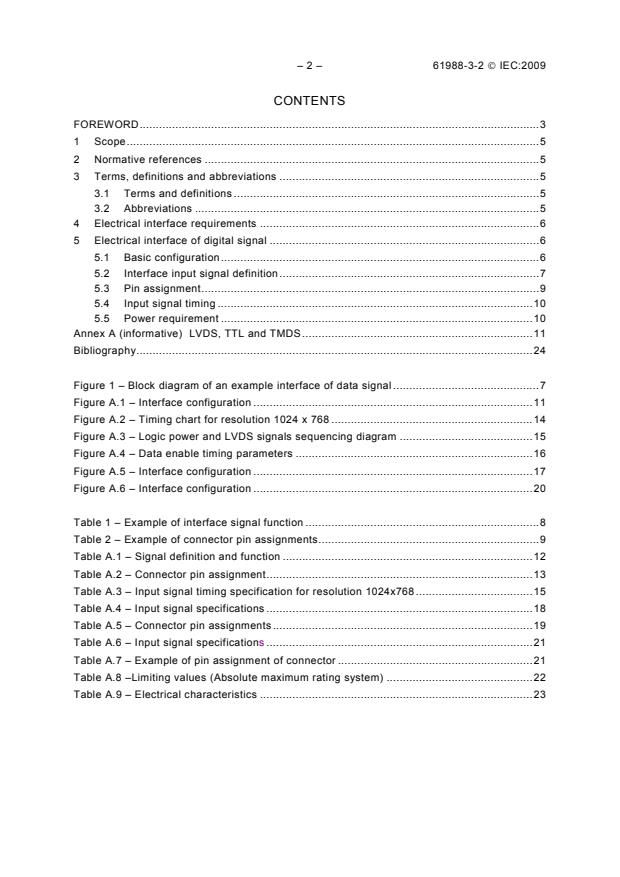
CONTENTS
FOREWORD.3
1 Scope.5
2 Normative references .5
3 Terms, definitions and abbreviations .5
3.1 Terms and definitions .5
3.2 Abbreviations .5
4 Electrical interface requirements .6
5 Electrical interface of digital signal .6
5.1 Basic configuration.6
5.2 Interface input signal definition.7
5.3 Pin assignment.9
5.4 Input signal timing .10
5.5 Power requirement .10
Annex A (informative) LVDS, TTL and TMDS.11
Bibliography.24
Figure 1 – Block diagram of an example interface of data signal .7
Figure A.1 – Interface configuration .11
Figure A.2 – Timing chart for resolution 1024 x 768 .14
Figure A.3 – Logic power and LVDS signals sequencing diagram .15
Figure A.4 – Data enable timing parameters .16
Figure A.5 – Interface configuration .17
Figure A.6 – Interface configuration .20
Table 1 – Example of interface signal function .8
Table 2 – Example of connector pin assignments.9
Table A.1 – Signal definition and function .12
Table A.2 – Connector pin assignment.13
Table A.3 – Input signal timing specification for resolution 1024x768 .15
Table A.4 – Input signal specifications .18
Table A.5 – Connector pin assignments .19
Table A.6 – Input signal specifications .21
Table A.7 – Example of pin assignment of connector .21
Table A.8 –Limiting values (Absolute maximum rating system) .22
Table A.9 – Electrical characteristics .23
61988-3-2 © IEC:2009 – 3 –
INTERNATIONAL ELECTROTECHNICAL COMMISSION
___________
PLASMA DISPLAY PANELS –
Part 3-2: Interface –
Electrical interface
FOREWORD
1) The International Electrotechnical Commission (IEC) is a worldwide organization for standardization comprising
all national electrotechnical committees (IEC National Committees). The object of IEC is to promote
international co-operation on all questions concerning standardization in the electrical and electronic fields. To
this end and in addition to other activities, IEC publishes International Standards, Technical Specifications,
Technical Reports, Publicly Available Specifications (PAS) and Guides (hereafter referred to as “IEC
Publication(s)”). Their preparation is entrusted to technical committees; any IEC National Committee interested
in the subject dealt with may participate in this preparatory work. International, governmental and non-
governmental organizations liaising with the IEC also participate in this preparation. IEC collaborates closely
with the International Organization for Standardization (ISO) in accordance with conditions determined by
agreement between the two organizations.
2) The formal decisions or agreements of IEC on technical matters express, as nearly as possible, an international
consensus of opinion on the relevant subjects since each technical committee has representation from all
interested IEC National Committees.
3) IEC Publications have the form of recommendations for international use and are accepted by IEC National
Committees in that sense. While all reasonable efforts are made to ensure that the technical content of IEC
Publications is accurate, IEC cannot be held responsible for the way in which they are used or for any
misinterpretation by any end user.
4) In order to promote international uniformity, IEC National Committees undertake to apply IEC Publications
transparently to the maximum extent possible in their national and regional publications. Any divergence
between any IEC Publication and the corresponding national or regional publication shall be clearly indicated in
the latter.
5) IEC provides no marking procedure to indicate its approval and cannot be rendered responsible for any
equipment declared to be in conformity with an IEC Publication.
6) All users should ensure that they have the latest edition of this publication.
7) No liability shall attach to IEC or its directors, employees, servants or agents including individual experts and
members of its technical committees and IEC National Committees for any personal injury, property damage or
other damage of any nature whatsoever, whether direct or indirect, or for costs (including legal fees) and
expenses arising out of the publication, use of, or reliance upon, this IEC Publication or any other IEC
Publications.
8) Attention is drawn to the Normative references cited in this publication. Use of the referenced publications is
indispensable for the correct application of this publication.
9) Attention is drawn to the possibility that some of the elements of this IEC Publication may be the subject of
patent rights. IEC shall not be held responsible for identifying any or all such patent rights.
International Standard IEC 61988-3-2 has been prepared by IEC technical committee 110:
Flat panel display devices.
The text of this standard is based on the following documents:
FDIS Report on voting
110/181/FDIS 110/190/RVD
Full information on the voting for the approval on this standard can be found in the report on
voting indicated in the above table.
This publication has been drafted in accordance with the ISO/IEC Directives, Part 2.
A list of all the parts in the IEC 61988 series, under the general title Plasma display panels,
can be found on the IEC website.
– 4 – 61988-3-2 © IEC:2009
The committee has decided that the contents of this publication will remain unchanged until
the maintenance result date indicated on the IEC web site under "http://webstore.iec.ch" in
the data related to the specific publication. At this date, the publication will be
• reconfirmed;
• withdrawn;
• replaced by a revised edition, or
• amended.
61988-3-2 © IEC:2009 – 5 –
PLASMA DISPLAY PANELS –
Part 3-2: Interface –
Electrical interface
1 Scope
This part of IEC 61988 defines the electrical interface of digital video data signals,
synchronization signals and functional signals between the image processing board of the
PDP set and the control board of the PDP module, and defines the description of the pin
assignment of the connectors.
2 Normative references
The following referenced documents are indispensable for the application of this document.
For dated references, only the edition cited applies. For undated references, the latest edition
of the referenced document (including any amendments) applies.
IEC 61988-1, Plasma display panels – Part 1: Terminology and letter symbols
IEC 61988-2-1, Plasma display panels – Part 2-1: Measuring methods – Optical
IEC 61988-2-2, Plasma display panels – Part 2-2: Measuring methods – Optoelectrical
TIA/EIA-644A, Electrical characteristics of low voltage differential signaling (LVDS) interface
circuits
JEIDA-59-1999, Digital interface standards for monitor (only available in English)
3 Terms, definitions and abbreviations
3.1 Terms and definitions
For the purposes of this document, the terms and definitions given in IEC 61988-1,
IEC 60068-1 and IEC 60107-1 as well as the following apply.
3.1.1
image processing board
circuit board including A/D converter, scaler and video decoder, deinterlacing for image signal
from input device such as TV-tuner, PC, DVD, etc.
3.2 Abbreviations
NOTE The following are acronyms for reference.
TTL Transistor-transistor logic
LVDS Low voltage differential signalling
TMDS Transition minimized differential signalling
HS Horizontal synchronization
VS Vertical synchronization
DE Data enable
DCLK Data clock
APC Auto power control
– 6 – 61988-3-2 © IEC:2009
4 Electrical interface requirements
The electrical interface of PDP module is a power sequence and a digital interface of PDP
module.
The power sequence of PDP module is power on- and off-sequence of all power supplies in
and to PDP module. The power on- and off-sequence of PDP module shall be fully described
in each relevant specification.
The digital signal interface is either an LVDS, a TTL or a TMDS interface, whose signal
encodes the digital video data and function control signals.
Function control signal, which is the additional signal, except digital video signal, to control
the functions such as APC, shall be fully described in each detail specification.
The interface configuration, input signal definition, pin assignment, input signal timing and
power requirement shall be described in each detail specification.
5 Electrical interface of digital signal
5.1 Basic configuration
The basic configuration of electrical interface of digital signal is shown in Figure 1 as one of
examples. Examples of LVDS, TTL and TMDS are explained in Annex A.
61988-3-2 © IEC:2009 – 7 –
Image processing board PDP module
Electrical interface signal
(Display data signal and control signal)
R – R R – R
0 n–1 0 n–1
G – G G – G
0 n–1 0 n–1
B – B B – B
0 n–1 0 n–1
LVDS
TTL
VS
VS
TMDS
HS
HS
DE
DE
DCLK
DCLK
Function control signals Function control signals
IEC 1348/09
NOTE 1 The image processing board includes A/D converter, scaler and video decoder for image signal from
input device such as TV-tuner, PC, DVD, etc.
NOTE 2 Ri, Gi and Bi: ith bit data for n-bit digital video signal of red, green and blue, respectively (i=0 to n-1).
Figure 1 – Block diagram of an example interface of data signal
5.2 Interface input signal definition
The example of interface signal definition and function is as follows in Table 1.
– 8 – 61988-3-2 © IEC:2009
Table 1 – Example of interface signal function
Symbol I/O Function Description
Rx IN0+
I LVDS differential data (+)
(or RA+) Display data signal:
R , R , R , R , R , R , G
Rx IN0 - 0 1 2 3 4 5 0
I LVDS differential data (-)
(or RA-)
Rx IN1+
I LVDS differential data (+)
Display data signal:
(or RB+)
G , G , G , G , G , B , B
Rx IN1 -
1 2 3 4 5 0 1
I LVDS differential data (-)
(or RB-)
Rx IN2+
I Display data signal: LVDS differential data (+)
(or RC+)
B , B , B , B , HS,
2 3 4 5
Rx IN2 -
I VS, DE LVDS differential data (-)
(or RC-)
Rx IN3+
I LVDS differential data (+)
Display data signal and control signal:
(or RD+)
R , R , G , G , B , B , RES
Rx IN3 - 6 7 6 7 6 7
I LVDS differential data (-)
(or RD-)
Rx IN4+
I LVDS differential data (+)
Display data signal and control signal:
(or RE+)
B , B , G , G , R , R , RES
Rx IN4-
8 9 8 9 8 9
I LVDS differential data (-)
(or RE-)
Rx CLKIN+
I LVDS differential clock (+)
(or CLK+)
Data clock signal:
DCLK
Rx CLKIN-
I LVDS differential clock (-)
(or CLK-)
NOTE This example shows the case of LVDS with 10-bit video signal.
61988-3-2 © IEC:2009 – 9 –
5.3 Pin assignment
The pin assignments should be given in the form of Table 2.
Table 2 – Example of connector pin assignments
Pin no Pin name
1 GND
2 GND
3 Rx IN0-
4 Rx IN0+
5 GND
6 GND
7 Rx IN1-
8 Rx IN1+
9 GND
10 GND
11 Rx IN2-
12 Rx IN2+
13 GND
14 GND
15 Rx CLKIN-
16 Rx CLKIN+
17 GND
18 GND
19 Rx IN3-
20 Rx IN3+
21 GND
22 GND
23 GND
24 GND
25 RX IN4-
26 RX IN4+
27 GND
28 GND
29 GND
30 GND
31 GND
– 10 – 61988-3-2 © IEC:2009
5.4 Input signal timing
Timing of the interface signals of the PDP module shall be fully described. An example is
given in A.1.
5.5 Power requirement
Power requirements, and power on sequence when needed, shall be fully described. An
example is given in A.1.1.
61988-3-2 © IEC:2009 – 11 –
Annex A
(informative)
LVDS, TTL and TMDS
A.1 Video
A.1.1 LVDS
A.1.1.1 Basic configuration
Figure A.1 shows an example of interface configuration of LVDS.
PDP module
Image processing board
Tx/Rx0+
R – R
Tx/Rx0–
0 n–1
R – R
0 n–1
Tx/Rx1+
G – G
0 n–1
G – G
0 n–1
Tx/Rx1–
B – B
Tx/Rx2+
0 n–1
B – B
0 n–1
LVDS LVDS
receiver
transmitter
Tx/Rx2–
VS
(Serial / Parallel)
(Parallel / Serial)
VS
Tx/Rx3+
HS
HS
Tx/Rx3–
DE
DE
Tx/Rx4+
DCLK
Tx/Rx4– DCLK
CLK+
CLK–
m bits
Function control signals
Function control signals
IEC 1349/09
Figure A.1 – Interface configuration
– 12 – 61988-3-2 © IEC:2009
A.1.1.2 Interface input signal specification
The input signal (display data signal and control signal) is converted from parallel data to
serial data with the LVDS transmitter and further converted into six sets of differential signals
before input to the PDP module. The LVDS signal definition and function is as follows in
Table A.1.
Table A.1 – Signal definition and function
Symbol I/O Function Description
Rx IN0+ (or RA+) I LVDS differential data (+)
Display data signal:
R , R , R , R , R , R , G
0 1 2 3 4 5 0
Rx IN0- (or RA-) I LVDS differential data (-)
Rx IN1+ (or RB+) I LVDS differential data (+)
Display data signal:
G , G , G , G , G , B , B
1 2 3 4 5 0 1
Rx IN1- (or RB-) I LVDS differential data (-)
Rx IN2+ (or RC+) I LVDS differential data (+)
Display data signal:
B , B , B , B , HS, VS, DE
2 3 4 5
Rx IN2- (or RC-) I LVDS differential data (-)
Rx IN3+ (or RD+) I LVDS differential data (+)
Display data signal and control signal:
R , R , G , G , B , B , RES
6 7 6 7 6 7
Rx IN3- (or RD-) I LVDS differential data (-)
Rx IN4+ (or RE+) I LVDS differential data (+)
Display data signal and control signal:
B , B , G , G , R , R , RES
8 9 8 9 8 9
Rx IN4- (or RE-) I LVDS differential data (-)
Rx CLKIN+
I LVDS differential clock (+)
(or DCLK+)
Data clock signal: DCLK
Rx CLKIN-
I LVDS differential clock (-)
(or DCLK-)
61988-3-2 © IEC:2009 – 13 –
A.1.1.3 Pin assignment
The pin names may be given in the form of Table A.2.
Table A.2 – Connector pin assignment
Pin no Pin name
1 GND
2 GND
3 Rx IN0-
4 Rx IN0+
5 GND
6 GND
7 Rx IN1-
8 Rx IN1+
9 GND
10 GND
11 Rx IN2-
12 Rx IN2+
13 GND
14 GND
15 Rx CLKIN-
16 Rx CLKIN+
17 GND
18 GND
19 Rx IN3-
20 Rx IN3+
21 GND
22 GND
23 GND
24 GND
25 RX IN4-
26 RX IN4+
27 GND
28 GND
29 GND
30 GND
31 GND
– 14 – 61988-3-2 © IEC:2009
A.1.1.4 Input signal timing chart
Figure A.2 is an example of input signal timing chart.
t
vsync
VS
t
vw
t
vbp
t
vfp
HS
1 2 3 - - 767 768 1 2 3 - - 767 768 1 2 3 - - -
Line number 768
t
hsync
HS
t
hw
t t
hbp
dclk t
hfp
DCLK
1 2 3 4 1 024
DE
(Period of valid data)
Data D1 D2 D3 D1 024
Shaded area
: Invalid data
IEC 1350/09
Figure A.2 – Timing chart for resolution 1 024 x 768
61988-3-2 © IEC:2009 – 15 –
A.1.1.5 Input signal timing specification
Table A.3 is an example of input signal timing specification.
Table A.3 – Input signal timing specification for resolution 1024 x 768
No Symbol Typical value Unit Remark
t
1 16,667 ms 60 Hz, 806 lines
vsync
t
2 0,12 ms 6 lines
vw
t
3 0,60 ms 29 lines
vbp
t
4 0,06 ms 3 lines
vfp
t
5 20,667 μs 1 344 dots
hsync
t
6 2,09 136 dots
μs
hw
t
7 2,46 μs 160 dots
hbp
t
8 0,36 μs 24 dots
hfp
t
9 15,385 ns 64,999 MHz
dclk
A.1.1.6 Power sequencing requirements
The LVDS interface requires the logic power and data/control signal sequencing and the data
enable timing of Figure A.3 and Figure A.4.
t
0,9 VDD 0,9 VDD
Power
0,1 VDD 0,1 VDD
Supply 0 V
t t
2 3
VDD t
Valid data
LVDS
interface
0,5 ms ≤ t ≤ 10 ms 0 ≤ t ≤ 50 ms 0 ≤ t ≤ 50 ms 500 ms ≤ t
1 2 3 4
IEC 1351/09
Figure A.3 – Logic power and LVDS signals sequencing diagram
– 16 – 61988-3-2 © IEC:2009
t
hsync
HS
t
hw
t t
hfp
hbp
DE
t
ha (horizontal active)
t
vsync
VS
t
vw
t t
vbp vfp
DE
t
va (vertical active)
DE-only timing mode
t or t t t or t
deb ha va
ha va
DE
IEC 1352/09
Figure A.4 – Data enable timing parameters
61988-3-2 © IEC:2009 – 17 –
A.1.2 TTL
A.1.2.1 Basic configuration
Figure A.5 shows an example of interface configuration of TTL.
Image processing board PDP module
R ∼ R R ∼ R
0 n–1 0 n–1
n bits
G ∼ G n bits G ∼ G
0 n–1 0 n–1
n bits
B ∼ B B ∼ B
0 n–1 0 n–1
VS VS
HS HS
DE DE
DCLK DCLK
m bits
Function control signals Function control signals
IEC 1353/09
Figure A.5 – Interface configuration
– 18 – 61988-3-2 © IEC:2009
A.1.2.2 Interface input signal specification
Table A.4 is an example of input signal specification.
Table A.4 – Input signal specifications
Symbol Function Remarks
Display data signal:
R ~ R
n bits red video signal
0 n-1
R : MSB*, R : LSB**
n-1 0
Display data signal:
G ~ G
n bits green video signal
0 n-1
G : MSB*, G : LSB**
n-1 0
Display data signal:
B ~ B
n bits blue video signal
0 n-1
B : MSB*, B : LSB**
n-1 0
This signal specifies the data period for
one horizontal line. Control of the next
HS Horizontal synchronous signal
line begins at the rising edge of
HS
Timing signal that controls the start of
VS Vertical synchronous signal
the screen. Control of the next screen
begins at the rising edge of VS
When DE signal is high, data is valid
DE Data enable
When DE signal is low, data is invalid
DCLK Clock for video signal Latch the video signal at falling edge
* MSB: Most significant bit (the highest intensity bit)
** LSB: Least significant bit (the lowest intensity bit)
61988-3-2 © IEC:2009 – 19 –
A.1.2.3 Pin assignment
Table A.5 shows an example of the pin assignments of TTL.
Table A.5 – Connector pin assignments
Pin
Pin no. Pin name Pin no. Pin name Pin no.
name
1 GND 24 B2 47 GND
2 NC 25 GND 48 G5
3 GND 26 B3 49 GND
4 NC 27 GND 50 G6
5 GND 28 B4 51 GND
6 NC 29 GND 52 G7
7 GND 30 B5 53 GND
8 NC 31 GND 54 R0
9 GND 32 B6 55 GND
10 NC 33 GND 56 R1
11 GND 34 B7 57 GND
12 DCLK 35 GND 58 R2
13 GND 36 NC 59 GND
14 DE 37 GND 60 R3
15 CTRL1 38 G0 61 GND
16 DHS 39 GND 62 R4
17 CTRL2 40 G1 63 GND
18 DVS 41 GND 64 R5
19 RESET 42 G2 65 GND
20 B0 43 GND 66 R6
21 GND 44 G3 67 GND
22 B1 45 GND 68 R7
23 GND 46 G4
A.1.2.4 Input signal timing chart
Description of input signal timing chart is basically same as that of LVDS. (See Figure A.2.)
A.1.2.5 Input signal timing specification
Description of input signal timing specification is basically same as that of LVDS. (See Table
A.3.)
– 20 – 61988-3-2 © IEC:2009
A.1.3 TMDS
A.1.3.1 Basic configuration
Figure A.6 shows an example of interface configuration of TMDS.
Image processing board PDP module
TX2 (Red)
R – R
0 n–1 R – R
0 n–1
TX1 (Green)
G – G
G – G
0 n–1
0 n–1
TMDS
TMDS
B – B
B – B
0 n–1
transmitter 0 n–1
receiver
TX0 (Blue)
(Parallel / Serial)
VS
(Serial / Parallel)
VS
HS
HS
DCLK
DE
DE
DCLK
DCLK
m bits
Function control signals Function control signals
IEC 1354/09
Figure A.6 – Interface configuration
61988-3-2 © IEC:2009 – 21 –
A.1.3.2 Interface input signal specification
Table A.6 is an example of input signal specification.
Table A.6 – Input signal specifications
Symbol I/O Function Description
TX0+ I Display data signal: TMDS differential data (+)
B , B , B , B , B , B , B , B , HS, VS
TX0- I 0 1 2 3 4 5 6 7 TMDS differential data (-)
Display data signal:
TX1+ I TMDS differential data (+)
G ,G , G , G , G , G ,G , G , PLL SYNC
TX1- I TMDS differential data (-)
0 1 2 3 4 5 6 7
Display data signal:
TX2+ I TMDS differential data (+)
R , R , R , R , R , R , R , R
TX2- I 0 1 2 3 4 5 6 7 TMDS differential data (-)
TXC+ I TMDS differential clock (+)
Data clock signal:
DCLK
TXC- I TMDS differential clock (-)
A.1.3.3 Pin assignment
Table A.7 shows an example of the pin assignments of TMDS.
Table A.7 – Example of pin assignment of connector
Pin no Pin name
1 TX1 +
2 TX1 -
3 TX1 SHELD
4 TXC SHELD
5 TXC +
6 TXC -
7 GND
8 +5VDC
9 RES
10 RES
11 TX2 +
12 TX2 -
13 TX2 SHELD
14 TX0 SHELD
15 TX0 +
16 TX0 -
17 RES
18 SENS
19 DDC/SDA
20 DDC/SCL
NOTE SDA is the abbreviation for ‘Serial data’, and SCL for ‘Serial clock’.
– 22 – 61988-3-2 © IEC:2009
A.1.3.4 Input signal timing chart
Description of input signal timing chart is basically same as that of LVDS. (See Figure A.2.)
A.1.3.5 Input signal timing specification
Description of input signal timing specification is basically same as that of LVDS. (See Table
A.3.)
A.2 Function control signal
Function control signal is the additional signal, except digital video signal, to control the
functions such as APC, SDA and SCL.
A.3 Electrical characteristics
A.3.1 Limiting values (Absolute maximum rating system)
Limiting values (Absolute maximum rating system) are those values beyond which the safety
of the device cannot be guaranteed.
Table A.8 shows an example of Limiting values (Absolute maximum rating system).
Table A.8 –Limiting values (Absolute maximum rating system)
Subclause Limiting values Symbol Value Unit
Min. Max.
A.1.1 Supply voltage V –0,3 4 V
CC
range of LVDS
A.1.2 Supply voltage V –0,5 7 V
CC
range of TTL
A.1.3 Supply voltage V –0,3 4 V
CC
range of TMDS
61988-3-2 © IEC:2009 – 23 –
A.3.2 Signal voltage and current
Table A.9 shows an example of the electrical characteristics of LVDS, TMDS and TTL.
Table A.9 – Electrical characteristics
Signal Parameter Symbol Conditions Min. Typ. Max. Unit
Common mode
V V = 3,3 V
1,125 1,25 1,375 mV
OC CC
Voltage
Differential
V = +1,2 V
OC
input high
V
100 mV
TH
= 3,3 V
V
CC
LVDS Threshold
Receiver
Differential
V = +1,2 V
OC
input low
V
–100 mV
TL
V = 3,3 V
CC
Threshold
V = +2,4 V / 0 V
Input
IN
I
±10 μA
IN
Current V = 3,6 V
CC
Differential
input
V V = 3,3 V
150 1200 mV
idiff CC
Voltage
Input
TMDS
common
V V = 3,3 V V – 300
V – 37
mV
icm CC CC
CC
Receiver
Mode
Voltage
Open circuit
V V = 3,3 V V – 10 V – 10
mV
I(OC) CC CC CC
Input Voltage
High–level
inp
...