

IEC 62443-2-1:2010
(Main)Industrial communication networks - Network and system security - Part 2-1: Establishing an industrial automation and control system security program
General Information
- Abstract
IEC 62443-2-1:2010 defines the elements necessary to establish a cyber security management system (CSMS) for industrial automation and control systems (IACS) and provides guidance on how to develop those elements. This standard uses the broad definition and scope of what constitutes an IACS described in IEC/TS 62443-1-1. The elements of a CSMS described in this standard are mostly policy, procedure, practice and personnel related, describing what shall or should be included in the final CSMS for the organization. This bilingual version (2012-04) corresponds to the monolingual English version, published in 2010-11.
- Status
- Published
- Publication Date
- 09-Nov-2010
- Technical Committee
- TC 65 - Industrial-process measurement, control and automation
- Drafting Committee
- WG 10 - TC 65/WG 10
- Current Stage
- DELPUB - Deleted Publication
- Start Date
- 07-Aug-2024
- Completion Date
- 04-May-2018
Buy Documents
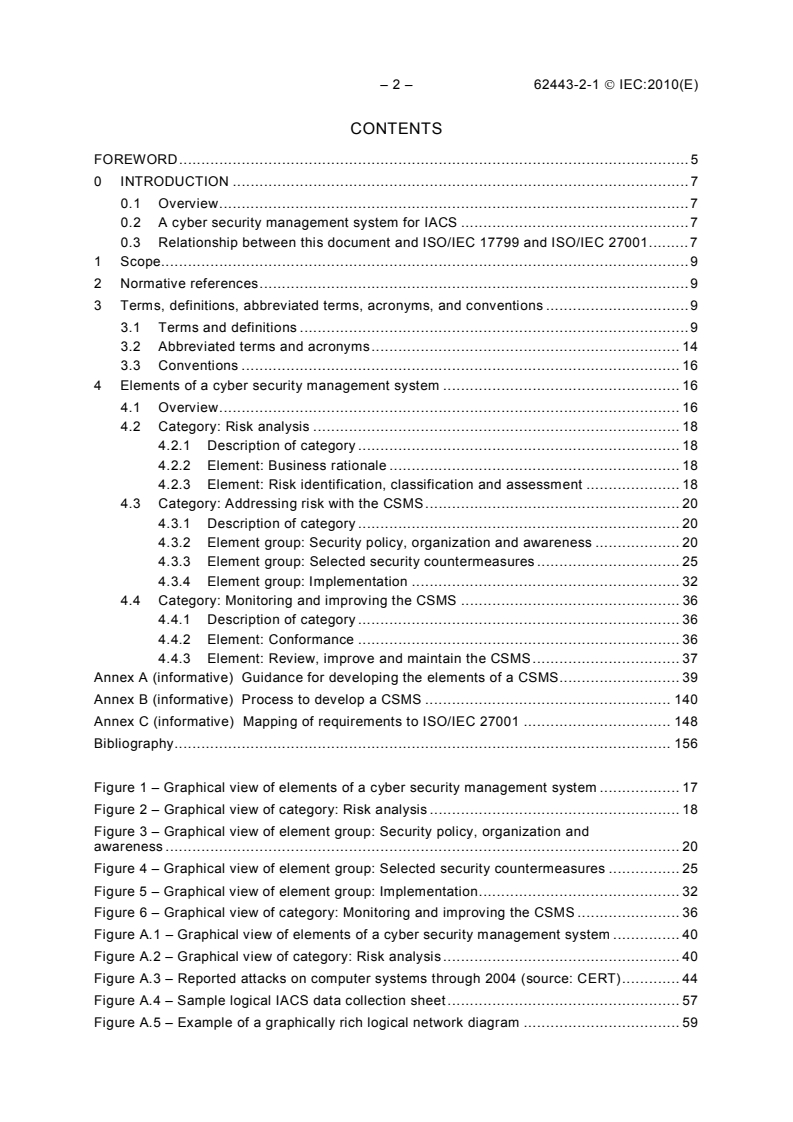
IEC 62443-2-1:2010 - Industrial communication networks - Network and system security - Part 2-1: Establishing an industrial automation and control system security program Released:11/10/2010
IEC 62443-2-1:2010 - Industrial communication networks - Network and system security - Part 2-1: Establishing an industrial automation and control system security program Released:11/10/2010
Overview
IEC 62443-2-1:2010 specifies the elements required to establish a Cyber Security Management System (CSMS) for Industrial Automation and Control Systems (IACS). Part of the IEC 62443 series on industrial communication networks and network/system security, this standard is primarily focused on policy, procedures, practices and personnel elements of IACS security and provides guidance on developing and maintaining those elements. It aligns with the broad IACS scope described in IEC/TS 62443-1-1 and includes informative annexes with guidance, a CSMS development process, and a mapping to ISO/IEC 27001.
Key topics and requirements
IEC 62443-2-1 structures CSMS requirements across a lifecycle and includes these core categories:
- Risk analysis
- Business rationale, asset identification, risk identification, classification and assessment.
- Addressing risk through the CSMS
- Security policy, organization and awareness (scope, responsibilities, staff training, business continuity).
- Selected security countermeasures (examples include network segmentation, access control - account administration, authentication, authorization - physical/environmental security).
- Implementation (risk management, system development & maintenance, document management, incident planning & response).
- Monitoring and continuous improvement
- Conformance, review, and ongoing CSMS maintenance.
The standard contains detailed requirement tables (e.g., Tables 3–19) and lifecycle models, plus illustrative figures and examples to help map security levels, zone architectures and implementation steps.
Practical applications
IEC 62443-2-1 is used to:
- Establish or mature an OT/ICS-focused CSMS that addresses unique operational availability and safety constraints.
- Guide risk assessments and specify organizational controls, policies, and incident response tailored to IACS.
- Provide a structured approach to integrating technical countermeasures (network segmentation, access controls) with organizational processes.
- Support compliance and conformance efforts by mapping CSMS elements to ISO/IEC 27001 controls (see Annex C).
Who should use this standard
- IACS owners/operators (utilities, manufacturing, energy, water).
- OT/SCADA/ICS engineers and control system integrators.
- Cybersecurity managers, compliance officers and auditors working in operational technology (OT).
- Security consultants and vendors implementing CSMS, policies or defense-in-depth architectures.
Related standards
- IEC/TS 62443-1-1 (IACS terminology & concepts)
- Other parts of the IEC 62443 series (technical and product-level requirements)
- ISO/IEC 27001 (information security management) - Annex C provides a mapping between IEC 62443-2-1 and ISO/IEC 27001.
Keywords: IEC 62443-2-1, CSMS, IACS security, industrial control systems security, OT security, SCADA security, network and system security.
Relations
- Effective Date
- 10-Feb-2026
- Effective Date
- 10-Feb-2026
- Effective Date
- 05-Sep-2023
Buy Documents
IEC 62443-2-1:2010 - Industrial communication networks - Network and system security - Part 2-1: Establishing an industrial automation and control system security program Released:11/10/2010
IEC 62443-2-1:2010 - Industrial communication networks - Network and system security - Part 2-1: Establishing an industrial automation and control system security program Released:11/10/2010
Get Certified
Connect with accredited certification bodies for this standard

BSI Group
BSI (British Standards Institution) is the business standards company that helps organizations make excellence a habit.

DVS-ZERT GmbH
German welding certification society.
CARES (UK Certification Authority for Reinforcing Steels)
UK certification for reinforcing steels and construction.
Sponsored listings
Frequently Asked Questions
IEC 62443-2-1:2010 is a standard published by the International Electrotechnical Commission (IEC). Its full title is "Industrial communication networks - Network and system security - Part 2-1: Establishing an industrial automation and control system security program". This standard covers: IEC 62443-2-1:2010 defines the elements necessary to establish a cyber security management system (CSMS) for industrial automation and control systems (IACS) and provides guidance on how to develop those elements. This standard uses the broad definition and scope of what constitutes an IACS described in IEC/TS 62443-1-1. The elements of a CSMS described in this standard are mostly policy, procedure, practice and personnel related, describing what shall or should be included in the final CSMS for the organization. This bilingual version (2012-04) corresponds to the monolingual English version, published in 2010-11.
IEC 62443-2-1:2010 defines the elements necessary to establish a cyber security management system (CSMS) for industrial automation and control systems (IACS) and provides guidance on how to develop those elements. This standard uses the broad definition and scope of what constitutes an IACS described in IEC/TS 62443-1-1. The elements of a CSMS described in this standard are mostly policy, procedure, practice and personnel related, describing what shall or should be included in the final CSMS for the organization. This bilingual version (2012-04) corresponds to the monolingual English version, published in 2010-11.
IEC 62443-2-1:2010 is classified under the following ICS (International Classification for Standards) categories: 25.040.40 - Industrial process measurement and control; 35.100.05 - Multilayer applications. The ICS classification helps identify the subject area and facilitates finding related standards.
IEC 62443-2-1:2010 has the following relationships with other standards: It is inter standard links to CLC/TS 50701:2023, CLC/TS 50701:2021, IEC 62443-2-1:2024. Understanding these relationships helps ensure you are using the most current and applicable version of the standard.
IEC 62443-2-1:2010 is available in PDF format for immediate download after purchase. The document can be added to your cart and obtained through the secure checkout process. Digital delivery ensures instant access to the complete standard document.
Standards Content (Sample)
IEC 62443-2-1 ®
Edition 1.0 2010-11
INTERNATIONAL
STANDARD
colour
inside
Industrial communication networks – Network and system security –
Part 2-1: Establishing an industrial automation and control system security
program
All rights reserved. Unless otherwise specified, no part of this publication may be reproduced or utilized in any form
or by any means, electronic or mechanical, including photocopying and microfilm, without permission in writing from
either IEC or IEC's member National Committee in the country of the requester.
If you have any questions about IEC copyright or have an enquiry about obtaining additional rights to this publication,
please contact the address below or your local IEC member National Committee for further information.
IEC Central Office
3, rue de Varembé
CH-1211 Geneva 20
Switzerland
Email: inmail@iec.ch
Web: www.iec.ch
About the IEC
The International Electrotechnical Commission (IEC) is the leading global organization that prepares and publishes
International Standards for all electrical, electronic and related technologies.
About IEC publications
The technical content of IEC publications is kept under constant review by the IEC. Please make sure that you have the
latest edition, a corrigenda or an amendment might have been published.
§ Catalogue of IEC publications: www.iec.ch/searchpub
The IEC on-line Catalogue enables you to search by a variety of criteria (reference number, text, technical committee,…).
It also gives information on projects, withdrawn and replaced publications.
§ IEC Just Published: www.iec.ch/online_news/justpub
Stay up to date on all new IEC publications. Just Published details twice a month all new publications released. Available
on-line and also by email.
§ Electropedia: www.electropedia.org
The world's leading online dictionary of electronic and electrical terms containing more than 20 000 terms and definitions
in English and French, with equivalent terms in additional languages. Also known as the International Electrotechnical
Vocabulary online.
§ Customer Service Centre: www.iec.ch/webstore/custserv
If you wish to give us your feedback on this publication or need further assistance, please visit the Customer Service
Centre FAQ or contact us:
Email: csc@iec.ch
Tel.: +41 22 919 02 11
Fax: +41 22 919 03 00
IEC 62443-2-1 ®
Edition 1.0 2010-11
INTERNATIONAL
STANDARD
colour
inside
Industrial communication networks – Network and system security –
Part 2-1: Establishing an industrial automation and control system security
program
INTERNATIONAL
ELECTROTECHNICAL
COMMISSION
PRICE CODE
XG
ICS 25.040.40; 33.040 ISBN 978-2-88912-206-6
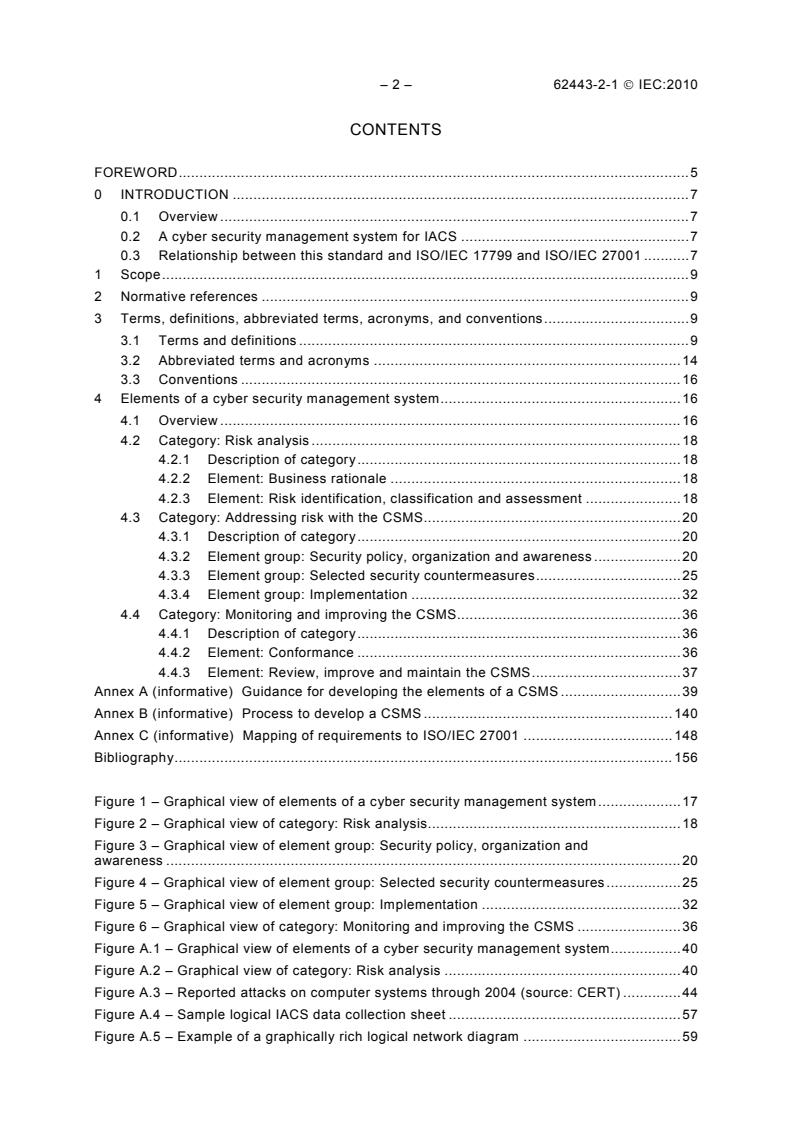
– 2 – 62443-2-1 Ó IEC:2010(E)
CONTENTS
FOREW ORD . 5
0 INTRODUCTION . 7
0.1 Ov erv iew . 7
0.2 A cyber security management system for IACS . 7
0.3 Relationship between this document and ISO/IEC 17799 and ISO/IEC 27001 . 7
1 Sc o pe . 9
2 Normative references . 9
3 Terms, definitions, abbreviated terms, acronyms, and conventions . 9
3.1 Terms and definitions . 9
3.2 Abbreviated terms and acronyms . 14
3.3 Conventions . 16
4 Elements of a cyber security management system . 16
4.1 Ov erv iew . 16
4.2 Category: Risk analysis . 18
4.2.1 Description of category . 18
4.2.2 Element: Business rationale . 18
4.2.3 Element: Risk identification, classification and assessment . 18
4.3 Category: Addressing risk with the CSMS . 20
4.3.1 Description of category . 20
4.3.2 Element group: Security policy, organization and awareness . 20
4.3.3 Element group: Selected security countermeasures . 25
4.3.4 Element group: Implementation . 32
4.4 Category: Monitoring and improving the CSMS . 36
4.4.1 Description of category . 36
4.4.2 Element: Conformance . 36
4.4.3 Element: Review, improve and maintain the CSMS . 37
Annex A (informative) Guidance for developing the elements of a CSMS . 39
Annex B (informative) Process to develop a CSMS . 140
Annex C (informative) Mapping of requirements to ISO/IEC 27001 . 148
Bibliography . 156
Figure 1 – Graphical view of elements of a cyber security management system . 17
Figure 2 – Graphical view of category: Risk analysis . 18
Figure 3 – Graphical view of element group: Security policy, organization and
awareness . 20
Figure 4 – Graphical view of element group: Selected security countermeasures . 25
Figure 5 – Graphical view of element group: Implementation . 32
Figure 6 – Graphical view of category: Monitoring and improving the CSMS . 36
Figure A.1 – Graphical view of elements of a cyber security management system . 40
Figure A.2 – Graphical view of category: Risk analysis . 40
Figure A.3 – Reported attacks on computer systems through 2004 (source: CERT) . 44
Figure A.4 – Sample logical IACS data collection sheet . 57
Figure A.5 – Example of a graphically rich logical network diagram . 59
62443-2-1 Ó IEC:2010(E) – 3 –
Figure A.6 – Graphical view of element group: Security policy, organization, and
awareness . 66
Figure A.7 – Graphical view of element group: Selected security countermeasures . 82
Figure A.8 – Reference architecture alignment with an example segmented
architecture . 90
Figure A.9 – Reference SCADA architecture alignment with an example segmented
architecture . 93
Figure A.10 – Access control: Account administration . 95
Figure A.11 – Access control: Authentication . 98
Figure A.12 – Access control: Authorization . 103
Figure A.13 – Graphical view of element group: Implementation . 106
Figure A.14 – Security level lifecycle model: Assess phase . 109
Figure A.15 – Corporate security zone template architecture. 112
Figure A.16 – Security zones for an example IACS . 113
Figure A.17 – Security level lifecycle model: Develop and implement phase . 116
Figure A.18 – Security level lifecycle model: Maintain phase . 120
Figure A.19 – Graphical view of category: Monitoring and improving the CSMS . 133
Figure B.1 – Top level activities for establishing a CSMS . 140
Figure B.2 – Activities and dependencies for activity: Initiate CSMS program. 142
Figure B.3 – Activities and dependencies for activity: High-level risk assessment . 143
Figure B.4 – Activities and dependencies for activity: Detailed risk assessment . 144
Figure B.5 – Activities and dependencies for activity: Establish security policy,
organization and awareness . 144
Figure B.6 – Training and assignment of organization responsibilities . 145
Figure B.7 – Activities and dependencies for activity: Select and implement
countermeasures . 146
Figure B.8 – Activities and dependencies for activity: Maintain the CSMS . 147
Table 1 – Business rationale: Requirements . 18
Table 2 – Risk identification, classification and assessment: Requirements . 19
Table 3 – CSMS scope: Requirements . 21
Table 4 – Organizing for security: Requirements . 22
Table 5 – Staff training and security awareness: Requirements . 22
Table 6 – Business continuity plan: Requirements . 23
Table 7 – Security policies and procedures: Requirements . 24
Table 8 – Personnel security: Requirements . 26
Table 9 – Physical and environmental security: Requirements. 27
Table 10 – Network segmentation: Requirements . 28
Table 11 – Access control – Account administration: Requirements . 29
Table 12 – Access control – Authentication: Requirements . 30
Table 13 – Access control – Authorization: Requirements . 31
Table 14 – Risk management and implementation: Requirements . 33
Table 15 – System development and maintenance: Requirements . 33
Table 16 – Information and document management: Requirements . 34
Table 17 – Incident planning and response: Requirements . 35
– 4 – 62443-2-1 Ó IEC:2010(E)
Table 18 – Conformance: Requirements . 37
Table 19 – Review, improve and maintain the CSMS: Requirements . 38
Table A.1 – Typical likelihood scale . 52
Table A.2 – Typical consequence scale . 54
Table A.3 – Typical risk level matrix . 55
Table A.4 – Example countermeasures and practices based on IACS risk levels . 107
Table A.5 – Example IACS asset table with assessment results . 110
Table A.6 – Example IACS asset table with assessment results and risk levels . 110
Table A.7 – Target security levels for an example IACS . 114
Table C.1 – Mapping of requirements in this standard to ISO/IEC 27001 references . 148
Table C.2 – Mapping of ISO/IEC 27001 requirements to this standard . 152
62443-2-1 Ó IEC:2010(E) – 5 –
INTERNATIONAL ELECTROTECHNICAL COMMISSION
____________
INDUSTRIAL COMMUNICATION NETWORKS –
NETWORK AND SYSTEM SECURITY –
Part 2-1: Establishing an industrial automation
and control system security program
FOREWORD
1) The International Electrotechnical Commission (IEC) is a worldwide organization for standardization comprising
all national electrotechnical committees (IEC National Committees). The object of IEC is to promote
international co-operation on all questions concerning standardization in the electrical and electronic fields. To
this end and in addition to other activities, IEC publishes International Standards, Technical Specifications,
Technical Reports, Publicly Available Specifications (PAS) and Guides (hereafter referred to as “IEC
Publication(s)”). Their preparation is entrusted to technical committees; any IEC National Committee interested
in the subject dealt with may participate in this preparatory work. International, governmental and non-
governmental organizations liaising with the IEC also participate in this preparation. IEC collaborates closely
with the International Organization for Standardization (ISO) in accordance with conditions determined by
agreement between the two organizations.
2) The formal decisions or agreements of IEC on technical matters express, as nearly as possible, an international
consensus of opinion on the relevant subjects since each technical committee has representation from all
interested IEC National Committees.
3) IEC Publications have the form of recommendations for international use and are accepted by IEC National
Committees in that sense. While all reasonable efforts are made to ensure that the technical content of IEC
Publications is accurate, IEC cannot be held responsible for the way in which they are used or for any
misinterpretation by any end user.
4) In order to promote international uniformity, IEC National Committees undertake to apply IEC Publications
transparently to the maximum extent possible in their national and regional publications. Any divergence
between any IEC Publication and the corresponding national or regional publication shall be clearly indicated in
the latter.
5) IEC itself does not provide any attestation of conformity. Independent certification bodies provide conformity
assessment services and, in some areas, access to IEC marks of conformity. IEC is not responsible for any
services carried out by independent certification bodies.
6) All users should ensure that they have the latest edition of this publication.
7) No liability shall attach to IEC or its directors, employees, servants or agents including individual experts and
members of its technical committees and IEC National Committees for any personal injury, property damage or
other damage of any nature whatsoever, whether direct or indirect, or for costs (including legal fees) and
expenses arising out of the publication, use of, or reliance upon, this IEC Publication or any other IEC
Publications.
8) Attention is drawn to the Normative references cited in this publication. Use of the referenced publications is
indispensable for the correct application of this publication.
9) Attention is drawn to the possibility that some of the elements of this IEC Publication may be the subject of
patent rights. IEC shall not be held responsible for identifying any or all such patent rights.
International Standard IEC 62443-2-1 has been prepared by IEC technical committee 65:
Industrial-process measurement, control and automation.
The text of this standard is based on the following documents:
FDIS Report on voting
65/457/FDIS 65/461/RVD
Full information on the voting for the approval of this standard can be found in the report on
voting indicated in the above table.
This publication has been drafted in accordance with the ISO/IEC Directives, Part 2.
– 6 – 62443-2-1 Ó IEC:2010(E)
A list of all existing parts of IEC 62443 series, published under the general title Industrial
communication networks – Network and system security, can be found on the IEC website.
The full list of existing and intended parts can also be found in the Bibliography of this
standard.
The committee has decided that the contents of this publication will remain unchanged until
the stability date indicated on the IEC web site under "http://webstore.iec.ch" in the data
related to the specific publication. At this date, the publication will be
· reconfirmed,
· withdrawn,
· replaced by a revised edition, or
· amended.
A bilingual version of this publication may be issued at a later date.
NOTE The revision of this international standard will be initiated shortly after this standard is published. The next
revision will be aligned more closely with ISO/IEC 27001, which addresses many of the same issues but without
consideration of the specialized requirements for continuous operation and safety that are common in the industrial
automation and control systems environment.
IMPORTANT – The 'colour inside' logo on the cover page of this publication indicates
that it contains colours which are considered to be useful for the correct
understanding of its contents. Users should therefore print this document using a
colour printer.
62443-2-1 Ó IEC:2010(E) – 7 –
0 INTRODUCTION
0.1 Overview
Cyber security is an increasingly important topic in modern organizations. Many organizations
involved in information technology (IT) and business have been concerned with cyber security
for many years and have well-established cyber security management systems (CSMS) in
place as defined by the International Organization for Standardization (ISO) and the
International Electrotechnical Commission (IEC) (see ISO/IEC 17799 [23] and ISO/IEC 27001
[24]). These management systems provide an organization with a well-established method for
protecting its assets from cyber attacks.
Industrial automation and control system (IACS) organizations have begun using commercial
off the shelf (COTS) technology developed for business systems in their everyday processes,
which has provided an increased opportunity for cyber attack against the IACS equipment.
These systems are not usually as robust, in the IACS environment, as are systems designed
specifically as IACS at dealing with cyber attack for many reasons. This weakness may lead
to health, safety and environmental (HSE) consequences.
Organizations may try to use the pre-existing IT and business cyber security solutions to
address security for IACS without understanding the consequences. While many of these
solutions can be applied to IACS, they need to be applied in the correct way to eliminate
inadvertent consequences.
0.2 A cyber security management system for IACS
Management systems typically provide guidance on what should be included in a
management system, but do not provide guidance on how to go about developing the
management system. This standard addresses the aspects of the elements included in a
CSMS for IACS and also provides guidance on how to go about developing the CSMS for
IACS.
A very common engineering approach when faced with a challenging problem is to break the
problem into smaller pieces and address each piece in a disciplined manner. This approach is
a sound one for addressing cyber security risks with IACS. However, a frequent mistake made
in addressing cyber security is to deal with cyber security one system at a time. Cyber
security is a much larger challenge that needs to address the entire set of IACS as well as the
policies, procedures, practices and personnel that surround and utilize those IACS.
Implementing such a wide-ranging management system may require a cultural change within
the organization.
Addressing cyber security on an organization-wide basis can seem like a daunting task.
Unfortunately there is no simple cookbook for security. There is good reason for this. There is
not a one-size-fits-all set of security practices. Absolute security may be achievable, but is
probably undesirable because of the loss of functionality that would be necessary to achieve
this near perfect state. Security is really a balance of risk versus cost. All situations will be
different. In some situations the risk may be related to HSE factors rather than purely
economic impact. The risk may have an unrecoverable consequence rather than a temporary
financial setback. Therefore a cookbook set of mandatory security practices will either be
overly restrictive and likely quite costly to follow, or be insufficient to address the risk.
0.3 Relationship between this standard and ISO/IEC 17799 and ISO/IEC 27001
ISO/IEC 17799 [23] and ISO/IEC 27001 [24] are excellent standards that describe a cyber
security management system for business/information technology systems. Much of the
content in these standards is applicable to IACS as well. This standard emphasizes the need
___________
1 Numbers in square brackets refer to the Bibliography.
– 8 – 62443-2-1 Ó IEC:2010(E)
for consistency between the practices to manage IACS cyber security with the practices to
manage business/information technology systems cyber security. Economies will be realized
by making these programs consistent. Users of this standard are encouraged to read
ISO/IEC 17799 and ISO/IEC 27001 for additional supporting information. This standard builds
on the guidance in these ISO/IEC standards. It addresses some of the important differences
between IACS and general business/information technology systems. It introduces the
important concept that cyber security risks with IACS may have HSE implications and should
be integrated with other existing risk management practices addressing these risks.
62443-2-1 Ó IEC:2010(E) – 9 –
INDUSTRIAL COMMUNICATION NETWORKS –
NETWORK AND SYSTEM SECURITY –
Part 2-1: Establishing an industrial automation
and control system security program
1 Scope
This part of IEC 62443 defines the elements necessary to establish a cyber security
management system (CSMS) for industrial automation and control systems (IACS) and
provides guidance on how to develop those elements. This standard uses the broad definition
and scope of what constitutes an IACS described in IEC/TS 62443‑1‑1.
The elements of a CSMS described in this standard are mostly policy, procedure, practice and
personnel related, describing what shall or should be included in the final CSMS for the
organization.
NOTE 1 Other documents in the IEC 62443 series and in the Bibliography discuss specific technologies and/or
solutions for cyber security in more detail.
The guidance provided on how to develop a CSMS is an example. It represents the author’s
opinion on how an organization could go about developing the elements and may not work in
all situations. The users of this standard will have to read the requirements carefully and
apply the guidance appropriately in order to develop a fully functioning CSMS for an
organization. The policies and procedures discussed in this standard should be tailored to fit
within the organization.
NOTE 2 There may be cases where a pre-existing CSMS is in place and the IACS portion is being added or there
may be some organizations that have never formally created a CSMS at all. The authors of this standard cannot
anticipate all cases where an organization will be establishing a CSMS for the IACS environment, so this standard
does not attempt to create a solution for all cases.
2 Normative references
The following referenced documents are indispensable for the application of this document.
For dated references, only the edition cited applies. For undated references, the latest edition
of the referenced document (including any amendments) applies.
IEC/TS 62443‑1‑1 – Industrial communication networks – Network and system security –
Part 1-1: Terminology, concepts and models
3 Terms, definitions, abbreviated terms, acronyms, and conventions
3.1 Terms and definitions
For the purposes of this document, the terms and definitions given in IEC/TS 62443‑1‑1 and
the following apply.
___________
This standard is derived from ANSI/ISA 99.02.01:2009 and wholly replaces it for international use. It is intended
that the second edition of IEC/TS 62443-1-1 be an International Standard, not a TS, after inclusion of some
normative requirements to which conformance is possible.
– 10 – 62443-2-1 Ó IEC:2010(E)
3.1.1
access account
access control function that allows the user access to a particular set of data or functions for
certain equipment
NOTE Many times accounts are linked to user identifications (IDs) and passwords. These user IDs and passwords
may be linked to an individual or group of individuals such as a control room work team performing the same set of
operating tasks.
3.1.2
administrative practices
defined and documented practices/procedures that individuals are personally accountable to
follow at all times
NOTE These are usually in the conditions of employment for the organization. In the IACS environment, these
often have HSE implications.
3.1.3
asset
physical or logical object owned by or under the custodial duties of an organization, having
either a perceived or actual value to the organization
[IEC/TS 62443‑1‑1, 3.2.6]
NOTE In this specific case, an asset is any item that should be protected as part of the CSMS.
3.1.4
authentication
security measure designed to establish the validity of a transmission, message or originator or
a means of verifying an individual’s authorization to receive specific categories of information
[IEC/TS 62443‑1‑1, 3.2.13]
3.1.5
burner management system
system for the safe start-up, monitoring and shutdown of burner systems associated with
boilers, flares, incinerators, gas turbines, thermal oxidizers, and other fired equipment
3.1.6
business continuity plan
document with identified procedures for recovering from a significant disruption and restoring
business operations
NOTE 1 This umbrella term also refers to other aspects of disaster recovery, such as emergency management,
human resources and media or press relations.
NOTE 2 A business continuity plan also identifies procedures for sustaining essential business operations while
recovering from a significant disruption.
3.1.7
business continuity planning
process to develop a business continuity plan
3.1.8
change management
process of controlling and documenting any change in a system to maintain the proper
operation of the equipment under control
3.1.9
compliance
adherence to the requirements in one standard by another
62443-2-1 Ó IEC:2010(E) – 11 –
Adapted from [ISO/IEC 10746-2, 15.1]
NOTE This is a relationship between two specifications, A and B, which holds when specification A makes
requirements which are all fulfilled by specification B (when B complies with A)
3.1.10
conformance
relationship between an implementation and a standard where any proposition that is true in
the standard must be true in its implementation
Adapted from [ISO/IEC 10746-2, 15.1]
NOTE The conformance relationship holds when specific requirements in the specification (the conformance
requirements) are met by the implementation. Conformance assessment is the process through which this relation
is determined.
3.1.11
consequence
result that occurs from a particular incident
3.1.12
critical
very important device, computer system, process, and the like that, if compromised by an
incident, could have high financial, health, safety or environmental (HSE) impact to an
organization
3.1.13
cyber security management system
program designed by an organization to maintain the cyber security of the entire
organization’s assets to an established level of confidentiality, integrity and availability,
whether they are on the business side or the IACS side of the organization
3.1.14
device requirements
countermeasure characteristics necessary for the devices within a zone to achieve the
desired target security level
3.1.15
gatekeeper
trusted individual that senior managers consult to prioritize issues they need to address over
the remaining issues that others are more suited to address
3.1.16
health, safety and environment
responsibility for protecting the health and safety of workers and the surrounding community
and maintaining high environmental stewardship
3.1.17
human-machine interface
aggregate of means by which people (the users) interact with a particular machine, device,
computer program or other complex tool (the system)
NOTE In many cases, these involve video screens or computer terminals, push buttons, auditory feedback,
flashing lights, and the like. The human-machine interface provides means of:
· Input, allowing the users to control the machine;
· Output, allowing the machine to inform the users.
– 12 – 62443-2-1 Ó IEC:2010(E)
3.1.18
incident
event that is not part of the expected operation of a system or service that causes or may
cause, an interruption to, or a reduction in, the quality of the service provided by the system
3.1.19
independent audit
review of an organization (policies, procedures, processes, equipment, personnel, and the
like) by an external group not affiliated with the organization
NOTE This may be required for public companies.
3.1.20
information technology
computer-related assets of an organization that represent nonphysical assets, such as
software applications, process programs and personnel files
NOTE 1 This use of the term information technology is not abbreviated throughout this document.
NOTE 2 Another use of the term information technology (IT) refers to the company’s internal organization (for
example, the IT department) or the items traditionally maintained by this department (that is, the administrative
computers, servers and network infrastructure). This use of the term information technology is abbreviated as IT
throughout this standard.
3.1.21
legacy system
existing industrial automation and control system in a facility that may not be available as a
commercial off the shelf (COTS) item
NOTE A legacy system may have been COTS at one time, but it may be no longer available and/or supported.
3.1.22
likelihood
quantitative estimation that an action, event or incident may occur
3.1.23
local user
user who is inside the perimeter of the security zone being addressed
NOTE A person in the immediate manufacturing area or control room is an example of a local user.
3.1.24
manufacturing execution system
production scheduling and tracking system used to analyze and report resource availability
and status, schedule and update orders, collect detailed execution data such as material
usage, labor usage, operating parameters, order and equipment status and other critical
information
NOTE 1 This system accesses bills of material, routing and other data from the base enterprise resource planning
system and is typically used for real-time shop floor reporting and monitoring that feeds activity data back to the
base system.
NOTE 2 Refer to IEC 62264-1 for additional information.
3.1.25
MAC address
hardware address that differentiates one device on a network from another
3.1.26
operator
particular type of user that is usually responsible for the correct operation of the equipment
under control
62443-2-1 Ó IEC:2010(E) – 13 –
3.1.27
patch management
area of systems management that involves acquiring, testing and installing multiple patches
(code changes) to an administered computer system
NOTE Patch management tasks include: maintaining current knowledge of available patches, deciding which
patches are appropriate for particular systems, ensuring that patches are installed properly, testing systems after
installation and documenting all associated procedures, such as specific configurations required remotely across
heterogeneous environments according to recognized best practices.
3.1.28
process engineer
person typically responsible for the technical aspects of the industrial operation and who uses
the IACS and other tools to oversee and manage the industrial automation in the facility
3.1.29
process information management system
set of systems that provides supporting information to assist with the operation of the facility
3.1.30
programmable logic controller
programmable microprocessor-based device that is used in industry to control assembly lines
and machinery on the shop floor as well as many other types of mechanical, electrical and
electronic equipment in a plant.
NOTE Typically programmed as in [14], a PLC is designed for real time use in rugged, industrial environments.
Connected to sensors and actuators, PLCs are categorized by the number and type of I/O ports they provide and
by their I/O scan rate.
3.1.31
process safety management
regulation intended to prevent a disaster in chemical and biotechnology systems by
addressing sound management and engineering design.
3.1.32
remote access
communication with, or use of, assets or systems within a defined perimeter from any location
outside that perimeter
3.1.33
remote user
user who is outside the perimeter of the security zone being addressed
EXAMPLE A person in an office in the same building, a person connecting over the corporate wide area network
(WAN) and a person connecting over public infrastructure networks are all remote users.
3.1.34
risk assessment
process of identifying and evaluating risks to the organization’s operations (including mission,
functions, image, or reputation), the organization’s assets or individuals by determining the
likelihood of occurrence, the resulting impact, and additional countermeasures that would
mitigate this impact
NOTE Synonymous with risk analysis and incorporates threat and vulnerability analyses.
3.1.35
risk mitigation
actions to reduce the likelihood and/or severity of an event
– 14 – 62443-2-1 Ó IEC:2010(E)
3.1.36
risk tolerance
risk the organization is willing to accept
3.1.37
self-assessment
review of an organization (that is, policies, procedures, operations, equipment and personnel)
by a group inside the organization
NOTE This group may be either directly associated with the organization’s business process or may be in another
part of the organization, but should be intimately familiar with the risks associated with that business process.
3.1.38
Six Sigma®
process-focused methodology designed to improve business performance through improving
specific areas of strategic business processes
3.1.39
social engineering
practice of obtaining confidential information by manipulation of legitimate users
3.1.40
stakeholder
individual or group with an interest in the success of an organization in delivering intended
results and maintaining the viability of the organization's products and services
NOTE Stakeholders influence programs, products and services. In this particular case, stakeholders are
personnel in an organization responsible for promoting and overseeing the cyber security process. These
personnel include the manager of the cyber security program as well as the cross-functional team of individuals
from all of the departments affected by the cyber security program.
3.1.41
system administrator
person(s) responsible for managing the security of the computer system
NOTE This may include operating system maintenance, network management, account administration and patch
management, in accordance with the change management process.
3.1.42
system requirements
attributes of the desired target security level
3.1.43
ushered access
shadowing
procedure for monitoring the actions of a remotely connected user
3.1.44
vulnerability assessment
formal description and evaluation of the vulnerabilities in a system
3.2 Abbreviated terms and acronyms
This subclause defines the abbreviated terms and acronyms used in this document.
ANSI American National Standards Institute
CFR U.S. Code of Federal Regulations
ChemITC Chemical Information Technology Center of the American Chemistry Council
COTS Commercial off the shelf
62443-2-1 Ó IEC:2010(E) – 15 –
CPU Central processing unit
CSCSP Chemical Sector Cyber Security Program
CSMS Cyber security management system
CSVA Cyber security vulnerability assessment
DCS Distributed control system
DMZ Demilitarized zone
DoS, DDoS Denial of service, Distributed denial of service
FDN Field device network
FTP File transfer protocol
HMI Human machine interface
HSE Health, safety and environmental
HVAC Heating, ventilation, and air-conditioning
IACS Industrial automation and control system(s)
ID Identification
IEC International Electrotechnical Commission
IEEE The Institute of Electrical and Electronics Engineers
IP Internet protocol
ISA International Society of Automation
ISO International Organization for Standardization
IT Information technology
KPI Key performance indicator(s)
LAN Local area network
MAC Media access control
MES Manufacturing execution system
NERC North American Electric Reliability Council (applies to U.S. and Canada)
NIST U.S. National Institute of Standards and Technology
OS Operating system
PC Personal computer
PCN Process control network
PCSRF NIST Process Control Security Requirements Forum
PIM Process information management
PIN Personal identification number
PLC Programmable logic controller
PSM Process safety management
RAID Redundant array of independent disks
RCN Regulatory control network
SANS SysAdmin, Audit, Networking, and Security Institute
SCADA Supervisory control and data acquisition
SI International System of Units
– 16 – 62443-2-1 Ó IEC:2010(E)
SIS Safety instrumented system(s)
SoA Statement of applicability
SOC Standard operating condition
SOP Standard operating procedure
SP Special Publication (by NIST)
SSL Secure socket layer
TCP Transmission control protocol
TR Technical report
VLAN Virtual local area network
VPN Virtual private network
WAN Wide area network
3.3 Conventions
The elements of a CSMS are the following:
· the objective of the element,
· a basic description of the element,
· a rationale to explain why the element is included and
· the requirements for that element.
A tabular presentation is used to provide a description and requirements for each element.
The requirements are numbered similar to subclauses (but are not in themselves subclauses),
so that the requirements can be referenced individually and selectively.
4 Elements of a cyber security management system
4.1 Overview
This clause presents the elements that constitute a CSMS for IACS. These elements
represent what shall and should be included in the CSMS in order to protect IACS against
cyber attacks.
The elements are presented in the following three main categories:
· Risk analysis,
· Addressing risk with the CSMS, and
· Monitoring and improving the CSMS.
Each of these categories is further divided into element groups and/or elements. Figure 1
depicts the relationship between the categories, element groups and elements.
62443-2-1 Ó IEC:2010(E) – 17 –
Risk analysis
Risk identification,
Business rationale classification and
assessment
Addressing risk with the CSMS
Security policy, Selected security Implementation
organization and countermeasures
awareness
Risk
Personnel
CSMS scope management and
security
implementation
Physical and System
Organize for
environmental development and
security
security maintenance
Staff training and Information and
Network
security document
segmentation
awareness management
Access control -
Business Incident planning
Account
continuity plan and response
administration
Security policies Access control -
and procedures Authentication
Access control -
Authorization
Monitoring and improving the CSMS
Review, improve and
Conformance
maintain the CSMS
IEC 2312/10
Figure 1 – Graphical view of elements of a cyber security management system
Each element in this clause lists the objective of the element, a basic description of the
element, a rationale to explain why the element is included and the requirements for that
element.
Annex A follows the same basic structure of this clause with categories, element groups and
elements. However, the annex provides guidance on how to develop the elements of the
CSMS. The reader should read Annex A in order to understand the special needs and issues
involved with developing a CSMS for IACS. The guidance discussed in Annex A should be
tailored to the special requirements of each organization.
This standard specifies the elements required for a CSMS. It is not the intent of the standard
to specify a particular sequential process for identifying and addressing risk that incorporates
these elements. Thus an organization will create such a process in accordance with its
culture, organization and the current status of its cyber security activities. To assist
organizations with this aspect of applying the standard, A.3.4.2 provides an example of a
process for identifying and addressing risk. In addition, Annex B offers insights on effective
ordering for activities related to all of the elements discussed in this standard.
– 18 – 62443-2-1 Ó IEC:2010(E)
While a CSMS is an excellent tool for managing risk within a large company it is equally
applicable to small companies as well. The CSMS may be more formalized in a large
company so it can be used in many different situations and geographies. In a small company,
similar CSMS activities need to be conducted, but they may not be as formal. Clause 4 and
Annex A provide guidance to help the user better understand the elements and activities of a
CSMS.
4.2 Category: Risk analysis
4.2.1 Description of category
The first main category of the CSMS is Risk analysis. This category discusses much of the
background information that feeds into many of the other elements in the CSMS. Figure 2
shows the two elements that are part of the category:
· Business rationale and
· Risk identification, classification and assessment.
Risk analysis
Risk identification,
Business rationale classification and
assessment
IEC 2313/10
Figure 2 – Graphical view of category: Risk analysis
4.2.2 Element: Business rationale
Objective:
Identi
...
IEC 62443-2-1 ®
Edition 1.0 2010-11
INTERNATIONAL
STANDARD
NORME
INTERNATIONALE
colour
inside
Industrial communication networks – Network and system security –
Part 2-1: Establishing an industrial automation and control system security
program
Réseaux industriels de communication – Sécurité dans les réseaux et les
systèmes –
Partie 2-1: Etablissement d’un programme de sécurité pour les systèmes
d’automatisation et de commande industrielles
All rights reserved. Unless otherwise specified, no part of this publication may be reproduced or utilized in any form
or by any means, electronic or mechanical, including photocopying and microfilm, without permission in writing from
either IEC or IEC's member National Committee in the country of the requester.
If you have any questions about IEC copyright or have an enquiry about obtaining additional rights to this publication,
please contact the address below or your local IEC member National Committee for further information.
Droits de reproduction réservés. Sauf indication contraire, aucune partie de cette publication ne peut être reproduite ni
utilisée sous quelque forme que ce soit et par aucun procédé, électronique ou mécanique, y compris la photocopie et les
microfilms, sans l'accord écrit de la CEI ou du Comité national de la CEI du pays du demandeur.
Si vous avez des questions sur le copyright de la CEI ou si vous désirez obtenir des droits supplémentaires sur cette
publication, utilisez les coordonnées ci-après ou contactez le Comité national de la CEI de votre pays de résidence.
IEC Central Office Tel.: +41 22 919 02 11
3, rue de Varembé Fax: +41 22 919 03 00
CH-1211 Geneva 20 info@iec.ch
Switzerland www.iec.ch
About the IEC
The International Electrotechnical Commission (IEC) is the leading global organization that prepares and publishes
International Standards for all electrical, electronic and related technologies.
About IEC publications
The technical content of IEC publications is kept under constant review by the IEC. Please make sure that you have the
latest edition, a corrigenda or an amendment might have been published.
Useful links:
IEC publications search - www.iec.ch/searchpub Electropedia - www.electropedia.org
The advanced search enables you to find IEC publications The world's leading online dictionary of electronic and
by a variety of criteria (reference number, text, technical electrical terms containing more than 30 000 terms and
committee,…). definitions in English and French, with equivalent terms in
It also gives information on projects, replaced and additional languages. Also known as the International
withdrawn publications. Electrotechnical Vocabulary (IEV) on-line.
IEC Just Published - webstore.iec.ch/justpublished Customer Service Centre - webstore.iec.ch/csc
Stay up to date on all new IEC publications. Just Published If you wish to give us your feedback on this publication
details all new publications released. Available on-line and or need further assistance, please contact the
also once a month by email. Customer Service Centre: csc@iec.ch.
A propos de la CEI
La Commission Electrotechnique Internationale (CEI) est la première organisation mondiale qui élabore et publie des
Normes internationales pour tout ce qui a trait à l'électricité, à l'électronique et aux technologies apparentées.
A propos des publications CEI
Le contenu technique des publications de la CEI est constamment revu. Veuillez vous assurer que vous possédez
l’édition la plus récente, un corrigendum ou amendement peut avoir été publié.
Liens utiles:
Recherche de publications CEI - www.iec.ch/searchpub Electropedia - www.electropedia.org
La recherche avancée vous permet de trouver des Le premier dictionnaire en ligne au monde de termes
publications CEI en utilisant différents critères (numéro de électroniques et électriques. Il contient plus de 30 000
référence, texte, comité d’études,…). termes et définitions en anglais et en français, ainsi que
Elle donne aussi des informations sur les projets et les les termes équivalents dans les langues additionnelles.
publications remplacées ou retirées. Egalement appelé Vocabulaire Electrotechnique
International (VEI) en ligne.
Just Published CEI - webstore.iec.ch/justpublished
Service Clients - webstore.iec.ch/csc
Restez informé sur les nouvelles publications de la CEI.
Just Published détaille les nouvelles publications parues. Si vous désirez nous donner des commentaires sur
Disponible en ligne et aussi une fois par mois par email. cette publication ou si vous avez des questions
contactez-nous: csc@iec.ch.
IEC 62443-2-1 ®
Edition 1.0 2010-11
INTERNATIONAL
STANDARD
NORME
INTERNATIONALE
colour
inside
Industrial communication networks – Network and system security –
Part 2-1: Establishing an industrial automation and control system security
program
Réseaux industriels de communication – Sécurité dans les réseaux et les
systèmes –
Partie 2-1: Etablissement d’un programme de sécurité pour les systèmes
d’automatisation et de commande industrielles
INTERNATIONAL
ELECTROTECHNICAL
COMMISSION
COMMISSION
ELECTROTECHNIQUE
PRICE CODE
INTERNATIONALE
XG
CODE PRIX
ICS 25.040.40; 33.040 ISBN 978-2-88912-037-6
– 2 – 62443-2-1 IEC:2010
CONTENTS
FOREWORD . 5
0 INTRODUCTION . 7
0.1 Overview . 7
0.2 A cyber security management system for IACS . 7
0.3 Relationship between this standard and ISO/IEC 17799 and ISO/IEC 27001 . 7
1 Scope . 9
2 Normative references . 9
3 Terms, definitions, abbreviated terms, acronyms, and conventions . 9
3.1 Terms and definitions . 9
3.2 Abbreviated terms and acronyms . 14
3.3 Conventions . 16
4 Elements of a cyber security management system . 16
4.1 Overview . 16
4.2 Category: Risk analysis . 18
4.2.1 Description of category . 18
4.2.2 Element: Business rationale . 18
4.2.3 Element: Risk identification, classification and assessment . 18
4.3 Category: Addressing risk with the CSMS . 20
4.3.1 Description of category . 20
4.3.2 Element group: Security policy, organization and awareness . 20
4.3.3 Element group: Selected security countermeasures . 25
4.3.4 Element group: Implementation . 32
4.4 Category: Monitoring and improving the CSMS. 36
4.4.1 Description of category . 36
4.4.2 Element: Conformance . 36
4.4.3 Element: Review, improve and maintain the CSMS . 37
Annex A (informative) Guidance for developing the elements of a CSMS . 39
Annex B (informative) Process to develop a CSMS . 140
Annex C (informative) Mapping of requirements to ISO/IEC 27001 . 148
Bibliography . 156
Figure 1 – Graphical view of elements of a cyber security management system . 17
Figure 2 – Graphical view of category: Risk analysis. 18
Figure 3 – Graphical view of element group: Security policy, organization and
awareness . 20
Figure 4 – Graphical view of element group: Selected security countermeasures . 25
Figure 5 – Graphical view of element group: Implementation . 32
Figure 6 – Graphical view of category: Monitoring and improving the CSMS . 36
Figure A.1 – Graphical view of elements of a cyber security management system . 40
Figure A.2 – Graphical view of category: Risk analysis . 40
Figure A.3 – Reported attacks on computer systems through 2004 (source: CERT) . 44
Figure A.4 – Sample logical IACS data collection sheet . 57
Figure A.5 – Example of a graphically rich logical network diagram . 59
62443-2-1 IEC:2010 – 3 –
Figure A.6 – Graphical view of element group: Security policy, organization, and
awareness . 66
Figure A.7 – Graphical view of element group: Selected security countermeasures. 82
Figure A.8 – Reference architecture alignment with an example segmented
architecture. 90
Figure A.9 – Reference SCADA architecture alignment with an example segmented
architecture. 93
Figure A.10 – Access control: Account administration . 95
Figure A.11 – Access control: Authentication . 98
Figure A.12 – Access control: Authorization . 103
Figure A.13 – Graphical view of element group: Implementation . 106
Figure A.14 – Security level lifecycle model: Assess phase. 109
Figure A.15 – Corporate security zone template architecture . 112
Figure A.16 – Security zones for an example IACS . 113
Figure A.17 – Security level lifecycle model: Develop and implement phase . 116
Figure A.18 – Security level lifecycle model: Maintain phase . 120
Figure A.19 – Graphical view of category: Monitoring and improving the CSMS . 133
Figure B.1 – Top level activities for establishing a CSMS . 140
Figure B.2 – Activities and dependencies for activity: Initiate CSMS program . 142
Figure B.3 – Activities and dependencies for activity: High-level risk assessment . 143
Figure B.4 – Activities and dependencies for activity: Detailed risk assessment . 144
Figure B.5 – Activities and dependencies for activity: Establish security policy,
organization and awareness . 144
Figure B.6 – Training and assignment of organization responsibilities . 145
Figure B.7 – Activities and dependencies for activity: Select and implement
countermeasures . 146
Figure B.8 – Activities and dependencies for activity: Maintain the CSMS . 147
Table 1 – Business rationale: Requirements . 18
Table 2 – Risk identification, classification and assessment: Requirements . 19
Table 3 – CSMS scope: Requirements . 21
Table 4 – Organizing for security: Requirements . 22
Table 5 – Staff training and security awareness: Requirements . 22
Table 6 – Business continuity plan: Requirements . 23
Table 7 – Security policies and procedures: Requirements . 24
Table 8 – Personnel security: Requirements . 26
Table 9 – Physical and environmental security: Requirements . 27
Table 10 – Network segmentation: Requirements . 28
Table 11 – Access control – Account administration: Requirements . 29
Table 12 – Access control – Authentication: Requirements . 30
Table 13 – Access control – Authorization: Requirements . 31
Table 14 – Risk management and implementation: Requirements . 33
Table 15 – System development and maintenance: Requirements . 33
Table 16 – Information and document management: Requirements . 34
Table 17 – Incident planning and response: Requirements . 35
– 4 – 62443-2-1 IEC:2010
Table 18 – Conformance: Requirements . 37
Table 19 – Review, improve and maintain the CSMS: Requirements . 38
Table A.1 – Typical likelihood scale . 52
Table A.2 – Typical consequence scale . 54
Table A.3 – Typical risk level matrix . 55
Table A.4 – Example countermeasures and practices based on IACS risk levels . 107
Table A.5 – Example IACS asset table with assessment results . 110
Table A.6 – Example IACS asset table with assessment results and risk levels . 110
Table A.7 – Target security levels for an example IACS . 114
Table C.1 – Mapping of requirements in this standard to ISO/IEC 27001 references . 148
Table C.2 – Mapping of ISO/IEC 27001 requirements to this standard . 152
62443-2-1 IEC:2010 – 5 –
INTERNATIONAL ELECTROTECHNICAL COMMISSION
____________
INDUSTRIAL COMMUNICATION NETWORKS –
NETWORK AND SYSTEM SECURITY –
Part 2-1: Establishing an industrial automation
and control system security program
FOREWORD
1) The International Electrotechnical Commission (IEC) is a worldwide organization for standardization comprising
all national electrotechnical committees (IEC National Committees). The object of IEC is to promote
international co-operation on all questions concerning standardization in the electrical and electronic fields. To
this end and in addition to other activities, IEC publishes International Standards, Technical Specifications,
Technical Reports, Publicly Available Specifications (PAS) and Guides (hereafter referred to as “IEC
Publication(s)”). Their preparation is entrusted to technical committees; any IEC National Committee interested
in the subject dealt with may participate in this preparatory work. International, governmental and non-
governmental organizations liaising with the IEC also participate in this preparation. IEC collaborates closely
with the International Organization for Standardization (ISO) in accordance with conditions determined by
agreement between the two organizations.
2) The formal decisions or agreements of IEC on technical matters express, as nearly as possible, an international
consensus of opinion on the relevant subjects since each technical committee has representation from all
interested IEC National Committees.
3) IEC Publications have the form of recommendations for international use and are accepted by IEC National
Committees in that sense. While all reasonable efforts are made to ensure that the technical content of IEC
Publications is accurate, IEC cannot be held responsible for the way in which they are used or for any
misinterpretation by any end user.
4) In order to promote international uniformity, IEC National Committees undertake to apply IEC Publications
transparently to the maximum extent possible in their national and regional publications. Any divergence
between any IEC Publication and the corresponding national or regional publication shall be clearly indicated in
the latter.
5) IEC itself does not provide any attestation of conformity. Independent certification bodies provide conformity
assessment services and, in some areas, access to IEC marks of conformity. IEC is not responsible for any
services carried out by independent certification bodies.
6) All users should ensure that they have the latest edition of this publication.
7) No liability shall attach to IEC or its directors, employees, servants or agents including individual experts and
members of its technical committees and IEC National Committees for any personal injury, property damage or
other damage of any nature whatsoever, whether direct or indirect, or for costs (including legal fees) and
expenses arising out of the publication, use of, or reliance upon, this IEC Publication or any other IEC
Publications.
8) Attention is drawn to the Normative references cited in this publication. Use of the referenced publications is
indispensable for the correct application of this publication.
9) Attention is drawn to the possibility that some of the elements of this IEC Publication may be the subject of
patent rights. IEC shall not be held responsible for identifying any or all such patent rights.
International Standard IEC 62443-2-1 has been prepared by IEC technical committee 65:
Industrial-process measurement, control and automation.
This bilingual version (2012-04) corresponds to the monolingual English version, published in
2010-11.
The text of this standard is based on the following documents:
FDIS Report on voting
65/457/FDIS 65/461/RVD
Full information on the voting for the approval of this standard can be found in the report on
voting indicated in the above table.
– 6 – 62443-2-1 IEC:2010
The French version of this standard has not been voted upon.
This publication has been drafted in accordance with the ISO/IEC Directives, Part 2.
A list of all existing parts of IEC 62443 series, published under the general title Industrial
communication networks – Network and system security, can be found on the IEC website.
The full list of existing and intended parts can also be found in the Bibliography of this
standard.
The committee has decided that the contents of this publication will remain unchanged until
the stability date indicated on the IEC web site under "http://webstore.iec.ch" in the data
related to the specific publication. At this date, the publication will be
• reconfirmed,
• withdrawn,
• replaced by a revised edition, or
• amended.
NOTE The revision of this international standard will be initiated shortly after this standard is published. The next
revision will be aligned more closely with ISO/IEC 27001, which addresses many of the same issues but without
consideration of the specialized requirements for continuous operation and safety that are common in the industrial
automation and control systems environment.
IMPORTANT – The 'colour inside' logo on the cover page of this publication indicates
that it contains colours which are considered to be useful for the correct
understanding of its contents. Users should therefore print this document using a
colour printer.
62443-2-1 IEC:2010 – 7 –
0 INTRODUCTION
0.1 Overview
Cyber security is an increasingly important topic in modern organizations. Many organizations
involved in information technology (IT) and business have been concerned with cyber security
for many years and have well-established cyber security management systems (CSMS) in
place as defined by the International Organization for Standardization (ISO) and the
International Electrotechnical Commission (IEC) (see ISO/IEC 17799 [23] and
ISO/IEC 27001 [24]). These management systems provide an organization with a well-
established method for protecting its assets from cyber attacks.
Industrial automation and control system (IACS) organizations have begun using commercial
off the shelf (COTS) technology developed for business systems in their everyday processes,
which has provided an increased opportunity for cyber attack against the IACS equipment.
These systems are not usually as robust, in the IACS environment, as are systems designed
specifically as IACS at dealing with cyber attack for many reasons. This weakness may lead
to health, safety and environmental (HSE) consequences.
Organizations may try to use the pre-existing IT and business cyber security solutions to
address security for IACS without understanding the consequences. While many of these
solutions can be applied to IACS, they need to be applied in the correct way to eliminate
inadvertent consequences.
0.2 A cyber security management system for IACS
Management systems typically provide guidance on what should be included in a
management system, but do not provide guidance on how to go about developing the
management system. This standard addresses the aspects of the elements included in a
CSMS for IACS and also provides guidance on how to go about developing the CSMS for
IACS.
A very common engineering approach when faced with a challenging problem is to break the
problem into smaller pieces and address each piece in a disciplined manner. This approach is
a sound one for addressing cyber security risks with IACS. However, a frequent mistake made
in addressing cyber security is to deal with cyber security one system at a time. Cyber
security is a much larger challenge that needs to address the entire set of IACS as well as the
policies, procedures, practices and personnel that surround and utilize those IACS.
Implementing such a wide-ranging management system may require a cultural change within
the organization.
Addressing cyber security on an organization-wide basis can seem like a daunting task.
Unfortunately there is no simple cookbook for security. There is good reason for this. There is
not a one-size-fits-all set of security practices. Absolute security may be achievable, but is
probably undesirable because of the loss of functionality that would be necessary to achieve
this near perfect state. Security is really a balance of risk versus cost. All situations will be
different. In some situations the risk may be related to HSE factors rather than purely
economic impact. The risk may have an unrecoverable consequence rather than a temporary
financial setback. Therefore a cookbook set of mandatory security practices will either be
overly restrictive and likely quite costly to follow, or be insufficient to address the risk.
0.3 Relationship between this standard and ISO/IEC 17799 and ISO/IEC 27001
ISO/IEC 17799 [23] and ISO/IEC 27001 [24] are excellent standards that describe a cyber
security management system for business/information technology systems. Much of the
content in these standards is applicable to IACS as well. This standard emphasizes the need
___________
1 Numbers in square brackets refer to the Bibliography.
– 8 – 62443-2-1 IEC:2010
for consistency between the practices to manage IACS cyber security with the practices to
manage business/information technology systems cyber security. Economies will be realized
by making these programs consistent. Users of this standard are encouraged to read
ISO/IEC 17799 and ISO/IEC 27001 for additional supporting information. This standard builds
on the guidance in these ISO/IEC standards. It addresses some of the important differences
between IACS and general business/information technology systems. It introduces the
important concept that cyber security risks with IACS may have HSE implications and should
be integrated with other existing risk management practices addressing these risks.
62443-2-1 IEC:2010 – 9 –
INDUSTRIAL COMMUNICATION NETWORKS –
NETWORK AND SYSTEM SECURITY –
Part 2-1: Establishing an industrial automation
and control system security program
1 Scope
This part of IEC 62443 defines the elements necessary to establish a cyber security
management system (CSMS) for industrial automation and control systems (IACS) and
provides guidance on how to develop those elements. This standard uses the broad definition
and scope of what constitutes an IACS described in IEC/TS 62443‑1‑1.
The elements of a CSMS described in this standard are mostly policy, procedure, practice and
personnel related, describing what shall or should be included in the final CSMS for the
organization.
NOTE 1 Other documents in the IEC 62443 series and in the Bibliography discuss specific technologies and/or
solutions for cyber security in more detail.
The guidance provided on how to develop a CSMS is an example. It represents the author’s
opinion on how an organization could go about developing the elements and may not work in
all situations. The users of this standard will have to read the requirements carefully and
apply the guidance appropriately in order to develop a fully functioning CSMS for an
organization. The policies and procedures discussed in this standard should be tailored to fit
within the organization.
NOTE 2 There may be cases where a pre-existing CSMS is in place and the IACS portion is being added or there
may be some organizations that have never formally created a CSMS at all. The authors of this standard cannot
anticipate all cases where an organization will be establishing a CSMS for the IACS environment, so this standard
does not attempt to create a solution for all cases.
2 Normative references
The following referenced documents are indispensable for the application of this document.
For dated references, only the edition cited applies. For undated references, the latest edition
of the referenced document (including any amendments) applies.
IEC/TS 62443‑1‑1 – Industrial communication networks – Network and system security –
Part 1-1: Terminology, concepts and models
3 Terms, definitions, abbreviated terms, acronyms, and conventions
3.1 Terms and definitions
For the purposes of this document, the terms and definitions given in IEC/TS 62443‑1‑1 and
the following apply.
___________
This standard is derived from ANSI/ISA 99.02.01:2009 and wholly replaces it for international use. It is intended
that the second edition of IEC/TS 62443-1-1 be an International Standard, not a TS, after inclusion of some
normative requirements to which conformance is possible.
– 10 – 62443-2-1 IEC:2010
3.1.1
access account
access control function that allows the user access to a particular set of data or functions for
certain equipment
NOTE Many times accounts are linked to user identifications (IDs) and passwords. These user IDs and passwords
may be linked to an individual or group of individuals such as a control room work team performing the same set of
operating tasks.
3.1.2
administrative practices
defined and documented practices/procedures that individuals are personally accountable to
follow at all times
NOTE These are usually in the conditions of employment for the organization. In the IACS environment, these
often have HSE implications.
3.1.3
asset
physical or logical object owned by or under the custodial duties of an organization, having
either a perceived or actual value to the organization
[IEC/TS 62443‑1‑1, 3.2.6]
NOTE In this specific case, an asset is any item that should be protected as part of the CSMS.
3.1.4
authentication
security measure designed to establish the validity of a transmission, message or originator or
a means of verifying an individual’s authorization to receive specific categories of information
[IEC/TS 62443‑1‑1, 3.2.13]
3.1.5
burner management system
system for the safe start-up, monitoring and shutdown of burner systems associated with
boilers, flares, incinerators, gas turbines, thermal oxidizers, and other fired equipment
3.1.6
business continuity plan
document with identified procedures for recovering from a significant disruption and restoring
business operations
NOTE 1 This umbrella term also refers to other aspects of disaster recovery, such as emergency management,
human resources and media or press relations.
NOTE 2 A business continuity plan also identifies procedures for sustaining essential business operations while
recovering from a significant disruption.
3.1.7
business continuity planning
process to develop a business continuity plan
3.1.8
change management
process of controlling and documenting any change in a system to maintain the proper
operation of the equipment under control
3.1.9
compliance
adherence to the requirements in one standard by another
62443-2-1 IEC:2010 – 11 –
Adapted from [ISO/IEC 10746-2, 15.1]
NOTE This is a relationship between two specifications, A and B, which holds when specification A makes
requirements which are all fulfilled by specification B (when B complies with A)
3.1.10
conformance
relationship between an implementation and a standard where any proposition that is true in
the standard must be true in its implementation
Adapted from [ISO/IEC 10746-2, 15.1]
NOTE The conformance relationship holds when specific requirements in the specification (the conformance
requirements) are met by the implementation. Conformance assessment is the process through which this relation
is determined.
3.1.11
consequence
result that occurs from a particular incident
3.1.12
critical
very important device, computer system, process, and the like that, if compromised by an
incident, could have high financial, health, safety or environmental (HSE) impact to an
organization
3.1.13
cyber security management system
program designed by an organization to maintain the cyber security of the entire
organization’s assets to an established level of confidentiality, integrity and availability,
whether they are on the business side or the IACS side of the organization
3.1.14
device requirements
countermeasure characteristics necessary for the devices within a zone to achieve the
desired target security level
3.1.15
gatekeeper
trusted individual that senior managers consult to prioritize issues they need to address over
the remaining issues that others are more suited to address
3.1.16
health, safety and environment
responsibility for protecting the health and safety of workers and the surrounding community
and maintaining high environmental stewardship
3.1.17
human-machine interface
aggregate of means by which people (the users) interact with a particular machine, device,
computer program or other complex tool (the system)
NOTE In many cases, these involve video screens or computer terminals, push buttons, auditory feedback,
flashing lights, and the like. The human-machine interface provides means of:
• Input, allowing the users to control the machine;
• Output, allowing the machine to inform the users.
– 12 – 62443-2-1 IEC:2010
3.1.18
incident
event that is not part of the expected operation of a system or service that causes or may
cause, an interruption to, or a reduction in, the quality of the service provided by the system
3.1.19
independent audit
review of an organization (policies, procedures, processes, equipment, personnel, and the
like) by an external group not affiliated with the organization
NOTE This may be required for public companies.
3.1.20
information technology
computer-related assets of an organization that represent nonphysical assets, such as
software applications, process programs and personnel files
NOTE 1 This use of the term information technology is not abbreviated throughout this document.
NOTE 2 Another use of the term information technology (IT) refers to the company’s internal organization (for
example, the IT department) or the items traditionally maintained by this department (that is, the administrative
computers, servers and network infrastructure). This use of the term information technology is abbreviated as IT
throughout this standard.
3.1.21
legacy system
existing industrial automation and control system in a facility that may not be available as a
commercial off the shelf (COTS) item
NOTE A legacy system may have been COTS at one time, but it may be no longer available and/or supported.
3.1.22
likelihood
quantitative estimation that an action, event or incident may occur
3.1.23
local user
user who is inside the perimeter of the security zone being addressed
NOTE A person in the immediate manufacturing area or control room is an example of a local user.
3.1.24
manufacturing execution system
production scheduling and tracking system used to analyze and report resource availability
and status, schedule and update orders, collect detailed execution data such as material
usage, labor usage, operating parameters, order and equipment status and other critical
information
NOTE 1 This system accesses bills of material, routing and other data from the base enterprise resource planning
system and is typically used for real-time shop floor reporting and monitoring that feeds activity data back to the
base system.
NOTE 2 Refer to IEC 62264-1 for additional information.
3.1.25
MAC address
hardware address that differentiates one device on a network from another
3.1.26
operator
particular type of user that is usually responsible for the correct operation of the equipment
under control
62443-2-1 IEC:2010 – 13 –
3.1.27
patch management
area of systems management that involves acquiring, testing and installing multiple patches
(code changes) to an administered computer system
NOTE Patch management tasks include: maintaining current knowledge of available patches, deciding which
patches are appropriate for particular systems, ensuring that patches are installed properly, testing systems after
installation and documenting all associated procedures, such as specific configurations required remotely across
heterogeneous environments according to recognized best practices.
3.1.28
process engineer
person typically responsible for the technical aspects of the industrial operation and who uses
the IACS and other tools to oversee and manage the industrial automation in the facility
3.1.29
process information management system
set of systems that provides supporting information to assist with the operation of the facility
3.1.30
programmable logic controller
programmable microprocessor-based device that is used in industry to control assembly lines
and machinery on the shop floor as well as many other types of mechanical, electrical and
electronic equipment in a plant
NOTE Typically programmed as in [14], a PLC is designed for real time use in rugged, industrial environments.
Connected to sensors and actuators, PLCs are categorized by the number and type of I/O ports they provide and
by their I/O scan rate.
3.1.31
process safety management
regulation intended to prevent a disaster in chemical and biotechnology systems by
addressing sound management and engineering design
3.1.32
remote access
communication with, or use of, assets or systems within a defined perimeter from any location
outside that perimeter
3.1.33
remote user
user who is outside the perimeter of the security zone being addressed
EXAMPLE A person in an office in the same building, a person connecting over the corporate wide area network
(WAN) and a person connecting over public infrastructure networks are all remote users.
3.1.34
risk assessment
process of identifying and evaluating risks to the organization’s operations (including mission,
functions, image, or reputation), the organization’s assets or individuals by determining the
likelihood of occurrence, the resulting impact, and additional countermeasures that would
mitigate this impact
NOTE Synonymous with risk analysis and incorporates threat and vulnerability analyses.
3.1.35
risk mitigation
actions to reduce the likelihood and/or severity of an event
– 14 – 62443-2-1 IEC:2010
3.1.36
risk tolerance
risk the organization is willing to accept
3.1.37
self-assessment
review of an organization (that is, policies, procedures, operations, equipment and personnel)
by a group inside the organization
NOTE This group may be either directly associated with the organization’s business process or may be in another
part of the organization, but should be intimately familiar with the risks associated with that business process.
3.1.38
Six Sigma®
process-focused methodology designed to improve business performance through improving
specific areas of strategic business processes
3.1.39
social engineering
practice of obtaining confidential information by manipulation of legitimate users
3.1.40
stakeholder
individual or group with an interest in the success of an organization in delivering intended
results and maintaining the viability of the organization's products and services
NOTE Stakeholders influence programs, products and services. In this particular case, stakeholders are
personnel in an organization responsible for promoting and overseeing the cyber security process. These
personnel include the manager of the cyber security program as well as the cross-functional team of individuals
from all of the departments affected by the cyber security program.
3.1.41
system administrator
person(s) responsible for managing the security of the computer system
NOTE This may include operating system maintenance, network management, account administration and patch
management, in accordance with the change management process.
3.1.42
system requirements
attributes of the desired target security level
3.1.43
ushered access
shadowing
procedure for monitoring the actions of a remotely connected user
3.1.44
vulnerability assessment
formal description and evaluation of the vulnerabilities in a system
3.2 Abbreviated terms and acronyms
This subclause defines the abbreviated terms and acronyms used in this document.
ANSI American National Standards Institute
CFR U.S. Code of Federal Regulations
ChemITC Chemical Information Technology Center of the American Chemistry Council
COTS Commercial off the shelf
62443-2-1 IEC:2010 – 15 –
CPU Central processing unit
CSCSP Chemical Sector Cyber Security Program
CSMS Cyber security management system
CSVA Cyber security vulnerability assessment
DCS Distributed control system
DMZ Demilitarized zone
DoS, DDoS Denial of service, Distributed denial of service
FDN Field device network
FTP File transfer protocol
HMI Human machine interface
HSE Health, safety and environmental
HVAC Heating, ventilation, and air-conditioning
IACS Industrial automation and control system(s)
ID Identification
IEC International Electrotechnical Commission
IEEE The Institute of Electrical and Electronics Engineers
IP Internet protocol
ISA International Society of Automation
ISO International Organization for Standardization
IT Information technology
KPI Key performance indicator(s)
LAN Local area network
MAC Media access control
MES Manufacturing execution system
NERC North American Electric Reliability Council (applies to U.S. and Canada)
NIST U.S. National Institute of Standards and Technology
OS Operating system
PC Personal computer
PCN Process control network
PCSRF NIST Process Control Security Requirements Forum
PIM Process information management
PIN Personal identification number
PLC Programmable logic controller
PSM Process safety management
RAID Redundant array of independent disks
RCN Regulatory control network
SANS SysAdmin, Audit, Networking, and Security Institute
SCADA Supervisory control and data acquisition
SI International System of Units
– 16 – 62443-2-1 IEC:2010
SIS Safety instrumented system(s)
SoA Statement of applicability
SOC Standard operating condition
SOP Standard operating procedure
SP Special Publication (by NIST)
SSL Secure socket layer
TCP Transmission control protocol
TR Technical report
VLAN Virtual local area network
VPN Virtual private network
WAN Wide area network
3.3 Conventions
The elements of a CSMS are the following:
• the objective of the element,
• a basic description of the element,
• a rationale to explain why the element is included and
• the requirements for that element.
A tabular presentation is used to provide a description and requirements for each element.
The requirements are numbered similar to subclauses (but are not in themselves subclauses),
so that the requirements can be referenced individually and selectively.
4 Elements of a cyber security management system
4.1 Overview
This clause presents the elements that constitute a CSMS for IACS. These elements
represent what shall and should be included in the CSMS in order to protect IACS against
cyber attacks.
The elements are presented in the following three main categories:
• Risk analysis,
• Addressing risk with the CSMS, and
• Monitoring and improving the CSMS.
Each of these categories is further divided into element groups and/or elements.
...