

IEC 60988:2009
(Main)Nuclear power plants - Instrumentation important to safety - Acoustic monitoring systems for detection of loose parts: characteristics, design criteria and operational procedures
- Abstract
IEC 60988:2009 is applicable to on-site systems used for continuous monitoring of structure-borne sound measured at the reactor coolant pressure boundary of light water reactors for the purpose of detecting loose parts. The main technical changes with regard to the previous edition are as follows:
- to bring the contents up to date with technology change in some areas and to reconsider and improve the recommendations;
- to include considerations and recommendations on digitalization for loose parts monitoring systems to cover requirements for such systems;
- to include improved and updated recommendations on storage, information display, alarm level monitor and logic elements;
- to give recommendations on functional and performance measures proven in use for operation of the monitoring system including updated details on the necessary actions after detection of a loose part;
- to improve the consistency and clarity and the layout of the contents and to correct any errors found in the previous version.
- Status
- Published
- Publication Date
- 13-Aug-2009
- Technical Committee
- SC 45A - Instrumentation, control and electrical power systems of nuclear facilities
- Drafting Committee
- WG 2 - Sensors and measurement techniques
- Current Stage
- PPUB - Publication issued - 60 Publication
- Start Date
- 14-Aug-2009
- Due Date
- 15-Sep-2009
- Completion Date
- 15-Sep-2009
Buy Documents


IEC 60988:2009 - Nuclear power plants - Instrumentation important to safety - Acoustic monitoring systems for detection of loose parts: characteristics, design criteria and operational procedures Released:8/14/2009
Overview
IEC 60988:2009 is a critical international standard developed by the International Electrotechnical Commission (IEC) focusing on acoustic monitoring systems designed for detecting loose parts in nuclear power plants. Specifically applicable to light water reactors, this standard defines the characteristics, design criteria, and operational procedures for on-site systems that continuously monitor structure-borne sound signals at the reactor coolant pressure boundary. The purpose is to identify and address loose parts promptly, ensuring nuclear plant safety and preventing potential damage.
The 2009 edition represents a significant technical revision, updating technology recommendations and incorporating digital system requirements. It emphasizes functional performance, alarm management, data storage, and operational protocols that align with modern nuclear safety practices.
Key Topics
Scope and System Definition
The standard applies to acoustic monitoring systems used for continuous detection of loose parts such as metal components within the reactor coolant boundary, which could compromise safety or integrity.System Design and Signal Processing
IEC 60988:2009 details the basic structure, including sensor selection and installation, preamplifiers, band-pass filters, and amplifiers. It covers signal acquisition, processing, and analog-to-digital conversion, ensuring high-fidelity detection and reliable noise differentiation.Digitalization of Monitoring Systems
Reflecting technological progress, the standard incorporates guidance on digital loose parts monitoring systems. This includes block diagrams, storage techniques, and data handling methods that improve operational efficiency and diagnostic capabilities.Alarm and Logic Elements
Recommendations focus on alarm threshold settings, logic elements for event validation, and monitoring strategies to minimize false alarms while maximizing sensitivity to real loose part impacts.Calibration and Functional Testing
Both mechanical and electrical calibration units are specified, alongside testing procedures before system startup and during routine operation to maintain system integrity and accuracy.Operational Procedures and Surveillance
The standard outlines procedures for initial system startup, preliminary surveillance without alarms, adaptation to specific plant requirements, and actions following loose part detection alarms. It stresses a systematic surveillance program with reference recordings and periodic system testing.Documentation and Reporting
Comprehensive documentation requirements ensure traceability and facilitate maintenance and regulatory compliance.
Applications
IEC 60988:2009 is essential for nuclear power plant operators, designers, and safety engineers focused on:
Loose parts detection to prevent reactor coolant system damage
Early identification of loose debris inside reactor systems prevents costly damage and potential safety hazards.Enhancing instrumentation important to safety
Acoustic monitoring systems adhering to this standard contribute to the safe operation of nuclear reactors by providing reliable continuous surveillance.Integration of modern digital monitoring technologies
Facilitating digital upgrade paths, the standard supports higher accuracy and sophisticated signal analysis.Supporting regulatory compliance and quality assurance
Implementation supports meeting international nuclear safety regulations and standards.
Related Standards
- IEC 61508 – Functional safety of electrical/electronic/programmable electronic safety-related systems
- IEC 62246 – Nuclear power plants – Instrumentation and control devices
- ISO 9001 – Quality management systems - Requirements (for documentation and operational quality assurance)
- IEC 60880 – Software for computers in nuclear power plants (relevant to digital system design)
- IEC 61226 – Nuclear power plants – Classification of instrumentation and control functions
These related IEC and ISO standards complement IEC 60988 by covering broader aspects of nuclear instrumentation safety, software quality, and system lifecycle management.
Keywords: IEC 60988, loose parts detection, nuclear power plants, acoustic monitoring systems, light water reactors, digital monitoring systems, nuclear safety instrumentation, reactor coolant boundary, alarm monitoring, system calibration, nuclear surveillance procedures.
Buy Documents
IEC 60988:2009 - Nuclear power plants - Instrumentation important to safety - Acoustic monitoring systems for detection of loose parts: characteristics, design criteria and operational procedures Released:8/14/2009
Get Certified
Connect with accredited certification bodies for this standard

DNV
DNV is an independent assurance and risk management provider.

Lloyd's Register
Lloyd's Register is a global professional services organisation specialising in engineering and technology.
DNV Energy Systems
Energy and renewable energy certification.
Sponsored listings
Frequently Asked Questions
IEC 60988:2009 is a standard published by the International Electrotechnical Commission (IEC). Its full title is "Nuclear power plants - Instrumentation important to safety - Acoustic monitoring systems for detection of loose parts: characteristics, design criteria and operational procedures". This standard covers: IEC 60988:2009 is applicable to on-site systems used for continuous monitoring of structure-borne sound measured at the reactor coolant pressure boundary of light water reactors for the purpose of detecting loose parts. The main technical changes with regard to the previous edition are as follows: - to bring the contents up to date with technology change in some areas and to reconsider and improve the recommendations; - to include considerations and recommendations on digitalization for loose parts monitoring systems to cover requirements for such systems; - to include improved and updated recommendations on storage, information display, alarm level monitor and logic elements; - to give recommendations on functional and performance measures proven in use for operation of the monitoring system including updated details on the necessary actions after detection of a loose part; - to improve the consistency and clarity and the layout of the contents and to correct any errors found in the previous version.
IEC 60988:2009 is applicable to on-site systems used for continuous monitoring of structure-borne sound measured at the reactor coolant pressure boundary of light water reactors for the purpose of detecting loose parts. The main technical changes with regard to the previous edition are as follows: - to bring the contents up to date with technology change in some areas and to reconsider and improve the recommendations; - to include considerations and recommendations on digitalization for loose parts monitoring systems to cover requirements for such systems; - to include improved and updated recommendations on storage, information display, alarm level monitor and logic elements; - to give recommendations on functional and performance measures proven in use for operation of the monitoring system including updated details on the necessary actions after detection of a loose part; - to improve the consistency and clarity and the layout of the contents and to correct any errors found in the previous version.
IEC 60988:2009 is classified under the following ICS (International Classification for Standards) categories: 27.120.20 - Nuclear power plants. Safety. The ICS classification helps identify the subject area and facilitates finding related standards.
IEC 60988:2009 is available in PDF format for immediate download after purchase. The document can be added to your cart and obtained through the secure checkout process. Digital delivery ensures instant access to the complete standard document.
Standards Content (Sample)
IEC 60988 ®
Edition 2.0 2009-08
INTERNATIONAL
STANDARD
NORME
INTERNATIONALE
Nuclear power plants – Instrumentation important to safety – Acoustic
monitoring systems for detection of loose parts: characteristics, design criteria
and operational procedures
Centrales nucléaires de puissance – Instrumentation importante pour la sûreté –
Systèmes de surveillance acoustique pour la détection des corps errants:
caractéristiques, critères de conception et procédures d’exploitation
All rights reserved. Unless otherwise specified, no part of this publication may be reproduced or utilized in any form or by
any means, electronic or mechanical, including photocopying and microfilm, without permission in writing from either IEC or
IEC's member National Committee in the country of the requester.
If you have any questions about IEC copyright or have an enquiry about obtaining additional rights to this publication,
please contact the address below or your local IEC member National Committee for further information.
Droits de reproduction réservés. Sauf indication contraire, aucune partie de cette publication ne peut être reproduite
ni utilisée sous quelque forme que ce soit et par aucun procédé, électronique ou mécanique, y compris la photocopie
et les microfilms, sans l'accord écrit de la CEI ou du Comité national de la CEI du pays du demandeur.
Si vous avez des questions sur le copyright de la CEI ou si vous désirez obtenir des droits supplémentaires sur cette
publication, utilisez les coordonnées ci-après ou contactez le Comité national de la CEI de votre pays de résidence.
IEC Central Office
3, rue de Varembé
CH-1211 Geneva 20
Switzerland
Email: inmail@iec.ch
Web: www.iec.ch
About the IEC
The International Electrotechnical Commission (IEC) is the leading global organization that prepares and publishes
International Standards for all electrical, electronic and related technologies.
About IEC publications
The technical content of IEC publications is kept under constant review by the IEC. Please make sure that you have the
latest edition, a corrigenda or an amendment might have been published.
ƒ Catalogue of IEC publications: www.iec.ch/searchpub
The IEC on-line Catalogue enables you to search by a variety of criteria (reference number, text, technical committee,…).
It also gives information on projects, withdrawn and replaced publications.
ƒ IEC Just Published: www.iec.ch/online_news/justpub
Stay up to date on all new IEC publications. Just Published details twice a month all new publications released. Available
on-line and also by email.
ƒ Electropedia: www.electropedia.org
The world's leading online dictionary of electronic and electrical terms containing more than 20 000 terms and definitions
in English and French, with equivalent terms in additional languages. Also known as the International Electrotechnical
Vocabulary online.
ƒ Customer Service Centre: www.iec.ch/webstore/custserv
If you wish to give us your feedback on this publication or need further assistance, please visit the Customer Service
Centre FAQ or contact us:
Email: csc@iec.ch
Tel.: +41 22 919 02 11
Fax: +41 22 919 03 00
A propos de la CEI
La Commission Electrotechnique Internationale (CEI) est la première organisation mondiale qui élabore et publie des
normes internationales pour tout ce qui a trait à l'électricité, à l'électronique et aux technologies apparentées.
A propos des publications CEI
Le contenu technique des publications de la CEI est constamment revu. Veuillez vous assurer que vous possédez
l’édition la plus récente, un corrigendum ou amendement peut avoir été publié.
ƒ Catalogue des publications de la CEI: www.iec.ch/searchpub/cur_fut-f.htm
Le Catalogue en-ligne de la CEI vous permet d’effectuer des recherches en utilisant différents critères (numéro de référence,
texte, comité d’études,…). Il donne aussi des informations sur les projets et les publications retirées ou remplacées.
ƒ Just Published CEI: www.iec.ch/online_news/justpub
Restez informé sur les nouvelles publications de la CEI. Just Published détaille deux fois par mois les nouvelles
publications parues. Disponible en-ligne et aussi par email.
ƒ Electropedia: www.electropedia.org
Le premier dictionnaire en ligne au monde de termes électroniques et électriques. Il contient plus de 20 000 termes et
définitions en anglais et en français, ainsi que les termes équivalents dans les langues additionnelles. Egalement appelé
Vocabulaire Electrotechnique International en ligne.
ƒ Service Clients: www.iec.ch/webstore/custserv/custserv_entry-f.htm
Si vous désirez nous donner des commentaires sur cette publication ou si vous avez des questions, visitez le FAQ du
Service clients ou contactez-nous:
Email: csc@iec.ch
Tél.: +41 22 919 02 11
Fax: +41 22 919 03 00
IEC 60988 ®
Edition 2.0 2009-08
INTERNATIONAL
STANDARD
NORME
INTERNATIONALE
Nuclear power plants – Instrumentation important to safety – Acoustic
monitoring systems for detection of loose parts: characteristics, design criteria
and operational procedures
Centrales nucléaires de puissance – Instrumentation importante pour la sûreté –
Systèmes de surveillance acoustique pour la détection des corps errants:
caractéristiques, critères de conception et procédures d’exploitation
INTERNATIONAL
ELECTROTECHNICAL
COMMISSION
COMMISSION
ELECTROTECHNIQUE
PRICE CODE
INTERNATIONALE
W
CODE PRIX
ICS 27.120.20 ISBN 978-2-88910-367-6
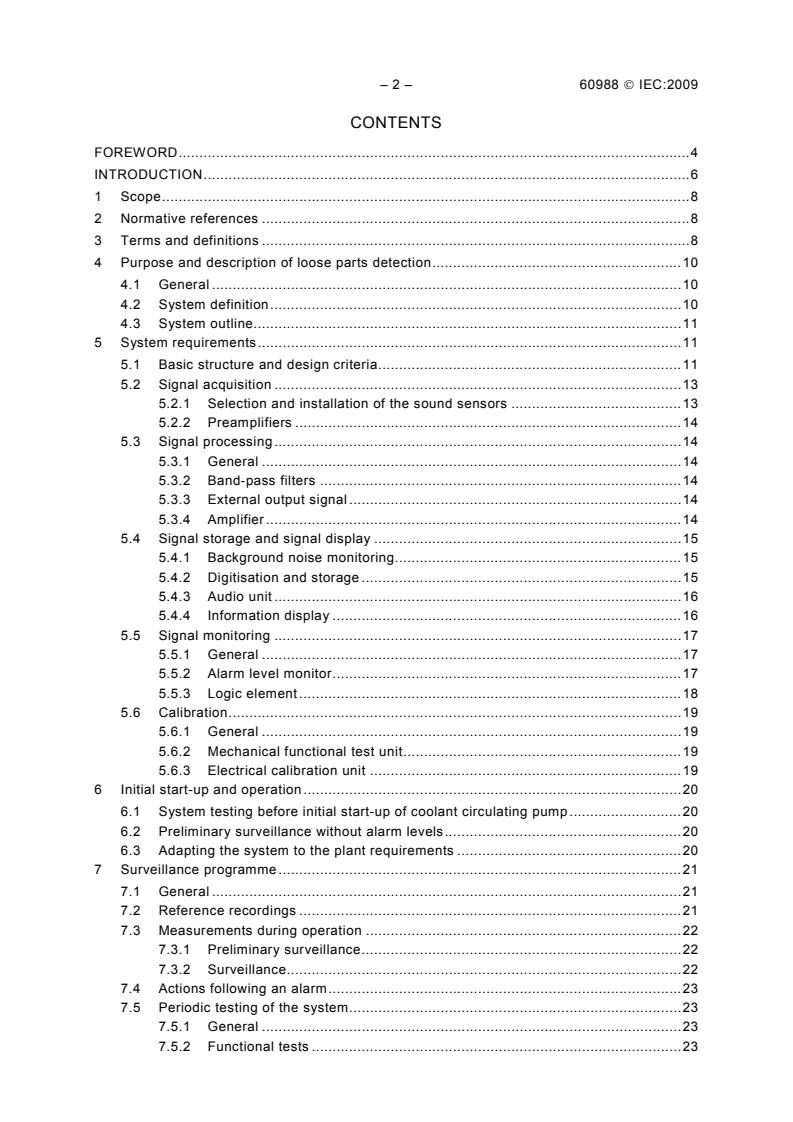
– 2 – 60988 © IEC:2009
CONTENTS
FOREWORD.4
INTRODUCTION.6
1 Scope.8
2 Normative references .8
3 Terms and definitions .8
4 Purpose and description of loose parts detection.10
4.1 General .10
4.2 System definition.10
4.3 System outline.11
5 System requirements.11
5.1 Basic structure and design criteria.11
5.2 Signal acquisition .13
5.2.1 Selection and installation of the sound sensors .13
5.2.2 Preamplifiers .14
5.3 Signal processing.14
5.3.1 General .14
5.3.2 Band-pass filters .14
5.3.3 External output signal.14
5.3.4 Amplifier .14
5.4 Signal storage and signal display .15
5.4.1 Background noise monitoring.15
5.4.2 Digitisation and storage .15
5.4.3 Audio unit .16
5.4.4 Information display .16
5.5 Signal monitoring .17
5.5.1 General .17
5.5.2 Alarm level monitor.17
5.5.3 Logic element .18
5.6 Calibration.19
5.6.1 General .19
5.6.2 Mechanical functional test unit.19
5.6.3 Electrical calibration unit .19
6 Initial start-up and operation.20
6.1 System testing before initial start-up of coolant circulating pump.20
6.2 Preliminary surveillance without alarm levels.20
6.3 Adapting the system to the plant requirements .20
7 Surveillance programme.21
7.1 General .21
7.2 Reference recordings .21
7.3 Measurements during operation .22
7.3.1 Preliminary surveillance.22
7.3.2 Surveillance.22
7.4 Actions following an alarm.23
7.5 Periodic testing of the system.23
7.5.1 General .23
7.5.2 Functional tests .23
60988 © IEC:2009 – 3 –
7.5.3 Electrical system test.24
7.5.4 Test impacts.24
8 Documentation .25
Annex A (informative) Description of loose parts detection with typical sound traces .26
Annex B (informative) Description of detailed functions of each block of the functional
block diagram .31
Annex C (informative) Examples of digital loose parts monitoring systems.32
Annex D (informative) Comments on evaluation.34
Bibliography.37
Figure 1 – Functional block diagram of a loose parts monitoring system .12
Figure A.1a – Typical signals of stationary background noise of a PWR.27
Figure A.1b – Typical signals of stationary background noise of a BWR.27
Figure A.1 – Typical signals.27
Figure A.2 – Signals with bursts caused by an operation-related single sound event
(control rod drive) .28
Figure A.3 – Signals with bursts caused by an impact of a loose part (pin of upper core
support plate) .28
Figure A.4a – Signals with bursts, caused by a test impact at a BWR .29
Figure A.4b – Localisation at a BWR.29
Figure A.4 – BWR.29
Figure A.5a – Signals with burst, caused by a test impact at a PWR .30
Figure A.5b – Localisation at a PWR.30
Figure A.5 – PWR.30
Figure C.1 – Block schematic diagram of a digital loose parts monitoring system.32
Figure C.2 – Block schematic diagram of a digital loose parts monitoring system.33
Figure D.1 – Auto power spectral density and amplitude distribution of a measurement
signal with electrical interference .35
Figure D.2 – Burst with corresponding frequency spectrum.35
Figure D.3 – Trend and distribution of channel-selective burst-amplitudes .36
Figure D.4 – Burst signals with determination of delay differences.36
– 4 – 60988 © IEC:2009
INTERNATIONAL ELECTROTECHNICAL COMMISSION
____________
NUCLEAR POWER PLANTS –
INSTRUMENTATION IMPORTANT TO SAFETY –
ACOUSTIC MONITORING SYSTEMS FOR DETECTION OF
LOOSE PARTS: CHARACTERISTICS, DESIGN CRITERIA
AND OPERATIONAL PROCEDURES
FOREWORD
1) The International Electrotechnical Commission (IEC) is a worldwide organization for standardization comprising
all national electrotechnical committees (IEC National Committees). The object of IEC is to promote
international co-operation on all questions concerning standardization in the electrical and electronic fields. To
this end and in addition to other activities, IEC publishes International Standards, Technical Specifications,
Technical Reports, Publicly Available Specifications (PAS) and Guides (hereafter referred to as “IEC
Publication(s)”). Their preparation is entrusted to technical committees; any IEC National Committee interested
in the subject dealt with may participate in this preparatory work. International, governmental and non-
governmental organizations liaising with the IEC also participate in this preparation. IEC collaborates closely
with the International Organization for Standardization (ISO) in accordance with conditions determined by
agreement between the two organizations.
2) The formal decisions or agreements of IEC on technical matters express, as nearly as possible, an international
consensus of opinion on the relevant subjects since each technical committee has representation from all
interested IEC National Committees.
3) IEC Publications have the form of recommendations for international use and are accepted by IEC National
Committees in that sense. While all reasonable efforts are made to ensure that the technical content of IEC
Publications is accurate, IEC cannot be held responsible for the way in which they are used or for any
misinterpretation by any end user.
4) In order to promote international uniformity, IEC National Committees undertake to apply IEC Publications
transparently to the maximum extent possible in their national and regional publications. Any divergence
between any IEC Publication and the corresponding national or regional publication shall be clearly indicated in
the latter.
5) IEC provides no marking procedure to indicate its approval and cannot be rendered responsible for any
equipment declared to be in conformity with an IEC Publication.
6) All users should ensure that they have the latest edition of this publication.
7) No liability shall attach to IEC or its directors, employees, servants or agents including individual experts and
members of its technical committees and IEC National Committees for any personal injury, property damage or
other damage of any nature whatsoever, whether direct or indirect, or for costs (including legal fees) and
expenses arising out of the publication, use of, or reliance upon, this IEC Publication or any other IEC
Publications.
8) Attention is drawn to the Normative references cited in this publication. Use of the referenced publications is
indispensable for the correct application of this publication.
9) Attention is drawn to the possibility that some of the elements of this IEC Publication may be the subject of
patent rights. IEC shall not be held responsible for identifying any or all such patent rights.
International Standard IEC 60988 has been prepared by subcommittee 45A: Instrumentation
and control of nuclear facilities, of IEC technical committee 45: Nuclear instrumentation.
This second edition cancels and replaces the first edition published in 1990. This edition
constitutes a technical revision.
The main technical changes with regard to the previous edition are as follows:
• to bring the contents up to date with technology change in some areas and to reconsider
and revise the recommendations;
• to include considerations and recommendations on digitalization for loose parts monitoring
systems to cover requirements for such systems;
• to provide an updated introductory subclause describing monitoring technology;
• to discuss and make recommendations on the architecture of a loose part monitoring
system;
60988 © IEC:2009 – 5 –
• to include improved and updated recommendations on storage, information display, alarm
level monitor and logic elements;
• to give recommendations on functional and performance measures proven in use for
operation of the monitoring system including updated details on the necessary actions
after detection of a loose part;
• to include improved recommendations on testing;
• to improve the consistency and clarity and the layout of the contents and to correct any
errors found in the previous version;
• to update the comments on evaluation in the informative annexes and to include suitable
references;
• to take advantage of experience within SC 45A participating nations.
The text of this standard is based on the following documents:
FDIS Report on voting
45A/754/FDIS 45A/775/RVD
Full information on the voting for the approval of this standard can be found in the report on
voting indicated in the above table.
This publication has been drafted in accordance with the ISO/IEC Directives, Part 2.
The committee has decided that the contents of this publication will remain unchanged until
the maintenance result date indicated on the IEC web site under "http://webstore.iec.ch" in
the data related to the specific publication. At this date, the publication will be
• reconfirmed,
• withdrawn,
• replaced by a revised edition, or
• amended.
– 6 – 60988 © IEC:2009
INTRODUCTION
a) Technical background, main issues and organisation of this Standard
This International Standard addresses the issues specific to acoustic monitoring systems for
loose parts detection. It describes the principles, the characteristics and the test methods for
those systems.
It is intended that this Standard be used by operators of NPPs (utilities), systems evaluators
and by licensors.
b) Situation of the current Standard in the structure of the IEC SC 45A standard series
IEC 60988 is the third level SC 45A document related to acoustic monitoring systems for
loose parts detection used in power reactors.
For more details on the structure of the IEC SC 45A standard series, see item d) of this
introduction.
c) Recommendations and limitations regarding the application of this Standard
It is important to note that this Standard establishes no additional functional requirements for
safety systems.
d) Description of the structure of the IEC SC 45A standard series and relationships
with other IEC documents and other bodies documents (IAEA, ISO)
The top-level document of the IEC SC 45A standard series is IEC 61513. It provides general
requirements for I&C systems and equipment that are used to perform functions important to
safety in NPPs. IEC 61513 structures the IEC SC 45A standard series.
IEC 61513 refers directly to other IEC SC 45A standards for general topics related to
categorization of functions and classification of systems, qualification, separation of systems,
defence against common cause failure, software aspects of computer-based systems,
hardware aspects of computer-based systems, and control room design. The standards
referenced directly at this second level should be considered together with IEC 61513 as a
consistent document set.
At a third level, IEC SC 45A standards not directly referenced by IEC 61513 are standards
related to specific equipment, technical methods, or specific activities. Usually these
documents, which make reference to second-level documents for general topics, can be used
on their own.
A fourth level extending the IEC SC 45A standard series, corresponds to the Technical
Reports which are not normative.
IEC 61513 has adopted a presentation format similar to the basic safety publication
IEC 61508 with an overall safety life-cycle framework and a system life-cycle framework and
provides an interpretation of the general requirements of IEC 61508-1, IEC 61508-2 and
IEC 61508-4, for the nuclear application sector. Compliance with IEC 61513 will facilitate
consistency with the requirements of IEC 61508 as they have been interpreted for the nuclear
industry. In this framework IEC 60880 and IEC 62138 correspond to IEC 61508-3 for the
nuclear application sector.
IEC 61513 refers to ISO as well as to IAEA 50-C-QA (now replaced by IAEA GS-R-3) for
topics related to quality assurance (QA).
60988 © IEC:2009 – 7 –
The IEC SC 45A standards series consistently implements and details the principles and
basic safety aspects provided in the IAEA code on the safety of NPPs and in the IAEA safety
series, in particular the Requirements NS-R-1, establishing safety requirements related to the
design of Nuclear Power Plants, and the Safety Guide NS-G-1.3 dealing with instrumentation
and control systems important to safety in Nuclear Power Plants. The terminology and
definitions used by SC 45A standards are consistent with those used by the IAEA.
– 8 – 60988 © IEC:2009
NUCLEAR POWER PLANTS –
INSTRUMENTATION IMPORTANT TO SAFETY –
ACOUSTIC MONITORING SYSTEMS FOR DETECTION OF
LOOSE PARTS: CHARACTERISTICS, DESIGN CRITERIA
AND OPERATIONAL PROCEDURES
1 Scope
This International Standard is applicable to on-site systems used for continuous monitoring of
structure-borne sound measured at the reactor coolant pressure boundary of light water
reactors for the purpose of detecting loose parts.
2 Normative references
The following referenced documents are indispensable for the application of this document.
For dated references, only the edition cited applies. For undated references, the latest edition
of the referenced document (including any amendments) applies.
IEC 61226, Nuclear power plants – Instrumentation and control systems important to safety –
Classification of instrumentation and control functions
IEC 61513, Nuclear power plants – Instrumentation and control for systems important to
safety – General requirements for systems
3 Terms and definitions
For the purposes of this document, the following terms and definitions apply.
3.1
adaptive resonant frequency
natural frequency of the mechanical attachment (e.g. bolts, magnets), including sound
sensors
3.2
alarm level monitor
a device which compares the value of a variable with a fixed or variable threshold. If the
threshold is exceeded, the output signal changes its state
3.3
background noise
structure-borne sound which is generated during operation of the reactor plant, even in the
absence of loose parts. It is composed of stationary background noise and operation-related
single sound events
3.4
burst amplitude distribution
frequency distribution of the maximum observed amplitudes of the bursts in the signal of a
sound sensor
60988 © IEC:2009 – 9 –
3.5
burst interval distribution
frequency distribution of the time intervals observed between the individual bursts in the
signal of a sound sensor
3.6
delay difference
time difference between the occurrences of the bursts generated by a single sound event in
the signals of different sound sensors
3.7
detached part
part which has become detached from the component in the pressure-retaining boundary of
the reactor coolant, and which therefore can be carried along with the reactor coolant
3.8
known event
an event for which comparable events occurred repeatedly, were recorded, evaluated and
assessed and the criteria for the comparability of these events have been identified and
defined (e. g. signal form, delay)
NOTE A known event can be a single burst or a set of bursts. A known event can be classified as an event being
alarm-relevant or not being alarm-relevant.
3.9
loose part
both a detached or loosened part as well as a foreign part
3.10
loosened part
part which becomes loose, yet still remains connected to the component to which it was
originally firmly attached
3.11
monitored signal
signal from a band-pass filter applied to the sound sensor signal
3.12
resonance factor
ratio of the signal amplitude at the natural frequency of response to the amplitude in the flat
region of response of the sensor system with any attachments
3.13
single channel alarm inhibit
a function that inhibits an alarm if only one channel has been triggered by a single sound
event. An alarm is set if at least a second channel has been triggered by the same single
sound event
3.14
single sound event
structure-borne sound generated by a single event which is superimposed on the stationary
background noise (e.g. impact of a loose part, control rod drive noise or a sudden reduction of
stresses)
3.15
sound burst
signal component generated in the sound sensor as a result of a single event causing a sound
which is superimposed on the signal of the stationary background noise
NOTE In this standard the term burst is used as an equivalent.
– 10 – 60988 © IEC:2009
3.16
sound sensor
mechanical/electrical energy converters receiving structure-borne sound which is detectable
at the surface of a solid body as displacement, velocity or acceleration
3.17
stationary background noise
consists of stochastic components (e.g. coolant flow noise, fluid resonances) and
deterministic components (e.g. speed-dependent pump noise)
3.18
structure-borne sound
sound which propagates in solid bodies. The structure-borne sound in this standard is taken
to mean the sound within the audible frequency range
4 Purpose and description of loose parts detection
4.1 General
The presence of a loose part in the primary coolant system can be indicative of degraded
reactor safety resulting from a failed or weakened component or from a part inadvertently left
in the primary system during construction, refuelling, or maintenance. A loose part can
contribute to component damage and material wear by frequent impacting with other parts in
the system. A loose part can pose a serious threat of partial flow blockage with attendant
departure from nucleate boiling which in turn could result in failure of fuel cladding.
Early detection of a loose part can provide the time required to avoid or mitigate safety-
related damage to, or malfunction of, primary system components. The primary purpose of a
loose parts detection system is the early detection of loose, loosened or detached metallic
parts with their potential to cause damage to:
a) the reactor core,
b) other internals structures of the primary circuit, or
c) the primary circuit pressure boundary.
Suitable systems shall be installed for this purpose.
Loose parts detection systems have been used successfully in water reactors for many years,
and have detected bolts and tools dropped in construction or refuelling, which otherwise could
have caused significant damage. They normally have a low safety significance, but due to the
potential for damage that a loose part could cause, regulators will expect installation of
suitable systems.
4.2 System definition
Depending on the national safety regulation,
– The system focuses mainly on the loose parts detection on the primary coolant system.
The system may additionally monitor the vibrational state of the primary circuit. This option
(which is outside the scope of this standard) may have consequences on the number and
the location of the sensors.
– The expertise to make a diagnosis may be present either:
locally in each plant site. This implies that the analysis tools are available on-site and the
on-site operators have to be trained for a signal evaluation; or
on a remote site at a national level. This implies that the transfer of all of the necessary
data to the experts is always fully efficient.
60988 © IEC:2009 – 11 –
– The triggering of an alarm sent to the control room may be based on signals exceeding a
threshold by either:
the burst amplitude of a single sound event. This makes it possible to record and analyse
the signals event by event, or
the rate at which transients are detected. This implies continuously recording the signals.
The diagnosis is then made from an analysis including many single sound events.
– The monitoring of the state of the sensors may be done by
a calibration test equipment for the measurement lines with impact hammer units on the
primary circuit, or by
in-depth monitoring and signal processing of the background noise.
When designing a new system a choice from the above-mentioned items should be made as a
first step. According to the national regulation the system definition needs to be specified.
4.3 System outline
Loose parts detection systems typically consist of a set of accelerometers mounted on the
reactor vessel, steam generators and coolant pump casings, with processing electronics to
filter the sound signals from the sensors and monitor them for alarms. Recording facilities are
provided, and operators generally listen to the sensor noise at regular intervals, and
specifically after refuelling, due to the sensitivity and processing power of the human ear. A
fuller description with typical sound traces is provided in Annex A.
5 System requirements
5.1 Basic structure and design criteria
Generally the system has the following basic functions (see Figure 1).
• signal acquisition,
• signal processing,
• signal storage and signal display,
• signal monitoring,
• calibration.
Requirements for each basic function are described in the following subclauses.
– 12 – 60988 © IEC:2009
External signal
Operational
Test impacts
processing
impacts information
Alarm
Calibration level
Signal storage and
signal display
Signal processing Signal monitoring
Signal
acquisition
IEC 1511/09
Key
1 Sound sensor 8 Audio unit
2 Preamplifier 9 Alarm level monitor
3 Band-pass filter 10 Logic element
4 Decoupled signal outputs 11 Internal alarm unit
5 Amplifier 12 Interface to external alarm unit
6 Indicator (display) 13 Calibration unit
7 Recording or storage
NOTE 1 Control signals are not shown.
NOTE 2 On-line calibration equipment and test impact units need not be permanently installed.
NOTE 3 The monitoring system is an operational system whose function is not classified at a high category
according to IEC 61513 and IEC 61226.
Figure 1 – Functional block diagram of a loose parts monitoring system
The detailed functions of each block are described in informative Annex B and specific
requirements are given in the following subclauses.
The design and installation of the system (including its detection sensitivity) shall be in
accordance with national regulations relating to system instrumentation and control for the
particular reactor plant.
The system shall be designed using a frequency range consistent with detection algorithms
that will ensure sufficient sensitivity of the system to detect a metallic loose part with a
minimum of false alarms. Depending upon the particular detection algorithm the frequency
range is typically between f = 0,5 Hz to 1 kHz and f = 10 kHz to 20 kHz, where f and f refer
a b a b
to the lower and upper 3 dB frequencies of the bandwidth of the pass band.
NOTE Processing up to f = 20 kHz is very suitable.
b
Structure
60988 © IEC:2009 – 13 –
The differences in the transfer functions of one measuring chain from any other measuring
chain, excluding the sound sensors, should not be greater than 1 dB when selecting identical
cut-off frequencies of the band-pass filters.
5.2 Signal acquisition
5.2.1 Selection and installation of the sound sensors
The recommended sound sensors are piezoelectric transducers. Sound sensors shall be
selected to be able to withstand the ambient conditions (e.g. simultaneous exposure to high
temperature and radiation levels, splash water) prevailing at their point of installation.
The sound sensors shall be mounted on the outer surface of the pressure-retaining boundary.
All methods of attachment (e.g. screw, magnetic, clamping connections) which meet the
requirements described in this standard may be used. All sound sensors should have uniform
response characteristics.
The mounting locations shall be selected on the basis of the following:
• the sound sensors shall be positioned in the areas to be monitored. Monitoring areas are,
e.g., the reactor pressure vessel bottom head and steam generator inlet water box,
• the sound sensors should be mounted in accessible areas where conditions for sound
transmission between the internal structures and the pressure-retaining boundary are
particularly favourable (e.g. in the nozzle area of the pressurised water reactor, in the area
of the core supports and in the area of the dryer support ring in boiling water reactors),
• the sound sensors should be replaceable,
• the arrangement of the sound sensors shall not restrict accessibility for non-destructive
examinations, and the sensor location should be selected so as to minimise dose rates to
the equipment and personnel conducting maintenance on the equipment.
The number of sound sensors for each monitoring area is directly related to the function. If
detection is required of a detached or loosened part only, then a single sound sensor is
sufficient. To distinguish between detached and loosened parts, two sound sensors may be
adequate in many cases. When it is necessary to locate detached and loosened parts two
dimensionally, at least three sound sensors are required (e.g. reactor pressure vessel
surveillance).
In case of defective and inaccessible sound sensors, new sound sensors may be installed in
accessible areas as a replacement, taking account of the information content of the signals in
comparison to the dose exposure of the personnel conducting maintenance.
NOTE It may be preferable to place at least two sensors in each monitoring area which avoids information loss in
case of a defective sensor. Further sound sensors may be necessary for the diagnosis of single sound events. The
associated signals may be monitored separately.
For installing the sound sensors, the mounting locations shall be prepared in accordance with
the nature of the intended connection. The mounting surface for the sound sensors should be
matched to the intended type of mounting. In addition, screw and clamping connections shall
be protected against loosening, and magnets against slipping. Provision shall be made for the
strain relief of the sensor cables.
The installation sites for sensors should be agreed with the design and site installation
engineers concerned with the vessels that are monitored and those concerned with their
thermal insulation. Removable sections of insulation should be used to allow access to the
sensors.
– 14 – 60988 © IEC:2009
5.2.2 Preamplifiers
The signals received from the sound sensors should be converted in preamplifiers (or
impedance converters) in such a way that the transmission to the signal processing unit is as
free from interference as possible. The design of the preamplifiers should take into account
the ambient conditions which prevail at the point of installation. Electrical interference shall be
minimized by suitable choice of cable type, routing and length, due consideration being given
to installation and maintenance. These cables shall be designed to withstand the ambient
conditions. The gain of the preamplifiers shall be adjusted to the sensitivity of each sound
sensor in such a way that all channels have nominally identical sensitivities within a tolerance
of ±10 %.
NOTE Identical sensitivities of the channels within a tolerance of ±10 % may also be achieved by adjustment of
the gain of the processing unit.
The upper cut-off frequency shall be selected in such a way that the adaptive resonant
frequency is transmitted.
5.3 Signal processing
5.3.1 General
The functions of the signal processing unit should be:
• to improve the ratio of signal strength to stationary background noise by means of band-
pass filtering,
• to provide unfiltered signals for external processing,
• to process the signals so that they are suitable for signal storage,
• signal display and signal monitoring.
These requirements may be fulfilled in various ways, provided that the design criteria of 5.1
are fulfilled. The signal processing unit normally consists of the modules included below.
5.3.2 Band-pass filters
The band-pass filters shall have minimum characteristics of:
• filter steepness: 24 dB/octave,
• filter top linearity: ± 1 dB,
• pass-band: f ≤ f ≤ f
a b.
The amplitude range which can be transmitted shall be matched to that of the preamplifiers.
NOTE The use of additional filters (stationary or temporary) or of a method for spectral subtraction for further
reduction of interfering signal components of stationary background noise in the pass-band is admissible.
5.3.3 External output signal
External signal output units should be short circuit proof and isolated by transformer output
circuits. Their design shall permit the full amplitude and frequency range of the preamplifiers
to be transmitted. The signal output shall be compatible with data processing equipment.
5.3.4 Amplifier
If an amplifier is required for improved signal display or for an audio unit, an amplifier with
variable gain is recommended. Gain should be varied in at least four steps of approximately
10 dB each.
60988 © IEC:2009 – 15 –
5.4 Signal storage and signal display
5.4.1 Background noise monitoring
A method of monitoring the background noise of the sensor signals shall be provided. This
can be done using either the raw signal or the signal envelope, or the RMS (root mean
square) value of the signal. The RMS monitor can be used for an objective assessment of the
background noise and of the signals used for the functional test. The design of the unit shall
be configured such that it is possible to display the RMS values of all signals (e.g. RMS
voltmeter with selector switch) or to display a background noise estimate. The RMS values
shall meet at least the following requirements:
• frequency range: 0,7 × f ≤ f ≤ 1,5 × f
a b,
• peak factor: > 5,
• accuracy: better than 10 % full scale,
• integration time: 1 s < t < 5 s.
i
Software calculation of background noise can improve on these characteristics.
5.4.2 Digitisation and storage
For evaluation and archiving of the structure-borne sound signals, the loose parts monitoring
system shall be provided with a unit for digital storage of the signals.
The system should include a facility to store all channel signals. It shall enable synchronous
processing of sufficient channels, such that all monitoring areas can be synchronously
registered with all channels necessary for localisation.
The storage of each signal value shall meet the following:
• sampling rate per channel: ≥48 kHz,
• resolution: ≥11 bit.
The design shall have the facility for automatic signal recording on exceeding an alarm level.
Transient recording or continuous recording may be used.
For transient recording the signals are stored, burst by burst. An alarm may be generated by
exceeding a threshold using the burst amplitude of a single sound event.
For continuous signal recording, the background noise and the low level bursts between the
detected bursts are included. An alarm may be generated from the rate at which single sound
event transients are detected.
For transient signal recording the minimum requirements of signal storage are:
• recording time window: ≥40 ms,
• pre-trigger time: 0 % to 100 % of the recording time window, adjustable
• dead time: ≤200 ms,
• storage capacity: as a minimum, 300 subsequently occurring events based on a recording
time window of ≤100 ms.
For continuous signal recording the recording time shall be between 10 min and 20 min for at
least 4 channels. If the recorder cannot record all the channels simultaneously, there shall be
a multiplex so that the signals from the monitoring area are redirected to the recorder.
– 16 – 60988 © IEC:2009
The single sound events stored during surveillance (see 7.3.2) should be archived
electronically for a time period of two years as a minimum.
5.4.3 Audio unit
Human listening to the signals of the acoustic sensors is a proven method of subjective online
evaluation of the signals.
The audio unit shall be designed so as to enable audible monitoring of each measuring
channel.
The audio unit shall provide at least:
• frequency range: f ≤ f ≤ f
a b,
• headset output (two-channel design is acceptable),
• volume: variable.
An additional loudspeaker may be provided.
5.4.4 Information display
The display and storage of the main data of an event should include as a minimum,
a) event-related information
1) event ID for clear identification,
2) system code,
3) date and time of the event,
4) main settings of digital storage.
b) channel-related information
1) RMS value of the background noise (this may include burst components),
2) alarm levels at the time of event occurrence,
3) measuring channel which has triggered
...