

IEC 60076-22-4:2019
(Main)Power transformers - Part 22-4: Power transformer and reactor fittings - Insulating liquid to water heat exchangers
General Information
- Abstract
IEC 60076-22-4:2019 applies to liquid to water heat exchangers, using forced water and forced liquid circuits, used on liquid immersed power transformers according to IEC 60076-1 and reactors according to IEC 60076-6 with and without conservator for indoor or outdoor installation. It outlines the service conditions and the mechanical and electrical requirements that are common to this equipment.
It also outlines the operation requirements specific to this equipment as well as the preferred dimensions relevant for interchangeability and the type and routine tests to be performed.
Keywords: insulating liquid to air heat exchangers in the cooling circuits of power transformers and reactors.
- Status
- Published
- Publication Date
- 07-Mar-2019
- Technical Committee
- TC 14 - Power transformers
- Drafting Committee
- WG 32 - TC 14/WG 32
- Current Stage
- PPUB - Publication issued
- Start Date
- 08-Mar-2019
- Completion Date
- 05-Apr-2019
Overview
IEC 60076-22-4:2019 is an international standard developed by the International Electrotechnical Commission (IEC) that specifies requirements for insulating liquid to water heat exchangers used in the cooling circuits of liquid-immersed power transformers and reactors. Applicable to both indoor and outdoor installations, this standard addresses forced water and forced liquid circuits for transformers (per IEC 60076-1) and reactors (per IEC 60076-6), with or without conservators. It establishes service conditions, mechanical and electrical requirements, operational guidelines, preferred dimensions for interchangeability, and specifies the type and routine testing procedures for these critical transformer accessories.
Key Topics
Scope and Applicability
- Covers liquid to water heat exchangers for liquid-immersed power transformers and reactors.
- Addresses units with or without conservator systems, suitable for both indoor and outdoor settings.
Service Conditions
- Aligns with operational limitations defined in IEC 60076-1.
- Considers impacts of varying water quality, antifreeze, contaminants, and environmental factors.
Performance and Mechanical Requirements
- Ensures mechanical separation of insulating liquid and water circuits.
- Requires easy inspection and cleaning of water-side components.
- Specifies the use of corrosion-resistant materials and surface treatments according to ISO 12944.
- Outlines criteria for safe operation, pressure ratings, and protection against internal moisture and corrosion.
Operational Requirements
- Details the rating plate information and documentation to support clear identification and specification.
- Includes installation options (vertical or horizontal) and mounting guidelines.
Testing and Certification
- Lists mandatory routine and type tests: tightness, visual inspection, cleanliness, and performance verification.
- Requires conformity with ISO and IEC guidelines for calibration and testing.
Applications
IEC 60076-22-4:2019 supports the design, selection, and installation of insulating liquid to water heat exchangers for the reliable cooling of power transformers and reactors. Its practical value includes:
- Power Utility Substations
- Ensures effective cooling, which enhances transformer performance, longevity, and safety.
- Industrial Power Systems
- Provides the standards necessary for cooling large transformer-reactor systems under demanding operational loads.
- OEMs and Manufacturers
- Facilitates standardization of components, enabling easier procurement and replacement.
- Assists in quality assurance and compliance for both domestic and export markets.
- Maintenance and Engineering Teams
- Guides proper inspection, routine cleaning, and troubleshooting.
- Offers a framework for specifying compatible materials based on water quality and site-specific requirements.
Related Standards
IEC 60076-22-4:2019 is part of the wider IEC 60076 series addressing diverse aspects of power transformers. Related standards of interest include:
- IEC 60076-1: Power transformers - General requirements.
- IEC 60076-6: Reactors.
- IEC 60076-7: Loading guide for mineral oil-immersed transformers.
- IEC 60296: Fluids for electrotechnical applications - Unused mineral insulating oils.
- IEC 60529: Degrees of protection provided by enclosures (IP Code).
- ISO 12944: Corrosion protection of steel structures by protective paint systems.
These standards collectively cover transformer construction, insulating fluids, operation, environmental protection, and testing requirements, ensuring a holistic and interoperable approach to power system cooling and reliability.
Keywords: IEC 60076-22-4, insulating liquid to water heat exchangers, power transformer cooling, reactor cooling, transformer fittings, liquid immersed transformers, IEC transformer standards, heat exchanger requirements, transformer accessories, transformer testing.
Get Certified
Connect with accredited certification bodies for this standard

IMQ S.p.A. (Certification)
Italian electrical product certification.

SLG Prüf- und Zertifizierungs GmbH
German testing and certification body.

UL Solutions
Global safety science company with testing, inspection and certification.
Sponsored listings
Frequently Asked Questions
IEC 60076-22-4:2019 is a standard published by the International Electrotechnical Commission (IEC). Its full title is "Power transformers - Part 22-4: Power transformer and reactor fittings - Insulating liquid to water heat exchangers". This standard covers: IEC 60076-22-4:2019 applies to liquid to water heat exchangers, using forced water and forced liquid circuits, used on liquid immersed power transformers according to IEC 60076-1 and reactors according to IEC 60076-6 with and without conservator for indoor or outdoor installation. It outlines the service conditions and the mechanical and electrical requirements that are common to this equipment. It also outlines the operation requirements specific to this equipment as well as the preferred dimensions relevant for interchangeability and the type and routine tests to be performed. Keywords: insulating liquid to air heat exchangers in the cooling circuits of power transformers and reactors.
IEC 60076-22-4:2019 applies to liquid to water heat exchangers, using forced water and forced liquid circuits, used on liquid immersed power transformers according to IEC 60076-1 and reactors according to IEC 60076-6 with and without conservator for indoor or outdoor installation. It outlines the service conditions and the mechanical and electrical requirements that are common to this equipment. It also outlines the operation requirements specific to this equipment as well as the preferred dimensions relevant for interchangeability and the type and routine tests to be performed. Keywords: insulating liquid to air heat exchangers in the cooling circuits of power transformers and reactors.
IEC 60076-22-4:2019 is classified under the following ICS (International Classification for Standards) categories: 29.180 - Transformers. Reactors. The ICS classification helps identify the subject area and facilitates finding related standards.
IEC 60076-22-4:2019 is available in PDF format for immediate download after purchase. The document can be added to your cart and obtained through the secure checkout process. Digital delivery ensures instant access to the complete standard document.
Standards Content (Sample)
IEC 60076-22-4 ®
Edition 1.0 2019-03
INTERNATIONAL
STANDARD
NORME
INTERNATIONALE
Power transformers –
Part 22-4: Power transformer and reactor fittings – Insulating liquid to water heat
exchangers
Transformateurs de puissance –
Partie 22-4: Accessoires pour transformateurs de puissance et bobines
d’inductance – Hydroréfrigérants
All rights reserved. Unless otherwise specified, no part of this publication may be reproduced or utilized in any form
or by any means, electronic or mechanical, including photocopying and microfilm, without permission in writing from
either IEC or IEC's member National Committee in the country of the requester. If you have any questions about IEC
copyright or have an enquiry about obtaining additional rights to this publication, please contact the address below or
your local IEC member National Committee for further information.
Droits de reproduction réservés. Sauf indication contraire, aucune partie de cette publication ne peut être reproduite ni
utilisée sous quelque forme que ce soit et par aucun procédé, électronique ou mécanique, y compris la photocopie et
les microfilms, sans l'accord écrit de l'IEC ou du Comité national de l'IEC du pays du demandeur. Si vous avez des
questions sur le copyright de l'IEC ou si vous désirez obtenir des droits supplémentaires sur cette publication, utilisez
les coordonnées ci-après ou contactez le Comité national de l'IEC de votre pays de résidence.
IEC Central Office Tel.: +41 22 919 02 11
3, rue de Varembé info@iec.ch
CH-1211 Geneva 20 www.iec.ch
Switzerland
About the IEC
The International Electrotechnical Commission (IEC) is the leading global organization that prepares and publishes
International Standards for all electrical, electronic and related technologies.
About IEC publications
The technical content of IEC publications is kept under constant review by the IEC. Please make sure that you have the
latest edition, a corrigendum or an amendment might have been published.
IEC publications search - webstore.iec.ch/advsearchform Electropedia - www.electropedia.org
The advanced search enables to find IEC publications by a The world's leading online dictionary on electrotechnology,
variety of criteria (reference number, text, technical containing more than 22 000 terminological entries in English
committee,…). It also gives information on projects, replaced and French, with equivalent terms in 16 additional languages.
and withdrawn publications. Also known as the International Electrotechnical Vocabulary
(IEV) online.
IEC Just Published - webstore.iec.ch/justpublished
Stay up to date on all new IEC publications. Just Published IEC Glossary - std.iec.ch/glossary
details all new publications released. Available online and once 67 000 electrotechnical terminology entries in English and
a month by email. French extracted from the Terms and Definitions clause of IEC
publications issued since 2002. Some entries have been
IEC Customer Service Centre - webstore.iec.ch/csc collected from earlier publications of IEC TC 37, 77, 86 and
If you wish to give us your feedback on this publication or need CISPR.
further assistance, please contact the Customer Service
Centre: sales@iec.ch.
A propos de l'IEC
La Commission Electrotechnique Internationale (IEC) est la première organisation mondiale qui élabore et publie des
Normes internationales pour tout ce qui a trait à l'électricité, à l'électronique et aux technologies apparentées.
A propos des publications IEC
Le contenu technique des publications IEC est constamment revu. Veuillez vous assurer que vous possédez l’édition la
plus récente, un corrigendum ou amendement peut avoir été publié.
Recherche de publications IEC - Le premier dictionnaire d'électrotechnologie en ligne au monde,
webstore.iec.ch/advsearchform avec plus de 22 000 articles terminologiques en anglais et en
La recherche avancée permet de trouver des publications IEC français, ainsi que les termes équivalents dans 16 langues
en utilisant différents critères (numéro de référence, texte, additionnelles. Egalement appelé Vocabulaire
comité d’études,…). Elle donne aussi des informations sur les Electrotechnique International (IEV) en ligne.
projets et les publications remplacées ou retirées.
Glossaire IEC - std.iec.ch/glossary
IEC Just Published - webstore.iec.ch/justpublished 67 000 entrées terminologiques électrotechniques, en anglais
Restez informé sur les nouvelles publications IEC. Just et en français, extraites des articles Termes et Définitions des
Published détaille les nouvelles publications parues. publications IEC parues depuis 2002. Plus certaines entrées
Disponible en ligne et une fois par mois par email. antérieures extraites des publications des CE 37, 77, 86 et
CISPR de l'IEC.
Service Clients - webstore.iec.ch/csc
Si vous désirez nous donner des commentaires sur cette
publication ou si vous avez des questions contactez-nous:
sales@iec.ch.
Electropedia - www.electropedia.org
IEC 60076-22-4 ®
Edition 1.0 2019-03
INTERNATIONAL
STANDARD
NORME
INTERNATIONALE
Power transformers –
Part 22-4: Power transformer and reactor fittings – Insulating liquid to water
heat exchangers
Transformateurs de puissance –
Partie 22-4: Accessoires pour transformateurs de puissance et bobines
d’inductance – Hydroréfrigérants
INTERNATIONAL
ELECTROTECHNICAL
COMMISSION
COMMISSION
ELECTROTECHNIQUE
INTERNATIONALE
ICS 29.180 ISBN 978-2-8322-6635-9
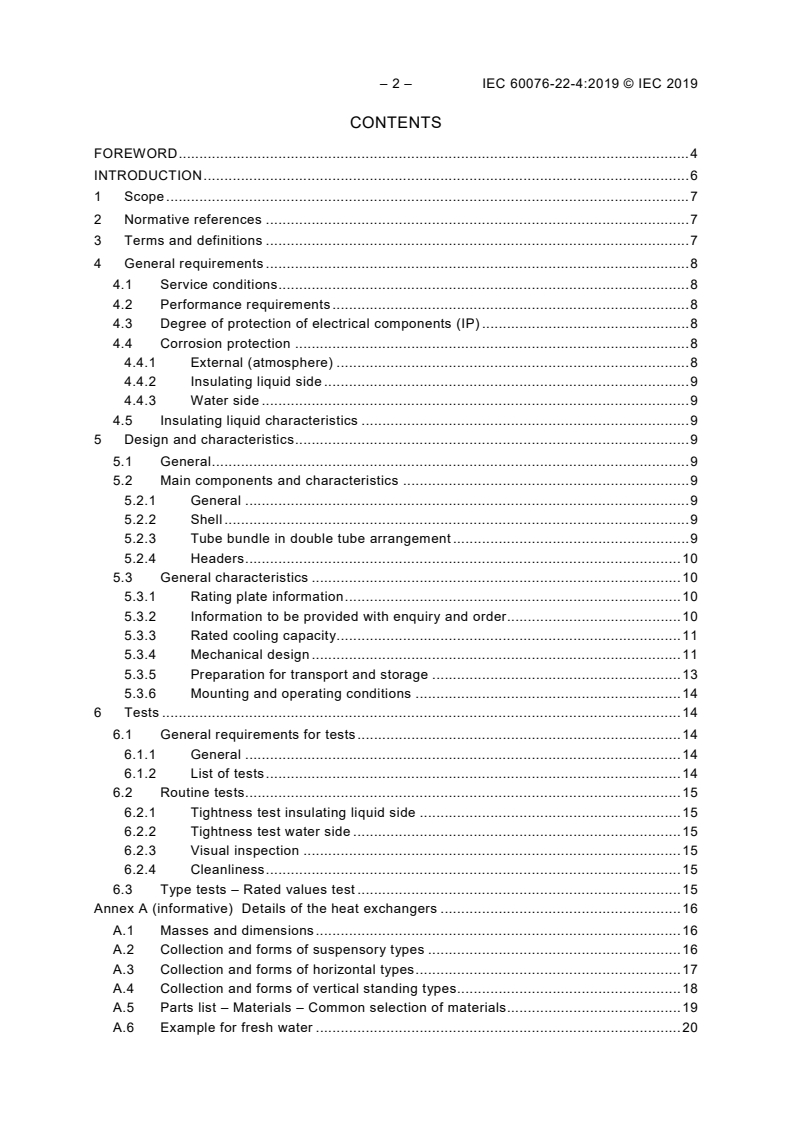
– 2 – IEC 60076-22-4:2019 © IEC 2019
CONTENTS
FOREWORD . 4
INTRODUCTION . 6
1 Scope . 7
2 Normative references . 7
3 Terms and definitions . 7
4 General requirements . 8
4.1 Service conditions . 8
4.2 Performance requirements . 8
4.3 Degree of protection of electrical components (IP) . 8
4.4 Corrosion protection . 8
4.4.1 External (atmosphere) . 8
4.4.2 Insulating liquid side . 9
4.4.3 Water side . 9
4.5 Insulating liquid characteristics . 9
5 Design and characteristics . 9
5.1 General . 9
5.2 Main components and characteristics . 9
5.2.1 General . 9
5.2.2 Shell . 9
5.2.3 Tube bundle in double tube arrangement . 9
5.2.4 Headers . 10
5.3 General characteristics . 10
5.3.1 Rating plate information . 10
5.3.2 Information to be provided with enquiry and order. 10
5.3.3 Rated cooling capacity . 11
5.3.4 Mechanical design . 11
5.3.5 Preparation for transport and storage . 13
5.3.6 Mounting and operating conditions . 14
6 Tests . 14
6.1 General requirements for tests . 14
6.1.1 General . 14
6.1.2 List of tests . 14
6.2 Routine tests. 15
6.2.1 Tightness test insulating liquid side . 15
6.2.2 Tightness test water side . 15
6.2.3 Visual inspection . 15
6.2.4 Cleanliness . 15
6.3 Type tests – Rated values test . 15
Annex A (informative) Details of the heat exchangers . 16
A.1 Masses and dimensions . 16
A.2 Collection and forms of suspensory types . 16
A.3 Collection and forms of horizontal types . 17
A.4 Collection and forms of vertical standing types. 18
A.5 Parts list – Materials – Common selection of materials . 19
A.6 Example for fresh water . 20
Annex B (informative) Rating conditions of the heat exchangers . 21
B.1 General . 21
B.2 Definitions, symbols . 21
B.3 Calculation of capacity in service . 21
B.3.1 Service capacity for different temperatures at inlet according to Figure
B.1 . 21
B.3.2 Service capacity for different mass flows according to Figure B.2 for
plain tubes and according to Figure B.3 for finned tubes . 21
B.3.3 Service capacity for different mass flows and different temperatures . 22
B.3.4 Example for calculation of 25 % capacity margin of new heat
exchangers . 22
Annex C (informative) Example for calculation of capacity in service . 26
Bibliography . 28
Figure A.1 – Collection and forms of suspensory types . 16
Figure A.2 – Collection and forms of horizontal types . 17
Figure A.3 – Collection and forms of vertical standing types . 18
Figure B.1 – Capacity factor depending on inlet temperatures of oil and water . 23
Figure B.2 – Capacity factor depending on mass for plain tubes . 24
Figure B.3 – Capacity factor depending on mass for finned tubes . 25
Table 1 – Water quality data . 12
Table 2 – Mandatory fittings . 13
Table A.1 – Examples of material selection depending on water quality . 20
Table A.2 – Average values for chemically neutral water (fresh water) . 20
– 4 – IEC 60076-22-4:2019 © IEC 2019
INTERNATIONAL ELECTROTECHNICAL COMMISSION
____________
POWER TRANSFORMERS –
Part 22-4: Power transformer and reactor fittings –
Insulating liquid to water heat exchangers
FOREWORD
1) The International Electrotechnical Commission (IEC) is a worldwide organization for standardization comprising
all national electrotechnical committees (IEC National Committees). The object of IEC is to promote international
co-operation on all questions concerning standardization in the electrical and electronic fields. To this end and
in addition to other activities, IEC publishes International Standards, Technical Specifications, Technical Reports,
Publicly Available Specifications (PAS) and Guides (hereafter referred to as “IEC Publication(s)”). Their
preparation is entrusted to technical committees; any IEC National Committee interested in the subject dealt with
may participate in this preparatory work. International, governmental and non-governmental organizations liaising
with the IEC also participate in this preparation. IEC collaborates closely with the International Organization for
Standardization (ISO) in accordance with conditions determined by agreement between the two organizations.
2) The formal decisions or agreements of IEC on technical matters express, as nearly as possible, an international
consensus on the relevant subjects since each technical committee has representation from all interested IEC
National Committees.
3) IEC Publications have the form of recommendations for international use and are accepted by IEC National
Committees in that sense. While all reasonable efforts are made to ensure that the technical content of IEC
Publications is accurate, IEC cannot be held responsible for the way in which they are used or for any
misinterpretation by any end user.
4) In order to promote international uniformity, IEC National Committees undertake to apply IEC Publications
transparently to the maximum extent possible in their national and regional publications. Any divergence between
any IEC Publication and the corresponding national or regional publication shall be clearly indicated in the latter.
5) IEC itself does not provide any attestation of conformity. Independent certification bodies provide conformity
assessment services and, in some areas, access to IEC marks of conformity. IEC is not responsible for any
services carried out by independent certification bodies.
6) All users should ensure that they have the latest edition of this publication.
7) No liability shall attach to IEC or its directors, employees, servants or agents including individual experts and
members of its technical committees and IEC National Committees for any personal injury, property damage or
other damage of any nature whatsoever, whether direct or indirect, or for costs (including legal fees) and
expenses arising out of the publication, use of, or reliance upon, this IEC Publication or any other IEC Publications.
8) Attention is drawn to the normative references cited in this publication. Use of the referenced publications is
indispensable for the correct application of this publication.
9) Attention is drawn to the possibility that some of the elements of this IEC Publication may be the subject of patent
rights. IEC shall not be held responsible for identifying any or all such patent rights.
International Standard IEC 60076-22-4 has been prepared by IEC technical committee 14:
Power transformers.
The text of this International Standard is based on the following documents:
FDIS Report on voting
14/996/FDIS 14/1004/RVD
Full information on the voting for the approval of this International Standard can be found in the
report on voting indicated in the above table.
This document has been drafted in accordance with the ISO/IEC Directives, Part 2.
A list of all parts in the IEC 60076 series, published under the general title Power transformers,
can be found on the IEC website.
The committee has decided that the contents of this document will remain unchanged until the
stability date indicated on the IEC website under "http://webstore.iec.ch" in the data related to
the specific document. At this date, the document will be
• reconfirmed,
• withdrawn,
• replaced by a revised edition, or
• amended.
– 6 – IEC 60076-22-4:2019 © IEC 2019
INTRODUCTION
Under the part title “Power transformer and reactor fittings” this part of IEC 60076-22 covers
the insulating liquid to water heat exchangers in the cooling circuits of power transformers and
reactors.
Annex B gives guidance to the end user for approximation of the behaviour of the heat
exchanger under different operation conditions. Annex C gives an example based on the
calculation rules stipulated in Annex B.
POWER TRANSFORMERS –
Part 22-4: Power transformer and reactor fittings –
Insulating liquid to water heat exchangers
1 Scope
This part of IEC 60076 applies to liquid to water heat exchangers, using forced water and forced
liquid circuits, used on liquid immersed power transformers according to IEC 60076-1 and
reactors according to IEC 60076-6 with and without conservator for indoor or outdoor
installation. It outlines the service conditions and the mechanical and electrical requirements
that are common to this equipment.
It also outlines the operation requirements specific to this equipment as well as the preferred
dimensions relevant for interchangeability and the type and routine tests to be performed.
2 Normative references
The following documents are referred to in the text in such a way that some or all of their content
constitutes requirements of this document. For dated references, only the edition cited applies.
For undated references, the latest edition of the referenced document (including any
amendments) applies.
IEC 60076-1, Power transformers – Part 1: General
IEC 60076-7, Power transformers – Part 7: Loading guide for mineral oil-immersed power
transformers
IEC 60296, Fluids for electrotechnical applications – Unused mineral insulating oils for
transformers and switchgear
IEC 60529, Degrees of protection provided by enclosures (IP Code)
ISO 4406, Hydraulic fluid power – Fluids – Method for coding the level of contamination by solid
particles
ISO 12944 (all parts), Paints and varnishes – Corrosion protection of steel structures by
protective paint systems
3 Terms and definitions
For the purposes of this document, the following terms and definitions apply.
ISO and IEC maintain terminological databases for use in standardization at the following
addresses:
• IEC Electropedia: available at http://www.electropedia.org/
• ISO Online browsing platform: available at http://www.iso.org/obp
– 8 – IEC 60076-22-4:2019 © IEC 2019
3.1
insulating liquid to water heat exchanger
component for the cooling of the insulating liquid of the transformer, using forced circulation of
the insulating liquid and forced circulation of water
4 General requirements
4.1 Service conditions
The normal service conditions set out in IEC 60076-1 represent the normal scope of operation
of the device and equipment specified in this document. Unless otherwise specified, fresh water
as defined by Table A.2 shall be considered as cooling water.
Device and equipment specification for operation under service conditions different from the
ones specified by IEC 60076-1 shall be subject to agreement between the purchaser and
supplier, as they require special consideration in the design of the device and equipment.
Any particular condition, which can influence the correct functioning of the cooler, shall be
specified, such as water quality, addition of anti-freeze compounds, mud, microorganisms,
addition of biocides, sea weed, and intermittent operation.
4.2 Performance requirements
Liquid to water heat exchangers should fulfil the following requirements:
• mechanical separation of liquid and water circuit shall be ensured at any time;
• independent design and control of liquid and water conditions shall be possible;
• the access to the water side surfaces shall be possible without influencing or opening the
liquid side circuit;
• easy access to the water side surfaces for inspection and cleaning on site by mechanical
means, for example using brushes;
• the heat exchanger construction shall be suitable for operating conditions complying with
the permissible pressure values of the liquid side and the water side;
• easy detection of possible leakages at the liquid and the water side.
4.3 Degree of protection of electrical components (IP)
The degree of protection of the connecting box or terminal box for an outdoor installation shall
be at least IP 54 according to IEC 60529, unless otherwise specified by the purchaser.
4.4 Corrosion protection
4.4.1 External (atmosphere)
The materials used for the construction of the equipment or the surface treatment shall be
resistant to accidental contact with the insulating liquid and suitable to withstand the
environmental conditions given in 4.1. The corrosion protection shall be agreed between
purchaser and manufacturer according to ISO 12944 (all parts). The responsibility to specify
the correct level of corrosion protection lies with the purchaser and is dependent on the
environment where the transformer will be located and on the durability required. Unless
otherwise specified, minimum withstand level shall be C4 medium durability according to
ISO 12944-6.
4.4.2 Insulating liquid side
In consideration of the storage conditions and expected time between shipment and
commissioning, the corrosion protection on the insulating liquid side of the cooling system shall
be agreed between purchaser and manufacturer. As a minimum requirement, precautions shall
be taken to prevent the ingress of moisture and the development of internal corrosion. The
internal flushing with insulation liquid fully miscible and compatible with the liquid to be used in
service conditions and the use of blanking plates with gaskets are considered as a minimum.
Internal painting, nitrogen filling, dehydrating material, etc., can be used as other or additional
solutions.
4.4.3 Water side
The corrosion protection on the water side of the cooling system shall be agreed between
purchaser and manufacturer and is dependent on the water quality. To attain the requested
degree of protection the manufacturer shall choose the combination of material and surface
protection. As a minimum requirement for paint, an epoxy coating with a thickness of 150 µm
shall be applied.
4.5 Insulating liquid characteristics
If not otherwise specified, the insulating liquid is mineral oil according to IEC 60296 and the
operating temperature shall be in accordance with IEC 60076-7.
When the insulating liquid is not mineral oil then the viscosity variation, the operating
temperature and all the other operating characteristics shall be indicated by the purchaser.
5 Design and characteristics
5.1 General
Shell and tube heat exchangers with double tube arrangement are established as the current
best practice of transformer insulating liquid cooling in compliance with all the requirements.
Any different type may be accepted and applied if all the requirements of 4.2 are fulfilled.
5.2 Main components and characteristics
5.2.1 General
See Figure A.1, Figure A.2 and Figure A.3 for reference.
The main components of a shell and tube heat exchanger are the shell, the tube bundle inside
the shell and two headers at both ends of the shell.
5.2.2 Shell
The shell is the cylindrical compartment containing the tube bundle and is provided with flanged
nozzles for piping connection of the insulating liquid. The shell contains the insulating liquid.
Baffles on the tube bundle are used to optimize the liquid path inside the shell.
5.2.3 Tube bundle in double tube arrangement
Double tubes are used for the tube bundle for safety reasons of the transformer. The liquid
pressure outside the tubes is independent from the water pressure and is usually less than the
water pressure inside the tubes.
– 10 – IEC 60076-22-4:2019 © IEC 2019
• The double tubes consist of two concentric tubes without a blocking fluid in between; the
tubes are straight and the outer tubes are plain or finned. Between the inner and outer tube
there shall be grooves, which enable the detection of a potential leakage by using a proper
device. The double tubes are connected at both ends to the respective tube sheets by roll
expansion or welding. The connection shall be fluid tight.
• The tube bundle can be arranged in different even number of passes to optimize water flow.
Removable tube bundles are the preferred solution for maintenance purposes.
5.2.4 Headers
• Two headers close the shell at both ends.
• One header includes flanged nozzles for the connection to the water piping. Inside the other
header, the water is redirected.
5.3 General characteristics
5.3.1 Rating plate information
The rating plate shall be corrosion resistant and acid proof. It shall be visible when the heat
exchanger is assembled to the transformer and carry the following data:
• logo or name of manufacturer;
• country and manufacturing location;
• number of this document;
• manufacturer identification;
• manufacturer serial number;
• year of manufacturing.
Rated data:
• rated cooling capacity [kW];
• rated liquid and water flow quantity [m /h];
• inlet and outlet temperatures liquid-side and water-side [°C];
• pressure drop in the heat exchanger liquid side/water side [bar];
• maximum pressure in service for liquid-side [kPa];
• maximum pressure in service for water-side [kPa];
• maximum design temperature for liquid-side [°C];
• mass of heat exchanger without oil and water [kg];
• oil and water quantity for filling [dm ].
5.3.2 Information to be provided with enquiry and order
The purchaser shall supply to the manufacturer the following information with the enquiry:
• insulation liquid characteristics;
• water quality;
• rated cooling capacity Q kW;
r
• water temperature at inlet t ’ °C;
• water temperature at outlet (max.) t ’’ °C;
• maximum allowed liquid temperature t ’ °C;
• liquid temperature difference (min. value/max. value) ∆t K;
• liquid flow quantity V m /h;
• water flow quantity (max.) V m /h;
• operating pressure (water side) kPa.
In case of order the following rated values should be fixed by the manufacturer:
• materials water side (Clause A.5)
• rated cooling capacity Q kW;
r
• rated water flow quantity V m /h;
³
• rated oil flow quantity V m /h;
• water temperature at inlet t ’ °C;
• water temperature at outlet t ’’ °C;
• liquid temperature at inlet t ’ °C;
• liquid temperature at outlet t ’’ °C;
• water side pressure drop ∆p kPa;
• liquid side pressure drop ∆p kPa;
• maximum operating pressure (water side) p kPa;
• maximum operating pressure (liquid side) p kPa.
5.3.3 Rated cooling capacity
The rated cooling capacity of the heat exchanger is the minimum capacity, which the
manufacturer has to guarantee when the cooler is new. Unless otherwise specified by
agreement between purchaser and manufacturer the heat exchanger shall be designed with a
capacity margin of minimum 25 %, because piping conditions on the water side, not conforming
to the design, can affect the efficiency and the life expectation of the cooler.
For new heat exchangers, the capacity, including the margin, has to be achieved with the rated
values for oil flow quantity, water flow quantity, oil temperature at inlet and water temperature
at inlet.
5.3.4 Mechanical design
5.3.4.1 General
The mechanical design is based on the environmental conditions described in 4.1. The
maximum liquid temperature shall be 100 °C and the maximum water temperature 50 °C. Other
environmental conditions, temperatures, as well as other cooling liquids shall be agreed
between manufacturer and purchaser.
The cooler can be designed to be installed in a vertical or horizontal position. The vertically
installed coolers can be suspended on frames. See Annex A for examples.
The cooling tubes and plates shall be fluid tight connected. The tube bundle can have the
following two possible executions to be agreed between manufacturer and purchaser:
• with floating head: in this execution the bundle can be removed for inspection and
replacement;
• with fixed tube sheets and stationary heads.
– 12 – IEC 60076-22-4:2019 © IEC 2019
For both executions, the water channels are removable and can be emptied separately.
Removing of a water channel shall not influence the oil circuit.
The heat exchanger shall be designed for an unprotected outdoor installation.
The heat exchanger shall be provided with draining and venting devices on both the liquid and
water side.
The mechanical design of the heat exchanger oil side shall withstand a vacuum of 2,5 kPa
absolute pressure.
The maximum admitted oil pressure in service shall be 330 kPa.
The maximum admitted water pressure in service in this document shall be 800 kPa.
5.3.4.2 Materials
The liquid to water heat exchanger can be made of different materials depending on the quality
of the cooling water and the operation conditions, see Table A.1. For examples of best practice
in case of water of drinking quality see Clause A.5.
5.3.4.3 Water quality
The purchaser shall specify at least the data indicated in Table 1 along with the enquiry.
Table 1 – Water quality data
sampling temperature iron/manganese content water type (e.g. fresh water)
pH value content of chloride content of ammonium
total degree of hardness content of sulphate free oxygen
carbonate hardness (m-value) content of nitrate electrical conductivity
free CO (p-value) content of phosphate suspended solids
If no water quality is provided, the water is considered to be drinking water according to
Table A.2.
In case of changing water quality during operation (e.g. near the coast where the cooling water
can be river water, brackish water and sea water depending on the tide) the material selection
shall consider all possible conditions.
5.3.4.4 Mandatory fittings
The liquid to water heat exchanger shall be equipped with at least the following fittings (see
Table 2):
Table 2 – Mandatory fittings
N° Designation Remarks
1 Connection flange DN 15/PN 6 For liquid draining, for connection of drain valve
1 Vent plug Venting liquid side
1 Leakage detector For detection of leakages, water side or liquid side
Each compartment shall have a water drain, allowing to fully drain
Water drain
the cooler
Locking plug Each thermometer pocket and water drain shall have a locking plug
2 Plate support
Cleaning orifice for water
1 Access to the header without removing the piping
compartment
2 Liquid side thermometer pocket G ¾ Immersion depth 65 mm, internal thread G ¾ x 20 mm
2 Water side thermometer pocket G ¾ Immersion depth 65 mm, internal thread G ¾ x 20 mm
2 Connection flange PN 10 Connection of liquid side
2 Connection flange PN 10 Connection of water side
Thread M10, thread length min. 12,5 mm, venting connection
Connection flange DN 15 PN 6
b
water-side, as many as necessary for venting all compartments
1 Earthing stud M12
a
2 Lifting lug
a
Lifting lug for each component with 30 kg mass and more is provided.
b
Vertical water connection flanges may be used for venting.
Upon customer request, the cooler may be designed for and equipped with thermometers, flow
indicators, pressure gauges and differential pressure devices.
5.3.4.5 Manufacturing requirements
Internal surfaces insulating liquid side shall be flushed with insulation liquid to remove any
potential debris resulting from the manufacturing process.
Number and size of particles, for example according to ISO 4406, as well as particle test
procedure and flushing velocity or other cleaning criteria, have to be agreed. The recommended
minimum level according to ISO 4406 is -/12/10.
The flushing via a micron filter shall continue until the amount of particles is less than the agreed
limited value. The flushing oil shall be in accordance with IEC 60296. During flushing the oil
flow velocity shall be sufficient to remove all the particles.
Immediately after the flushing procedure the flushing liquid has to be removed; possible small
residuals can be considered. All flanges on the insulating liquid side shall be closed with covers
not to be removed without purpose.
5.3.5 Preparation for transport and storage
5.3.5.1 Transport
The flanges on the water side as well as all other openings (i.e. thermometer pockets, venting
and draining devices) shall be closed to prevent ingress of humidity and pollution.
The liquid to water heat exchanger shall be arranged on a pallet suited for easy handling with
a forklift and to prevent damages during the transport. A suitable protection to prevent pollution
during transport shall be provided.
– 14 – IEC 60076-22-4:2019 © IEC 2019
For difficult transport conditions, such as overseas transport, specific requirements may apply.
5.3.5.2 Storage
Unless otherwise specified, the storage configuration shall be designed to ensure a minimum
storage period of three months until commissioning in the environmental conditions defined in
IEC 60076-1.
For a storage period over three months, the manufacturer shall be informed about the exact
storage conditions (for example humidity and temperature changes) and storage requirements
may be specified.
As an option, upon demand by the purchaser, the insulating liquid side of the heat exchanger
shall be filled under an overpressure of approximately 45 kPa with nitrogen or dry air (humidity
less than 10 %) using a valve installed in one of the blind flanges. For long-term storage, which
has to be indicated by the purchaser, the overpressure shall remain at minimum 5 kPa and
therefore has to be checked regularly.
5.3.6 Mounting and operating conditions
Liquid to water heat exchangers, which are not in service, shall be completely drained, cleaned,
dried and closed.
They should be checked periodically on the water-side depending on the water quality and
cleaned if necessary.
Insoluble impurities, especially suspended solids will cause frequent cleaning periods. This
could be avoided, for example by using screens or filters.
The liquid to water heat exchangers shall be operated with the nominal water flow quantity.
In case a higher or lower water flow quantity is required, this has to be clarified with the supplier.
Upper and lower limits have to be checked carefully especially under consideration of the
maximum permissible water velocity, permissible pressure drop and potential contamination by
the cooling water.
6 Tests
6.1 General requirements for tests
6.1.1 General
Tests shall be made at an ambient temperature between 10 °C and 40 °C, unless otherwise
specified.
All measuring instruments used for the tests shall have traceable accuracy and be subject to
periodic calibration. An example of a quality management system is ISO 9001.
6.1.2 List of tests
6.1.2.1 Routine tests
The following list of tests is not in any specific order:
– tightness test insulating liquid side (6.2.1);
– tightness test water side (6.2.2);
– tightness test leakage compartment according to manufacturer’s best practice;
– visual inspection (6.2.3);
– cleanliness (6.2.4);
– external painting according to specification.
6.1.2.2 Type tests
The following list of tests is not in any specific order:
– rated values test (6.3).
6.2 Routine tests
6.2.1 Tightness test insulating liquid side
The insulating liquid to water heat exchanger has to be submitted to one of the following
alternative tightness tests by agreement between manufacturer and purchaser:
• hydraulic test with transformers oil filled at (60 ± 5) °C and a pressure of 500 kPa for 2 h;
• pneumatic test with compressed air under water at 500 kPa for 30 min.
Any leakage has to be detected (by visual inspection), during the above period .
6.2.2 Tightness test water side
The insulating liquid to water heat exchanger has to be filled with fresh water under a pressure
of 1 200 kPa. After elimination of the last leakage the pressure test shall be performed for a
period of 2h.
6.2.3 Visual inspection
6.2.3.1 Outer surface
All surfaces shall be free of damages, deformations and dirt. No sort of filling compounds shall
be used.
6.2.3.2 Inside surface insulating liquid side
All visible surfaces shall be free of damages, deformations and dirt.
6.2.3.3 Inside surface water side
All visible surfaces shall be free of damages, deformations and dirt.
6.2.4 Cleanliness
The cleanliness of the internal surfaces shall comply with the values indicated in 5.3.4.5.
6.3 Type tests – Rated values test
Usually this test is performed together with the transformer. Separate type tests should be
planned by a special agreement between supplier and purchaser.
– 16 – IEC 60076-22-4:2019 © IEC 2019
Annex A
(informative)
Details of the heat exchangers
A.1 Masses and dimensions
The masses and dimensions of a heat exchanger are usually fixed in the offer. The dimensions
A, B, and C in Figures A.1 to A.3 are the minimum information for a preliminary offer.
In general, dimensions and nozzle position/orientation should be agreed between manufacturer
and purchaser depending on the flow rates.
A.2 Collection and forms of suspensory types
B/2
B
C
B/2
0°
Position of flanges for water connection
as well as position of controls and fasteners
shall be agreed if deviating from the forms
270° 90°
below.
Enlarged construction: Form A
180°
Form A Form B Form C Form D
IEC
NOTE 1 The position of the oil inlet/outlet or water inlet/outlet is arbitrary.
NOTE 2 The positions of the thermometer pocket in the middle or on the edge depend on the manufacturer's
decision.
Figure A.1 – Collection and forms of suspensory types
A
A.3 Collection and forms of horizontal types
X
A
0°
270°
90°
Position of flanges for water connection as
well as position of controls and fasteners
shall be agreed if deviating from the form below.
Enlarged construction: Form A
B/2
180°
View X
Form A Form B
Form C Form D
IEC
NOTE The position of the oil inlet/outlet or water inlet/outlet is arbitrary.
Figure A.2 – Collection and forms of horizontal types
B
B/2
B/2
C
– 18 – IEC 60076-22-4:2019 © IEC 2019
A.4 Collection and forms of vertical standing types
B/2
C
C + 60
B
B/2
0°
Position of flanges for water connection as
well as position of controls and fasteners
shall be agreed if deviating from the forms
270° 90°
below.
Enlarged construction: Form A
180°
Form A Form B Form C Form D
IEC
NOTE The position of the oil inlet/outlet or water inlet/outlet is arbitrary.
Figure A.3 – Collection and forms of vertical standing types
A
A.5 Parts list – Materials – Common selection of materials
Common requirements for fresh water of drinking quality:
shell: minimum steel S 235 JRG2 according to EN 10025-2 based
on the manufacturer’s decision;
tube plate oil side: steel S335 J2G3 according to EN 10025-2;
tube plate water side: CuZn38AlFeNiPbSn according to EN 1653, minimum R390;
tubes oil side: Cu-DHP-R220 material-no. CW024A according to
EN 12451 or EN 12452;
tubes water side: Cu-DHP-R220 material-no. CW024A according to
EN 12451 or EN 12452;
baffles / pass partition: low carbon steel according to EN 10130, surface type (B),
surface treatment: extra plain (b) or stainless steel
according to EN 10088-2;
water channel: GG-25 according to EN 1561 or minimum S 235 JRG2
according to EN 10025-2 based on manufacturer’s decision;
venting and locking screws:
water side: non-corrosive material;
oil side: standard material;
common screws and nuts: stainless steel according to ISO 3506-1.
The above-mentioned materials require fresh water in drinking quality for cooling water without
harmful substances. A typical analysis for fresh water is shown in Table A.2. For other water
qualities the people running the heat exchanger shall provide water analysis according to
EN 12502-1 for an adequate material selection. It is recommended to submit several analyses
over a one-year runtime period.
Spectrum of materials used:
Tube plates:
S235JRG2 / 1.0038; CuZn38AlFeNiPbSn-R390 / CW715R; CuZn39Pb0.5 / CW610N;
CuZn38Sn1As / CW717R; CuZn38Sn1 / 2.0530; CuZn39Sn1 / CW719R; CuNi10Fe1Mn /
CW352H; CuNi30Mn1Fe / CW354H; X5CrNiN19-9 / 1.4315; X3CrNiCu19-9-2 / 1.4560;
X6CrNiTi18-9 / 1.4301; X6CrNiTi18-10 / 1.4541; X6CrNiMoTi17-12-2 / 1.4571; Ti1 / 3.7025
Tubes water side:
Cu-DHP-R220 / CW024A; CuNi10Fe1Mn-R290 / CW352H; CuZn28Sn1As-R320 / CW706R;
CuZn28Sn2As-R340 / CW702R; CuNi30Mn1Fe-R370 / CW354H; X5CrNiN19-9 / 1.4315;
X3CrNiCu19-9-2 / 1.4560; X6CrNiTi18-9 / 1.4301; X6CrNiTi18-10 / 1.4541; X6CrNiMoTi17-12-
2 / 1.4571; Ti1 / 3.7025
– 20 – IEC 60076-22-4:2019 © IEC 2019
Table A.1 – Examples of material selection depending on water quality
Tube plates,
Tubes, wa
...