


IEC 60966-2-1:1991
(Main)Radio frequency and coaxial cable assemblies - Part 2-1: Sectional specification for flexible coaxial cable assemblies
Radio frequency and coaxial cable assemblies - Part 2-1: Sectional specification for flexible coaxial cable assemblies
Relates to flexible coaxial cable assemblies operating in the transverse electromagnetic mode (TEM). Establishes uniform requirements for testing the electrical, mechanical and climatic properties of flexible coaxial cable assemblies composed of flexible coaxial cables and coaxial connectors.
Ensemble de cordons coaxiaux et de cordons pour fréquences radioélectriques - Partie 2-1: Spécification intermédiaire pour cordons coaxiaux souples
Concerne les cordons coaxiaux souples fonctionnant dans le mode électromagnétique transversal (TEM). Etablit des prescriptions uniformes pour l'essai des propriétés électriques, mécaniques et climatiques des cordons coaxiaux souples composés de câbles coaxiaux et de connecteurs coaxiaux.
General Information
- Status
- Published
- Publication Date
- 24-Oct-1991
- Technical Committee
- SC 46A - Coaxial cables
- Current Stage
- DELPUB - Deleted Publication
- Start Date
- 19-Nov-2016
- Completion Date
- 13-Feb-2026
Relations
- Effective Date
- 05-Sep-2023
- Effective Date
- 05-Sep-2023
Overview
IEC 60966-2-1:1991 is an international standard developed by the International Electrotechnical Commission (IEC) that specifies uniform requirements and test methods for flexible coaxial cable assemblies used in radio frequency (RF) applications. This standard addresses flexible coaxial cables and their connectors operating in the transverse electromagnetic mode (TEM). It focuses on defining the electrical, mechanical, and environmental testing procedures to ensure performance, durability, and reliability of these assemblies.
The document consolidates the original 1991 edition with Amendment 1 of 1997, reflecting updated industry practices and technological advancements. It serves as a sectional specification within a broader IEC framework for RF and coaxial cable assemblies.
Key Topics
Scope and Definitions
IEC 60966-2-1 covers flexible coaxial cable assemblies, emphasizing design and construction of both cables and connectors. It defines key terms such as "flexible coaxial cable assembly" to provide clarity and consistency across applications.Design and Manufacturing Requirements
The standard sets out criteria for cable and connector design, including construction details, materials, dimensions, and interface compliance to ensure interoperability and quality manufacturing.Electrical Testing
Critical electrical properties are tested, including:- Reflection characteristics to assess signal integrity
- Insertion loss stability over time and conditions
- Electrical length stability ensuring phase consistency
- Phase difference and temperature-dependent phase variation, key for precision communication systems
Mechanical Robustness Tests
Mechanical durability is verified through tests such as flexure, which simulates bending stresses experienced during installation and use.Environmental Tests
To guarantee performance in diverse conditions, the standard includes:- Vibration, shock, and bump resistance testing
- Climatic sequence testing to evaluate endurance under temperature and humidity cycles
- Resistance to solvents, contaminants, water immersion, salt mist, and sulfur dioxide environments
- Special tests for flammability compliance ensuring safety under fire hazards
Test Schedules and Procedures
Detailed guidelines on test sequencing for type approval, qualification, and capability approvals are provided, facilitating consistent and repeatable validation processes.
Applications
IEC 60966-2-1 is essential for manufacturers, quality assurance teams, and engineers involved in:
- Production and quality control of flexible coaxial cables and assemblies used in RF transmission.
- Design of communication infrastructure requiring reliable coaxial connections, including telecommunication networks, broadcast systems, and radar installations.
- Environmental qualification of cable assemblies ensuring long-term durability in industrial, automotive, aerospace, and harsh climate scenarios.
- Compliance verification when developing new connectors and cable designs to meet global standards.
By adhering to IEC 60966-2-1, organizations can ensure interoperability, optimize signal transfer, and minimize downtime due to cable failures, enhancing overall system reliability.
Related Standards
Users of IEC 60966-2-1 may also refer to these IEC standards to support comprehensive cable and connector specifications:
- IEC 60050 - International Electrotechnical Vocabulary (IEV), providing consistent terminology for electrical and electronic engineering.
- IEC 60027 - Letter symbols used in electrical technology to standardize notation.
- IEC 60417 - Graphical symbols for equipment, useful for cable labeling and documentation.
- IEC 60617 - Graphical symbols for diagrams, aiding technical schematics of cable assemblies.
- Other parts of IEC 60966 addressing coaxial cables and RF assemblies for broader performance and safety requirements.
These related standards create a holistic framework to ensure flexible coaxial cable assemblies meet both functional and regulatory demands in international markets.
Keywords: IEC 60966-2-1, flexible coaxial cable assemblies, radio frequency cables, coaxial connectors, electrical testing, cable mechanical testing, environmental testing, RF cable standards, IEC standards, insertion loss, phase stability, cable assembly qualification, coaxial cable design.
Get Certified
Connect with accredited certification bodies for this standard

TL 9000 QuEST Forum
Telecommunications quality management system.

ANCE
Mexican certification and testing association.

Intertek Slovenia
Intertek testing, inspection, and certification services in Slovenia.
Sponsored listings
Frequently Asked Questions
IEC 60966-2-1:1991 is a standard published by the International Electrotechnical Commission (IEC). Its full title is "Radio frequency and coaxial cable assemblies - Part 2-1: Sectional specification for flexible coaxial cable assemblies". This standard covers: Relates to flexible coaxial cable assemblies operating in the transverse electromagnetic mode (TEM). Establishes uniform requirements for testing the electrical, mechanical and climatic properties of flexible coaxial cable assemblies composed of flexible coaxial cables and coaxial connectors.
Relates to flexible coaxial cable assemblies operating in the transverse electromagnetic mode (TEM). Establishes uniform requirements for testing the electrical, mechanical and climatic properties of flexible coaxial cable assemblies composed of flexible coaxial cables and coaxial connectors.
IEC 60966-2-1:1991 is classified under the following ICS (International Classification for Standards) categories: 33.120.10 - Coaxial cables. Waveguides. The ICS classification helps identify the subject area and facilitates finding related standards.
IEC 60966-2-1:1991 has the following relationships with other standards: It is inter standard links to IEC 60966-2-1:1991/AMD1:1997, IEC 60966-2-1:2003. Understanding these relationships helps ensure you are using the most current and applicable version of the standard.
IEC 60966-2-1:1991 is available in PDF format for immediate download after purchase. The document can be added to your cart and obtained through the secure checkout process. Digital delivery ensures instant access to the complete standard document.
Standards Content (Sample)
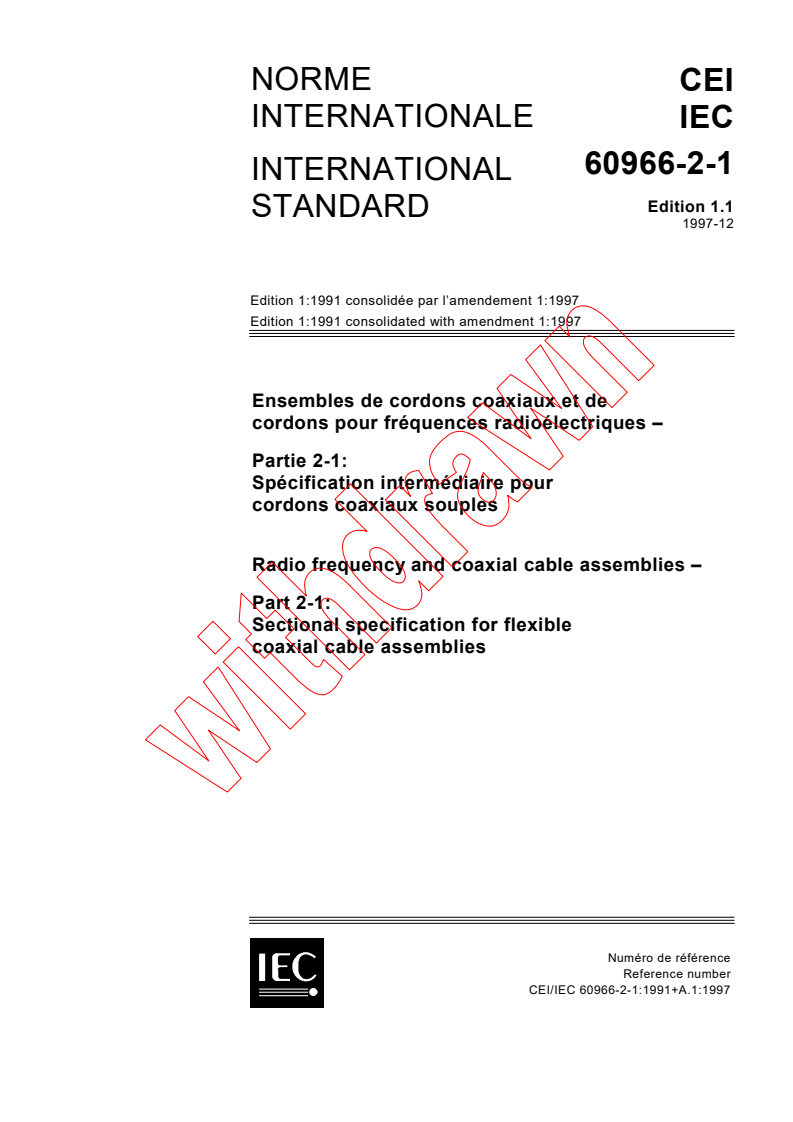
NORME
CEI
INTERNATIONALE
IEC
60966-2-1
INTERNATIONAL
Edition 1.1
STANDARD
1997-12
Edition 1:1991 consolidée par l’amendement 1:1997
Edition 1:1991 consolidated with amendment 1:1997
Ensembles de cordons coaxiaux et de
cordons pour fréquences radioélectriques –
Partie 2-1:
Spécification intermédiaire pour
cordons coaxiaux souples
Radio frequency and coaxial cable assemblies –
Part 2-1:
Sectional specification for flexible
coaxial cable assemblies
Numéro de référence
Reference number
CEI/IEC 60966-2-1:1991+A.1:1997
Numéros des publications Numbering
Depuis le 1er janvier 1997, les publications de la CEI As from the 1st January 1997 all IEC publications are
sont numérotées à partir de 60000. issued with a designation in the 60000 series.
Publications consolidées Consolidated publications
Les versions consolidées de certaines publications de Consolidated versions of some IEC publications
la CEI incorporant les amendements sont disponibles. including amendments are available. For example,
Par exemple, les numéros d’édition 1.0, 1.1 et 1.2 edition numbers 1.0, 1.1 and 1.2 refer, respectively, to
indiquent respectivement la publication de base, la the base publication, the base publication
publication de base incorporant l’amendement 1, et la incorporating amendment 1 and the base publication
publication de base incorporant les amendements 1 incorporating amendments 1 and 2.
et 2.
Validité de la présente publication Validity of this publication
Le contenu technique des publications de la CEI est The technical content of IEC publications is kept under
constamment revu par la CEI afin qu'il reflète l'état constant review by the IEC, thus ensuring that the
actuel de la technique. content reflects current technology.
Des renseignements relatifs à la date de Information relating to the date of the reconfirmation of
reconfirmation de la publication sont disponibles dans the publication is available in the IEC catalogue.
le Catalogue de la CEI.
Les renseignements relatifs à ces révisions, à l'établis- Information on the revision work, the issue of revised
sement des éditions révisées et aux amendements editions and amendments may be obtained from
peuvent être obtenus auprès des Comités nationaux de IEC National Committees and from the following
la CEI et dans les documents ci-dessous: IEC sources:
• Bulletin de la CEI • IEC Bulletin
• Annuaire de la CEI • IEC Yearbook
Accès en ligne* On-line access*
• Catalogue des publications de la CEI • Catalogue of IEC publications
Publié annuellement et mis à jour régulièrement Published yearly with regular updates
(Accès en ligne)* (On-line access)*
Terminologie, symboles graphiques Terminology, graphical and letter
et littéraux symbols
En ce qui concerne la terminologie générale, le lecteur For general terminology, readers are referred to
se reportera à la CEI 60050: Vocabulaire Electro- IEC 60050: International Electrotechnical Vocabulary
technique International (VEI). (IEV).
Pour les symboles graphiques, les symboles littéraux For graphical symbols, and letter symbols and signs
et les signes d'usage général approuvés par la CEI, le approved by the IEC for general use, readers are
referred to publications IEC 60027: Letter symbols to
lecteur consultera la CEI 60027: Symboles littéraux à
utiliser en électrotechnique, la CEI 60417: Symboles be used in electrical technology, IEC 60417: Graphical
graphiques utilisables sur le matériel. Index, relevé et symbols for use on equipment. Index, survey and
compilation of the single sheets
compilation des feuilles individuelles, et la CEI 60617: and IEC 60617:
Symboles graphiques pour schémas. Graphical symbols for diagrams.
Publications de la CEI établies par IEC publications prepared by the same
le même comité d'études technical committee
L'attention du lecteur est attirée sur les listes figurant The attention of readers is drawn to the end pages of
à la fin de cette publication, qui énumèrent les this publication which list the IEC publications issued
publications de la CEI préparées par le comité by the technical committee which has prepared the
d'études qui a établi la présente publication. present publication.
* Voir adresse «site web» sur la page de titre. * See web site address on title page.
NORME
CEI
INTERNATIONALE
IEC
60966-2-1
INTERNATIONAL
Edition 1.1
STANDARD
1997-12
Edition 1:1991 consolidée par l’amendement 1:1997
Edition 1:1991 consolidated with amendment 1:1997
Ensembles de cordons coaxiaux et de
cordons pour fréquences radioélectriques –
Partie 2-1:
Spécification intermédiaire pour
cordons coaxiaux souples
Radio frequency and coaxial cable assemblies –
Part 2-1:
Sectional specification for flexible
coaxial cable assemblies
IEC 1997 Droits de reproduction réservés Copyright - all rights reserved
Aucune partie de cette publication ne peut être reproduite ni No part of this publication may be reproduced or utilized in
utilisée sous quelque forme que ce soit et par aucun any form or by any means, electronic or mechanical,
procédé, électronique ou mécanique, y compris la photo- including photocopying and microfilm, without permission in
copie et les microfilms, sans l'accord écrit de l'éditeur. writing from the publisher.
International Electrotechnical Commission 3, rue de Varembé Geneva, Switzerland
Telefax: +41 22 919 0300 e-mail: inmail@iec.ch IEC web site http: //www.iec.ch
CODE PRIX
Commission Electrotechnique Internationale
PRICE CODE Q
International Electrotechnical Commission
Pour prix, voir catalogue en vigueur
For price, see current catalogue
– 2 – 60966-2-1 © CEI:1991+A.1:1997
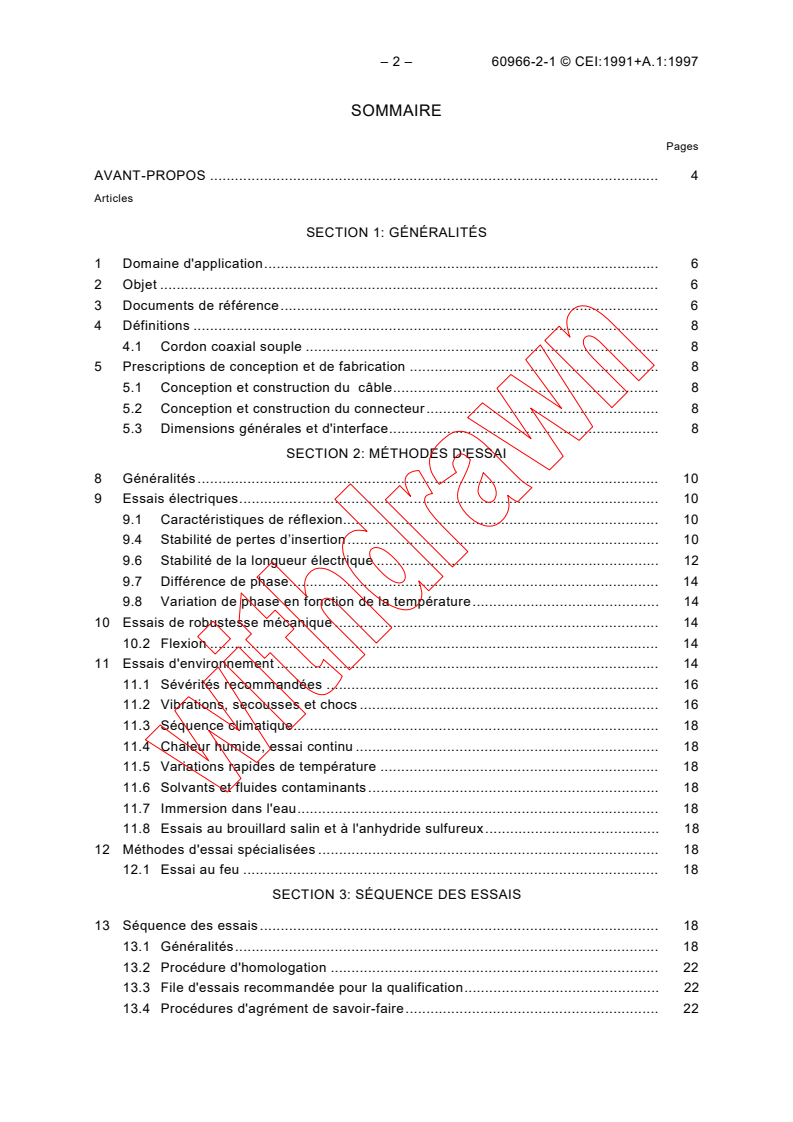
SOMMAIRE
Pages
AVANT-PROPOS . 4
Articles
SECTION 1: GÉNÉRALITÉS
1 Domaine d'application. 6
2 Objet . 6
3 Documents de référence. 6
4 Définitions . 8
4.1 Cordon coaxial souple . 8
5 Prescriptions de conception et de fabrication . 8
5.1 Conception et construction du câble. 8
5.2 Conception et construction du connecteur. 8
5.3 Dimensions générales et d'interface. 8
SECTION 2: MÉTHODES D'ESSAI
8 Généralités. 10
9 Essais électriques. 10
9.1 Caractéristiques de réflexion. 10
9.4 Stabilité de pertes d’insertion. 10
9.6 Stabilité de la longueur électrique . 12
9.7 Différence de phase. 14
9.8 Variation de phase en fonction de la température. 14
10 Essais de robustesse mécanique . 14
10.2 Flexion . 14
11 Essais d'environnement . 14
11.1 Sévérités recommandées . 16
11.2 Vibrations, secousses et chocs . 16
11.3 Séquence climatique. 18
11.4 Chaleur humide, essai continu . 18
11.5 Variations rapides de température . 18
11.6 Solvants et fluides contaminants. 18
11.7 Immersion dans l'eau. 18
11.8 Essais au brouillard salin et à l'anhydride sulfureux. 18
12 Méthodes d'essai spécialisées . 18
12.1 Essai au feu . 18
SECTION 3: SÉQUENCE DES ESSAIS
13 Séquence des essais . 18
13.1 Généralités. 18
13.2 Procédure d'homologation . 22
13.3 File d'essais recommandée pour la qualification. 22
13.4 Procédures d'agrément de savoir-faire. 22
60966-2-1 © IEC:1991+A.1:1997 – 3 –
CONTENTS
Page
FOREWORD . 5
Clause
SECTION 1: GENERAL
1 Scope . 7
2 Object . 7
3 Related documents . 7
4 Definitions. 9
4.1 Flexible coaxial cable assembly . 9
5 Design and manufacturing requirements. 9
5.1 Cable design and construction . 9
5.2 Connector design and construction . 9
5.3 Outline and interface dimensions . 9
SECTION 2: TEST METHODS
8 General. 11
9 Electrical tests . 11
9.1 Reflection properties. 11
9.4 Insertion loss stability . 11
9.6 Stability of electrical length . 13
9.7 Phase difference . 15
9.8 Phase variation with temperature . 15
10 Mechanical robustness tests . 15
10.2 Flexure. 15
11 Environmental tests. 17
11.1 Recommended severities. 17
11.2 Vibration, bumps and shock . 17
11.3 Climatic sequence . 19
11.4 Damp heat, steady state . 19
11.5 Rapid change of temperature. 19
11.6 Solvents and contaminating fluids . 19
11.7 Water immersion . 19
11.8 Salt mist and sulphur dioxide tests. 19
12 Specialised test methods. 19
12.1 Flammability . 19
SECTION 3: TEST SCHEDULES
13 Test schedules. 19
13.1 General . 19
13.2 Qualification approval procedure. 23
13.3 Recommended qualification test schedule. 23
13.4 Capability approval procedures . 23
– 4 – 60966-2-1 © CEI:1991+A.1:1997
COMMISSION ÉLECTROTECHNIQUE INTERNATIONALE
––––––––––
ENSEMBLES DE CORDONS COAXIAUX ET DE
CORDONS POUR FRÉQUENCES RADIOÉLECTRIQUES –
Partie 2-1: Spécification intermédiaire
pour cordons coaxiaux souples
AVANT-PROPOS
1) La CEI (Commission Electrotechnique Internationale) est une organisation mondiale de normalisation composée
de l'ensemble des comités électrotechniques nationaux (Comités nationaux de la CEI). La CEI a pour objet de
favoriser la coopération internationale pour toutes les questions de normalisation dans les domaines de
l'électricité et de l'électronique. A cet effet, la CEI, entre autres activités, publie des Normes Internationales.
Leur élaboration est confiée à des comités d'études, aux travaux desquels tout Comité national intéressé par le
sujet traité peut participer. Les organisations internationales, gouvernementales et non gouvernementales, en
liaison avec la CEI, participent également aux travaux. La CEI collabore étroitement avec l'Organisation
Internationale de Normalisation (ISO), selon des conditions fixées par accord entre les deux organisations.
2) Les décisions ou accords officiels de la CEI concernant les questions techniques, représentent, dans la mesure
du possible un accord international sur les sujets étudiés, étant donné que les Comités nationaux intéressés
sont représentés dans chaque comité d’études.
3) Les documents produits se présentent sous la forme de recommandations internationales. Ils sont publiés
comme normes, rapports techniques ou guides et agréés comme tels par les Comités nationaux.
4) Dans le but d'encourager l'unification internationale, les Comités nationaux de la CEI s'engagent à appliquer de
façon transparente, dans toute la mesure possible, les Normes internationales de la CEI dans leurs normes
nationales et régionales. Toute divergence entre la norme de la CEI et la norme nationale ou régionale
correspondante doit être indiquée en termes clairs dans cette dernière.
5) La CEI n’a fixé aucune procédure concernant le marquage comme indication d’approbation et sa responsabilité
n’est pas engagée quand un matériel est déclaré conforme à l’une de ses normes.
6) L’attention est attirée sur le fait que certains des éléments de la présente Norme internationale peuvent faire
l’objet de droits de propriété intellectuelle ou de droits analogues. La CEI ne saurait être tenue pour
responsable de ne pas avoir identifié de tels droits de propriété et de ne pas avoir signalé leur existence.
La présente spécification intermédiaire a été établie par le Sous-Comité 46A: Câbles
coaxiaux, du Comité d'Etudes 46 de la CEI: Câbles, fils, guides d'ondes, connecteurs et
accessoires pour communications et signalisation.
La présente version consolidée de la CEI 60966-2-1 est issue de la première édition (1991)
[documents 46A(BC)124 et 46A(BC)136] et de son amendement 1 (1997) [documents
46A/287/FDIS et 46A/296/RVD].
Elle porte le numéro d’édition 1.1.
Une ligne verticale dans la marge indique où la publication de base a été modifiée par
l’amendement 1.
60966-2-1 © IEC:1991+A.1:1997 – 5 –
INTERNATIONAL ELECTROTECHNICAL COMMISSION
–––––––––
RADIO FREQUENCY AND COAXIAL
CABLE ASSEMBLIES –
Part 2-1: Sectional specification for
flexible coaxial cable assemblies
FOREWORD
1) The IEC (International Electrotechnical Commission) is a worldwide organization for standardization comprising
all national electrotechnical committees (IEC National Committees). The object of the IEC is to promote
international co-operation on all questions concerning standardization in the electrical and electronic fields. To
this end and in addition to other activities, the IEC publishes International Standards. Their preparation is
entrusted to technical committees; any IEC National Committee interested in the subject dealt with may
participate in this preparatory work. International, governmental and non-governmental organizations liaising
with the IEC also participate in this preparation. The IEC collaborates closely with the International Organization
for Standardization (ISO) in accordance with conditions determined by agreement between the two
organizations.
2) The formal decisions or agreements of the IEC on technical matters express, as nearly as possible, an
international consensus of opinion on the relevant subjects since each technical committee has representation
from all interested National Committees.
3) The documents produced have the form of recommendations for international use and are published in the form
of standards, technical reports or guides and they are accepted by the National Committees in that sense.
4) In order to promote international unification, IEC National Committees undertake to apply IEC International
Standards transparently to the maximum extent possible in their national and regional standards. Any
divergence between the IEC Standard and the corresponding national or regional standard shall be clearly
indicated in the latter.
5) The IEC provides no marking procedure to indicate its approval and cannot be rendered responsible for any
equipment declared to be in conformity with one of its standards.
6) Attention is drawn to the possibility that some of the elements of this International Standard may be the subject
of patent rights. The IEC shall not be held responsible for identifying any or all such patent rights.
This sectional specification has been prepared by Sub-Committee 46A: Coaxial cables, of IEC
Technical Committee 46: Cables, wires, waveguides, R.F. connectors and accessories for
communication and signalling.
This consolidated version of IEC 60966-2-1 is based on the first edition (1991) [documents
46A(CO)124 and 46A(CO)136] and its amendment 1 (1997) [documents 46A/287/FDIS and
46A/296/RVD].
It bears the edition number 1.1.
A vertical line in the margin shows where the base publication has been modified by
amendment 1.
– 6 – 60966-2-1 © CEI:1991+A.1:1997
ENSEMBLES DE CORDONS COAXIAUX ET DE
CORDONS POUR FRÉQUENCES RADIOÉLECTRIQUES –
Partie 2-1: Spécification intermédiaire
pour cordons coaxiaux souples
SECTION 1: GÉNÉRALITÉS
1 Domaine d'application
La présente spécification intermédiaire concerne les cordons coaxiaux souples fonctionnant
dans le mode électromagnétique transversal (TEM).
Elle doit être utilisée avec la CEI 60966-1: Spécification générique pour ensembles de cordons
coaxiaux et de cordons pour fréquences radioélectriques. Le numérotage des paragraphes est
le même que dans la spécification générique; pour les paragraphes manquants, voir la
spécification générique.
Objet
La présente spécification intermédiaire établit des prescriptions uniformes pour l'essai des
propriétés électriques, mécaniques et climatiques des cordons souples composés de câbles
coaxiaux et de connecteurs coaxiaux.
A la présente spécification intermédiaire doivent s'ajouter des spécifications particulières
donnant des détails supplémentaires comme l'exige l'application individuelle.
3 Documents de référence
CEI 60068-2-6:1970 (quatrième édition), Essais d'environnement, Deuxième partie: Essais,
Essai Fc et guide: Vibrations (sinusoïdales)
CEI 60096, Câbles pour fréquences radioélectriques
CEI 60096-2:1988, Câbles pour fréquences radioélectriques, Deuxième partie: Spécifications
particulières de câbles
CEI 60332-1:1979, Essais des câbles électriques soumis au feu, Première partie: Essai
effectué sur un câble vertical
CEI 60410:1973, Plans et règles d'échantillonnage pour les contrôles par attributs
CEI 60966-1:1988, Spécification générique pour ensembles de cordons coaxiaux et de cordons
pour fréquences radioélectriques, Première partie: Généralités et méthodes d'essai
Modification 1 (1990), Amendement 2 (1995)
CEI QC 001002:1986, Règles de procédure du Système CEI d'assurance de la qualité des
composants électroniques (IECQ)
60966-2-1 © IEC:1991+A.1:1997 – 7 –
RADIO FREQUENCY AND COAXIAL
CABLE ASSEMBLIES –
Part 2-1: Sectional specification for
flexible coaxial cable assemblies
SECTION 1: GENERAL
1 Scope
This sectional specification relates to flexible coaxial cable assemblies operating in the
transverse electromagnetic mode (TEM).
It shall be used together with IEC 60966-1: Generic specification for radio frequency and
coaxial cable assemblies. The numbering of the subclauses is the same as in the generic
specification; for the missing subclauses, see the generic specification.
2 Object
This sectional specification establishes uniform requirements for testing the electrical,
mechanical and climatic properties of flexible cable assemblies composed of flexible coaxial
cables and coaxial connectors.
This sectional specification shall be supplemented with detail specifications giving additional
details as required by the particular application.
3 Related documents
IEC 60068-2-6:1970 (fourth edition), Environmental testing, Part 2: Tests, Test Fc and
guidance: Vibration (sinusoidal)
IEC 60096, Radio frequency cables
IEC 60096-2:1988, Radio frequency cables, Part 2: Relevant cable specifications
IEC 60332-1:1979, Tests on electric cables under fire conditions, Part 1: Test on a single
vertical insulated wire or cable
IEC 60410:1973, Sampling plans and procedures for inspection by attributes
IEC 60966-1:1988, Generic specification for radio frequency and coaxial cable assemblies.
Part 1: General requirements and test methods
Amendment 1 (1990), Amendment 2 (1995)
IEC QC 001002:1986, Rules of Procedure of the IEC quality assessment system for
electronic components (IECQ)
– 8 – 60966-2-1 © CEI:1991+A.1:1997
4 Définitions
4.1 Cordon coaxial souple
Combinaison d'un câble souple et de connecteurs ayant un fonctionnement spécifié, utilisés
comme simple unité.
NOTE - Les cordons réalisés conformément à la présente spécification intermédiaire comprennent un tronçon de
câble et deux connecteurs. Lorsque cela est précisé dans la spécification particulière, le cordon peut aussi
comprendre des étiquettes pour l'identification du cordon et des connecteurs d'extrémités. Des capuchons
d'extrémité et autres accessoires peuvent également être spécifiés.
Pour les besoins de la présente spécification intermédiaire, un cordon est toujours considéré
comme une unité intégrale. Toutes les spécifications s'appliquent au cordon terminé et non à
des constituants individuels ou non assemblés de celui-ci.
* Lorsque spécifié
Figure 1 – Exemple de cordon
5 Prescriptions de conception et de fabrication
5.1 Conception et construction du câble
Lorsque cela est possible, les câbles doivent être conformes à la CEI 60096-2. Si nécessaire,
le fabricant peut utiliser un tube protecteur supplémentaire ou un câble s'écartant de la
CEI 60096, de façon à répondre aux exigences de la spécification particulière.
Les matériaux utilisés dans le câble doivent être indiqués pour information dans la
spécification particulière.
5.2 Conception et construction du connecteur
Les matériaux utilisés dans le connecteur doivent être indiqués pour information dans la
spécification particulière.
5.3 Dimensions générales et d'interface
Les dimensions générales doivent être conformes aux spécifications particulières. Sans autre
particularité, la longueur spécifiée s'applique au câble avant dénudage. La longueur extérieure
du cordon sera plus longue et dépend des connecteurs.
Si elle n'est pas indiquée dans la spécification particulière, la tolérance de longueur doit être
de ±1 % pour les câbles de longueur égale ou supérieure à 300 mm et de ±3 mm pour les
câbles plus courts que 300 mm.
60966-2-1 © IEC:1991+A.1:1997 – 9 –
4 Definitions
4.1 Flexible coaxial cable assembly
A combination of a flexible cable and connectors used as a single unit with specified
performance.
NOTE – Cable assemblies made in accordance with this sectional specification comprise a section of cable and two
connectors. When specified in the detail specification, the assembly may additionally include markers for
identification of the assembly and interconnecting ends. End caps and other accessories may also be specified.
For the purpose of this sectional specification, a cable assembly is always regarded as an
integral unit. All specifications apply to the finished assembly and not to individual and non-
assembled parts thereof.
* When specified
Figure 1 – Example of a cable assembly
5 Design and manufacturing requirements
5.1 Cable design and construction
Whenever possible, cables shall conform to IEC 60096-2. If required, the manufacturer may
use additional protective tubing or cable deviating from IEC 60096, in order to comply with the
requirements of the detail specification.
The materials used in the cable shall be given as engineering information in the detail
specification.
5.2 Connector design and construction
The materials used in the connector shall be given as engineering information in the detail
specification.
5.3 Outline and interface dimensions
The outine dimensions shall be in accordance with the detail specifications. If not further
detailed, the specified length applies to the cable before stripping. The overall length of the
assembly will be longer and depends on the connectors.
If not indicated in the detail specification, the length tolerance shall be ±1 % for cables equal or
longer than 300 mm and ±3 mm for cables shorter than 300 mm.
– 10 – 60966-2-1 © CEI:1991+A.1:1997
7 SECTION 2: MÉTHODES D'ESSAI
8 Généralités
Toutes les méthodes d'essai autres que celles indiquées ou décrites ci-dessous sont données
dans la spécification générique ou particulière.
9 Essais électriques
9.1 Caractéristiques de réflexion
Bien que l'affaiblissement de réflexion (A ) soit le paramètre préférentiel, le facteur de réflexion
r
(r), ainsi que le rapport d'onde stationnaire (ROS) peuvent être spécifiés
A = –20 log r et ROS = (1 + r )/ (1 – r ).
r 10
9.4 Stabilité de pertes d'insertion
Les fréquences d'essai ou la bande de fréquences doivent être choisies de façon que les
pertes d'insertion mesurées soient au moins dix fois plus élevées que la résolution du système
de mesure.
Conformément aux caractéristiques de flexibilité du cordon, l'un des dispositifs mécaniques
indiqués à la figure 2 doit être utilisé. L'essai peut ne pas être applicable pour les cordons
courts.
Les dispositifs a) et b) sont prévus pour les méthodes d'essai 1 et 2 de mesure en
transmission. Le dispositif c) est prévu pour la méthode d'essai 3 de mesure en réflexion. Les
méthodes d'essai 1, 2 et 3 sont indiquées dans la CEI 60966-1, Modification 1, annexe B. En
plus du pliage du câble, le dispositif a) implique une torsion autour de son axe longitudinal de
360° par tour.
Au cours de la mesure des pertes d'insertion, le câble est d'abord enroulé autour du mandrin
dans le sens des aiguilles d'une montre, puis relâché vers la position neutre (position de
départ), enroulé autour du mandrin dans le sens inverse des aiguilles d'une montre puis à
nouveau relâché pour le ramener à sa position de départ. On doit enregistrer la variation des
pertes d'insertion au cours de ces mouvements.
Pour les cordons longs, le nombre de tours doit être choisi de façon que, après enroulement,
20 % ou plus de la longueur du cordon soient en contact avec le mandrin.
Le dispositif utilisé doit être indiqué dans la spécification particulière. Le dispositif préférentiel
est le dispositif a) de la figure 2.
60966-2-1 © IEC:1991+A.1:1997 – 11 –
7 SECTION 2: TEST METHODS
8 General
All test methods other than those indicated or described below are given in the generic or detail
specification.
9 Electrical tests
9.1 Reflection properties
Whilst the parameter return loss (A ) is preferred, the reflection factor (r) or the VSWR may be
r
specified, where
A = –20 log r and VSWR = (1 + r )/ (1 – r ).
r 10
9.4 Insertion loss stability
The test frequencies or frequency range shall be chosen such that the measured insertion loss
is at least ten times higher than the resolution of the test system.
In accordance with the flexibility characteristics of the cable assembly, one of the mechanical
arrangements given in figure 2 shall be used. The test may not be appropriate for short cable
assemblies.
Arrangements a) and b) provide for a transmission measurement by test methods 1 and 2.
Arrangement c) provides for a reflection measurement by test method 3. Test methods 1, 2
and 3 are indicated in appendix B of IEC 60966-1, Amendment 1. In addition to cable bending,
arrangement a) implies torsional twisting around its longitudinal axis of 360° per turn.
During the measurement of insertion loss, the cable is first wound clockwise around the
mandrel, released to the neutral position (starting position), wound counter-clockwise around
the mandrel and again released to its starting position. The variation of insertion loss shall be
recorded during these movements.
For long cable assemblies, the number of turns shall be chosen such that, after winding, 20 %
or more of the length of cable is in contact with the mandrel.
The arrangement used shall be indicated in the detail specification. Arrangement a) of figure 2
is preferred.
– 12 – 60966-2-1 © CEI:1991+A.1:1997
Figure 2 – Dispositifs pour l'essai de stabilité des pertes d'insertion
et de stabilité de la longueur électrique
9.6 Stabilité de la longueur électrique
Selon la flexibilité, les caractéristiques de torsion et la longueur des cordons, on peut utiliser
l'une des méthodes suivantes pour déterminer la stabilité de la longueur électrique en fonction
des contraintes mécaniques.
Méthode I
On doit utiliser le dispositif mécanique a) de la figure 2. Au cours de la mesure de la différence
de phase, le câble est d'abord enroulé dans le sens des aiguilles d'une montre autour du
mandrin dont le diamètre est indiqué dans la spécification particulière, puis relâché vers la
position neutre (position de départ), enroulé dans le sens inverse des aiguilles d'une montre
autour du mandrin et à nouveau relâché pour le ramener à sa position de départ. La variation
de phase doit être enregistrée au cours de ces mouvements de torsion et de pliage combinés.
Méthode II
Pour les cordons ne pouvant se tordre que difficilement, la méthode I peut ne pas être
applicable. La stabilité de la longueur électrique en fonction du pliage et de la torsion doit alors
être mesurée indépendamment dans deux dispositifs différents.
Pliage
On doit utiliser le dispositif mécanique b) de la figure 2. Au cours de la mesure de la différence
de phase, le câble est d'abord enroulé dans le sens des aiguilles d'une montre autour du
mandrin, puis relâché vers la position neutre (position de départ), enroulé dans le sens inverse
des aiguilles d'une montre autour du mandrin et à nouveau relâché pour le ramener à sa
position de départ. La variation de phase doit être enregistrée au cours de ces mouvements de
pliage.
60966-2-1 © IEC:1991+A.1:1997 – 13 –
Figure 2 – Arrangements for testing insertion loss stability
and stability of electrical length
9.6 Stability of electrical length
Depending on the flexibility, the torsional characteristics and the length of the cable
assemblies, one of the following methods may be used to determine the stability of the
electrical length as a function of the mechanical constraints.
Method I
The mechanical arrangement a) of figure 2 shall be used. During the measurement of the
phase difference, the cable is first wound clockwise around a mandrel of diameter given in the
detail specification. It is released to the neutral position (starting position), wound counter-
clockwise around the mandrel and again released to its starting position. The variation of
phase shall be recorded during these composite movements of twisting and bending.
Method II
For cable assemblies which are torsionally stiff, method I may not be appropriate. The stability
of electrical length as a function of bending and twisting shall then be measured independently
in two different arrangements.
Bending
The mechanical arrangement b) of figure 2 shall be used. During the measurement of the
phase difference, the cable is first wound clockwise around the mandrel, then it is released to
the neutral position (starting position), wound counter-clockwise around the mandrel and again
released to its starting position. The variation of phase shall be recorded during these bending
movements.
– 14 – 60966-2-1 © CEI:1991+A.1:1997
Torsion
On doit utiliser le dispositif mécanique d) de la figure 3. Au cours de la mesure de la différence
de phase, la courbure dans le milieu du câble subit d'abord un mouvement de torsion dans le
sens des aiguilles d'une montre, puis est relâchée vers la position neutre (position de départ),
subit une torsion dans le sens inverse des aiguilles d'une montre et est à nouveau relâchée
pour la ramener à sa position de départ. La variation de phase doit être enregistrée au cours
de ces mouvements de torsion.
Figure 3 – Dispositif d) pour l'essai de stabilité de la longueur électrique
9.7 Différence de phase
Si plus de deux cordons font partie d'un groupe apparié, le cordon de référence doit être
clairement marqué.
9.8 Variation de phase en fonction de la température
Selon l'application du cordon, une des deux méthodes peut être employée pour déterminer la
variation de phase en fonction de la température.
Méthode I: Variation de phase dans une plage de températures donnée
Les bandes de fréquences et plages de températures doivent être indiquées dans la
spécification particulière. Le résultat peut être présenté en degrés/GHz ou en degrés. On
préfère les degrés/GHz, normalisés en fréquence.
Méthode II: Sensibilité de la phase en fonction de la température, c'est-à-dire dérivée des
variations de phase ci-dessus
Les bandes de fréquences et plages de températures doivent être indiquées dans la
spécification particulière. Le résultat peut être présenté en degrés/GHz/K ou en degrés/K. On
préfère les degrés/GHz/K normalisés en fréquence.
10 Essais de robustesse mécanique
10.2 Flexion
Si elle n'est pas précisée dans la spécification particulière, une force F doit être appliquée au
cordon de façon que la charge totale sur le joint du câble au connecteur soit égale au poids de
10 m de câble.
60966-2-1 © IEC:1991+A.1:1997 – 15 –
Twisting
The mechanical arrangement d) shown in figure 3 shall be used. During the measurement of
the phase difference, the bow in the middle of the cable is first twisted in a clockwise direction
then released to the neutral position (starting position), twisted counter-clockwise and again
released to its starting position. The variation of phase shall be recorded during these twisting
movements.
Figure 3 – Arrangement d) for testing stability of electrical length
9.7 Phase difference
If more than two cable assemblies belong to a matched set, the reference cable assembly shall
be clearly marked.
9.8 Phase variation with temperature
Depending on the application of the cable assembly, one of two methods may be used to
determine the variation of the phase as a function of temperature.
Method I: Phase change within a given temperature range
The frequency and temperature ranges shall be indicated in the detail specification. The result
may be presented in degrees/GHz or degrees. The frequency normalised unit degrees/GHz is
preferred.
Method II: Phase sensitivity as a function of temperature, i.e. the derivative of the phase
change
The frequency and temperature ranges shall be indicated in the detail specification. The result
may be expressed in degrees/GHz/K or degrees/K. The frequency normalised unit degrees/GHz/K
is preferred.
10 Mechanical robustness tests
10.2 Flexure
If it is not defined in the detail specification, a force F shall be applied to the cable assembly
such that the total load on the joint of the cable to the connector is equal to the weight of 10 m
of the cable.
– 16 – 60966-2-1 © CEI:1991+A.1:1997
11 Essais d'environnement
11.1 Sévérités recommandées
Les sévérités pour les essais climatiques doivent être choisies dans l'annexe E de la
CEI 60966-1, Modification 1, sauf indication contraire dans la spécification particulière.
11.2 Vibrations, secousses et chocs
11.2.1 Vibrations
11.2.1.1 Procédure
Les essais doivent être effectués conformément à l'essai Fc de la CEI 60068-2-6, Procédure B4.
La sévérité des vibrations doit être choisie en E.2.1 de la CEI 60966-1, Modification 1, sauf
indication contraire dans la spécification particulière.
Figure 4 – Dispositif préférentiel pour l'essai de vibration
Le dispositif préférentiel pour l'essai de vibration est décrit à la figure 4. On doit faire vibrer la
portion de câble du cordon dans chacune des trois directions perpendiculaires dont l'une doit
être parallèle à l'axe commun des connecteurs. La continuité du conducteur intérieur et
extérieur doit être contrôlée au cours de l'essai. L'équipement d'essai doit pouvoir déceler des
interruptions de 1 μs.
11.2.1.2 Prescriptions
Il ne doit y avoir aucune discontinuité en courant continu ou basse fréquence du conducteur
intérieur ou extérieur au cours de l'essai.
Après l'essai, les pertes d'insertion et l'affaiblissement de réflexion ne doivent pas dépasser
les limites spécifiées.
11.2.1.3 Renseignements devant être fournis dans la spécification particulière:
a) particularités de montage du cordon;
b) paramètres de sévérité pour les vibrations conformément à E.2.1 de la CEI 60966-1,
Modification 1;
c) paramètres d'essai pour le contrôle de la continuité conformément à 9.12.4 de la
CEI 60966-1;
d) prescription pour les pertes d'insertion;
e) prescription pour l'affaiblissement de réflexion.
60966-2-1 © IEC:1991+A.1:1997 – 17 –
11 Environmental tests
11.1 Recommended severities
The severities for the environmental tests shall be chosen from appendix E of IEC 60966-1,
Amendment 1, unless otherwise indicated in the detail specification.
11.2 Vibration, bumps and shock
11.2.1 Vibration
11.2.1.1 Procedure
The tests shall be carried out in accordance with test Fc of IEC 60068-2-6, Procedure B4.
The vibration severity shall be chosen from E.2.1 of IEC 60966-1, Amendment 1, unless
otherwise indicated in the detail specification.
Figure 4 – Preferred arrangement for the vibration test
The preferred arrangement for the vibration test is described in figure 4. The cable portion of
the cable assembly shall be vibrated in each of three perpendicular directions, one of which
shall be parallel to the common axis of the connectors. The continuity of the inner and outer
conductors shall be monitored during the test. The test equipment shall be able to reveal
interruptions of 1 μs.
11.2.1.2 Requirements
There shall be no d.c. or low frequency discontinuity of the inner or outer conductor during the
test.
After the test, the insertion loss and return loss shall not exceed the specified limits.
11.2.1.3 Information to be gven in the detail specification:
a) mounting details of the cable assembly;
b) severity parameters for vibration according to E.2.1 of IEC 60966-1, Amendment 1;
c) test parameters for continuity checking according to 9.12.4 of IEC 60966-1;
d) requirement for insertion loss;
e) requirement for return loss.
– 18 – 60966-2-1 © CEI:1991+A.1:1997
11.2.2 Secousses
Cet essai doit être précisé, si nécessaire, dans la spécification particulière.
Pour les sévérités recommandées, voir E.2.2 de la CEI 60966-1, Modification 1.
11.2.3 Chocs
Cet essai doit être précisé, si nécessaire, dans la spécification particulière.
Pour les sévérités recommandées, voir E.2.3 de la CEI 60966-1, Modification 1.
11.3 Séquence climatique
La procédure d'essai indiquée en E.2.4 de la CEI 60966-1, Modification 1, est préférentielle.
11.4 Chaleur humide, essai continu
Voir 11.4 de la CEI 60966-1 et E.2.5 de la Modification 1.
11.5 Variations rapides de température
Voir 11.5 de la CEI 60966-1 et E.2.6 de la Modification 1.
11.6 Solvants et fluides contaminants
Ces essais sont des essais spéciaux pour les cordons selon spécification client et doivent être
indiqués dans la spécification particulière, si prescrit en 13.3.
11.7 Immersion dans l'eau
Cet essai est un essai spécial pour les cordons selon spécification client et doit être indiqué
dans la spécification particulière, si prescrit en 13.3.
11.8 Essais au brouillard salin et à l'anhydride sulfureux
Voir E.2.7 et E.2.8 de la CEI 60966-1, Modification 1.
12 Méthodes d'essai spécialisées
12.1 Essai au feu
Lorsque cela est prescrit par la spécification particulière, le câble utilisé dans le cordon doit
être essayé conformément à la CEI 60332-1.
SECTION 3: SÉQUENCE DES ESSAIS
13 Séquence des essais
13.1 Généralités
A côté des prescriptions électriques, mécaniques et d'environnement, la spécification
particulière doit indiquer les essais à effectuer avec les niveaux de contrôle correspondants,
les niveaux de qualité de la réception et les périodicités. Lorsque cela est possible, à la place
d'essais individuels, des groupes d'essais complets du tableau 1 doivent être spécifiés, par
exemple Eb, Ep, Vt.
60966-2-1 © IEC:1991+A.1:1997 – 19 –
11.2.2 Bumps
This test shall be specified, if necessary, in the detail specification.
For the recommended severities, see E.2.2 of IEC 60966-1, Amendment 1.
11.2.3 Shock
This test shall be specified, if necessary, in the detail specification.
For the recommended severities, see E.2.3 of IEC 60966-1, Amendm
...
Questions, Comments and Discussion
Ask us and Technical Secretary will try to provide an answer. You can facilitate discussion about the standard in here.
Loading comments...