

IEC 60076-22-3:2019
(Main)Power transformers - Part 22-3: Power transformer and reactor fittings - Insulating liquid to air heat exchangers
General Information
- Abstract
IEC 60076-22-3:2019 applies to liquid to air heat exchangers, using forced air and forced liquid circuits, used on liquid immersed power transformers according to IEC 60076-1 and reactors according to IEC 60076-6 with and without conservator for indoor or outdoor installation. It outlines the service conditions and the mechanical and electrical requirements that are common to this equipment. It also outlines the operation requirements specific to this equipment as well as the preferred dimensions relevant for interchangeability and the type and routine tests to be performed.
Keywords: insulating liquid to air heat exchangers in the cooling circuits of power transformers and reactors
- Status
- Published
- Publication Date
- 07-Mar-2019
- Technical Committee
- TC 14 - Power transformers
- Drafting Committee
- WG 32 - TC 14/WG 32
- Current Stage
- PPUB - Publication issued
- Start Date
- 08-Mar-2019
- Completion Date
- 05-Apr-2019
Overview
IEC 60076-22-3:2019 is an international standard published by the International Electrotechnical Commission (IEC) that specifies requirements for insulating liquid to air heat exchangers used in the cooling circuits of liquid immersed power transformers and reactors. These heat exchangers employ forced air and forced liquid circuits to manage thermal dissipation, ensuring the reliable operation of transformers and reactors in both indoor and outdoor installations.
This standard applies to equipment used with power transformers according to IEC 60076-1 and reactors following IEC 60076-6. It provides comprehensive guidelines on service conditions, mechanical and electrical requirements, operation specifics, preferred dimensions for interchangeability, and necessary type and routine testing protocols.
Key Topics
Scope and Service Conditions
The standard covers heat exchangers that are integral parts of liquid immersed transformers and reactors with or without conservators. It considers both indoor and outdoor service environments, addressing the relevant service conditions such as ambient temperature, humidity, and exposure to external elements.Design and Characteristics
Includes detailed specifications for the main components of heat exchangers such as headers, tube sheets, tube bundles, turbulators, and passes. It emphasizes a standard design and cooling arrangement to promote compatibility and interchangeability.Mechanical and Corrosion Protection
Specifies corrosion protection requirements for both external atmospheric exposure and the insulating liquid side of the equipment. It assigns appropriate degrees of protection (IP codes) for electrical components to ensure operational safety and durability.Thermal Performance
Defines methods to assess cooling capacity relative to factors like average insulating oil temperature, flow rates of air and liquid, and ensures that performance aligns with transformer and reactor cooling needs.Testing Requirements
Mandates routine tests that include tightness, visual inspections, functional tests, cleanliness, and external painting inspections. Type tests focus on verifying rated values and overall performance to guarantee quality and conformity to operational standards.Standard Dimensions and Interchangeability
Offers preferred dimensions to facilitate interchangeability of heat exchangers across various transformer and reactor designs, helping streamline procurement, installation, and maintenance processes.
Applications
IEC 60076-22-3:2019 primarily serves manufacturers, designers, and operators of power transformers and reactors that utilize insulating liquid to air heat exchangers for effective thermal management. Key application areas include:
Power Generation Plants
Ensuring efficient cooling of transformers critical to stable power delivery.Electrical Utilities
Supporting grid reliability through optimized transformer cooling solutions that reduce downtime and extend equipment lifespan.Industrial Facilities
Implementing robust transformer cooling systems aligned with international standards to maintain operational continuity.Transformer Manufacturing
Designing and producing heat exchangers that meet strict IEC requirements to ensure global applicability and customer confidence.Maintenance and Testing Services
Conducting routine and type tests as prescribed by IEC 60076-22-3 to validate heat exchanger performance and safety.
Related Standards
IEC 60076-22-3:2019 complements other standards within the IEC 60076 series that collectively address various aspects of power transformer design and operation:
- IEC 60076-1: Power Transformers – General requirements
- IEC 60076-6: Reactors
- IEC 60076-7: Loading guide for mineral oil-immersed transformers
- IEC 60296: Fluids for electrotechnical applications – Mineral insulating oils
- IEC 60529: Degrees of protection provided by enclosures (IP Code)
Additional international standards referenced include:
- ISO 3746: Acoustics – Determination of sound power levels
- ISO 4406: Hydraulic fluid power – Contamination coding
- ISO 7005: Pipe flanges
These related standards support the proper selection, testing, and installation of insulating liquid to air heat exchangers and their integration within power transformer and reactor systems.
Keywords: insulating liquid to air heat exchangers, power transformer cooling, reactor fittings, IEC 60076-22-3, transformer heat dissipation, forced air cooling, forced liquid circuits, transformer thermal management, IEC power transformer standards, heat exchanger testing, corrosion protection, transformer maintenance.
Get Certified
Connect with accredited certification bodies for this standard

IMQ S.p.A. (Certification)
Italian electrical product certification.

SLG Prüf- und Zertifizierungs GmbH
German testing and certification body.

UL Solutions
Global safety science company with testing, inspection and certification.
Sponsored listings
Frequently Asked Questions
IEC 60076-22-3:2019 is a standard published by the International Electrotechnical Commission (IEC). Its full title is "Power transformers - Part 22-3: Power transformer and reactor fittings - Insulating liquid to air heat exchangers". This standard covers: IEC 60076-22-3:2019 applies to liquid to air heat exchangers, using forced air and forced liquid circuits, used on liquid immersed power transformers according to IEC 60076-1 and reactors according to IEC 60076-6 with and without conservator for indoor or outdoor installation. It outlines the service conditions and the mechanical and electrical requirements that are common to this equipment. It also outlines the operation requirements specific to this equipment as well as the preferred dimensions relevant for interchangeability and the type and routine tests to be performed. Keywords: insulating liquid to air heat exchangers in the cooling circuits of power transformers and reactors
IEC 60076-22-3:2019 applies to liquid to air heat exchangers, using forced air and forced liquid circuits, used on liquid immersed power transformers according to IEC 60076-1 and reactors according to IEC 60076-6 with and without conservator for indoor or outdoor installation. It outlines the service conditions and the mechanical and electrical requirements that are common to this equipment. It also outlines the operation requirements specific to this equipment as well as the preferred dimensions relevant for interchangeability and the type and routine tests to be performed. Keywords: insulating liquid to air heat exchangers in the cooling circuits of power transformers and reactors
IEC 60076-22-3:2019 is classified under the following ICS (International Classification for Standards) categories: 29.180 - Transformers. Reactors. The ICS classification helps identify the subject area and facilitates finding related standards.
IEC 60076-22-3:2019 is available in PDF format for immediate download after purchase. The document can be added to your cart and obtained through the secure checkout process. Digital delivery ensures instant access to the complete standard document.
Standards Content (Sample)
IEC 60076-22-3 ®
Edition 1.0 2019-03
INTERNATIONAL
STANDARD
NORME
INTERNATIONALE
Power transformers –
Part 22-3: Power transformer and reactor fittings – Insulating liquid to air heat
exchangers
Transformateurs de puissance –
Partie 22-3: Accessoires pour transformateurs de puissance et bobines
d’inductance – Aéroréfrigérants
All rights reserved. Unless otherwise specified, no part of this publication may be reproduced or utilized in any form
or by any means, electronic or mechanical, including photocopying and microfilm, without permission in writing from
either IEC or IEC's member National Committee in the country of the requester. If you have any questions about IEC
copyright or have an enquiry about obtaining additional rights to this publication, please contact the address below or
your local IEC member National Committee for further information.
Droits de reproduction réservés. Sauf indication contraire, aucune partie de cette publication ne peut être reproduite ni
utilisée sous quelque forme que ce soit et par aucun procédé, électronique ou mécanique, y compris la photocopie et
les microfilms, sans l'accord écrit de l'IEC ou du Comité national de l'IEC du pays du demandeur. Si vous avez des
questions sur le copyright de l'IEC ou si vous désirez obtenir des droits supplémentaires sur cette publication, utilisez
les coordonnées ci-après ou contactez le Comité national de l'IEC de votre pays de résidence.
IEC Central Office Tel.: +41 22 919 02 11
3, rue de Varembé info@iec.ch
CH-1211 Geneva 20 www.iec.ch
Switzerland
About the IEC
The International Electrotechnical Commission (IEC) is the leading global organization that prepares and publishes
International Standards for all electrical, electronic and related technologies.
About IEC publications
The technical content of IEC publications is kept under constant review by the IEC. Please make sure that you have the
latest edition, a corrigendum or an amendment might have been published.
IEC publications search - webstore.iec.ch/advsearchform Electropedia - www.electropedia.org
The advanced search enables to find IEC publications by a The world's leading online dictionary on electrotechnology,
variety of criteria (reference number, text, technical containing more than 22 000 terminological entries in English
committee,…). It also gives information on projects, replaced and French, with equivalent terms in 16 additional languages.
and withdrawn publications. Also known as the International Electrotechnical Vocabulary
(IEV) online.
IEC Just Published - webstore.iec.ch/justpublished
Stay up to date on all new IEC publications. Just Published IEC Glossary - std.iec.ch/glossary
details all new publications released. Available online and once 67 000 electrotechnical terminology entries in English and
a month by email. French extracted from the Terms and Definitions clause of IEC
publications issued since 2002. Some entries have been
IEC Customer Service Centre - webstore.iec.ch/csc collected from earlier publications of IEC TC 37, 77, 86 and
If you wish to give us your feedback on this publication or need CISPR.
further assistance, please contact the Customer Service
Centre: sales@iec.ch.
A propos de l'IEC
La Commission Electrotechnique Internationale (IEC) est la première organisation mondiale qui élabore et publie des
Normes internationales pour tout ce qui a trait à l'électricité, à l'électronique et aux technologies apparentées.
A propos des publications IEC
Le contenu technique des publications IEC est constamment revu. Veuillez vous assurer que vous possédez l’édition la
plus récente, un corrigendum ou amendement peut avoir été publié.
Recherche de publications IEC - Le premier dictionnaire d'électrotechnologie en ligne au monde,
webstore.iec.ch/advsearchform avec plus de 22 000 articles terminologiques en anglais et en
La recherche avancée permet de trouver des publications IEC français, ainsi que les termes équivalents dans 16 langues
en utilisant différents critères (numéro de référence, texte, additionnelles. Egalement appelé Vocabulaire
comité d’études,…). Elle donne aussi des informations sur les Electrotechnique International (IEV) en ligne.
projets et les publications remplacées ou retirées.
Glossaire IEC - std.iec.ch/glossary
IEC Just Published - webstore.iec.ch/justpublished 67 000 entrées terminologiques électrotechniques, en anglais
Restez informé sur les nouvelles publications IEC. Just et en français, extraites des articles Termes et Définitions des
Published détaille les nouvelles publications parues. publications IEC parues depuis 2002. Plus certaines entrées
Disponible en ligne et une fois par mois par email. antérieures extraites des publications des CE 37, 77, 86 et
CISPR de l'IEC.
Service Clients - webstore.iec.ch/csc
Si vous désirez nous donner des commentaires sur cette
publication ou si vous avez des questions contactez-nous:
sales@iec.ch.
Electropedia - www.electropedia.org
IEC 60076-22-3 ®
Edition 1.0 2019-03
INTERNATIONAL
STANDARD
NORME
INTERNATIONALE
Power transformers –
Part 22-3: Power transformer and reactor fittings – Insulating liquid to air heat
exchangers
Transformateurs de puissance –
Partie 22-3: Accessoires pour transformateurs de puissance et bobines
d’inductance – Aéroréfrigérants
INTERNATIONAL
ELECTROTECHNICAL
COMMISSION
COMMISSION
ELECTROTECHNIQUE
INTERNATIONALE
ICS 29.180 ISBN 978-2-8322-6634-2
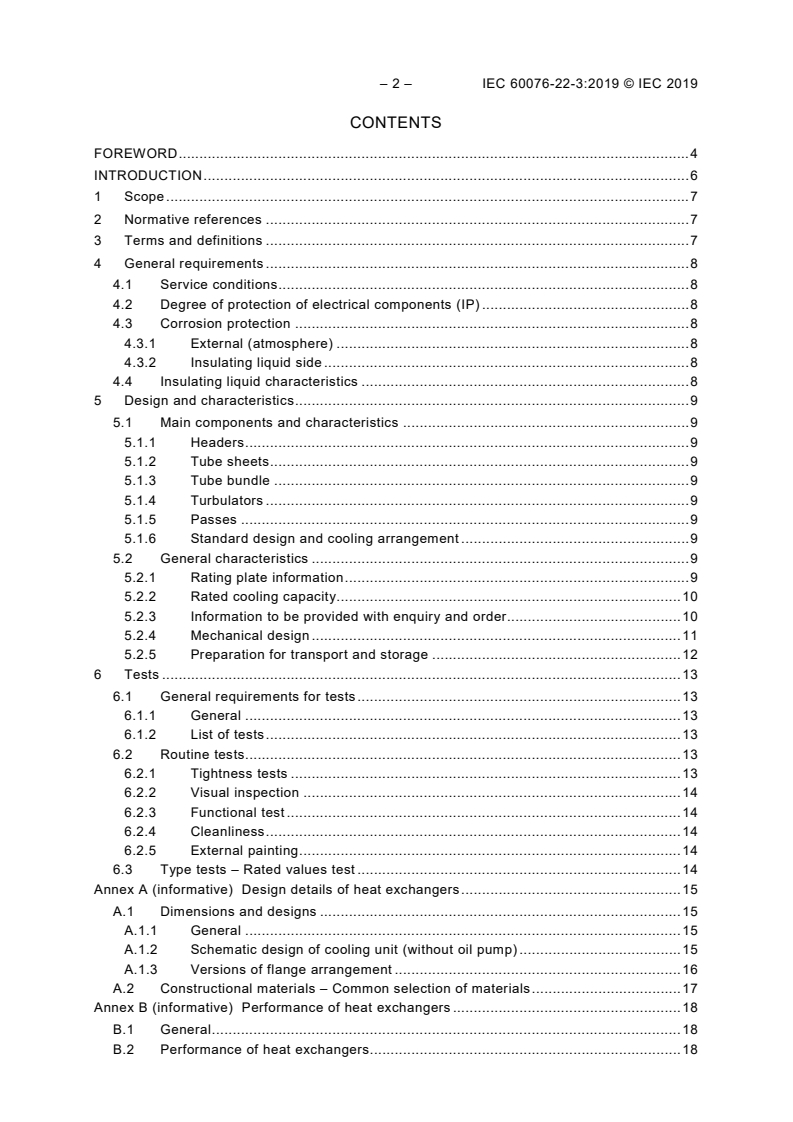
– 2 – IEC 60076-22-3:2019 © IEC 2019
CONTENTS
FOREWORD . 4
INTRODUCTION . 6
1 Scope . 7
2 Normative references . 7
3 Terms and definitions . 7
4 General requirements . 8
4.1 Service conditions . 8
4.2 Degree of protection of electrical components (IP) . 8
4.3 Corrosion protection . 8
4.3.1 External (atmosphere) . 8
4.3.2 Insulating liquid side . 8
4.4 Insulating liquid characteristics . 8
5 Design and characteristics . 9
5.1 Main components and characteristics . 9
5.1.1 Headers . 9
5.1.2 Tube sheets . 9
5.1.3 Tube bundle . 9
5.1.4 Turbulators . 9
5.1.5 Passes . 9
5.1.6 Standard design and cooling arrangement . 9
5.2 General characteristics . 9
5.2.1 Rating plate information . 9
5.2.2 Rated cooling capacity . 10
5.2.3 Information to be provided with enquiry and order. 10
5.2.4 Mechanical design . 11
5.2.5 Preparation for transport and storage . 12
6 Tests . 13
6.1 General requirements for tests . 13
6.1.1 General . 13
6.1.2 List of tests . 13
6.2 Routine tests. 13
6.2.1 Tightness tests . 13
6.2.2 Visual inspection . 14
6.2.3 Functional test . 14
6.2.4 Cleanliness . 14
6.2.5 External painting . 14
6.3 Type tests – Rated values test . 14
Annex A (informative) Design details of heat exchangers . 15
A.1 Dimensions and designs . 15
A.1.1 General . 15
A.1.2 Schematic design of cooling unit (without oil pump) . 15
A.1.3 Versions of flange arrangement . 16
A.2 Constructional materials – Common selection of materials . 17
Annex B (informative) Performance of heat exchangers . 18
B.1 General . 18
B.2 Performance of heat exchangers. 18
B.3 Variation of cooling capacity as function of average oil temperature rise . 19
B.4 Variation of cooling capacity for modified flow quantities . 20
B.4.1 Variation of cooling capacity as function of air flow quantity . 20
B.4.2 Variation of cooling capacity as function of oil flow quantity . 21
Bibliography . 22
Figure A.1 – Schematic design of cooling unit (without oil pump) . 15
Figure A.2 – Versions of flange arrangement . 16
Figure B.1 – General diagram for cooling temperatures . 18
Figure B.2 – Variation of cooling capacity as function of average oil temperature rise . 19
Figure B.3 – Variation of cooling capacity as function of air flow quantity . 20
Figure B.4 – Variation of cooling capacity as function of oil flow quantity . 21
Table 1 – Mandatory fittings . 12
– 4 – IEC 60076-22-3:2019 © IEC 2019
INTERNATIONAL ELECTROTECHNICAL COMMISSION
____________
POWER TRANSFORMERS –
Part 22-3: Power transformer and reactor fittings –
Insulating liquid to air heat exchangers
FOREWORD
1) The International Electrotechnical Commission (IEC) is a worldwide organization for standardization comprising
all national electrotechnical committees (IEC National Committees). The object of IEC is to promote international
co-operation on all questions concerning standardization in the electrical and electronic fields. To this end and
in addition to other activities, IEC publishes International Standards, Technical Specifications, Technical Reports,
Publicly Available Specifications (PAS) and Guides (hereafter referred to as “IEC Publication(s)”). Their
preparation is entrusted to technical committees; any IEC National Committee interested in the subject dealt with
may participate in this preparatory work. International, governmental and non-governmental organizations liaising
with the IEC also participate in this preparation. IEC collaborates closely with the International Organization for
Standardization (ISO) in accordance with conditions determined by agreement between the two organizations.
2) The formal decisions or agreements of IEC on technical matters express, as nearly as possible, an international
consensus on the relevant subjects since each technical committee has representation from all interested IEC
National Committees.
3) IEC Publications have the form of recommendations for international use and are accepted by IEC National
Committees in that sense. While all reasonable efforts are made to ensure that the technical content of IEC
Publications is accurate, IEC cannot be held responsible for the way in which they are used or for any
misinterpretation by any end user.
4) In order to promote international uniformity, IEC National Committees undertake to apply IEC Publications
transparently to the maximum extent possible in their national and regional publications. Any divergence between
any IEC Publication and the corresponding national or regional publication shall be clearly indicated in the latter.
5) IEC itself does not provide any attestation of conformity. Independent certification bodies provide conformity
assessment services and, in some areas, access to IEC marks of conformity. IEC is not responsible for any
services carried out by independent certification bodies.
6) All users should ensure that they have the latest edition of this publication.
7) No liability shall attach to IEC or its directors, employees, servants or agents including individual experts and
members of its technical committees and IEC National Committees for any personal injury, property damage or
other damage of any nature whatsoever, whether direct or indirect, or for costs (including legal fees) and
expenses arising out of the publication, use of, or reliance upon, this IEC Publication or any other IEC Publications.
8) Attention is drawn to the normative references cited in this publication. Use of the referenced publications is
indispensable for the correct application of this publication.
9) Attention is drawn to the possibility that some of the elements of this IEC Publication may be the subject of patent
rights. IEC shall not be held responsible for identifying any or all such patent rights.
International Standard IEC 60076-22-3 has been prepared by IEC technical committee 14:
Power transformers.
The text of this International Standard is based on the following documents:
FDIS Report on voting
14/995/FDIS 14/1003/RVD
Full information on the voting for the approval of this International Standard can be found in the
report on voting indicated in the above table.
This document has been drafted in accordance with the ISO/IEC Directives, Part 2.
A list of all parts in the IEC 60076 series, published under the general title Power transformers,
can be found on the IEC website.
The committee has decided that the contents of this document will remain unchanged until the
stability date indicated on the IEC website under "http://webstore.iec.ch" in the data related to
the specific document. At this date, the document will be
• reconfirmed,
• withdrawn,
• replaced by a revised edition, or
• amended.
– 6 – IEC 60076-22-3:2019 © IEC 2019
INTRODUCTION
Under the part title “Power transformer and reactor fittings”, this part of IEC 60076-22 covers
the insulating liquid to air heat exchangers in the cooling circuits of power transformers and
reactors.
POWER TRANSFORMERS –
Part 22-3: Power transformer and reactor fittings –
Insulating liquid to air heat exchangers
1 Scope
This part of IEC 60076 applies to liquid to air heat exchangers, using forced air and forced liquid
circuits, used on liquid immersed power transformers according to IEC 60076-1 and reactors
according to IEC 60076-6 with and without conservator for indoor or outdoor installation. It
outlines the service conditions and the mechanical and electrical requirements that are common
to this equipment.
It also outlines the operation requirements specific to this equipment as well as the preferred
dimensions relevant for interchangeability and the type and routine tests to be performed.
2 Normative references
The following documents are referred to in the text in such a way that some or all of their content
constitutes requirements of this document. For dated references, only the edition cited applies.
For undated references, the latest edition of the referenced document (including any
amendments) applies.
IEC 60076-1, Power transformers – Part 1: General
IEC 60076-7, Power transformers – Part 7: Loading guide for mineral oil-immersed power
transformers
IEC 60296, Fluids for electrotechnical applications – Unused mineral insulating oils for
transformers and switchgear
IEC 60529, Degrees of protection provided by enclosures (IP Code)
ISO 3746, Acoustics – Determination of sound power levels and sound energy levels of noise
sources using sound pressure – Survey method using an enveloping measurement surface over
a reflecting plane
ISO 4406, Hydraulic fluid power – Fluids – Method for coding the level of contamination by solid
particles
ISO 7005 (all parts), Pipe flanges
ISO 9614-2, Acoustics – Determination of sound power levels of noise sources using sound
intensity – Part 2: Measurement by scanning
ISO 12944 (all parts), Paints and varnishes – Corrosion protection of steel structures by
protective paint systems
3 Terms and definitions
For the purposes of this document, the following terms and definitions apply.
– 8 – IEC 60076-22-3:2019 © IEC 2019
ISO and IEC maintain terminological databases for use in standardization at the following
addresses:
• IEC Electropedia: available at http://www.electropedia.org/
• ISO Online browsing platform: available at http://www.iso.org/obp
3.1
insulating liquid to air heat exchanger
component for the cooling of the insulating liquid of the transformer, using forced circulation of
the insulating liquid and a forced air flow
4 General requirements
4.1 Service conditions
The normal service conditions set out in IEC 60076-1 represent the normal scope of operation
of the device and equipment specified in this document.
Device and equipment specification for operation under unusual service conditions as per
IEC 60076-1 shall be subject to agreement between the purchaser and supplier, as they require
special consideration in the design of the device and equipment.
In addition to the unusual service conditions of IEC 60076-1, any unusual condition, which can
influence the correct functioning of the cooler, shall be mentioned, such as heavy snow,
permanent wind, pollen, sealing dust.
4.2 Degree of protection of electrical components (IP)
The degree of protection of the connecting box or terminal box for an outdoor installation shall
be at least IP 54 according to IEC 60529, unless otherwise specified by the purchaser.
4.3 Corrosion protection
4.3.1 External (atmosphere)
The materials used for the construction of the equipment or the surface treatment shall be
resistant to accidental contact with the insulating liquid and suitable to withstand the
environmental conditions given in 4.1. The corrosion protection shall be agreed between
purchaser and manufacturer according to ISO 12944 (all parts). The responsibility to specify
the correct level of corrosion protection lies with the purchaser and is dependent on the
environment where the transformer will be located and on the durability required. Unless
otherwise specified, the minimum withstand level shall be C4 medium durability according to
ISO 12944-6.
4.3.2 Insulating liquid side
In consideration of the storage conditions and expected time between shipment and
commissioning, the corrosion protection on the insulating liquid side of the cooling system shall
be agreed between purchaser and manufacturer. As a minimum requirement, precautions shall
be taken to prevent the ingress of moisture and the development of internal corrosion. The
internal flushing with insulation liquid fully miscible and compatible with the liquid to be used in
service conditions and the use of blanking plates with gaskets are considered as a minimum.
Internal painting, nitrogen filling, dehydrating material, etc., can be used as other or additional
solutions.
4.4 Insulating liquid characteristics
If not otherwise specified, the insulating liquid is mineral oil according to IEC 60296 and the
operating temperature shall be in accordance with IEC 60076-7.
When the insulating liquid is not mineral oil then the purchaser shall indicate the viscosity
variation, the operating temperature and all the other operating characteristics.
5 Design and characteristics
5.1 Main components and characteristics
5.1.1 Headers
Liquid collecting and guiding compartment with flanged connections to the circuit of the
transformer.
5.1.2 Tube sheets
Flat plates at both ends of the cooler where the cooling tubes are connected.
5.1.3 Tube bundle
Consisting of a bundle of single tubes and fins connected to both tube sheets. Tubes might
have different shapes and can be made of different materials.
5.1.4 Turbulators
Inserts inside the tubes aimed at enhancing the cooling efficiency.
5.1.5 Passes
Number of times the insulating liquid flows through the exchanger. For instance, the number of
passes “1” means that the liquid is flowing one way from one header to the other (liquid inlet
and outlet in the opposite headers).
5.1.6 Standard design and cooling arrangement
The liquid to air heat exchanger arrangement can be with:
• vertical cooling pipes and horizontal air direction;
• horizontal cooling pipes and horizontal air direction;
• horizontal cooling pipes and vertical air direction;
• forced-draught type or induced draught type fan arrangement can be used.
5.2 General characteristics
5.2.1 Rating plate information
The rating plate shall be corrosion resistant and acid proof. It shall be visible when the heat
exchanger is assembled to the transformer and carry following data:
• logo or name of manufacturer;
• country and manufacturing location;
• number of this document;
• manufacturer identification;
• manufacturer serial number;
• year of manufacturing;
• maximum oil pressure in service [kPa];
• maximum oil temperature [°C];
– 10 – IEC 60076-22-3:2019 © IEC 2019
• minimum ambient temperature [°C].
Rating data:
– rated cooling capacity [kW];
– rated air flow/liquid flow quantity [m /h];
– temperature of air and oil at inlet and outlet [°C];
– pressure drop of oil and air [kPa/Pa];
– mass of heat exchanger without oil [kg];
– oil volume [dm ].
5.2.2 Rated cooling capacity
The rated cooling capacity of the heat exchanger is the minimum capacity which the
manufacturer has to guarantee when the cooler is new and in free field conditions.
An additional cooling capacity can be agreed between purchaser and manufacturer to take into
consideration the fouling that can occur in service.
The point of operation on the fan characteristic curve for nominal air duty shall be at least 15 %
below the area of instability.
Air pollution, piping conditions, wind direction and fan rotation direction not conforming to
design can affect the efficiency and the life expectancy of the cooler and the fans.
Unless otherwise agreed between purchaser and manufacturer, the calculation of rated cooling
capacity shall consider dry ambient air at a pressure of p = 101,3 kPa and the selected
abs
cooling liquid.
Conversion of rated cooling capacity into other operating conditions can be calculated according
to Annex B. Changes of flow quantities should generally be co-ordinated with the manufacturer.
5.2.3 Information to be provided with enquiry and order
The purchaser shall supply to the manufacturer the following information with the enquiry:
• insulation liquid characteristics;
• design arrangement conforming with 5.1.6;
• required cooling capacity Q kW;
r
• maximum ambient temperature (inlet air temperature) t ’ °C;
• maximum allowed liquid temperature t ’ °C;
• liquid temperature difference (min. value/max. value) ∆t K;
• maximum sound power measurement according to ISO 9614-2 or
sound pressure measurement according to ISO 3746 L dB(A);
w
• minimum ambient temperature °C;
• altitude above sea level h m.
In case of order, the manufacturer should fix the following rated values:
• insulation liquid characteristics;
• design arrangement conforming with 5.1.6;
• rated cooling capacity Q kW;
r
• rated air flow quantity V m /s;
• rated liquid flow quantity V m /h;
• air temperature at inlet t ’ °C;
• air temperature at outlet t ’’ °C;
• liquid temperature at cooler inlet t ’ °C;
• liquid temperature at cooler outlet t ’’ °C;
• air side pressure drop ∆p Pa;
• liquid side pressure drop ∆p kPa;
• maximum sound power level (including any tolerance) L dB(A);
w
• minimum ambient temperature °C;
• altitude A m.
5.2.4 Mechanical design
5.2.4.1 General
The mechanical design is based on the environmental conditions described in 4.1. The
maximum liquid temperature shall be 100 °C. Other environmental conditions, temperatures as
well as other cooling liquids shall be agreed between manufacturer and purchaser.
Connection between cooling pipes and tube sheets shall be oil tight. Excessive thermal
expansion shall be avoided by appropriate design features.
The heat exchanger shall be designed for outside mounting without further protection and
without any place to accumulate rain or condense water.
For transformers with a frequency of 50 Hz, significant resonance frequency
(mass participation > 20 %) of the operable heat exchanger should not be in the range of (80
to 320) Hz, and for transformers with a frequency of 16 2/3 Hz it should not be in the range of
(25 to 180) Hz.
It is the responsibility of the transformer or cooling circuit designer to design the pipework and
the dampers to prevent the transfer of vibration from the transformer to the cooling equipment.
Appropriate reinforcements shall be used to prevent vibration of the tube bundle.
Types of flanges and fixing shall be agreed between purchaser and manufacturer. Possible
flange arrangements are shown in Figure A.2.
It shall be possible to clean the heat exchanger on the air side by means of water under high
pressure.
The mechanical design of the heat exchanger shall withstand a vacuum of 2,5 kPa absolute
pressure.
The maximum permissible oil pressure in service for the heat exchanger is limited to 330 kPa.
Annex A provides informative dimensions and design parameters which have to be determined.
– 12 – IEC 60076-22-3:2019 © IEC 2019
5.2.4.2 Materials
The liquid to air heat exchanger can be made of different materials depending on the
environmental and operation conditions.
5.2.4.3 Mandatory fittings
The liquid to air heat exchanger shall be equipped with at least the following fittings
(see Table 1):
Table 1 – Mandatory fittings
Number Description Remark
2 Connection flanges PN 10 For connection to oil circuit, diameter to be agreed
1 Plug for air release Venting of oil circuit
1 Plug for draining Residual oil
2 Lifting lugs For transport, assembly and disassembly
1 Blind flange including gasket and For closing oil circuit during transport or storage
fastenings
1 Blind flange with vent including gasket For closing oil circuit during transport or storage and filling
and fastenings with synthetic air
2 Earthing cam
1 Rating plate See 5.2.1
1 U-bolt cable hanger Fixing of cable
5.2.4.4 Manufacturing requirements
Internal surfaces shall be flushed with insulation liquid to remove any potential debris resulting
from the manufacturing process.
Number and size of particles, for example according to ISO 4406, as well as particle test
procedure and flushing velocity or other cleaning criteria, have to be agreed. The recommended
minimum level according to ISO 4406 is -/12/10.
The flushing via a micron filter shall continue until the amount of particles is less than the agreed
limited value. The flushing oil shall be in accordance with IEC 60296. During flushing the oil
flow velocity shall be sufficient to remove all the particles.
Immediately after the flushing procedure the flushing liquid shall be removed; possible small
residuals are acceptable. All flanges shall be closed with covers not to be removed without a
reason.
5.2.5 Preparation for transport and storage
5.2.5.1 Transport
The liquid to air heat exchanger shall be arranged on a pallet suited for easy handling with a
forklift and to prevent damages during the transport.
As a minimum requirement, it shall be protected against water ingress in the motors of the fans
and other electrical parts.
For difficult transport conditions, such as overseas transport, specific requirements may apply.
5.2.5.2 Storage
Unless otherwise specified the storage configuration shall be designed to ensure a minimum
storage period of three months until commissioning in the environmental conditions defined in
IEC 60076-1.
For a storage period over three months the manufacturer shall be informed about the exact
storage conditions (for example humidity and temperature changes) and storage requirements
may be specified.
Upon demand by the purchaser, the heat exchanger shall be filled under an overpressure of
approximately 45 kPa with nitrogen or dry air (humidity less than 10 %) using a valve installed
in one of the blind flanges. For long-term storage, which has to be indicated by the purchaser,
the overpressure shall remain at minimum 5 kPa and therefore has to be checked regularly.
6 Tests
6.1 General requirements for tests
6.1.1 General
Tests shall be made at an ambient temperature between 10 °C and 40 °C, unless otherwise
specified.
All measuring instruments used for the tests shall have traceable accuracy and be subject to
periodic calibration. An example of a quality management system is ISO 9001 .
6.1.2 List of tests
6.1.2.1 Routine tests
The following list of tests is not in any specific order:
– tightness tests (6.2.1);
– visual inspection (6.2.2);
– functional test (6.2.3);
– cleanliness (6.2.4);
– external painting (6.2.5).
6.1.2.2 Type tests
The following list of tests is not in any specific order:
– rated values test (6.3).
6.2 Routine tests
6.2.1 Tightness tests
The liquid to air heat exchanger has to be submitted to one of the following alternative tightness
tests by agreement between manufacturer and purchaser:
• hydraulic test with transformer's oil filled at (60 ± 5) °C and a pressure of 500 kPa for 2 h;
• pneumatic test with compressed air under water at 500 kPa for 30 min.
Any leakage has to be detected (by visual inspection) during the above period.
– 14 – IEC 60076-22-3:2019 © IEC 2019
6.2.2 Visual inspection
6.2.2.1 Outer surfaces
All surfaces shall be free of damages, deformations and dirt. No sort of filling compounds shall
be used.
6.2.2.2 Inner surfaces
All visible surfaces shall be free of damages, deformations and dirt.
6.2.3 Functional test
The liquid to air heat exchanger has to be tested to verify that all the components perform as
expected.
6.2.4 Cleanliness
The cleanliness of the internal surfaces shall comply with the values indicated in 5.2.4.4.
6.2.5 External painting
Application of painting shall be documented and thickness of painting shall be tested and found
conforming to the order specification. Other tests shall be agreed between purchaser and
manufacturer.
6.3 Type tests – Rated values test
The manufacturer shall be able to perform a rated values type test, at least at partial rated
power; the values at full power shall be extrapolated. Usually rated values are tested together
with the transformer. Separate type tests shall be agreed between manufacturer and purchaser.
Annex A
(informative)
Design details of heat exchangers
A.1 Dimensions and designs
A.1.1 General
The dimensions indicated in Figure A.1 and Figure A.2 , the exact position of flanges and their
diameter, as well as the fixing of heat exchangers have to be agreed between purchaser and
manufacturer. The arrangement of the lifting lugs, air- and drain plugs has to be chosen
according to the design of the heat exchanger.
A.1.2 Schematic design of cooling unit (without oil pump)
C
A
Air
IEC
Figure A.1 – Schematic design of cooling unit (without oil pump)
B
– 16 – IEC 60076-22-3:2019 © IEC 2019
A.1.3 Versions of flange arrangement
A
A
D
A1 A2
D D
D
A
A
D
Versions A1, B1, C1 can be used laterally
reversed (mirrored on the vertical axis); in
are to be marked with “*”
this case they
(for example A1*).
B1 B2
The detailed nozzle positions shall be
agreed between manufacturer and
purchaser.
D D D
A
A
E
C1 C2
E
IEC
Figure A.2 – Versions of flange arrangement
B
B
B
E E
F
B
B B
E
F
A.2 Constructional materials – Common selection of materials
Example for aluminium, aluminium alloy:
– tube sheets: aluminium alloy EN-AW 6061 according to EN 1386:2007
– tubes: aluminium alloy EN-AW 3003 according to EN 754-2
– side walls: mild steel S235JRG2 according to EN 10025-2
– header: mild steel S235JRG2 according to EN 10025-2
– flanges: mild steel S235JRG2 according to EN 10025-2
– supporting sheets: rimmed steel DC01 according to EN 10130, surface type (B),
surface treatment extra smooth (b)
– screws and nuts: non-magnetic material according to ISO 3506-1
Example for steel, mild steel:
– tube sheets: mild steel S235JRG2 according to EN 10025-2
– tubes: according to EN 10217-1, minimum mild steel S235JR
– side walls: mild steel S235JRG2 according to EN 10025-2
– header: mild steel S235JRG2 according to EN 10025-2
– flanges: mild steel S235JRG2 according to EN 10025-2
– supporting sheets: rimmed steel DC01 according to EN 10130, surface type (B),
surface treatment extra smooth (b)
– screws and nuts: non-magnetic material according to ISO 3506-1
Commonly used materials:
Tube sheets:
S235JRG2 / 1.0038; P265GH / 1.0425; EN-AW 6061; EN AW-AlMg1SiCu; X5CrNiN19-9 /
1.4315; X3CrNiCu19-9-2 / 1.4560; X6CrNiTi18-10 / 1.4541; X6CrNiMoTi17-12-2 / 1.4571
Tubes:
S235JRG2 / 1.0038; P235GH-TC1 / 1.0305; Cu-DHP / CW024A according to EN 12451; EN-AW
3003; EN AW-AlMn1Cu; X5CrNiN19-9 / 1.4315; X3CrNiCu19-9-2 / 1.4560; X6CrNiTi18-10 /
1.4541; X6CrNiMoTi17-12-2 / 1.4571
Side walls, header, flanges, supporting sheets:
S235JRG2; X5CrNiN19-9 / 1.4315; X3CrNiCu19-9-2 / 1.4560; X6CrNiTi18-10 / 1.4541;
X6CrNiMoTi17-12-2 / 1.4571
– 18 – IEC 60076-22-3:2019 © IEC 2019
Annex B
(informative)
Performance of heat exchangers
B.1 General
The purpose of Annex B is to give guidance to the end user for approximation of behaviour of
the heat exchanger under different operation conditions. The calculations and derivate graphs
in Figure B.1, Figure B.2, Figure B.3 and Figure B.4 have limited accuracy and are not intended
to verify the calculations of the manufacturer.
B.2 Performance of heat exchangers
t '
The rated cooling capacity follows the
t ''
relation:
Q = V ⋅ c ⋅ ρ ⋅ (t ‘‘ – t ‘)
r 1 1 1 1 1
t ''
1 Q = V ⋅ c ⋅ ρ ⋅ (t ‘‘ – t ‘)
r 2 2 2 2 2
For definition of variables see 5.2.3
t '
IEC
Figure B.1 – General diagram for cooling temperatures
The calculations and graphs are related to an ambient temperature range from +10 °C to +40 °C.
The calculation of the cooling capacity proportionally to the oil temperature difference ∆t has
reduced accuracy. In many cases this is sufficient if the rated flow quantity remains constant.
In case of deviation of the air temperature at the inlet, all other temperatures (t ‘‘, t ‘, t ‘‘)
1 2 2
change in the same way if the cooling capacity and flow quantities remain constant.
CAUTION: The change of air flow quantity always causes a change of the sound power level.
Basic values for calculation:
Dry air at inlet temperature at a pressure of p = 101,3 kPa:
abs
• density ρ = 1,292 x 273,2 / (273,2 + t ‘) kg/m
1 1
• specific heat capacity c = 1,006 + 0,000 05 x t ‘ kW s/(kg K)
1 1
∆t
Transformer oil according to IEC 60296:
• density ρ = 880 – 0,65 x (t ‘+ t ‘‘) / 2 kg/m
2 2 2
-6
• specific heat capacity c = (493 + 1,177 x (t ‘+ t ‘‘) / 2) x 10 kW h/(kg K)
2 2 2
B.3 Variation of cooling capacity as function of average oil temperature rise
75 80 85 90 95 100 105 110 115 120 125
t /t (%)
2m 2mr
IEC
Figure B.2 – Variation of cooling capacity as function of average oil temperature rise
The conversion covers the range of ±25 % (corresponding to roughly ±10 K).
Q/Q (%)
r
– 20 – IEC 60076-22-3:2019 © IEC 2019
B.4 Variation of cooling capacity for modified flow quantities
B.4.1 Variation of cooling capacity as function of air flow quantity
70 80 90 100 110 120 130 140
V /V (%)
1 1r
IEC
Figure B.3 – Variation of cooling capacity as function of air flow quantity
Oil flow quantity and temperatures for oil inlet and outlet remain constant, and air side pressure
drop and temperature of air at outlet change.
Q/Q (%)
r
B.4.2 Variation of cooling capacity as function of oil flow quantity
60 70 80 90 100 110 120 130 140
V /V (%)
2 2r
IEC
Figure B.4 – Variation of cooling capacity as function of oil flow quantity
Air flow quantity remains constant as well as air temperature at inlet and outlet and average oil
temperature difference. Oil side pressure drop and oil temperature at inlet and outlet change.
Q/Q (%)
r
– 22 – IEC 60076-22-3:2019 © IEC 2019
Bibliography
IEC 60076-6, Power transformers – Part 6: Reactors
ISO 3506-1, Mechanical properties of corrosion-resistant stainless steel fasteners – Part 1:
Bolts, screws and studs
ISO 9001, Quality management systems – Requirements
EN 754-2, Aluminum and aluminum alloys – Cold drawn rod/bar and tube – Part 2: Mechanical
properties
EN 1386:2007, Aluminium and aluminium alloys – Tread plate – Specifications
EN 10025-2, Hot rolled products of structural steels – Part 2: Technical delivery conditions for
non-alloy structural steels
EN 10130, Cold rolled low carbon steel flat products for cold forming – Technical delivery
conditions
EN 10217-1, Welded steel tubes for pressure purposes – Technical delivery conditions – Part 1:
Electric welded and submerged arc welded non-alloy steel tubes with specified room
temperature properties
___________
– 24 – IEC 60076-22-3:2019 © IEC 2019
SOMMAIRE
AVANT-PROPOS . 26
INTRODUCTION . 28
1 Domaine d’application . 29
2 Références normatives . 29
3 Termes et définitions . 29
4 Exigences générales . 30
4.1 Conditions de service . 30
4.2 Degré de protection des composants électriques (IP) . 30
4.3 Protection contre la corrosion . 30
4.3.1 Extérieure (atmosphère) . 30
4.3.2 Côté liquide isolant . 30
4.4 Caractéristiques du liquide isolant. 31
5 Conception et caractéristiques . 31
5.1 Principaux composants et caractéristiques . 31
5.1.1 Boîte à huile . 31
5.1.2 Plaques à tubes . 31
5.1.3 Faisceau de tubes . 31
5.1.4 Turbulateurs . 31
5.1.5 Passages.
...