

IEC 60318-1:2009
(Main)Electroacoustics - Simulators of human head and ear - Part 1: Ear simulator for the measurement of supra-aural and circumaural earphones
General Information
- Abstract
IEC 60318-1:2009 specifies an ear simulator for the measurement of supra-aural and circumaural earphones (used for example in audiometry and telephonometry) applied to the ear without acoustical leakage, in the frequency range from 20 Hz to 10 kHz. The same device can be used as an acoustic coupler at additional frequencies up to 16 kHz. This second edition cancels and replaces the first edition published in 1998 as well as replacing IEC 60318-2, published in 1998. It constitutes a technical revision. This edition includes the following significant technical changes with respect to the previous edition:
- an extension of the frequency range to 16 kHz;
- a revised specification for the acoustical transfer impedance, including tolerances;
- a method for measuring the acoustical transfer impedance;
- expanded measurement uncertainties.
- Status
- Published
- Publication Date
- 30-Aug-2009
- Technical Committee
- TC 29 - Electroacoustics
- Drafting Committee
- WG 21 - TC 29/WG 21
- Current Stage
- PPUB - Publication issued
- Start Date
- 31-Aug-2009
- Completion Date
- 31-Aug-2009
Overview
IEC 60318-1:2009 is an international standard developed by the International Electrotechnical Commission (IEC) that specifies an ear simulator designed for the precise measurement of supra-aural and circumaural earphones. This standard focuses on electroacoustics and simulates the acoustical characteristics of the human ear to ensure accurate and repeatable measurement of earphone acoustic output.
The ear simulator described in IEC 60318-1 is applicable across a frequency range from 20 Hz up to 10 kHz and can be extended as an acoustic coupler up to 16 kHz. The standard is widely used in the fields of audiometry, telephonometry, and other applications requiring reliable earphone performance assessment.
This edition of the standard is a significant technical update from the 1998 version and introduces expanded measurement uncertainties, updated specifications for acoustic transfer impedance, and a method for measuring this impedance with defined tolerances.
Key Topics
Ear Simulator Design:
The device simulates the acoustic impedance of the human ear, tailored for two distinct earphone types:- Supra-aural earphones: fitted externally on the ear, resting on the pinna.
- Circumaural earphones: enclose the entire ear, contacting surrounding head surfaces with cushions to avoid significant pinna compression.
Measurement Range and Frequency Extension:
Accurate measurements are guaranteed from 20 Hz to 10 kHz, with acoustic coupler capabilities up to 16 kHz for additional applications. High-frequency measurement repeatability above 10 kHz may show variability.Acoustic Transfer Impedance:
The standard specifies exact acoustic transfer impedance requirements, including tolerances, to ensure the ear simulator accurately replicates human ear characteristics for reliable measurement results.Calibration and Measurement Uncertainty:
The standard outlines calibration procedures under specified environmental conditions and expands on measurement uncertainty parameters to guide quality assurance in testing.Technical Construction Features:
The ear simulator consists of three acoustically coupled cavities with a conical primary cavity housing a calibrated pressure-type microphone. The external coupling surface varies by earphone type to ensure optimal contact and prevent acoustic leakage:- Supra-aural earphone coupling features sloped sides matching ear cushion profiles.
- Circumaural earphone coupling uses a flat surface compatible with a wide range of designs.
Applications
IEC 60318-1 ear simulators serve a critical role in industries and fields where precise acoustic evaluation of earphones is necessary:
Audiometry:
Enables accurate calibration and testing of supra-aural and circumaural earphones used in hearing tests and diagnostic equipment.Telephonometry:
Assists in standardizing and measuring the output of communication headsets to ensure clarity and consistent audio quality.Product Development:
Manufacturers use the standard to assess earphone acoustic performance during design and quality control phases.Regulatory Compliance:
Helps organizations comply with international requirements for measuring and reporting earphone sound emissions.
Related Standards
IEC 61094-4: Specifies standards for working standard microphones used in acoustic measurements, ensuring accuracy in microphones incorporated into the ear simulator.
ISO/IEC Guide 98-3 (GUM): Provides guidelines for the expression of uncertainty in measurement, crucial for calibration procedures and quality assurance outlined in IEC 60318-1.
Other IEC 60318 Series Parts:
IEC 60318 is a multi-part series covering various simulators of human head and ear with each part tailored to different acoustic measurement scenarios and devices.
Keywords: IEC 60318-1, ear simulator, supra-aural earphones, circumaural earphones, acoustic transfer impedance, electroacoustics, audiometry, telephonometry, earphone measurement standard, calibration, acoustic coupler, frequency range, measurement uncertainty, IEC standards.
Relations
- Effective Date
- 05-Sep-2023
- Effective Date
- 25-Aug-2026
- Effective Date
- 05-Sep-2023
Get Certified
Connect with accredited certification bodies for this standard

BSMI (Bureau of Standards, Metrology and Inspection)
Taiwan's standards and inspection authority.
Sponsored listings
Frequently Asked Questions
IEC 60318-1:2009 is a standard published by the International Electrotechnical Commission (IEC). Its full title is "Electroacoustics - Simulators of human head and ear - Part 1: Ear simulator for the measurement of supra-aural and circumaural earphones". This standard covers: IEC 60318-1:2009 specifies an ear simulator for the measurement of supra-aural and circumaural earphones (used for example in audiometry and telephonometry) applied to the ear without acoustical leakage, in the frequency range from 20 Hz to 10 kHz. The same device can be used as an acoustic coupler at additional frequencies up to 16 kHz. This second edition cancels and replaces the first edition published in 1998 as well as replacing IEC 60318-2, published in 1998. It constitutes a technical revision. This edition includes the following significant technical changes with respect to the previous edition: - an extension of the frequency range to 16 kHz; - a revised specification for the acoustical transfer impedance, including tolerances; - a method for measuring the acoustical transfer impedance; - expanded measurement uncertainties.
IEC 60318-1:2009 specifies an ear simulator for the measurement of supra-aural and circumaural earphones (used for example in audiometry and telephonometry) applied to the ear without acoustical leakage, in the frequency range from 20 Hz to 10 kHz. The same device can be used as an acoustic coupler at additional frequencies up to 16 kHz. This second edition cancels and replaces the first edition published in 1998 as well as replacing IEC 60318-2, published in 1998. It constitutes a technical revision. This edition includes the following significant technical changes with respect to the previous edition: - an extension of the frequency range to 16 kHz; - a revised specification for the acoustical transfer impedance, including tolerances; - a method for measuring the acoustical transfer impedance; - expanded measurement uncertainties.
IEC 60318-1:2009 is classified under the following ICS (International Classification for Standards) categories: 17.140.50 - Electroacoustics. The ICS classification helps identify the subject area and facilitates finding related standards.
IEC 60318-1:2009 has the following relationships with other standards: It is inter standard links to IEC 60318-2:1998, EN ISO 389-1:2018, IEC 60318-1:1998. Understanding these relationships helps ensure you are using the most current and applicable version of the standard.
IEC 60318-1:2009 is available in PDF format for immediate download after purchase. The document can be added to your cart and obtained through the secure checkout process. Digital delivery ensures instant access to the complete standard document.
Standards Content (Sample)
IEC 60318-1 ®
Edition 2.0 2009-08
INTERNATIONAL
STANDARD
NORME
INTERNATIONALE
Electroacoustics – Simulators of human head and ear –
Part 1: Ear simulator for the measurement of supra-aural and circumaural
earphones
Electroacoustique – Simulateurs de tête et d'oreille humaines –
Partie 1: Simulateur d'oreille pour la mesure des écouteurs supra-auraux et
circumauraux
All rights reserved. Unless otherwise specified, no part of this publication may be reproduced or utilized in any form or by
any means, electronic or mechanical, including photocopying and microfilm, without permission in writing from either IEC or
IEC's member National Committee in the country of the requester.
If you have any questions about IEC copyright or have an enquiry about obtaining additional rights to this publication,
please contact the address below or your local IEC member National Committee for further information.
Droits de reproduction réservés. Sauf indication contraire, aucune partie de cette publication ne peut être reproduite
ni utilisée sous quelque forme que ce soit et par aucun procédé, électronique ou mécanique, y compris la photocopie
et les microfilms, sans l'accord écrit de la CEI ou du Comité national de la CEI du pays du demandeur.
Si vous avez des questions sur le copyright de la CEI ou si vous désirez obtenir des droits supplémentaires sur cette
publication, utilisez les coordonnées ci-après ou contactez le Comité national de la CEI de votre pays de résidence.
IEC Central Office
3, rue de Varembé
CH-1211 Geneva 20
Switzerland
Email: inmail@iec.ch
Web: www.iec.ch
About the IEC
The International Electrotechnical Commission (IEC) is the leading global organization that prepares and publishes
International Standards for all electrical, electronic and related technologies.
About IEC publications
The technical content of IEC publications is kept under constant review by the IEC. Please make sure that you have the
latest edition, a corrigenda or an amendment might have been published.
ƒ Catalogue of IEC publications: www.iec.ch/searchpub
The IEC on-line Catalogue enables you to search by a variety of criteria (reference number, text, technical committee,…).
It also gives information on projects, withdrawn and replaced publications.
ƒ IEC Just Published: www.iec.ch/online_news/justpub
Stay up to date on all new IEC publications. Just Published details twice a month all new publications released. Available
on-line and also by email.
ƒ Electropedia: www.electropedia.org
The world's leading online dictionary of electronic and electrical terms containing more than 20 000 terms and definitions
in English and French, with equivalent terms in additional languages. Also known as the International Electrotechnical
Vocabulary online.
ƒ Customer Service Centre: www.iec.ch/webstore/custserv
If you wish to give us your feedback on this publication or need further assistance, please visit the Customer Service
Centre FAQ or contact us:
Email: csc@iec.ch
Tel.: +41 22 919 02 11
Fax: +41 22 919 03 00
A propos de la CEI
La Commission Electrotechnique Internationale (CEI) est la première organisation mondiale qui élabore et publie des
normes internationales pour tout ce qui a trait à l'électricité, à l'électronique et aux technologies apparentées.
A propos des publications CEI
Le contenu technique des publications de la CEI est constamment revu. Veuillez vous assurer que vous possédez
l’édition la plus récente, un corrigendum ou amendement peut avoir été publié.
ƒ Catalogue des publications de la CEI: www.iec.ch/searchpub/cur_fut-f.htm
Le Catalogue en-ligne de la CEI vous permet d’effectuer des recherches en utilisant différents critères (numéro de référence,
texte, comité d’études,…). Il donne aussi des informations sur les projets et les publications retirées ou remplacées.
ƒ Just Published CEI: www.iec.ch/online_news/justpub
Restez informé sur les nouvelles publications de la CEI. Just Published détaille deux fois par mois les nouvelles
publications parues. Disponible en-ligne et aussi par email.
ƒ Electropedia: www.electropedia.org
Le premier dictionnaire en ligne au monde de termes électroniques et électriques. Il contient plus de 20 000 termes et
définitions en anglais et en français, ainsi que les termes équivalents dans les langues additionnelles. Egalement appelé
Vocabulaire Electrotechnique International en ligne.
ƒ Service Clients: www.iec.ch/webstore/custserv/custserv_entry-f.htm
Si vous désirez nous donner des commentaires sur cette publication ou si vous avez des questions, visitez le FAQ du
Service clients ou contactez-nous:
Email: csc@iec.ch
Tél.: +41 22 919 02 11
Fax: +41 22 919 03 00
IEC 60318-1 ®
Edition 2.0 2009-08
INTERNATIONAL
STANDARD
NORME
INTERNATIONALE
Electroacoustics – Simulators of human head and ear –
Part 1: Ear simulator for the measurement of supra-aural and circumaural
earphones
Électroacoustique – Simulateurs de tête et d'oreille humaines –
Partie 1: Simulateur d'oreille pour la mesure des écouteurs supra-auraux et
circumauraux
INTERNATIONAL
ELECTROTECHNICAL
COMMISSION
COMMISSION
ELECTROTECHNIQUE
PRICE CODE
INTERNATIONALE
T
CODE PRIX
ICS 17.140.50 ISBN 978-2-88910-120-7
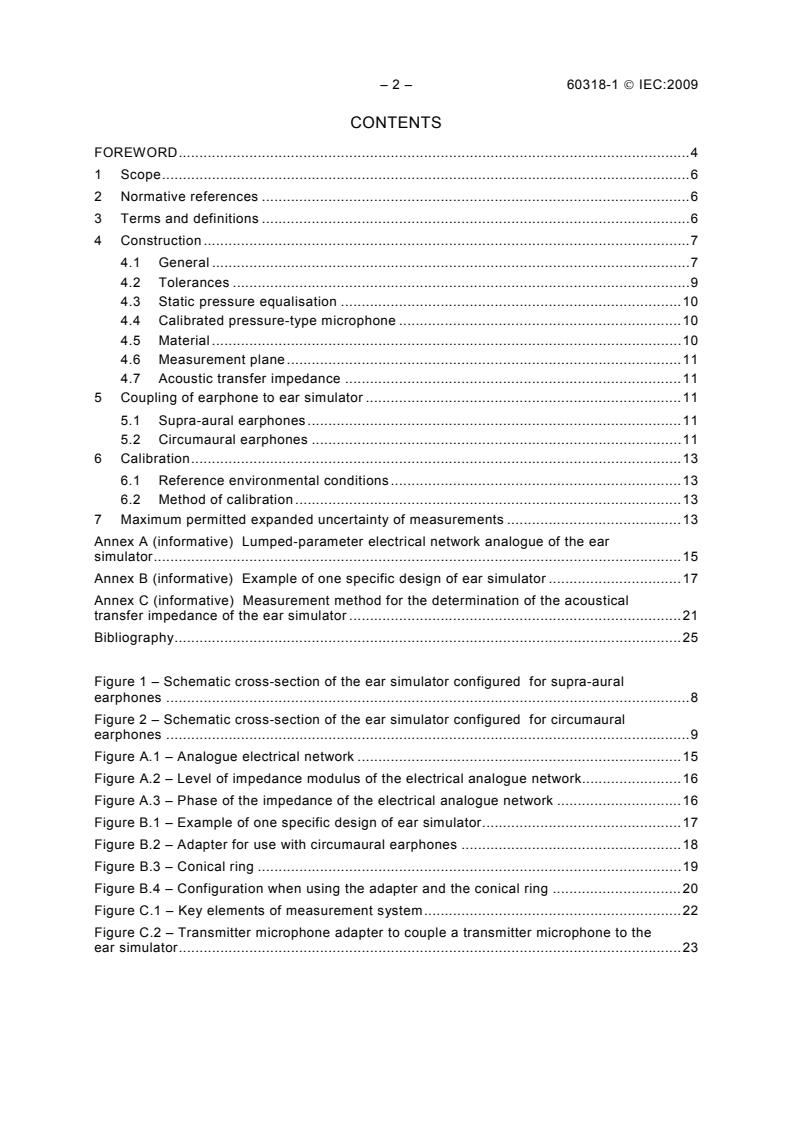
– 2 – 60318-1 © IEC:2009
CONTENTS
FOREWORD.4
1 Scope.6
2 Normative references .6
3 Terms and definitions .6
4 Construction .7
4.1 General .7
4.2 Tolerances .9
4.3 Static pressure equalisation .10
4.4 Calibrated pressure-type microphone .10
4.5 Material .10
4.6 Measurement plane.11
4.7 Acoustic transfer impedance .11
5 Coupling of earphone to ear simulator .11
5.1 Supra-aural earphones .11
5.2 Circumaural earphones .11
6 Calibration.13
6.1 Reference environmental conditions.13
6.2 Method of calibration.13
7 Maximum permitted expanded uncertainty of measurements .13
Annex A (informative) Lumped-parameter electrical network analogue of the ear
simulator.15
Annex B (informative) Example of one specific design of ear simulator .17
Annex C (informative) Measurement method for the determination of the acoustical
transfer impedance of the ear simulator .21
Bibliography.25
Figure 1 – Schematic cross-section of the ear simulator configured for supra-aural
earphones .8
Figure 2 – Schematic cross-section of the ear simulator configured for circumaural
earphones .9
Figure A.1 – Analogue electrical network .15
Figure A.2 – Level of impedance modulus of the electrical analogue network.16
Figure A.3 – Phase of the impedance of the electrical analogue network .16
Figure B.1 – Example of one specific design of ear simulator.17
Figure B.2 – Adapter for use with circumaural earphones .18
Figure B.3 – Conical ring .19
Figure B.4 – Configuration when using the adapter and the conical ring .20
Figure C.1 – Key elements of measurement system.22
Figure C.2 – Transmitter microphone adapter to couple a transmitter microphone to the
ear simulator.23
60318-1 © IEC:2009 – 3 –
Table 1 – Specification for the acoustic transfer impedance level.12
Table 2 – Values of U for basic measurements .14
max
Table C.1 – Typical components of measurement uncertainty in the measurement of
acoustic transfer impedance .24
– 4 – 60318-1 © IEC:2009
INTERNATIONAL ELECTROTECHNICAL COMMISSION
____________
ELECTROACOUSTICS –
SIMULATORS OF HUMAN HEAD AND EAR –
Part 1: Ear simulator for the measurement of supra-aural
and circumaural earphones
FOREWORD
1) The International Electrotechnical Commission (IEC) is a worldwide organization for standardization comprising
all national electrotechnical committees (IEC National Committees). The object of IEC is to promote
international co-operation on all questions concerning standardization in the electrical and electronic fields. To
this end and in addition to other activities, IEC publishes International Standards, Technical Specifications,
Technical Reports, Publicly Available Specifications (PAS) and Guides (hereafter referred to as “IEC
Publication(s)”). Their preparation is entrusted to technical committees; any IEC National Committee interested
in the subject dealt with may participate in this preparatory work. International, governmental and non-
governmental organizations liaising with the IEC also participate in this preparation. IEC collaborates closely
with the International Organization for Standardization (ISO) in accordance with conditions determined by
agreement between the two organizations.
2) The formal decisions or agreements of IEC on technical matters express, as nearly as possible, an international
consensus of opinion on the relevant subjects since each technical committee has representation from all
interested IEC National Committees.
3) IEC Publications have the form of recommendations for international use and are accepted by IEC National
Committees in that sense. While all reasonable efforts are made to ensure that the technical content of IEC
Publications is accurate, IEC cannot be held responsible for the way in which they are used or for any
misinterpretation by any end user.
4) In order to promote international uniformity, IEC National Committees undertake to apply IEC Publications
transparently to the maximum extent possible in their national and regional publications. Any divergence
between any IEC Publication and the corresponding national or regional publication shall be clearly indicated in
the latter.
5) IEC provides no marking procedure to indicate its approval and cannot be rendered responsible for any
equipment declared to be in conformity with an IEC Publication.
6) All users should ensure that they have the latest edition of this publication.
7) No liability shall attach to IEC or its directors, employees, servants or agents including individual experts and
members of its technical committees and IEC National Committees for any personal injury, property damage or
other damage of any nature whatsoever, whether direct or indirect, or for costs (including legal fees) and
expenses arising out of the publication, use of, or reliance upon, this IEC Publication or any other IEC
Publications.
8) Attention is drawn to the Normative references cited in this publication. Use of the referenced publications is
indispensable for the correct application of this publication.
9) Attention is drawn to the possibility that some of the elements of this IEC Publication may be the subject of
patent rights. IEC shall not be held responsible for identifying any or all such patent rights.
International Standard IEC 60318-1 has been prepared by IEC technical committee 29:
Electroacoustics.
This second edition cancels and replaces the first edition published in 1998 as well as
replacing IEC 60318-2, published in1998. It constitutes a technical revision.
This edition includes the following significant technical changes with respect to the previous
edition:
• an extension of the frequency range to 16 kHz;
• a revised specification for the acoustical transfer impedance, including tolerances;
• a method for measuring the acoustical transfer impedance;
• expanded measurement uncertainties.
60318-1 © IEC:2009 – 5 –
The text of this standard is based on the following documents:
FDIS Report on voting
29/683/FDIS 29/698/RVD
Full information on the voting for the approval of this standard can be found in the report on
voting indicated in the above table.
This publication has been drafted in accordance with the ISO/IEC Directives, Part 2.
A list of all parts of IEC 60318 series, under the general title Electroacoustics – Simulators of
human head and ear, can be found on the IEC website.
The committee has decided that the contents of this publication will remain unchanged until
the maintenance result date indicated on the IEC web site under "http://webstore.iec.ch" in
the data related to the specific publication. At this date, the publication will be
• reconfirmed;
• withdrawn;
• replaced by a revised edition; or
• amended.
– 6 – 60318-1 © IEC:2009
ELECTROACOUSTICS –
SIMULATORS OF HUMAN HEAD AND EAR –
Part 1: Ear simulator for the measurement of supra-aural
and circumaural earphones
1 Scope
This part of IEC 60318 specifies an ear simulator for the measurement of supra-aural and
circumaural earphones (used for example in audiometry and telephonometry) applied to the
ear without acoustical leakage, in the frequency range from 20 Hz to 10 kHz. The same
device can be used as an acoustic coupler at additional frequencies up to 16 kHz.
NOTE 1 This device has alternative configurations for supra-aural earphones and different types of circumaural
earphones. In practice, the alternative configurations can be realised through the use of adapters where necessary.
NOTE 2 Repeatability for supra-aural and circumaural earphones may get significantly worse above 10 kHz.
2 Normative references
The following referenced documents are indispensable for the application of this document.
For dated references, only the edition cited applies. For undated references, the latest edition
of the referenced document (including any amendments) applies.
IEC 61094-4, Measurement microphones – Part 4: Specifications for working standard
microphones
ISO/IEC Guide 98-3, Uncertainty of measurement – Part 3: Guide to the expression of
uncertainty in measurement (GUM: 1995)
3 Terms and definitions
For the purposes of this document, the following terms and definitions apply.
3.1
ear simulator
device for measuring the acoustic output of sound sources where the sound pressure is
measured by a calibrated microphone coupled to the source so that the overall acoustic
impedance of the device approximates that of the normal human ear at a given location and in
a given frequency band
3.2
acoustic coupler
device for measuring the acoustic output of sound sources where the sound pressure is
measured by a calibrated microphone coupled to the source by a cavity of predetermined
shape and volume which does not necessarily approximate the acoustical impedance of the
normal human ear
3.3
supra-aural earphone
earphone applied externally to the outer ear and intended to rest on the pinna
60318-1 © IEC:2009 – 7 –
3.4
circumaural earphone
earphone which encloses the pinna and rests on the surrounding surface of the head
NOTE Contact with the head is normally maintained by compliant cushions. Circumaural earphones may touch but
not significantly compress the pinna.
3.5
acoustic impedance
at a specified surface, quotient of the sound pressure by volume velocity through the surface
–3
NOTE Unit: Pa·s·m .
3.6
acoustic transfer impedance of the ear simulator
quotient of the sound pressure acting on the diaphragm of the microphone by volume velocity
through the planar surface bounded by the upper rim of the ear simulator
–3
NOTE Unit: Pa·s·m .
3.7
level of acoustic transfer impedance
ten times the logarithm to the base of ten of the quotient of the absolute value (modulus) of
the squared acoustic transfer impedance of the ear simulator by the squared reference
–3
acoustic transfer impedance of one pascal second per cubic meter (Pa·s·m )
NOTE Unit: decibel (dB).
4 Construction
4.1 General
The measurements of supra-aural and circumaural earphones each require the ear simulator
to have a different external configuration. Apart from this, the remaining specifications apply
to both types of earphone.
For supra-aural earphones the coupling surface of the ear simulator has sloped sides to
match the shape of the earphone cushions. For circumaural earphones, a flat coupling
surface is specified to suit the variety of earphone designs that may be encountered. Figure 1
shows the ear simulator configuration for supra-aural earphones and Figure 2 shows that for
circumaural earphones.
Internally, the ear simulator is composed of three acoustically coupled cavities. The primary
cavity is conical in shape and houses the microphone at its lower surface. The key
dimensions of the primary cavity and the acoustical compliances of each cavity are specified
in Figure 1 (and replicated in Figure 2). The secondary cavities are coupled to the primary
cavity by elements having acoustical mass and resistance. The lumped-parameter values of
the coupling elements shall be as follows:
2 2 –3
M = 4,5 × 10 Pa·s ·m
a2
4 2 –3
M = 1,06 × 10 Pa·s ·m
a3
6 –3
R = 6,05 × 10 Pa·s·m
a2
7 -3
R = 2 × 10 Pa·s·m
a3
M and M represent acoustic masses, R and R represent acoustic resistances. These
a2 a3 a2 a3
values are applicable for the reference environment conditions and are subject to the
tolerances of 4.2.
– 8 – 60318-1 © IEC:2009
A pressure equalization mechanism (R ) is included.
a1
An electrical analogue of the ear simulator is given in Annex A.
The general construction of the ear simulator and mounting of the microphone shall aim to
reduce the response to vibration of any earphone or to sound outside the cavity.
Dimensions in millimeters
∅25
56,5° ± 0,5°
32°
R
a1
V
–11 3 –1
C = 1,85 × 10 m ⋅Pa
a1
M M
a2 a3
R R
a2 ∅13,2 a3
V V
2 3
–11 3 –1 –11 3 –1
C = 1,43 × 10 m ⋅Pa C = 5,28 × 10 m ⋅Pa
a2 a3
IEC 1654/09
Key
1 microphone
NOTE 1 The volume of cavity V includes the total effective volume of the microphone capsule, a corresponding
correction for the presence of a protective grid also being taken into account.
NOTE 2 The acoustical compliance of the cavities may depend on the shape as well as the volume.
NOTE 3 Tolerances on dimensions are specified in 4.2.
Figure 1 – Schematic cross-section of the ear simulator configured
for supra-aural earphones
An ear simulator only capable of having the configuration shown in Figure 1, but meeting all
other specifications in this standard shall be considered as conforming to this part of
IEC 60318 for supra-aural earphones only.
h = 8,26
60318-1 © IEC:2009 – 9 –
Dimensions in millimeters
∅25
56,5° ± 0,5°
32°
R
a1
V
–11 3 –1
C = 1,85 × 10 m ⋅Pa
a1
M M
a2 a3
R R
a2 a3
∅13,2
V V
2 3
–11 3 –1 –11 3 –1
C = 1,43 × 10 m ⋅Pa C = 5,28 × 10 m ⋅Pa
a2 a3
IEC 1655/09
Key
1 microphone
2 flat coupling surface
NOTE 1 The external face of the flat surface should be marked with a series of rings concentric with the opening
in the ear simulator to aid alignment of the earphone.
NOTE 2 The 0,8 mm lip at the entrance to the ear simulator is an artefact of a typical practical realisation of this
configuration, where a flat plate adapter is inserted between the body of the ear simulator and a removable conical
ring (see Annex B for details).
NOTE 3 Tolerances on dimensions are specified in 4.2.
Figure 2 – Schematic cross-section of the ear simulator configured
for circumaural earphones
The dimensions of the flat coupling surface are not critical, but shall be sized to accommodate
the range of circumaural earphones to be measured (together with their headbands. if
appropriate), noting that these are often non-circular. A size of approximately 100 mm ×
120 mm is appropriate.
An ear simulator only capable of having the configuration shown in Figure 2, but meeting all
other specifications in this standard shall be considered as conforming to this part of
IEC 60318 for circumaural earphones only.
An example of a design of the ear simulator, including the adapter to convert from supra-aural
to circumaural configuration, is shown in Annex B.
4.2 Tolerances
The following specified tolerances are for manufacturing the ear simulator and are not
normally subject to checking by a test laboratory. The specified dimensions determine the
acoustic transfer impedance of the device, which can be tested for conformance (see 4.7).
The distance h between a plane through the upper rim of the ear simulator and the diaphragm
of the microphone shall be 8,26 mm ± 0,30 mm.
h = 8,26
0,8
5,4
– 10 – 60318-1 © IEC:2009
Other specified linear dimensions shall have a tolerance of ± 0,3 mm.
The angular dimensions 56,5° shall have a tolerance of ± 0,5°.
+3 °
The angular dimension 32° shall have a tolerance of .
−1°
The acoustical compliances, masses and resistances shall each have a tolerance of ± 10 %.
4.3 Static pressure equalization
Any change in the static pressure within the ear simulator caused by assembly of the
earphone to the cavity and microphone shall decay toward the static ambient pressure with a
time constant less than 1,5 s. If this necessitates the introduction of a controlled leak in the
ear simulator, it shall have the following characteristics:
;
a) it shall not alter the total cavity volume by more than 20 mm
b) it shall attenuate external sound reaching the cavity, with the entrance blocked, by at least
16 dB at 100 Hz, increasing by 6 dB per octave for increasing frequency.
NOTE 1 This specification for the static pressure equalization is equivalent to a value for R of nominally 500 ×
a1
6 –3
10 Pa⋅s⋅m .
NOTE 2 Equalization can be realised, for example, by a capillary tube with a diameter of 0,3 mm and a length of
9 mm.
4.4 Calibrated pressure-type microphone
A calibrated microphone is located at the base of cavity V . The acoustic impedance of the
microphone diaphragm shall be high, so that the equivalent volume is less than 20 mm over
the specified range of frequencies.
In the frequency range from 20 Hz to 10 kHz, the overall pressure sensitivity level of the
microphone and associated measuring system shall be known with an uncertainty not
exceeding 0,2 dB for a level of confidence of 95 %. The microphone shall be coupled to the
cavity V with a protective grid and without leakage. The microphone shall conform to the
requirements of IEC 61094-4 for a type WS2P microphone.
For measurements above 10 kHz the overall pressure sensitivity level of the microphone and
associated measuring system over the specified frequency range shall be known with an
uncertainty not exceeding 0,5 dB for a level of confidence of 95 %. Furthermore there shall be
no protection grid or other obstruction between the microphone diaphragm and cavity V .
The make and model of the microphone shall be specified, together with any adapter used.
NOTE 1 The obstruction caused by the protection grid may cause the sound pressure acting on the microphone
diaphragm to be non-uniform.
NOTE 2 A microphone conforming with the requirements of IEC 61094-1 [1] for a type LS2aP microphone
provides a suitable configuration for use above 10 kHz. For some models of type WS2P microphone the
manufacturer supplies an ring to be used in place of the grid, that enables the microphone to be converted to type
LS2aP.
4.5 Material
The ear simulator and the adapters shall be made of a material that has no negative
influences on its performance. For example it should be acoustically hard and dimensionally
stable.
———————
Figures in brackets refer to the bibliography.
60318-1 © IEC:2009 – 11 –
4.6 Measurement plane
The plane of the microphone diaphragm shall be understood to represent the entrance of the
mean human ear canal, up to 10 kHz. Beyond this frequency, the device can only be
considered as an acoustic coupler having no direct relation to the mean human ear canal.
4.7 Acoustic transfer impedance
In the frequency range below 10 kHz, the ear simulator is designed so that its acoustic
transfer impedance matches the input impedance of the average human ear under sealed
conditions. Under reference environmental conditions, the ear simulator shall couple an
applied earphone to the microphone with an acoustic transfer impedance given in Table 1.
The tolerance on the frequency specified in Table 1 is 0,1 %.
NOTE 1 The acoustic transfer impedance is specified, because for practical reasons the locations of the earphone
and microphone are physically separated within the ear simulator. By modelling the acoustic input impedance of
real ears with the acoustic transfer impedance of the ear simulator, the sound pressure measured by the
microphone represents the sound pressure applied to the entrance of the ear canal.
NOTE 2 The acoustic impedance of an applied earphone will add in parallel to the specified acoustic transfer
impedance, when the earphone is modelled by a source of volume velocity in parallel with the acoustic impedance
of the earphone.
NOTE 3 The specification is only given in the frequency range where the device acts as an ear simulator.
Annex C gives details of a method for determining the acoustic transfer impedance. The
specified tolerance shall be reduced by an amount equal to the expanded uncertainty of
measurement before deciding if a device conforms to this specification.
5 Coupling of earphone to ear simulator
5.1 Supra-aural earphones
Supra-aural earphones shall be measured with the ear simulator having the configuration
shown in Figure 1.
The earphone to be measured shall be applied to the ear simulator without acoustic leakage
with a force 4,5 N ± 0,5 N, not including the weight of the earphone itself. If, for a specific
earphone, a different coupling force is specified this shall be stated.
The earphone shall not rest on the sloping side of the ear simulator, but only on the upper
rim.
In the case of earphones with a hard ear cushion, a thin film of sealing material or a thin soft
rubber ring shall be used on the lip in order to produce an effective seal between the
earphone and the upper edge of the coupler.
5.2 Circumaural earphones
Circumaural earphones shall be measured with the ear simulator having the configuration
shown in Figure 2.
The earphone shall be positioned symmetrically. For earphones with an asymmetric cushion
the manner of placement on the coupler shall be stated by the manufacturer. The coupling
force applied for the calibration shall be stated.
– 12 – 60318-1 © IEC:2009
Table 1 – Specification for the acoustic transfer impedance level
Impedance level Tolerance
Frequency
-3
on level
(ref. 1 Pa⋅s⋅m )
Hz
± dB
dB
100 145,8 1,5
126 144,4 1,5
158 143,2 1,5
200 143,0 1,5
251 143,5 1,5
316 144,1 1,5
398 143,4 1,5
501 141,4 1,5
631 139,0 1,5
750* 137,2 1,5
794 136,6 1,5
1 000 134,4 1,5
1 259 132,5 1,5
1 500* 131,4 1,5
1 585 131,1 1,5
1 995 131,5 1,5
2 512 131,5 1,5
3 000* 130,8 1,5
3 162 130,6 1,5
3 982 128,5 1,5
5 012 126,0 1,5
6 000* 124,0 1,5
6 310 123,6 1,5
7 943 121,1 1,5
9 000* 119,9 1,5
10 000 118,5 1,5
n/10
NOTE 1 The values of frequency in Table 1 are calculated from 1 000 × 10 , where n is a positive or
negative integer or zero, except those marked * which are used specifically in audiometry.
NOTE 2 Using the measurement method described in Annex C, it is not easy to measure the acoustic
transfer impedance level below 100 Hz, due to the effects of an imperfectly sealed measurement
configuration. However, the acoustic transfer impedance between 20 Hz and 125 Hz is governed
predominantly by the volumetric elements of the ear simulator, and their contribution to the overall
acoustic transfer impedance can be validated by the measurements at higher frequencies.
60318-1 © IEC:2009 – 13 –
6 Calibration
6.1 Reference environmental conditions
The reference environmental conditions are the following:
– static pressure: 101,325 kPa
– temperature: 23 °C
– relative humidity: 50 %
6.2 Method of calibration
The manufacturer shall describe in an instruction manual a method of calibration for the
complete ear simulator, including the microphone, and for determining stability.
The quantity to be measured and the calibration method may vary depending on the intended
application.
The calibration shall be performed at the reference environmental conditions with the
following tolerances:
– static pressure: ± 3 kPa
– temperature: ± 3 °C
– relative humidity ± 20 %
If it is not possible to meet these requirements, or the application requires other conditions to
be used, the actual values shall be stated.
7 Maximum permitted expanded uncertainty of measurements
Table 2 specifies the maximum permitted expanded uncertainty U , calculated with a
max
coverage factor of k = 2 to give a level of confidence of approximately 95 %, associated with
the measurements undertaken in this standard, according to ISO/IEC Guide 98-3. One set of
values for U is given for basic type approval measurements.
max
The expanded uncertainties of measurements given in Table 2 are the maximum permitted for
demonstration of conformance to the requirements of this standard. If the actual expanded
uncertainty of a measurement performed by the test laboratory exceeds the maximum
permitted value in Table 2, the measurement shall not be used to demonstrate conformance
to the requirements of this part of IEC 60318.
– 14 – 60318-1 © IEC:2009
Table 2 – Values of U for basic measurements
max
Relevant subclause
U (k = 2)
Measured quantity
max
number
Acoustic impedance lumped parameter 4.1 5 %
Angle 4.1, 4.2, 5.1, 5.2 0,2º
Linear dimensions 4.1, 4.2 , 5.1, 5.2 0,10 mm
Static pressure equalization time constant 4.3 0,1 s
Sound attenuation 4.3 0,1 dB
Microphone equivalent volume 4.4
5 mm
Microphone sensitivity level (≤10 kHz) 4.4 0,2 dB
Microphone sensitivity level (>10 kHz) 4.4 0,5 dB
Level of acoustic transfer impedance modulus 4.7 0,5 dB
Frequency 4.7 0,03 %
Ambient pressure 7.2 0,1 kPa
Temperature 7.2 0,5 °C
Relative humidity 7.2 5 %
60318-1 © IEC:2009 – 15 –
Annex A
(informative)
Lumped parameter electrical network analogue of the ear simulator
5 –3
In this analogue, one electrical ohm corresponds to 10 Pa⋅s⋅m .
4,5 mH 106 mH
M M
a2 a3
5 kΩ 60,5 Ω 200 Ω
R R R
a1 a2 a3
1,85 μF 1,43 μF 5,28 μF
C C C
a1 a2 a3
IEC 1656/09
Figure A.1 – Analogue electrical network
A number of independent determinations (see [8], [10], [11]) of the acoustic impedance of the
mean human ear under no-leak conditions have been made covering various earphone
cushion contours used on audiometric earphones. In each case, an analogue network of the
type shown in Figure A.1 was devised with values of the elements adjusted to produce
optimum fit to the experimental impedance data. Ear simulators have subsequently been
designed and constructed according to these optimised parameters.
The model in Figure A.1 assumes that the sound pressure is spatially uniform in the cavity V .
It follows that the acoustic transfer impedance between the microphone diaphragm and the
plane where the sound source is applied, is constrained in this model to be the same as the
acoustic input impedance of the ear simulator. However, the spatial uniformity assumption,
and therefore the model overall, has limited validity at frequencies above about 5 kHz.
NOTE 1 The quoted scaling factor produces realistic electrical component values should it be necessary to
construct the circuit. However if the response is to be evaluated analytically, the scaling factor is unnecessary and
components having the value of the acoustical parameters can be used directly to yield data equivalent with that in
Table 1.
NOTE 2 The lumped parameter model is not a precise representation of actual devices. For example the elements
corresponding to the acoustical compliances of the cavities can differ from those calculated from the volume of
these cavities. Effects such as heat conduction, which depends on the shape as well as the volume, can cause
differences.
NOTE 3 The lumped parameter model is a useful tool for designing new models of ear simulators. However, due
to its limitations, it cannot be used as the basis for the acoustic transfer impedance specification.
– 16 – 60318-1 © IEC:2009
The following Figures A.2 and A.3 show the level of impedance modulus of the electrical
analogue network and the phase of the impedance of the electrical analogue network
respectively.
10 100 1 000 10 000
Frequency (Hz)
IEC 1657/09
Figure A.2 – Level of impedance modulus of the electrical analogue network
–10
–20
–30
–40
–50
–60
–70
–80
–90
10 100 1 000 10 000
Frequency (Hz)
IEC 1658/09
Figure A.3 – Phase of the impedance of the electrical analogue network
–3
Level of impedance modulus (dB re 1 Pa⋅s⋅m )
Phase of impedance (degrees)
60318-1 © IEC:2009 – 17 –
Annex B
(informative)
Example of one specific design of ear simulator
B.1 General
Figure B.1 shows an ear simulator design having the basic configuration for the calibration of
supra-aural earphones. Adapters are then specified to convert the design to have the external
configuration for circumaural earphones.
NOTE The configuration shown in Figure B.1 is the one used in ISO 389-5 [5] and ISO 389-8 [6].
Dimensions in millimeters
33,52°
∅25
3 3
V = 2,5 × 10 mm
32°
≈ 0,1
3 3
V = 1,8 × 10 mm
∅14,9
∅17,5
3 3
V = 7,5 × 10 mm
IEC 1659/09
Key
1 four holes 0,45 Ø × 3,8 long 4 three adjustment screws
5 microphone preamplifier
2 one hole 0,3 Ø × 9 long
3 microphone 6 removable conical ring
6 −3
NOTE 1 The three adjusting screws are set so that the corresponding acoustic resistance is 6,05 × 10 Pa⋅s⋅m .
NOTE 2 At higher frequencies, the configuration of the microphone will not be as shown (see 4.4).
Figure B.1 – Example of one specific design of ear simulator
– 18 – 60318-1 © IEC:2009
B.2 Adapter for use with circumaural earphones
The ear simulator should be fitted with an adapter in order to use it with circumaural
earphones. The manufacturer of the earphone shall state whether the earphone is compatible
with this adapter.
Figure B.2 shows the design of the adapter to convert the configuration shown in Figure B.1.
The adapter is used in conjunction with a conical ring. The design of this ring is shown in
Figure B.3.
The tolerance on the linear dimensions and angles specified in Figure B.2 and Figure B.3 are
± 0,3 mm and ± 2º respectively.
The adapter and the conical ring should be made from an acoustically hard, dimensionally
stable and non-magnetic material.
Dimensions in millimeters
10,8
A
7,8
A A-A
IEC 1660/09
NOTE Tolerances on dimensions : ± 0,3 mm.
Figure B.2 – Adapter for use with circumaural earphones
∅120
∅66
∅60
∅25,6
60318-1 © IEC:2009 – 19 –
Dimensions in millimeters
32°
∅25,6
IEC 1661/09
NOTE 1 Tolerances on dimensions : ± 0,3 mm.
NOTE 2 Tolerances on angles : ± 2°.
Figure B.3 – Conical ring
B.3 Configuration using the adapter
For circumaural earphones designed to be calibrated using the adapter, the ear simulator
should be adapted in the following manner:
– the conical ring shown in Figure B.1 should be removed from the ear simulator and the
adapter fitted in its place, with the flat side uppermost;
– the conical ring should then be placed on top of the adapter as shown in Figure B.4.
Figure B.4 illustrates the final configuration.
6,2
– 20 – 60318-1 © IEC:2009
IEC 1662/09
Key
1 example of a circumaural earphone
2 conical ring
3 adapter
4 IEC 60318-1 ear simulator
Figure B.4 – Configuration when using the adapter and the conical ring
60318-1 © IEC:2009 – 21 –
Annex C
(informative)
Measurement method for the determination of the acoustical
transfer impedance of the ear simulator
C.1 Measurement method
Consider an electroacoustic transmitter, coupled acoustically to a remote receiver. For a
given volume velocity developed by the transmitter, the pressure resulting at the receiver
position is determined by the acoustic transfer impedance coupling the two transducers. For
close-coupled transducers, the pressure sensitivity of the transmitter will determine the
volume velocity produced for a given electrical current. Similarly, the receiver pressure
sensitivity will determine the corresponding output voltage produced.
If both transducers are measurement microphones of known sensitivity, and if they are
coupled appropriately by an ear simulator conforming to this standard, the arrangement then
provides the basis for determining the acoustic transfer impedance of the ear simulator. Let
the transmitter microphone, having a pressure sensitivity M , be driven by an electrical
current i. If the acoustic transfer impedance of the ear simulator is Z , then by the chain of
a
actions noted above, the output voltage U of the receiver microphone system is given by
U = M Z .M i (C.1)
2 2 a 1
This relationship holds true whether the receiver system is considered to be the microphone
capsule or the combination of a microphone, preamplifier and any other elements, provided
M corresponds to the pressure sensitivity of the system considered.
In practice the sensitivity of the transmitter microphone is likely to be taken as its response as
a receiver, while assuming that this particular device is reciprocal.
Then directly from Equation (C.1):
U
Z = (C.2)
a
M M i
1 2
Figure C.1 shows a generalized equipment set-up for conducting the necessary
measurements to implement Equation (C.2).
– 22 – 60318-1 © IEC:2009
i
U
U
i
C
IEC 1663/09
Key
1 signal generator 5 ear simulator
2 microphone power supply 6 receiver microphone in ear simulator
3 transmitter microphone 7 microphone preamplifier and power supply
4 transmitter microphone
Figure C.1 – Key elements of measurement system
Here the electric current driving the transmitter microphone is determined by placing a known
electric impedance in series with the microphone and measuring the voltage U developed
across it. Any type of stable electric impedance element can be used, but a capacitor has the
advantage that U remains approximately constant as a function of frequency when a fixed
voltage drives the transmitter microphone.
In this case, and referring to Figure C.1, Equation (C.2) becomes
U
1 1
Z = (C.3)
a
M M U jωC
1 2 1
where ω is the angular frequency.
The transmitter microphone should be a type WS2P having a nominal pressure sensitivity of
approximately 12 mV/Pa, used without any protection grid in place. The microphone should be
mounted in a flat plate, such that the microphone diaphragm is flush with the face that
couples to the ear simulator. It is recommended that this coupling surface be set in a shallow
recess to facilitate reproducible coupling to the upper edge of the ear simulator. The
microphone should be placed concentrically in this recess. Figure C.2 shows an adapter
suitable for the design of ear simulator given in Annex B.
60318-1 © IEC:2009 – 23 –
∅12,7
60 UNS-2B
∅13,2
IEC 1664/09
Figure C.2 – Transmitter microphone adapter to couple a transmitter microphone
to the ear simulator
The receiver microphone is housed in the ear simulator and should be fitted with its protection
grid if the acoustic transfer impedance is to be determined in the frequency range where it is
specified (see Table 1). The microphone and its preamplifier can be calibrated as a system.
While it is possible to use the devices normally fitted to the ear simulator, they will not
necessarily be suitably calibrated. However, it is possible to use an alternative microphone
system, calibrated specifically for this purpose, in their place. Acoustical calibration can be
considered, but given that the acoustic transfer impedance is likely to be determined at
closely spaced frequency intervals, calibration by electrostatic actuator may be preferred for
convenience. However, it should be noted that the actuator response only approximates the
pressure response of the microphone. Frequency dependent differences of up to 0,3 dB can
be expected and should be allowed for in the overall uncertainty budget.
Output signals U and U can be measured conveniently by a two-channel analyser. To
1 2
reduce the effect of the measuring channel linearity, cross-talk etc. on the measurement
uncertainty, it is useful to select the capacitance so that U ≈ U , noting that the variation in
1 2
the acoustic impedance wit
...