

IEC TS 62257-5:2005
(Main)Recommendations for small renewable energy and hybrid systems for rural electrification - Part 5: Protection against electrical hazards
General Information
- Abstract
Specifies the general requirements for the protection of persons and equipment against electrical hazards to be applied in decentralised rural electrification systems. Requirements dealing with protection against electric shock are based on the rules taken from IEC 61140 and IEC 60364.
- Status
- Published
- Publication Date
- 12-Jul-2005
- Technical Committee
- TC 82 - Solar photovoltaic energy systems
- Drafting Committee
- JWG 1 - TC 82/JWG 1
- Current Stage
- DELPUB - Deleted Publication
- Start Date
- 11-Dec-2015
- Completion Date
- 28-Aug-2026
Overview
IEC TS 62257-5:2005 - “Recommendations for small renewable energy and hybrid systems for rural electrification - Part 5: Protection against electrical hazards” provides general requirements for protecting people and equipment in decentralised rural electrification systems (DRES). It is part of the IEC 62257 series for off‑grid and hybrid systems with typical limits of a.c. nominal voltage < 500 V, d.c. nominal voltage < 750 V and nominal power < 100 kVA. The document adapts rules from IEC 61140 and IEC 60364 to the specific contexts of rural, small‑scale and often resource‑constrained electrification projects.
Key Topics
The technical specification addresses practical protective measures across DRES and includes:
- Classification of DRES (process, individual electrification systems (IES), collective electrification systems (CES) and micro‑grids).
- Protection against electric shock - general requirements for both d.c. and a.c. sides, referencing IEC 61140/60364 principles.
- Overcurrent protection - measures for overload and short‑circuit protection appropriate to decentralized systems.
- Fire risk reduction - guidance to minimise ignition and fire hazards from electrical faults.
- Lightning and surge protection - principles and provisions for lightning protection and the use of surge protective devices.
- Selection and erection of equipment - operational conditions, wiring systems, isolation and switching, earthing arrangements, protective and bonding conductors.
- Verification, operation and maintenance - testing and ongoing upkeep requirements to ensure continued safety.
- Informative annexes on shock protection, LV earthing types, equipment classification and lightning effects.
Practical Applications
IEC TS 62257-5 is intended for real‑world off‑grid and hybrid renewable projects such as:
- Solar home systems and battery‑based IES
- Village micro‑grids and CES supplying community lighting, water pumping, clinics and small industry
- Hybrid systems combining PV, wind, diesel or other generators
- Process electrification (e.g., irrigation pumps)
The guidance helps ensure installations are safe, reliable and suited to rural conditions (limited grid access, variable maintenance capability).
Who Should Use It
- Project designers and system engineers specifying protection schemes
- Installers and contractors implementing DRES wiring, earthing and protective devices
- Project managers, NGOs and rural electrification agencies setting safety requirements
- Regulators and standards bodies adapting IEC guidance to national codes
- Maintenance teams responsible for verification and lifecycle safety
Related Standards
- IEC 61140 (Protection against electric shock)
- IEC 60364 (Electrical installations of buildings)
- Other parts of the IEC 62257 series (system selection, operation, component specs)
Using IEC TS 62257-5 helps balance safety, cost and practicality for small renewable energy and hybrid rural electrification projects.
Relations
- Effective Date
- 05-Sep-2023
Get Certified
Connect with accredited certification bodies for this standard

DNV
DNV is an independent assurance and risk management provider.

Lloyd's Register
Lloyd's Register is a global professional services organisation specialising in engineering and technology.
DNV Energy Systems
Energy and renewable energy certification.
Sponsored listings
Frequently Asked Questions
IEC TS 62257-5:2005 is a technical specification published by the International Electrotechnical Commission (IEC). Its full title is "Recommendations for small renewable energy and hybrid systems for rural electrification - Part 5: Protection against electrical hazards". This standard covers: Specifies the general requirements for the protection of persons and equipment against electrical hazards to be applied in decentralised rural electrification systems. Requirements dealing with protection against electric shock are based on the rules taken from IEC 61140 and IEC 60364.
Specifies the general requirements for the protection of persons and equipment against electrical hazards to be applied in decentralised rural electrification systems. Requirements dealing with protection against electric shock are based on the rules taken from IEC 61140 and IEC 60364.
IEC TS 62257-5:2005 is classified under the following ICS (International Classification for Standards) categories: 27.160 - Solar energy engineering; 27.180 - Wind turbine energy systems. The ICS classification helps identify the subject area and facilitates finding related standards.
IEC TS 62257-5:2005 has the following relationships with other standards: It is inter standard links to IEC TS 62257-5:2015. Understanding these relationships helps ensure you are using the most current and applicable version of the standard.
IEC TS 62257-5:2005 is available in PDF format for immediate download after purchase. The document can be added to your cart and obtained through the secure checkout process. Digital delivery ensures instant access to the complete standard document.
Standards Content (Sample)
IEC/TS 62257-5 ®
Edition 1.0 2005-07
TECHNICAL
SPECIFICATION
colour
inside
Recommendations for small renewable energy and hybrid systems for rural
electrification –
Part 5: Protection against electrical hazards
IEC/TS 62257-5:2005(E)
All rights reserved. Unless otherwise specified, no part of this publication may be reproduced or utilized in any form or by
any means, electronic or mechanical, including photocopying and microfilm, without permission in writing from either IEC or
IEC's member National Committee in the country of the requester.
If you have any questions about IEC copyright or have an enquiry about obtaining additional rights to this publication,
please contact the address below or your local IEC member National Committee for further information.
Droits de reproduction réservés. Sauf indication contraire, aucune partie de cette publication ne peut être reproduite
ni utilisée sous quelque forme que ce soit et par aucun procédé, électronique ou mécanique, y compris la photocopie
et les microfilms, sans l'accord écrit de la CEI ou du Comité national de la CEI du pays du demandeur.
Si vous avez des questions sur le copyright de la CEI ou si vous désirez obtenir des droits supplémentaires sur cette
publication, utilisez les coordonnées ci-après ou contactez le Comité national de la CEI de votre pays de résidence.
IEC Central Office
3, rue de Varembé
CH-1211 Geneva 20
Switzerland
Email: inmail@iec.ch
Web: www.iec.ch
About IEC publications
The technical content of IEC publications is kept under constant review by the IEC. Please make sure that you have the
latest edition, a corrigenda or an amendment might have been published.
Catalogue of IEC publications: www.iec.ch/searchpub
The IEC on-line Catalogue enables you to search by a variety of criteria (reference number, text, technical committee,…).
It also gives information on projects, withdrawn and replaced publications.
IEC Just Published: www.iec.ch/online_news/justpub
Stay up to date on all new IEC publications. Just Published details twice a month all new publications released. Available
on-line and also by email.
Electropedia: www.electropedia.org
The world's leading online dictionary of electronic and electrical terms containing more than 20 000 terms and definitions
in English and French, with equivalent terms in additional languages. Also known as the International Electrotechnical
Vocabulary online.
Customer Service Centre: www.iec.ch/webstore/custserv
If you wish to give us your feedback on this publication or need further assistance, please visit the Customer Service
Centre FAQ or contact us:
Email: csc@iec.ch
Tel.: +41 22 919 02 11
Fax: +41 22 919 03 00
IEC/TS 62257-5 ®
Edition 1.0 2005-07
TECHNICAL
SPECIFICATION
colour
inside
Recommendations for small renewable energy and hybrid systems for rural
electrification –
Part 5: Protection against electrical hazards
INTERNATIONAL
ELECTROTECHNICAL
COMMISSION
PRICE CODE
V
ICS 27.160; 27.180 ISBN 2-8318-8102-1
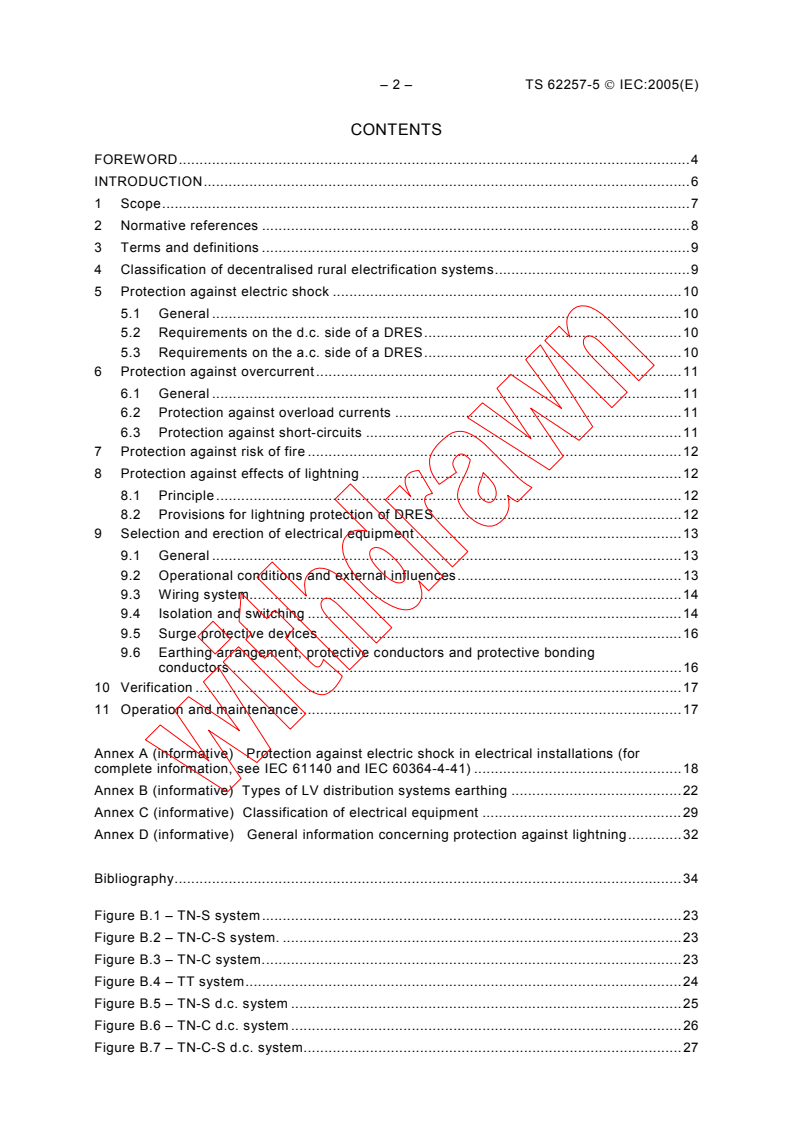
– 2 – TS 62257-5 IEC:2005(E)
CONTENTS
FOREWORD.4
INTRODUCTION.6
1 Scope.7
2 Normative references .8
3 Terms and definitions .9
4 Classification of decentralised rural electrification systems.9
5 Protection against electric shock .10
5.1 General .10
5.2 Requirements on the d.c. side of a DRES.10
5.3 Requirements on the a.c. side of a DRES.10
6 Protection against overcurrent.11
6.1 General .11
6.2 Protection against overload currents .11
6.3 Protection against short-circuits .11
7 Protection against risk of fire .12
8 Protection against effects of lightning .12
8.1 Principle.12
8.2 Provisions for lightning protection of DRES .12
9 Selection and erection of electrical equipment.13
9.1 General .13
9.2 Operational conditions and external influences.13
9.3 Wiring system.14
9.4 Isolation and switching .14
9.5 Surge protective devices .16
9.6 Earthing arrangement, protective conductors and protective bonding
conductors .16
10 Verification .17
11 Operation and maintenance.17
Annex A (informative) Protection against electric shock in electrical installations (for
complete information, see IEC 61140 and IEC 60364-4-41) .18
Annex B (informative) Types of LV distribution systems earthing .22
Annex C (informative) Classification of electrical equipment .29
Annex D (informative) General information concerning protection against lightning.32
Bibliography.34
Figure B.1 – TN-S system.23
Figure B.2 – TN-C-S system. .23
Figure B.3 – TN-C system.23
Figure B.4 – TT system.24
Figure B.5 – TN-S d.c. system .25
Figure B.6 – TN-C d.c. system .26
Figure B.7 – TN-C-S d.c. system.27
TS 62257-5 IEC:2005(E) – 3 –
Figure B.8 – TT d.c. system .28
Figure D.1 – Example of effects of a lightning stroke .32
Table 1 – Typology of decentralized electrification systems .9
Table 2 – Rated operating residual current of the protective device depending on the
value of the earthing resistance .11
Table 3 – Number of protected poles regarding to the characteristics of the distribution
system .15
– 4 – TS 62257-5 IEC:2005(E)
INTERNATIONAL ELECTROTECHNICAL COMMISSION
____________
RECOMMENDATIONS FOR SMALL RENEWABLE ENERGY
AND HYBRID SYSTEMS FOR RURAL ELECTRIFICATION –
Part 5: Protection against electrical hazards
FOREWORD
1) The International Electrotechnical Commission (IEC) is a worldwide organization for standardization comprising
all national electrotechnical committees (IEC National Committees). The object of IEC is to promote
international co-operation on all questions concerning standardization in the electrical and electronic fields. To
this end and in addition to other activities, IEC publishes International Standards, Technical Specifications,
Technical Reports, Publicly Available Specifications (PAS) and Guides (hereafter referred to as “IEC
Publication(s)”). Their preparation is entrusted to technical committees; any IEC National Committee interested
in the subject dealt with may participate in this preparatory work. International, governmental and non-
governmental organizations liaising with the IEC also participate in this preparation. IEC collaborates closely
with the International Organization for Standardization (ISO) in accordance with conditions determined by
agreement between the two organizations.
2) The formal decisions or agreements of IEC on technical matters express, as nearly as possible, an international
consensus of opinion on the relevant subjects since each technical committee has representation from all
interested IEC National Committees.
3) IEC Publications have the form of recommendations for international use and are accepted by IEC National
Committees in that sense. While all reasonable efforts are made to ensure that the technical content of IEC
Publications is accurate, IEC cannot be held responsible for the way in which they are used or for any
misinterpretation by any end user.
4) In order to promote international uniformity, IEC National Committees undertake to apply IEC Publications
transparently to the maximum extent possible in their national and regional publications. Any divergence
between any IEC Publication and the corresponding national or regional publication shall be clearly indicated in
the latter.
5) IEC provides no marking procedure to indicate its approval and cannot be rendered responsible for any
equipment declared to be in conformity with an IEC Publication.
6) All users should ensure that they have the latest edition of this publication.
7) No liability shall attach to IEC or its directors, employees, servants or agents including individual experts and
members of its technical committees and IEC National Committees for any personal injury, property damage or
other damage of any nature whatsoever, whether direct or indirect, or for costs (including legal fees) and
expenses arising out of the publication, use of, or reliance upon, this IEC Publication or any other IEC
Publications.
8) Attention is drawn to the Normative references cited in this publication. Use of the referenced publications is
indispensable for the correct application of this publication.
9) Attention is drawn to the possibility that some of the elements of this IEC Publication may be the subject of
patent rights. IEC shall not be held responsible for identifying any or all such patent rights.
The main task of IEC technical committees is to prepare International Standards. In
exceptional circumstances, a technical committee may propose the publication of a technical
specification when
• the required support cannot be obtained for the publication of an International Standard,
despite repeated efforts, or
• the subject is still under technical development or where, for any other reason, there is the
future but no immediate possibility of an agreement on an International Standard.
Technical specifications are subject to review within three years of publication to decide
whether they can be transformed into International Standards.
IEC 62257-5, which is a technical specification, has been prepared by IEC technical
committee 82: Solar photovoltaic energy systems.
This document is based on IEC/PAS 62111(1997); it cancels and replaces the relevant parts
of IEC/PAS 62111.
TS 62257-5 © IEC:2005(E) – 5 –
This technical specification is to be used in conjunction with IEC 62257 series.
The text of this technical specification is based on the following documents:
Enquiry draft Report on voting
82/370/DTS 82/390/RVC
Full information on the voting for the approval of this technical specification can be found in
the report on voting indicated in the above table.
This publication has been drafted in accordance with the ISO/IEC Directives, Part 2.
IEC 62257 consists of the following parts, under the general title Recommendations for small
renewable energy and hybrid systems for rural electrification:
Part 1: General introduction to rural electrification
Part 2: From requirements to a range of electrification systems
Part 3: Project development and management
Part 4: System selection and design
Part 5: Protection against electrical hazards
Part 6: Acceptance, operation, maintenance and replacement
Part 7: Technical specifications: generators
Part 8: Technical specifications: batteries and converters
Part 9: Technical specifications: integrated systems
Part 10: Technical specifications: energy manager
Part 11: Technical specifications: considerations for grid connection
Part 12: Appliances
Part 13: Other topics
The committee has decided that the contents of this publication will remain unchanged until
the maintenance result date indicated on the IEC web site under "http://webstore.iec.ch" in
the data related to the specific publication. At this date, the publication will be
• transformed into an International standard ,
• reconfirmed,
• withdrawn,
• replaced by a revised edition, or
• amended.
A bilingual edition of this publication may be issued at a later date.
IMPORTANT – The “colour inside” logo on the cover page of this publication indicates
that it contains colours which are considered to be useful for the correct
understanding of its contents. Users should therefore print this publication using a
colour printer.
___________
Under consideration.
This text is standard IEC text but it is not the intention of IEC technical committee 82 to convert this into an IEC
standard. This might be done by another body at a later date, if needed.
– 6 – TS 62257-5 IEC:2005(E)
INTRODUCTION
The IEC 62257 series of documents intends to provide to different players involved in rural
electrification projects (such as project implementers, project contractors, project supervisors,
installers, etc.) documents for the setting up of renewable energy and hybrid systems with a.c.
nominal voltage below 500 V, d.c. nominal voltage below 750 V and nominal power below
100 kVA.
These documents are recommendations:
• to choose the right system for the right place,
• to design the system,
• to operate and maintain the system.
These documents are focused only on rural electrification concentrating on but not specific to
developing countries. They should not be considered as all inclusive to rural electrification.
The documents try to promote the use of renewable energies in rural electrification; they do
not deal with clean mechanisms developments at this time (CO emission, carbon credit, etc.).
Further developments in this field could be introduced in future steps.
This consistent set of documents is best considered as a whole with different parts
corresponding to items for safety, sustainability of systems and at the lowest life cycle cost as
possible. One of the main objectives is to provide the minimum sufficient requirements,
relevant to the field of application that is: small renewable energy and hybrid off-grid systems.
The purpose of this part of IEC 62257 is to specify the general requirements for the protection
of persons and equipment against electrical hazards to be applied in decentralized rural
electrification systems.
TS 62257-5 IEC:2005(E) – 7 –
RECOMMENDATIONS FOR SMALL RENEWABLE ENERGY
AND HYBRID SYSTEMS FOR RURAL ELECTRIFICATION –
Part 5: Protection against electrical hazards
1 Scope
Decentralized Rural Electrification Systems (DRES) are designed to supply electric power for
sites which are not connected to a large interconnected system, or a national grid, in order to
meet basic needs.
The majority of these sites are:
• isolated dwellings,
• village houses,
• community services (public lighting, pumping, health centers, places of worship or
cultural activities, administrative buildings, etc.),
• economic activities (workshops, micro-industry, etc.).
The DRE systems fall into three categories:
• process electrification systems (for example for pumping),
• individual electrification systems (IES) for single users,
• collective electrification systems (CES) for multiple users.
Process or individual electrification systems exclusively consist of two subsystems:
• an electric energy generation subsystem,
• the user's electrical installation.
Collective electrification systems, however, consist of 3 subsystems:
• an electric energy generation subsystem,
• a distribution subsystem, also called micro-grid,
• user’s electrical installations including interface equipment between the installations
and the micro-grid.
The purpose of this document is to specify the general requirements for the protection of
persons and equipment against electrical hazards to be applied in decentralised rural
electrification systems. Requirements dealing with protection against electric shock are based
on basic rules from IEC 61140 and IEC 60364.
These general requirements are to be applied to all the identified categories of DRES.
Application to each subsystem of a DRES is dealt within a specific section of IEC 62257-9.
– 8 – TS 62257-5 IEC:2005(E)
2 Normative references
The following referenced documents are indispensable for the application of this document.
For dated references, only the edition cited applies. For undated references, the latest edition
of the referenced document (including any amendments) applies.
IEC 60050-826, International Electrotechnical Vocabulary (IEV) – Part 826: Electrical
installations
IEC 60364 (all parts), Electrical installations of buildings
IEC 61024-1:1990, Protection of structures against lightning – Part 1: General principles
IEC 61140:1997, Protection against electric shock – Common aspects for installation and
equipment
IEC 62257-1, Recommendations for small renewable energy and hybrid systems for rural
electrification – Part 1: General introduction to rural electrification
IEC 62257-2, Recommendations for small renewable energy and hybrid systems for rural
electrification – Part 2: From requirements to a range of electrification systems
IEC 62257-3, Recommendations for small renewable energy and hybrid systems for rural
electrification – Part 3: Project development and management
IEC 62257-4, Recommendations for small renewable energy and hybrid systems for rural
electrification – Part 4: System selection and design
IEC 62257-5, Recommendations for small renewable energy and hybrid systems for rural
electrification – Part 5: Safety rules
IEC 62257-6, Recommendations for small renewable energy and hybrid systems for rural
electrification – Part 6: Acceptance, operation, maintenance and replacement
IEC 62257-7, Recommendations for small renewable energy and hybrid systems for rural
electrification – Part 7: Technical specifications: generators
IEC 62257-8, Recommendations for small renewable energy and hybrid systems for rural
electrification – Part 8: Technical specifications: batteries and converters
IEC 62257-9, Recommendations for small renewable energy and hybrid systems for rural
electrification – Part 9: Technical specifications: integrated systems
IEC 62257-10, Recommendations for small renewable energy and hybrid systems for rural
electrification – Part 10: Technical specifications: energy manager
IEC 62257-11, Recommendations for small renewable energy and hybrid systems for rural
electrification – Part 11: Technical specifications: considerations for grid connection
IEC 62257-12, Recommendations for small renewable energy and hybrid systems for rural
electrification – Part 12: Appliances
IEC 62257-13, Recommendations for small renewable energy and hybrid systems for rural
electrification – Part 13: Other topics
IEC 62305-2:2005, Protection against lightning – Part 2: Risk management
___________
Under consideration.
TS 62257-5 IEC:2005(E) – 9 –
3 Terms and definitions
For the purpose of this part of IEC 62257, the following terms and definitions apply.
3.1
DRES
decentralized rural electrification system
3.2
REN
renewable energy
3.3
micro-grid
subsystem of a DRES intended for power distribution
NOTE The prefix «micro» being intended to express the low level of transmitting capacity, usually less than 50 kVA.
3.4
micro-powerplant
subsystem of a DRES intended for power generation. The prefix «micro» being intended to
express the low power level generated (from a few kVA to a few tens of kVA)
3.5
SPD
Surge Protection Device
4 Classification of decentralised rural electrification systems
DRES are classified into six different types. See Table 1.
Table 1 – Typology of decentralized electrification systems
Type of generator Classification of associated systems
Individual Collective
REN only, hybrid or not no storage T.I T .C
1 1
REN only, hybrid or not storage T.I T .C
2 2
REN, hybrid or not no storage T.I T .C
3 3
plus Genset
REN, hybrid or not storage T.I T .C
4 4
plus Genset
Genset only no storage T.I T .C
5 5
Genset only storage T.I T .C
6 6
Notation principle: Ti.I = individual system, type i; Tj.C = collective system, type j.
“Storage” = storage of energy produced by one of the generator of the system and which can be reconverted.
Architecture and characteristics of the different electrification system types are developed in
Clause 6 of IEC 62257-2.
– 10 – TS 62257-5 IEC:2005(E)
5 Protection against electric shock
5.1 General
Basic rules for protection against electric shock are given in IEC 61140 and IEC 60364-4-41.
Information is also available in Annex A.
5.2 Requirements on the d.c. side of a DRES
The principles for the design and erection of a d.c. electrical circuit are similar to those for an
a.c. circuit. The main differences concern short-circuit current calculation and the selection of
the protective devices.
Protection by extra-low voltage (SELV and PELV systems) or protection by double or
reinforced insulation should preferably be adopted on the d.c. side of DRES.
NOTE Protection by automatic disconnection of supply on the d.c. side requires special measures which are
under consideration.
Simple separation, at least, should be provided between the a.c. side and the d.c. side unless
the inverter is not able, by construction, to feed d.c. fault current into the a.c. installation.
Earthing of one of the live conductors of the d.c. side is permitted, if there is at least simple
separation between the d.c. side and the a.c. side.
5.3 Requirements on the a.c. side of a DRES
5.3.1 General
Protection by use of automatic disconnection of supply should preferably be adopted on the
a.c. side of a DRES. For each circuit, maximum disconnecting times given in IEC 60364-4-41
should apply.
TN-S system should preferably be used for user's installations, TN-S or TN-C system being
preferably used for the micro-grid.
TT system is acceptable. IT system is normally not used for DRES and has hence not been
dealt with in this specification.
A residual current protective device, with a rated operating residual current not exceeding
30 mA, should be provided as additional protection for each installation or for a group of
installations.
5.3.2 TT system
Basic protection is provided by basic insulation of live parts or by barriers or enclosures. Fault
protection is provided by residual current devices regarding the resistance value of the earth
electrode to which the PE conductor is connected. The fault current should be high enough to
activate the differential current device. The rated operating residual current I of the device
Δn
should fulfil the formula:
U
L
I ≤ with U = 50 V
∆n L
R
A
where U is the conventional maximum voltage and R is the earthing resistance.
L A
TS 62257-5 IEC:2005(E) – 11 –
This formula results in the values shown in Table 2.
Table 2 – Rated operating residual current of the protective device
depending on the value of the earthing resistance
R
I
A
Δn
A
Ω
R ≤ 50
A
0,5
50 < R ≤ 100
A
0,3
100 < R ≤ 167
A
0,1
167 < R ≤ 300
A
0,03
300 < R ≤ 500
A
5.3.3 TN system
Basic protection is provided by basic insulation of live parts or by barriers or enclosures. Fault
protection is provided by devices protecting against over-currents.
Additional information is given in Annexes A and B.
6 Protection against overcurrent
6.1 General
Protective devices should be provided to break any over-current flowing in the circuit
conductors before such a current could cause a danger due to thermal and mechanical effects
or a temperature rise detrimental to insulation, joints, termination (see IEC 60364-4-43).
6.2 Protection against overload currents
The operating characteristics of a device protecting a cable against overload current should
satisfy the two following conditions:
I ≤ I ≤ I
b n z
I ≤ 1,45 × I
2 z
where
I is the current for which the circuit is designed;
b
I is the continuous current-carrying capacity of the cable;
z
I is the nominal current of the protective device;
n
I is the current ensuring effective operation in the conventional time of the protective
device.
6.3 Protection against short-circuits
For cables and isolated conductors, each short-circuit protective device should meet both of
the following conditions:
– The breaking capacity should not be less than the prospective short-circuit current at the
place of its installation, except where another protective device having the necessary
breaking capacity and coordinated characteristics is installed upstream.
– 12 – TS 62257-5 IEC:2005(E)
– All current caused by a short-circuit occurring at any point of the circuit should be
interrupted in a time not exceeding that which brings the conductors to the admissible limit
temperature. For short-circuits of duration up to 5 s, the time t, in which a given short-
circuit current will raise the conductors from the highest admissible temperature in normal
duty to the limit temperature can, as an approximation, be calculated from the formula:
t = k × S/I
where
t is the duration in s;
S is the cross-sectional area, in square millimetres;
I is the effective short-circuit current, in amperes, expressed as r.m.s. value;
k is a factor taking account of the resistivity, temperature coefficient and heat capacity of
the conductor material, and the appropriate initial and final temperatures.
7 Protection against risk of fire
Where there is a risk of personal injury or property damage due to fire caused by an earth
fault in the system, a residual current protective device should be provided at least at the
entry to the user’s installation. Its rated operating residual current should be ≤300 mA. Such a
device should switch all live conductors.
8 Protection against effects of lightning
8.1 Principle
Information about the effects of lightning on electrical supply systems is given in Annex D.
Decision for lightning protective provision (lightning rod, surge protective devices, …) should
be based on risk assessment, taking account of the lightning frequency statistics, the
characteristics and position of the structures, the length of the overhead lines, if any, the cost
and the requested availability of the equipment.
Examples of risk assessment methods appropriate for lightning protection can be found in the
draft IEC 60364-4-44:2001, Clause 443 and IEC 62305-2:2005.
8.2 Provisions for lightning protection of DRES
8.2.1 Protection against overvoltages
Where protection against overvoltages (for example due to indirect lightning) is required, an
SPD(s) should be installed both at the distribution board of the micro-power plant, and at the
entry point of the user's installations or associated with each socket-outlet.
Installation of SPD should comply with IEC 60364-5-53, Clause 534.
To minimize voltages induced by lightning, the area of all wiring loops should be as small as
possible.
8.2.2 Protection against direct lightning
Where protection against direct lightning is required, the following provisions apply:
– In case of wind powered generation, the lightning rod should be installed at the summit of
the mast.
TS 62257-5 IEC:2005(E) – 13 –
– Where PV generation coexists with wind-powered generation, protection against direct
lightning is generally achieved by placing the panels inside the pick-up zone of the wind-
powered generator mast.
– Where PV generation is alone, the panels can be protected by installing a protective wire
above the PV panel with an appropriate pick-up area.
– Protection should be completed by the installation of SPDs between conductors and
between conductors and earth, with appropriate characteristics (see IEC 60364-5-53,
Clause 534).
Determination of the pick up area of a rod or wire should be achieved according to
IEC 61024-1.
9 Selection and erection of electrical equipment
9.1 General
All equipment should be selected according to the rules of IEC 60364-5-53.
9.2 Operational conditions and external influences
Every item of equipment should be selected and erected in compliance with the appropriate
standards.
Equipment should be suitable for the nominal voltage (r.m.s. value for a.c.) of the circuit
concerned and for the overvoltages which could occur.
Equipment should be selected for the design current (r.m.s. value for a.c.) which it has to
carry in normal service.
Equipment on the d.c. side should be suitable for direct voltage and direct current.
Equipment should also be capable of carrying the currents likely to flow in abnormal
conditions for such periods of time as are determined by the characteristics of the protective
devices.
If frequency has an influence on the characteristics of equipment, the rated frequency of the
equipment should correspond to the frequency and frequency variations which could occur in
the circuit concerned.
The electrical equipment should withstand the expected external influences such as wind, ice
formation, temperature and solar radiation, etc. If a piece of equipment does not have, by
construction, the necessary qualities corresponding to the location in which it is installed,
appropriate additional protection should be provided, forming part of the installation.
Electrical equipment should be selected and erected so that it does not produce, in normal
service, any interference with the other equipment in the system. The causes of interference
include:
– power factor,
– inrush current,
– phase unbalance (three-phase systems),
– harmonics.
– 14 – TS 62257-5 IEC:2005(E)
9.3 Wiring system
The minimum cross-sectional area of protective conductors should be determined according
IEC 60364-5-54.
The minimum cross sectional area of conductors should be determined according to:
– The current-carrying capacity of conductors taking account of external influences and of
the methods of installation. See tables in IEC 60364-5-52.
– The acceptable voltage drop in conductors. Voltage value should comply with the following
limits at the terminals of any user’s electrical equipment:
230 V ± 10 %
a.c.
NOTE A wider range of voltage variation (up to 20 %) may be accepted regarding the agreed target for power
quality (see IEC 62257-2).
+20
12/24 V ( ) %.
d.c.
−15
9.4 Isolation and switching
9.4.1 Isolation
The purpose of isolation is to separate a circuit or equipment unit from the rest of the system
in order to guarantee the safety of persons who may have to work on, to maintain or repair it.
Every circuit should be capable of being isolated.
In TN-C systems, the PEN conductor should not be interrupted (broken, switched or
disconnected). In TN-S systems, the neutral conductor need not be interrupted.
Suitable means (padlocking, location within lockable enclosure, etc.) should be provided to
prevent any equipment from being unintentionally energised.
The isolating distance between open contacts should be visible or clearly and reliably
indicated.
9.4.2 Over-current protective devices
9.4.2.1 General
Fuses (gG type) or circuit-breakers with appropriate range of instantaneous tripping should be
used.
The range of instantaneous tripping for a circuit-breaker should be selected according to the
prospective short-circuit current.
Over-current protective devices should be preferably of a type ensuring protection against
both overload and short-circuit currents and capable of acting as isolating switch in the open
position.
Special attention should be paid to over-current protective devices installed in series, to
ensure that an appropriate coordination is achieved. Selectivity between protective devices in
series should preferably be total.
9.4.2.2 AC over-current protective devices
The number of protected poles depends on the neutral earthing distribution system and on the
cross-sectional area the neutral conductor, in accordance with Table 3.
NOTE A protected pole is a pole provided with an over-current release.
TS 62257-5 IEC:2005(E) – 15 –
Table 3 – Number of protected poles with regard to the characteristics
of the distribution system
Neutral earthing Conductors Cross-sectional area of Protected poles Conditions
distribution system the neutral conductor
3 ph 3 ph
3 ph + N S = S 3 ph or 3 ph + N
N ph
TT or TN-S
ph + N S = S ph or ph + N
N ph
3 ph + N S < S 3 ph 1 + 2 + 3 + 4
N ph
3 ph + N S < S 3 ph + N 1 + 2 + 3
N ph
3 ph + PEN S = S 3 ph
N ph
TN-C S < S
3 ph + PEN 3 ph 1 + 2 + 3 + 4
N ph
ph + PEN S = S ph
N ph
Conditions:
2 2
1: The cross-sectional area of the conductors is >16 mm Cu or >25 mm Al.
2: The power consumed between phases and neutral is <10 % of the total power transmitted by the mains.
3: The maximum current expected to flow in the neutral conductor is less than its permissible current.
4: The neutral conductor is protected against short-circuits by the steps taken to protect the phase conductors.
9.4.2.3 DC over-current protective devices
For the selection of d.c. overcurrent protective devices, it is recommended to be assisted by
the manufacturer after having determined and transmitted the characteristics of the circuit
(short-circuit current, rated current, time constant).
NOTE For calculation of the short-circuit current in case of a battery whose internal resistance is not known, the
following formula may be used:
I =10 × C
k
C in A/h.
For calculation of the short-circuit current at the terminals of a d.c. generator, the following formula may be used:
I =1,1 × U / R
k n i
R is the internal resistance of the generator
i
For calculation of the short-circuit current at any point of the installation, the following formula may be used:
I =1,1 × U /R + 2R
k n i L
R is the line resistance.
L
And in case of the presence of a d.c. motor, the value of I , here above is increased by the value of
k
6I of the motor.
N
9.4.3 Residual Current protective Devices (RCD)
Residual current devices should be so selected, and the electric circuits so subdivided that
any earth-leakage current which may be expected to occur during normal operation of the
connected load(s) will be unlikely to cause unnecessary tripping of the device.
NOTE Residual current protective devices may operate at any value of residual current in excess of 50 % of the
rated operating current.
Residual current protective devices in d.c. systems should be specially designed for detection
of d.c. residual currents, and to break circuit currents under normal conditions and fault
conditions.
For the systems concerned, RCDs installed upstream surge protective devices should be of
type S, in order to allow service continuity.
– 16 – TS 62257-5 IEC:2005(E)
9.5 Surge protective devices
The selection and erection of SPDs should comply with IEC 60364-5-53, Clause 534.
The following are the leading parameters needed to select SPDs (see also Annex 3):
UP = protection level for nominal current (for example 2,5 kV, 1,5 kV).
UC = continuous service voltage to be chosen on the basis of mains
nominal voltage.
I (8/20 wave) = nominal discharge current. Standard values: 20 kA, 10 kA, 5 kA, etc.
nominal
Use of SPDs in presence of harmonics (e.g. where non sine-wave inverters are used) is
problematic. Due to harmonics, the ageing of varistors is accelerated. The solution consists in
installing SPDs including internal spark-gaps in series with the varistor (SiC or ZnO).
9.6 Earthing arrangement, protective conductors and protective bonding conductors
9.6.1 Earth electrodes
9.6.1.1 General
Materials and dimensions of the earth electrodes should be selected to withstand corrosion
and to have mechanical strength.
When selecting type and embedded depth of earth electrode, consideration should be given to
local conditions so that soil drying and freezing will be unlikely to increase the earth
resistance of the earth electrode to such a value that would impair the protective measures
against electric shock.
9.6.1.2 Earth electrodes for the supply system
Examples of earth electrodes which may be used are:
– underground structural network embedded in foundations (foundation earthing),
– rods or pipes,
– tapes or wires,
– metal sheaths and other metal coverings of cables according to local conditions or
requirements,
– plates.
Where possible, a foundation earthing should be preferred.
Common minimum sizes for earth electrodes of commonly used material can be found in
IEC 60364-5-54.
9.6.1.3 Earth termination (electrode) of a lightning protection system
In order to disperse the lightning current into the earth without causing dangerous
overvoltages, the shape and the dimensions of the earth termination system of an LPS are
more important than the value of the resistance of the earth electrode (characteristic
applicable for d.c. or low frequency phenomena).
The earth termination system should be composed of:
– either conductors of the same nature and same cross-section as the down-conductors (in
general, 30 mm × 2 mm copper strip) laid out in the form of a large crow’s foot:
3 conductors 7 m to 8 m long buried horizontally at a depth of at least 0,60 m,
TS 62257-5 IEC:2005(E) – 17 –
– or a set of 3 vertical rods 2 m in length connected together and set out at the apexes of an
equilateral triangle with sides measuring about 2 m.
The earth termination system of the LPS should be bonded to the earthing arrangement with
short connexions.
9.6.1.4 Application to the protection of an ENR power system
The wind-powered generator and/or the frame of the PV panels should be earthed by a crow’s
foot earth electrode with the lowest possible resistance (a 10 Ω at 50 Hz is frequently
adopted). This earth electrode should be bonded, with short connexions, to the earthing
arrangement of the technical rooms housing the other equipment of the installation.
9.6.2 Protective bonding conductors
Where protective equipotential bonding conductors are installed, they should be parallel to
and in close contact as possible with d.c. cables and a.c. cables and accessories
(IEC 60364-7-712).
10 Verification
See IEC 62257-6.
11 Operation and maintenance
See IEC 62257-6.
– 18 – TS 62257-5 IEC:2005(E)
Annex A
(informative)
Protection against electric shock in electrical installations
(for complete information, see IEC 61140 and IEC 60364-4-41)
A.1 Terms and definitions
For the purposes of this Annex, the following terms and definitions, taken from IEC 60050-195,
apply.
A.1.1
protection against electric shock
provision of measures reducing the risk of electric shock
A.1.2
basic protection
protection against electric shock under fault-free conditions
A.1.3
fault protection
protection against electric shock under single-fault conditions
A.1.4
direct contact
electric contact of persons or animals with live parts
A.1.5
indirect contact
electric contact of persons or animals with exposed-conductive-parts which have become live
under fault conditions
A.1.6
hazardous-live-part
live part which, under certain conditions, can give a harmful electric shock
A.2 Protection against electric shock
The fundamental rule of protection against electric shock, according to IEC 61140, is that
hazardous-live-parts should not be accessible and accessible conductive parts should not be
hazardous live either under normal conditions or under single fault conditions.
According to IEC 61140, protection under normal conditions is provided by basic protective
provisions and protection under single fault conditions is provided by fault protective
provisions. Alternatively, protection against electric shock is provided by an enhanced
protective provision which provides protection under normal conditions and under single fault
conditions.
NOTE Formerly, protection under normal conditions was referred to as protection against direct contact and
protection under single-fault conditions was referred to as protection against indirect contact.
TS 62257-5 IEC:2005(E) – 19 –
Consequently, a protective measure is:
• an appropriate combination of a basic protective provision and an independent fault
protective provision, or
• an enhanced protective provision which provides both basic protection and fault
protection.
In each part of an installation, one or more protective measures should be applied. Except
otherwise specified, the following protective measures are permitted:
• automatic disconnection of supply,
• double or reinforced insulation,
• electrical separation for the supply of one item of current using equipment,
• extra-low voltage.
The following protective measures
• use of obstacles,
• placing out of reach,
should only be used under the control of skilled or instructed persons.
The following protective
...