

IEC 62585:2012
(Main)Electroacoustics - Methods to determine corrections to obtain the free-field response of a sound level meter
General Information
- Abstract
IEC 62585:2012 provides information on the corrections required over a range of frequencies in order for a periodic test of a sound level meter to be performed according to IEC 61672-3. These corrections include; corrections for the typical effects of reflections from the case of the sound level meter and diffraction of sound around the microphone; corrections for the deviation of the typical microphone frequency response from a uniform frequency response, where the actual microphone response cannot be measured; and corrections for the influence on the frequency response of a typical microphone of a specified windscreen and any other accessory that is part of the configuration for normal use of the particular sound level meter submitted for testing. This International Standard includes discussion about uncertainties of measurement of the required corrections. In some instances a maximum permitted expanded uncertainty for the manufacturer or testing laboratory is given. The aim of this International Standard is to ensure that the adjustment value at the calibration check frequency and all corrections are determined using consistent and appropriate methods. It is intended that this International Standard will be used by manufacturers to determine adjustment values and corrections, by laboratories performing pattern evaluation tests according to IEC 61672-2, and by laboratories performing periodic tests according to IEC 61672-3. Laboratories performing periodic tests according to IEC 61672-3 will also need to consult this International Standard to ensure that the expanded uncertainties of measurement for the corrections quoted by the manufacturer do not exceed the maximum permitted values.
- Status
- Published
- Publication Date
- 24-Jul-2012
- Technical Committee
- TC 29 - Electroacoustics
- Drafting Committee
- WG 17 - TC 29/WG 17
- Current Stage
- PPUB - Publication issued
- Start Date
- 25-Jul-2012
- Completion Date
- 31-Aug-2012
Overview
IEC 62585:2012 is an International Standard developed by the International Electrotechnical Commission (IEC) that focuses on electroacoustics, specifically methods to determine corrections needed to obtain the free-field response of a sound level meter. This standard provides comprehensive guidance on the necessary frequency-dependent corrections that enable precise periodic testing of sound level meters as per IEC 61672-3. Its primary goal is to establish consistent and reliable approaches for calibrating sound level meters to ensure their measurement accuracy, especially regarding sound reflections, microphone response deviations, and accessories like windscreens.
Key Topics
Correction for Sound Reflections and Diffraction
IEC 62585 details the methods to account for typical effects caused by reflections from the sound level meter's case and diffraction of sound waves around its microphone. These corrections are crucial to ensure that the sound level meter accurately measures sound as if in a free-field environment (no reflective surfaces nearby).Microphone Frequency Response Deviations
The standard addresses adjustments needed due to the microphone’s deviation from an ideal uniform frequency response when direct measurement of the actual microphone response is not feasible. This ensures that the sound level meter readings are corrected to represent true sound pressure levels across frequencies.Accessory Impact Corrections
The influence of accessories such as windscreens and other attachments that are part of the normal meter configuration on the frequency response of microphones is also covered. Correcting for these attachments ensures accurate measurements in typical real-world applications.Uncertainty of Measurement
IEC 62585 discusses uncertainty factors associated with correction measurements and specifies maximum permitted expanded uncertainties for manufacturers and testing laboratories. This supports conformity assessment and helps maintain high standards during calibration and periodic testing.Adjustment Values at Calibration Check Frequencies
The standard defines the methodology for determining the adjustment value manufacturers should quote at the calibration check frequency, optimizing the meter’s performance over its operating frequency range.Measurement Methods with Various Calibration Tools
The document specifies procedures for determining frequency corrections when using recommended instruments such as sound calibrators, comparison couplers, or electrostatic actuators to ensure the free-field equivalent sound level is obtained during testing.
Applications
Sound Level Meter Manufacturing
Manufacturers utilize IEC 62585 to establish correction values and adjustment factors necessary for their sound level meters to comply with IEC 61672 series standards. This supports product reliability and international market acceptance.Calibration and Testing Laboratories
Testing facilities apply the methods specified in IEC 62585 when performing periodic pattern evaluations and testing of sound level meters. Adherence to this standard ensures traceable and consistent measurement results and helps laboratories meet accreditation requirements.Environmental Noise Assessment
Accurate sound level meter calibration following IEC 62585 guidelines is vital for environmental noise monitoring, ensuring that measurements reflect true environmental sound levels free from equipment-induced anomalies.Occupational Health and Safety Compliance
Organizations monitoring workplace noise risks benefit from sound level meters calibrated in accordance with IEC 62585, supporting compliance with safety regulations and protecting workers from hazardous noise exposure.
Related Standards
IEC 61672-1:2002 - Electroacoustics - Sound level meters - Part 1: Specification
Defines performance requirements for sound level meters which IEC 62585 supports by providing methods for correction and calibration.IEC 61672-3:2013 - Electroacoustics - Sound level meters - Part 3: Periodic tests
Specifies periodic testing procedures where the corrections and adjustment methods in IEC 62585 are applied.IEC 60942:2003 - Electroacoustics - Sound calibrators
Governs sound calibrators used during calibration and measurement procedures referenced in IEC 62585.ISO/IEC Guide 98-3:2008 - Uncertainty of measurement - Part 3: Guide to the expression of uncertainty in measurement (GUM)
Provides the framework for uncertainty assessment relevant to measurement corrections discussed in IEC 62585.
Adherence to IEC 62585:2012 ensures that sound level meters provide accurate, reliable, and consistent measurements by accounting for environmental and equipment influences through standardized correction methods. This facilitates international consistency, regulatory compliance, and trustworthy acoustic measurement results in diverse applications.
Relations
- Effective Date
- 22-Jul-2026
Get Certified
Connect with accredited certification bodies for this standard

BSMI (Bureau of Standards, Metrology and Inspection)
Taiwan's standards and inspection authority.
Sponsored listings
Frequently Asked Questions
IEC 62585:2012 is a standard published by the International Electrotechnical Commission (IEC). Its full title is "Electroacoustics - Methods to determine corrections to obtain the free-field response of a sound level meter". This standard covers: IEC 62585:2012 provides information on the corrections required over a range of frequencies in order for a periodic test of a sound level meter to be performed according to IEC 61672-3. These corrections include; corrections for the typical effects of reflections from the case of the sound level meter and diffraction of sound around the microphone; corrections for the deviation of the typical microphone frequency response from a uniform frequency response, where the actual microphone response cannot be measured; and corrections for the influence on the frequency response of a typical microphone of a specified windscreen and any other accessory that is part of the configuration for normal use of the particular sound level meter submitted for testing. This International Standard includes discussion about uncertainties of measurement of the required corrections. In some instances a maximum permitted expanded uncertainty for the manufacturer or testing laboratory is given. The aim of this International Standard is to ensure that the adjustment value at the calibration check frequency and all corrections are determined using consistent and appropriate methods. It is intended that this International Standard will be used by manufacturers to determine adjustment values and corrections, by laboratories performing pattern evaluation tests according to IEC 61672-2, and by laboratories performing periodic tests according to IEC 61672-3. Laboratories performing periodic tests according to IEC 61672-3 will also need to consult this International Standard to ensure that the expanded uncertainties of measurement for the corrections quoted by the manufacturer do not exceed the maximum permitted values.
IEC 62585:2012 provides information on the corrections required over a range of frequencies in order for a periodic test of a sound level meter to be performed according to IEC 61672-3. These corrections include; corrections for the typical effects of reflections from the case of the sound level meter and diffraction of sound around the microphone; corrections for the deviation of the typical microphone frequency response from a uniform frequency response, where the actual microphone response cannot be measured; and corrections for the influence on the frequency response of a typical microphone of a specified windscreen and any other accessory that is part of the configuration for normal use of the particular sound level meter submitted for testing. This International Standard includes discussion about uncertainties of measurement of the required corrections. In some instances a maximum permitted expanded uncertainty for the manufacturer or testing laboratory is given. The aim of this International Standard is to ensure that the adjustment value at the calibration check frequency and all corrections are determined using consistent and appropriate methods. It is intended that this International Standard will be used by manufacturers to determine adjustment values and corrections, by laboratories performing pattern evaluation tests according to IEC 61672-2, and by laboratories performing periodic tests according to IEC 61672-3. Laboratories performing periodic tests according to IEC 61672-3 will also need to consult this International Standard to ensure that the expanded uncertainties of measurement for the corrections quoted by the manufacturer do not exceed the maximum permitted values.
IEC 62585:2012 is classified under the following ICS (International Classification for Standards) categories: 17.140.50 - Electroacoustics. The ICS classification helps identify the subject area and facilitates finding related standards.
IEC 62585:2012 has the following relationships with other standards: It is inter standard links to EN ISO 6926:2016. Understanding these relationships helps ensure you are using the most current and applicable version of the standard.
IEC 62585:2012 is available in PDF format for immediate download after purchase. The document can be added to your cart and obtained through the secure checkout process. Digital delivery ensures instant access to the complete standard document.
Standards Content (Sample)
IEC 62585 ®
Edition 1.0 2012-07
INTERNATIONAL
STANDARD
NORME
INTERNATIONALE
Electroacoustics – Methods to determine corrections to obtain the free-field
response of a sound level meter
Électroacoustique – Méthodes de détermination de corrections pour obtenir la
réponse en champ libre d'un sonomètre
All rights reserved. Unless otherwise specified, no part of this publication may be reproduced or utilized in any form
or by any means, electronic or mechanical, including photocopying and microfilm, without permission in writing from
either IEC or IEC's member National Committee in the country of the requester.
If you have any questions about IEC copyright or have an enquiry about obtaining additional rights to this publication,
please contact the address below or your local IEC member National Committee for further information.
Droits de reproduction réservés. Sauf indication contraire, aucune partie de cette publication ne peut être reproduite ni
utilisée sous quelque forme que ce soit et par aucun procédé, électronique ou mécanique, y compris la photocopie et les
microfilms, sans l'accord écrit de la CEI ou du Comité national de la CEI du pays du demandeur.
Si vous avez des questions sur le copyright de la CEI ou si vous désirez obtenir des droits supplémentaires sur cette
publication, utilisez les coordonnées ci-après ou contactez le Comité national de la CEI de votre pays de résidence.
IEC Central Office Tel.: +41 22 919 02 11
3, rue de Varembé Fax: +41 22 919 03 00
CH-1211 Geneva 20 info@iec.ch
Switzerland www.iec.ch
About the IEC
The International Electrotechnical Commission (IEC) is the leading global organization that prepares and publishes
International Standards for all electrical, electronic and related technologies.
About IEC publications
The technical content of IEC publications is kept under constant review by the IEC. Please make sure that you have the
latest edition, a corrigenda or an amendment might have been published.
Useful links:
IEC publications search - www.iec.ch/searchpub Electropedia - www.electropedia.org
The advanced search enables you to find IEC publications The world's leading online dictionary of electronic and
by a variety of criteria (reference number, text, technical electrical terms containing more than 30 000 terms and
committee,…). definitions in English and French, with equivalent terms in
It also gives information on projects, replaced and additional languages. Also known as the International
withdrawn publications. Electrotechnical Vocabulary (IEV) on-line.
IEC Just Published - webstore.iec.ch/justpublished Customer Service Centre - webstore.iec.ch/csc
Stay up to date on all new IEC publications. Just Published If you wish to give us your feedback on this publication
details all new publications released. Available on-line and or need further assistance, please contact the
also once a month by email. Customer Service Centre: csc@iec.ch.
A propos de la CEI
La Commission Electrotechnique Internationale (CEI) est la première organisation mondiale qui élabore et publie des
Normes internationales pour tout ce qui a trait à l'électricité, à l'électronique et aux technologies apparentées.
A propos des publications CEI
Le contenu technique des publications de la CEI est constamment revu. Veuillez vous assurer que vous possédez
l’édition la plus récente, un corrigendum ou amendement peut avoir été publié.
Liens utiles:
Recherche de publications CEI - www.iec.ch/searchpub Electropedia - www.electropedia.org
La recherche avancée vous permet de trouver des Le premier dictionnaire en ligne au monde de termes
publications CEI en utilisant différents critères (numéro de électroniques et électriques. Il contient plus de 30 000
référence, texte, comité d’études,…). termes et définitions en anglais et en français, ainsi que
Elle donne aussi des informations sur les projets et les les termes équivalents dans les langues additionnelles.
publications remplacées ou retirées. Egalement appelé Vocabulaire Electrotechnique
International (VEI) en ligne.
Just Published CEI - webstore.iec.ch/justpublished
Service Clients - webstore.iec.ch/csc
Restez informé sur les nouvelles publications de la CEI.
Just Published détaille les nouvelles publications parues. Si vous désirez nous donner des commentaires sur
Disponible en ligne et aussi une fois par mois par email. cette publication ou si vous avez des questions
contactez-nous: csc@iec.ch.
IEC 62585 ®
Edition 1.0 2012-07
INTERNATIONAL
STANDARD
NORME
INTERNATIONALE
Electroacoustics – Methods to determine corrections to obtain the free-field
response of a sound level meter
Électroacoustique – Méthodes de détermination de corrections pour obtenir la
réponse en champ libre d'un sonomètre
INTERNATIONAL
ELECTROTECHNICAL
COMMISSION
COMMISSION
ELECTROTECHNIQUE
PRICE CODE
INTERNATIONALE
CODE PRIX X
ICS 17.140.50 ISBN 978-2-83220-290-6
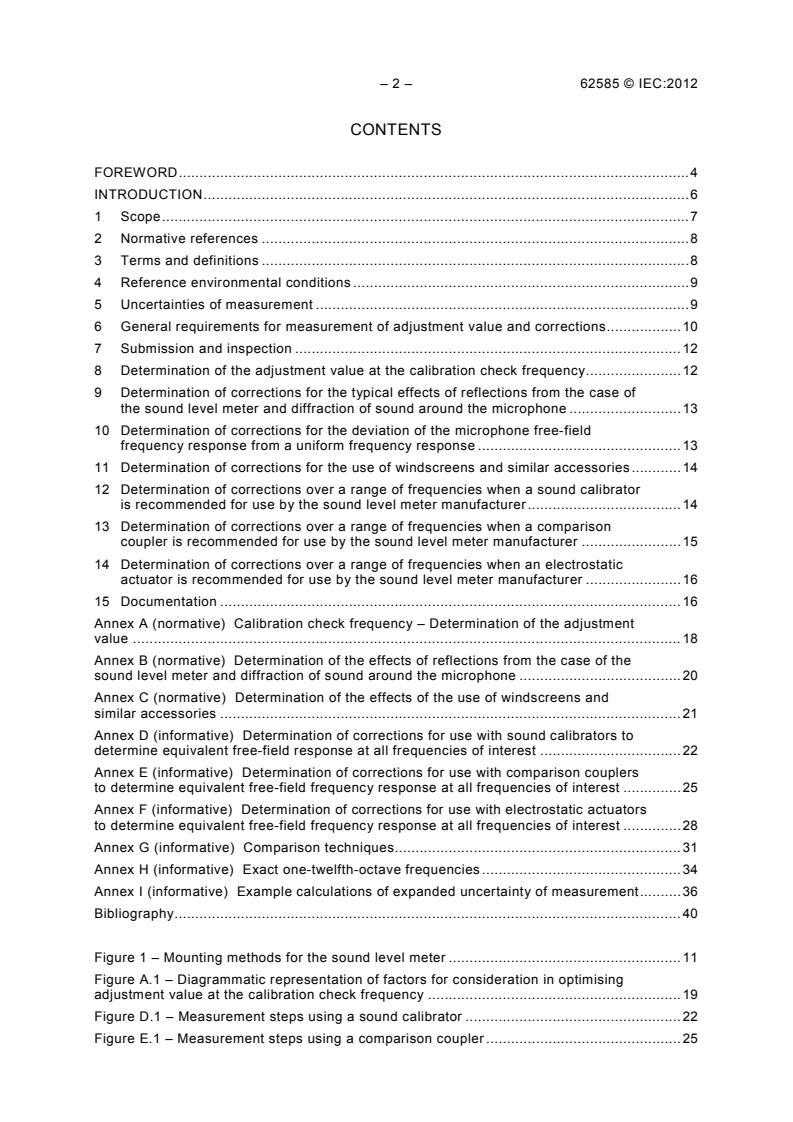
– 2 – 62585 © IEC:2012
CONTENTS
FOREWORD . 4
INTRODUCTION . 6
1 Scope . 7
2 Normative references . 8
3 Terms and definitions . 8
4 Reference environmental conditions . 9
5 Uncertainties of measurement . 9
6 General requirements for measurement of adjustment value and corrections . 10
7 Submission and inspection . 12
8 Determination of the adjustment value at the calibration check frequency . 12
9 Determination of corrections for the typical effects of reflections from the case of
the sound level meter and diffraction of sound around the microphone . 13
10 Determination of corrections for the deviation of the microphone free-field
frequency response from a uniform frequency response . 13
11 Determination of corrections for the use of windscreens and similar accessories . 14
12 Determination of corrections over a range of frequencies when a sound calibrator
is recommended for use by the sound level meter manufacturer . 14
13 Determination of corrections over a range of frequencies when a comparison
coupler is recommended for use by the sound level meter manufacturer . 15
14 Determination of corrections over a range of frequencies when an electrostatic
actuator is recommended for use by the sound level meter manufacturer . 16
15 Documentation . 16
Annex A (normative) Calibration check frequency – Determination of the adjustment
value . 18
Annex B (normative) Determination of the effects of reflections from the case of the
sound level meter and diffraction of sound around the microphone . 20
Annex C (normative) Determination of the effects of the use of windscreens and
similar accessories . 21
Annex D (informative) Determination of corrections for use with sound calibrators to
determine equivalent free-field response at all frequencies of interest . 22
Annex E (informative) Determination of corrections for use with comparison couplers
to determine equivalent free-field frequency response at all frequencies of interest . 25
Annex F (informative) Determination of corrections for use with electrostatic actuators
to determine equivalent free-field frequency response at all frequencies of interest . 28
Annex G (informative) Comparison techniques. 31
Annex H (informative) Exact one-twelfth-octave frequencies . 34
Annex I (informative) Example calculations of expanded uncertainty of measurement . 36
Bibliography . 40
Figure 1 – Mounting methods for the sound level meter . 11
Figure A.1 – Diagrammatic representation of factors for consideration in optimising
adjustment value at the calibration check frequency . 19
Figure D.1 – Measurement steps using a sound calibrator . 22
Figure E.1 – Measurement steps using a comparison coupler . 25
62585 © IEC:2012 – 3 –
Figure F.1 – Measurement steps using an electrostatic actuator . 28
Table H.1 – Exact frequencies for one-twelfth-octave steps over one decade . 35
Table I.1 – Description of likely uncertainty components . 37
Table I.2 – Uncertainty example for a frequency of 1 kHz . 38
Table I.3 – Uncertainty example for a frequency of 8 kHz . 39
– 4 – 62585 © IEC:2012
INTERNATIONAL ELECTROTECHNICAL COMMISSION
____________
ELECTROACOUSTICS –
METHODS TO DETERMINE CORRECTIONS TO OBTAIN
THE FREE-FIELD RESPONSE OF A SOUND LEVEL METER
FOREWORD
1) The International Electrotechnical Commission (IEC) is a worldwide organization for standardization comprising
all national electrotechnical committees (IEC National Committees). The object of IEC is to promote
international co-operation on all questions concerning standardization in the electrical and electronic fields. To
this end and in addition to other activities, IEC publishes International Standards, Technical Specifications,
Technical Reports, Publicly Available Specifications (PAS) and Guides (hereafter referred to as “IEC
Publication(s)”). Their preparation is entrusted to technical committees; any IEC National Committee interested
in the subject dealt with may participate in this preparatory work. International, governmental and non-
governmental organizations liaising with the IEC also participate in this preparation. IEC collaborates closely
with the International Organization for Standardization (ISO) in accordance with conditions determined by
agreement between the two organizations.
2) The formal decisions or agreements of IEC on technical matters express, as nearly as possible, an international
consensus of opinion on the relevant subjects since each technical committee has representation from all
interested IEC National Committees.
3) IEC Publications have the form of recommendations for international use and are accepted by IEC National
Committees in that sense. While all reasonable efforts are made to ensure that the technical content of IEC
Publications is accurate, IEC cannot be held responsible for the way in which they are used or for any
misinterpretation by any end user.
4) In order to promote international uniformity, IEC National Committees undertake to apply IEC Publications
transparently to the maximum extent possible in their national and regional publications. Any divergence
between any IEC Publication and the corresponding national or regional publication shall be clearly indicated in
the latter.
5) IEC itself does not provide any attestation of conformity. Independent certification bodies provide conformity
assessment services and, in some areas, access to IEC marks of conformity. IEC is not responsible for any
services carried out by independent certification bodies.
6) All users should ensure that they have the latest edition of this publication.
7) No liability shall attach to IEC or its directors, employees, servants or agents including individual experts and
members of its technical committees and IEC National Committees for any personal injury, property damage or
other damage of any nature whatsoever, whether direct or indirect, or for costs (including legal fees) and
expenses arising out of the publication, use of, or reliance upon, this IEC Publication or any other IEC
Publications.
8) Attention is drawn to the Normative references cited in this publication. Use of the referenced publications is
indispensable for the correct application of this publication.
9) Attention is drawn to the possibility that some of the elements of this IEC Publication may be the subject of
patent rights. IEC shall not be held responsible for identifying any or all such patent rights.
International Standard IEC 62585 has been prepared by IEC technical committee 29:
Electroacoustics.
The text of this International Standard is based on the following documents:
FDIS Report on voting
29/770/FDIS 29/782/RVD
Full information on the voting for the approval of this International Standard can be found in
the report on voting indicated in the above table.
This publication has been drafted in accordance with the ISO/IEC Directives, Part 2.
62585 © IEC:2012 – 5 –
The committee has decided that the contents of this publication will remain unchanged until
the stability date indicated on the IEC web site under "http://webstore.iec.ch" in the data
related to the specific publication. At this date, the publication will be
• reconfirmed,
• withdrawn,
• replaced by a revised edition, or
• amended.
– 6 – 62585 © IEC:2012
INTRODUCTION
The performance specification International Standard for sound level meters, IEC 61672-1,
requires that at least one model of sound calibrator, conforming to the requirements of
IEC 60942 be specified in the instruction manual for checking and maintaining the correct
indication on the display of the sound level meter at the calibration check frequency. The
sound level meter manufacturer specifies the adjustment value to be applied to obtain the
required indication on the display in response to the sound pressure level generated by the
sound calibrator, in order to optimize performance over the complete frequency range.
In addition, various corrections need to be available over a range of frequencies in order for a
periodic test of a sound level meter to be performed according to IEC 61672-3. For example,
corrections are needed for any effects of the sound level meter case or of accessories such
as windscreens on the equivalent free-field sound level. Information on these corrections is
also required by users of sound level meters and sound calibrators on a regular basis.
Also, a manufacturer producing a sound level meter to the specifications of IEC 61672-1, may
recommend, in the instruction manual, the use of a sound calibrator, comparison coupler or
electrostatic actuator to determine the acoustical response of a sound level meter at various
frequencies. In this case the manufacturer is required to provide corrections to obtain
equivalent sound levels that would be displayed under reference environmental conditions in
response to plane progressive sinusoidal waves that are incident from the reference direction
at each frequency used for periodic testing. These corrections will either be given in the
instruction manual, or the instruction manual will state where they can be found.
62585 © IEC:2012 – 7 –
ELECTROACOUSTICS –
METHODS TO DETERMINE CORRECTIONS TO OBTAIN
THE FREE-FIELD RESPONSE OF A SOUND LEVEL METER
1 Scope
This International Standard provides information on the corrections required over a range of
frequencies in order for a periodic test of a sound level meter to be performed according to
IEC 61672-3. These corrections include:
• corrections for the typical effects of reflections from the case of the sound level meter and
diffraction of sound around the microphone;
• corrections for the deviation of the typical microphone frequency response from a uniform
frequency response, where the actual microphone response cannot be measured;
• corrections for the influence on the frequency response of a typical microphone of a
specified windscreen and any other accessory that is part of the configuration for normal
use of the particular sound level meter submitted for testing.
This International Standard includes discussion about uncertainties of measurement of the
required corrections. In some instances a maximum permitted expanded uncertainty for the
manufacturer or testing laboratory is given. This maximum permitted expanded uncertainty
excludes any component due to the variability of different samples of artefact (for example,
microphone or windscreen). It should be noted that if large uncertainties of measurement are
quoted for each of the individual corrections, when they are combined to account for the
configuration of sound level meter under test, the large individual uncertainties may result in a
failure to conform to the maximum permitted expanded uncertainties of measurement given in
Table A.1 of IEC 61672-1:— and hence a failure of the sound level meter to conform to
IEC 61672-1
In addition, this International Standard describes methods for determining these corrections,
over the frequency range of interest, and explains the adjustment value at the calibration
check frequency to be quoted by the manufacturer of the sound level meter (also required by
IEC 61672-3).
When the sound level meter manufacturer recommends the use of a sound calibrator,
comparison coupler, or an electrostatic actuator for periodic testing of the acoustical response
of a sound level meter at various frequencies, this International Standard describes methods
of measurement of the corrections required to adjust the indication on the sound level meter
to an equivalent free-field level, over the frequency range of interest. These corrections relate
to a specific model of sound calibrator, comparison coupler or electrostatic actuator,
microphone and sound level meter (also required by IEC 61672-3).
The aim of this International Standard is to ensure that the adjustment value at the calibration
check frequency and all corrections are determined using consistent and appropriate
methods.
It is intended that this International Standard will be used by manufacturers to determine
adjustment values and corrections, by laboratories performing pattern evaluation tests
according to IEC 61672-2, and by laboratories performing periodic tests according to
IEC 61672-3. Laboratories performing periodic tests according to IEC 61672-3 will also need
to consult this International Standard to ensure that the expanded uncertainties of
___________
Second edition to be published. (A revision of 61672-1:2002.)
– 8 – 62585 © IEC:2012
measurement for the corrections quoted by the manufacturer do not exceed the maximum
permitted values.
The corrections obtained by use of the methods given in this International Standard are the
result of measurements made using samples of the devices. It is possible that these
corrections may not be totally representative either for all batches produced or over time.
Repeating the measurements at regular intervals is recommended to ensure that no changes
are required to the corrections stated in the instruction manual.
This International Standard does not specifically cover the case where the sound level meter
is fitted with a microphone intended for use in random-incidence sound fields, as information
is given in IEC 61183.
2 Normative references
The following documents, in whole or in part, are normatively referenced in this document and
are indispensable for its application. For dated references, only the edition cited applies. For
undated references, the latest edition of the referenced document (including any
amendments) applies.
IEC 60942, Electroacoustics – Sound calibrators
IEC 61094-1, Measurement microphones – Part 1: Specifications for laboratory standard
microphones
IEC 61094-5, Measurement microphones – Part 5: Methods for pressure calibration of working
standard microphones by comparison
IEC 61094-6, Measurement microphones – Part 6: Electrostatic actuators for determination of
frequency response
IEC/TS 61094-7, Measurement microphones – Part 7: Values for the difference between free-
field and pressure sensitivity levels of laboratory standard microphones
IEC 61183, Electroacoustics-Random-incidence and diffuse-field calibration of sound level
meters
IEC 61672-1: — , Electroacoustics – Sound level meters – Part 1: Specifications
IEC 61672-2, Electroacoustics – Sound level meters – Part 2: Pattern evaluation tests
IEC 61672-3, Electroacoustics – Sound level meters – Part 3: Periodic tests
ISO/IEC Guide 98-3, Uncertainty of measurement – Part 3: Guide to the expression of
uncertainty in measurement (GUM:1995)
ISO/IEC Guide 99, International vocabulary of metrology – Basic and general concepts and
associated terms (VIM)
3 Terms and definitions
For the purposes of this document, the terms and definitions given in the ISO/IEC Guide 99,
as well as the following apply.
___________
Second edition to be published. (A revision of 61672-1:2002.)
62585 © IEC:2012 – 9 –
3.1
adjustment value at the calibration check frequency
value, at the calibration check frequency, for adjusting the sensitivity of the sound level meter,
as specified by the manufacturer to be added to the displayed value of the sound level meter
to obtain the stated sound pressure level from the calibrator while the sound level meter is
exposed to the sound pressure in the calibrator, in order to optimise performance of the sound
level meter over the complete frequency range
Note 1 to entry: The adjustment value is expressed in decibels (dB).
3.2
microphone
microphone cartridge
electroacoustic transducer by which electrical signals are obtained from acoustic oscillations
3.3
microphone reference point
point specified on, or close to, the microphone to describe the position of the microphone
Note 1 to entry: The microphone reference point will usually be at the centre of the diaphragm of the microphone.
3.4
free-field correction for sound level meter
value, at a particular frequency, that, during calibration or verification, is added to the level
displayed by the sound level meter to obtain its response to a progressive sound wave in the
free field of sound pressure level equal to that produced or simulated by the sound source,
dependent on the specific models and configurations of sound level meter and sound source
Note 1 to entry: The IEC 61672 series permits the use of a sound calibrator, a comparison coupler or an
electrostatic actuator as the sound source. The values of the corrections for these sound sources are not
necessarily equal.
Note 2 to entry: The value of this correction depends on the direction of incidence of the progressive sound wave.
Note 3 to entry: When the free-field correction is stated, the reference direction is assumed unless an alternative
direction is given.
Note 4 to entry: A measurement with an electrostatic actuator is not an absolute measurement, but is referenced
to a sensitivity at a particular frequency, for example the calibration check frequency.
Note 5 to entry: Corrections are expressed in decibels (dB).
4 Reference environmental conditions
Reference environmental conditions for specifying the adjustment value and corrections are:
– temperature: 23 °C
– static air pressure: 101,325 kPa
– relative humidity: 50 %
5 Uncertainties of measurement
Laboratories performing measurements of the corrections shall calculate the uncertainties
associated with all measurements in accordance with the guidelines given in ISO/IEC Guide
98-3. Actual expanded uncertainties shall be calculated for a level of confidence of 95 %,
using the necessary coverage factor, which shall be stated.
NOTE 1 Generally a coverage factor of 2 approximates to a level of confidence of 95 %, unless the contributions
are such that it is necessary to use a different coverage factor to maintain the 95 % level of confidence.
– 10 – 62585 © IEC:2012
The maximum permitted expanded uncertainties of measurement are given separately in the
following clauses for the appropriate corrections. If the actual expanded uncertainty of
measurement exceeds any of the maximum permitted values, the measurement shall not be
used to evaluate the corrections provided in the instruction manual for the sound level meter.
NOTE 2 It is not possible to derive corrections for use in demonstrating conformance of the sound level meter to
the requirements of IEC 61672-1 if the actual expanded uncertainty of measurement exceeds any of the maximum
permitted values.
Calculation of the expanded uncertainty of measurement for a particular measurement should
consider all relevant components. An example calculation is given in Annex I.
6 General requirements for measurement of adjustment value and corrections
For all measurements the laboratory shall use instruments that have been calibrated for the
appropriate quantities at appropriate intervals. As required, the calibrations shall be traceable
to national standards.
Measurements shall be performed within the following ranges of environmental conditions:
80 kPa to 105 kPa for static air pressure, 20 °C to 26 °C for air temperature and 25 % to 70 %
for relative humidity. If the measurements are performed at a static pressure below 97 kPa an
additional uncertainty component shall be included in the calculation of the uncertainty of the
measured corrections to account for the deviations from the values at reference conditions. If
specific data are not available this additional uncertainty component shall be an expanded
uncertainty (k=2) of 0,15 dB at frequencies less than and equal to 3 kHz and 0,25 dB for
frequencies above 3 kHz.
Static air pressure, air temperature and relative humidity at the time of a measurement shall
be recorded. Sufficient time shall be allowed for the components to stabilize before any
measurements are performed. The range in air temperature during each test shall not exceed
1 °C.
For the sound calibrators used in the determination of the adjustment value at the calibration
check frequency, evidence shall be available to demonstrate that the actual specimens of
sound calibrator conform to the requirements for periodic testing of IEC 60942 for the
appropriate performance class. In addition, where a sound calibrator is used in the
determinations of corrections at various frequencies, evidence shall be available to
demonstrate that the actual specimens of sound calibrator used conform to the requirements
for periodic testing of IEC 60942 for a class 1 sound calibrator.
Where the sound level meter manufacturer recommends the use of a comparison coupler for
periodic testing of the acoustical response of the sound level meter at various test
frequencies, the comparison coupler used should preferably be designed in accordance with
the examples given in IEC 61094-5.
Where the sound level meter manufacturer recommends the use of an electrostatic actuator
for periodic testing of the acoustical response of the sound level meter at various test
frequencies, the actuator used shall conform to the requirements of IEC 61094-6.
Where a sound calibrator is used, as applicable, the effect of the prevailing environmental
conditions during the measurements on the sound pressure level produced in the coupler of
the sound calibrator, relative to the sound pressure level produced under the reference
environmental conditions, shall be accounted for in accordance with the procedure from the
instruction manual for the sound calibrator and data from the most recent calibration of the
sound calibrator.
For any measurements performed in a free-field as part of the determination of the adjustment
value or corrections, in order to avoid inclusion of unwanted effects, all microphones and
microphone/preamplifier combinations, including reference microphones shall be mounted on
62585 © IEC:2012 – 11 –
a rod the diameter of which is nominally the same as the diameter of the microphone. In
addition, the distance from the source to the microphone shall be greater than 1 m, with the
minimum distance from the source being at least six times the longest dimension of the sound
level meter. Sound shall be incident in the reference direction.
It is recommended that the length of the mounting rod between the microphone and any
mounting point of the rod should be at least 1 m.
The sound level meter shall be suspended in a free-field using a non-vertical rod at the rear,
and accurate positioning shall be obtained, for example by use of laser alignment. Two
suitable methods of mounting, 1 and 2, are shown in Figure 1. For mounting method 2 the
angle θ shall be less than 60º. Mounting method 3 is not suitable and shall not be used – see
[1] .
For reliable results to be obtained, particularly for mounting method 1, care should be taken to
minimise the bulk of the mounting structure and to avoid any sharp edges.
IEC 1467/12
Figure 1 – Mounting methods for the sound level meter
Where the acoustic frequency response of the sound level meter is required, the measured
response needs to be compared with the response of a known reference microphone, for
which the calibration is traceable to national standards. A calibrated reference microphone is
also required if absolute measurements in a sound calibrator or comparison coupler are
required.
Where an a.c. output or equivalent from the sound level meter is used, the testing laboratory
shall verify that changes in the levels of applied signals produce changes in the signal levels
indicated on the display device of the sound level meter and at the output in accordance with
IEC 61672-1.
Where corrections are applied in software, it will be necessary not to change these
corrections (for example by switching ‘in’ or ‘out’) during measurements described in this
International Standard.
___________
Numbers in square brackets refer to the Bibliography.
– 12 – 62585 © IEC:2012
Clauses 9 to 14 give further information on determination of various corrections that may be
required in order for a periodic test of a sound level meter to be performed according to
IEC 61672-3, or during testing to IEC 61672-2 to verify the data provided in the instruction
manual, or by a manufacturer during the design process. Wherever possible the data for
these corrections shall be provided separately.
NOTE If the configuration of the sound level meter includes use of extension cables this can result in a different
value for the correction to that obtained when the microphone is directly mounted on the sound level meter case.
Care should be taken to ensure that ambient noise does not affect the measurement results,
and this should be considered in the evaluation of the uncertainty components.
7 Submission and inspection
In general for all the test methods described, as applicable, at least three sound calibrators of
the same model, one electrostatic actuator, one comparison coupler, three microphones of
the same model and one sound level meter shall be submitted, allowing for various
combinations to be tested. If the typical frequency response of a microphone is to be
measured, at least five microphones shall be submitted. Appropriate instruction manuals
applicable to the model and version of the sound level meter, the sound calibrator,
comparison coupler and electrostatic actuator shall be supplied.
At least three samples of all relevant accessories, such as adaptors for the sound calibrator,
and at least five samples of windscreen as appropriate, shall also be supplied.
If possible the five samples of windscreen should be taken from different production batches.
Prior to any measurements the sound level meter, sound calibrators, comparison couplers
and electrostatic actuators, as appropriate, shall be visually inspected for any damage, and all
appropriate controls shall be operated to ensure that they are in working order. It shall also be
ensured that any power supplies are functioning within the specified operating limits.
8 Determination of the adjustment value at the calibration check frequency
According to IEC 61672-1 at least one model of sound calibrator, conforming to the
requirements of IEC 60942, shall be specified in the instruction manual of the sound level
meter for checking and maintaining the required indication on the display of the sound level
meter at the calibration check frequency. Annex A of this International Standard gives the
method for obtaining a suitable adjustment value at the calibration check frequency when
adjusting the sensitivity of the sound level meter by application of the recommended sound
calibrator.
IEC 61672-1 requires the manufacturer to specify the adjustment value, at reference
conditions, to be applied to obtain the required indication on the display in response to the
sound pressure level generated by the sound calibrator to optimize performance over the
complete frequency range. The adjustment level shall account for the model of microphone,
reflections from the sound level meter case and any diffraction effects, and may depend on
the configuration in which the sound level meter is to be used, for example with or without
extension cable. Any adaptor used with the sound calibrator shall be clearly identified, and
referred to in the statement of the adjustment value. IEC 61672-3 requires that an adaptor of
the same model shall then be used for any periodic testing of the sound level meter.
NOTE 1 As the manufacturer is optimizing over the complete frequency range it is possible that the adjustment
value will not result in an indication at the calibration check frequency equivalent to the sound pressure level that
would be indicated in response to plane progressive sound waves incident in the reference direction. There can be
a small ‘offset’ to optimise performance of the sound level meter over the complete frequency range.
NOTE 2 An incorrect adjustment value could cause the sound level meter to not conform to the relevant
specifications of IEC 61672-1.
62585 © IEC:2012 – 13 –
The adjustment value has no associated uncertainty of measurement.
9 Determination of corrections for the typical effects of reflections from the
case of the sound level meter and diffraction of sound around the
microphone
IEC 61672-3 requires the use of corrections for the typical effects of reflections from the case
of the sound level meter and diffraction of sound around the microphone of the sound level
meter.
Annex B gives recommendations on methods for determining the corrections for the typical
effects of reflections from the case of the sound level meter and diffraction of sound around
the microphone, and possible measurement methods are given in Annex G.
The expanded uncertainty of measurement for the corrections for the typical effects of
reflections from the case of the sound level meter and diffraction of sound around the
microphone shall not exceed 0,25 dB up to and including 4 kHz, and 0,35 dB at all
frequencies above 4 kHz. The manufacturer or testing laboratory shall state the expanded
uncertainty of the actual measurements performed, together with the associated coverage
factor, in the documentation supplied.
10 Determination of corrections for the deviation of the microphone free-field
frequency response from a uniform frequency response
IEC 61672-3 requires the use of corrections for the deviation of the typical microphone free-
field response from a uniform frequency response. This shall be interpreted as the deviation
of the actual microphone response from a uniform frequency response, unless it is not
possible to measure this, in which case the deviation of the typical microphone response shall
be used.
Methods of measuring the frequency response are given in IEC 61094 (all parts).
Where a sound calibrator, comparison coupler or electrostatic actuator is used to measure the
actual microphone response, corrections shall be available to obtain the microphone free-field
response over the required range of frequencies.
Measurements shall be made at octave intervals over the frequency range 63 Hz to 16 kHz for
microphones used on class 1 sound level meters, and from 63 Hz to 8 kHz for microphones
used on class 2 sound level meters. Exact frequencies shall be used for the measurements
and in reporting the results.
NOTE 1 Exact frequencies are specified in Annex H.
For microphones where the reference direction is not along the principal axis e.g. some
microphones used outdoors, the reference direction defines a range of directions. In this case
at least four measurements at equally spaced rotational intervals shall be made, and the
mean value and the maximum deviation from the mean value shall be calculated and reported
for each microphone measured. If the variation in the results obtained is greater than the
applicable tolerance limit, the correction shall not be used to demonstrate conformance of the
sound level meter to IEC 61672-1.
NOTE 2 This method is being used whilst further experience is gained for microphones where the reference
direction is not along the principal axis.
Where a typical free-field response is determined by the manufacturer for inclusion in the
instruction manual, measurements shall be made on at least five samples of the model of
microphone. The mean value shall be calculated at each frequency, and this is considered to
be the typical response. The maximum deviation from the mean shall also be specified.
– 14 – 62585 © IEC:2012
The corrections for the deviation from a uniform frequency response shall be calculated for
either the actual microphone response or the typical microphone response, as applicable.
The expanded uncertainty of measurement, for the manufacturer or testing laboratory
determining the corrections for the deviation of the microphone response from a uniform
frequency response, shall not exceed 0,25 dB from 63 Hz up to and including 4 kHz, 0,35 dB
at all frequencies above 4 kHz up to and including 8 kHz, and 0,45 dB at all frequencies
above 8 kHz, when the ‘reproducibility component’ due to the variability of different samples
of the microphone under test is excluded. The manufacturer or testing laboratory shall state
the expanded uncertainty of the actual measurements performed, together with the associated
coverage factor, in the documentation supplied.
11 Determination of corrections for the use of windscreens and similar
accessories
IEC 61672-3 requires the use of corrections, for the influence on the frequency response of a
typical microphone, of a specified windscreen and any other accessory that is part of the
configuration for normal use of the particular sound level meter submitted for testing.
A windscreen is considered to be in the form of a porous object of various shapes that can be
placed over a microphone. A similar accessory is one that can be mounted on a microphone
without altering the position of the microphone and retains the same reference direction.
Where an accessory is an integral part of the sound level meter for the meter to conform to
the requirements of IEC 61672-1, the complete sound level meter with the accessory fitted
shall be tested. Possible examples are outdoor microphone enclosures, automatic calibration
systems etc.
Further details on measuring these corrections are given in Annex C, and possible
measurement methods are given in Annex G.
For microphones where the reference direction is not along the principal axis, for example
some microphones used outdoors, at least four measurements at equally spaced rotational
intervals shall be made, and the mean value calculated for each microphone measured.
NOTE In some instances combined data covering the corrections described in Clauses 10 and 11 can be
provided.
The expanded uncertainty of measurement for the manufacturer or testing laboratory
determining corrections for the use of accessories, including windscreens, shall not exceed
0,20 dB for all frequencies up to and including 4 kHz, and 0,30 dB at all frequencies above
4 kHz when the ‘reproducibility component’ due to the variability of different samples of the
accessory under test is excluded. The manufacturer or testing laboratory shall state the
expanded uncertainty of the actual measurements performed, together with the associated
coverage factor, in the documentation supplied.
12 Determination of corrections over a range of frequencies when a sound
calibrator is recommended for use by the sound level meter manufacturer
When the sound level meter manufacturer recommends the use of a multi-frequency sound
calibrator for periodic testing of the acoustical response of the sound level meter at various
test frequencies, IEC 61672-3 requires the use of corrections to adjust the indication on the
sound level meter to an equivalent free-field level.
At each test frequency the sound pressure level in the coupler of the sound calibrator shall be
in the range from 70 dB to 125 dB, and preferably the reference sound pressure level at
1 kHz.
62585 © IEC:2012 – 15 –
In some cases, depending on the construction of the multi-frequency calibrator and the
particular model of microphone on the sound level meter, it will be necessary to replace the
microphone protection grid with an adaptor ring to avoid resonances at the higher
frequencies. The model of adaptor ring shall be specified by the manufacturer of the sound
level meter and shall be available for general purchase. Any adaptor used with the sound
calibrator shall be clearly identified, and referred to in the corrections. IEC 61672-3 requires
that adaptors and adaptor rings of the same model shall be used for periodic testing of the
sound level meter. If the range of correction values at each frequency measured using a
sample of three microphones exceeds the maximum permitted expanded uncertainty of
measurement, the microphone shall be considered as unsuitable for testing with a multi-
frequency calibrator unless further testing of more samples can demonstrate otherwi
...