

IEC 60068-2-31:2008
(Main)Environmental testing - Part 2-31: Tests - Test Ec: Rough handling shocks, primarily for equipment-type specimens
General Information
- Abstract
IEC 60068-2-31:2008 deals with a test procedure for simulating the effects of rough handling shocks, primarily in equipment-type specimens, the effects of knocks, jolts and falls which may be received during repair work or rough handling in operational use. This procedure does not simulate the effects of impacts received during transportation as loosely constrained cargo. Where the effects of loose cargo transportation are to be assessed, test Ee: Bounce should be used. Also this procedure does not simulate the effects of shock applied to installed equipments. Where this effect is to be assessed refer to test Ea: Shock. Testing should only be specified for equipment likely to receive such rough handling, for example those of small to medium size and mass, and should only be applied to those faces and corners where there is a risk of such treatment being encountered. In general, equipment which is frequently handled and serviced (for example field equipment and unit spares) can be considered at risk, whereas equipment forming an integral part of a permanent installation would not normally be considered at risk and need not be tested. Testing may not be applicable to fragile unprotected equipment of irregular shape (for example aircraft nose radar) which, when removed from the installation would be contained in a handling frame or jig. It may however be applicable to these items of equipment when they are in their transit case or in their handling frame or jig. For equipment which stands only on one face (for example the normal base) the test is generally only applied to that face. Shock tests are performed on the specimen when fixed to the test machine. Drop and topple, free fall, repeated free fall and bounce tests are performed with the specimen free. This second edition cancels and replaces the first edition, published in 1969 and constitutes a technical revision. The major changes with regard to the previous edition concern the introduction of soft packaging tests, where appropriate. This new edition of IEC 60068-2-31 now incorporates the second edition of IEC 60068-2-32 (1975).
- Status
- Published
- Publication Date
- 20-May-2008
- Technical Committee
- TC 104 - Environmental conditions, classification and methods of test
- Drafting Committee
- MT 17 - TC 104/MT 17
- Current Stage
- PPUB - Publication issued
- Start Date
- 21-May-2008
- Completion Date
- 15-Jun-2008
Overview
IEC 60068-2-31:2008 is an international standard published by the International Electrotechnical Commission (IEC) that outlines environmental testing procedures specifically designed for simulating rough handling shocks. This standard is primarily intended for equipment-type specimens such as small to medium-sized field equipment and unit spares which may be subjected to knocks, jolts, or falls during operational use or repair work.
The key aim of IEC 60068-2-31 is to evaluate the mechanical robustness of equipment under conditions of rough handling-not transportation shocks as loose cargo, nor shocks applied to installed equipment. For transportation-related shock testing, IEC recommends using IEC 60068-2-55 (Bounce test), and for installed equipment shock, IEC 60068-2-27 (Shock test).
Key Topics
Scope and Applicability
- Applicable to equipment likely to receive rough handling shocks in service.
- Focus on small to medium size and mass specimens.
- Testing is restricted to faces and corners likely to be impacted during handling.
- Not suitable for fragile or irregularly shaped equipment unless tested in their transit cases or handling frames.
Test Procedures
The standard defines multiple test methods to simulate rough handling shocks:
Drop and Topple Test
Designed to simulate knocks or jolts during handling or repair work. It covers three types of impacts:- Dropping onto a face
- Dropping onto an edge or corner
- Toppling or push-over action
Free Fall – Procedure 1
A simple free-fall drop test assessing the potential damage caused by falls experienced during rough handling. The specimen is free during the fall.Free Fall – Procedure 2
This test simulates repeated free-fall shocks, suitable for components exposed to multiple impacts, such as connectors in service.Test Parameters
Tests allow for ±10% tolerance on height and angle measurements. Test severity correlates with specimen mass and geometry, focusing on realistic handling scenarios.
Test Equipment and Setup
- Shock tests are executed with specimens fixed to the test machine.
- Drop, topple, free-fall, and bounce tests involve specimens released freely.
- Tests consider mass, center of gravity, and dimensions to determine applicability and test parameters.
Applications
IEC 60068-2-31 is valuable for industries requiring assurance of equipment mechanical durability under rough handling conditions. Typical application areas include:
- Field Equipment: Portable instruments and devices frequently handled and serviced in operational environments.
- Unit Spares: Equipment parts and spares removed and replaced during maintenance.
- Transit Cases and Handling Frames: Testing items in protective containers or jigs to simulate handling during transportation within operational contexts.
- Manufacturing and Quality Assurance: Validation of equipment design against handling shock requirements to ensure longevity and reliability.
- Military and Aerospace: Evaluating ruggedized equipment that may encounter rough handling shocks during field deployment or logistics handling (excluding fragile radar components unless protected by handling frames).
By simulating practical real-life rough handling scenarios, this standard helps manufacturers reduce failure risks, increase product reliability, and ensure compliance with international durability norms.
Related Standards
IEC 60068-2-31 works alongside several other IEC and ISO standards to provide comprehensive environmental and mechanical testing guidelines:
IEC 60068-2-27 – Environmental Testing – Test Ea: Shock
For evaluating shock effects on installed or fixed equipment.IEC 60068-2-55 – Environmental Testing – Test Ee: Bounce
Designed to assess impacts during transportation as loosely constrained cargo.IEC Guide 104 – Preparation of Safety Publications
Framework for composing basic safety and group safety publications, providing guidance on environmental testing standards.ISO 48 – Determination of Rubber Hardness
Used for material characterization within packaging and cushioning relevant to handling tests.ISO 4180-2 – Transport Package Performance Test Schedules
Rules for compiling performance test data pertinent to packages and packaging systems.
By implementing IEC 60068-2-31 compliant testing procedures, manufacturers and engineers ensure that their equipment withstands rough handling environments, improving product durability, customer satisfaction, and international market acceptance.
Relations
- Effective Date
- 25-Aug-2026
- Effective Date
- 25-Aug-2026
- Effective Date
- 25-Aug-2026
- Effective Date
- 25-Aug-2026
- Effective Date
- 25-Aug-2026
- Effective Date
- 25-Aug-2026
- Referred By
EN ISO 21856:2022 - Assistive products - General requirements and test methods (ISO 21856:2022) - Effective Date
- 25-Aug-2026
- Effective Date
- 25-Aug-2026
- Effective Date
- 25-Aug-2026
- Effective Date
- 25-Aug-2026
- Effective Date
- 25-Aug-2026
- Effective Date
- 25-Aug-2026
- Effective Date
- 25-Aug-2026
- Effective Date
- 25-Aug-2026
- Effective Date
- 25-Aug-2026
Get Certified
Connect with accredited certification bodies for this standard

IMP NDT d.o.o.
Non-destructive testing services. Radiography, ultrasonic, magnetic particle, penetrant, visual inspection.
Inštitut za kovinske materiale in tehnologije
Institute of Metals and Technology. Materials testing, metallurgical analysis, NDT.
Q Techna d.o.o.
NDT and quality assurance specialist. 30+ years experience. NDT personnel certification per ISO 9712, nuclear and thermal power plant inspections, QA/
Sponsored listings
Frequently Asked Questions
IEC 60068-2-31:2008 is a standard published by the International Electrotechnical Commission (IEC). Its full title is "Environmental testing - Part 2-31: Tests - Test Ec: Rough handling shocks, primarily for equipment-type specimens". This standard covers: IEC 60068-2-31:2008 deals with a test procedure for simulating the effects of rough handling shocks, primarily in equipment-type specimens, the effects of knocks, jolts and falls which may be received during repair work or rough handling in operational use. This procedure does not simulate the effects of impacts received during transportation as loosely constrained cargo. Where the effects of loose cargo transportation are to be assessed, test Ee: Bounce should be used. Also this procedure does not simulate the effects of shock applied to installed equipments. Where this effect is to be assessed refer to test Ea: Shock. Testing should only be specified for equipment likely to receive such rough handling, for example those of small to medium size and mass, and should only be applied to those faces and corners where there is a risk of such treatment being encountered. In general, equipment which is frequently handled and serviced (for example field equipment and unit spares) can be considered at risk, whereas equipment forming an integral part of a permanent installation would not normally be considered at risk and need not be tested. Testing may not be applicable to fragile unprotected equipment of irregular shape (for example aircraft nose radar) which, when removed from the installation would be contained in a handling frame or jig. It may however be applicable to these items of equipment when they are in their transit case or in their handling frame or jig. For equipment which stands only on one face (for example the normal base) the test is generally only applied to that face. Shock tests are performed on the specimen when fixed to the test machine. Drop and topple, free fall, repeated free fall and bounce tests are performed with the specimen free. This second edition cancels and replaces the first edition, published in 1969 and constitutes a technical revision. The major changes with regard to the previous edition concern the introduction of soft packaging tests, where appropriate. This new edition of IEC 60068-2-31 now incorporates the second edition of IEC 60068-2-32 (1975).
IEC 60068-2-31:2008 deals with a test procedure for simulating the effects of rough handling shocks, primarily in equipment-type specimens, the effects of knocks, jolts and falls which may be received during repair work or rough handling in operational use. This procedure does not simulate the effects of impacts received during transportation as loosely constrained cargo. Where the effects of loose cargo transportation are to be assessed, test Ee: Bounce should be used. Also this procedure does not simulate the effects of shock applied to installed equipments. Where this effect is to be assessed refer to test Ea: Shock. Testing should only be specified for equipment likely to receive such rough handling, for example those of small to medium size and mass, and should only be applied to those faces and corners where there is a risk of such treatment being encountered. In general, equipment which is frequently handled and serviced (for example field equipment and unit spares) can be considered at risk, whereas equipment forming an integral part of a permanent installation would not normally be considered at risk and need not be tested. Testing may not be applicable to fragile unprotected equipment of irregular shape (for example aircraft nose radar) which, when removed from the installation would be contained in a handling frame or jig. It may however be applicable to these items of equipment when they are in their transit case or in their handling frame or jig. For equipment which stands only on one face (for example the normal base) the test is generally only applied to that face. Shock tests are performed on the specimen when fixed to the test machine. Drop and topple, free fall, repeated free fall and bounce tests are performed with the specimen free. This second edition cancels and replaces the first edition, published in 1969 and constitutes a technical revision. The major changes with regard to the previous edition concern the introduction of soft packaging tests, where appropriate. This new edition of IEC 60068-2-31 now incorporates the second edition of IEC 60068-2-32 (1975).
IEC 60068-2-31:2008 is classified under the following ICS (International Classification for Standards) categories: 19.040 - Environmental testing. The ICS classification helps identify the subject area and facilitates finding related standards.
IEC 60068-2-31:2008 has the following relationships with other standards: It is inter standard links to EN ISO 80601-2-12:2011, EN ISO 4064-2:2014, EN ISO 14708-7:2022, EN ISO 10374:1997, EN ISO 4064-2:2017, EN ISO 80601-2-55:2011, EN ISO 21856:2022, EN ISO 21649:2023, EN ISO 80601-2-85:2021, EN ISO 10651-4:2023, EN ISO 4064-2:2025, EN ISO 80601-2-12:2020, EN ISO 14708-5:2022, EN ISO 80601-2-61:2011, EN 15859:2010. Understanding these relationships helps ensure you are using the most current and applicable version of the standard.
IEC 60068-2-31:2008 is available in PDF format for immediate download after purchase. The document can be added to your cart and obtained through the secure checkout process. Digital delivery ensures instant access to the complete standard document.
Standards Content (Sample)
IEC 60068-2-31
Edition 2.0 2008-05
INTERNATIONAL
STANDARD
NORME
INTERNATIONALE
BASIC SAFETY PUBLICATION
PUBLICATION FONDAMENTALE DE SÉCURITÉ
Environmental testing –
Part 2-31: Tests – Test Ec: Rough handling shocks, primarily for equipment-type
specimens
Essais d'environnement –
Partie 2-31: Essais – Essai Ec: Choc lié à des manutentions brutales, essai
destiné en premier lieu aux matériels
All rights reserved. Unless otherwise specified, no part of this publication may be reproduced or utilized in any form or by
any means, electronic or mechanical, including photocopying and microfilm, without permission in writing from either IEC or
IEC's member National Committee in the country of the requester.
If you have any questions about IEC copyright or have an enquiry about obtaining additional rights to this publication,
please contact the address below or your local IEC member National Committee for further information.
Droits de reproduction réservés. Sauf indication contraire, aucune partie de cette publication ne peut être reproduite
ni utilisée sous quelque forme que ce soit et par aucun procédé, électronique ou mécanique, y compris la photocopie
et les microfilms, sans l'accord écrit de la CEI ou du Comité national de la CEI du pays du demandeur.
Si vous avez des questions sur le copyright de la CEI ou si vous désirez obtenir des droits supplémentaires sur cette
publication, utilisez les coordonnées ci-après ou contactez le Comité national de la CEI de votre pays de résidence.
IEC Central Office
3, rue de Varembé
CH-1211 Geneva 20
Switzerland
Email: inmail@iec.ch
Web: www.iec.ch
About the IEC
The International Electrotechnical Commission (IEC) is the leading global organization that prepares and publishes
International Standards for all electrical, electronic and related technologies.
About IEC publications
The technical content of IEC publications is kept under constant review by the IEC. Please make sure that you have the
latest edition, a corrigenda or an amendment might have been published.
ƒ Catalogue of IEC publications: www.iec.ch/searchpub
The IEC on-line Catalogue enables you to search by a variety of criteria (reference number, text, technical committee,…).
It also gives information on projects, withdrawn and replaced publications.
ƒ IEC Just Published: www.iec.ch/online_news/justpub
Stay up to date on all new IEC publications. Just Published details twice a month all new publications released. Available
on-line and also by email.
ƒ Electropedia: www.electropedia.org
The world's leading online dictionary of electronic and electrical terms containing more than 20 000 terms and definitions
in English and French, with equivalent terms in additional languages. Also known as the International Electrotechnical
Vocabulary online.
ƒ Customer Service Centre: www.iec.ch/webstore/custserv
If you wish to give us your feedback on this publication or need further assistance, please visit the Customer Service
Centre FAQ or contact us:
Email: csc@iec.ch
Tel.: +41 22 919 02 11
Fax: +41 22 919 03 00
A propos de la CEI
La Commission Electrotechnique Internationale (CEI) est la première organisation mondiale qui élabore et publie des
normes internationales pour tout ce qui a trait à l'électricité, à l'électronique et aux technologies apparentées.
A propos des publications CEI
Le contenu technique des publications de la CEI est constamment revu. Veuillez vous assurer que vous possédez
l’édition la plus récente, un corrigendum ou amendement peut avoir été publié.
ƒ Catalogue des publications de la CEI: www.iec.ch/searchpub/cur_fut-f.htm
Le Catalogue en-ligne de la CEI vous permet d’effectuer des recherches en utilisant différents critères (numéro de référence,
texte, comité d’études,…). Il donne aussi des informations sur les projets et les publications retirées ou remplacées.
ƒ Just Published CEI: www.iec.ch/online_news/justpub
Restez informé sur les nouvelles publications de la CEI. Just Published détaille deux fois par mois les nouvelles
publications parues. Disponible en-ligne et aussi par email.
ƒ Electropedia: www.electropedia.org
Le premier dictionnaire en ligne au monde de termes électroniques et électriques. Il contient plus de 20 000 termes et
définitions en anglais et en français, ainsi que les termes équivalents dans les langues additionnelles. Egalement appelé
Vocabulaire Electrotechnique International en ligne.
ƒ Service Clients: www.iec.ch/webstore/custserv/custserv_entry-f.htm
Si vous désirez nous donner des commentaires sur cette publication ou si vous avez des questions, visitez le FAQ du
Service clients ou contactez-nous:
Email: csc@iec.ch
Tél.: +41 22 919 02 11
Fax: +41 22 919 03 00
IEC 60068-2-31
Edition 2.0 2008-05
INTERNATIONAL
STANDARD
NORME
INTERNATIONALE
BASIC SAFETY PUBLICATION
PUBLICATION FONDAMENTALE DE SÉCURITÉ
Environmental testing –
Part 2-31: Tests – Test Ec: Rough handling shocks, primarily for equipment-type
specimens
Essais d'environnement –
Partie 2-31: Essais – Essai Ec: Choc lié à des manutentions brutales, essai
destiné en premier lieu aux matériels
INTERNATIONAL
ELECTROTECHNICAL
COMMISSION
COMMISSION
ELECTROTECHNIQUE
PRICE CODE
INTERNATIONALE
P
CODE PRIX
ICS 19.040 ISBN 2-8318-9794-7
– 2 – 60068-2-31 © IEC:2008
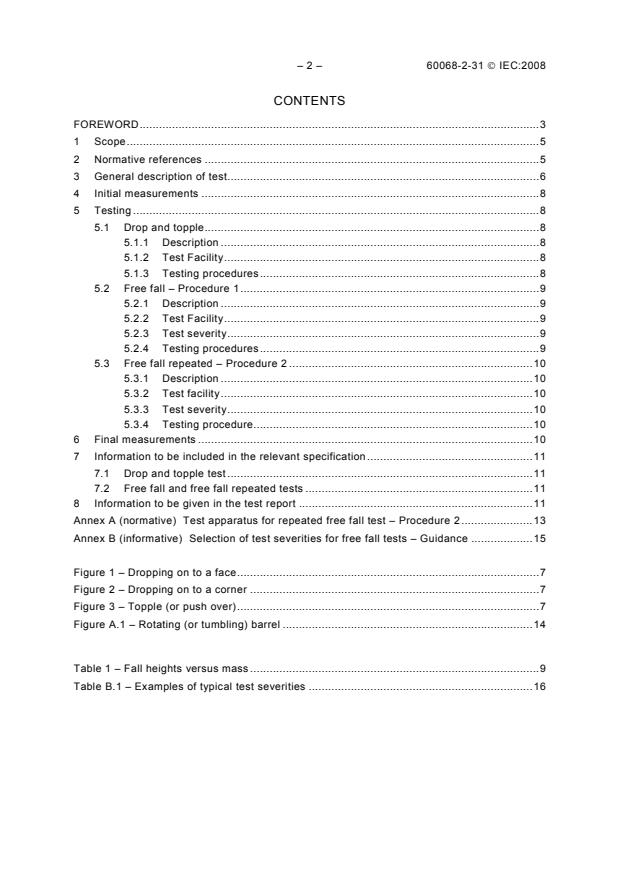
CONTENTS
FOREWORD.3
1 Scope.5
2 Normative references .5
3 General description of test.6
4 Initial measurements .8
5 Testing .8
5.1 Drop and topple.8
5.1.1 Description .8
5.1.2 Test Facility.8
5.1.3 Testing procedures.8
5.2 Free fall – Procedure 1.9
5.2.1 Description .9
5.2.2 Test Facility.9
5.2.3 Test severity.9
5.2.4 Testing procedures.9
5.3 Free fall repeated – Procedure 2 .10
5.3.1 Description .10
5.3.2 Test facility.10
5.3.3 Test severity.10
5.3.4 Testing procedure.10
6 Final measurements .10
7 Information to be included in the relevant specification.11
7.1 Drop and topple test .11
7.2 Free fall and free fall repeated tests .11
8 Information to be given in the test report .11
Annex A (normative) Test apparatus for repeated free fall test – Procedure 2.13
Annex B (informative) Selection of test severities for free fall tests – Guidance .15
Figure 1 – Dropping on to a face.7
Figure 2 – Dropping on to a corner .7
Figure 3 – Topple (or push over).7
Figure A.1 – Rotating (or tumbling) barrel .14
Table 1 – Fall heights versus mass .9
Table B.1 – Examples of typical test severities .16
60068-2-31 © IEC:2008 – 3 –
INTERNATIONAL ELECTROTECHNICAL COMMISSION
____________
ENVIRONMENTAL TESTING –
Part 2-31: Tests –
Test Ec: Rough handling shocks,
primarily for equipment-type specimens
FOREWORD
1) The International Electrotechnical Commission (IEC) is a worldwide organization for standardization comprising
all national electrotechnical committees (IEC National Committees). The object of IEC is to promote
international co-operation on all questions concerning standardization in the electrical and electronic fields. To
this end and in addition to other activities, IEC publishes International Standards, Technical Specifications,
Technical Reports, Publicly Available Specifications (PAS) and Guides (hereafter referred to as “IEC
Publication(s)”). Their preparation is entrusted to technical committees; any IEC National Committee interested
in the subject dealt with may participate in this preparatory work. International, governmental and non-
governmental organizations liaising with the IEC also participate in this preparation. IEC collaborates closely
with the International Organization for Standardization (ISO) in accordance with conditions determined by
agreement between the two organizations.
2) The formal decisions or agreements of IEC on technical matters express, as nearly as possible, an international
consensus of opinion on the relevant subjects since each technical committee has representation from all
interested IEC National Committees.
3) IEC Publications have the form of recommendations for international use and are accepted by IEC National
Committees in that sense. While all reasonable efforts are made to ensure that the technical content of IEC
Publications is accurate, IEC cannot be held responsible for the way in which they are used or for any
misinterpretation by any end user.
4) In order to promote international uniformity, IEC National Committees undertake to apply IEC Publications
transparently to the maximum extent possible in their national and regional publications. Any divergence
between any IEC Publication and the corresponding national or regional publication shall be clearly indicated in
the latter.
5) IEC provides no marking procedure to indicate its approval and cannot be rendered responsible for any
equipment declared to be in conformity with an IEC Publication.
6) All users should ensure that they have the latest edition of this publication.
7) No liability shall attach to IEC or its directors, employees, servants or agents including individual experts and
members of its technical committees and IEC National Committees for any personal injury, property damage or
other damage of any nature whatsoever, whether direct or indirect, or for costs (including legal fees) and
expenses arising out of the publication, use of, or reliance upon, this IEC Publication or any other IEC
Publications.
8) Attention is drawn to the Normative references cited in this publication. Use of the referenced publications is
indispensable for the correct application of this publication.
9) Attention is drawn to the possibility that some of the elements of this IEC Publication may be the subject of
patent rights. IEC shall not be held responsible for identifying any or all such patent rights.
International Standard IEC 60068-2-31 has been prepared by IEC technical committee 104:
Environmental conditions, classification and methods of test.
This second edition cancels and replaces the first edition, published in 1969 and constitutes a
technical revision.
The major changes with regard to the previous edition concern the introduction of soft
packaging tests, where appropriate. This new edition of IEC 60068-2-31 now incorporates the
second edition of IEC 60068-2-32 (1975).
IEC 60068-2-32 will be withdrawn once this standard has been issued.
– 4 – 60068-2-31 © IEC:2008
The text of this standard is based on the following documents:
FDIS Report on voting
104/458/FDIS 104/462/RVD
Full information on the voting for the approval of this standard can be found in the report on
voting indicated in the above table.
This publication has been drafted in accordance with the ISO/IEC Directives, Part 2.
It has the status of a basic safety publication in accordance with IEC Guide 104.
A list of all the parts in the IEC 60068 series, under the general title Environmental testing,
can be found on the IEC website.
The committee has decided that the contents of this publication will remain unchanged until
the maintenance result date indicated on the IEC web site under "http://webstore.iec.ch" in
the data related to the specific publication. At this date, the publication will be
• reconfirmed,
• withdrawn,
• replaced by a revised edition, or
• amended.
60068-2-31 © IEC:2008 – 5 –
ENVIRONMENTAL TESTING –
Part 2-31: Tests –
Test Ec: Rough handling shocks,
primarily for equipment-type specimens
1 Scope
This part of IEC 60068 deals with a test procedure for simulating the effects of rough handling
shocks, primarily in equipment-type specimens, the effects of knocks, jolts and falls which
may be received during repair work or rough handling in operational use.
This procedure does not simulate the effects of impacts received during transportation as
loosely constrained cargo. Where the effects of loose cargo transportation are to be
assessed, test Ee: Bounce should be used. Also this procedure does not simulate the effects
of shock applied to installed equipments. Where this effect is to be assessed refer to test Ea:
Shock.
Testing should only be specified for equipment likely to receive such rough handling, for
example those of small to medium size and mass, and should only be applied to those faces
and corners where there is a risk of such treatment being encountered.
In general, equipment which is frequently handled and serviced (for example field equipment
and unit spares) can be considered at risk, whereas equipment forming an integral part of a
permanent installation would not normally be considered at risk and need not be tested.
Testing may not be applicable to fragile unprotected equipment of irregular shape (for
example aircraft nose radar) which, when removed from the installation would be contained in
a handling frame or jig. It may however be applicable to these items of equipment when they
are in their transit case or in their handling frame or jig.
For equipment which stands only on one face (for example the normal base) the test is
generally only applied to that face.
Shock tests are performed on the specimen when fixed to the test machine. Drop and topple,
free fall, repeated free fall and bounce tests are performed with the specimen free.
2 Normative references
The following referenced documents are indispensable for the application of this document.
For dated references, only the edition cited applies. For undated references, the latest edition
of the referenced document (including any amendments) applies.
IEC 60068-2-27, Environmental testing – Part 2-27: Tests – Test Ea and guidance: Shock
IEC 60068-2-55:1987, Environmental testing – Part 2-55: Tests – Test Ee and guidance:
Bounce
IEC Guide 104,The preparation of safety publications and the use of basic safety publications
and group safety publications
ISO 48:2007, Rubber, vulcanized or thermoplastic – Determination of hardness (hardness
between 10 IRHD and 100 IRHD)
– 6 – 60068-2-31 © IEC:2008
ISO 4180-2:1980, Complete, filled transport packages – General rules for the compilation of
performance test schedules – Part 2: Quantitative data
3 General description of test
Rough handling shocks can be simulated by one or more of the following tests:
a) Drop and topple
A simple test intended to assess the effects of knocks or jolts likely to be received
primarily by equipment-type specimens during repair work or rough handling on a table or
bench.
b) Free fall – Procedure 1
A simple test to assess the effects of falls likely to be experienced due to rough handling.
It is also suitable to demonstrate a degree of robustness.
c) Free fall – Procedure 2
A test that additionally simulates repetitive shocks likely to be received by certain
component-type specimens, for example connectors in service.
The topple test need not be applied to specimens which have dimensions which make them
stable whilst being handled. Reference to points 1) and 2) below should be made for
information on the “c – g ratio” and “height ratio” to establish if the test is necessary.
The falling or topple actions produced by the test procedures given in 5.1.3.1, 5.1.3.2 and
5.1.3.3 are illustrated by Figures 1, 2 and 3.
The drop and topple test includes three distinct procedures:
i) dropping on to a face (5.1.3.1);
ii) dropping on to an edge or a corner (5.1.3.2);
iii) toppling (or pushover) (5.1.3.3).
The purpose of each of these procedures is basically the same, but they represent different
kinds of handling.
The test is not intended to be a precise test and a tolerance of ±10 % is allowed on the
heights and angles prescribed in 5.1.2.
NOTE For a more precise shock test, test Ea: Shock (IEC 60068-2-27) should be used.
The topple test need not be applied to specimens which have dimensions which make them
stable while being handled. When considering the applicability of the topple test, two
dimensional ratios are important:
1) the ratio of the height of the centre of gravity from the base, to the smaller dimension of
the base, hereinafter referred to as the c – g ratio;
2) the ratio of the height of the specimen to the smaller dimension of the base, hereinafter
referred to as the height ratio.
If the c – g ratio is small, for example less than 0,25, the specimen is unlikely to fall over due
to sudden sideways displacements. If the height ratio is small, for example less than 0,5, the
specimen is unlikely to topple over due to a sudden sideways force or blow at the top. In such
cases the writer of the relevant specification should consider whether the topple test is
applicable.
60068-2-31 © IEC:2008 – 7 –
a
h
IEC 782/08
h = distance between edge of specimen and test surface
a = angle between bottom face of specimen and test surface
Figure 1 – Dropping on to a face
Dimensions in millimetres
a
h
IEC 783/08
h = distance between edge of specimen and test surface
a = angle between bottom face of specimen and test surface
Figure 2 – Dropping on to a corner
IEC 784/08
Figure 3 – Topple (or push over)
– 8 – 60068-2-31 © IEC:2008
4 Initial measurements
Before commencement of the test, the specimen shall be visually examined and electrically
and mechanically checked as required by the relevant specification.
5 Testing
5.1 Drop and topple
5.1.1 Description
Having taken into account the manner in which the specimen will be handled in use and
during repair, the relevant specification shall state the test procedure to be used and whether
covers, cables, etc., are to be in position or not. The relevant specification shall also state
whether the specimen is, or is not, operational during the test.
In the test procedure where the specimen is dropped on to a face or corner, it is possible for
the specimen to topple onto a different face instead of falling back onto the test face as
intended. This shall be avoided by a suitable method.
In any of the test procedures, the specimen shall not be allowed to continue rolling about the
next edge.
Where the number of bottom edges exceeds four, the number of drops or topples shall be
limited to four and the relevant specification shall prescribe the edges to be used for the test.
5.1.2 Test facility
The test facility surface shall be smooth, hard, rigid, unyielding, horizontal and, for example,
made of concrete or steel. The steel plate shall be wet floated, that is, installed while the
concrete is still wet in order to remove voids, or bonded to the concrete. The seismic reaction
mass of the facility shall be at least 20 times the mass of the specimen under test. The
thickness of the steel plate shall be a minimum of 25 mm. With a specimen in excess of
500 kg, the steel plate shall be at least 40 mm thick, level within two degrees to the horizontal
and with a Brinell hardness of 90 – 300.
5.1.3 Testing procedures
5.1.3.1 Dropping onto a face
The specimen, standing in its normal position of use, is tilted along one bottom edge so that
the distance between the opposite edge and the test surface is 25 mm, 50 mm or 100 mm, as
prescribed by the relevant specification, or so that the angle made by the bottom and the test
surface is 30°, whichever condition is less severe.
It is then allowed to fall freely onto the test surface.
The specimen shall be subjected to one drop along each of four bottom edges (see also
Figure 1).
5.1.3.2 Dropping onto an edge or a corner
The specimen, standing in its normal position of use, is raised above the test surface by
placing a wooden stud 10 mm high under one corner, and a 20 mm wooden stud under the
other adjacent corner of one of the bottom edges. The specimen is then lifted above the test
surface by rotating it about the edge on the two studs, until the other corner adjacent to the
10 mm stud is raised 25 mm, 50 mm or 100 mm, as prescribed in the relevant specification, or
60068-2-31 © IEC:2008 – 9 –
so that the angle made by the specimen and the test surface is 30°, whichever condition is
less severe.
It is then allowed to fall freely on the test surface.
The specimen shall be subjected to one drop on each of the four bottom corners by applying
the test along the four bottom edges in turn (see Figure 2).
5.1.3.3 Topple or push-over
The specimen, standing in its normal position of use, is tilted about one bottom edge until it
reaches a position of instability. It is then allowed to fall over freely from this position on to an
adjacent face.
The specimen shall be subjected to one topple about each of four bottom edges (see also
Figure 3).
5.2 Free fall – Procedure 1
5.2.1 Description
The specimen shall be allowed to fall freely in its normal attitudes of transport or use, as
prescribed in the relevant specification.
Unless otherwise prescribed in the relevant specification, the specimen shall be subjected to
two falls from each prescribed attitude.
5.2.2 Test facility
The test facility used for free fall, procedure 1, is identical to that described in 5.1.2.
5.2.3 Test severity
Test severity is defined by the height of fall which shall be taken from the following series,
taking into account the mass of the specimen, unless real usage conditions are known or as
otherwise specified:
Table 1 – Fall heights versus mass
25 mm Mass < 50 kg
50 mm, 100 mm, 250 mm, 500 mm Mass < 10 kg
750 mm, 1 000 mm 1500 mm Mass < 1 kg
a
The values in bold type are preferred values.
b
For specimens in their transit case or for packed specimens, use the fall heights given in
ISO 4180-2.
5.2.4 Testing procedures
The specimen shall be dropped onto the surface of the test facility, see 5.2.2, from a height
selected from values in 5.2.3 and as prescribed in the relevant specification.
The height shall be measured from the part of the specimen nearest to the test surface, when
the specimen is suspended prior to letting it fall.
– 10 – 60068-2-31 © IEC:2008
The method of releasing the specimen shall allow free fall from the position of suspension
with a minimum of disturbance at the moment of release.
Where justified, other impact surfaces and hitting angle of the specimen may be prescribed in
the relevant specification.
5.3 Free fall repeated – Procedure 2
5.3.1 Description
The specimen shall be placed in the test apparatus and subjected to the prescribed number of
falls. If the specimen is normally attached to a cable, the relevant specification shall state the
type of cable to be used. When the specimen is normally attached to a cable, a free length of
100 mm of cable shall remain connected to the specimen during the test, unless otherwise
prescribed in the relevant specification.
5.3.2 Test facility
A suitable apparatus for use as the test facility is described in Annex A.
The specimen shall fall onto a smooth, hard, rigid test surface which, unless otherwise
prescribed by the relevant specification, shall be of steel of 3 mm thickness, backed by
hardwood of between 10 mm and 19 mm thickness.
NOTE 1 The tumbling barrel may not be appropriate for heavy specimens or if the shape of specimen prevents
repeated free fall.
5.3.3 Test severity
The total number of falls shall be as prescribed in the relevant specification and shall be taken
from the following series:
50, 100, 200, 500, 1 000
The height of the fall shall be 500 mm or 1000 mm.
NOTE The height of the fall should be related to the intended usage of the specimen.
5.3.4 Testing procedure
Each specimen is tested individually, and to simulate practical conditions, a length of cable
(see 5.3.1) is normally attached to the specimen during the test, which consists of subjecting
the specimen to a prescribed number of falls from a specified height onto a hard surface. The
effect of the test is checked in relation to the changes, if any, in the mechanical and electrical
parameters of the specimen.
The test apparatus shall be such that the prescribed number of falls from the specified height
selected from values given in 5.3.3 and stated in the relevant specification may be applied to
individual specimens. The number of falls selected from the list given below should be related
to the intended usage of the item.
Annex A describes one suitable form of apparatus employing a rotating barrel.
6 Final measurements
The specimen shall be visually examined and electrically and mechanically checked, as
required by the criteria prescribed in the relevant specification.
60068-2-31 © IEC:2008 – 11 –
The rate of fall shall be approximately ten falls per minute.
7 Information to be included in the relevant specification
When the test is included in the relevant specification, the following details shall be given as
far as they are applicable.
7.1 Drop and topple test Clause
a) Initial measurements 4
b) Testing 5.1.1
c) Fitting of cables, covers, etc. 5.1.1
d) Whether the specimen is operational or not during the test 5.1.1
e) Edges to be used in the test, where there are more than 5.1.1
four bottom edges
f) Height of drop onto a face 5.1.3.1
g) Height of drop onto a corner 5.1.3.2
h) Final measurements 6
7.2 Free fall and free fall repeated tests
a) Initial measurements 4
b) Test surface if other than concrete or steel 5.1.2
c) Height of fall Table 1, 5.3.4
d) Attitude from which the specimen is dropped 5.2.1
e) Number of falls, if other than two 5.2.1
f) Final measurements 6
g) Type of cable to be attached 5.3.1
8 Information to be given in the test report
As a minimum, the test report shall show the following information:
1. Customer (name and address)
2. Test laboratory (name and address)
3. Test report identification (date of issue, unique number)
4. Test dates
5. Type of test (free fall or drop and topple)
6. Purpose of the test (development test, qualification, etc.)
7. Test standard, edition (relevant test procedure)
8. Test specimen description (unique identity, drawing, photo, quantity, etc.)
9. Mounting of test specimen (test apparatus used, if applicable)
10. Performance of test apparatus (description and mass of test surface)
11. Initial and final measurements
12. Required severities (from test specification)
13. Test severities with documentation
14. Test results (comment on status of test specimen)
15. Observations during testing and actions taken
16. Summary of test
– 12 – 60068-2-31 © IEC:2008
17. Test manager (name and signature)
18. Distribution (list of those receiving report)
NOTE A test log should be written in which the test is documented, e.g. with a chronological list of test runs that
includes test parameters, observations during testing and actions taken as well as data sheets on measurements
made. The test log can be attached to the test report.
60068-2-31 © IEC:2008 – 13 –
Annex A
(normative)
Test apparatus for repeated free fall test –
Procedure 2
One suitable form of apparatus for the repeated free fall test (see 5.3.4) is based on a barrel
which rotates and causes a free fall combined with a tumbling motion of the specimen. Where
a large number of specimens have to be tested, the barrel may contain a number of sections,
one specimen being placed in each section, so that simultaneous testing may be carried out.
The width of each section, W, is not specified but shall preferably be between 200 mm and
300 mm, depending on the size of the specimen.
The dimensions of the barrel, and/or its sections shall be as shown in Figure A.1. The smooth,
rigid, steel test surface at each end, 3 mm in thickness, is backed by wood of between 10 mm
and 19 mm thickness (see also 5.1.2).
Each compartment in which the specimen rests between falls is backed by a wedge-shaped
piece made of chip-resistant rubber with a hardness of 80 ± 20 IRHD , as defined in ISO 48,
and the sliding surfaces of that same compartment are made of smooth, hard plastics
laminated sheet.
The rotating barrel is designed so that the shaft does not protrude into the interior.
The rotating barrel is provided with an aperture with a lid which may be made of transparent
acrylic material.
—————————
International rubber hardness degrees.
– 14 – 60068-2-31 © IEC:2008
Dimensions in millimetres
Block of wood A
45°
Plastics
laminated sheet
Rubber For fastening
of ends
Steel
A
W
Section A-A
a) The body of the rotating barrek is of sheet of 1,5 mm thickness
IEC 785/08
Figure A.1 – Rotating (or tumbling) barrel
10-19
a)
500 100 75
W
60068-2-31 © IEC:2008 – 15 –
Annex B
(informative)
Selection of test severities for free fall tests –
Guidance
B.1 Object
The free fall test is applicable to specimens which during transportation, handling or repair
work are liable to be dropped from their means of transport or from a work surface. The test is
not applicable to very heavy specimens or to those with large dimensions, for example large
power transformers.
B.2 Selection of test severities
The specification writer intending to prescribe this test should refer to Clause 7 of this
standard to ensure that all such information is included in the relevant specification.
Where possible, the test severity applied to the specimen should be related to the expected
handling and transport conditions to which the specimen will be subjected. However, it is
neither realistic nor economical to expect all specimens to survive the most severe mis-
handling which can be encountered in service, for example, dropping from an aircraft loading
platform or from a crane. For tests on specimens where it is required to demonstrate
serviceability, the height of the fall should be selected taking into account the risk of
occurrence, the tolerable level of damage and the conditions of operational use,
transportation and storage.
The appropriate severity, selected from 5.2.3, and 5.3.3 should be related to the mass of the
specimen, the type of handling and transport, and whether the test is to be applied to
unpacked specimens such as sub-assemblies, components, non-portable equipment, or
transportable items which are housed in integral transport cases.
In the absence of precise information on these aspects, a suitable severity should be selected
by the specification writer from Table B.1 which lists examples of severities appropriate to
various transport or handling conditions.
This table is not mandatory, but lists severities which are typical. It should be borne in mind
that there will be instances where the actual severities experienced in handling differ from
those shown in the table.
– 16 – 60068-2-31 © IEC:2008
Table B.1 – Examples of typical test severities
Specimen mass
Height
Example of
of
Type of
In integral unpacked
fall
handling
Unpacked
specimen
transport
mm
cases
kg
kg
a
25 ≥ 50 >500 Cubicles
Fork lift trucks
a
50 >10 < 50 ≤200 Cabinets
Fork lift trucks
a
100 >10 < 50 ≤100 Switchboards
Cranes
Storage,
250 >10 < 50 ≤75 Portable cases
Stacking
Fall from conveyor
500 <10 ≤40 Small items
belts
Fall from work
Components,
1 000 ≤1 ≤15 benches or
small assemblies
tailboard of truck
a
This is limited to simulate the impact when lowered to the loading level by a fork
lift truck or crane, not dropping from the platform of the truck or sling of the crane.
____________
– 18 – 60068-2-31 © CEI:2008
SOMMAIRE
AVANT-PROPOS.19
1 Domaine d'application .21
2 Références normatives.21
3 Description général de l’essai.22
4 Mesures initiales .24
5 Epreuve.24
5.1 Chute et culbute .24
5.1.1 Description .24
5.1.2 Installation d’essai.24
5.1.3 Méthodes d'essai.24
5.2 Chutes libres – Méthode 1.25
5.2.1 Description .25
5.2.2 Installation d’essai.25
5.2.3 Sévérité de l'essai .25
5.2.4 Méthodes d'essai.26
5.3 Chutes libres répétées – Méthode 2 .26
5.3.1 Description .26
5.3.2 Installation d’essai.26
5.3.3 Sévérité de l'essai .26
5.3.4 Méthode d’essais.26
6 Mesures finales .27
7 Renseignements à inclure dans la spécification particulière .27
7.1 Essais de chute et culbute.27
7.2 Essais de chute libre et de chutes libres répétées .27
8 Renseignements à fournir dans le rapport d’essai .27
Annexe A (normative) Appareillage d’essais pour les essais de chutes libres répétées
– Méthode 2.29
Annexe B (informative) Sélection des sévérités d’essai pour les essais de chutes
libres – Guide .31
Figure 1 – Chute sur une face.
Figure 2 – Chute sur un coin.23
Figure 3 – Culbute .23
Figure A.1 – Tonneau rotatif .30
Tableau 1 – Hauteurs de chute par rapport à la masse .25
Tableau B.1 – Exemples de sévérités d’essais types .32
60068-2-31 © CEI:2008 – 19 –
COMMISSION ÉLECTROTECHNIQUE INTERNATIONALE
____________
ESSAIS D'ENVIRONNEMENT –
Partie 2-31: Essais –
Essai Ec: Choc lié à des manutentions brutales,
essai destiné en premier lieu aux matériels
AVANT-PROPOS
1) La Commission Electrotechnique Internationale (CEI) est une organisation mondiale de normalisation
composée de l'ensemble des comités électrotechniques nationaux (Comités nationaux de la CEI). La CEI a
pour objet de favoriser la coopération internationale pour toutes les questions de normalisation dans les
domaines de l'électricité et de l'électronique. A cet effet, la CEI – entre autres activités – publie des Normes
internationales, des Spécifications techniques, des Rapports techniques, des Spécifications accessibles au
public (PAS) et des Guides (ci-après dénommés "Publication(s) de la CEI"). Leur élaboration est confiée à des
comités d'études, aux travaux desquels tout Comité national intéressé par le sujet traité peut participer. Les
organisations internationales, gouvernementales et non gouvernementales, en liaison avec la CEI, participent
également aux travaux. La CEI collabore étroitement avec l'Organisation Internationale de Normalisation (ISO),
selon des conditions fixées par accord entre les deux organisations.
2) Les décisions ou accords officiels de la CEI concernant les questions techniques représentent, dans la mesure
du possible, un accord international sur les sujets étudiés, étant donné que les Comités nationaux de la CEI
intéressés sont représentés dans chaque comité d’études.
3) Les Publications de la CEI se présentent sous la forme de recommandations internationales et sont agréées
comme telles par les Comités nationaux de la CEI. Tous les efforts raisonnables sont entrepris afin que la CEI
s'assure de l'exactitude du contenu technique de ses publications; la CEI ne peut pas être tenue responsable
de l'éventuelle mauvaise utilisation ou interprétation qui en est faite par un quelconque utilisateur final.
4) Dans le but d'encourager l'uniformité internationale, les Comités nationaux de la CEI s'engagent, dans toute la
mesure possible, à appliquer de façon transparente les Publications de la CEI dans leurs publications
nationales et régionales. Toutes divergences entre toutes Publications de la CEI et toutes publications
nationales ou régionales correspondantes doivent être indiquées en termes clairs dans ces dernières.
5) La CEI n’a prévu aucune procédure de marquage valant indication d’approbation et n'engage pas sa
responsabilité pour les équipements déclarés conformes à une de ses Publications.
6) Tous les utilisateurs doivent s'assurer qu'ils sont en possession de la dernière édition de cette publication.
7) Aucune responsabilité ne doit être imputée à la CEI, à ses administrateurs, employés, auxiliaires ou
mandataires, y compris ses experts particuliers et les membres de ses comités d'études et des Comités
nationaux de la CEI, pour tout préjudice causé en cas de dommages corporels et matériels, ou de tout autre
dommage de quelque nature que ce soit, directe ou indirecte, ou pour supporter les coûts (y compris les frais
de justice) et les dépenses découlant de la publication ou de l'utilisation de cette Publication de la CEI ou de
toute autre Publication de la CEI, ou au crédit qui lui est accordé.
8) L'attention est attirée sur les références normatives citées dans cette publication. L'utilisation de publications
référencées est obligatoire pour une application correcte de la présente publication.
9) L’attention est attirée sur le fait que certains des éléments de la présente Publication de la CEI peuvent faire
l’objet de droits de propriété intellectuelle ou de droits analogues. La CEI ne saurait être tenue pour
responsable de ne pas avoir identifié de tels droits de propriété et de ne pas avoir signalé leur existence.
La Norme internationale CEI 60068-2-31 a été établie par le comité d'études 104 de la
CEI: Conditions, classification et essais d'environnement.
Cette deuxième édition annule et remplace la première édition, publiée en 1969, et constitue
une révision technique.
Les modifications principales par rapport à l’édition précédente concernent l’introduction, aux
endroits appropriés, des essais sur les emballages. Par ailleurs, la deuxième édition de la
CEI 60068-2-32 (1975) a été incorporée dans cette nouvelle édition de la CEI 60068-2-31:
La CEI 60068-2-32 sera supprimée une fois que la présente norme aura été publiée.
– 20 – 60068-2-31 © CEI:2008
Le texte de cette norme est issu des documents suivants:
FDIS Rapport de vote
104/458/FDIS 104/462/RVD
Le rapport de vote indiqué dans le tableau ci-dessus donne toute information sur le vote ayant
abouti à l'approbation de cette norme.
Cette publication a été rédigée selon les Directives ISO/CEI, Partie 2.
Elle a le statut de publication fondamentale de sécurité, conformément au Guide CEI 104.
Une liste de toutes les parties de la série CEI 60068, présentées sous le titre général Essais
d’environnement, peut être consultée sur le site web de la CEI.
Le comité a décidé que le contenu de cette publication ne sera pas modifié avant la date de
...