


IEC TR 60825-10:2002
(Main)Safety of laser products - Part 10: Application guidelines and explanatory notes to IEC 60825-1
General Information
- Abstract
This technical report gives information on the physics relating to the dangers posed by laser products. It complements, but does not replace, the information in IEC 60825-1 by explaining the underlying principles, so that the user may correctly interpret its requirements. The application of this technical report is limited to laser products with finite accessible emissions of laser radiation.
- Status
- Withdrawn
- Publication Date
- 21-Feb-2002
- Withdrawal Date
- 05-Oct-2010
- Technical Committee
- TC 76 - Optical radiation safety and laser equipment
- Drafting Committee
- WG 8 - TC 76/WG 8
- Current Stage
- WPUB - Publication withdrawn
- Start Date
- 03-Sep-2010
- Completion Date
- 28-Aug-2026
Get Certified
Connect with accredited certification bodies for this standard

CIS Institut d.o.o.
Personal Protective Equipment (PPE) certification body. Notified Body NB-2890 for EU Regulation 2016/425 PPE.

Kiwa BDA Testing
Building and construction product certification.
Kmetijski inštitut Slovenije
Agricultural Institute of Slovenia. Soil testing, plant health, agricultural product analysis.
Sponsored listings
Frequently Asked Questions
IEC TR 60825-10:2002 is a technical report published by the International Electrotechnical Commission (IEC). Its full title is "Safety of laser products - Part 10: Application guidelines and explanatory notes to IEC 60825-1". This standard covers: This technical report gives information on the physics relating to the dangers posed by laser products. It complements, but does not replace, the information in IEC 60825-1 by explaining the underlying principles, so that the user may correctly interpret its requirements. The application of this technical report is limited to laser products with finite accessible emissions of laser radiation.
This technical report gives information on the physics relating to the dangers posed by laser products. It complements, but does not replace, the information in IEC 60825-1 by explaining the underlying principles, so that the user may correctly interpret its requirements. The application of this technical report is limited to laser products with finite accessible emissions of laser radiation.
IEC TR 60825-10:2002 is classified under the following ICS (International Classification for Standards) categories: 13.110 - Safety of machinery; 31.260 - Optoelectronics. Laser equipment. The ICS classification helps identify the subject area and facilitates finding related standards.
IEC TR 60825-10:2002 is available in PDF format for immediate download after purchase. The document can be added to your cart and obtained through the secure checkout process. Digital delivery ensures instant access to the complete standard document.
Standards Content (Sample)
TECHNICAL IEC
REPORT
TR 60825-10
First edition
2002-02
Safety of laser products –
Part 10:
Application guidelines and
explanatory notes to IEC 60825-1
Sécurité des appareils à laser –
Partie 10:
Guide d'application et notes explicatives
concernant la CEI 60825-1
Reference number
IEC/TR 60825-10:2002(E)
Publication numbering
As from 1 January 1997 all IEC publications are issued with a designation in the
60000 series. For example, IEC 34-1 is now referred to as IEC 60034-1.
Consolidated editions
The IEC is now publishing consolidated versions of its publications. For example,
edition numbers 1.0, 1.1 and 1.2 refer, respectively, to the base publication, the
base publication incorporating amendment 1 and the base publication incorporating
amendments 1 and 2.
Further information on IEC publications
The technical content of IEC publications is kept under constant review by the IEC,
thus ensuring that the content reflects current technology. Information relating to
this publication, including its validity, is available in the IEC Catalogue of
publications (see below) in addition to new editions, amendments and corrigenda.
Information on the subjects under consideration and work in progress undertaken
by the technical committee which has prepared this publication, as well as the list
of publications issued, is also available from the following:
• IEC Web Site (www.iec.ch)
• Catalogue of IEC publications
The on-line catalogue on the IEC web site (www.iec.ch/catlg-e.htm) enables
you to search by a variety of criteria including text searches, technical
committees and date of publication. On-line information is also available on
recently issued publications, withdrawn and replaced publications, as well as
corrigenda.
• IEC Just Published
This summary of recently issued publications (www.iec.ch/JP.htm) is also
available by email. Please contact the Customer Service Centre (see below) for
further information.
• Customer Service Centre
If you have any questions regarding this publication or need further assistance,
please contact the Customer Service Centre:
Email: custserv@iec.ch
Tel: +41 22 919 02 11
Fax: +41 22 919 03 00
TECHNICAL IEC
REPORT
TR 60825-10
First edition
2002-02
Safety of laser products –
Part 10:
Application guidelines and
explanatory notes to IEC 60825-1
Sécurité des appareils à laser –
Partie 10:
Guide d'application et notes explicatives
concernant la CEI 60825-1
IEC 2002 Copyright - all rights reserved
No part of this publication may be reproduced or utilized in any form or by any means, electronic or
mechanical, including photocopying and microfilm, without permission in writing from the publisher.
International Electrotechnical Commission, 3, rue de Varembé, PO Box 131, CH-1211 Geneva 20, Switzerland
Telephone: +41 22 919 02 11 Telefax: +41 22 919 03 00 E-mail: inmail@iec.ch Web: www.iec.ch
PRICE CODE
Commission Electrotechnique Internationale
W
International Electrotechnical Commission
Международная Электротехническая Комиссия
For price, see current catalogue
– 2 – TR 60825-10 IEC:2002(E)
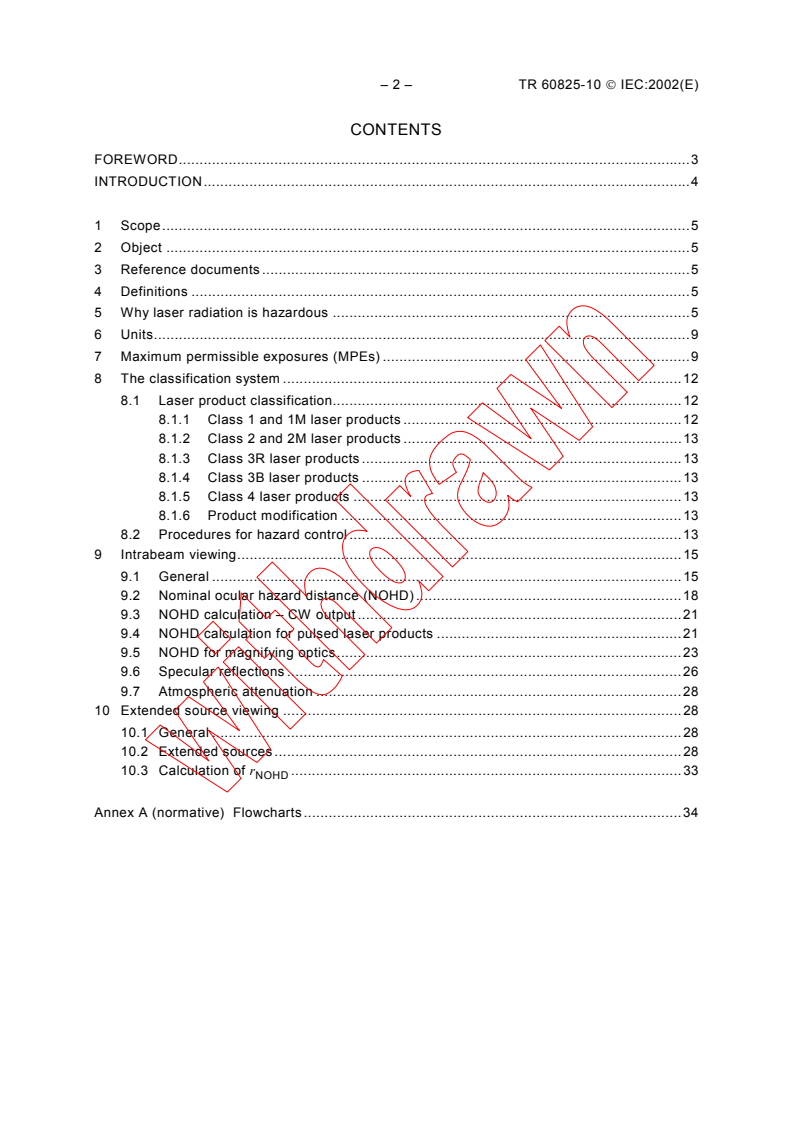
CONTENTS
FOREWORD.3
INTRODUCTION.4
1 Scope.5
2 Object .5
3 Reference documents .5
4 Definitions .5
5 Why laser radiation is hazardous .5
6 Units.9
7 Maximum permissible exposures (MPEs) .9
8 The classification system .12
8.1 Laser product classification.12
8.1.1 Class 1 and 1M laser products .12
8.1.2 Class 2 and 2M laser products .13
8.1.3 Class 3R laser products .13
8.1.4 Class 3B laser products .13
8.1.5 Class 4 laser products .13
8.1.6 Product modification .13
8.2 Procedures for hazard control .13
9 Intrabeam viewing.15
9.1 General .15
9.2 Nominal ocular hazard distance (NOHD) .18
9.3 NOHD calculation – CW output .21
9.4 NOHD calculation for pulsed laser products .21
9.5 NOHD for magnifying optics.23
9.6 Specular reflections .26
9.7 Atmospheric attenuation .28
10 Extended source viewing .28
10.1 General .28
10.2 Extended sources .28
10.3 Calculation of r .33
NOHD
Annex A (normative) Flowcharts .34
TR 60825-10 IEC:2002(E) – 3 –
INTERNATIONAL ELECTROTECHNICAL COMMISSION
____________
SAFETY OF LASER PRODUCTS –
Part 10: Application guidelines and explanatory notes
to IEC 60825-1
FOREWORD
1) The IEC (International Electrotechnical Commission) is a worldwide organization for standardization comprising
all national electrotechnical committees (IEC National Committees). The object of the IEC is to promote
international co-operation on all questions concerning standardization in the electrical and electronic fields. To
this end and in addition to other activities, the IEC publishes International Standards. Their preparation is
entrusted to technical committees; any IEC National Committee interested in the subject dealt with may
participate in this preparatory work. International, governmental and non-governmental organizations liaising
with the IEC also participate in this preparation. The IEC collaborates closely with the International Organization
for Standardization (ISO) in accordance with conditions determined by agreement between the two
organizations.
2) The formal decisions or agreements of the IEC on technical matters express, as nearly as possible, an
international consensus of opinion on the relevant subjects since each technical committee has representation
from all interested National Committees.
3) The documents produced have the form of recommendations for international use and are published in the form
of standards, technical specifications, technical reports or guides and they are accepted by the National
Committees in that sense.
4) In order to promote international unification, IEC National Committees undertake to apply IEC International
Standards transparently to the maximum extent possible in their national and regional standards. Any
divergence between the IEC Standard and the corresponding national or regional standard shall be clearly
indicated in the latter.
5) The IEC provides no marking procedure to indicate its approval and cannot be rendered responsible for any
equipment declared to be in conformity with one of its standards.
6) Attention is drawn to the possibility that some of the elements of this technical report may be the subject of
patent rights. The IEC shall not be held responsible for identifying any or all such patent rights.
The main task of IEC technical committees is to prepare International Standards. However, a
technical committee may propose the publication of a technical report when it has collected
data of a different kind from that which is normally published as an International Standard, for
example "state of the art".
Technical reports do not necessarily have to be reviewed until the data they provide are
considered to be no longer valid or useful by the maintenance team.
IEC 60825-10, which is a technical report, has been prepared by subcommittee 76: Optical
radiation safety and laser equipment.
The text of this technical report is based on the following documents:
Enquiry draft Report on voting
76/217/CDV 76/229/RVC
Full information on the voting for the approval of this technical report can be found in the report
on voting indicated in the above table.
This publication has been drafted in accordance with the ISO/IEC Directives.
This document, which is purely informative, is not to be regarded as an International Standard.
– 4 – TR 60825-10 IEC:2002(E)
INTRODUCTION
This technical report is an informative document providing a simplified introduction to laser
hazard concepts, classification, intrabeam viewing and extended source viewing used in
IEC 60825-1, Safety of laser products – Part 1: Equipment classification, requirements and
user’s guide.
This technical report does not replace IEC 60825-1; however, if there is any real or apparent
conflict between this technical report and the standard, the standard must prevail.
TR 60825-10 IEC:2002(E) – 5 –
SAFETY OF LASER PRODUCTS –
Part 10: Application guidelines and explanatory notes
to IEC 60825-1
1 Scope
This technical report gives information on the physics relating to the dangers posed by laser
products. It complements, but does not replace, the information in IEC 60825-1 by explaining
the underlying principles. The application of this technical report is limited to laser products
with finite accessible emissions of laser radiation.
2 Object
This technical report provides a user of IEC 60825-1 with background information for that
standard (specifically the laser hazard, classification system, intrabeam viewing and extended
source viewing), giving the user an insight into the physics behind that standard, so that the
user may correctly interpret its requirements.
3 Reference documents
The following referenced documents are indispensable for the application of this document. For
dated references, only the edition cited applies. For undated references, the latest edition of
the referenced document (including any amendments) applies.
IEC 60825-1:1993, Safety of laser products – Equipment classification, requirements and
user’s guide
Amendment 1 (1997)
Amendment 2 (2001)
4 Definitions
For the purpose of this technical report, the definitions in IEC 60825-1 apply.
5 Why laser radiation is hazardous
Electromagnetic radiation is not normally considered dangerous. However, the simple analysis
below shows that a 1 W laser can introduce more than five orders of magnitude greater light
into the eye (at 1 m distance) than an incandescent bulb of equal power placed at the same
distance, and more than one order of magnitude greater than that of the sun.
Laser radiation in the optical hazard region from 400 nm to 1 400 nm is focused to a small spot
on the retina. This increases the hazard in that region. The current example illustrates the
effect in the optical hazard region.
___________
There exists a consolidated edition (2001) that includes IEC 60825-1 (1993) and its Amendment 1 (1997) and
Amendment 2 (2001).
– 6 – TR 60825-10 IEC:2002(E)
Moreover, unlike the incandescent light bulb, laser light in the ocular hazard region may be
focused to a small point on the retina measuring a few microns across. By comparison, the
image of the sun on the retina would be of the order of 0,15 mm on the retina. The effect of an
exposure to laser radiation could therefore be considerably worse than indicated by the
analysis below.
Consider a light bulb producing 1 W of optical radiation (see Figure 1) typical of the interior
light of a car. Light from the globe at 1 m has irradiance (power density) given by the power of
the light globe divided by the surface area of a sphere whose radius is 1 m, as shown by the
following equation:
1,0 W
– 2 −2
= 8,0 ×10 (1)
W ⋅ m
4π(1,0 m
)
NOTE The surface area of a sphere of radius r is given by 4πr .
Compare this with radiation from a 1,0 W laser in the ocular hazard region with a 1 mm beam
diameter at 1 m from the laser, with an approximate irradiance of:
1,0 W
6 –2
= 1,3 × 10 W ⋅ m (2)
π 2
–3
()1,0 × 10 m
NOTE The area of a circle of diameter d is given by πd /4.
Throughout IEC 60825-1 it is assumed that the diameter of the pupil of the eye is 7 mm. This is
a worst case occurring when the ambient light level is low. Under these circumstances the light
from the globe entering a pupil having an area of:
π 2
–5
–3 2
= 3,8×10 (3)
m
(7× 10 )
would be
–2 –2 –5 2 –6
(8,0 × 10 W ⋅ m ) × (3,8 × 10 m ) = 3,0 × 10 W (4)
TR 60825-10 IEC:2002(E) – 7 –
1,0 m
Irradiance =
-2 -2
8,0 × 10 W·m
-6
W
3,0 × 10
enters eye
1 watt light globe
Irradiance =
Sun
3 -2
1,0 × 10 W·m
-2
3,8 × 10 W
enters eye
1 mm
Irradiance =
1 W laser
6 -2
1,3 × 10 W·m
1,0 W
Pupil diameter is
enters eye
assumed to be 7 mm
IEC 571/02
Figure 1 – Comparison of the hazards of various light sources
Compare this with light entering the eye from a laser at 1 m. In the case of the laser with a
beam diameter of 1 mm and small divergence, all of the light will enter an eye with a pupil
diameter of 7 mm. This is 3,3 × 10 times as much light as would have entered the eye from a
bulb producing the same amount of visible radiation.
The reason for this difference is shown diagrammatically in Figure 1.
The radiation from any source (including laser radiation with a wavelength between 400 nm and
1 400 nm) is generally focused on the retina, the light sensitive area at the back of the eye (see
Figure 2). In the case of lasers, this may increase the irradiance (watts per square metre) of
the light by approximately five orders of magnitude.
NOTE The anatomy of the human eye is shown in Figure B.1 of IEC 60825-1.
– 8 – TR 60825-10 IEC:2002(E)
When a person 'looks at' an object, their eye is actually focusing that object on the fovea,
where there is the highest density of cone receptor cells (see Figure 2). The fovea is only
1,5 mm or so in diameter and is the area on the retina generating our most acute vision.
Images which need to be viewed in detail, such as the words on this page, are focused on the
foveola which is only 350 microns in diameter. It is this section of the retina which is most at
risk because of a natural tendency to `look at' objects which attract our interest.
The highest risk is normally seen at the fovea because this is the location of gaze produced by
the eye. It is also the section of the retina which has the most impact on visual function if
damaged. Depending on the area of the foveola and the fovea damaged, reading may be
precluded but individuals may still retain a measure of central and peripheral vision. Damage to
the area surrounding the retina can occur with little loss of effective sight other than some
reduction in peripheral vision which can occur without the affected person being aware of it.
The eye is remarkable in that it can detect light intensities varying over eight or nine orders of
magnitude. Part of this accommodation is effected by changing the size of the pupil, but this
only accounts for one order of magnitude. The change in pupil size occurs over a matter of
seconds. When viewing in bright light, the fovea is active in discriminating small detail and
colour, while the remainder of the retina provides peripheral vision, which primarily detects
movement. As the light level reduces, the fovea becomes less important to vision and the
remainder of the retina provides 'night vision'.
Retina
5 m
Fovea
0,1 m
340 μm
Cornea -2
E = 134 W·m
Lens
100 W lamp
Optic disk (where optic
with frosted glass
nerve and blood supply
5 m
17 mm
leaves eye)
Spot size = 25 μm
Laser
-2
1 mW HeNe laser E = 2,0 MW·m
IEC 572/02
Figure 2 – Cross-section of eye showing comparison of the irradiance at the retina
for an image of a lamp with an output of 100 W and an ideal diffraction limited spot
from a 1 mW HeNe laser
Damage to tissues can be caused by heat effects, thermo-acoustic transients, or photo-
chemical processes. The degree to which these effects are responsible for damage depends
on the physical parameters relating to the exposure.
NOTE The various mechanisms for damage are shown in Figure B.2 of IEC 60825-1.
TR 60825-10 IEC:2002(E) – 9 –
Radiation from laser products can cause different effects depending on the wavelengths and
energy density of the radiation, and the part of the body exposed to the radiation.
NOTE See Figure B.3 of IEC 60825-1.
Hazards include absorption by and damage to the skin and the eye, setting fire to clothes and
other materials. The full range of hazards needs to be considered.
In assessing the hazard, a number of laser parameters are of importance. These include:
a) exposure duration;
b) pulse width;
c) wavelength;
d) CW or pulsed operation;
e) repetition rate, if applicable;
f) beam diameter;
g) beam divergence; and
h) viewing distance.
The hazard is often increased by telescopes or binoculars because they can gather additional
radiation and concentrate it in the eye. These parameters are discussed in detail in later
sections.
6 Units
Table 1 lists the common units and their symbols used in IEC 60825-1. Examples of these
quantities are given diagrammatically in Figure 3.
7 Maximum permissible exposures (MPEs)
IEC 60825-1 relies on the concept of maximum permissible exposures (MPEs). The MPEs are
derived primarily from animal and human data, but take account of human variability and laser
parameters. MPE levels are set by ICNIRP (International Commission on Non-Ionising
Radiation Protection). They are reevaluated from time to time in the light of available evidence.
Clause 3.51 of IEC 60825-1 defines the maximum permissible exposure as “That level of laser
radiation to which, under normal circumstances, persons may be exposed without suffering
adverse effects. The MPE levels represent the maximum level to which the eye or skin can be
exposed without consequential injury immediately after, or after a long time, and are related to
the wavelength of the radiation, the pulse duration or exposure time, the tissue at risk and, for
visible and near infra-red radiation in the range of 400 nm to 1 400 nm, the size of the retinal
image. Maximum permissible exposure levels are (in the existing state of knowledge) specified
in clause 13 (of IEC 60825-1).”
MPEs are expressed as irradiance or radiant exposure at the cornea, and are given as tables
in IEC 60825-1. MPEs for ocular exposure at the cornea are tabulated in Table 6 of IEC 60825-1
as a function of wavelength and exposure time. Table 8 of IEC 60825-1 tabulates the MPE of
skin to laser radiation.
The MPE values should be used as guides in the control of exposures and should not be
regarded as precisely defining the dividing lines between safe and dangerous levels. In any
case, exposure to laser radiation shall be a low as possible.
– 10 – TR 60825-10 IEC:2002(E)
Note that while the probability of an exposure at the level of the MPE causing eye damage is
very low, it may not be zero. Because of this, and the uncertainty in the derivation of MPEs, it is
good practice to avoid all unnecessary exposure to laser radiation at levels that approach the
MPE.
The biophysical effects of laser radiation are described in detail in Annex B of IEC 60825-1.
Thermal effects are those which occur when sufficient radiation energy has been absorbed by
a biological system to cause heating in the system. Most laser damage is due to the heating of
the absorbing tissue or tissues.
On the other hand, at certain wavelengths, photochemical effects or those caused by the
specific molecular absorption of a given radiation can lead to tissue damage. Following
the absorption, the molecule may undergo a chemical reaction unique to its excited state. This
photochemical reaction is believed to be responsible for damage at low levels of exposure.
By this mechanism, some biological tissues such as the skin, and the lens of the eye, may
show irreversible changes induced by prolonged exposure to moderate levels of UV radiation
and short wavelength radiation. For this reason the MPEs are correspondingly lower than for
wavelengths where the mechanism is thermal.
In Table 6 of IEC 60825-1 a calculation of both the retinal photochemical hazard levels and the
retinal thermal hazard levels is required for exposures greater than 10 s of radiation with a
wavelength between 400 nm and 600 nm and for exposures greater than 1,0 s of radiation with
a wavelength between 400 nm and 484 nm. In these cases the most restrictive hazard level
becomes the MPE.
In some cases, laser products produce radiation comprising multiple wavelengths. The multiple
wavelengths may affect similar tissue. For example there may be more than one wavelength
contributing to heat generation in the retina. Alternatively each wavelength may operate
independently. Table 5 of IEC 60825-1 provides a guide to determine whether the hazardous
effects of one or more wavelengths are additive or whether each should be treated separately.
Table 1 – Commonly used units and symbols
Quantity Unit Abbreviation Symbol Formulae
Area Square metre m A See Figure 3
Exposure time Second s T —
–2 –1
b
a
Integrated radiance Joule per square J m sr L
L = H/Ω
metre per steradian
–2
Irradiance Watt per square W m EE = P/A
metre
Linear angle Radian rad See Figure 3
φ
-2 –1
b a
Radiance Watt per square W m sr L L = E/Ω
metre per steradian
Radiant energy Joule J QQ = PT
–2
Radiant exposure Joule per square J m HH = Q/A
metre
Radiant power Watt W P = Q/T
P, Φ
Solid angle Steradian sr See Figure 3
Ω
a
In this case H (or E) is the radiant exposure (or irradiance) measured at the diffuse reflector or divergent
source.
Ω is the solid angle into which the radiation is directed.
b
L is used for both integrated radiance and radiance in different parts of IEC 60825-1
TR 60825-10 IEC:2002(E) – 11 –
Intrabeam
viewing
πd
A
=
Area A
Q
Radiant exposure H =
A
P
Irradiance E
=
A
Linear angle
Linear angle =
d
d
φ
φ ≅
radians
r
for small φ
r
Solid angle
Area A
Solid angle
πφ
A πd
steradians
≅ = =
Ω Ω
r 4r
r
Diffuse reflections
Radiance
E
-2 -1
L =
W⋅m ⋅ sr
π
-2 -1
Radiance W⋅m ⋅ sr
IEC 573/02
Figure 3 – Commonly used units
– 12 – TR 60825-10 IEC:2002(E)
8 The classification system
8.1 Laser product classification
The product classification is the primary indication of whether the laser product is capable of
causing injury. It is the responsibility of the manufacturer to label and provide information about
its laser product in accordance with Section 2 of IEC 60825-1. A guide for the implementation
of safe practice for the user is set out in Section 3 of IEC 60825-1. It is therefore necessary
that both the manufacturer and, where a hazard exists, the user, understand the system of
classification. The details of the classification system are set out in Section 2 of IEC 60825-1,
and the philosophy behind it is described below.
The classification of a laser product is based on the radiation emitted during the normal
operation and any reasonably foreseeable fault condition for that product. In some cases the
removal of protective shielding or access panels may lead to the possibility of an exposure in
excess of that allowable for that class of laser. Such panels should be clearly marked by the
manufacturer, and should only be removed by persons with the appropriate level of knowledge
and training in laser safety.
In the process of taking the measurements required for classification, the concept of
measurement aperture is used. The size of the spot on the retina will depend on a number of
factors including the diameter of the beam, and whether the beam is focused on the retina. The
worst case (that is the smallest retinal spot) is one for which the beam just fills the pupil
(assumed to be of 7 mm diameter) and the beam is accurately focused. For this reason, when
–2
the MPE is specified as an irradiance (W⋅m ) it is assumed that, if the beam is less than 7 mm
its power should be averaged over 7 mm. That is, it should be assumed that the beam is
expanded to 7mm diameter. If the beam diameter is greater than 7 mm, only that power
entering a 7 mm aperture should be considered. The same principle applies if the MPE is
–2
expressed as a radiant exposure (J⋅m ).
The measurement procedures for classification are specified in IEC 60825-1. The procedures
specify a range of measurement apertures which vary with wavelength and the class of laser
and which relate to the diameter of the pupil and the assumed diameter of viewing optics, or in
some cases a limiting aperture is specified for measurement convenience and standardization.
The limits used for classification are called accessible emission limits (AELs). They are derived
from the MPEs using limiting apertures and are expressed either as a power limit, an energy
limit, an irradiance limit, a radiant exposure limit, or an combination of these.
A laser is correctly classified if its parameters exceed those of the next lower class, and are
less than or equal to the limits of its class.
NOTE Because the AELs are based on MPEs, the classification system is an indication of whether the laser
product is likely to cause injury. An exposure to visible laser radiation less than that required to cause injury may
still be uncomfortable and cause temporary blindness or distraction. For this reason all exposure to laser radiation
should be as low as possible.
8.1.1 Class 1 and 1M laser products
Class 1 laser products are safe under reasonably foreseeable conditions of operation. In
general they would not allow exposure to sufficient radiant energy to damage the eye or skin.
The AELs for Class 1 laser products are set out in Table 1 of IEC 60825-1.
Class 1M laser products are safe under reasonably foreseeable conditions of operation
provided that they are not viewed with magnifying optics of any kind. Class 1M usually relates
to laser products with high divergence or large beam diameters compared to the limiting
aperture.
Magnifying optical instruments are designed to magnify the image on the retina. See 9.5 for
more details.
TR 60825-10 IEC:2002(E) – 13 –
8.1.2 Class 2 and 2M laser products
Class 2 laser products would not cause permanent damage to the eye under reasonably
foreseeable conditions of operation, provided that any exposure can be terminated by the blink
reflex (assumed to take 0,25 s). Because classification assumes the blink reflex, only laser
products with a visible output (400 nm to 700 nm wavelengths) can be classified as Class 2.
–2
The MPE for visible radiation for 0,25 s is 25 W⋅m . This irradiance is equivalent to 1 mW
entering an aperture of 7 mm diameter (the assumed size of the pupil).
Thus the AEL for Class 2 laser products is 1,0 mW for collimated beams or beams from small
sources. This can be seen in Table 2 of IEC 60825-1. Note that the parameter C equals 1 for
well-collimated beams, as indicated in the notes to Tables 1 to 4 of IEC 60825-1. C takes on
another value for extended sources, and this is discussed in detail in Clause 10 of this
technical report.
Class 2 laser products are not hazardous as long as staring at them is not a requirement of
their design. However, they may cause flash blindness. The use of viewing optics such as
binoculars with Class 2 laser products does not usually create a hazard as long as the
objective lens diameter is not greater than 50 mm.
In the case of Class 2M laser products, a hazard may exist if they are viewed through
magnifying optics such as eye loupes, binoculars or telescopes.
8.1.3 Class 3R laser products
Class 3R laser products emit radiation in the wavelength range from 302,5 nm to 10 nm where
direct intrabeam viewing is potentially hazardous but the risk is lower than for Class 3B lasers,
and fewer manufacturing requirements and control measures for the user apply than for Class
3B lasers. The accessible emission limit is within five times the AEL of Class 2 in the
wavelength range from 400 nm to 700 nm and within five times the AEL of Class 1 for other
wavelengths.
8.1.4 Class 3B laser products
Class 3B laser products are unsafe for eye exposure at all wavelengths, but are generally not
so powerful that a short exposure would damage skin. Usually only ocular protection would be
required. Diffuse reflections are safe if viewed for less than 10 s. Table 4 in IEC 60825-1
shows the AELs for Class 3B laser products.
8.1.5 Class 4 laser products
Class 4 laser products are generally powerful enough to burn skin and cause fires and may
ionise the atmosphere when focused. As such, a range of additional safety measures are
required.
8.1.6 Product modification
If the user of a laser product makes changes to the product or does not use it in the manner
intended by the manufacturer, reclassification may be required. Under these circumstances the
person or organization that modifies the laser product takes on the responsibilities of a
manufacturer (see 4.1.1 of IEC 60825-1).
8.2 Procedures for hazard control
The procedures for hazard control are set out in Clause 12 of IEC 60825-1. The primary
considerations include the capacity of the laser product to cause injury (as indicated broadly by
its classification), the environment in which it is used and the level of knowledge of people who
might be exposed.
– 14 – TR 60825-10 IEC:2002(E)
Where a hazard is likely to exist, a laser safety officer (LSO) should be appointed. It is the
LSO's responsibility to evaluate the hazard and establish appropriate procedures.
Safe operation of Class 3B and Class 4 laser products outdoors relies on the concept of
nominal ocular hazard distance, which is discussed in Clause 9.
Class 3B laser products need to be operated in a controlled area, with appropriate beam stops
and with precautions taken to prevent unintended specular reflections. Eye protection is
required if there is any possibility of exposure. Diffuse reflections are safe, provided the
distance between the diffusely reflecting screen and the observer exceeds 130 mm and the
exposure does not exceed 10 s.
For Class 4 laser products additional precautions are required. Beams can cause fires and
injuries to the skin as well as eye injuries. Beam paths should be enclosed and the area should
be restricted to properly trained and protected personnel during operations. Remote control
should be used where practicable, there should be good room illumination and eye protection
should be worn. Fire resistant materials should be used as backstops. Special precautions
should be taken for lasers radiating at invisible wavelengths.
In choosing eye protection, the degree of protection should be considered. Laser eye
protectors are rated according to their “optical density” (D ) defined as:
λ
H
= log (5)
D
λ
MPE
where H is the expected radiant exposure at the unprotected eye.
–2 –2
This equation is used when the MPE is in units of J⋅m . In cases where the MPE is in W⋅m ,
the following form should be used:
E
= log (6)
D
λ
MPE
where E is the expected irradiance at the unprotected eye.
The units of MPE determine whether H or E should be used.
0 0
The major considerations include:
a) wavelengths of operation;
b) radiant exposure or irradiance;
c) MPE;
d) optical density;
e) visible radiation transmission requirements;
f) the exposure level at which damage to the eyewear occurs;
g) need for prescription glasses;
h) comfort and ventilation;
i) degradation;
j) strength;
k) peripheral vision requirements.
TR 60825-10 IEC:2002(E) – 15 –
In cases where eye protection would otherwise be required, operations should only be
undertaken with the approval of the laser safety officer. More detailed information on hazard
identification as well as guidance on the selection of appropriate laser eye protectors is given
in IEC 60825-1.
9 Intrabeam viewing
9.1 General
For a given amount of radiant power or energy entering the eye, one might expect the damage
threshold to depend on the size of the image focused onto the retina in the case of thermal
hazards. Paradoxically, this only occurs when the angle subtended at the eye by the source, α
(see Figure 4) exceeds the coefficient called α (equal to 1,5 mrad) in IEC 60825-1. At
min
angular subtenses less than α damage thresholds are determined by the total energy or
min
power entering the eye and not by the irradiance or radiant exposure of the retinal image.
This effect results from the fact that, for small retinal image sizes, tissue cooling is dominated
by radial conduction from the centre of the image formed on the retina. Although the heating
rate of individual cells reduces with increasing image size, the lengthening of the radial cooling
path from the centre of the image means that the cells in the image centre sustain a
temperature rise for a given exposure time which is constant for a range of image sizes. This
exposure condition is referred to as ‘point source viewing’.
At angular subtenses above α , “extended source viewing” conditions apply. Cooling into the
min
vitreous humour gradually becomes the dominant cooling mechanism. Consequently, damage
processes become dependent on the image size and, therefore, on the value of angular
subtense. This is the basis for the coefficient C in IEC 60825-1.
At angular subtenses above α , damage thresholds depend upon the radiance or integrated
max
radiance of the image as described in 10.2.
As far as IEC 60825-1 is concerned, for all α > α extended source viewing conditions exist.
min
For all α < α point source or intrabeam viewing exists.
min
All laser beams diverge or converge to some extent. In the case of Class 3B and Class 4 laser
products, the MPE is exceeded at the output of the laser. For a laser beam the irradiance
–2 –2
(W⋅m ) and the radiant exposure (J⋅m ) generally decrease as the cross-sectional area of
the beam increases with increasing distance from the source. This is shown in Figure 5.
– 16 – TR 60825-10 IEC:2002(E)
Viewing a collimated beam (α < α )
min
Heat dissipation
Viewing a extended source (α > α )
max
Heat dissipation
Image size
F = 17 mm
r
α
α
d
i
D
I
D d
I i
α ≅
=
r F
D
I
≅
d F Fα
=
i
r IEC 574/02
Figure 4 – Angular subtense, retinal cooling and image size
for wavelengths in the retinal hazard region
TR 60825-10 IEC:2002(E) – 17 –
D
L
Laser
φ
a
r
Diameter, D = rφ + a
L
π
D
L
Area, A =
Power
Irradiance, E =
A
Energy
Radiant exposure,
H =
A
IEC 575/02
Figure 5 – Divergence of laser radiation without an external beam waist
It may be necessary to determine whether a potential exposure at some distance r from the
laser would be hazardous (see Figure 5). This can be done by comparing the actual exposure
with the relevant MPE. The first step is to determine the MPE for the wavelength and the likely
exposure time. Taking the simplest case of a visible CW laser, the MPE can be determined
from Table 6 of IEC 60825-1. The determination of MPEs for pulsed lasers is discussed in
detail in 9.4.
This derivation only applies to beams which diverge from the laser in the far field region of the
beam. For beams which converge to a waist external to the laser a more accurate analysis
beyond the scope of this document is required.
–2 –2 –2
The MPE will be in units of either W⋅m or J⋅m . If the MPE is in units of W⋅m the radiation
–2
output of the laser product in watts should be determined. If the MPE is in units of J⋅m the
radiation output of the laser in joules should be determined. This can be done with the following
equations:
Q
P = (7)
t
or Q = P × t (8)
where:
P is the power, in watts
Q is the energy, in joules, and
t is the time for Q to be delivered, in seconds.
– 18 – TR 60825-10 IEC:2002(E)
The output of the laser product in watts or joules, should be divided by the area of the beam at
–2 –2
the observer to obtain the irradiance (in W⋅m ) or the radiant exposure (in J⋅m ). If the
exposure exceeds the MPE then the exposure should be avoided. If the diameter of the beam
at the distance r is less than the limiting aperture (7 mm for a laser radiation between 400 nm
and 1 400 nm), the beam should be assumed to have a diameter equal to the limiting aperture
(see 8.1).
NOTE When comparing any exposure to a MPE, it is essential that the units in which the exposure is be identical to
those of the MPE.
On occasions it may be necessary to convert irradiance to radiant exposure and vice versa,
This can be achieved as follows:
H
E = (9)
t
or H = E × t (10)
where
E is the irradiance, in watts per square metre,
H is the radiant exposure, in joules per square metre, and
t is the time, in seconds.
An alternative approach is to determine the distance from the laser product at which an
exposure is just below the MPE. This is called he nominal ocular hazard distance (NOHD). At
smaller distances the exposure will exceed the MPE.
9.2 Nominal ocular hazard distance (NOHD)
In the analysis of point source viewing conditions, the concept of NOHD is used and is related
to that of MPE. The NOHD is the nominal distance at which the exposure equals the MPE.
The concept of NOHD is used when laser products such as range finders or display lasers are
to be used in the open air. It represents the distance within which exposure exceeds the MPE
and eye protection is required.
Assuming linear divergence, from Figure 6 and the definition of the angle φ it is evident that:
D = NOHD ×φ + a (11)
NOHD
where:
D is the diameter of the beam at the NOHD,
NOHD
a is the diameter of beam at the exit from the laser, and
φ is the divergence angle.
NOTE In 3.10 of IEC 60825-1 the beam diameter is defined as the diameter of the smallest circle which contains
63% of the total beam energy. In the case of a Gaussian beam the diameter is the distance between two opposite
points at which the irradiance or radiant exposure has fallen to 1/e of its peak value.
The area of the beam at the NOHD (A ) is given by the following equation:
NOHD
π ×
D
NOHD
= (12)
A
NOHD
TR 60825-10 IEC:2002(E) – 19 –
The irradiance at the NOHD (E ) is given by the following equation:
NOHD
P 4 × P
= = = MPE (13)
E
NOHD
A
π ×
NOHD
D
NOHD
where
P is the radiant power of the laser, and
D is the diameter of the beam at the NOHD.
NOHD
Irradiance or Radiant
Exposure equals MPE
Laser a
φ
D
NOHD
NOHD
Exposure does not
Exposure exceeds MPE
exceed MPE
IEC 576/02
Figure 6 – The concept of nominal ocular hazard distance
Replacing D with (NOHD × φ + a) from equation 11 gives:
NOHD
4 × P
MPE = (14)
π × ×φ
(NOHD + a)
where
a is the diameter of the beam at the exit from the laser, and
P is the radiant power of the laser.
Rearranging this equation to obtain NOHD explicitly gives:
0,5
1 4 × P a
NOHD = − (15)
φ π × MPE φ
– 20 – TR 60825-10 IEC:2002(E)
where
P is the radiant power of the laser,
a is the diameter of the beam at the exit from the laser, and
φ is the beam divergence angle.
The above equations are approximations applicable to a generalized situation.
If a is small compared to the term in square brackets in equation 15, it can conservatively be
neglected.
If a is not small and the calculated NOHD is negative, the result indicates that the laser is safe
for that exposure at all distances.
The above formula relates to laser products with Gaussian beams. For laser products of
unknown mode structure, a factor is introduced to account for possible `hot spots' in the beam.
This matter is referred to in Annex A5 of IEC 60825-1. In this technical report the factor is
given the symbol k. For beams of unknown mode structure it has the value of 2,5. If the mode
structure is known to be Gaussian, then k = 1.
If the mode structure is known and is non-Gaussian, the appropriate value for k should be
determined. The full equation then becomes:
0,5
1 4 × k × P a
NOHD ≈ − (16)
−2
φ φ
π × MPE( )
W⋅ m
where P is the radiant power produced by the laser.
This formula has been derived for the case where the MPE of the laser is given as an
–2
irradiance (W⋅m ). In cases where the MPE is given as a radiant exposure, the corresponding
NOHD equation is:
0,5
1 4 × k × Q a
NOHD ≈ − (17)
−2
φ φ
π × MPE( )
J ⋅ m
The preceding equations form the basis of the calculation of NOHD. In cases where the second
term can (conservatively) be ignored, a further approximation can be obtained as follows:
1,784 P
NOHD ≈ for k = 2,5; and (18)
φ MPE
1,128 P
NOHD ≈ k = 1 for Gaussian beams. (19)
φ MPE
–2 –2
The above two equations are true for MPEs in W⋅m . If the stated MPE is in J⋅m then the P
in watts should be replaced by Q in joules.
___________
For Gaussian beam propagation, more exact equations are given in KOLGENICK, H. and LI, T. Laser Beams
and Resonators. Appl. Opt., 1996, 5, p.1550–1567 and Proc IEEE, 1996, 54(10), p.1312–1329.
TR 60825-10 IEC:2002(E) – 21 –
9.3 NOHD calculation – CW output
For Class 3R, Class 3B and Class 4 laser products it may be necessary to calculate the NOHD.
Flowchart 1 of Annex A describes a technique for calculating the NOHD for a product with a
CW output. The first step is to tabulate the relevant parameters (box 2). Since the MPE
depends on the maximum likely exposure time it is necessary to determine an exposure time
consistent with the standard. The MPE should be determined for each wavelength, using the
appropriate exposure time in Table 6 of IEC 60825-1 (box 3). If only one wavelength is involved
(box 4A) the MPE can be determined from Tabl
...