

IEC 60318-4:2010
(Main)Electroacoustics - Simulators of human head and ear - Part 4: Occluded-ear simulator for the measurement of earphones coupled to the ear by means of ear inserts
General Information
- Abstract
IEC 60318-4:2010 describes an occluded-ear simulator intended for the measurement of insert earphones in the frequency range from 100 Hz to 10 000 Hz. It is suitable for air conduction hearing aids and earphones, coupled to the ear by means of ear inserts e.g. ear moulds or similar devices. The occluded-ear simulator is also suitable as the basis for an extension intended to simulate the complete ear canal and the outer ear (for instance in head simulators). The occluded-ear simulator simulates the acoustic transfer impedance for the occluded normal adult human ear. However, it does not simulate the leakage between an earmould and a human ear canal; therefore, the results obtained with the occluded-ear simulator may deviate from the performance of an insert earphone on a real ear, especially at low frequencies. Moreover, large performance variations among individual ears will occur which should be considered when using the ear simulator. Above 10 kHz the device does not simulate a human ear, but can be used as an acoustic coupler at additional frequencies up to 16 kHz. Below 100 Hz, the device has not been verified to simulate a human ear, but can be used as an acoustic coupler at additional frequencies down to 20 Hz. IEC 60318-4:2010 cancels and replaces IEC 60711, published in 1981 and constitutes a technical revision. The main changes with respect to the previous edition are listed below:
- extension of the usable frequency range to 100 Hz - 16 000 Hz;
- addition of values of maximum permitted expanded uncertainties to all tolerances.
- Status
- Published
- Publication Date
- 20-Jan-2010
- Technical Committee
- TC 29 - Electroacoustics
- Drafting Committee
- WG 21 - TC 29/WG 21
- Current Stage
- PPUB - Publication issued
- Start Date
- 21-Jan-2010
- Completion Date
- 30-Apr-2010
Buy Documents
IEC 60318-4:2010 - Electroacoustics - Simulators of human head and ear - Part 4: Occluded-ear simulator for the measurement of earphones coupled to the ear by means of ear inserts Released:1/21/2010
Overview
IEC 60318-4:2010 is an international standard published by the International Electrotechnical Commission (IEC) that specifies the design and application of an occluded-ear simulator. This electroacoustic simulator is intended for the measurement of insert earphones and air conduction hearing aids coupled to the ear through ear inserts like ear moulds. The standard precisely defines the frequency range from 100 Hz to 10,000 Hz for accurate measurement, with additional capabilities extending the usable frequency range to 20 Hz - 16,000 Hz as an acoustic coupler.
The occluded-ear simulator mimics the acoustic transfer impedance of the occluded normal adult human ear, making it an essential tool for evaluating the acoustic performance of earphones and hearing aids under standardized, repeatable conditions. Released as a revision of the earlier IEC 60711 standard (1981), IEC 60318-4 offers updated frequency range coverage and includes defined tolerances for measurement uncertainties.
Key Topics
- Occluded-Ear Simulator: A device that simulates the acoustic properties from the tip of an ear insert to the eardrum, providing a repeatable test environment for measuring insert earphones.
- Acoustic Transfer Impedance: The standard quantifies the ratio of sound pressure to volume velocity at the reference plane, essential for correlating measurements with human ear acoustics.
- Frequency Range: Primary simulation accuracy from 100 Hz to 10,000 Hz; auxiliary acoustic coupling is possible from 20 Hz to 16,000 Hz to cover broader testing needs.
- Insertion Devices: Covers a variety of ear inserts including ear moulds and other similar devices, emphasizing air-tight and symmetrical designs for consistent measurement.
- Measurement Uncertainty: IEC 60318-4 introduces maximum permitted expanded uncertainties for all tolerances, ensuring precision and reliability in acoustic measurements.
- Limitations: Does not simulate leakage between ear moulds and ear canals, which can cause deviations especially at low frequencies; user discretion advised when interpreting results.
- Calibration and Construction: Detailed guidelines on construction specifications, microphone calibration (IEC 61094-4 compliant), pressure equalization, and acoustic transfer impedance levels.
Applications
- Hearing Aid Testing: Enables standardized performance evaluation of air conduction hearing aids fitted with insert earphones.
- Insert Earphone Measurement: Provides a consistent method for testing small earphones inserted into the ear canal, crucial for product development and quality control in consumer electronics and audiology.
- Acoustic Research: Serves as a foundational component for more complex head and ear simulators, assisting in the detailed study of human auditory responses and device interactions.
- Regulatory Compliance: Assists manufacturers in meeting international regulations for electroacoustic devices, supporting conformity and certification processes.
- Quality Assurance: Ensures repeatability and comparability of measurements across laboratories and manufacturers, reducing performance variability due to anatomical differences in individual human ears.
Related Standards
- IEC 61094-4: Specifies requirements for measurement microphones used as working standards, crucial for the occluded-ear simulator's microphone calibration.
- ISO/IEC Guide 98-3 (GUM 1995): Provides guidelines on measurement uncertainty, referenced for defining the maximum permissible expanded uncertainties in IEC 60318-4.
- ISO 389-6: Details earphones for extended high-frequency audiometry, referenced for use with occluded-ear simulators beyond 10 kHz.
- IEC 60318 Series: This part 4 complements other standards in the IEC 60318 series covering human ear simulators and their various configurations, offering a comprehensive framework for electroacoustic measurement.
IEC 60318-4:2010 is a vital tool for professionals in electroacoustics, audiology, and hearing device manufacturing, offering a harmonized approach to measuring the acoustic performance of insert earphones and hearing aids. Its precise simulation of the occluded human ear ensures reliable, reproducible results that enhance design, testing, and compliance of personal audio devices globally.
Relations
- Effective Date
- 25-Aug-2026
- Effective Date
- 25-Aug-2026
Buy Documents
IEC 60318-4:2010 - Electroacoustics - Simulators of human head and ear - Part 4: Occluded-ear simulator for the measurement of earphones coupled to the ear by means of ear inserts Released:1/21/2010
Get Certified
Connect with accredited certification bodies for this standard

BSMI (Bureau of Standards, Metrology and Inspection)
Taiwan's standards and inspection authority.
Sponsored listings
Frequently Asked Questions
IEC 60318-4:2010 is a standard published by the International Electrotechnical Commission (IEC). Its full title is "Electroacoustics - Simulators of human head and ear - Part 4: Occluded-ear simulator for the measurement of earphones coupled to the ear by means of ear inserts". This standard covers: IEC 60318-4:2010 describes an occluded-ear simulator intended for the measurement of insert earphones in the frequency range from 100 Hz to 10 000 Hz. It is suitable for air conduction hearing aids and earphones, coupled to the ear by means of ear inserts e.g. ear moulds or similar devices. The occluded-ear simulator is also suitable as the basis for an extension intended to simulate the complete ear canal and the outer ear (for instance in head simulators). The occluded-ear simulator simulates the acoustic transfer impedance for the occluded normal adult human ear. However, it does not simulate the leakage between an earmould and a human ear canal; therefore, the results obtained with the occluded-ear simulator may deviate from the performance of an insert earphone on a real ear, especially at low frequencies. Moreover, large performance variations among individual ears will occur which should be considered when using the ear simulator. Above 10 kHz the device does not simulate a human ear, but can be used as an acoustic coupler at additional frequencies up to 16 kHz. Below 100 Hz, the device has not been verified to simulate a human ear, but can be used as an acoustic coupler at additional frequencies down to 20 Hz. IEC 60318-4:2010 cancels and replaces IEC 60711, published in 1981 and constitutes a technical revision. The main changes with respect to the previous edition are listed below: - extension of the usable frequency range to 100 Hz - 16 000 Hz; - addition of values of maximum permitted expanded uncertainties to all tolerances.
IEC 60318-4:2010 describes an occluded-ear simulator intended for the measurement of insert earphones in the frequency range from 100 Hz to 10 000 Hz. It is suitable for air conduction hearing aids and earphones, coupled to the ear by means of ear inserts e.g. ear moulds or similar devices. The occluded-ear simulator is also suitable as the basis for an extension intended to simulate the complete ear canal and the outer ear (for instance in head simulators). The occluded-ear simulator simulates the acoustic transfer impedance for the occluded normal adult human ear. However, it does not simulate the leakage between an earmould and a human ear canal; therefore, the results obtained with the occluded-ear simulator may deviate from the performance of an insert earphone on a real ear, especially at low frequencies. Moreover, large performance variations among individual ears will occur which should be considered when using the ear simulator. Above 10 kHz the device does not simulate a human ear, but can be used as an acoustic coupler at additional frequencies up to 16 kHz. Below 100 Hz, the device has not been verified to simulate a human ear, but can be used as an acoustic coupler at additional frequencies down to 20 Hz. IEC 60318-4:2010 cancels and replaces IEC 60711, published in 1981 and constitutes a technical revision. The main changes with respect to the previous edition are listed below: - extension of the usable frequency range to 100 Hz - 16 000 Hz; - addition of values of maximum permitted expanded uncertainties to all tolerances.
IEC 60318-4:2010 is classified under the following ICS (International Classification for Standards) categories: 17.140.50 - Electroacoustics. The ICS classification helps identify the subject area and facilitates finding related standards.
IEC 60318-4:2010 has the following relationships with other standards: It is inter standard links to EN ISO 389-9:2009, EN ISO 389-6:2007. Understanding these relationships helps ensure you are using the most current and applicable version of the standard.
IEC 60318-4:2010 is available in PDF format for immediate download after purchase. The document can be added to your cart and obtained through the secure checkout process. Digital delivery ensures instant access to the complete standard document.
Standards Content (Sample)
IEC 60318-4 ®
Edition 1.0 2010-01
INTERNATIONAL
STANDARD
NORME
INTERNATIONALE
Electroacoustics – Simulators of human head and ear –
Part 4: Occluded-ear simulator for the measurement of earphones coupled to
the ear by means of ear inserts
Électroacoustique – Simulateurs de tête et d’oreille humaines –
Partie 4: Simulateur d'oreille occluse pour la mesure des écouteurs couplés à
l'oreille par des embouts
All rights reserved. Unless otherwise specified, no part of this publication may be reproduced or utilized in any form or by
any means, electronic or mechanical, including photocopying and microfilm, without permission in writing from either IEC or
IEC's member National Committee in the country of the requester.
If you have any questions about IEC copyright or have an enquiry about obtaining additional rights to this publication,
please contact the address below or your local IEC member National Committee for further information.
Droits de reproduction réservés. Sauf indication contraire, aucune partie de cette publication ne peut être reproduite
ni utilisée sous quelque forme que ce soit et par aucun procédé, électronique ou mécanique, y compris la photocopie
et les microfilms, sans l'accord écrit de la CEI ou du Comité national de la CEI du pays du demandeur.
Si vous avez des questions sur le copyright de la CEI ou si vous désirez obtenir des droits supplémentaires sur cette
publication, utilisez les coordonnées ci-après ou contactez le Comité national de la CEI de votre pays de résidence.
IEC Central Office
3, rue de Varembé
CH-1211 Geneva 20
Switzerland
Email: inmail@iec.ch
Web: www.iec.ch
About the IEC
The International Electrotechnical Commission (IEC) is the leading global organization that prepares and publishes
International Standards for all electrical, electronic and related technologies.
About IEC publications
The technical content of IEC publications is kept under constant review by the IEC. Please make sure that you have the
latest edition, a corrigenda or an amendment might have been published.
ƒ Catalogue of IEC publications: www.iec.ch/searchpub
The IEC on-line Catalogue enables you to search by a variety of criteria (reference number, text, technical committee,…).
It also gives information on projects, withdrawn and replaced publications.
ƒ IEC Just Published: www.iec.ch/online_news/justpub
Stay up to date on all new IEC publications. Just Published details twice a month all new publications released. Available
on-line and also by email.
ƒ Electropedia: www.electropedia.org
The world's leading online dictionary of electronic and electrical terms containing more than 20 000 terms and definitions
in English and French, with equivalent terms in additional languages. Also known as the International Electrotechnical
Vocabulary online.
ƒ Customer Service Centre: www.iec.ch/webstore/custserv
If you wish to give us your feedback on this publication or need further assistance, please visit the Customer Service
Centre FAQ or contact us:
Email: csc@iec.ch
Tel.: +41 22 919 02 11
Fax: +41 22 919 03 00
A propos de la CEI
La Commission Electrotechnique Internationale (CEI) est la première organisation mondiale qui élabore et publie des
normes internationales pour tout ce qui a trait à l'électricité, à l'électronique et aux technologies apparentées.
A propos des publications CEI
Le contenu technique des publications de la CEI est constamment revu. Veuillez vous assurer que vous possédez
l’édition la plus récente, un corrigendum ou amendement peut avoir été publié.
ƒ Catalogue des publications de la CEI: www.iec.ch/searchpub/cur_fut-f.htm
Le Catalogue en-ligne de la CEI vous permet d’effectuer des recherches en utilisant différents critères (numéro de référence,
texte, comité d’études,…). Il donne aussi des informations sur les projets et les publications retirées ou remplacées.
ƒ Just Published CEI: www.iec.ch/online_news/justpub
Restez informé sur les nouvelles publications de la CEI. Just Published détaille deux fois par mois les nouvelles
publications parues. Disponible en-ligne et aussi par email.
ƒ Electropedia: www.electropedia.org
Le premier dictionnaire en ligne au monde de termes électroniques et électriques. Il contient plus de 20 000 termes et
définitions en anglais et en français, ainsi que les termes équivalents dans les langues additionnelles. Egalement appelé
Vocabulaire Electrotechnique International en ligne.
ƒ Service Clients: www.iec.ch/webstore/custserv/custserv_entry-f.htm
Si vous désirez nous donner des commentaires sur cette publication ou si vous avez des questions, visitez le FAQ du
Service clients ou contactez-nous:
Email: csc@iec.ch
Tél.: +41 22 919 02 11
Fax: +41 22 919 03 00
IEC 60318-4 ®
Edition 1.0 2010-01
INTERNATIONAL
STANDARD
NORME
INTERNATIONALE
Electroacoustics – Simulators of human head and ear –
Part 4: Occluded-ear simulator for the measurement of earphones coupled to
the ear by means of ear inserts
Électroacoustique – Simulateurs de tête et d’oreille humaines –
Partie 4: Simulateur d'oreille occluse pour la mesure des écouteurs couplés à
l'oreille par des embouts
INTERNATIONAL
ELECTROTECHNICAL
COMMISSION
COMMISSION
ELECTROTECHNIQUE
PRICE CODE
INTERNATIONALE
R
CODE PRIX
ICS 17.140.50 ISBN 978-2-88910-121-4
– 2 – 60318-4 © IEC:2010
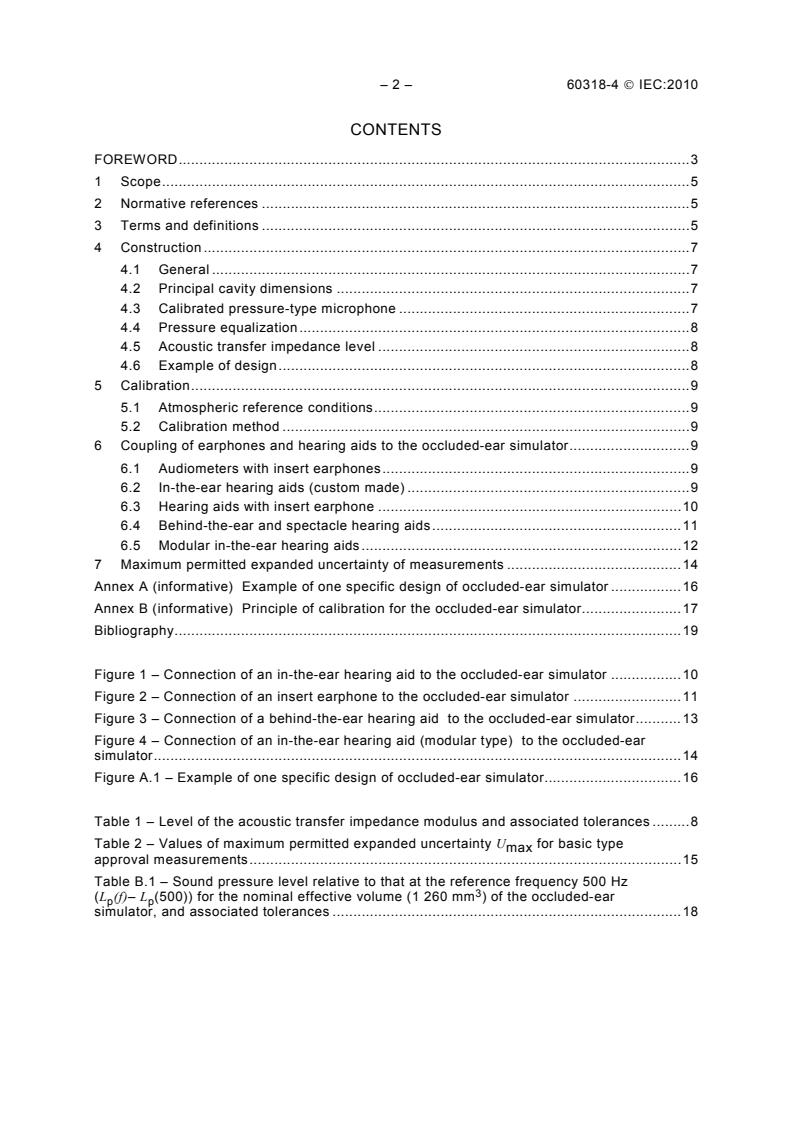
CONTENTS
FOREWORD.3
1 Scope.5
2 Normative references .5
3 Terms and definitions .5
4 Construction .7
4.1 General .7
4.2 Principal cavity dimensions .7
4.3 Calibrated pressure-type microphone .7
4.4 Pressure equalization.8
4.5 Acoustic transfer impedance level .8
4.6 Example of design.8
5 Calibration.9
5.1 Atmospheric reference conditions.9
5.2 Calibration method .9
6 Coupling of earphones and hearing aids to the occluded-ear simulator.9
6.1 Audiometers with insert earphones.9
6.2 In-the-ear hearing aids (custom made) .9
6.3 Hearing aids with insert earphone .10
6.4 Behind-the-ear and spectacle hearing aids.11
6.5 Modular in-the-ear hearing aids.12
7 Maximum permitted expanded uncertainty of measurements .14
Annex A (informative) Example of one specific design of occluded-ear simulator .16
Annex B (informative) Principle of calibration for the occluded-ear simulator.17
Bibliography.19
Figure 1 – Connection of an in-the-ear hearing aid to the occluded-ear simulator .10
Figure 2 – Connection of an insert earphone to the occluded-ear simulator .11
Figure 3 – Connection of a behind-the-ear hearing aid to the occluded-ear simulator.13
Figure 4 – Connection of an in-the-ear hearing aid (modular type) to the occluded-ear
simulator.14
Figure A.1 – Example of one specific design of occluded-ear simulator.16
Table 1 – Level of the acoustic transfer impedance modulus and associated tolerances .8
Table 2 – Values of maximum permitted expanded uncertainty U for basic type
max
approval measurements.15
Table B.1 – Sound pressure level relative to that at the reference frequency 500 Hz
(L (f)– L (500)) for the nominal effective volume (1 260 mm ) of the occluded-ear
p p
simulator, and associated tolerances .18
60318-4 © IEC:2010 – 3 –
INTERNATIONAL ELECTROTECHNICAL COMMISSION
____________
ELECTROACOUSTICS –
SIMULATORS OF HUMAN HEAD AND EAR –
Part 4: Occluded-ear simulator for the measurement
of earphones coupled to the ear by means of ear inserts
FOREWORD
1) The International Electrotechnical Commission (IEC) is a worldwide organization for standardization comprising
all national electrotechnical committees (IEC National Committees). The object of IEC is to promote
international co-operation on all questions concerning standardization in the electrical and electronic fields. To
this end and in addition to other activities, IEC publishes International Standards, Technical Specifications,
Technical Reports, Publicly Available Specifications (PAS) and Guides (hereafter referred to as “IEC
Publication(s)”). Their preparation is entrusted to technical committees; any IEC National Committee interested
in the subject dealt with may participate in this preparatory work. International, governmental and non-
governmental organizations liaising with the IEC also participate in this preparation. IEC collaborates closely
with the International Organization for Standardization (ISO) in accordance with conditions determined by
agreement between the two organizations.
2) The formal decisions or agreements of IEC on technical matters express, as nearly as possible, an international
consensus of opinion on the relevant subjects since each technical committee has representation from all
interested IEC National Committees.
3) IEC Publications have the form of recommendations for international use and are accepted by IEC National
Committees in that sense. While all reasonable efforts are made to ensure that the technical content of IEC
Publications is accurate, IEC cannot be held responsible for the way in which they are used or for any
misinterpretation by any end user.
4) In order to promote international uniformity, IEC National Committees undertake to apply IEC Publications
transparently to the maximum extent possible in their national and regional publications. Any divergence
between any IEC Publication and the corresponding national or regional publication shall be clearly indicated in
the latter.
5) IEC itself does not provide any attestation of conformity. Independent certification bodies provide conformity
assessment services and, in some areas, access to IEC marks of conformity. IEC is not responsible for any
services carried out by independent certification bodies.
6) All users should ensure that they have the latest edition of this publication.
7) No liability shall attach to IEC or its directors, employees, servants or agents including individual experts and
members of its technical committees and IEC National Committees for any personal injury, property damage or
other damage of any nature whatsoever, whether direct or indirect, or for costs (including legal fees) and
expenses arising out of the publication, use of, or reliance upon, this IEC Publication or any other IEC
Publications.
8) Attention is drawn to the Normative references cited in this publication. Use of the referenced publications is
indispensable for the correct application of this publication.
9) Attention is drawn to the possibility that some of the elements of this IEC Publication may be the subject of
patent rights. IEC shall not be held responsible for identifying any or all such patent rights.
International Standard IEC 60318-4 has been prepared by IEC technical committee 29:
Electroacoustics.
This first edition of IEC 60318-4 cancels and replaces IEC 60711, published in 1981 and
constitutes a technical revision.
The main changes with respect to the previous edition are listed below:
– extension of the usable frequency range to 100 Hz – 16 000 Hz;
– addition of values of maximum permitted expanded uncertainties to all tolerances.
– 4 – 60318-4 © IEC:2010
The text of this standard is based on the following documents:
Enquiry draft Report on voting
29/662/CDV 29/685/RVC
Full information on the voting for the approval of this standard can be found in the report on
voting indicated in the above table.
This publication has been drafted in accordance with the ISO/IEC Directives, Part 2.
A list of all parts of the IEC 60318 series can be found on the IEC website under the title:
Electroacoustics – Simulators of human head and ear.
The committee has decided that the contents of this publication will remain unchanged until
the maintenance result date indicated on the IEC web site under "http://webstore.iec.ch" in the
data related to the specific publication. At this date, the publication will be
• reconfirmed,
• withdrawn,
• replaced by a revised edition, or
• amended.
60318-4 © IEC:2010 – 5 –
ELECTROACOUSTICS –
SIMULATORS OF HUMAN HEAD AND EAR –
Part 4: Occluded-ear simulator for the measurement
of earphones coupled to the ear by means of ear inserts
1 Scope
This part of IEC 60318 describes an occluded-ear simulator intended for the measurement of
insert earphones in the frequency range from 100 Hz to 10 000 Hz. It is suitable for air
conduction hearing aids and earphones, coupled to the ear by means of ear inserts e.g. ear
moulds or similar devices. The occluded-ear simulator is also suitable as the basis for an
extension intended to simulate the complete ear canal and the outer ear (for instance in head
simulators).
The occluded-ear simulator simulates the acoustic transfer impedance for the occluded
normal adult human ear. However, it does not simulate the leakage between an earmould and
a human ear canal; therefore, the results obtained with the occluded-ear simulator may
deviate from the performance of an insert earphone on a real ear, especially at low
frequencies. Moreover, large performance variations among individual ears will occur which
should be considered when using the ear simulator.
Above 10 kHz the device does not simulate a human ear, but can be used as an acoustic
coupler at additional frequencies up to 16 kHz. Below 100 Hz, the device has not been
verified to simulate a human ear, but can be used as an acoustic coupler at additional
frequencies down to 20 Hz.
NOTE Due to resonances in the acoustic transfer impedance of the occluded-ear simulator above 10 kHz, high
measurement uncertainties, e.g. in the order of 10 dB, can occur in earphone responses. Repeatable results mainly
are obtained for insert earphones with high acoustic damping (used for instance in the extended high-frequency
audiometry, see the earphones listed in ISO 389-6)[3] coupled to the occluded-ear simulator by means of a
simple, symmetrically designed and air tight coupling device.
2 Normative references
The following referenced documents are indispensable for the application of this document.
For dated references, only the edition cited applies. For undated references, the latest edition
of the referenced document (including any amendments) applies.
IEC 61094-4, Measurement microphones – Part 4: Specifications for working standard
microphones
ISO/IEC Guide 98-3, Uncertainty of measurement – Part 3: Guide to the expression of
uncertainty in measurement (GUM:1995)
3 Terms and definitions
For the purposes of this document, the following terms and definitions apply.
___________
Figures in square brackets refer to the Bibliography.
– 6 – 60318-4 © IEC:2010
3.1
ear insert
device used to provide the acoustic coupling between an earphone and the ear canal (e.g. an
earmould or a similar device with or without a connecting tube)
3.2
insert earphone
small earphone coupled to the ear canal by means of an ear insert or attached to a
connecting element which is inserted into the ear canal
NOTE This ear insert may be a part of the insert earphone.
3.3
ear-mould simulator
ear insert simulator
insert which terminates the entrance of the ear simulator and provides for passage of sound
into the occluded-ear simulator through an opening on its axis
3.4
ear simulator
device for measuring the acoustic output of sound sources where the sound pressure is
measured by a calibrated microphone coupled to the source so that the overall acoustic
impedance of the device approximates that of the normal human ear at a given location and in
a given frequency band
3.5
occluded-ear simulator
ear simulator which approximates the acoustic transfer impedance of the inner part of the ear
canal, from the tip of an ear insert to the eardrum
3.6
acoustic coupler
device for measuring the acoustic output of sound sources where the sound pressure is
measured by a calibrated microphone coupled to the source by a cavity of predetermined
shape and volume which does not necessarily approximate the acoustical impedance of the
normal human ear
3.7
reference plane of the occluded-ear simulator
plane perpendicular to the axis of the cavity of the simulator, chosen to pass through the
position normally occupied by the tip of an earmould in a human ear
3.8
acoustic transfer impedance of the occluded-ear simulator
quotient of the sound pressure at the diaphragm of its microphone by the volume velocity
through the reference plane
–3
unit: Pa⋅s⋅m
3.9
acoustic transfer impedance level of the occluded-ear simulator
ten times the logarithm to the base of ten of the quotient of the absolute value (modulus) of
the squared acoustic transfer impedance of the occluded-ear simulator by the squared
–3
reference acoustic transfer impedance of one pascal second per cubic metre (Pa⋅s⋅m )
unit: dB
60318-4 © IEC:2010 – 7 –
3.10
effective volume
equivalent volume of air of the acoustic compliance of the ear simulator formed by the cavity
and the microphone at a frequency of 500 Hz
unit: mm
4 Construction
4.1 General
The occluded-ear simulator shall be constructed of hard, dimensionally stable, non-porous
and non-magnetic material. The general construction of the occluded-ear simulator and
mounting of the microphone shall aim at minimizing the response of the microphone to
vibration (for example from an earphone) or to extraneous sound outside the cavity.
NOTE 1 The external diameter of the occluded-ear simulator should be kept as small as possible in order to
minimize diffractional errors which might affect the measurements when the occluded-ear simulator has to be
placed in a free sound field.
NOTE 2 In order to avoid a possible sound attenuation caused by the dust protector (see Figure A.1), an
earphone calibration should be performed above 10 kHz at least every two years with the occluded-ear simulator
equipped with and without its dust protector in place. The two results should not differ by more than 0,2 dB at
frequencies up to 16 kHz. If this is not the case at some frequencies, earphone measurements at those frequencies
should generally be performed without the dust protector.
The construction of the occluded-ear simulator shall permit the location of a transducer at the
reference plane for calibrating the simulator.
Where tolerances are specified in this part of IEC 60318, these shall be reduced by an
amount equal to the actual expanded measurement uncertainty of the test laboratory before
deciding if a device conforms to the stated requirement.
4.2 Principal cavity dimensions
The diameter of the principal cavity shall be (7,50 ± 0,04) mm.
The length of the principal cavity shall be such as to produce a half-wavelength resonance of
the sound pressure at (13,5 ± 1,5) kHz.
4.3 Calibrated pressure-type microphone
A calibrated microphone is located at the base of principal cavity of the occluded-ear
simulator. The acoustic impedance of the microphone diaphragm shall be high, so that the
equivalent volume is less than 20 mm over the specified range of frequencies. The
microphone shall conform to the requirements of IEC 61094-4 for a type WS2P microphone.
The microphone shall be coupled to the principal cavity with a seal that prevents acoustic
leaks.
In the frequency range 20 Hz to 10 kHz, the overall sound pressure sensitivity level of the
microphone and associated measuring system shall be known with an uncertainty not
exceeding 0,3 dB for a level of confidence of 95 %. For measurements above 10 kHz, the
overall pressure sensitivity level of the microphone and associated measuring system over
the specified frequency range shall be known with an uncertainty not exceeding 0,5 dB for a
level of confidence of 95 %.
The make and model of the microphone shall be specified by the manufacturer of the
occluded-ear simulator.
NOTE The acoustic impedance of the microphone affects the overall acoustic impedance of the occluded-ear
simulator.
– 8 – 60318-4 © IEC:2010
4.4 Pressure equalization
A vent shall be provided to equalize the static pressure in the cavity of the occluded-ear
–3
simulator. The vent shall have an acoustic resistance of (7,0 ± 5,5) GPa⋅s⋅m .
4.5 Acoustic transfer impedance level
The level of the acoustic transfer impedance modulus of the occluded-ear simulator and the
associated tolerances shall be as specified in Table 1.
NOTE 1 At 500 Hz, the specified transfer impedance level corresponds to the magnitude of the acoustic transfer
–3 3
and also to the magnitude of the effective volume 1 260 mm of the ear simulator.
impedance 35,9 MPa⋅s⋅m
NOTE 2 The tolerances have minimum values at the frequency 500 Hz, where the influence of leakage and wave
motion is small.
4.6 Example of design
An example of one specific design of occluded-ear simulator is shown in Annex A.
Table 1 – Level of the acoustic transfer impedance modulus
and associated tolerances
Acoustic transfer
Nominal
impedance level
frequency
–3
re 1 MPa⋅s⋅m in dB
Hz
Level Tolerances
100 44,8
± 0,7
125 42,9 ± 0,7
160 40,8 ± 0,7
200 39,0 ± 0,6
250 37,0
± 0,6
315 35,0
± 0,6
400 33,0 ± 0,6
500 31,1 ± 0,3
630 29,2 ± 0,6
800 27,2
± 0,6
1 000 26,7 ± 0,7
1 250 26,4 ± 0,7
1 600 25,5 ± 0,7
2 000 24,2
± 0,8
2 500 23,1
± 0,8
3 150 22,0
± 0,9
4 000 21,1 ± 1,0
5 000 20,4 ± 1,2
6 300 20,5 ± 1,2
8 000 20,8
± 1,7
10 000 23,1
± 2,2
NOTE 1 Using the measurement method described in Annex B, it is not easy to measure the acoustical transfer
impedance level below 100 Hz, due to the effects of an imperfectly sealed measurement configuration. However,
the acoustical transfer impedance between 20 Hz and 100 Hz is governed predominantly by the volumetric
elements of the occluded-ear simulator, and their contribution to the overall acoustical transfer impedance can be
validated by the measurements at higher frequencies.
60318-4 © IEC:2010 – 9 –
n/10
NOTE 2 The values in Table 1 are valid for the exact one-third-octave frequencies calculated from 1 000 × 10 ,
where n is a positive or negative integer or zero.
5 Calibration
5.1 Atmospheric reference conditions
Reference ambient pressure: 101,325 kPa
Reference temperature: 23 °C
Reference relative humidity: 50 %
5.2 Calibration method
The manufacturer shall describe the method(s) for determining calibration and overall stability
of the complete occluded-ear simulator including the microphone in an instruction manual.
The method shall include the determination of the effective volume at 500 Hz.
The principle of calibration is given in Annex B.
The calibration should be performed for the atmospheric reference conditions given in 5.1 with
the following tolerances:
Ambient pressure: ± 3 kPa
Temperature: ± 3 °C
Relative humidity: ± 20 %
If it is not possible to perform the calibration at reference conditions, the calibration shall be
referred to the atmospheric reference conditions given in 5.1, see [8], [9].
6 Coupling of earphones and hearing aids to the occluded-ear simulator
6.1 Audiometers with insert earphones
Insert earphones with standardized reference equivalent threshold sound pressure levels
shall be connected to the occluded-ear simulator as specified in the relevant ISO standards.
For other earphones, the manufacturer of the audiometer shall describe the method of
connection.
NOTE Reference hearing threshold sound pressure levels of insert earphones for audiometers and its connection
to the occluded-ear simulator are standardized in ISO 389-2 [1], ISO 389-5 [2] and ISO 389-6 [3].
6.2 In-the-ear hearing aids (custom made)
The hearing aid shall be connected directly to the cavity of the occluded-ear simulator as
indicated in Figure 1. The connection between the hearing aid and the occluded-ear simulator
shall be made airtight by using a suitable seal. In doing so, care shall be taken not to
introduce additional volume to the cavity which can affect the measured performance of the
hearing aid.
In the same way, a hearing aid equipped with a separate ear insert can be measured.
– 10 – 60318-4 © IEC:2010
Dimensions in millimetres
IEC 030/10
Key
a hearing aid (custom-made)
b airtight seal and support for hearing aid
c retaining collar
d reference plane
e tip of hearing aid or insert should lie in the reference plane
f occluded-ear simulator
NOTE 1 This diagram is only intended as a schematic representation illustrating the principle of connecting the
hearing aid to the occluded-ear simulator. Effective airtight seals should be assured at all connection points.
NOTE 2 In the same manner, a hearing aid equipped with a separate ear insert can be connected to the occluded
ear simulator.
Figure 1 – Connection of an in-the-ear hearing aid
to the occluded-ear simulator
6.3 Hearing aids with insert earphone
Where possible, the ear insert used with the human ear shall be replaced by an ear-mould
simulator consisting essentially of a rigid tube, coaxial with the cavity, of length 18,0 mm ±
0,20 mm and internal diameter 3,00 mm ± 0,06 mm, representing the tubular portion of an
average ear mould.
The connection between the nub of the earphone and the ear-mould simulator shall be made
airtight by using a suitable seal, In doing so, care shall be taken not to introduce additional
volume to the cavity which can affect the measured performance of the earphone.
60318-4 © IEC:2010 – 11 –
An example of an earphone connected to the occluded-ear simulator with an ear-mould
simulator is shown in Figure 2. It illustrates the principal features of the connection method.
However, other forms may also be used, provided that they conform to the above
specifications.
Dimensions in millimetres
IEC 031/10
Key
a insert earphone
b airtight seal and support for nub of earphone
c ear-mould simulator for insert earphone
d retaining collar
e reference plane
f occluded-ear simulator
NOTE This diagram is only intended as a schematic representation illustrating the principle of connecting the
hearing aid to the occluded-ear simulator. Effective airtight seals should be assured at all connection points.
Figure 2 – Connection of an insert earphone to the occluded-ear simulator
If it is inappropriate to disconnect the ear insert used with the human ear from the receiver,
the ear insert shall be connected directly to the entrance of the cylindrical cavity and shall be
coaxial with it. An airtight seal shall be ensured. In doing so, care shall be taken not to
introduce additional volume to the cavity which can affect the measured performance of the
earphone.
6.4 Behind-the-ear and spectacle hearing aids
The hearing aid with its acoustic outlet attachment (e.g. hook and flexible connecting tube of
behind-the-ear hearing aids or nub and flexible connecting tube of spectacle hearing aids)
– 12 – 60318-4 © IEC:2010
shall be connected to the occluded-ear simulator with an ear-mould simulator as described in
6.3. This shall be accomplished by means of a small coupling device of rigid material, having
the same internal diameter as the nominal diameter at the end of the acoustic outlet
attachment ± 0,06 mm and a length of 5,0 mm ± 0,1 mm.
The connection between the small coupling device and the ear-mould simulator shall be made
airtight by using a suitable seal. In doing so, care shall be taken not to introduce additional
volume to the cavity which can affect the measured performance of the hearing aid.
The material, length and internal diameter of the connecting tube between the hearing aid and
the small coupling device shall conform to the hearing-aid manufacturer's specifications. In
particular, the connecting tube can be of flexible or rigid material. This connecting tube
between the hearing aid and the small coupling device shall be connected to the nub of a
spectacle hearing aid or to the hook, if any, of a behind-the-ear hearing aid. The connecting
tube shall not be connected directly to the behind-the-ear type of hearing aid if this aid is
intended to be used with a hook.
Unless otherwise specified, the length of the connecting tube measured from the end of the
hook or from the end of the nub to the entrance of the 3 mm diameter rigid tube of the ear-
mould simulator shall be 25 mm ± 1 mm.
The principal features of the occluded-ear simulator with ear-mould simulator and small
coupling device, showing the connection arrangement for a behind-the-ear hearing aid are
indicated in Figure 3. As an example, the internal diameter of the small coupling device is
chosen to be 2 mm in accordance with the tubing most commonly used. Forms other than the
one illustrated may be used, provided that they conform to the above specifications.
NOTE The manufacturer’s specifications for the dimensions of the tubing should be in accordance with the
average conditions found in practical use of the hearing aid. If, for some unusual reason, it is impossible to
simulate the average conditions of practical use with the ear-mould simulator specified above in the occluded-ear
simulator, an appropriate different system may be used if fully described.
6.5 Modular in-the-ear hearing aids
The modular version of the hearing aid shall be connected directly to the cavity of the
occluded-ear simulator as indicated in Figure 4. This shall be accomplished by means of a
tube coupling device of rigid material, having the same internal diameter as the nominal
diameter at the end of the acoustic outlet attachment ± 0,06 mm and a length of 5,0 mm
± 0,1 mm.
The connection between the tube coupling device and the occluded-ear simulator shall be
made airtight by using a suitable seal. In doing so, care shall be taken not to introduce
additional volume to the cavity which can affect the measured performance of the hearing aid.
Unless otherwise specified, the length of the connecting tube measured from the outlet of the
hearing aid to the entrance of the reference plane of the occluded-ear simulator shall be
8,0 mm ± 0,7 mm.
60318-4 © IEC:2010 – 13 –
Dimensions in millimetres
IEC 032/10
Key
a behind-the-ear type of hearing aid (BTE)
b acoustical outlet of hearing aid (hook)
c flexible connecting tube, typically Ø 2 mm internal
d small tube coupling device having the same internal diameter as the nominal diameter of the acoustical
outlet attachment of the hearing aid, typically Ø 2 mm
e ear-mould simulator for hearing aids
f reference plane
g retaining collar
h occluded-ear simulator
NOTE 1 The length of the tubing and the inside diameters of both the tubing and the coupling device (which are to
be equal) should be as shown and stated above, unless otherwise specified by the manufacturer, in order to meet
the average conditions found in practical use of a particular hearing aid.
NOTE 2 This diagram is only intended as a schematic representation illustrating the principle of connecting the
hearing aid to the occluded-ear simulator. Effective airtight seals should be assured at all connection points.
Figure 3 – Connection of a behind-the-ear hearing aid
to the occluded-ear simulator
– 14 – 60318-4 © IEC:2010
Dimensions in millimetres
IEC 033/10
Key
a hearing aid (modular type)
b flexible connecting tube, typically Ø 2 mm internal
c retaining collar
d tube coupling device, typically Ø 2 mm internal
e reference plane
f occluded-ear simulator
NOTE 1 The length of the tubing and the inside diameters of both the tubing and the tube coupling device (which
are to be equal) should be as shown and stated above, unless otherwise specified by the manufacturer, in order to
meet the average conditions found in practical use of a particular hearing aid.
NOTE 2 This diagram is only intended as a schematic representation illustrating the principle of connecting the
hearing aid to the occluded-ear simulator. Effective airtight seals should be assured at all connection points.
Figure 4 – Connection of an in-the-ear hearing aid (modular type)
to the occluded-ear simulator
7 Maximum permitted expanded uncertainty of measurements
Table 2 specifies the maximum permitted expanded uncertainty U for a probability of
max
approximately 95 % equivalent to a coverage factor of k = 2, associated with the
measurements undertaken in this part of IEC 60318 (see ISO/IEC Guide 98-3). One set of
values for U is given for basic type approval measurements.
max
The expanded uncertainties of measurements given in Table 2 are the maximum permitted for
demonstration of conformance to the requirements of this part of IEC 60318. If the actual
expanded uncertainty of a measurement performed by the test laboratory exceeds the
maximum permitted value in Table 2, the measurement shall not be used to demonstrate
conformance to the requirements of this part of IEC 60318.
60318-4 © IEC:2010 – 15 –
Table 2 – Values of maximum permitted expanded
uncertainty U for basic type approval measurements
max
Measured quantity Relevant subclause
Basic U (k = 2)
max
number
Diameter of principal cavity 4.2 0,02 mm
Resonance frequency of the principal 4.2 0,3 kHz
cavity
Microphone pressure sensitivity level 4.3 0,3 dB
(≤ 10 kHz)
Microphone pressure sensitivity level 4.3 0,5 dB
(> 10 kHz)
Microphone equivalent volume 4.3 2 mm
–3
Acoustic resistance of vent 4.4 0,5 GPa⋅s⋅m
Acoustic transfer impedance level at 4.5 0,1 dB
500 Hz
Acoustic transfer impedance level 4.5 0,3 dB
(< 500 Hz and > 500 Hz)
Ambient pressure 5.2 0,1 kPa
Temperature 5.2 0,5 °C
Relative humidity 5.2 5 %
Effective volume of the occluded-ear 5.2 15 mm
simulator at 500 Hz
Internal diameter of ear-mould 6.3, 6.4 0,02 mm
simulator or small coupling device
Length of ear-mould simulator or 6.3, 6.4 0,02 mm
small coupling device
– 16 – 60318-4 © IEC:2010
Annex A
(informative)
Example of one specific design of occluded-ear simulator
Dimensions in millimetres
IEC 034/10
Key
a external-ear simulator
b retaining collar
c reference plane
d dust protector
e annular grove
f annular grove
g main housing
h pressure equalizing holes
i pressure microphone
j microphone preamplifier
NOTE The lower part of the figure shows an example of one specific design of an occluded-ear simulator
conforming to this standard.
Figure A.1 – Example of one specific design of occluded-ear simulator
60318-4 © IEC:2010 – 17 –
Annex B
(informative)
Principle of calibration for the occluded-ear simulator
The acoustic transfer impedance Z (f) of an occluded-ear simulator can be defined as the ratio
t
between the sound pressure p(f) at the membrane of the microphone and the volume velocity
at the ear simulator reference plane:
p( f )
Z ( f ) = (B.1)
t
ΔV 2πf
where the volume velocity is the volume displacement ΔV times the angular frequency 2πf.
The value of the acoustic transfer impedance Z (f) relative to that at the reference frequency
t
500 Hz can be determined by using as a sound source a transducer producing constant
volume displacement at the reference plane.
In this case, at 500 Hz, we have
p(500)
Z (500) = (B.2)
t
ΔV 2π500
and – by dividing Equation (B.1) by Equation (B.2) and taking into account that the nominal
effective volume of the ear simulator cavity is 1 260 mm corresponding to a magnitude of the
-3
acoustic transfer impedance of 35,9 MPa⋅s⋅m (see 4.5)
500 p( f )
Z ( f ) = 35,9 (B.3)
t
f p(500)
Thus, the acoustic transfer impedance of the ear simulator at a frequency f can be calculated
from the ratio of the sound pressures at that frequency and the frequency 500 Hz.
So, by using logarithmic values, the acoustic transfer impedance level L (f) can be calculated
Zt
from the measured sound pressure levels at that frequency and the reference frequency
500 Hz:
L (f) = 10 lg Z (f) = 20 lg(35,9 × 500) – 20 lg f + (L (f) – L(500)), (B.4)
Zt t p p
where (L (f) - L (500)) can be found in Table B.1.
p p
EXAMPLE According to Table B.1, the relative sound pressure level at 100 Hz is –0,3 dB. Using Equation (B.4) we
get:
L (100) = 85,08 – 40 – 0,3 = 44,78 dB
Zt
For the nominal effective volume of the cavity of 1 260 mm at 500 Hz, the sound pressure
level at a frequency f minus the sound pressure level at 500 Hz (L (f) – L (500)) – and the
p p
corresponding tolerances – will be as given in Table B.1. If the actual effective volume V in
3 2 2
cubic millimetres at 500 Hz deviates from 1 260 mm , 10 Ig (V /1 260 ) dB shall be added to
the magnitudes of the relative sound pressure level given in Table B.1.
NOTE 1 A WS3P microphone driven by a constant voltage may be used as a constant volume displacement sound
source.
– 18 – 60318-4 © IEC:2010
NOTE 2 The effective volume may be measured using a reference volume of about 1 260 mm . For a cylindrical
reference volume and frequency of 500 Hz, the diameter should be greater than 0,6 of the length (see [7]).
NOTE 3 The values in Table B.1 are valid for the exact one-third octave frequencies calculated from 1 000 ×
n/10
10 , where n is a positive or negative integer or zero.
NOTE 4 At high frequencies, the electrically measured frequency response of the occluded-ear simulator has to
be corrected for the frequency-response characteristics of the microphone and the sound source.
Table B.1 – Sound pressure level relative to that at the reference frequency 500 Hz
(L (f)– L (500)) for the nominal effective volume (1 260 mm ) of the occluded-ear
p p
simulator, and associated tolerances
Relative sound pressure level
Nominal
dB
frequency
Hz
Magnitude Tolerances
100 –0,3
±0,7
125 –0,2
±0,7
160 –0,2
±0,7
200 –0,1
±0,6
250 –0,1 ±0,6
315 –0,1 ±0,6
400 0 ±0,6
630 0,1 ±0,6
800 0,2 ±0,6
1 000 1,6
±0,7
1 250 3,3
±0,7
1 600 4,5
±0,7
2 000 5,2 ±0,7
2 500 6,0 ±0,8
3 150 6,9 ±0,9
4 000 8,0 ±1,0
5 000 9,3
±1,2
6 300 11,4
±1,2
8 000 13,7
±1,7
10 000 18,0 ±2,2
NOTE The sound pressure levels in this table are valid
for an input with constant volume displacement.
.
60318-4 © IEC:2010 – 19 –
Bibliography
[1] ISO 389-2, Acoustics – Reference zero for the calibration of audiometric equipment –
Part 2: Reference equivalent threshold sound pressure levels for pure tones and insert
earphones
[2] ISO 389-5, Acoustics – Reference zero for the calibration of audiometric equipment –
Part 5: Reference equivalent threshold sound pressure levels for pure tones in the
frequency range 8 kHz to 16 kHz
[3] ISO 389-6, Acoustics – Reference zero for the calibration of audiometric equipment –
Part 6: Reference threshold of hearing for test signals of short duration
[4] BRÜEL, P.V., FREDERIKSEN, E., MATHIASEN, H., RASMUSSEN, G., SIGH, E.,
TARNOW, V.: Impedance of real and artificial ears. Copenhagen, Denmark,1976,
Literature number Brüel&Kjaer BN0221 (only available in English)
[5] ANSI S 3.7:1995 (R2003), Methods for coupler calibration of earphones (only
available in English)
[6] RICHTER, U.: Characteristic data of different kinds of earphones used in the extended
high-frequency range for pure-tone audiometry. PTB report MA-72, 2003 (only
available in English)
[7] DANIELS, F.B.: Acoustical impedances of enclosures. J Acoust Soc Am, 1947, Vol 19,
569-571 (only available in English)
Modelling of the Bruel & Kjaer Type 4157 occluded ear simulators at
[8] JONSSON, S.:
different ambient conditions. Copenhagen, Denmark 2009, Brüel & Kjaer report
number BN0583 (only available in English)
[9] HEEREN, W., RASMUSSEN, P.: RA 0045 (IEC 711 coupler), different ambient
conditions. Copenhagen, Denmark 2008, G.R.A.S. Sound & Vibration, Internal Report
(only available in English)
Simulation of the IEC 711
[10] JONSSON, S., Liu, B., SCHUHMACHER, A, NIELSEN, L.:
occluded ear simulator. Audio Engineering Society 2004, Berlin (only available in
English)
[11] ZHANG, Bin L., JONSSON, S., SCHUHMACHER, A., NIELSEN. L.: A Combined
BEM/FEM Acoustic Model of an Occluded Ear Simulator. Internoise 2004, Prague
(only available in English)
___________
– 20 – 60318-4 © CEI:2010
SOMMAIRE
AVANT-PROPOS.21
1 Domaine d’application .23
2 Références normatives.23
3 Termes et définitions .24
4 Construction .25
4.1 Généralités.25
4.2 Dimensions de la cavité principale.25
4.3 Microphone de type pression étalonné .25
4.4 Egalisation de pression .
...