

IEC 60721-3-5:1997
(Main)Classification of environmental conditions - Part 3: Classificationof groups of environmental parameters and their severities -Section 5: Ground vehicle installations
General Information
- Abstract
Classifies the environmental conditions to which a product not forming part of the vehicle is subjected when installed in a ground vehicle. Such products are for example radios, communication systems, fare meters, and flow meters for liquids transported by the vehicle. Vehicles where products may be permanently or temporarily installed include road vehicles, rail vehicles, overland vehicles, handling and storage vehicles, and self-propelled machinery.
- Status
- Published
- Publication Date
- 20-Mar-1997
- Technical Committee
- TC 104 - Environmental conditions, classification and methods of test
- Drafting Committee
- MT 19 - TC 104/MT 19
Buy Documents
IEC 60721-3-5:1997 - Classification of environmental conditions - Part 3: Classificationof groups of environmental parameters and their severities -Section 5: Ground vehicle installations Released:3/21/1997
Overview
IEC 60721-3-5:1997 is an international standard published by the International Electrotechnical Commission (IEC) focused on the classification of environmental conditions specifically related to ground vehicle installations. This standard addresses the environmental stresses to which products, not integral parts of a vehicle, are subjected when installed in various types of terrestrial vehicles. Examples of such products include radios, communication systems, fare meters, and flow meters used in vehicles transporting liquids such as milk or petroleum products.
The standard applies to a broad spectrum of ground vehicles, including:
- Road vehicles: passenger cars, commercial vehicles, special purpose vehicles, tractors, trailers, motorcycles
- Rail vehicles: trains, trams, cranes
- Off-road vehicles: 4-wheel drive vehicles, tractors, snow scooters
- Handling and storage vehicles: forklifts, baggage transporters
- Self-propelled machinery: excavators, harvesters
IEC 60721-3-5 helps designers, manufacturers, and users understand and classify the environmental parameters and severity levels affecting products installed in these vehicles, guiding the selection and testing of equipment to ensure durability and reliability under specified environmental conditions.
Key Topics
- Environmental Parameter Classification: The standard categorizes various environmental factors affecting ground vehicle-installed equipment, including climatic, biological, chemical, mechanical, and contaminant-related parameters.
- Severity Levels: Each environmental parameter is further classified by severity to represent the typical conditions that equipment may experience, aiding in product design and testing.
- Scope of Application: The standard focuses on external environmental factors relevant to products installed either permanently or temporarily in ground vehicles. It excludes vehicle components themselves but may be applicable to spare parts installed similarly.
- Environmental Conditions Covered: Includes climatic conditions (temperature, humidity, precipitation), biologically active conditions (fungi, insects), chemical exposure (corrosive agents), mechanical effects (vibration, shock), and contamination by fluids (fuels, lubricants).
- Guidance and Annexes: Annex A offers a practical survey to assist users in selecting appropriate environmental classifications based on application conditions. Annex B explains tropical environment specifics detailed in certain climatic categories.
- Normative References: Cross-references other relevant IEC standards on environmental conditions and terminologies to ensure harmonization within the classification framework.
Applications
IEC 60721-3-5 is essential for:
- Manufacturers of vehicle-installed electronic and mechanical products, ensuring their products withstand environmental stresses encountered during in-vehicle operation.
- Component designers and engineers seeking to define product performance requirements and test protocols aligned with real-world environmental conditions.
- Quality assurance and testing laboratories validating compliance of in-vehicle equipment against standardized environmental classifications.
- Vehicle operators and fleet managers understanding product suitability based on environmental classifications, aiding maintenance and replacement strategies.
- Regulatory bodies and certification organizations validating equipment reliability and safety under specified environmental conditions.
By leveraging this standard, industry stakeholders can reduce product failure due to environmental stresses, improve safety, and extend operational life cycles of vehicular equipment.
Related Standards
- IEC 60721-1: Environmental parameters and their severities - general guidelines.
- IEC 60721-2: Environmental conditions present in nature - for natural environmental influences.
- IEC 60721-3 (other parts): Classify environmental parameters and severities for other product installation contexts.
- IEC 617: Graphical symbols for electrical diagrams, aiding standardized communication in documentation.
- IEC 417 and IEC 27: Standards for graphical and letter symbols, supporting uniform symbol usage across related documentation.
- Other IEC standards on mechanical, climatic, and chemical testing methods, aligning testing with classified environmental conditions.
Keywords: IEC 60721-3-5, ground vehicle installations, environmental classification, environmental parameters, severity levels, radios, communication systems, fare meters, flow meters, off-road vehicles, rail vehicles, handling vehicles, environmental conditions, international standard, vehicle equipment testing, product reliability.
Relations
- Effective Date
- 25-Aug-2026
- Effective Date
- 25-Aug-2026
- Effective Date
- 05-Sep-2023
Buy Documents
IEC 60721-3-5:1997 - Classification of environmental conditions - Part 3: Classificationof groups of environmental parameters and their severities -Section 5: Ground vehicle installations Released:3/21/1997
Get Certified
Connect with accredited certification bodies for this standard

IMP NDT d.o.o.
Non-destructive testing services. Radiography, ultrasonic, magnetic particle, penetrant, visual inspection.
Inštitut za kovinske materiale in tehnologije
Institute of Metals and Technology. Materials testing, metallurgical analysis, NDT.
Q Techna d.o.o.
NDT and quality assurance specialist. 30+ years experience. NDT personnel certification per ISO 9712, nuclear and thermal power plant inspections, QA/
Sponsored listings
Frequently Asked Questions
IEC 60721-3-5:1997 is a standard published by the International Electrotechnical Commission (IEC). Its full title is "Classification of environmental conditions - Part 3: Classificationof groups of environmental parameters and their severities -Section 5: Ground vehicle installations". This standard covers: Classifies the environmental conditions to which a product not forming part of the vehicle is subjected when installed in a ground vehicle. Such products are for example radios, communication systems, fare meters, and flow meters for liquids transported by the vehicle. Vehicles where products may be permanently or temporarily installed include road vehicles, rail vehicles, overland vehicles, handling and storage vehicles, and self-propelled machinery.
Classifies the environmental conditions to which a product not forming part of the vehicle is subjected when installed in a ground vehicle. Such products are for example radios, communication systems, fare meters, and flow meters for liquids transported by the vehicle. Vehicles where products may be permanently or temporarily installed include road vehicles, rail vehicles, overland vehicles, handling and storage vehicles, and self-propelled machinery.
IEC 60721-3-5:1997 is classified under the following ICS (International Classification for Standards) categories: 19.040 - Environmental testing. The ICS classification helps identify the subject area and facilitates finding related standards.
IEC 60721-3-5:1997 has the following relationships with other standards: It is inter standard links to EN ISO 24534-2:2010, EN ISO 14815:2005, IEC 60721-3-5:2026. Understanding these relationships helps ensure you are using the most current and applicable version of the standard.
IEC 60721-3-5:1997 is available in PDF format for immediate download after purchase. The document can be added to your cart and obtained through the secure checkout process. Digital delivery ensures instant access to the complete standard document.
Standards Content (Sample)
NORME CEI
INTERNATIONALE
IEC
60721-3-5
INTERNATIONAL
Deuxième édition
STANDARD
Second edition
1997-03
Classification des conditions d’environnement –
Partie 3:
Classification des groupements des agents
d’environnement et de leurs sévérités –
Section 5: Installations des véhicules terrestres
Classification of environmental conditions –
Part 3:
Classification of groups of environmental parameters
and their severities –
Section 5: Ground vehicle installations
Numéro de référence
Reference number
CEI/IEC 60721-3-5: 1997
Validité de la présente publication Validity of this publication
Le contenu technique des publications de la CEI est cons- The technical content of IEC publications is kept under
tamment revu par la CEI afin qu'il reflète l'état actuel de constant review by the IEC, thus ensuring that the content
la technique. reflects current technology.
Des renseignements relatifs à la date de reconfirmation de Information relating to the date of the reconfirmation of the
la publication sont disponibles auprès du Bureau Central de publication is available from the IEC Central Office.
la CEI.
Les renseignements relatifs à ces révisions, à l'établis- Information on the revision work, the issue of revised
sement des éditions révisées et aux amendements peuvent editions and amendments may be obtained from IEC
être obtenus auprès des Comités nationaux de la CEI et National Committees and from the following IEC
dans les documents ci-dessous: sources:
• Bulletin de la CEI • IEC Bulletin
• Annuaire de la CEI • IEC Yearbook
Publié annuellement Published yearly
• Catalogue des publications de la CEI • Catalogue of IEC publications
Publié annuellement et mis à jour régulièrement Published yearly with regular updates
Terminologie Terminology
En ce qui concerne la terminologie générale, le lecteur se For general terminology, readers are referred to IEC 50:
reportera à la CEI 50: Vocabulaire Electrotechnique Inter- International Electrotechnical Vocabulary (IEV), which is
national (VEI), qui se présente sous forme de chapitres issued in the form of separate chapters each dealing
séparés traitant chacun d'un sujet défini. Des détails with a specific field. Full details of the IEV will be
complets sur le VEI peuvent être obtenus sur demande. supplied on request. See also the IEC Multilingual
Voir également le dictionnaire multilingue de la CEI. Dictionary.
Les termes et définitions figurant dans la présente publi- The terms and definitions contained in the present publi-
cation ont été soit tirés du VEI, soit spécifiquement cation have either been taken from the IEV or have been
approuvés aux fins de cette publication. specifically approved for the purpose of this publication.
Symboles graphiques et littéraux Graphical and letter symbols
Pour les symboles graphiques, les symboles littéraux et les For graphical symbols, and letter symbols and signs
signes d'usage général approuvés par la CEI, le lecteur approved by the IEC for general use, readers are referred to
consultera: publications:
– la CEI 27: Symboles littéraux à utiliser en – IEC 27: Letter symbols to be used in electrical
électrotechnique; technology;
– la CEI 417: Symboles graphiques utilisables – IEC 417: Graphical symbols for use on
sur le matériel. Index, relevé et compilation des equipment. Index, survey and compilation of the
feuilles individuelles; single sheets;
– la CEI 617: Symboles graphiques pour schémas; – IEC 617: Graphical symbols for diagrams;
et pour les appareils électromédicaux, and for medical electrical equipment,
– la CEI 878: Symboles graphiques pour – IEC 878: Graphical symbols for electromedical
équipements électriques en pratique médicale. equipment in medical practice.
Les symboles et signes contenus dans la présente publi- The symbols and signs contained in the present publication
cation ont été soit tirés de la CEI 27, de la CEI 417, de la have either been taken from IEC 27, IEC 417, IEC 617
CEI 617 et/ou de la CEI 878, soit spécifiquement approuvés and/or IEC 878, or have been specifically approved for the
aux fins de cette publication. purpose of this publication.
Publications de la CEI établies par le IEC publications prepared by the same
même comité d'études technical committee
L'attention du lecteur est attirée sur les listes figurant à la fin The attention of readers is drawn to the end pages of this
de cette publication, qui énumèrent les publications de la publication which list the IEC publications issued by the
CEI préparées par le comité d'études qui a établi la technical committee which has prepared the present
présente publication. publication.
NORME
CEI
INTERNATIONALE
IEC
60721-3-5
INTERNATIONAL
Deuxième édition
STANDARD
Second edition
1997-03
Classification des conditions d’environnement –
Partie 3:
Classification des groupements des agents
d’environnement et de leurs sévérités –
Section 5: Installations des véhicules terrestres
Classification of environmental conditions –
Part 3:
Classification of groups of environmental parameters
and their severities –
Section 5: Ground vehicle installations
IEC 1997 Droits de reproduction réservés Copyright - all rights reserved
Aucune partie de cette publication ne peut être reproduite ni utilisée No part of this publication may be reproduced or utilized in
sous quelque forme que ce soit et par aucun procédé, électronique any form or by any means, electronic or mechanical, including
ou mécanique, y compris la photocopie et les microfilms, sans photocopying and microfilm, without permission in writing from
l'accord écrit de l'éditeur. the publisher.
International Electrotechnical Commission 3, rue de Varembé Geneva, Switzerland
Telefax: +41 22 919 0300 e-mail: inmail@iec.ch IEC web site http: //www.iec.ch
CODE PRIX
Commission Electrotechnique Internationale
PRICE CODE U
International Electrotechnical Commission
Pour prix, voir catalogue en vigueur
For price, see current catalogue
− 2 − 60721-3-5 CEI:1997
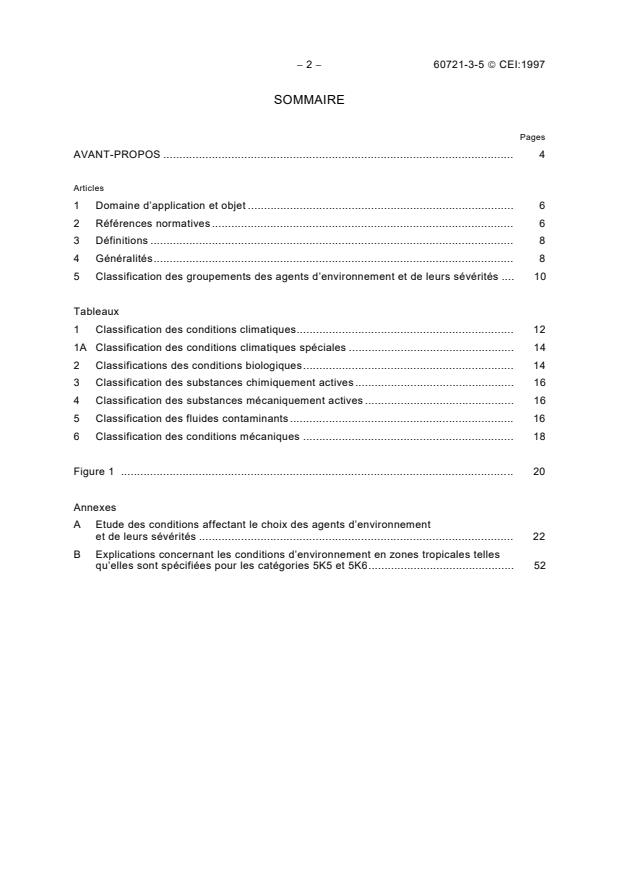
SOMMAIRE
Pages
AVANT-PROPOS . 4
Articles
1 Domaine d’application et objet . 6
2 Références normatives . 6
3 Définitions . 8
4 Généralités. 8
5 Classification des groupements des agents d’environnement et de leurs sévérités . 10
Tableaux
1 Classification des conditions climatiques. 12
1A Classification des conditions climatiques spéciales . 14
2 Classifications des conditions biologiques. 14
3 Classification des substances chimiquement actives . 16
4 Classification des substances mécaniquement actives . 16
5 Classification des fluides contaminants . 16
6 Classification des conditions mécaniques . 18
Figure 1 . 20
Annexes
A Etude des conditions affectant le choix des agents d’environnement
et de leurs sévérités . 22
B Explications concernant les conditions d’environnement en zones tropicales telles
qu’elles sont spécifiées pour les catégories 5K5 et 5K6. 52
60721-3-5 IEC:1997 − 3 −
CONTENTS
Pages
FOREWORD . 5
Clause
1 Scope and object. 7
2 Normative references . 7
3 Definitions . 9
4 General . 9
5 Classification of groups of environmental parameters and their severities. 11
Tables
1 Classification of climatic conditions. 13
1A Classification of special climatic conditions . 15
2 Classification of biological conditions . 15
3 Classification of chemically active substances. 17
4 Classification of mechanically active substances. 17
5 Classification of contaminating fluids . 17
6 Classification of mechanical conditions . 19
Figure 1 . 21
Annexes
A Survey of conditions affecting the choice of environmental parameters and their
severities. 23
B Explanation of the environmental conditions in tropical areas as specified
in classes 5K5 and 5K6 . 53
− 4 − 60721-3-5 CEI:1997
COMMISSION ÉLECTROTECHNIQUE INTERNATIONALE
_________
CLASSIFICATION DES CONDITIONS D’ENVIRONNEMENT −
Partie 3: Classification des groupements des agents
d’environnement et de leurs sévérités −
Section 5: Installations des véhicules terrestres
AVANT-PROPOS
1) La CEI (Commission Electrotechnique Internationale) est une organisation mondiale de normalisation
composée de l'ensemble des comités électrotechniques nationaux (Comités nationaux de la CEI). La CEI a
pour objet de favoriser la coopération internationale pour toutes les questions de normalisation dans les
domaines de l'électricité et de l'électronique. A cet effet, la CEI, entre autres activités, publie des Normes
Internationales. Leur élaboration est confiée à des comités d'études, aux travaux desquels tout Comité
national intéressé par le sujet traité peut participer. Les organisations internationales, gouvernementales et
non gouvernementales, en liaison avec la CEI, participent également aux travaux. La CEI collabore
étroitement avec l'Organisation Internationale de Normalisation (ISO), selon des conditions fixées par accord
entre les deux organisations.
2) Les décisions ou accords officiels de la CEI concernant les questions techniques, représentent, dans la
mesure du possible un accord international sur les sujets étudiés, étant donné que les Comités nationaux
intéressés sont représentés dans chaque comité d’études.
3) Les documents produits se présentent sous la forme de recommandations internationales. Ils sont publiés
comme normes, rapports techniques ou guides et agréés comme tels par les Comités nationaux.
4) Dans le but d'encourager l'unification internationale, les Comités nationaux de la CEI s'engagent à appliquer
de façon transparente, dans toute la mesure possible, les Normes internationales de la CEI dans leurs normes
nationales et régionales. Toute divergence entre la norme de la CEI et la norme nationale ou régionale
correspondante doit être indiquée en termes clairs dans cette dernière.
5) La CEI n’a fixé aucune procédure concernant le marquage comme indication d’approbation et sa respon-
sabilité n’est pas engagée quand un matériel est déclaré conforme à l’une de ses normes.
6) L’attention est attirée sur le fait que certains des éléments de la présente Norme internationale peuvent faire
l’objet de droits de propriété intellectuelle ou de droits analogues. La CEI ne saurait être tenue pour respon-
sable de ne pas avoir identifié de tels droits de propriété et de ne pas avoir signalé leur existence.
La Norme internationale CEI 60721-3-5 a été établie par le comité d’études 75 de la CEI:
Classification des conditions d’environnement.
Cette deuxième édition annule et remplace la première édition parue en 1985, l’amendement 1
(1991) et l’amendement 2 (1994). Le troisième amendement a conduit à la publication de cette
édition consolidée.
Le texte de cette norme est issu des documents suivants:
FDIS Rapport de vote
75/281/FDIS 75/294/RVD
Le rapport de vote indiqué dans le tableau ci-dessus donne toute information sur le vote ayant
abouti à l'approbation de cette norme.
Classification des
La CEI 721 comprend les parties suivantes, présentées sous le titre général
conditions d’environnement:
− Partie 1: 1990, Agents d’environnement et leurs sévérités
− Partie 2: Conditions d’environnement présentes dans la nature
− Partie 3: Classification des groupements des agents d’environnement et de leurs
sévérités.
Les annexes A et B sont données uniquement à titre d’information.
60721-3-5 IEC:1997 − 5 −
INTERNATIONAL ELECTROTECHNICAL COMMISSION
_________
CLASSIFICATION OF ENVIRONMENTAL CONDITIONS −
Part 3: Classification of groups of environmental parameters
and their severities −
Section 5: Ground vehicle installations
FOREWORD
1) The IEC (International Electrotechnical Commission) is a worldwide organization for standardization
comprising all national electrotechnical committees (IEC National Committees). The object of the IEC is to
promote international co-operation on all questions concerning standardization in the electrical and electronic
fields. To this end and in addition to other activities, the IEC publishes International Standards. Their
preparation is entrusted to technical committees; any IEC National Committee interested in the subject dealt
with may participate in this preparatory work. International, governmental and non-governmental organizations
liaising with the IEC also participate in this preparation. The IEC collaborates closely with the International
Organization for Standardization (ISO) in accordance with conditions determined by agreement between the
two organizations.
2) The formal decisions or agreements of the IEC on technical matters express, as nearly as possible, an
international consensus of opinion on the relevant subjects since each technical committee has representation
from all interested National Committees.
3) The documents produced have the form of recommendations for international use and are published in the
form of standards, technical reports or guides and they are accepted by the National Committees in that
sense.
4) In order to promote international unification, IEC National Committees undertake to apply IEC International
Standards transparently to the maximum extent possible in their national and regional standards. Any
divergence between the IEC Standard and the corresponding national or regional standard shall be clearly
indicated in the latter.
5) The IEC provides no marking procedure to indicate its approval and cannot be rendered responsible for any
equipment declared to be in conformity with one of its standards.
6) Attention is drawn to the possibility that some of the elements of this International Standard may be the
subject of patent rights. The IEC shall not be held responsible for identifying any or all such patent rights.
International Standard IEC 60721-3-5 has been prepared by IEC technical committee 75:
Classification of environmental conditions.
This second edition cancels and replaces the first edition published in 1985, amendment 1
(1991) and amendment 2 (1994). The third amendment led to the publication of this
consolidated edition.
The text of this standard is based on the following documents:
FDIS Report on voting
75/281/FDIS 75/294/RVD
Full information on the voting for the approval of this standard can be found in the report on
voting indicated in the above table.
IEC 721 consists of the following parts, under the general title Classification of environmental
conditions:
− Part 1: 1990, Environmental parameters and their severities
− Part 2: Environmental conditions appearing in nature
− Part 3: Classification of groups of environmental parameters and their severities.
Annexes A and B are for information only.
− 6 − 60721-3-5 CEI:1997
CLASSIFICATION DES CONDITIONS D’ENVIRONNEMENT −
Partie 3: Classification des groupements des agents
d’environnement et de leurs sévérités −
Section 5: Installations des véhicules terrestres
1 Domaine d’application et objet
La présente norme classifie les conditions d’environnement auxquelles un produit qui ne fait
pas partie du véhicule est soumis lorsqu’il est installé dans un véhicule terrestre. Tels sont, par
exemple, les récepteurs radio, les systèmes de communication, les compteurs de
kilométrage/tarification, les débitmètres pour les liquides transportés par le véhicule (lait,
produits pétroliers, etc.). Les véhicules sur lesquels les produits peuvent être installés de
manière permanente ou provisoire comprennent
− les véhicules routiers: voitures à passagers, véhicules commerciaux, véhicules spéciaux,
tracteurs, remorques, motos, motocycles, etc.;
− les véhicules ferroviaires: trains, tramways, grues, etc.;
− les véhicules tout terrain: voitures à quatre roues motrices, tracteurs, scooters à neige,
etc.;
− les véhicules de manutention et de stockage: chariots élévateurs à fourche (manuels et
robots), transporteurs de bagages, etc.;
− les engins motorisés: excavatrices, moissonneuses, etc.
Quoique cette publication ne vise pas les produits faisant partie des véhicules, la classification
des conditions d’environnement peut aussi être employée pour certaines pièces de rechange,
installées de la même manière et aux mêmes endroits du véhicule que le sont les produits qui
ne font pas partie du véhicule. Seules les conditions de sévérité susceptibles d’être
préjudiciables aux produits sont incluses.
Les conditions de stockage et de transport sont données dans la CEI 721-3-1 et la CEI 721-3-2.
La présente norme a pour objet de classifier les agents d’environnement et leurs sévérités
auxquels un produit peut être exposé dans les conditions relatives à son utilisation lorsqu’il est
installé dans des véhicules terrestres.
Un nombre limité de catégories de conditions d’environnement est donné, couvrant un vaste
domaine d’application. L’utilisateur de la présente norme choisira les catégories les plus
basses exigées pour couvrir les conditions d’application en question. Un guide est donné à
l’annexe A à ce sujet.
2 Références normatives
Les documents normatifs suivants contiennent des dispositions qui, par suite de la référence
qui y est faite, constituent des dispositions valables pour la présente section de la CEI 721-3.
Au moment de la publication, les éditions indiquées étaient en vigueur. Tout document normatif
est sujet à révision et les parties prenantes aux accords fondés sur la présente section de la
CEI 721-3 sont invitées à rechercher la possibilité d’appliquer les éditions les plus récentes des
documents normatifs indiqués ci-après. Les membres de la CEI et de l’ISO possèdent le
registre des Normes internationales en vigueur.
60721-3-5 IEC:1997 − 7 −
CLASSIFICATION OF ENVIRONMENTAL CONDITIONS −
Part 3: Classification of groups of environmental parameters
and their severities −
Section 5: Ground vehicle installations
1 Scope and object
This standard classifies the environmental conditions to which a product not forming part of the
vehicle is subjected when installed in a ground vehicle. Such products are for example radios,
communication systems, fare meters, flow meters for liquids transported by the vehicle, for
example milk, petroleum products, etc. Vehicles where products may be permanently or
temporarily installed include
− road vehicles: passenger cars, commercial vehicles, special vehicles, towing vehicles,
trailers, mopeds, motor cycles, etc.;
− rail vehicles: trains, trams, cranes, etc.;
− overland vehicles: four wheel drive cars, tractors, snow scooters, etc.;
− handling and storage vehicles: fork-lift trucks (manual and robot), luggage transporters,
etc.;
− self-propelled machinery: diggers, harvesters, etc.
Although this standard is not designed for products forming part of the vehicles, the
environmental condition classification may also be used for some exchangeable parts, installed
in a similar way and in the same locations of the vehicle as products which do not form part of
the vehicle. Only severe conditions which may be harmful to products are included.
Conditions of storage and transportation are given in IEC 721-3-1 and IEC 721-3-2.
The object of this standard is to classify the environmental parameters and their severities to
which a product will be exposed under its conditions of use when installed in ground vehicles.
A limited number of classes of environmental conditions are given, covering a broad field of
application. The user of this standard should select the lowest class necessary covering each
of the conditions of the intended use. Some guidance for this is given in annex A.
2 Normative references
The following normative documents contain provisions which, through reference in this text,
constitute provisions of this section of IEC 721-3. At the time of publication, the editions
indicated were valid. All normative documents are subject to revision, and parties to
agreements based on this section of IEC 721-3 are encouraged to investigate the possibility of
applying the most recent editions of the normative documents indicated below. Members of IEC
and ISO maintain registers of currently valid International Standards.
− 8 − 60721-3-5 CEI:1997
CEI 721-1: 1990, Classification des conditions d’environnement − Partie 1: Agents
d’environnement et leurs sévérités
Amendement 1 (1992)
Amendement 2 (1995)
CEI 721-2-1: 1982, Classification des conditions d’environnement − Partie 2: Conditions
d’environnement présentes dans la nature − Température et humidité
Modification 1 (1987)
CEI 721-3-0: 1984, Classification des conditions d’environnement − Partie 3: Classification des
groupements des agents d’environnement et de leurs sévérités − Introduction
Modification 1 (1987)
CEI 721-3-1: 1997, Classification des conditions d’environnement − Partie 3: Classification des
groupements des agents d’environnement et de leurs sévérités − Section 1: Stockage
Classification des conditions d’environnement − Partie 3: Classification des
CEI 721-3-2: 1997,
groupements des agents d’environnement et de leurs sévérités − Section 2: Transport
3 Définitions
Pour les besoins de la présente section de la CEI 721-3, les définitions suivantes sont
applicables, en plus des définitions figurant à l’article 3 de la CEI 721-1.
3.1 monté intérieurement: Le produit est monté à l’intérieur du véhicule dans un
compartiment assurant une certaine protection contre l’environnement, allant de l’isolation
totale par rapport aux influences extérieures jusqu’à la protection seulement contre les
précipitations lorsque le véhicule est à l’arrêt.
monté extérieurement:
3.2 Le produit est monté à l’extérieur du véhicule. Il n’est pas
protégé contre les influences extérieures éventuelles.
3.3 endroit protégé contre les intempéries: Endroit où le véhicule est protégé contre les
effets directs des intempéries. On suppose que l’endroit est raisonnablement ventilé (c’est-à-
dire que l’air s’y renouvelle au moins normalement).
4 Généralités
Il est instamment recommandé de se reporter à la CEI 721-3-0 afin d’éviter une mauvaise
utilisation des catégories définies dans d’autres sections de la CEI 721-3.
Les valeurs spécifiées sont celles qui ont une faible probabilité d’être dépassées. Toutes les
valeurs spécifiées sont des valeurs maximales ou des valeurs limites. Ces valeurs peuvent être
atteintes mais ne se maintiennent pas de façon permanente. Selon la situation, différentes
fréquences d’apparition liées à un certain laps de temps peuvent apparaître. De telles
fréquences d’apparition n’ont pas encore été introduites dans cette norme, mais il convient de
les considérer au sujet de tout agent d’environnement. Il convient de les spécifier
complémentairement, le cas échéant.
Des indications concernant la durée et la fréquence d’apparition sont données dans la
modification 1 à la CEI 721-3-0 en tant qu’article 6.
L’attention est attirée sur le fait que des combinaisons des agents d’environnement indiqués
peuvent augmenter les effets sur un produit. Cela est particulièrement applicable lorsqu’il s’agit
d’une humidité relative élevée à laquelle s’ajoutent les conditions biologiques, ou la présence
de substances actives sur le plan chimique ou mécanique.
60721-3-5 IEC:1997 − 9 −
IEC 721-1: 1990, Classification of environmental conditions − Part 1: Environmental
parameters and their severities
Amendment 1 (1992)
Amendment 2 (1995)
IEC 721-2-1: 1982, Classification of environmental conditions − Part 2: Environmental
conditions appearing in nature − Temperature and humidity
Amendment 1 (1987)
IEC 721-3-0: 1984, Classification of environmental conditions − Part 3: Classification of groups
of environmental parameters and their severities − Introduction
Amendment 1 (1987)
IEC 721-3-1: 1997, Classification of environmental conditions − Part 3: Classification of groups
of environmental parameters and their severities − Section 1: Storage
IEC 721-3-2: 1997, Classification of environmental conditions − Part 3: Classification of groups
of environmental parameters and their severities − Section 2: Transportation
3 Definitions
For the purpose of the present section of IEC 721-3, the following definitions apply, in addition
to the definitions in clause 3 of IEC 721-1.
3.1 internally mounted: The product is mounted internally in the vehicle, in a compartment
which affords some protection from the environment, ranging from complete isolation from
external influences to protection only from precipitation when the vehicle is not moving.
externally mounted:
3.2 The product is mounted on the outside of the vehicle. It is not
protected from any external influences.
3.3 weatherprotected location: A location in which the vehicle is protected from direct
weather influences. The locality is assumed to be reasonably ventilated (at least natural air
flow).
4 General
Reference to IEC 721-3-0 is strongly recommended in order to avoid misuse of the classes
defined in the other sections of IEC 721-3.
The severities specified are those which will have a low probability of being exceeded. All
specified values are maximum or limit values. These values may be reached, but do not occur
permanently. Depending on the situation there may be different frequencies of occurrence
related to a certain period of time. Such frequencies of occurrence have not yet been included
in this standard, but should be considered for any environmental parameter. They should
additionally be specified, if applicable.
Information on the duration and frequency of occurrence is given, as clause 6, in amendment 1
to IEC 721-3-0.
Attention is drawn to the fact that combinations of the environmental parameters given may
increase the effect on a product. This applies especially to the presence of high relative
humidity in addition to biological conditions, or to conditions of chemically or mechanically
active substances.
− 10 − 60721-3-5 CEI:1997
5 Classification des groupements des agents d’environnement et de leurs sévérités
Les tableaux 1, 1A, 2, 3, 4, 5 et 6 donnent un nombre limité de catégories pour les conditions
climatiques (K), les conditions climatiques spéciales (Z), les conditions biologiques (B), les
substances chimiquement actives (C), les substances mécaniquement actives (S), les fluides
contaminants (F) et les conditions mécaniques (M). Pour un produit donné, il convient de se
référer à la série complète de catégories, par exemple 5K2/5B1/5C3/5S2/5F1/5M2.
L’article A.2 de l’annexe A explique sur quoi sont fondées ces catégories.
Les conditions climatiques en zones tropicales, telles qu’elles sont spécifiées dans les caté-
gories 5K5 et 5K6 sont expliques à l’annexe B.
Lorsque les catégories les plus basses, c’est-à-dire celles comportant le chiffre le plus bas
5K1/5B1/5C1/5S1/5F1/5M1, se trouvent combinées, cela représente les conditions auxquelles
un produit est exposé lorsqu’il est installé, par exemple dans des véhicules à marche douce et
utilisés uniquement dans des conditions très restrictives (à l’intérieur des locaux).
Lorsque les catégories les plus élevées, c’est-à-dire celles comportant l’indice le plus élevé
5K4/5B3/5C3/5F3/5M3 se trouvent combinées, cela couvre l’installation des produits dans un
grand choix de types de véhicules, y compris des endroits où les conditions sont très sévères.
Pour un certain nombre d’agents et de conditions d’environnement, un degré de sévérité
spécial est spécifié pour les produits installés dans les compartiments moteur.
Toute catégorie couvrant les conditions représentées par un indice élevé comprend
normalement toutes les catégories représentées par des indices inférieurs. Pour certains
agents il n’a pas encore été possible d’attribuer des valeurs quantitatives aux différents degrés
de sévérité.
L’article A.3 de l’annexe A résume les conditions couvertes par les différentes catégories.
60721-3-5 IEC:1997 − 11 −
5 Classification of groups of environmental parameters and their severities
A limited number of classes for climatic conditions (K), special climatic conditions (Z),
biological conditions (B), chemically active substances (C), mechanically active substances (S),
contaminating fluids (F) and mechanical conditions (M) are given in tables 1, 1A, 2, 3, 4, 5 and
6. For a given product reference should be made to the total set of classes, for example
5K2/5B1/5C3/5S2/5F1/5M2.
The basis of these classes is explained in clause A.2 of annex A.
Climatic conditions in tropical areas as specified in classes 5K5 and 5K6 are explained in
annex B.
The combination of the lowest classes 5K1/5B1/5C1/5S1/5F1/5M1 forms the condition to which
a product will be subjected when being installed in, for example, smooth running vehicles used
only in very restricted conditions (indoors).
The combination of the highest classes 5K4/5B3/5C3/5S3/5F3/5M3 covers installations in a
wide number of types of vehicles, including locations with very severe conditions. For a number
of environmental parameters and classes special severities are given for products installed in
engine compartments.
A class with higher digit conditions normally includes all classes with lower digits. For certain
parameters it has not yet been possible to give quantitative severities.
A summary of the conditions covered by the classes is given in clause A.3 of annex A.
− 12 − 60721-3-5 CEI:1997
Tableau 1 – Classification des conditions climatiques
Agent d’environnement Unité Catégorie
8) 8)
5K1 5K2 5K3 5K4 5K4H 5K4L
5K5 5K6
a) Basse température de l’air °C +5 +5
−25 −40 −65 −25 −65 −20
b) Haute température de l’air dans °C +40 +40 +40 +55 +55 +40 +40 +55
des compartiments ventilés (à
l’exception des compartiments
1)
moteur) ou air au dehors
c) Haute température de l’air dans °C Non +70 +70 +85 +85 +70 +70 +85
des compartiments non ventilés, à
l’exception des compartiments
2)
moteur
d) Haute température de l’air dans
°C +60 +70 +70 +85 +85 +70 +70 +85
des compartiments moteur
e) Variation de température, °C Non − − − − − +5/+30 −
25/+30 40/+30 65/+30 25/+30 65/+30 20/+30
3)
air/air
f) Variation graduelle de tempé- °C Non +5/+30
−25/+30 −40/+30 −65/+30 −25/+30 −65/+30 −20/+30
rature, air/air, excepté dans des
°C/min Non 5
5 5 5 5 5 5
compartiments moteur
g) Variation graduelle de tempé- °C Non +5/+30
−25/+60 −40/+70 −65/+70 −25/+70 −65/+70 −20/+70
rature, air/air, dans des
°C/min Non 10
10 10 10 10 10 10
compartiments moteur
h) Variation de température, °C Non Non +40/+5 +55/+5 +55/+5 +40/+5 +40/+5 +55/+5
air/eau, excepté dans des
4) 3)
compartiments moteur
i) Variation de température,
°C Non +60/+5 +70/+5 +85/+5 +85/+5 +70/+5 +70/+5 −
+85/ 5
air/eau, dans des compartiments
4) 3)
moteur
j) Variation de température, °C Non
+60/−5 +70/−5 +70/−5 +70/−5 +70/−5 +70/−5 +70/−5
air/neige, dans des compartiments
moteur seulement
k) Humidité relative, non associée % 75 95 95 95 95 95 95 95
à des variations rapides de tempé-
°C +30 +40 +45 +50 +50 +45 +45 +50
rature, non compris dans des
compartiments moteur de véicules
mus par des moteurs à
combustion interne
l) Humidité relative, non associée
% Non Non 95 95 95 95 95 95
à des variations rapides de tempé-
°C Non Non +70 +85 +85 +70 +85 +85
rature, dans des compartiments
moteur de véhicules mus par des
moteurs à combustion interne
m) Humidité relative, associée à % Non 95 95 95 95 95 95 95
des variations rapides de tempé-
°C Non +5/+30
−25/+30 −40/+30 −65/+30 −25/+30 −65/+30 −20/+30
rature, air/air, à des niveaux
d’humidité relative élevés. Pas
dans le voisinage immédiat de
systèmes de climatisation à air
réfrigéré
n) Humidité relative, associée à % Non 95 95 95 95 95 95 95
des variations rapides de tempé-
°C Non +10/+70 − +10/+85 +10/+85 +10/+70 +10/+85 +10/+85
10/+70
rature, air/air, à des niveaux
d’humidité relative élevés. Dans le
voisinage immédiat de systèmes
de climatisation à air réfrigéré
g/m
o) Humidité absolue associée à Non 60 60 80 80 60 60 60
d’air
des variations rapides de tempé-
rature, air/air, avec teneur en eau
Non +70/+15 +70/+15 +85/+15 +85/+15 +70/+15 +70/+15 +85/+15
°C
5)
élevée
(Pour les notes, voir la fin du tableau)
60721-3-5 IEC:1997 − 13 −
Table 1 − Classification of climatic conditions
Environmental parameter Unit Class
8) 8)
5K1 5K2 5K3 5K4 5K4H 5K4L
5K5 5K6
a) Low air temperature °C +5 +5
−25 −40 −65 −25 −65 −20
b) High air temperature in ventilated °C +40 +40 +40 +55 +55 +40 +40 +55
compartments (except engine
1)
compartments) or outdoor air
c) High air temperature, air in °C No +70 +70 +85 +85 +70 +70 +85
unventilated compartments, except
2)
engine compartments
d) High air temperature, air in engine °C +60 +70 +70 +85 +85 +70 +70 +85
compartments
3)
°C No +5/+30
e) Change of temperature, air/air −25/+30 −40/+30 −65/+30 −25/+30 −65/+30 −20/+30
f) Gradual change of temperature, °C No +5/+30
−25/+30 −40/+30 −65/+30 −25/+30 −65/+30 −20/+30
air/air, except in engine compartments
°C/min No 5
5 5 5 5 5 5
g) Gradual change of temperature, °C No +5/+70
−25/+60 −40/+70 −65/+70 −25/+70 −65/+70 −20/+70
air/air, in engine compartments
°C/min No 10
10 10 10 10 10 10
h) Change of temperature, air/water, °C No No +40/+5 +55/+5 +55/+5 +40/+5 +40/+5 +55/+5
4) 3)
except in engine compartments
i) Change of temperature, air/water, in °C No +60/+5 +70/+5 +85/+5 +85/+5 +70/+5 +70/+5
+85/−5
4) 3)
engine compartments
j) Change of temperature, air/snow, in °C No
+60/−5 +70/−5 +70/−5 +70/−5 +70/−5 +70/−5 +70/−5
engine compartments only
k) Relative humidity, not combined % 75 95 95 95 95 95 95 95
with rapid temperature changes,
°C +30 +40 +45 +50 +50 +45 +45 +50
except in engine compartments of
vehicles powered by internal
combustion engines
l) Relative humidity, not combined % No No 95 95 95 95 95 95
with rapid temperature changes, in
°C No No +70 +85 +85 +70 +85 +85
engine compartments of vehicules
powered by internal combustion
engines
m) Relative humidity, combined with % No 95 95 95 95 95 95 95
rapid temperature changes, air/air at
°C No +5/+30
−25/+30 −40/+30 −65/+30 −25/+30 −65/+30 −20/+30
high relative humidities. Not in close
proximity to refrigerated air
conditioning systems
n) Relative humidity combined with % No 95 95 95 95 95 95 95
rapid temperature changes, air/air, at
°C No +10/+70 +10/+70 +10/+85 +10/+85 +10/+70 +10/+85 +10/+85
high relative humidities. In close
proximity to refrigerated air
conditioning systems
g/m
o) Absolute humidity combined with No 60 60 80 80 60 60 60
of air
rapid temperature changes, air/air at
5)
high water content
No +70/+15 +70/+15 +85/+15 +85/+15 +70/+15 +70/+15 +85/+15
°C
(For the notes, see end of table)
− 14 − 60721-3-5 CEI:1997
Tableau 1 − Classification des conditions climatiques (fin)
Agent d’environnement Unité Catégorie
8) 8)
5K1 5K2 5K3 5K4 5K4H 5K4L
5K5 5K6
p) Faible humidité relative % 10 10 10 10 10 10 10 10
°C +30 +30 +30 +30 +30 +30 +30 +30
q) Basse pression kPa 7070 707070 7070 70
6)
atmosphérique
r) Mouvement du milieu avoisinant, m/s Non 20 20 30 30 30 30 30
air
s) Précipitations, pluie mm/min Non Non 6 15 15 6 15 15
t) Rayonnement solaire Non 700 1120 1120 1120 1120 1120 1120
W/m
u) Rayonnement, chaleur, excepté Non 600 600 600 600 600 600 600
W/m
dans les compartiments moteur
v) Rayonnement, chaleur, dans 600 600 1200 1200 1200 1200 1200 1200
W/m
des compartiments moteur
w) Eau provenant d’autres sourcesm/s Non 0,3 133 33 3
7)
que la pluie
x) Mouillure Rien Non Conditions des surfaces mouillées
1)
La haute température de la surface d’un produit peut être influencée par la température de l’air avoisinant
indiquée ici et par le rayonnement solaire défini ci-après.
2)
La haute température de la surface d’un produit peut être influencée par la température de l’air avoisinant
indiquée ici et par le rayonnement solaire à travers une fenêtre ou autre ouverture.
3)
On suppose un transfert direct du produit entre les deux températures indiquées.
4)
La température inférieure est celle de l’eau du robinet.
5)
On suppose que le produit est soumis seulement à une baisse rapide de température (pas d’augmentation
rapide). Les valeurs de teneur en eau s’appliquent aux températures allant en diminuant jusqu’au point de rosée;
aux températures inférieures, on suppose que l’humidité relative est d’approximativement 100 %.
6)
La valeur de la sévérité 70 kPa couvre des applications répandues dans le monde (altitudes allant jusqu’à
3000 m). Pour quelques utilisations limitées, une valeur peut être choisie dans le tableau 1A.
7)
Le chiffre indique la vitesse de l’eau et non la hauteur d’eau accumulée.
8)
D’autres informations sur les catégories 5K5 (tropical humide) et 5K6 (tropical sec) sont données à
l’annexe B.
Tableau 1A − Classification des conditions climatiques spéciales
Agent d’environnement Catégorie Unité Condition spéciale Z
1)
5Z1 kPa 84
q) Basse pression atmosphérique
1)
La classe 5Z1 correspond à une altitude de 1400 m environ.
Tableau 2 − Classification des conditions biologiques
Agent d’environnement Unité Catégorie
5B1 5B2 5B3
a) Flore Rien Non Présence de moisissures, d’excroissances
fongueuses, etc.
b) Faune
Rien Non Présence de rongeurs et autres animaux
nuisibles aux produits
excepté les termites y compris les termites
60721-3-5 IEC:1997 − 15 −
Table 1 − Classification of climatic conditions (ended)
Environmental parameter Unit Class
8) 8)
5K1 5K2 5K3 5K4 5K4H 5K4L
5K5 5K6
p) Low relative humidity % 10 10 10 10 10 10 10 10
°C +30 +30 +30 +30 +30 +30 +30 +30
6)
kPa 70 70 70 70 70 70 70 70
q) Low air pressure
r) Movement of surrounding medium, m/s No 20 20 30 30 30 30 30
air
s) Precipitation, rain mm/min No No 6 15 15 6 15 15
t) Solar radiation No 700 1120 1120 1120 1120 1120 1120
W/m
u) Radiation, heat, not in engine No 600 600 600 600 600 600 600
W/m
compartments
v) Radiation, heat, in engine 600 600 1200 1200 1200 1200 1200 1200
W/m
compartments
w) Water from sources other than m/s No 0,3 133 33 3
7)
rain
x) Wetness None No Conditions of wet surfaces
1)
The high temperature of the surface of a product may be influenced by the surrounding air temperature given here and
the solar radiation defined below.
2)
The high temperature of the surface of a product may be influenced by the surrounding air temperature given here and
the solar radiation through a window or other opening.
3)
A direct transfer of the product between the two temperatures given is presumed.
4)
The lower temperature is equivalent to the temperature of tap water.
5)
The product is assumed to be subjected to a rapid decrease of temperature only (no rapid increase). The figures of
water content apply to temperatures down to the dew-point; at lower temperatures the relative humidity is assumed to be
approximately 100 %.
6)
Severity value of 70 kPa covers worldwide application (altitudes up to 3000 m). For some restricted applications, a value
may be selected from table 1A.
7)
The figure indicates the velocity of water and not the height of water accumulation.
8)
Further information on classes 5K5 (tropical damp) and 5K6 (tropical dry) is given in annex B.
Table 1A − Classification of special climatic conditions
Environmental parameter Class Unit Special condition Z
1)
5Z1 kPa 84
q) Low air pressure
1)
Class 5Z1 corresponds to an altitude of approximately 1400 m.
Table 2 − Classification of biological conditions
Environmental parameter Unit Class
5B1 5B2 5B3
a) Flora None No Presence of mould, fungus, etc.
b) Fauna None No Presence of rodents or other animals harmful
to products
excluding termites including termites
− 16 − 60721-3-5 CEI:1997
Tableau 3 − Classification des substances chimiquement actives
Agent d’environnement Unité Catégorie
5C1 5C2 5C3
a) Sels marins Rien Non Conditions du brouillard salin
b) Sels employés sur les routes Rien Non Conditions où l’on a parfois des sels
solides et de l’eau salée
c) Dioxyde de soufre 0,1 1,0 (0,3) 10 (5,0)
mg/m
d) Hydrogène sulfuré 0,01 0,5 (0,1) 10 (3,0)
mg/m
e) Oxydes d’azote (exprimés sous 0,1 1,0 (0,5) 10 (3,0)
mg/m
forme de valeurs équivalentes de
dioxydes d’azote)
f) Ozone 0,01 0,1 (0,05) 0,3 (0,1)
mg/m
g) Chlorure d’hydrogène 0,1 0,5 (0,1) 5,0 (1,0)
mg/m
h) Fluorure d’hydrogène 0,003 0,03 (0,01) 2,0 (0,1)
mg/m
i) Ammoniac 0,3 3,0 (1,0) 35 (10)
mg/m
NOTES
1 Les chiffres indiqués sont des valeurs maximales se produisant au cours d’une période de 30 min par jour.
2 Les chiffres donnés entre parenthèses sont des valeurs moyennes.
3 3
3 Les chiffres correspondants en cm /m (à 20 °C et 101,3 kPa) se trouvent dans la CEI 721-1.
Tableau 4 − Classification des substances mécaniquement actives
Agent d’environnement Unité Catégorie
5S1 5S2 5S3
a) Sable (y compris gravier) Non 0,1 10
g/m d’air
b) Sédimentation de poussière 1,0 3,0 3,0
mg(m ⋅h)
Tableau 5 − Classification des fluides contaminants
Agent d’environnement Catégorie
5F1 5F2 5F3
a) Huile moteur
Non Non Oui
b) Huile de boîte de vitesses Non Non Oui
c) Huile hydraulique Non Oui Oui
d) Huile de transformateurs Non Oui Oui
e) Fluide de freins Non Oui Oui
f) Fluide de refroidissement Non Oui Oui
g) Graisse Non Oui Oui
h) Carburant
Non Non Oui
i) Electrolyte de batterie Non Oui Oui
60721-3-5 IEC:1997 − 17 −
Table 3 − Classification of chemically active substances
Environmental parameter Unit Class
5C1 5C2 5C3
a) Sea salts None No Conditions of salt mist
b) Road salts None No Conditions of solid salt and salt water
c) Sulphur dioxide 0,1 1,0 (0,3) 10 (5,0)
mg/m
d) Hydrogen sulphide 0,01 0,5 (0,1) 10 (3,0)
mg/m
e) Nitrogen oxides (expressed in the 0,1 1,0 (0,5) 10 (3,0)
mg/m
equivalent values of nitrogen dioxides)
f) Ozone 0,01 0,1 (0,05) 0,3 (0,1)
mg/m
g) Hydrogen chloride 0,1 0,5 (0,1) 5,0 (1,0)
mg/m
h) Hydrogen fluoride 0,003 0,03 (0,01) 2,0 (0,1)
mg/m
i) Ammonia 0,3 3,0 (1,0) 35 (10)
mg/m
NOTES
1 The figures given are maximum values, occurring over a 30 min period per day.
2 The figures within brackets are mean value
...