


IEC 61158-4-17:2007
(Main)Industrial communication networks - Fieldbus specifications - Part 4-17: Data-link layer protocol specification - Type 17 elements
Industrial communication networks - Fieldbus specifications - Part 4-17: Data-link layer protocol specification - Type 17 elements
IEC 61158-4-17:2007, defines the data-link layer which provides basic time-critical messaging communications between devices in an automation environment. It defines procedures for the timely transfer of data and control information from one data-link user entity to a peer user entity, and among the data-link entities forming the distributed data-link service provider. This first edition and its companion parts of the IEC 61158-4 subseries cancel and replace IEC 61158-4:2003. It includes the following:
- deletion of the former Type 6 fieldbus, and the placeholder for a Type 5 fieldbus data link layer, for lack of market relevance;
- addition of new types of fieldbuses;
- division of this part into multiple parts numbered -4-1, -4-2, ..., -4-19. This bilingual version (2013-09) corresponds to the monolingual English version, published in 2007-12.
Réseaux de communication industriels - Spécifications de bus de terrain - Partie 4-17: Spécification de protocole de la couche de liaison de données - Eléments de Type 17
La CEI 61158-4-17:2007 définit la couche de liaison de données qui assure les communications de messagerie de base en temps critique entre des dispositifs dans un environnement d'automation. Elle spécifie les procédures de transfert opportun des données et des informations de commande entre une entité utilisateur de liaison de données et une entité utilisateur homologue, mais aussi parmi les entités de liaison de données formant le fournisseur de service de liaison de données distribué. Cette première édition et ses parties associées de la sous-série CEI 61158-4 annulent et remplacent la CEI 61158-4:2003. Elle comporte les modifications suivantes:
- suppression du précédent bus de terrain Type 6 et du "placeholder" (réceptacle) pour une couche de liaison de données de bus de terrain Type 5, en raison du manque de pertinence commerciale;
- ajout de nouveaux types de bus de terrain;
- division de la présente partie en plusieurs parties numérotées -4-1, -4-2, ..., -4-19. La présente version bilingue (2013-09) correspond à la version anglaise monolingue publiée en 2007-12.
General Information
- Status
- Published
- Publication Date
- 13-Dec-2007
- Technical Committee
- SC 65C - Industrial networks
- Drafting Committee
- WG 9 - TC 65/SC 65C/WG 9
- Current Stage
- PPUB - Publication issued
- Start Date
- 14-Dec-2007
- Completion Date
- 30-Nov-2007
Relations
- Effective Date
- 05-Sep-2023
- Effective Date
- 05-Sep-2023
- Effective Date
- 05-Sep-2023
Overview
IEC 61158-4-17:2007 - Industrial communication networks - Fieldbus specifications - Part 4-17: Data-link layer protocol specification - Type 17 elements - specifies the data-link layer for Type 17 fieldbus systems used in industrial automation. Edition 1.0 (2007-12) defines the procedures, message formats and services that provide time‑critical messaging communications between peer data‑link entities (DLEs). This part is one element of the IEC 61158 fieldbus series and replaces earlier editions (IEC 61158-4:2003 and IEC/PAS 62405). The document describes DLPDU structure, protocol architecture, scheduling, redundancy and security/authentication features for deterministic communication in automation environments.
Key Topics
- Data‑link layer architecture: role within the fieldbus/OSI reference model and how the DLL uses physical‑layer services to deliver deterministic messaging.
- Protocol characteristics: support for cyclic asynchronous and synchronous (scheduled) message transfer to meet strict timing requirements.
- DLPDU structure and encoding: common header and body formats for Data‑Link Protocol Data Units (DLPDUs) and defined PDU types/subtypes.
- Services and procedures: unacknowledged and acknowledged unitdata transfer (UUS, AUS), acknowledged sequences (ASS), multipoint services (MUS, MSS) and their procedure tables.
- Local parameters & resources: configuration ranges and parameters for network structure, real‑time transfer, scheduling and security.
- Transmission scheduling & redundancy: support for scheduled access, deterministic cycles and redundancy mechanisms for high availability.
- Security / authentication: DLPDU authentication and related security elements to protect control communications.
- Conformance & applicability: guidelines for implementors, testing bodies and system integrators; notes on intellectual property and patent declarations (e.g., PCT filings noted by the standard).
Applications & Who Uses It
IEC 61158-4-17 is intended for:
- Automation device manufacturers (PLCs, I/O modules, sensors, actuators) implementing a Type 17 data‑link layer.
- System integrators and control engineers designing deterministic fieldbus networks for process and factory automation.
- Test labs and procurement teams using the specification for compliance testing and equipment selection.
- OEMs and safety/availability engineers deploying time‑critical, redundant or secure industrial communication systems.
Typical use cases include real‑time control loops, synchronized I/O polling, deterministic messaging for safety or process control, and high‑availability network topologies.
Related Standards
- IEC 61158 series (fieldbus specifications)
- IEC/TR 61158‑1 (fieldbus reference model)
- IEC 61784 (profiles and permitted type combinations)
- Note: This part cancels/replaces IEC 61158‑4:2003 and IEC/PAS 62405; users should check the IEC webstore for the latest editions and any corrigenda.
Keywords: IEC 61158-4-17, data-link layer, fieldbus, Type 17, industrial communication networks, time-critical messaging, DLPDU, scheduling, redundancy, real-time automation.
IEC 61158-4-17:2007 - Industrial communication networks - Fieldbus specifications - Part 4-17: Data-link layer protocol specification - Type 17 elements Released:12/14/2007 Isbn:2831894409
IEC 61158-4-17:2007 - Industrial communication networks - Fieldbus specifications - Part 4-17: Data-link layer protocol specification - Type 17 elements
Frequently Asked Questions
IEC 61158-4-17:2007 is a standard published by the International Electrotechnical Commission (IEC). Its full title is "Industrial communication networks - Fieldbus specifications - Part 4-17: Data-link layer protocol specification - Type 17 elements". This standard covers: IEC 61158-4-17:2007, defines the data-link layer which provides basic time-critical messaging communications between devices in an automation environment. It defines procedures for the timely transfer of data and control information from one data-link user entity to a peer user entity, and among the data-link entities forming the distributed data-link service provider. This first edition and its companion parts of the IEC 61158-4 subseries cancel and replace IEC 61158-4:2003. It includes the following: - deletion of the former Type 6 fieldbus, and the placeholder for a Type 5 fieldbus data link layer, for lack of market relevance; - addition of new types of fieldbuses; - division of this part into multiple parts numbered -4-1, -4-2, ..., -4-19. This bilingual version (2013-09) corresponds to the monolingual English version, published in 2007-12.
IEC 61158-4-17:2007, defines the data-link layer which provides basic time-critical messaging communications between devices in an automation environment. It defines procedures for the timely transfer of data and control information from one data-link user entity to a peer user entity, and among the data-link entities forming the distributed data-link service provider. This first edition and its companion parts of the IEC 61158-4 subseries cancel and replace IEC 61158-4:2003. It includes the following: - deletion of the former Type 6 fieldbus, and the placeholder for a Type 5 fieldbus data link layer, for lack of market relevance; - addition of new types of fieldbuses; - division of this part into multiple parts numbered -4-1, -4-2, ..., -4-19. This bilingual version (2013-09) corresponds to the monolingual English version, published in 2007-12.
IEC 61158-4-17:2007 is classified under the following ICS (International Classification for Standards) categories: 25.040.40 - Industrial process measurement and control; 35.100.20 - Data link layer. The ICS classification helps identify the subject area and facilitates finding related standards.
IEC 61158-4-17:2007 has the following relationships with other standards: It is inter standard links to IEC 61158-4:2003, IEC PAS 62405:2005, IEC 61158-4:2003/COR1:2004. Understanding these relationships helps ensure you are using the most current and applicable version of the standard.
IEC 61158-4-17:2007 is available in PDF format for immediate download after purchase. The document can be added to your cart and obtained through the secure checkout process. Digital delivery ensures instant access to the complete standard document.
Standards Content (Sample)
IEC 61158-4-17
Edition 1.0 2007-12
INTERNATIONAL
STANDARD
Industrial communication networks – Fieldbus specifications –
Part 4-17: Data-link layer protocol specification – Type 17 elements
All rights reserved. Unless otherwise specified, no part of this publication may be reproduced or utilized in any form
or by any means, electronic or mechanical, including photocopying and microfilm, without permission in writing from
either IEC or IEC's member National Committee in the country of the requester.
If you have any questions about IEC copyright or have an enquiry about obtaining additional rights to this publication,
please contact the address below or your local IEC member National Committee for further information.
IEC Central Office
3, rue de Varembé
CH-1211 Geneva 20
Switzerland
Email: inmail@iec.ch
Web: www.iec.ch
About the IEC
The International Electrotechnical Commission (IEC) is the leading global organization that prepares and publishes
International Standards for all electrical, electronic and related technologies.
About IEC publications
The technical content of IEC publications is kept under constant review by the IEC. Please make sure that you have the
latest edition, a corrigenda or an amendment might have been published.
ƒ Catalogue of IEC publications: www.iec.ch/searchpub
The IEC on-line Catalogue enables you to search by a variety of criteria (reference number, text, technical committee,…).
It also gives information on projects, withdrawn and replaced publications.
ƒ IEC Just Published: www.iec.ch/online_news/justpub
Stay up to date on all new IEC publications. Just Published details twice a month all new publications released. Available
on-line and also by email.
ƒ Electropedia: www.electropedia.org
The world's leading online dictionary of electronic and electrical terms containing more than 20 000 terms and definitions
in English and French, with equivalent terms in additional languages. Also known as the International Electrotechnical
Vocabulary online.
ƒ Customer Service Centre: www.iec.ch/webstore/custserv
If you wish to give us your feedback on this publication or need further assistance, please visit the Customer Service
Centre FAQ or contact us:
Email: csc@iec.ch
Tel.: +41 22 919 02 11
Fax: +41 22 919 03 00
IEC 61158-4-17
Edition 1.0 2007-12
INTERNATIONAL
STANDARD
Industrial communication networks – Fieldbus specifications –
Part 4-17: Data-link layer protocol specification – Type 17 elements
INTERNATIONAL
ELECTROTECHNICAL
COMMISSION
PRICE CODE
V
ICS 35.100.20; 25.040.40 ISBN 2-8318-9440-9
– 2 – 61158-4-17 © IEC:2007(E)
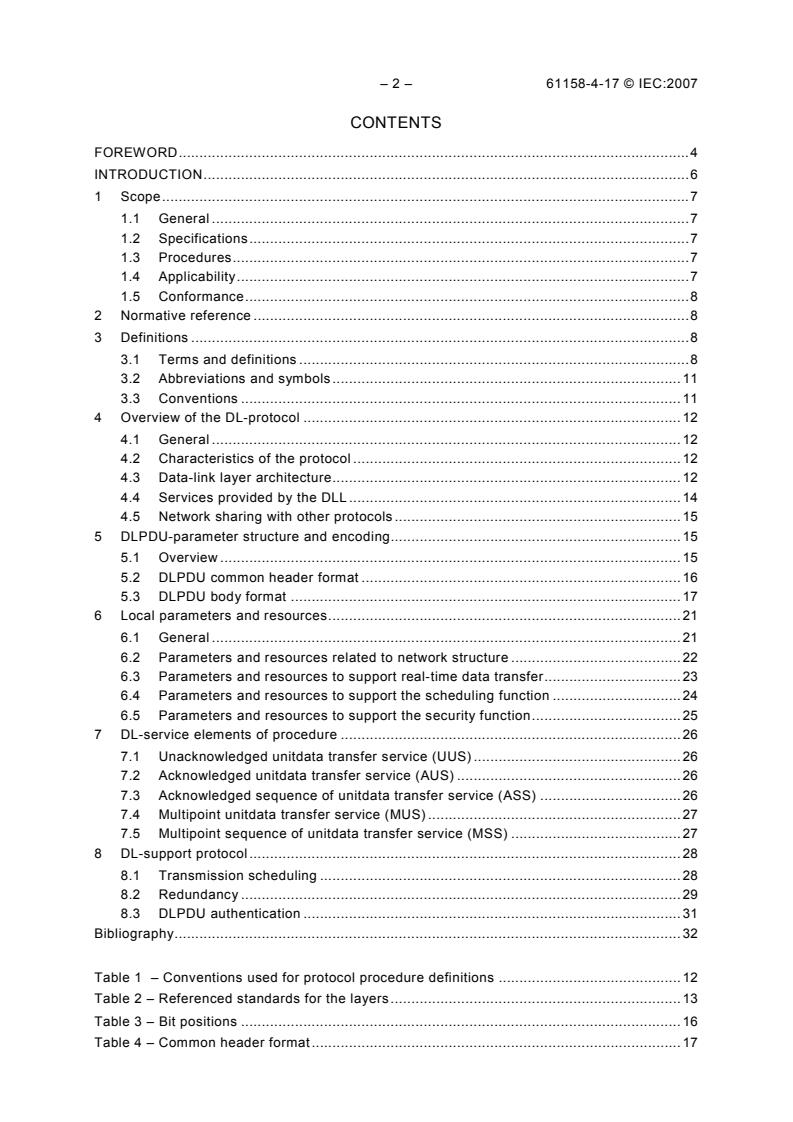
CONTENTS
FOREWORD.4
INTRODUCTION.6
1 Scope.7
1.1 General .7
1.2 Specifications.7
1.3 Procedures.7
1.4 Applicability.7
1.5 Conformance.8
2 Normative reference .8
3 Definitions .8
3.1 Terms and definitions .8
3.2 Abbreviations and symbols.11
3.3 Conventions .11
4 Overview of the DL-protocol .12
4.1 General .12
4.2 Characteristics of the protocol .12
4.3 Data-link layer architecture.12
4.4 Services provided by the DLL.14
4.5 Network sharing with other protocols .15
5 DLPDU-parameter structure and encoding.15
5.1 Overview .15
5.2 DLPDU common header format .16
5.3 DLPDU body format .17
6 Local parameters and resources.21
6.1 General .21
6.2 Parameters and resources related to network structure .22
6.3 Parameters and resources to support real-time data transfer.23
6.4 Parameters and resources to support the scheduling function .24
6.5 Parameters and resources to support the security function.25
7 DL-service elements of procedure .26
7.1 Unacknowledged unitdata transfer service (UUS) .26
7.2 Acknowledged unitdata transfer service (AUS) .26
7.3 Acknowledged sequence of unitdata transfer service (ASS) .26
7.4 Multipoint unitdata transfer service (MUS) .27
7.5 Multipoint sequence of unitdata transfer service (MSS) .27
8 DL-support protocol.28
8.1 Transmission scheduling .28
8.2 Redundancy .29
8.3 DLPDU authentication .31
Bibliography.32
Table 1 – Conventions used for protocol procedure definitions .12
Table 2 – Referenced standards for the layers.13
Table 3 – Bit positions .16
Table 4 – Common header format.17
61158-4-17 © IEC:2007(E) – 3 –
Table 5 – DLPDU types .17
Table 6 – Service subtype and PDU type of DLPDUs.18
Table 7 – UUS_DT_PDU.18
Table 8 – AUS_DT_PDU.19
Table 9 – AUS_RSP_PDU .19
Table 10 – ASS_DT_PDU .20
Table 11 – ASS_ENQ_PDU .20
Table 12 – ASS_RSP_PDU.20
Table 13 – MUS_DT_PDU .21
Table 14 – MSS_DT_PDU .21
Table 15 – Parameters and resources for the network structure.22
Table 16 – Ranges of parameters for the network structure .23
Table 17 – Parameters and resources real-time data transfer .23
Table 18 – Ranges of parameters for real-time data transfer.23
Table 19 – Parameters and resources for scheduling function .24
Table 20 – Ranges of parameters for scheduling .25
Table 21 – Parameters and resources for security function .25
Table 22 – Ranges of parameters for security function.25
Table 23 – UUS procedure.26
Table 24 – AUS procedure.26
Table 25 – ASS procedure .27
Table 26 – MUS procedure .27
Table 27 – MSS procedure .28
– 4 – 61158-4-17 © IEC:2007(E)
INTERNATIONAL ELECTROTECHNICAL COMMISSION
____________
INDUSTRIAL COMMUNICATION NETWORKS –
FIELDBUS SPECIFICATIONS –
Part 4-17: Data-link layer protocol specification – Type 17 elements
FOREWORD
1) The International Electrotechnical Commission (IEC) is a worldwide organization for standardization comprising
all national electrotechnical committees (IEC National Committees). The object of IEC is to promote
international co-operation on all questions concerning standardization in the electrical and electronic fields. To
this end and in addition to other activities, IEC publishes International Standards, Technical Specifications,
Technical Reports, Publicly Available Specifications (PAS) and Guides (hereafter referred to as “IEC
Publication(s)”). Their preparation is entrusted to technical committees; any IEC National Committee interested
in the subject dealt with may participate in this preparatory work. International, governmental and non-
governmental organizations liaising with the IEC also participate in this preparation. IEC collaborates closely
with the International Organization for Standardization (ISO) in accordance with conditions determined by
agreement between the two organizations.
2) The formal decisions or agreements of IEC on technical matters express, as nearly as possible, an international
consensus of opinion on the relevant subjects since each technical committee has representation from all
interested IEC National Committees.
3) IEC Publications have the form of recommendations for international use and are accepted by IEC National
Committees in that sense. While all reasonable efforts are made to ensure that the technical content of IEC
Publications is accurate, IEC cannot be held responsible for the way in which they are used or for any
misinterpretation by any end user.
4) In order to promote international uniformity, IEC National Committees undertake to apply IEC Publications
transparently to the maximum extent possible in their national and regional publications. Any divergence
between any IEC Publication and the corresponding national or regional publication shall be clearly indicated in
the latter.
5) IEC provides no marking procedure to indicate its approval and cannot be rendered responsible for any
equipment declared to be in conformity with an IEC Publication.
6) All users should ensure that they have the latest edition of this publication.
7) No liability shall attach to IEC or its directors, employees, servants or agents including individual experts and
members of its technical committees and IEC National Committees for any personal injury, property damage or
other damage of any nature whatsoever, whether direct or indirect, or for costs (including legal fees) and
expenses arising out of the publication, use of, or reliance upon, this IEC Publication or any other IEC
Publications.
8) Attention is drawn to the Normative references cited in this publication. Use of the referenced publications is
indispensable for the correct application of this publication.
NOTE Use of some of the associated protocol types is restricted by their intellectual-property-right holders. In all
cases, the commitment to limited release of intellectual-property-rights made by the holders of those rights permits
a particular data-link layer protocol type to be used with physical layer and application layer protocols in Type
combinations as specified explicitly in the IEC 61784 series. Use of the various protocol types in other
combinations may require permission from their respective intellectual-property-right holders.
IEC draws attention to the fact that it is claimed that compliance with this standard may involve the use of patents
as follows, where the [xx] notation indicates the holder of the patent right:
Type 17 and possibly other Types:
PCT Application No. PCT/JP2004/011537 [YEC] Communication control method
PCT Application No. PCT/JP2004/011538 [YEC] Communication control method
IEC takes no position concerning the evidence, validity and scope of these patent rights.
The holders of these patent rights have assured IEC that they are willing to negotiate licences under reasonable
and non-discriminatory terms and conditions with applicants throughout the world. In this respect, the statement of
the holders of these patent rights are registered with IEC. Information may be obtained from:
[YEC]: Yokogawa Electric Corporation
2-9-32 Nakacho, Musashino-shi, 180-8750 Tokyo,
180-8750 Tokyo,
Japan
Attention: Intellectual Property & Standardization Center
Attention is drawn to the possibility that some of the elements of this standard may be the subject of patent rights
other than those identified above. IEC shall not be held responsible for identifying any or all such patent rights.
61158-4-17 © IEC:2007(E) – 5 –
International Standard IEC 61158-4-17 has been prepared by subcommittee 65C: Industrial
networks, of IEC technical committee 65: Industrial-process measurement, control and
automation.
This first edition and its companion parts of the IEC 61158-4 subseries cancel and replace
IEC 61158-4:2003. This edition of this part constitutes a technical addition. This part and its
Type 17 companion parts also cancel and replace IEC/PAS 62405, published in 2005.
This edition of IEC 61158-4 includes the following significant changes from the previous
edition:
a) deletion of the former Type 6 fieldbus, and the placeholder for a Type 5 fieldbus data link
layer, for lack of market relevance;
b) addition of new types of fieldbuses;
c) division of this part into multiple parts numbered -4-1, -4-2, …, -4-19.
The text of this standard is based on the following documents:
FDIS Report on voting
65C/474/FDIS 65C/485/RVD
Full information on the voting for the approval of this standard can be found in the report on
voting indicated in the above table.
This publication has been drafted in accordance with ISO/IEC Directives, Part 2.
The committee has decided that the contents of this publication will remain unchanged until
the maintenance result date indicated on the IEC web site under http://webstore.iec.ch in the
data related to the specific publication. At this date, the publication will be:
• reconfirmed;
• withdrawn;
• replaced by a revised edition, or
• amended.
NOTE The revision of this standard will be synchronized with the other parts of the IEC 61158 series.
The list of all the parts of the IEC 61158 series, under the general title Industrial
communication networks – Fieldbus specifications, can be found on the IEC web site.
– 6 – 61158-4-17 © IEC:2007(E)
INTRODUCTION
This part of IEC 61158 is one of a series produced to facilitate the interconnection of
automation system components. It is related to other standards in the set as defined by the
“three-layer” fieldbus reference model described in IEC/TR 61158-1.
The data-link protocol provides the data-link service by making use of the services available
from the physical layer. The primary aim of this standard is to provide a set of rules for
communication expressed in terms of the procedures to be carried out by peer data-link
entities (DLEs) at the time of communication. These rules for communication are intended to
provide a sound basis for development in order to serve a variety of purposes:
a) as a guide for implementors and designers;
b) for use in the testing and procurement of equipment;
c) as part of an agreement for the admittance of systems into the open systems environment;
d) as a refinement to the understanding of time-critical communications within OSI.
This standard is concerned, in particular, with the communication and interworking of sensors,
effectors and other automation devices. By using this standard together with other standards
positioned within the OSI or fieldbus reference models, otherwise incompatible systems may
work together in any combination.
61158-4-17 © IEC:2007(E) – 7 –
INDUSTRIAL COMMUNICATION NETWORKS –
FIELDBUS SPECIFICATIONS –
Part 4-17: Data-link layer protocol specification – Type 17 elements
1 Scope
1.1 General
The data-link layer provides basic time-critical messaging communications between devices in
an automation environment.
This protocol provides communication opportunities to all participating data-link entities
a) in a cyclic asynchronous manner, sequentially to each of those data-link entities, and
b) in a synchronous manner, either cyclically or acyclically, according to a pre-established
schedule.
The specified protocol also provides means of changing the set of participating data-link
entities and of modifying the set of scheduled communications opportunities. When the set of
scheduled communications opportunities is null, the distribution of communication
opportunities to the participating data-link entities is completely asynchronous.
Thus this protocol can be characterized as one which provides access asynchronously but
with a synchronous overlay.
1.2 Specifications
This standard specifies
a) procedures for the timely transfer of data and control information from one data-link user
entity to a peer user entity, and among the data-link entities forming the distributed data-
link service provider;
b) the structure of the fieldbus DLPDUs used for the transfer of data and control information
by the protocol of this standard, and their representation as physical interface data units.
1.3 Procedures
The procedures are defined in terms of
a) the interactions between peer DL-entities (DLEs) through the exchange of fieldbus
DLPDUs;
b) the interactions between a DL-service (DLS) provider and a DLS-user in the same system
through the exchange of DLS primitives;
c) the interactions between a DLS-provider and a Ph-service provider in the same system
through the exchange of Ph-service primitives.
1.4 Applicability
These procedures are applicable to instances of communication between systems which
support time-critical communications services within the data-link layer of the OSI or fieldbus
reference models, and which require the ability to interconnect in an open systems
interconnection environment.
Profiles provide a simple multi-attribute means of summarizing an implementation’s
capabilities, and thus its applicability to various time-critical communications needs.
– 8 – 61158-4-17 © IEC:2007(E)
1.5 Conformance
This standard also specifies conformance requirements for systems implementing these
procedures. This standard does not contain tests to demonstrate compliance with such
requirements.
2 Normative reference
The following referenced documents are indispensable for the application of this document.
For dated references, only the edition cited applies. For all other undated references, the
latest edition of the referenced document (including any amendments) applies.
IEC 61158-3-17, Industrial communication networks – Fieldbus specifications – Part 3-17:
Data-link layer service definition – Type 17 elements
ISO/IEC 7498 (all parts), Information technology – Open Systems Interconnection – Basic
Reference Model
ISO/IEC 8802-3, Information technology – Telecommunications and information exchange
between systems – Local and metropolitan area networks - Specific requirements – Part 3:
Carrier sense multiple access with collision detection (CSMA/CD) access method and
physical layer specifications
ISO/IEC 10731, Information technology – Open Systems Interconnection – Basic Reference
Model – Conventions for the definition of OSI services
IEEE Std 802.3ab, Information technology – Telecommunications and information exchange
between systems - Local and metropolitan area networks – Specific requirements –
Supplement to Carrier Sense Multiple Access with Collision Detection (CSMA/CD) access
method and physical layer specifications – Physical layer parameters and specifications for
1000 Mb/s operation over 4-pair of category 5 balanced copper cabling, type 1000BASE-T
Internet Engineering Task Force (IETF), Request for Comments (RFC):
RFC 768 User Datagram Protocol
(available at )
RFC 791 Internet Protocol
(available at )
RFC 792 Internet Control Message Protocol
(available at )
RFC 826 Ethernet Address Resolution Protocol
(available at )
RFC 894 A standard for the Transmission of IP Datagrams over Ethernet Networks
(available at )
RFC 1112 Host Extensions for IP Multicasting
(available at )
RFC 2236 Internet Group Management Protocol Version 2
(available at )
3 Definitions
For the purposes of this document, the following terms and definitions apply.
3.1 Terms and definitions
3.1.1 ISO/IEC 10731 terms
a) (N)-connection
b) (N)-entity
c) (N)-layer
61158-4-17 © IEC:2007(E) – 9 –
d) (N)-service
e) (N)-service-access-point
f) confirm (primitive)
g) deliver (primitive)
h) indication (primitive)
i) request (primitive)
j) response (primitive)
3.1.2 Other terms and definitions
3.1.2.1
bridge
intermediate equipment that connects two or more segments using a Data Link layer relay
function
3.1.2.2
domain
part of the RTE network consisting of one or two subnetwork(s)
NOTE Two subnetworks are required to compose a dual-redundant RTE network, and each end node in the
domain is connected to both of the subnetworks.
3.1.2.3
domain master
station which performs diagnosis of routes to all other domains, distribution of network time to
nodes inside the domain, acquisition of absolute time from the network time master and
notification of status of the domain
3.1.2.4
domain number
numeric identifier which indicates a domain
3.1.2.5
external bridge
bridge to which neither internal bridges nor RTE stations are connected directly
3.1.2.6
interface port
physical connection point of an end node, which has an independent DL-address
3.1.2.7
internal bridge
bridge to which no routers, external bridges or nodes non-compliant with this specification are
connected directly
3.1.2.8
junction bridge
bridge to which at least one router, external bridge or node non-compliant with this
specification, and to which at least one internal bridge or RTE station is connected
3.1.2.9
link
physical communication channel between two nodes
3.1.2.10
network time master
station which distributes network time to domain masters
– 10 – 61158-4-17 © IEC:2007(E)
3.1.2.11
non-redundant interface node
node whch has a single interface port
3.1.2.12
non-redundant station
station that consists of a single end node
NOTE “non-redundant station” is synonymous with “end node”.
3.1.2.13
path
logical communication channel between two nodes, which consists of one or two link(s)
3.1.2.14
redundant interface node
node with two interface ports one of which is connected to a primary network, while the other
is connected to a secondary network
3.1.2.15
redundant station
station that consists of a pair of end nodes
NOTE Each end node of a redundant station has the same station number, but has a different DL-address.
3.1.2.16
route
logical communication channel between two communication end nodes
3.1.2.17
router
intermediate equipment that connects two or more subnetworks using a network layer relay
function
3.1.2.18
RTE station
station with real-time capability
3.1.2.19
segment
communication channel that connects two nodes directly without intervening bridges
3.1.2.20
station
end node or a pair of end nodes that perform a specific application function
3.1.2.21
station number
numeric identifier which indicates a RTE station
3.1.2.22
subnetwork
part of a network that does not contain any routers. A subnetwork consists of end nodes,
bridges and segments
NOTE Every end node included in a subnetwork has the same IP network address.
61158-4-17 © IEC:2007(E) – 11 –
3.2 Abbreviations and symbols
3.2.1 ISO/IEC 10731 abbreviations
OSI Open Systems Interconnection
3.2.2 Other abbreviations and symbols
ASS acknowledged sequence of unitdata transfer service
AUS acknowledged unitdata transfer service
DL- Data-link layer (as a prefix)
DLE DL-entity (the local active instance of the data-link layer)
DLL DL-layer
DLM DL-management
DLMS DL-management Service
DLPDU DL-protocol-data-unit
DLS DL-service
DLSAP DL-service-access-point
DLSDU DL-service-data-unit
FIFO first-in first-out (queuing method)
ID identifier
IEC International Electrotechnical Commission
ind indication primitive
IP Internet protocol
ISO International Organization for Standardization
LLC logical link control
lsb least significant bit
MAC medium access control
msb most significant bit
MSS multipoint sequence of unitdata transfer service
MUS multipoint unitdata transfer service
PDU protocol data unit
Ph- physical layer (as a prefix)
PhL Ph-layer
QoS quality of service
req request primitive
rsp response primitive
SAP service access point
SDU service data unit
ToS type of dervice
UUS unacknowledged unitdata transfer service
3.3 Conventions
3.3.1 General conventions
This standard uses the descriptive conventions given in ISO/IEC 10731.
– 12 – 61158-4-17 © IEC:2007(E)
3.3.2 Conventions for DLE protocol procedure definitions
The conventions used for DLE state machine definitions are described in Table 1.
Table 1 – Conventions used for protocol procedure definitions
Event Condition Procedure
Events that trigger these actions Conditions Actions that are taken when the events and conditions are met
4 Overview of the DL-protocol
4.1 General
The Data Link Layer provides basic real-time and reliable communications between devices in
automation environments.
This part of the document specifies
a) procedures of the Data Link (DL) protocols for real-time data transfer and control
information from one Data Link Service user entity to a peer user entity, and among the
Data Link entities forming the distributed Data Link Service provider;
b) the structure of the Data Link Protocol Data Units (DLPDUs) used for data transfer and
control information, and their mapping to the underlying layers.
The procedures are defined in terms of
a) the interactions between peer DL-entities (DLEs) through the exchange of fieldbus Data
Link Protocol Data Units;
b) the interactions between a DL-service (DLS) provider and a DLS-user in the same system
through the exchange of DLS primitives;
c) the interactions between a DLS-provider and a Physical Service provider in the same
system through the exchange of Ph-service primitives.
4.2 Characteristics of the protocol
The requirements of continuous process control, e.g. in the Oil and Gas, Petrochemical and
Chemical, Pharmaceutical and Power industries, result in the following characteristic features
of the Data Link protocol.
The maximum system size for this protocol is 254 subnetworks of 254 nodes, where each
node has 254 DLSAP-addresses. All Data Link entities can communicate with all others in a
cyclic or acyclic manner with prioritized access, or in a combination of the two.
This protocol provides real-time communication by means of transmission scheduling. The
minimum cycle-time of scheduling is 10 ms. In addition, it provides a means to maintain clock
synchronization across a subnetwork with a precision better than 1 ms, and across an
extended network with a precision better than 5 ms.
This protocol provides reliable and flexible communications by remotely confirmed acyclic data
transfer with retransmission. In addition, it provides a dual-redundant network with a switchover
time of less than 100 ms, and also provides the facilities for dual-redundant devices.
4.3 Data-link layer architecture
4.3.1 General
The DLL is modeled as
61158-4-17 © IEC:2007(E) – 13 –
a) a real-time data transfer function;
b) a datagram transfer function;
c) a network routing function;
d) a media access function;
e) a logical link and management function.
With the exception of the real-time data transfer function, each function is implemented
according to the following existing protocols specified in Table 2.
Table 2 – Referenced standards for the layers
Function Compliance
Datagram transfer function RFC 768 (UDP)
Network routing function RFC 791 (IP)
Media access function ISO/IEC 8802-3, IEEE Std 802.3ab
4.3.2 Real-time data transfer function
The real-time data transfer function is specified in this specification, and it provides the
Connectionless-mode Data Link Service specified in IEC 61158-3-17.
4.3.3 Datagram transfer function
The datagram transfer function is compliant with RFC 768 (UDP definition) and provides
datagram transfer service for the real-time data transfer function.
4.3.4 Network routing function
The network routing function is compliant with RFC 791 (IP definition) and provides datagram
routing service for the datagram transfer function.
This function also performs fragmentation of a datagram to maintain independence from MTU
of the underlying sublayer. The function utilizes two logical link functions to realize a dual-
redundant network.
In a dual-redundant station, two network routing entities are implemented for both end nodes.
4.3.5 Logical link and media access function
The logical link and media access function is compliant with ISO/IEC 8802-3. It provides
fragments transfer service within a subnetwork and a means of accessing the network for the
network routing function.
Two entities that execute media access function are implemented in a node to realize a dual-
redundant network.
4.3.6 Management function
The management function is specified in this specification, and it provides the DL-
management Service and DLSAP management Data Link Service. These services are
specified in IEC 61158-3-17.
– 14 – 61158-4-17 © IEC:2007(E)
4.4 Services provided by the DLL
4.4.1 General
The services provided by the DLL are specified in IEC 61158-3-17.
There are three types of Data Link Service:
a) a Connectionless-mode Data Link Service;
b) a DLSAP management Data Link Service;
c) a DL-management Service.
4.4.2 Quality of Service (QoS) attributes
QoS attributes specified by the DLS-user select some aspects of the various Data Link
Services, and can be specified only when a DLSAP-address is bound to the DLS-user’s
DLSAP.
4.4.2.1 Service subtype
This attribute determines a service subtype of data transfer service of DLSAP specified by
DL-BIND request.
Each service subtype has different data delivery features and different data transfer
relationships i.e., the point-to-point or multipoint model. Some QoS attributes are limited by
the type of service subtype.
There are five service subtypes.
a) Unacknowledged Unitdata transfer Service (UUS).
b) Acknowledged Unitdata transfer Service (AUS).
c) Acknowledged Sequence of unitdata transfer Service (ASS).
d) Multipoint Unitdata transfer Service (MUS).
e) Multipoint Sequence of unitdata transfer Service (MSS).
4.4.2.2 DLL maximum confirm delay
This attribute determines the upper bound on the time delay permitted until the DL-UNITDATA
service is confirmed, i.e., the maximum permissible delay between the issuing of a DL-
UNITDATA request primitive and receiving of the corresponding DL-UNITDATA confirm primitive.
The parameter specifies an interval from 1 ms to 60 s inclusive in units of 1 ms.
4.4.2.3 DLL priority
This attribute specifies an associated DLL priority used in scheduling DLL data transfer
services. The DL-protocol should support four DLL priority levels. The four DLL priorities, from
highest to lowest priority, are as follows.
a) URGENT
b) HIGH
c) NORMAL
d) TIME-AVAILABLE
The priority attribute assigned for each DLSDU is recognized by both of the sending DLE and
receiving DLE, and it may be translated to the underlying service QoS parameter which is
used by lower entities to control the priority of PDU transfer.
61158-4-17 © IEC:2007(E) – 15 –
In the sending DLE, DLSDU with higher priority requested by a DL-UNITDATA request primitive
is transmitted in advance of any other DLSDUs with lower priority.
In the receiving DLE, the received DLPUD with higher priority is delivered to the DLS-user in
advance of any other DLPDUs with lower priority.
4.4.2.4 Maximum DLSDU size
The DLS-user data requested by DL-UNITDATA request are conveyed in a single DLPDU. The
Maximum DLSDU size attribute specifies an upper bound on the size (in octets) of DLSDUs
that will be offered for transmission, and an upper bound on the size of DLSDUs that are
acceptable for reception.
The parameter shall be chosen from 256 × N, where 1 ≤ N ≤ 16.
NOTE The maximum size of DLSDU supported for DLSAP, which is assigned as Acknowledged Unitdata transfer
Service (AUS) for service subtype, is limited to 2 048.
4.4.2.5 Authentication level
This attribute specifies the level of authentication for data transfer. The following four
alternative levels are available:
a) “no authentication”;
b) “use 64-bit key code”;
c) “use 128-bit key code”;
d) “use 256-bit key code”.
4.4.2.6 Maximum residual error rate
This parameter specifies upper bound on acceptable residual error rate of the underlying layer
service.
The DLL monitors the bit error rate of the underlying layer service continuously. Under
conditions where the residual error rate, calculated from the bit error rate and the error
detection performance, is higher than the maximum residual error rate, the requested DL-
UNITDATA request is completed with error.
This feature supports the DLS-user switching the sending interface to prevent unexpected
loss of data integrity caused by the underlying service.
4.5 Network sharing with other protocols
Other TCP-based protocols, such as HTTP and FTP, can work on the same network alongside
communication of the DLE. In this case, total traffic of communication based on other
protocols shall be limited by some means such as switching hubs. The methods for limitation
are outside the scope of this standard.
5 DLPDU-parameter structure and encoding
5.1 Overview
The specification of the transfer syntax combines the specification of the abstract syntax and
their encodings as a set of fixed-format DLPDUs. Each DLPDU contains a DLPDU common
header and a DLPDU body.
The DLPDU body consists of an individual header, which is specified by the service subtype,
and the DLSDU.
– 16 – 61158-4-17 © IEC:2007(E)
5.1.1 Data type encodings
The following data types, which are specified in Part 3 of this document, are used in DLPDU
definitions.
a) Unsigned8
b) Unsigned16
c) Unsigned32
d) OctetString.
The bit positions in an octet value are defined in Table 3.
Table 3 – Bit positions
Bit position Hex value Decimal value
8 0x80 128
7 0x40 64
6 0x20 32
5 0x10 16
4 0x08 8
3 0x04 4
2 0x02 2
1 0x01 1
5.1.2 Structure and definition of DL-addresses
Although the DLS conforms formally to the “three-layer” Fieldbus Reference Model, it actually
utilizes the Network Layer Service of the OSI Basic Reference Model and IP address
specified by RFC 791.
The IP unicast and multicast addresses shall be used as the DL-address.
5.2 DLPDU common header format
Table 4 defines the common header format.
61158-4-17 © IEC:2007(E) – 17 –
Table 4 – Common header format
Parameter Octet Octet
Data type Description
name offset length
DLPUD Version 0 Unsigned8 1 Specifies the Version number of the DLPDU format.
The version number of the DLPDUs specified in this
edition is 1
1 = Version 1
PDU type 1 Unsigned8 1 Indicates DLPDU attribute
Bit 8: 1= Multicast
Bit 7: 1= For external of the domain
Bit 6: 1= Response
Bit 5: 1= Remote confirmation is requested
Bits 4-3: Indicates destination SAP-ID
0= DLS-user (SAP)
1= DL Management
2= Reserved
3= Reserved
Bits 2-1: Indicates destination extension
0= Don’t care
1= On-service end node
2= Standby end node
3= Both
Service Subtype 2 Unsigned8 1 Indicates the subtype of service
Bits 8-5:
1= UUS
2= AUS
3= ASS
4= MUS
5= MSS
All other values are reserved
Bits 4-1: reserved
Option 3 Unsigned8 1 Indicates the options
Bits 8-5: indicates security option
0= No security control
1= 2 octet authentication data, simplified control
2= 2 octet authentication data, full control
3= 4 octet authentication data, simplified control
4= 4 octet authentication data, full control
All other values are reserved
Bits 4-1: indicate safety option
0= No safety control
All other values are reserved
Total Length 4 Unsigned32 4 Indicates octet length of the DLPDU
Authentication 8 Unsigned n Authentication data created according to the security
Data type
The length is specified by the security option
Integrity Data 8+n Unsigned m Authentication data created according to the security
type
The length is specified by the safety option
5.3 DLPDU body format
There are 8 kinds of DLPDU. Table 5 is the list of DLPDUs.
Table 5 – DLPDU types
DLPDU name Description
UUS_DT_PDU This PDU conveys DLSDU of UUS service
AUS_DT_PDU This PDU conveys DLSDU of AUS service
AUS_RSP_PDU This PDU is used to respond to the AUS_DATA_PDU
ASS_DT_PDU This PDU conveys DLSDU of AAS service
ASS_ENQ_PDU This PDU is used to enquire whether ASS_DTPDUs are received
ASS_RSP_PDU This PDU is used to respond to the ASS_ENQ_PDU
MUS_DT_PDU This PDU conveys DLSDU of MUS service
MSS_DT_PDU This PDU conveys DLSDU of MSS service
– 18 – 61158-4-17 © IEC:2007(E)
Table 6 defines assignment of the Service Subtype and PDU type field of the common header
for each DLPDU.
Table 6 – Service subtype and PDU type of DLPDUs
PDU type
DLPDU type Service subtype
Multicast External Response Confirm SAP-ID Extension
UUS_DATA 1 0 0/1 0 0 DEPND DEPND
AUS_DATA 2 0 0 0 1 DEPND DEPND
AUS_RSP 2 0 0 1 0 DEPND DEPND
ASS_DATA 3 0 0/1 0 0 DEPND DEPND
ASS_ENQ 3 0 0/1 0 1 DEPND DEPND
ASS_RSP 3 0 0/1 1 0 DEPND DEPND
MUS_DATA 4 1 0/1 0 0 DEPND DEPND
MSS_DATA 5 1 1/1 0 0 DEPND DEPND
5.3.1 Common parameter of DLPDU body
The common parameters are defined as follows.
Service subtype
This parameter is the same as Service Subtype in the common header.
PDU subtype
This parameter specifies the subtype that represents the role of the DLPDU.
Status
This parameter indicates the status of the transaction.
Sequence number
This parameter identifies the DT_PDU, and is also used to inform the latest received DT_PDU
in the RSP_PDUs.
DLSAP ID
This parameter indicates the DLSAP identifier.
DLSDU length
This parameter indicates the octet length of the DLSDU.
DLSDU
This parameter is the user data requested by the Unitdata request.
5.3.2 DLPDU format for UUS
Table 7 indicates the body format of DLPDU for UUS.
Table 7 – UUS_DT_PDU
Octet Octet
Parameter name Data type Description
offset length
Service subtype 0 Unsigned8 1 Same as service subtype in common header
Bits 8-5: 1 (UUS)
Bits 4-1: reserved
PDU Subtype 1 Unsigned8 1 Indicates the subtype of DLPDU
Bits 8-5: 1 = DATA
Bits 4-1: reserved
Status 2 Unsigned8 1 Not Used, set to 0
Sequence number 3 Unsigned8 1 Identifies PDU in the sequence of PDUs
DLSAP ID 4 Unsigned16 2 Indicates DLSAP identifier
DLSDU Length 6 Unsigned16 2 Indicates octet length of the DLSDU
DLSDU 8 OctetString - DLSDU requested by DLS-user
The length of DLSDU is specified by the
DLSDU length
61158-4-17 © IEC:2007(E) – 19 –
5.3.3 DLPDU format for AUS
Table 8 and Table 9 indicate body formats of DLPDU for AUS.
Table 8 – AUS_DT_PDU
Octet Octet
Parameter name Data type Description
offset length
Service subtype 0 Unsigned8 1 Same as service subtype in common header
Bits 8-5: 2 (AUS)
Bits 4-1: reserved
Subtype 1 Unsigned8 1 Indicates the subtype of DLPDU
Bits 8-5: 1 = DATA
Bits 4-1: reserved
Status 2 Unsigned8 1 Indicates status of the transaction
Bits 8-5: reserved
Bits 4-1: Retry count
Sequence number 3 Unsigned8 1 Identifies PDU in the sequence of PDUs
Indicates DLSAP identifier
DLSAP ID 4 Unsigned16 2
DLSDU Length 6 Unsigned16 2 Indicates octet length of the DLSDU
DLSDU 8 OctetString - DLSDU requested by DLS-user
The length of DLSDU is specified by the
DLSDU length
Table 9 – AUS_RSP_PDU
Octet Octet
Parameter name Data type Description
offset length
Service subtype 0 Unsigned8 1 Same as service subtype in common header
Bits 8-5: 2 (AUS)
Bits 4-1: reserved
Subtype 1 Unsigned8 1 Indicates the subtype of DLPDU
Bits 8-5: 8 = RESPONE
Bits 4-1: reserved
Stat
...
IEC 61158-4-17 ®
Edition 1.0 2007-12
INTERNATIONAL
STANDARD
NORME
INTERNATIONALE
Industrial communication networks – Fieldbus specifications –
Part 4-17: Data-link layer protocol specification – Type 17 elements
Réseaux de communication industriels – Spécifications des bus de terrain –
Partie 4-17: Spécification de protocole de la couche de liaison de données –
Eléments de Type 17
All rights reserved. Unless otherwise specified, no part of this publication may be reproduced or utilized in any form
or by any means, electronic or mechanical, including photocopying and microfilm, without permission in writing from
either IEC or IEC's member National Committee in the country of the requester.
If you have any questions about IEC copyright or have an enquiry about obtaining additional rights to this publication,
please contact the address below or your local IEC member National Committee for further information.
Droits de reproduction réservés. Sauf indication contraire, aucune partie de cette publication ne peut être reproduite ni
utilisée sous quelque forme que ce soit et par aucun procédé, électronique ou mécanique, y compris la photocopie et les
microfilms, sans l'accord écrit de la CEI ou du Comité national de la CEI du pays du demandeur.
Si vous avez des questions sur le copyright de la CEI ou si vous désirez obtenir des droits supplémentaires sur cette
publication, utilisez les coordonnées ci-après ou contactez le Comité national de la CEI de votre pays de résidence.
IEC Central Office Tel.: +41 22 919 02 11
3, rue de Varembé Fax: +41 22 919 03 00
CH-1211 Geneva 20 info@iec.ch
Switzerland www.iec.ch
About the IEC
The International Electrotechnical Commission (IEC) is the leading global organization that prepares and publishes
International Standards for all electrical, electronic and related technologies.
About IEC publications
The technical content of IEC publications is kept under constant review by the IEC. Please make sure that you have the
latest edition, a corrigenda or an amendment might have been published.
Useful links:
IEC publications search - www.iec.ch/searchpub Electropedia - www.electropedia.org
The advanced search enables you to find IEC publications The world's leading online dictionary of electronic and
by a variety of criteria (reference number, text, technical electrical terms containing more than 30 000 terms and
committee,…). definitions in English and French, with equivalent terms in
It also gives information on projects, replaced and additional languages. Also known as the International
withdrawn publications. Electrotechnical Vocabulary (IEV) on-line.
IEC Just Published - webstore.iec.ch/justpublished Customer Service Centre - webstore.iec.ch/csc
Stay up to date on all new IEC publications. Just Published If you wish to give us your feedback on this publication
details all new publications released. Available on-line and or need further assistance, please contact the
also once a month by email. Customer Service Centre: csc@iec.ch.
A propos de la CEI
La Commission Electrotechnique Internationale (CEI) est la première organisation mondiale qui élabore et publie des
Normes internationales pour tout ce qui a trait à l'électricité, à l'électronique et aux technologies apparentées.
A propos des publications CEI
Le contenu technique des publications de la CEI est constamment revu. Veuillez vous assurer que vous possédez
l’édition la plus récente, un corrigendum ou amendement peut avoir été publié.
Liens utiles:
Recherche de publications CEI - www.iec.ch/searchpub Electropedia - www.electropedia.org
La recherche avancée vous permet de trouver des Le premier dictionnaire en ligne au monde de termes
publications CEI en utilisant différents critères (numéro de électroniques et électriques. Il contient plus de 30 000
référence, texte, comité d’études,…). termes et définitions en anglais et en français, ainsi que
Elle donne aussi des informations sur les projets et les les termes équivalents dans les langues additionnelles.
publications remplacées ou retirées. Egalement appelé Vocabulaire Electrotechnique
International (VEI) en ligne.
Just Published CEI - webstore.iec.ch/justpublished
Service Clients - webstore.iec.ch/csc
Restez informé sur les nouvelles publications de la CEI.
Just Published détaille les nouvelles publications parues. Si vous désirez nous donner des commentaires sur
Disponible en ligne et aussi une fois par mois par email. cette publication ou si vous avez des questions
contactez-nous: csc@iec.ch.
IEC 61158-4-17 ®
Edition 1.0 2007-12
INTERNATIONAL
STANDARD
NORME
INTERNATIONALE
Industrial communication networks – Fieldbus specifications –
Part 4-17: Data-link layer protocol specification – Type 17 elements
Réseaux de communication industriels – Spécifications des bus de terrain –
Partie 4-17: Spécification de protocole de la couche de liaison de données –
Eléments de Type 17
INTERNATIONAL
ELECTROTECHNICAL
COMMISSION
COMMISSION
ELECTROTECHNIQUE
PRICE CODE
INTERNATIONALE
CODE PRIX V
ICS 25.040.40; 35.100.20 ISBN 978-2-8322-1021-5
– 2 – 61158-4-17 © IEC:2007
CONTENTS
FOREWORD . 4
INTRODUCTION . 6
1 Scope . 7
1.1 General . 7
1.2 Specifications . 7
1.3 Procedures . 7
1.4 Applicability . 7
1.5 Conformance . 8
2 Normative reference . 8
3 Definitions . 8
3.1 Terms and definitions . 8
3.2 Abbreviations and symbols . 11
3.3 Conventions . 11
4 Overview of the DL-protocol . 12
4.1 General . 12
4.2 Characteristics of the protocol . 12
4.3 Data-link layer architecture . 12
4.4 Services provided by the DLL . 14
4.5 Network sharing with other protocols . 15
5 DLPDU-parameter structure and encoding . 15
5.1 Overview . 15
5.2 DLPDU common header format . 16
5.3 DLPDU body format . 17
6 Local parameters and resources . 21
6.1 General . 21
6.2 Parameters and resources related to network structure . 22
6.3 Parameters and resources to support real-time data transfer . 23
6.4 Parameters and resources to support the scheduling function . 24
6.5 Parameters and resources to support the security function . 25
7 DL-service elements of procedure . 26
7.1 Unacknowledged unitdata transfer service (UUS) . 26
7.2 Acknowledged unitdata transfer service (AUS) . 26
7.3 Acknowledged sequence of unitdata transfer service (ASS) . 26
7.4 Multipoint unitdata transfer service (MUS) . 27
7.5 Multipoint sequence of unitdata transfer service (MSS) . 27
8 DL-support protocol . 28
8.1 Transmission scheduling . 28
8.2 Redundancy . 29
8.3 DLPDU authentication . 31
Bibliography . 32
Table 1 – Conventions used for protocol procedure definitions . 12
Table 2 – Referenced standards for the layers . 13
Table 3 – Bit positions . 16
Table 4 – Common header format . 17
61158-4-17 © IEC:2007 – 3 –
Table 5 – DLPDU types . 17
Table 6 – Service subtype and PDU type of DLPDUs . 18
Table 7 – UUS_DT_PDU . 18
Table 8 – AUS_DT_PDU . 19
Table 9 – AUS_RSP_PDU . 19
Table 10 – ASS_DT_PDU . 20
Table 11 – ASS_ENQ_PDU . 20
Table 12 – ASS_RSP_PDU . 20
Table 13 – MUS_DT_PDU . 21
Table 14 – MSS_DT_PDU . 21
Table 15 – Parameters and resources for the network structure . 22
Table 16 – Ranges of parameters for the network structure . 23
Table 17 – Parameters and resources real-time data transfer . 23
Table 18 – Ranges of parameters for real-time data transfer . 23
Table 19 – Parameters and resources for scheduling function . 24
Table 20 – Ranges of parameters for scheduling . 25
Table 21 – Parameters and resources for security function . 25
Table 22 – Ranges of parameters for security function . 25
Table 23 – UUS procedure . 26
Table 24 – AUS procedure . 26
Table 25 – ASS procedure . 27
Table 26 – MUS procedure . 27
Table 27 – MSS procedure . 28
– 4 – 61158-4-17 © IEC:2007
INTERNATIONAL ELECTROTECHNICAL COMMISSION
____________
INDUSTRIAL COMMUNICATION NETWORKS –
FIELDBUS SPECIFICATIONS –
Part 4-17: Data-link layer protocol specification – Type 17 elements
FOREWORD
1) The International Electrotechnical Commission (IEC) is a worldwide organization for standardization comprising
all national electrotechnical committees (IEC National Committees). The object of IEC is to promote
international co-operation on all questions concerning standardization in the electrical and electronic fields. To
this end and in addition to other activities, IEC publishes International Standards, Technical Specifications,
Technical Reports, Publicly Available Specifications (PAS) and Guides (hereafter referred to as “IEC
Publication(s)”). Their preparation is entrusted to technical committees; any IEC National Committee interested
in the subject dealt with may participate in this preparatory work. International, governmental and non-
governmental organizations liaising with the IEC also participate in this preparation. IEC collaborates closely
with the International Organization for Standardization (ISO) in accordance with conditions determined by
agreement between the two organizations.
2) The formal decisions or agreements of IEC on technical matters express, as nearly as possible, an international
consensus of opinion on the relevant subjects since each technical committee has representation from all
interested IEC National Committees.
3) IEC Publications have the form of recommendations for international use and are accepted by IEC National
Committees in that sense. While all reasonable efforts are made to ensure that the technical content of IEC
Publications is accurate, IEC cannot be held responsible for the way in which they are used or for any
misinterpretation by any end user.
4) In order to promote international uniformity, IEC National Committees undertake to apply IEC Publications
transparently to the maximum extent possible in their national and regional publications. Any divergence
between any IEC Publication and the corresponding national or regional publication shall be clearly indicated in
the latter.
5) IEC provides no marking procedure to indicate its approval and cannot be rendered responsible for any
equipment declared to be in conformity with an IEC Publication.
6) All users should ensure that they have the latest edition of this publication.
7) No liability shall attach to IEC or its directors, employees, servants or agents including individual experts and
members of its technical committees and IEC National Committees for any personal injury, property damage or
other damage of any nature whatsoever, whether direct or indirect, or for costs (including legal fees) and
expenses arising out of the publication, use of, or reliance upon, this IEC Publication or any other IEC
Publications.
8) Attention is drawn to the Normative references cited in this publication. Use of the referenced publications is
indispensable for the correct application of this publication.
NOTE Use of some of the associated protocol types is restricted by their intellectual-property-right holders. In all
cases, the commitment to limited release of intellectual-property-rights made by the holders of those rights permits
a particular data-link layer protocol type to be used with physical layer and application layer protocols in Type
combinations as specified explicitly in the IEC 61784 series. Use of the various protocol types in other
combinations may require permission from their respective intellectual-property-right holders.
IEC draws attention to the fact that it is claimed that compliance with this standard may involve the use of patents
as follows, where the [xx] notation indicates the holder of the patent right:
Type 17 and possibly other Types:
PCT Application No. PCT/JP2004/011537 [YEC] Communication control method
PCT Application No. PCT/JP2004/011538 [YEC] Communication control method
IEC takes no position concerning the evidence, validity and scope of these patent rights.
The holders of these patent rights have assured IEC that they are willing to negotiate licences under reasonable
and non-discriminatory terms and conditions with applicants throughout the world. In this respect, the statement of
the holders of these patent rights are registered with IEC. Information may be obtained from:
[YEC]: Yokogawa Electric Corporation
2-9-32 Nakacho, Musashino-shi, 180-8750 Tokyo,
180-8750 Tokyo,
Japan
Attention: Intellectual Property & Standardization Center
Attention is drawn to the possibility that some of the elements of this standard may be the subject of patent rights
other than those identified above. IEC shall not be held responsible for identifying any or all such patent rights.
61158-4-17 © IEC:2007 – 5 –
International Standard IEC 61158-4-17 has been prepared by subcommittee 65C: Industrial
networks, of IEC technical committee 65: Industrial-process measurement, control and
automation.
This first edition and its companion parts of the IEC 61158-4 subseries cancel and replace
IEC 61158-4:2003. This edition of this part constitutes a technical addition. This part and its
Type 17 companion parts also cancel and replace IEC/PAS 62405, published in 2005.
This edition of IEC 61158-4 includes the following significant changes from the previous
edition:
a) deletion of the former Type 6 fieldbus, and the placeholder for a Type 5 fieldbus data link
layer, for lack of market relevance;
b) addition of new types of fieldbuses;
c) division of this part into multiple parts numbered -4-1, -4-2, …, -4-19.
This bilingual version (2013-09) corresponds to the monolingual English version, published in
2007-12.
The text of this standard is based on the following documents:
FDIS Report on voting
65C/474/FDIS 65C/485/RVD
Full information on the voting for the approval of this standard can be found in the report on
voting indicated in the above table.
The French version of this standard has not been voted upon.
This publication has been drafted in accordance with ISO/IEC Directives, Part 2.
The committee has decided that the contents of this publication will remain unchanged until
the maintenance result date indicated on the IEC web site under http://webstore.iec.ch in the
data related to the specific publication. At this date, the publication will be:
• reconfirmed;
• withdrawn;
• replaced by a revised edition, or
• amended.
NOTE The revision of this standard will be synchronized with the other parts of the IEC 61158 series.
The list of all the parts of the IEC 61158 series, under the general title Industrial
communication networks – Fieldbus specifications, can be found on the IEC web site.
– 6 – 61158-4-17 © IEC:2007
INTRODUCTION
This part of IEC 61158 is one of a series produced to facilitate the interconnection of
automation system components. It is related to other standards in the set as defined by the
“three-layer” fieldbus reference model described in IEC/TR 61158-1.
The data-link protocol provides the data-link service by making use of the services available
from the physical layer. The primary aim of this standard is to provide a set of rules for
communication expressed in terms of the procedures to be carried out by peer data-link
entities (DLEs) at the time of communication. These rules for communication are intended to
provide a sound basis for development in order to serve a variety of purposes:
a) as a guide for implementors and designers;
b) for use in the testing and procurement of equipment;
c) as part of an agreement for the admittance of systems into the open systems environment;
d) as a refinement to the understanding of time-critical communications within OSI.
This standard is concerned, in particular, with the communication and interworking of sensors,
effectors and other automation devices. By using this standard together with other standards
positioned within the OSI or fieldbus reference models, otherwise incompatible systems may
work together in any combination.
61158-4-17 © IEC:2007 – 7 –
INDUSTRIAL COMMUNICATION NETWORKS –
FIELDBUS SPECIFICATIONS –
Part 4-17: Data-link layer protocol specification – Type 17 elements
1 Scope
1.1 General
The data-link layer provides basic time-critical messaging communications between devices in
an automation environment.
This protocol provides communication opportunities to all participating data-link entities
a) in a cyclic asynchronous manner, sequentially to each of those data-link entities, and
b) in a synchronous manner, either cyclically or acyclically, according to a pre-established
schedule.
The specified protocol also provides means of changing the set of participating data-link
entities and of modifying the set of scheduled communications opportunities. When the set of
scheduled communications opportunities is null, the distribution of communication
opportunities to the participating data-link entities is completely asynchronous.
Thus this protocol can be characterized as one which provides access asynchronously but
with a synchronous overlay.
1.2 Specifications
This standard specifies
a) procedures for the timely transfer of data and control information from one data-link user
entity to a peer user entity, and among the data-link entities forming the distributed data-
link service provider;
b) the structure of the fieldbus DLPDUs used for the transfer of data and control information
by the protocol of this standard, and their representation as physical interface data units.
1.3 Procedures
The procedures are defined in terms of
a) the interactions between peer DL-entities (DLEs) through the exchange of fieldbus
DLPDUs;
b) the interactions between a DL-service (DLS) provider and a DLS-user in the same system
through the exchange of DLS primitives;
c) the interactions between a DLS-provider and a Ph-service provider in the same system
through the exchange of Ph-service primitives.
1.4 Applicability
These procedures are applicable to instances of communication between systems which
support time-critical communications services within the data-link layer of the OSI or fieldbus
reference models, and which require the ability to interconnect in an open systems
interconnection environment.
Profiles provide a simple multi-attribute means of summarizing an implementation’s
capabilities, and thus its applicability to various time-critical communications needs.
– 8 – 61158-4-17 © IEC:2007
1.5 Conformance
This standard also specifies conformance requirements for systems implementing these
procedures. This standard does not contain tests to demonstrate compliance with such
requirements.
2 Normative reference
The following referenced documents are indispensable for the application of this document.
For dated references, only the edition cited applies. For all other undated references, the
latest edition of the referenced document (including any amendments) applies.
IEC 61158-3-17, Industrial communication networks – Fieldbus specifications – Part 3-17:
Data-link layer service definition – Type 17 elements
ISO/IEC 7498 (all parts), Information technology – Open Systems Interconnection – Basic
Reference Model
ISO/IEC 8802-3, Information technology – Telecommunications and information exchange
between systems – Local and metropolitan area networks - Specific requirements – Part 3:
Carrier sense multiple access with collision detection (CSMA/CD) access method and
physical layer specifications
ISO/IEC 10731, Information technology – Open Systems Interconnection – Basic Reference
Model – Conventions for the definition of OSI services
IEEE Std 802.3ab, Information technology – Telecommunications and information exchange
between systems - Local and metropolitan area networks – Specific requirements –
Supplement to Carrier Sense Multiple Access with Collision Detection (CSMA/CD) access
method and physical layer specifications – Physical layer parameters and specifications for
1000 Mb/s operation over 4-pair of category 5 balanced copper cabling, type 1000BASE-T
Internet Engineering Task Force (IETF), Request for Comments (RFC):
RFC 768 User Datagram Protocol
(available at )
RFC 791 Internet Protocol
(available at )
RFC 792 Internet Control Message Protocol
(available at )
RFC 826 Ethernet Address Resolution Protocol
(available at )
RFC 894 A standard for the Transmission of IP Datagrams over Ethernet Networks
(available at )
RFC 1112 Host Extensions for IP Multicasting
(available at )
RFC 2236 Internet Group Management Protocol Version 2
(available at )
3 Definitions
For the purposes of this document, the following terms and definitions apply.
3.1 Terms and definitions
3.1.1 ISO/IEC 10731 terms
a) (N)-connection
b) (N)-entity
c) (N)-layer
61158-4-17 © IEC:2007 – 9 –
d) (N)-service
e) (N)-service-access-point
f) confirm (primitive)
g) deliver (primitive)
h) indication (primitive)
i) request (primitive)
j) response (primitive)
3.1.2 Other terms and definitions
3.1.2.1
bridge
intermediate equipment that connects two or more segments using a Data Link layer relay
function
3.1.2.2
domain
part of the RTE network consisting of one or two subnetwork(s)
NOTE Two subnetworks are required to compose a dual-redundant RTE network, and each end node in the
domain is connected to both of the subnetworks.
3.1.2.3
domain master
station which performs diagnosis of routes to all other domains, distribution of network time to
nodes inside the domain, acquisition of absolute time from the network time master and
notification of status of the domain
3.1.2.4
domain number
numeric identifier which indicates a domain
3.1.2.5
external bridge
bridge to which neither internal bridges nor RTE stations are connected directly
3.1.2.6
interface port
physical connection point of an end node, which has an independent DL-address
3.1.2.7
internal bridge
bridge to which no routers, external bridges or nodes non-compliant with this specification are
connected directly
3.1.2.8
junction bridge
bridge to which at least one router, external bridge or node non-compliant with this
specification, and to which at least one internal bridge or RTE station is connected
3.1.2.9
link
physical communication channel between two nodes
3.1.2.10
network time master
station which distributes network time to domain masters
– 10 – 61158-4-17 © IEC:2007
3.1.2.11
non-redundant interface node
node whch has a single interface port
3.1.2.12
non-redundant station
station that consists of a single end node
NOTE “non-redundant station” is synonymous with “end node”.
3.1.2.13
path
logical communication channel between two nodes, which consists of one or two link(s)
3.1.2.14
redundant interface node
node with two interface ports one of which is connected to a primary network, while the other
is connected to a secondary network
3.1.2.15
redundant station
station that consists of a pair of end nodes
NOTE Each end node of a redundant station has the same station number, but has a different DL-address.
3.1.2.16
route
logical communication channel between two communication end nodes
3.1.2.17
router
intermediate equipment that connects two or more subnetworks using a network layer relay
function
3.1.2.18
RTE station
station with real-time capability
3.1.2.19
segment
communication channel that connects two nodes directly without intervening bridges
3.1.2.20
station
end node or a pair of end nodes that perform a specific application function
3.1.2.21
station number
numeric identifier which indicates a RTE station
3.1.2.22
subnetwork
part of a network that does not contain any routers. A subnetwork consists of end nodes,
bridges and segments
NOTE Every end node included in a subnetwork has the same IP network address.
61158-4-17 © IEC:2007 – 11 –
3.2 Abbreviations and symbols
3.2.1 ISO/IEC 10731 abbreviations
OSI Open Systems Interconnection
3.2.2 Other abbreviations and symbols
ASS acknowledged sequence of unitdata transfer service
AUS acknowledged unitdata transfer service
DL- Data-link layer (as a prefix)
DLE DL-entity (the local active instance of the data-link layer)
DLL DL-layer
DLM DL-management
DLMS DL-management Service
DLPDU DL-protocol-data-unit
DLS DL-service
DLSAP DL-service-access-point
DLSDU DL-service-data-unit
FIFO first-in first-out (queuing method)
ID identifier
IEC International Electrotechnical Commission
ind indication primitive
IP Internet protocol
ISO International Organization for Standardization
LLC logical link control
lsb least significant bit
MAC medium access control
msb most significant bit
MSS multipoint sequence of unitdata transfer service
MUS multipoint unitdata transfer service
PDU protocol data unit
Ph- physical layer (as a prefix)
PhL Ph-layer
QoS quality of service
req request primitive
rsp response primitive
SAP service access point
SDU service data unit
ToS type of dervice
UUS unacknowledged unitdata transfer service
3.3 Conventions
3.3.1 General conventions
This standard uses the descriptive conventions given in ISO/IEC 10731.
– 12 – 61158-4-17 © IEC:2007
3.3.2 Conventions for DLE protocol procedure definitions
The conventions used for DLE state machine definitions are described in Table 1.
Table 1 – Conventions used for protocol procedure definitions
Event Condition Procedure
Events that trigger these actions Conditions Actions that are taken when the events and conditions are met
4 Overview of the DL-protocol
4.1 General
The Data Link Layer provides basic real-time and reliable communications between devices in
automation environments.
This part of the document specifies
a) procedures of the Data Link (DL) protocols for real-time data transfer and control
information from one Data Link Service user entity to a peer user entity, and among the
Data Link entities forming the distributed Data Link Service provider;
b) the structure of the Data Link Protocol Data Units (DLPDUs) used for data transfer and
control information, and their mapping to the underlying layers.
The procedures are defined in terms of
a) the interactions between peer DL-entities (DLEs) through the exchange of fieldbus Data
Link Protocol Data Units;
b) the interactions between a DL-service (DLS) provider and a DLS-user in the same system
through the exchange of DLS primitives;
c) the interactions between a DLS-provider and a Physical Service provider in the same
system through the exchange of Ph-service primitives.
4.2 Characteristics of the protocol
The requirements of continuous process control, e.g. in the Oil and Gas, Petrochemical and
Chemical, Pharmaceutical and Power industries, result in the following characteristic features
of the Data Link protocol.
The maximum system size for this protocol is 254 subnetworks of 254 nodes, where each
node has 254 DLSAP-addresses. All Data Link entities can communicate with all others in a
cyclic or acyclic manner with prioritized access, or in a combination of the two.
This protocol provides real-time communication by means of transmission scheduling. The
minimum cycle-time of scheduling is 10 ms. In addition, it provides a means to maintain clock
synchronization across a subnetwork with a precision better than 1 ms, and across an
extended network with a precision better than 5 ms.
This protocol provides reliable and flexible communications by remotely confirmed acyclic data
transfer with retransmission. In addition, it provides a dual-redundant network with a switchover
time of less than 100 ms, and also provides the facilities for dual-redundant devices.
4.3 Data-link layer architecture
4.3.1 General
The DLL is modeled as
61158-4-17 © IEC:2007 – 13 –
a) a real-time data transfer function;
b) a datagram transfer function;
c) a network routing function;
d) a media access function;
e) a logical link and management function.
With the exception of the real-time data transfer function, each function is implemented
according to the following existing protocols specified in Table 2.
Table 2 – Referenced standards for the layers
Function Compliance
Datagram transfer function RFC 768 (UDP)
Network routing function RFC 791 (IP)
Media access function ISO/IEC 8802-3, IEEE Std 802.3ab
4.3.2 Real-time data transfer function
The real-time data transfer function is specified in this specification, and it provides the
Connectionless-mode Data Link Service specified in IEC 61158-3-17.
4.3.3 Datagram transfer function
The datagram transfer function is compliant with RFC 768 (UDP definition) and provides
datagram transfer service for the real-time data transfer function.
4.3.4 Network routing function
The network routing function is compliant with RFC 791 (IP definition) and provides datagram
routing service for the datagram transfer function.
This function also performs fragmentation of a datagram to maintain independence from MTU
of the underlying sublayer. The function utilizes two logical link functions to realize a dual-
redundant network.
In a dual-redundant station, two network routing entities are implemented for both end nodes.
4.3.5 Logical link and media access function
The logical link and media access function is compliant with ISO/IEC 8802-3. It provides
fragments transfer service within a subnetwork and a means of accessing the network for the
network routing function.
Two entities that execute media access function are implemented in a node to realize a dual-
redundant network.
4.3.6 Management function
The management function is specified in this specification, and it provides the DL-
management Service and DLSAP management Data Link Service. These services are
specified in IEC 61158-3-17.
– 14 – 61158-4-17 © IEC:2007
4.4 Services provided by the DLL
4.4.1 General
The services provided by the DLL are specified in IEC 61158-3-17.
There are three types of Data Link Service:
a) a Connectionless-mode Data Link Service;
b) a DLSAP management Data Link Service;
c) a DL-management Service.
4.4.2 Quality of Service (QoS) attributes
QoS attributes specified by the DLS-user select some aspects of the various Data Link
Services, and can be specified only when a DLSAP-address is bound to the DLS-user’s
DLSAP.
4.4.2.1 Service subtype
This attribute determines a service subtype of data transfer service of DLSAP specified by
IND request.
DL-B
Each service subtype has different data delivery features and different data transfer
relationships i.e., the point-to-point or multipoint model. Some QoS attributes are limited by
the type of service subtype.
There are five service subtypes.
a) Unacknowledged Unitdata transfer Service (UUS).
b) Acknowledged Unitdata transfer Service (AUS).
c) Acknowledged Sequence of unitdata transfer Service (ASS).
d) Multipoint Unitdata transfer Service (MUS).
e) Multipoint Sequence of unitdata transfer Service (MSS).
4.4.2.2 DLL maximum confirm delay
This attribute determines the upper bound on the time delay permitted until the DL-UNITDATA
service is confirmed, i.e., the maximum permissible delay between the issuing of a DL-
UNITDATA request primitive and receiving of the corresponding DL-UNITDATA confirm primitive.
The parameter specifies an interval from 1 ms to 60 s inclusive in units of 1 ms.
4.4.2.3 DLL priority
This attribute specifies an associated DLL priority used in scheduling DLL data transfer
services. The DL-protocol should support four DLL priority levels. The four DLL priorities, from
highest to lowest priority, are as follows.
a) URGENT
b) HIGH
c) NORMAL
d) TIME-AVAILABLE
The priority attribute assigned for each DLSDU is recognized by both of the sending DLE and
receiving DLE, and it may be translated to the underlying service QoS parameter which is
used by lower entities to control the priority of PDU transfer.
61158-4-17 © IEC:2007 – 15 –
In the sending DLE, DLSDU with higher priority requested by a DL-UNITDATA request primitive
is transmitted in advance of any other DLSDUs with lower priority.
In the receiving DLE, the received DLPUD with higher priority is delivered to the DLS-user in
advance of any other DLPDUs with lower priority.
4.4.2.4 Maximum DLSDU size
The DLS-user data requested by DL-UNITDATA request are conveyed in a single DLPDU. The
Maximum DLSDU size attribute specifies an upper bound on the size (in octets) of DLSDUs
that will be offered for transmission, and an upper bound on the size of DLSDUs that are
acceptable for reception.
The parameter shall be chosen from 256 × N, where 1 ≤ N ≤ 16.
NOTE The maximum size of DLSDU supported for DLSAP, which is assigned as Acknowledged Unitdata transfer
Service (AUS) for service subtype, is limited to 2 048.
4.4.2.5 Authentication level
This attribute specifies the level of authentication for data transfer. The following four
alternative levels are available:
a) “no authentication”;
b) “use 64-bit key code”;
c) “use 128-bit key code”;
d) “use 256-bit key code”.
4.4.2.6 Maximum residual error rate
This parameter specifies upper bound on acceptable residual error rate of the underlying layer
service.
The DLL monitors the bit error rate of the underlying layer service continuously. Under
conditions where the residual error rate, calculated from the bit error rate and the error
detection performance, is higher than the maximum residual error rate, the requested DL-
UNITDATA request is completed with error.
This feature supports the DLS-user switching the sending interface to prevent unexpected
loss of data integrity caused by the underlying service.
4.5 Network sharing with other protocols
Other TCP-based protocols, such as HTTP and FTP, can work on the same network alongside
communication of the DLE. In this case, total traffic of communication based on other
protocols shall be limited by some means such as switching hubs. The methods for limitation
are outside the scope of this standard.
5 DLPDU-parameter structure and encoding
5.1 Overview
The specification of the transfer syntax combines the specification of the abstract syntax and
their encodings as a set of fixed-format DLPDUs. Each DLPDU contains a DLPDU common
header and a DLPDU body.
The DLPDU body consists of an individual header, which is specified by the service subtype,
and the DLSDU.
– 16 – 61158-4-17 © IEC:2007
5.1.1 Data type encodings
The following data types, which are specified in Part 3 of this document, are used in DLPDU
definitions.
a) Unsigned8
b) Unsigned16
c) Unsigned32
d) OctetString.
The bit positions in an octet value are defined in Table 3.
Table 3 – Bit positions
Bit position Hex value Decimal value
8 0x80 128
7 0x40 64
6 0x20 32
5 0x10 16
4 0x08 8
3 0x04 4
2 0x02 2
1 0x01 1
5.1.2 Structure and definition of DL-addresses
Although the DLS conforms formally to the “three-layer” Fieldbus Reference Model, it actually
utilizes the Network Layer Service of the OSI Basic Reference Model and IP address
specified by RFC 791.
The IP unicast and multicast addresses shall be used as the DL-address.
5.2 DLPDU common header format
Table 4 defines the common header format.
61158-4-17 © IEC:2007 – 17 –
Table 4 – Common header format
Parameter Octet Octet
Data type Description
name offset length
DLPUD Version 0 Unsigned8 1 Specifies the Version number of the DLPDU format.
The version number of the DLPDUs specified in this
edition is 1
1 = Version 1
PDU type 1 Unsigned8 1 Indicates DLPDU attribute
Bit 8: 1= Multicast
Bit 7: 1= For external of the domain
Bit 6: 1= Response
Bit 5: 1= Remote confirmation is requested
Bits 4-3: Indicates destination SAP-ID
0= DLS-user (SAP)
1= DL Management
2= Reserved
3= Reserved
Bits 2-1: Indicates destination extension
0= Don’t care
1= On-service end node
2= Standby end node
3= Both
Service Subtype 2 Unsigned8 1 Indicates the subtype of service
Bits 8-5:
1= UUS
2= AUS
3= ASS
4= MUS
5= MSS
All other values are reserved
Bits 4-1: reserved
Option 3 Unsigned8 1 Indicates the options
Bits 8-5: indicates security option
0= No security control
1= 2 octet authentication data, simplified control
2= 2 octet authentication data, full control
3= 4 octet authentication data, simplified control
4= 4 octet authentication data, full control
All other values are reserved
Bits 4-1: indicate safety option
0= No safety control
All other values are reserved
Total Length 4 Unsigned32 4 Indicates octet length of the DLPDU
Authentication 8 Unsigned n Authentication data created according to the security
Data type
The length is specified by the security option
Integrity Data 8+n Unsigned m Authentication data created according to the security
type
The length is specified by the safety option
5.3 DLPDU body format
There are 8 kinds of DLPDU. Table 5 is the list of DLPDUs.
Table 5 – DLPDU types
DLPDU name Description
UUS_DT_PDU This PDU conveys DLSDU of UUS service
AUS_DT_PDU This PDU conveys DLSDU of AUS service
AUS_RSP_PDU This PDU is used to respond to the AUS_DATA_PDU
ASS_DT_PDU This PDU conveys DLSDU of AAS service
ASS_ENQ_PDU This PDU is used to enquire whether ASS_DTPDUs are received
ASS_RSP_PDU This PDU is used to respond to the ASS_ENQ_PDU
MUS_DT_PDU This PDU conveys DLSDU of MUS service
MSS_DT_
...
Questions, Comments and Discussion
Ask us and Technical Secretary will try to provide an answer. You can facilitate discussion about the standard in here.
Loading comments...