

IEC 62083:2009
(Main)Medical electrical equipment - Requirements for the safety of radiotherapy treatment planning systems
General Information
- Abstract
IEC 62083:2009 applies to the design, manufacture and some installation aspects of a radiotherapy treatment planning systems:
- for use in radiotherapy treatment planning in human medical practice;
- that imports data either through input by the operator or directly from other devices;
- that outputs data either in printed form for review or directly to other devices;
and which is intended to be:
a) for normal use, under the authority of appropriately licensed or qualified persons, by operators having the required skills and training;
b) maintained in accordance with the recommendations given in the instructions for use, and
c) used within the environmental and electrical supply conditions specified in the technical description.
This second edition replaces the first edition of IEC 62083, published in 2000. This edition constitutes a technical revision, which brings this standard in line with changes to the other standards referred to in this standard.
- Status
- Published
- Publication Date
- 22-Sep-2009
- Drafting Committee
- WG 1 - TC 62/SC 62C/WG 1
Overview
IEC 62083:2009 is an international standard developed by the International Electrotechnical Commission (IEC) that specifies the safety requirements for radiotherapy treatment planning systems (RTPS). These systems are programmable medical electrical devices used in radiotherapy treatment planning for human medical practice. The standard focuses on the design, manufacture, and aspects of installation to ensure safe use by qualified operators following the manufacturer’s instructions.
RTPS typically import data from operators or other medical devices and output treatment plans in printed or electronic form. The standard applies to systems operated under the authority of appropriately licensed professionals, maintained according to instructions, and used within specified environmental and electrical supply conditions.
This edition, the second since the original publication in 2000, aligns the requirements with updates in related standards to enhance patient safety and treatment efficacy.
Key Topics
Scope and Applicability
IEC 62083 outlines requirements for RTPS used in planning radiotherapy treatments, including data handling, user authorization, and operational environment considerations.Operational Safety Requirements
It mandates protection against unauthorized use and modification, correctness in data transfer, and accuracy in input/output data handling to minimize risks of treatment errors.Modelling Components
- Equipment and brachytherapy source modelling
- Patient anatomy modelling, including data acquisition and contouring of regions of interest
These ensure accurate simulation of radiation dose distributions.
Treatment Planning Accuracy
The standard requires validated algorithms for absorbed dose distribution calculations and sets accuracy criteria to ensure reliable treatment plans.Documentation and Accompanying Information
IEC 62083 emphasizes comprehensive instructions and documentation to assist operators in safely using RTPS and understanding system limitations.Software and Hardware Safety
It addresses software design against human errors, version control, and hardware diagnostics to maintain system integrity over time.
Applications
IEC 62083:2009 is essential for manufacturers and developers of radiotherapy treatment planning systems, ensuring their products meet global safety standards. Healthcare providers utilize RTPS compliant with this standard to develop accurate and safe radiation treatment plans, minimizing patient risks due to software or hardware failures.
Manufacturers use this standard to guide product development and compliance testing, integrating safety features critical for medical environments.
Medical Physicists and Clinicians rely on RTPS designed per IEC 62083 to produce reliable treatment parameters with validated absorbed dose calculations.
Regulatory Bodies reference this standard when assessing the safety and compliance of radiotherapy planning equipment during approvals and audits.
Related Standards
IEC 62083 complements and interacts with several other international standards, including:
IEC 60601-1 - General safety and essential performance standards for medical electrical equipment, providing baseline hardware safety requirements.
IEC 62304 - Medical device software lifecycle processes, relevant to the software design and maintenance requirements mentioned in IEC 62083.
IEC 60801 (if applicable) - Standards for electromagnetic compatibility (EMC) that affect safe operation of RTPS in medical environments.
These interconnected standards collectively ensure the comprehensive safety, reliability, and interoperability of medical electrical devices used in radiotherapy practices.
Keywords: IEC 62083, radiotherapy treatment planning system, RTPS safety, medical electrical equipment, absorbed dose calculation, radiotherapy treatment plans, equipment modeling, safety standards for medical devices, radiotherapy software safety, IEC standards radiotherapy
Relations
- Effective Date
- 08-Dec-2023
- Effective Date
- 05-Sep-2023
Get Certified
Connect with accredited certification bodies for this standard

BSI Group
BSI (British Standards Institution) is the business standards company that helps organizations make excellence a habit.

TÜV Rheinland
TÜV Rheinland is a leading international provider of technical services.

TÜV SÜD
TÜV SÜD is a trusted partner of choice for safety, security and sustainability solutions.
Sponsored listings
Frequently Asked Questions
IEC 62083:2009 is a standard published by the International Electrotechnical Commission (IEC). Its full title is "Medical electrical equipment - Requirements for the safety of radiotherapy treatment planning systems". This standard covers: IEC 62083:2009 applies to the design, manufacture and some installation aspects of a radiotherapy treatment planning systems: - for use in radiotherapy treatment planning in human medical practice; - that imports data either through input by the operator or directly from other devices; - that outputs data either in printed form for review or directly to other devices; and which is intended to be: a) for normal use, under the authority of appropriately licensed or qualified persons, by operators having the required skills and training; b) maintained in accordance with the recommendations given in the instructions for use, and c) used within the environmental and electrical supply conditions specified in the technical description. This second edition replaces the first edition of IEC 62083, published in 2000. This edition constitutes a technical revision, which brings this standard in line with changes to the other standards referred to in this standard.
IEC 62083:2009 applies to the design, manufacture and some installation aspects of a radiotherapy treatment planning systems: - for use in radiotherapy treatment planning in human medical practice; - that imports data either through input by the operator or directly from other devices; - that outputs data either in printed form for review or directly to other devices; and which is intended to be: a) for normal use, under the authority of appropriately licensed or qualified persons, by operators having the required skills and training; b) maintained in accordance with the recommendations given in the instructions for use, and c) used within the environmental and electrical supply conditions specified in the technical description. This second edition replaces the first edition of IEC 62083, published in 2000. This edition constitutes a technical revision, which brings this standard in line with changes to the other standards referred to in this standard.
IEC 62083:2009 is classified under the following ICS (International Classification for Standards) categories: 11.040.60 - Therapy equipment. The ICS classification helps identify the subject area and facilitates finding related standards.
IEC 62083:2009 has the following relationships with other standards: It is inter standard links to IEC 62083:2025, IEC 62083:2000. Understanding these relationships helps ensure you are using the most current and applicable version of the standard.
IEC 62083:2009 is available in PDF format for immediate download after purchase. The document can be added to your cart and obtained through the secure checkout process. Digital delivery ensures instant access to the complete standard document.
Standards Content (Sample)
IEC 62083 ®
Edition 2.0 2009-09
INTERNATIONAL
STANDARD
NORME
INTERNATIONALE
Medical electrical equipment – Requirements for the safety of radiotherapy
treatment planning systems
Appareils électromédicaux – Exigences de sécurité pour les systèmes de
planification de traitement en radiothérapie
All rights reserved. Unless otherwise specified, no part of this publication may be reproduced or utilized in any form or by
any means, electronic or mechanical, including photocopying and microfilm, without permission in writing from either IEC or
IEC's member National Committee in the country of the requester.
If you have any questions about IEC copyright or have an enquiry about obtaining additional rights to this publication,
please contact the address below or your local IEC member National Committee for further information.
Droits de reproduction réservés. Sauf indication contraire, aucune partie de cette publication ne peut être reproduite
ni utilisée sous quelque forme que ce soit et par aucun procédé, électronique ou mécanique, y compris la photocopie
et les microfilms, sans l'accord écrit de la CEI ou du Comité national de la CEI du pays du demandeur.
Si vous avez des questions sur le copyright de la CEI ou si vous désirez obtenir des droits supplémentaires sur cette
publication, utilisez les coordonnées ci-après ou contactez le Comité national de la CEI de votre pays de résidence.
IEC Central Office
3, rue de Varembé
CH-1211 Geneva 20
Switzerland
Email: inmail@iec.ch
Web: www.iec.ch
About the IEC
The International Electrotechnical Commission (IEC) is the leading global organization that prepares and publishes
International Standards for all electrical, electronic and related technologies.
About IEC publications
The technical content of IEC publications is kept under constant review by the IEC. Please make sure that you have the
latest edition, a corrigenda or an amendment might have been published.
ƒ Catalogue of IEC publications: www.iec.ch/searchpub
The IEC on-line Catalogue enables you to search by a variety of criteria (reference number, text, technical committee,…).
It also gives information on projects, withdrawn and replaced publications.
ƒ IEC Just Published: www.iec.ch/online_news/justpub
Stay up to date on all new IEC publications. Just Published details twice a month all new publications released. Available
on-line and also by email.
ƒ Electropedia: www.electropedia.org
The world's leading online dictionary of electronic and electrical terms containing more than 20 000 terms and definitions
in English and French, with equivalent terms in additional languages. Also known as the International Electrotechnical
Vocabulary online.
ƒ Customer Service Centre: www.iec.ch/webstore/custserv
If you wish to give us your feedback on this publication or need further assistance, please visit the Customer Service
Centre FAQ or contact us:
Email: csc@iec.ch
Tel.: +41 22 919 02 11
Fax: +41 22 919 03 00
A propos de la CEI
La Commission Electrotechnique Internationale (CEI) est la première organisation mondiale qui élabore et publie des
normes internationales pour tout ce qui a trait à l'électricité, à l'électronique et aux technologies apparentées.
A propos des publications CEI
Le contenu technique des publications de la CEI est constamment revu. Veuillez vous assurer que vous possédez
l’édition la plus récente, un corrigendum ou amendement peut avoir été publié.
ƒ Catalogue des publications de la CEI: www.iec.ch/searchpub/cur_fut-f.htm
Le Catalogue en-ligne de la CEI vous permet d’effectuer des recherches en utilisant différents critères (numéro de référence,
texte, comité d’études,…). Il donne aussi des informations sur les projets et les publications retirées ou remplacées.
ƒ Just Published CEI: www.iec.ch/online_news/justpub
Restez informé sur les nouvelles publications de la CEI. Just Published détaille deux fois par mois les nouvelles
publications parues. Disponible en-ligne et aussi par email.
ƒ Electropedia: www.electropedia.org
Le premier dictionnaire en ligne au monde de termes électroniques et électriques. Il contient plus de 20 000 termes et
définitions en anglais et en français, ainsi que les termes équivalents dans les langues additionnelles. Egalement appelé
Vocabulaire Electrotechnique International en ligne.
ƒ Service Clients: www.iec.ch/webstore/custserv/custserv_entry-f.htm
Si vous désirez nous donner des commentaires sur cette publication ou si vous avez des questions, visitez le FAQ du
Service clients ou contactez-nous:
Email: csc@iec.ch
Tél.: +41 22 919 02 11
Fax: +41 22 919 03 00
IEC 62083 ®
Edition 2.0 2009-09
INTERNATIONAL
STANDARD
NORME
INTERNATIONALE
Medical electrical equipment – Requirements for the safety of radiotherapy
treatment planning systems
Appareils électromédicaux – Exigences de sécurité pour les systèmes de
planification de traitement en radiothérapie
INTERNATIONAL
ELECTROTECHNICAL
COMMISSION
COMMISSION
ELECTROTECHNIQUE
PRICE CODE
INTERNATIONALE
U
CODE PRIX
ICS 11.040.60 ISBN 978-2-88910-617-2
– 2 – 62083 © IEC:2009
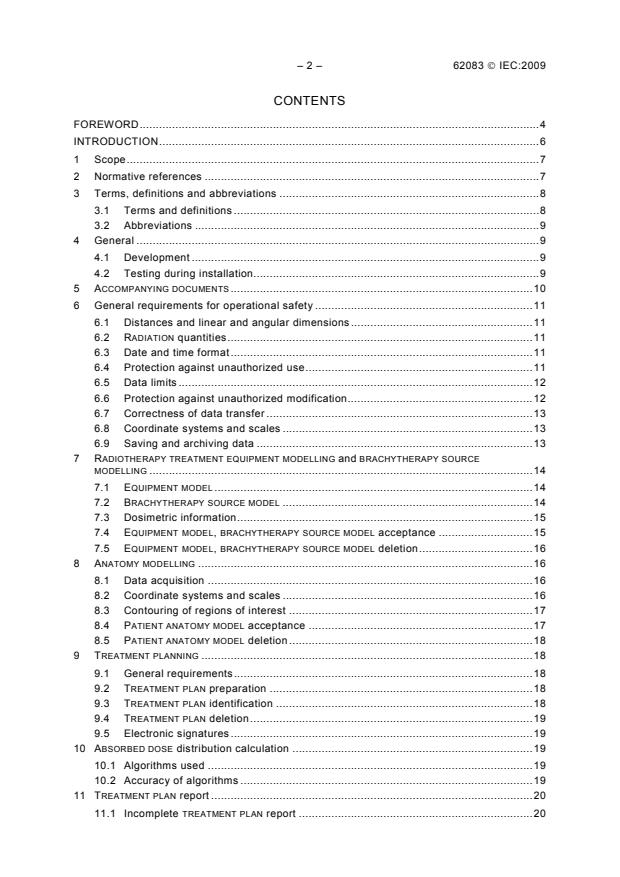
CONTENTS
FOREWORD.4
INTRODUCTION.6
1 Scope.7
2 Normative references .7
3 Terms, definitions and abbreviations .8
3.1 Terms and definitions .8
3.2 Abbreviations .9
4 General .9
4.1 Development .9
4.2 Testing during installation.9
5 ACCOMPANYING DOCUMENTS.10
6 General requirements for operational safety .11
6.1 Distances and linear and angular dimensions .11
6.2 RADIATION quantities.11
6.3 Date and time format.11
6.4 Protection against unauthorized use.11
6.5 Data limits .12
6.6 Protection against unauthorized modification.12
6.7 Correctness of data transfer .13
6.8 Coordinate systems and scales .13
6.9 Saving and archiving data .13
7 RADIOTHERAPY TREATMENT EQUIPMENT MODELLING and BRACHYTHERAPY SOURCE
MODELLING .14
7.1 EQUIPMENT MODEL .14
7.2 BRACHYTHERAPY SOURCE MODEL .14
7.3 Dosimetric information.15
7.4 EQUIPMENT MODEL, BRACHYTHERAPY SOURCE MODEL acceptance .15
7.5 EQUIPMENT MODEL, BRACHYTHERAPY SOURCE MODEL deletion.16
8 ANATOMY MODELLING .16
8.1 Data acquisition .16
8.2 Coordinate systems and scales .16
8.3 Contouring of regions of interest .17
8.4 PATIENT ANATOMY MODEL acceptance .17
8.5 PATIENT ANATOMY MODEL deletion.18
9 TREATMENT PLANNING .18
9.1 General requirements.18
9.2 TREATMENT PLAN preparation .18
9.3 TREATMENT PLAN identification .18
9.4 TREATMENT PLAN deletion.19
9.5 Electronic signatures .19
10 ABSORBED DOSE distribution calculation .19
10.1 Algorithms used .19
10.2 Accuracy of algorithms .19
11 TREATMENT PLAN report .20
11.1 Incomplete TREATMENT PLAN report .20
62083 © IEC:2009 – 3 –
11.2 Information on the TREATMENT PLAN report .20
11.3 Transmitted TREATMENT PLAN information.21
12 General hardware diagnostics .21
13 Data and code .22
14 Human errors in software design .22
15 Change in software versions.22
16 USE ERRORS.23
Annex A (normative) Hardware safety.24
Annex B (informative) Imported and exported data.26
Bibliography.27
Index of defined terms .28
Table 1 – Clauses and subclauses in this standard that require the provision of
information in the ACCOMPANYING DOCUMENTS and the technical description .10
Table A.1 – Table indicating correlation .24
– 4 – 62083 © IEC:2009
INTERNATIONAL ELECTROTECHNICAL COMMISSION
____________
MEDICAL ELECTRICAL EQUIPMENT –
REQUIREMENTS FOR THE SAFETY OF RADIOTHERAPY
TREATMENT PLANNING SYSTEMS
FOREWORD
1) The International Electrotechnical Commission (IEC) is a worldwide organization for standardization comprising
all national electrotechnical committees (IEC National Committees). The object of IEC is to promote
international co-operation on all questions concerning standardization in the electrical and electronic fields. To
this end and in addition to other activities, IEC publishes International Standards, Technical Specifications,
Technical Reports, Publicly Available Specifications (PAS) and Guides (hereafter referred to as “IEC
Publication(s)”). Their preparation is entrusted to technical committees; any IEC National Committee interested
in the subject dealt with may participate in this preparatory work. International, governmental and non-
governmental organizations liaising with the IEC also participate in this preparation. IEC collaborates closely
with the International Organization for Standardization (ISO) in accordance with conditions determined by
agreement between the two organizations.
2) The formal decisions or agreements of IEC on technical matters express, as nearly as possible, an international
consensus of opinion on the relevant subjects since each technical committee has representation from all
interested IEC National Committees.
3) IEC Publications have the form of recommendations for international use and are accepted by IEC National
Committees in that sense. While all reasonable efforts are made to ensure that the technical content of IEC
Publications is accurate, IEC cannot be held responsible for the way in which they are used or for any
misinterpretation by any end user.
4) In order to promote international uniformity, IEC National Committees undertake to apply IEC Publications
transparently to the maximum extent possible in their national and regional publications. Any divergence
between any IEC Publication and the corresponding national or regional publication shall be clearly indicated in
the latter.
5) IEC provides no marking procedure to indicate its approval and cannot be rendered responsible for any
equipment declared to be in conformity with an IEC Publication.
6) All users should ensure that they have the latest edition of this publication.
7) No liability shall attach to IEC or its directors, employees, servants or agents including individual experts and
members of its technical committees and IEC National Committees for any personal injury, property damage or
other damage of any nature whatsoever, whether direct or indirect, or for costs (including legal fees) and
expenses arising out of the publication, use of, or reliance upon, this IEC Publication or any other IEC
Publications.
8) Attention is drawn to the Normative references cited in this publication. Use of the referenced publications is
indispensable for the correct application of this publication.
9) Attention is drawn to the possibility that some of the elements of this IEC Publication may be the subject of
patent rights. IEC shall not be held responsible for identifying any or all such patent rights.
International Standard IEC 62083 has been prepared by IEC subcommittee 62C: Equipment
for radiotherapy, nuclear medicine and radiation dosimetry, of IEC technical committee 62:
Electrical equipment in medical practice.
This second edition replaces the first edition of IEC 62083, published in 2000. This edition
constitutes a technical revision, which brings this standard in line with changes to the other
standards referred to in this standard.
The text of this standard is based on the following documents:
FDIS Report on voting
62C/473/FDIS 62C/479/RVD
Full information on the voting for the approval of this standard can be found in the report on
voting indicated in the above table.
This publication has been drafted in accordance with the ISO/IEC Directives, Part 2.
62083 © IEC:2009 – 5 –
In this standard, the following print types are used:
– requirements, compliance with which can be tested, and definitions: in roman type;
– explanations, advice, general statements, exceptions and notes: in small roman type;
– test specifications: in italic type;
– TERMS USED THROUGHOUT THIS STANDARD THAT HAVE BEEN LISTED IN THE INDEX OF DEFINED
TERMS AND DEFINED IN CLAUSE 3, OR IN OTHER STANDARDS: SMALL CAPITALS.
The committee has decided that the contents of this publication will remain unchanged until
the maintenance result date indicated on the IEC web site under "http://webstore.iec.ch" in
the data related to the specific publication. At this date, the publication will be
• reconfirmed;
• withdrawn;
• replaced by a revised edition, or
• amended.
– 6 – 62083 © IEC:2009
INTRODUCTION
A RADIOTHERAPY TREATMENT PLANNING SYSTEM (RTPS) is a device, usually a PROGRAMMABLE
ELECTRICAL MEDICAL SYSTEM that is used to simulate the application of RADIATION to a PATIENT
for a proposed RADIOTHERAPY TREATMENT. It usually, but not necessarily, provides estimates of
ABSORBED DOSE distribution in human tissue using a particular algorithm or algorithms. These
estimations, referred to in this International Standard as ABSORBED DOSE distributions, are
used by a QUALIFIED PERSON in planning a course of RADIOTHERAPY.
The output of an RTPS is used by appropriately QUALIFIED PERSONS as important information
in RADIOTHERAPY TREATMENT PLANNING. Inaccuracies in the input data, the limitations of the
algorithms, errors in the TREATMENT PLANNING process, or improper use of output data, may
represent a safety HAZARD to PATIENTS should the resulting data be used for TREATMENT
purposes. This standard defines requirements to be complied with by MANUFACTURERS in the
design and construction of an RTPS in order to provide protection against the occurrence of
such HAZARDS.
SPECIFIC types of input data and calculation algorithms are not addressed in this standard.
These are dependent on many factors, such as available technology, RESPONSIBLE
ORGANIZATION preference, and the type of TREATMENT being planned. However, this standard
establishes the safety requirements that are common to algorithms. It also establishes the
minimum requirements for the contents of the ACCOMPANYING DOCUMENTS that will permit the
OPERATOR to make informed choices during the TREATMENT PLANNING process.
Generally, an RTPS is not used in the presence of PATIENTS, so it is not MEDICAL ELECTRICAL
EQUIPMENT as defined by IEC 60601-1. Consequently, this standard is written in an
independent format rather than as a particular standard to IEC 60601-1.
• Relationship to other standards
The BASIC SAFETY of hardware, such as for protection against electric shock and fire, and for
assuring ELECTROMAGNETIC COMPATIBILITY requires that these subjects be addressed by the
MANUFACTURER through compliance with an appropriate standard, depending upon the nature
and environment of the hardware used for the RTPS. See Annex A for hardware safety
standards.
A RTPS is principally a software application for medical purposes. IEC 62304 applies (see
Clause 14).
IEC 61217 gives guidance on the designation of ME EQUIPMENT movements, the marking of
scales, their zero position and the direction of movement with increasing value. The means of
applying IEC 61217 are SPECIFIED in appropriate clauses and subclauses of this standard.
IEC 62366 applies (see Clause 16).
62083 © IEC:2009 – 7 –
MEDICAL ELECTRICAL EQUIPMENT –
REQUIREMENTS FOR THE SAFETY OF RADIOTHERAPY
TREATMENT PLANNING SYSTEMS
1 Scope
This International Standard applies to the design, manufacture and some installation aspects
of a radiotherapy treatment planning systems(RTPS)
– for use in RADIOTHERAPY TREATMENT PLANNING in human medical practice;
– that imports data either through input by the OPERATOR or directly from other devices;
– that outputs data either in printed form for review or directly to other devices;
– and which is intended to be
– for NORMAL USE, under the authority of appropriately licensed or QUALIFIED PERSONS, by
OPERATORS having the required skills and training;
– maintained in accordance with the recommendations given in the INSTRUCTIONS FOR
USE, and
– used within the environmental and electrical supply conditions SPECIFIED in the
technical description.
2 Normative references
The following referenced documents are indispensable for the application of this document.
For dated references, only the edition cited applies. For undated references, the latest edition
of the referenced document (including any amendments) applies.
IEC 60601-1:2005, Medical electrical equipment – Part 1: General requirements for basic
safety and essential performance
IEC 60601-1-2, Medical electrical equipment – Part 1-2: General requirements for basic
safety and essential performance – Collateral standard: Electromagnetic compatibility –
Requirements and tests
IEC 60601-2-1:2009, Medical electrical equipment – Part 2-1: Particular requirements for the
basic safety and essential performance of electron accelerators in the range 1 MeV to 50 MeV
IEC 60601-2-11:1997, Medical electrical equipment – Part 2: Particular requirements for the
safety of gamma beam therapy equipment
IEC/TR 60788:2004, Medical electrical equipment – Glossary of defined terms
IEC 60950-1, Information technology equipment – Safety – Part 1: General requirements
IEC 61000-4-1, Electromagnetic compatibility (EMC) – Part 4-1: Testing and measurement
techniques – Overview of IEC 61000-4 series
IEC 61000-4-2, Electromagnetic compatibility (EMC) – Part 4-2: Testing and measurement
techniques – Electrostatic discharge immunity test
– 8 – 62083 © IEC:2009
IEC 61000-4-3, Electromagnetic compatibility (EMC) – Part 4-3: Testing and measurement
techniques – Radiated, radio-frequency, electromagnetic field immunity test
IEC 61000-4-4, Electromagnetic compatibility (EMC) – Part 4-4: Testing and measurement
techniques – Electrical fast transient/burst immunity test
IEC 61217, Radiotherapy equipment – Coordinates, movements and scales
IEC 62304, Medical device software – Software life cycle processes
IEC 62366:2007, Medical devices – Application of usability engineering to medical devices
ICRU Report 42:1987, Use of Computers in External Beam Radiotherapy Procedures with
High Energy Photons and Electrons
3 Terms, definitions and abbreviations
3.1 Terms and definitions
For the purposes of this document, the following terms and definitions apply.
NOTE See the Index of defined terms for a full list of terms used in this standard and their source.
3.1.1
ANATOMY MODELLING
process of establishing the PATIENT ANATOMY MODEL
3.1.2
BRACHYTHERAPY SOURCE MODEL
all physical, geometric and RADIATION parameters required to plan a course of RADIOTHERAPY
for a particular BRACHYTHERAPY RADIOACTIVE SOURCE
3.1.3
EQUIPMENT MODEL
all physical, geometric and RADIATION parameters required to plan a course of RADIOTHERAPY
for particular ME EQUIPMENT
3.1.4
EQUIPMENT MODELLING
process of establishing the EQUIPMENT MODEL
3.1.5
PATIENT ANATOMY MODEL
all physical and anatomical parameters required to plan a course of RADIOTHERAPY for a
particular patient
3.1.6
RADIOTHERAPY TREATMENT PLANNING SYSTEM
RTPS
device, usually a PROGRAMMABLE ELECTRICAL MEDICAL SYSTEM including its associated
peripherals, that is used to simulate the application of RADIATION to a patient for a proposed
RADIOTHERAPY TREATMENT
NOTE It usually, but not necessarily, provides estimations of ABSORBED DOSE distribution in human tissue using a
particular algorithm or algorithms. These algorithms provide simulations of RADIATION that is typically from, but not
necessarily limited to, MEDICAL ELECTRON ACCELERATORS, GAMMA BEAM THERAPY EQUIPMENT, or in BRACHYTHERAPY
from RADIOACTIVE SOURCES.
62083 © IEC:2009 – 9 –
3.1.7
SOURCE MODELLING
process of establishing the BRACHYTHERAPY SOURCE MODEL
3.1.8
TREATMENT PLAN
all patient and dosimetric information that is intended for use by appropriately qualified
persons for the purpose of prescribing or administering RADIOTHERAPY, including any
information to be transmitted to other equipment
NOTE A printed or plotted TREATMENT PLAN is referred to as a TREATMENT PLAN report.
3.1.9
TREATMENT PLANNING
process of establishing the TREATMENT PLAN
3.2 Abbreviations
Certain defined terms have been abbreviated in this document as follows:
Defined term Abbreviation
RADIOTHERAPY TREATMENT PLANNING SYSTEM RTPS
BEAM LIMITING DEVICE BLD
COMPUTED TOMOGRAPHY CT
Magnetic resonance imaging MRI
Central processing unit CPU
4 General
4.1 Development
Compliance with IEC 62304 requires identification of HAZARDS, assessment of their RISKS, and
appropriate verification and validation of RISK CONTROLS. Demonstration of compliance with
the requirements of this standard shall be included as part of the above processes, with
explicit reference to each requirement of this standard. Compliance data shall be retained by
the MANUFACTURER as a permanent record. Each test shall include a protocol containing all
the necessary input data, sufficient detail to provide for exact reproducibility, and the
expected result. A statement of compliance to this standard shall be included in the technical
description.
Compliance is checked by inspection of the records of the MANUFACTURER.
4.2 Testing during installation
The MANUFACTURER shall provide an installation test document as part of the technical
description that includes, as a minimum, performance of the ABSORBED DOSE distribution
calculation algorithm tests given in 10.2 and tests of geometric relationships. The tests shall
also demonstrate correct functioning of the RTPS hardware components and their ability to
achieve predetermined results when performing TREATMENT PLANNING functions.
Due to the complexity of TREATMENT PLANNING functions and the possible use of configurations
beyond those specified by the MANUFACTURERS, it is usually not possible for the
MANUFACTURER to demonstrate complete fitness for use of the RTPS at time of installation.
The technical description shall provide explicit warnings to the RESPONSIBLE ORGANIZATION to
add additional tests specific for the installation of the RTPS at the RESPONSIBLE ORGANIZATION.
Compliance is checked by inspection of the ACCOMPANYING DOCUMENTS.
– 10 – 62083 © IEC:2009
5 ACCOMPANYING DOCUMENTS
The ACCOMPANYING DOCUMENTS shall include a technical description and the INSTRUCTIONS FOR
USE, which shall contain the information as required by this standard (see Table 1 for
references).
Table 1 – Clauses and subclauses in this standard that require the provision of
information in the ACCOMPANYING DOCUMENTS and the technical description
Check reference INSTRUCTIONS FOR USE Technical description
1 4.1
2 4.2
3 6.4 a)
4 6.4 c)
5 6.4 d)
6 6.5
7 6.7 a)
8 6.7 b)
9 6.8
10 7.1 g)
11 7.2 b)
12 7.3 b)
13 8.1 a)
14 8.2 a)
15 8.2 c)
16 8.3 c)
17 9.2 a)
18 9.5 a)
19 10.1 a)
20 10.1 b)
21 10.2 a)
22 10.2 c)
23 10.2 c)
24 10.2 d)
25 10.2 e)
26 12
27 13
28 14 b)
29 15 a)
30 15 b)
31 15 d)
32 16
33 A.1
34 A.3
35 A.3
36 Annex B
NOTE The check reference is given as an aid for checking the availability of compliance documentation.
62083 © IEC:2009 – 11 –
6 General requirements for operational safety
6.1 Distances and linear and angular dimensions
Distance measurements and linear dimensions shall be indicated in centimetres or in
millimetres but not both. Angular dimensions shall be indicated in degrees (°) All values of
distance measurements and linear and angular dimensions requested, displayed, or printed
shall include their units.
Compliance is checked by inspection of the DISPLAY and output information.
6.2 RADIATION quantities
All values of RADIATION quantities requested, displayed or printed shall include their units.
RADIATION quantities should conform to the SI convention.
Units of
Compliance is checked by inspection of the DISPLAY and output information.
6.3 Date and time format
When the date is displayed or printed, correct interpretation shall not depend upon the
OPERATOR'S interpretation of format, and a DISPLAY of the year shall be in four digits.
NOTE 1 Examples acceptable: "03 Apr 2005", "03/04/2005 (dd/mm/yyyy)".
NOTE 2 Examples not acceptable: "03/04/05", "03 Apr 05".
When the time is requested, displayed or printed, it shall be represented on a 24 h clock
basis, or the letters "a.m." and "p.m." shall be appropriately included. Measurements of time
shall include units (hours, minutes, seconds).
NOTE 3 By convention, noon is 12:00 p.m. and midnight is 12:00 a.m.
When time is entered, displayed or printed, each denomination of time shall be labelled. To
prevent confusion with numbers, single-letter abbreviations of time denomination shall not be
used (for example h,m,s). Acceptable examples: 2,05 min; 1 hour 33 minutes; 1:43:15
(hr:min:sec).
It shall be possible to enter, display and print time together with an indication of the time zone
and, where applicable, the use of daylight saving time. The OPERATOR should have the
possibility to select or de-select this option.
Time-sensitive functions shall be performed correctly at transitions such as year boundaries,
leap years, year 2000, etc.
Compliance is checked by testing and by inspection of the DISPLAY and output information.
6.4 Protection against unauthorized use
PASSWORD protection feature, or the use of a key, shall be provided by the
a) A
MANUFACTURER as a means for the RESPONSIBLE ORGANIZATION to ensure that only
authorized persons operate the TREATMENT PLANNING system. A means to control
PASSWORD access or key access shall be provided to ensure that these may be controlled
by an individual designated by the RESPONSIBLE ORGANIZATION. The technical description
shall describe how protection is implemented and how access is controlled.
Protection against unauthorized use shall provide for selective access for different
functions so that the RESPONSIBLE ORGANIZATION can specify the levels of protection for
SPECIFIC OPERATORS.
– 12 – 62083 © IEC:2009
EXAMPLE Not all OPERATORS qualified for TREATMENT PLANNING are likely to be qualified for
BRACHYTHERAPY SOURCE MODELLING and EQUIPMENT MODELLING. Also, viewing TREATMENT PLANS, or printing out
TREATMENT PLANS, may be permitted with fewer restrictions than for TREATMENT PLANNING.
Compliance is checked by testing and by inspection of the ACCOMPANYING DOCUMENTS.
b) Where network connection is permitted by the design, the following requirements apply:
– access to the RTPS shall be provided only to authorized equipment or individuals who
are authorized (for example, by a PASSWORD under the control of the RESPONSIBLE
ORGANIZATION);
– access to EQUIPMENT MODEL, BRACHYTHERAPY SOURCE MODEL, and PATIENT ANATOMY
MODEL data, or to TREATMENT PLANS (with or without ABSORBED DOSE distribution
calculation) through the network shall be restricted so as to prevent unauthorized
access.
Compliance is checked by testing and by inspection of the ACCOMPANYING DOCUMENTS.
c) The MANUFACTURER may employ copy protection to prevent the creation of a useable
duplicate RTPS not intended by the MANUFACTURER to be used for TREATMENT PLANNING. If
copy protection is employed, it shall permit backup of data. The existence of copy
protection shall be stated in the INSTRUCTIONS FOR USE.
Compliance is checked by testing and by inspection of the ACCOMPANYING DOCUMENTS.
d) Protection against unauthorized changes to software or data (e.g., viruses) shall be
employed. The manufacturer shall state in the INSTRUCTIONS FOR USE the means of
protection employed.
Compliance is checked by testing and by inspection of the ACCOMPANYING DOCUMENTS.
6.5 Data limits
Data elements entered by the OPERATOR or acquired from a device or network shall be
compared against pre-established limits. Operation shall be prevented if the data are outside
these limits unless the OPERATOR overrides a cautionary message at the time the data are
found to be outside the limits.
Limits for those data elements that are entered by the OPERATOR shall be provided in the
INSTRUCTIONS FOR USE and/or shall be provided as part of the error messages displayed by the
RTP when these limits are exceeded.
Other consistency checks on data should also be performed as appropriate to the expected
nature of the data.
For TREATMENT PLANNING performed when the OPERATOR has overridden data limits,
TREATMENT PLAN reports shall include the message "CAUTION: SOME DATA ELEMENTS
USED WERE OUTSIDE NORMAL RANGE" or a similar statement.
NOTE The requirements in this subclause do not ensure that input data are correct or used appropriately by the
OPERATOR. The limits define the maximum ranges of input data elements. Defining these ranges permits safe use
of the system with input data, which the MANUFACTURER could not anticipate, and provides the MANUFACTURER with
the means to test algorithms for correct behaviour at established boundaries. See also 10.2 b).
Compliance is checked by testing and by inspection of the output information and
ACCOMPANYING DOCUMENTS.
6.6 Protection against unauthorized modification
See clause 13.
62083 © IEC:2009 – 13 –
6.7 Correctness of data transfer
a) Data transferred to or from other devices shall use a communication protocol that verifies
error-free data transmission. The MANUFACTURER shall specify these protocols in the
technical description.
EXAMPLE DICOM 3 or FTP, each of which includes error detection.
Compliance is checked by inspection of the communication protocol specifications, and by
ACCOMPANYING DOCUMENTS.
inspection of the
b) If data are transmitted for use by another device, other than closed communication with a
peripheral or a component of an integrated RTPS/delivery system that has been type
tested by the MANUFACTURER, then
– the format of the output data shall be included in the technical description, including
(but not limited to) identification of all data elements, data types, and data limits;
– the data output shall include the name of the OPERATOR, the date on which the data
was written, and any relevant identifiers for the PATIENT, EQUIPMENT MODEL,
BRACHYTHERAPY SOURCE MODEL, PATIENT ANATOMY MODEL and TREATMENT PLAN.
NOTE See Annex B concerning correctness of transferred data.
Compliance is checked by testing and by inspection of the output information and
ACCOMPANYING DOCUMENTS.
6.8 Coordinate systems and scales
It shall be possible for the OPERATOR to perform all TREATMENT PLANNING functions with the
scales and coordinates of RADIOTHERAPY TREATMENT ME EQUIPMENT displayed according to the
IEC 61217 convention. It should also be possible for the OPERATOR to perform all TREATMENT
PLANNING functions with the scales and coordinates of ME EQUIPMENT displayed according to
the customization for the particular ME EQUIPMENT performed during EQUIPMENT MODELLING.
In either case, the TREATMENT PLAN reports used for RADIOTHERAPY TREATMENT prescription
shall show the scales and coordinates of ME EQUIPMENT according to the customization for the
particular ME EQUIPMENT performed during EQUIPMENT MODELLING.
The method of display of scales shall be explained in the INSTRUCTIONS FOR USE.
Compliance is checked by testing and by inspection of the DISPLAY, output information and
ACCOMPANYING DOCUMENTS.
6.9 Saving and archiving data
Means shall be provided such that an EQUIPMENT MODEL, BRACHYTHERAPY SOURCE MODEL,
TREATMENT PLAN, and other data critical to proper operation can be saved while work is in
progress so that it can be retrieved in the case of a system malfunction.
Means shall be provided for archiving data onto a separate medium from the primary storage,
such that it can be retrieved in the case of a failure of the data storage device or complete
RTPS.
Compliance is checked by testing.
– 14 – 62083 © IEC:2009
7 RADIOTHERAPY TREATMENT EQUIPMENT MODELLING and BRACHYTHERAPY SOURCE
MODELLING
7.1 EQUIPMENT MODEL
a) An EQUIPMENT MODEL shall contain all information required to identify the available
RADIATION QUALITY from the RADIOTHERAPY ME EQUIPMENT in the required detail to prevent
ambiguity. For each RADIATION QUALITY available, this shall include, but not be limited to
– RADIATION QUALITY;
– NOMINAL ENERGY;
– where applicable ABSORBED DOSE profiles and DEPTH DOSE distribution data measured
under, or validated for, conditions that permit modelling in human tissue.
b) An EQUIPMENT MODEL shall include the available ranges of the BLD, GANTRY motion, and all
other motions and geometric factors that are pertinent to the TREATMENT PLANNING
process.
c) An EQUIPMENT MODEL shall include all pertinent data for RADIATION BEAM modifying devices
that are to be useable during the TREATMENT PLANNING process, such as WEDGE FILTERS,
ELECTRON BEAM APPLICATORS, and multi-element BLD. The data shall be in the form of
exact values or bounded ranges (for example, for allowed RADIATION FIELD size). All such
values shall be displayed for the OPERATOR to review during the EQUIPMENT MODELLING
process.
d) When appropriate, an EQUIPMENT MODEL shall specify all available locations, relative to the
RADIATION SOURCE, of blocking trays, compensators, or other customizable RADIATION BEAM
modifying devices.
e) Where the EQUIPMENT MODELLING process is not confined to particular ME EQUIPMENT for
which the direction of motion and reference position of motions of ME EQUIPMENT parts are
known, then the EQUIPMENT MODELLING process shall permit these parameters to be
customizable for each EQUIPMENT MODELLED. While the parameters are being customized,
the DISPLAY shall clearly indicate the direction of view from which the OPERATOR is
observing the ME EQUIPMENT.
f) It shall be possible for the OPERATOR to select the convention established by IEC 61217.
g) The means by which ME EQUIPMENT data are input into the RTPS, and the complete data
set required, shall be described in the INSTRUCTIONS FOR USE.
The MANUFACTURER shall state in the INSTRUCTIONS FOR USE the minimum data required for
the RTPS to perform to the SPECIFIED accuracy, and shall also include any pertinent
instructions or precautions concerning the quality of the data to be entered.
h) Data to be entered by the OPERATOR shall not default to any value without confirmation by
the OPERATOR.
NOTE Some TREATMENT PLANNING functions, such as virtual simulation, may require only a simple EQUIPMENT
MODEL because the ME EQUIPMENT is generic. In this case, most or all of the requirements of this subclause may be
addressed by the MANUFACTURER as being not applicable. However, many other subclauses may nonetheless be
applicable, such as 6.5 regarding data limits for parameters entered by the OPERATOR, and 6.8 regarding
coordinate systems and scales.
Compliance is checked by the tests of a), b), c), d), e), f) and h) and by inspection of the
ACCOMPANYING DOCUMENTS.
7.2 BRACHYTHERAPY SOURCE MODEL
a) A BRACHYTHERAPY SOURCE MODEL shall contain:
– parameters describing the ABSORBED DOSE profiles for a nominal source strength (e.g.,
a TG43 model) measured under, or validated for, conditions that permit modelling in
human tissue;
– a reference to the source of these parameters;
– RADIOACTIVE HALF LIFE of the RADIONUCLIDE;
62083 © IEC:2009 – 15 –
– any conversion factors used by the RTPS to convert the source strength of the sources
to other units.
b) The means by which data are input into the RTPS, and the complete data set required,
shall be described in the INSTRUCTIONS FOR USE.
The MANUFACTURER shall state in the INSTRUCTIONS FOR USE the minimum data required for
the RTPS to perform to the SPECIFIED accuracy, and shall also include any pertinent
instructions or precautions concerning the quality of the data to be entered.
c) Data to be entered by the OPERATOR shall not default to any value without confirmation by
the OPERATOR.
NOTE For electronic brachytherapy equipment the requirements of 7.1 for an EQUIPMENT MODEL are valid. The
requirements of 7.1 b) and f) may not be applicable to this type of equipment.
Compliance is checked by the tests of a), b), and c) and by inspection of the ACCOMPANYING
DOCUMENTS.
7.3 Dosimetric information
a) Where an EQUIPMENT MODEL or a BRACHYTHERAPY SOURCE MODEL is based on dosimetric
data entered by the OPERATOR during the modelling process, the dimensions of the volume
to which the dosimetric data apply (modelled dosimetric volume) shall be displayed during
the modelling process.
b) The ABSORBED DOSE RATE outside the modelled dosimetric volume shall either be set to
zero or extrapolated. Extrapolated data shall be non-negative and shall
– be set to a SPECIFIC constant relative ABSORBED DOSE RATE; or
– be determined by a SPECIFIED mathematical formula dependent on a SPECIFIED
distance parameter.
The OPERATOR shall be informed through a message, or other means, of the method used
to estimate the ABSORBED DOSE outside the modelled volume during EQUIPMENT MODELLING
or TREATMENT PLANNING. The method used to estimate the ABSORBED DOSE outside the
modelled volume shall be explained in the technical description.
c) Where TRANSMISSION RATIOS or other parameters for RADIATION BEAM modifying devices
that are required for ABSORBED DOSE distribution calculation are to be entered, these
values shall be displayed along with the physical parameters for the beam modifiers for
the OPERATOR to review during the EQUIPMENT MODELLING process.
Compliance is checked by the tests of a), b) and c) and by inspection of the ACCOMPANYING
DOCUMENTS b).
7.4 EQUIPMENT MODEL, BRACHYTHERAPY SOURCE MODEL acceptance
a) It shall be possible to save an EQUIPMENT MODEL as "complete" after creation or
modification only when the OPERATOR has acknowledged
– that the data and parameters in the model have been reviewed and are correct, and
– that dosimetric data have been confirmed through alternative calculations, comparison
to published data, independent review, or other appropriate means.
NOTE See 9.1 regarding use of an incomplete model for TREATMENT PLANNING purposes.
b) Means shall be provided so that the OPERATOR may review all pertinent data prior to
saving the EQUIPMENT MODEL or BRACHYTHERAPY SOURCE MODEL as "complete". Graphical
representation of the data should be provided where applicable.
c) When the EQUIPMENT MODEL or BRACHYTHERAPY SOURCE MODEL is accepted and saved, it
shall be saved
– along with the date of acceptance;
– along with the OPERATOR'S identification, and
– 16 – 62083 © IEC:2009
– under a separate name from saved models accepted as “complete” according to 7.4 a),
unless the OPERATOR overrides a cautionary message.
Compliance is checked by the tests of a), b) and c).
7.5 EQUIPMENT MODEL, BRACHYTHERAPY SOURCE MODEL deletion
It shall not be possible to delete an EQUIPMENT MODEL or BRACHYTHERAPY SOURCE MODEL
unless the OPERATOR has received and overridden a cautionary message advising that the
model should be archived prior to being deleted.
Compliance is checked by testing.
8 ANATOMY MODELLING
8.1 Data acquisit
...